

Little is known of the prehistoric environment of northwestern Guyana as it relates to the unique shell mound culture of the area. Although we presume a degree of constancy in Holocene contexts, few area studies address environmental change (Van der Hammen Reference Van der Hammen and Prance1982; Van der Hammen and Wijmstra Reference Van der Hammen and Wijmstra1964). Williams (Reference Williams2003) argues that environmental conditions of the Late Pleistocene/Early Holocene resulted in instability, leading to diet breadth shifts. To date, no studies have attempted to assess the diet breadth shifts of hunter-gatherers using the shellfish resources of the Guyana littoral. This study uses the results of isotopic analyses of human and other faunal remains from shell mounds to assess environmental changes in northwestern Guyana during the Archaic period. Owing to highly degraded samples that failed to produce sufficient levels of collagen for nitrogen analysis, we used stable carbon δ13C and oxygen δ18O isotope compositions data to assess the degree of dietary constancy during the past several thousand years as a proxy for determining the likelihood of there being any significant changes in the Archaic/Holocene environment that would have influenced the use of shellfish resources in the northwest.
Archaic Shell Middens
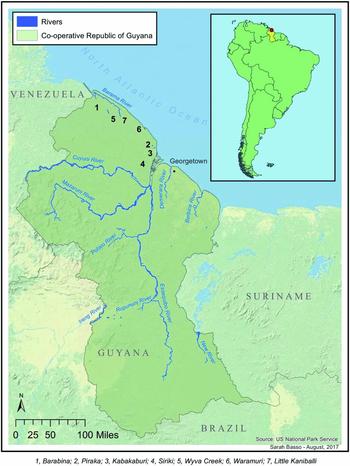
The coastal plain of northwestern Guyana is characterized by Early to Middle Holocene-age shell mounds (Figure 1). The mounds, which are accumulations of shell refuse, served as living areas and as places for burials. The landscape is covered by primary, secondary, and marsh forests. Archaeological discoveries of mounds within this area have reported assemblages of chipped and groundstone artifacts that form the basis of Evans and Meggers’ (Reference Evans and Meggers1960) description of the so-called Alaka phase, which they originally dated between 1950 and 1450 BP. Radiocarbon dates of a number of shell midden deposits nevertheless indicate pre-ceramic occupations as early as ca. 7500 BP (Plew and Daggers Reference Plew and Daggers2016). Some mounds, including Barabina (Williams Reference Williams1981) and Kabakaburi (Plew et al. Reference Plew, Pereira and Simon2007), contain early ceramic remains—the former being the focus of a debate regarding the earliest presence of pottery in northwestern Guyana (Roosevelt Reference Roosevelt1997; Williams Reference Williams1996). Although shell mounds are not found in adjacent Suriname and French Guiana, they are common in the south Caribbean, where beginning around 6000 BP the Banwari Trace and El Conchero shell midden occupations represent a regional Archaic pattern similar to that of Alaka phase sites but different in assemblage variation (Boomert Reference Boomert2000:54–56). In general, Banwary Trace assemblages contain many more specialized tools. To the east, at Taperinha and Pedra Pintada, Mina phase pottery has been dated at 7090 BP and 7580 BP, respectively. Early and Middle Holocene Age non-ceramic-bearing shell mounds have recently been identified in lowland Bolivia (Lombardo et al. Reference Lombardo, Sazbo, Caprilles, May, Amelung, Hutterer, Lehndorff, Plotzki and Veit2013).
Map showing general location shell mound sites mentioned in text: 1- Barabina, 2- Piraka, 3- Kabakaburi, 4- Siriki, 5- Wyva Creek, 6- Waramuri, 7- Little Kaniballi.

The Holocene shell deposits examined in this study are located on the coastal plain within the Northwestern district of Guyana. The area is believed to have been occupied by the prehistoric Warrau people, who exploited marine resources and left behind an extensive shell midden complex with ages ranging between 7500 BP and 260 BP. The coastal littoral is characterized by vast rivers, creeks and tributaries, swamps and marsh forests. Coastal pollen data analysis shows that the vegetation of the period consisted predominantly of mangroves, palms, and open grass vegetation (Van der Hammen Reference Van der Hammen and Prance1982). Williams (Reference Williams2003) argues that fluctuating environmental conditions of the Late Pleistocene-Early Holocene resulted in periods of instability and shifting resource emphases. Different species associated with marine and brackish waters were exploited with sea level rises that occurred between 7200 and 6000 BP. Additional diet breadth shifts were associated with the emergence of mangrove swamps between 6000 and 4000 BP. Although Early Holocene sea levels would have varied due to differences in precipitation and temperature, Van der Hammen (Reference Van der Hammen1963) suggests that Late Alleröd interstadial sea levels rose as much as 36 m above the modern land surface in the Demerara River Valley. Rull (Reference Rull1999) nonetheless suggests that post-glacial/Holocene sea levels vary greatly from one location to another. It appears that sea level oscillations during the past 6,000 years may have varied little more than 3 m in many locations (Fairbridge Reference Fairbridge1976). In this regard, Early Holocene sea levels along the Guyana coast most probably varied according to local terrain features, which in turn would have influenced settlement and resource availability. Acknowledging these fluctuations and their influence upon local patterns, Plew (Reference Plew, Whitehead and Aleman2010:35) argues that periods of environmental change should not be seen as reflecting instability but rather as events resulting in an ever-increasing range of potential adaptive responses.
The stratigraphy of shell mounds demonstrates alternating layers of shell refuse from different species of mollusks, including the small striped snail, clams, and oysters; and crab and fish remains, intermixed with clayey lateritic soil. The remains of peccary, agouti, turtle, large birds, and cayman have also been reported (Plew Reference Plew2016; Plew and Daggers Reference Plew and Daggers2016; Williams Reference Williams2003). Subsistence appears to have relied heavily upon mollusk exploitation associated with relatively brackish environs (Jansma Reference Jansma1981; Williams Reference Williams1981:16, 30–32). Williams's (Reference Williams1981, Reference Williams2003) excavations have produced evidence of features including hearths, postmolds, and several storage pits measuring 30–40 cm in diameter and extending to 40–50 cm in depth. Similar features have also been noted at Kabakaburi (Plew et al. Reference Plew, Pereira and Simon2007) and Siriki (Plew and Daggers Reference Plew and Daggers2016; Plew et al. Reference Plew, Willson and Daggers2012).
Radiocarbon dates have been obtained for nine shell mounds. The dates establish a general temporal range of between 7500 BP and 2600 BP—the more recent dates from the upper levels of Hosororo Creek (2660 ± 45 BP, SI-6636, Williams Reference Williams2003) and the earliest from Piraka, (7545 BP, Beta-449110) together with the earliest ones occurring at Barabina, where a radiocarbon date of 6885 ± 85 BP has been reported. An additional early date was obtained from carbon collected from the Wyva Creek shell mound near the Barima River. Wyva Creek returned a conventional radiocarbon age of 6340 ± 50 BP (Beta-264970, Plew and Willson Reference Plew and Willson2009). A recently obtained date for Little Kaniballi dates its occupation to 6340 ± 30 BP (7320-7245 cal BP; Beta-449111; Daggers and Plew Reference Daggers and Plew2017). Other Middle Holocene dates in the range of 5965 ± 50 BP (Barabina) to 5710 ± 80 BP (Koriabo) are not common, suggesting that there may be a more limited shell mound occupation in this time frame, although the sample size is too small to provide a level of confidence. In contrast, some mounds were occupied between c. 4000 and c. 2600 BP. The most recent dates are from Hobodiah at 139 ± 60 (Beta-109244) and Siriki at 270 ± 30 BP.
Isotope Analyses as a Source of Assessing Dietary and Environmental Change
Bone and tooth enamel are composed of hydroxyapatite (Ca5 (PO4)3OH) with a carbonate (CO3) substitution in either the PO4 and OH sites (Elliot Reference Elliott2002). In this study, we analyzed the (CO3) component in human bone and tooth enamel samples for δ13C and δ18O values. The carbon isotopic compositions of δ13C of mammalian bones and teeth record dietary δ13C values, with a fixed fractionation factor of ~13‰ in primates (Cerling et al. Reference Cerling, Hart and Hart2004; Sandberg et al. Reference Sandberg, Loudon and Sponheimer2012). In enamel, there is limited fractionation in δ13C composition with increasing trophic level (i.e., through carnivores and omnivores higher in the food chain, see Lee-Thorp and Sponheimer [Reference Lee-Thorp and Sponheimer2006]). Therefore, the δ13C of animal tissue preserves the δ13C value of the vegetation at the base of the food chain (Janssen et al. Reference Janssen, Joordens, Koutamanis, Puspaningrum, de Vos, van der Lubbe, Reijmer, Hampe and Vonhof2016). The majority of global vegetation (>90%) uses the C3 photosynthetic pathway, whereas the remainder is split between the C4 and CAM (Crassulacean acid metabolism) pathways—both adaptations to hot, arid environments through increased water use efficiency and reduced photorespiration (Ehleringer and Monson Reference Ehleringer and Monson1993; Ehleringer et al. Reference Ehleringer, Phillips and Comstock1992; Kohn Reference Kohn2010). C3 plants have a mean δ13C value of -27‰ (range -22‰ to -35‰; Kohn Reference Kohn2010), whereas C4 plants have a mean δ13C value of -13‰ (range -9‰ to -19‰). CAM plants have a range of value but typically fall closer to the C4 range; nevertheless, CAM plants (e.g., succulents, orchids) rarely contribute to human diets and therefore are not considered as a food source in this study. The δ13C values of C3 plants can be further influenced by environmental factors; water stress results in higher δ13C values, and a closed canopy environment shifts δ13C to very low values (Janssen et al. Reference Janssen, Joordens, Koutamanis, Puspaningrum, de Vos, van der Lubbe, Reijmer, Hampe and Vonhof2016; Kohn Reference Kohn2010; Van der Merwe and Medina Reference Van der Merwe and Medina1991). More positive δ13C values in vegetation and animal tissues may indicate a habitat with more open vegetation. Thus, differences in the δ13C value recorded in animal bone and tooth enamel allow detection of changing vegetation patterns (C3 vs C4 plants; closed vs. open canopy structure) that can be interpreted as paleodietary and paleoenvironmental proxies in archeological specimens. Furthermore, paleoclimate inferences can be made by applying a mean annual precipitation model to δ13C values (Kohn Reference Kohn2010); nevertheless, these calculations have mainly been done on herbivore tooth specimens—omnivory and any component of artificial irrigation incorporated into the dietary δ13C would potentially undermine model output. It remains important to note that fossil fuel combustion since the late 19th century has decreased the δ13C value of atmospheric CO2 by ~ 1.5‰ (Indermühle et al. Reference Indermühle, Stocker, Joos, Fischer, Smith, Wahlen, Deck, Mastroianni, Tschumi, Blunier, Meyer and Stauffer1999).
The oxygen isotope composition of mammalian tooth enamel and bone hydroxyapatite carbonate is directly linked to the δ18O values of body water, reflecting food and drinking water, which are in turn a complex function of habitat, climate, and diet (Clementz and Koch Reference Clementz and Koch2001; Janssen et al. Reference Janssen, Joordens, Koutamanis, Puspaningrum, de Vos, van der Lubbe, Reijmer, Hampe and Vonhof2016; Kohn et al. Reference Kohn, Schoeninger and Valley1996; Lüdecke et al. Reference Lüdecke, Mulch, Kullmer, Sandrock, Theimeyer, Fiebig and Schrenk2016). The δ18O value of rainwater decreases with increasing distance from moisture source, increasing altitude, decreasing temperature, and intensity of precipitation (Dansgaard Reference Dansgaard1964). In arid environments, surface waters and leaf water δ18O values increase with evaporation (Gonfiantini et al. Reference Gonfiantini, Gratziu and Tongiori1965), and under similar conditions, C4 plants have higher δ18O values than C3 vegetation (Helliker and Ehleringer Reference Helliker and Ehleringer2000; Sternberg Reference Sternberg, Rundel, Ehleringer and Nagy1989). Fossil tooth enamel and bone δ18O values represent the interplay of environmental parameters and diet composition influence on body water composition. For mammals, there is a constant offset (~26‰) between the δ18O of body water and the CO3 component of bioapatite (Bryant et al. Reference Bryant, Koch, Froelich, Showers and Genna1996; Kohn and Cerling Reference Kohn, Cerling, Kohn, Rakovan and Hughes2002; Lüdecke et al. Reference Lüdecke, Mulch, Kullmer, Sandrock, Theimeyer, Fiebig and Schrenk2016).
Methods
Geographical and dietary baseline data for this project used both animal proxies and contemporary plant materials. Oxygen and carbon stable isotope compositions were collected from tooth enamel and bone samples from seven sites. Baseline data were collected for Barabina, Kabakaburi, Piraka, and Waramuri mounds from the excavations of Denis Williams during the 1980s, and from more recent samples from the excavations of Little Kaniballi (Daggers Reference Daggers2017), Siriki (Plew et al. Reference Plew, Willson and Daggers2012) and Wyva Creek (Plew and Wilson Reference Plew and Willson2009). All collections were stored at the Walter Roth Museum of Anthropology.
Surficial material was removed manually from specimens with a carbide burr followed by an ethanol rinse prior to sampling. Bioapatite samples were then hand-milled using a Dremel® rotary tool equipped with a 0.5-mm carbide dental drill bit. Approximately 8 mg of enamel or bone powder were pretreated using the approach of Koch et al. (Reference Koch, Tuross and Fogel1997). Residual organics were oxidized overnight using 30% hydrogen peroxide. Twelve hours later, the hydrogen peroxide was decanted, and powders were rinsed twice with deionized water. Powders were then treated with a 1.0 M Ca-acetate/acetic acid buffer overnight to remove labile carbonates. Following this pretreatment procedure, samples were rinsed three times with deionized water and dried in a vacuum oven at 40 °C.
The CO3 component of powdered enamel and bone samples was analyzed by digestion in phosphoric acid using a Thermo Delta V Plus continuous-flow isotope ratio mass spectrometer coupled with a Thermo GasBench II. All carbonate isotopic compositions were standardized to Pee Dee Belemnite (PDB), using NBS-18 and NBS-19 calcite standards; oxygen isotopic compositions were then normalized to Vienna Standard Mean Ocean Water (VSMOW). Analytical reproducibility for the dataset was ± 0.20‰ and ± 0.25‰ for δ13C and δ18O respectively, based on NBS 18 and 19 (n = 14). All isotope data are reported in standard delta (δ) notation. Statistical analyses were completed using R - v. 3.3.2. One-way ANOVA was used to compare pooled bone and tooth data between localities. Post hoc students’ T-tests corrected for multiple comparisons isolated significant differences at the p < 0.05 level.
Sample Selection
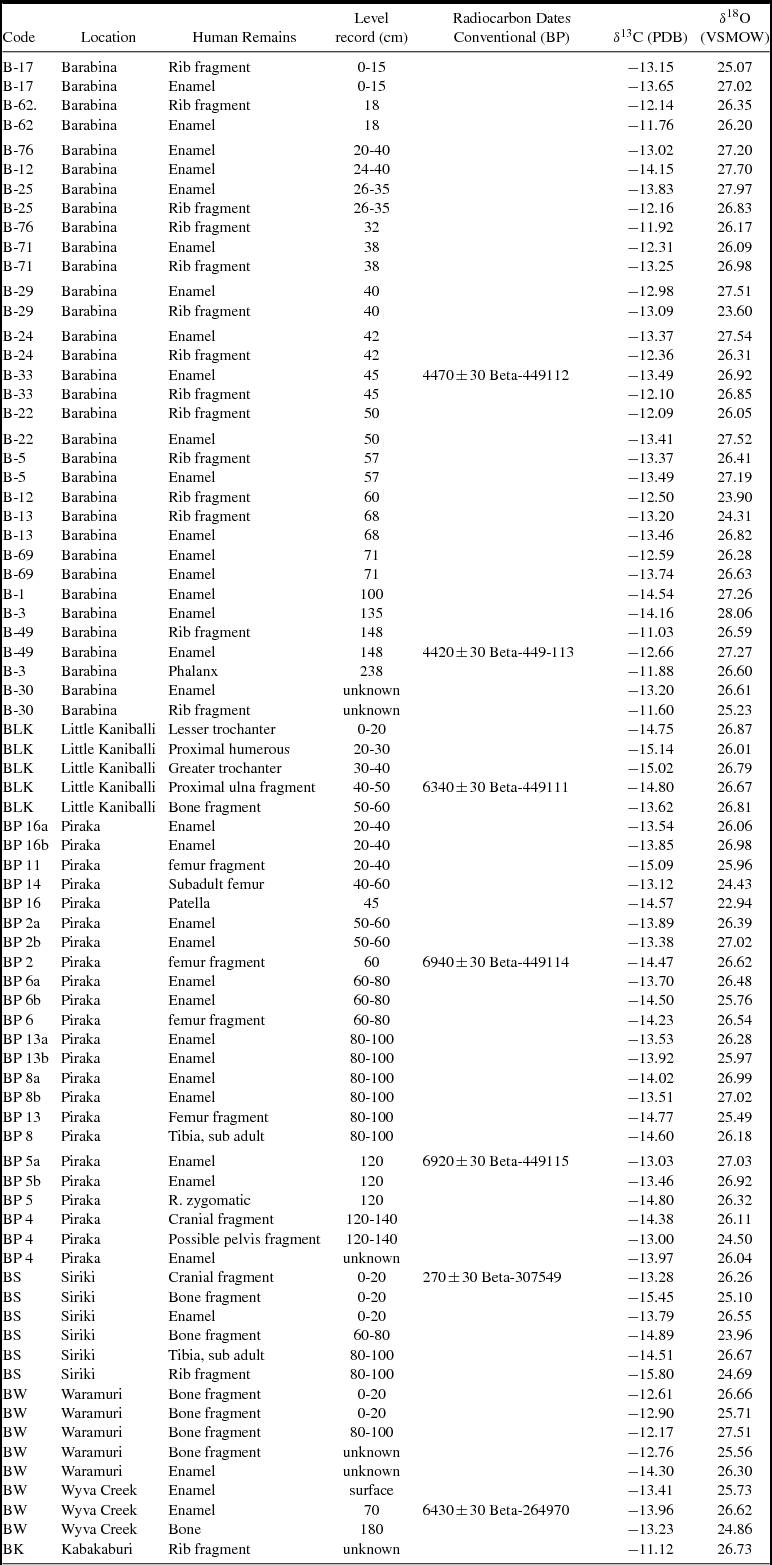
Differences in the quantity and condition of bone from the mound sites served to define sample size. During the selection process, bones displaying evidence of pathologies were avoided (Olsen et al. Reference Olsen, White, Longstaffe, von Heyking, McGlynn, Grupe and Rühli2014). Eighty-one samples of human bone and teeth were analyzed in this study, although four lacked exact stratigraphic provenance (Table 1). Owing to considerable differences in past recovery processes, many collections are incomplete. Given this, we used remains that were available from early excavations. In the case of Barabina, we used rib fragments that had been retained in the collection. In other assemblages, long bone fragments were sampled. A significant percent of the collections analyzed was degraded, which resulted in poor collagen preservation. As a result, we were not able to conduct nitrogen analysis. Only a few samples were taken from stratigraphic units that had been radiocarbon dated. In this regard, we were cognizant of the problem of sampling elements from the same individuals. Although we cannot say with certainty that all samples come from separate individuals, we believe that most are. For better control of this problem, we relied on detailed descriptions of stratigraphic positioning of skeletal remains (Williams Reference Williams1981) and distinct locations of burials within mounds (Plew et al. Reference Plew, Willson and Daggers2012). The samples document an age range from infants to 30 years of age (Figure 2).
Frequency Distribution of Sample by Site and Human Remains, Associated Stratigraphic Levels, Radiocarbon Dates and δ13C and δ18O Results.

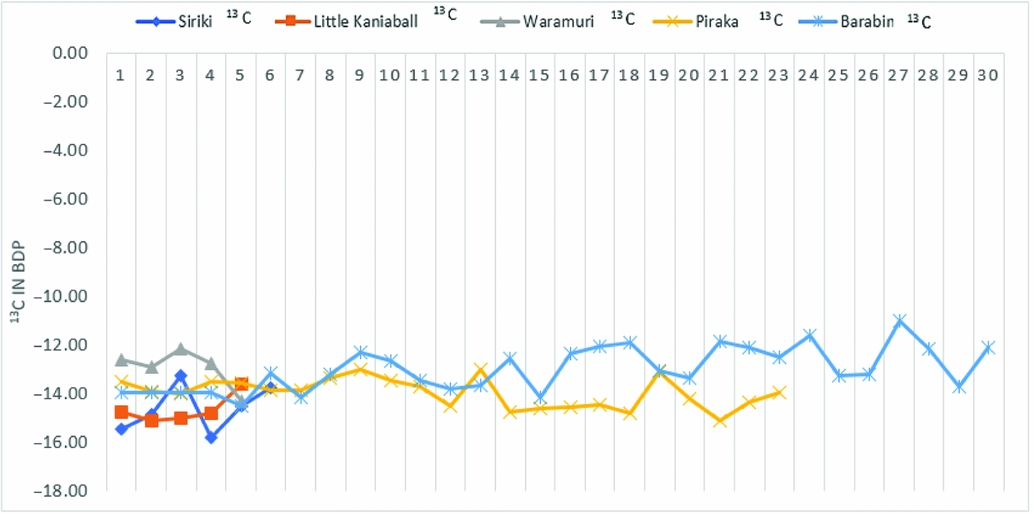
δ13C values (range) for each locality showing age variations from youngest to oldest.
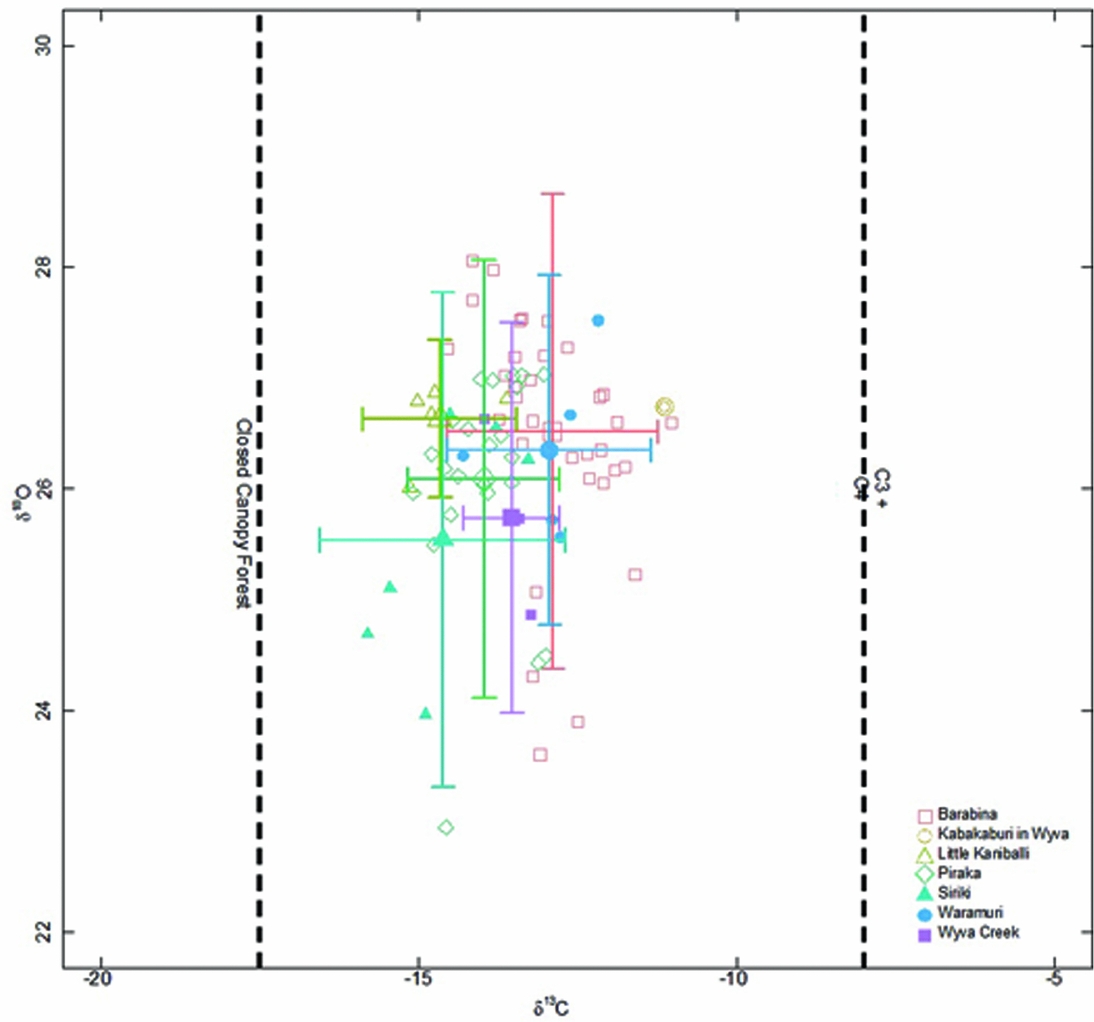
Values of δ13C and δ18O for each locality. Larger circles represent site mean values with two error bars. Vertical dashed lines indicate cutoff for closed canopy forests resources (Kohn Reference Kohn2010) and mixed C3-C4 resources.

In addition to bone and teeth samples from the midden sites, contemporary samples (C3, C4 and cam, n = 27) were collected for δ13C analysis. Carbon isotope compositions were used as a primary proxy of diet and of the Archaic shell mound populations, whereas oxygen isotope compositions provided a basis for assessing environmental changes.
Results
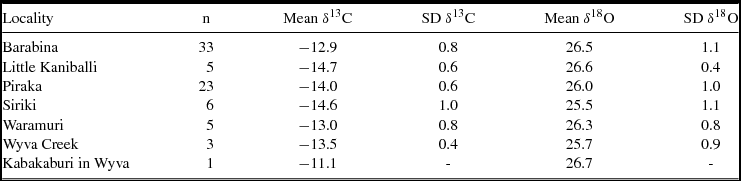
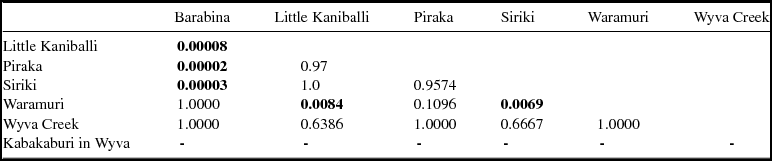
We analyzed 81 samples from seven sites—Barabina, Little Kaniballi, Kabakaburi, Piraka, Siriki, Waramuri, and Wyva Creek (Table 1). Although some studies have shown offsets between bone and tooth enamel isotopic compositions within individuals (Warinner and Tuross Reference Warinner and Tuross2009; Webb et al. Reference Webb, White and Longstaffe2014), our analysis showed no difference between bone and tooth enamel datasets. Oxygen isotope values range from 25.7‰ to 26.7‰ and show no significant differences between localities (ANOVA, p = 0.2274). Carbon isotope values range from -14.7‰ to -11.1‰ and show significant differences between localities (ANOVA, p = 0.001). Pairwise comparisons (t-test, Bonferroni correction) are reported in Table 2.
Descriptive Statistics for Enamel and Bone Stable Isotope Compositions.

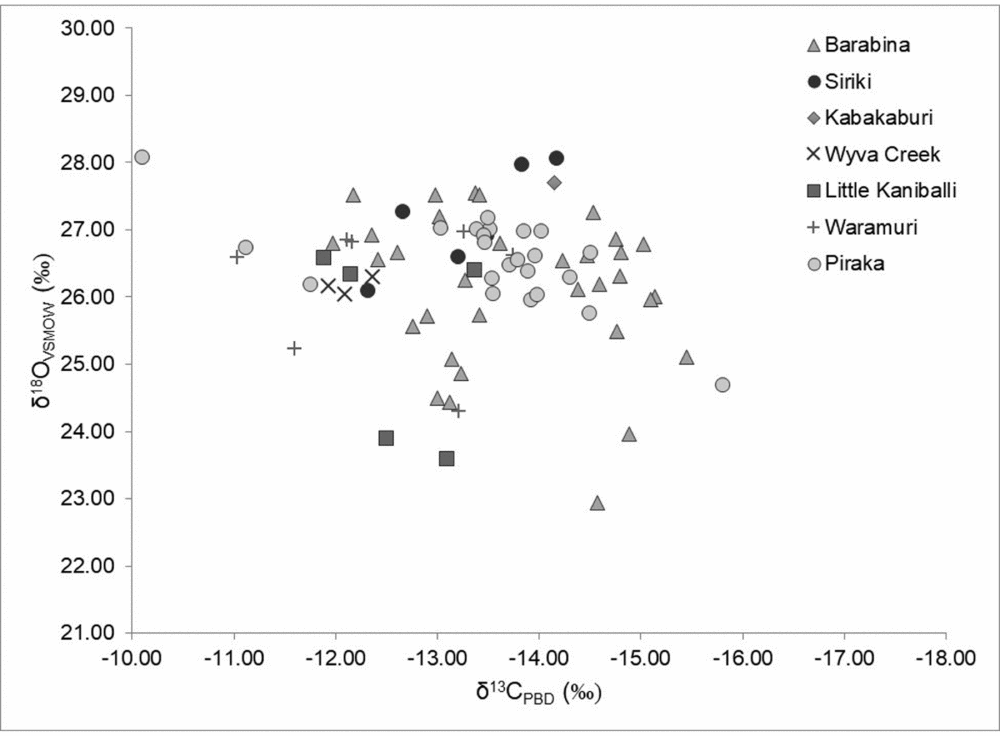
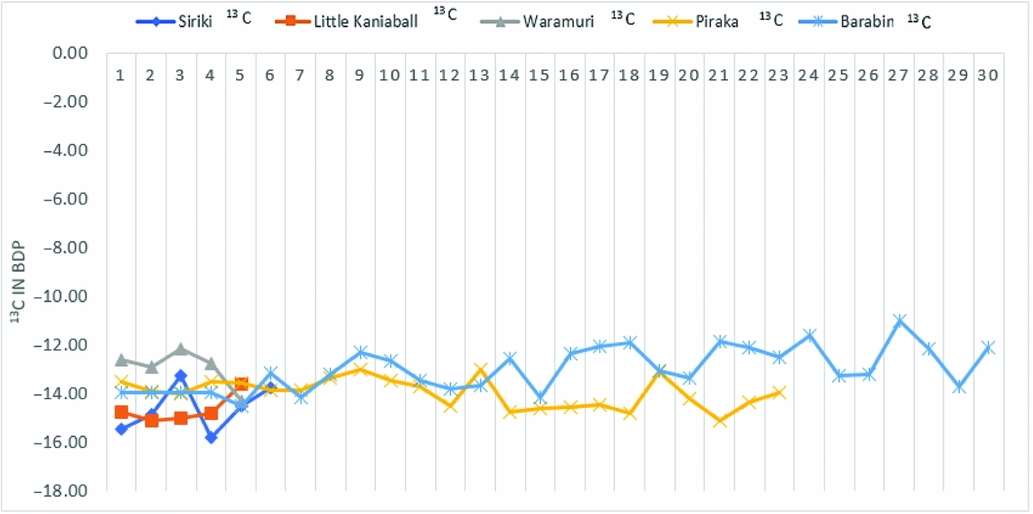
The δ13C values from all samples fall within the range indicative of C3 plant resource use in an open canopy environment (Kohn Reference Kohn2010). This conclusion is supported by carbon isotopic analyses of modern examples of local plants, dominantly C3 photosynthesizing (Table 3). Plant δ13C values measured here are consistent with the findings of Guehl and colleagues (Reference Guehl, Domenach, Bereau, Barigah, Casabianca, Ferhi and Garbaye1998) for regional vegetation in Guyana (Figure 3). A diet correction, incorporating the fractionation from diet to bioapatite, and an offset to account for modern decreases in atmospheric δ13C (13‰ + 1.5‰), were applied to the plant δ13C compositions (Table 3). Diet-corrected δ13C values based on the local plant isotopic compositions are consistent with the bone and tooth enamel sample compositions shown, supporting the conclusion that the diet of the populations sampled was dominated by C3 vegetation (Guehl et al. Reference Guehl, Domenach, Bereau, Barigah, Casabianca, Ferhi and Garbaye1998; Supplemental Table 1).
Statistical Comparisons of δ13C Values. Bold p-Values Indicate Significant Differences. For Localities Where n = 1, Minus Signs (−) Indicate the Data Fell Beyond 2σ of the Mean for Modern Samples

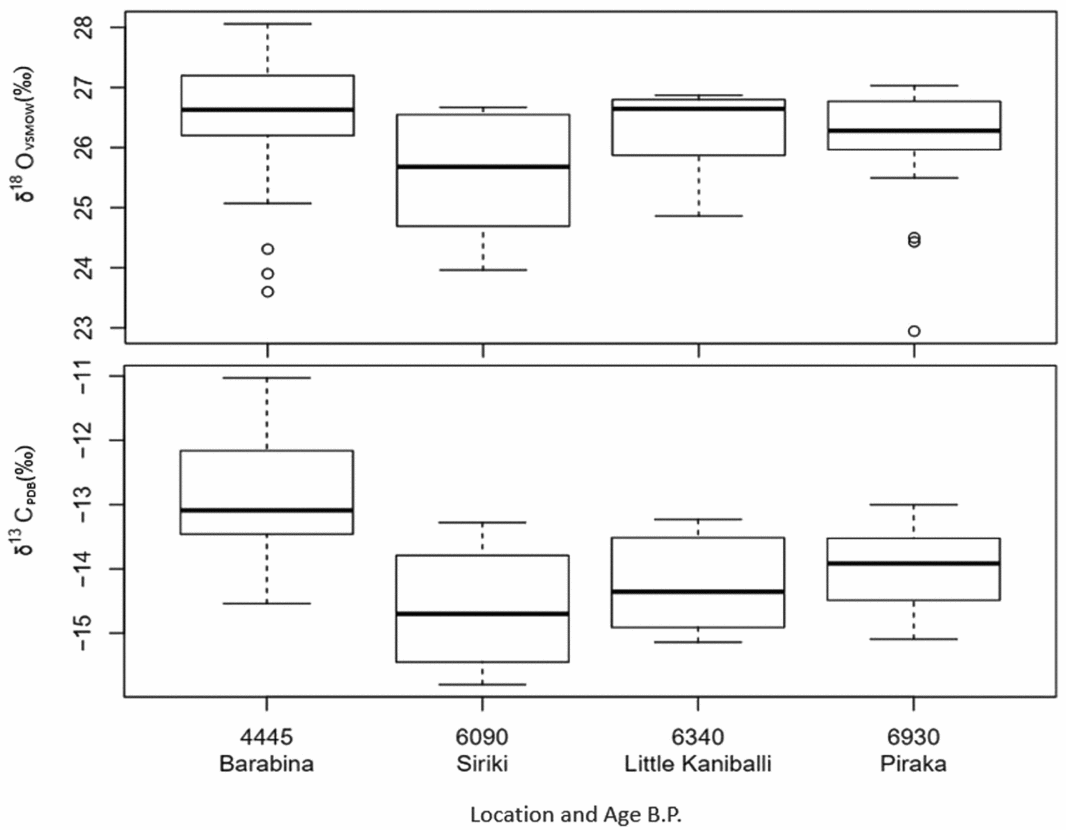
Locations with 14C dates are shown by age in Figure 4. The uniformity over time and between locations in bone and tooth enamel δ18O compositions suggests that isotopically similar drinking water sources were accessed at all sites, and that other variables known to influence oxygen isotopic compositions in surface water (precipitation sources, temperature, evaporative enrichment) were similar across all sites through time. The time span represented by the majority of the dated material from these locations falls within a period referred to as the Holocene climatic optimum (HCO), which is characterized by a climatic warming spanning 8000–5000 years BP. Temperature increases of up to 4˚C at the poles and decreases to 1˚C at the equator have been inferred from ice-core datasets and global climate models (Dahl-Jensen et al. Reference Dahl-Jensen, Mosegaard, Gundestrup, Clow, Johnsen, Hansen and Balling1998; Gagan et al. Reference Gagan, Ayliffe, Hopley, Cali, Mortimer, Chappell and McCulloch1998; Koshkarova and Koshkarov Reference Koshkarova and Koshkarov2004; Mayle et al. Reference Mayle, Beerling, Gosling and Bush2004). This warm period may have influenced the carbon isotopic values recorded in bone and tooth enamel.
Values of δ18O and δ13C in tooth enamel and bone from four localities in coastal Guyana.

Mayle and others (Reference Mayle, Beerling, Gosling and Bush2004) extend the period of warming in Amazonia to 8000–3600 years BP, spanning the full chronology potentially represented by the present study. Areas of the northern Amazon may have had reduced precipitation during this time period, leading to shifts toward more drought-tolerant dry forest taxa and savannahs in ecotonal areas (Mayle et al. Reference Mayle, Beerling, Gosling and Bush2004). The Barabina site is the recent dated location falling at the end of the HCO. It had significantly higher δ13C compositions in comparison with the older Little Kaniballi, Siriki, and Piraka sites. The 1–2‰ increase in δ13C values at Barabina does not seem significant enough to represent a shift toward C4 diet inputs; it may be the result of a drier environment under water stress after prolonged warming.
In this regard, δ 18O fails to identify climate change unless all factors are known, but it is useful in reflecting the state of climate and surface temperature. Pooled bone and teeth data shown in Figure 5 show no statistical differences (ANOVA, p = 0.2274). Fricke and others (Reference Fricke, O'Neil and Niels1995) posit that the δ18O composition of the body water is a reflection of the water consumed, as a result of which climate and surface water temperature can be deduced. The δ18O samples from Barabina suggest variations in temperatures that may indicate intense rainfall and warming during this period. A warmer trend is evident in samples for the early Holocene, including Little Kaniballi, Wyva, Piraka, and Siriki (Figure 5).
δ18O and δ13C variations across sample populations.

Diet Breadth
The apatite-collagen model suggests that populations in the Northwest became increasingly reliant on C3-based resources and C3-fed fauna. In this regard, Williams (Reference Williams2003) has argued that the later Holocene sees increasing use of multiple resources, including those of niche resources, specifically starchy plants (Plew et al. Reference Plew, Willson and Daggers2012). This is further supported by the appearance of mangrove fringes and forest along the coast during the Holocene, which provided favorable habitat for both marine resources and terrestrial fauna (Van der Hammen and Wijmstra Reference Van der Hammen and Wijmstra1964). The δ13C values are consistent with an open landscape such as palm forest in the Amazon region. The population who are believed to be small, highly mobile groups would have adopted a coastal hunter-gatherer strategy, in which residential base camps were established with the seasonal use of shell midden sites, which to an extent supports William's (Reference Williams2003) arguments regarding shifting resource use.
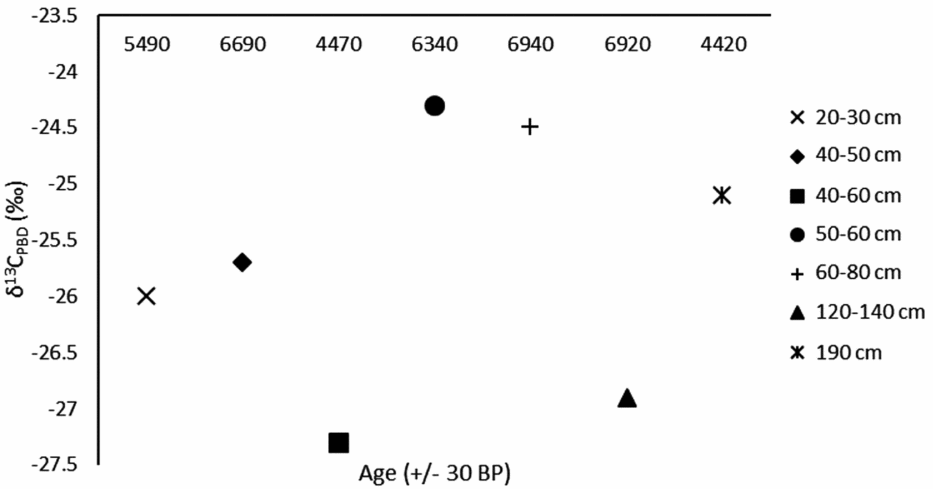
The δ13C values of the sediments transported and accumulated on four sites—Wyva, Siriki, Piraka, and Barabina— show varying levels of depletion and enrichment by depth and age. These values, which range between −24.3 and 27.3 ‰ (Figure 6), suggest that sediments moved to these locations were taken from an environment dominated by C3 plants. This indicates the depletion of δ13C approaching the Mid-Holocene; within our data set this is evident at Siriki 5490 ± 30 BP and at the Barabina site 4470 ± 30 BP. This is further supported by Hammond and colleagues’ (Reference Hammond, ter Steege and van der Borg2006) study of soil charcoal in the wet tropical forest of Guyana, where data indicates a series of forest fires during the Holocene with δ13C values ranging between -29.4 and -25.4 ‰; this suggests charcoal formation from C3 plants, typifying modern tropical forest habitat.
δ13C values compared against radiocarbon dates (14C) of different levels of sediment by depth from four localities.

The δ13C range of the human samples, while implying the consumption of C3 plants, also indicates that these populations used resources from an open canopy environment. This is supported by Van der Hammen (Reference Van der Hammen and Prance1982), who reports a series of dry periods in the central Amazon basin and South America during the early and Mid-Holocene. In this regard, Ledru (Reference Ledru1993) suggests vegetation changes and forest retreat associated with dry climatic conditions between 11,000 and 4500 BP, resulting in forest fires (Pessenda et al. Reference Pessenda, Aravena, Melfi, Telles, Boulet, Valencia and Tomazzello1996), and possibly anthropogenic fires to some degree, which would have influenced the vegetation cover, as suggested by Tardy (Reference Tardy1998) in French Guiana. The influence of prehistoric populations on fires is arguable but possible because human ignition of combustible dry forest may have been one means of controlling forest resources during the Holocene (Hammond et al. Reference Hammond, ter Steege and van der Borg2006; Mayle and Power Reference Mayle and Power2008; Tardy Reference Tardy1998). Nevertheless, in the absence of charcoal samples from the study area, conclusions regarding anthropogenic fires are not possible. Notably, Iriarte and others (Reference Iriarte, Power, Rostain, Mayle, Jones, Watling, Whitney and McKey2012) suggest fire-free land use in pre-1492 Amazonian savannas. Regardless, the fluctuating climatic conditions of the Amazon and Guyana are further supported by the δ18O data. The data suggest a period of greater warming in the early Holocene, reflected in the δ18O values from Piraka range of 28–26 ‰, the Wyva sample range between 26–27 ‰, and the Siriki sample range 26–28 ‰, though δ18O is observed at Little Kanaballi, and a steady depletion in δ18O as seen at Barabina in the Mid- Holocene. This may indicate climate fluctuation and possible stabilization resulting in more favorable temperatures.
Conclusion
This study has used the results of isotopic analyses of human and other faunal remains to assess environmental changes in northwestern Guyana during the Early to Late Archaic period. Using δ 13C and δ 18O data, we have demonstrated some degree of constancy in the availability of C3 plants during the past several thousand years, though we note an increasing reliance on such plants beginning in the Early Holocene. We also document warming intervals during the Early Holocene (Early Archaic), which appear to correlate with dry periods known elsewhere in the central Amazon during this period. Although our data support long-term perpetuation of what may be thought of as relatively modern forest conditions, we conclude that in at least the Early Holocene there may have been more open canopy—a condition that may well have seen prehistoric peoples moving to a range of seasonally available resources. In sum, we believe that over time, what we know as the modern environment may have remained relatively unchanged, with the minor exception of drying conditions of the Early Holocene, which may have seen increased residential mobility.
Acknowledgments
This project was funded by the University of Guyana Science and Technology Support Project. We greatly appreciate the very useful comments of three anonymous reviewers.
Data Availability Statement
Data and materials used and or generated in this study are available through the Amerindian Research Unit, University of Guyana, the Walter Roth Museum of Anthropology, and the Department of Geosciences, Boise State University.
Supplemental Materials
For supplementary material accompanying this paper, visit https://doi.org/10.1017/laq.2017.87.
Supplemental Table 1. Isotopic Analyses of Modern Plant Taxa with a Diet Correction to Illustrate Potential Values in Associated Bone and Tooth Enamel.