

Introduction
The dairy production systems in Northern Spain used to be based on the use of grass for grazing or mowing regimes. Today, many of these dairy farms have evolved into more intensive models, replacing fresh grass with silage and with greater intakes of concentrates, fertilizers, livestock restocking and increased fossil fuels usage. This scenario creates a surplus of N higher than in traditional systems, increasing eutrophication and terrestrial acidification (Salcedo, Reference Salcedo2011a). However, efficiency expressed, for example, as kg milk/kg dry matter (DM); CH4/kg milk or kg N/kg N recovered in milk, is lower in extensive systems, which are considered more environmentally sustainable. Given the complexity of the interactions between management, efficiency, economy and mitigation of greenhouse gases in current dairy systems, it is very difficult for the dairy farmer to evaluate all these factors on farm. Therefore it is of great interest to have tools that may be used to support decision making in managing livestock, plants and land. Their main contribution is the differentiation between production systems (grazing, extensive and intensive) and food management.
Model description
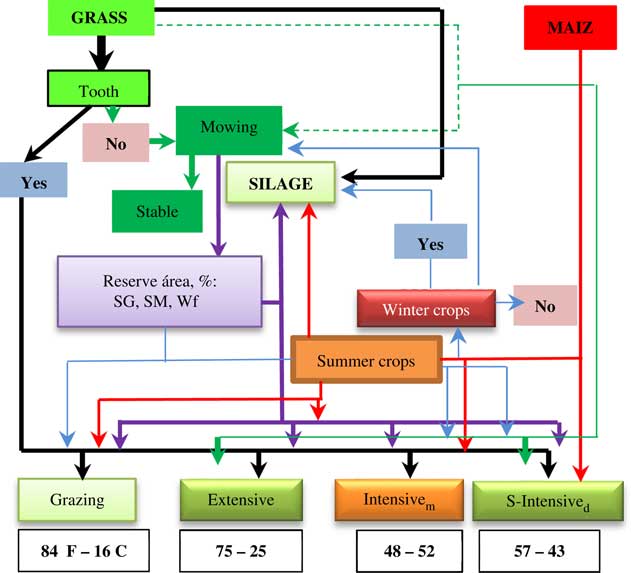
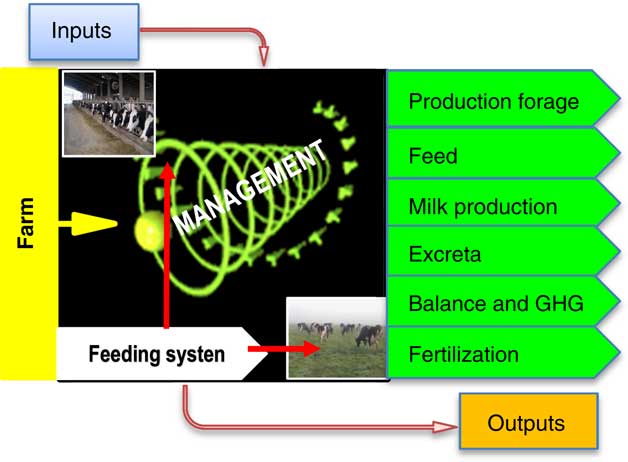
‘DairyCant’ is an empirical model based on research and statistical analysis that simulates management aspects related to milk production and environmental health on dairy farms. The experimental field work was performed in the Milk Production Unit of CIFP ‘La Granja’ Cantabria under an experimental grazing regime (Salcedo, Reference Salcedo2006) and on intensive commercial farms (Salcedo, Reference Salcedo2011a). Mathematical models of experimental grazing (Pasexp) developed at the scale of month and hectare were extrapolated to extensive systems (Ex) from basic inputs such as area, animal numbers, subscriber fee, energy, food, climate and soil, derived from INIA projects RTA2006-00132-CO2-1 and 2012-0006512-05. Intensive farms were subdivided into those that offer mixed feeding (Intm) or separate food (SIntd), derived from the Ministry of Environment of the Government of Cantabria 05-640-02.2174 project. Thus, DairyCant groups four dairy production systems based on feeding regime (Figure 1). Management is considered as the effect that guides the inputs and outputs of the operation (Figure 2).
Forage/dairy systems in Cantabria.

Conceptual model.

The outputs are obtained by multiple linear regression analysis, making a diagnosis of collinearity of the independent variables using the variance inflation factor, assuming a lower cutoff to 10. These are grouped into simulation modules: (i) production of forage and grazing management; (ii) food; (iii) production and chemical composition of the milk; (iv) excretion; (v) balance of nutrients and emission of greenhouse gases; and vi) fertilization.
Grass production in Ex (including the reserve for silage) and cow DM intake per day are estimated from climatic variables: solar radiation, temperature, rainfall, evapotranspiration, pasture height, stocking density, number of grazing days, fertilization and supplementation. DairyCant estimated the increased number of grazing days when cows receive extra supplementation of maize silage or winter forage crops, aside from the pasture area. A production of 7.5 tonnes DM/ha in pasture in intensive (Salcedo, Reference Salcedo2006) is estimated, of which 100% is given as silage in Intm and 60% in SIntd, the remaining 40% being given as green forage. The production of maize for silage is estimated from the contribution of nitrogen fertilizer (kg N/ha), N concentration in g/kg DM and days of culture at time of harvest. Forage crops production is estimated at 6 tonnes DM/ha for Italian ryegrass (Salcedo, Reference Salcedo2011a) and 6 to 8 tonnes winter cereals, with or without legumes (Salcedo, Reference Salcedo2011b).
The nutritional requirements of cows are estimated from NRC (2001) and CNCPS (6.0) data considering milk production, days in milk, BW, percentage of fat and protein. Ingestion of pasture in the Ex is estimated from the grass on offer, grazing days and concentrate intake. The model assumes Pasexp a daily intake of 12 kg DM during the dry period of the cow. DairyCant includes a nutritional evaluation of forages and concentrates derived from the Spanish Foundation for the Development of Animal Nutrition. The DairyCant Ext systems calculate the amounts of grass silage or maize that may be supplemented during the grazing season (March to November).
The potential milk production, corrected for fat content, is evaluated at the cow level and ha/month during grazing. The milk quality parameters are expressed as fatty acid (Coppa et al., Reference Coppa, Ferlay, Chassaing, Agabriel, Glasser, Chilliard, Borreani, Barcarolo, Baars, Kusche, Harstad, Verbič, Golecký and Martin2013), fat, protein, urea concentration in the milk, based on the diet components for the flock. The energy cost represented by the excess of urea and its equivalent in litres is also estimated. Other aspects such as the efficiency of utilization of N and P and gross efficiency (kg milk/kg DM intake) are also included in the outputs.
Manure production is calculated from the DM and nutrient intake, while urine is measured from the consumption of CP (Salcedo, Reference Salcedo2006) and the P in droppings (Salcedo, Reference Salcedo2007). The excretion of N and P per hectare, the storage time of the manure and the number of times of emptying the manure pit are also estimated; used this information to calculate the fertilization.
The greenhouse gases considered are CH4, N2O and CO2. The manure CH4 (IPCC, 1997 [1996]) and enteric fermentation are estimated from the equations described by Salcedo (Reference Salcedo2012). The N2O emissions considered are divided into Direct: from the stables and dunghill (de Vries et al., Reference de Vries, Hoeksma and Groenestein2011); grazing, leaching, volatilization and biological fixation (Velthof et al., Reference Velthof, Jarvis, Stein, Allen and Oenema1996); fertilizer application (Velthof and Mosquera, Reference Velthof and Mosquera1998); contribution of manure (Schils et al., Reference Schils, Oudendag, van der Hoek, de Boer, Evers and de Haan2006); rumen (Kaspar and Tiedje, Reference Kaspar and Tiedje1981); energy (Nielsen et al., Reference Nielsen, Nielsen, Weidema, Dalgaard and Halberg2003); and crop residues (IPCC, 2006). Indirect: buying fertilizer (Kaspar and Tiedje, Reference Kaspar and Tiedje1981); purchase of fodder and concentrates (Velthof and Oenema, Reference Velthof and Oenema1997). DairyCant assumes 50, 80 and 100 l of diesel UGW and KWh 0.0562 kg−1 milk (Irimia et al., Reference Irimia, Escudro and Alavarez2012) and emission factors (Nielsen et al., Reference Nielsen, Nielsen, Weidema, Dalgaard and Halberg2003). The acidification potential as SO2-eq (Reinhardt, Reference Reinhardt1997) and the potential for eutrophication in NO3-eq (Weidema et al., Reference Weidema, Mortensen, Nielsen and Hauschild1996) are also considered.
The overall balance of soil N is estimated as the difference between inputs and outputs, according to the expression: [inputs Σ (organic+inorganic+atmospheric+symbiotic+recycling+the mechanical origin)]−[Σ outputs (NH3+NO+N2O+NO3)+extraction]. The balance of P as: [Σ inputs (organic+inorganic+recycling+the mechanical origin)]−[Σ outputs (extractions)].
Fertilization is estimated from the analysis of soil type and recycling contributions and withdrawals.
Acknowledgement
This work was supported by the Environmental Office of the Cantabria Government (Spain), Project 05-640.02-2174.
Further information
The LiveM International Livestock Modelling and Research Colloquium was hosted by the Basque Centre for Climate Change (BC3) at the Maritime Museum in Bilbao, Spain between 14 and 16 October 2014. LiveM is the livestock and grassland modelling theme of the EU knowledge hub Modelling European Agriculture with Climate Change for Food Security (MACSUR). The MACSUR project is a pilot knowledge hub started by FACCE-JPI in 2012. It provides an opportunity to explore the role and potential of multi-disciplinary networking structures to address complex regional and global issues. More information on MACSUR and the LiveM theme can be found at www.macsur.eu, with PDFs of slides from conference presentations available through the conference website (http://www.livem2014bilbao.com/).