Introduction
Herbicide resistance is a current and growing problem in the United States and around the world. Currently, there are approximately 500 unique cases of herbicide resistance worldwide (Heap Reference Heap2019). As a result, effective herbicide options are decreasing. New herbicide sites of action (SOA) are increasingly difficult to commercialize (Stubler and Strek Reference Stubler and Strek2016), necessitating adoption of integrated weed management (IWM), which relies on the use of multiple, different strategies to control weeds (Swanton and Weise Reference Swanton and Weise1991; Thill et al. Reference Thill, Lish, Callihan and Bechinski1991). Using IWM places multiple selection pressures on weeds, which reduces the likelihood that resistance will develop to any single management practice (Thill et al. Reference Thill, Lish, Callihan and Bechinski1991). One such IWM technique is harvest weed seed control (HWSC), which was pioneered in Australia in response to widespread herbicide resistance. In Australian wheat production, rigid ryegrass (Lolium rigidum Guadin) and wild radish (Raphanus raphanistrum L.) are major problems because of multiple resistance to as many as seven and four herbicide SOA, respectively.
HWSC targets weed seed at harvest, reducing soil seed-bank inputs (Walsh et al. Reference Walsh, Newman and Powles2013). Methods of HWSC include narrow windrow burning, chaff lining, chaff tramlining, chaff carts, bale direct, and seed destructors (Walsh et al. Reference Walsh, Harrington and Powles2012, Reference Walsh, Ouzman, Newman, Powles and Llewellyn2017a; Walsh and Newman Reference Walsh and Newman2007; Walsh and Powles Reference Walsh and Powles2007). Walsh et al. (Reference Walsh, Broster, Schwartz-Lazaro, Norsworthy, Davis, Tidemann, Beckie, Lyon, Soni, Neve and Bagavathiannan2018) provided an excellent explanation of these systems. Walsh et al. (Reference Walsh, Aves and Powles2017b) reported an average of 60% reduction in rigid ryegrass populations in the season after HWSC implementation, regardless of system (i.e., seed destructor, chaff cart, narrow windrow burning) used. There are few data on the efficacy of chaff lining on limiting the emergence of weeds, but preliminary data show rigid ryegrass emergence can be reduced by as much as 80% when the seed are in field residues from either wheat, barley (Hordeum vulgare L.), canola (Brassica napus L.), or lupin (Lupinus albus L.) (Condon Reference Condon2018).
In Australia, as of 2014, 43% of farmers surveyed practiced some form of HWSC. When respondents were asked about future use of the technique, 82% said they would implement some form of HWSC in their operation by 2019. The most common method of HWSC that respondents reported using is narrow windrow burning (30%) and the least used was chaff carts (3%) (Walsh et al. Reference Walsh, Ouzman, Newman, Powles and Llewellyn2017a). In U.S. cropping systems, research on the effectiveness of HWSC systems is limited. Norsworthy et al. (Reference Norsworthy, Korres, Walsh and Powles2016) reported that field residue removal and narrow windrow burning can reduce Palmer amaranth densities 37% to 90% when used with various herbicide programs. However, efficacy of HWSC systems can be variable based on Palmer amaranth density and soil seed-bank size (Norsworthy et al. Reference Norsworthy, Korres, Walsh and Powles2016; Walsh et al. Reference Walsh, Aves and Powles2017b).
The efficacy of HWSC relies on high proportions of weed seed production being retained at crop maturity. Several agronomically important weed species in U.S. and Australian cropping systems retain large proportions of their seed at crop maturity. Notably, Walsh and Powles (Reference Walsh and Powles2014) reported that rigid ryegrass retained 85% of its seed at the time of wheat harvest in Australia. It has been reported that Italian ryegrass seed retention is 58% at the time of wheat harvest in the United States (Walsh et al. Reference Walsh, Broster, Schwartz-Lazaro, Norsworthy, Davis, Tidemann, Beckie, Lyon, Soni, Neve and Bagavathiannan2018). In U.S. soybean production systems, it has been reported that Palmer amaranth and tall waterhemp [Amaranthus tuberculatus (Moq.) J.D. Sauer] retain greater than 95% and 99%, respectively, of their seed at soybean harvest (Schwartz et al. Reference Schwartz, Norsworthy, Young, Bradley, Kruger, Davis, Steckel and Walsh2016). In their 2018 publication, Walsh et al. provide a complete list of weed species with reported seed retention values in multiple cropping systems around the world. Even though these weed species retain most of their seed at crop maturity, delays in crop harvest can result in fewer weed seeds being captured, because of seed shatter: Rates of seed shatter range from 0.75 to 721 seed d−1 for giant ragweed, barnyardgrass, and Palmer amaranth, thereby reducing the efficacy of HWSC (Goplen et al. Reference Goplen, Sheaffer, Becker, Coulter, Breitenbach, Behnken, Johnson and Gunsolus2016; Schwartz-Lazaro et al. Reference Schwartz-Lazaro, Green and Norsworthy2017a). Tidemann et al. (Reference Tidemann, Hall, Harker and Alexander2016) report seed retention must be greater than 80% at crop harvest for HWSC to be effective. Seed retention of greater than 80% at crop maturity in many agronomically important weed species creates the unique opportunity to target these weed seeds to prevent their input to the weed seed bank.
Weeds such as Palmer amaranth, common ragweed, and Italian ryegrass are major problems in crops across the United States (Webster Reference Webster2012, Reference Webster2013); biotypes of these weeds are resistant to eight, four, and six SOA, respectively. In addition, there are biotypes with multiple resistance to three SOA in each of these species except Italian ryegrass, for which there is a population with multiple resistance to four SOA (Heap Reference Heap2019). These weeds, or their relatives, retain much of their seed on the plant at harvest, making them excellent candidates for HWSC.
Although HWSC systems effectively reduce weed densities in Australia, there has been limited research on the efficacy of HWSC in U.S. cropping systems. Therefore, our objective was to determine the effect of HWSC on Italian ryegrass in winter wheat and on common ragweed and Palmer amaranth in soybean.
Materials and Methods
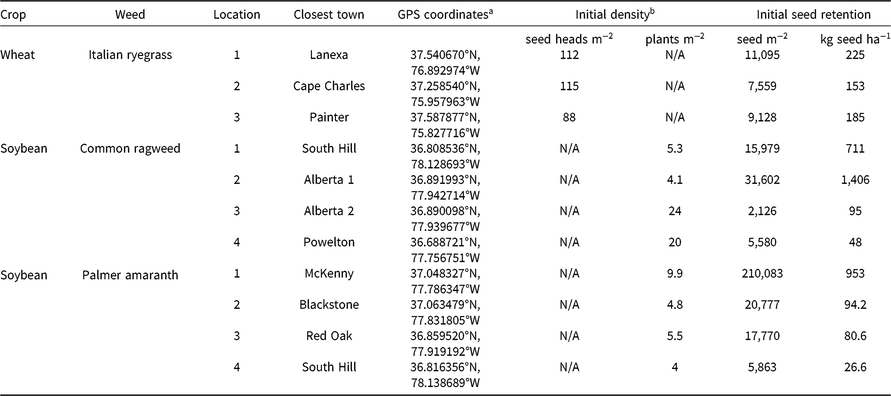
Field studies were initiated on production fields in Virginia in 2017 and continued into 2018 (Table 1). In selected fields, the dominant weed was either Italian ryegrass, common ragweed, or Palmer amaranth. Three wheat fields infested with Italian ryegrass were selected in Lanexa, Cape Charles, and Painter, VA (Table 1). The sites in West Point and Cape Charles had plots measuring 9 m by 30 m and the site in Painter had plots measuring 4.5 m by 30 m. For the Palmer amaranth and common ragweed sites, four soybean fields for each weed species were selected in Southside Virginia (1). Each soybean field had plots measuring 9 m by 30 m. At all sites, experiments were arranged as a randomized complete block design with four replications.
Study locations, including weed species, closest town, GPS coordinates, initial density, and initial seed retention at 2017 harvest.

a Abbreviations: GPS, global positioning system; N/A, not applicable.
b Initial densities were taken at crop harvest 2017.
Treatments at all locations consisted of either conventional harvest or HWSC at grain harvest in 2017. Conventional harvest was conducted with a commercial combine that returned all field residues and weed seed exiting the combine to the respective plot. The HWSC treatments were implemented using a Wintersteiger Classic plot combine (Wintersteiger AG, Ried im Innkreis, Austria) modified with a trailer, which captured all weed seeds and field residues exiting the combine. All field residues and weed seeds were then dumped outside of the field, removing them from the plot. All sites were no-tillage production, so the only soil disturbance was the planting operation. Wheat row spacing was 15 cm and soybean row spacing was 76 cm. The farmer at each location was responsible for all other management decisions and practices, including planting date, fertility, crop variety, and herbicides.
Italian Ryegrass Study
Italian ryegrass plant density counts were recorded at harvest in 2017 and then again in April 2018 (the Lanexa site was lost after data collection on April 12, 2018, before harvest, when the farmer terminated wheat to plant corn). Initial plant densities were determined by counting plants in six random, 0.25-m2 quadrats per plot immediately before harvest on June 14, 2017. The number of seed heads per quadrat was counted instead of individual plants, because of the difficulty of distinguishing large tillers from whole Italian ryegrass plants. In the subsequent production season, tillers were counted from eight random 0.25-m2 quadrats per plot on April 12, 2018. Numbers of seed heads were counted immediately before wheat harvest on June 20, 2018, as described for the 2017 harvest.
Common Ragweed and Palmer Amaranth Studies
At the common ragweed and Palmer amaranth locations, data collected included initial weed density from six random, 0.25-m2 quadrats per plot at the 2017 harvest. Common ragweed density was measured in late April to early May 2018, before preplant herbicide application in preparation for soybean planting. Density was determined by counts from eight random, 0.25-m2 quadrats per plot. Palmer amaranth density was not measured at this time, because of lack of germination across all study locations at this time of the year. Density was determined again from eight random, 0.25-m2 quadrats per plot in June or July 2018 before POST herbicide applications to control both common ragweed and Palmer amaranth. End-of-season weed density was assessed immediately before soybean harvest at all locations between October 1 and November 15, 2018. The number of subsamples ranged from eight 0.25-m2 quadrats per plot to full-plot counts and were adjusted depending on weed density to ensure an accurate census.
Across all study locations and species, the quantity of seed retained was determined at the initial (2017) and subsequent (2018) harvest, by collecting seed heads or whole weed plants from one 0.25-m2 quadrat per plot. To quantify the seed number, samples were dried, threshed, and sieved to remove large plant material. After cleaning, the entire sample was weighed. Then a 0.5-g aliquot of the sample (seed and fine chaff) was weighed and the number of seeds counted; this process was done three times per sample and the numbers of seeds were averaged. The total number of seed ha−1 was calculated on the basis of the triplicate 0.5-g aliquot average, using the following formula:
 $${\rm{Y}} = [(\{ {\rm{A}} \times {\rm{B}}\} /{\rm{C}}) \times {\rm{D}}] \times 10,000$$
([1])
where Y is the number of seeds ha−1; A is the average number of seed g−1; B is the total seed and fine chaff sample weight (in grams); C is the number of seed heads for Italian ryegrass or plants for common ragweed and Palmer amaranth from which the seeds were collected; D is the average seed head or plant density m−2 determined within each plot; and 10,000 is a conversion factor for m2 to ha. For Palmer amaranth, the number of plants was divided by 2 to account for an assumed 1:1 male-to-female ratio (Rottenberg Reference Rottenberg1998). To determine the weight of seed ha−1, an estimate of 493,835 seed kg−1 was used for Italian ryegrass (Lacefield et al. Reference Lacefield, Collins, Henning, Phillips, Rasnake, Spitaleri, Girgson and Turner2003), 224,719 seed kg−1 for common ragweed (Guillemin and Chauvel Reference Guillemin and Chauvel2011), and 2,204,620 seed kg−1 for Palmer amaranth (Jha Reference Jha2008). Grain yield was assessed in all crops by harvesting a single pass (46.5 m−2) from each plot at the time of treatment implementation in 2017 and at the conclusion of the study in 2018.
All data were analyzed in JMP Pro 14 (SAS Institute Inc., Cary, NC), with density, seed retained at harvest, and grain yield subjected to ANOVA with main model effects of treatment, location, block, and interaction of treatment by location. Treatment and location were considered fixed effects in the model and block was considered a random effect. When the model was significant, means were separated using Fisher protected LSD (P = 0.05). When a significant location by treatment effect was observed, the data were analyzed and presented by location.
Results and Discussion
Italian Ryegrass
In 2018, after treatments were applied at 2017 harvest, there were significant treatment by location interactions at all sites (P = 0.001 and P < 0.001 for April and harvest censuses, respectively). Therefore, data from all locations are presented separately. Initial Italian ryegrass densities ranged from 88 to 115 seed heads m−2 across all locations (Table 1). In April, Italian ryegrass tillers were reduced in the HWSC plots at both the Lanexa and Painter locations (Table 2). In Lanexa, average tiller densities in the HWSC and conventional harvest plots were 175 and 245 m−2, respectively, a 29% reduction. At Painter, HWSC (46 tillers m−2) reduced Italian ryegrass tillers 69% compared with conventional harvest (149 tillers m−2). At the final density measurement, just before wheat harvest in 2018, only two locations were assessed; the location in Lanexa was lost because the farmer decided to terminate the wheat crop and plant corn instead. In Painter, seed-head density was less in HWSC plots compared with conventional harvest: 41 and 125 seed heads m−2, respectively, a 67% reduction. These reductions in Italian ryegrass populations are similar to what has been observed with rigid ryegrass populations in Australia.
Italian ryegrass tiller and seed head density in 2018 after 2017 harvest treatment application.

a Abbreviation: –, no data; HWSC, harvest weed seed control.
b Means within a column followed by the same letter are not different according to Fisher protected LSD (P = 0.05).
c This site was lost after April data collection, before harvest, when the farmer terminated wheat to plant corn.
Walsh et al. (Reference Walsh, Aves and Powles2017b) reported that after a one-time HWSC treatment, rigid ryegrass populations were reduced by an average of 60% compared with the nontreated control when assessed before POST herbicide application. In our study, reductions in Italian ryegrass populations ranged from 30% to 69%, which is similar to the observed variability of 37% to 90% reduction found by Walsh et al. (Reference Walsh, Aves and Powles2017b). This variability in efficacy of HWSC can be attributed to differences in seed retention as well as the number of seeds in the soil seed bank in a particular field (Walsh et al. Reference Walsh, Aves and Powles2017b). Italian ryegrass does not form a very persistent soil seed bank (Ghersa and Martinez-Ghersa Reference Ghersa and Martinez-Ghersa2000). Ichihara et al. (Reference Ichihara, Yamashita, Sawada, Kida and Asai2009) reported that 89.3% and 96.8% of Italian ryegrass seed on the soil surface did not emerge after 100 d. By 300 d, 98.3% did not emerge, and buried seed had germination rates of 61% and 72% at 300 d. Most Italian ryegrass seed will be on the soil surface in a no-tillage production system, so a large proportion of seed would not germinate and become a problem in the subsequent crop. However, seed that is buried can persist and become a problem. This means HWSC would need to be successfully implemented for at least two consecutive seasons to substantially deplete Italian ryegrass seedbank populations.
At wheat harvest in 2018, no differences in wheat yield were observed between treatments. Yield at the Cape Charles location was 3,642 and 3,581 kg ha−1 in the HWSC and conventional harvest plots, respectively. At Painter, wheat yield was 3,085 and 2,834 kg ha−1 in the HWSC and conventional harvest plots, respectively. Yield differences were not reported in previous HWSC research. Wheat yield response is variable to Italian ryegrass density, ranging from 19% to 39% yield loss from 39 to 107 plants m−2 (Appleby et al. Reference Appleby, Olson and Colbert1976) to no yield loss with no control of Italian ryegrass (Ritter and Menbere Reference Ritter and Menbere2002).
HWSC has the capability of removing large quantities of weed seeds with the harvest operation. The potential number of seeds that could be removed by a HWSC operation in 2017 ranged from 7,559 to 11,095 seed m−2 (Table 1) across locations. The amount of Italian ryegrass seed that could be removed by HWSC before treatment implementation (153 to 225 kg ha−1) was approximately 6.7 to 6.8 times the seeding rate of Italian ryegrass for pastures, which is between 22.4 and 33.6 kg ha−1 (Lacefield et al. Reference Lacefield, Collins, Henning, Phillips, Rasnake, Spitaleri, Girgson and Turner2003). When Italian ryegrass is seeded into fields for weed science studies, it is seeded between 8 and 9 kg ha−1 (MJ VanGessel, personal communication) or a 19- to 25-fold reduction than what was observed in the present study.
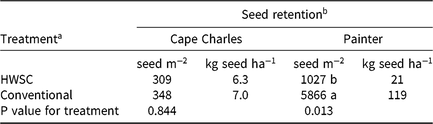
Similar to the tiller and seed-head density data, total seed production at the Cape Charles location, in the HWSC plots, was not different from the conventional harvest plots (309 and 348 seed m−2, respectively) (Table 3). At the Painter location, seed production in the HWSC plots was less than in the conventional harvest plots (1,027 and 5,866 kg seed m−2, respectively). Seed retention in these studies is similar to that reported by Walsh and Powles (Reference Walsh and Powles2014): Between 4,029 and 15,913 seed m−2 of rigid ryegrass was retained. Because some seed may have shattered from the plant before harvest and, therefore, sampling, these data are not an estimate of total fecundity or fraction of seeds retained at harvest. It has been reported that Italian ryegrass retains approximately 58% of its seed at crop harvest in Washington state (Walsh et al. Reference Walsh, Broster, Schwartz-Lazaro, Norsworthy, Davis, Tidemann, Beckie, Lyon, Soni, Neve and Bagavathiannan2018).
Italian ryegrass seed retention at wheat harvest in 2018 after 2017 harvest treatment application.

a Abbreviation: HWSC, harvest weed seed control.
b Means within a column followed by the same letter are not different according to Fisher protected LSD (P = 0.05).
Common Ragweed
Initial common ragweed densities across all locations ranged from 4.1 to 24 plants m−2 (Table 1). At all other time points, no significant treatment by location interactions were observed (P = 0.186, 0.515, and 0.274 at preplant, POST, and harvest censuses, respectively), so data were pooled across all locations for analyses. Before preplant herbicide applications in spring 2018, common ragweed density in the HWSC plots was less than in the conventional harvest plots: 94 and 120 plants m−2, respectively (Table 4), representing a 22% reduction. When common ragweed density was assessed again before POST herbicide applications, the HWSC treatment had lower density compared with the conventional harvest plots (31 and 42 plants m−2, respectively—approximately a 26% reduction).
Common ragweed density and seed retention in 2018 after 2017 harvest treatment application.

a Abbreviation: HWSC, harvest weed seed control.
b Means within a column followed by the same letter are not different according to Fisher protected LSD (P = 0.05).
At soybean harvest in 2018, no differences in common ragweed density or seed retention were observed between treatments, which we attribute to effective POST herbicide programs applied by the farmers. Because this was the case, it is not surprising that no significant differences in soybean yield were observed between the HWSC (2,648 kg ha−1) and conventional harvest (2,452 kg ha−1) plots. The critical weed-free period for soybeans falls between V2 to R3 growth stages (Van Acker et al. Reference Van Acker, Swanton and Weise1993). Because weed density was reduced after POST herbicide applications, common ragweed competition with the crop was greatly reduced, leading to similar soybean yield at the end of the season.
There has been limited research on seed retention and efficacy of HWSC in common ragweed. However, different HWSC techniques have been demonstrated to be effective at removing or destroying broadleaf weed seeds in Australia and the United States. In wild radish, 95% of seed was removed via chaff carts and 93% killed using a Harrington Seed Destructor (Walsh and Powles Reference Walsh and Powles2007; Walsh et al. Reference Walsh, Harrington and Powles2012). In the United States, Schwartz-Lazaro et al. (Reference Schwartz-Lazaro, Norsworthy, Walsh and Bagavathiannan2017b) reported 100% destruction of giant ragweed seed using an integrated Harrington Seed Destructor (iHSD). These high levels of removal or destruction of broadleaf weed species demonstrate how effective these systems can be at limiting additions to the soil seed bank. As demonstrated with rigid ryegrass in Australia, different HWSC systems were comparable at reducing weed populations after HWSC implementation (Walsh et al. Reference Walsh, Aves and Powles2017b). Thus, it is likely that using the iHSD or other HWSC system would provide similar results to those observed in the current study.
At soybean harvest in 2017, the total number of common ragweed seed that could potentially be removed by HWSC ranged from 2,126 to 31,602 seed m−2 or 95 to 1,406 kg seed ha−1 (Table 1) across all locations. At soybean harvest in 2018, similar to the common ragweed density data, no differences were observed in total common ragweed seed retention between the HWSC and conventional harvest plots for total common ragweed seed retention. Seed retention ranged between 23 and 27 seed m−2 or 1.0 and 1.2 kg seed ha−1 (Table 4). Goplen et al. (Reference Goplen, Sheaffer, Becker, Coulter, Breitenbach, Behnken, Johnson and Gunsolus2016) reported that giant ragweed retained 80% of its seed at the time of soybean harvest. Because common ragweed and giant ragweed are closely related, common ragweed is likely to have similar levels of seed retention, as has been seen with other closely related species such as Palmer amaranth and tall waterhemp (Schwartz et al. Reference Schwartz, Norsworthy, Young, Bradley, Kruger, Davis, Steckel and Walsh2016).
Palmer Amaranth
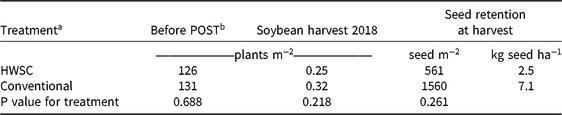
Initial Palmer amaranth density ranged from 4.0 to 9.9 plants m−2 (Table 1) across all locations. At all other time points, no significant treatment by location interaction was observed (P = 0.831 and 0.423 at POST and harvest censuses, respectively), so data were pooled across all locations for analyses. At all data collection dates in 2018, no differences between treatments were observed, likely because of the use of effective PRE and POST herbicide applications, which led to better Palmer amaranth control across the study locations, making any potential treatment differences difficult to detect. There was little to no emergence of Palmer amaranth prior to field preparation for soybean planting in 2018, so no data were collected at that time. Palmer amaranth does not typically emerge until after full season soybean planting in Virginia. Before POST herbicide application, only the sites in McKenny and Blackstone were included in the analysis, owing to low weed densities at the other locations. Palmer amaranth density was 126 plants m−2 in the HWSC plots and 131 plants m−2 in the conventional harvest plots (Table 5). At soybean harvest in 2018, Palmer amaranth density was 0.25 plants m−2 in the HWSC plots and 0.32 plants m−2 in the conventional harvest plots. Palmer amaranth retains 95% to 100% of its seed at soybean harvest across many different environments (Schwartz et al. Reference Schwartz, Norsworthy, Young, Bradley, Kruger, Davis, Steckel and Walsh2016). Norsworthy et al. (Reference Norsworthy, Korres, Walsh and Powles2016) reported reductions in Palmer amaranth density compared with conventional harvest; however, the effects from HWSC treatments, including field residue removal and narrow windrow burning, were variable. This is different than in the current study, in which we saw no differences in Palmer amaranth density between HWSC and conventional harvest. Lack of differentiation can be attributed to effective management by the farmers. The farmers were able to achieve high levels of Palmer amaranth control in 2018 through the use of timely and effective POST plus residual herbicide applications. Schwartz-Lazaro et al. (Reference Schwartz-Lazaro, Norsworthy, Walsh and Bagavathiannan2017b) reported 100% destruction of Palmer amaranth seed when passed through an iHSD. It is likely that Palmer amaranth populations can be reduced through HWSC, owing to the efficacy of the iHSD at destroying seed. However, the magnitude of the effects observed in subsequent seasons can be influenced by the size of the residual soil seed bank (Walsh et al. Reference Walsh, Aves and Powles2017b). As with common ragweed, at soybean harvest in 2018, no significant differences in yield were observed between treatments at the Palmer amaranth locations. Soybean yield in the HWSC plots was 3,349 kg ha−1, whereas yield in the conventional harvest plots was 3,269 kg ha−1.
Palmer amaranth density and seed retention in 2018 after 2017 harvest treatment application.

a Abbreviation: HWSC, harvest weed seed control.
b Only the McKenny and Blackstone locations were analyzed, because of minimal Palmer amaranth presence at the other two locations at this rating time.
Herbicide resistance is one of the biggest threats to advancing crop production, and as resistance continues to grow, it will be critical to continue to adopt additional weed management tactics to control troublesome weeds like Italian ryegrass, common ragweed, and Palmer amaranth (Swanton and Weise Reference Swanton and Weise1991; Thill et al. Reference Thill, Lish, Callihan and Bechinski1991). HWSC shows promise as a tool to reduce weed populations, with up to 70% reduction in Italian ryegrass and 21% and 28% reductions in common ragweed and Palmer amaranth, respectively, that were equal to best management practices with current, effective herbicides. However, differences between HWSC and conventional harvest were not detected when weed-seed densities were low or where weeds were well controlled with other tactics. Reductions in weed density, and therein subsequent seed production, can help reduce weed populations to manageable levels.
The current study observed variability in HWSC effectiveness, which suggests additional research needs to be conducted. Such research should validate HWSC methods in U.S. winter wheat and soybean production systems and additional weed species. The impact of prolonged use of HWSC on soil seed banks should also be evaluated.
Author ORCIDs
Shawn C Beam https://orcid.org/0000-0001-9206-5693
Acknowledgements
The authors acknowledge Paul Davis, Bill Shockley, Dee Claiborne, Spencer Wallace, Donald Anderson, Robert Proffitt, Cecil Shell, and Robbie Taylor for allowing this research to be conducted on their farms. The Virginia Small Grains Board, the Virginia Agricultural Experiment Station, the Hatch Program of the National Institute of Food and Agriculture, U.S. Department of Agriculture, and the U.S. Department of Agriculture, Agricultural Research Service Areawide program (award 58-8042-5-054) provided partial funding for this research. No conflicts of interest have been declared.