1. Introduction
The age, sophistication, and maturity of Chile's personal account pension system make it an ideal place to study the effects of financial literacy on savings, pensions, and pension-related financial behavior. Chile's pension reform was implemented in 1981, making it one of the very first countries where individual accounts were implemented. Although the pension system is still in transition toward its steady state (most of those affiliated are still in the accumulation phase), it is the ideal place to study if one wants to understand the role and effects on behavior of pension rule and finance literacy.
Individual control over financial wellbeing in retirement is a central principle in Chile's system of personal pension accounts. Choices are balanced with government safeguards, which protect individuals from shortsightedness and adverse shocks. Nonetheless, the tight link between contributions while working and pension benefits in retirement, along with options for voluntary savings and account management, are supposed to encourage members to tailor their retirement savings to their particular circumstances, future plans, planning horizons, and risk-bearing profiles.
Standard Modigliani style life cycle theories of savings based on rational individuals with concave utility and access to capital markets predict that individuals treated with a compulsory saving policy will adapt their non-compulsory savings or debt to accommodate mandatory savings. We also expect them to adapt their investment policy for their non-compulsory savings to make them fit with the financial properties of the investment policies of the pension funds. This global optimization of saving, debt levels, and investment policies should be sensitive to the different options within the system and particularly to the relative tax incentives of the different savings systems.
A defined contribution multi-fund personal account system vis-à-vis a defined benefit system should increase voluntary pension savings (assuming they are financially attractive) because it creates a direct link between the pension saving effort and the pension obtained. Hence, individuals interested in saving should be more likely to make additional contributions within the system. Also, since 2002 agents in Chile can choose among different investment policies within the pension system according to their risk return preferences,Footnote 1 and therefore could globally optimize their savings strategy using the options within the system.
Since individual accounts make individuals assume the financial consequences of the fund's performance, one would expect an increase in the sensitivity of agents (the frequency and likeliness of changes in their pension investment decisions) to changing financial circumstances, in particular to the performance of the financial intermediaries in charge of administrating the pension funds.
A good summary on the well-known shortcomings of life cycle theory can be found in Thaler (Reference Thaler1994). He argues that the theory assumes that households are optimizing without considering the possibility that households can have bounded rationality when considering their retirement plans. The probability of finding these sorts of optimizing households depends on the difficulty of the problem, the possibility of learning the answer, and, critically, on how likely it is that following a couple of simple rules approximates a correct answer with less costs. Solving the optimal consumption path is difficult, and individuals only have to solve it once, so they do not have an opportunity of learning. As Thaler (Reference Thaler1994) says ‘The only plausible ways in which people might approximate an optimal saving plan is either by learning from others (e.g. role models or experts) or by using good rules of thumb.’
In contrast, the behaviors expected within the Chilean Pension System rely on the assumption of unbounded rationality among the agents involved. After almost three decades after its inception, there is limited knowledge about the personal account system and even personal stakes in the system. For example, only around 25% of contributors know the contribution rate (that is deducted from wages every month by law) and barely 12% know how a pension is calculated. In additional, there are doubts on the quality of their financial behavior.Footnote 2 This is troublesome in a system that is established on the assumption that consumers should be ‘voting with their feet.’
In the local public policy discussion, the low level of knowledge is usually associated with the limited success of voluntary pension savings schemes and, together with the evidence of very low expected replacement rates, continuously fuels the agenda of providing more education and information to the public with the objective of increasing their voluntary savings (very simple calculations show that the current compulsory saving rules lead to very low replacement rates). When the system was designed, it was expected to achieve a 75% average replacement rate, however, it is estimated that only one-third of affiliates will reach that rate (Berstein et al. 2005). One of the public consequences of this widespread belief is the need for more information provision occurred in 2005. Using the first application of the Social Protection Survey, in 2002, which was released in 2004, Arenas de Mesa et al. (Reference Arenas de Mesa, Bravo, Behrman, Mitchell and Todd2006) were the first to show that the very low levels of pension literacy of the general public and, in particular, pension system affiliates in the Chilean pension system. As a result, in 2005, the Pension Fund Administrator Superintendence decided to implement a public system of report letters that included the status of personal funds, pension projections, and even a counterfactual exercise on the pension effect of delaying retirement dates, consistent with the widespread belief in the need for more education.
In this paper, we investigate the causal link between pension finance knowledge (which we call literacy) and voluntary savings, as well as financial behavior within the system. One of the major challenges of the growing literature on financial literacy and financial decision making is to develop empirical strategies to estimate the causal effect of knowledge on decision making. Considering the possibility of bounded rationality, and how individuals can actually learn about the pension system, we will identify this effect using the presence of a parent pensioner in the household as an instrument for knowledge and understanding of the pension system.
Our identification assumptions are that having a pensioner in the household is correlated with pension knowledge, either directly by pensioner sharing his greater knowledge of the rules or indirectly by having someone in the household with greater knowledge; and that it only affects pension savings through this channel. We will show the first relationship holds, reporting the strong connection between pension knowledge and having a pensioner in the household, and provide evidence to support the second assumption. A possible worry is the existence of unobserved effects that affect both the decisions of the household and the pensioner on living arrangements. In order to address this concern, we show that the results hold when the sample is restricted to pensioners who only have one child, which reduces the number of decisions the pensioner could be making. We also show that the relationship is not driven by income, health, or risk aversion. Considering these results, we consider that having a pensioner in the household is a plausible instrument for pension financial knowledge.
We cannot read or measure the nature of the information that the pensioner is providing to the household. Information could have three sorts of effects: reducing uncertainty or bias on the risks and returns involved in the canonical savings decision (for example by correcting expectations conditional on savings levels); helping to choose investment options within the available savings systems (including the pension system); or reducing noise within the available systems, making them more attractive for risk averse affiliates. Furthermore, it is conceivable that it can increase interest in and effectiveness of information already available such as the pension reports distributed by the Superintendence discussed above.
We find that pension finance literacy is positively correlated with the presence of pensioners in the households, but we do not find any evidence of exogenously provided additional knowledge by the presence of an elder in the household on voluntary pension savings within the system at large. However, we do find evidence that pension system knowledge increases savings in the financial system. We find that workers who have more pension literacy are more likely to engage in pension-fund-type switching, but not pension fund administrator switching. We also find that self-employed workers are more likely to become voluntary affiliates of the system when they have greater levels of pension literacy.
This paper contributes to the bounded rationality and behavioral finance literature, since it gives evidence of an exogenous information enhancing shock having significant effects on savings behavior, levels, and choices. Second, it also contributes to the related economic literature on financial literacy since it actually tests determinants and effects of a particular type of financial literacy. Third, this paper should be interesting to those working in pension reform, since it measures an information effect in the oldest privatized pension system in the world – which has been a role model in the pension literature for many decades. Fourth, the paper contributes to the case literature on the Chilean pension system where there continue to be discussions on the need to provide more information to make the system work better without any real measure of the impacts of current information providing.
The paper is organized as follows. Section 2 briefly locates this paper within the new literature on financial literacy. Section 3.1 describes the interplay of individual choices and government safeguards in the Chilean personal account system; this is crucial to understand the options actually faced by the affiliates, providing a rationale for pension finance information use in globally optimizing a savings strategy. Section 3.2 presents some basic stylized facts on the Chilean pension system and we document the limited knowledge of the retirement account system, discussing the potential demand for and supply of information and education. In Section 4.1, we estimate the effects of pension finance literacy on voluntary pension savings using our instrumental variable approach. In Section 4.2, we do the same for voluntary financial savings (outside the pension system), and in Section 4.3 we do likewise for pension-related financial behavior (fund or administrator switching and voluntary affiliation). Section 4.4 is dedicated to addressing the possible endogeneity of the instrument as well as plausible non-observables that could cast doubt on our results and in Section 4.5 we analyze the plausible information content of the pensioner–affiliate relationship within the household. In the final section, we offer our conclusions.
2. Briefly addressing the financial literacy literature
Despite the importance of pension literacy in public policy agendas, both in developed and developing economies, there is little well identified evidence on the effects of information on financial decisions within pension systems. This is perhaps not surprising since the systematic and rigorous measurement of financial literacy is a relatively new area of expertise (see for example Lusardi and Mitchell Reference Lusardi and Mitchell2007a, Reference Lusardi and Mitchellb, Reference Lusardi and Mitchell2008; Lusardi et al. Reference Lusardi, Mitchell and Curto2009, Reference Lusardi, Mitchell and Curto2010; Behrman et al. Reference Behrman, Mitchell, Soo and Bravo2012; van Rooij et al. Reference van Rooij, Lusardi and Alessie2011a, Reference van Rooij, Lusardi and Alessieb). Lusardi and Mitchell (Reference Lusardi and Mitchell2008) use wealth effects from housing price variations across cohorts to identify an effect of financial literacy on savings. Behrman et al. (Reference Behrman, Mitchell, Soo and Bravo2012) use the same dataset we used in this paper, with an instrumental variable approach to show a very large effect of financial literacy on wealth accumulation. Lusardi and Tufano (Reference Lusardi and Tufano2009a) use self-reported ‘financial experiences’ as an instrument for information to find a demographically controlled effect on self-reported over-indebtedness. Recently, Bucher-Koenen and Lusardi (Reference Bucher-Koenen and Lussardi2011) exploit regional variations of financial literacy within Germany to identify important effects of financial knowledge on the probability of financial planning.
There is also a growing literature that addresses the mechanisms by which financial literacy is obtained or the ways in which individuals make decisions in a context of limited financial literacy. A particularly interesting strand of this literature studies the effects of peers on financial decisions, which is closely related to the findings of this paper (see for example Hong et al. Reference Hong, Kubik and Stein2004; Brown et al. Reference Brown, Ivkovich, Smith and Weisbenner2008; van Rooij et al. Reference van Rooij, Lusardi and Alessie2011b).
This literature consistently finds very large and important effects of financial literacy on financial behavior, wealth, and debt in a variety of contexts and using a variety of databases and methodologies.
In the specific case of pension finance literacy and pension behavior, Duflo and Saez (2003) randomize the incentive to go to a pension information fair and find an effect on financial behavior. Chan and Stevens (Reference Chan and Stevens2008), using self-reported and administrative data of retirement incentives, solve the apparent empirical puzzle of the existence of a relationship between retirement incentives and retirement behavior. They show that the behavioral response is driven by a strong reaction of highly knowledgeable individuals: uninformed individuals do not respond to retirement incentives. Mastrobuoni (Reference Mastrobuoni2006) uses the introduction in 1995 of the Social Security Statement in the US as a natural experiment to show large information effects and some heterogeneous effects on financial decisions, Lusardi and Tufano (Reference Lusardi and Tufano2009b) use a financial literacy questionnaire from the Rand American Life Panel to show how more literate individuals are more likely to do retirement planning; and van Rooij et al. (Reference van Rooij, Lusardi and Alessie2011a) use a Dutch Household Survey to measure the effects of financial literacy on wealth, separately through private savings behavior and savings within the pension system.
For Chile, Miranda (Reference Miranda2010) and Fajnzylber et al. (Reference Fajnzylber and Reyes2009) study the impact of official pension fund reports, the first on the retirement decision, and the second on voluntary pension savings. Fajnzylber et al. (Reference Fajnzylber and Reyes2009) find that the report increased voluntary pension savings of individuals aged 40–50 years old. Miranda (Reference Miranda2010) finds that it increased the average retirement age. Although both studies address the same question of this paper (what is the impact of pension knowledge on pension behavior?), the identification strategy is very different.Footnote 3 We identify the impact of information through the effect that having a pensioner in the household, not the effect of the pension reports. Hence, the measure of pension literacy that we use is different and, in particular, has more dimensions as we will explain when we describe the variable.
The results of this paper are broadly consistent with the stylized findings of the pension finance literature that reports the important effects of financial literacy on behavior in the stock and pension fund market. Moreover, it is also consistent with a strand of this literature that finds that some of these effects are the result of information transmitted by peers. In our case, we seem to find that the information vehicle for some household heads is elderly pensioners in the household.
3. The pension system and pension literacy in Chile
3.1. Briefly on the Chilean pension system
While accumulating funds in their retirement accounts and later converting their balances to pension benefits, Chilean affiliates can tailor their accounts to their particular needs and preferences, albeit with considerable government oversight and safeguards on their choices. In this section, we summarize the main choices facing members of the Chilean retirement account system and use survey responses to characterize the overall utilization of these options. In characterizing the real choices available, we want to assess the actual use that they can give to marginal increases in pension finance literacy.
Our analysis focuses on voluntary retirement savings in personal accounts and financial behavior, specifically participation, administrator, and fund choices. It is important to note that most affiliates in the survey are still in the accumulation phase. While the new pension system began in 1981, and that before the 2008 reform, only 10% of those participating are receiving a pension – either for age or disability. Moreover, according to the Chilean Social Protection Survey (EPS for the Spanish acronym of Encuesta de Protección Social) of 2009, there are 9,229,009 affiliates in the pension system of which 5.46% receive retirement pensions, 3.03% receive anticipated retirement pensions, and 2.26% receive disability pensions. Nonetheless, the structure of expected pension benefits should influence (observable) current savings decisions. In converting their retirement account balances to pension benefits, members will face several choices and may be eligible for certain government safeguards, so we need to carefully address these rules before attempting any identification of information or knowledge effects.
After reaching normal retirement age,Footnote 4 members can receive a pension from their accounts; however, there is no mandatory age at which an account must be converted to a pension and continued employment does not affect pension benefits, so potential retirees can delay the liquidation of their funds. Early receipt of a pension is only possible for those members with sufficiently large account balances.Footnote 5 When retiring, members can use their pension funds to purchase an annuity from an insurance company, establish a programmed withdrawal flow from their account with their fund manager or utilize a combination of these two options. Mitchell and Ruiz (Reference Mitchell and Ruiz2009) study how these options mainly differ in terms of the ownership of residual claims and individual risk-bearing.
A profound pension reform was enacted in March 2008 changing the pension system structure and requirements, particularly regarding the complementarity between the personal savings and the minimum pension guarantees. However, we consider the regulations previous to this reform because it is what the survey respondents knew when they made their voluntary savings and financial behavior decisions. In addition to regulating the conversion of account balances to benefits, the government provides a pension safety net. Members who have contributed at least 20 years (or 240 months) are guaranteed a minimum pension level on retirement. Since December 2008, the minimum pension is 104,960 pesos per month (roughly US $2,500 per year) for persons under age 70 years, 114,766 pesos per month (US $2,750 per year) for those between 70 and 75 years, and 122,451 pesos per month (US $2,900 per year) for those 75 years and older, which is approximately 50% of median monthly earnings. The level of the minimum pension is inflation-indexed. For eligible members, the government provides the difference between the pension they can finance from their retirement accounts and the minimum level. Regardless of their contribution history, individuals may be eligible for a welfare pension (PASIS) of 122,451 pesos per month since December 2008 (US $2,900 per year).Footnote 6 The minimum pension, in particular, provides a significant insurance benefit for low-income members, who have made regular contributions to their retirement accounts but have not accumulated sufficient funds.Footnote 7 Studies created for the pension reform of 2008 projected that between 10% and 50% of account members may end up receiving some government funds based on the minimum pension guarantee.Footnote 8
In the contribution phase, individuals must make four critical decisions.
The first is whether or not to contribute. Employees in the formal sector with a contract make compulsory monthly contributions to their accounts. The basic tax-exempt contribution, 10% of monthly earnings up to 60UF (roughly US$ 30,000 per year), is transferred directly by employers.Footnote 9 When making basic contributions, members also pay 2–3% of their monthly earnings to their fund manager for fees and for disability and survivor insurance. For those who are self-employed, participation is voluntary. The self-employed also have full discretion over the frequency and amount of their continued contributions.
The second decision is the choice of Pension Fund Administrator (AFP). Members can freely select their fund manager and change managers at no cost based on feesFootnote 10 and investment performance, yet government regulation limits the asset allocation of AFPs and diminishes the incentives to out-perform other AFPs, so differences are very slight and rankings variable.Footnote 11 In addition to the minimum return guarantee, the government regulates the investments of AFPs. In August 2010, 56.1% of the AFP funds were held in national instruments with 8.7% of that in public debt, 28.5% in other fixed rent contracts, and 18.2% in variable rent. Also, the percentage of the pensions that was held in foreign variable rent contracts was 27.9% (Source: Superintendency of Pension Fund Administrators). Members pay no additional fees to switch AFPs, even though this involves administrative costs and time. Theoretically the system relies on free choice of AFPs to encourage competition among the fund managers, however, the limitations of this mechanism have been well known for quite some time and also have been the subject of recent regulatory reform. Moreover, the 2008 pension reform created a new mechanism for the allocation of new members to AFPs by auctioning off portfolios of new affiliates. The individuals, however, retain their right to individually choose their AFP manager and switch whenever they find it convenient to do so. With moderate differences in fees and returns, AFPs have frequently been involved in marketing wars that involved the hiring of large sales forces to influence member choices. Survey data show almost half of members have changed AFPs at least once, though most do so quite infrequently.
The third decision is the type of fund to invest in. The five types of funds available within the pension system vary in the limits to exposure to stocks and other variable yield instruments from the riskiest A fund (with maximum 80% and minimum 40% exposure) to the E fund (with maximum 5% exposure).Footnote 12 The choice of funds is completely voluntary up to the age of 55 years for men and 50 years for women, afterwards fund A is forbidden and pensioners are also forbidden to invest in fund B. In the case of voluntary saving schemes within the system (that we explain in detail below), there are no restrictions on fund choice. Contributors are allowed to distribute their savings into two different types of funds. If the affiliate does not choose a fund, he will be invested in B funds if his age is under 35 years; C funds if he is male and in the 36–55 years range or female and in the 36–50 years range; and D funds if he is a man older than 56 years or a woman older than 51 years.
Finally, members can increase their retirement funds or get their pension earlier with additional pension savings. There are two financial instruments for additional pension savings within the system: voluntary pension saving and voluntary savings accounts.
All working members of the system can make additional voluntary contributions to their retirement accounts. Initially, members could contribute an additional 10% of earnings tax-free, and these funds could not be withdrawn from the accounts before retirement. Since 2002, the cap on additional contributions is much higher and additional contributions (plus the interest earned) can be withdrawn early at a tax penalty.Footnote 13 Theoretically, with additional contributions to their retirement accounts, members can compensate for irregular contribution histories, reduce their current tax burden, and increase their future pension benefits, yet only 10% of members have ever utilized this option.Footnote 14 The question of estimating how many non-credit constrained individuals have not used this option (which is relevant from a policy perspective) is open and interesting.
Voluntary savings accounts were introduced in 1987 to offer another form of savings for retirement and other purposes. While individuals use the same fund manager for their voluntary savings and retirement accounts, these accounts are separate. The self-employed can, however, make basic contributions to their retirement accounts with transfers from their voluntary savings account. At retirement, all members can use their voluntary accounts to increase the amount in their retirement accounts to obtain a larger pension. There are no tax benefits to contributions in voluntary savings accounts, but transfers to retirement accounts are not taxed so the taxes are deferred to retirement (when it is probable that they will face lower marginal rates). Other withdrawals from voluntary accounts (a maximum of four times per year) are subject to income taxes. These accounts are supposed to be preferable to other savings vehicles, for example bank deposits that earn low interest rates and mutual funds that have relatively high fees. The EPS 2009 asks about voluntary savings accounts, inquiring if the affiliate has used Voluntary Pension Savings (APV in Spanish abbreviation) between January 2006 and the period of the survey. Just 3.7% of affiliates have a voluntary savings account. The reason for this low number could be in the nature of the question because some respondents could have started using APV before 2006, which is not captured by the statistic. The most common reason to have a voluntary account is that they want increased pension benefits (46.7%); but convenience (35.5%) and it ‘allows him or her to retire money’ (11%) are also important factors. As with additional contributions to retirement accounts, most members are unaware of voluntary savings accounts. Again, an interesting and open empirical question (with policy implications) is how many non-credit constrained individuals have not used this option. Other members, who do not have voluntary accounts, claim that the accounts are not necessary or they have too little income to save. Again, these accounts offer an option for increased saving, but few members choose to participate.
Part of the 2008 effort to reform the Chilean pension system included changes to the APV system. This reform included the possibility of establishing collective APV plans (APVC) consisting of a mechanism within companies and designed to supplement personal APV efforts by employees. Also a tax benefit for APV and APVC was implemented. The idea of this reform was to stimulate an increase in personal voluntary saving, mainly, for the middle classes. However, it is too soon to evaluate the impact of these changes, and it is not possible within the time span of the last available EPS databases.
As we can see, there are a variety of voluntary savings alternatives available in the system as well as fund managers and fund type choices available, which have the potential of being affected by pension finance literacy.
3.2. Stylized facts of pension finance literacy in Chile
Limited information on members has previously impeded micro-level studies on pension finance literacy for the Chilean system, forcing analysts to infer conclusions from aggregated data.Footnote 15 In this paper, we use the second and third wave of the Encuesta de Protección Social (EPS) to investigate this relationship. The second wave is representative of both pension affiliates and non-affiliates, and was conducted between November 2004 and March 2005; and the third wave was conducted between September 2006 and May 2007.Footnote 16 The survey has a panel structure following affiliates found in the first wave. The questionnaire allows us to use innovative survey measures of pension system knowledge, financial planning horizons, and retirement plans to understand individuals' savings because it has a module that asks the members about these issues.Footnote 17
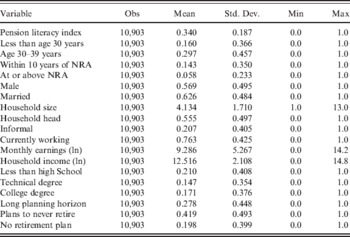
Table 1 shows the descriptive statistics of our sample. We include individuals affiliated with an AFP in 2004 and 2006. The sample size is 10,903 individuals. Around 16% of members are younger than 30 years, 30% are aged 30–39 years, 14% are within 10 years of the normal retirement age (NRA), and 6% are above the NRA. About 63% are married, and around 55% are male and head of household. The average household size is 4.1, 76.3% of surveyed individuals are currently working, and 20.7% are informally employed (do not have a contract or are self-employed). Finally, 27.8% have a long planning horizon (savings and expenditure planning considering one or more years ahead), 42% plan to never retire, and 20% have no retirement plan.
Descriptive statistics

Source: Authors' calculation based on EPS 2004 and 2006.
Note: NRA is normal retirement age.
To make well-informed decisions about their retirement accounts, and to design optimal complimentary savings policies, members require some knowledge of the pension system. Yet, the value of such information and the costs of obtaining it are very likely to differ across members. We begin by assessing the overall knowledge of personal pension finance, finding that most members have a very limited understanding. This is worrying since some of the logic of the system is based on the market disciplining virtues of rational and informed individual choices. We also show that more knowledgeable members are more active in the retirement account system, which is expected but of course impossible to disentangle in a statistical sense. Thus, it does not necessarily imply that knowledge increases active saving and management of accounts, and it could perfectly well indicate the other direction of causality. In Section 4, we investigate the direction of causality of this relationship using our identification strategy.
To assess members' overall knowledge of the retirement account system, we use the EPS from 2004 and 2006. We examine their survey answers in a module on knowledge and perceptions of the pension system. For each question, respondents may reply with a specific answer or ‘don't know’. The correct responses follow each question in brackets. The exact wording of the questions is in Appendix 2.
The first three questions pertain to the contribution phase:
1. What is the monthly contribution as a percent of earnings? [10–13%]
2. What is your account balance?
3. How are your funds invested?
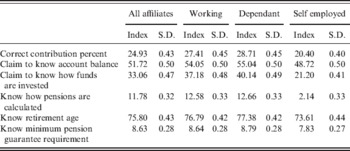
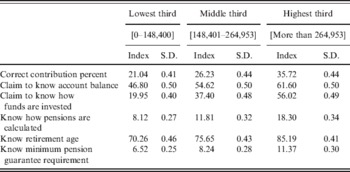
Table 2 displays the distribution of responses for AFP members in the 2004 wave. A few members (24.9%) correctly answered the contribution question. However, employers deposit their employees' contributions with the AFPs, so most members do not need to know the rate. This value would, however, be needed to assess the adequacy of these contributions for retirement savings goals and for the design of a globally optimal savings policy. The value also directly affects workers' take-home pay and other savings strategies.
Pension literacy

Note: Tabulations include the 9,521 account members in the 2004 wave. Average percent of correct answers in 2004 and 2006 is 34%. The correlation between both years is 0.45.
The percent of correct answers between dependent and self-employed are statistically different for all questions, except for know minimum pension guarantee requirement.
Source: Authors' calculation based on EPS 2004.
Members seem to be most knowledgeable about their account balance, with 51.7% claiming to know it. We do not have access to administrative data to investigate if the balance declared is what members actually have in their individual balance account, so this figure is probably an upper bound on the knowledge of the account.
Finally, 33.1% claim to know how their pension funds are invested. Members have a choice between five fund types differentiated by risk. Again, we do not have access to administrative data to check if they are correct, although we have checked based on age cutoffs,Footnote 18 so we think that it is safe to take 33.1% is an upper bound. Putting these figures together, at least half of the members do not know their balance and two-thirds do not know how their pension funds are invested. Both are critical figures to define the level of global savings needed and the portfolio of non-pension system investments.
The next three questions address pension benefits from retirement account system:
4. How are pensions from the AFP calculated? [Account balance and other factors like retirement age.]
5. What is the legal retirement age for men? [65 years] For women? [60 years]Footnote 19
6. What are the conditions for the minimum pension? [Contributions for 20 years or 240 months.]
Only 11.8% members understand the most basic principle of the pension system: their account balance determines their pension benefit. While the system design tightly links contributions to benefits, there is little evidence that most members actually understand this connection. Unfortunately, this is not particular to Chile, for example in the United States, Gustman and Steinmeier (Reference Gustman and Steinmeier1999) also find misinformation about pensions. For example, they find that only 50% of persons with employer pensions correctly identify their plan as either defined-contribution or defined-benefit.
In sharp contrast to the benefit calculation, members are quite knowledgeable about the timing of retirement. Over 75% of members know the normal retirement ages. The final question covers the government pension guarantee. Again, the vast majority of members do not know the right answer – only 8.6% know the conditions for eligibility for the guaranteed minimum pension. In a study of Santiago workers, Barr and Packard (Reference Barr and Packard2002) suggest that some self-employed workers contribute to their accounts only to be eligible for the guarantee. Such strategic contribution behavior, which could be justified as rational, is hard to reconcile with the general lack of knowledge about the pension guarantee, so there is probably some space here for further research.
There is some very significant pension literacy heterogeneity across different types of workers. Affiliates that are still working seem to be relatively more knowledgeable, dependent workers more so (only slightly but across all questions), and self-employed workers (for which adherence to the pensions system is not compulsory) seem to be much less literate on the system comparatively.
Members' answers across all six questions reveal limited overall knowledge of the pension system. On average, members answer only 2.06 questions correctly and the median is two correct answers (out of six). Only 14% of members correctly answered more than half of the questions. In the next section, where we attempt to identify the effects of knowledge on behavior in the pension system, we will use this score (percent of correct answers) as an indicator of pension finance knowledge. We will call this percentage of correct answers ‘pension literacy.’ The pension literacy index goes from 0 to 1, and on average individuals correctly answer one-third of the questions (Table 3).
This low degree of overall knowledge could simply reflect its limited value to most members. With government mandates on employee contributions and the management of pension funds, most members who are far from retirement, could feel that they face few relevant account decisions and do not need to know about the system. Yet, there are certain groups of members who have more discretion and could likely benefit from greater knowledge who actually have less. While the self-employed and those with intermittent work histories face more choices, we find them to be less informed about the system; the average number of correct answers for informal workers (self-employed or working without a contract) is 1.78.
The cost of obtaining information about the system could also affect members' overall knowledge. The government has long recognized the need to inform members about their retirement accounts. AFPs are required to regularly send account statements to their members.Footnote 20 These statements include the members' current balance, contributions, fees, return on their account, and financial performance of their AFP. The statements also provide the return and commission structure for all AFPs. However, the statements did not (during most of the period for which we have data) provide any projections of members' retirement benefits. According to the survey responses, two-thirds of members regularly receive an account statement. In addition to their account statements, members can visit their local AFP office or use their websites to obtain information on their accounts. However, access to these other methods may differ based on where members' live, education level, and income. Also Chile is a country with very low scores in internationally comparable tests measuring adult functional literacy and quantitative skills. Unfortunately there are no available internationally comparable measures of financial literacy, such as those on functional literacy in math and reading comprehension but it seems safe to assume that it is also very low. It is, at the very least, plausible that a significant portion of pension system members that receive this information do not actually understand it or even read it.
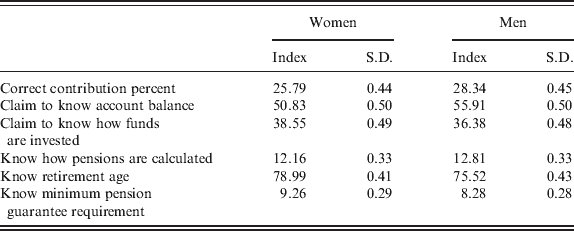
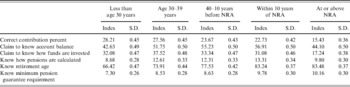
As we can see from Table 3, there are gender differences in pension literacy but they are not all in the same direction. Women seem to be more knowledgeable on three of the questions, men know more on two of them and one is tied. Women are more aware of the retirement age (it is a public policy issue that is much discussed), they claim to know more about investment policies, and know more about minimum guarantees (which would be expected since they are more likely to use them given high rotation in and out of the labor market). Men are more likely to know the contribution rate right and to claim to know their account balance (we have no way of verifying this). From Table 4, we can see that pension literacy is not globally correlated with age, but within questions there are very striking age effects that actually make sense in intuitive terms. Older affiliates are more likely to know their balance, how pensions are calculated, about minimum pension requirements, and about the retirement age. Younger affiliates, on the other hand, know more about the contribution percentage and how the funds are invested. From Table 5 we can see that pension literacy is clearly correlated with wages, even in the case of questions that are most relevant to lower income affiliates (such as eligibility for minimum pensions).
Pension literacy by gender
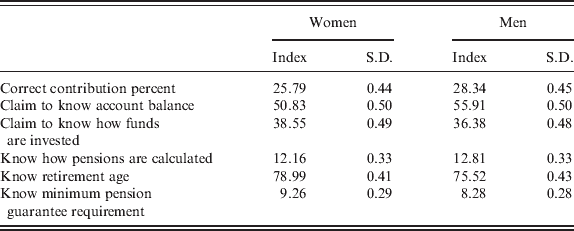
Note: Tabulations include the 7,260 account members working in the 2004 wave.
The percent of correct answers for men and women are statistically different for all questions, except in know how pensions are calculated and know minimum pension guarantee requirement.
Source: Authors' calculation based on EPS 2004.
Pension literacy by age

Note: Tabulations include the 9,521 account members in the 2004 wave.
Source: Authors calculations based on EPS 2004.
Pension finance knowledge by wages

Note: Tabulations include the 9,521 account members in the 2004 wave.
4. Pension literacy and savings behavior
4.1. Voluntary pension savings
4.1.1. Correlations
Voluntary savings accounts provide another vehicle for retirement savings. Although separate from retirement accounts, members can use their voluntary accounts to increase their retirement account balance and thus their pension benefit.
Martinez and Sahm (Reference Martinez and Sahm2009) document that more knowledgeable members are also more active participants in the retirement account system. They investigate four choices facing members: basic contributions by the self-employed, additional contributions, having a voluntary savings account and changing fund managers. Even after controlling for other attributes relevant to saving, such as planning horizons, expected retirement, and risk preferences, greater pension literacy is strongly associated with participating in these choices. However, these correlations cannot establish a clear causal link between greater knowledge and greater participation. Members with a high desire for retirement savings may seek out more information on the account system. Past participation in the system may also generate greater knowledge and encourage future participation. In both cases, other attributes could drive account behavior and seem to affect knowledge as well. The association between knowledge and account behavior mixes the direct effect of knowledge and the indirect effects of these other attributes. One of the main objectives of this paper is to disentangle this causality using an identification strategy.
In this paper, we study the relationship between retirement saving and knowledge using the proportion of periods (out of two: 2004 and 2006) where the AFP member had some form of voluntary pension saving as a dependent variable.Footnote 21 It is important to notice that the dependent variable is not a dummy because the AFP member could conceivably have voluntary pension savings only one year out of two.Footnote 22 The mean of this variable is 0.11, and 16.04% have had voluntary pension savings in at least one period. Regarding the level of knowledge we also use the two period average of the pension literacy index described in the previous section.Footnote 23
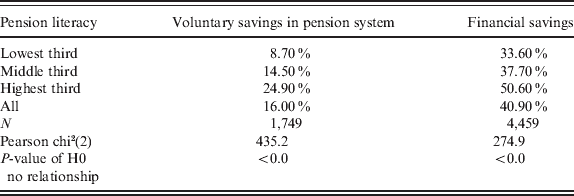
Table 6 shows the positive relationship between pension literacy and voluntary pension savings found by Martinez and Sahm (Reference Martinez and Sahm2009). Individuals are divided into three groups according to their pension literacy index (lowest 33%, middle 33%, and top 33%). Overall 16% members have voluntary pension savings, and this proportion monotonically increases from 8.7% to 24.9% as their level of knowledge increases. The table also shows that financial savings outside the pension system also seems to increase with pension literacy.
Pension literacy and savings
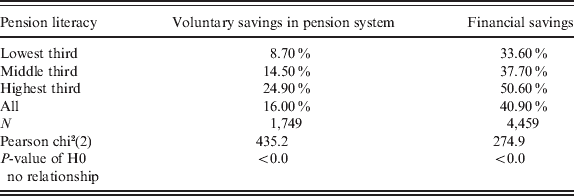
Note: All tabulations with 10,903 respondents who are AFP members and responded to the 2004 or 2006 EPS waves. Individuals are sorted according to their pension literacy index in three categories: lowest (33%), middle (22–66 %), and highest (66% and more).
Source: Authors calculation based on EPS 2004 and 2006.
As Martinez and Sahm (Reference Martinez and Sahm2009) we run a simple regression to refine this correlation:
 $$\eqalign{\tab {\rm VPS}_{i} \equals \alpha \plus \beta \ {\rm Pension} \ {\rm Literacy}_{i} \plus \varepsilon _{i} \comma \cr \tab {\rm VPS}_{i} \equals \alpha \plus \beta \ {\rm Pension} \ {\rm Literacy}_{i} \plus \gamma V_{i} \plus \varepsilon _{i} \comma \cr} $$
where VPSi is the proportion of periods (out of two)Footnote 24 that the individual is involved in voluntary savings; Pension Literacyi is the pension literacy index; and Vi represents a vector of controls that include demographic (age, years to the normal retirement age, gender, civil status, household size, and a dummy for household heads), labor (dummies for informality and work status), income (wages and household income), education (dummies for education level), planning horizon, and retirement plans.Footnote 25
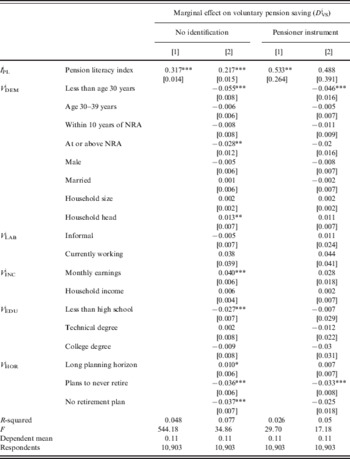
Martinez and Sahm (Reference Martinez and Sahm2009) found a positive association between the pension literacy index and the probability of having voluntary pension savings. For comparability, we report these replicated results in columns 1 and 2 of Table 8. The first column shows the correlation without controls, whereas the second column documents the correlation when controls are included.
A one standard deviation increase in the pension literacy index (0.18) increases the probability of having voluntary pension saving by 5.7 percentage points. This magnitude decreases to 3.9 percentage points when controls are included. If we are to believe the non-identified effects of column 2 of Table 8, we would say that young individuals (<30 years old), less-educated individuals (without a high-school degree) and those at or above the normal contribution rates are less likely to use this financial instrument. Higher wages and being the household head increase the probability of having voluntary savings, whereas having no retirement plan or not planning to retire decreases this probability. This, of course, makes sense but is not identified in any statistical sense.
These correlations suggest that improved knowledge about the account system could have a sizeable impact on voluntary pension saving. Yet, these results are suggestive rather than definitive given that they show a correlation and not a causal effect.
4.1.2. Causality
In order to identify the causal effect of knowledge on voluntary pension savings, we use an exogenous variation in knowledge that does not directly affect savings behavior. Having an additional pensioner in the household exogenously increases knowledge of the pension system by generating an information spillover. Individuals will naturally be exposed to the consequences of pension behavior and better understand the pension system and information costs about the pension system will be reduced. Moreover, having a pensioner in the household might increase member's interest and curiosity in the pension system, which can lead to more knowledge.Footnote 26
As is usually the case with instrumental variable methodologies, the validity of the results depend on both the strength of the relationship between the instrument and the dependent variable as well as the independence of the instrument to observed and unobserved effects on the dependent variable. We will directly test the first assumption and show there is a strong relationship between having a pensioner in the household and the ‘pension literacy index.’ Although the second condition is an assumption, we will present what we see as strongly persuasive evidence that this assumption holds in Section 4.4.
The possible endogeneity of the instrument is central to the validity of the results, and we rule out several channels that might threat this assumption. A first channel might be the endogeneity of the family structure: in Section 4.4 we show that when we limit the sample to families of single children, most of the main results hold despite a severe decrease in the sample size. Secondly, we report the correlation between living with a child and income, education, health status and risk aversion, all variables that might affect the savings behavior studied. We find no significant correlation between living with a pensioner and health status or risk aversion, but find a slightly higher propensity of less educated and poorer households to be multigenerational. However, this last result works against our results, considering that financial savings is positively correlated with income.
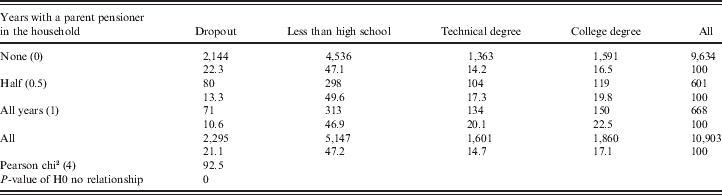
We only include in our measure of pensioners those parents who live with their children and have a pension.Footnote 27 About 5.5% of the sample (equivalent to 601 households) has a pensioner in only one of the two years of the survey and about 6.1% (equivalent to 668 households) in both years.
The main results we will present, therefore, results from running the following two-stage regression:
 $$\eqalign{\tab {\rm VPS}_{i} \equals \alpha \plus \beta \ {\rm Pension}\ {\rm Literacy}_{i} \plus \varepsilon _{i} \comma \cr \tab {\rm VPS}_{i} \equals \alpha \plus \beta \ {\rm Pension}\ {\rm Literacy}_{i} \plus \gamma V_{i} \plus \varepsilon _{i} \comma \cr} $$
with first stages:
 $$\eqalign{\tab {\rm Pension} \ {\rm Literacy}_{i} \equals \delta \plus \pi \ {\rm Pensioner} \ {\rm in} \ {\rm household}_{i} \plus \mu _{i} \comma \cr \tab {\rm Pension} \ {\rm Literacy}_{i} \equals \delta \plus \pi \ {\rm Pensioner} \ {\rm in} \ {\rm household}_{i} \plus \rho V_{i} \plus \mu _{i} \comma \cr} $$
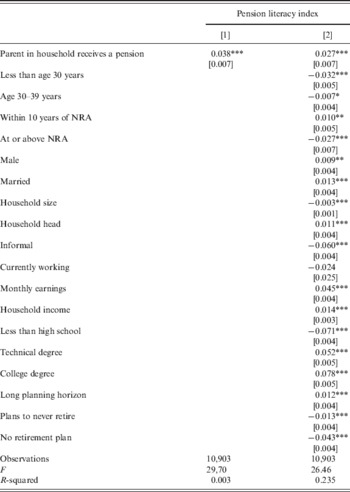
where Pensioner in householdi is a dummy indicating if there is a pensioner in the household. Table 7 shows the first stage regression. The dependent variable in this table is our knowledge measure, and the independent variable is the presence of a parent pensioner in the household. Column 1 shows a strong relationship among these variables, with an associated F test of 29.7, and column 2 shows that the relationship is robust to our set of controls (with an associated F stat of 26.26). This strong first stage shows that the instrument satisfies one of the identification assumptions of the instrumental variable strategy.
Columns 3 and 4 of Table 8 show the results for the second stage regression where knowledge is instrumented by the presence of a parent pensioner in the household. Column 3 shows that when no controls are included, there is a significant effect of knowledge, but the relationship disappears once we add controls (column 4). Putting together the results of Tables 7 and 8, we can see that having a parent pensioner in the household increases its members' knowledge of the pension system, but the induced increase in knowledge does not increase (nor decrease) voluntary pension saving for those whose knowledge of the system increased due to having a pensioner in the household.
First stage: pensioner instrument

Standard errors in brackets. We report F stats of excluded instruments: ***p < 0.01, **p < 0.05, *p < 0.1.
Voluntary pension saving

Note: All regressions with 10,903 respondents who are AFP members, respondent to the 2004 or 2006 EPS waves. The instrument for pension literacy (parent pensioner in the household averaged in 2004 and 2006) is statistically significant at 5% level in all the first-stage regressions. Covariates are age, gender, married household members, work and informal dummies, ln(wage), ln(total household income), household income, year 2006 dummy, education dummies (dropout, technical, and college), dummy if long horizon, no retirement plan, plans to never retire, household head, region density, and region. *Significant at 5%; ***Significant at 1%.
Standard errors in brackets. We report F stats of excluded instruments for IV estimations.
Source: Authors calculation based on EPS 2004 and 2006.
Therefore the strong correlation between knowledge and voluntary pension savings found in the previous section is not a causal relationship from knowledge to savings. There are other unobservables affecting both variables at the same time.
An extreme interpretation of the previous result is that knowledge has no effect on pension savings. Two caveats must be considered: first, it is the induced variation in knowledge caused by the household composition (the presence of a parent pensioner in the household) which appears to have no effect on voluntary pension saving. In other words, variation in knowledge induced by other instruments (such as the pension reports studied by Miranda (Reference Miranda2010) and Fjanzylber et al. (Reference Fajnzylber and Reyes2009) ) might have an effect on voluntary pension savings.Footnote 28 Secondly, individuals can save for retirement outside the pension system. They can buy real estate, have a small firm, or save within the financial system but outside the pension system. Moreover, it could be that pension literate individuals actually decide to save less as we have argued in the introduction. Finally, it could be that voluntary saving within the system is not that attractive or that since avoiding savings is not available within the system, the endogenous reaction occurs outside. Hence, people who get more information may decide to save or borrow outside the pension system, in the financial market.
4.2. Voluntary financial savings
In this section, we focus on the effects of pension knowledge on savings in the financial system at large,Footnote 29 but outside the voluntary options of the pension system. Clearly not every savings in the financial system is intended for pensions. However, financial savings caused by the presence of a parent pensioner in the household can increase savings outside the pension system. As we discussed in the introduction, the information provided by the pensioner is not necessarily reducing uncertainty or bias on the canonical savings decision that would induce the individual to save more as information is revealed to him. We also argued in that section that information could sort investment options within the available savings systems. The induced increase in pension system knowledge might be a manifestation of increased overall financial knowledge. Table 6 shows a monotonically increasing relationship between pension literacy and the percentage of members with financial savings.
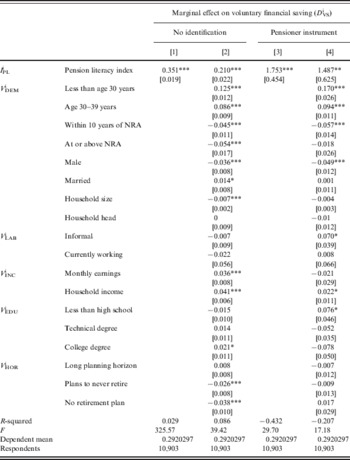
Table 9 shows regressions where the dependent variable is the (average over two periods) existence of any financial saving. As in Table 8, columns 1 and 2 are the OLS results and show a strong correlation between pension knowledge and financial saving. Interestingly, columns 3 and 4 show that when the pension knowledge index is increased by the presence of a parent pensioner in the household, there is a positive and significant effect of pension knowledge on financial savings, even when controls are included. Moreover, the estimated coefficient increases considerably, which could seem puzzling at first glance.
Voluntary financial saving

Note: All regressions with 10,903 respondents who are AFP members, respondent to the 2004 or 2006 EPS waves.
The instrument for pension literacy (parent pensioner in the household averaged in 2004 and 2006) is statistically significant at 5% level in all the first-stage regressions. Covariates are age, gender, married household members, work and informal dummies, ln(wage), ln(total household income), household income, year 2006 dummy, education dummies (dropout, technical, and college), dummy if long horizon, no retirement plan, plans to never retire, household head, region density, and region. *Significant at 5%; ***Significant at 1%.
Standard errors in brackets. We report F stats of excluded instruments for IV estimations.
Source: Authors calculation based on EPS 2004 and 2006.
The instrumental variable strategy identifies the effect of pension knowledge on those individuals who are affected by the instrument. These are the ‘compliers’, those that change their knowledge by having the pensioner in the household and would not change their behavior without it. Therefore, the larger coefficient we find with the instrument can be understood by thinking of the OLS as a (poorly identified) average treatment effect and the instrumental variable result as a local average treatment effect. In other words, the compliers can be thought of as a sub-group of the population for which the information is more relevant.
From the combined results of Section 4.1 and this section, it seems that the additional information and increased financial literacy that is being provided by the pensioner in the household is inducing additional savings by individuals. However, it is not inducing them to save more within the pension system, but rather outside of it. The welfare effect of this analysis is not straightforward. On the one hand, the private return to savings might be higher outside the pension system, but on the other hand, the marginal propensity to consume from savings might be higher on savings outside the pension system because of the mental accounts argument (Thaler, Reference Thaler1994) or by characteristics of the pension system (voluntary pension savings can be withdrawn but with a cost).
On the other hand, the surviving effect of pension literacy on the probability of engaging in financial savings is quite considerable. Remember that the dependent variable has a value of 1 if the individual has saved in both the 2004 and 2006 surveys, 0.5 if only in one period, and 0 if never. Given this rationale, the table shows that a 1% increase in the literacy index increases the probability of financial savings in both periods by almost 1.5%. To mentally calibrate this, remember that our pension literacy index is composed of six questions, so correctly answering one more question is an improvement of slightly less than 17%. Thus, a literacy enhancing shock through a pensioner in the household that induces an additional correct answer generates an approximately 25% additional chance that the individual will save in both periods. Moreover, it means that the probability of saving in at least one period increases by 50%. This is a large effect by any measure.
4.3. Pensions related financial behavior
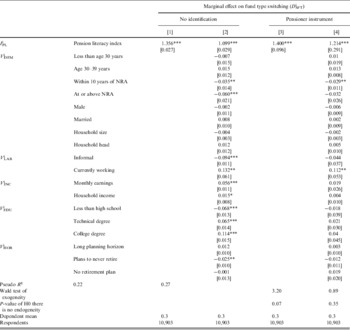
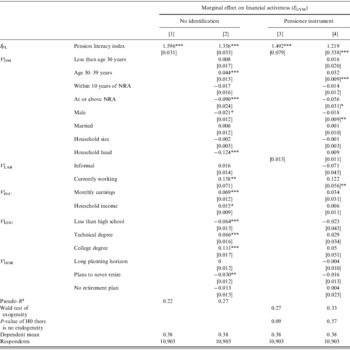
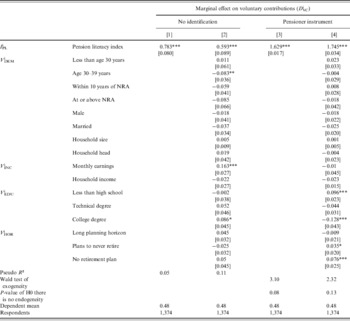
The existence of increased pension literacy can also increase financial behavior, that is, the frequency and sensitivity of pension saving choices. In practical terms, the EPS provides us with four possible measures of financial choices within the system: voluntary affiliation, administrator switching, fund switching (risk-return type), and what we will call fund originality, that is, the propensity to deviate from the fund type automatically assigned. In this section, we will follow the same empirical strategy but with four new dependent variables: a dummy indicating if the self-employed worker is voluntarily affiliated to the system (D VCt), a dummy indicating if the affiliate has ever switched fund administrator (D SFAt), a dummy indicating if the affiliate has ever switched fund type (D SFTt), a dummy indicating if the affiliate has ever had an ‘original’ fund type (D OFTt), and a dummy that summarizes the three later dummies (I GYMt) (the dummies that indicate pension activeness for affiliated, dependant workers) by having value 1 if any of the component variables has a 1 and 0 in the rest of the cases (we call this variable active financial behavior). What we attempt to do with this last measure is to capture as much activity as we can.
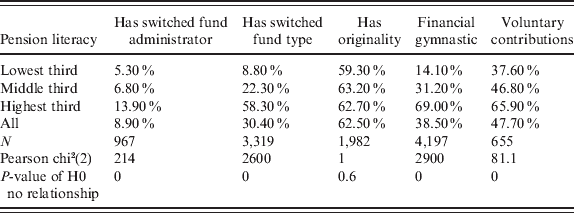
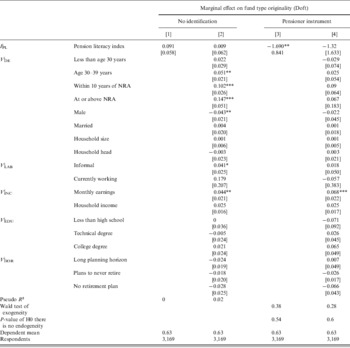
The correlation of each of these measures and knowledge is reported in Table 10. All measures of pension activeness monotonically increase with pension knowledge, with the exception of pension fund originality, which increases from the lowest third of pension literacy to the second but not to the highest third. In any case, we believe that this is a sufficiently robust correlation that we may test it with our identification strategy. Also, this table illustrates why we construct this aggregated activeness measure. It is possible that there is some non-monotonic effect of pension literacy on the originality variable, but what we are in fact finding is that, at the very least at the very lowest levels this is not sufficient for it to be a global effect. The result does contribute, on the other hand, to the testing of the global hypothesis we are addressing in this section.
Pension literacy and financial behavior
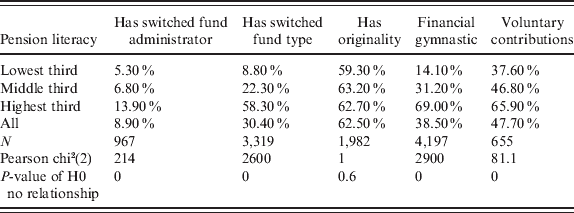
Note: All tabulations with 10,903 respondents who are AFP members and responded to the 2004 or 2006 EPS waves. Individuals are sorted according to their pension literacy index in three categories: lowest (33%), middle (22–66 %), and highest (66% and more).
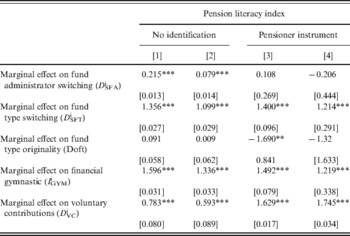
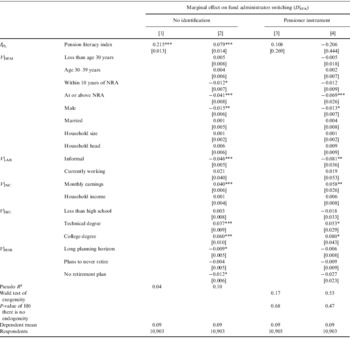
Table 11 summarizes the results of these regressions by showing only the parameters and significance for the pension finance literacy parameter. As we can see, most of the correlation we reported in Table 10 survives controls in the regressions of the second columns of these tables. Pension Fund type originality does not appear as significantly correlated, as we saw in Table 10. Looking down the second column of all of these tables (full results in Appendix Tables A1–A5), we can see that individual income levels seem to have a positive effect in inducing active financial behavior. It also seems that being closer to the retirement age also induces significantly less active behavior, and that education induces more active behavior.
Pension literacy index estimators by model estimated

Columns 3 and 4 show the effect of the identification strategy using the pensioner instrument. The effect on pension fund administrator switching does not hold when the pension literacy index is instrumented with having a pensioner in the household, but pension fund type switching result does. However, when aggregated in the overall measure that we have denominated pension behavior, the significant effect survives. An increase of 1% in correct answers increases the probability of behavior changes by 1.2%. To mentally calibrate this, remember that our pension literacy index is composed of six questions, so getting one more answer right is an improvement of slightly less than 17%, so a literacy enhancing shock through a pensioner in the household that induces an additional correct answer generates almost a 20% increase in the probability of engaging in pension fund type switching and financial activeness.
The effect of pension literacy on voluntary contributions by self-employed workers also increases with the instrumental variable. In this case, an increase of one correct answer by the self-employed individual increases his probability of voluntary affiliation to the system by almost 30%, which is quite a big effect.
Interestingly, the instrumented regression also selects among the rest of the controls, showing that different things seem to have an effect on different types of pension active financial behaviors (see Tables A1–A5). The distance of the retirement age continues to have a positive effect on active financial behavior, some significance survives on the effect of education on the probability of pension fund administrator switching and employment status on fund switching (which makes sense), and individual income levels seem to increase the probability of having pension originality (which also makes sense). Finally, it seems quite interesting that men seem less likely to involve themselves in pension finance activeness, although we do not have an intuition for why.
4.4. Discussion of the empirical strategy
As previously noted, our empirical strategy relies on two identification assumptions: the instrument (having a pensioner in the household) being strongly correlated with the pension knowledge index and the instrument being uncorrelated with the error term in the second stage. We provide evidence to support the first assumption in Section 4.1.1. In this section, we discuss the second assumption and provide evidence that in our view strongly persuades that this assumption holds. In this section, we also discuss the external validity of the results.
One of the major potential limitations of an identification strategy such as the one implemented in this paper is the possibility that family structure is endogenous. Consider, for example, the possibility that the parent decides endogenously to live with the wealthier or the more ‘financially competent’ of his children. This could happen by rational choice of the parent or by a negotiated arrangement between the children. If this were so, then we would have to assume that the correlation between ‘pension financial literacy’ and having a pensioner or parent in the household could indicate an inverse causality than the one we need for our identification strategy.
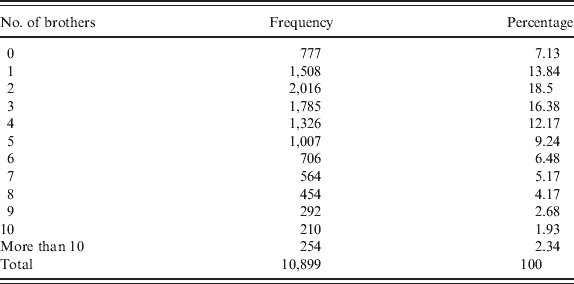
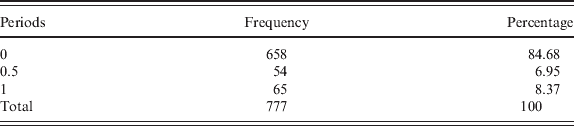
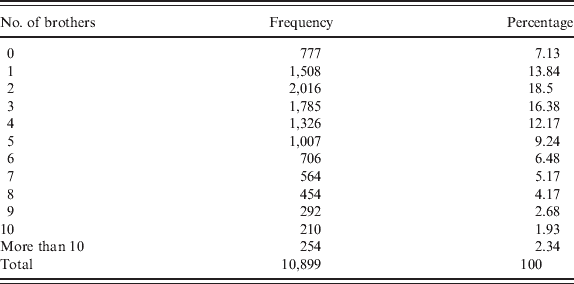
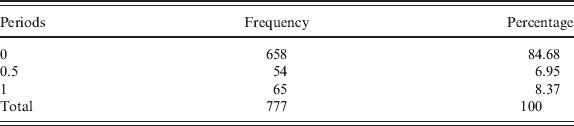
To address this concern, we restricted the sample to single children. This reduces the sample size but allows us to look at a sub-sample where the choice of parental living arrangements is severely restricted. Table A6 in the appendix summarizes the number of brothers that different households have within the samples we are using. Single child household heads and partners represent only 7.13% of the sample (we go from almost 11,000 observations to just under 800). This is a severe information cost, which is why we prefer the estimations with the whole database and only use these estimations to check for robustness. Table A7 serves to illustrate the information cost we are incurring. Of the 777 observations that survive, we have only 65 in which the household has had a pensioner in the household for both periods and a mere 54 more in which the pensioner has been present in one period.
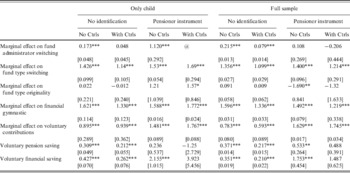
We run the full set of regressions that are summarized in Table A8 where we repeat the results of Tables 8 and 9 as well as the summary of financial behavior results from Table 11 to facilitate comparability for the reader. Owing to the information cost of restricting the sample, we are also unable to get convergence in the estimations with pensioner instrument for pension fund administrator switching and controls (column 4, line 1). This is the only case that we are unable to run.
What is remarkable is that with very few exceptions, the results survive this very intense reduction in sample size. Moreover, the effect of information as identified by our instrument seems to survive both in signs and levels. The only differences we find are two. First, we now lose the significance of pension literacy on pension savings in the no controls case. Second, we gain significance (with a negative sign) in the effect of information on pension fund originality in the no controls case. The effect disappears in the case with controls. We interpret these results to be a very good indication that household endogeneity is not driving our results.
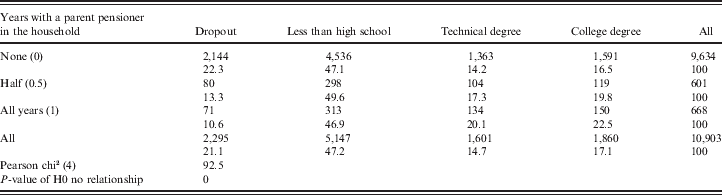
Despite these results, one can still wonder about the pensioner's decision process that leads him to live with a child. For example, if there is correlation between living with a child and income, education, health status, and/or risk aversion. Tables A9 and A10 show the correlation of multigenerational households and of living with a pensioner with both income and education levels of the household head. In this case, we find that the distributions seem to be close to uniformity although there does seem to be some slightly larger propensity of less educated and poorer households to be multigenerational. However, this distribution works against the significance of our results since voluntary pension saving and financial savings are overwhelmingly a higher income behavior.
To address the possibility that parent pensioners who are more risk averse have children who are also more risk averse, leading both to save more and seek out more financial knowledge, we use the EPS' questionnaire on risk aversion. To investigate the relationship between risk aversion and having a pensioner in the household, we computed the average risk aversion (over the two years of the survey) of the household head according to the answers to the EPS questions and correlate it with the number of years of having a pensioner in the household. The correlation between these two variables is 0.0008 (p-value 0.75) and it is statistically not significant. Therefore, there does not seem to be any clear pattern by which more risk averse households have a higher propensity to have pensioners in their households.
Also, to address the possibility that the unobserved determining factor for parent pensioners to live with their children and become more financially literate is their health, we constructed a dummy variable for disability of the parent and compute a correlation between the pension finance literacy index with a probit regression where the dependent variable is the health dummy and the independent variable is the financial literacy index of the household head. The associated coefficient is small and has no statistical significance. We also computed the correlation between the disability of the parent and living in a multigenerational household. The correlation is 0.005, and not significant.
Summing up, although we cannot fully understand the decision making of parents and their children of living together, we can see that our results do not depend on deciding the type of match, considering that results are robust to restricting the sample to single children. We also show that the decision is not related to health status or risk aversion. There is a relationship between multigenerational households and education/income of the household head. However, although poorer/less educated households tend to have more generations in the household, intergenerational households are found in all of the income distributions. Therefore, results are not representative only of more vulnerable household heads.
4.5 Information content
We have shown what we see as strong evidence that pension financial literacy generates more savings in the financial sector, but not in the pension system. We also show that more active financial behavior in general for those household heads with a pensioner living in the household. This increase in information can be directly transmitted from the pensioner to the household head or having the pensioner in the household could show the household head the importance of saving for retirement, which could increase their knowledge of the pension system. Related to this concern, it would be interesting to understand what is the nature of the increased information that is a result of this interaction? In particular, we have used as a measure of pension financial literacy, an index that summarizes the responses of six questions regarding the pension system. It is natural to wonder which questions are driving the results.
In order to address the first issue, we consider the effect of having head of household's parent living in the household, independent of pension status, and the effect of having a non-AFP pensioner on pension financial literacy. In both cases, we find that there is a still a strong first stage. Therefore, the change in information about the AFP system induced by having a pensioner seems to be associated with creating a demand for this information, rather than by a direct transmission of knowledge of the system.
In order to explore which questions are serving as information mechanisms, we performed two types of analysis.Footnote 30 First, in order to understand what type of knowledge having a pensioner in the household changed, we conduct the analysis using each question used to construct the pension financial literacy separately. We find that having a pensioner in the household is correlated with questions 2, 3 and 5. Thus, the household head is more likely to know his account balance, investment policy, and retirement age. Importantly, we find that our main results – the lack of effect of pension literacy on voluntary pension savings, and the strong effect on voluntary financial savings – holds in all questions for which the instrument is valid. We still believe that the aggregate index is preferable to the question by question approach due to possible complementarities between the questions. However, it is still possible that there are different types of questions. So, secondly, to address this possibility we aggregate the questions in two indexes: one of ‘general knowledge of the pension system’ (q1, q4–6) and another of ‘knowledge about personal account’ (q2 and q3). The correlation between both measures is 0.3168 and is significant at 1%. The first stage indicates that the instrument is valid for both indices, and our results continue to hold.
Hence, we are able to discard some hypotheses on the information transmitted between the pensioner and the household head. It does not seem to be related to an AFP experience by the pensioner and does not seem to be related to specific types of information. For the moment all we can say is that it seems to be related to a general pension awareness induced by the pensioner.
5. Discussion and conclusion
Chileans with greater knowledge about the pension system are more likely to have additional financial savings, but not within the voluntary pension saving plans offered by the pension system. This positive association between pension finance literacy and financial savings survives controls and an identification strategy that relies on instrumenting pension knowledge with the presence of a parent pensioner in the household, which is shown to be strongly correlated with pension literacy. This arguably has the desired exogeneity properties and is very likely to indicate exogenous access to more information on the system. However, considering the nature of the instrument, the pension knowledge effect that we analyze is the one that is transmitted within the household by having a pensioner in the household. This should be kept in mind when considering the results. We find that getting one additional answer right in the pension literacy survey (out of six) generates approximately a 50% additional chance that the individual will save in at least in one period and a 25% additional chance that the individual will save in both periods surveyed. We also test for evidence that pension literacy affects worker's pension choices (what we call active financial behavior). We find that more literate workers are more likely to engage in pension fund type switching and that independent workers are more likely to voluntarily enter the pension system as affiliates if they have pension knowledge. Getting one additional answer right in the pension literacy survey (out of six) increases by 20% the probability of pension fund type switching and by 30% the probability of voluntary affiliation to the pension system of self-employed workers. The results seem to be robust to the restriction of the sample to single child household heads and partners to control for household structure endogeneity. The effects of information on savings seem to disappear when we use seniors living in the household rather than pensioners, indicating that the latter may have more information to contribute to the household.
In our view, these results show that information is having some potentially relevant effects on savings amounts as well as savings strategies. It is particularly important when trying to increase the probability of certain types of pension finance behavior, which we believe is associated with a noise reduction effect of the information, provided that is increasing the sensitivity.
As we discussed in Section 4 what we have in is a proxy of information and pension literacy. Even when we identify the effect by instrumenting with the pensioner in the household, we do not truly know what the transmission mechanism of information is or what actual information is being transmitted. We ran a complete set of results on a question by question basis instead of the index that compiles the information provided in each question reported in the paper. The results are very consistent with the index, although indicate that some questions are more important than others. However, we do not have sufficiently rich data to actually grasp what type of information is being transmitted. What we do know is that the information is correlated with our measure of pension literacy. Hence, the formulation of well-designed ‘information policies’ directed toward actual and potential affiliates of the pension system would most likely require a more profound and directed inquiry into the actual content of the information that individuals actually consider as important in determining their savings strategy.
We believe that the results documented in this paper for the case of Chile, one of the original countries that implemented individual retirement accounts, are consistent with most of the findings of the financial literacy literature. There is growing evidence, coming from a variety of economies and institutional settings, showing the effects that financial literacy has on financial behavior and, more recently, peer effects on financial literacy and behavior. This paper shows another mechanism of information acquisition that could play a significant role in determining financial decisions regarding pensions. In addition, it gives indications of a very important role played by pension finance literacy.
Appendix 1: Tables
Pension fund administrator switching

Pension fund type switching

Pension fund type originality

Financial activeness

Voluntary contributions by self-employed

Distribution of brothers of household head and partner
Distribution of time with the pensioner for single children household heads and partners
Pension literacy index estimators by model, comparative for full and ‘only child’ samples

Correlation between generations in a household and income quintile education

Parent pensioner in the household and education level
Appendix 2: Pension finance knowledge questions
The wording of the questions is reported in a summarized way in section 2.2. All of the questions have the option ‘I do not know’ but otherwise vary in their answer options.
Question 1 (Do you know what is the monthly contribution as a percent of your earnings?) allows for the answers: ‘yes’ and ‘no’; in the ‘yes’ case it continues by asking for the percentage; in the ‘no’ case it is followed by the question ‘In what range do you believe it is?’ while the surveyed individual is shown a card with a couple of alternatives.
Question 2 (What is your account balance?) works in the same way as question 1.
Question 3 (Do you know in which type of fund are your funds invested?) has options ‘yes’ and ‘no’.
Question 4 (Do you know how the pensions from the AFPs are calculated?) has three options: (a) based on the wages of recent years; (b) considering the amount of the account, retirement age, and other factors; and (c) don't know.
Question 5 (Do you know your legal retirement age?) has options ‘yes’ and ‘no’ with the follow up asking for the age if the answer is yes.
Question 6 (Do you know the conditions for the minimum pension benefit?) has five options: (a) a minimum number of contributions (if ticked this detonates the question of how many); (b) having a pension that is lower than the minimum; (c) being in a situation of poverty; (d) other requisites (if ticked detonates ‘which?’); and (e) does not know.