1. Introduction
Among the many sovereign powers that a country retains when it joins the World Trade Organization (WTO) is the right to inspect, regulate, and, if necessary, ban the import of diseased agricultural products. Given the importance of agriculture to the economic sustenance of large swaths of the population in many countries, particularly in the developing world, a government has a responsibility to ensure that imported agricultural products do not lead to the introduction of pests, which could devastate domestic crops or livestock.
However, this power, if left unchecked, can be transformed into a form of protectionism. Suppose an outbreak of an agricultural disease occurs in an exporting country. Can an importing country use this outbreak as justification to ban all imports of the product from the exporting country? Allowing full discretion to do so might seem excessive. After all, non-diseased versions of the product might also be produced in another part of the exporting country, far away from the outbreak of the disease. On the other hand, under certain circumstances, an absolute ban might make sense, especially if the disease can spread easily and the exporting country has taken inadequate steps to contain the spread of the disease.
To balance this right to regulate and the need to prevent its abuse as a form of disguised protectionism, governments, when signing the WTO Agreements, agreed to the Agreement on Sanitary and Phytosanitary (SPS) measures. This agreement lays out a series of obligations that both the importing and exporting states must fulfill when faced with a disease outbreak. In particular, Article 6 discusses a series of obligations that must be upheld when countries are adapting regulatory measures that deviate from international standards. The Article stipulates that regulatory adaptations must fit the circumstances of the disease outbreak, including appropriate consideration of whether these adapted measures ought to be imposed on a more limited regional basis rather than applied to all exports.
In recent years, a number of cases concerning diseased agriculture products have surfaced before the Dispute Settlement Body, due to outbreaks impacting poultry and swine. Many of the countries facing the disease outbreaks have been geographically large economic entities, such as the United States and European Union. Consequently, these disputes have required that the Appellate Body focus on questions concerning adaptation and regionalization of SPS measures, given that the agricultural exports from the entire economic area may not face the dangers of agricultural disease.
In India–Agricultural Products, the Appellate Body clarified that it is the obligation of the importing government to adapt and adjust the contours of an SPS measure, not only at the outset, when the measure is adopted, but, also over time as the nature of the agricultural disease evolves, as long as the SPS measure is maintained.Footnote 1 But what exactly does this mean in practice? And how does this obligation interface with the concurrent obligation of the exporting country to provide information about the disease over time? After all, an importing country relies in part on information provided by the exporting country in order to tailor and adapt its own measure. What if this information from the exporting country is inadequate or incomplete? Can the importing country nevertheless be held in breach?
The latest dispute to highlight these questions is the Russia–Pigs case,Footnote 2 a dispute between Russia and the European Union over pork products from regions facing a possible outbreak of African swine fever (ASF). To prevent the spread of diseased products into its territory, Russia imposed an absolute ban on all European pork products. This was despite the fact that several exports were produced in regions far away from the diseased areas. In February 2017, the Appellate Body ruled that Russia's actions violated its WTO obligations.
While the DSB found the Russian Federation to have violated several obligations, this Article focuses on the questions of adaptation and regionalization as required by Article 6 of the SPS Agreement. In particular, it draws attention to how the Appellate Body views the relationship between the various provisions within Article 6 itself.
What makes this set of questions particularly interesting is the fact that Article 6 imposes legal obligations on not only the importing country imposing the SPS measure, but also the exporting country. Hence, not only does the WTO member accused of the breach have certain legal obligations that it must uphold, so too does the trading partner alleging the breach. How are we to consider the interrelationship between these two sets of obligations? After all, as noted above, the importing member requires information from the exporting member in order to adapt its SPS measures to fit the circumstances at hand.
In Russia–Pigs, the Appellate Body went so far as to state that ‘a panel should conduct a careful case-by-case examination, based on all relevant circumstances’Footnote 3 before opining on whether an importing state had violated its WTO obligations in light of the actions of the exporting state. But again, what exactly does this mean? The Appellate Body offers guidance, but it does not explicitly answer this question. It only condemns the Panel in this dispute for having done an inadequate job, but leaves it to future jurisprudence to spell out the answer.
This Article picks up from this open question. We argue that considerable attention ought to be given to the risks associated with the potential geographical and cross-sector spread of agricultural disease via third-country trade and supply chain linkages. Using a simple economic framework, we identify four distinct classes of potential negative externalities that may stem from the transmission of agricultural disease: bilateral externalities, which are the focus of most existing studies; sequential and pass-through externalities, which may indirectly transmit disease through ostensibly unaffected third countries; and supply chain externalities, which can propagate agricultural disease through backward and forward supply chain linkages across products. Our analysis highlights how potential differences in these transmission mechanisms play an important role in explaining whether or not a far-reaching ban on imports from non-diseased regions or product classes is justified. To the extent that this information is not forthcoming from the exporting member, it will be difficult to expect that an importing member will necessarily be able to adapt or develop a regionalized SPS measure that protects its interests. Therefore, we suggest that future WTO panels, when conducting the required case-by-case analysis of relevant circumstances commanded by the Appellate Body in Russia–Pigs, ought to pay particular attention to these factors.
This Article is organized as follows. Section 2 explains the background facts of the Russia–Pigs dispute. Section 3 then focuses specifically on the law at issue, concerning adaptation and regionalization, and discusses how the questions raised in the Russia–Pigs dispute are resolved by the Appellate Body. Section 4 then identifies and defines four distinct classes of cross-border and cross-product externalities associated with trade in agricultural products, and outlines a simple list of guiding questions for consideration in future disputes. Section 5 offers a few concluding thoughts.
2. Background
The recent dispute between Russia and the EU over Russian efforts to contain ASF illustrates the difficult challenges confronting jurists in ascertaining whether a government has imposed an overly excessive SPS measure against imports in an effort to safeguard its domestic agricultural products against a potentially deadly disease.
The disease which Russia sought to contain, ASF, is a highly contagious hemorrhagic disease that impacts pigs, warthogs, European wild boar, and American wild pigs. It is transmitted via the African swine fever virus. The warthog serves as a natural reservoir of the virus, without any sign of the disease, and the virus is found in all body fluids and tissues of infected animals. ASF is spread by soft ticks, biting flies, and other blood-sucking insects. In addition, the disease can also be contracted through direct contact with bodily fluids of infected pigs or ingesting garbage containing unprocessed infected pig products. The impact of infestation varies depending on the virulence of the ASF virus. Severe cases of the disease result in high fever and death within two to ten days on average, with mortality rates as high as 100%. Other clinical signs associated with the severe form include loss of appetite, depression, respiratory distress, vomiting, bleeding from the nose and rectum, and sometimes diarrhea. Moderately virulent forms of the virus produce less intense systems, but mortality rates can still range from 30% to 70%. The ASF virus is not a threat to humans (OIE, 2013).
ASF first appeared in 1960 with outbreaks in Spain, Portugal, and Sardinia. Severe epidemics have occurred over the years in Brazil, Haiti, and the Dominican Republic. In Europe, ASF was eradicated from Portugal in 1993 and from Spain in 1995, but it remains enzootic in Sardinia. Limited outbreaks have also occurred in Belgium and the Netherlands in the mid-1980s, but these were quickly eradicated (ibid.). Outside of Sardinia, ASF also remains enzootic in most countries in Sub-Saharan Africa.
Given the severe threat to domestic livestock posed by an outbreak of ASF, governments worldwide are keen to contain its spread. Outbreaks of ASF must be reported to the World Organization for Animal Health (OIE). The disease is covered by Chapter 15.1 of the OIE Terrestrial Code. At least one commentator has described ASF as the ‘most dangerous and emerging swine disease worldwide’ due to the lack of any effective vaccine against the disease. (Kolbasov et al., Reference Kolbasov, Titov, Tsybanov, Gogin and Malogolovkin2018: 796).
2.1 Russian efforts to contain African swine fever
In 2007, an outbreak of ASF occurred in Georgia. It spread to other nearby countries including Azerbaijan and Armenia. By late 2007, the disease had been introduced to southern Russia; authorities reported five cases of infected boars to the OIE in November–December 2007. While the disease was initially confined to the Caucusus, beginning in 2011, ASF jumped to other parts of western Russia and up as far as the Arctic. The wild boar population, the military supply chain, and the infiltration of cheap infected products in the domestic marketing chain are all believed to be factors which contributed to the disease's spread within Russia. (Dietze et al., Reference Dietze, Beltran-Alcrudo, Khomenko, Seck, Pinto, Diallo, Lamien, Lubroth, Martin and Rozstalnyy2012: 3; Khomenko et al., Reference Khomenko, Titov, Tsybanov, Gogin and Malogolovkin2013: 1–8) Given the disease's harsh impact, this raised alarm within Russia's veterinary service.
The deteriorating situation in Russia and trans-Caucasian countries raised concerns within the EU that ASF could spread to its territories. As early as 2010, EU officials raised the possibility that live pigs, and particularly wild boar, in the eastern EU member states were vulnerable to infection.Footnote 4
In 2012, ASF was detected in Ukraine. Russian authorities were quick to blame Ukraine's lax transport rules for hand luggage on trains between the two countries for the spread, noting that Ukraine should have adhered to the more stringent EU standards (ter Beek, Reference ter Beek2012). In 2013, ASF was reported in Belarus, a fellow member of the Eurasian Customs Union (EACU). The Russian Federal Service for Veterinary and Phytosanitary Supervision (Rosselkhoznadzor) quickly introduced a temporary ban on pork and pork products from Belarus in line with EACU rules (Vorotnikov, Reference Vorotnikov2013).
Alarmed with the spread of ASF in western Russia and keen to contain its movement northward, Russian authorities once again acted quickly when an outbreak of ASF was reported in Lithuania on 24 January 2014. The next day, they issued an administrative notice announcing a temporary restriction on imports of ‘live pigs and its genetic material; pork products (which were not heat treated no less than 72°C for at least 30 minutes); [and] products from the slaughter of wild boars’ from Lithuania.Footnote 5 The restriction also extended to ‘horn-hoofed and leather; intestinal matters; bristles; feed for pigs; hunting trophies, which were not subjected to full taxidermy treatment; [and] previously used equipment for maintenance, transportation, slaughter and cutting of pigs’.Footnote 6
Because the WTO litigation occurred in the backdrop of deteriorating tensions between the EU and Russia over Crimea, it is worth noting that Russia's initial actions in curbing European pork imports were not motivated by a desire to retaliate against European sanctions. Instead, its introduction of a temporary ban against pork and pork products from Lithuania was largely in line with its actions following ASF outbreaks in other neighboring countries. The Crimea crisis would not arise until November 2014, well after the bans were already in place.
However, unlike the other neighboring countries with ASF outbreaks (i.e., Georgia, Azerbaijan, Armenia, Belarus, and Ukraine), Lithuania was a member of a customs union to which Russia did not belong, namely the EU. This meant that, in principle, its live pigs, pork, and pork products could flow freely to the other 27 countries. Worried that contaminated Lithuanian pigs, pork, and pork products might have already made its way into the markets of other EU countries, Russian authorities sought to curtail imports of these products from the EU as a whole.
However, unlike the other bans, this was not done through an administrative notice. Instead, on 29 January 2014, Rosselkhoznadzor simply sent a letter to the EU concerning European export certificates. It noted that the certificate contained the phrase ‘healthy animals grown in farms and/or administrative territories officially free from contagious animal diseases, including African swine fever during three years in the whole territory of the EU except Sardinia’.Footnote 7 Russian authorities requested ‘veterinary doctors in the EU Member-States must stop certification’ of such exports, or else ‘products accompany[ing] certificates issued after 27.01.2014 [would be] subject to returns’.Footnote 8 In other words, Russian authorities sought to deny all European live pigs, pork, and pork products from entering the Russian market on the grounds that its export certificates were no longer accurate.
The following month, ASF spread to yet another EU member state. On 3 February, a wild male boar was found frozen and dead in Poland in an area less than a kilometer away from the Belarus border. Ten days later, a sample was finally collected from the boar (as it had been impossible to do so while it was frozen) and was sent for testing. Two days later, a second wild boar was found dead, approximately fifteen kilometers away from the first and three kilometers away from the Belarus border. On 17 February 2014, Polish authorities confirmed that the wild boar had contracted ASF (Jazdzewski and Popiolek, Reference Jazdzewski and Popiolek2014). Russian authorities then issued an administrative notice on 27 February 2014 proclaiming a temporary ban on the same range of Polish exports as that applied to Lithuania.Footnote 9
On 2 April 2014, Russian authorities announced that they would expand the import restrictions to include processing products containing pork from Lithuania and Poland.Footnote 10 Exclusion would apply to ready-to-use feed, which had undergone heat treatment, for cats and dogs.Footnote 11 Russia promptly reported each of the specific administrative notices imposing import restrictions against Lithuanian and Polish products to the WTO.
In late June 2014, a wild boar infected with ASF was found in Latvia, close to the Belarussian border. The outbreak quickly spread northward (Ojsevskis et al., 2016). On 2 September 2014, the first wild boar infected with ASF was discovered in southern Estonia near the Latvian border; a second ASF-positive wild boar was found a week later in a different county also bordering Latvia. On 14 September 2014, Estonian officials also reported finding an ASF-positive wild boar in northeastern Estonia in a county bordering Russia (Nurmoja et al., Reference Nurmoja, Schulz, Staubach, Sauter-Louis, Depner, Conraths and Viltrop2017). Russian authorities promptly enacted import restrictions against Latvian and Estonian products, similar to those applied against Lithuanian and Polish products.Footnote 12
Despite these severe import restrictions, ASF has continued to spread in Russia. By 2017, outbreaks had been reported in places as far east as the Irkutsk region in Siberia (Kolbasov, Reference Kolbasov, Titov, Tsybanov, Gogin and Malogolovkin2018). Overall, ASF has had a devastating impact on small-scale pig farmers in rural Russia. Rosselkhoznadzor reports that for the period of 2007–2017, Russia has experienced more than 1,000 outbreaks spanning across 46 different regions, leading to the death or slaughter of over 800,000 domesticated pigs. The backyard swine industry has declined by almost 50%, from 1,119 tons of pork in 2007 to 608 tons in 2017 (Kolbasov et al., Reference Kolbasov, Titov, Tsybanov, Gogin and Malogolovkin2018: 796). However, the ASF epidemic so far has managed to avoid impacting large-scale industrialized Russian pig farms.
Since 2014, ASF has also spread within the EU itself. In 2017, ASF was detected in two wild boars in the Czech Republic, about 400 kilometers from the nearest infected population at the time and demonstrating the disease's westward spread (Mueller, Reference Mueller2017; Stokstad, Reference Stokstad2017). ASF cases were also reported among backyard domestic pigs in Romania (Marinas, Reference Marinas2017). Hence, Russian authorities are not alone in dealing with a gradually worsening crisis. The struggle of veterinary services worldwide has been to take measures necessary to curb the speed and scale of the disease's spread.
Given the potentially devastating consequences of ASF, there is no doubt that a sovereign government retains the right to take action to prevent its spread. However, when it comes to taking action against imports from an infested country, the question is whether the actions taken are in line with what is required or excessive. It is on these questions that the EU and Russia disagree.
2.2 Economic impact of ASF and Russian trade restrictions
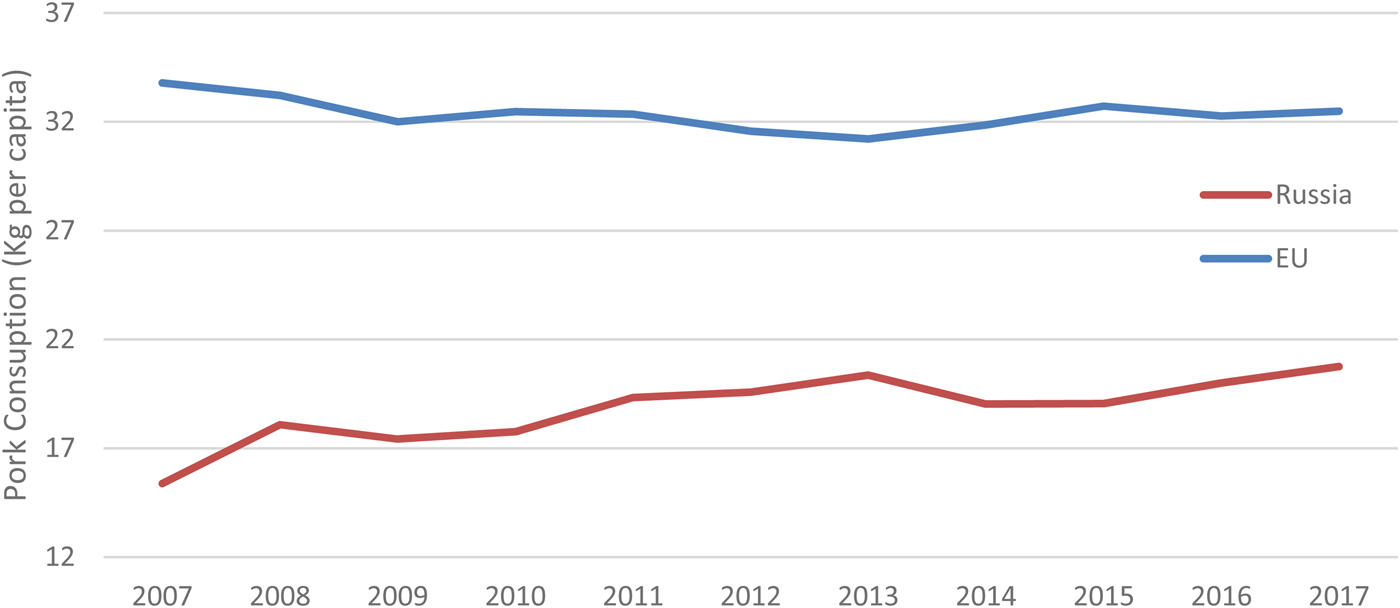
While the European ASF outbreak and subsequent trade restrictions had a powerful effect on the pattern of trade in swine and pork products, there was little discernable change in pork consumption over the same time frame.
According to data collected by the OECD (2018), consumption of pork in Russia fell somewhat as the dispute unfolded, but the quantitative effects on consumption were decidedly modest. As shown in Figure 1, Russian per capita pork consumption reached its lowest level in 2014, but even then the decline marked less than a 3% drop from 2012 consumption levels. By 2016, Russian consumption had surpassed 2012 levels. Meanwhile, European per capita pork consumption increased very slightly after 2012 (marking less than a 1% gain in 2014 relative to 2012) and remained steady thereafter.
Pork Consumption: EU and Russia, 2007–2017

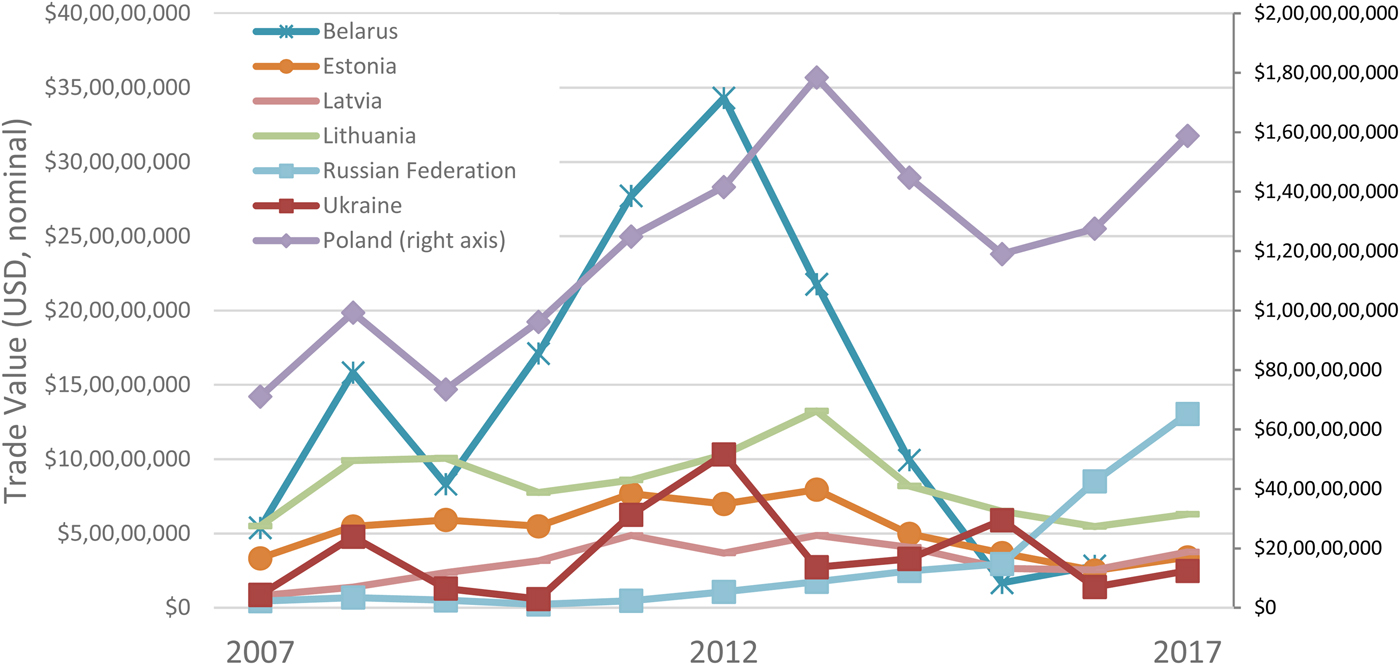
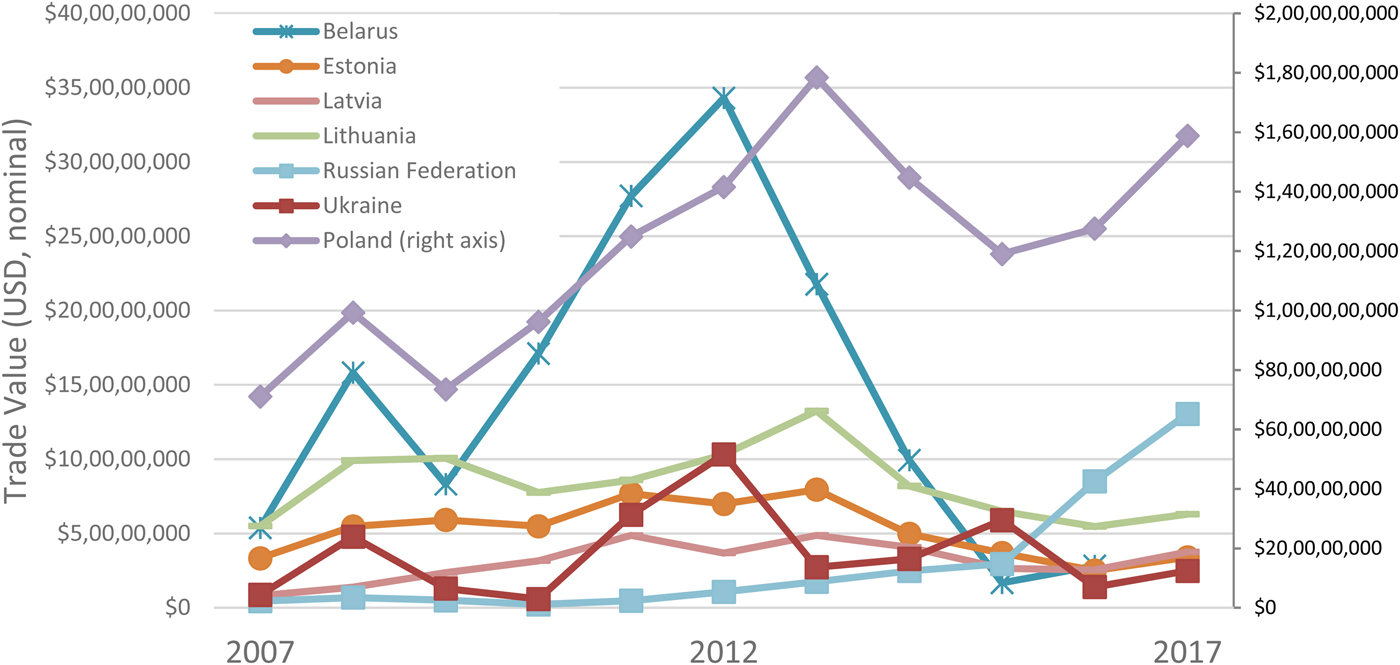
Data on trade patterns from UN ComtradeFootnote 13 tell a different story in Figure 2. The ASF outbreak and subsequent trade restrictions coincided with a marked change in imports and exports of swine and pork products in Europe and in Russia. Exports of swine and pork fell precipitously after 2012 for many of the European countries directly impacted by ASF. Consistent with the timing of the initial ASF outbreaks, pork exports fell first in Belarus and Ukraine starting in 2013, followed by a sharp decline in exports from Poland and the Baltics in the subsequent year.Footnote 14 In contrast, Russian exports of swine and pork products rose over the same period, increasing modestly from 2012 to 2015, surging rapidly thereafter; by 2017, Russian swine and pork exports were more than 25 times higher than their 2007 pre-ASF levels, constituting an important commercial export for Russia's farmers.
Total export of swine and pork: ASF-affected countries 2007–2017
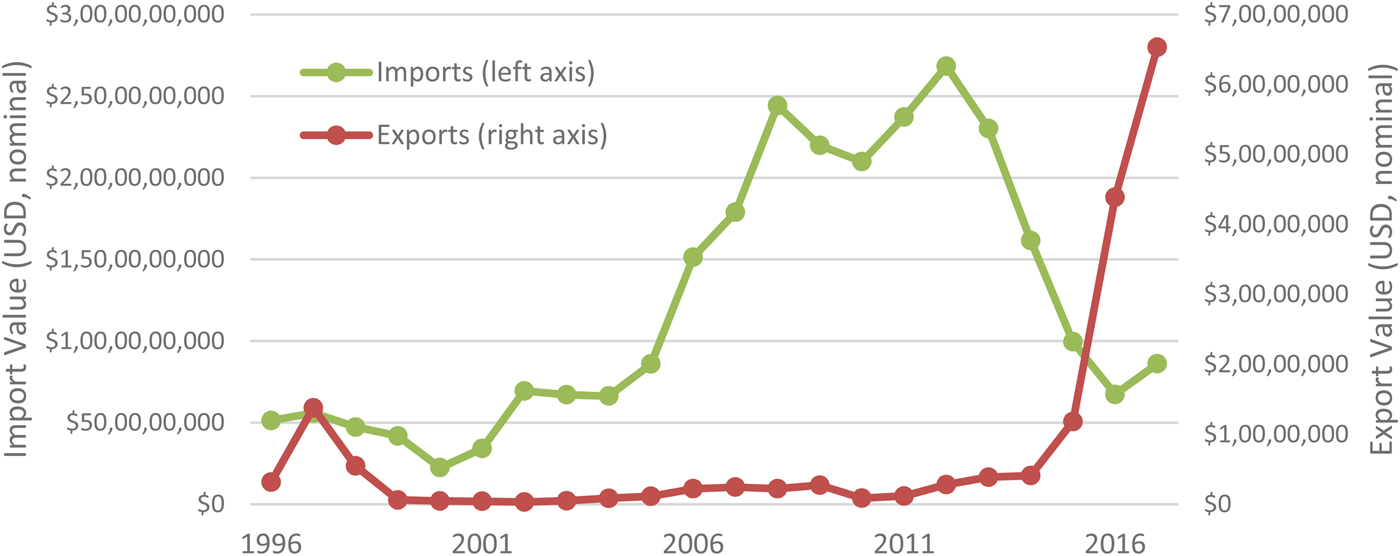
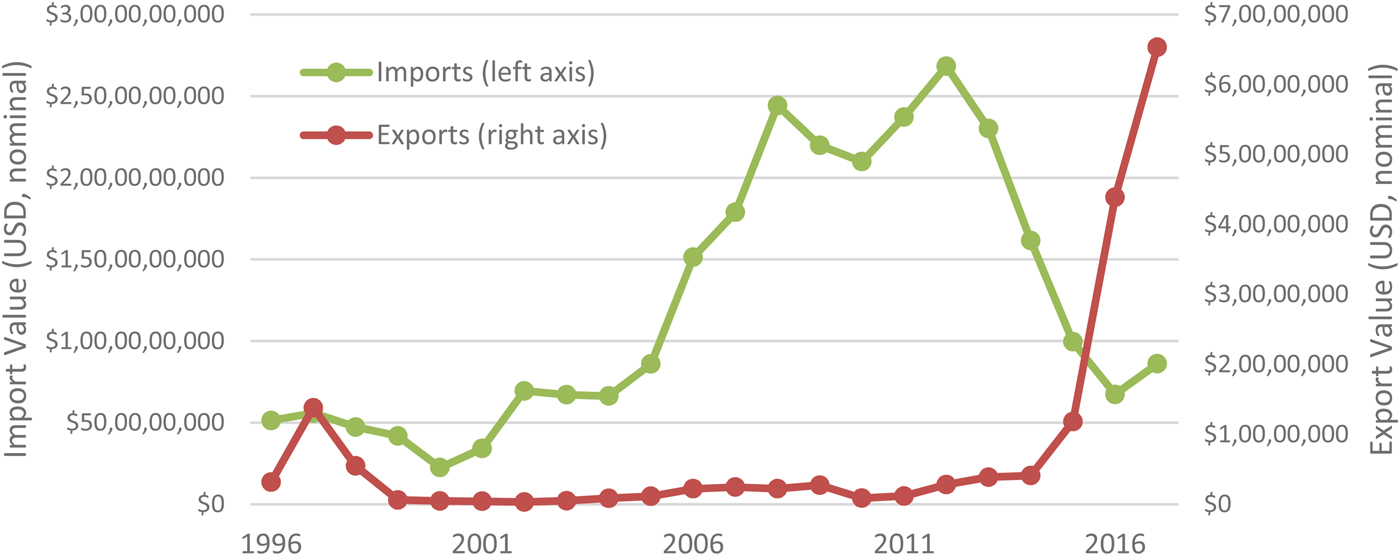
During the same time period, Russian imports of swine and pork products plummeted. The timing of the 2012 outbreaks is clearly seen in Figure 3, where Russia's imports of affected products decline precipitously after 2012. As noted above, the initial change in Russia's exports of the same products was modest before 2015, after which exports surged.
Russian swine and pork trade 1996–2017
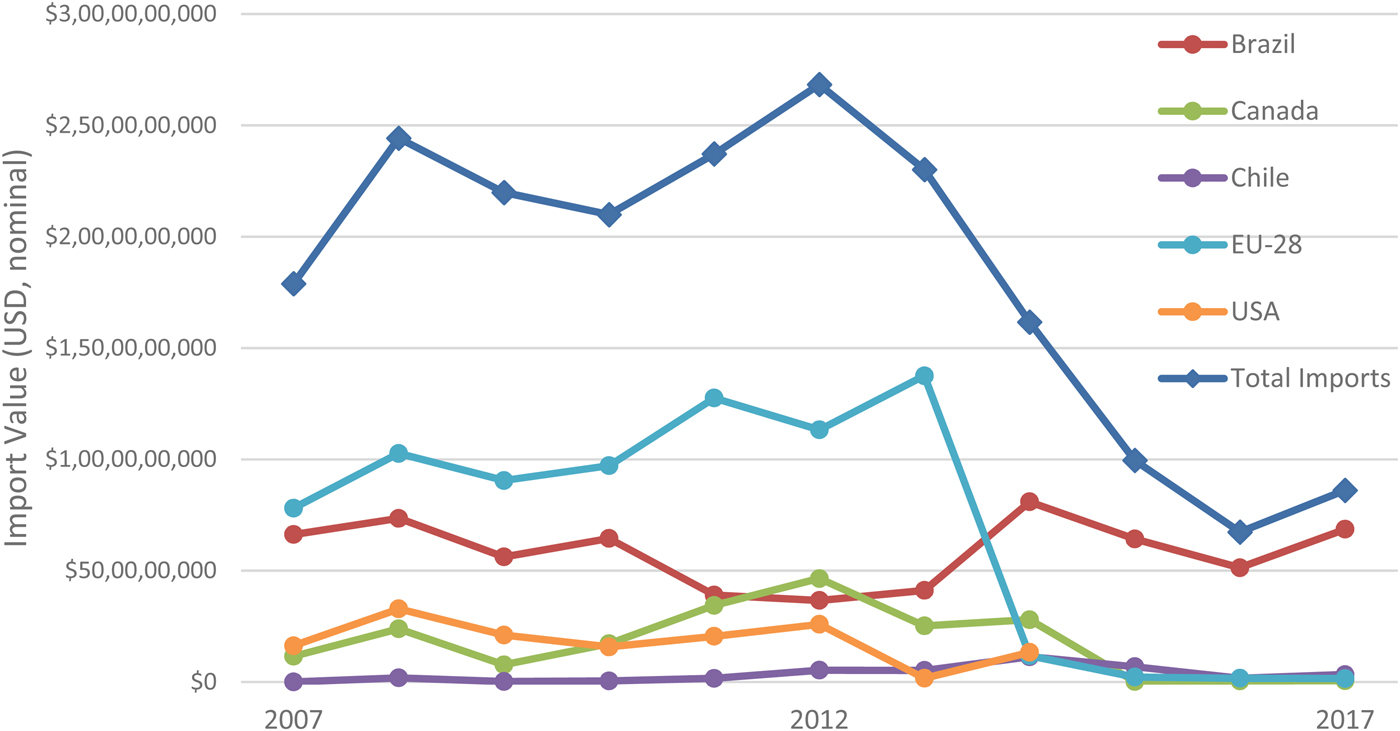
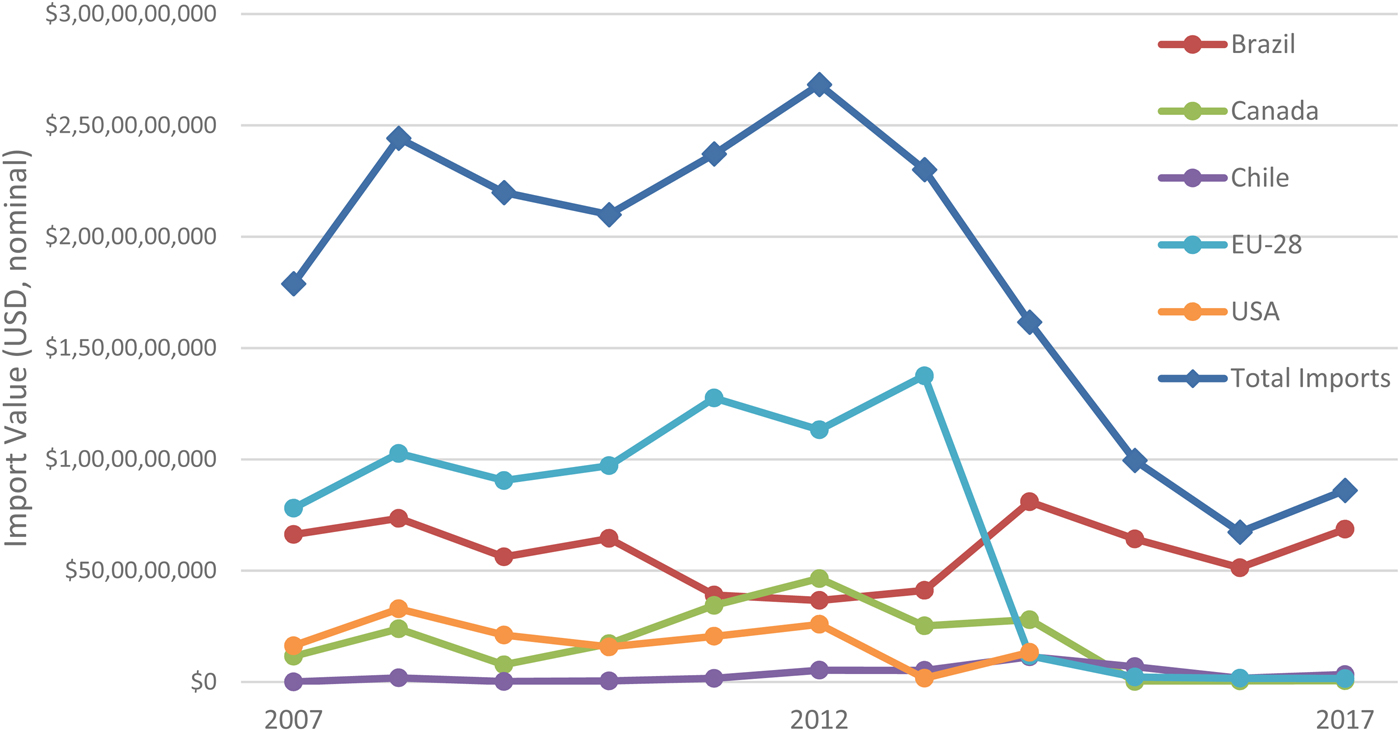
The composition of Russia's imports also changed dramatically after 2012. Figure 4 presents data from Russia's top five suppliers of imported swine and pork products between 2007 and 2017. Until 2013, the EU dominated the Russian swine and pork import market. Following the imposition of ASF sanctions in 2014, Russian imports from Europe collapsed, while Russian imports from Brazil and Chile briefly rallied before falling to pre-ASF levels by 2016 when Russian imports of swine and pork products reached their lowest level.
Russian imports of swine and pork, world top 5 sources 2007–2017
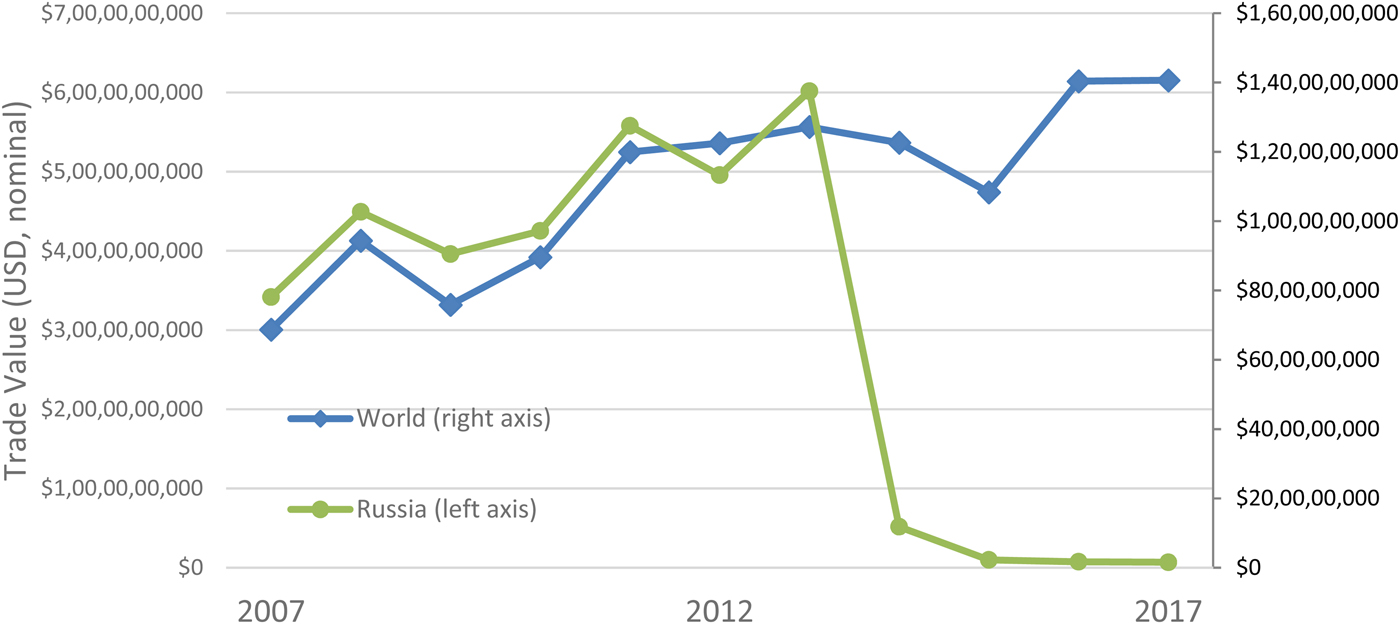
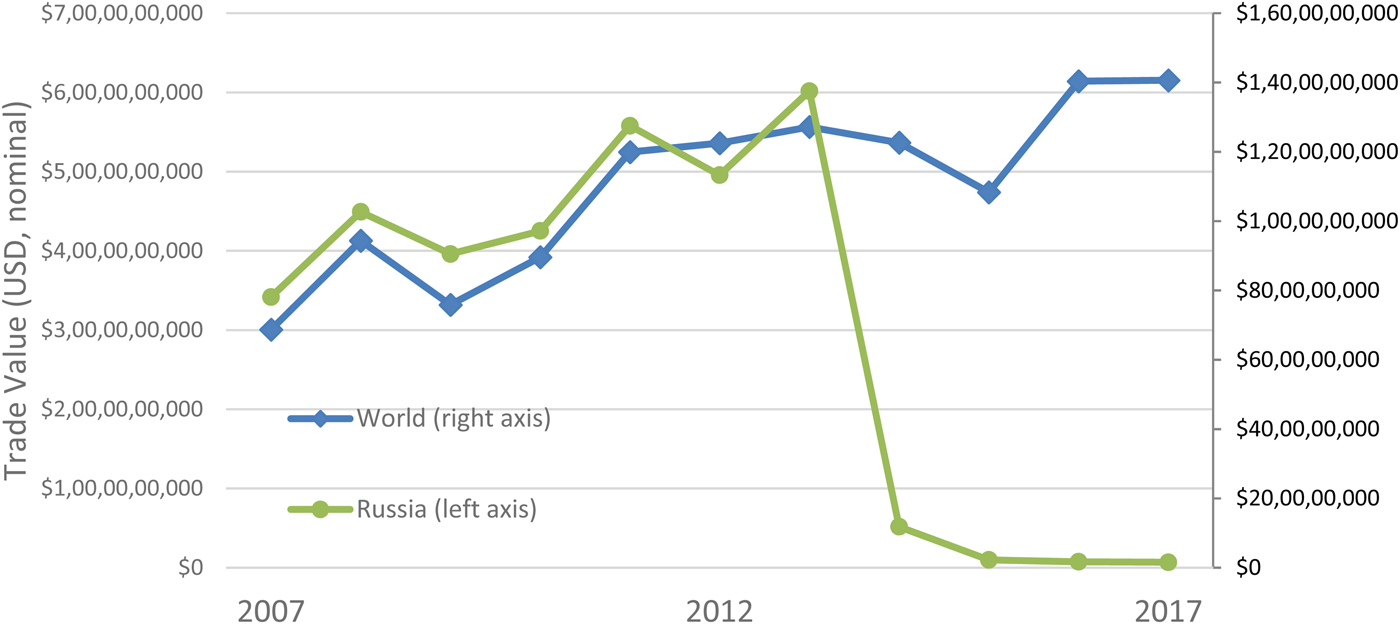
Finally, Figure 5 shows that the sudden decline in EU exports of swine and pork products to Russia in 2014 had a modest, short-lived effect on Europe's worldwide exports of those products. Before 2014, the total worldwide EU exports of swine and pork products had increased steadily and in parallel with EU exports to Russia in particular. In 2014, EU exports to Russia plummeted, as noted above, but the overall effect on EU exports of those same products to the world was limited, and by 2016, total worldwide EU exports of swine and pork products had surpassed 2013 levels, as European swine farmers and pork producers found other buyers outside Russia.
EU exports of swine and pork to Russia and the world 2007–2017
2.3 WTO challenge and Panel ruling
On 14 April 2014, the European Union filed a complaint alleging that Russia's actions violated several of its WTO commitments. The EU highlighted that its authorities had promptly provided Russian authorities with all requested relevant information to highlight EU efforts to separate the non-affected areas from affected areas (i.e., regionalization) in an effort to maintain the veracity of its export certificates. Moreover, the EU pointed out that Russian authorities had accepted the regionalization efforts from Ukraine and Belarus, thereby resulting in less favorable discriminatory treatment for EU member states.
Specifically, the EU alleged that Russia violated numerous Articles of the SPS Agreement, namely Articles 2.2, 3.1–3.3, 5.1–5.5, 6.1–6.3, 6.7, and 6.8 as well as Annexes B and C. Following unsuccessful consultations, a Panel was requested in June 2014 and was composed in October 2014. Soon thereafter, Russia annexed the Crimea, leading to heightened tensions between Russia and the EU. Litigation proceeded against this backdrop, with the Panel report was issued to the parties in April 2016 and circulated in August 2016.
On numerous counts, the Panel sided with the EU. In assessing these claims, the Panel found that all of the alleged measures, including the EU-wide ban, constituted SPS measures attributable to Russia.Footnote 15 It then concluded that neither the EU-wide ban nor the import bans specific to the four affected EU countries (Estonia, Latvia, Lithuania, and Poland) were ‘based on’ relevant international standards – with the exception of bans of imports from Latvia for non-treated products – in violation of Article 3.1.Footnote 16 The Panel similarly concluded that the import bans applicable to the four countries did not ‘conform to’ international standards, in violation of Article 3.2.Footnote 17
With regards to all measures, the Panel concluded that Russia had sufficient scientific evidence to conduct a risk assessment. Therefore, they could not fall under the scope of Article 5.7, applicable to temporary precautionary measures.Footnote 18 Because Russia did not base them on a risk assessment, the Panel held that Russia violated Articles 2.2, 5.1, and 5.2.Footnote 19 Furthermore, Russia violated Article 5.3 by failing to take into account the relevant economic factorsFootnote 20 and Article 5.6 because its import ban was more trade restrictive than necessary to achieve Russia's appropriate level of protection.Footnote 21 The Panel also held that in most instances, Russia's measures violated Article 2.2 because its trade restrictions were applied beyond the extent necessary to protect animal life or health.Footnote 22 However, with respect to the EU's claims concerning Russia's ban on non-treated products from Latvia, the Panel declined to rule on this particular claim, finding that the EU had failed to make a prima facie case that its proposed alternative measures were significantly less trade restrictive.Footnote 23
The Panel further ruled that Russia's measures violated Article 2.3 because they arbitrarily and unjustifiably discriminated between WTO members where identical or similar measures prevailed.Footnote 24 It also held that Russia's measures constituted a disguised restriction on trade.Footnote 25
Finally, we turn to the questions of whether Russia's SPS measures are properly adapted in response to EU efforts to engage in regionalization (i.e., separate exports from non-ASF areas from ASF-affected areas). The Panel held that Russia's process for consideration of the EU's request for recognition of ASF-free areas violated Article 8 and Annex C because the information request extended beyond what was necessary, and its procedures were not conducted expeditiously.Footnote 26 Turning then to the Article 6 claims, the Panel held that the EU objectively demonstrated that the EU areas outside of the four ASF-affected countries were ASF-free and likely to remain so in conformance with its obligations under Article 6.3.Footnote 27 It also held that the EU similarly demonstrated this to be the case for non-ASF areas of Estonia, Lithuania, and Poland, but not Latvia.Footnote 28 The Panel held that Russia did not violate Article 6.2 because it did recognize the concept of ASF-free areas. However, Russia failed to adapt its measures in response to the information provided by the EU, resulting in a violation of Article 6.1.Footnote 29
Soon after the final Panel report was circulated, both the EU and Russia announced their intention to appeal. Both parties filed notices in late September 2016.Footnote 30 As an aside, the Appellate Body is to be commended for deciding this appeal expeditiously, within the deadline of 90 days as stipulated in the Dispute Settlement Understanding. The final AB report was circulated in February 2017, less than five months after the notice was filed, and adopted on 21 March 2017.
3. The key legal controversy: adaptation and regionalization of SPS measures
Both Russia and the EU concentrated their appeals on questions pertaining to Article 6 of the SPS Agreement. Russia challenged the Panel's ruling that the EU had complied with its obligations under Article 6.3 and that it had violated Article 6.1. The EU, on the other hand, contested the Panel's ruling that Russia had not violated Article 6.2.
3.1 The applicable law
Article 6 of the SPS Agreement presents a set of interlinked obligations for both the importing and exporting countries. The first two paragraphs require that the importing country tailor its SPS measure to fit the particular circumstances of the outbreak. In other words, the importing country cannot just reflexively impose an outright ban. Rather it must consider the specific conditions within both its own territory as well as that of the exporting country, taking specific delineated factors into account. Specifically, the law reads as follows:
1. Members shall ensure that their sanitary or phytosanitary measures are adapted to the sanitary or phytosanitary characteristics of the area – whether all of a country, part of a country, or all or parts of several countries – from which the product originated and to which the product is destined. In assessing the sanitary or phytosanitary characteristics of a region, Members shall take into account, inter alia, the level of prevalence of specific diseases or pests, the existence of eradication or control programmes, and appropriate criteria or guidelines which may be developed by the relevant international organizations.
2. Members shall, in particular, recognize the concepts of pest- or disease-free areas and areas of low pest or disease prevalence. Determinations of such areas shall be based on factors such as geography, ecosystems, epidemiological surveillance, and the effectiveness of sanitary or phytosanitary controls.Footnote 31
However, the drafters of the SPS Agreement also recognized that the ability of the importing government to adapt its SPS measure to the conditions is contingent, in part, on information provided by the exporting country. Thus, WTO law also imposes requirements on the exporting member, which reads as follows:
3. Exporting Members claiming that areas within their territories are pest- or disease-free areas or areas of low pest or disease prevalence shall provide the necessary evidence thereof in order to objectively demonstrate to the importing Member that such areas are, or are likely to remain, pest- or disease-free areas or areas of low pest or disease prevalence, respectively. For this purpose, reasonable access shall be given, upon request, to the importing Member for inspection, testing, and other relevant procedures.Footnote 32
The definitions of what constitutes ‘pest- or disease-free areas’ or ‘areas of low pest or disease prevalence’ are then set forth in Annex A(6) and A(7) of the SPS Agreement respectively.
In India–Agricultural Products, the Appellate Body opined on the relationship between the respective obligations set forth in the various paragraphs of Article 6. Recognizing that there is ‘no explicit conditional linkage linking Article 6.1 and 6.3’, the Appellate Body nevertheless emphasized the need for Article 6.1 to read in conjunction with the remainder of Article 6.Footnote 33 Specifically, the Appellate Body noted the following:
[A]n exporting Member claiming, for example, that an importing Member has failed to determine a specific area within that exporting Member's territory as ‘pest- or disease-free’ – and ultimately adapt its SPS measures to that area – will have difficulties succeeding in a claim that the importing Member has thereby acted inconsistently with Articles 6.1 or 6.2, unless that exporting Member can demonstrate its own compliance with Article 6.3.
This is not to suggest …. that a Member adopting or maintaining an SPS measure can only be found to have breached the obligation in the first sentence of Article 6.1 after an exporting Member has made the objective demonstration provided for in Article 6.3. Indeed …. even in the absence of such objective demonstration by an exporting member, a Member may still be found to have failed to ensure that an SPS measure is adapted to regional conditions within the meaning of Article 6.1 in a situation where, for example, the concept of pest- and disease-free areas is relevant, but such Member's regulatory regime precludes the recognition of such concept. Moreover … pest- or disease-free areas and areas of low pest or disease prevalence, which are specifically addressed in Articles 6.2 and 6.3, are only a subset of the SPS characteristics that may call for the adaptation of an SPS measure pursuant to the first sentence of Article 6.1. We also observe that Article 6.1 expressly identifies ‘criteria or guidelines’ developed by relevant organizations as relevant for the assessment of the SPS characteristics of regions, which suggests that, under certain circumstances, the adaptation of an SPS measure to regional SPS characteristics may be accomplished by taking into account relevant criteria and guidelines developed by such organizations, if any. Finally we recall that the overarching requirement under Article 6.1 to ensure the adaptation of SPS measures is an ongoing obligation that applies upon adoption of an SPS measure as well as thereafter. All of these considerations reinforce that a Member may act inconsistently with the obligation under the first sentence of Article 6.1 absent the objective demonstration provided for in Article 6.3 by an exporting Member.Footnote 34
3.2 Appellate Body Report
In Russia–Pigs, the Appellate Body was called upon to further clarify a number of important questions related to Article 6 of the SPS Agreement, both large and small. Among the detailed legal questions, for example, is the time period which an importing member is to be accorded to evaluate the information provided by the exporting country. The Appellate Body clarified that the importing member does not have ‘unfettered discretion’ in terms of timing; rather, ‘what constitutes an appropriate period of time is to be assessed on a case-by-case basis and may depend on, among other things, the nature and complexity of the procedure to be undertaken and completed’.Footnote 35
Another clarification provided by the Appellate Body is that an importing country cannot satisfy its obligation under Article 6.2 by simply merely acknowledging the concepts of ‘pest- or disease-free areas’ and ‘areas of low pest or disease prevalence’ in abstract. This led the AB to reverse the Panel's ruling that Russia had satisfied its obligations under Article 6.2, but the AB noted that it was unable to complete the analysis.Footnote 36
We wish to draw attention to two questions, in particular, that surfaced in the appeal. Both concern the relationship between the information provided by the exporting country concerning its regionalization efforts to separate disease-free areas from disease-affected areas and the obligation of the importing country: First: what constitutes the ‘necessary evidence’ an exporting country is obliged to provide to the importing country pursuant to Article 6.3. Second: in light of the performance (full, partial, or lack thereof) of an exporting country's obligation under Article 6.3, how is a Panel to judge whether the importing country has complied with its obligation under Article 6.1?
Turning first to the question of ‘necessary evidence,’ the Appellate Body noted that ‘the term “necessary” qualifies the nature, quantity, and quality of the evidence to be provided by the exporting Member, which must be sufficient to enable the importing Member ultimately to make an objective “determination” as to the pest or disease status concerned, within the meaning of the second sentence of Article 6.2’.Footnote 37 At the same time, the term also indicates certain limitations placed on the importing country when making requests of exporting countries; the information must be pertinent to its evaluation.Footnote 38
The AB then goes on to clarify that ‘[w]hat exactly constitutes “necessary” evidence for the purposes of the first sentence of Article 6.3 must be ascertained in light of the facts and circumstances of each case’.Footnote 39 It further notes that ‘a panel's review of compliance with Article 6.3 must be limited to assessing whether the evidence provided by the exporting Member to the importing Member is of a nature, quantity, and quality sufficient to enable the importing Member's authorities to make a determination as to the pest or disease status of the relevant areas within the exporting Member's territory’.Footnote 40 However, the panel itself is not called upon to determine for itself whether the area is, or likely to remain, disease-free.Footnote 41 Rather, it is to focus upon the question of whether the information provided by the exporting country is sufficient to allow authorities in the importing country to do so.
As to the question of the inter-relationship between Articles 6.1 and 6.3, the Appellate Body again reiterated that ‘on the one hand, the exporting Member's compliance or non-compliance with Article 6.3 will, in many cases, have implications for the importing Member's ability to assess the SPS characteristics of areas located within the exporting Member's territory and to adapt its measures accordingly, as required by Article 6.1’.Footnote 42 However, on the other hand, it also reemphasized its rejection of ‘the notion that an importing Member's violation of Article 6.1, would necessarily be contingent on the exporting Member's compliance with Article 6.3’.Footnote 43 Rather, it highlighted its previous jurisprudence, discussed above, of instances when a violation of Article 6.1 could occur irrespective of the exporting country's performance of its obligations under Article 6.3. Ultimately, the Appellate Body noted that ‘a panel should conduct a careful case-by-case examination, based on all relevant circumstances, before reaching its conclusions as to the relationship between the exporting Member's compliance or non-compliance with Article 6.3 and the alleged breach of Article 6.1 by the importing Member’.Footnote 44
3.3 Open questions
While the AB was correct to emphasize a case-by-case approach, this still leaves several open questions: What exactly is the type of information which falls within the right of an importing country to request of an exporting country? What falls within the range of ‘relevant circumstances’, which should be considered when a Panel is assessing whether the authorities within the importing country has properly complied with Article 6.1?
Such questions are particularly relevant when the importing country is seeking to impose a wide-ranging ban applicable to non-diseased areas far away from the disease outbreak. Turning back to the specific case at hand, what information ought Russia have asked of the EU in order to try to justify an EU-wide ban? When might have been a legitimate concern to ban pigs, pork, or pork products from Spain or Portugal, for instance, when they are hundreds of kilometers away from Poland or the Baltic states, but nevertheless within a single customs union?
These are open questions with which future Panels will have to grapple. Economics, we suggest, offers helpful insights.
4. How economic theory can inform future case law
The fundamental economic rationale behind the SPS Agreement is simple: the recognition of potential negative cross-border externalities. When imports may be contaminated by harmful biological or viral pathogens, trade itself imposes a negative external cost to the importing country. Absent the ability to perfectly screen shipments for safety, trade protection may be an economically efficient response, targeted to reduce trade volumes and thus contamination.
This basic point is well understood and has been carefully articulated in earlier volumes of this journal by, for example, Bown and Hillman (2016) and Saggi and Wu (Reference Saggi and Wu2017) in the context of the India–Agricultural Products dispute. Nonetheless, the Russia–Pigs dispute raises several important economic and legal wrinkles of particular relevance, compared to earlier cases at the WTO. As we explain below, the economic contours of ‘SPS externalities’ can vary substantially by context; the scientific basis for limiting transmission of (say) Avian Flu from the United States naturally will differ from the scientific basis for limiting African Swine Flu in the European Union.
The Russia–Pigs dispute highlights several important dimensions of the nature of economic externalities that until now have been afforded relatively little attention. Russia's imposition of trade restrictions in this dispute is unusually broad in both product and geographical coverage. Under what conditions could such sweeping restrictions be economically justified? What criteria should WTO panels investigate to evaluate the merits of this kind of SPS case in the future?
In the following pages, we identify and explore two features of agricultural trade that are of particular relevance in the Russia–Pigs dispute, the potential for: (i) geographical ‘sequential’ or ‘pass through’ externalities, which are distinct from the familiar ‘bilateral’ transmission externalities; and (ii) ‘supply chain’ externalities, which capture the potential for transmission across vertically related product classes. We argue that these factors are of particular relevance when considering limits on exports from a geographically diverse customs union, as in the Russia–Pigs dispute, and describe a set of economic factors that bear consideration in evaluating the economic basis for sweeping restrictions on imports in future cases of SPS externalities.
4.1 Benchmark: bilateral externalities
As a benchmark, we begin by defining a very basic cross-border externality: the risk that a contaminated imported product (e.g. pork) could transmit a harmful pathogen (e.g. ASF) from an exporting country to an importing country. In its simplest form, the potential for contamination implies that the social cost of the imported good is strictly greater than the private cost. That is, while an individual importer may pay a market price of P for a kilogram of pork, the total cost to the importing country is strictly greater than P, after accounting for the possibility that contaminated pork may impose an externality cost on the rest of the importing country if the pathogen is transmitted locally, leading to reduced yields, mandatory culling, human illness, etc. For the now, in the interest of simplicity, suppose this negative ‘SPS externality’ can be expressed as a constant, per-unit cost of δ, as in previous work (e.g. Saggi and Wu, Reference Saggi and Wu2017).Footnote 45
A standard optimal Pigouvian tax, then, would impose a tariff (or equivalent quota) of δ applied to imports, to perfectly offset the negative externality from traded pork.Footnote 46 By the same logic, a complete ban on pork imports would be socially optimal if (and only if) it implied a cross-border price wedge of δ or less between the domestic price of pork in the exporting country and the (now higher) domestic price in the importing country.
4.2 Sequential and pass-through externalities
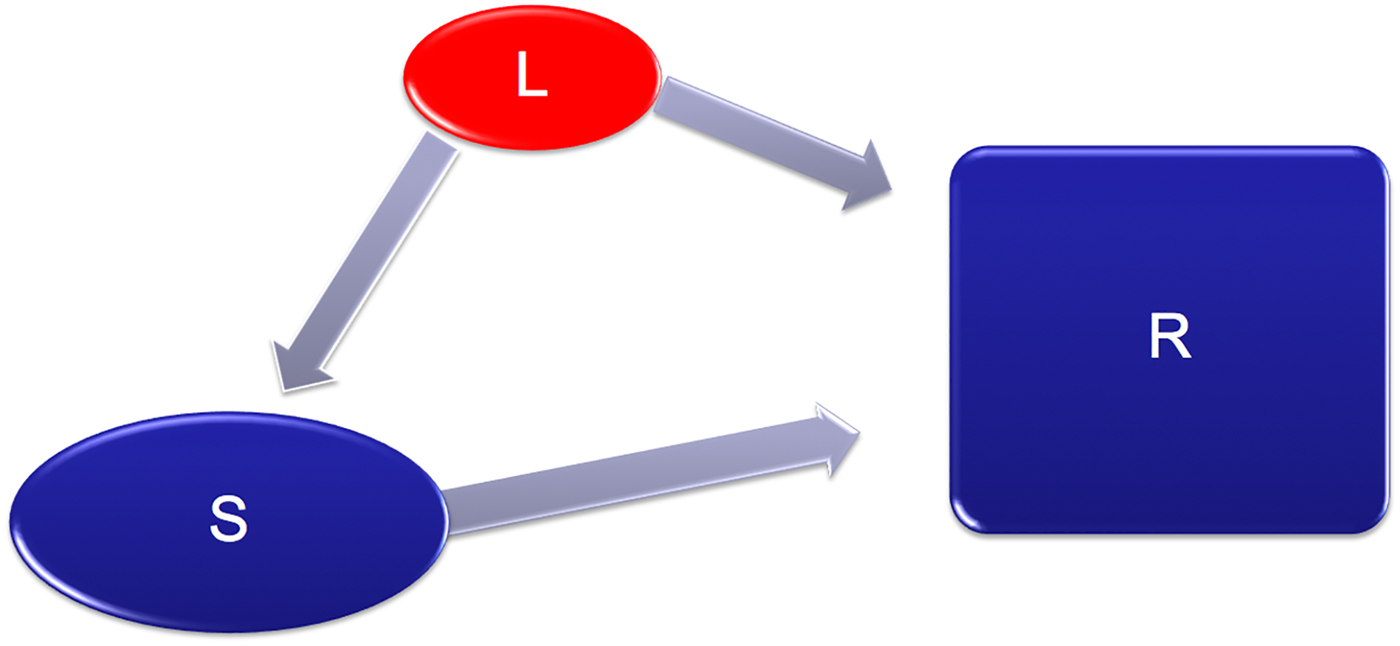
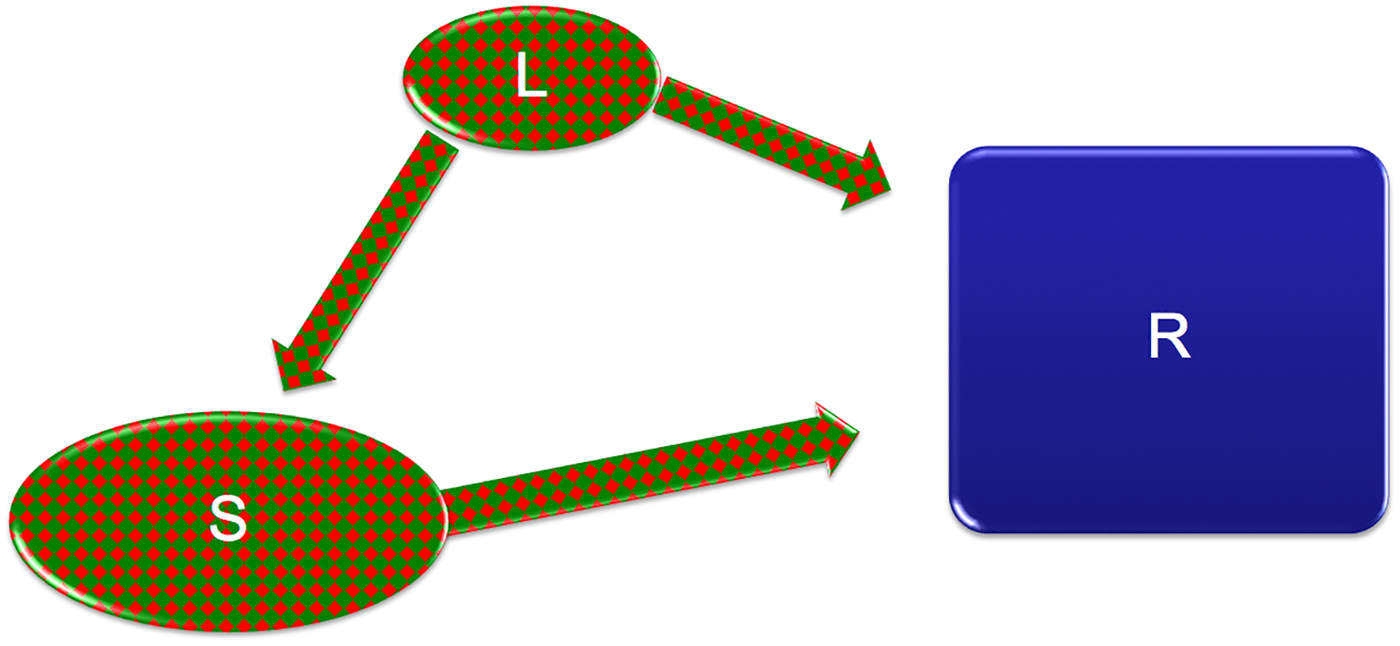
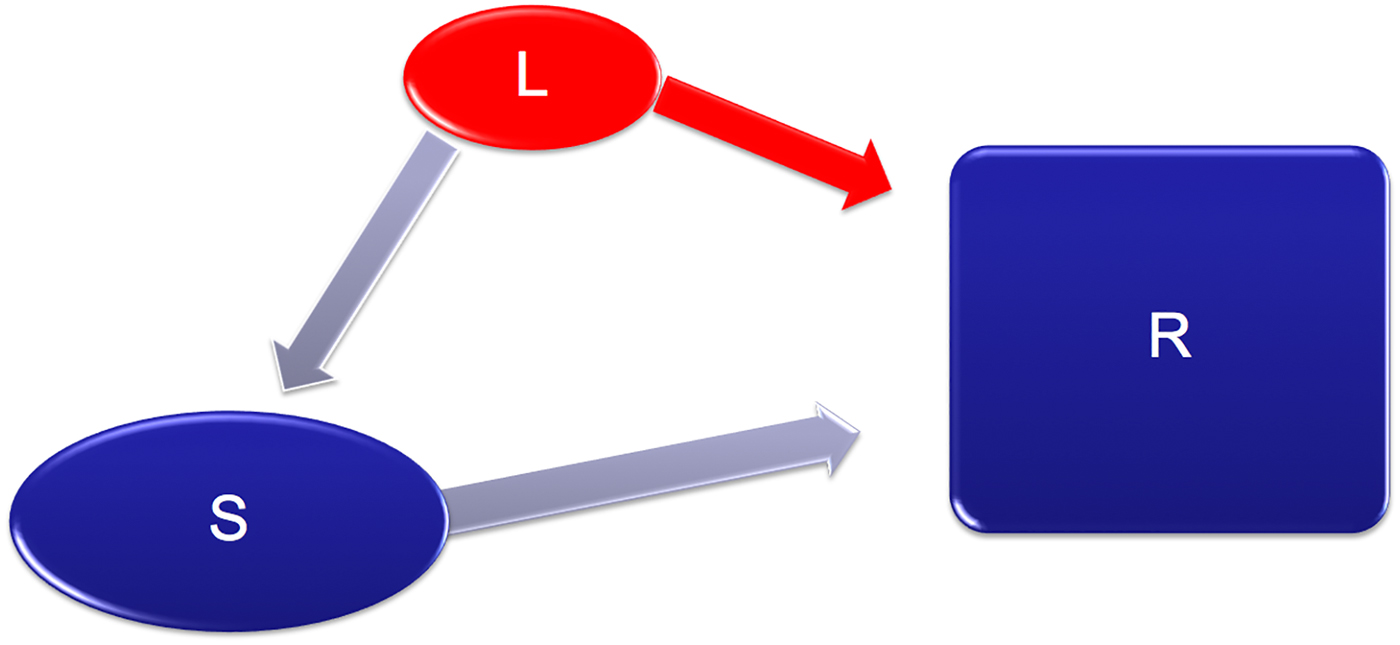
In a world with more than two countries, matters are more complicated. Consider the following scenario, in which cases of ASF have been scientifically documented in Country L. Country R imports pork and has proposed import restrictions to curb the potential for ASF transmission into its domestic market. A third country, Country S, trades with both Countries L and R. Country L exports pork to Countries R and S; Country R imports pork from countries L and S; and, Country S imports pork from Country L and exports (possibly a differentiated variety of) pork to Country R. Figure 6 represents these trading relationships.
A three-country scenario

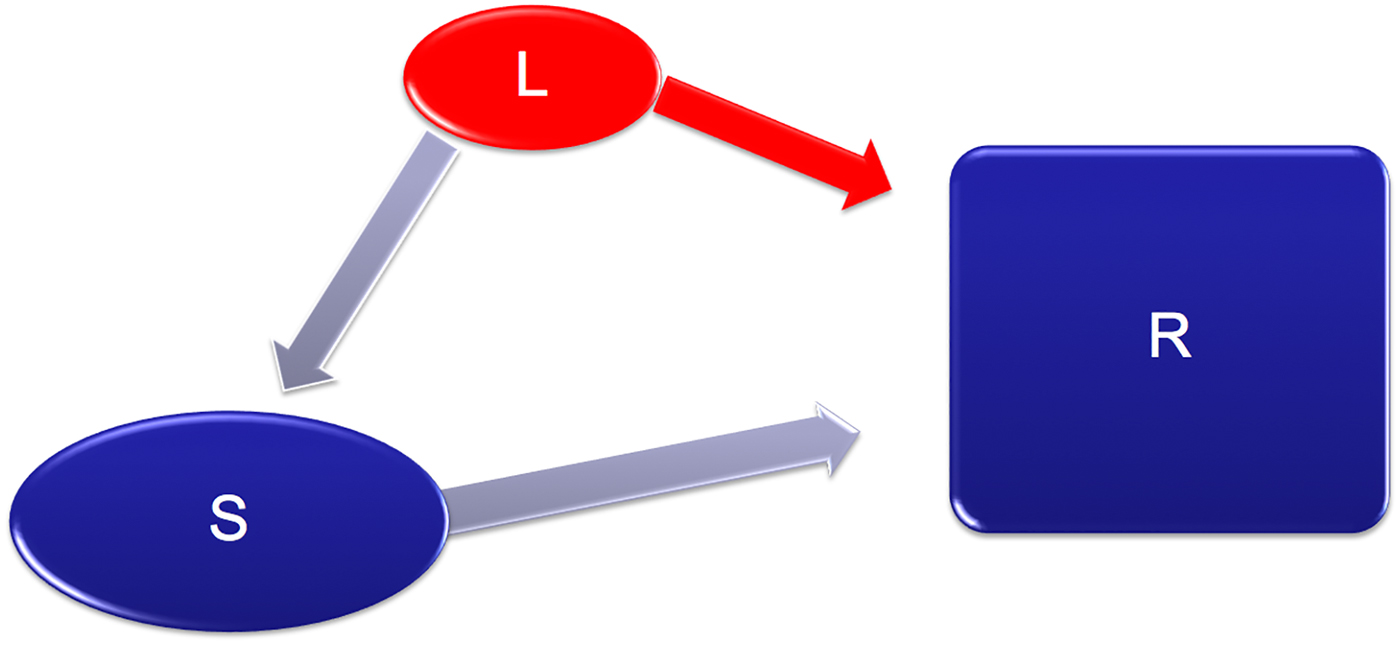
What are the optimal import restrictions on pork by Country R? For pork imported by Country R directly from Country L, the negative externality of potential ASF transmission via trade is simply bilateral, as represented in Figure 7. As noted earlier, the optimal (Pigouvian) restriction on imported pork from L therefore would increase the price of pork imported from Country L in Country R by no more than the per-unit cost of the bilateral externality, δ.
Bilateral externalities
In contrast, Country R's optimal import restriction on pork from Country S is more nuanced, since it depends on the extent to which ASF can be passed indirectly from Country L to R through a third country.Footnote 47
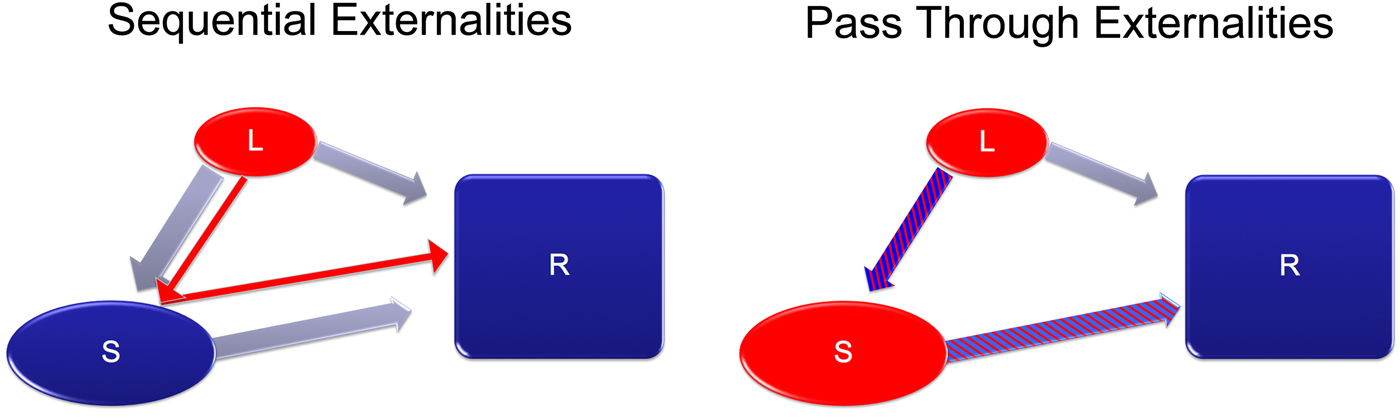
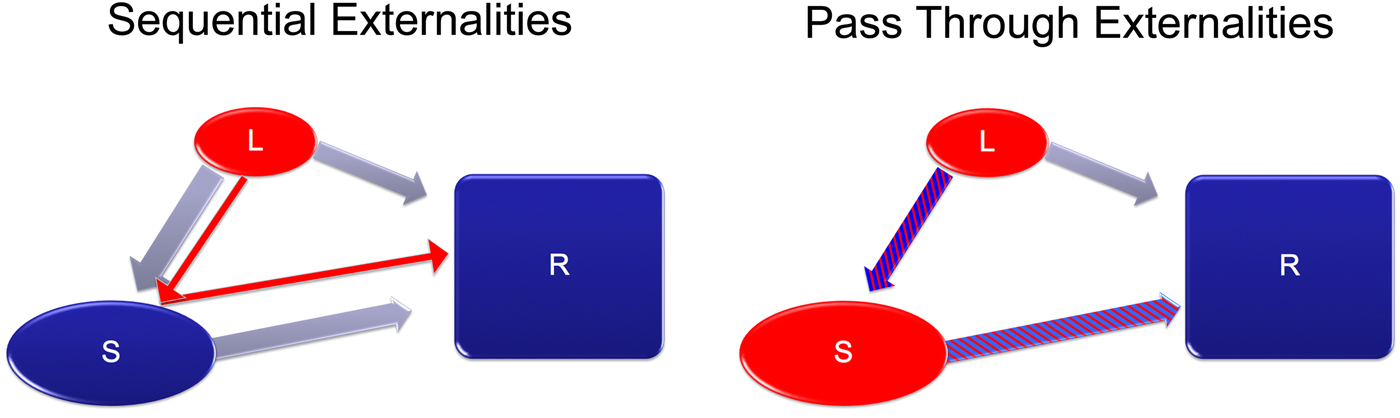
When Country L exports pork to Country S, both sequential and pass-through transmission of ASF to Country R via Country S are possible; Figure 8 illustrates. While these two possibilities are conceptually distinct, as described below, both may justify the imposition of trade restrictions by Country R on Country S's exports under certain conditions.
Sequential and pass through externalities
Supply chain externalities

One possible means of third-country ASF transmission arises through the practice of transshipment (the re-exportation of pork sourced in Country L, from Country S to Country R). To be sure, transshipment is more expensive than direct bilateral trade – after all, why send pork (or any other product) on a geographically circuitous trip through a third country when it's not necessary – but there are certainly cases in which ‘innocuous’ transshipment occurs, for instance through the widespread practice by multi-product exporters who frequently bundle diverse sets of products (often sourced from abroad) to foreign consumers. Moreover, when there are differences in trade barriers across countries, transshipment is a well-known (and less innocuous) side effect, though rules or origin and other product labeling rules are designed to prevent the practice.
If tainted pork can reach Country R from Country L through Country S, we refer to this possibility as a sequential externality. To fix ideas, suppose that transshipments from Country L comprise a share t% of Country S's exports to Country R. Then Country R's optimal Pigouvian tax/import restriction against imports of pork from Country S would be given by tδ% – weaker than the restriction against country L, but still positive. In principle, clear rules of origin and regionalization reporting can eliminate this sequential externality directly so that the trade restriction on Country S is not warranted.
Alternatively, suppose there is no transshipment, but Country L still exports pork to Country S. There is still potential for ASF to be transmitted from Country L to Country R via Country S if and only if tainted imports from Country L into Country S can contaminate domestic production in Country S. We call this indirect transmission possibility a pass-through externality. If tainted pork from Country L can infect the existing domestic pork industry in Country S, the magnitude may in fact be very large, especially if it is a case in which ‘one bad apple spoils the lot’. Indeed, if the resulting outbreak in Country S becomes more widespread than the initial contamination in Country L – and a priori, there is no scientific basis for ruling out such a possibility – the resulting per-unit equivalent cost of the pass through externality from Country S to Country R may in fact by larger than δ. Consequently, the optimal trade restriction in Country R imposed on Country S's imports could – at least in principle – be even more severe than the initial restriction against Country L. Crucially, then, in the presence of a potential pass-through externality, there is no implied hierarchy in the structure of economically justifiable import protections, in contrast to the case of a sequential externality. As before, however, SPS provisions can supplant the potential role for trade restrictions: if Country S can document that it is in fact ASF-free, then no import protection is economically warranted or justifiable.
4.3 Supply chain externalities
So far, we have considered only the potential for direct and indirect transmission of ASF through contaminated pork. But, of course, pork is not only a product for final consumption but also acts as an input into other downstream products (e.g., sausages, pet foods, or other pork-derivatives) as well as a potential contaminant for upstream capital goods (e.g. pork processing machinery). The broad product coverage of the trade restrictions in the Russia–Pigs dispute makes plain the potential breadth of the concern.
The economics of potential supply chain externalities is straightforward: if contaminated pork can transmit ASF to related products via supply chain linkages, additional import restrictions on these related products may be justifiable, both bilaterally (applied to imports from Country L) or via third-country trade (on imports from Country S). As with pass-through externalities, there is no strict hierarchy in the relative levels of import protection across countries or products. Indeed, it seems especially plausible in the case of downstream trade that one infected shipment of pork could be magnified many-fold in downstream shipments of, say, uncooked sausage.
The danger is that the potential for indirect transmission via sequential, pass-though, or supply chain externalities may be misused to mask protectionist or punitive motives that have nothing to do with SPS concerns. Although in principle SPS-externalities can propagate to include broad geographic areas – including independent third countries – and broad classes of related product trade, the basis for these indirect linkages must be scientifically based. Depending on the specific context, investigating the scientific merits of sequential, pass-though, and supply chain externalities may substantially increase the burden faced by a government considering a broad-based agricultural import ban. Nonetheless, in light of the previous analysis, the nature and dynamic of such externalities are important factors for understanding whether a particular import ban is justified given the circumstances.
We argue that future WTO panels should at least consider the following additional factors when assessing the scientific and economic merits of future trade disputes with SPS-related externalities:
• whether transshipment of potentially infected products is (or may be) practiced through third countries, by both trade intermediaries and multi-product firms;
• whether pathogens or infection may be transmitted without detection from infected countries to third-country domestic production; and
• the extent to which pathogens or infection may be passed through supply chains to related upstream and downstream products.
Finally, notice that to the extent indirect transmission is possible via third-country trade, there may be divergence between the legal basis, scientific basis, and economic basis for whether importing countries may justifiably impose import restrictions against third, ostensibly ‘safe’ exporters, depending on whether those ‘third countries’ are in a customs union or free trade area with affected countries. Neither the economic arguments, nor the scientific basis for extent of allowable trade restrictions, depend on the nature of the trade rules between third countries. Legally, however, the burdens imposed on the exporting countries will be quite different depending on whether an exporting country is part of a customs union. Any time there is an agricultural outbreak within an exporting country within a customs union, every other country within that customs union will need to demonstrate that its territory is unaffected and will remain disease-free. In this case, exporters from disease-free countries within the EU, such as Spain and Germany, face a higher burden than exporters from other disease-free countries, such as Switzerland or Serbia, that are also geographically proximate to the disease-affected areas but are outside of the customs union.
5. Conclusion
While the Appellate Body in Russia–Pigs did not uphold Russia's ban on potentially ASF-affected products from across the EU as legitimate, the dispute nevertheless raises a number of important questions with which future WTO panels will continue to grapple: Under what circumstances is an importing country allowed to reject the regionalization efforts of an exporting country affected by an agricultural disease? What falls within the scope of legitimate information for authorities in the importing country to request of the exporting country as necessary for the proper assessment of the exporting country's regionalization effort? When might an importing country be justified in imposing an agricultural import ban that extends across an entire customs union, even when some exporting countries within that customs union are disease-free? When assessing such questions in the context of an SPS measure, proper consideration ought to be given to distinct forms of externalities that will determine the economic impact that results from the spread of an agricultural disease.