Introduction
Cognitive and Psychosocial Phenotype of Young Children with Neurofibromatosis-1
Neurofibromatosis-1 (NF1) is a neurocutaneous disorder resulting from a single gene mutation with a prevalence of 1 in 3000. The NF1 gene codes for neurofibromin, which is involved in a neurodevelopmental cascade regulating neuronal cell growth. NF1 is associated with a range of medical features including cutaneous and plexiform neurofibromas and skeletal abnormalities, and with cognitive, learning, and attention problems. Most current research about cognitive and psychosocial functioning has been conducted with older children and adolescents with NF1. There are relatively few studies of the cognitive and psychosocial functioning of preschool children with NF1 (Lorenzo, Barton, Acosta, & North, Reference Lorenzo, Barton, Acosta and North2011; Sangster, Shores, Watt, & North, Reference Sangster, Shores, Watt and North2011; Soucy, Gao, Gutmann, & Dunn, Reference Soucy, Gao, Gutmann and Dunn2012). This study provides further in-depth examination of cognitive and psychosocial functioning in the preschool years in comparison to a well matched group of unaffected children, as a foundation to understanding the developmental trajectory of cognitive functioning and learning in NF1.
Cognitive Functioning
A general lowering of IQ in individuals with NF1 relative to both the general population and to unaffected siblings has been observed (Cutting, Clements, Lightman, Yerby-Hammack, & Denckla, 2004; Ferner, Hughes, & Weinman, Reference Ferner, Hughes and Weinman1996). Up to 60% of people with NF1 ultimately show learning problems. In a review of recent studies, Levine, Materek, Abel, O'Donnell, and Cutting (Reference Levine, Materek, Abel, O'Donnell and Cutting2006) found evidence for impairment in all academic areas including word reading, reading comprehension, mathematics, and spelling relative to siblings and other unaffected children. However, unlike some genetic disorders with consistent and distinctive psychological phenotypes (e.g., Williams or Fragile-X syndromes), there is no consensus on a distinctive cognitive or behavioral profile with clear sensitivity or specificity in NF1.
Difficulties with language, visuospatial skills, nonverbal reasoning, and motor development have all been observed. Earlier investigations of cognitive skills were suggestive of stronger verbal abilities and weaker nonverbal abilities (Legius et al., Reference Legius, Descheemaeker, Steyaert, Spaepen, Vlietinck, Casaer and Fryns1995; Wadsby, Lindehammar, & Eeg-Olofsson, Reference Wadsby, Lindehammar and Eeg-Olofsson1989). Ozonoff (Reference Ozonoff1999) has suggested that visuospatial deficits are the most common area of difficulty seen in NF1, with decrements in performance on the Judgment of Line Orientation task as the most consistent finding (e.g., Cutting, Koth, & Denckla, Reference Cutting, Koth and Denckla2000; Moore, Slopis, Schomer, Jackson & Levy, 2000). Deficits on other visuospatial tasks are sometimes (Dilts et al., Reference Dilts, Carey, Kircher, Hoffman, Creel, Ward and Leonard1996; Eliason, Reference Eliason1986), but not always, observed (Eldridge et al., Reference Eldridge, Denckla, Bien, Myers, Kaiser-Kupfer, Pikus and Zasloff1989; North et al., Reference North, Joy, Yuille, Cocks, Mobbs, Hutchins and de Silva1994). Verbal deficits are also commonly present (Cutting et al., Reference Cutting, Clements, Lightman, Yerby-Hammack and Denckla2004; Mazzocco et al., Reference Mazzocco, Turner, Denckla, Hoffman, Scanlon and Vellutino1995; Moore et al., Reference Moore, Slopis, Schomer, Jackson and Levy1996; North et al., Reference North, Joy, Yuille, Cocks, Mobbs, Hutchins and de Silva1994). While a universal pattern is not shown, the majority of individuals with NF1 have at least one domain of cognitive deficit (Hyman, Shores, & North, Reference Hyman, Shores and North2005, Reference Hyman, Shores and North2006).
Psychosocial Functioning
On broad measures of psychosocial functioning, higher levels of problem behaviors are typically reported for children with NF1 than for unaffected siblings or in comparison to normative populations and elevated rates of difficulties are observed (e.g., Descheemaecker, Ghesquière, Symons, Fryns, & Legius, Reference Descheemaecker, Ghesquière, Symons, Fryns and Legius2005; Johnson, Saal, Lovell, & Schorry, Reference Johnson, Saal, Lovell and Schorry1999; Martin et al., Reference Martin, Wolters, Baldwin, Gillespie, Dombi, Walker and Wildemann2012; Moore & Denckla, Reference Moore and Denckla2000). Findings regarding internalizing symptoms are inconsistent. Social difficulties are described for children with NF1 using a variety of methods, including parent and teacher report and peer ratings (Barton & North, Reference Barton and North2004; Dilts et al., Reference Dilts, Carey, Kircher, Hoffman, Creel, Ward and Leonard1996; Huijbregts & Sonneville, Reference Huijbregts and de Sonneville2011; Noll et al., Reference Noll, Reiter-Purtill, Moore, Schorry, Lovell, Vannatta and Gerhardt2007). Attention problems are the most consistently occurring difficulty (e.g., Payne, Hyman, Shores, & North, Reference Payne, Hyman, Shores and North2011; North, Hyman, & Barton, Reference North, Hyman and Barton2002). One-third to half of older children with NF1 meet diagnostic criteria for Attention Deficit/Hyperactivity Disorder (ADHD; Kayl, Moore, Slopis, Jackson, & Leeds, Reference Kayl, Moore, Slopis, Jackson and Leeds2000; Koth, Cutting, & Denckla, Reference Koth, Cutting and Denckla2000). Notably, children with comorbid ADHD and NF1 have shown significantly poorer parent-reported social skills (Barton & North, 2004) and weaker intellectual functioning (Mautner, Kluwe, Thakker, & Leark, Reference Mautner, Kluwe, Thakker and Leark2002; Koth et al., Reference Koth, Cutting and Denckla2000) than children with NF1 without ADHD.
Research in Young Children
There has been sparse research about the cognitive or psychosocial functioning of young children with NF1. Using an infant and toddler measure, Lorenzo and colleagues (Reference Lorenzo, Barton, Acosta and North2011) found that cognitive difficulties can be observed as early as two or three years of age. A very recent study using a parent report measure found that difficulties are more often reported in older children than in younger children (Soucy et al., Reference Soucy, Gao, Gutmann and Dunn2012; Wessel, Gao, Guttman, & Dunn, Reference Wessel, Gao, Gutmann and Dunn2012). In a small sample of 4- and 5-year-old children, Sangster and colleagues (Reference Sangster, Shores, Watt and North2011) found overall decrements in intellectual functioning and spatial abilities. Attention problems assessed by a lab-based measure, but not parent ratings, were significantly related to intellectual functioning, and group differences in parent ratings for attention were not present once maternal education was statistically controlled. No significant group difference in psychosocial functioning was found, with the exception of the Somatization scale. However, the sample size was small (17–24 children with NF1 depending on the analysis), the unaffected group was on average 6 months younger than the NF1 group, of higher socio-economic status, and higher than average intellectual functioning (M IQ = 111.1; SD = 12.5). While the authors conducted analyses controlling statistically for these group differences, an a priori study design accounting for these factors is an important next step.
Rationale and Hypotheses
Given that up to 60% of people with NF1 show attention or learning problems in adulthood, further well-designed studies on cognitive and psychosocial functioning in children with NF1 are warranted. In the current study, we use measures designed to assess specific patterns of cognitive ability and psychosocial functioning in the preschool years and include a well-matched unaffected contrast group. In addition to knowing the mean performance levels in a representative sample of preschool children with NF1, an examination of the percentage of these children who have difficulties in particular aspects of cognitive and psychosocial functioning is important to provide the clinician or parent with a sense of the likelihood of impaired performance within particular areas for an individual child; examination of mean ratings alone may obscure the distribution of difficulties given that close to half of children with NF1 appear not to have difficulties. Hypotheses are as follows: (1) Overall intellectual functioning as well as verbal, nonverbal reasoning, and especially spatial abilities will be weaker for children with NF1 than for unaffected contrast group. (2) Children with NF1 will show more areas of cognitive difficulty than children in the unaffected group, with most children with NF1 showing at least one area of impairment; (3) A characteristic or distinctive pattern of relative strengths and weaknesses is not expected; (4) Children with NF1 will show greater psychosocial difficulty than children in the contrast group, especially related to attention problems; (5) stronger cognitive functioning is expected to be related to stronger social skills and fewer attention problems. The current study adds to the existing literature by including a contrast group matched for socioeconomic status, thereby experimentally rather than statistically controlling for this variable which has been related to cognitive skills in NF1 in prior research. It also includes a different measure of cognitive abilities than used previously, providing a measure of the robustness of prior findings. Finally, in addition to providing a description of psychosocial functioning in preschool children, the relations of psychosocial and cognitive functioning in young children with NF1 are also examined.
Method
Participants
Demographic information about the participants is presented in Table 1. Participants were 40 children diagnosed with NF1, between the ages of 3 to 6 years and an unaffected contrast group of 37 children without NF1, ages 3 to 6 years. The contrast group was made up of 16 siblings of the children in the NF1 group and 21 children recruited from the communityFootnote 1 . Siblings were included regardless of overall intellectual functioning. Participants recruited from the community were only included if intellectual functioning fell within the range seen in the NF1 group, to ensure that children with high intellectual functioning were not overrepresented. The participant groups did not differ in age (t(75) = .63; p = .53) or gender distribution (χ2(1,77) = .02; p = .88). Distribution across age of the NF1 and contrast group was similar, with somewhat greater representation of 3- and 4-year-olds than 5- and 6-year-olds in both groups. While the representation of particular minority groups differed slightly across the participant groups, the percentage of minority representation did not differ significantly (χ2(1,77) = 1.15; p = .28). The majority of the participants’ mothers, in both groups, had some post high-school education (87.5% of the NF1 sample, 95% of the contrast sample), and the groups were matched for maternal education (χ2(1,77) = 1.17; p = .28) and socioeconomic status (based on the Hollingshead Index; t(73) = 1.00; p = .32). Only one participant with NF1 was prescribed medication for attention problems. For 16 participants with NF1 the mutation was familial (i.e., inherited from the parent), and sporadic (i.e., a spontaneous mutation not present in either parent) for 24.
Demographic data

Measures
The Differential Ability Scales – Second Edition Early Years Form (DAS-II; Elliot, Reference Elliot2007) was administered to assess cognitive functioning. This is a comprehensive, individually administered battery of cognitive abilities for individuals 2½ through 17 years; the Early Years Form is appropriate for ages 3 through 8 with strong demonstrated reliability, validity, standardization, and excellent floor and ceiling levels. It yields an overall composite score (General Cognitive Abilities; GCA) akin to the Full Scale IQ, as well as Verbal Ability, Nonverbal Reasoning Ability, and Spatial cluster scores.Footnote 2 Supplementary diagnostic subtests include measures of Digit Span Forward (DF) and Early Number Concepts (ENC). Ipsative analysis of patterns of intra-individual performance are provided; significant relative strengths and weakness at both the cluster and subset level are identified, taking into account reliability and intercorrelations among subtests. The DAS-II was chosen because of its strong validation and usefulness for capturing strengths and weaknesses and its heavy usage in behavioral phenotyping research (e.g., Baron, Erickson, Ahronovich, Baker, & Litman, Reference Baron, Erickson, Ahronovich, Baker and Litman2011; Bishop, Guthrie, Coffing, & Lord, Reference Bishop, Guthrie, Coffing and Lord2011).
The Behavior Assessment Scale for Children – Second Edition (BASC-2; (Reynolds & Kamphaus, 2005) was administered to parents to assess psychosocial functioning, including Externalizing Problems (Hyperactivity and Aggression scales), Internalizing Problems (Anxiety, Depression, and Somatization scales), and Adaptive Skills (Adaptability, Activities of Daily Living (ADL), Social Skills, Leadership, and Functional Communication (FC) scales). The Behavior Symptoms Index consists of the Atypicality, Attention Problems, and Withdrawal scales, as well as the Hyperactivity, Aggression, and Depression scales. This measure has strong reliability and validity data. The form appropriate to the child's age was administered.
Procedure
Participants with NF1 and their siblings were recruited at medical NF clinic visits (rather than at a learning disabilities clinic) through consecutive referrals at yearly medical check-ins. Procedures of the study were briefly explained by the clinical geneticist. Once the family indicated an interest in participating, a member of the study staff explained further and, either in person or by phone, briefly reviewed the informed consent, and arranged the appointment time and location. Non-sibling contrast group participants were recruited via fliers in areas frequented by families such as libraries, coffee shops, and YMCA's. Questionnaire measures were mailed to participants in advance of the assessment appointment, including the consent form. Informed consent was reviewed at the assessment appointment. Questionnaire measures were collected and immediately reviewed for missing data. Each appointment lasted approximately 3 hours with breaks and included parent interview measures, cognitive assessment with the child (always administered first), and a variety of experimental measures administered to the child in a quiet room. This work was conducted in compliance with all IRB requirements.
Results
Given the number of comparisons made, the False Discovery Rate approach (Benjamini & Hochberg, Reference Benjamini and Hochberg1995; Pike, Reference Pike2011) was used to determine a q-value adjusted for the number of comparisons within each set of analyses with multiple comparisons, and these q-values were compared with alpha = .05 to determine statistical significance. Tests for equal variances were examined (at alpha level of .01) and pooled variances were used when appropriate. Effect sizes are also reported. For continuous data, D was used for effect size, interpreted as follows: 0 to .14 negligible, .15 to .39 small, .40 to .74 medium, .75 and above large (Cohen, Reference Cohen1988). For categorical data analysis, Phi was used to determine effect size, interpreted as follows: 0–.10 weak, .11 to .15 moderate, and .16 to .25 strong, and > .25 very strong. For examination of intra-individual strengths and weaknesses, an alpha level of .05 was used.
Cognitive Functioning
Group-based analysis
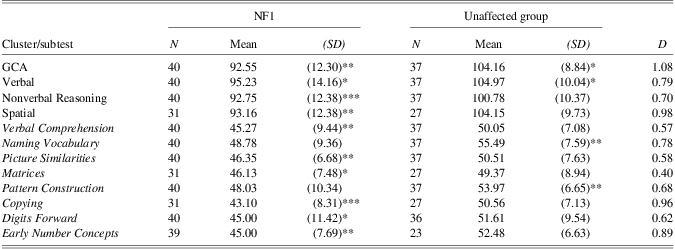
Repeated measures analyses of variance were conducted to examine group differences in cognitive ability and patterns of cognitive strength and weakness at the cluster and subtest levels separately. Significant main effects of group were seen at the cluster [F(1,56) = 16.41; p < .001] and subtest [F(1,46) = 12.35; p < .001] levels, with significantly weaker cognitive functioning seen for the children with NF1 (see Table 2 for descriptive statistics at the cluster and subtest level). Effect sizes were large. No group × cluster interaction [F(2,112) = 1.29; p = .280] or group × subtest interactions [F(7,40) = 1.12; p = .365] were observed, indicating that the groups do not systematically differ in patterns of strengths and weaknesses.
Descriptive statistics for NF1 and unaffected groups on the DAS-II, differences from normative mean, and effect sizes

Symbol near mean reflects difference from normative mean; *p < .05; **p < .01; ***p < .001
Case-based analysis
There was no difference between the groups in the frequency of particular patterns of cluster strengths or weakness, although a trend for more children with NF1 to show weaker Spatial than Nonverbal abilities was observed (see Table 4). Group differences in the proportion of children showing performance one standard deviation (SD) below the mean on the clusters and subtests were examined (see Table 3). At the cluster level, significant group differences, with children with NF1 more often showing difficulty, were observed for GCA, Verbal, Nonverbal, and Spatial functioning. Forty-five percent of the children with NF1 (but only one child in the contrast group) showed at least one cluster score more than 1 SD below the mean. At the subtest level, significant group differences in the frequency of difficulties were observed for both spatial tasks (Pattern Construction and Copying) and for Naming Vocabulary (NV) but not Verbal Comprehension (VC) within the verbal cluster, and for ENC but not DF within the diagnostic subtests. No significant group differences in the frequency of difficulty were reported for the nonverbal reasoning subtests.
Frequency of Performance 1 standard deviation or more below the mean on DAS-II Clusters and Subtests

Note. *p < .05; **p < .01; significant difference determined based on q-value (FDR derived significance threshold).
Percent of participants demonstrating significant differences on DAS-II Cluster Scores

The number of children in each group showing performance one SD or more below the mean on one, two, or three subtests was compared. More children with NF1 (55%; n = 22) performed one SD below the mean on at least one subtest than in the contrast group (21.6%; n = 8; χ 2 (1,77) = 9.01; p = .003; Phi = .34). More children with NF1 (27.5%; n = 11) performed one SD below the mean on at least two subtests than contrast children (2.7%; n = 1; χ2(1,77) = 8.98; p = .003, Phi = .34). Finally, more children with NF1 (17.5%; n = 7) performed one SD below the mean on at least three subtests than children in the contrast group (n = 0; χ2(1,77) = 7.12; p = .008; Phi = .30).
Relations to age, gender, and familial status
There were no significant bivariate correlations between cluster standard scores or subtest t-scores with age for either group. No significant gender differences were observed. Within the NF1 group, the effect of familiality was explored. There were no statistically significant effects at the cluster or subtest levels.
Psychosocial Functioning
Group comparisons
Two multivariate analyses of variance were conducted to examine group differences in psychosocial functioning, one at the broad index level and the other at the scale level. Descriptive statistics are in Table 5. No significant effect of group was observed at the broad scale level (F(4,70) = 1.86; p = .127). At the scale level, a main effect of group was observed (F(12,62) = 2.04; p < .05). As indicated in Table 5, the children with NF1 showed significantly weaker FC skills than did the contrast group. While there was no significant group difference in attention problems, a medium effect size was observed. No other significant group differences were observed.
Descriptive statistics and group differences on the BASC-II T-scores

Note. Significantly different from normative data in one-sample t-test *p < .05; **p < .01, ***p < .001. Data from one participant in the unaffected group was missing entirely, and data from a second was missing for Activities of Daily Living, which is included in the Adaptive Skills index.
Case-based analysis
In addition to examining mean performance, to gain a sense of the proportion of children with NF1 who show psychosocial difficulties, the number of children in each group showing parent ratings one SD or more above the standardization mean (for problem behavior scales) or below the mean (for adaptive scales) was examined (see Table 6). There were no significant group differences in the frequency of problem behavior or adaptive difficulties.
Frequency of ratings 1 standard deviation or more away from the mean on BASC-II indices and scales (higher for Problem Scales, lower for Adaptive Scales)

Relations to age, familial status, and cognitive abilities
Bivariate correlations between Index and Scale t-scores and age were examined, yielding no significant correlations. No significant effects of familial status on parent ratings were observed. Bivariate correlations between cognitive ability clusters and psychosocial functioning t-scores were examined. For the group as a whole, significant correlations between Adaptive skills and both GCA (r(75) = .331; q = .032) and Verbal skills (r(75) = .392; q = .008) were seen. At the scale level, significant correlations between FC and both GCA (r(76) = .368; q = .018) and Verbal Ability (r(76) = .434; q = .001) were found.
Given that FC emerged as an area of relative challenge for the children with NF1, DAS predictors of FC were examined separately using a regression approach, with group by cognitive ability interactions also examined. At the cluster level, Verbal cluster score was a significant predictor of FC (β = .334; t = 3.44; p = .002) with no significant group by predictor interaction. At the subtest level, there were trends toward effects of DF (β = .314; t = 1.96; p = .056) and NV (β = .277; t = 1.74; p = .089), with no significant group by subtest interactions.
Given the a priori expectation of a relation between intellectual functioning and both attention problems and social skills for children with NF1, regressions were conducted to examine effects of cognitive abilities on Attention Problems and Social Skills separately, including examinations of group by cognitive ability interactions. Verbal cluster score was a significant predictor of both Attention Problems (β = −.338; t = 2.15; p = .036) and Social Skills (β = −.411; t = 2.69; p = .010) with no significant group by cognitive ability interactions.
Discussion
The purpose of the current study was to examine the presence of cognitive vulnerabilities that lay the foundation for the developmental cascade toward learning and psychosocial difficulties in children with NF1. As emphasized by Karmiloff-Smith (2008) “genetic mutations are more likely to affect low-level cognitive processes that will have differing, cascading effects on different domains as development proceeds over time” (Karmiloff-Smith, 2008, p. 697). As hypothesized, evidence for a mild downward shift in global intellectual functioning was found, and difficulties in at least one broad area (e.g., verbal, nonverbal, or spatial skills) were present for close to half (45%) of the sample. As expected based on prior research with older children, no specific and distinctive pattern of cognitive difficulties emerged. Rather, it appears that the NF gene mutation confers a general vulnerability for cognitive difficulties that is observable even in the preschool years. One novel finding is that functional communication was identified as a difficulty, with suggestive evidence of relations to expressive language and memory. Even though psychosocial problems were generally low, as expected, stronger social skills and fewer attention problems were observed in children with stronger intellectual functioning.
For some genetically based neurodevelopmental disorders, a distinctive pattern of cognitive functioning emerges that is consistent across affected children. NF1 appears to confer a general vulnerability to cognitive difficulties that is manifest differently across children. Age differences were not generally apparent, but this sample included participants in a narrow age range. Longitudinal research is important to examine whether the sometimes subtle difficulties seen by children with NF1 become more pronounced over time, particularly with increased demands as the children enter elementary school. The variable cognitive phenotype highlights the potential predictive utility of identifying individual patterns of strength and weakness at an early age using a measure that captures functioning across many domains, so that early interventions can be individualized. The lack of group by predictor interactions suggests that cognitive contributions to psychosocial functioning also do not follow a distinctive pattern for children with NF1. It remains likely, therefore, that interventions tailored specifically to children with NF1 may not be needed, but rather that interventions useful for other children with similar difficulties are likely to be beneficial. Practitioners working with children with NF1 will need to elucidate mechanisms underlying each child's difficulty on such tasks (i.e., spatial, verbal, motor, executive, attention, or likely a combination) to recommend the most suitable interventions. No brain-based markers of risk within the NF1 population have been definitively identified. Likely related to the significant phenotypic variability in NF1, investigations of brain-behavior relationships have yielded conflicting findings. Brain abnormalities associated with NF1 include brain tumors, macrocephaly, and so-called “unidentified bright objects (UBO),” (Cutting et al., Reference Cutting, Clements, Lightman, Yerby-Hammack and Denckla2004; Kayl & Moore, Reference Kayl and Moore2000). While some studies suggest a connection between UBOs (particularly in the thalamus) and cognitive impairment, Moore and colleagues (Reference Moore, Slopis, Schomer, Jackson and Levy1996) caution that individuals with NF1 without UBOs can and do show learning difficulties. Combining careful phenotyping with brain-imaging techniques may ultimately prove fruitful to gain a more nuanced sense of the neurocognitive profile of individual children with NF1. Recent studies have highlighted the potential diagnostic utility of MRI for young children with NF1 (Sabol et al., Reference Sabol, Resic, Juraski, Sabol, Sizgoric, Orsolic and Grahova2011), with high prevalence of UBOs in young children with NF1, however brain-based markers of cognitive risk within the NF1 population have not been definitively identified. There is good reason to expect neurocognitive difficulties in children with NF1, as there is an identified role for neurofibromin in regulating GABA release, which is critical to prefrontal-striatal communication and long-term potentiation in the hippocampus (Shilyansky et al., 2010), in turn affecting learning, attention, working memory, and processing speed, and general recruitment of brain areas for cognitive tasks (Costa & Silva, 2002; Cui et al., 2008; Genova, Hillary, Wylie, Rypma, & Deluca, 2009; Schneider et al., 2010).
A novel finding is that difficulties with functional communication were the most evident psychosocial challenge, suggesting that the language difficulties of children with NF1 translate into real-word difficulties with verbal communication. These communication challenges have the potential to set the stage for continued social and learning difficulties. Additional clarification of the language functioning of children with NF1 using more comprehensive language measures is also needed given the high rates of reading difficulties in the NF1 population and the role of language impairments as a risk factor for reading challenges. Other contributors to functional communication included rote verbal memory, which is often included in studies of attention in older children with NF1 (e.g., Philip & Turk, 1996) and has more broadly been tied to attention problems (Hellwig-Brida, Daseking, Keller, Petermann, & Goldbeck, 2011). This is the first study with young children with NF1 to use a digit span task, with evidence that this task may be useful to identify difficulties even in young children with NF1.
Group differences in parental reports of attention problems were not observed. The lack of clear attention difficulties reported by parents in these young children may be partly due to the high variability in attention functioning in the preschool years, and/or to the lower demands for sustained attention placed on preschool-aged children. It may also be a function of a somewhat small sample size, given that a moderate effect size was indeed observed. Regardless, the lack of clear difference suggests that attention problems as measured by parent report are not striking in these early childhood years. Further work examining attention in young children with NF1 is warranted to determine whether there are subtle behavior patterns present that may be predictive of later attention difficulties, and longitudinal work to track the point at which attention difficulties become evident would be useful. It has been suggested that inattentive rather than hyperactive symptoms characterize the attention difficulties of children with NF1 (Ferner et al., Reference Ferner, Hughes and Weinman1996; North et al., 1995; Hofman et al., 1994), and the developmental literature regarding inattention suggests that such symptoms are indeed more rarely observed in young children than in the school-age years (Lahey et al., Reference Lahey, Applegate, McBurnett, Biederman, Greenhill, Hynd and Richters1994; Smidts & Oosterlaan, Reference Smidts and Oosterlaan2007). The rote memory difficulties seen here, as well as the functional communication challenges, may be indications of attention problems. While in older children digit span is considered a measure of verbal memory span, in younger children this measure may approximate working memory function, which is closely tied to inattention conceptually (e.g., Alloway, Gathercole, Kirkwood, & Elliott, Reference Alloway, Gathercole, Kirkwood and Elliott2009).
Difficulties with foundational number concept knowledge were also observed, placing children with NF1 at risk for later mathematics-related learning problems. There is ample evidence that the number knowledge of preschoolers is related to later mathematics abilities (Mazzocco & Thompson, 2005; Aunola, Leskinen, Lerkkanen, & Nurmi, 2004; Jordan, Kaplan, Ramineni, & Locuniak, 2009), with evidence that development of number specific skills depends on development of domain general abilities as well (e.g., Ansari et al., 2003; Halberda & Feigenson, 2008). Using a longitudinal design, LeFevre and colleagues (2010) found that linguistic abilities, spatial attention, and quantitative skills independently contribute to concurrent early number knowledge, which in turn predicts later math achievement. Hyman and colleagues (Reference Hyman, Shores and North2006) found that some school-aged children with NF1 have specific deficits in academic and neuropsychological skills despite average intellectual functioning, while others have more general difficulties across areas. The Early Number Concepts measure included here likely taps both domain-general and domain-specific skills, both of which likely contribute to later mathematics knowledge. Inclusion of more purely domain-specific assessment as predictors of number knowledge in future research (e.g., subitizing ability, large number acuity; Mazzocco, Feigenson, & Halberda, Reference Mazzocco, Feigenson and Halberda2011) would more effectively allow for examination of both domain-specific and domain-general pathways toward later learning difficulties for children with NF1.
Conclusion
In sum, close to half of the children with NF1 in this sample displayed some cognitive vulnerability at the broad cognitive cluster level, with considerable variability in the specific areas of difficulty. This replicates prior research with a larger sample and a different measure adding to the robustness of the findings. By controlling more carefully for age and SES in the research design rather than relying on statistical approaches, moreover, this study used a design that effectively rules out some critical alternative explanations of prior research findings. In contrast to some prior work (Sangster et al., Reference Sangster, Shores, Watt and North2011), difficulties with spatial functioning were indeed observed here, and do not appear to be accounted for by maternal education or socioeconomic status. Finally, while rates of psychosocial difficulties were generally low, cognitive and psychosocial functioning appear to be interrelated even in young children with NF1, pointing to the potential utility of cognitive assessment at identifying children at risk for psychosocial difficulty. Although functioning remains in the average range for the vast majority of children with NF1, the presence of even subtle cognitive difficulty appears to confer risk for everyday challenges affecting the quality of life of children with NF1 and their families.
While this is one of the larger studies of young children with NF1 involving direct child assessment, an even larger sample size would nevertheless be useful, especially given expected variability in cognitive and psychosocial functioning in the preschool years and the sometimes subtle nature of the cognitive and attention difficulties seen in children with NF1. Research examining even earlier precursors of the cognitive difficulties observed is also needed. Bernstein (Reference Bernstein2010) explains, “that the neuropathologies of childhood occur in the context of dynamic change over the course of development and thus the pathology becomes part of the developmental course. Genetic and structural disorders set up conditions for alternative developmental trajectories” (p. 21). As the brain matures, the low-level global changes that are observed may very well affect local processing at some point down the line. While this study adds to research indicating that difficulties can be seen in early childhood that set the stage for potential future difficulties, further examination of cognitive functioning in infants is warranted to observe even earlier potential precursors of cognitive vulnerability (e.g., visual-spatial perception, attention). Further longitudinal study of cognitive functioning including the preschool years remains an important backdrop for brain-based studies. Future research should clarify the developmental trajectory of cognitive and psychosocial functioning, and also of brain-behavior relations in children with NF1 with attention to both domain-general and domain-specific factors. Longitudinal research examining the timing, placement, and natural history of neurological abnormalities, and most importantly, relations between these brain findings and neurocognitive functioning, is warranted.
Acknowledgments
We are especially appreciative of the participation of the children with NF1, their siblings, community participants, and their parents. Thank you also to the numerous undergraduate researchers who assisted in the preparation of these data, and to the UWM Office of Undergraduate Research for their support. This work was supported with funds from NF Midwest, NF MidAtlantic, University of Chicago CTSA grant UL1 RR024999 and the University of Wisconsin – Milwaukee Research Growth Initiative. No conflicts of interest exist.