Introduction
Adinandra Jack (Pentaphylacaceae) is a genus predominantly of trees or shrubs, distributed from tropical to warm-temperate regions of Asia and Africa. Melchior (Reference Melchior, Engler and Prantl1925), Kobuski (Reference Kobuski1947, Reference Kobuski1953) and Sugau (Reference Sugau2005) studied Adinandra in detail and made significant contributions to our knowledge and understanding of the genus. Of the c.115 species (Kobuski, Reference Kobuski1947, Reference Kobuski1953; Sugau, Reference Sugau2005), 112 are from Asia and the rest from Africa. In Asia, the genus has three major centres of diversity, namely the Malay Archipelago, the Philippines (Kobuski, Reference Kobuski1947, Reference Kobuski1953) and East Asia (Hsieh et al., Reference Hsieh and Huang1996; Min & Bartholomew, Reference Min, Bartholomew, Wu and Raven2007). The Malay Archipelago has the highest diversity with c.68 species, followed by East Asia with c.36 species, the Philippines with eight species and Africa with three species. Only one species of Adinandra, namely A. griffithii Dyer of Arunachal Pradesh, Meghalaya and Nagaland, is known from India (Dyer, Reference Dyer and Hooker1874; Paul, Reference Paul, Sharma and Sanjappa1993).
During botanical exploration of Upper Siang District, Arunachal Pradesh, a localised population of 10–20 individuals of Adinandra was found. These plants appeared different from the known species of Adinandra from India, Burma and China, differing markedly from the Indian species A. griffithii in having a simple style instead of a deeply 5-fid one. It seems to be allied to the Chinese species Adinandra latifolia L.K.Ling, which is also thought to be found in northern Burma (Min & Bartholomew, Reference Min, Bartholomew, Wu and Raven2007), but differs in not having an obtuse-mucronate calyx apex and in the shape of the petals. We describe it here as a new species, allied to Adinandra latifolia from China.
Species Description
Adinandra kamalae M.K.Pathak, Bhaumik & G.Krishna, sp. nov.
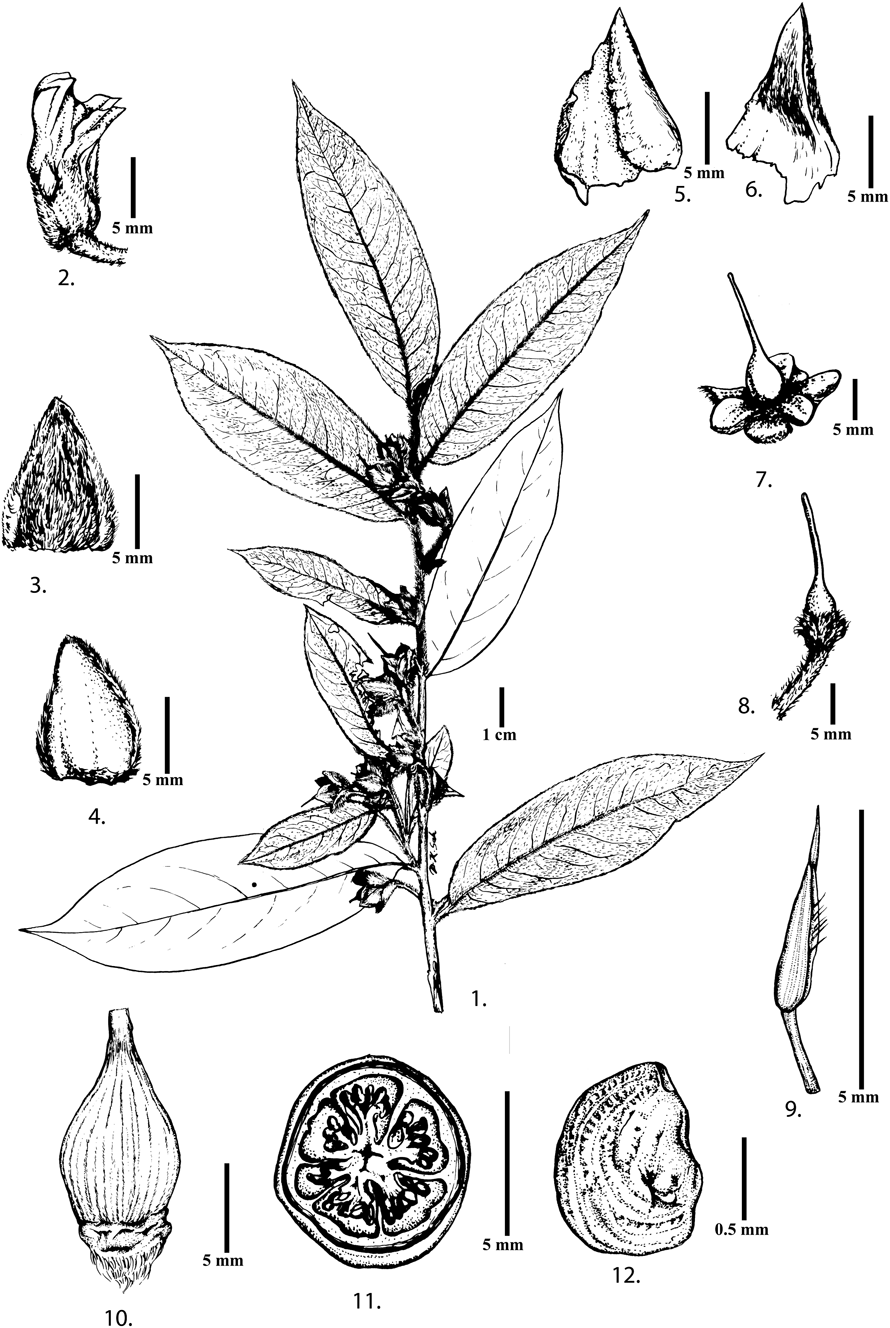
Adinandra kamalae is allied to A. latifolia L.K.Ling but differs in being a treelet, 2.5–3.5 m tall (vs. tree 10–15 m tall); leaves densely pubescent on midrib and leaf margins with distinct hair bands (vs. sparsely pubescent on midrib and leaf margins without distinct hair bands); number of secondary veins up to 18 on each side (vs. 25–30 on each side); bracteoles acute at apex (vs. abruptly acute at apex); length of pedicels 8–20 mm (vs. 5–10 mm); sepals acute at apex (vs. obtuse to rounded and mucronate at apex); petals ovate, broadest at base, acute at apex (vs. obovate, narrowed at base, rounded at apex); style length 10–15 mm (vs. c.8 mm); berries ovoid, 10–12 × 6–7 mm (vs. globose, c.1.5 cm across). – Type: India, Arunachal Pradesh, Upper Siang District, Tuting to Nereng, 28°56.951′N, 95°00.88′E, 600–649 m, 17 vii 2010, M.K. Pathak 72803 (holo CAL; iso ASSAM, BSD, CAL). Figs 1,2.
Adinandra kamalae M.K.Pathak, Bhaumik & G.Krishna. 1, flowering branch; 2, flower; 3 & 4, sepals; 5 & 6, petals; 7, pistil with calyx; 8, pistil; 9, stamen; 10, fruit; 11, cross-section of fruit; 12, seed.

Adinandra kamalae M.K.Pathak, Bhaumik & G.Krishna. 1, habit; 2, close-up view of flowers. (See online for a colour version of this figure.)
Evergreen treelets, 2.5–3.5 m tall. Branches alternate; branchlets densely pubescent; terminal buds narrowly conical, 12–15 mm long, yellowish brown sericeous. Leaves simple, alternate, oblong-lanceolate, 4.4–16.7 × 1.5–4.7 cm, acuminate at apex, entire at margins, cuneate-rounded at base, coriaceous, glabrous above, densely tomentose beneath, green; midrib impressed above, raised beneath; lateral veins up to 18 pairs, obscure above, prominent beneath, young leaves densely brownish pubescent, particularly on leaf margins and midrib; petioles 3–5 mm long, thick, densely appressed-sericeous when young. Flowers axillary, solitary or in pairs, bisexual; pedicels 8–20 mm long, usually recurved, brown-pubescent; bracteoles 2, opposite, broadly ovate, 5–8 × 2.8–3.5 mm, unequal, coriaceous, acute at apex, glabrous inside, densely sericeous outside, persistent, situated at the apex of the pedicel. Calyx 5-lobed; lobes free, imbricate, broadly ovate, 8–12 × 6–8.5 mm, unequal, acute at apex, coriaceous, appressed-sericeous outside, glabrous inside, accrescent. Petals 5, white, imbricate, ovate, 6–8 × 4.5–5 mm, acute-apiculate at apex, broadest at base, subcoriaceous, glabrous inside, appressed-sericeous on median portion outside, caducous. Stamens c.35, 1-seriate; filaments 2–3 mm long, glabrous, free above, adnate to base of petals; anthers oblong, 2.5–3 mm long, basifixed, 2-celled; cells slender, hairy along one side; connective exserted, c.1 mm long. Ovary superior, ovoid, c.0.5 × 0.5 mm, appressed-hairy to subglabrous, 5-locular; branches of placenta often touching the ovary wall to give an impression of septation; ovules many in each locule, on axile placenta; style simple, 10–15 mm long, thick, persistent, glabrous; stigma simple. Berries ovoid, 10–12 × 6–7 mm, indehiscent; pericarp thick, coriaceous, shining, faintly ribbed below, appressed-hairy on ribs, glabrous between, many-seeded; seeds reniform to variable, 0.3–0.4 mm long, more or less rugose, glabrous.
Distribution. India (Arunachal Pradesh, Upper Siang District).
Habitat. A small population of 10–20 trees was found, growing at the forest edge on the sunny side of a hill at an elevation of about 600 m in association with Helicia nilagirica Bedd., Oreocnide integrifolia (Gaudich.) Miq., Embelia ribes Burm.f., Medinilla assamica (C.B.Clarke) C.Chen, Engelhardtia spicata Lesch. ex Blume, Saurauia armata Kurz, Viburnum colebrookeanum Wall. ex DC. and Ardisia sp.
Flowering and fruiting. July–September.
Etymology. The senior author (M.K.P.) died after describing this species which he had named in honour of his mother, Ms Kamala Devi, for her continuous support in all spheres of his life.
Conservation status. Adinandra kamalae is known only from the type locality, a very small population of 10–20 mature individuals. Following the recommendations of IUCN (2001), the species should be considered Critically Endangered (CR; B2a and D).
Acknowledgements
We thank Dr Paramjit Singh, Director, Dr D. K. Singh, Additional Director, Botanical Survey of India, Kolkata and Dr P. Lakshminarasimhan, Scientist ‘D’ & H.o.O, Central National Herbarium, Botanical Survey of India, Howrah, for access to facilities. We also thank Dr K. N. Gandhi, Senior Nomenclatural Registrar, HUH, Cambridge, Dr John B. Sugau, Sabah Forestry Department, Malaysia, Yao Tze Leong, Forest Botanist, Forest Research Institute, Malaysia, Dr W. Arisdason, Scientist ‘B’, Botanical Survey of India, Kolkata and Dr S. Bandyopadhyay, Botanist, Central National Herbarium, Howrah, for their valuable suggestions in improving the manuscript. The authors also thank Mr D. K. Sah for the line drawings and the anonymous reviewers and Mark Newman, Taxonomist, Royal Botanic Garden Edinburgh for their helpful suggestions.