


Introduction
Freedom of Information (FOI) is a fundamental right recognized by the United Nations (art. 19, Universal Declaration of Human Rights). As a key democratic norm, FOI contributes to accountability and informed citizen participation in governance (Hood Reference Hood, Hood and Heald2006; Piotrowski Reference Piotrowski2007). It grants citizens and civil society organizations the right to access government-held information while obligating public administration officials to disclose such information. For this reason, FOI laws are widely regarded as pivotal policy tools that enable citizens to monitor government actions and promote informed decision-making (Abouassi and Nabatchi Reference Abouassi and Nabatchi2019; Howlett Reference Howlett2009). Reflecting these expectations, FOI laws have been rapidly adopted worldwide (Michener Reference Michener2011).
However, despite widespread adoption, FOI laws do not always deliver the levels of transparency they are intended to achieve. Variation in implementation across public administrations contributes to an enduring gap between formal compliance (de jure) and actual administrative practice (de facto). As Michener and Nichter (Reference Michener and Nichter2022, p. 39) note, “adopting regulation (de jure compliance) may not equate to responsiveness to citizens in practice (de facto compliance).” Governments often fail to comply with their own FOI legislation when responding to citizen requests, and even when they do respond, the information disclosed may be overly technical, fragmented, delayed, or otherwise inaccessible – thereby undermining transparency goals (Michener et al. Reference Michener, Coelho and Moreira2021).
To explain this implementation gap, recent research has shifted toward micro-level explanations of FOI implementation. Drawing on field experiments, this literature examines how bureaucrats exercise discretion in handling FOI requests and how their responses are shaped by requester identity and request characteristics, such as tone or legal framing (e.g., Cicatiello et al. Reference Cicatiello, De Simone, Di Mascio, Gaeta, Natalini and Worthy2024; Cuillier Reference Cuillier2010; Lagunes and Pocasangre Reference Lagunes and Pocasangre2019; Michener and Rodrigues Reference Michener and Rodrigues2015; Worthy et al. Reference Worthy, John and Vannoni2017). These studies challenge the assumption that bureaucrats behave as neutral implementers of legal mandates and instead highlight the role of discretion and behavioral biases – such as risk aversion and legal framing (Cicatiello et al. Reference Cicatiello, De Simone, Di Mascio, Gaeta, Natalini and Worthy2024) or social status and gender (Michener and Rodrigues Reference Michener and Rodrigues2015; Michener et al. Reference Michener, Velasco, Contreras and Rodrigues2020) – in shaping how public officials respond to external informational requests and, in doing so, implement FOI laws in practice.
In this literature, such biases are typically inferred from observable administrative responses to systematically varied requests, rather than directly measured at the level of internal decision-making processes. This approach is consistent with behavioralist traditions in political science, which emphasize the empirical study of observable actions rather than formal rules alone (Dahl Reference Dahl1961). Applied to FOI, this implies focusing on how public officials actually respond to requests (de facto) rather than how they are formally expected to behave (de jure), thereby shifting attention from formal compliance to observed administrative conduct.
However, this behavioral dimension remains largely implicit, and experimental research on FOI implementation remains conceptually fragmented. Much of the literature follows a gap-spotting logic, testing new sources of bias – such as requester identity, tone, or textual framing – across different empirical settings. While this work has produced important empirical findings, these effects are often treated as discrete results, with limited integration into a shared conceptual framework that systematically links observed response patterns to broader behavioral dynamics in governance. As a result, existing studies provide valuable insights into specific effects but offer limited guidance for developing cumulative theoretical explanations, despite the richness of empirical evidence and the broader behavioral turn in public policy and administration (Grimmelikhuijsen et al. Reference Grimmelikhuijsen, Jilke, Olsen and Tummers2017; Tummers Reference Tummers2012). Against this background, the paper asks, how do variations in FOI requests shape patterns of administrative responses, and what do these patterns reveal about bureaucratic behavior in FOI implementation?
To answer this question, the paper first reviews the existing literature, outlining the de jure functioning of FOI laws through the lens of policy tool theory (Howlett Reference Howlett2009), and then reinterprets field experimental research from a behavioralist perspective to theorize the de facto implementation of FOI laws through bureaucrats’ interactions with requesters. Building on this experimental literature, it develops theoretical hypotheses regarding patterns of bureaucratic responses to different types of FOI requests. These hypotheses guide the empirical analysis, which examines FOI implementation in Belgian municipal administrations – a federal context where FOI legislation was introduced in 1994. While recent studies have begun to examine FOI implementation in Belgium (e.g., Esposito et al. Reference Esposito, Cicatiello, Mabillard and Gaeta2024; Mabillard et al. Reference Mabillard, Esposito, Cicatiello, Gaeta and Pasquier2025), these contributions focus primarily on descriptive responsiveness patterns to assess the implementation gap or on qualitative analyses of administrative replies. This paper complements this emerging literature by providing a theory-informed experimental analysis of how variations in FOI requests shape administrative responses, thereby offering a behavioral interpretation of FOI implementation that enables more systematic theorization of existing experimental findings.
The remainder of the paper is structured as follows. Section Literature review reviews the literature and develops the theoretical hypotheses. Section Research design outlines the research design, including the experimental setup, data, and analytical strategy. Section Results presents the empirical results. Sections Discussion and Conclusion discuss the findings and conclude.
Literature review
This section reviews scholarship on FOI laws as policy tools for information disclosure and on recent micro-level approaches to FOI implementation. Drawing on existing field experimental research, it develops hypotheses on how behavioral biases are reflected in officials’ observable response patterns, providing the basis for the empirical analysis.
FOI laws as policy tools: the legal design of information disclosure
FOI laws are essential policy tools designed to enhance government nodality – that is, the state’s capacity to collect and disseminate information (Howlett Reference Howlett2009). By strengthening information flows between governments and citizens, FOI laws improve both the government’s understanding of societal needs and the public’s ability to observe government actions (Hood Reference Hood1983; Margetts and John Reference Margetts and John2024). They grant citizens access to official documents while obligating public officials to disclose information, thereby shaping interactions between citizens and bureaucrats.
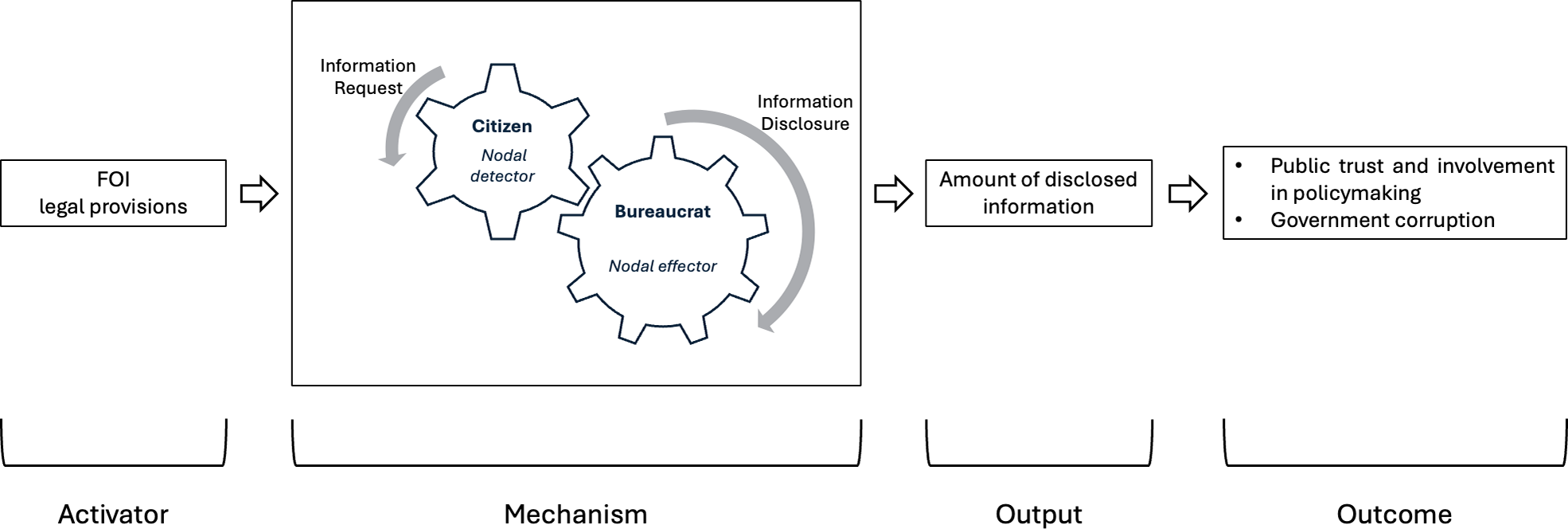
Like many policy tools (Schneider and Sidney Reference Schneider and Sidney2009), FOI laws are structured to activate interactions among actors that generate outputs and, ultimately, broader societal outcomes. As Beach and Pedersen (Reference Beach and Pedersen2013, p. 176) note, policy tools “produce outcomes through the interactions of a series of parts that transmit causal forces from X to Y.” To analyze how FOI laws function internally, Capano and Howlett (Reference Capano and Howlett2021) propose examining the relationships between activators, mechanisms, outputs, and outcomes. In the FOI context, legal provisions and procedural rules act as activators that define the conditions for information disclosure and trigger processes that lead to observable results.
These processes operate through mechanisms – organized activities that consistently link initial conditions to specific results (Machamer et al. Reference Machamer, Darden and Craver2000). The immediate results of these mechanisms are outputs, such as the number of requests processed or the amount of information disclosed, while outcomes refer to longer-term effects, including improved transparency, greater accountability, and enhanced public trust. Focusing on mechanisms clarifies how FOI laws operate in practice and how they are intended to generate these effects.
Howlett’s (Reference Howlett2009) distinction between substantive and procedural policy tools further sharpens this analysis. Substantive tools directly shape the production or delivery of public goods, whereas procedural tools influence outcomes indirectly by altering the environment in which policy actors interact (Bali et al. Reference Bali, Howlett, Lewis and Ramesh2021). FOI laws fall into this latter category: rather than mandating specific policy outputs, they establish a regulatory framework that reshapes interactions between citizens and bureaucrats and reinforces government nodality.
Within this framework, Margetts and John (Reference Margetts and John2024) distinguish between nodal effectors, who release information, and nodal detectors, who receive and interpret it. FOI laws compel public bureaucrats, as nodal effectors, to disclose information upon request from citizens, who act as nodal detectors. When disclosure occurs, nodality increases (Hood Reference Hood1983; Margetts and John Reference Margetts and John2024), enhancing the public’s capacity to monitor government behavior. Over time, this process can contribute to greater transparency and accountability and, in turn, to outcomes such as reduced corruption, improved administrative performance, and stronger public trust and civic engagement (Mabillard and Zumofen Reference Mabillard and Zumofen2017).
As summarized in Figure 1, FOI laws are best understood as procedural policy tools composed of legal activators that shape interactions between citizens and bureaucrats. These activators trigger disclosure mechanisms, producing outputs such as increased information release and higher volumes of processed requests. These outputs, in turn, contribute to broader governance outcomes, including enhanced transparency, reduced corruption, increased institutional trust, and stronger democratic participation.
The legal design of FOI tools.

Bureaucratic behavior and the implementation of FOI laws
FOI tools are expected to function effectively when public administration is conceived as a neutral, rule-bound instrument of government, as reflected in early Weberian conceptions of bureaucracy (Seibel Reference Seibel2010). This entails a “purely bureaucratic, thus bureaucratic-monocratic, document-based administration” that ensures “the highest degree of performance” as the “formally most rational type of authority” (Weber Reference Weber1922, p. 128). In this view, bureaucratic behavior is assumed to be impersonal, professional, and guided by legal rationality, with public officials implementing rules without personal bias.
However, behavioralist research challenges this assumption by shifting attention from formal rules to how public officials act in practice (Dahl Reference Dahl1961). This tradition redirects the focus of policy analysis from formal institutions – such as constitutions and laws – to the behavior of individuals and groups through which these institutions operate in practice. By moving from the de jure to the de facto dimension of policies, this tradition treats behavior as the empirical and observable actions of such actors, making it the primary unit of analysis. In fact, while legal frameworks formally constrain bureaucratic action, cognitive processes and behavioral biases shape how rules are interpreted and applied in practice, leading to systematic variation in policy implementation (Gofen et al. Reference Gofen, Moseley, Thomann and Kent Weaver2021). In ambiguous, resource-constrained, or high-discretion environments – conditions that often characterize local administrations – bureaucrats rely on heuristics to manage workload and fulfill legal obligations (Cantarelli et al. Reference Cantarelli, Bellé and Belardinelli2020). These mental shortcuts can generate cognitive biases that influence administrative decision-making and interactions with citizens.
Applied to FOI, this implies focusing on how bureaucrats respond to information requests as an expression of behavior. While field experiments on FOI implementation do not always conceptualize their findings in these terms, they nonetheless capture such behavioral variation through observed differences in administrative responses. Indeed, evidence from field experiments on FOI implementation at the local level confirms the relevance of such behavioral dynamics (Cicatiello et al. Reference Cicatiello, De Simone, Di Mascio, Gaeta, Natalini and Worthy2024; Grimmelikhuijsen et al. Reference Grimmelikhuijsen, John, Meijer and Worthy2018; Spáč et al. Reference Spáč, Voda and Zagrapan2018; Worthy et al. Reference Worthy, John and Vannoni2017). Rather than uniformly following the legal design of FOI tools, patterns of administrative responses frequently deviate from their intended operation, undermining the effectiveness of FOI laws in producing their expected outputs. In Brazil, Michener and Rodrigues (Reference Michener and Rodrigues2015) assess potential social status discrimination in government responsiveness. Using around 500 FOI requests sent to public administrations, they compare “institutional” requesters (e.g., researchers) with “non-institutional” individuals lacking an identifiable public profile (i.e., individuals with no Internet profile). Their design combines requests for routine administrative information with more politically sensitive issues, such as remuneration and nepotism. They find some evidence of discriminatory patterns favoring institutional identities, particularly female Ph.D. students, who were perceived by bureaucrats as more legitimate or deserving of attention. Male requesters, by contrast, showed little or no significant variation, highlighting how institutional affiliation and gender intersect in bureaucratic stereotyping based on perceived social status. Similarly, Michener et al. (Reference Michener, Velasco, Contreras and Rodrigues2020) show that non-institutional requesters were significantly less likely to receive compliant responses than institutional requesters in Brazil. Based on 700 requests sent to large municipalities, their study focuses on aggregated and routine administrative data (e.g., the number of teachers and doctors employed), highlighting the role of “identity-questing,” whereby public officials actively investigate the identity of requesters – typically through online searches – to assess their credibility and status.
These findings indicate that social status biases may influence how public officials respond to requests for information. Status is associated with prestige, honor, and respect and shapes implicit assumptions about competence, credibility, and deservingness (Ridgeway Reference Ridgeway2014). In the FOI context, requesters affiliated with elite institutions – such as universities – may be perceived as more serious, knowledgeable, or well connected. Public officials may therefore feel more accountable or exposed when dealing with such requesters, anticipating heightened scrutiny or reputational consequences in the event of non-compliance. Against this theoretical background, the first hypothesis posits that, due to social status bias in administrative response behavior, requests from institutional identities are perceived as more credible or legitimate, thereby increasing the likelihood of receiving a complete response. Therefore, the first hypothesis is formulated as follows:
H1: Public officials are more likely to provide complete disclosure to institutional requesters than to ordinary citizens.
In addition to requester identity, several field experiments identify systematic differences in bureaucratic responsiveness between requests that explicitly reference FOI legislation and those that do not (Grimmelikhuijsen et al. Reference Grimmelikhuijsen, John, Meijer and Worthy2018; Spáč et al. Reference Spáč, Voda and Zagrapan2018; Worthy et al. Reference Worthy, John and Vannoni2017). In these studies, both types of requests sought identical information, but one was framed in legalistic terms, citing the FOI law, while the other was presented more informally. The consistently higher response rates to legally framed requests suggest that legal language functions as a cognitive cue, signaling obligation, risk, or oversight and thereby prompting greater attention from bureaucrats.
This pattern aligns with the framing effect described by Tversky and Kahneman (Reference Tversky and Kahneman1981), according to which individuals’ decisions are influenced not only by substantive information but also by how that information is presented. Framing can trigger heuristic rather than deliberative processing, shaping behavior even when the underlying request remains unchanged. In the FOI context, such effects are observed through systematic differences in administrative responses to otherwise equivalent requests. Against this theoretical background, the second hypothesis posits that the explicit mention of FOI laws in requests serves as a framing effect, directing public officials’ attention to their accountability and legal obligations, thereby increasing the likelihood of a complete response. Therefore, the second hypothesis is formulated as follows:
H2: Public officials are more likely to provide complete disclosure in response to requests that explicitly mention FOI laws than to requests that do not.
Research design
This study employs a randomized field experiment to investigate how bureaucratic behavior, understood as observable administrative responses, shapes the implementation of FOI laws in Belgian municipalities. The research design is grounded in the behavioralist framework discussed earlier and focuses on how variations in FOI requests (i.e., experimental stimuli) affect observable patterns of bureaucratic response behavior across diverse contexts, thereby shaping the outputs of the FOI mechanism.
The following subsections introduce the empirical setting, describing the operation of FOI laws within Belgium’s multilevel administrative system. We then outline the data collection process, including the experimental treatments designed as stimuli to elicit variation in administrative responses, the stratified randomization strategy used to ensure internal validity across local jurisdictions, and the response categories employed to assess observable patterns of compliance. The section concludes by describing the analytical strategy used to evaluate the experimental results.
The legal design of FOI in Belgium
Belgium’s federal system includes the federal government, three language-based communities (the Dutch-speaking Flemish Community, the French-speaking Walloon Community, and the German-speaking Community), three regions (Flanders, Wallonia, and the Brussels-Capital Region), ten provinces, and 581 municipalities. This decentralized governance structure significantly shapes the implementation of FOI laws.
Introduced in 1994, the federal FOI law grants individuals the right to access documents held by federal authorities through written requests, including via email, without the need to demonstrate specific interest – except in cases involving personal documents. Authorities must respond within 30 days, extendable to 45 days with justification, and any refusal must be substantiated.
Regional laws, based on the federal framework, differ in some procedural details. In the Brussels-Capital Region, requests must include a scanned or photocopied ID, and response times range from 20 to 40 days depending on complexity. In Wallonia, the standard response period is 30 days, extendable by 15 days, with any delays or refusals requiring explanation. In Flanders, responses are due within 20 days, extendable to 40 days with justification; overly general requests must be revised before processing.
Field experiment and data collection
The field experiment covered all 581 Belgian municipalities, ensuring comprehensive representation of the country’s administrative, linguistic, and demographic diversity. A standardized FOI request – slightly modified across treatments described below – was sent to each municipality, requesting disclosure of the explanatory note and annexes from the most recent municipal council meeting.
The explanatory note provides essential background, context, and clarifications about the topics, agenda items, or decisions discussed during the meeting. It is intended to inform both council members and the public, helping them understand the purpose and relevance of each item. This note is typically accompanied by annexes containing supplementary information.
The content of these annexes varies by meeting and municipal practice but commonly includes detailed reports, studies, or analyses; copies of relevant laws, regulations, or legal opinions; financial documents such as budgets, statements, or cost estimates; and contracts, agreements, or proposals. These annexes are crucial, as they often provide substantive details on projects or decisions listed only in general terms in the explanatory note.
These documents – routinely available under FOI laws – served as a consistent and objective measure of compliance across municipalities.
Base and treatment groups
To examine how observable administrative responses vary in reaction to different stimuli, the FOI requests were systematically varied across five experimental groups. Each group was designed to test the effects of requester identity and the explicit mention of FOI laws:
-
a. Common Citizen: a baseline request signed by a non-identifiable pro bono collaborator using a generic Belgian name.
-
b. Common Citizen + FOI Mention: identical to the baseline request but with an explicit reference to the relevant regional FOI law.
-
c. University Professor: a request signed by one of the study’s co-authors, using the academic title “Prof.” to signal an institutional affiliation.
-
d. University Professor + FOI Mention: same as the previous group but with an explicit reference to the FOI law.
-
e. Common Citizen via Transparencia.be: like group (b), this request was submitted via Transparencia.be, a transparency advocacy platform developed by Anticor Belgium – a civil society organization committed to combating corruption in politics, the judiciary, and business. Requests submitted through this platform automatically include a reference to the FOI law and display the Transparencia.be logo in the signature, signaling affiliation with Anticor Belgium.
These treatments were designed to test the following hypothesized biases:
-
• Social status bias (H1): differences in observed response patterns between the common citizen and the university professor, and between the unaffiliated citizen and the citizen associated with a civil society organization, reflect how perceptions of status and credibility shape bureaucratic response decisions.
-
• Framing bias (H2): the explicit mention of FOI laws acts as a legal frame, directing bureaucrats’ attention toward their formal obligations, potentially increasing the likelihood of a positive response.
Based on the hypotheses outlined above, we expect patterns of administrative responses to vary systematically across treatment groups:
-
• Professor + FOI Mention and Citizen via Advocacy Platform: these institutional profiles, combined with legal framing, are expected to yield the highest rates of complete responses (i.e., norm compliance).
-
• Common Citizen + FOI Mention: legal framing is predicted to increase responsiveness, though moderated by the requester’s non-institutional identity.
-
• Professor (No FOI Mention): the institutional status of the requester is expected to increase responsiveness, though less than when paired with legal framing.
-
• Common Citizen (No FOI Mention): without either institutional affiliation or legal framing, this group is expected to receive the lowest level of responsiveness.
Randomization
Municipalities were randomly assigned to one of the five treatment groups through stratified randomization based on region and municipal size. The regions included Flanders, Wallonia, and the Brussels-Capital Region, accounting for linguistic, cultural, and institutional differences. Municipal size was categorized into three population ranges (<12,000, 12,000–50,000, and >50,000) to serve as a proxy for administrative capacity. A balance test reported in the appendix (Tables A10–A11) suggests a successful randomization, as the five groups do not show significant differences on several contextual variables. The appendix also reports the distribution of observations by randomization block and the treatment conditions (Tables A1–A3).
FOI requests were sent via standardized email addresses (e.g., name.surname@gmail.com), with the language of the request matching the official language of the municipality – Flemish for Flanders and French for Wallonia and Brussels. All requests were dispatched between March 13 (Monday) and March 15 (Wednesday), 2023, ensuring uniform timing across all municipalities.
Responses’ categorization
To ensure consistency and objectivity in coding, all responses were analyzed by research assistants using a detailed codebook. Requests were categorized into three categories to aggregate functionally similar outcomes and to facilitate the evaluation of observable bureaucratic behavior:
-
1. No Reply: no response was received within 60 days following the request.
-
2. Negative Reply: the request was either explicitly denied, or the municipalities requested additional information not required by the law, or the documents provided were irrelevant or unsatisfactory.
-
3. Disclosure: the bureaucrats provided at least the requested explicative note.
To minimize variability arising from differing levels of engagement in follow-up communications, only initial responses were included in the analysis.
Control variables
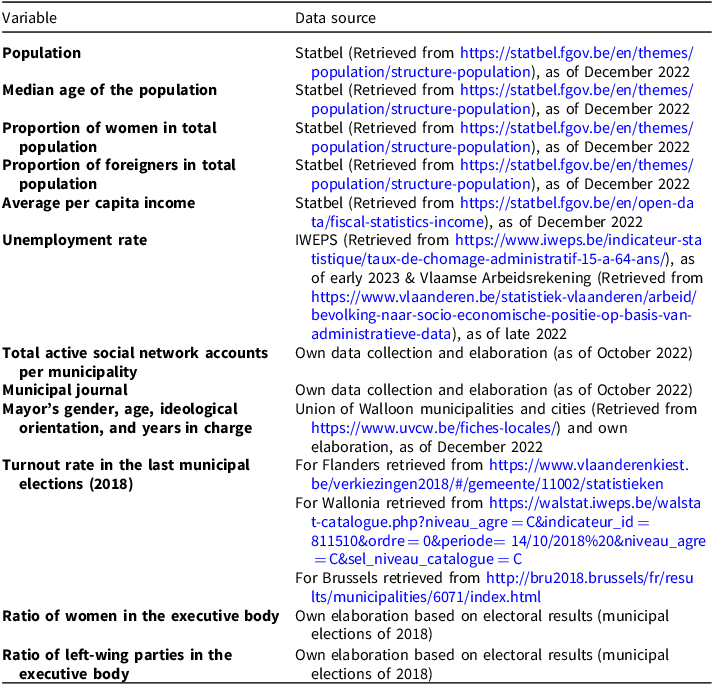
To account for contextual factors that may influence observable administrative responses to FOI requests, the models include a set of demographic, socio-economic, technological, and political control variables identified in prior research (Table 1). Demographic characteristics – such as population composition, including age, gender, and the share of foreign residents – have been shown to shape administrative capacity and communication, with larger and more diverse jurisdictions displaying systematically different disclosure patterns (Spáč et al. Reference Spáč, Voda and Zagrapan2018; Wagner Reference Wagner2021). Socio-economic conditions are captured through average per capita income and unemployment rates, as wealthier municipalities with stronger fiscal capacity and professionalized administrations tend to be more responsive to FOI requests (Hameed Reference Hameed2005; Piotrowski and Van Ryzin Reference Piotrowski and Van Ryzin2007; Tejedo-Romero and de Araujo Reference Tejedo-Romero and de Araujo2023). To control for variation in proactive transparency and communication practices, we include indicators of municipal informational infrastructure, such as the presence of a municipal journal and the number of active social media accounts, which are associated with higher levels of information disclosure (Mabillard and Keuffer Reference Mabillard and Keuffer2022). Political context is accounted for through controls for mayoral characteristics and executive composition, including gender, ideology, and tenure, given evidence that female leadership and left-leaning governments are more likely to promote transparency and citizen-oriented governance (Spáč et al. Reference Spáč, Voda and Zagrapan2018; Tejedo-Romero and de Araujo Reference Tejedo-Romero and de Araujo2023). Finally, voter turnout in the most recent municipal elections is included as a proxy for democratic engagement; consistent with the zero-sum democracy argument, lower turnout has been associated with greater reliance on transparency mechanisms such as FOI (del Sol Reference del Sol2013; Peters Reference Peters2016).
Overview of variables and data sources
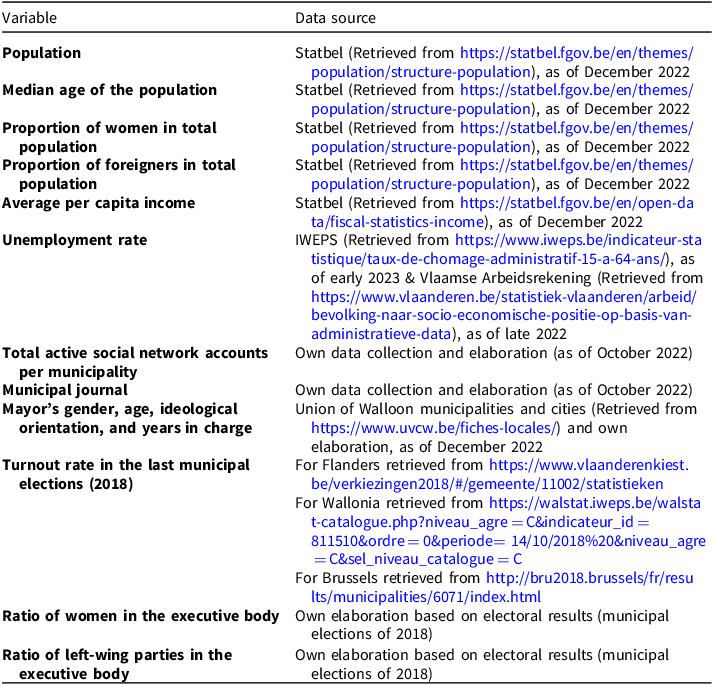
Table 1. Long description
The table has two columns: Variable and Data source. It lists 13 variables and their corresponding data sources. Row 1: Population, Statbel (Retrieved from https://statbel.fgov.be/en/themes/population/structure-population), as of December 2022. Row 2: Median age of the population, Statbel (Retrieved from https://statbel.fgov.be/en/themes/population/structure-population), as of December 2022. Row 3: Proportion of women in total population, Statbel (Retrieved from https://statbel.fgov.be/en/themes/population/structure-population), as of December 2022. Row 4: Proportion of foreigners in total population, Statbel (Retrieved from https://statbel.fgov.be/en/themes/population/structure-population), as of December 2022. Row 5: Average per capita income, Statbel (Retrieved from https://statbel.fgov.be/en/open-data/fiscal-statistics-income), as of December 2022. Row 6: Unemployment rate, IWEPS (Retrieved from https://www.iweps.be/indicateur-statistique/taux-de-chomage-administratif-15-a-64-ans/), as of early 2023 & Vlaamse Arbeidsrekening (Retrieved from https://www.vlaanderen.be/statistiek-vlaanderen/arbeid/bevolking-naar-socio-economische-positie-op-basis-van-administratieve-data), as of late 2022. Row 7: Total active social network accounts per municipality, Own data collection and elaboration (as of October 2022). Row 8: Municipal journal, Own data collection and elaboration (as of October 2022). Row 9: Mayor’s gender, age, ideological orientation, and years in charge, Union of Walloon municipalities and cities (Retrieved from https://www.ucvw.be/ficches-locales/) & own elaboration, as of December 2022. Row 10: Turnout rate in the last municipal elections (2018), For Flanders retrieved from https://www.vlaanderenkiest.be/verkiezingen2018/#/gemeente/11002/statistieken. For Wallonia retrieved from https://walstat.iweps.be/walstat-catalogue.php?niveau_agre=C&indicateur_id=811510&ordre=0&periode=14/10/2018%20&niveau_agre=C&sel_niveau_catalogue=C. For Brussels retrieved from http://bru2018.brussels/fr/resultats/municipalities/6071/index.html. Row 11: Ratio of women in the executive body, Own elaboration based on electoral results (municipal elections of 2018). Row 12: Ratio of left-wing parties in the executive body, Own elaboration based on electoral results (municipal elections of 2018).
Data analysis
To assess the results of the experiment, we employed descriptive statistics alongside a series of regression analyses. First, in order to test how the outcome varies across experimental treatments, we estimate a series of multinomial logit models to contrast the likelihood of a negative reply and the likelihood of disclosure with the base outcome, which is no response (see Tables A4–A9 in the Appendix for full regression results). Then, since disclosure is the only outcome which has the ability to activate the FOI mechanism depicted in Figure 1, and is therefore our preferred outcome, we estimate a series of logit regressions in which we estimate the effect of conditions on disclosure, as opposed to no responses and negative replies. To provide a clear test of our hypotheses, we estimate separate models for each relevant treatment contrast. First, we compare citizen requests, with and without an FOI-law reference, with professor requests under the same two conditions. We then estimate the effect of mentioning the FOI law separately for citizen and professor requests. Finally, we compare requests submitted through the advocacy platform with those submitted directly by the common citizen. These contrast-specific specifications constitute our main analysis because they allow each effect to be assessed within the relevant set of treatment groups and against the appropriate reference category. These estimations are reported in Table 6. Finally, we estimate logit models by including all the treatment categories and the control variables listed in Table 1, allowing us to assess whether external factors are associated with the likelihood of disclosure while holding treatment effects constant. We also explore potential regional heterogeneity in bureaucratic responsiveness by estimating additional models on subsamples restricted to specific regions.
Results
The outputs of FOI tools
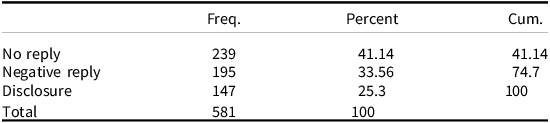
Designed to compel bureaucrats to disclose information upon citizen request, the output of FOI tools is measured by both the quantity and quality of information disclosed. Table 2 summarizes the experimental results on this output. Across all treatment conditions, approximately 41% of municipalities did not respond to the request. One-third of municipalities replied in an unsatisfactory manner. Only 25% of municipalities (147 out of 581) provided at least the explanatory note.
Outcome of the experiment
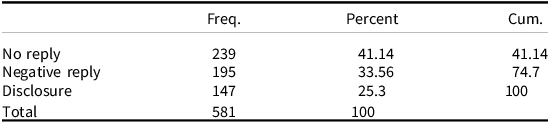
Table 2. Long description
A table comparing the outcomes of an experiment on information disclosure by municipalities. The table has four rows and three columns. Column headers are Freq., Percent, and Cum. Row labels are No reply, Negative reply, Disclosure, and Total. Row 1: No reply, Freq. 239, Percent 41.14, Cum. 41.14. Row 2: Negative reply, Freq. 195, Percent 33.56, Cum. 74.7. Row 3: Disclosure, Freq. 147, Percent 25.3, Cum. 100. Row 4: Total, Freq. 581, Percent 100, Cum. The table shows that 41% of municipalities did not respond to the request, one-third replied negatively, and only 25% provided at least the explanatory note.
Compliance with FOI obligations also varied by municipal size, as shown in Table 3. In small municipalities, at least one document was disclosed in only 20% of cases, compared to 29% in medium-sized municipalities and 43% in large ones. On the one hand, larger municipalities generally possess more articulated administrative structures, greater specialization of offices, and higher levels of bureaucratic professionalization, all of which may increase administrative capacity and facilitate compliance with FOI requests. On the other hand, larger municipalities also manage a greater volume and complexity of administrative activity, which likely requires more extensive documentation and more systematic production and preservation of explanatory notes and annexes. As a result, higher disclosure rates in larger municipalities may reflect both stronger administrative capacity and a greater institutional propensity to generate and maintain formal records. Of course, it is worth noting that the largest population category contains a limited number of observations and that this category is sizably smaller than the small and medium population categories.
Share of replies by population

Table 3. Long description
A table comparing the share of replies by population categories. The table has four rows and four columns. Column headers are Less than 12,000, Between 12,000 and 49,999, More than 50,000, and Total. Row labels are No reply, Negative reply, Disclosure, and Total. Row 1: No reply, 0.50, 0.34, 0.23, 0.41. Row 2: Negative reply, 0.30, 0.37, 0.33, 0.34. Row 3: Disclosure, 0.20, 0.29, 0.43, 0.25. Row 4: Total, 1, 1, 1, 1. Row 5: N, 278, 273, 30, 581.
Regional variation is also evident in Table 4. Municipalities in the Brussels-Capital Region (n = 19) exhibited the highest disclosure rate (37%), while those in Wallonia (n = 262) showed the lowest (18%), with more than half (52%) failing to respond altogether.
Share of replies by region

Table 4. Long description
A table with four rows and five columns comparing the share of replies by region. The columns are labeled Brussels, Flanders, Wallonia, and Total. The rows are labeled No reply, Negative reply, Disclosure, and Total. The table includes the following data: Row 1: No reply, Brussels 0.26, Flanders 0.33, Wallonia 0.52, Total 0.41. Row 2: Negative reply, Brussels 0.37, Flanders 0.36, Wallonia 0.31, Total 0.34. Row 3: Disclosure, Brussels 0.37, Flanders 0.31, Wallonia 0.18, Total 0.25. Row 4: Total, Brussels 1, Flanders 1, Wallonia 1, Total 1. The table also includes the number of municipalities (N) in each region: Brussels 19, Flanders 300, Wallonia 262, Total 581.
Biases in administrative response behavior to FOI requests
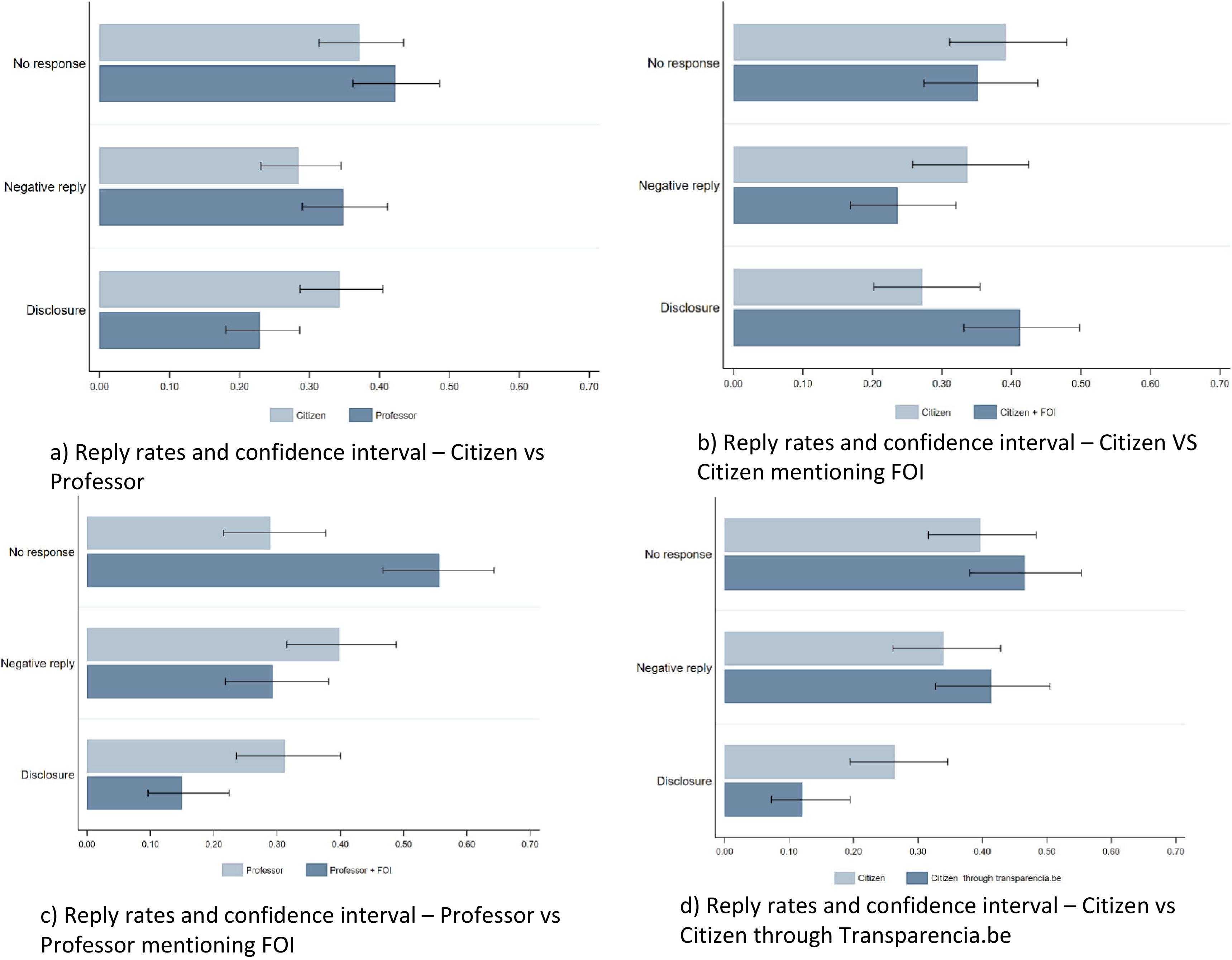
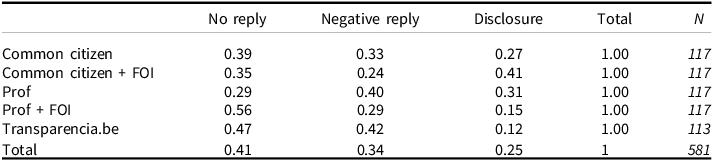
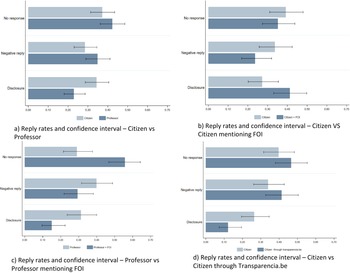
The share of replies by treatment is presented in Table 5. To facilitate the presentation of our findings, we use visualizations (Figure 2) that depict the predicted probabilities of observing different outcomes – i.e., “no reply,” “negative reply,” and “disclosure” – based on the requester’s profile and whether the FOI law was explicitly mentioned in the request. In these figures, bars represent the estimated likelihood of each outcome, with error bars indicating 95% confidence intervals. The underlying multinomial logit regression analyses used to compute these probabilities and intervals are reported in the Appendix (Tables A4–A8, while Table A9 reports the observed outcome by treatment conditions). All regression models include, as control variables, regional dummies (Wallonia, Flanders, Brussels), and population categories.
Share of replies by treatments
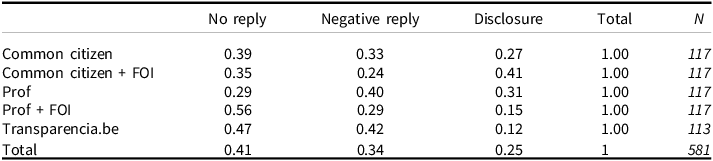
Table 5. Long description
A table with six rows and five columns comparing the share of replies by different treatments. The columns are labeled No reply, Negative reply, Disclosure, Total, and N. The rows are labeled Common citizen, Common citizen + FOI, Prof, Prof + FOI, Transparencia.be, and Total. Each cell contains a value representing the share of replies for each treatment. Notable trends include variations in the share of no reply, negative reply, and disclosure across different treatments.
Predicted probabilities of bureaucratic responses to FOI requests by treatment condition.
Social status bias
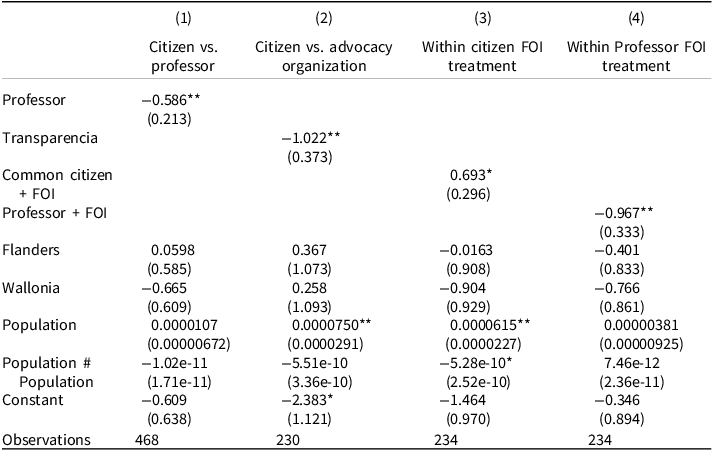
Evidence for H1, concerning the existence of social status bias, is drawn from analyses comparing the observed response patterns to FOI requests submitted by university professors and by an advocacy platform with those submitted by ordinary citizens. Figure 2a compares the outcomes of requests from the ordinary citizen to requests from the university professor. These two categories include that either mention or do not mention FOI law. This allows us to assess the effect of social status independently of whether the law is explicitly mentioned, a potential signal of awareness and expertise. Requests from ordinary citizens had a disclosure probability of 34%, significantly higher than the 22% for university professors. Column (1) of Table 6 shows that the difference in disclosure is statistically significant at the 1% level. Similarly, Figure 2d compares the outcomes of requests submitted by common citizens (not mentioning FOI) and those submitted by common citizens through the advocacy organization transparencia.be. The disclosure probability is 26% for common citizens not mentioning FOI, compared to just 12% for those submitted via Transparencia.be. This 14-percentage-point gap is also statistically significant at the 1% level, as shown in column (2) of Table 6. Contrary to expectations that institutional profiles would enhance compliance due to perceived authority, the findings suggest the opposite: bureaucrats appear more responsive to non-institutional actors like ordinary citizens. H1 is therefore rejected.
Framing bias
Evidence for H2, concerning the existence of framing bias, is drawn from an analysis comparing the observed response patterns to FOI requests that explicitly mention the Belgian FOI law with those that do not. The results are presented in Figures 2b and 2c.
Figure 2b compares requests submitted by ordinary citizens not mentioning the FOI law contrasted with requests submitted by ordinary citizens who do mention the FOI law. Such mention increased the estimated disclosure probability from 27% to 41%, a statistically significant rise at the 5% level, as reported in column (3) of Table 6. This supports the hypothesis that invoking legal authority enhances compliance for non-threatening profiles. The findings demonstrate a clear framing effect: referencing FOI legislation draws bureaucrats’ attention to their formal obligations, increasing responsiveness to requests from ordinary citizens.
However, the pattern differs when analyzing requests submitted by university professors (Figure 2c). In this case, mentioning the FOI law reduced the estimated disclosure probability from 31% to 14%, a statistically significant decline at the 1% level, as shown in column (4) of Table 6. These results suggest that when professors invoke FOI legislation, bureaucrats may respond with defensiveness or resistance. While FOI mention was expected to enhance compliance through legal framing, its effect appears conditional on the perceived status and intent of the requester. For professors, legal references may heighten perceptions of scrutiny or legal risk, thereby undermining the framing effect and decreasing compliance. Thus, H2 is only partially supported, as the effect of legal framing is conditional on the perceived status of the requester.
It is worth noting that these results are visible only when a contrast-specific approach is adopted. If all requests mentioning the FOI law had been compared with all the requests not mentioning it, regardless of the requester identity, the positive effect among citizen requests and the negative effect among professor requests would have offset each other.
Logistic regressions results. The dependent variable takes the value of 1 when at least the note explicative is disclosed, and take the value of 0 in case of no response or negative reply
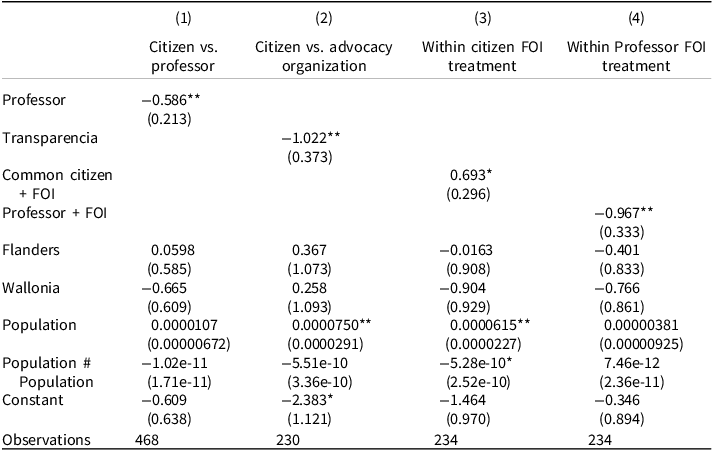
Table 6. Long description
The table presents logistic regression results with four columns and multiple rows. Column headers include Citizen vs. professor, Citizen vs. advocacy organization, Within citizen FOI treatment, and Within Professor FOI treatment. Row labels include Professor, Transparencia, Common citizen + FOI, Professor + FOI, Flanders, Wallonia, Population, Population # Population, Constant, and Observations. Each cell contains numerical values and standard errors in parentheses. Notable trends include significant negative values for Professor and Transparencia in the first two columns and significant positive values for Common citizen + FOI in the third column. The table compares the likelihood of disclosure under different conditions and treatments.
Notes: the columns report coefficients and standard errors in parentheses. *p < 0.05, **p < 0.01.
Control variables: the role of context
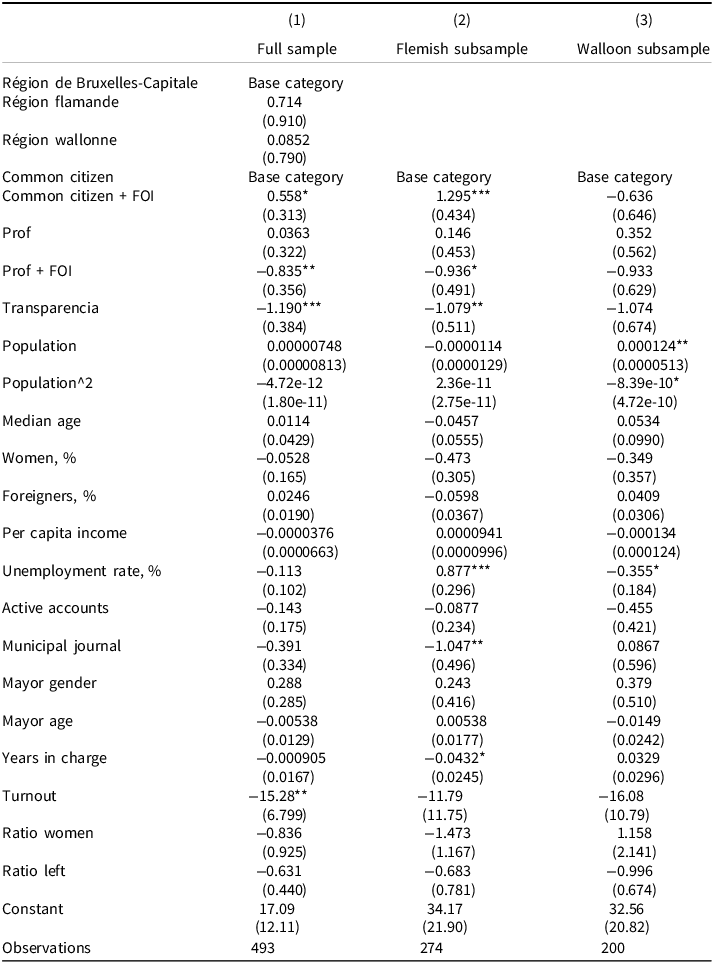
Table 7 presents the results of additional logit regression analyses examining how contextual factors are associated with FOI implementation. Again, such regressions are estimated on the probability of disclosure. This analysis serves two purposes. First, contextual variables are included as covariates in the full-sample model (Column 1) to assess whether the main treatment effects are robust to differences in municipal characteristics. Second, separate models are estimated for two of Belgium’s three regions (Columns 2 for Flanders and 3 for Wallonia) to explore whether the observed behavioral patterns vary across institutional and socio-economic contexts. The subsample of the third Belgian region, Bruxelles Capital Region, has not been analyzed due to the small sample size (n = 19). Unfortunately, some of the contextual variables are not available for some municipalities in the sample, so that the number of observations drops to 493 (274 in Flanders, 200 in Wallonia).
Logit regression results - contextual factors
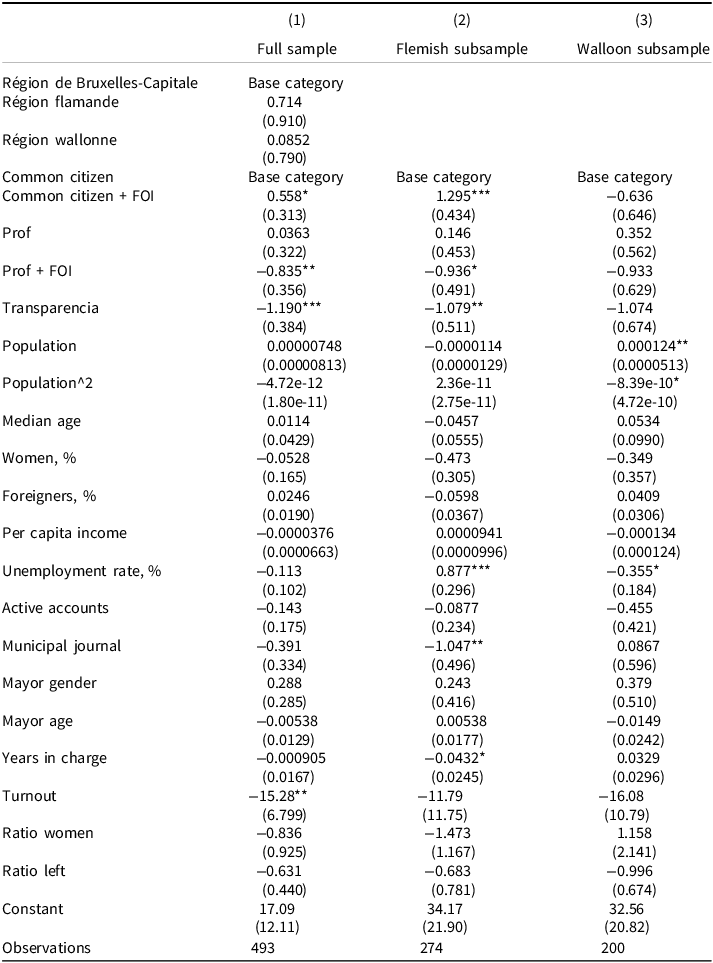
Table 7. Long description
The table presents logit regression results examining the association of contextual factors with FOI implementation. It includes three columns: Full sample, Flemish subsample, and Walloon subsample. Each column lists various factors such as region, citizen type, transparency, population, median age, women percentage, foreigners percentage, per capita income, unemployment rate, active accounts, municipal journal, mayor gender, mayor age, years in charge, turnout, ratio women, ratio left, and constant. Each row provides regression coefficients and standard errors for these factors. Notable trends include significant coefficients for common citizen + FOI, prof + FOI, transparency, population, population squared, unemployment rate, active accounts, municipal journal, years in charge, and turnout in different regions.
Notes: the columns report coefficients and standard errors in parentheses. *p < 0.1, **p < 0.05, ***p < 0.01.
Because logit models are non-linear, coefficients cannot be interpreted in the same way as in linear regressions. While the direction and statistical significance of associations can be inferred from Table 7, substantive interpretation is based on predicted probabilities, which are not reported in an additional table for the sake of space but are presented and discussed below.
In the full sample, the inclusion of contextual variables does not alter the main treatment effects. The framing effect for requests submitted by common citizens remains positive and statistically significant: referencing the FOI law continues to increase the likelihood of disclosure relative to the baseline request. No evidence of enhanced responsiveness toward institutional profiles, such as university professors, emerges once contextual factors are considered. The advocacy organization treatment remains negatively and significantly associated with disclosure, indicating lower responsiveness toward civil society–affiliated requests.
Among the contextual variables, voter turnout is the only factor that reaches statistical significance in the full sample. Higher turnout is associated with a lower likelihood of disclosure. At the mean turnout level (approximately 0.92), the predicted probability of disclosure is 0.27; this increases to 0.36 one standard deviation below the mean (0.89) and decreases to 0.19 one standard deviation above the mean (0.95). This pattern suggests that stronger electoral participation may coincide with reduced reliance on administrative transparency mechanisms such as FOI, consistent with existing arguments on substitution effects between representative and administrative accountability.
Besides being highly heterogeneous in terms of social, economic, political, and demographic factors (Billiet et al. Reference Billiet, Maddens and Frognier2006), Belgian regions are heterogeneous in a number of ways that are difficult to measure. Among those, recent research suggests that even in the presence of similar contextual factors, administrative outputs may differ because of administration capacities to activate resources and carry out processes (Fratesi et al. Reference Fratesi, Livert, Polverari and Zerbinati2026). This suggests that administrative capacity may not only directly affect outputs but also moderate how observed contextual variables related to our outcome, since the effectiveness of a given contextual factor could itself depend on the administration’s capacity to act on it. This is why one might expect that our findings are heterogeneous across regions. Indeed, estimating separate models by region reveals substantial differences. In Flanders (Column 2), the main behavioral patterns observed in the full sample are replicated, indicating that requester identity and legal framing play a significant role in shaping bureaucratic responsiveness. In Wallonia (Column 3), by contrast, none of the treatment coefficients reach statistical significance, suggesting that FOI responsiveness is more strongly conditioned by macro-level contextual factors.
In Wallonia, municipal size is positively associated with disclosure up to a population threshold of approximately 50,000 inhabitants, beyond which the effect becomes statistically insignificant – likely reflecting differences in administrative capacity across smaller municipalities. While interpreting this effect one has to take into account that the number of municipalities beyond 50,000 inhabitants is particularly low (n = 9) in this region. Unemployment is also negatively associated with FOI responsiveness. At the mean unemployment rate (approximately 5.6%), the predicted probability of disclosure is 0.23; this decreases to 0.14 one standard deviation above the mean and increases to 0.34 one standard deviation below. This association is statistically significant at the 10% level. It must be noted that the lack of statistical significance for some effects in Wallonia may be attributable to the smaller number of observations rather than to the absence of a substantive effect. This appears particularly relevant for the Professor mentioning FOI and Transparencia.be conditions, which have coefficients of similar magnitude and direction as those in the model for the Flemish subsample but are associated with larger standard errors.
In Flanders, contextual variables also matter, though not always in expected directions. The presence of a municipal journal – used as a proxy for proactive transparency – is associated with a lower likelihood of disclosure. The predicted probability of disclosure is 0.29 in municipalities with a journal, compared to 0.49 in those without (p < 0.05), suggesting a potential trade-off between proactive and reactive transparency practices. Additional interaction analyses (reported in the Appendix) suggest that the presence of a municipal journal reinforces the negative effect of the Professor mentioning FOI treatment on the probability of receiving a reply. In other words, the negative effect of this treatment becomes even stronger in municipalities where a municipal journal exists.
Unemployment is positively associated with FOI responsiveness: the predicted probability of disclosure rises from 0.19 one standard deviation below the mean unemployment rate (2.55%) to 0.43 one standard deviation above it, an effect that is statistically significant at the 1% level.
Finally, mayoral tenure in Flanders is negatively associated with FOI responsiveness. At the mean tenure (approximately nine years), the predicted probability of disclosure is 0.31; this decreases to 0.26 one standard deviation above the mean and increases to 0.36 one standard deviation below. Additional interaction analyses (not reported but available upon request) indicate that this pattern is particularly pronounced for requests submitted via advocacy platforms, where external scrutiny may be perceived as more challenging to established authority.
Overall, these results indicate that while the main behavioral findings are robust to the inclusion of contextual controls, FOI implementation is shaped by a complex interplay between micro-level behavioral mechanisms and macro-level conditions. The influence of contextual factors varies across regions and operates in non-linear ways, underscoring the importance of accounting for institutional and socio-economic environments when assessing bureaucratic responsiveness.
Discussion
This paper examines how variations in FOI requests shape administrative responses and what these observed patterns reveal about bureaucratic behavior in the implementation of FOI laws. Drawing on a field experiment conducted in Belgian municipalities, it analyzes how responsiveness to FOI requests varies with requester identity and legal framing across municipal contexts.
The findings indicate that FOI laws in Belgium function as procedural tools that establish an institutional framework for disclosure, but that this framework alone does not ensure effective implementation. In comparative terms, FOI performance in Belgian municipalities falls between the disclosure rates reported by Spáč et al. (Reference Spáč, Voda and Zagrapan2018) in Slovakia (29.51%) and Worthy et al. (Reference Worthy, John and Vannoni2017) in England (2.02%) yet remains well below the higher compliance levels observed by Cicatiello et al. (Reference Cicatiello, De Simone, Di Mascio, Gaeta, Natalini and Worthy2024) in Italy, where 59.6% of municipalities fully disclosed the requested information. These differences suggest that while legal design structures implementation, it provides an insufficient explanation for the observed variation. Consistent with prior research, the results confirm a persistent gap between FOI law as written (de jure) and as implemented in practice (de facto) (Michener and Nichter Reference Michener and Nichter2022; Michener et al. Reference Michener, Coelho and Moreira2021).
These results also suggest that differences in responsiveness across studies partly reflect variation in experimental design and administrative context, particularly in terms of administrative capacity and the nature of the information requested. Studies differ in the type of local governments included. For example, Worthy et al. (Reference Worthy, John and Vannoni2017) focus on English parish councils – the lowest tier of local government, often administered on a voluntary or part-time basis – which are substantially smaller than Belgian municipalities. Given that larger municipalities tend to exhibit higher responsiveness (Spáč et al. Reference Spáč, Voda and Zagrapan2018), this may help explain the comparatively low response rates observed in England. By contrast, Cicatiello et al. (Reference Cicatiello, De Simone, Di Mascio, Gaeta, Natalini and Worthy2024) restrict their analysis to municipalities with more than 30,000 inhabitants and request standardized, non-sensitive administrative data (the number of electronic ID cards issued), which may be easier to process and disclose. This may contribute to the higher response rates observed in Italy. The Slovak case (Spáč et al. Reference Spáč, Voda and Zagrapan2018) is more comparable to the Belgian setting, as it includes municipalities of varying sizes and requests potentially sensitive information (e.g., electoral scores), which may explain the closer alignment in response rates.
Beyond these contextual and design-related factors, the analysis shows that this gap is shaped by bureaucratic behavior. FOI implementation is not neutral or mechanical but depends on how public officials interpret and respond to cues embedded in information requests, as reflected in observable response patterns. First, as discussed below, bureaucratic responsiveness varies systematically with requester identity, reflecting perceptions of risk rather than legal obligation alone. Second, legal framing increases compliance for ordinary citizens but reduces it for university professors, while requests submitted through an advocacy platform exhibit particularly low levels of disclosure. Third, bureaucratic behavior varies across contexts, shaping patterns of responsiveness.
Social status bias or bureaucratic risk aversion?
Drawing on Michener and Rodrigues (Reference Michener and Rodrigues2015) and Michener et al. (Reference Michener, Velasco, Contreras and Rodrigues2020), the first hypothesis (H1) predicted that requests from institutional identities would be perceived as more credible or legitimate, thereby increasing the likelihood of disclosure. Our findings do not support this expectation. Institutional requesters received significantly lower disclosure rates than ordinary citizens: university professors obtained disclosure in only 22% of cases, compared to 34% for common citizens, while requests submitted via an advocacy organization exhibited the lowest disclosure rate in the sample (12%). These patterns are consistent with Cicatiello et al. (Reference Cicatiello, De Simone, Di Mascio, Gaeta, Natalini and Worthy2024), who argue that bureaucrats may seek to avoid requests perceived as high-risk, such as those associated with legal scrutiny, reputational damage, or external oversight. Rather than reflecting social status bias, bureaucratic behavior in this context may be consistent with patterns typically interpreted as risk aversion. Professors and advocacy organizations may be perceived as actors capable of mobilizing information for critical scrutiny or public exposure, prompting cautious or avoidance responses. By contrast, ordinary citizens are more likely to be viewed as non-threatening, eliciting higher levels of responsiveness. More broadly, requests from ordinary citizens may be interpreted as routine or low-risk interactions whereas requests from institutional or external actors may signal greater scrutiny or potential reputational consequences.
This interpretation is further reinforced by the nature of the information requested. In contrast to studies such as Michener et al. (Reference Michener, Velasco, Contreras and Rodrigues2020), where requests concern aggregated and routine administrative data, the requests in our study target municipal council documents and annexes, which may contain information related to ongoing decisions, financial commitments, or politically sensitive issues. In such contexts, the perceived status of the requester may amplify concerns about scrutiny and potential consequences of disclosure, thereby reinforcing risk-averse patterns of bureaucratic behavior. These findings suggest that bureaucrats do not systematically privilege institutional affiliation but instead differentiate between requesters in ways that reflect how they interpret both the identity of the requester and the implications of the requested information. In this regard, evidence from Michener and Rodrigues (Reference Michener and Rodrigues2015) suggests that the effect of requester identity is conditional on the nature of the information requested: while institutional affiliation may confer an advantage when requests concern routine administrative data, this effect weakens or disappears when requests involve more politically sensitive issues. In such contexts, the perceived status of the requester may amplify concerns about scrutiny and the consequences of disclosure, thereby reinforcing risk-averse patterns of bureaucratic behavior.
Universal or conditional framing effect?
The results related to H2 further reinforce the interpretation of the findings for H1. Drawing on previous literature (Grimmelikhuijsen et al. Reference Grimmelikhuijsen, John, Meijer and Worthy2018; Spáč et al. Reference Spáč, Voda and Zagrapan2018; Worthy et al. Reference Worthy, John and Vannoni2017), H2 posited that the explicit mention of FOI laws in requests would function as a framing effect – directing bureaucrats’ attention toward their legal obligations and accountability, thereby increasing the likelihood of a complete response. This hypothesis is only partially confirmed. The framing effect holds for requests submitted by ordinary citizens: explicitly referencing FOI legislation increased the estimated probability of disclosure from 27% to 41% compared to requests that did not include such a reference. However, the opposite pattern is observed for university professors. In this case, legal framing led to a decline in compliance, with the estimated probability of disclosure dropping from 31% without FOI mention to just 14% when FOI laws were explicitly cited. This pattern is consistent with the interpretation that professors invoking FOI laws may be perceived as more adversarial or threatening, prompting more defensive or resistant responses. These findings offer a new perspective on previous studies of legal framing in FOI requests. While invoking FOI law was expected to universally enhance compliance, its effectiveness appears conditional on the perceived identity of the requester. As also suggested by the findings for H1, public officials may be more reluctant to respond to requesters perceived as highly knowledgeable about FOI legislation. In such cases, referencing legal authority may amplify perceptions of external scrutiny or legal risk, thereby undermining the positive framing effect observed for non-threatening profiles like ordinary citizens and ultimately reducing compliance.
A related pattern emerges when comparing requests submitted by ordinary citizens with an explicit FOI reference to those submitted via the Transparencia.be platform. While both treatments include a reference to FOI legislation, their effects differ substantially: legal framing increases responsiveness for ordinary citizens but is associated with lower disclosure when combined with an advocacy platform. This suggests that FOI mention does not operate as a uniform framing device but interacts with how the requester is perceived. When embedded in a neutral request from an ordinary citizen, legal references may function as a benign reminder of administrative obligations. In contrast, when coupled with signals of external monitoring – such as the involvement of a civil society organization – FOI references may be interpreted as indicative of scrutiny, reputational risk, or adversarial intent. In such cases, rather than increasing compliance, legal framing may trigger defensive or avoidance behavior.
Taken together, the findings for H1 and H2 are consistent with a common behavioral logic shaping bureaucratic responses. Rather than reflecting separate effects of requester identity and legal framing, the results suggest that public officials interpret FOI requests as signals about the potential risks and consequences of disclosure. In this perspective, both who makes the request and how it is formulated contribute to shaping perceived risk, anticipated scrutiny, and the potential costs of compliance. Bureaucratic behavior thus appears to be guided not by formal rules alone, but by how officials interpret and respond to these signals in context.
The embeddedness of bureaucratic responsiveness
The study reveals that while bureaucratic responsiveness is influenced by behavioral biases in individual-level interactions with citizens, patterns of administrative responsiveness also vary with contextual factors.
Democratic trade-offs and bureaucratic responsiveness
One notable finding across Belgian municipalities is the negative association between electoral turnout and bureaucratic responsiveness. This aligns with Tejedo-Romero and de Araujo’s (Reference Tejedo-Romero and de Araujo2023) findings in Portugal, where municipalities with lower electoral participation exhibited higher levels of information disclosure – interpreted as a strategic effort by bureaucrats to regain citizen trust when engagement with representative democratic institutions is low. Our results similarly point to a trade-off between democratic instruments: where electoral engagement is strong, bureaucrats may feel less compelled to ensure transparency through tools such as FOI.
This pattern supports the zero-sum democracy argument advanced by Peters (Reference Peters2016), which holds that democratic tools can displace one another in both perception and practice. These findings suggest a form of normative crowding, whereby one type of accountability mechanism – such as elections – displaces another – such as FOI – in the bureaucratic mindset. As Vandamme et al. (Reference Vandamme, Pilet and Bedock2021) argue, democratic tools are not necessarily additive; rather, they may reconfigure the institutional logic of accountability within public administrations and shift the perceived locus of legitimacy. Our findings indicate that bureaucrats may reinterpret their obligations depending on how various democratic instruments – such as FOI laws and electoral mandates – are institutionalized and prioritized in their local environment.
Policy tool interactions and bureaucratic responsiveness
When disaggregating the analysis by region, further nuance emerges. In Flanders, we observe not only a trade-off between transparency mechanisms and representative democratic institutions but also between different forms of transparency themselves. Specifically, municipalities with proactive transparency tools like municipal bulletins were less likely to respond positively to FOI requests. Contrary to Mabillard and Keuffer’s (Reference Mabillard and Keuffer2022) findings in Switzerland – where proactive and passive transparency were mutually reinforcing – our results suggest competition between transparency mechanisms in Flanders. This again supports the idea of normative crowding, where institutionalized routines of proactive communication may lead bureaucrats to deprioritize citizen-initiated requests, perceiving them as redundant or burdensome.
In addition, mayoral tenure in Flanders was negatively associated with FOI responsiveness, supporting the argument that political strength of incumbent elected leaders may shift accountability away from the public and toward internal hierarchies. In contexts where elected officials are firmly entrenched in power, bureaucrats may prioritize loyalty and internal responsiveness over public-facing transparency. This aligns with Tejedo-Romero and de Araujo’s (Reference Tejedo-Romero and de Araujo2018) theory that political strength can reduce transparency by weakening the principal-agent accountability relationship between citizens and elected officials. Where such leadership is perceived as stable or unchallenged, the incentive to maintain public trust through transparency may diminish.
Importantly, our findings emphasize that FOI laws do not function as isolated legal instruments but rather operate within a multi-tool governance environment, where their effectiveness depends on how they interact with other democratic tools. This resonates with the policy design literature, which emphasizes the complexity and interdependence of modern policy toolkits (Howlett et al. Reference Howlett, Mukherjee and Woo2015). Whether tools such as FOI laws, elections, or public bulletins compete, overlap, or reinforce one another depends not only on formal design but also on how bureaucrats perceive and interpret them in practice.
The role of legitimacy and administrative capacity in bureaucratic responsiveness
In contrast to Flanders, in Wallonia, FOI responsiveness was more strongly associated with demographic and socio-economic conditions than with zero-sum democratic dynamics. Experimental treatments – such as framing or status-based biases – had no significant effects when contextual variables were included. In Wallonia, municipal size was positively associated with responsiveness across most of the observed population range, consistent with the notion that administrative resources and professionalization are more concentrated in urban areas (Spáč et al. Reference Spáč, Voda and Zagrapan2018; Wagner Reference Wagner2021). Evidence for the largest municipalities should, however, be interpreted cautiously given their small number in the Walloon subsample. Conversely, high unemployment rates were associated with lower bureaucratic responsiveness, suggesting that socio-economic stress may constrain administrative responsiveness. This finding mirrors previous studies using unemployment as a proxy for municipal socio-economic status (Cuadrado-Ballesteros Reference Cuadrado-Ballesteros2014; García-Sánchez et al. Reference García-Sánchez, Frías-Aceituno and Rodríguez-Domínguez2013) and is consistent with research linking more favorable socio-economic conditions to greater transparency (Hameed Reference Hameed2005). This pattern is consistent with a capacity-based interpretation in which socio-economic stress may constrain administrative resources or shift attention toward competing priorities, reducing responsiveness to FOI requests. Interestingly, the association runs in the opposite direction in Flanders, where higher unemployment was associated with greater responsiveness. This Flemish pattern is consistent with a legitimacy-based explanation, according to which transparency can serve as a means of maintaining or restoring public confidence following perceived failures in socio-economic policy (Piotrowski and Van Ryzin Reference Piotrowski and Van Ryzin2007). Taken together, these contrasting regional associations suggest that socio-economic conditions may relate to bureaucratic responsiveness through different mechanisms depending on the administrative context.
Conclusion
This article has shown that the implementation of FOI laws in municipal administrations is not determined by legal design alone but also depends on bureaucratic behavior. Drawing on a field experiment across Belgian municipalities, the analysis demonstrates that public officials’ responses to FOI requests vary systematically with requester identity, legal framing, and contextual conditions. These patterns indicate that FOI laws function as tools-in-use, whose effectiveness depends on how frontline officials interpret requests, assess risks, and navigate competing accountability demands within their institutional environments.
By advancing a behavioral interpretation of information disclosure interactions between citizens and public administration officials, this study contributes to research on FOI implementation by moving beyond formal compliance accounts and highlighting behavioral mechanisms inferred from patterns of administrative responses. More specifically, the findings suggest that different request features signal varying levels of scrutiny, risk, and potential consequences of disclosure. By demonstrating that FOI responsiveness is contingent and context-dependent, the article underscores the need to understand information disclosure as an embedded administrative practice rather than a purely procedural obligation.
Supplementary material
The supplementary material for this article can be found at https://doi.org/10.1017/S0143814X26101378.
Data availability statement
The data, code, and documentation required to replicate the analyses in this article are available in the Journal of Public Policy Dataverse at https://doi.org/10.7910/DVN/J7ZJFM. The replication files were prepared for Stata 15.
Because the experimental sample consists of all 581 Belgian municipalities, several contextual variables used as controls can act as quasi-identifiers even after municipality names and codes are removed. Publishing these variables at full precision could make it possible, by cross-referencing them with publicly available statistics, to identify the outcome of the FOI request submitted to a specific municipality. To protect the confidentiality of municipality-level results, the replication package is therefore organized in two tiers.
A restricted-access version of the dataset (dataset_anonymized_restricted_access.dta, used with replication_analysis_full_data.do) contains the exact values of the contextual variables required for full replication. Municipality names and codes have been removed and replaced with anonymous identifiers. Access to this dataset is restricted to protect the confidentiality of municipality-level experimental outcomes.
A public, unrestricted-access version of the dataset and code (dataset_unrestricted_public.dta, used with replication_analysis_unrestricted.do) contains recoded versions of five quasi-identifying variables to prevent re-identification. This version allows most of the paper’s tables and figures to be reproduced. Analyses that use these variables in their original continuous form cannot exactly reproduce the coefficients or predicted probabilities reported in the published article using the public dataset alone and require access to the restricted dataset for exact replication.
The replication package also includes a README file and codebook documenting the data and replication procedures and identifying which results can be reproduced from the public data alone and which require the restricted-access dataset.
Acknowledgements
The authors thank Jean-Benoit Pilet for valuable early feedback on the empirical results of the experiment, as well as the anonymous reviewers for their constructive comments and suggestions.
Funding statement
This research received financial support from the Fonds d’encouragement à la recherche (FER) of the Université libre de Bruxelles (ULB).
Competing interests
The authors declare no conflicts of interest.
AI assistance disclosure
Language assistance was provided using OpenAI’s ChatGPT for proofreading purposes. No content generation or data analysis was conducted using the tool.




 Open access

