INTRODUCTION
A major problem that has affected the studies on behaviour and ecology of intertidal fish stems from the fact that, in most studies, observations and fish collections were conducted during low-tide. This means that information on habitat and diet is potentially biased in favour of the habitat the fish select to spend the low-tide period, and eventually to the prey items more abundant in those sites. The problem is made more serious as it is known that for many intertidal fish, the low-tide time corresponds to periods where the activity of the fish is minimal (e.g. Gibson, Reference Gibson1967, Reference Gibson1971). They concentrate on microhabitats that are selected by the fish for shelter but do not represent the ecological conditions where most activities take place (Burrows et al., Reference Burrows, Kawai and Hughes1999; Faria & Almada, Reference Faria and Almada2006).
The giant goby, Gobius cobitis (Pallas, 1814), which is one of the major components of the rocky intertidal fish assemblages of the north-eastern Atlantic coasts, is a case in point. Its biology and ecology have been the subject of considerable interest (e.g. Wheeler, Reference Wheeler1960; Gibson, Reference Gibson1968, Reference Gibson1970, Reference Gibson1972; Faria & Almada, Reference Faria and Almada1995, Reference Faria and Almada2001; Faria et al., Reference Faria, Almada and Nunes1998). Traditionally, this fish was viewed as an inhabitant of the upper part of the intertidal of sheltered shores (Gibson, Reference Gibson1972). More recently, Faria & Almada (Reference Faria and Almada2001) showed that although juveniles of this goby recruit in large numbers to the upper intertidal pools, as they reach about 7–8 cm total length they tend to disappear from these high level pools, moving to deeper channels, usually permanently connected to the sea. The adults establish their spawning sites under boulders on these low level channels, in the transition between the intertidal and the subtidal (Faria & Almada, Reference Faria and Almada1995). Faria & Almada (Reference Faria and Almada2001) showed that during low-tide these gobies are absent from the highly structured rock-walls and cliffs, with dense covers of barnacles and mussels, where blenniids are most abundant, and which may be exposed for some hours.
In a more recent study, Faria & Almada (Reference Faria and Almada2006) noted that preliminary observations on this species during high-tide suggested that their distribution changed with the tidal cycle, a finding that emphasized the need for further studies on the ecology and behaviour of this fish.
Sampling of stomach contents led Gibson (Reference Gibson1968, Reference Gibson1970, Reference Gibson1972) to the conclusion that this fish is an omnivore, feeding on a wide variety of food. Gibson (Reference Gibson1970) also stated that the most common food item was algae, particularly in the larger individuals, where it was almost the only food ingested, followed by some amphipods and crabs. The few fish he found in the stomachs were larvae of blennies and small rocklings.
In this paper, based on high-tide observations, we provide further information on the microhabitats used by G. cobitis and provide preliminary behavioural observations on its predatory behaviour on intertidal fish.
MATERIALS AND METHODS
The study areas were a semi-exposed rocky platform near the mouth of the Tagus River, Avencas (38°41′N 9°22′W) and a sheltered rocky platform in Algarve, Praia da Luz (37°06′N 8°40′W). The study period ranged from July to October 2005 at Avencas and from April 2003 to June 2005 at Praia da Luz.
In both sites the observations were based on visual censuses made by snorkelling dives. On each day, 2 dives were always performed (with a mean duration of 1 hour 30 minutes to 2 hours each), with intervals of 1 to 2 hours between them, to cover 2 of the 3 distinct phases of the same tidal cycle: the rising phase (which corresponds to the submersion period that permits the diver to swim over the platform up to 1 hour before high tide); the high-tide phase (which includes the period 1 hour before to 1 hour after high tide); and the ebbing phase (which was from 1 hour after high tide to the time when the water level was so low that it was no longer possible to swim over the platform).
At Avencas, a total of 40 dives were performed: 10 during the rising tide and 10 during the high-tide of the same day and 10 during the high-tide and 10 during the ebbing tide of the same day. The observations were made along 2 rock-walls, almost parallel to the coast, that were emersed during low tide and along 2 channels (where these fish are very abundant during low-tide), in front of the rock walls, and which remained connected to the sea during low-tide, being always submerged (see Faria & Almada, Reference Faria and Almada1995, Reference Faria and Almada2001 for habitat descriptions). At Praia da Luz, a total of 34 dives were performed: 9 during the rising tide and 9 during the high-tide of the same day and 8 during the high-tide and 8 during the ebbing tide of the same day. The observations were made along 3 transects parallel to the coast in the intertidal area of the platform (the section that was subject to water tidal movements) (see Faria & Almada, Reference Faria and Almada2006 for further methodological details). All quantitative treatments were based on the data collected at Avencas because we had previous data on the ecology of this species in that area, namely low tide observations which provided background information needed for this study. The observations at Praia da Luz were intended to add more opportunities to perform qualitative observations of the fish.
For each dive, the species and the behaviour of each fish observed were recorded on an underwater writing pad. Fish whose size was estimated to be less than 7 cm TL were excluded from analysis for two reasons: they are easily confused with Gobius paganellus (Linnaeus, 1758) in the field and, being smaller, they are easily overlooked, so their counts could be very inaccurate.
RESULTS
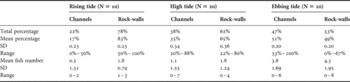
Inspection of the distribution of fish larger than 7 cm TL in rock-walls and channels observed at Avencas (Table 1) shows that, contrary to what happens during low-tide, fish are more numerous during all other tidal phases on rock-walls than in the channels, which constitutes their low-tide habitat. As soon as the tide rises, they must move in large numbers to the rock-walls, which is reflected on a significantly higher number of fish in this habitat than in the channels (Wilcoxon matched-pairs tests: Z = 2.52, P < 0.05, N = 10). When the tide is ebbing, there are more fish on the rock-walls that in the preceding high-tide (Wilcoxon matched-pairs tests: Z = 2.65, P < 0.01, N = 10). All other comparisons were not significant. This pattern suggests that G. cobitis moves to the rock-walls as soon as water level allows it and remains there during high water, leaving only when the water level is getting too low.
Total and mean percentage of fish larger than 7 cm TL observed in channels and rock-walls observed at Avencas, during the tidal phases considered. The means compared for each series of observations corresponded to a given tidal phase.

SD, standard deviation; N, number of dives.
During all the study period, only 4 fish in 507 observations were observed feeding on the algal cover, although we could not ascertain if they were feeding on algae or on small animals that could be hiding among them. In most other observations, the fish were lying still, concealed by some topographical feature, in a posture that gave the impression that they were behaving as an ambush predator. On 4 occasions, they were observed eating other adult fish (blenniid species). One of them could be identified as a Lipophrys pholis (Linnaeus, 1758). On one occasion they where observed eating the remains of a pelagic fish already dead. The four blennies which were preyed upon were still alive, trying to escape. They were eaten head first so that, for some time, the posterior part of the body and tail were still visible out of the goby's mouth.
On occasional observations in aquaria with G. cobitis and G. paganellus (at Aquario Vasco da Gama), predation events were also observed, with one adult G. cobitis attacking and eating one adult G. paganellus, with more than 8 cm TL. Two instances of predation, where G. cobitis ate Ciliata mustela (Linnaeus, 1758) of the same length were also recorded. Shrimps were also attacked and eaten in aquarium observations. In all cases where the predatory behaviours were observed, the goby laid still, suddenly jumping and gripping the prey in the mouth when it passed at a sufficiently short distance.
DISCUSSION
The present results show that the topographically complex surfaces of rock cliffs and walls, rich in barnacles, on which the species is not found during low-tide, are a major microhabitat used by this goby during high-tide. This finding corroborates previous studies (Burrows et al., Reference Burrows, Kawai and Hughes1999; Faria & Almada, Reference Faria and Almada2006) that have shown that full understanding of the ecology of the intertidal fish assemblages may only be achieved with surveys covering all the phases of the tidal cycle. A feature that was evident during low-tide, a clear ecological segregation between G. cobitis and blenniids (see Faria & Almada, Reference Faria and Almada2001), is no longer valid when the water is high.
As an attempt to synthesize the different studies on the ecology of this fish, we believe that there is sufficient evidence to support the conclusion that the giant goby recruit to very high level pools, move down to channels and even to the subtidal as they grow past 7–8 cm (a habitat where they also breed) (Faria & Almada, Reference Faria and Almada1995, Reference Faria and Almada2001), and a very important fraction of the population moves up to visit the mid-intertidal walls and cliffs when the tide is high.
Concerning the observations on feeding behaviour, they are obviously still very fragmentary, so conclusions must be drawn with great caution. Anyway, two points seem to be firmly established:
1. the fish are, at least some times, capable of hunting fish of considerable size;
2. they spend much more time in what seems to be an ambush predation than biting or nibbling on algae.
How to reconcile these observations with the findings previously reported in the literature? We suggest that the small individuals that are still in the high level pools may have little more to eat except algae and a few invertebrates. In addition, if the digestion of fish is rapid, samples taken during low-tide may cause an artificial over-representation of algae, which are likely a more slowly degraded material. In the future, diet analysis should include samples collected both at low and high-tide, and covering the different microhabitats which the species visit. The very large size of this goby, combined with its movements to typical blenniid habitats, make it an important candidate for a predatory role on other fish of the intertidal assemblages.
ACKNOWLEDGEMENTS
Part of this study was supported by Fundação para a Ciência e Tecnologia (FCT) within the Pluriannual Program (UI&D 331/94, partially FEDER funded) and by FCT and FEDER within the project POCTI/BSE/46825/2002. C.F. was also supported by a grant from FCT (SFRH/BPD/14478/2003). We thank C. Luís and C. Silva who helped with the field work.