

INTRODUCTION
Water availability is the environmental factor that most strongly affects plant growth and yield worldwide (Nemani et al., Reference Nemani, Keeling, Hashimoto, Jolly, Piper, Tucker, Myneni and Running2003). Increased irrigation inputs are not a viable option because water resources are either scarce or too expensive. Plants can sense water availability around the roots and respond by sending chemical signals to the shoot to elicit several adaptive responses, such as decrease in leaf expansion and stomatal closure (Wilkinson and Davies, Reference Wilkinson and Davies2002). Abscisic acid (ABA) has been suggested as a major signalling molecule in the response of plants to drought stress. As the soil dries, ABA is produced at the root tips and transported via the transpiration stream to the leaf where it reduces stomatal conductance. It is well known that these responses can occur without any change in shoot water relations (Wilkinson and Davies, Reference Wilkinson and Davies2002).
The area cultivated with dwarf coconut palm (C. nucifera var. nana) in Brazil has increased in recent years mainly for the production of coconut water (the endosperm of the immature fruit) in both the Atlantic coastal strip and some inland areas. The effects of drought on physiology, growth and productivity of Cocos nucifera have been documented (Gomes and Prado, Reference Gomes and Prado2007; Rajagopal and Kasturi Bai, Reference Rajagopal and Kasturi Bai2002) among important findings on the impact of irrigation levels, rainfall, irradiance, air temperature and relative humidity on physiology and biochemistry of this crop. Nevertheless, the role of ABA as a root-to-shoot non-hydraulic signal for soil drought in C. nucifera is still under debate.
The aim of this study was to evaluate the impact of repeated cycles of water stress on ABA accumulation and its involvement in the control of gas exchange in leaves of two Brazilian Green Dwarf coconut ecotypes from contrasting areas in relation to climate. Two hypotheses were tested: i) ABA accumulates in leaves of green dwarf coconut and regulates stomatal conductance under mild water deficit; ii) the two ecotypes show a distinct pattern of response to the drying/recovery cycles.
MATERIALS AND METHODS
A pot experiment was conducted at the Plant Growth Unit of the Universidade Federal de Viçosa, Brazil (20°45′S, 42°52′W, 648 m asl) using two coconut ecotypes: Brazilian Green Dwarf from Una (UGD) and Brazilian Green Dwarf from Jiqui (JGD). UGD is cultivated in the municipality of Una in the southeast of Bahia State (15°15′S, 39°05′W, 105 m asl), Brazil, where the predominant climate is the Af type of the Köppen climatic classification system (McKnight and Hess, Reference McKnight, Hess, McKnight and Hess2004). It is characterized by a hot and humid environment, without a dry season and with annual precipitation above 1300 mm, air relative humidity above 80% and mean air temperature between 24 and 27 °C. JGD is cultivated in Rio Grande do Norte State (05°47′S, 35°12′W, 30 m asl), Brazil, a contrasting semi-arid hot climate of the Bsh type of the Köppen system, characterized by a defined and severe dry season, low precipitation (< 650 mm in 1 year) and average annual temperature of 27.5 °C (McKnight and Hess, Reference McKnight, Hess, McKnight and Hess2004).
Forty plants (20 from each ecotype) were cultivated throughout 2004 in pots of 150 l filled with a soil/sand mixture (1:2), in the greenhouse. During all the experimental period air temperature (T) and solar irradiance (SI) were measured with a non-linear thermistor and a LI-200SA pyranometer sensor, respectively, connected to a datalogger LI-1200 Data Set Recorder (LI-COR, Inc., NE, USA). Simultaneously, relative humidity (RH) was measured with a bundle of human hair sensor type thermohygrograph calibrated weekly against a ventilated wet bulb psychrometer. Leaf-to-air water vapour pressure deficit (VPDL), leaf temperature (Tleaf) and atmospheric CO2 molar fraction (Ca), measured by the humidity, temperature and infrared gas analyser sensors of a portable photosynthesis system LI6400 (LI-COR) during the measurements of leaf gas exchange (see below) varied from 1.08 to 0.95 kPa, from 26.9 to 25.2 °C and from 383 to 380 μmol mol−1, respectively.
The plants were irrigated daily to maintain the soil water content close to field capacity. All essential nutrients were supplied, following leaf and soil analyses and the requirements of coconut palms (Magat, Reference Magat2003). Drought stress treatment was initiated after 12 months (January 2005) by suspension of irrigation until the net photosynthetic rate (A) approached zero, which was considered the point of maximum stress (PMS). So-called water stressed (WS) plants were rewatered for 8 days. This procedure was repeated consecutively twice, giving a total of three drying/recovery cycles.
Net photosynthetic rate (A), stomatal conductance to water vapour (gs) and transpiration rate (E) were always measured between 8:30 and 11:30 hours with the LI-6400 in eight to ten plants randomly selected at each time for each treatment. The photosynthetic photon flux density and leaflet temperature were fixed at, respectively, 1200 μmol photons m−2 s−1 and 26 °C using the equipment's accessories. The readings were stable within 2–3 min (coefficient of variation < 1%) when they were saved by the LI-6400. The intercellular CO2 molar fraction (Ci) was calculated by the equipment from the values of A, gs and E (von Caemmerer and Farquhar, Reference von Caemmerer and Farquhar1981). Attached leaflets in the middle of rank two leaves (counting from the top taking the spindle as zero) were used for the measurements, which were performed weekly, during the drying period, and at the fourth and eighth days after rewatering the plants.
Predawn leaflet water potential (ΨPD) was measured weekly at 04:30 hours in one leaflet per plant of four randomly selected plants per treatment, with a pressure chamber (Skye SKPM 1400; Skye Instruments Ltd, UK). All measurements were made on opposite leaflets of those used for gas exchange measurements. After detaching the leaflet, the base of the lamina was trimmed to free the cylindrical midrib, the leaflet was rolled (keeping the adaxial surface outermost to avoid breaking the rib) and sealed into the pressure chamber. The pressure was increased slowly (0.02 MPa s−1) with compressed nitrogen until the sap was visible at the exposed base of the midrib, characterizing the balancing pressure.
Leaflet tissues were collected at the beginning of the experiment (day zero), at the PMS and after four (Rec 4) and eight (Rec 8) days of rewatering in each cycle. The samples were immediately frozen in liquid nitrogen and stored at −80 °C. ABA concentration in samples of frozen fresh leaflet tissue was determined using a radioimmunoassay according to Quarrie et al. (Reference Quarrie, Whitford, Appleford, Wang, Cook, Henson and Loveys1988), using the monoclonal antibody (MAC252), which is specific for (+)-ABA (Barrieu and Simonneau, Reference Barrieu and Simonneau2000). Standard ABA samples were included in each assay for the construction of a standard curve. The validation of the radioimmunoassay for use with unpurified leaflet extracts was checked by a spike dilution test for non-specific interference, according to Jones (Reference Jones1987).
The experiment was organized in completely randomized factorial design with two treatments, water stressed (WS) and well watered (WW), and two ecotypes (UGD and JGD). All measured and/or calculated variables were submitted to a factorial analysis of variance (ANOVA), with treatment and ecotype as main factors. Correlation analyses were also performed. The statistical procedures were accomplished using the Statistica 6.0 (Statsoft Inc., USA).
RESULTS
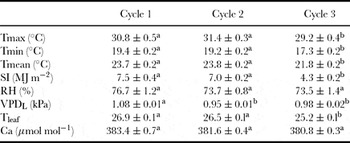
Air and leaf temperature and solar irradiance did not change from cycle 1 to 2 but decreased significantly from cycle 2 to 3 (Table 1). On the other hand, VPDL decreased significantly from cycle 1 to 2 and did not change thereafter (Table 1). Leaf temperature showed a decreasing trend toward the end of experiment, although it was significant only from cycle 2 to 3, following the decreasing in air temperature. Only non-significant changes in RH and Ca were observed.
Daily values of maximum (Tmax), minimum (Tmin) and mean (Tmean) air temperature, global solar irradiance (SI), air relative humidity (RH), leaf-to-air water vapor pressure deficit (VPDL), leaf temperature (Tleaf) and atmospheric CO2 molar fraction (Ca) measured inside the greenhouse, during the drying/recovery cycles. The values are means (± s.e.) of 55, 43 and 43 days for cycles 1, 2 and 3, respectively. Values followed by the same letter are not different by Tukey's test (p ≤ 0.05).

There were no significant (p < 0.05) differences between the ecotypes for some variables measured in the present experiment. So their data were pooled for subsequent analyses.
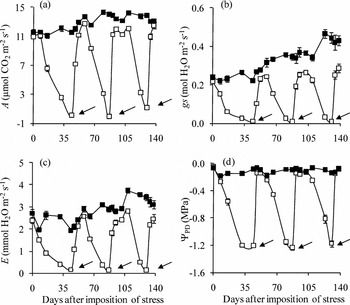
Net photosynthetic rate (A) and transpiration (E) of WW plants increased during the experiment, following an increase of stomatal conductance (gs, Figure 1). The values of A increased from 11 to 15 μmol m−2 s−1, whereas gs increased from 0.24 to 0.43 mol m−2 s−1 and E from 2.5 to 3.5 mmol m−2 s−1. In WS plants A, gs and E started to diverge from the WW controls after 16 (ΨPD = −0.56 MPa) and 8 (ΨPD = −0.27 MPa) days after the imposition of stress, respectively (Figure 1). Net photosynthetic rate (A) approach zero when ΨPD was −1.2 MPa on average, characterizing the PMS. At this moment, gs and E in WS plants were less than 10% of their controls, in all the three cycles. Upon rewatering for 8 days in cycle 1, A, gs and E recovered partially to values > 80% of their controls. In cycles 2 and 3, however, the recovery of gs was less than that of A and E (Figure 1). After 8 days of rewatering, the mean values of gs in WS plants were 32% lower than WW plants in cycle 1 and 26% in cycle 2.
Photosynthesis (A, a), stomatal conductance (gs, b), transpiration (E, c) and pre-dawn leaf water potential (ΨPD, d) of well-watered (solid) and water-stressed (open) plants of Brazilian Green Dwarf coconut. Values are means of 16–20 replicates (data of the two ecotypes were pooled) for A, gs and E and of eight replicates for ΨPD and error bars are the standard error of means. The arrows indicate the times of rewatering.

In WW plants, ΨPD fluctuated around an average value of −0.1 MPa during the experimental period (Figure 1). In WS plants, ΨPD decreased significantly (p < 0.05) 8 days after the imposition of stress, reaching −1.2 MPa at the point of maximum stress irrespective of cycle. Upon rewatering for 8 days a rapid recovery of ΨPD was observed (Figure 1).
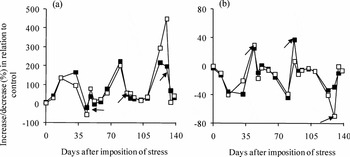
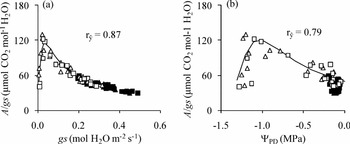
After the onset of drought, intrinsic water use efficiency (A/gs) increased and the ratio of internal to atmospheric CO2 concentration (Ci/Ca) decreased (Figure 2). Except for JGD in cycle 3, the peaks of A/gs and Ci/Ca were observed before the point of maximum stress (Figure 2). Moreover, the increase in A/gs and the decrease in Ci/Ca in cycle 3 were significantly (p < 0.05) higher in JGD than in UGD (Figure 2). When A/gs was plotted against gs (Figure 3a) and ΨPD (Figure 3b), it was possible to estimate threshold values of gs (0.04 mol m−2 s−1) and ΨPD (−1.0 MPa) below which A/gs started to decrease and Ci/Ca started to increase.
Intrinsic water use efficiency (A/gs, a) and the ratio of intercellular to atmospheric CO2 concentration (Ci/Ca, b) of drought-stressed Brazilian Green Dwarf coconut, expressed as percentage change in relation to controls. Solid symbol, Brazilian Green Dwarf from Una, Bahia and open symbol, Brazilian Green Dwarf from Jiqui, Rio Grande do Norte. The arrows indicate the times of rewatering.

Intrinsic water use efficiency (A/gs) expressed as a function of a) stomatal conductance (gs) and b) pre-dawn leaf water potential (ΨPD) of well-watered (solid) and water-stressed (open) plants of Brazilian Green Dwarf coconut from Una (UGD, triangles) and from Jiqui (JGD, squares). For each ecotype, values are means of eight to ten replicates for A/gs and gs and four replicates for ΨPD. The error bars are s.e. and the lines represent the rational models [A/gs = (−21.4 + (14169.8 × gs)) / ((1 + (55.8 × gs)) + (957.3 × gs 2)) and A/gs = 49.9 + (35.4 × ΨPD)) / ((1 + (1.44 × ΨPD)) + (0.56 × ΨPD2))].

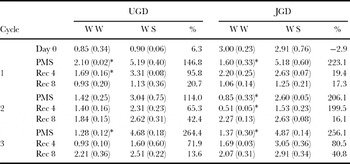
The leaflet ABA concentration in WW plants ranged from 0.8 to 2.2 nmol g−1 DW in UGD and from 0.5 to 3.0 nmol g−1 DW in JGD (Table 2). At the point of maximum stress, leaflet ABA concentration in WS plants of UGD was 147% higher than in WW plants in cycle 1, 114% higher in cycle 2 and 264% higher in cycle 3. At the same time, the corresponding values for JGD were 223, 206 and 256%. The return of ABA concentration to control levels was partial in all the three cycles in both ecotypes, even after 8 days of rewatering (Table 2).
Abscisic acid concentration (nmol g−1 DW) in leaflets of Brazilian Green Dwarf coconut ecotypes from Una (UGD) and from Jiqui (JGD) exposed to three cycles of drought/recovery. The values are mean (s.e.) of four replicates collected at the beginning of the experiment (day zero), at the point of maximum stress (PMS) and after 4 (Rec 4) and 8 (Rec 8) days of rewatering in each cycle. * indicates significant contrasts (p < 0.05) among water-stressed (WS) and well-watered (WW) plants by the F test. % is the percent increase in WS in relation to WW plants.

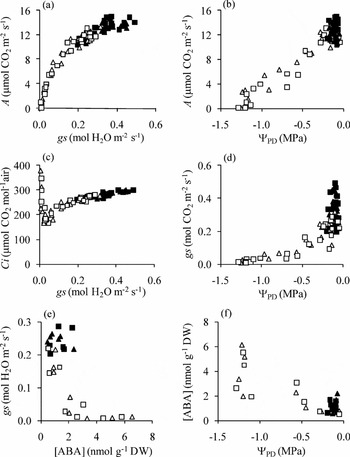
The relationship between A and gs (Figure 4a) demonstrated that A did not change when gs decreased from 0.5 to about 0.25 mol m−2 s−1 a strong influence of gs over A being observed only when gs < 0.1 mol m−2 s−1. The response of A can be explained, in part, by the trend of Ci, whose values did not vary with of gs from 0.5 to 0.25 mol m−2 s−1 (Figure 4c). However, that decrease in gs occurred without great changes in ΨPD (from −0.1 to −0.25 MPa) (Figure 4d). Strong influence of ΨPD over A and gs were observed only when ΨPD was lower than −0.5MPa (Figure 4b, 4d). On the other hand, both a sharp decline of gs (Figure 4e) and a small decline of ΨPD (from −0.1 to −0.25 MPa, Figure 4f) were observed when ABA concentration increased from 0.5 to 1.0 nmol g−1.
Photosynthesis (A) as a function of a) stomatal conductance (gs) and b) of pre-dawn leaf water potential (ΨPD); c) intercellular CO2 concentration (Ci) as a function of gs; d) gs as a function of ΨPD and e) of leaflet abscisic acid concentration ([ABA]) and f) [ABA] as a function of ΨPD in well-watered (solid) and water-stressed (open) plants of Brazilian Green Dwarf coconut from Una (UGD, triangles) and from Jiqui (JGD, squares). Values are means of 4–12 replicates.

DISCUSSION
The extent to which drought affects carbon assimilation is variable among plant species and depends on the rapidity, severity and duration of the drought event. It has been demonstrated for other cultivated palm species that A and gs approached zero at lower leaf water potential (Ψ) such as −1.9 MPa in peach palm (Bactris gasipaes) (Oliveira et al., Reference Oliveira, Bovi, Machado, Gomes, Habermann and Rodrigues2002), −2.1 MPa in buriti palm (Mauritia vinifera) (Calbo and Moraes, Reference Calbo and Moraes1997) and −2.5 MPa in açaí (Euterpe oleracea) (Calbo and Moraes, Reference Calbo and Moraes2000). It is not clear if those authors measured Ψ at predawn, but their values were lower than those measured in the current work (−1.2 MPa), suggesting greater sensitivity of the gas exchange variables to soil drought. On the other hand, our value was similar to that reported by Repellin et al. (Reference Repellin, Laffray, Daniel, Braconnier and Zuily-Fodil1997) for other genotypes of coconut (−1.35 MPa).
In coconut, gs has been shown to respond negatively to increasing VPDL (Gomes and Prado, Reference Gomes and Prado2007; Gomes et al., Reference Gomes, Mielke and Almeida2002; Passos et al., Reference Passos, Prado and Aragão2009). The stomatal opening in WW toward the end of experiment could be due to decreasing VPDL and leaf temperature. The relationship between A and gs indicate stomatal limitation of A below gs of 0.2 mol m−2 s−1. Above this value, A levelled off. Moreover, great reduction in Ci was observed when gs was lower than 0.2 mol m−2 s−1 as compared to 0.1 mol m−2 s−1 in adult tall coconut genotypes during the dry season (Prado et al., Reference Prado, Passos and Moraes2001). These results confirm the well-documented superiority of tall over dwarf genotypes under water stress (Rajagopal and Kasturi Bai, Reference Rajagopal and Kasturi Bai2002; Repellin et al., Reference Repellin, Laffray, Daniel, Braconnier and Zuily-Fodil1997), Slow and incomplete recovery of A and gs upon rewatering were observed in the present work even after 8 days of rewatering. Similar results were observed in other palms such as buriti (Calbo and Moraes, Reference Calbo and Moraes1997) and açaí (Calbo and Moraes, Reference Calbo and Moraes2000). In addition, the recovery of gs was slower than that of A, E and ΨPD in accordance with what has been observed in other palm species (Calbo and Moraes, Reference Calbo and Moraes2000; Oliveira et al., Reference Oliveira, Bovi, Machado, Gomes, Habermann and Rodrigues2002). In spite of slow and incomplete recovery gs reached values (0.1–0.2 mol m−2 s−1) that, on one hand, allowed the diffusion of CO2 to sustain A and, on the other hand, allowed rapid recover of E.
Slow recovery of gs after a drought stress period has been attributed to high ABA concentrations (Davies et al., Reference Davies, Wilkinson and Loveys2002; Wilkinson and Davies, Reference Wilkinson and Davies2002). Our results showed accumulation of ABA in coconut leaflets during drought stress, and the concentration remained high even after rewatering for 8 days. Studies involving ABA determination in coconut have reported altered stomatal behaviour in diseased coconut plants (León et al., Reference León, Santamaría, Alpizar, Escamilla and Oropeza1996; Ranasinghe, Reference Ranasinghe2005). In leaves of lethal yellowing-affected coconut ABA concentration increased by a factor of 2.5 when water potential was reduced to −1.8 MPa (León et al., Reference León, Santamaría, Alpizar, Escamilla and Oropeza1996). In non-symptomatic adult coconuts of the tall variety ABA concentration was 3.8 nmol g−1 DW, a value slight higher than that measured in the present experiment in well-watered plants.
Together these results suggest that is possible to manipulate the stomatal conductance of coconut to increase water use efficiency without great reduction of carbon assimilation rate. Manipulation of water deficit responses, through techniques such as ‘partial root zone drying’ (Dodd, Reference Dodd2007) and ‘regulated deficit irrigation’ (Souza et al., Reference Souza, Maroco, Santos, Rodrigues, Lopes, Pereira and Chaves2005) allows the exploration of the plant's long distance signalling system, preventing the development of severe water deficit (Davies et al., Reference Davies, Wilkinson and Loveys2002).
It was demonstrated in the present work that below gs = 0.04 mol m−2 s−1 and ΨPD = −1.0 Mpa, Ci increased and A/gs decreased sharply, suggesting the occurrence of non-stomatal limitations under severe water deficit. An increase in Ci at low values of gs was observed in peach palm (gs = 0.05 mol m−2 s−1; Oliveira et al., Reference Oliveira, Bovi, Machado, Gomes, Habermann and Rodrigues2002) and in other genotypes of coconut (gs = 0.09 mol m−2 s−1, Repellin et al., Reference Repellin, Laffray, Daniel, Braconnier and Zuily-Fodil1997). The low threshold value of gs in green dwarf coconut (present results) compared to that measured by Repellin et al. (Reference Repellin, Laffray, Daniel, Braconnier and Zuily-Fodil1997), may suggest that non-stomatal factors are expected to limit A at lower gs, which may be an advantage of dwarf over tall genotypes under severe drought conditions. Nevertheless, the non-stomatal factors were demonstrated recently to limit A in drought-stressed coconut even after 4 days of rewatering (Gomes et al., Reference Gomes, Oliva, Mielke, Almeida, Leite and Aquino2008).
A high scatter of the values of gs at high ΨPD suggests closure of stomata before changes in the leaf water status, a response frequently reported in many other plant species (Davies et al., Reference Davies, Wilkinson and Loveys2002) and also in other coconut genotypes (Repellin et al., Reference Repellin, Laffray, Daniel, Braconnier and Zuily-Fodil1997). Moreover, a clear relationship between leaflet ABA concentration and gs was observed early after the imposition of stress, despite some delay in the increase of ABA after the onset of drought. It has been demonstrated that xylem rather than leaf ABA concentration is much more sensitive to soil drought and gs is thought to respond more to xylem ABA concentration than to its accumulation in leaves (Burschka et al., Reference Burschka, Tenhunen and Hartung1983), which partially explain the delayed initial increase of ABA.
In conclusion, our results show that the imposition of water deficit resulted in the activation of physiological responses that culminated in severe impairment of carbon assimilation rates. It was demonstrated that abscisic acid accumulated in leaves of drought-stressed green dwarf coconut and remained high after 8 days of rewatering. At mild soil water deficit, stomatal conductance was controlled by ABA accumulated in leaflets and, at severe water deficit, by the leaf water status. Furthermore, water use efficiency was improved at mild water deficit without significant impairment of the photosynthetic rate, suggesting that it might be possible to manipulate the stomatal conductance to bring about an improvement in water economy of the plant. In general, the ecotypes showed similar behaviour when submitted to water stress, but the ecotype from a hot/dry environment showed higher water use efficiency after repeated cycles of water stress.
Acknowledgements
We would like to thank Rogério Gomide for his help with the acquisition of experimental data, Kacilda Kuki and Vânia Silva for their help with ABA extraction and analysis. The lead author was provided with scholarship by CAPES and with research fellowship by FAPESB (n° 2317/2004). Financial support was also provided by CNPq.