Introduction
Smoking cessation remains a public health priority worldwide. Tobacco use is the leading preventable cause of death worldwide; approximately six million deaths related to tobacco use occur each year, including 600,000 from second-hand smoke (Öberg, Jaakkola, Woodward, Peruga, & Prüss-Ustün, Reference Öberg, Jaakkola, Woodward, Peruga and Prüss-Ustün2011). In total, worldwide tobacco use prevalence was estimated just below 24% (approximately 794 million smokers) in 2010. The quit smoking clinic (QSC) is an important strategy in helping smokers to quit smoking. The clinic provides a structured programme that consists of pharmacological and non-pharmacological treatment. A study utilising data from cessation clinics in primary care in the United States reported an 11% quit rate at nine-month follow-up (Sippel, Osborne, Bjornson, Goldberg, & Buist, Reference Sippel, Osborne, Bjornson, Goldberg and Buist1999). Meanwhile, the average quit rate was 53% at the 4-week and 15% at the 12-month follow-up for the NHS-funded smoking cessation services in the UK (Bauld, Chesterman, Ferguson, & Judge, Reference Bauld, Chesterman, Ferguson and Judge2009). The average quit rate in Turkey was 43.3% (Akkaya et al., Reference Akkaya, Oztürk, Cobanoğlu, Bircan, Simşek and Şahin2006), while an average quit rate of 18% at six-month follow-up was estimated in Denmark (Kjaer et al., Reference Kjaer, Evald, Rasmussen, Juhl, Mosbech and Olsen2007). In Malaysia, an average quit rate of 35.4% at three-month follow-up (Wee, Shahab, Bulgiba, & West, Reference Wee, Shahab, Bulgiba and West2011) and 31.8% at six-month follow-up (Wee, West, Bulgiba, & Shahab, Reference Wee, West, Bulgiba and Shahab2011) were reported in five publicly funded QSCs.
Several studies estimating the associated cost of QSCs have been published. The cost per quitter was estimated to be between USD 643 (MYR 1,992.33) and USD 6,450 (MYR 19,985.31) in Medicare-based cessation clinics in the United States (Joyce et al., Reference Joyce, Niaura, Maglione, Mongoven, Larson-Rotter and Coan2008) and GBP 123 (MYR 597.63) (per quit attempt) and GBP 684 (MYR 3,323.39) (per life-years gained) in NHS-funded quit smoking services in the UK (Godfrey, Parrott, Coleman, & Pound, Reference Godfrey, Parrott, Coleman and Pound2005). To date, no similar estimates are available for Malaysia.
Many of the QSCs are traditionally led by a physician. Pharmacists present an opportunity for delivering QSCs, as they are easily accessible to smokers. Pharmacists are uniquely positioned to simultaneously provide both smoking cessation services and SCAs to a smoker who wants to quit. A large body of research has been published, which provides evidence that pharmacists see themselves as playing a role in providing cessation support for smokers (Dent, Harris, & Noonan, Reference Dent, Harris and Noonan2007, Reference Dent, Harris and Noonan2009; Dent, Scott, & Lewis, Reference Dent, Scott and Lewis2004; Kennedy, Giles, Chang, Small, & Edwards, Reference Kennedy, Giles, Chang, Small and Edwards2002; Maguire, McElnay, & Drummond, Reference Maguire, McElnay and Drummond2001; Philbrick, Newkirk, Farris, McDanel, & Horner, Reference Philbrick, Newkirk, Farris, McDanel and Horner2009; Ragucci & Shrader, Reference Ragucci and Shrader2009; Roth & Westman, Reference Roth and Westman2001; Zillich, Ryan, Adams, Yeager, & Farris, Reference Zillich, Ryan, Adams, Yeager and Farris2002). Increasing the utilisation of pharmacists in smoking cessation activities may have a positive impact on increasing quit smoking rates at population level.
Many studies have cautioned against generalising the findings from Western to Asian populations, particularly in terms of smoking behaviour, beliefs and cessation outcomes (Hosking et al., Reference Hosking, Borland, Yong, Fong, Zanna and Laux2009; Li et al., Reference Li, Borland, Yong, Fong, Bansal-Travers and Quah2010; Siahpush, McNeill, Borland, & Fong, Reference Siahpush, McNeill, Borland and Fong2006). This is due to the distinct differences between the regions and tobacco control policies, socio-economic conditions and cultures that have considerable influence on individual smoking behaviour and intent to change (Abdullah & Husten, Reference Abdullah and Husten2004; Li et al., Reference Li, Borland, Yong, Fong, Bansal-Travers and Quah2010; Siahpush et al., Reference Siahpush, McNeill, Borland and Fong2006).
Geographically, Malaysia is sandwiched between Thailand and Singapore. Unlike its neighbouring countries that exercise stringent tobacco control policies, Malaysia has a more tobacco-friendly environment, with a smoking prevalence of 45% among males (Li et al., Reference Li, Borland, Yong, Fong, Bansal-Travers and Quah2010). In addition, Malaysia is an upper-middle income country with a predominantly Malay ethnicity but with large Chinese, Indians and native minorities that present challenges for smoking cessation. While there are attempts to elucidate the determinants of smoking and cessation behaviour in Malaysia (Li et al., Reference Li, Borland, Yong, Fong, Bansal-Travers and Quah2010; Siahpush et al., Reference Siahpush, McNeill, Borland and Fong2006), there is lack of published evidence on the cessation treatment outcomes, particularly in the public health system framework (Wee et al., Reference Wee, Shahab, Bulgiba and West2011). Malaysia has recently initiated a PM-QSC in selected public hospitals throughout the country. Smokers attend these clinics by referral or walk-ins. The heavily subsidised services comprise counselling and pharmacological SCAs, such as nicotine replacement therapy(s) (NRTs) and varenicline. The pharmacist meets with patients individually to conduct an initial assessment and agree on a quit date. Follow-up contact usually occurs within a week of the established quit date. Subsequent follow-ups are recommended weekly for the first month, and then fortnightly for the second and third month, and then monthly for the remaining three months (Ministry of Health Malaysia, 2003). This study was conducted to assess the quit rate and costs associated with the PM-QSC in Melaka, Malaysia.
Methods
Study Design
This is a retrospective observational study on patients who were enrolled in the PM-QSC at a tertiary hospital in Melaka, Malaysia, between January 2009 and December 2010. Their medical records were abstracted using an adapted structured questionnaire from previous studies (Nielsen & Fiore, Reference Nielsen and Fiore2000; Parrott, Godfrey, Raw, West, & McNeill, Reference Parrott, Godfrey, Raw, West and McNeill1998) until the study endpoint or 31 December 2010. Data collected include agreed quit date, the types and the frequency of prescribed SCAs, frequency of QSC visits, age and ethnicities. All data were anonymised. This study was reviewed and approved by the MREC.
Analysis
Clinical outcomes
This study only considered continuous abstinence, defined as self-reported cessation since the targeted quit date. Quit rate was calculated as the percentage of successful quitters in the PM-QSC who managed to remain abstinent for six months (Ministry of Health Malaysia, 2003). The default rate was estimated as the percentage of enrolled patients who failed to attend the subsequent appointments after their first contact with the PM-QSC.
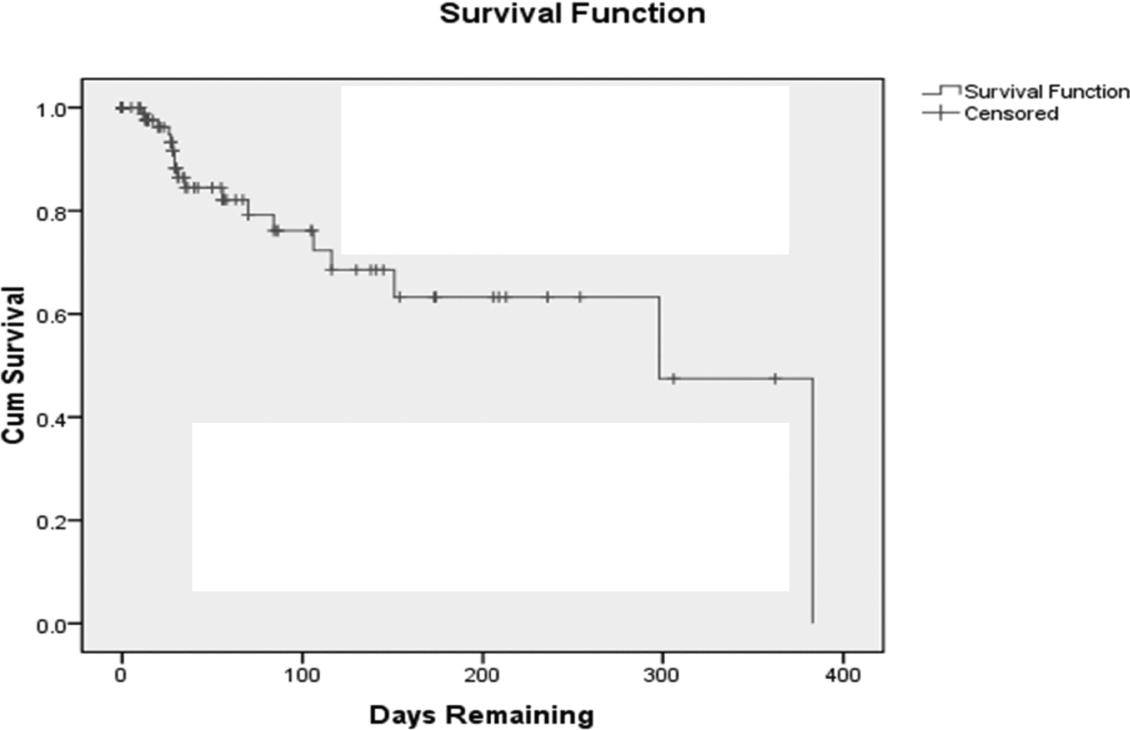
The time-to-quit, defined as the interval between the date of enrolment at the PM-QSC and the event of quit smoking, was determined using a Kaplan–Meier (KM) curve to take into account right censorship in the study. Person-year of observation or smoking time was defined as the interval between the date of enrolment at the PM-QSC and the event outcome. The relationship between the characteristics of smokers (age categories, sex and ethnicities) and successfully quit smokers was determined using the Fisher exact test.
Cost outcomes
This study calculated the health care costs from the perspective of the health care provider.
The costs were estimated by quantifying the resources utilised by patients and valuing them using the hospital's purchasing and salary records.
The duration of pharmacotherapy initiated by the pharmacists was based on the practice guideline. The costs for patient education pamphlets and self-help manuals were not included, as they were provided freely by the pharmaceutical companies during the duration of the study. The distribution of the self-help material, however, was estimated to require five minutes of the pharmacist time. Furthermore, an average of 20-minutes pharmacist counselling time was assumed based on the published consultation time (Bauld et al., Reference Bauld, Chesterman, Ferguson and Judge2009; Cromwell, Bartosch, Fiore, Hasselblad, & Baker, Reference Cromwell, Bartosch, Fiore, Hasselblad and Baker1997).
Total costs (cTotal) are the sum of costs for outpatient consultations and SCAs. The mean cost per patient was calculated by dividing the cTotal for all patients by the number of enrolled patients. The mean cost per patient who successfully quit smoking was calculated by dividing cTotal by the number of patients who successfully quit smoking. The mean cost per quit attempt was calculated by dividing cTotal by the number of quit attempts made by patients. Quit attempt was defined as the point of contact between the smoker and the PM-QSC.
Several assumptions were made in this study. First, all smokers who successfully quit would remain abstinent. Secondly, patients lost during follow-up were treated as smokers. They included patients who could not be located, requested no follow-up, were deceased, had no means of contact or had missing follow-up data. All costs were standardised to year 2010.
All analyses were conducted using the Statistical Package for Social Science (SPSS) software, version 18.0 (SPSS Inc., Chicago).
Results
Characteristics of Patients
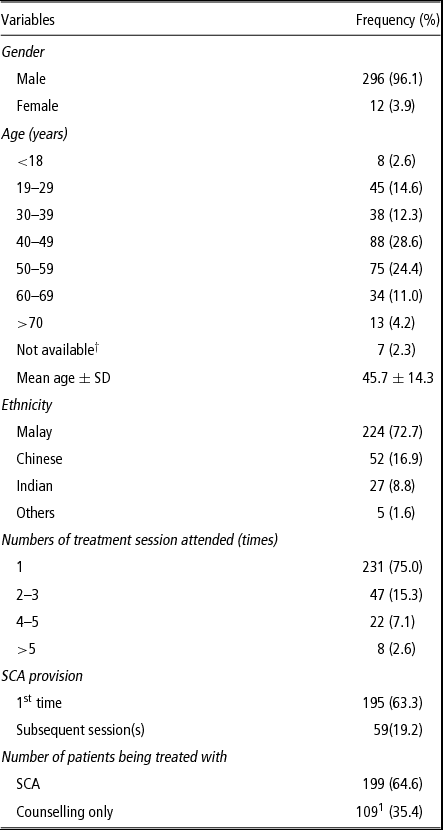
A total of 308 patients were selected in this study; the majority were male (96.1%) and of Malay ethnicity (72.7%). The overall average age of the recruited patients was 45.7 years. The majority of the patients (75.1%) attended PM-QSC only once, and 63.3% received SCA provision for the first time (Table 1).
Descriptive statistics of the enrolled smokers at the PM-QSC between January 2009 and December 2010 (N = 308)

1The inclusion of multivitamin preparation dispensing as a form compliance measurement for varenicline consideration.
†The absence in the patients’ medical records.
Abbreviations: SCA: smoking cessation aid(s); SD: standard deviation.
Treatment outcomes and quit rate
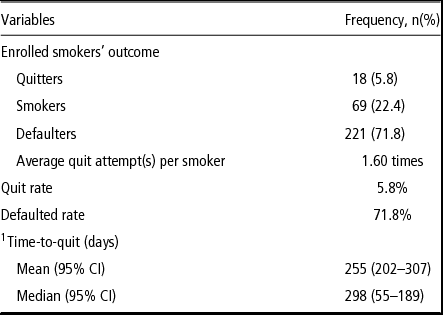
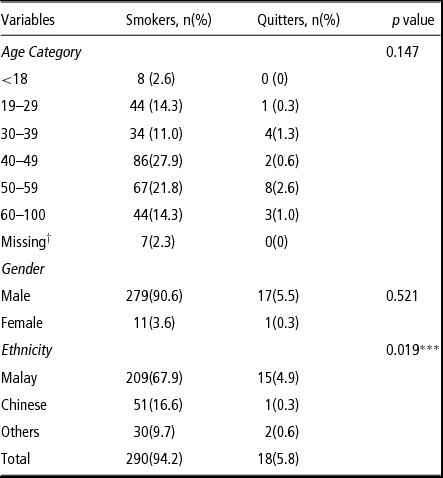
Table 2 summarises the treatment outcomes of the selected patients at the PM-QSC and the quit and default rate. The majority of the recruited patients (71.8%) did not attend the subsequent appointment after first contact at the PM-QSC (defaulters). The average quit attempt was 1.6 times per smoker. The quit rate was 5.8% during the period of observation. The mean time-to-quit was 255 days and median was 298 days. A statistically significant (Table 3) higher proportion of Malays (4.9%) quit compared to Chinese (0.3%) and other ethnicities (0.6%).
Treatment outcomes of the enrolled smokers at the PM-QSC between January 2009 and December 2010 (N = 308)

1Estimation is limited to the largest survival time if it is censored.
Relationship between the age categories, ethnicities and gender variables in relation to abstinence for the enrolled smokers at the PM-QSC (N = 308)

† Denotes the absence in the patients’ medical records.
***Significant at 5%.
Dispensing and administration costs of PM-QSC
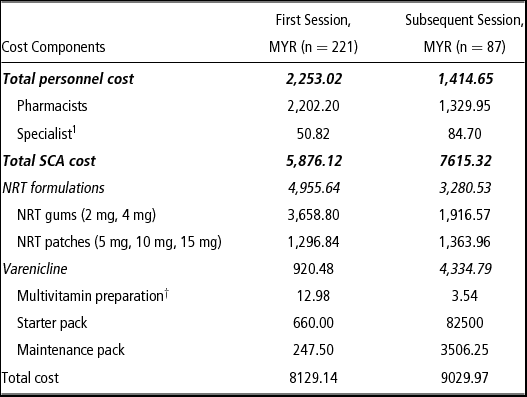
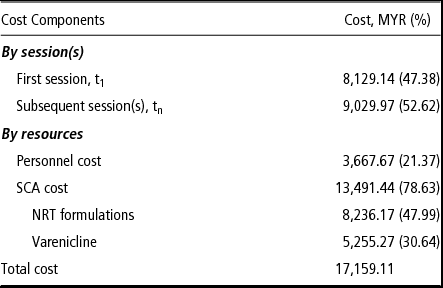
As shown in Tables 4 and 5, the total cost by sessions was similar. However, the total cost by resource differed substantially between personnel cost (MYR 3,667.67; USD 1185) and SCA cost (MYR 13,491.44; USD 4355). The majority of the costs (78.63%) were related to SCA cost. The mean cost per patient was MYR 55.71 (USD 18) and the mean cost of patient who quit or attempted to quit was MYR 953.28 (USD 308) and MYR 34.74 (USD 11), respectively.
Cost calculations, by first session and subsequent session(s) for PM-QSC between January 2009 and December 2010 (N = 308)

Abbreviations: SCA: smoking cessation agent; NRT: nicotine replacement therapy; MYR: Malaysian Ringgit.
1The inclusion of specialist evaluation of the patient's suitability for varenicline commencement therapy was determined by the categorical prescribing of varenicline in MOH.
†Multivitamin preparation is a tool for compliance measurement for varenicline initiation.
Abbreviations: SCA: smoking cessation agent; NRT: nicotine replacement therapy; MYR: Malaysian Ringgit.
Cost calculations, by sessions and resource(s) for the PM-QSC between January 2009 and December 2010 (N = 308)

Discussion
Quit rate and default rate
This study sought to assess the quit and default rate of the cessation treatment for the pharmacist-managed QSC. The quit rate of 5.8% at 12-month follow-up was substantially low compared to both local and worldwide data. However, the data published in Malaysia assessed the quit rate at three and six months.
A potential contributing factor to the low quit rate is due to this study's relatively high default rate. Unlike Wee et al. (Reference Wee, Shahab, Bulgiba and West2011) who reported an average of 51.8% default rate at 24 weeks of follow-up in five public-funded cessation clinics, this study, on the other hand, had 71.8% of smokers default upon enrolment. The impact of high default rate on low quit rate might be supported by the findings of the earlier studies which demonstrated that increased participation rates led to improved quit rates (Alberg et al., Reference Alberg, Stashefsky Margalit, Burke, Rasch, Stewart and Kline2004; An et al., Reference An, Schillo, Kavanaugh, Lachter, Luxenberg and Wendling2006; Hollis et al., Reference Hollis, McAfee, Fellows, Zbikowski, Stark and Riedlinger2007; Kottke, Battista, DeFriese, & Brekke, Reference Kottke, Battista, DeFriese and Brekke1998).
The mean number of days for a smoker to quit in this study was estimated to be 255 (Figure 1). This figure surpassed the existing timeframe of six months (Hughes et al., Reference Hughes, Keely, Niaura, Ossip-Klein, Richmond and Swan2003; Ministry of Health Malaysia, 2003; West, Hajek, Stead, & Stapleton, Reference West, Hajek, Stead and Stapleton2005). Consequently, it challenges the commonly held belief of the recommended six-month timeframe advocated in guidelines for treating tobacco use and dependence in a cessation programme. This argument holds in terms of the high attrition rate in the actual population settings of cessation clinics.
Kaplan–Meier survival curve of unadjusted survival of enrolled quitters at the pharmacist-managed QSC.

Cost analysis
Apart from considering the quit and defaulted rates, this study also analysed the cost incurred in the PM-QSC from the health care provider perspective. The composition of the smokers enrolled at the PM-QSC was comparable to those sampled in the 2006 nationwide survey (Ministry of Health Malaysia, 2008). They were predominantly male, Malay and 40–60 years old.
The findings of this study reflected a higher proportion of the SCAs cost consumption compared to the personnel costs consumption, with a ratio of 3.68. This supports earlier findings that demonstrated personnel cost held a weak bearing on the total treatment cost (Gilbert et al., Reference Gilbert, Pinget, Bovet, Cornuz, Shamlaye and Paccaud2004), compared to the dominant SCA cost in the public-funded cessation programmes. Similarly, another study found that the costs of SCAs accounted for a slightly higher proportion of the service costs compared to personnel costs (3:2 ratio) in the NHS-funded cessation services in the UK (Godfrey et al., Reference Godfrey, Parrott, Coleman and Pound2005). This implies that the resultant SCA prices would be the deciding factor for consideration of cessation treatment guideline implementation in the context of restrained resources, especially when they are being subsidised by the public sector. On the whole, the costs per unit of the SCAs valuation were relatively similar. They were valuated as expensive, since the prices of the original NRT formulations and varenicline were primarily governed by their respective manufacturer trade prices (Gilbert et al., Reference Gilbert, Pinget, Bovet, Cornuz, Shamlaye and Paccaud2004; Nielsen & Fiore, Reference Nielsen and Fiore2000; Ronckers, Groot, & Ament, Reference Ronckers, Groot and Ament2005).
On the other hand, personnel costs, such as the pharmacists and specialist costs, were subject to the current market workforce economics in each country. In this case, the value of time input by the Malaysian pharmacists (MYR 7.15/20 minutes) and the specialists (MYR 16.94/20 minutes) was lower if the currency conversion and the adjustment of the year of study were taken into account compared to peers in other countries. Relative to other countries, especially in the West, this group of professionals received relatively higher wages. For example, Ronckers et al. estimated the time input of a non-physician counsellor as USD 56.80 (MYR 176) per hour (Ronckers et al., Reference Ronckers, Groot and Ament2005). The physician time-input cost in France, Canada, the UK, the United States and Switzerland was more than USD 60 (MYR 186) per hour (Cornuz et al., Reference Cornuz, Gilbert, Pinget, McDonald, Slama and Salto2006). By comparison, the pharmacist time-input cost in the setting of the community pharmacy was assessed in 1998 as GBP 30 (MYR 150) per hour; this was averaged over a six-month participation period in Northern Ireland (Crealey, McElnay, Maguire, & O’Neill, Reference Crealey, McElnay, Maguire and O’Neill1998). Meanwhile, in the year 2009, it rose to GBP 13.20 (MYR 66) for four-week participation in a cessation service in Glasgow (Boyd & Briggs, Reference Boyd and Briggs2009).
Extrapolating the findings that the high SCA costs overshadowed the low personnel costs in relation to the total treatment cost suggests that in light of limited skilled HCPs to manage the QSC, the cheaper HCP alternate (pharmacist as opposed to specialist) is a viable move for local QSCs that does not compromise the quality of pharmaceutical care. The argument that ‘most competent’ HCP as opposed to the ‘least expensive’ (Gilbert et al., Reference Gilbert, Pinget, Bovet, Cornuz, Shamlaye and Paccaud2004) should be reconsidered, since intensive cessation management would be needed for six months and beyond.
The average cost spent per quitter in this study was relatively low (MYR 953.28) compared to the published cost-analysis studies (Mudde, de Vries, & Strecher, Reference Mudde, de Vries and Strecher1996; Ong & Glantz, Reference Ong and Glantz2005; Ronckers et al., Reference Ronckers, Groot and Ament2005; Song et al., Reference Song, Raftery, Aveyard, Hyde, Barton and Woolacott2002). This may be due to the exclusion of patient education materials, the overhead operating costs and the application of different health care system infrastructure. Additionally, the aforementioned studies had smokers supplied with or completing the full course of SCAs, be that the various NRT formulations or varenicline therapies (Cromwell et al., Reference Cromwell, Bartosch, Fiore, Hasselblad and Baker1997; Nielsen & Fiore, Reference Nielsen and Fiore2000; Ong & Glantz, Reference Ong and Glantz2005), as opposed to this study in which enrolled smokers defaulted by receiving limited amounts of the SCAs. The mean cost incurred per quit attempt estimated in this study was lower than that of other studies (Godfrey et al., Reference Godfrey, Parrott, Coleman and Pound2005; Ong & Glantz, Reference Ong and Glantz2005). Ong and Glantz (Reference Ong and Glantz2005) established a calculation of cost per quit attempt as ‘the product cost multiplied by the recommended duration of therapy’. Hence, their estimated cost of the mean quit attempt was understandably more expensive than those obtained in this study: USD 183.45 (MYR 569) with the usage of an NRT (Ong & Glantz, Reference Ong and Glantz2005) versus USD 11.20 (MYR 34.74) found in this study.
Strength and limitations
This study provides early data from the quit and default rate of the PM-QSC in Malaysia. Unlike previous studies, it also provides the costs associated with this service.
However, several limitations exist in this study. First, the smoking status was self-reported by each individual smoker. This contradicted the Russell Standard (SRNT Subcommittee on Biochemical Verification, 2002) that stipulated further biochemical verification in addition to the self-reported smoking status is required. However, several studies have supported that self-verification is sufficiently valid in ascertaining smoking status (Alberg et al., Reference Alberg, Stashefsky Margalit, Burke, Rasch, Stewart and Kline2004; Attebring, Herlitz, Berndt, Karlsson, & Hjalmarson, Reference Attebring, Herlitz, Berndt, Karlsson and Hjalmarson2001; Philbrick et al., Reference Philbrick, Newkirk, Farris, McDanel and Horner2009).
Secondly, the mean cost incurred per quitter was not adjusted for the natural quit rate because of the negligible impact of the natural quit rate on the intervention quit rate (Crealey et al., Reference Crealey, McElnay, Maguire and O’Neill1998; Thavorn & Chaiyakunapruk, Reference Thavorn and Chaiyakunapruk2008). Despite this, almost all cost-effectiveness studies made allowances for the adjustment of the natural quit rate (Buck, Richmond, & Mendelsohn, Reference Buck, Richmond and Mendelsohn2000; Gilbert et al., Reference Gilbert, Pinget, Bovet, Cornuz, Shamlaye and Paccaud2004; Ronckers et al., Reference Ronckers, Groot and Ament2005; Shearer & Shanahan, Reference Shearer and Shanahan2006). Hence, the intended omission in this study limited the generalisation of results of this study.
Finally, the selected QSC was at a relatively early stage of development in terms of cessation services, as it began operating in the middle of 2008. Thus, the findings of this study must be interpreted with caution.
Conclusions
The quit rate between January 2009 and December 2010 was 5.8%, while the default rate was 71.8%. The mean time-to-quit was 259 days. The mean costs per quitter, per patient and per quit attempt were USD 308 (MYR 953.28), USD 18 (MYR 55.71) and USD 11 (MYR 34.74), respectively. The SCA costs (>70%) dominated the low personnel costs (< 30%), at a ratio of almost 4 to 1.
The preliminary findings of this study demonstrate that the pharmacist delivery of cessation services at the public-funded QSC was associated with a high default rate. While the pharmacist could not be dismissed entirely as an ineffective HCP for the provision of cessation services based solely on the preliminary findings of this study, these early findings stress the need to address the high default rate prior to expansion of the service.
Funding
This study was supported by the Universiti Sains Malaysia Research Grant (1001/PFARMASI/834013 and 1001/PFARMASI/816206).
Any potential competing interests
None
Acknowledgements
We would like to thank the Director-General of Health Malaysia for granting permission and supporting this research.
Financial Support
This work was supported by the Universiti Sains Malaysia Research Grant (grant number 1001/PFARMASI/834013, 1001/PFARMASI/816206).
Conflict of Interest
None.
Ethical Standards
The authors assert that all procedures contributing to this work comply with the ethical standards of the relevant national and institutional committees on human experimentation and with the Helsinki Declaration of 1975, as revised in 2008.