Introduction
A new beryllophosphate mineral species, loomisite, ideally Ba[Be2P2O8]⋅H2O, was found on specimens collected from the Big Chief mine near Keystone, Pennington County, South Dakota, USA. It is named in honour of Mr. Thomas A. Loomis, the owner of Dakota Matrix Minerals, Inc., who has generously donated/provided over 200 mineral specimens, known or unknown, including the loomisite specimen, to the RRUFF Project (http://rruff.info) for research and data collection. Thomas received his B.S. degree in Geological Engineering from the South Dakota School of Mines and has field-collected and studied minerals from the Black Hills, South Dakota since 1978. The new mineral and its name (symbol Lmi) have been approved by the Commission on New Minerals, Nomenclature and Classification (CNMNC) of the International Mineralogical Association (IMA2022-003, Yang et al., Reference Yang, Gu, Gibbs and Scott2022). The cotype samples have been deposited at the University of Arizona Alfie Norville Gem and Mineral Museum (Catalogue # 22725) and the RRUFF Project (deposition # R210017) (http://rruff.info).
Although beryllophosphate minerals are relatively rare in Nature (less than three dozen to date), they are of great interest because their structures are similar to those of aluminosilicates and borosilicates and exhibit a variety of structure types due to different polymerisation of the BeO4–PO4 tetrahedra, including clustered, chain, sheet, framework and zeolite-type structures (e.g. Kampf Reference Kampf1992; Hawthorne and Huminicki Reference Hawthorne, Huminicki and Grew2002; Dal Bo et al., Reference Dal Bo, Hatert and Baijot2014). Thus far, several framework beryllophosphate minerals have been reported, such as tiptopite with the sodalite-type framework, K2(Li,Na,Ca)6(Be6P6)O24(OH)2⋅1.3H2O (Grice et al., Reference Grice, Peacor, Robinson, Van Velthuizen, Roberts, Campbell and Dunn1985), pahasapaite with the zeolite RHO-type framework, Li8(Ca,Li,K)10Be24(PO4)24⋅38H2O (Rouse et al., Reference Rouse, Peacor, Dunn, Campbell, Roberts, Wicks and Newbury1987), and limousinite, BaCa[Be4P4O16]⋅6H2O and wilancookite, (Ba5Li2□)Ba6Be24P24O96⋅26H2O, with the phillipsite-type framework (Hatert et al., Reference Hatert, Dal Bo, Bruni, Meisser, Vignola, Risplendente, Châtenet and Lebocey2020). Loomisite is the first natural example with the zeolite ABW-type framework, which is adopted by over 100 synthetic compounds with different chemical compositions (e.g. Bu et al., Reference Bu, Feng, Gier and Stucky1997; Kahlenberg et al., Reference Kahlenberg, Fischer and Baur2001). This paper describes the physical and chemical properties of loomisite and its crystal structure determined from single-crystal X-ray diffraction data, illustrating its structural relationships with zeolite-type frameworks.
Sample description and experimental methods
Occurrence, physical and chemical properties, and Raman spectra
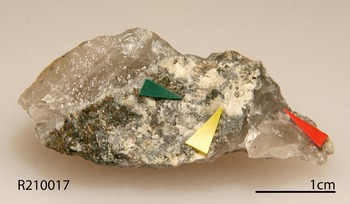
Loomisite was found on specimens (Fig. 1) collected from the Big Chief mine (43°51'54''N, 103°22'54''W), near Keystone, Pennington County, South Dakota, USA. Associated minerals on the type sample include dondoellite Ca2Fe(PO4)2⋅2H2O, earlshannonite Mn2+Fe3+2(PO4)2(OH)2⋅4H2O, mitridatite Ca2Fe3+3O2(PO4)3⋅3H2O, rockbridgeite (Fe2+0.5Fe3+0.5)2Fe3+3(PO4)3(OH)5, jahnsite-(CaMnFe) CaMn2+Fe2+2Fe3+2(PO4)4(OH)2⋅8H2O, and quartz. On a larger scale, loomisite was found in a boulder containing ludlamite Fe2+3(PO4)2⋅4H2O, vivianite Fe2+3(PO4)2⋅8H2O, and, to a lesser extent, phosphoferrite Fe2+3(PO4)2⋅3H2O, perloffite BaMn2+2Fe3+2(PO4)3(OH)3, and kryzhanovskite (Fe3+,Mn2+)3(PO4)2(OH,H2O)3. The Big Chief pegmatite was mined for feldspar in the 1930s. Its geology and mineralogy were reported by Norton (Reference Norton1964), Roberts and Rapp (Reference Roberts and Rapp1965), and Campbell and Roberts (Reference Campbell and Roberts1985). Primary iron-manganese phosphates and beryl were chemically attacked, producing secondary phosphates such as loomisite and those mentioned above. The Big Chief pegmatite is the type locality for metavivianite (Ritz et al., Reference Ritz, Essene and Peacor1974), olmsteadite (Moore et al., Reference Moore, Araki, Kampf and Steele1976) and perloffite (Kampf, Reference Kampf1977).
The specimen (R210017) on which the new mineral loomisite was found.

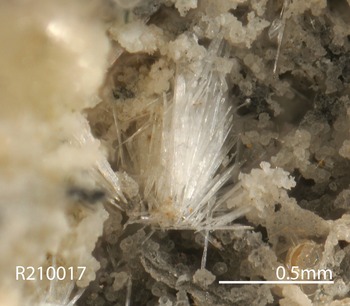
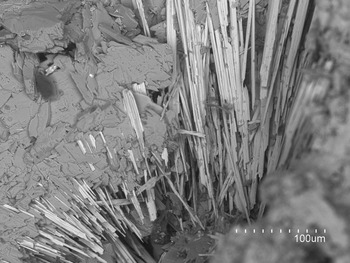
Loomisite occurs as divergent sprays of very thin bladed crystals that gently taper to a blunt termination. Individual crystals are found up to 0.80 × 0.06 × 0.03 mm (Figs 2 and 3). No twinning or parting is observed macroscopically. The mineral is murky white in transmitted light, transparent with white streak and silky to vitreous lustre. It is brittle and has a Mohs hardness of 3½–4, with perfect cleavage on {100} and {$\bar{1}$ 10}. The density measured by flotation in heavy liquids is 3.46(5) g/cm3 and the calculated density is 3.512 g/cm3. Optically, loomisite is biaxial (+), with α = 1.579(5), β = 1.591(5), γ = 1.606(5) (white light), 2V (meas.) = 82(2)° and 2V (calc.) = 85°. It is non-pleochroic under polarised light and the dispersion is very weak with r > v. The calculated compatibility index based on the empirical formula is 0.045 (good) (Mandarino, Reference Mandarino1981). Loomisite is insoluble in water or hydrochloric acid.
A microscopic view of a sprays of white, very thin bladed loomisite crystals (R210017).

A back-scattered electron image of thin bladed loomisite crystals (R210017). The matrix is primarily dondoellite.

The chemical composition of loomisite was determined using a Cameca SX-100 electron microprobe (WDS mode, 15 kV, 10 nA and a beam diameter of 5 μm). The standards used for the probe analysis are given in Table 1, along with the determined compositions (5 analysis points) and the BeO content measured with an X-Series 2 quadrupole ICP-MS following the procedure described by Xing et al. (Reference Xing, Luo, Ni Yuan, Liu, Yang, Dai, Zhang and Chen2021). The resultant chemical formula, calculated on the basis of 9 O atoms per formula unit (from the structure determination), is (Ba0.96Ca0.06)Σ1.02[(Be1.96Fe0.06)Σ2.02P1.99O8]⋅H2O, which can be simplified to (Ba,Ca)[(Be,Fe)2P2O8]⋅H2O.
Chemical compositions (in wt.%) for loomisite.

*The BeO content was measured with an X-Series 2 quadrupole ICP-MS.
**The H2O content was added according to the ideal value of H2O.
S.D. – standard deviation
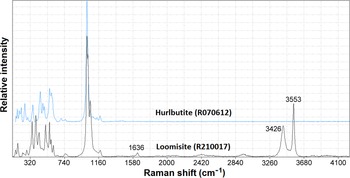
The Raman spectrum of loomisite (Fig. 4) was collected on a randomly oriented crystal with a Thermo Almega microRaman system, using a solid-state laser with a wavelength of 532 nm at the full power of 150 mW and a thermoelectric cooled CCD detector. The laser is partially polarised with 4 cm–1 resolution and a spot size of 1 μm.
Raman spectra of loomisite and hurlbutite, CaBe2(PO4)2.

X-ray crystallography
The powder X-ray diffraction data of loomisite (Table 2) were collected on a Rigaku Xtalab Synergy single crystal diffractometer (CuKα radiation) in Gandolfi powder mode at 50 kV and 1 mA. The unit-cell parameters refined using the program by Holland and Redfern (Reference Holland and Redfern1997) are as follows: a = 7.6457(2), b = 9.4427(3), c = 4.7512(2) Å, β = 91.272(5)°, and V = 342.47(14) Å3.
Powder X-ray diffraction data (d in Å, I in %) for loomisite.

The strongest lines are given in bold.
All loomisite crystals examined are pervasively twinned on (100) with the twin law [1 0 0 / 0 $\bar{1}$ 0 / 0 0 $\bar{1}$
 ] or consist of multi-crystal intergrowth, making it very difficult to find a suitable single crystal for X-ray intensity data collection. The X-ray intensity data used for the structure analysis were collected from a bladed fragment with the size of 0.06 × 0.02 × 0.01 mm on a Bruker APEX2 CCD X-ray diffractometer equipped with graphite-monochromatised MoKα radiation with frame widths of 0.5° in ω and 30 s counting time per frame. The intensity data were processed using the Bruker TWINABS software, yielding a twin ratio of 59:41. The systematic absences of reflections suggest possible space group P2/n, Pn, or P2. The crystal structure was solved and refined using SHELX2018 (Sheldrick Reference Sheldrick2015a, Reference Sheldrick2015b) based on space group Pn, because it produced the better refinement statistics in terms of bond lengths and angles, atomic displacement parameters, and R factors. No H atoms were located through the difference-Fourier syntheses. Refinement statistics are given in Table 3. Final atomic coordinates and displacement parameters are given in Tables 4 and 5, respectively. Selected bond distances are presented in Table 6. The bond-valence sums were calculated using the parameters given by Brese and O'Keefe (Reference Brese and O'Keeffe1991) (Table 7). The crystallographic information file has been deposited with the Principal Editor of Mineralogical Magazine and is available as Supplementary material (see below).
Summary of crystallographic data and refinement results for loomisite.

Fractional atomic coordinates and equivalent isotropic displacement parameters (Å2) for loomisite.

*Occupancies <1: Ba 0.950(12), Ca 0.052(12)
Atomic displacement parameters (Å2) for loomisite.

Selected bond distances for loomisite.

Bond-valence sums for loomisite.

Crystal structure description and discussion
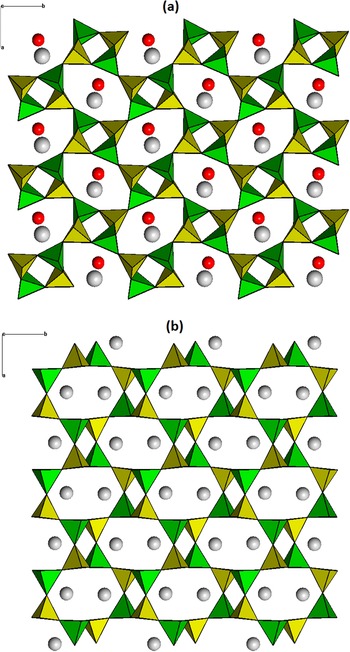
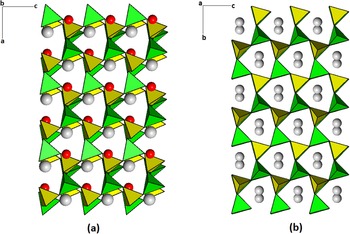
The crystal structure of loomisite is characterised by a framework of corner-sharing PO4 and BeO4 tetrahedra, with a topology identical to that of the zeolite ABW type (e.g. Bu et al., Reference Bu, Feng, Gier and Stucky1997; Kahlenberg et al., Reference Kahlenberg, Fischer and Baur2001). The framework can be considered as built from the stacking of sheets consisting of 4- and 8-membered rings (4.82 nets) along [001] (Fig. 5) or hexagonal layers (63 nets) along [010] (Fig. 6). The extra-framework Ba2+ and H2O are situated in the channels formed by the 8-membered rings. For comparison, Figs 5 and 6 also show the structure for the ABW-type M +[BePO4] compounds with space group Pna21 (M + = Li, K, Rb and NH4) (e.g. Bu et al., Reference Bu, Feng, Gier and Stucky1997; Zhang et al., Reference Zhang, Chen, Shi, Bu, Zhou, Xu and Zhao2001). As in other framework beryllophosphates, every framework O atom in loomisite is bonded to one P and one Be, giving rise to an ordered arrangement of P and Be atoms in the framework. Any linkages of P–O–P or Be–O–Be are strictly forbidden because they would make bridging O atoms either over-bonded or under-bonded (e.g. Hatert et al., Reference Hatert, Dal Bo, Bruni, Meisser, Vignola, Risplendente, Châtenet and Lebocey2020 and references therein).
(a) The crystal structure of loomisite, viewed as the stacking of sheets consisting of 4- and 8-membered PO4 and BeO4 tetrahedral rings (4.82 nets) along [001]. The extra-framework Ba2+ (grey spheres) and H2O (red spheres) are situated in the channels formed by the 8-membered rings. The yellow and green tetrahedra represent PO4 and BeO4 groups, respectively. (b) The structure for the ABW-type M +[BePO4] compounds with the space group Pna21 (M + = Li, K, Rb and NH4) (e.g. Bu et al., Reference Bu, Feng, Gier and Stucky1997; Zhang et al., Reference Zhang, Chen, Shi, Bu, Zhou, Xu and Zhao2001). The M + cations are represented by grey spheres.

Crystal structure of (a) loomisite and (b) the ABW-type zeolite, showing the stacking of hexagonal layers (63 nets) along [010] for loomisite and along [100] for the ABW-type zeolite. All figure legends are the same as in Fig. 4.

All average <P–O> and <Be–O> bond lengths in loomisite are comparable to those in other beryllophosphate minerals (e.g. Grice et al., Reference Grice, Peacor, Robinson, Van Velthuizen, Roberts, Campbell and Dunn1985; Rouse et al., Reference Rouse, Peacor, Dunn, Campbell, Roberts, Wicks and Newbury1987; Hatert et al., Reference Hatert, Dal Bo, Bruni, Meisser, Vignola, Risplendente, Châtenet and Lebocey2020). The Ba2+ cation in the big cavity shows a (7+4) coordination, with seven Ba–O distances between 2.74 and 2.94 Å, and four between 3.11 and 3.30 Å (Table 6).
Although we were unable to locate H atoms from the structure refinement, a calculation of the O–O distances around the O9 atom (H2O) in the cavity shows that eight O atoms are within 3.2 Å, which may be divided into two groups. Group 1 includes O2, O4, O5 and O6, which are at distances between 2.84 and 2.94 Å from O9, whereas group 2 includes O1, O3, O4 and O5, which are at distances between 3.04 and 3.20 Å from O9, as illustrated in Fig. 7. This observation suggests that H2O in loomisite might form dynamic, rather than static, H-bonds with these 8 O atoms.
An illustration of possible H-bonds for H2O in an 8-membered tetrahedral ring. The red, grey, and aqua spheres represent O, Ba and H2O, respectively. Four grey lines are for the O–O distances between 2.84–2.94 Å and four blue ones between 3.04–3.20 Å.

Based on previous Raman spectroscopic studies on beryllophosphate minerals (e.g. Frost et al., Reference Frost, Xi, Scholz, Belotti and Filho2012, Reference Frost, Scholz, Lopez, Xi, Queiroz, Belotti and Filho2014; Gatta et al., Reference Gatta, Jacobsen, Vignola, McIntyre, Guastella and Abate2014), we made the following tentative assignments of major Raman bands for loomisite. The two relatively strong bands centred at 3426 and 3553 cm–1 are assigned to the O–H stretching vibrational and a weak band centred at 1636 cm–1 to the H–O–H bending vibration in H2O. The nature of the two weak and broad bands at 2437 and 2938 cm–1 are unclear. The bands between 720 and 1150 cm–1 are ascribable to the P–O and Be–O stretching vibrations within the PO4 and BeO4 groups, whereas those from 400 to 660 cm–1 are due to the O–P–O and O–Be–O bending vibrations. The bands below 400 cm–1 are mainly associated with the rotational and translational modes of PO4 and BeO4 tetrahedra, Ba–O stretching, and lattice vibrational modes. According to the correlation between νO–H and O—H⋅⋅⋅O distances for minerals (Libowitzky,Reference Libowitzky1999), the Raman band at 3426 cm–1 corresponds well with the O–O distances of 2.84–2.94 Å and that at 3553 cm–1 with the O–O distances of 3.04–3.20 Å. Because hurlbutite, CaBe2(PO4)2, also possesses a framework structure similar to that of loomisite (see below), its Raman spectrum from the RRUFF Project (http://rruff.info/R070612) is also plotted in Fig. 4 for comparison. Except for the region above 1200 cm–1, the strong resemblance between the two spectra is apparent. The difference in peak intensities between the two spectra principally results from the different crystal orientations when the data were collected.
Loomisite is the first natural example with the zeolite ABW-type framework and the fifth natural Ba-beryllophosphate known to date, after babefphite BaBe(PO4)F, minjiangite BaBe2(PO4)2, wilancookite (Ba5Li2□)Ba6Be24P24O96⋅26H2O, and limousinite BaCa[Be4P4O16]⋅6H2O. According to Bu et al. (Reference Bu, Feng, Gier and Stucky1997) and Kahlenberg et al. (Reference Kahlenberg, Fischer and Baur2001), six different symmetries have been reported for the structures with the ABW-type framework, including Imam, Pnam, Pna21, P21/c (or P21/a or P21/n), P21, P $\bar{1}$ , with Pna21 and P21 being the most common space groups at room temperature. Loomisite represents the first ABW-type structure with space group Pn, expanding the diversity of the ABW-type framework symmetries.
In addition to babefphite BaBe(PO4)F and minjiangite BaBe2(PO4)2, hurlbutite CaBe2(PO4)2 and hydroxylherderite CaBe(PO4)(OH) are also related to loomisite in terms of chemical compositions. Among these minerals, hurlbutite also exhibits a framework consisting of 4-, 6-, and 8-membered rings (Lindbloom et al., Reference Lindbloom, Gibbs and Ribbe1974; Dal Bo et al., Reference Dal Bo, Hatert and Baijot2014), analogous to that of danburite, but its linkage between the 4.82 nets is different from that of loomisite. The framework of hurlbutite belongs to the paracelsian-type structure, not the zeolite ABW-type.
Acknowledgements
We are grateful for the constructive comments by Structures Editor Peter Leverett and two anonymous reviewers, and help from Dr. Aaron Celestian and Dr. Anthony Kampf for identifying zeolite types. This study was funded by the Feinglos family and Mr. Michael Scott.
Supplementary material
To view supplementary material for this article, please visit https://doi.org/10.1180/mgm.2022.117
Competing interests
The authors declare none.