




No CrossRef data available.
Article contents
Inhibition of return in obsessive-compulsive disorder
Published online by Cambridge University Press: 06 February 2004
Abstract
Obsessive-compulsive disorder (OCD) is characterized by repetitive obsessions and/or compulsions that interfere with daily functioning. Neuropsychological studies have suggested that such perseverative behaviors may be due to underlying attentional deficits. Inhibition of return (IOR) is an adaptive mechanism that is thought to assist visual search by biasing attention after a critical, short interval to novel, previously unattended areas. Therefore, this study aimed to examine whether deficient IOR mechanisms could underlie some of the attentional, and perhaps behavioral, problems, reported in OCD patients. Using a computerized IOR paradigm, participants were required to respond to a target that appeared at either the same or different location to a precue that was presented either 100 ms or 700 ms earlier. Results indicate that patients had a reduced IOR for targets presented in the left visual field, suggesting lateralized anomalies in shifting attention. Results are consistent with lateralization anomalies previously reported in OCD. (JINS, 2004, 10, 54–59.)
Keywords
Information
- Type
- Research Article
- Information
- Journal of the International Neuropsychological Society , Volume 10 , Issue 1 , January 2004 , pp. 54 - 59
- Copyright
- © 2004 The International Neuropsychological Society
INTRODUCTION
Directing attention to a cued location facilitates target detection at that location, if the cue-to-target interval is less than 300 ms. However, if the cue-to-target delay is between 300 and 2000 ms, target detection is typically faster at an uncued location, compared to the cued location (Klein, 2000). This phenomenon has been termed Inhibition of Return (IOR), and was first demonstrated by Posner and Cohen (1984). IOR is thought to be a highly adaptive mechanism that assists visual search by biasing attention to novel, previously unattended areas (Klein, 2000; Tipper et al., 1996). For example, at a gross level, when searching for a lost object efficient search requires attention to be moved across the environment to novel locations, rather than returning to locations that have previously been searched. Therefore, deficits in IOR may result in perseverative behaviors, such as those seen in obsessive-compulsive disorder (OCD).
IOR is thought to involve effects of the ocular–motor system (Harman et al., 1994; Posner et al., 1985; Taylor & Klein, 1998), and therefore to be mediated by midbrain structures. Posner et al. (1985) investigated IOR in patients with progressive supranuclear palsy (PSP), a disorder in which the superior colliculus is compromised. They reported a loss of IOR in PSP patients, indicating that the superior colliculus may be necessary for IOR to operate. Further evidence implicating the superior colliculus in IOR comes from a recent study that recorded activity from neurons in the superior colliculus in monkeys during a cue–saccade paradigm (Dorris et al., 1998). Reduced responses were found for targets that appeared at the cued location, compared to targets presented at the uncued location. This finding suggests that the superior colliculus is involved in IOR (Klein, 2000).
Midbrain deficiencies, such as atypical eye movements, have been reported in OCD (Rosenberg et al., 1997). Specifically, patients with OCD have been reported to have increased latencies producing antisaccades where an eye movement away from a stimulus event is required (Maruff et al., 1999). Furthermore, problems with orienting attention, also thought to involve midbrain structures (Rafal et al., 1988), have similarly been reported (Christensen et al., 1992; Clayton et al., 1999; Head et al., 1989).
Nelson et al. (1993) used a Posner-type visual paradigm to determine the ability of OCD patients to orient attention. Two boxes were flanked either side of a central fixation point, and participants were required to press a button in response to the target (an asterisk) appearing in one of the boxes. Prior to the presentation of the target a peripheral cue was given (brightening of box), which was either valid (cue and target appeared on same side) or invalid (cue and target appeared on opposite sides). Valid cues were presented on 60% of trials and invalid cues were presented on 20% of trials. On the remaining 20% of trials no cue was presented. As valid cues occurred 3 times more often than invalid, these cues could be considered to have an informative value. The cue-to-target delay was also manipulated, with short (100 ms) and long (800 ms) conditions. As expected, on the short cue-to-target delay condition, OCD patients and controls were faster on valid cue trials, compared to invalid trials and when no cues were presented. With the long cue-to-target delay condition, controls were faster on invalid cues, compared to valid, indicating normal IOR. However, OCD participants continued to show a valid cue superiority, which suggests atypical or absent IOR. Further analysis of OCD data revealed a lateralized impairment of IOR, with reduced IOR for targets presented to the left, and no IOR for targets presented to the right (Nelson et al., 1993). However, it may be argued that the informative nature of the cues may have provided an incentive, especially for patients with such a disorder, to hold attention at the cued location (Rafal & Henik, 1994). Therefore, valid cue superiority might be expected, irrespective of the cue-to-target delay.
This study aimed to determine whether deficient IOR mechanisms underlie some of the attentional and perhaps behavioral problems reported in OCD patients. The current study used an IOR paradigm adapted from Posner and Cohen (1984); however, in order to overcome the methodological shortcomings of Nelson et al.'s (1993) study, the current study used precues that were uninformative (i.e., precues did not predict the likely location of the target). It was hypothesized that all participants would show a valid cue superiority on short cue-to-target delay conditions. Furthermore, due to the attentional impairments reported in OCD it was hypothesized that patients would show atypical IOR; however, the nature and extent of the atypicality was uncertain.
METHODS
Research Participants
Five males and 5 females diagnosed with OCD and 10 age- and sex-matched controls participated (see Table 1 for the demographic details for each group). OCD participants were recruited from The Obsessive-Compulsive and Anxiety Disorders Foundation of Victoria, and met DSM–IV diagnostic criteria (American Psychiatric Association, 1994). Eight of the OCD participants were medicated on fluoxetine, clonazepam, paroxetine, or a combination of these. Previously, medication status has been shown to have no effect on performance on an IOR task in OCD patients (Nelson et al., 1993). The Padua Inventory (Sanavio, 1988) was administered to all participants to assess obsessive-compulsive symptoms. Anxiety and depression, which are often associated with OCD, were assessed in patients and controls using the Beck Anxiety Inventory (BAI; Beck et al., 1988) and the Beck Depression Inventory (BDI; Beck et al., 1961), respectively. In addition, premorbid intellectual ability was assessed using the National Adult Reading Test (NART; Nelson & O'Connell, 1978), and all participants were screened for dementia using the Short Test of Mental Status (STMS; Kokmen et al., 1987).
Demographic and clinical details of OCD and matched controls (SD in brackets)

The OCD and control groups did not differ with respect to age [F(1,18) = 0.05, p = .83], or intellectual ability [F(1,18) = 1.10, p = .31]. However, the controls scored significantly higher on the STMS, compared to the OCD group [F(1,18) = 10.53, p < .01]. The OCD participants had greater levels of depression [F(1,18) = 15.04, p < .01], anxiety [F(1,18) = 6.18, p < .01], and OC symptoms [F(1,18) = 34.54, p < .01], compared to controls. See Table 1 for descriptive data.
Apparatus
A Toshiba notebook computer was used to present the stimuli. Stimuli consisted of two pale rectangular boxes presented either side of a centrally presented fixation point (“+”), see Figure 1. Each box spanned 1.8 cm in height and 1.4 cm in width, and the distance between the midpoint of each box and the midpoint of the fixation point was 8.5 cm. The target was a bright green asterisk that appeared in one of the two boxes. Prior to the onset of the target a lateral cue was presented in the form of a brightening (yellow) of one of the two boxes. All stimuli were presented on a black background. Participants pressed the space bar on the computer in response to the appearance of the target.

A schematic diagram of the inhibition of return display for a trial where the cue and target occur on the same side. ‘+’ = fixation point, ‘*’ = target, and the brightening of the box is the cue.
Procedure
Participants were required to sit 60 cm in front of the computer and to rest their preferred hand on the space-bar. After 1500 ms, one of the lateral boxes became yellow for 50 ms. The target was presented either 100 ms (short-delay condition) or 700 ms (long-delay condition) after the lateral precue appeared. On catch trials no target was presented. Participants were required to press the space bar of the computer as quickly as possible, in response to the presentation of the target.
There were 200 trials in total, including 40 catch trials, which were presented in blocks of 25. After each block was completed a short break was given. The position of the lateral precue (left or right), the position of the target (same or different to the precue) and the delay (short or long) were all counterbalanced in a factorial design. Reaction times (RTs) less than 100 ms were considered to be anticipations, and RTs that exceeded 2000 ms were considered to be misses. RTs, anticipations, misses and false alarms (e.g., response on a catch trial) were analyzed separately.
RESULTS
Reaction Time
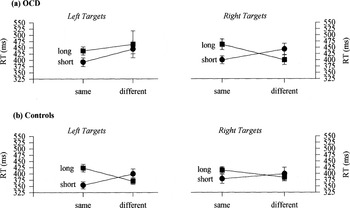
RT data were submitted to a four-way ANOVA with factors of group (OCD, controls), target side (left, right), relative position (same or different to precue) and delay (short, long). A significant interaction between Relative Position × Delay [F(1,18) = 23.30, p < .01], with faster responses when cue and target occupied the same position and the delay was short, and vice versa with long delays, indicates a normal IOR pattern. Although a main effect of group was not found [F(1,18) = 2.67, p = .12], there was a significant four-way interaction of Group × Target Side × Relative Position × Delay [F(1,18) = 5.24, p < .05; see Figure 2].

Mean RT (ms) for short and long delay conditions as a function of cue-to-target relative position (same, different), for left and right targets, for (a) OCD patients and (b) controls. SE bars included.
To further examine this interaction, two-way Relative Position × Delay ANOVAs were conducted separately for left and right directed targets for OCD participants and controls. Controls displayed normal IOR for targets directed towards the left [F(1,9) = 65.62, p < .01] and right [F(1,9) = 8.69, p < .05], whereas OCD patients only showed normal IOR for targets directed towards the right [F(1,9) = 38.00, p < .01]. Therefore, the locus of this interaction lies in the RTs for left targets for OCD participants. Further post-hoc analyses revealed that for targets directed toward the left, in the short cue-to-target delay, OCD participants were significantly faster when the cue and target appeared on the same side, compared to when the cue and target appeared on different sides, [t(9) = −5.50, p < .01]. However, in the long cue-to-target delay there was no performance difference when the cue and target appeared on the same side or different sides, [t(9) = −0.49, p > .05]. Thus, OCD participants seem to have been anomalously slow with left-located targets, at a long interval, with a different cue-to-target position.
To ensure that the increased RTs found for OCD participants were not due to increased depression, anxiety or OCD symptomatology, a series of correlations were conducted for OCD participants between scores on the BDI, BAI and PI and RT for left-located targets, at long intervals, with a different cue-target position. However, no correlations were significant.
Anticipations, Misses, and False Alarms
The four-way ANOVA for anticipations (RT < 100 ms) was identical to the one performed above. A significant main effect of delay was found [F(1,18) = 14.36, p < .01], with more anticipations made in the long cue-to-target condition (M = 1.4), compared to the short cue-to-target condition (M = 0.3), which may merely be due to increased time in which an error can be made.
An analogous four-way ANOVA was conducted on the number of misses (RT > 2000 ms) and a t test on the number of false alarms produced by patients and controls; however, no main effects or interactions reached significance.
DISCUSSION
OCD patients displayed a reduced IOR; however, this reduction was specific to targets presented in the left visual field. Furthermore, both the OCD and control groups produced a similar number of anticipations, misses and false alarms, indicating that neither group employed a speed–accuracy trade-off.
The present study indicates that OCD patients showed normal facilitatory effects for cued locations in the short cue-to-target delay condition. However, they did not show the expected inhibitory effect at the cued locations, in the long cue-to-target delay condition, for targets presented in the left visual field, indicating perhaps an abnormal IOR mechanism. One possible explanation for the reduced IOR for targets presented in the left visual field may involve a deficit in shifting attention. If the cues captured patients' attention at that location, similar RTs would be expected irrespective of the cue–target delay. This is consistent with the current findings for targets presented in the left visual field.
Problems in shifting the focus of attention are frequently reported in the OCD literature (Christensen et al., 1992; Enright & Beech, 1993; Head et al., 1989; Veale et al., 1996). In fact, the most consistent performance deficits occur on tasks requiring shifting of mental set (Tallis, 1997). Veale et al. (1996) employed a computerized attentional set-shifting task, which assessed the ability to maintain and shift response set. OCD patients were impaired relative to controls, indicating deficits in both maintaining and shifting cognitive set. Head et al. (1989) also reported OCD patients were more impaired relative to matched controls on the Money Road Map Test. Again, this suggests that patients have problems shifting cognitive set. In effect, such a deficit may underlie the perseverative nature of obsessions and compulsions.
The findings from the current study may also be explained in terms of an inhibitory deficit, a function that is assumed to underlie IOR effects. Although such an explanation is consistent with previous OCD research (Enright & Beech, 1993; Martinot et al., 1990) it may be argued that such a deficit would manifest itself as a global neuropsychological impairment, rather than lateralized, as was found in the current study.
The lack of a reduced IOR for targets presented in the right visual field (which projects to the left cerebral hemisphere) may be explained by lateralization anomalies. Neuropsychological (Aronowitz et al., 1994; Denckla, 1989; Zielinski et al., 1991) and neuroimaging data (Baxter et al., 1992) typically implicate right hemisphere dysfunction in patients with OCD. Reduced IOR for targets appearing in the left visual field, together with normal IOR for targets presented in the right visual field, are consistent with right hemisphere dysfunction. Findings from the present study therefore add to the growing literature on lateralization anomalies in OCD.
Results from the current study are consistent with Nelson et al. (1993), who also reported reduced IOR for targets presented in the left visual field. However, unlike this earlier study by Nelson et al. (1993), OCD participants in the present study did not show a reduced or abolished IOR for targets presented in the right visual field. The task used in the present study employed exogenous cues, whereas the nature of the cues used by Nelson et al. (1993), suggests both exogenous and endogenous cueing may have occurred. Some authors explain that the type of cueing employed (endogenous or exogenous) differentially affects inhibitory effects (Rafal & Henik, 1994). For example, Rafal and Henik (1994) argue that because exogenously triggered orienting may occur without voluntary or controlled processing, it may occur more quickly and produce facilitation of detection at the cued location without producing inhibition at other locations. Therefore, differences between the current study and previous studies (Nelson et al., 1993) may be a consequence of the type of cueing employed.
It is interesting to note that patients with schizophrenia, a disorder also considered to have right hemisphere dysfunction, show abnormal IOR (Huey & Wexler, 1995; Larrison-Faucher et al., 2002; Sapir et al., 2001). Larrison-Faucher et al. (2002) reported that patients with schizophrenia displayed a delayed IOR, compared to healthy controls. Thus, although patients showed IOR it did not begin until greater than normal intervals between cue and target. Given the findings from the current study and that the neuropathology of schizophrenia and OCD both involve right hemisphere dysfunction future research should employ various stimulus-onset-asynchronies to examine the time course of IOR in OCD patients.
In summary, OCD patients have a lateralized impairment in IOR, which may be due to an underling deficit in shifting attention. Furthermore, such impairment may also account for the perseverative nature of OCD symptoms.
ACKNOWLEDGMENTS
We would like to thank the Obsessive-Compulsive Disorder and Anxiety Foundation of Victoria for all their help and cooperation, and all the members who participated. Thanks also go to the American Tourette's Syndrome Association, Permanent Research Fund for supporting the research.
References
American Psychiatric Association.
(1994).
Diagnostic and statistical manual of mental disorders
(4th ed.).
Washington, DC:
Author.
Aronowitz, B.,
Hollander, E.,
DeCaria, C.,
Cohen, L.,
Saoud, J.,
Stein, D.,
Liebowitz, M., &
Rosen, W.
(1994).
Neuropsychology of obsessive-compulsive disorder: Preliminary
findings.
Neuropsychiatry, Neuropsychology and Behavioral Neurology,
7,
81–86.Google Scholar
Baxter, L.,
Schwartz, J.,
Bergman, K.,
Szuba, M.,
Guze, B.,
Mazziotta, J.,
Alazraki, A.,
Selin, C.,
Munford, H.-K.P., &
Phelps, M.
(1992).
Caudate glucose metabolic rate changes with both drug and behavior
therapy for obsessive-compulsive disorder.
Archives of General Psychiatry,
49,
681–689.Google Scholar
Beck, A.,
Epstein, N.,
Brown, G., &
Steer, R.
(1988).
An inventory for measuring clinical anxiety: Psychometric
properties.
Journal of Consulting and Clinical Psychology,
56,
893–897.Google Scholar
Beck, A.,
Ward, C.,
Mendelson, M.,
Mock, J., &
Erbaugh, J.
(1961).
An inventory for measuring depression.
Archives of General Psychiatry,
4,
53–63.Google Scholar
Christensen, K.,
WonKim, S.,
Dysken, M., &
Hoover, K.
(1992).
Neuropsychological performance in obsessive-compulsive disorder.
Biological Psychiatry,
31,
4–18.Google Scholar
Clayton, I.,
Richards, J., &
Edwards, C.
(1999).
Selective attention in Obsessive-Compulsive Disorder.
Journal of Abnormal Psychology,
108,
171–175.Google Scholar
Denckla, M.
(1989).
Neurological examination. In
J.L. Rapoport (Ed.),
OCD in children and adolescents (pp.
107–15).
Washington, DC:
American Psychiatric Press.
Dorris, M.,
Everling, S.,
Klein, R., &
Munoz, D.
(1998).
Neural correlate of Inhibition of Return (IOR): Visual and motor
preparatory signals in the monkey superior colliculus.
Society for Neuroscience Abstracts,
24,
417.Google Scholar
Enright, S. &
Beech, A.
(1993).
Reduced cognitive inhibition in obsessive-compulsive disorder.
British Journal of Clinical Psychology,
32,
67–74.Google Scholar
Harman, C.,
Posner, M.,
Rothbart, M., &
Thomas-Thrapp, L.
(1994).
Development of orienting to locations and objects in human infants.
Canadian Journal of Experimental Psychology,
48,
301–318.Google Scholar
Head, D.,
Bolton, D., &
Hymas, N.
(1989).
Deficit in cognitive shifting ability in patients with
obsessive-compulsive disorder.
Biological Psychiatry,
25,
929–937.Google Scholar
Huey, E. &
Wexler, B.
(1995).
Abnormalities in rapid, automatic aspects of attention in
schizophrenia: Blunted inhibition of return.
Schizophrenia Research,
14,
57–63.Google Scholar
Kokmen, E.,
Naessens, J.M., &
Offord, K.P.
(1987).
A short test of mental status: Description and preliminary results.
Mayo Clinic Proceedings,
62,
218–288.Google Scholar
Larrison-Faucher, A.,
Briand, K., &
Sereno, A.
(2002).
Delayed onset of inhibition of return in schizophrenia.
Progress in Neuro-Psychopharmacology and Biological Psychiatry,
26,
505–512.Google Scholar
Martinot, J.L.,
Allilaire, J.F.,
Mazoyer, B.M.,
Hantouche, E.,
Huret, J.D.,
Legaut-Demare, F.,
Deslauriers, A.G.,
Hardy, P.,
Pappata, S.,
Baron, J.C., &
Syrota, A.
(1990).
Obsessive-compulsive disorder: A clinical neuropsychological and
positron emission tomography study.
Acta Psychiatrica Scandinavica,
82,
233–242.Google Scholar
Maruff, P.,
Purcell, R.,
Tyler, P.,
Pantelis, C., &
Currie, J.
(1999).
Abnormalities of internally generated saccades in
obsessive-compulsive disorder.
Psychological Medicine,
29,
1377–1385.Google Scholar
Nelson, E.,
Early, T., &
Haller, J.
(1993).
Visual attention in obsessive-compulsive disorder.
Psychiatry Research,
49,
183–196.Google Scholar
Nelson, H. &
O'Connell, A.
(1978).
Dementia: The estimation of premorbid intelligence levels using the
new adult reading test.
Cortex,
14,
234–244.Google Scholar
Posner, M. &
Cohen, Y.
(1984).
Components of visual orienting. In
D.G. Bouwhuis (Ed.),
Attention and Performance (pp.
531–556).
Hillsdale, NJ:
Erlbaum.
Posner, M.,
Rafal, R.,
Choate, L., &
Vaughan, J.
(1985).
Inhibition of return: Neural basis and function.
Cognitive Neuropsychology,
2,
211–288.Google Scholar
Rafal, R. &
Henik, A.
(1994).
The neurology of inhibition: Integrating controlled and automatic
processes. In
D. Dagenbach &
T. Carr (Eds.),
Inhibitory processes in attention, memory and language (pp.
1–51).
New York:
Academic Press.
Rafal, R.,
Posner, M.,
Friedman, J.,
Inoff, A., &
Bernstein, E.
(1988).
Orienting of visual attention in progressive supranuclear palsy.
Brain,
111,
267–280.Google Scholar
Rosenberg, R.,
Averbach, D.,
O'Hearn, K.,
Seymour, A.,
Birmaher, B., &
Sweeney, J.
(1997).
Oculomotor response inhibition abnormalities in pediatric
obsessive-compulsive disorder.
Archives of General Psychiatry,
54,
831–838.CrossRefGoogle Scholar
Sapir, A.,
Henik, A.,
Dobrusin, M., &
Hochman, E.Y.
(2001).
Attentional asymmetry in schizophrenia: Disengagement and
inhibition of return deficits.
Neuropsychology,
15,
361–370.Google Scholar
Sanavio, E.
(1988).
Obsessions and compulsions: The Padua inventory.
Behavioural Research and Therapy,
26,
169–177.Google Scholar
Tallis, F.
(1997).
The neuropsychology of obsessive-compulsive disorder: A review and
consideration of clinical implications.
British Journal of Clinical Psychology,
36,
3–20.Google Scholar
Taylor, T. &
Klein, R.
(1998).
On the causes and effects of inhibition of return.
Psychonomic Bulletin and Review,
5,
625–643.Google Scholar
Tipper, S.,
Weaver, B., &
Watson, F.
(1996).
Inhibition of Return to successively cued spatial locations:
Commentary on Pratt and Abrams (1995).
Journal of Experimental Psychology: Human Perception and
Performance,
22,
1289–1293.Google Scholar
Veale, D.M.,
Sahakian, B.J.,
Owen, A.M., &
Marks, I.M.
(1996).
Specific cognitive deficits in tests sensitive to frontal lobe
dysfunction in obsessive-compulsive disorder.
Psychological Medicine,
26,
1261–1269.Google Scholar
Zielinski, C.,
Taylor, M., &
Juzwin, K.
(1991).
Neuropsychological deficits in obsessive-compulsive disorder.
Neuropsychiatry, Neuropsychology, and Behavioral Neurology,
4,
110–126.Google Scholar

Demographic and clinical details of OCD and matched controls (SD in brackets)

A schematic diagram of the inhibition of return display for a trial where the cue and target occur on the same side. ‘+’ = fixation point, ‘*’ = target, and the brightening of the box is the cue.
Mean RT (ms) for short and long delay conditions as a function of cue-to-target relative position (same, different), for left and right targets, for (a) OCD patients and (b) controls. SE bars included.
 You have
Access
- 12
- Cited by