INTRODUCTION
I began my dissertation in 1999 with the following quote:
“[W]hen archaeologists fail to assign specific activities to these groups [women, peasants, and ethnic groups], dominant groups in contemporary society are free to depict them in any way they please. Most often, dominant groups will overstate the historical importance of their own group and undervalue the contributions of others, legitimating inequalities. In addition, when women, peasants, and ethnic groups are assigned no specific activities in the past, professional archaeologists make implicit assumptions about their roles and capabilities, resulting in the widespread acceptance of untested, and possibly erroneous, interpretations of archaeological data. As archaeologists, we have a professional responsibility to present our prehistories in ways that make distorted appropriations of the past as difficult as possible, and, as scientists, we need to work with models that expose our implicit assumptions concerning human roles and capabilities to critical reflection and hypothesis testing” (Brumfiel Reference Brumfiel1992:553).
Written more than 20 years ago, this quote from Elizabeth Brumfiel's Distinguished Lecture in Archaeology to the American Anthropological Association, “Breaking and Entering the Ecosystem: Gender, Class, and Faction Steal the Show,” still resonates with its initial force, a testament to the power and impact of Brumfiel's work. In the quote above, Brumfiel put forward a call to arms to archaeologists to take seriously the roles of traditionally neglected social groups, women, peasants, ethnic groups, and any other marginalized group. As a feminist scholar she was aware of the disabling stereotypes and profound misunderstandings of society that could ensue if researchers assumed, rather than investigated, what the roles and capabilities of members of marginalized social groups were.
Across her career Elizabeth Brumfiel sought to bring the lives of the marginalized to the front and center of archaeological research to further an understanding of how inequality worked in society. She did so specifically through the exploration of the lives of pre-Columbian commoners and women living under Aztec and Spanish domination (e.g., Brumfiel Reference Brumfiel, Gero and Conkey1991, Reference Brumfiel1996a, Reference Brumfiel and Wright1996b, Reference Brumfiel, Alcock, D'Altroy, Morrison and Sinopoli2001, Reference Brumfiel and Nelson2006a, Reference Brumfiel2006b; Robin and Brumfiel Reference Robin and Brumfiel2008). Her working premise was that marginalized peoples where neither dopes nor dupes, but rather active and knowledgeable participants in their world. In 1996 she stated boldly: “One of my basic operating assumptions is that women are not dupes” (Brumfiel Reference Brumfiel1996a:454). Later she expanded upon this line of thinking by highlighting that “recognizing the economic and political structures that engaged individuals in past societies actually enhances our sense of them as active agents rather than cultural dupes” (Brumfiel Reference Brumfiel and Nelson2006a: 36). While peoples' actions may be constrained by their positions in society, people are neither dopes nor dupes, unaware of the social structures of their society. As Brumfiel championed, analyses based on the premise that people are dupes, unaware of their position in society not only miss the opportunity to understand peoples' lives and experiences in the past but also misunderstand how power and inequality operate in society.
As a salute to the work and legacy of Elizabeth Brumfiel, I develop a case study from my own research on the lives and religious practices of Maya farmers at the Chan site in Belize, that demonstrates how farmers were neither the dopes, dupes, nor mystified masses of Maya state level ideologies. I use this case study to show how archaeological research prompts a broader rethinking of anthropological theories that attempt to explain the role of state level ideologies in the production of inequality and power particularly ideas about ideology and false consciousness that are often bundled together and referred to as the ‘dominant ideology thesis.' While in this article I am highlighting Elizabeth Brumfiel’s foundational contributions to rethinking the ‘dominant ideology thesis,’ there is a rich literature in Mesoamerican archaeology and beyond that has used archaeological and other sources of data to critique the ‘dominant ideology thesis’ (e.g., Abercrombie et al. Reference Abercrombie, Hill, Turner and Allen1980; Blackmore Reference Blackmore2011; Hutson Reference Huston2002; Joyce et al. Reference Joyce, Bustamante and Levine2001; Lucero Reference Lucero2003; Lohse Reference Lohse, Gonlin and Lohse2007; Scott Reference Scott1985).
FARMERS AND THE CHAN COMMUNITY
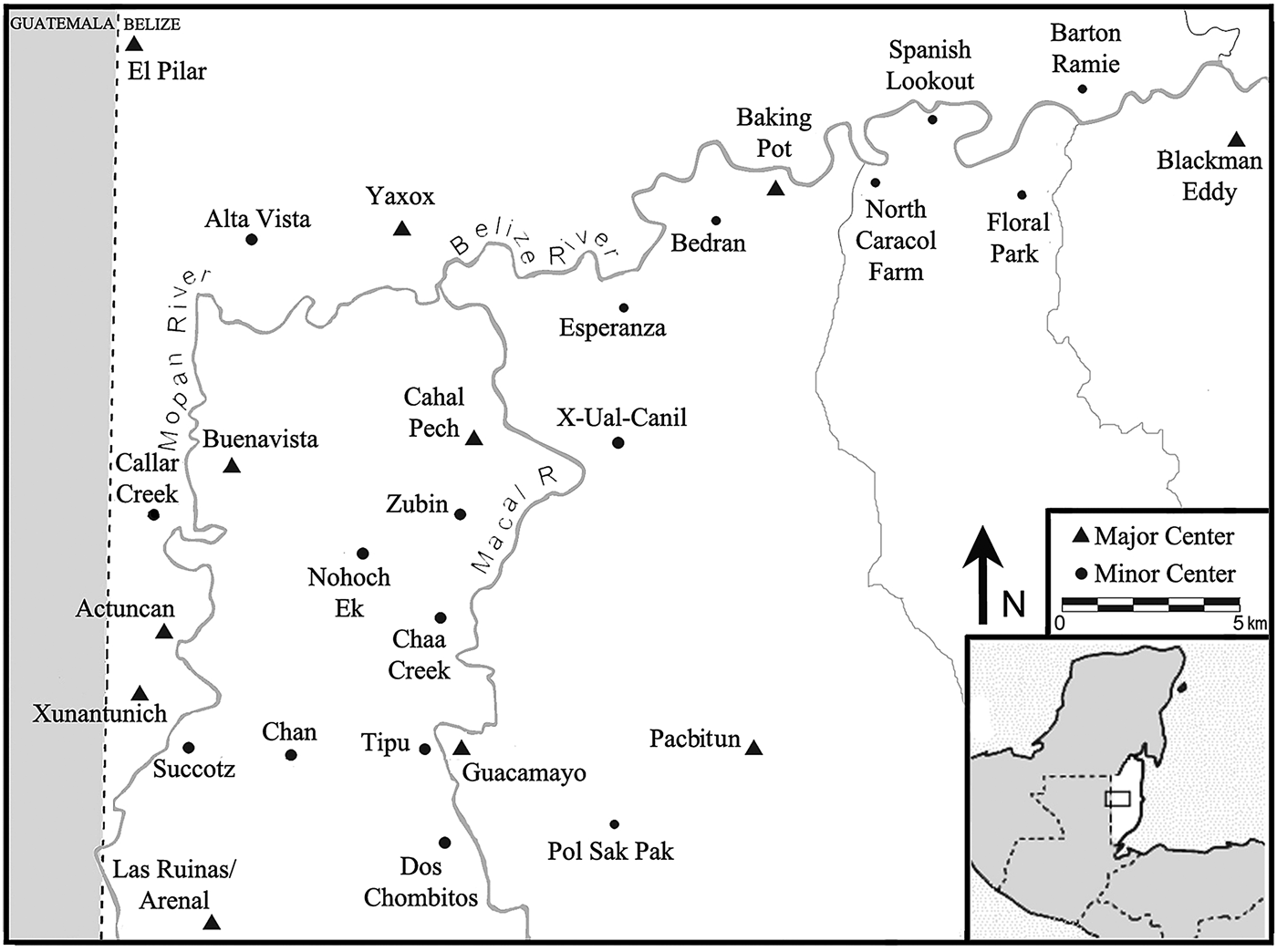
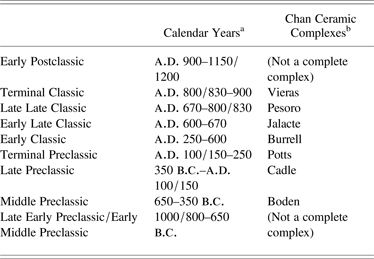
The Maya farming community of Chan is located in the upper Belize valley region of west-central Belize, in an upland area between the Mopan and Macal branches of the Belize River (Figure 1). Across Chan's undulating upland terrain, its ancient inhabitants constructed a productive landscape of agricultural terraces surrounding a community center. This agricultural base supported Chan's 2000 year occupation (800 b.c.–a.d. 1200), which spans the major periods of political change in Maya society (the Preclassic, Classic, and Postclassic periods; Kosakowsky Reference Kosakowsky and Robin2012) (see Table 1). The scale of the Chan community provides a window into the lives of people who lived in what was a prehistoric Maya agrarian community. Chan's deep chronology provides a means to examine diachronically how farmers’ lives were embedded within and significant for the construction of broader Maya society (Robin Reference Robin2012, Reference Robin2013).
Map of the Belize river valley and Maya area showing the Chan site. [Illustration by Elizabeth Schiffman.]

Chronology chart detailing the ceramic complexes from the Chan site
aCalendar years are approximate based on correlation with 24 radiocarbon dates from Chan and correlation with other sites in the Maya lowlands.
bChan ceramic complexes are named for geographical bodies of water in and around the Belize Valley.
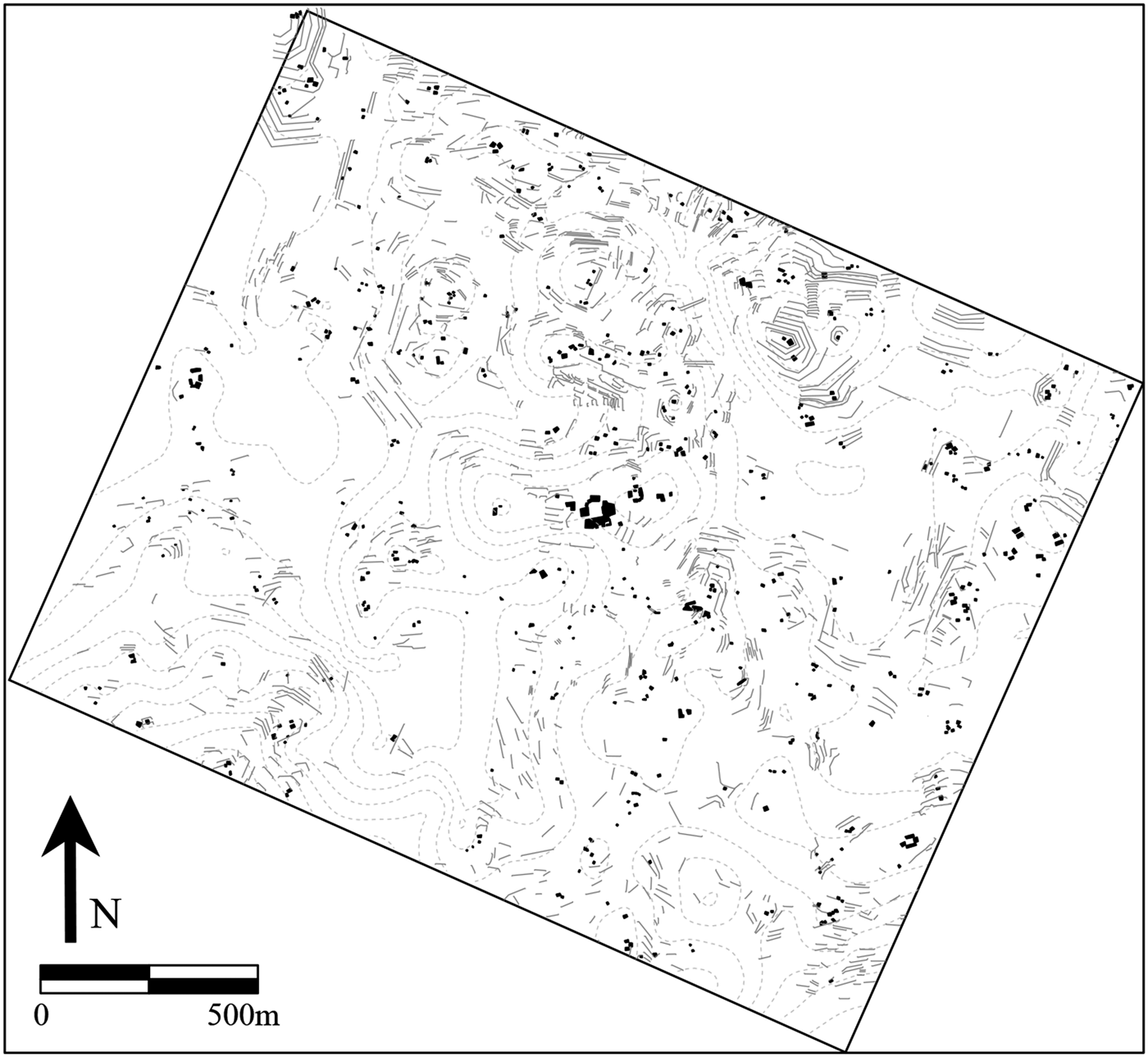
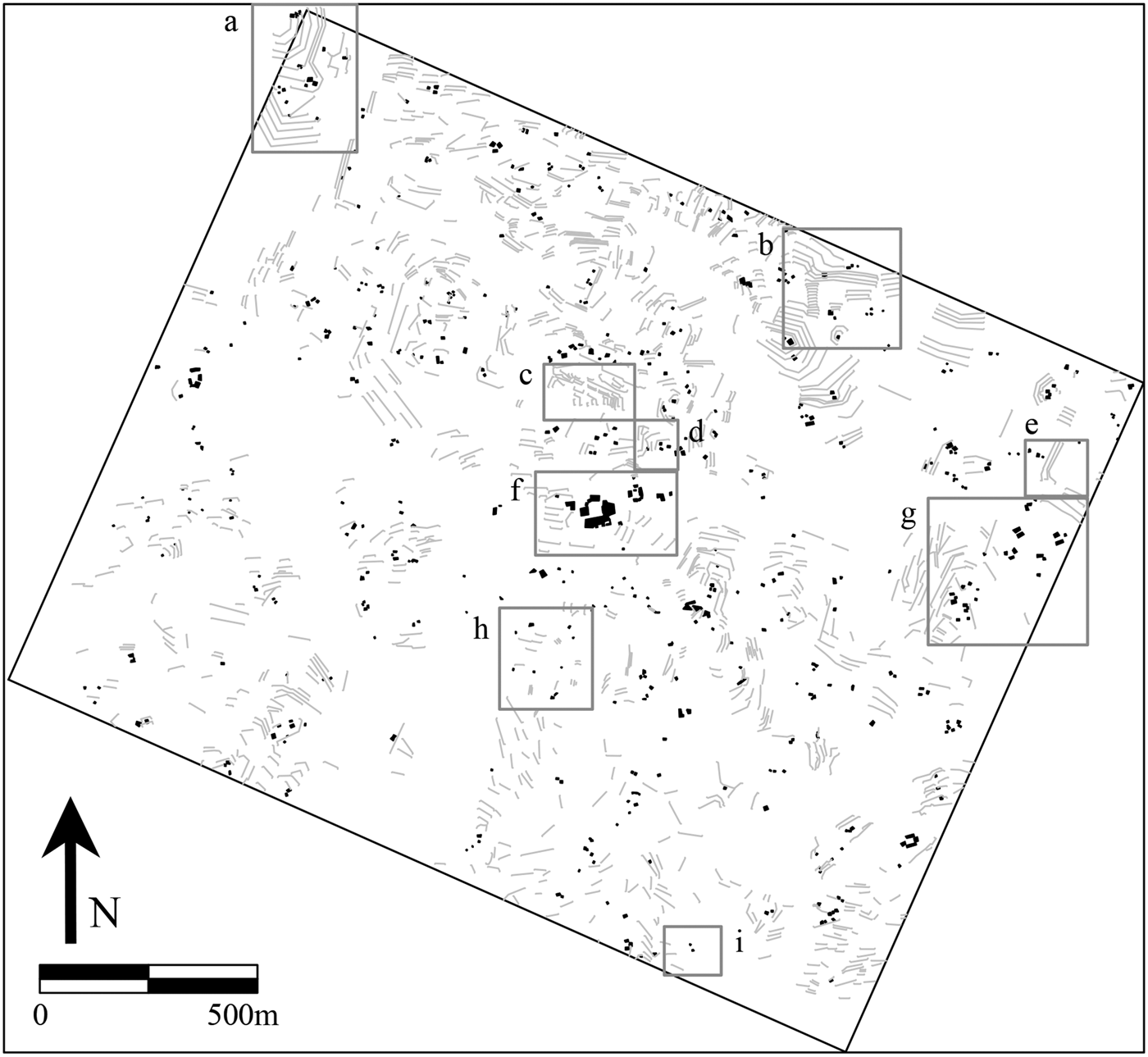
The Chan community consists of 274 households and 1223 agricultural terraces surrounding a community center (Figure 2). The majority of Chan's residents were farmers (Wyatt Reference Wyatt2008, Reference Wyatt and Robin2012). Farmers agricultural terraces were the most numerous and substantial constructions at Chan. Agricultural terraces would have transformed Chan's hilly landscape into what would have looked like green stepped pyramids. Resonating with the focus of this article on illustrating commoners’ understanding of broader state level ideology, it may be that the Maya stepped temple pyramid, the central religious architecture of the Maya state, took its form from the green stepped terrace agricultural landscapes of Maya farmers.
Topography, settlement, and agricultural terraces at Chan. Black squares are mounds, grey linear features are agricultural terraces. Ten meter contour interval.
In addition to farming some residents produced chert bifaces (Hearth Reference Hearth and Robin2012), limestone block (Kestle Reference Kestle and Robin2012), and leading families were involved in the production and procurement of marine shell and obsidian objects (Keller Reference Keller and Robin2012; Meierhoff et al. Reference Meierhoff, Golitko, Morris and Robin2012). All of Chan's residents, from its humblest farmer to community leader, lived in perishable buildings with thatch roofs constructed on stone substructures.
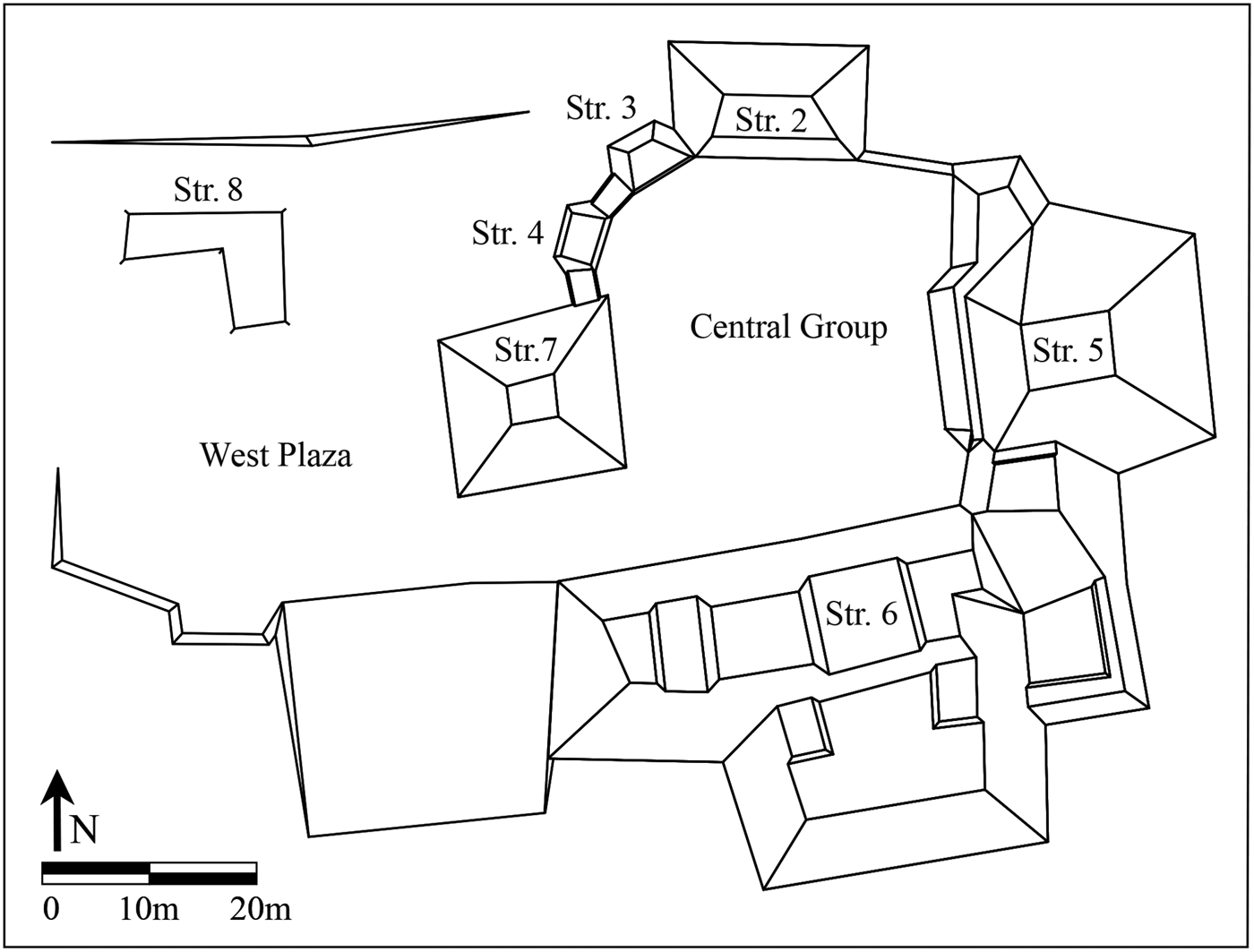
Chan's community center is located at the spatial and geographical center of the community on a local high point in the topography. It consists of two adjoining plazas (Figure 3). The Central Group and Central Plaza is the largest architectural complex at Chan and was its main location for community-level political and ceremonial events, administration, and adjudication and houses a residence for Chan's leading family. The adjoining West Plaza is a largely open space used for public political and ritual events (Cap Reference Cap and Robin2012). On the east and west sides of the Central Group are an E-Group, a distinctive type of architectural complex common throughout the Maya area that was an important location for ritual and ancestor veneration. The east structure of the E-Group is the tallest structure at Chan rising to a height of 5.6 m. An E-Group can be defined as an east-west oriented religious complex, where a tripartite east structure consisting of three separate buildings situated on a linear platform is paired with a single western structure, located opposite the central east structure, that is often radial and also has no superstructure (Aimers Reference Aimers1993; Aimers and Rice Reference Aimers and Rice2006; Aveni and Hartung Reference Aveni, Hartung and Aveni1989; Chase and Chase Reference Chase, Chase and Grube1995; Cohodas Reference Cohodas1980; Freidel et al. Reference Freidel, Schele and Parker1993; Hansen Reference Hansen and Houston1998; Laporte and Fialko Reference Laporte, Fialko, Clancy and Harrison1990; Ricketson Reference Ricketson1928). Chan's E-Group is most similar in form and construction history to what Arlen Chase and Diane Chase (Reference Chase, Chase and Grube1995) refer to as the Cenote-style E-Group (for a full discussion of Chan's E-Group see Robin Reference Freidel, Chase, Dowd and Murdock2016 and Robin et al. Reference Robin, Meierhoff, Kestle, Blackmore, Kosakowsky, Novotny and Robin2012a).
Chan's community center.
Excavations were undertaken at Chan between 2002 and 2009 by a team of more than 120 archaeologists, botanists, geologists, geographers, chemists, computer scientists, artists, students, workers, and volunteers from Belize, the US, England, Canada, and China (Robin Reference Robin2012, Reference Robin2013). To understand the temporal, socio-economic, and vocational variability in Chan's households, members of the Chan project excavated a representative 10 percent sample of Chan's households (26 households) and associated agricultural terraces (Figure 4). They also excavated all ritual, residential, and administrative buildings at Chan's community center.
The Chan site showing excavation areas. (a) operation 15 agricultural terrace and household excavations, (b) operation 4 agricultural terrace and household excavations, (c) operation 20 agricultural terrace excavations; (d) operation 28 limestone quarry and household excavations; (e) operation 18 agricultural terrace excavations; (f) central group, west plaza, and leading family household excavations; (g) northeast group mid-level neighborhood excavations; (h) small farming family household excavations; (i) chert biface production household excavations.
UNDERSTANDING FARMERS AND RELIGION AT CHAN
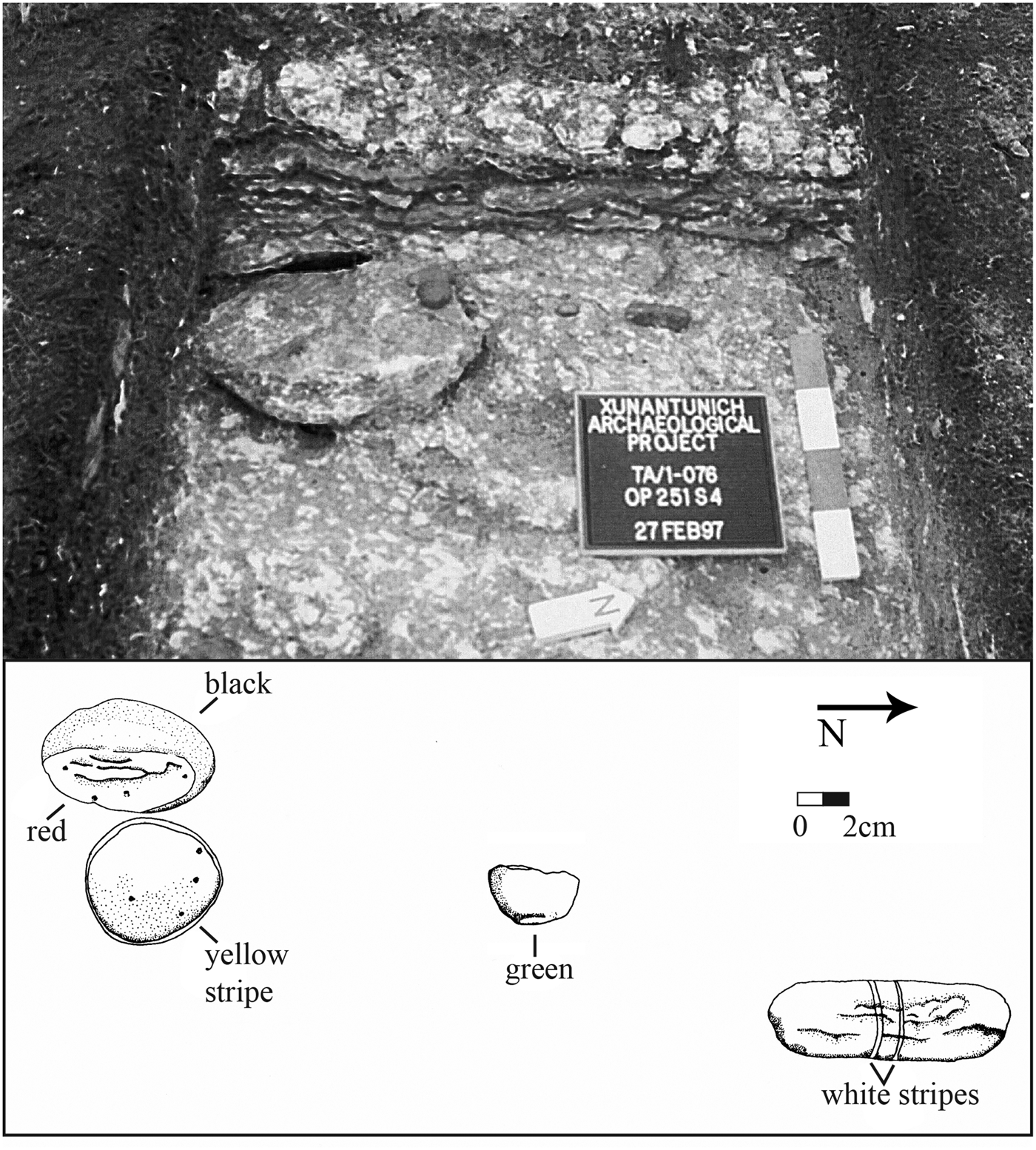
In 1996, when Bernabe Camal, then a teenager and aspiring Belizean slate carver, called me over and said he had just uncovered an important find which he had cleaned for photography and drawing, I looked down into the excavation unit and didn't see anything, ordinary river cobbles, that's all (Figure 5). Bernabe's ‘find’ was located on the rear axial center line of a late Late Classic (a.d. 670–800/830) farmer's house at farmstead CN5 which is situated just south of Chan's community center (excavation area h on Figure 4). I looked down but saw no archaeological evidence—certainly nothing worthy of either a photograph or a drawing (Figure 5 upper). So I asked Bernabe what he had found. He pointed to four ordinary river cobbles, the kind anyone could find in a stream or river in the vicinity of Chan. These were located around a broken fragment of a greenstone axe. I had not initially noted the dirt-covered fragment of the greenstone axe, but as soon as I did, I registered it as an artifact, albeit a broken one, which might have been discarded behind the house because of its broken and fragmentary nature. Bernabe asked why I thought the greenstone fragment might have been discarded. Broken things, he said, can be very useful. Bernabe noted that the four river cobbles were oriented to the cardinal directions around the greenstone fragment and that each river cobble had a different coloration: yellow, white, black, and red (Figure 5). Could this have some symbolic meaning he asked. The stones did not look ritual or symbolic to me; they were too ordinary or too broken. I doubted at the time that he had actually found an ancient ritual deposit, but because he had already cleaned the find for photography and was one of the best illustrators on the crew, I let him go ahead and photograph and draw the find. He asked me whether I would look into his idea that the stones had a ritual significance. I said that I would, but I promptly forgot.
River cobble cache behind eastern house at CN5. Upper image shows the original field photograph. The photograph illustrates how difficult it is to identify the river cobbles as a significant archaeological find. Lower image: illustration of river cobble cache by Bernabe Camal with colors marked.
Some weeks later, back in the field camp, an undergraduate field school student was reading Linda Schele and David Freidel's (Reference Schele and Freidel1992) A Forest of Kings: The Untold Story of the Ancient Maya. The book was open to a page that had an image of the Maya cosmogram, which is schematically represented as a quincunx pattern oriented to the cardinal directions with particular colors associated with particular cardinal directions. This cosmogram is vividly represented in royal Maya art and iconography of the Classic period (a.d. 250–900). It represents a complex ideational system that centered the Maya world at the center of an axis mundi. In royal ritual, the cosmogram situated the power of royal actors within a cosmological frame. I looked down at the book and realized that the color and directional associations of the Maya cosmogram were the same as those of Bernabe's river cobbles. I realized that Bernabe had made what might well be a very important find: humble Maya farmers were using ordinary and broken objects to represent the Maya cosmogram to ritually sanctify their home in similar ways to what Maya royals did to sanctify their palaces and temples with a rich array of elaborate objects. Subsequent finds similar to Bernabe's made by members of the Chan project further indicated that the development of complex religious ideas by farmers at Chan had a long history going back to the Middle Preclassic period (650–350 b.c.), predating their adoption and use by Classic Maya royalty. Farmers created a wealth of religious knowledge in their homes and communities, and only later was this “popular religion” elevated by Maya royalty into a state religion. The findings discussed here for Chan resonate with a wealth of studies across the Maya area about ordinary people's production of complex ideational knowledge (e.g., Gonlin and Lohse Reference Gonlin and Lohse2007; Lucero Reference Lucero2003, Reference Lucero2010; McAnany Reference McAnany2004; and Walker and Lucero Reference Walker, Lucero, Dobres and Robb2000).
The Preclassic Antecedents
In its final form Chan's Central Group (see Figure 3) was oriented to the cardinal directions, not to features of the local landscape such as waterways and topography, as was prevalent in the organization and planning of farmsteads. On the east and west sides of the plaza of the Central Group sit the paired pyramidal structures of its central religious buildings and ancestral shrine, its E-Group (Structures 5 and 7). To the north sits the leading family residence (Structure 2) and to the south is the administrative building (Structure 6). This cardinal directional orientation of the Central Group had its antecedents in the Preclassic form of the group: each building in the Central Group had a deep history going back to the Preclassic period and the orientation of the Central Groups and its buildings were maintained through time (Robin et al. Reference Robin, Meierhoff, Kestle, Blackmore, Kosakowsky, Novotny and Robin2012a).
As Wendy Ashmore (Reference Ashmore1991) documents for larger civic-centers across the Maya area, in constructing their cities and placing particular types of buildings in north, south, east, and west locations, Maya royalty referenced cosmological understandings to make powerful political and ideological statements through the architecture of a city (Ashmore Reference Ashmore1991; Ashmore and Sabloff Reference Ashmore and Sabloff2002). Royal city planning of the Classic period mirrored Preclassic farmers' community center planning as seen at Chan. Maya royalty often marked the east and west sides of plazas with ritual structures that commemorate these significant natural cycles as well as agricultural cycles. East and west within a city spatially mark the path of the sun and the location of the rising and the setting of the sun as seen on the horizon. Along the sun's daily path, north (up) marks the sun's height at midday, associating north with the heavens and a position of supreme power. South (down) is associated with a worldly and underworldly position, as the sun passes through the underworld at night. Across the Maya area, leaders of the largest Maya cities claimed the powerful north location for the construction of their residences or monuments commemorating their power, as did Chan's Preclassic leaders, to make a vivid and visual statement about their power. In Maya cities, the worldly affairs of administrative buildings, as at Chan, are often found in southern locations.
Beginning in the Preclassic period, when Chan was a farming community of around 144 to 330 people (Robin et al. Reference Robin, Wyatt, Kosakowsky, Juarez, Kalosky, Enterkin and Robin2012b), its residents planned their community center in similar ways to later Classic Maya royalty associating types of buildings with the cardinal directions. From a small Maya center such as Chan to the largest royal centers, residents employed similar directional principles and spatial layouts to define community centers and invest salient social meanings in spaces to define Maya places. When similar social ideals appear at small and large sites, an argument could be put forward that the small site is mimicking or emulating the ideas developed at the large site. But the historical depth of the planning principles employed in the construction and reconstruction of Chan's community center shows that many of the ideas that later in time became part of a Maya noble and royal ideology and political strategy were in fact initially conceived by farmers in farming communities.
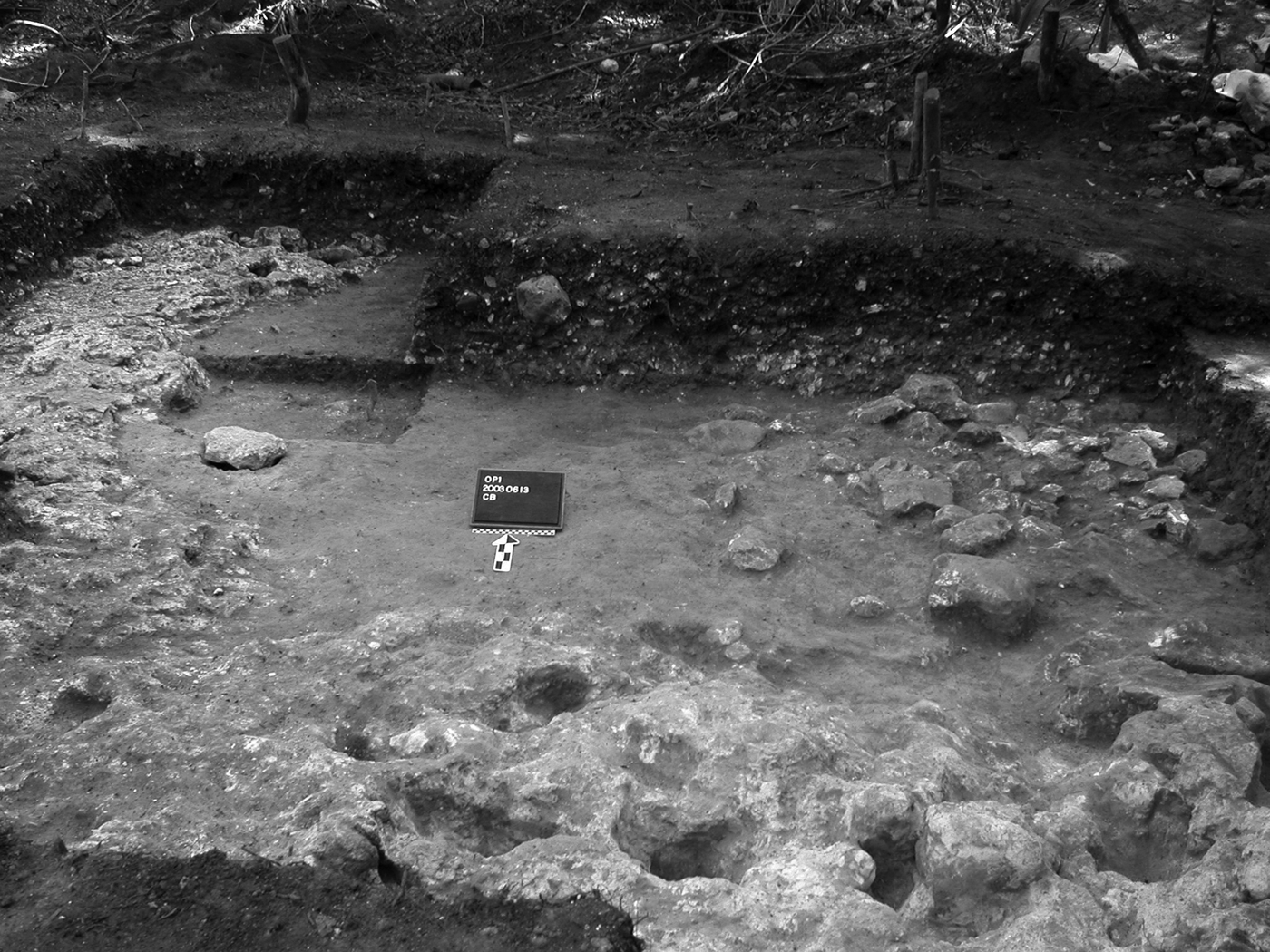
For two thousand years, ritual practitioners at Chan sanctified the center of their community by placing caches in the plaza of the Central Group (Figure 6), making this location the most sacred location in the community, if one measures sacred in terms of the length of time people use a location for ritual practices (Robin et al. Reference Robin, Meierhoff, Kestle, Blackmore, Kosakowsky, Novotny and Robin2012a). Ritual practitioners placed green objects, either of serpentine or of jade, more commonly in Central Plaza ritual deposits than in ritual deposits at other locations in the community (Kosakowsky et al. Reference Kosakowsky, Novotny, Keller, Hearth, Ting and Robin2012). Both today and in the past, Maya ritual specialists associate the color green with the “center,” and Chan's residents used green objects in rituals to consecrate the center of their community (Blackmore Reference Blackmore and Robin2003, 2011; Chase Reference Chase, Lackey and Kolb1988; McAnany Reference McAnany2004; Thompson Reference Thompson1970).
Caches and burial 1 excavated into bedrock at the center of the Chan community. Note that what looks like a single large circular pit in the photo is a sequential series of ritual deposits dug into bedrock at the center of the community. Stone concentration in the northeast corner of excavations caps burial 1.
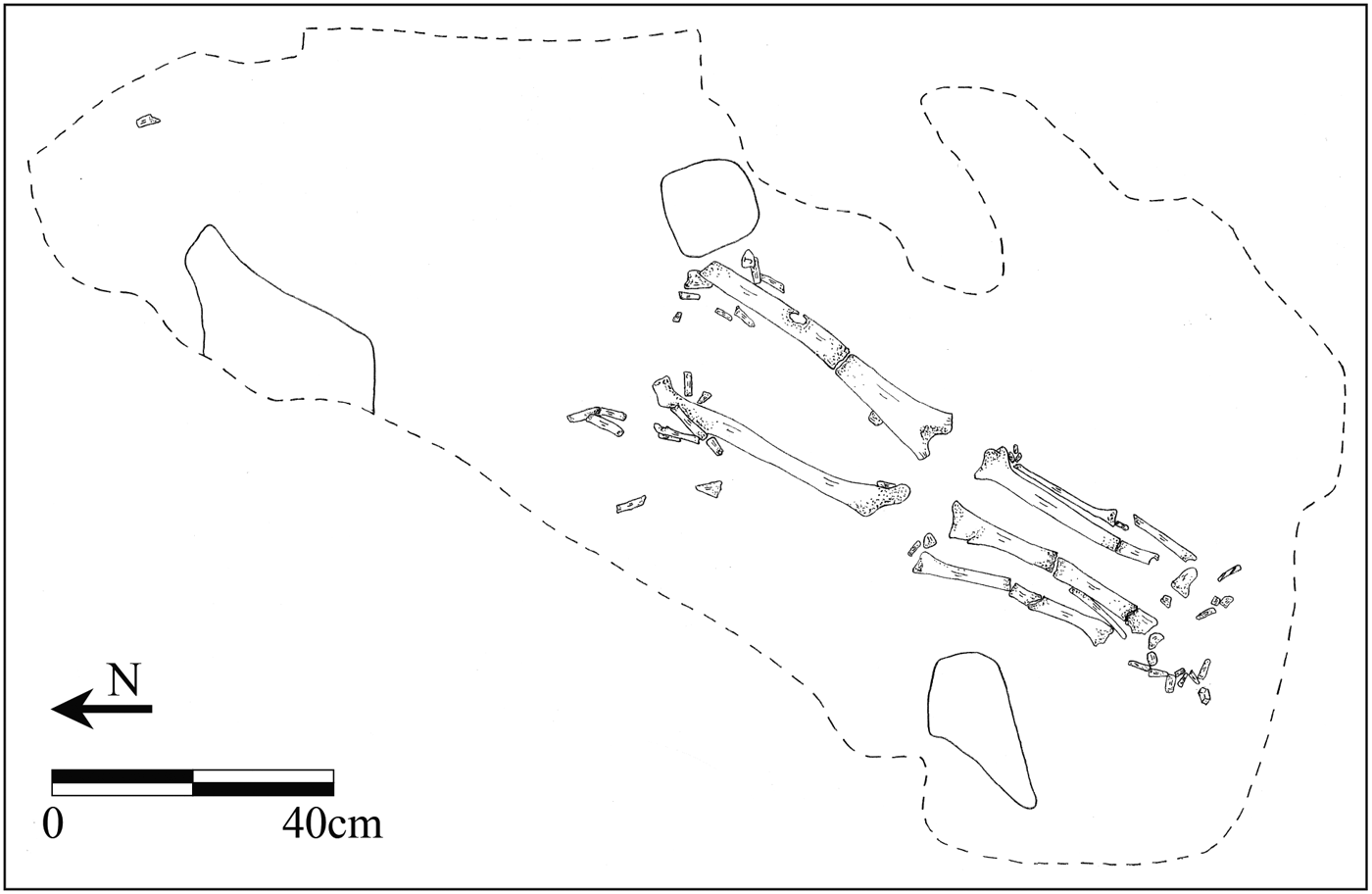
In the Middle Preclassic, in the Central Plaza, residents interred a single individual, an adult 20 to 24 years old of unknown sex (Burial 1; see Figure 7). They placed the deceased in a shallow grave cut into the underlying limestone bedrock in an extended supine position with the deceased's “head” (which had been removed) at the northeast end of the grave (Novotny Reference Novotny and Robin2012). There were a few stones lining the grave (a simple cist grave). Reverents reentered the grave of this individual for centuries across the Middle Preclassic and Late Preclassic periods (650 b.c–a.d. 100/150). At each reentry they deposited fragments of human bone, serpentine, jade, shell, and slate above the grave. These objects either were objects people had originally placed with the deceased and the later reverents removed and replaced during the reentries, or they were objects that later reverents deposited at the time of the reentries to commemorate the visitation of this individual. Regardless, the individual buried in this grave was revered through time with the most offerings of any ancestor or person buried at Chan. As reverents reentered the grave, they removed body parts of this ancestor from the grave and in some cases repositioned them in unusual ways. Although they removed the bones of the cranium, torso, and left arm, they repositioned the right humerus beside the right femur. Residents remembered and revered the death and burial of this individual for generations, and in fact centuries, initiating a practice of remembering and revisiting ancestral burials across time at Chan, a practice that later in time becomes an important part of royal ritual and politics that linked and legitimated rulers through their ancestors.
Burial 1. [Illustration by Carmen Ting.]
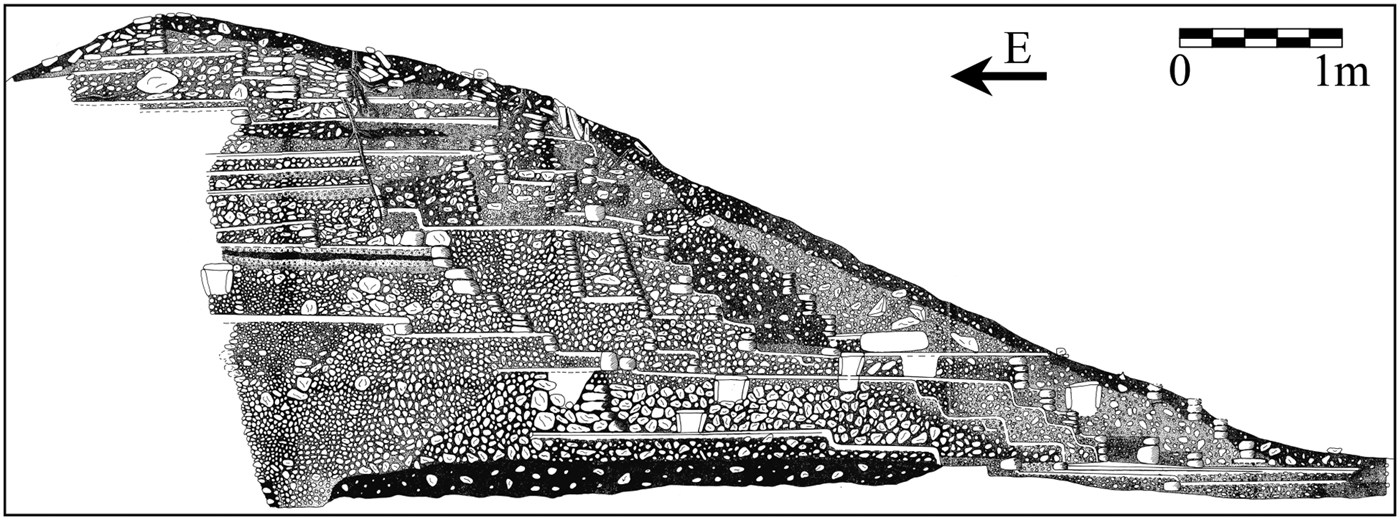
Beginning in the Late Preclassic period (350 b.c–a.d. 100/150) and continuing into the Terminal Classic period (a.d. 800/830–900), Chan's E-Group became the community's primary location for ancestral burials (Novotny Reference Novotny and Robin2012). In its earliest Late Preclassic form, the E-Group consisted of an 80 cm high eastern structure (Structure 5) and a 50 cm high western structure (Structure 7). Through time, residents reconstructed these structures, ultimately raising them to 5.6 and 4.9 m in height, respectively (Figure 8). They expanded the eastern structure from a single to a tripartite building. The traces of incense burners visible and chemically identifiable in the floors, the caching of an incense burner, and the deposition of incense-burning and food-bearing vessels across room floors are the lines of evidence that build a picture of the ritual use of the E-Group: burning of incense and the serving of food accompanied ritual events at the E-Group. The sight and smell of the incense rising from the ceremonial event would have been an integral part of the experience of those events.
Profile of central east structure of E-Group (structure 5-center). [Illustration by Nasario Puc.]
Like other E-Groups, Chan's E-Group served as a shrine for a select group of ancestors from the community. Adults (both men and women) and children were among the twenty individuals buried in fourteen graves that the project excavated from the E-Group (Novotny Reference Novotny and Robin2012). Many of the ancestors buried in the E-Group were young individuals. Chan's residents identified youth, a feature highly regarded in Classic Maya royal society (Houston Reference Houston2009), as a selection factor for ancestral burial (Robin and Novotny Reference Robin, Novotny, Rodríguez-Shadow and Kellogg2013).
Ritual was an integral part of domestic life at households across the Chan community (e.g., Blackmore Reference Blackmore2011, Reference Blackmore and Robin2012; Kosakowsky et al. Reference Kosakowsky, Novotny, Keller, Hearth, Ting and Robin2012; Kosakowsky and Robin Reference Kosakowsky and Robin2010; Robin Reference Robin2002). All of Chan's households, from those of its humblest farmer to its community leader, housed incense burners for the production of smoke and scent in rituals, and all residents interred material offerings of some kind in their homes (Blackmore Reference Blackmore2011, Reference Blackmore and Robin2012; Robin Reference Robin2002; Robin, Meierhoff, and Kosakowsky Reference Robin, Meierhoff, Kestle, Blackmore, Kosakowsky, Novotny and Robin2012; Wyatt Reference Wyatt and Robin2012). The tiny fragments of hardwood and pine, less than 0.01 gm in weight and less than 1 mm in length, that Andrew Wyatt identified across agricultural terrace excavations were part of a process through which farmers amended soil through the application of household waste. But because pine gives off a particularly odiferous scent, produces a great deal of smoke, and is associated with ritual offerings elsewhere at the community, the incorporation of tiny pine fragments into agricultural fields may also attest to agricultural rituals (Wyatt Reference Wyatt2008, 2012).
In the Middle Preclassic period, members of Chan's leading families buried a single blue-green teardrop-shaped jade adorno at the center of their residence (Structure 2; Keller Reference Keller2008). Structure 2, located on the north end of the Central Group was at that time a 25 cm high stone platform that supported a perishable structure. While the north residence grew in size through time, with its stone substructure ultimately rising to a height of 1.5 m, the position of the jade adorno remained the center point of the structure across its subsequent two-thousand-year history. This domestic ritual practice, using jade to consecrate the center of a home, parallels the community-wide ritual practices, just discussed, where green objects were used to consecrate the center of the community in caches deposited in Chan's Central Plaza.
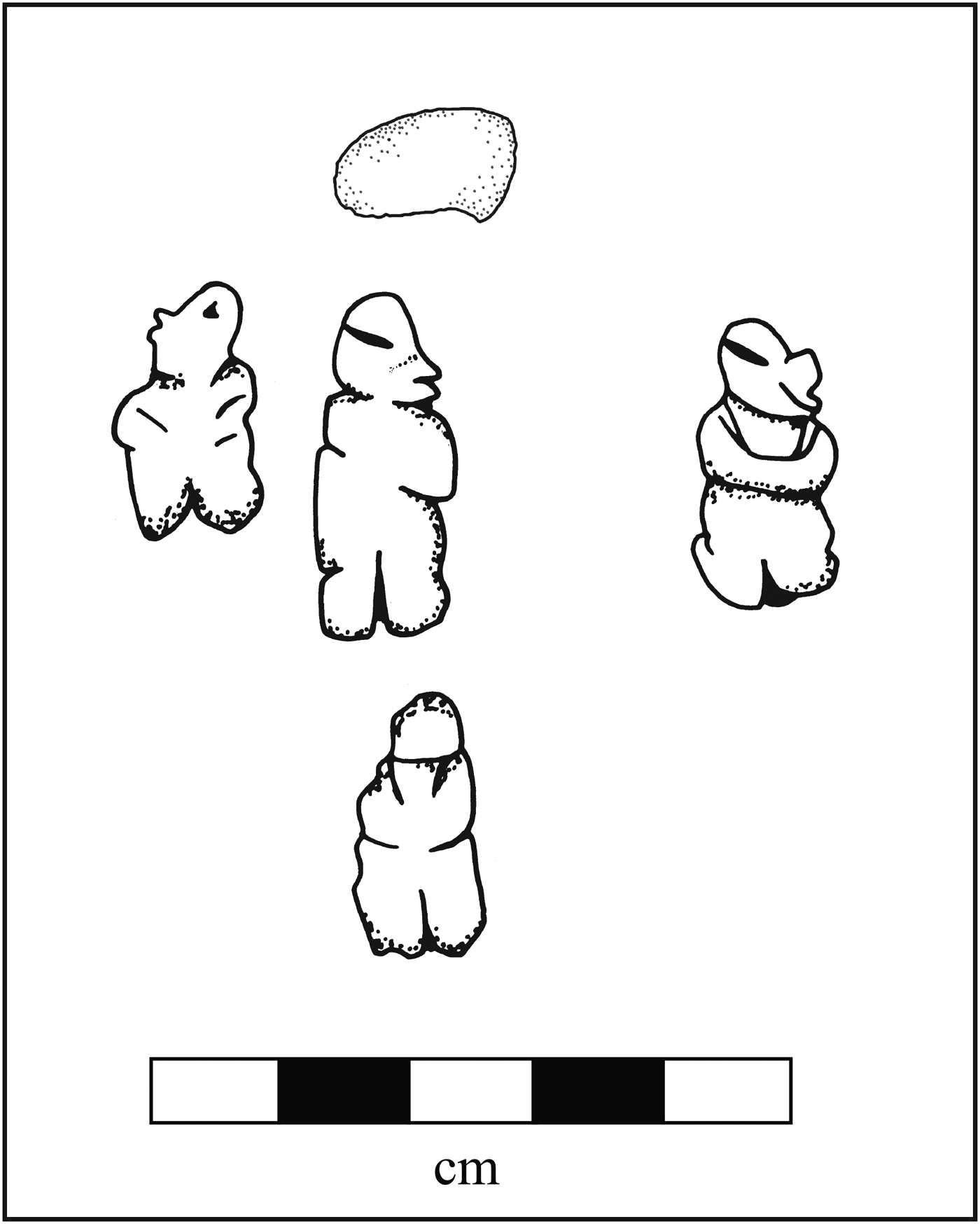
Likewise the late Late Classic river cobble cache that Bernabe Camal identified at humble farming household CN5, is structurally similar to a Terminal Preclassic cache (a.d. 100/150–250) that ritual practitioners placed in Chan's Central Plaza in front of the west structure of the E-Group (Structure 7). In this cache, ritual practitioners placed a cache of two lip-to-lip Pucte Brown or Balanza Black basal flange bowls that contained numerous small jade, shell, slate, and chert items, at the base of which were five small figures placed in a quincunx pattern (Figure 9) (Keller Reference Keller and Robin2012). The central figure is slate. Around this are a yellowish and reddish Spondylus figure, a green jade figure, and a white shell profile face. The placement of the black figure in the center, rather than the green figure, perhaps signifies the western location of this cache in the plaza, as west is associated with black. Comparing the quincunx caches at household CN5 and Chan's Central Plaza we see again that domestic and community-level ritual practices at Chan drew upon comparable understandings of ideational knowledge. The complexity and pervasiveness of domestic ritual at Chan illustrates that people developed the same range of depth of ritual knowledge within their homes as they performed in community center rituals.
Cache 9 cutout figures. Figures were found face down in vessel. The view shown here is looking at the figures from the bottom of the vessel. The central figure is slate, the upper profile is white shell, the lower figure jade, the left figure is reddish spondylus, and the right figure is yellowish spondylus. [Illustrations by Carmen Ting.]
The material objects that residents and ritual practitioners typically chose to use in ritual at Chan, be that ritual a household or a community center ritual, were objects that they also used in daily life, not a specialized set of objects produced solely for ritual use (Kosakowsky et al. Reference Kosakowsky, Novotny, Keller, Hearth, Ting and Robin2012; Kosakowsky and Robin Reference Kosakowsky and Robin2010). The ceramic vessels that ritual practitioners placed in ritual deposits—the most numerous items they placed in these deposits—were used items. They were people's possessions and containers for food and other items (Kosakowsky et al. Reference Kosakowsky, Novotny, Keller, Hearth, Ting and Robin2012; Kosakowsky and Robin Reference Kosakowsky and Robin2010). Even the luxury items that ritual practitioners incorporated into ritual deposits show evidence of use. They included shell detritus from marine shell bead production placed in ritual deposits in the Preclassic period (Keller Reference Keller and Robin2012). The jade objects, beads, celts, and other polished pieces that were included in ritual deposits were used, broken, or formerly strung (Keller Reference Keller2008; Robin Reference Robin2002). There were a few items that appear to have been specially produced for ritual use, such as a unique 38 cm-long honey-brown colored chert blade from northern Belize and eccentric chert objects (crescents, serpents, and celestial forms) that do not show signs of use and are not found in domestic nonritual inventories (Nicholas Hearth, personal communication 2009). But most of the objects that ritual practitioners interred in ritual deposits were items people had used in daily life.
Because the objects that ritual practitioners incorporated into ritual deposits were objects that residents used in daily life and could typically be found in domestic inventories, ritual and everyday life were linked at Chan. Residents’ concerns for the sacred and supernatural were tied to, not separate from, the experiences of everyday life, through the incorporation of ordinary objects in ritual. As community members gathered on special occasions to observe even the largest of community-wide ritual events at Chan's community center, they not only experienced a sacrosanct periodic event but also recognized, through the manipulation of daily objects in these events, the way in which the sacred and the meaning of special events was deeply tied to the conditions of their daily lives.
Many of the objects that residents deposited in burials and caches were partial objects: pieces of a larger serpentine or jade object, shell-working detritus, a fragment of a figurine, or individual shell beads that may have been part of a larger piece of jewelry. In one case, ritual practitioners successively interred four fragments of the same jade object in three different caches and as a grave offering to Burial 1 across the Middle and Late Preclassic periods (Keller Reference Keller2008). Pieces of objects were interred in ritual deposits, and other pieces of those same objects either would have remained in circulation in daily life at Chan or would have been sequestered by ritual practitioners until the next ritual event. Regardless, ritual practitioners placed pieces of objects in ritual deposits, and other pieces of those same objects remained and were curated in the living community, perhaps being used in later rituals and in some cases being interred in a subsequent ritual deposit. The part of the object that remained in circulation in the community referenced the buried part of that object and the earlier ritual event. By burying and curating partial objects, people linked themselves and their lives to their history and community (Robin et al. Reference Robin, Meierhoff, Kestle, Blackmore, Kosakowsky, Novotny and Robin2012a). Ritual practices at Chan involving the incorporation of broken objects, parallel practices of modern Maya ritual practitioners who incorporate broken objects into sacred spaces and ritual deposits (Brown Reference Brown2000, Reference Brown2005).
Across domestic and community-wide ritual, Chan's residents drew upon a wealth of ritual knowledge about the sacred order and organization of the Maya world. The association of the color green with the center is a common element of Maya ideology from the Preclassic period onward (e.g., Chase Reference Chase, Lackey and Kolb1988; McAnany Reference McAnany2004; Thompson Reference Thompson1970). The association of the colors white, yellow, red, and black with a quincunx and the directions north, south, east, and west is most standardized during the period of contemporary ethnographies (e.g., Hanks Reference Hanks1990; Vogt Reference Vogt1976). Postclassic sources do note color-directional symbolism, but there is variation as to what colors go in what directions. Quincunx patterns themselves have a deep history going back to the Preclassic period. In comparing domestic and community-wide ritual at Chan, residents, from the humblest of farmers to community leaders, were among the actors who through their specific ritual practices took part in creating what would become the highly conventionalized structures of ritual practices of much later times. As Chan's deep history attests, its residents were not emulators of Classic Maya royal ritual practices; instead, they were active agents who developed complex ideas about the sacred world.
The two-thousand-year history of domestic and community-wide ritual at Chan attests to the ways in which ritual and daily life interpenetrated each other, through ritual practices that incorporated objects of daily use, through the performance of ritual across the spaces and places of daily life, and through the process of remembering past rituals. In terms of the broader history of ideational practices in the Maya area—long seen through grand ritual acts—Chan's history illustrates that complex religious knowledge was initially developed in farmers’ homes and communities and continued to be used by Maya nobility. The Chan evidence resonates with a range of studies across the Maya area that have documented ordinary people's roles in developing complex ideational knowledge (e.g., Gonlin and Lohse Reference Gonlin and Lohse2007, Lucero Reference Lucero2003, Reference Lucero2010; McAnany Reference McAnany2004; and Walker and Lucero Reference Walker, Lucero, Dobres and Robb2000). At Chan, venerating a select group of ancestors and reentering their graves has a deep history going back to the Middle Preclassic period. The ritual activities at the center of the Central Plaza all materially represent ideas about the meaning and importance of the center and its color, divinity, and cosmological associations. Chan's architects planned and organized the Central Group around the cardinal directions to make visible statements about power and ideology. Noble Maya art, iconography, and hieroglyphs make clear that all of these practices were key aspects of later Classic period state religion and city planning. But here at Chan, ordinary people were formulating complex sets of ritual knowledge through material objects dating back to the Middle Preclassic period. Chan's historical depth illustrates that many of the ideas that later in time became part of a Maya noble and royal ideology and political strategy were in fact initially conceived by farmers in farming communities. Chan's residents, and many others like them across the Maya area, constructed a popular religion that only later in time was adopted by nobility into state-level religious practices.
RETHINKING THEORY: IDEOLOGY AND INEQUALITY
The Chan research illustrates the capacity of ordinary farmers to innovate complex ideational knowledge. The archaeological visibility of hieroglyphic inscriptions and monumental imagery that display royal religious practices, can play into generating an image of religion as an elite domain. But religion can also be an ordinary practice, involving ordinary places and things, as seen at Chan. At Chan complex ideational knowledge was initially developed in the homes and communities of farmers, dating back to the Middle Preclassic period (also see Gonlin and Lohse Reference Gonlin and Lohse2007; Lucero Reference Lucero2003, Reference Lucero2010; McAnany Reference McAnany2004; and Walker and Lucero Reference Walker, Lucero, Dobres and Robb2000 for comparable evidence across the Maya area for ordinary people's production of complex ideational knowledge). This “popular religion” was only later adopted by society's ruling class and elevated to a “state religion.” The dominant ideology, then, was not impenetrable to the ordinary Maya person, who had the knowledge to critically assess it. Ordinary people have the capacity for the development of complex ideational knowledge that may later in time be incorporated into dominant ideologies.
The Chan research resonates with previous research by Elizabeth Brumfiel on commoners' reception of Aztec imperial ideology. Instead of looking at commoners roles in innovating ideational knowledge, Brumfiel's work explores their abilities to understand and thus be able to question dominant ideologies. Brumfiel (Reference Brumfiel and Wright1996b) explored whether residents of the conquered polity of Xaltocan in central Mexico passively accepted the dominant ideology of the Aztec state. Looking at figurines used at Xaltocan before and after the Aztec conquest, she sees no appropriation of Aztec ideology. Additionally, ethnohistoric documents suggest that “commoners had no special enthusiasm for [Aztec} imperial religion” (Brumfiel Reference Brumfiel, Alcock, D'Altroy, Morrison and Sinopoli2001:309). In the case of people conquered by the Aztecs, they are not dopes or dupes but had the means to assess dominant ideologies (also see Joyce and Weller Reference Joyce, Weller, Gonlin and Lohse2007 for a Zapotec example).
Pre-Columbian archaeological cases of knowledgeable commoners innovating and questioning ideational knowledge, leads to questioning conventional anthropological ideas of ideology and false consciousness. Concepts of ideology and false consciousness articulated by Karl Marx and Friedrich Engels (Reference Marx and Engels1970[1932]) in The German Ideology and later developed by Louis Althusser (Reference Althusser1971) and Antonio Gramsci (Reference Gramsci1971) posit that ideological knowledge is created by dominant groups to support their position in society. Because ordinary people are mystified and lack the knowledge to critically assess the dominant ideology, it is imposed on their consciousness and they become a complicit, unquestioning mass. This set of ideas, commonly referred to as the ‘dominant ideology thesis,’ attempts to free power from necessarily involving coercive force (e.g., Abercrombie et al. Reference Abercrombie, Hill, Turner and Allen1980; Blackmore Reference Blackmore2011; Lohse Reference Lohse, Gonlin and Lohse2007; Scott Reference Scott1985).
Marx and Engels (Reference Marx and Engels1970[1932]) define the dominant ideology as elites’ conscious management of worldviews to enforce their own self-interests. Through the concept of false consciousness, a society's dominant ideology hides the self-interests of dominators from duped subordinates. Gramsci (Reference Gramsci1971) incorporates the idea of a false consciousness produced by great men into his concept of hegemony. Hegemony is the inalienable ability of the dominant group to control other groups. Through the existence of false consciousness, the dominant group does not need coercive force to exert control. Within hegemony, the dominant ideology is impenetrable by subordinate groups, who are therefore condemned to support and reproduce it. While hegemony is a social construct, only knowledgeable elites have the capacity to create or modify it.
But are subordinate people really dupes and dopes who do not understand state ideologies and thus have no potential to question them? Is there any opening for subordinate groups to act within constraint? Following through on this line of questioning James Scott (Reference Scott1985:314–50) uses research on contemporary Malaysian peasants to directly confront Gramsci's notions of hegemony, which Scott feels is quite dangerous for studies of class relations. To assume that dominant classes can and do impose their visions of the social order on the consciousness of others who are mystified and passively comply with the means of their domination denies the existence of enforcement, coercion, and sanctions in legitimating class relations. Scott's work on Malaysian peasants illustrates how peasants could comprehend what was going on in the world around them and recognize the inequalities in their society. Coercion of some kind is indeed needed to enforce inequality.
A critical shortcoming of the dominant ideology thesis, as seen in the ancient Maya and Aztec cases, is its assumption that ordinary people do not have the will or intellectual capacity to understand or assess dominant ideologies, a position that Scott (Reference Scott1985) and Abercrombie and colleagues (Reference Abercrombie, Hill, Turner and Allen1980) also take to task with contemporary data. Such a position arises because of assumptions and misunderstandings about what social groups in society have the capacity to develop and understand higher and esoteric knowledge. Assuming that higher and esoteric knowledge is only the purview of certain people, elites and dominant groups, leads to another assumption that ordinary people do not have the capacity to understand higher or esoteric knowledge. Neither of these assumptions are born out in archaeological (or contemporary) research. Recognizing that all people have the capacity for understanding higher and esoteric knowledge allows for the possibility that the masses can understand, see through, and potentially contest dominant ideologies. The most dangerous aspect of the dominant ideology thesis is that it denies a role for sanctions in legitimating class relations. If researchers seek to understand why inequalities exist in society, they must understand the power relationships through which certain groups assert and maintain their claims to superiority and the channels that may be open to challenge these claims: pretending that power does not exist by assuming commoners are the dopes and dupes of ideology does not help researchers get any closer to understanding the operation of inequality in society. Understanding how commoners can be active agents in developing or critiquing complex ideational knowledge is a step toward understanding how marginalized people can construct agency within the constraints of an unequal society.
RESUMEN
Inspirándome de la obra y el legado de Elizabeth Brumfiel, desarrollo un estudio de caso sobre las vidas y las prácticas religiosas de los agricultores mayas en el sitio Chan en Belice para demostrar que los agricultores no eran idiotas, engañados, ni las mistificadas masas de las ideologías del Estado maya. Utilizo este estudio de caso para repensar teorías antropológicas que tratan de explicar el papel de las ideologías al nivel del Estado en la producción de la desigualdad y el poder, en particular las ideas sobre la ideología y la falsa conciencia que a menudo están agrupadas y a que se ha referido como la “tesis de la ideología dominante.”
ACKNOWLEDGMENTS
I thank all the members of the Chan project and Belize Institute of Archaeology for their work on the Chan research without which this article would not have been possible. Research at Chan was permitted by the Belize Institute of Archaeology. The Chan project was funded by two National Science Foundation grants: a National Science Foundation Senior Archaeology Grant (BCS–0314686) and a National Science Foundation International Research Fellowship (INT–0303713); a National Endowment for the Humanities Collaborative Research Grant (RZ–50804–07); a National Geographic Society Grant (2002–3); an H. John Heinz III Fund Grant for Archaeological Field Research in Latin America (2002); two anonymous donations; three University Research Grants from Northwestern University (2002, 2005, 2009); two Alumnae Foundation Grants from Northwestern University (2002, 2006); and an AT&T Research Scholar award (2005).