
This linguistic study contributes to the decades-long discussion on the inappropriateness of the Library of Congress Subject Heading illegal aliens by examining its absence in a corpus of US Supreme Court oral arguments and by evaluating automatic translation tool results related to keywords as well as a corpus extract. This linguistic study confirms the ideological bias of the illegal aliens subject heading compared to a plethora of other expressions that legal scholars may use to describe the situations implied under the more neutral umbrella term noncitizen. The automatic translation results for alien and illegal alien also support the notion that the term illegal alien is confined to a United States historical context, which hinders its international comprehension as a subject heading.
History of the Terminology
In the wake of the 2001 terrorist attack on the World Trade Center, the Attorney General John Ashcroft testified before the Senate, encouraging national unity and explicitly acknowledging the contributions of noncitizens:
We need honest, reasoned debate; not fearmongering. To those who pit Americans against immigrants, and citizens against non-citizens; to those who scare peace-loving people with phantoms of lost liberty; my message is this: Your tactics only aid terrorists - for they erode our national unity and diminish our resolve.Footnote 2
The terminology of this inclusive plea contrasts with that of the 1798 Alien and Sedition Acts, according to which “all natives, citizens, denizens, or subjects of the hostile nation or government, […] not actually naturalized, shall be liable to be apprehended, restrained, secured and removed, as alien enemies.” The term alien continues to be adopted in the United States as a legal term, alongside other more specific terms such as displaced person, when referring to persons without US citizenship. The US Immigration reform bill of 2021 proposes to replace the outdated alien by the more neutral noncitizen.
Members of the European Union (EU) also decided to withdraw the term alien within the 2013 context of establishing Eurodac, an EU-wide biometric database containing fingerprints of asylum applicants and non-EU/European Economic Area (EEA) nationals for comparison between EU countries. While drafting this regulation, Alima Boumediene-Thiery demanded that the expression “third-country national” be substituted for “alien”. The President of the European Commission of Justice and Home Affairs, António Vitorino later pursued this position, stating that the Commission “can accept amendment No 1 to avoid the term ‘alien’ and instead refer to ‘third country nationals’, although we will have to make it clear that the Regulation also covers stateless persons.”Footnote 3
In Canada, the Associate Professor of Sociology, Luin Golding testified before the Standing Committee on Citizenship and Immigration in 2008, explaining that the term “undocumented” does not always define the many foreign nationals who initially enter Canada with authorized documentation. However, it is “a response to such terms as ‘illegal alien’, which have the effect of dehumanizing and criminalizing people.”Footnote 4
Since the beginning of this century, both the press and libraries across the United States have taken steps to adopt more inclusive terms. In 2013, the Associated Press discontinued the use of illegal when describing a person. Their decision followed the ban implemented by major US newspapers including the Miami Herald (2003), Huffington Post (2008), and The Los Angeles Times (2012). In 2014, spearheaded by student coalitions, Dartmouth College modernized the subject heading in their library catalog, replacing the term “illegal aliens” with “undocumented immigrants”. Other universities followed suit, notably the University of Colorado (2018), the California State University Libraries (2020), Harvard University (2021), Middlebury College (2021), and Vasser College (2021).Footnote 5 Dartmouth College librarian John DeSantis submitted proposals in June 2014 through the Library of Congress’ Subject Authority Cooperative Program (SACO), which was initially accepted by the Library of Congress in 2016Footnote 6, before an unresolved reversal of their decision:
The delay in the decision from the Library of Congress to revise this heading is unfortunate and the library community should not lose sight of the real pain and alienation that having this offensive terminology in our catalogs can entail for members of a marginalized community.Footnote 7
US Supreme Court Discourse
In light of this international debate, this study focuses on the discourse of US Supreme Court Justices and Advocates in relation to noncitizens. To determine if the subject heading illegal alien reflects the discourse held by some of the US's leading legal experts, I analyzed the oral arguments of three US Supreme Court cases dealing with detained noncitizens, before and during the national debate concerning the appellations of noncitizensFootnote 8. Zadvydas v. Davis (2001)Footnote 9 concerns a stateless person detained upon reentry into the United States, where he had previously lived for over 40 years. Jennings v. Rodriguez (2017)Footnote 10 concerns the detention of a person who arrived in the United States at the age of seven, later married a US citizen, before becoming the father of a US citizen minor. Johnson v. Guzman Chavez (2020)Footnote 11 concerns the detention upon reentry of a woman deemed by an US immigration judge to have a credible fear of torture if she returned to her native country.
As the cases spanned nineteen years, sixteen Justices speak as well as seven Advocates for a total of three hours of arguments, largely in the form of questions and answers. Grammatical terms, such as she or him, and titles of acts or other documents were not included in the results. AntConc Footnote 12 was used to analyze the transcripts retrieved from the website Oyez.Footnote 13
The corpus contains 561 occurrences of such appellations, ranging from alien (n = 196), to person/people (n = 163), to immigrant (n = 10), and to specific situations, including single occurrences of human being, infant, spy, US citizen's wife, and visitor. Many such appellations are actually multi-word units, such as “individuals in removal proceedings”, “a businessperson who, in fact, has overstayed his visa” or “anyone in the immigrant status who is convicted of a felony”.
Within this plethora of possibilities, alien is the keyword in seven different two-word units: arriving alien (n = 11), criminal alien (n = 11), detained alien (n = 3), dangerous alien (n = 3), resident alien (n = 2), admitted alien (n = 11), and arrested alien (n = 2). There is not a single occurrence of the expression “illegal alien”.
The frequency of certain terms is highly biased by ideology, as expressed through the Justices voting pattern in the given case or the party defended by the Advocate. Of the 196 occurrences of alien, a substantial 166 (85%) are pronounced by conservative-leaning Justices or Advocates. Among the 142 occurrences of the term alien pronounced by Advocates, 134 (94%) occurrences were emitted by those defending the Government. This is in stark contrast with the term noncitizen (n = 14) that was employed equally by both ideological sides. Noncitizen is absent in the earlier 2001 case, is employed only once by the Advocate pleading for Rodriguez in 2017, and is pronounced thirteen times in 2020. In 2020, the term is used seven times by more recently appointed conservative Justices (Justice Barret and Justice Kavanaugh), five times by the Advocate of Guzman Chavez, and once by Justice Sotomayor.
Thus, an analysis of the discourse of actors of the Supreme Court—when they are specifically discussing legal issues related to detained persons who are not citizens of the United States—refutes the notion that the term illegal alien might be appropriate. To the contrary, the use of multiword expressions detailing given situations and the term noncitizen are shared across ideological borders.
Understanding of the Term Alien by Automatic Translators and a Concordancer
As Kim-Prieto and Van Laer (Reference Kim-Prieto and Van Laer2011) note in their study of multilingual law dictionaries, automatic translators, such as Google Translate, have become ubiquitous:
Google Translate does not claim to be a legal translation tool, but it is an ubiquitous tool, and will likely stand as a model for bi- and multi-lingual dictionaries of the future (for general purposes as well as for legal purposes).Footnote 14
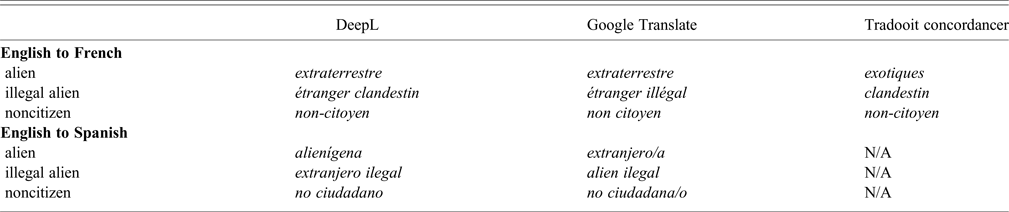
Automatic translators, which draw upon international data, reflect how expressions might be understood in a foreign language, be they by a person or a person who uses these tools to understand a foreign language word or expression. Thus, we next examine how two automatic translators and one concordancer treat the terms alien, illegal alien, and noncitizen (Table 1). DeepLFootnote 15 is an advanced German-based translation tool that draws upon global representations of translation fragment meanings. The creators of Google TranslateFootnote 16 do not reveal the technology behind this tool, which often simplifies translation results.Footnote 17 Finally, Tradooit concordancerFootnote 18 is a Canadian-based English-French concordancer that allows users searching a given term to choose the corpus of consultation, including governmental documents (Canadian institutions, European Parliament, United Nations) and other multi-lingual corpora, such as film subtitles.Footnote 19
French and Spanish translations of alien, illegal alien, and noncitizen

The three sources propose varying results for French. The popular meaning of an “extraterrestrial” is ranked first as a translation by both DeepL and Google Translate. This reflects the great amount of popular, notably film, culture around inter-galactic aliens. An equivalent for “exotic” is ranked first by the Tradooit Concordancer, the examples revealing that “alien” is systematically used in Canadian governmental documents when discussing invasive nonhuman species. All three sources identify “alien” as referring to a person within the two-word unit “illegal alien”. For DeepL and Google Translate, the keyword is étranger, be they “clandestine” or “illegal”. To contextualize this, L’étranger is the title of Albert Camus's novella The Stranger, also translated into English as The Outside. Footnote 20 This term does not evoke inter-galactic travel, but foreignness or the quality of being external to a local setting. Tradooit's first ranking equivalent is “clandestine”, which conveys, in French, the notion of an undeclared foreign nationality. A review of the results indicates that clandestin is frequently used to replace “illegal alien” in film subtitles. Finally, all three equivalents for “noncitizen” are the transparent term non-citoyen (although Google translate drops the hyphen).
For Spanish, there is also a range of results, with identical results for noncitizen: no cuidadna/o. Tradooit does not incorporate Spanish. For “alien”, DeepL finds alienígena, which again implies inter-galactic travel, while Google Translate proposes extranjero/a, a term similar to the French étranger and the Spanish title of Albert Camus's novella. For “illegal alien”, both sources incorporate the Spanish adjective ilegal. However, while DeepL proposes extranjero, Google Translate proposes alien ilegal. Curiously, the word alien is absent from the Dictionario de la Lengua Española. Footnote 21
These results demonstrate the multiple meanings of the English term “alien”. Automatic translators and concordancers do not find the definition of “alien” as a human being as their first-ranking translations. In collocation with “illegal”, the results are not identical for either language, a sign of the lack of consensus surrounding this expression. Thus, we turn to examine the translations of a phrase taken from the previously discussed US Supreme Court corpusFootnote 22 using DeepL,Footnote 23 Google TranslateFootnote 24 for French and Spanish and the Tradooit translatorFootnote 25 for French only.
In Example 1 from Jennings v. Rodriguez,Footnote 26 the keyword alien is surrounded by context clues that should assist in establishing meaning, notably “policy of DHS” and “credible fear screening”. For the French translations results, one can see in bold that Google Translate continues to consider alien as an extraterrestrial entity: the French extraterrestre having no relation to human beings. Both DeepL and Tradooit translate alien with étranger, as noted above, this a frequent non-pejorative French term for a foreign national or more generally, an unknown person.
Example 1 from English to French:
it's the policy of DHS that if an alien passes a credible fear screening
DeepL: la politique du DHS est que si un étranger passe un examen de crainte crédible
Google Translate: la politique du DHS est que si un extraterrestre réussit un test de peur crédible
Tradooit: la politique du département de la Sécurité intérieure est que si un étranger passe un test de dépistage de la peur crédible
To test translation in the opposite direction, the best translation of Example 1 was translated back into English in Example 2. Here, we see that while DeepL finds the original term “alien”, this is not the case for Google Translate and Tradooit, for which “stranger” is proposed.
Example 2 from French to English:
la politique du DHS est que si un étranger réussit un test de peur crédible
Deepl: DHS policy is that if an alien passes a credible fear test
Google translate: DHS policy is that if a stranger passes a credible fear test
Tradooit: DHS policy is that if a stranger passes a credible fear test
We find similar results for Spanish translations of the same phrase. As can be seen in Example 3, both DeepL and Google Translate propose extranjero for “alien”. However, if the given translation is entered back into the automatic translator for a new English translation, the results differ. DeepL proposes the international term foreign national for extranjero, while Google translate retains the original US term “alien”.
Example 3 from English to Spanish, then Spanish to English:
it's the policy of DHS that if an alien passes a credible fear screening
DeepL translation to Spanish: la política del DHS es que si un extranjero pasa un examen de miedo creíble
DeepL translation back to English: DHS policy is that if a foreign national passes a credible fear test
Google Translate to Spanish: Es política del DHS que si un extranjero pasa una prueba de detección de miedo creíble
Google Translate back to English: It is DHS policy that if an alien passes a credible fear screening test
These results support the notion that the term “alien”, when referring to a human being, is subject to confusion in a multilingual setting. Although this study is limited to two widely spoken languages, it is highly probable that this semantic confusion arises across other languages.
Conclusion
This linguistic study supports the replacement of the subject heading “illegal alien” with a more appropriate subject heading, such as “noncitizen”. The outdated term “illegal alien” is not privileged by US legal experts in the highest sphere. Furthermore, international students, teachers, and researchers may not be familiar with this expression and will not be aided by accessible translation tools. Finally, as confirmed in this empirical corpus study, the single term “alien” also retains a substantial ideological weight, absent for the term “noncitizen”. To conclude, this problematic ideology is highlighted by the Harvard University's Gutman Library Scholarly Communications Librarian, Rebecca Martin:
Intentionally not using the Library of Congress subject heading is a really defiant act in a way,” said Martin. “[But] our task force feels really strongly that our users, especially our students, should not see pejorative terms describing them from the University.Footnote 27