





1. Introduction
Recent developments in artificial intelligence (AI) and machine learning (ML) have made complex algorithmic processes more accessible and therefore increasingly embedded in works of sonic art. Within such works, algorithms are often described in anthropomorphic terms: as possessing agency or autonomy or acting as collaborators and co-creators. While evocative, describing contributing entities in this way may rely on conflicting definitions of these terms drawn from multiple domains. For example, across philosophy, politics, medicine, sociology and computer science, understandings of autonomy range from referring to moral self-legislation or institutional independence to software processes that operate without direct human input.
In this discussion, relational framing refers to the way discourse surrounding an artwork articulates the relations between its contributing entities, whether human, non-human, technical or environmental, and the terms through which those entities are understood. This includes descriptions that cast contributors as collaborators, prostheses, autonomous agents or otherwise shape how their significance is perceived. As used here, relational framing does not refer to the material engagement of such entities in the production of an artwork but to the ways they are described across forms of discourse, including academic writing, artist statements, catalogues, wall labels, interviews and presentations.
When terms such as agency, autonomy and collaboration are mobilised across artistic discourse, their meanings can become fragile. In sonic arts practices between humans, autonomy is often assumed, and collaboration and agency may be unequal or constrained. In multi-species work, autonomy often refers to physical freedom, and collaboration remains speculative because non-human intention cannot be verified. In work involving algorithms, definitions of agency and autonomy are often borrowed from computer science, where they function as a convenient shorthand for system behaviour, a nuance often lost when translated into sonic arts discourse. The result is a conceptual friction: similar terms are used across human, animal and algorithmic practices, but they operate according to incompatible logics.
Artists have sought to bridge this gap through new materialist perspectives such as Actor-Network Theory (Latour Reference Latour1994), which by default considers agency equally for human and non-human actors. While influential, such approaches risk collapsing into flat ontologies, where distinctions between technical artefacts, living species and human collaborators become difficult to parse. Moreover, attempts to ontologise terms that originated as convenient shorthands can misdirect critical analysis.
More recent critical posthumanist and postcolonial perspectives from Donna Haraway, Rosi Braidotti and Gayatri Spivak offer alternative orientations for thinking about relational framing. Haraway (Reference Haraway2016) emphasises sympoiesis, or making-together, over isolated autonomy; Braidotti (Reference Braidotti2013) frames agency as an affirmative process, distributed across human and non-human relations; and Spivak (Reference Spivak and Morris2010) highlights the risks of attributing agency where it cannot be literally claimed and instead urges for strategic and situated framings. Together, these perspectives resist both ontological flattening and anthropomorphism and foreground accountability and difference: ‘All of us must become more ontologically inventive and sensible within the bumptious holobiome that earth turns out to be’ (Haraway Reference Haraway2016: 98).
Building on these orientations, I propose a ludic approach to the relational framing of contributors to works of sonic art. Following Gregory Bateson’s (Reference Bateson1987) framing of play as analogical behaviour, the agency, collaboration or autonomy of algorithms can be explored ludically – that is, as creative analogies rather than ontological claims. Ludic framings are not evasions; they are deliberate, speculative commitments that shape methods, instruments and interpretations while remaining accountable to the logics they engage with.
This discussion is presented in three stages. First, the paper examines historical and contemporary human–animal sonic practices to show that claims of agency and collaboration in sonic art have long been speculative and not ontological. Second, it investigates the historical relational framing of embedded algorithms in sonic art and tracks how terms such as agency and autonomy migrated from computer science. Third, it contextualises these discussions through the author’s practice-based research project Synthetic Ornithology, which uses a ludic approach to the relational framing of contributions from humans, non-human animals and algorithms. Finally, it synthesises the implications for interspecies practice and algorithmic instruments and proposes the methodological advantages of a ludic approach.
By situating relational framings as a creative strategy, embedding algorithms in works of sonic art becomes not merely structural (as in the integration of software into instruments) but also conceptual, as relational framing becomes embedded in artistic practice itself. In doing so, the paper argues for a more nuanced and flexible approach to how algorithmic systems are positioned in sound art and presents powerful opportunities to shape meaning, affect and conceptual resonance.
1.1. Ludic framings in practice
In this paper, I use ludic to name a creative and explicitly non-ontological mode of framing relations between contributors in more-than-human sonic practice. The concept is rooted in Gregory Bateson’s account of play as behaviour that is analogous to, but not the same as, the acts it resembles, marked by metacommunication that signals ‘this is play’ (Bateson Reference Bateson1987: emphasis added). As Bateson explains, metacommunication can be expanded to include actions in which participants engage but ‘do not denote what those actions for which they stand would denote’ (Bateson Reference Bateson1987: 185).
This distinction between the gestures of play as opposed to functional actions is further investigated by Brian Massumi (Reference Massumi2014), who uses the term ludic to describe the playful analogue. For example, a swipe of a claw in a play fight between two animals is close enough to a genuine fighting swipe to evoke combat but is marked by metacommunication as belonging to play. If the swipe were indistinguishable from a real attack, play would collapse into fighting. Importantly, the ludic nature of the play swipe both separates the play from fighting and connects to it through an adherence to the logic of the gesture it is analogous to.
Applied to relational framing in sonic art, a ludic approach does not abandon logic or rigour; it reconfigures the hierarchy of definition. When taxonomies of agency and autonomy from computer science are imported into sonic arts, these definitions risk constraining creative processes by forcing works to align with predetermined concepts. A ludic framing inverts this topology: rather than a fixed definition guiding artistic practice, the work itself, through its design, behaviours and contexts of embedding, produces the operative relationships between contributors. The algorithm is not merely interpreted through inherited categories but actively reshapes them, allowing definitions that are contingent and open to multiple logics.
One critical aspect of ludic gestures is the metacommunication of the ‘this is play’ signal. Within a ludic approach to relational framing, however, there is no fixed form of such signalling. Art, Bateson suggests, is already metacommunication, ‘a sort of play behavior whose function is, amongst other things, to practice and make more perfect communication of this kind’ (Bateson Reference Bateson1987: 147). The refusal to pursue relational framings as ontological claims becomes the signal itself. To assert, for example, that an algorithm possesses autonomy in the sense used in computer science would collapse analogy into literalism. By contrast, ludic framing treats the logics of agency, autonomy or collaboration as resources available for play, structures to engage with while remaining accountable to their internal coherence, but not obligations to prove.
This is not to suggest that all invocations of agency, autonomy or collaboration in sonic art should be treated as merely playful, nor that stronger ontological claims are always misplaced. Rather, the ludic is proposed here as an available mode of relational framing, particularly useful where such terms move across divergent disciplinary logics and become unstable when treated literally. In this sense, the value of ludic framing is not that it weakens artistic claims, but that it suspends the burden of proving them as ontological facts.
For artistic practice, this has a methodological consequence. Once relational framings are not restricted to literal or even strictly plausible descriptions of the entities involved, artists are freer to approach those relations conceptually and imaginatively. This does not prescribe how artworks must be made, nor does it interfere with the material processes of artistic production. Rather, it concerns the conceptual terms through which contributors to a work are understood and described in discourse. On this account, there is no need to demonstrate that an algorithm has literal agency or qualifies as an autonomous collaborator. Terms such as agency and autonomy can instead operate as organising fictions within a work, shaping its method, interpretation and meaning without functioning as verified descriptions of the system itself.
2. Relational structures in more-than-human sonic practice
Human sonic practices have long been entangled with the sounds of the more-than-human world, from instruments and rituals imitating animal calls to contemporary interspecies improvisations and ecological sound art. These practices provide precedents for how ideas of agency, autonomy and collaboration are used in contexts where participants cannot be assumed to share human intentions. Examining them shows that relational framings are fragile, speculative and mediated, and while they may at times be articulated in ontological terms, they can also generate new and complex understandings of agency and autonomy.
2.1. Mimicry
Bernie Krause (Reference Krause2012) has argued that human music may have originated from imitations of the sounds of the natural world. Across many cultures, instruments have been designed to mimic or evoke animal sounds. Pre-Columbian Peruvian whistling vessels produced warbling tones resembling the birds pictured on them (Ransom Reference Ransom1998). The Hupa people of north-western California mimicked coyote calls in ritualised song (Keeling Reference Keeling2012), and hunters in the southeastern United States similarly used ‘hawk whistles’ in ritualised practices, mimicking the predator’s call to startle prey (Moser et al. Reference Moser, Buckner, Sarian and Winking2022). In these cases, animals were absent, yet their sonic roles can be seen to be preserved through sound.
Using an ontological approach, when humans use a whistle to reproduce the sound of the hawk, the hawk is absent and has no relation to the frame. A ludic approach to framing this relation may allow for something more nuanced. The hawk’s whistle as reproduced by humans carries forward the role of the hawk within the system. The squirrel still freezes; the predatory relation is re-enacted, but now through a human-made instrument. Aligning with posthumanist perspectives, agency here belongs neither to the hawk nor to the human hunter, nor to the instrument, but to the network that momentarily reconstitutes the predator–prey interaction. In this sense, the whistle is not merely a tool of mimicry but embeds a more-than-human process into a human sonic practice.
2.2. Sonic directive
In other traditions, humans have directed sound toward animals, imagining one-way influence as communication. Ancient Egyptian reliefs show percussive instruments used to herd birds (Lawergren Reference Lawergren1988). Buddhist and Confucian texts describe music calming elephants or making cranes dance (Van Gulik Reference Van Gulik1938). More recently, the viral video by Farmer Derek, ‘Serenading the cattle with my trombone’, interprets non-human engagement as evidence of aesthetic appreciation of human music (Farmer Derek 2014).
Sustaining literal interpretations of understanding or aesthetic appreciation is difficult here, as Schneider and Bräuer (Reference Schneider and Bräuer2024) note, as in such exchanges the non-humans’ position is always speculative and mediated through human cultural, technical and empathetic frameworks. These examples are less evidence of literal interspecies dialogue than an opportunity for poetic relationality, opening space for humans to recognise their entanglement with other species and examples of shared but uneven making of meaning within a more-than-human assemblage.
2.3. Synchronous and co-located
Contemporary sonic artists have sought direct, co-located interaction with non-humans. Ullrich and Trump (Reference Ullrich and Trump2023) offer critical commentary on some such works, characterising Annika Kahrs’s A Concert for the Birds (2014) – a work that stages Franz Liszt’s St François d’Assise for a live pianist and seventy caged songbirds – as ethically problematic due to the subjugation of the birds. By contrast, Céleste Boursier-Mougenot’s installation From Hear to Ear (1999), in which captive finches inhabit a gallery filled with sound-making devices, is treated with more ambivalence. Here, the birds are said to retain ‘a lot of concrete autonomy and behavioural flexibility’, despite their captivity (Ullrich and Trump Reference Ullrich and Trump2023).
The suggestion of agency on the grounds that the birds are not forced to participate is fragile: their possibilities are tightly bounded by captivity and, echoing Spivak, their subaltern voices are ventriloquised through imposed conditions (Spivak Reference Spivak and Morris2010). What such works foreground is less the birds’ intention or agency than the interpretive frame of the human audiences and stage speculative encounters within more-than-human assemblages that are uneven and ethically questionable.
By contrast, other artists have pursued synchronous, co-located encounters without relying on subjugation. In ‘Tibutibuvihihehehiu – Live with the Blyth’s Reed Warbler’ (2025), David Rothenberg describes playing clarinet, flute and electronic samples with/to/at wild birds as a type of ‘interspecies jamming’. Rothenberg emphasises their moments of seeming responsiveness with some level of anthropomorphism, saying, ‘He certainly seems to like them. It’s as if each complementary sound challenges the bird to wonder’ (Rothenberg Reference Rothenberg2025). Here, the birds are imagined as conversational partners, with collaboration inferred from apparent responsiveness rather than proven interaction.
Australian composer Hollis Taylor engages similarly with wild participants. Is Birdsong Music? (Taylor Reference Taylor2017b), Taylor describes being locked in a call-and-response structure in which the birds initiate and she responds. When she tries to reverse roles, the birds refuse and will not allow the relationship to become symmetrical but instead set the terms of interaction: ‘We revert to them calling and me responding. I am the birds’ apprentice’ (Taylor, Reference Taylor2017b: 107). Taylor accepts the limits imposed by the birds’ agency, positioning herself as an apprentice within their sonic culture.
These two examples illustrate an ethics of restraint: recognising asymmetry, preserving physical freedom and accepting that collaboration remains speculative. Neither case establishes literal collaboration in any provable sense; we cannot know if the birds are curious, indifferent or simply annoyed, nor can we ignore that the human artists have entered their territory uninvited. Artistic meaning emerges not from ontological proof of dialogue but from framing encounters as provisional and exploratory relations.
2.4. Asynchronous and mediated
Recording technologies extend interspecies sonic practice into asynchronous, mediated domains, which again, due to the absence of the non-human participants, can result in a simplistic framing, missing much artistic potential. Through ludic relational framing, recordings in these practices can be heard not as inert traces but as sites where agency persists in mediated form, sounds that carry forward non-human presence through human recontextualisation.
Taylor’s Absolute Bird (Taylor Reference Taylor2017a) uses unedited recordings of birdsong as the structural foundation for a composition that responds to the rhythms and melodies of the birds. Taylor argues that birds’ songs demonstrate culture, play and musical sophistication as complex and inventive as that of humans (Taylor Reference Taylor2017b). In Absolute Bird, this interpretive stance assigns agency to the non-human participants through the way their recorded sounds are framed, heard and re-presented in human musical systems.
Similarly, soundscape composers such as Barry Truax (Reference Truax2008) and Hildegard Westerkamp (Reference Westerkamp2002) avoid the exploitation of live animals and remove physical agency from the non-human participants. Here, the representation of ecosystems through electroacoustic composition positions recorded environments as active ecological voices rather than inert material. In these practices, ludic framing determines whether recordings are treated as traces or as sites of agency. Mediated sound acts as an active participant in more-than-human assemblages, carrying forward presence across time and space, where absence does not preclude participation and sound itself becomes the mediator.
2.5. Summary and implications
Across mimicry, directive, co-located and mediated practices, the same tension recurs: literal agency may be constrained, absent or unverifiable, yet sounds continue to act, shaping ritual, behaviour or musical form. This suggests the usefulness of distinguishing sonically derived agency from literal agency.
Literal agency refers to the capacity of non-human participants to enter, refuse or withdraw from an encounter. Sonically derived agency refers to the ways in which non-human sounds, whether present, absent or mediated, structure and influence artistic practice when framed as meaningful contributions and exemplifies how ludic framing can generate new relational categories.
This distinction is not offered as a fixed typology but as a ludic conceptual tool, invented through the analysis of these examples. Rather than proving whether animals truly can or do collaborate, sonic agency foregrounds the speculative, provisional quality of more-than-human engagement.
Just as non-human sounds could be framed as agents of meaning despite absence or asymmetry, so too algorithms may be framed as collaborators, autonomous actors or prosthetic extensions. But, as with birds or ecosystems, such claims are best understood not as ontological truths but aesthetic strategies, creative tools for shaping meaning, affect and relation.
3. Positioning algorithms in artistic practice
Algorithms in more-than-human works of sonic art have been described as agentic (Smith and Freeman Reference Smith and Freeman2025), collaborators (Thelle and Wærstad Reference Thelle and Wærstad2023) and autonomous instruments (Tahiroğlu et al. Reference Tahiroğlu, Kastemaa and Koli2021). These claims are rooted in computer science discourse, where autonomy and agency have pseudo-technical definitions. In artistic contexts, however, these framings are difficult to sustain, as not only do they sit uneasily alongside the relational framing of multi-species more-than-human works, but they also risk narrow determinism and limiting creative potential.
In animal–human practices, as discussed earlier, relational framing is often approached experientially and interpretively, with limits and refusals foregrounded (as in Taylor’s apprenticeship to butcherbirds). In algorithmic practice, by contrast, relational framing is often presented as measurable, quantified by adaptability, emergence or proactivity. Yet in both domains, relational framing may be most productive when approached not ontologically but as a playful, ludic strategy.
3.1. Algorithmic processes in sound art
The integration of algorithms into sonic art has a long history, from rule-based compositional systems to advanced AI and ML algorithms that interpret and generate complex data. Algorithms can encode relationships on many scales, from between events inside a composition to between the player, instrument and environment. Early examples include algorithmic scores embedded in decision-making processes within compositional form (Hiller and Isaacson Reference Hiller and Isaacson1959). Interactive computer-music systems then positioned software as a listener–responder within performance settings (Rowe Reference Rowe1993), and live coding brought the algorithm itself onstage as a performative medium (Collins et al. Reference Collins, McLean, Rohrhuber and Ward2003). More recently, ML systems have been used to generate or recognise gestural data (Schacher et al. Reference Schacher, Miyama and Bisig2015; DeSmith et al. Reference DeSmith, Piepenbrink and Kapur2020), generate scores (Næss and Martin Reference Næss and Martin2019; Lupker Reference Lupker2021), model rhythm (Nuttall et al. Reference Nuttall, Haki and Jorda2021; Warren and Çamcı Reference Warren and Çamcı2022), control synthesis (Kerlleñevich et al. Reference Kerlleñevich, Eguía and Riera2011; Zheng et al. Reference Zheng, Sette, Saitis, Xambó and Bryan-Kinns2024) and generate audio (Scurto and Postel Reference Scurto and Postel2023; Stefani et al. Reference Stefani, Tomasetti, Angeloni and Turchet2024).
Across these lineages, algorithms are never neutral tools: they encode assumptions about what counts as signal, how variation should unfold and which outcomes are valuable. Relational framing, therefore, begins here, not in proving literal autonomy but in how artists expose, stage and play with those assumptions.
3.2. Framing algorithms as agents
The field of musical metacreation (MuMe), the partial or complete automation of musical tasks, has been influential in shaping discourse around algorithms as agents. Tatar and Pasquier’s work surveyed 78 systems and developed a typology of musical agents that has been influential in the relational framing of algorithms in sonic art (Tatar and Pasquier Reference Tatar and Pasquier2019). Their taxonomy draws directly on multi-agent systems, AI and computational creativity, citing Wooldridge’s An Introduction to Multi-Agent Systems (2012) as a foundational definition of agency and autonomy. Wooldridge notes, however, that attributing beliefs, desires or intentions to agents is merely an intentional stance, ‘a convenient shorthand for talking about complex systems, which allows us to succinctly predict and explain their behaviour without having to understand how they actually work’ (Wooldridge Reference Wooldridge2012: 28). This qualification is seldom carried into MuMe discourse, where anthropomorphic framings often read literally, reifying autonomy as an ontological property rather than recognising its fragility in artistic contexts.
This can be seen in Tahiroğlu et al.’s excellent and influential work AI-terity 2.0 (Tahiroğlu et al. Reference Tahiroğlu, Kastemaa and Koli2021), an ‘autonomous’ digital musical instrument (DMI) featuring a deep learning model (GANSpaceSynth). When discussing the algorithm’s agency, the authors cite Tatar and Pasquier as well as Franklin and Graesser (Reference Franklin, Graesser, Müller, Wooldridge and Jennings1997), whose work provides a definition of autonomy as a continuum that ranges from thermostats to humans. Using such a broad scale of autonomy, however, becomes too diffuse to be analytically useful.
Parkinson and Dunning (Reference Parkinson and Dunning2024) extend this work, offering a taxonomy of machine roles in improvisation (running, playing, surprising, evolving, malfunctioning, collaborating and learning). While useful descriptively, they note that ‘in attributing agency to inanimate objects, there is a risk that our taxonomy and other new materialist thing-valuing philosophies are overly anthropomorphic, preposterously projecting human behaviours onto non-human things’.
Practice-based accounts foreground this risk; Frisk (Reference Frisk2020), reflecting on the machine improviser Kim Auto, notes that musicians inevitably attribute agency and intentionality to the system. They describe it as a fifth member of the ensemble, a co-musician or even a composer. Frisk emphasises that these framings are aesthetic fictions: ‘it is difficult to avoid some level of anthropomorphism among the users, but it is also clear that this effect contributes to the willingness to engage with the system’ (Frisk Reference Frisk2020: 34).
Taken together, these examples show that the relational framing of algorithms in sonic art moves between literal claims of autonomy (as in MuMe discourse), often derived from definitions from computer science that were not intentionally literal, and poetic framings that acknowledge relational framings as speculative, mirroring interspecies practice but referencing conflicting concepts of agency and autonomy.
3.3. Fragility of ontological framings
Just as interspecies practices reveal the fragility of literal claims to collaboration, algorithmic practices demonstrate the limits of literal autonomy, impacts that are mitigated by approaching relational framing ludically and as a mediatory fiction. LaBelle’s (Reference LaBelle2018) sonic agency offers a precedent: agency here is a conceptual figure enabling political and aesthetic reflection rather than a measurable trait. Just as LaBelle’s invisible, overheard, itinerant and weak are conceptual framings, algorithmic agency can be understood as a device that shapes how artists and audiences engage with a work.
This view is reinforced by Berthaut et al. (Reference Berthaut, Coyle, Moore and Limerick2015), who show that audience attributions of agency in algorithmic music depend heavily on perception, visibility and framing. Their study demonstrates that agency is not inherent in the system but is constructed relationally by audiences. Similarly, Smith and Freeman (Reference Smith and Freeman2025) show that perceptions of autonomy in their system GestAlt shifted over time as musicians interacted with it, evolving from treating it as an instrument to perceiving it as a duet partner. Autonomy here was not discovered but performed into being.
3.4. Toward embedded algorithms in instruments
The call to embed algorithms in instruments or sonic arts practice provides a productive way to articulate this stance. In this discussion, embedding does not simply refer to the inclusion of software, machine learning or algorithmic processes within a work. Rather, it describes the way such processes are built into a work at multiple levels, shaping not only its operation but also the terms through which it is understood.
Embedding in this sense operates at two coupled levels. First, technical embedding, in which architectures, datasets, mappings, interfaces and training procedures materially constrain what a system can do. Here, the algorithm is not an external add-on but part of the operative structure of the work. Second, there is aesthetic embedding, in which the framing, language, staging, paratexts and presentation of the work shape how the system’s behaviour is perceived and interpreted. In this sense, the algorithm is embedded not only in circuitry or code but also in the conceptual and affective organisation of the artwork.
This distinction also clarifies the difference between embedding and mere use. To use an algorithm is simply to employ it as a means to an artistic end. To embed it is to allow its logics, constraints and framings to participate in the formation of the work itself. An embedded algorithm does not merely generate output for a pre-existing artistic frame; rather, its behaviour, its design and its attributed significance become part of the artwork’s method, experience and conceptual structure.
Bown et al. (Reference Bown, Eldridge and McCormack2009) frame algorithms as ‘behavioural objects’ in performance, with ‘performative’ and ‘memetic’ agency describing how software shapes interaction and culture, not as ontological claims but as accounts of mediation. Højlund and Riis (Reference Højlund and Riis2015) extend this through ‘wavefront aesthetics’, treating algorithms and sensors as speculative mediators that open aesthetic possibility rather than simply serving human ends.
A ludic approach, instead of importing fixed taxonomies of agency from computer science, treats embedding as a site where definitions are produced through practice. The algorithm is materially embedded in its architecture, training and mappings while also conceptually embedded in the as-if framings that position it as a collaborator, prosthesis, mediator or otherwise. This makes space for contradiction: a system may be framed simultaneously as collaborator and prosthesis, so long as these are understood not as ontological claims but as relational framings that shape meaning and experience. Such multiple and overlapping modes of embedding are illustrated clearly by the following case study, Synthetic Ornithology, where a bespoke machine learning model is designed, staged and interpreted through precisely such mediatory fictions.
4. Case study: Synthetic Ornithology
4.1. Overview
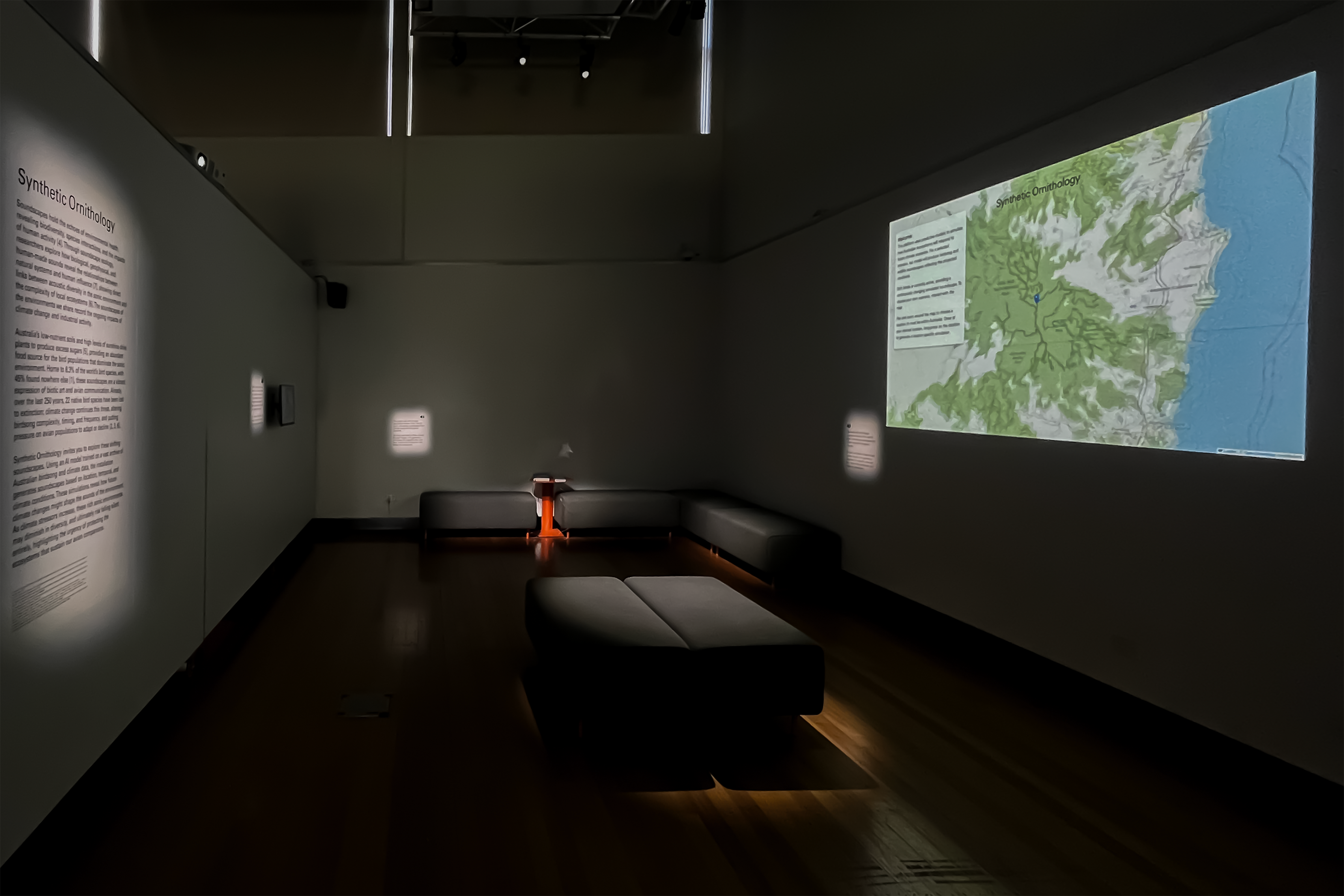
Synthetic Ornithology, a practice-led research project in sonic arts, asks: How can sonic representations of hypothetical climate futures be engaged as a tool to prompt critical conversations on climate crisis mitigation? Addressing this question required working at the intersection of two areas: the use of machine learning to generate soundscapes conditioned by climate scenarios and investigation into the role of generative ML in reshaping sonic arts practice. Developing, training and embedding a bespoke machine learning algorithm were fundamental tasks in creating the work. This required approaching the relational framing of the algorithm within Synthetic Ornithology as a ludic process, not only as a matter of later reflection but as an ongoing part of the work’s development. Figure 1 shows the overall installation layout of Synthetic Ornithology, including the interface, wall texts and projected imagery.
Wide view of Synthetic Ornithology installation showing the arrangement of the interface, wall texts and projected imagery. Phoenix Gallery, Melbourne, Australia, 2025. Photo credit Frederick Rodrigues.

4.2. Design of the model
Central to Synthetic Ornithology is the bespoke ML model, Environmental Audio Generation for Localised Ecologies (EAGLE). EAGLE generates high-quality, birdsong-focused soundscapes from speculative climate scenarios comprised of a GPS location, date, time of day and climate conditions. Synthetic Ornithology is, in essence, an interactive audio simulation of climate futures; visitors can select the conditions for a speculative scenario and hear the simulated outcome, or when left idle, the installation will drift through pre-generated scenarios.
The EAGLE model is the central facilitator of the simulation, and all technical aspects of the development, including dataset curation, model design and training, were aimed at fulfilling this role in the work. The dataset consisted of 50,000 recordings of birdsong-focused soundscapes, and each recording was labelled with the GPS location and time of the recording as well as the climate conditions at that time and location. The model structure used supervised learning, so the model learns correlations between the content of a dataset and the data labels and can generate appropriate audio for a given set of labels (conditions).
As discussed in my earlier work (Rodrigues Reference Rodrigues2025), while a model that could generate highly accurate soundscapes from climate scenarios might use a similar structure and conditioning data to EAGLE, Synthetic Ornithology is a creative, speculative work. Accurately simulating the influence of climate change on localised soundscapes would depend on many factors not accounted for by this approach. However, the plausibility of the approach, namely that such a model design could simulate climate-focused soundscapes, is central to the work’s function. This illustrates the parafictional (Lambert-Beatty Reference Lambert-Beatty2009) nature of the work: it borrows the appearance and authority of scientific simulation closely enough to be inhabited as plausible while remaining fundamentally a work of sonic fiction. The plausibility in the parafiction is further facilitated by the highly realistic output of the model, as evidenced by results of mean opinion score surveys, where EAGLE’s generated output was shown to be too difficult to differentiate from actual recordings.
4.3. Installation, interaction and contextual surrounding
The installation space and the interactive interface of Synthetic Ornithology are specifically designed to influence the audience’s perception of the work as both trustworthy and credible. The overall installation of the work references the aesthetics of science museums and features academic texts discussing the impact of climate change on bird populations and ambiguously hinting at the accuracy of the ML model. This is further reinforced by the design of the interface, which adopts familiar, credibility-laden UI conventions, piggybacking on users’ prior encounters with interfaces that ordinarily yield factual outcomes.
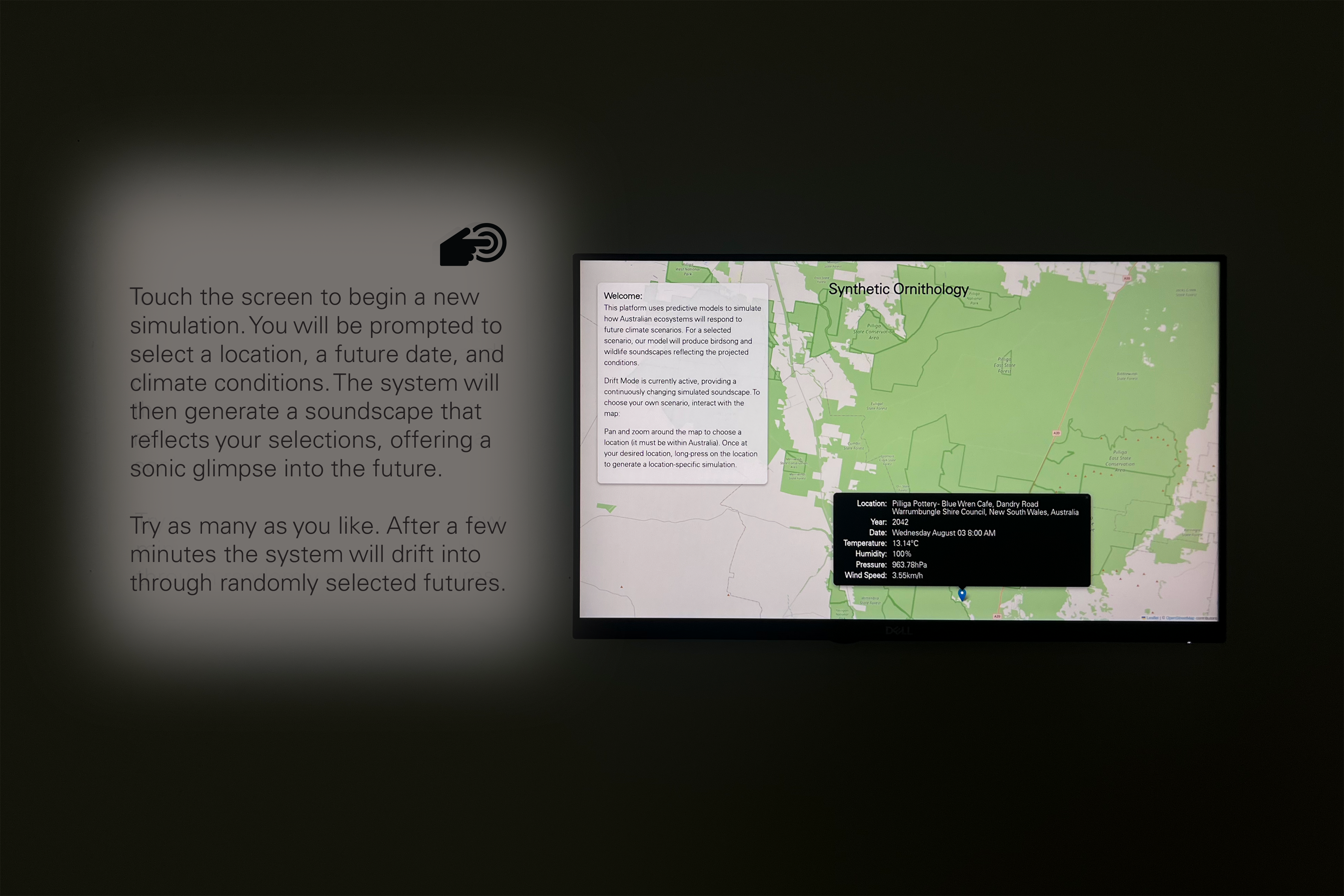
Leveraging the dynamics of ‘mere’ exposure (Zajonc Reference Zajonc1965), audiences are more likely to create a scenario that includes personally meaningful parameters (a place they know, an anniversary date, or the time they normally wake up). This familiarity amplifies affect through appropriateness, the felt fit (or misfit) between an existing sonic experience and a generated soundscape (Schulte-Fortkamp et al. Reference Schulte-Fortkamp, Fiebig, Sisneros, Popper and Fay2023). Cumulatively, these design choices nudge participants to hear the output less as an artwork and more as a forecast. However, these strategies of plausibility are balanced by cues that the work is speculative rather than scientific, including the improbable character of some pre-generated future scenarios, the assertive predictive tone of certain textual elements and the exaggerated imagery used within the installation. Figure 2 shows the idle touchscreen interface, whose distant future date and unusual climate conditions cue the work’s parafictional status.
A view of the Synthetic Ornithology touchscreen interface while the system is idle, showing a distant future date and unusual climate conditions, including 100 per cent humidity at 13°C. Phoenix Gallery, Melbourne, Australia, 2025. Photo credit: Frederick Rodrigues.

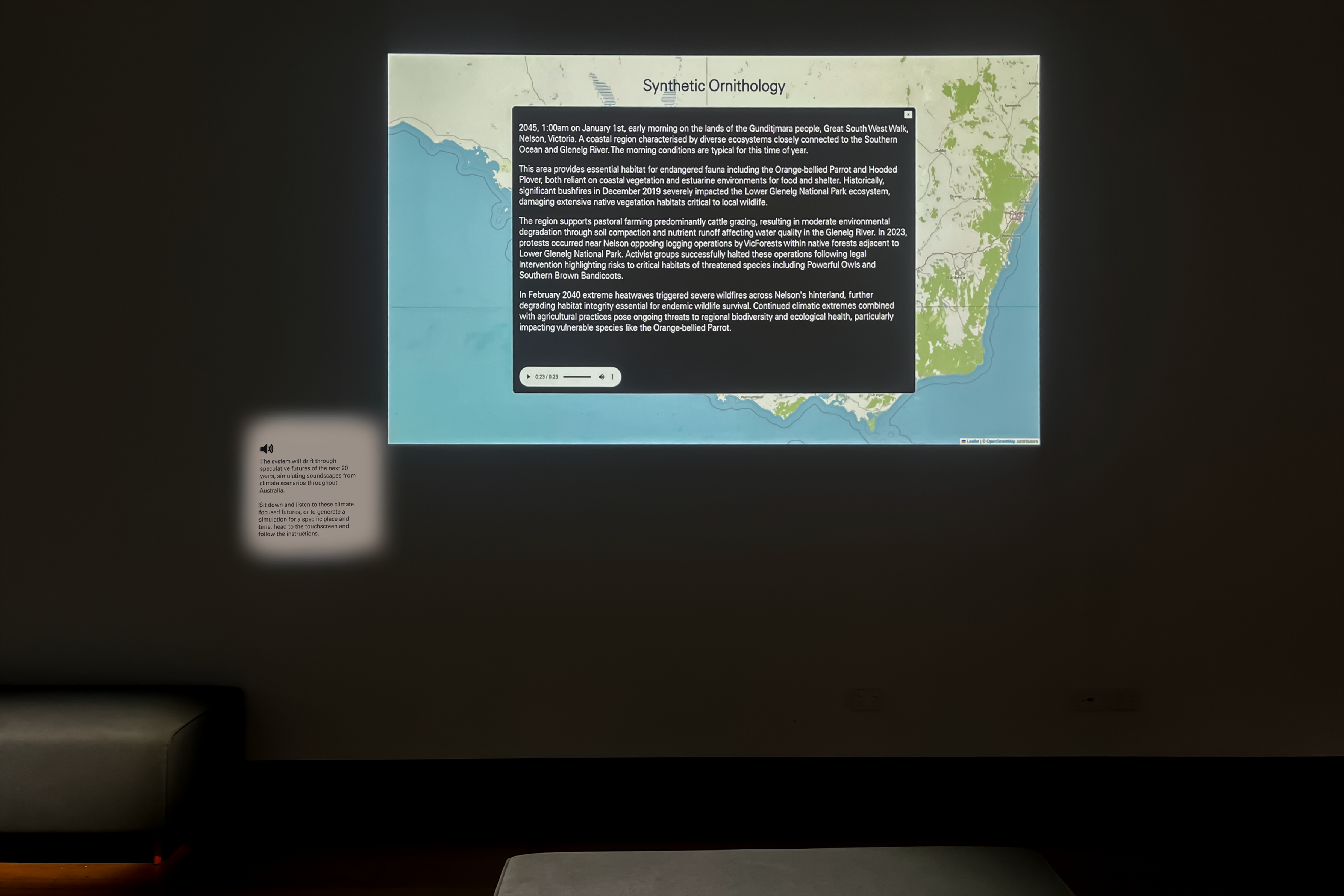
While the audience waits as the audio is being generated, a brief text appears on the interface. The text, generated using a large language model, is seeded from the selected location, time and climate inputs. It weaves local species, histories of extraction or protest and the degree of climatic deviation into a short narrative that bridges from the present to the audience’s chosen point in the future. While such language-model summaries are fallible, in Synthetic Ornithology they function as cues that seed expectation and plausibility without asserting verification, priming audiences to listen ‘as if’ the model were extrapolating a near-future ecology. At the same time, these generated narratives exceed the plausible scope of a soundscape forecasting tool, offering accounts of future events and conditions that subtly disclose the work’s parafictional nature. Figure 3 shows the generated text as it appears during the interval between scenario selection and audio playback, illustrating how the work uses the narrative to frame the speculative soundscape.
A view of the Synthetic Ornithology installation showing the generated text projected during the interval between audience scenario selection and audio playback. Phoenix Gallery, Melbourne, Australia, 2025. Photo credit: Frederick Rodrigues.

In combination, the design of the installation, the interface and the generative text operate as ludic gestures containing the metacommunicative signals of play, consciously adopting the presentation, look, sound and framing associated with scientific simulation in order to support the artwork’s as-if stance. These interface and paratextual choices are not claims to verification but design cues that stage the listening as-if.
This parafictional effect depends on proximity rather than distance. A ludic gesture need not be clearly marked off from the gesture it resembles; indeed, its force may depend on how closely it adheres to the logic of what it evokes. In Synthetic Ornithology, the installation borrows the visual and procedural codes of scientific display closely enough to be inhabited as plausible but without providing the evidence that would stabilise it as scientific fact. It asks audiences to proceed as if the work were forecasting a plausible ecological future, while leaving that proposition suspended rather than verified.
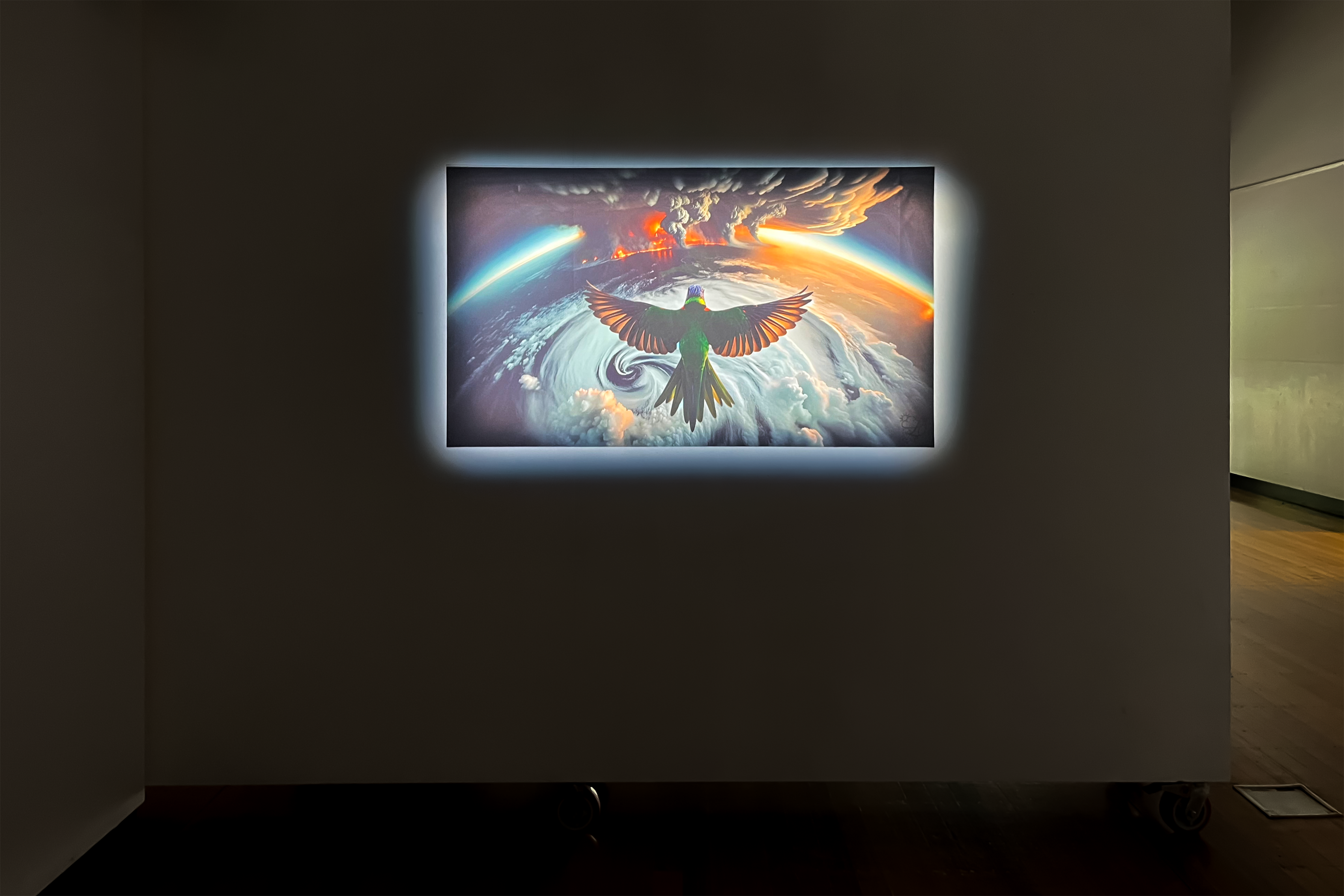
For this reason, the metacommunication of play does not take the form of a single explicit reveal. This ambiguity is also staged through more concrete cues within and around the installation. Some of the weather conditions proposed are improbable or unconventional enough to register, if only gradually, as speculative rather than straightforwardly scientific. The generated text, with its speculative future narratives, clearly exceeds the plausible scope of a soundscape forecasting tool. The visual language of the installation likewise departs from the restrained rhetoric of scientific display, most clearly in the exaggerated imagery of birds flying over a burning earth, which pushes the work toward the superreal. The work does not simply announce itself as fiction from outside, nor does it seek permanent deception. Rather, its speculative status is distributed across the encounter.
The audience is therefore not asked to choose between belief and disbelief outright but to inhabit a temporary ambiguity in which the work can function seriously as a proposition without requiring literal assent. In this sense, Synthetic Ornithology operates through a mediatory fiction: an as-if construction that organises how relations between model, birds, climate data and listener are perceived for a time. Its aim is not to deceive indefinitely but to produce an experiential and reflective space in which speculative ecological futures can be encountered as though they were momentarily available to audition. Beyond the installation itself, the discourse surrounding the work, including wall texts, presentations and academic publications, makes its speculative and ludic framing explicit. Figure 4 shows the exaggerated projected imagery used within the installation, illustrating a visual register that departs from scientific restraint and reinforces the work’s parafictional framing.
A view of the Synthetic Ornithology installation showing an AI-generated image of a parrot flying above the Earth with plumes of smoke. Image generated using ChatGPT 4.5 from a text prompt authored by the artist, February 2024. Phoenix Gallery, Melbourne, Australia, 2025. Photo credit: Frederick Rodrigues.

4.4. Ludic relational framing in practice
The mechanisms engaged in Synthetic Ornithology are best understood as relational framings in the sense defined earlier: they articulate the model, the recorded birds, the speculative scenario and the audience in particular interpretive relation to one another. These framings are ludic because they organise the work through as-if propositions rather than ontological claims. Their effects are multiple and at times contradictory, but this is not a weakness. It is part of how the work distributes meaning across technical design, aesthetic presentation and audience interpretation.
First, the machine learning model is relationally framed as a forecasting device. This does not mean that the work claims EAGLE scientifically verifies future soundscapes in any strict sense. Rather, the installation organises the audience’s encounter so that the model is experienced as if it were simulating a plausible ecological future. The ludic force of this framing lies in its disciplined proximity to scientific simulation: it borrows the procedures and aesthetics of forecasting closely enough to be inhabited, while stopping short of scientific verification.
Second, the EAGLE model is presented as preserving and extending the agency of non-human contributors. The original bird recordings were captured in situ without disturbance, ensuring that literal agency – the birds’ ability to withdraw or resist cooperation – remained intact. If the model is as accurate as ludically proposed, then, in learning correlations between climate data and avian vocalisation, it also learns what has been outlined above as sonic agency: the vitality of the birds’ voices and their ecological responsiveness. By extrapolating these relations into speculative futures, the work amplifies rather than replaces the presence of avian contributors.
Third, the model is proposed to extend the sensory reach of human audiences. By generating soundscapes from future climate scenarios, it allows audiences to hear ecological changes that exceed ordinary human temporal and spatial perception. This ludic framing positions the algorithm as a speculative prosthesis, an extension of the human capacity to sense and reflect upon climate futures.
Lastly, the dataset includes traces of human presence and perspective, such as the incidental sounds of recordists in the field and the artefacts of consumer devices such as smartphone microphones. These sounds are reproduced and recombined by the model and introduce human perspectives into the speculative soundscapes. The model is seen to create spectres of future humans and allow the audience to embody their speculative existence.
Taken together, these ludic framings represent the double embedding of algorithms within a work of sonic art. EAGLE is computationally part of the installation, but more importantly, the design development, training and conceptualisation of the model’s capabilities shape how the work is perceived by audiences. Simultaneously, the work itself brings forth new relational structures for the algorithm to inhabit, which, while somewhat fantastical, still adhere to the logics they play with.
5. Discussion
This paper has proposed a ludic approach to relational framing, treating classifications of embedded algorithms such as agentic, autonomous and collaborative as explicitly non-ontological devices that organise making and listening. The case study, Synthetic Ornithology, demonstrates how such framing can be embedded structurally (via model design and data conditioning) and aesthetically (via paratexts, interface and installation design) without reverting to literal claims about algorithmic or interspecies autonomy. This positions both the algorithm and the non-human species it draws upon within a network of playful yet accountable analogies. Building on the historical and contemporary materials reviewed in Sections 2 and 3, the following is a synthesis of implications for more-than-human sonic art.
5.1. Interspecies mediation and agency preservation in practice
Across interspecies work, agency is best understood as speculative, situated and distributed, not as a property that can be conclusively proven. Practices of mimicry and directive sound demonstrate how human techniques can carry forward non-human roles within a network of effects (e.g., ritual calls and predator–prey signalling). Synchronous, co-located encounters can foreground asymmetry and refusal; Rothenberg’s ‘interspecies jamming’ and Taylor’s ‘apprenticeship’ exemplify responsiveness without confirmed reciprocity, while captive-bird works reveal how physical constraint undermines any claim to collaboration. Asynchronous, recorded and mediated works show that sonically derived agency can persist in reproduction when it is framed and heard as meaningful presence. Together, these trajectories support a working distinction between literal agency and sonically derived agency, which forms a basis for ludic approaches to expand upon.
5.2. Algorithms as mediatory fictions and the logic of embedding
In algorithmic contexts, agency likewise appears as an interactional effect that arises from design and framing rather than from any intrinsic autonomy. MuMe discourse imports definitions from technical fields, which can be analytically useful yet risks reifying ontological claims. Practice-based accounts (Frisk Reference Frisk2020; Parkinson and Dunning Reference Parkinson and Dunning2024) show that what performers call agency tracks flows of interaction, surprise, resistance and malfunction, rather than inner states. Audience studies confirm that perceived agency depends on legibility and presentation, not specific characteristics or relationality (Berthaut et al. Reference Berthaut, Coyle, Moore and Limerick2015). A more durable perspective treats algorithms as behavioural objects (Bown et al. Reference Bown, Eldridge and McCormack2009) within distributed ecologies and embraces mediatory fictions (Højlund and Riis Reference Højlund and Riis2015): as-if framings that guide method and interpretation without demanding ontological proof.
From this vantage, embedding algorithms in sonic arts has two coupled layers: technical embedding, where architectures, datasets and mappings constrain the system’s behaviour; and aesthetic embedding, where concepts, framing or paratexts, interfaces and contexts stage how relations between contributors are perceived. It is these aspects of embedding, rather than proposed ontological definitions, that shape meaning and experience in algorithmic instruments.
Approached through a ludic lens, relational framing in both interspecies and algorithmic practices avoids category mistakes (such as proving ‘real’ autonomy) while retaining the imaginative power of agency and collaboration to organise making, listening and critique.
6. Conclusion
This paper proposes that relational framings of algorithms in sonic art are most productive when approached as ludic, creative, accountable and non-ontological. Historical interspecies practices already show that claims of agency are fragile and situated (Mondémé Reference Mondémé2023; Nilsson and Norrthon Reference Nilsson and Norrthon2024) (and have also already been approached in ludic ways), and contemporary algorithmic practices reveal the same fragility (Frisk Reference Frisk2020; Parkinson and Dunning Reference Parkinson and Dunning2024). Framing then becomes an aesthetic strategy, one that shapes experience, relation and meaning without obliging artists to prove ontological claims.
Algorithmic systems in sonic art should be understood simultaneously as technical components and poetic frames. In doing so, there is a drive to interrogate, develop and customise existing algorithms to make them fit with a work’s conceptual approach, which is furthered by the removal of the burden of proving claims of an algorithm’s literal ontology. A ludic approach makes room for nuanced, playful and complex artistic possibilities, which honour the speculative capacities of sound and the ethical demands of more-than-human practice. It offers a practical path for reconceptualising algorithmic instruments and their relations and a critical vocabulary for discussing them without collapsing into literalism.
Acknowledgements
The author acknowledges the use of ChatGPT (GPT-5, OpenAI, accessed September 2025) to assist with restructuring the manuscript. The tool was used as an editorial aid to suggest alternative structuring to help clarify the document. All text was produced by the author. The author takes full responsibility for the content and interpretation presented in this article.

 Open access

