1 Introduction
The deletion of unstressed vowels from iterative feet, or rhythmic syncope, has attracted interest in phonological theory because it can be generated by serial theories of phonology, but not by parallel theories (McCarthy Reference McCarthy2008, Bowers & Hao Reference Bowers and Hao2018; see Kager Reference Kager and Roca1997 and Blumenfeld Reference Blumenfeld2006 for attempted parallelist solutions). A more fundamental question is whether language learners acquire rhythmic syncope. This paper details the recent development of Nishnaabemwin (a collective name for the Odawa and Eastern Ojibwe dialects of the Algonquian language Ojibwe, spoken around the Great Lakes in the United States and Canada), where phonetic unstressed vowel reduction came to the cusp of phonological rhythmic syncope (Bloomfield Reference Bloomfield1957). That is, the word for ‘shoe’, historically [(mʌˈkɪ)(ˈzɪn)], came to be pronounced as [(məˈkɪ)(ˈzɪn)], while the possessive form [(nɪ-ˈmʌ])(kɪˈzɪn)] ‘my shoe’ was pronounced [(nə-ˈmʌ)(kəˈzɪn)]. Nishnaabemwin has reportedly undergone a dramatic restructuring instead of maintaining the incipient rhythmic deletion alternations (Kaye Reference Kaye1974, Rhodes Reference Rhodes and Cowan1975, Reference Rhodes1976, Reference Rhodes1985a, Reference Rhodesb, Piggott Reference Piggott1980). The abandonment of the vowel–zero alternations may be evidence that learners have difficulty with rhythmic syncope.
Unfortunately, strong conclusions cannot be drawn from the existing literature, as the descriptive facts are somewhat incomplete. Early work strongly suggests that the restructuring was initiated by the first cohort that was exposed to incipient deletion, and that all members of that cohort adopted the restructuring (Rhodes Reference Rhodes and Cowan1975, Reference Rhodes1985a, Reference Rhodesb, Piggott Reference Piggott1980). If this is correct, rhythmic deletion may pose enough of a challenge to learners that they simply reject it. However, the original reports do not conclusively demonstrate cohort-wide restructuring, and later authors have suggested that the restructuring was neither immediate nor cohort-wide (Valentine Reference Valentine1994, Reference Valentine2001). Furthermore, attrition, rather than an inherent difficulty with rhythmic deletion, is a potential competing explanation for the change (Valentine Reference Valentine1994, Reference Valentine2001).
We seek to resolve these uncertainties with three surveys of the first cohort of speakers born during the original incipient deletion period. The first two surveys confirm the original restructuring reports: there are no speakers who prefer the rhythmic syncope patterns. The third survey shows that the participants have accurate knowledge of the original alternating paradigms, which suggests that the restructuring was not due to attrition.
In the following sections, I situate the restructuring in the context of the initial rhythmic near-syncope system, and highlight areas of uncertainty in the descriptive literature (§2). §3 introduces the methodology used in the surveys reported here. §4 discusses the first survey, which shows that innovative prefixes have proliferated throughout the language. §5 discusses the second survey, which affirms that innovative prefixation with non-alternating paradigms is now preferred. §6 discusses the third survey, which shows that the participants can distinguish between conservative forms and non-existent forms synthesised for the surveys; in other words, the restructuring cohort prefers innovative patterns, despite having accurate knowledge of the conservative pattern. §7 moves beyond the set of surface forms in Nishnaabemwin, and argues that the grammar of Modern Nishnaabemwin does not recapitulate the historical rhythmic syncope process. §8 concludes by considering the ramifications of the observed instability for phonological theory.
2 Background
This section provides background on the rejected historical pattern, and also outlines gaps in our understanding of the innovative variety. §2.1 illustrates the original severe reduction system, §2.2 outlines the modern variety of Nishnaabemwin, §2.3 establishes that the modern variety is the immediate successor to the original severe reduction system, §2.4 discusses suggestions that the modern variety has not been adopted by all speakers and §2.5 outlines gaps in our understanding of the modern system.
2.1 1930s Nishnaabemwin
This section illustrates key aspects of Nishnaabemwin as it was spoken in the late 1930s. Crucially, adult speakers in the 1930s had phonological representations with unstressed vowels, but reduced them phonetically. Furthermore, though the severe reduction was not quite total deletion, it was liable to be perceived as such, and the subsequent generation evidently did perceive reduction as deletion.
The precursor to rhythmic syncope, the severe phonetic reduction of unstressed vowels, was first documented for Nishnaabemwin by Bloomfield in the late 1930s. Bloomfield (Reference Bloomfield1957: 5) reports that ‘the vowels of … odd-numbered’ light syllables were reduced, where the count goes from left to right, restarts after long vowels and ignores the final syllable. The alternating reduction matches the uncontroversial iambic stress pattern common in Ojibwe dialects (Valentine Reference Valentine1994), which places odd-numbered light syllables in the weak branch of the foot. Specifically, the typical Ojibwe dialect has iteratively assigned left-aligned iambs, with otherwise unparsable final syllables placed in a degenerate foot. While syllables with long vowels are always heavy, closed syllables are not. With reduction grafted to this stress pattern, a word like the name for the language, which had been [(ʌˈnɪ)(ʃɪˈnaː)(ˈbεː)(mʊˈwɪn)], was now pronounced as [(əˈnɪ)(ʃəˈnaː)(ˈbεː)(məˈwɪn)].
Importantly, person prefixes were part of the domain for footing. This gave rise to paradigmatic alternations, which provided evidence of an active reduction-cum-deletion process, as shown in (1). Note that phonological mappings are presented in rule-based derivations because they are a compact and comprehensible way to illustrate phonological mappings, not because derivations are assumed to be theoretically desirable (see Bowers & Hao Reference Bowers and Hao2018 for a formal characterisation of alternating vowel deletion). To clarify which stage of Nishnaabemwin is under discussion, examples are labelled either 1930s or Modern.Footnote 1
(1)

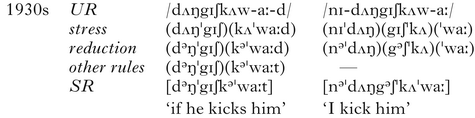
Such alternations were quite well attested, with approximately 40% of the words listed in Rhodes (Reference Rhodes1985a) beginning historically with a light syllable, and around 25% with more than one light syllable. Similar figures obtain for more recent dictionaries of Nishnaabemwin (Corbiere & Valentine Reference Corbiere and Randolph Valentine2016), as well as dictionaries of non-syncopated dialects of Ojibwe (Nichols & Nyholm Reference Nichols and Nyholm1995, Nichols Reference Nichols2015).
2.1.1 Hiatus resolution
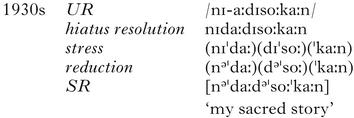
We digress briefly to preview another process that will figure prominently in the reanalyses discussed in §2.2. Like all Ojibwe dialects and many Algonquian languages, 1930s Nishnaabemwin had a vowel-hiatus resolution process that inserted [d] between VV sequences spanning a prefix–stem boundary. Hiatus resolution was a well-established phonological process in Nishnaabemwin prior to the development of reduction, supporting early placement in the derivation in (2).
(2)
2.1.2 Severe reduction vs. categorical phonological deletion
Although the alternating stress pattern forms an uncontroversial part of the 1930s phonology, reduction was a gradient phonetic process when Bloomfield encountered it. According to Bloomfield (Reference Bloomfield1957: 5) reduced vowels were primarily ‘rapidly spoken and often whispered or entirely omitted’. However, the reduced vowels also optionally had ‘more distinct forms’ that reflected their underlying quality, as seen in the contrast between /ɪ-nɪnʤ/ → [(ɪˈnɪnʧ)] ‘someone's hand’ and /ʊ-nɪnʤ/ → [(ʊˈnɪnʧ)] ‘his hand’ (1957: 6). Bloomfield further reports that all of the reported phonetic variants could occur ‘even in utterances of one and the same form’ (Reference Bloomfield1957: 5). This gradience is corroborated by Bloch's (Reference Bloch1938) parallel transcriptions of Bloomfield's elicitation sessions.
According to Bloomfield's description, the reduced vowels were not yet phonologically deleted. If they were, the underlying quality of the reduced vowels could never surface in forms like [(ʊˈnɪnʧ)], as that information would be absent from the phonetic representation. The most appropriate analysis of the 1930s reduction is that it involved phonetic underarticulation of unstressed vowels, usually tending towards a null value.
While it is not currently known when first-language learners classify severely reduced segments as categorically deleted, presumably there is some point where such a decision is taken. Note that a categorical threshold is standardly assumed in explaining the phonologisation of categorical processes from gradient phonetics (Bermúdez-Otero Reference Bermúdez-Otero and de Lacy2007, Reference Bermúdez-Otero, Honeybone and Salmons2015). Importantly, the threshold could be either an absolute value (e.g. a segment is absent if the adjacent segments are separated by no more than a particular number of milliseconds for some percentage of the time) or could be relative to language-particular values (e.g. a vowel is absent if the adjacent consonants are separated by no more than 25% of the mean duration of a short vowel), but the phonological grammar is presumably formed on the basis of categorical percepts (see Ohala Reference Ohala, Breivik and Jahr1989, Reference Ohala, Kellermann and Morrissey1992, Reference Ohala and Jones1993). That is, whether the ambient data instantiates deletion or reduction is not a free parameter that language learners may manipulate; learners must build a phonological grammar from their perceived phonetic data, and they may not second-guess their perception. Following Bloomfield's description, it is clear that 1930s Nishnaabemwin was at least approaching the threshold for reinterpretation as deletion. §2.3 will review evidence that it had crossed this threshold.
2.1.3 Extrapolated phonologisation
The default expectation when a phonetic pattern becomes extreme is that the succeeding stage of the language will feature a categorical phonological version of the gradient phonetics. If severe reduction were phonologised as rhythmic deletion, the following generation would be expected to productively maintain a categorical version of the alternations illustrated in (1). This categorical derivation is shown in (3).
(3)

However, if learners have difficulty with rhythmic syncope, reduction might not be seamlessly converted to its deletion doppelganger.
2.2 Modern Nishnaabemwin (post-1930s)
Reports written after Bloomfield (Reference Bloomfield1957) indicate that Nishnaabemwin has substantially changed. Rhodes (Reference Rhodes1985b: 467) reports the rise of an ‘innovative’ dialect that utilises new prefixes and that has levelled out the alternations found in 1930s Nishnaabemwin (see also Kaye Reference Kaye1974, Rhodes Reference Rhodes and Cowan1975 and Piggott Reference Piggott1980, discussed in §2.3). Recall from (1) that ‘kick someone’ alternated between [dəŋgɪʃkəw-aː-t] ‘if he kicks him’ and [nədʌŋgəʃkʌw-aː] ‘I kick him’. In the innovative dialect, ‘I kick him’ is [ndoː-dŋgɪʃkw-aː], with a novel prefix and vocalism for a prefixed form. Strikingly, with this innovation, the paradigm has lost the 1930s rhythmic syncope alternations, since ‘if he kicks him’ is still [dŋgɪʃkw-aː-t]. This combination of levelled paradigms with innovative prefixes is the ‘regular’ inflectional pattern in the innovative dialect (Rhodes Reference Rhodes1985b: 466), as is robustly reflected in the dictionary published in the same year (Rhodes Reference Rhodes1985a), from which some representative forms are given in (4).Footnote 2
(4)
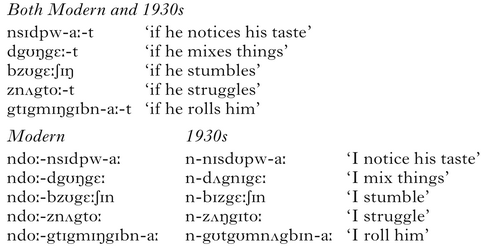
The innovative prefixation strategy is slightly more complicated, as three prefix allomorphs have emerged (all three prefix allomorphs are found with the words in (4), but only one is shown, for brevity). In addition to [ndoː-], 1st person may also be realised as [ndɪ-] or [ndʌ-]. According to Rhodes (Reference Rhodes1985b: 467), [ndoː-] and [ndʌ-] predominate in Odawa communities, while [ndɪ-] is favoured in Eastern Ojibwe.
The adoption of a consistent vocalism in place of the 1930s alternations is a sharp departure from the expected alternating deletion pattern discussed in §2.1.3. The origin of the consistent vocalism does not warrant discussion here, as it can be straightforwardly traced from the unprefixed allomorph used in the 1930s (see Bowers Reference Bowers2015). In contrast, at first blush the innovative prefixes seem to have no precedent from the 1930s, since the syncopated realisation for the prefix [nɪ-] is simply [n-]. The following section discusses the likely origin of the Modern Nishnaabemwin prefix system.
2.2.1 Origins of the prefix allomorphs
The innovative prefix allomorphs were not created out of whole cloth, but most likely arose via reanalysis of words that historically began with short vowels, so that the former stem-initial material was parsed into the prefix. (5) shows a 1930s Nishnaabemwin derivation motivating [ndʌ-] (recall from §2.1.1 that [d] was inserted to break vowel hiatus across a prefix–stem boundary).
(5)
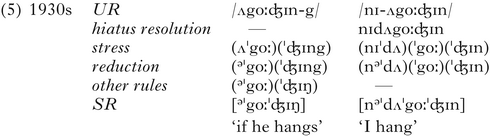
Because the stress algorithm ‘restarted’ the iambic stress pattern after a long vowel, the person prefix only affected the footing of the stem-initial vowel in /ʌgoːˈʤɪn/. This means that when the form had no person prefix, the stem-initial vowel was unstressed and severely reduced, producing [əˈgoːˈʤɪŋ]. When a person prefix was attached, the stem-initial vowel was stressed, as in [nə-ˈdʌˈgoːˈʤɪn].
From the perspective of a language learner, the segmentation of [n-], given the unsegmented forms [goːʤɪn] ‘if he hangs’ and [ndʌgoːʤɪn] ‘I hang’, could leave [dʌ] with no morphemic parse. In contrast, a historically incorrect parse of the prefix as [ndʌ-] leaves no unexplained material, as schematised in (6).
(6)
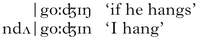
With this segmentation, the formerly stem-initial vowel has become part of the prefix, and the stem is now consonant-initial.
This process can be repeated for stems that began with other short vowels. The derivations of the 1930s stem /ɪnaːbʌʤɪtoː/ ‘use something so’ in (7) demonstrate how [ndɪ-] arose from forms like [əˈnaːbəˈʤɪˈtoː-t] ‘if he uses it so’ and [nə-ˈdɪˈna:bəˈʤɪˈtoː-n] ‘I use it so’.
(7)
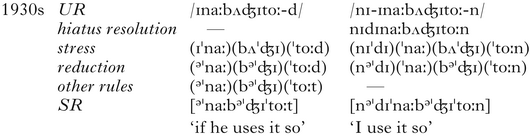
Aligning the words provides a plausible source for the 1st person prefix [ndɪ-].
(8)

Words like 1930s Nishnaabemwin /ʊʤεːpɪzɪ/ ‘be lively’ were the source for [ndoː-]. Consider first the 1930s derivations in (9). Note that, as common in Algonquian languages, [ʊ] lengthened and lowered after a prefix.
(9)
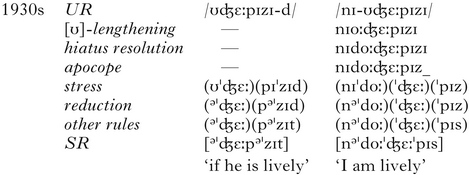
Alignment of the two surface forms provides a plausible source for a 1st person prefix [ndoː-] and a stem [ʤεːpɪzɪ].
(10)

Note that while the recutting analysis was evidently adopted, it is obviously not the only imaginable analysis. Given a rhythmic syncope grammar, the presence or absence of [ʌ] in [ndʌgoːʤɪn] ‘I hang’ and [goːʤɪŋ] ‘if he hangs’ is explainable as the result of the serial interaction of stress and syncope. Moreover, the limitation of this [ʌ]–∅ alternation to particular lexical items is usually taken to be evidence that the [ʌ] is part of the lexical representation of the stem, not the prefix. The prefix inventory would then consist of [n-] and [nd-] (see immediately below), with the former occurring before consonant-initial stems and the latter before vowel-initial stems.
Learners had strong evidence for simpler prefixes as well. Far and away the most frequent prefix allomorph [n-] was segmentable from CVV-initial words like /gaːskʌnʊzʊ/ ‘whisper’, whose derivations appear in (11).
(11)
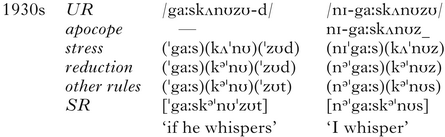
Aligning [gaːsknʊzʊt] and [ngaːsknʊs] allows [n-] to be segmented as in (12).
(12)

Finally, the allomorph [nd-] could be segmented from 1930s Nishnaabemwin words that began with long vowels, like [nəd-ˈoːˈdεːˈtoː] in (13).
(13)
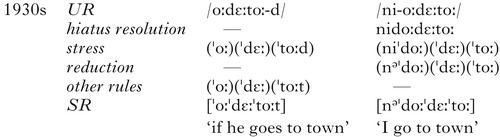
The segmentation producing [nd-] is illustrated in (14).
(14)

In summary, learners evidently took 1930s Nishnaabemwin surface forms as supporting five prefix allomorphs for the 1st person. Of these five, [ndʌ-] and [ndoː-] became the default forms in Odawa communities.Footnote 3
Setting aside further discussion until §7, Modern Nishnaabemwin has a straightforward description: the prefixes [ndoː-], [ndʌ-], [ndɪ-], [n-] and [nd-] compete to be attached to stems. Given the interchangeability reported by Rhodes (Reference Rhodes1985a, Reference Rhodesb), some of the competition must be decided probabilistically, with [ndʌ-] and [ndoː-] being the most likely allomorphs to be deployed in Odawa communities. Some categorical effects clearly also hold, since, for instance, *[nd-gaːsknʊz] is unreported. This can be straightforwardly explained, since the word-initial clusters in such forms were unattested in 1930s Nishnaabemwin, and thus can be expected to be ruled out by undominated phonotactic constraints.
2.3 Restructuring coincided with deletion interpretation
Thus far it has been shown that adult speakers of 1930s Nishnaabemwin had extreme phonetic reduction of unstressed vowels (§2.1), that reduction was reinterpretable as deletion (§2.1.2) and that Nishnaabemwin now contains innovative prefixes and levelled paradigms (§2.2). This section reviews evidence that restructuring was initiated at the same time that severe reduction was documented, and that restructuring went hand in hand with the reinterpretation of reduction as deletion. §2.3.1 discusses evidence that restructuring may have begun slightly before the reinterpretation of reduction as deletion, while §2.4 discusses claims that restructuring may not have been adopted by all members of the cohort.
The first reports after Bloomfield (Reference Bloomfield1957) contain brief indications that a major change was underway in Nishnaabemwin. A remarkably precise date for the initiation of restructuring can be inferred from Piggott (Reference Piggott1980: 2), who writes that ‘the elaborate inflectional system of Ojibwa [Nishnaabemwin] which is well attested in the grammar of older speakers has undergone (or, rather, is undergoing) considerable modification in the grammar of speakers who are in the mid-thirties and under’. The changes Piggott mentioned most likely include the prefix reanalysis and stem levelling discussed above (Glyne Piggott, personal communication). This is buttressed by the fact that Rhodes (Reference Rhodes1985b) and Valentine (Reference Valentine1994, Reference Valentine2001) identify only the novel prefixation system plus levelling as the main morphological innovations in Nishnaabemwin.
The age of the leading edge of the cohort suggests that the 1930s pattern began to be abandoned towards the end of the decade. Piggott (Reference Piggott1980) describes field data from 1968 to 1974. Importantly, the speakers who were in their mid-thirties and younger between 1968 and 1974 were children during the period of extreme reduction documented by Bloomfield in 1938.
Where Piggott suggests a concrete date for the initiation of restructuring, Rhodes (Reference Rhodes and Cowan1975, Reference Rhodes1985b) affirms that the prior generation displayed severe reduction, and that the restructuring cohort reinterpreted this as deletion. Rhodes (Reference Rhodes and Cowan1975: 130) notes that, for older speakers, ‘deletion seems to be a … casual speech phenomenon’, echoing Bloomfield's description of a low-level reduction process. Rhodes further reports that older speakers had an intuitive awareness of absent vowels, stating that ‘the vowels can be easily resupplied (with only some ambiguity of quality)’. This contrasts with younger speakers, for whom absent vowels are ‘totally abstract’, since ‘they cannot resupply the [missing] vowels except by reference to appropriate allomorphs’ (Reference Rhodes and Cowan1975: 130). Such distinct types of awareness should match distinct linguistic characterisations, like the difference between a gradient phonetic process and a categorical one.
Somewhat later, Rhodes (Reference Rhodes1985b: 464–466) provides concrete evidence that missing vowels are truly absent for younger speakers. Recall from §2.1.2 that in 1930s Nishnaabemwin severely reduced vowels could still surface as short vocoids. In Modern Nishnaabemwin, short vocoid segments do not correspond to the reduced vowels described by Bloomfield. That is, both [nʊwεː] ‘he speaks’ and [aːnʊwɪ] ‘despite’ have the same vocoid, but the vocoid is innovative in [nʊwεː] (cf. Western Ojibwe [ɪnwεː]; Nichols Reference Nichols2015), while the vocoid corresponds to a historical vowel in [aːnʊwɪ] ‘despite’ (cf. Western Ojibwe [aːnʌwɪ]; Nichols Reference Nichols2015).
Rhodes further shows that the presence and quality of excrescent vocoids can be predicted by the identity of flanking consonants. This is standardly interpreted as evidence that the vocoids are the result of phonetic interpolation between CC transitions. Interpolation between consonants presupposes that the consonants are adjacent prior to phonetic implementation, even if they were historically separated by a vowel. The neutralisation of the distinction between originally adjacent and formerly separated consonants provides further evidence that etymological vowels have been categorically removed in Modern Nishnaabemwin. On a similar note, Rhodes (Reference Rhodes1985b: 468–469) and Valentine (Reference Valentine2001: 73–89) enumerate various neutralisations in consonant clusters that are derived by reduction-cum-syncope, which presupposes that formerly separated consonants are now adjacent phonologically. Importantly, these data diagnose only categorical absence, but leave unresolved the key question of whether the absent vowels were removed by synchronic rhythmic syncope or were lost outright from underlying representations (see §7).
Hence the contemporary reports suggest that the recent development of Nishnaabemwin is divided into two stages: a severe reduction stage in the 1930s, and a subsequent restructured stage. Furthermore, the onset of restructuring coincided with the interpretation of reduction as deletion.
2.3.1 Possible early restructuring
Bloomfield (Reference Bloomfield1957: 5, 24) occasionally records forms that presage the imminent restructuring, as in [ndoː-bgʌktaːn] ‘I hear it distinctly’, where [n-bʌgkɪtaːn] is the expected conservative form (Rhodes Reference Rhodes1985b: 467). These forms suggest several possibilities, including that Bloomfield's consultant was updating his grammar on the basis of a reanalysis of adult speech (Rhodes Reference Rhodes1985b: 468), or, as a reviewer suggests, that restructuring had already taken place and that Bloomfield's report is in fact an idealised reconstruction, rather than an accurate representation of his consultant's speech. While we cannot rule out either of these possibilities, the first would require a more sophisticated model of grammar construction than we are inclined to argue for here, while the second would imply that Bloomfield extensively falsified the data, despite the fact that he explicitly states that he reconstructed only a handful of forms (Reference Bloomfield1957: 6).Footnote 4
An alternative is that these apparently anachronistic restructured forms were borrowed from Potawatomi, a very closely related language. Potawatomi developed severe reduction shortly before Nishnaabemwin, and is in fact widely credited with having introduced reduction to Nishnaabemwin, as Potawatomi speakers fled the United States and settled in southern Nishnaabemwin-speaking communities (Rhodes Reference Rhodes1985a: x, Valentine Reference Valentine1994: 151). Importantly, Potawatomi was also already undergoing a similar restructuring to Nishnaabemwin, as [ndoː-] was becoming a prefix in its own right (Hockett Reference Hockett1939: 28–29, Reference Hockett1948: 5).Footnote 5
Bloomfield's consultant lived on Walpole Island, a southern community, and thus would likely have been exposed to a substantial amount of Potawatomi. Bloomfield may therefore have simply recorded the sporadic use of a borrowed prefixation strategy. Under this account, Bloomfield's consultant reduced, but did not delete, unstressed vowels, while sometimes deploying forms borrowed from Potawatomi. Regardless of which explanation ultimately proves correct, the stark difference between the original severe reduction pattern (with at most a smattering of restructured forms) and the later language (with prolific use of restructured forms) points to a major reanalysis on the part of learners.
2.4 Possible heterogeneity in the restructuring cohort
While the early reports established that restructuring emerged with the reinterpretation of reduction as deletion, later work indicates it may not have been the only analysis. Valentine (Reference Valentine1994: 150) stops short of claiming that all younger speakers restructured the phonology, affirming only that restructuring has occurred ‘at least for some speakers’. Sometime later, he substantiates the implied restriction by limiting the restructuring to younger and/or less proficient speakers (Reference Valentine2001: 65–67). The limitation to younger speakers is certainly consistent with the reports from the 1970s, though the original 1970s cohort would have been around 60 years old in 2001, and thus unlikely to qualify as young. Note, however, that even if Valentine is referring to a still younger cohort, it is unlikely that they would have been much younger than 30, since intergenerational transmission in even the most robust Nishnaabemwin-speaking communities ceased in the 1960s.Footnote 6
More importantly, Valentine (Reference Valentine2001: 66–67, citing unpublished pedagogical materials by Mary Ann Corbiere) indicates that restructuring is limited to less proficient or even attrited speakers, and that highly proficient speakers continue to use the conservative 1930s system. Such highly proficient conservative speakers may even include members of the restructuring cohort (Rand Valentine, personal communication). However, Valentine (Reference Valentine2001: 66) acknowledges that there has been no systematic study of how widespread innovative prefixes and levelled paradigms are in Modern Nishnaabemwin.
The current descriptive literature thus does not provide a clear picture of learners’ responses to perceived rhythmic syncope. While the earliest reports suggest a uniform rejection of the rhythmic syncope alternations, sufficiently expert speakers may prefer the conservative pattern, or perhaps even use it exclusively. Which scenario is actually attested has significant potential implications for the learnability of rhythmic syncope. If all learners failed to acquire the original rhythmic syncope pattern, a rhythmic syncope grammar may be highly dispreferred, or perhaps even impossible for learners. On the other hand, if at least some learners succeed in acquiring rhythmic syncope, a rhythmic syncope grammar must be attainable at least some of the time. If those conservative speakers are generally non-attrited, whether a rhythmic syncope grammar is acquired may depend on the amount of exposure to the pattern.
The surveys in this study seek to address these questions. The first two surveys measure speakers’ intuitions regarding prefix choice (innovative vs. conservative) on stems that either did not (Survey 1) or did (Survey 2) alternate in 1930s Nishnaabemwin. The key concern is whether some or all speakers will show a preference for conservative 1930s patterns, and thus demonstrate that rhythmic syncope is acquirable. The third survey directly tests the theory that the restructuring was due to insufficient exposure to 1930s forms by measuring the accuracy with which speakers differentiate 1930s forms from non-existent forms, henceforth ‘foils’. Moreover, the participant sample deliberately included a range of proficiencies within the target cohort, so that any effect of proficiency on conservatism could be measured.
2.5 Further desiderata
The descriptive literature is incomplete in other respects as well. Rhodes (Reference Rhodes1985b: 466) claims that new prefixes did not spread across the entire lexicon, but that the new prefixes are limited to ‘exactly’ stems that had vowel–zero alternations after the first stem consonant in 1930s Nishnaabemwin. That is, words that had no left-edge alternations under prefixation in the 1930s, as in [n-gaːsknʊs] ‘I whisper’ (unprefixed form [gaːsknʊzʊ-t] ‘if he whispers’), or words where the only alternation could be attributed to prefix allomorphy, as in [nd-ʌgoːʤɪn] ‘I hang’ (unprefixed form [goːʤɪn]), reportedly take only etymologically correct prefixes. In contrast, words that alternated after the first stem consonant under prefixation, as in [n-mɪskwiːwnɪkεː] ‘I have a bleeding arm’ (unprefixed form [mskwiːwnɪkεː] ‘he has a bleeding arm’), do take the innovative prefixation pattern, as in [ndʌ-mskwiːwnɪkεː] (Rhodes Reference Rhodes1985b: 467). This pattern of prefixation is fairly robust in Rhodes (Reference Rhodes1985a), where non-alternating stems are often not listed with innovative prefixes. However, the force of the claim that new prefixes are limited to historically alternating stems is vitiated by Rhodes’ (Reference Rhodes1985b: 467) observation that for ‘these same speakers’ who have innovated Modern Nishnaabemwin, novel prefixation has spread to many formerly non-alternating words. This can be seen in Modern Nishnaabemwin [zaːmsɪniː] ‘he overeats’ and [ndʌ-zaːmsɪniː] ‘I overeat’ (1930s Nishnaabemwin prefixed form [nd-oːzaːmsɪniː]).
Finally, according to the description of the data in Rhodes (Reference Rhodes1985a: xx), new prefixes may appear on verbs, but not on nouns. The validity of this is unclear, as Valentine (Reference Valentine1994: 146–147) adduces nouns with innovative prefixes. Furthermore, there were editorial considerations that may have resulted in the suppression of innovative prefixes on nouns in Rhodes’ dictionary (Richard Rhodes, personal communication).
In sum, within the broader goal of measuring the degree of innovation after incipient rhythmic deletion, this study seeks to address the empirical goals in (15).
(15)
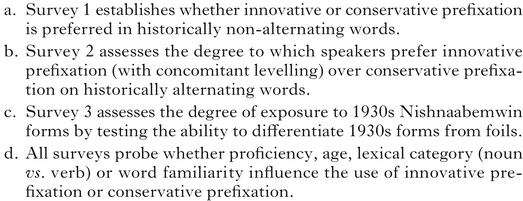
Foreshadowing the main results, we can say that Modern Nishnaabemwin was uniformly adopted by participants of all ages and proficiencies, while innovative prefixation occurred whether or not stems historically alternated, and whether or not stems were nouns or verbs. Furthermore, in the final survey participants reliably distinguished historical forms from foils. These results suggest that, despite substantial exposure to the historical deletion pattern, the cohort in question uniformly converged on a changed language.
3 General methods
20 native speakers of Nishnaabemwin (12 female, 8 male) between the ages of 61 and 87 (mean 71.6, standard deviation 7.3) participated in the study. Participants had grown up speaking the Odawa variety of Nishnaabemwin on Manitoulin Island (15) or Walpole Island (5). The participant pool included several highly esteemed translators and language instructors, but also speakers who were not professionally involved in the language.Footnote 7
All participants completed three surveys, though one potential participant (not included in the results) only completed part of the first survey before withdrawing. Each survey consisted of at least 30 words, and could include either nouns or verbs. Words were drawn randomly from Corbiere & Valentine (Reference Corbiere and Randolph Valentine2016). To ensure that a broad swathe of the lexicon was sampled, surveys contained a different set of randomly drawn words for each participant. This permits more confident claims about the prevalence of the patterns across the lexicon than if only a few words were sampled. To allow direct comparison of participants to each other, surveys also included a core set of words that were shown to all participants. In total, 1441 words were sampled, of which 1030 were sampled once, 376 between two and ten times and 35 more than ten times. In total, 969 words were recognised by at least one participant.
Stimuli were presented using a widely used roman orthography, with instructions in English. Participants were instructed that their day-to-day speech, as opposed to a more formal register, was of interest for the research. Surveys were conducted in the homes of participants. Participants were given $50 CAD for their time.
In the first survey, participants rated and made forced-choice judgements on all possible prefix allomorphs on historically non-alternating stems. In the second survey, participants made forced-choice judgements between 1930s alternating prefixed forms and Modern Nishnaabemwin levelled prefixed forms. In the third survey, participants made forced-choice judgements between 1930s alternating prefixed forms and fabricated decoys. The full set of surveys typically took between 90 and 120 minutes to complete.
Well-formedness ratings and forced-choice preferences are, like all measurements, imperfect windows to speakers’ grammars. In a case of language change with multiple competing variants, the chief concern is to cover all possibilities. By directly querying the relevant variants, this study addresses the question head-on, and reduces the chance that a minority variant will not be measured simply because it is improbable rather than impossible. Of course, suggesting rare forms can make participants overstate how much they prefer them (see Albright & Hayes Reference Albright and Hayes2003: §4.3.4). This means that the regularisation found in this study is likely to be even stronger than our current measurements indicate. Collecting a corpus or eliciting speaker productions without suggesting forms would help provide a fuller picture.
3.1 Speaker proficiency and word familiarity
In this study, it is especially important to assess the effects of speaker proficiency and word frequency. Speaker proficiency must be tracked so that we can (a) ensure that the sample of participants was not mistakenly filled with heavily attrited individuals, and (b) establish whether proficiency is significantly correlated with a speakers’ use of conservative forms. Word frequency is a perennial variable of interest in both synchronic and diachronic studies (see for instance Bybee Reference Bybee2001, Hay et al. Reference Hay, Pierrehumbert, Walker and LaShell2015), and in this study we would expect highly frequent words to correlate with a higher degree of conservatism. Unfortunately, standardised proficiency tests and large text databases for calculating frequency do not exist for Nishnaabemwin. However, the design of the experiment allows vocabulary size and word familiarity to be estimated. These estimates are proxies for proficiency and frequency.
Word familiarity was calculated by dividing the number of participants who recognised a word by the total number of participants who were shown that word. Because words were drawn randomly in order to sample more of the lexicon, an individual word was typically shown only to at most a handful of participants. To avoid claiming that a word is universally recognised when it had been shown to few participants, familiarity estimates were Laplace smoothed, with a constant value of 2. Thus, if a word had only been shown to and recognised by a single participant, this measure estimates that one third of speakers would recognise it, while a word that was shown to and recognised by twenty participants is estimated to be recognised by (20 / (20 + 2)) = 91% of speakers.Footnote 8
To measure speaker proficiency, the percentage of words recognised by each speaker across all surveys was calculated. On average, speakers recognised 70.8% of words (standard deviation 13.7%). This rate of vocabulary recognition is comparable to that of English-speaking adults (Brysbaert et al. Reference Brysbaert, Stevens, Mandera and Keuleers2016).Footnote 9 Note that participant age is not correlated with proficiency (r 2 = 0.002), although the correlation does improve substantially if the two participants over 80 years old are excluded (r 2 = 0.169).
4 Survey 1: prefix distribution
The first survey assesses the distribution of prefix allomorphs (see (15a)). The proliferation of innovative prefix allomorphs, along with the concomitant levelling of paradigmatic alternations, is a major aspect of restructuring. This survey looks at historically non-alternating words, in order to examine prefix allomorphs separately from alternations. The prevalence of levelled paradigms in place of alternations will be assessed in §5.
The narrow focus on prefix distribution helps illuminate the durability of rhythmic syncope patterns across generations, and by extension, the acquirability of a rhythmic syncope grammar. Any points of similarity between the stages of Nishnaabemwin could suggest that Modern Nishnaabemwin retains a rhythmic syncope grammar. Conversely, where Modern Nishnaabemwin departs from 1930s Nishnaabemwin, it is presumably because language learners disregarded the original distribution and overlaid a new pattern over it. Hence, whether restructured prefixes proliferated or the conservative prefix distribution endured can reveal whether prefix boundaries were misparsed or if a phonological explanation for apparent prefix allomorphy was adopted (see §2.2.1).
The prior descriptive literature inconclusively suggests that historically non-alternating words retain the conservative 1930s distribution of prefix allomorphs (see §2.5). Consequently, the null hypothesis is that for a historically non-alternating word, the historical prefix allomorph for the word will be preferred to the innovative prefix allomorphs [ndʌ-] and [ndoː-]. The alternative hypothesis is that innovative prefix allomorphs will be preferred to the historical prefix allomorph.
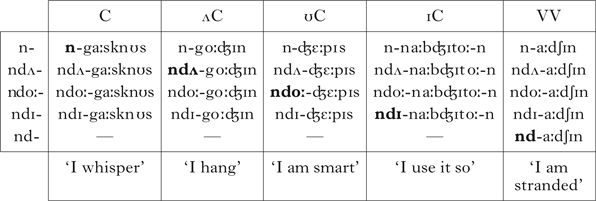
To test these hypotheses, the survey used the following design. Speakers evaluated all possible 1st person prefix allomorphs on stems that for present purposes were non-alternating in 1930s Nishnaabemwin, because they contain a long vowel after the first consonant.Footnote 10 That is, given a word like [gaːsknʊzʊ-t] ‘if he whispers’, speakers evaluated [n-gaːsknʊs] (the historical form), [ndʌ-gaːsknʊs], [ndoː-gaːsknʊs] and [ndɪ-gaːsknʊs] as alternative realisations of ‘I whisper’. For words beginning with a long vowel, the historical [nd-] allomorph was also evaluated, so that for [aːdʃɪn] ‘be stranded’, participants additionally evaluated [nd-aːdʃɪn] ‘I am stranded’. The [nd-] allomorph was not presented for the other words in the survey, because stimuli were constrained to be phonotactically legal, and the concatenation of [nd-] to a C-initial word would produce an unattested word-initial [ndC] cluster.
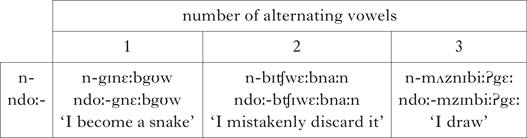
For each word, participants made a forced-choice judgement on which of the possible prefixed forms they were most likely to say, and rated each prefixed form on a seven-point Likert scale. If a speaker did not recognise a word, they were not asked to evaluate prefixed forms of it. The order in which the options were arranged varied randomly between trials. Participants evaluated words from the five classes that produced the distinct prefix allomorphs. Word class varied randomly between trials. The types of forms that participants evaluated are summarised in Table I, where the historical prefixes are in bold.
Example items for Survey 1. Columns correspond to historical segments at the left edge of the stem. Rows show prefix allomorphs applied to stems. The prefix in historically attested prefix–stem combinations is bolded.

To allow direct comparison of responses on a set of high-familiarity items, all speakers were presented with two words in each category that the author considered likely to be known by all participants. All remaining words were randomly selected. The survey ended once participants had evaluated six words from each category, giving a total of 30 evaluated words. Two participants did not complete all items. In total, 2426 ratings of individual prefixed forms and 578 forced-choice selections of the best prefixed form of a word were collected.
4.1 Results of Survey 1
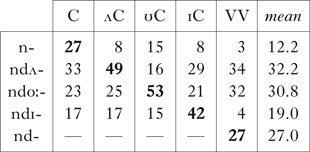
The prefix survey results strongly indicate that [ndʌ-] and [ndoː-] are the default allomorphs in Modern Nishnaabemwin. The results also indicate that historical forms have not been entirely supplanted by default forms. To see the interweaving of historical attestation with regularisation, consider the data in Table II, which summarises the results of the forced-choice component of the survey. Each cell contains the percentage of times a prefix was selected for a category (column).
Percentage of times speakers selected a prefix–stem combination as the best option, within historical classes (columns). Values for historically attested prefix–stem combinations are in bold.

Recall that Rhodes (Reference Rhodes1985b) and Valentine (Reference Valentine2001) raise the possibility that speakers are conservative with respect to non-alternating words, and will consistently select the historical prefixed form. The effect of historical attestation can be most clearly seen by reading across the rows, where each prefix stands the best chance of being selected with its historical host, i.e. the bolded cell is the largest in each row.
Despite this boost, the historical prefixes are not the clear favourites. Within each class of stem (the columns in Table II), the historical form is the most commonly selected form only for the recut allomorphs ([ndʌ-, ndoː-, ndɪ-]), and only [ndoː-] is selected more than 50% of the time. That is, the bolded cell is not categorically selected; it is in fact rarely the majority of its column, and it is not even consistently the most popular option.
Rather than providing evidence of a conservative system, the forced-choice responses point to strong regularisation, as at least one of the top two prefix allomorphs in every column is [ndʌ-] or [ndoː-]. Furthermore, in three out of the five stem categories (ʌC, ʊC, VV), both [ndʌ-] and [ndoː-] are the top two prefix allomorphs, together making up 74% to 50% of selected forms in any category.
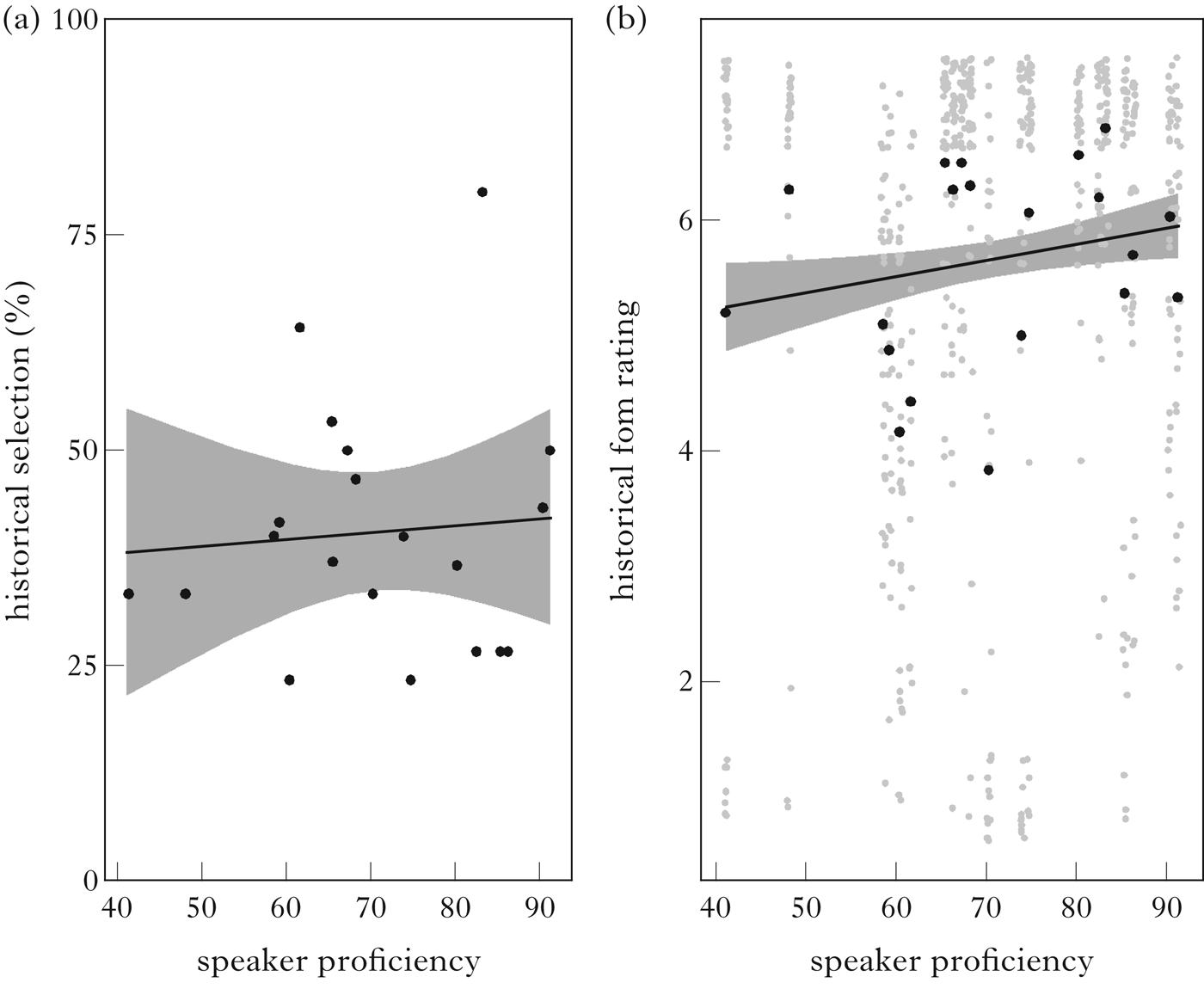
Recall that Valentine (Reference Valentine2001) indicates that more skilled Nishnaabemwin speakers use conservative 1930s prefixation. The measure of speaker proficiency (the percentage of items recognised in all surveys) is not correlated with the rate at which speakers select historical forms (r 2 = 0.006), as shown in Fig. 1a. Perhaps more importantly, speakers generally select historical forms only around 40% of the time, while only five speakers select the historical form 50% or more of the time, and only one speaker selects historical forms over 75% of the time. Contrary to previous suggestions, none of the participants employs 1930s Nishnaabemwin prefix allomorphy.
Plots of prefix survey results: (a) speaker-by-speaker plot of percentage of historical forms selected, by proficiency score; (b) speaker-by-speaker plot of rating given to historical forms, by proficiency score. Dark dots indicate speaker means; light dots show raw ratings (jittered).

This is not to say that more proficient speakers are insensitive to historical attestation. The rating data (Fig. 1b) shows that more proficient speakers give modestly higher ratings to historical forms than less proficient speakers do.
4.1.1 Statistical methods and model-construction parameters
The surveys in this study are oriented towards confirming whether the target cohort prefers conservative forms over innovative forms (Surveys 1 and 2) or foil forms (Survey 3), and finding the factors that influence this preference. Note that the models discussed here are not models of phonological competence, as our goal is to describe whether conservative features are retained.
Given the descriptive nature of this study, an appropriate statistical method is to gauge the relative strength of predictors within an array of hypotheses (see Symonds & Moussalli Reference Symonds and Moussalli2011 for an introduction to this approach to statistical modelling). A major difference between this approach and traditional null hypothesis testing is that it allows comparison of models whose predictors are not in a superset–subset relation, using Akaike's Information Criterion (AIC), where lower scores reflect better fit. When applicable, we also carry out null hypothesis tests and report p-values from the anova() function in R (R Core Team 2016). When ∆AIC scores and p-values diverge in whether a model is supported, p-values are used.Footnote 11
Linear mixed-effects models were fitted to the rating variable using the lmer() function from the lme4 package (Bates et al. Reference Bates, Mächler, Bolker and Walker2015) in R. All models of the rating data contain random slopes for prefix allomorph by speaker. Models could also include prefix allomorph, whether an allomorph was historically attested on the stem in question, and interactions of participant age, participant proficiency or familiarity with historical attestation.Footnote 12 Including historical attestation as a predictor reflects the possibility that historical prefix allomorphs will receive higher ratings than innovative allomorphs. The interactions of historical attestation with age, proficiency and familiarity reflect the possibility that the historical form may receive higher ratings on familiar words or from older or more proficient participants. To avoid scaling problems, values for speaker proficiency, speaker age and word familiarity were centred and rescaled.
4.1.2 Hypothesis testing and model selection
Models including different configurations of fixed effects were compared using AIC scores and, for nested models, the likelihood ratio test via the anova() function in R. A truly null model with no fixed effects and a more plausible null model that includes historical attestation as a predictor were compared against models that also include fixed effects for whether the prefix allomorph is [ndʌ-] or [ndoː-]. Both null hypotheses can be rejected, as including whether the form is prefixed with [ndʌ-] or [ndoː-] significantly improves fit with respect to both the truly null model (p < 0.001, ∆AIC = 11.947) and the historical model (p < 0.001, ∆AIC = 18.137).
The comparisons above merely show that our sample contains enough data from restructured speakers that modern default allomorphs are significantly correlated with ratings. As discussed in §2.4, a more nuanced perspective might expect historical forms to receive improved ratings for widely familiar words, or from highly proficient or older speakers. Models with all combinations of these factors were fitted to the rating data. The best model according to AIC includes prefix allomorph, as well as historical attestation and its interaction with word familiarity and participant proficiency. The best model outperforms competing models that include only historical attestation (p < 0.001, ∆AIC = 35.4), only prefix allomorph (p < 0.001, ∆AIC = 80.2), the interaction between historical attestation and speaker proficiency (p < 0.001, ∆AIC = 23.1) or the interaction between historical attestation and word familiarity (p = 0.012, ∆AIC = ―0.3). This supports the hypothesis that some speakers are more conservative than others, but does not conclusively rule out the hypothesis that these speakers maintain the conservative 1930s pattern over the innovative pattern. These possibilities are further explored in the next section.
4.1.3 Model criticism
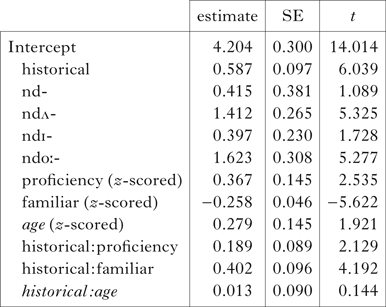
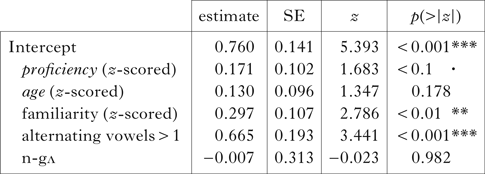
The fixed effects of the maximal model of the data are shown in Table III. Predictors that are not present in the best model are italicised, and are displayed in order to facilitate comparison between surveys. Examination of the estimates for the fixed effects emphasises that innovative prefixation in Modern Nishnaabemwin is now widely preferred, because effects favouring conservative prefixation are swamped by those indicating prefix regularisation. Four prefixes are shown in Table III; the fifth, [n-], is the reference level included in the intercept.
Fixed-effects table for maximal model of prefix-rating results. Italicised factors are excluded in the best-fitting model.

As in the forced-choice data, the rating data clearly shows that [ndʌ-] and [ndoː-] are generally favoured, as their ratings are respectively 1.4 and 1.6 points higher than the intercept value. The remaining allomorphs have smaller, non-reliable effects (absolute t-values greater than 2 indicate reliable effects). The non-default allomorphs [n-, nd-, ndɪ-] only approximate the high ratings of [ndʌ-] or [ndoː-] if they are the historical allomorph, the speaker is highly proficient and the word is widely familiar.
To be specific, the model estimates that non-default prefixes on their historical host words are rated 0.4 to 1.6 points lower than [ndʌ-] and [ndoː-], all else being equal. In order to gain even an additional 0.4 points, the effects of proficiency (β̂ = 0.37) and familiarity (β̂ = ―0.26), and their interactions with historical attestation (β̂ = 0.19 and 0.40 respectively) must be included.Footnote 13 Only if a word is one standard deviation more familiar than average and a speaker is one standard deviation more proficient than average do the interaction terms contribute approximately 0.4 rating points. While highly proficient speakers are clearly more sensitive to historical attestation, they do not routinely prefer historical forms. Rather, the historical form is at best favoured to roughly the same extent as the modern regularised forms.
4.1.4 Local discussion
To briefly summarise, the central question considered here is how thoroughly the restructuring cohort supplanted the rhythmic syncope patterns. Previous literature has tentatively suggested that prefix regularisation has not applied to non-alternating words, and that some speakers resisted the change. The results of this survey suggest that [ndʌ-] and [ndoː-] are dominant for all speakers of Modern Nishnaabemwin, even for words that did not have clear stem-internal alternations in 1930s Nishnaabemwin.
5 Survey 2: alternation vs. levelling
The second survey examines innovative prefixation on historically alternating stems (see (15b)), thus complementing the first survey, which examined only historically non-alternating stems. In a forced-choice task, participants were asked to state whether they preferred a levelled prefixed form (e.g. [ndoː-mkɪzɪn] ‘my shoe’) or a conservative form ([n-mʌkzɪn]). Words in this survey historically began with a CVC sequence, and thus had unambiguous stem-internal alternations in 1930s Nishnaabemwin.
As before, the null hypothesis in this survey is that Modern Nishnaabemwin maintains the conservative 1930s distribution, if not for all speakers, then at least for the highly proficient ones. The alternative hypothesis is that this cohort prefers innovative prefixation.
Rhodes’ (Reference Rhodes1985b) report leaves open the possibility that innovative prefixation applies to all formerly alternating stems at the same rate, without distinguishing between the number of alternating vowels. The survey tested this possibility by sorting words according to the number of stem-internal vowel–zero alternations present in 1930s Nishnaabemwin, or equivalently, the number of vowel–zero mismatches between the innovative prefixed form and the conservative prefixed form. The lexicon was partitioned by the number of vowel–zero disparities between the conservative [n-] form and the innovative [ndoː-], with the maximum number of alternating vowels being five. This is schematised in Table IV for words with one to three alternating vowels.
Modern Nishnaabemwin forms categorised by the number of vowels that change between the conservative [n-] form and the modern [ndoː-] form.

As in the prefix survey, all participants were shown short lists of plausibly familiar words from each partition. Words were otherwise drawn randomly from each partition, though the number was not actively balanced. The order in which prefixed variants were displayed varied randomly between trials.
Additionally, foil trials were randomly interspersed amongst the test trials. In a foil trial, all of the vowels that uniquely occurred under prefixation were replaced with a randomly selected short vowel. That is, the [ʌ] of [n-mʌkzɪn] uniquely occurs under prefixation, while the [ɪ] also occurs in the unprefixed form, as seen in [mkɪzɪn]. In a foil trial, the [ʌ] could be replaced with either [ɪ] or [ʊ], producing, for instance, [n-mɪkzɪn] in place of [n-mʌkzɪn]. These foil trials were included to check whether participants who selected conservative forms knew the true conservative form. Since foil trials did not directly address the central question of the survey (whether participants prefer innovative or conservative forms), the number was capped at five per participant. The survey ended when participants had completed 30 non-foil trials. A total of 581 forced-choice evaluations were collected from 20 participants (one participant did not complete all 30 trials).
5.1 Results of Survey 2
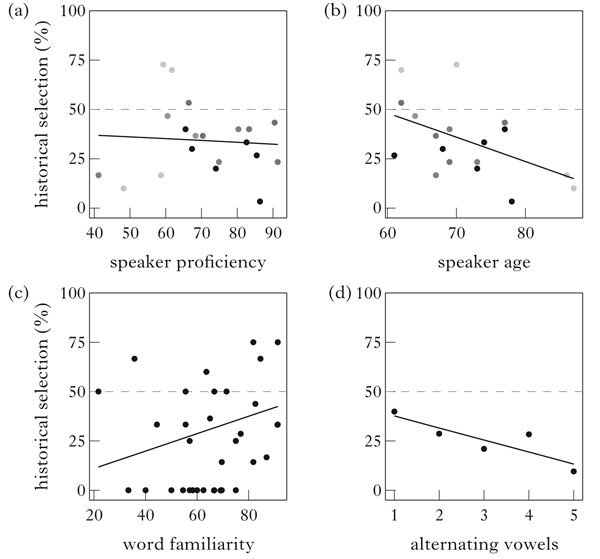
The levelling survey results affirm that historically alternating stems now take the innovative prefixes, as suggested by Rhodes (Reference Rhodes and Cowan1975, Reference Rhodes1985a, Reference Rhodesb) and Piggott (Reference Piggott1980). Participants overwhelmingly selected levelled forms (e.g. [ndoː-mkɪzɪn]) over alternating forms ([n-mʌkzɪn]). Contrary to what Valentine (Reference Valentine2001) reports, highly proficient speakers did not reliably select historical forms, as seen in Fig. 2a.Footnote 14 Furthermore, the two speakers who selected historical forms nearly three-quarters of the time also chose foil items at a comparable rate, suggesting that they had adopted a strategy of merely selecting conservative-looking forms, regardless of whether these were actually found in the language. Increased word familiarity increased the likelihood of the historical form being selected, as can be seen in Fig. 2c. Figure 2b illustrates that, contrary to the prefix survey, older speakers chose historical forms less often than younger speakers. Finally, in a striking result, Fig. 2d shows that, as the number of alternating vowels increases, participants are less likely to select historical forms.
Plots of levelling survey results. Dashed lines mark 50% (chance) historical selection rate. (a) Speaker-by-speaker plot of percentage of historical forms selected, by proficiency score; (b) speaker-by-speaker plot of percentage of historical forms selected, by age; (c) percentage of times historical forms were selected, by wordfamiliarity score, for words that were sampled four or more times; (d) percentage of historical forms selected, by number of alternating vowels. In both (a) and (b), a lighter shade indicates that the speaker accepted foil forms at a higher rate.

5.1.1 Model construction parameters
Statistical analysis confirms these impressions. Generalised linear mixed-effects models predicting the choice between innovative and conservative forms with a random intercept for speaker were fitted using the glmer() function from the lme4 package in R. As in the prefix survey, model predictors could include none or any of speaker age, speaker proficiency or word familiarity. The rate at which each participant selected unattested conservative foil forms was also included as a potential predictor.
Except when specified otherwise, models also included a factor to measure the effect of multiple vowel–zero alternations. A reviewer helpfully points out that the number of alternations might best be coded as a binary factor for one vs. many alternations, since forms with two to four alternating vowels are selected at about the same rate. Models fitted under this binned coding scheme fit slightly better, and thus will be used below, though no claims are made regarding whether Nishnaabemwin speakers have a binary one vs. many dispreference rather than a gradient one.
Finally, 1930s forms often contain local morphological ambiguities, which could prompt participants to avoid a historical form and select the unambiguous innovative form instead. The first such ambiguity lies in prefixed forms that historically began with [n-gʌ], which is locally ambiguous with a parse of ‘1-fut’ [n-gʌ-]. The second such factor is whether the 1930s Nishnaabemwin form began with [n-dʌ], [n-dɪ] or [n-dʊ], the first two of which were locally ambiguous with an extended allomorph parse ([ndʌ-] or [ndɪ-]).Footnote 15 Both of these ambiguities were coded with binary categorical variables for whether the conservative form began with the relevant sequence.
5.1.2 Hypothesis testing and model selection
Like the prefix survey, this survey probes the extent of restructuring in Modern Nishnaabemwin. This survey asked participants to choose between a conservative form and an innovative [ndoː-] form. As a result, the extent of restructuring is reflected in how often participants selected innovative forms over conservative forms. As is already clear from Fig. 2, participants overwhelmingly selected innovative forms.
While the clear avoidance of conservative forms is already established, the results can shed light on what influences the probability that an innovative form will be chosen. Most pressing is Valentine's (Reference Valentine1994, Reference Valentine2001) hypothesis that highly proficient speakers prefer conservative patterns. The null hypothesis in this case cannot be rejected (p = 0.8943, ∆AIC = ―1.98). Proficiency is not a reliable predictor of whether a speaker prefers innovative forms over conservative forms.
Additionally, models containing different combinations of the factors listed above were compared for AIC and p-values. The best model of the data includes age, but excludes speaker proficiency and word familiarity.Footnote 16 It significantly improves fit relative to an intercept-only model (p < 0.001, ∆AIC = 29.3). Model fit was not significantly improved in models that also included word familiarity (p = 0.6935, ∆AIC = ―1.9), speaker proficiency (p = 0.3265, ∆AIC = ―1) or all three predictors (p = 0.578, ∆AIC = ―2.9). The best model has substantially better fit than models that do not contain a subset or superset of its predictors. This includes models with only speaker proficiency (∆AIC = 9.3) or word familiarity (∆AIC = 9.5).
5.1.3 Model criticism
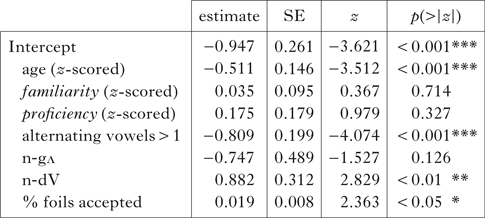
Table V shows the fixed effects of the maximal model, where negative coefficients indicate that a predictor improves the odds of the innovative form ([ndoː-mkɪzɪn]) and positive coefficients improve the odds of the historical form ([n-mʌkzɪn]).
Fixed-effects table for maximal model of levelling preference results. Italicised factors are excluded in the best-fitting model.

The key confirmation is that historical forms are strongly dispreferred, as can be seen in Fig. 2 above, where the historical form is typically chosen less than 50% of the time. That is, in addition to the baseline tendency to accept innovative forms represented in the intercept, there is also a large effect favouring the selection of innovative forms when there would be multiple vowel–zero alternations in the conservative form. Historical forms stand the best chance of being selected if the speaker is younger than average, or if the historical form is locally ambiguous with an innovative prefix. Notably, the effect of age is smaller than the effect of the presence of multiple alternating vowels. That is, in order for a historical form to be favoured when multiple vowels alternate, the speaker must be more than one standard deviation younger than the survey average. The dispreference for historical forms underlines the major result of the prefix allomorph survey: the cohort has effectively abandoned 1930s Nishnaabemwin forms.
5.1.4 Local discussion
These results are inconsistent with Valentine's (Reference Valentine2001) claim that highly proficient speakers continue to prefer 1930s forms. Speaker proficiency has a non-significant effect in Table V, and speaker age, which might be expected to be correlated with greater facility with 1930s Nishnaabemwin, is associated with an increased dispreference for 1930s forms.
The negative correlation of age with preference for 1930s forms is somewhat surprising, especially since the effect of age in the prefix survey was not substantial. It is possible that social desirability is responsible for this effect. 1930s Nishnaabemwin forms are prestigious in a society that values age and traditional knowledge. Under this explanation, younger speakers were being hypercorrect when they selected conservative forms, while older speakers are linguistically more secure.Footnote 17 Tentative support for this explanation comes from the fact that the two younger speakers who most frequently selected conservative forms also selected foils like *[n-mʊkzɪn] (in place of attested [n-mʌkzɪn] ‘my shoe’) three out of five times, the highest rate observed in the study (see Fig. 2c). These participants may have been determined enough to select conservative forms that they even selected false conservative forms. Strikingly, these speakers drive the correlation with age, as omitting speakers who selected foil forms 60% of the time causes speaker age to no longer be a reliable predictor.
In sum, the answer to the second research question posed in §2.5 is that speakers strongly prefer innovative forms over conservative forms with alternations. The prefix survey and the levelling survey together show that the restructuring cohort has uniformly adopted the innovative system; no subgroup maintains the conservative pattern. The next survey assesses whether the innovations are the result of attrition or otherwise imperfect knowledge of the 1930s pattern.
6 Survey 3: alternation accuracy
The previous two surveys showed that non-etymological prefixation and paradigm levelling are the predominant patterns for the restructuring cohort. The third survey sought to address the research question in (15c) by testing whether speakers can distinguish 1930s Nishnaabemwin prefixed forms from foils. The concern is that a lack of primary linguistic data may have impeded these speakers from acquiring a 1930s-style deletion process. If speakers abandoned 1930s prefixation and alternations because of insufficient data, they would be expected to distinguish poorly between actually attested 1930s prefixed forms and unattested foils.
The procedure was nearly identical to the one used in the levelling survey. Speakers were asked to choose the better of two potential 1930s prefixed forms. In this survey, the choice was between a historical prefixed form and a foil form. That is, the choice for the prefixed form of [mkɪzɪn] ‘shoe’ was between [n-mʌkzɪn] ‘my shoe’ and a form where random, distinct short vowels replaced all vowels that only occurred in the 1930s prefixed form, such as *[n-mʊkzɪn].
Participants were not given any prior information about the forms they would be evaluating, but were told that there would be two alternatives, of which one had to be chosen. Words were randomly drawn from the same lists used in the levelling survey, though no participant was shown the same word in both surveys. The survey ran until speakers recognised and evaluated 30 words. A total of 597 forced-choice judgements were collected (one participant did not complete all trials).
6.1 Results of Survey 3
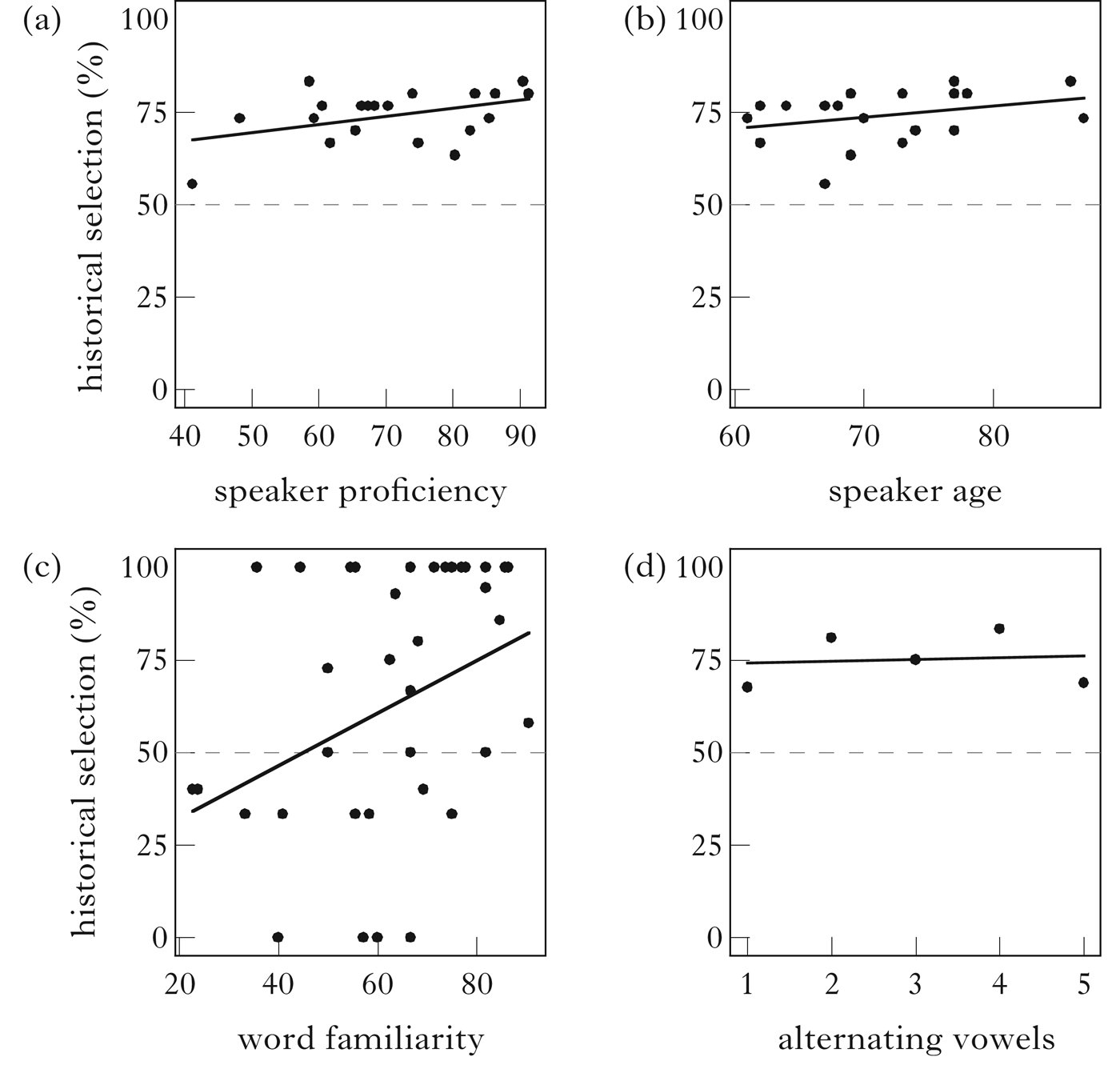
All speakers preferred attested 1930s Nishnaabemwin forms over foils. This can be seen in Figs 3a and b, which plot the rate at which individual speakers chose attested 1930s Nishnaabemwin forms by proficiency and age. Furthermore, word familiarity, but not the number of alternating vowels, is positively correlated with the rate at which 1930s forms were selected (Figs 3c, d).
Plots of alternation accuracy survey results. Dashed lines mark 50% (chance) historical selection rate. (a) Speaker-by-speaker plot of percentage of historical forms selected, by proficiency score; (b) speaker-by-speaker plot of percentage of historical forms selected, by age; (c) percentage of times historical form was selected, by word-familiarity score, for words that were sampled four or more times; (d) percentage of historical forms selected, by number of alternating vowels.

6.1.1 Model construction parameters
As in the previous surveys, generalised linear mixed-effects models predicting whether the conservative form or a foil was selected were fitted to the data. All models included random intercepts for speaker. As before, models included none or any of word familiarity, speaker age and speaker proficiency. Except where explicitly noted, all non-empty models also included the number of alternating vowels (binned between one or more) and whether a form had a local ambiguity with the parse [n-gʌ-] ‘1-fut-’.Footnote 18
6.1.2 Hypothesis testing and model selection
This survey probes whether speakers can reliably differentiate between true 1930s prefixed forms and foils. The test hypothesis is that speakers prefer true 1930s prefixed forms to foils, while the null hypothesis (dubbed the ‘attrition hypothesis’ here) is that participants do not. If the attrition hypothesis is correct, a likely cause is that speakers of the innovative modern language do not know the true 1930s prefixed forms, so speakers should choose foils and real 1930s prefixed forms at approximately the same rate. The attrition hypothesis is not supported, since speakers select true 1930s prefixed forms much more frequently than foils. Outright ignorance cannot be the explanation for the rise of restructuring across the entire cohort.
However, we still might expect to find echoes of attrition in this data. Specifically, speaker proficiency could predict whether conservative forms would be selected over foils. In this case we would expect low estimated vocabulary size to impede selection of conservative forms. This is not the case, as a model including only speaker proficiency does not significantly improve fit in comparison to an empty model (p = 0.1198, ∆AIC = 0.42).Footnote 19
AIC scores indicate that several models fit the data roughly equally well. The model with the lowest AIC score included word familiarity and speaker proficiency (AIC = 672.46), but similar AIC scores were obtained by models containing just word familiarity (AIC = 673.14), word familiarity and speaker age (AIC = 673.45) and all three predictors (AIC = 672.62). The least complex of these models (the one including only word familiarity) should be preferred, as none of the more complex models fit the data significantly better (familiarity and proficiency: p = 0.1014; familiarity and age: p = 0.1938; familiarity, proficiency and age: p = 0.1042).
6.1.3 Model criticism
Table VI shows the fixed effects for the maximal model (containing proficiency, familiarity and age as predictors). Positive coefficients correspond to an increase in the likelihood that the attested form is chosen.
Fixed-effects table for maximal model of alternation accuracy results. Italicised factors are excluded in the best-fitting model.

The model estimates that historical forms are selected at a much higher rate than foils, as reflected in the intercept value. This is significantly augmented by the effect of word familiarity, and whether there were multiple alternating vowels.
6.1.4 Local discussion
The earlier surveys established that, when choosing between historical forms and innovative forms, participants prefer innovative forms. This study has shown that participants can distinguish reliably between historical prefixed forms and unattested foils, suggesting that speakers have fairly accurate knowledge of 1930s alternations, despite having abandoned the historical system.
Note that we cannot disprove that the historical pattern was abandoned due to insufficient exposure. After all, we do not even know how much exposure to rhythmic syncope is enough to acquire it. But we can reject the proposition that the target cohort had dramatically impoverished experience with the old system. In fact, participants’ accuracy in this task is remarkable when we consider that the task is somewhat unnatural, and that they are evaluating forms that must have been largely unused for several decades.
7 Analysis of Modern Nishnaabemwin
The major empirical results of the three surveys are summarised in (16), in terms of the goals outlined in (15) in §2.5.
(16)
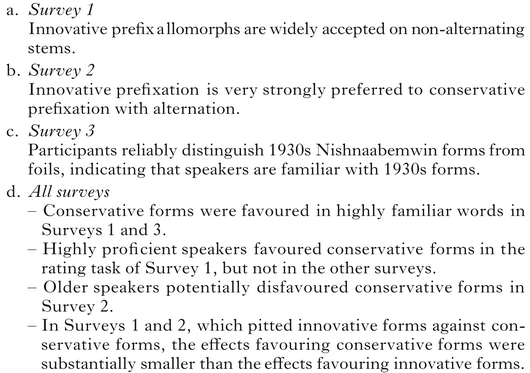
With the change in the language established, we can now ask whether the grammar changed as well. This section contrasts a restructuring analysis with a recapitulationist analysis, which posits synchronic rhythmic syncope in Modern Nishnaabemwin (Valentine Reference Valentine1994, Reference Valentine2001). The recapitulationist analysis encounters theoretical and empirical difficulties, which argues for the restructuring analysis.
7.1 Restructuring analysis
A restructuring analysis is quite simple. Underlying forms, to a very good first approximation (Bowers Reference Bowers2015: ch. 5), correspond to 1930s Nishnaabemwin unprefixed forms, and the person prefixes [ndʌ-, ndɪ-, ndoː-], and even [n-, nd-], are probabilistically deployed according to a speaker's preference for particular allomorphs (Bowers Reference Bowers2012). There is no need for the grammar to build and destroy iambic feet under this analysis, because all of the missing etymological vowels are already absent from underlying representations. Hence levelled paradigms in the modern Odawa varieties are generated via the identity map, so that /mkɪzɪn/ → [mkɪzɪn] and /ndoː-mkɪzɪn/ → [ndo:mkɪzɪn]. Other prefixed forms, like *[nmkɪzɪn] or *[ndmkɪzɪn], are ruled out by presumably high-ranked phonotactic constraints, as the word-initial clusters in such forms were unattested in 1930s Nishnaabemwin.
Central to the analysis of Modern Nishnaabemwin is the continued acceptance of 1930s prefixed forms. Under a restructuring analysis, 1930s Nishnaabemwin alternations are irregular. That is, the 1930s form for ‘my shoe’ is stored whole as /n-mʌkzɪn/, and produced without alteration. Deriving 1930s alternations via a general, regular rule is impossible if etymological vowels have been lost from URs. For instance, from a restructured UR like /mkɪzɪn/, vowels that appeared only in 1930s Nishnaabemwin prefixed forms, like the [ʌ] in [nmʌkzɪn], would need to be epenthesised. With three potentially epenthetic short vowels, [ʌ ɪ ʊ], such a procedure is not generally applicable.
There is some independent evidence for 1930s forms being listed irregulars, as many speakers in the study reported that regular innovative forms had compositional meanings, while 1930s prefixed forms had idiosyncratic meanings. For instance, one participant reported that the innovative form [ndoː-goːʤɪn] means ‘I hang’ (cf. [goːʤɪn] ‘he hangs’), while the conservative form [ndʌ-goːʤɪn] means ‘I fall’. This is reminiscent of the state of affairs in Tongan with respect to regularised and etymological suffix allomorphs (Kie Zuraw, personal communication); see also Hale (Reference Hale and Sebeok1973, Reference Hale1991: 100) on Maori.
A restructuring analysis, because it merely selects prefix allomorphs and does not alter the underlying representation, is compatible with any modern theory of grammar. Only the variability in prefix allomorph choice requires any departure from default grammatical mechanisms. A full analysis could be couched in current theories such as Partial Order OT (Anttila Reference Anttila, Hinskens, van Hout and Wetzels1997), Stochastic OT (Boersma Reference Boersma1997, Boersma & Hayes Reference Boersma and Hayes2001), Noisy Harmonic Grammar (Boersma & Pater Reference Boersma, Pater, McCarthy and Pater2016) or the Maximum Entropy model of Harmonic Grammar (Goldwater & Johnson Reference Goldwater, Johnson, Spenader, Eriksson and Dahl2003).
7.2 Recapitulationist analysis
A recapitulationist analysis of Modern Nishnaabemwin posits that underlying forms have not restructured, and that vowels continue to delete in an alternating pattern (Valentine Reference Valentine2001: 65–66, 79–80; see also Valentine Reference Valentine1994: 147–148 on Potawatomi). For convenience, the recapitulationist grammar is assumed to enforce a serial interaction between stress and syncope (McCarthy Reference McCarthy2008), though a subregular transducer obeying certain properties can also compute the mapping (Bowers & Hao Reference Bowers and Hao2018).Footnote 20
In order to generate rhythmic syncope alternations, [n-] must be part of a foot that contains stem material, thereby shifting foot boundaries leftwards. Meanwhile, in order to condition non-alternation, innovative prefixes must be followed by a foot boundary. The prefix [ndoː-] has a long vowel and thus is always followed by a foot boundary. However, [ndʌ-] and [ndɪ-] can only be followed by a foot boundary if they are disyllabic. This can be ensured by assuming that person prefixes contain syllabic consonants (see Valentine Reference Valentine2001: 74), yielding URs like /n̩-/ or /n̩dʌ-/.Footnote 21 Under the recapitulationist theory, the absence of overt alternations between [mkɪzɪn] and [n̩doː-mkɪzɪn] is the result of a new person prefix being followed by a foot boundary. Thus, whether a stem is preceded by a new person prefix or appears in isolation, its vowels will always be parsed into the same foot position, as in (m_ˈkɪ)(ˈzɪn) and (n̩ˈdoː-)(m_ˈkɪ)(ˈzɪn). This is illustrated in the derivation in (17).
(17)
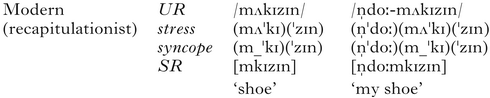
Because of the neat correspondence between foot boundaries and innovative prefix boundaries, under the recapitulationist account, the lexicon and grammar of Modern Nishnaabemwin remain substantially the same as 1930s Nishnaabemwin. The only major differences are that phonetic reduction is now phonological deletion, and that innovative prefix allomorphs have been created.
Note that the development of innovative prefix allomorphs must be stipulated in a recapitulationist account. Under a rhythmic syncope grammar, the presence of the stem-initial vowel in (n̩d-ˈʌ)(ˈgoː)(ˈʤɪn) ‘I hang’ or its absence in (_ˈgoː)(ˈʤɪn) ‘he hangs’ has a perfectly sound phonological explanation, where the stem vowel remains part of the stem, yielding /ʌgoːʤɪn/, and deletes following the general rhythmic syncope pattern. No innovation would therefore be expected in the language, and 1930s Nishnaabemwin would have been truly phonologised. An important apparent benefit of a recapitulationist analysis is that it need not resort to listing 1930s Nishnaabemwin prefixed forms, since it generates them directly from the UR when an appropriate prefix is used. For instance, forms like [n̩-mʌkzɪn] are analysed as the result of /n̩-mʌkɪzɪn/ →(n̩ˈmʌ)(kɪˈzɪn) → [n̩mʌkzɪn]. However, §7.3 shows that continued syncopation is a liability for the recapitulationist analysis.
7.3 Distinguishing restructuring from recapitulation
Wider descriptive facts weigh against the recapitulationist analysis of Modern Nishnaabemwin. As seen in (17), the recapitulationist analysis generates modern levelled paradigms by attaching an innovative prefix to a historically alternating word, as in /n̩doː-mʌkɪzɪn/ → (n̩ˈdoː)-(mʌˈkɪ)(ˈzɪn) → [(nˈdoː)-(m_ˈkɪ)(ˈzɪn)], but it can also attach a conservative prefix to produce a conservative prefixed form, as in /n̩-mʌkɪzɪn/ →(n̩-ˈmʌ)(kɪˈzɪn) → [(n̩-ˈmʌ)(k_ˈzɪn)] ‘my shoe’. However, this result only holds for consonant-initial alternating words. The recapitulationist analysis predicts that alternating words that began with a short vowel (VCV words) will overapply deletion. To see this, first consider the 1930s derivation of /ʌnʊkiː/ ‘work’ in (18).
(18)
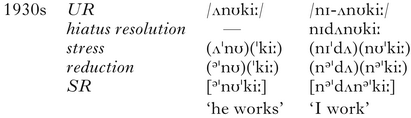
Recall from §2.2.1 that stem-initial short vowels were parsed into the prefix, thereby creating the innovative prefix allomorphs. Concretely, learners exposed to 1930s Nishnaabemwin analysed [ndʌnkiː] as [(n̩ˈdʌ)-(n_ˈkiː)] ‘I work’. As a result, the underlying representation for ‘work’ is /nʊkiː/, [ʊ] being supplied from the unaffixed form [nʊkiː] ‘he works’. The recapitulationist analysis thus predicts that modern speakers should produce the paradigm in (19).
(19)
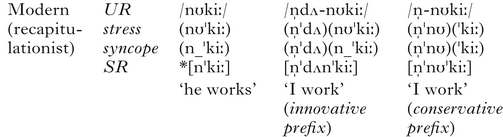
According to Rhodes (Reference Rhodes1985a, Reference Rhodesb: 467), modern speakers produce four forms. These are [nʊkiː] ‘he works’, with no deletion, [ndʌ-nʊkiː] ‘I work’ (where [ndʌ-] stands in for any innovative prefix), and, less frequently, the conservative deletion form [ndʌnkiː] ‘I work’ and the form [n-nʊkiː], with /n-/ attached to the stem. The recapitulationist analysis must include the original stem-initial vowel in the UR to prevent the vowel [ʊ] from obligatorily deleting in isolation forms and after innovative prefixes. That is, with all original vowels included, the recapitulationist analysis produces /ʌnʊkiː/ → [(_ˈnʊ)(ˈkiː)] and /ndʌ-ʌnʊkiː/ →[(n̩ˈdʌ)-(_ˈnʊ)(ˈkiː)].Footnote 22
Adopting this analysis requires an internally inconsistent view of the rise of the innovative prefix allomorphs (see Valentine Reference Valentine1994: 148 for early acknowledgement of the inconsistency). An underlying representation like /ʌnʊkiː/ can only exist if the morphological boundary between prefix and stem is not reanalysed from [nd-ʌnkiː] to [ndʌ-nkiː]. However, the most salient aspect of the modern language is that the innovative prefix allomorphs have cascaded across the lexicon, making it all but certain that the reanalysis occurred. The recapitulationist analysis must therefore propose that a rhythmic syncope grammar and the correct morphological affiliations were found by learners, but that learners nonetheless changed the language away from the rhythmic syncope system.
In contrast, the restructuring analysis states that the UR is /nʊkiː/, and the modern paradigm is generated seamlessly by the identity map, as in /nʊkiː/ → [nʊkiː] ‘he works’, /ndʌ-nʊkiː/ → [ndʌ-nʊkiː] or /n-nʊkiː/ → [n-nʊkiː]. Continued use of the historical form [ndʌnkiː] is due to lexical listing.
In sum, a recapitulationist analysis either misgenerates or results in contradiction when innovative prefixes on VCV words are considered. A restructuring account does not suffer from this problem.
8 Conclusion
The surveys in this paper confirm that Nishnaabemwin was thoroughly restructured by the generation born during and after the 1930s, in line with contemporary reports (Rhodes Reference Rhodes and Cowan1975, Reference Rhodes1985a, Reference Rhodesb, Piggott Reference Piggott1980). In both the prefix allomorph survey and the levelling survey, participants preferred innovative forms over 1930s forms. The results from the alternation accuracy survey show that participants did not avoid 1930s forms because of a lack of familiarity, as they reliably distinguished them from foils. Modern Nishnaabemwin thus arose from 1930s Nishnaabemwin despite what could only have been substantial exposure to the 1930s system.
The mere observation that a change occurred is not sufficient; we also require a description of the grammar of Modern Nishnaabemwin. The critical question is whether the phonological grammar recapitulates 1930s Nishnaabemwin with a phonological rhythmic syncope process, or whether the phonology has been restructured so that the grammar no longer actively enforces rhythmic syncope. A restructuring analysis appeals to large-scale memorisation of 1930s forms, but, unlike a recapitulationist analysis, it has a consistent position on the development of prefix allomorphs, and avoids generating incorrect modern forms.
The shift away from 1930s Nishnaabemwin is clearly relevant to phonological theory. The prefix survey highlights the breakdown of a tidy allophonic system, while the levelling survey illustrates a sharp dispreference against 1930s alternations. Such a response strongly suggests that learners had great difficulty with the phonological system, and ultimately did not acquire it. It is interesting to note that there are other aspects of Nishnaabemwin morphophonology, not discussed here, that by all accounts were faithfully transmitted to current speakers. First, 1930s Nishnaabemwin had an apocope process deleting word-final short vowels, which has not changed (see Piggott Reference Piggott1980, Reference Piggott1983: 84, Valentine Reference Valentine2001: 215). Second, it had an intricate inflectional class system in noun suffixation, which has also not changed (see Jones Reference Jones, Kaye, Piggott and Tokaichi1971, Valentine Reference Valentine2001: 174). Learners instead specifically rejected rhythmic syncope, which suggests that it may not be safe to assume that it can easily be acquired by learners. In the event that this difficulty is general, an explanation is needed. Such an explanation could lie in inferring the necessary underlying representations or in deducing the serial interaction of stress and syncope, or it could be due to the absence of the appropriate grammatical architecture for rhythmic syncope.