Historians of the Ottoman legal system agree that the basic precepts of Islamic law (the shari
a) were, as a matter of principle, to apply fully to the Muslim inhabitants of the empire on all matters civil, personal, and marital. Customary law (örf or adet) was, in personal and civil matters, always subordinate to it. Public law imposed by the Ottoman political authority (kanun and örf-i sultani) was promulgated on the authority of the state and reflected, first and foremost, the priorities and values of the imperial system.
1 Taxation is an obvious example, as the Ottomans were never burdenend with scruples as to the orthodoxy or equanimity of their tax assessment and collection procedures. So is the system of land tenure. For an overview of the relationship between Islam and the Ottoman polity, see Halil Inalcık, “Süleyman the Lawgiver and Ottoman Law,” Archivium Ottomanicum 1 (1969): 105–38.
Penal law was one other particular area where the Ottoman peculiarity in the implementation of the shari
a found expression. The powers of the religious judge, the kadı, were extended to include some supervisory duties, such as the policing of guilds and the regulation and control of markets. Urban security was also placed under his authority, with officers to help implement his decisions. In penal or commercial matters, the law that was effectively put into practice might have been an amalgam of shari
a, imperial fiat, and custom, the particular outcome being the result of the interplay of political and social forces.
But this was certainly not the case for issues strictly in the personal domain, such as marriage, family, and inheritance. Notwithstanding the discrepancies—mostly in matters of detail—among the four main schools of Islamic legal interpretation, it was the precepts of the shari
a that were supposed to govern the family lives of Ottoman Muslims.
2 For the law of marriage and divorce in Islam, see Y. Linant de Bellefonds Traité de droit musulman comparé (Paris, 1965). For its implementation, which seems always to have admitted a wide range of local variations, see Dawoud el-Alami and Doreen Hinchcliffe, Islamic Marriage and Divorce Laws of the Arab World (Kluwer, 1996); Ziba Mir-Hosseini, Marriage on Trial: A Study of Islamic Family Law (London: I. B. Tauris, 2000).
In the central lands of the empire and in Istanbul, the basic legal underpinnings of marriage and divorce of Muslims were provided by orthodox Islamic jurisprudence (more specifically, by the Hanafi school of law). There might indeed have existed many local variations. Everyday Ottoman legal practice, obviously a combination of law and life, often did deviate from strict Islamic precepts,
3 For instance, in Ottoman lands various roundabout methods, including the use of the waqfs, were devised to bypass the rules of property devolution implied by the Islamic law of inheritance: see Ömer Lütfü Barkan “Edirne Askerî Kassamına ait Tereke Defterleri (1545–1659),” Türk Tarih Kurumu—Belgeler 3, 5–6: 1–479; Ömer Lütfü Barkan and E. H. Ayverdi, Istanbul Vakıfları Tahrir Defteri, 953 (1546) (Istanbul: Istanbul Fetih Cemiyeti, 1970).
and the incongruities between legal norm and practice were perhaps more widespread than Ottoman historians usually admit. Still, on matters of marriage, divorce, family, and inheritance, the shari
a was the law that on the whole prevailed.
4 For the common practice of family law in the central Ottoman/Turkish lands, see Ziyaeddin Fahri Fındıkoǧlu, Essai sur la transformation du Code Familial en Turquie (Paris: 1936); Hayreddin Karaman, Mukayeseli İslâm Hukuku (Comparative Islamic Law) (Istanbul: Irfan yayınları, 1974); M. Akif Aydın, “Osmanlı Hukukunda Nikâh Akitleri,” Osmanlı Araştırmaları 3 (1982): 1–12; idem, İslâm—Osmanlı Aile Hukuku (Istanbul: Marmara Üniversitesi, 1985); Halil Cin, Islâm ve Osmanlı Hukukunda Evlenme (Ankara: Ankara Üniversitesi Hukuk Fakültesi, 1974); idem, Eski Hukukumuzda Boşanma (Ankara: Ankara Üniversitesi Hukuk Fakültesi, 1976); Peter Benedict “Hukuk reformu açısından başlık parası ve mehr,” in Türk Hukuku ve Toplumu üzerine İncelemeler, ed. Adnan Güriz and Peter Benedict (Ankara: Türkiye Kalkınma Vakfı, 1974).
And it had no alternative.
5 For a confirmation of this judgment but on a much wider level of implementation, see Haim Gerber, State, Society and Law in Islam—Ottoman Law in Comparative Perspective (Albany: State University of New York Press, 1994), 25–42.
The drive toward codification and modernization of the Tanzimat period culminated with a massive legal compilation (the Mecelle) that dealt only with commercial law and the law of obligations and left civil law untouched.
6 Aydın, İslâm, 134–35. The Hukuk-u Aile Kararnamesi of 1917 was the first Ottoman code of family law.
Marriage and family law was one sure legal area where the Weberian idea of a “kadı justice” could have no place. This generic term was used in the context of patrimonial societies to denote all non–Western legal systems seemingly devoid of internal rationality and of objective rules for dealing with ever renewed cases. Codified and predictable law was a root cause of the development of capitalism. The legal systems lumped together under the catchall label “kadı justice” were characterized by the unpredictability and intuitiveness that pervade court rulings. In such a system, the judge's discretionary powers are limitless, and their arbitrariness would entail a denial of basic human rights. An evaluation of the historical and anthropological underpinnings and consequences of such a view lies beyond the scope of this article. In the area of Ottoman Muslim marriage and family law, however, the contention that the absence of a written code of law results in unprincipled, excessively individualized, and almost random rulings is completely off the mark. The Ottoman kadı was armed with an impressive number of fatwa collections, authoritative legal opinions that covered the whole field. Exemplary court rulings were grouped in legal collections (sakk) and were widely used by kadıs as guides to formal precision and uniformity in rulings. Authoritative legal treatises belonging to all four Islamic schools of legal interpretation had been in use in the Ottoman Empire at least since the 16th century. In matters of family, marriage, and inheritance law, there was no room for a case-by-case “substantive law finding” process or for an “amalgamation of sacred and secular law,” as Brian Turner puts it.7
For a critical exposition of Weber's conception of legal rationality and of its opposite, the so-called kadi justice, in relation to Ottoman law and legal apparatus, see Gerber, State, Society and Law, 1–23; Brian S. Turner, Weber and Islam (London, 1974).
If custom did not fit the law, the kadı clearly had to be avoided, for the court would always force on those coming before it family law that might be at variance with their custom or with any local ad hoc arrangement. It remains, as we shall see in the case of one particular neighborhood, that some practical details and not a few of the solutions adopted by Istanbulites in the 19th century may have run contrary to the letter and the spirit of basic Islamic tenets on marriage. The simple and candidly open records of the local leaders of the Kasap Ilyas neighborhood in the second half of the 19th century provide an illustration.
THE KASAP ILYAS MAHALLE AND ITS RECORDS
The Kasap Ilyas (“Butcher” Ilyas) mahalle is a modest traditional neighborhood situated in south-central intra-mural Istanbul bordering on the Sea of Marmara. It was regarded as forming, with a couple of adjacent neighborhoods, a larger section (semt) of the city known as Davudpaşa, which was surrounded by such other well-known areas of traditional Istanbul as Etyemez, Cerrahpaşa, and Langa. The existence of this local entity and that of the small mosque from which it derives its name are documented from the end of the 15th century on.8
For a general portrait of the Kasap Ilyas mahalle at the end of the 19th century, see Cem Behar, “Fruit Vendors and Civil Servants: A Social and Demographic Portrait of a Neighborhood Community in Intra-mural Istanbul, the Kasap Ilyas Mahalle in 1885,” Boğaziçi Journal 11 (1997): 5–32. On the social and demographic history of the neighborhood, and for maps and the topographical setting, see idem, A Neighborhood in Ottoman Istanbul—The Kasap Ilyas Mahalle: Fruit Vendors and Civil Servants (Albany: State University of New York Press, 2003).
The neighborhood still exists as an administrative unit and is now within the bounds of the Fatih district of the Istanbul municipality. The available waqf registers for the neighborhood, as well as other elements of local folklore, bear evidence of a durable sense of local identity and significant intra-community links of solidarity.
Like all mahalles of Ottoman Istanbul, Kasap Ilyas was very mixed in terms of social class and status. Residential patterns in 19th-century Istanbul usually ran along lines of ethnicity and religion, not class or wealth. Like many of the peripheral Istanbul neighborhoods located near the city walls and gates, though, Kasap Ilyas seems to have been inhabited by relatively poor people. It contained a large number of small shopkeepers and street peddlers, a small community of manumitted black slaves, and a considerable number of rural migrant families of modest means who made a living from itinerant vending of fruit and vegetables supplied by the nearby Langa vegetable gardens. But the mahalle also housed a few high-ranking Ottoman military and bureaucrats who owned large and luxurious mansions (konak).
The first modern Ottoman population census was taken in 1885, and a second and last one was taken in 1907. The census rosters reveal that Kasap Ilyas had in this period a stable population of 1,000 to 1,100 people living in the thirteen streets and blind alleys that constituted the mahalle. The neighborhood contained a sizable minority (about 10%) of non–Muslim inhabitants (mostly Greek Orthodox) apparently living in harmony with the Muslim majority. Osman efendi (1842–1904), a haberdasher (astarcı; a dealer in small articles for sewing such as buttons, lining, and ribbons) by profession, was the muhtar (local headman) for about a quarter of a century, from 1880 on, and was instrumental in keeping and transmitting the records of his neighborhood.
The local records of Kasap Ilyas—indeed, an exceptional historical data set—were taken down by the successive imams of the local mosque and by the secular local headmen (muhtar) of the community. These headmen were appointed after the 1830s as part of the overarching administrative reforms of the Tanzimat period. We can provide no convincing explanation of why, among hundreds of traditional community neighborhoods of Istanbul,9
A listing of Istanbul neighborhoods established in 1876 contains the names of no fewer than 251 mahalles: see “Esami-i mahallât,” in İşbu 1294 Saferinin 22sinde…meb'usânın suret-i intihabına dair beyannamedir (Istanbul: Matbaa-yı Amire, 1876).
it was in Kasap Ilyas alone that such detailed records were kept or of why these alone have survived. These very particular records, as well as the neighborhood to which they belong, can have no claim whatsoever of “representativeness” of the city of Istanbul or of recording procedures for vital events.
The records are listed in three thick notebooks containing various types of information of local interest and kept by successive imams and muhtars. The notebooks contain a total of 679 marriage contracts covering a period of forty-three years, from 1864 to 1906.10
The notebooks, marked D1, D2, and D3, are now part of a private collection.
In addition to marriages, the notebooks contain (incomplete) records of births and deaths and of population movements to and from the neighborhood. The care and continuity with which the marriages were recorded, however, are in sharp contrast with the relative sloppiness shown in the registration of other vital events.
MARRIAGE AND MARRIAGE REGISTRATION
So far as we know, there was no tradition in the Ottoman Empire (or in any other Islamic lands, for that matter) of systematically recording demographic occurrences—that is, vital events. Births, deaths, marriages, and divorces were neither systematically recorded nor were the records centralized, be it for religious, legal, or political purposes. Some sparse parish records do exist of baptisms, marriages, and funerals for a few isolated Christian communities of the Ottoman Empire.11
See Haroutoune Armenian, Huda C. Zurayk, and Vahe Kazandjian, “The Epidemiology of Infant Deaths in the Armenian Parish Records of Lebanon,” International Journal of Epidemiology 15 (1986): 372–77; Youssef Courbage and Philippe Fargues, Christians and Jews under Islam (London: I. B. Tauris, 1997). In addition, records of baptisms, marriages, and burials of some Greek Orthodox communities of Istanbul in the 19th century are kept in the archives of the Orthodox Patriarchate. These, however, have not yet been delved into. Similar registers probably also exist for Christian communities of other Ottoman cities.
There are also Islamic court records of cases of marriage and divorce with litigation. But this is all that has been unearthed so far of pre–Tanzimat Ottoman historical documents directly related to vital events—in all, not a very representative demographic sample. Besides, the empire never had any official who was in charge of celebrating or registering marriage agreements. As to the registration of Muslim marriage contracts with the courts, records are notoriously incomplete. The references to the Kasap Ilyas neighborhood in the Davudpaşa Religious Court records of Istanbul (Şer'iye Sicilleri) mostly concern problematic or contentious cases of divorce with litigation or decisions on alimony (
nafaka).
After the re-centralizing drive of the Tanzimat reforms of the mid-19th century, it took some decades before a new, modern, and fully centralized Ottoman statistical system could be established and become fully operational. Before the first official regulation on census and population registration, dating from 1881 (the Sicill-i Nüfus Nizamnamesi),12
On the development of Ottoman demographic data sources, see Ömer Lütfü Barkan, “Notes sur les sources de démographie historique existant en Turquie,” in Colloque de démographie Historique, ed. Etienne Helin (Paris: Editions M. Th. Génin, 1963), 180–98; idem, “Essai sur les données statistiques des Registres de Recensement dans l'Empire Ottoman aux XVe et XVIème siècles,” Journal of the Economic and Social History of the Orient 1 (1957): 9–36; Cem Behar, Osmanlı İmparatorluğu'nun ve Türkiye'nin Nüfusu (1500–1927) (Ankara: State Institute of Statistics, 1996); idem, “Osmanlı Nüfus Istatistikleri ve 1831 sonrası Modernleşmesi,” in Osmanlı Devletinde Bilgi ve İstatistik, ed. Halil Inalcık and Şevket Pamuk (Ankara: State Institute of Statistics, 2000), 61–73; idem, “Sources pour la démographie historique de l'Empire Ottoman: Les tahrirs de 1885 et 1907,” Population (Paris) 53 (1998): 161–81; idem, “Qui Compte? Recensements et statistiques démographiques dans l'Empire Ottoman, du XVIème au XXe siècle,” Histoire et Mesure 13 (1998): 135–46.
there had been no attempt to systematically centralize record-keeping on births, deaths, and marriages in the Ottoman lands. This first Ottoman regulation on this issue was intended to constitute the basis of a population census, followed up by a compulsory and general population-registration system largely inspired by the Belgian registers of Quételet. The 1881 regulation entailed a legal obligation to declare and register all marriages within six months of the event. However, this first Ottoman regulation could not really be implemented, and the legal provisions for the registration of all vital events remained virtually ineffective. Vital registers with an acceptable coverage rate came into being only after the turn of the 20th century. The improvement was due to a new regulation issued in 1902 and leading to the new population census taken in 1907
13 On the late Ottoman population regulations and censuses and the registration system based on them, see Stanford J. Shaw, “The Ottoman Census System and Population, 1831–1914,” International Journal of Middle East Studies 9 (1978): 323–38; Alan Duben and Cem Behar, Istanbul Households: Marriage, Family and Fertility, 1880–1940 (Cambridge: Cambridge University Press, 1991), esp. 15–21.
that was accompanied by disincentives and penalties for non-compliers. A representative sample of marriage agreements drawn from post–1907 marriage registers of central Istanbul has been analyzed elsewhere.
14 Duben and Behar, Istanbul Households.
Data on marriage and on nuptial arrangements for periods preceding the 20th century are therefore quite exceptional to come by.
Islamic law does not consider marriage a sacrament. Marriage is not an act that has to be religiously sanctified or recorded. In sharp contrast to Christian marital blessing, the validity of a Muslim marriage is not dependent on its being blessed, performed, or recorded by any religious authority whatsoever. Marriage is only a contract between two people or, if they are not of age, between two families or guardians. Marriage obviously produces important civil and financial consequences. Islamic jurists and theologians unanimously agree that the presence of a man of religion is not necessary for the marriage to be valid and binding and does not constitute a seal of legitimacy. A declaration of intention in the presence of at least two adult male and legally capable Muslim witnesses is, in principle, sufficient to constitute a marriage agreement, provided that certain minimum legal conditions are satisfied on the part of the spouses. In all Islamic orthodoxy, the contract itself did not even have to be put on paper, although that seems to have been the usual practice in the capital city of the Ottoman Empire. The presence of at least two witnesses was deemed sufficient proof of the agreement. The marriage could also be agreed on in absentia, the spouses being replaced by their guardians or appointed legal representatives. In Ottoman Istanbul, a Muslim marriage became valid, and consummation socially licit, as soon as the contract was agreed on and, if the case be, the nuptial celebrations completed. The short religious ceremony that sometimes took place (never in a mosque, though) was performed on a purely voluntary basis.
The fact that a marriage contract was considered a purely personal matter never meant, however, that there was no control of any sort of marriages in Istanbul. Islam prescribes a certain number of fundamental preconditions, both formal and substantive, for a marriage contract to be valid. It is these basic preconditions that had to be controlled by the religious judge, the kadı. These preconditions mainly pertained to age, the mental and legal capability of both spouses, and the consent of their guardians, if any. Previous marital status, the opportunity given to them to exercise their free will, and the absence of some kinship relations considered an impediment to marriage were crucial. The suitability of the match (kefâet) in terms of legal status, social class, and moral standards was also an important legal precondition.15
That excessively disparate backgrounds of the spouses could be considered an impediment to marriage is also shown by Judith Tucker in the case of Ottoman Syria and Palestine in the 18th century: cf. Judith Tucker, In the House of the Law: Gender and Islamic Law in Ottoman Syria and Palestine (Berkeley: University of California Press, 1998). It is difficult, however, to evaluate the degree to which this equivalence was effectively met in Istanbul: see Duben and Behar, Istanbul Households, 120.
The exercise by the spouses of their free will was particularly important. In Kasap Ilyas there were two cases of marriage records involving manumitted slaves. In both instances, a certificate of manumission (
‘ıtıkname) signed by the former slave owner was produced during the drawing of the marriage contract as proof of the legal capability of the spouse.
The kadı in Ottoman lands had among his duties ruling on the legality of marriage contracts, and the archives of the religious courts are full of such rulings. Unlike in some other Islamic lands, this duty was never delegated. In fact, many of the kadı rulings were no more than marriage licences of a kind, documents certifying that, for a given person, there was no legal impediment to marriage. The izinnames (marriage permits) were to be required by the imam. The kadı also acted as an ex officio legal guardian for those who happened to have none. In all legality, one would have to obtain from the kadı one of these licences (a hüccet or izinname) showing that no barriers existed to the nuptial arrangements. To cover himself, the local imam, who in Istanbul was either present during the nuptial arrangements or was subsequently informed and recorded the marriage, was supposed to ask the parties to produce such a licence. The kadı could refuse to consider cases of litigation brought to him if the marriage had not been previously celebrated with the necessary izinname.16
See Aydın “Osmanlı Hukukunda Nikâh Akitleri.”
The 1881 Ottoman regulation that dealt with the recording of vital events prescribed that the imams should refrain from recording marriage agreements unless the marrying parties produced a regular
izinname. The 1902 regulation confirmed this basic requirement. So did the population registration law (Sicill-i Nüfus Kanunu) of 1914.
17 As we shall see, however, this legal requirement was never fully implemented in the capital city of the empire—let alone in the provinces or in rural areas.
THE MARRIAGE RECORDS OF THE KASAP ILYAS MAHALLE
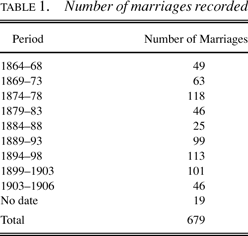
The number of marriage agreements recorded in the Kasap Ilyas neighborhood are given in Table 1. After the last Ottoman population census of 1907, births, deaths, and marriages began to be duly registered in centralized rosters (vukuat defteri) kept by the secular authority. As for the local records of Kasap Ilyas, they were discontinued after 1906. The death in 1904 of Osman efendi, who had conscientiously officiated as a muhtar for about a quarter of a century, may have been a factor. The unexplainable irregularity of the figures in Table 1 argues against any claim to exhaustiveness. Besides, these records cover neither all marriages contracted in the neighborhood nor necessarily marriages agreed on by local residents. They are marriage agreements that were brought to the knowledge of the local headman and recorded in his notebook.
First, this whole recording procedure was, for all we know, highly unusual. The muhtar was a purely secular local representative of government authority, a headman appointed to promote law and order in his neighborhood and to function as a link between the Istanbul populace and the government. True, it was the imam of the Kasap Ilyas mosque who was instrumental in the marriage agreement. It was he who performed the short religious ceremony that the parties sometimes must have demanded, to comply with local custom.18
In a few cases, the marriage record specifies that the “contract was drawn by the müezzin, the imam being absent”.
As for the local headman of the Kasap Ilyas neighborhood, however, in terms of Islamic orthodoxy his presence, actions, and records were simply redundant. The assessment and registration of the marriage contracts fall within the jurisdiction of the religious judge or his surrogate (the
naib). The encroachment of the headman's authority on such matters will be further illustrated in the context of the specific items included in the marriage agreements. In fact, this particular
muhtar's initiatives went far beyond the simple and perhaps understandable zeal shown by a meticulous late Ottoman local administrator intent on listing the names and dates of marriage of newlyweds in his ward as a matter of bureaucratic record-keeping. These local leaders unilaterally took upon themselves the authority to accept or reject the declarations of future spouses on the matter of their legal capability to contract a marriage. Thus, they went way beyond the legal limits of their religious and secular powers.
As noted earlier, the Kasap Ilyas neighborhood had at the time a population of about 1,000 people.19
See Behar, “Fruit Vendors and Civil Servants,” 5–32.
Over a forty-three–year period (1864–1906) there had been on average sixteen registered marriages per year (679 divided by 43). This “crude marriage rate” of 16 per thousand population is too high from a demographic standpoint. It is also highly unrealistic, given the unbalanced age and sex structure of the population of the neighborhood in the second half of the 19th century.
20 A “normal” crude marriage rate in a traditional population would not over the long run exceed about 10 per thousand inhabitants.
21 See Donald J. Bogue, Principles of Demography (New York: John Wiley and Sons, 1969).
The records therefore include a non-negligible proportion of marriage agreements involving people who were not permanent residents of Kasap Ilyas. Indeed, a few of the records bear explicit marginal notes indicating either that the marriage involved people residing elsewhere or that the marriage contract was agreed on in another neighborhood. The note to a marriage recorded on 12 October 1867, for instance, says that the nuptials were those of Ayşe binti Hasan and Mehmed efendi and that the groom was the imam of a mosque in another
mahalle (the Hacı Pirî neighborhood).
22 “Hacı Piri mahallesi imamı Mehmed efendinin akd-i nikâhı”: D1, 3b.
On 29 April 1877, a marginal note to Hadice binti Mehmed and Mehmed Asaf efendi's nuptials specifies that it had been celebrated not in Kasap Ilyas but in the Bayezid-i Cedid neighborhood.
23 “Bayezid-i cedid mahallesinde icra olunan akd-i nikâh bervech-i âtî beyan şüd”: D1, 11b.
The marriage records give no addresses before 1890, so only in a very few cases are the whereabouts of the spouses or the marriage contract indirectly referred to. Only after 1890 do the marriage records begin to include a more or less precise address in the neighborhood.24
In Istanbul, streets received official names and houses were given numbers in the 1870s.
Only 168 of the 359 post–1890 records (46.7%), however, point to a precise location within Kasap Ilyas, and we can surmise that many of the remaining 191 marriages took place or involved people residing in other areas of the city.
The fact that there were, in the second half of the 19th century, fewer Kasap Ilyas residents who recorded their nuptials elsewhere than non-residents who chose to deal with the imam and muhtar of our neighborhood is perhaps related to the confidence inspired by the local leaders of Kasap Ilyas themselves. The permanence of the Kasap Ilyas mosque and of its namesake neighborhood since the end of the 15th century must have enhanced the prestige of the local leaders.25
In sharp contrast to the frequent changes in the names and borders of traditional Istanbul neighborhoods, Kasap Ilyas has demonstrated a surprising degree of stability through the centuries. For a history of the Kasap Ilyas neighborhood since the 16th century, see Behar, A Neighborhood in Ottoman Istanbul.
THE MARRIAGE AGREEMENT AND ITS CONTENTS
The amount of information contained in each of the 19th-century Kasap Ilyas marriage agreements varies considerably. “Core elements” present in all of the records are very few. Besides, the records are unsatisfactory from a strictly demographic viewpoint, since none give any indication of the age or date of birth of the spouses. They are not, therefore, amenable to demographic analysis.
The simplest marriage record, reduced to its bare bones, contains only the date of the agreement, the names of the spouses and of the witnesses, and the amount of the mehr (marriage payment). Many of the records are more prolix, though. In general, they contain the core informative elements and a combination of the following items: (1) the mehr that has actually been paid (the mehr-i muaccel) and the amount that has been postponed as a promissory payment (the mehr-i müeccel); (2) the official titles and occupations of the witnesses; (3) the name and occupation of the legal representative(s) (vekil) of the spouses, if the case be; (4) the marriage order, in case the marriage is not the first; (5) special conditions inserted in the marriage agreement, if any; (6) izinnames, certificates, written or oral statements either of the spouses or of third parties stating that there is no legal or religious obstacle to the marriage agreement; and (7) oral testimony or written proof of the wife's divorce if she was previously married.
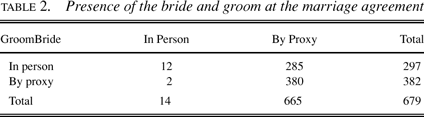
Some of these items of information are more amenable to classification, quantification, and tabulation than others. Whether each of the spouses was effectively present during the nuptial agreement or not, for instance, is a clearly quantifiable item of information. So is the number of witnesses, the types of marriage payments that have effectively been made, and their amounts. The number and proportion of records accompanied by the mention of a legal justification or a guarantorship can also be easily calculated. If the spouse is physically present in the recording of the marriage agreement, this fact is mentioned in the record (asaleten). If not, the name of the legal deputy is invariably entered. Marriages where no mehr or no witnesses are mentioned are clearly instances of faulty recording.
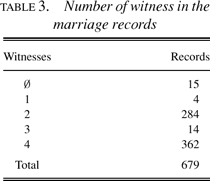
The classification of the records according to these four simple quantitative criteria is given in Tables 2–5. As the vertical and horizontal totals in Table 2 show, women were replaced by legal representatives in a much larger percentage of the nuptial agreements than men (98% versus 56%). Both spouses were physically present in a very small proportion of the records—that is, in only 12 of the total 679 marriages (Table 2). There is no apparent relationship between the groom's physical presence during the marriage contract and any known socio-economic variable such as occupation, status marker, or amount of the marriage settlement. The same can be said about the number of witnesses. Two and four are obviously the preferred numbers of witnesses—that is, either one or two witnesses appear on behalf of each of the spouses. In 19 records, no witness appears or only a single witness is noted (Table 3).
However, in almost all of the nuptial arrangements where both spouses were absent, there were four witnesses, whereas in most of the cases where at least one of the spouses was physically present, only two witnesses attended. A tradeoff seems to have existed, in the minds of the Istanbulites, between the number of witnesses to a marriage agreement and their own physical presence. In the cases where the spouses were not present, the presence of the extra witnesses seems to have been intended to compensate. This tradeoff is, of course, entirely spurious. The local customs of the Istanbulites had been transmogrified into a totally erroneous sui generis interpretation of religious requirements. The only thing that the shari
a clearly imposes in this matter is the presence of at least two Muslim, free, mentally able, adult male witnesses. This requirement is unrelated to whether the spouses are physically present at the drawing of the marriage agreement.
As for the statements of guarantee appended to marriage agreements, a typical simple statement would read: “this marriage agreement was recorded under the guarantee of such and such a person.”26
The entry dated 2 July 1877/9 Cemâziyülâhir 1294 gives the following explanatory note: “koltukçu Hüseyin Ağa'nın kefaletiyle kıyılan akd-i nikâh (agreement recorded under the guarantee of Hüseyin Ağa, the old-clothes-man)”: D1, 11b.
A more complex note is the following: “the bride is the former wife of Süleyman efendi of Bostancık, who has repudiated her in the neighborhood coffeehouse in the presence of witnesses, as shown in the stamped and signed declaration that we keep; Ali Rıza, of the mounted police, and Ali Kâhya have certified in writing that none of the spouses have any legal or religious impediment to matrimony.”
27 Those are approximately the contents of the note appended to the marriage record dated 7 January 1896/20 Recep 1313. “[M]ezbûre Bostancıklı Süleyman efendinin zevce-i sâbıkası olup mahalle kahvesinde şahitler huzurunda tatlik edip kendi mühürleriyle olan senet bizde mahfuzdur, mezburânın hiçbir vechile mani-i şer'i ve nizamileri olmadığına dair bâb-ı zaptiyede süvari polisi Ali Rıza ile Ali Kâhyanın senedi vardır”: D3, 33a.
We shall return to the issues raised by the presence of various types of statements of guarantee inserted in the marriage agreements (Tables
4 and
5).
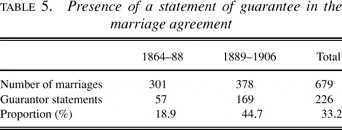
The temporal distribution of these statements of guarantee, however, deserves some attention. We have chronologically subdivided the bulk of the 679 marriage records under study into two more or less equal chunks. Clearly, a significantly smaller proportion of guarantor statements appear in the first sub-period compared with those in the second. Furthermore, these statements, which are usually oral and quite simple and straightforward in the beginning, tend to become more detailed and complex over time. They are also more frequently put down on paper.
It appears that there was a clear trend toward a more thorough check of the legal capability of those who were entering into a marriage contract. This capability was supported by various declarations by third parties. The muhtar and the imam of the Kasap Ilyas neighborhood were less and less willing to record marriage agreements that could run counter to religious requirements (and that could be annulled later by the kadı). As far as I can surmise, the more rigorous implementation of the rules in matters of marriage was due neither to a general increase in the religiosity of the Muslim population at large nor to any change in the law relative to matrimony. It was due simply to the desire of the two local officers to protect themselves.
In the last decades of the Ottoman Empire, it was paradoxically the establishment of a compulsory but purely secular registration system of vital events in the 1880s that gave rise to a more resolute application of the shari
a in matters of matrimony. As shown by the notebooks of the muhtar of the Kasap Ilyas neighborhood, the legal obligation to register marriages with the secular authorities brought more meticulous control of the religious preconditions of the marriage contract. The centralization and modernizing bureaucratic reforms of the Tanzimat period had led to a more rigorous implementation of the law, but the law here was the shari
a. Greater care was taken (probably also thanks to a demand coming from the spouses themselves) to check more thoroughly and put down in writing the fact that the parties had no legal or religious obstacles to matrimony.
28 “Mani-i şer'isi veya nizamisi olmadığı” is the quasi-canonical formulation used in most of the cases.
Whether this crucially important assertion, from the viewpoint of the Islamic law of marriage, was always upheld by conclusive or sufficiently weighty evidence, however, is another matter.
One further point, related to the identity of the witnesses to the nuptial agreements, has to be stressed here. As a matter of principle, it was the spouses who were supposed to bring forward the witnesses to their nuptials. That is not exactly how things seem to have functioned in Kasap Ilyas, though. In a large number of cases, the witnesses were in no way related to the marrying couple but were present as a matter of pure formality. Some witnesses' names recur in such a strikingly large number of marriage contracts that it is impossible to believe that these people were bona fide witnesses of a legal contract. It is highly unlikely that they attended because they had a significant relationship with all of the couples on the nuptial agreements of which their name appears, or even that they knew them personally.
For instance, Mustafa, who was the night watchman (bekçi) of the neighborhood, appears as a witness in no fewer than twenty-one marriage contracts between 1878 and 1884. The name of another bekçi, Mehmed ibn Hasan, appears in seventeen instances between 1885 and 1890. Yet another, Ömer ibn Mehmed, has his name mentioned nineteen times between 1892 and 1899. The muezzins of the Kasap Ilyas mosque appear as witnesses in thirty-five different instances between 1881 and 1906. Even the janitors (kayyum) in charge of keeping and cleaning the Kasap Ilyas mosque were called on to witness ten different marriages in the 1870s. Not surprisingly, the muhtars themselves acted as witnesses. The name of the local headman Ismail ibn Mehmet appears fifteen times between 1869 and 1877; that of his aide (muhtar-ı sani), Süleyman ibn Hasan, thirteen times between 1864 and 1872; and that of another aide, Osman ibn Ali (who became a muhtar a few years later), in thirteen instances between 1873 and 1880.
Other locals were called on to act as a witness or as a legal representative of one of the spouses. Hacı Ibrahim ibn Sadullah, the Şeyh of the local dervish lodge (the Gümüş Baba tekke) affiliated to the Kadirî order, for instance, was present in no fewer than twenty-four different marriage agreements between 1864 and 1885. His son and successor to the shaykdom of the same lodge, Hacı Izzet ibn Ibrahim, was present in seven instances. Other well-known figures of the neighborhood, such as the owner/manager of one of the local coffeehouses and the warden of a trade guild who happened to live nearby, appear on the records in a much larger number of instances than a random distribution could have warranted.
Clearly, the neighborhood had a pool of potential marriage witnesses to whom the imam and the muhtar had easy access. These were called on whenever a witness was missing or a representative needed to record a marriage already arranged and agreed to. Whether the Islamic legal precepts on marriage were respected not only in form but also in substance was apparently not a primary concern when it came to rounding up the witnesses.29
See Karaman, Comparative Islamic Law, 269.
There is, however, one precise point at which both the formal and the substantive requirements of the Islamic law of marriage were always fully put to practice in the Kasap Ilyas neighborhood: the religious affiliation of the witnesses, of the guarantors, and of the spouses' legal representatives at the nuptial agreement. All four Islamic schools of legal interpretation agree that in a marriage where both bride and groom are Muslims, the witnesses (and a fortiori the legal representatives of the spouses) should be Muslims, too. As mentioned, in the second half of the 19th century, the neighborhood contained a sizable minority (about 10%) of non–Muslim inhabitants. However, not one non–Muslim witness, guarantor, or representative appears in the 679 marriage records. Not a single exception mars this rule. The obverse is, of course, also true. Not a single marriage record of local non–Muslims appears in the notebooks of the imam and muhtar. For the local Christians, marriage was a religious sacrament, and it had to be performed—and eventually recorded—by the church.
As for those who were called on by the muhtar or the imam, they willingly complied and played their part as witnesses or legal representatives. In Islam, the state of matrimony is considered preferable and even morally superior to that of celibacy. Helping to form a couple and a family is nothing less than a good deed. The ad hoc local witnesses and legal representatives felt that they performed a good and moral act by contributing to marrying people off.30
It is also possible that some of these frequent witnesses (the janitor, the night watchman, for instance) were compensated for their services.
That is surely also why, on the whole, their names appear more frequently in the nuptial records of relatively poor/modest inhabitants of the
mahalle.
DIVORCE AND REMARRIAGE
According to Islamic law, divorce is an easy matter—at least, for the husband. For a repudiation (talâk) to be valid, it was sufficient for the husband to make a declaration in front of two witnesses. This could be registered later by the kadı, but even that formality was often avoided. The exceptions are the cases in which the wife took the case to court and sued either for alimony, if the couple had children, or for the effective payment of the portion of the mehr that had been deferred at the time of the marriage (the mehr-i müeccel).
A divorce procedure could be initiated by the wife, and the divorce could take place by mutual consent (this was called hul' or muhala'a). In that case, the wife agreed to relinquish her rights to the part of the mehr that had not yet been paid and to alimony. The Istanbul Religious Courts' records contain a large number of such cases. Contrary to simple repudiation, this type of divorce required a regular court ruling to make the decision binding. The husband could, through a special provision inserted in the marriage contract, relinquish his right of repudiation or transfer it to his wife (tefviz-i nikâh). This was common practice in the nuptials of female members of the Ottoman ruling household.31
See Cin, Eski Hukukumuzda Boşanma, 67–69.
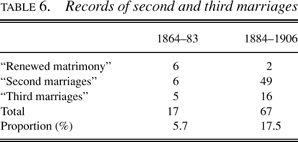
The simplicity of the procedure of repudiation is misleading, however. Indeed, couples who found themselves divorced after a few words said in anger often wanted to be reunited. Words pronounced in front of witnesses could not be retracted, however, and if the canonical waiting period (iddet) was over, a new marriage contract had to be drawn. In official parlance, these couples entered into a “second contract” (akd-i sânî) or they “renewed their matrimony” (tecdid-i nikâh). If the wife had been repudiated twice, the reunited spouses entered a “third marriage” (akd-i sâlis). For each of the matrimonial agreements, a new mehr had to be specified. These items of information were invariably indicated with the relevant marriage record. Table 6 presents the distribution of these marriages.32
The table does not include second or third marriages of polygynous husbands. The Kasap Ilyas marriage records contain no mention of the marriage order of polygynous husbands.
A non-negligible proportion of marriage agreements recorded in Kasap Ilyas (12.3% of the total 679) therefore concerned the second or third nuptials of a previously separated couple. The extraordinary increase in the proportion of remarrying couples during the second sub-period is probably artificial and is an unexpected byproduct of the introduction of compulsory registration of vital events in the 1880s. Here, too, a purely secular obligation to register marital unions had given rise to a more thorough check of the previous marital status of the spouses and of the religious preconditions of the nuptials.
Islam allows the husband to remarry his divorced wife only after a first or a second repudiation. If the wife has been repudiated three times (the three repudiations can be successive or simultaneous), the couple falls under a legal prohibition to remarry unless the wife has, in the meantime, legally contracted, effectively consummated, and officially terminated a valid marriage with another man. A purely formal or temporary marriage arrangement between the thrice-repudiated wife and a complacent third party—that is, the use of a legal stratagem to bypass the prohibition—was possible. But this was morally reprehensible (mekruh) and illegal.33
See Cin, Eski Hukukumuzda Boşanma, 51–61; Y. Linant de Bellefonds, Traité de droit musulman comparé, 405–407.
There is reason to believe, however, that such sham marriages, set up to liberate the divorced couples from a legal prohibition, were widely practiced in 19th-century Istanbul. The legal device involved was called a hülle, and the man who agreed to act as a straw husband (sometimes for a sum of money) was called a hülleci. He was expected to marry the woman repudiated three times and then repudiate her without consummating the marriage. This last detail turns the marriage, as a matter of fact, into a legally “incomplete” one and makes it prone to annulment. Article 118 of the Ottoman Family Law (Hukuk-u Aile Kararnamesi) of 1917 confirmed and codified the Islamic prohibition of the sham interim marriage and confirmed that consummation was an essential condition for the validity of a marriage contract.34
This first Ottoman Code of Family Law was recently republished: see Aile Hukuku Kararnamesi (Istanbul: Ebru yayınları, 1985), 43.
The imam of the Kasap Ilyas mosque and the muhtar of the neighborhood did not always heed these legal and religious injunctions. In at least one instance, they openly and clearly disregarded the rules of the shari
a on the issue of a thrice-repudiated wife. On 21 November 1899, the nuptials of Mustafa ibn Süleyman and Emine binti Abdullah were recorded. The marginal note to the record of their marriage agreement reads: “[a]fter the brother-in-law of the above-mentioned Mustafa ibn Süleyman divorced Emine binti Abdullah, a hülle was performed and she was married to her first husband.”
35 “Mezburun eniştesi mezbureyi baad'el tatlik hülle-i şer'iye icrasından sonra zevc-i evvel mezbura”: D3, 98.
Mustafa ibn Süleyman had repudiated his wife Emine binti Abdullah three times and then had changed his mind. He then asked his brother-in-law (
enişte),
36 In Turkish kinship terminology, enişte designates either a sister's husband or a paternal or maternal aunt's husband.
whose name is not mentioned in the record, to act as an interim husband—that is, marry his former wife Emine and then divorce her. The result was a typical case of
hülle involving a wife repudiated three times, a repentant husband, a friend or relative willing to play the part of sham husband, and a complacent imam to formalize and record the whole event.
If that typical case of hülle had ever been brought to the knowledge of the kadı, there is no doubt that Mustafa ibn Süleyman and Emine binti Abdullah's last nuptial arrangement would have been declared null and void. Mustafa's brother-in-law would also have been punished for being instrumental in an illegal deal, and so would the imam of the Kasap Ilyas mosque. The imam and muhtar, knowing full well that there was here an artificial step designed to evade the law, candidly recorded the occurrence without trying to conceal the truth. Whether there were other cases of hülle among the 679 marriage records of Kasap Ilyas we do not know.
THE MARRIAGE-PAYMENT, ISLAMIC LAW, AND LOCAL PRACTICE
The marriage payment (mehr) is a fundamental feature of the Islamic law of marriage, an essential component of any marriage contract. Mention of its exact amount, however, could be omitted in the contract. The religious court would then ex officio assign an appropriate sum. The mehr was a payment handed by the groom or his family directly to the bride, and it legally belonged to her. Unlike the traditional brideprice, called başlık, aǧırlı k, kıymet, or kalın and common in many Anatolian rural areas, the Islamic marriage payment did not go to the bride's family, father, or other kin.
It was common Ottoman practice to pay the mehr in two parts.
37 This was also the case in the Arab provinces of the empire where the Hanafi school of legal interpretation prevailed: cf. Tucker, In the House of the Law, 52–57.
The first part, which was to be paid by the husband when the marriage contract was drawn, was the
mehr-i muaccel (the advance
mehr). Payment of the second part (the
mehr-i müeccel, or deferred
mehr) was to be made later. The woman maintained her absolute right to it, though, and it had to be paid in the case of a repudiation. In case of a divorce by mutual consent, the wife could, as part of the financial arrangements, relinquish her right to the as yet unpaid portion of the
mehr. The shari
a court of Davudpaşa in Istanbul recorded a large number of instances of muhala'a concerning couples from the Kasap Ilyas neighborhood. On the husband's side, the mehr was an outstanding debt that had priority over all of his other debts. In case of the husband's death, the mehr-i müeccel had to be paid to his widow before any of his other debts were redeemed and before his estate was divided among the legal heirs.
The mehr could be paid in cash or in kind, and in quite a few cases in the Kasap Ilyas neighborhood the advance mehr had been paid in kind. A great variety of objects (furniture, household appliances, jewelry, a share in the ownership of a house) were given as mehr-i muaccel. The mehr-i müeccel, however, was a promise to pay and was always a sum of money. Table 4 gives the distribution of the information concerning the mehrs attached to the 679 Kasap Ilyas marriage agreements. In twenty-three records, no marriage payment appears at all. The deferred mehr is indicated in all of the remaining 656 records, whereas the advance mehr is present along with the deferred one in only 232 records (35.2%). The difference is too large to be due only to sloppy recording. Besides, the amount of the mehr-i müeccel seems sometimes to have functioned as a symbolic status marker for the family of the groom. In some other cases, families tried to safeguard a daughter's marriage and security by having a disproportionately large mehr-i müeccel put in the agreement, to serve as a deterrent to hasty repudiation.
A robust record would require that the full mehr, with both of its parts, be indicated. But this condition was fulfilled in only about one-third of the registrations. This is all the more surprising since the advance mehr, an existential condition of the marriage, had to be paid at the time of the nuptial agreement. Otherwise—and if this became later the object of a legal dispute—the marriage could be declared null and void. One has to assume, therefore, that in all of the 232 cases where the amount of the advance mehr was clearly specified, it had also been effectively paid. Apparently, however, this inference is not always justified, for in quite a few of these 232 cases (about twenty in all), the record notes not only the amount of the advance mehr but the fact that payment has really taken place. Some of these marginal notes even mention that the witnesses are not only witnesses to the marriage agreement but also to the effective disbursement of the mehr-i muaccel.
38 The term used in the records is “şuhûd'ül mehr (witnesses to the mehr).” These notes of effective payment are apparently not concentrated in the upper or lower end of the range of mehrs.
To give but a few examples, in the nuptials of Halil ibn Ahmet and Ayşegül binti Mustafa, on 23 February 1892, a
mehr-i muaccel of 350
kuruş is indicated, and the record mentions that this sum was paid “in our presence.”
39 “[H]uzurumuzda verilmiştir,” meaning that of the imam and the witnesses: D3, 21a.
On 21 November 1893, Ismail ibn Hüseyin, a cart driver, married Cemile binti Abdullah with an advance
mehr of 1,051
kuruş; the record says that the sum of 1,051
kuruş was “received in full.”
40 On another occasion, that of the nuptials of Halil Kâhya ibn Ibrahim and Safiye binti Veli, on 15 March 1889, the record indicates that the
mehr-i muaccel of 1,000
kuruş “had been paid in advance.”
41 “peşinen verilmiştir”: D2, 58b.
For a marriage whose validity is not in doubt, such financial statements are redundant.
42 The exact amount of the mehr is not of crucial importance in this context. There is, however, no discernable trend in the amounts given as marriage payment during the period under study. The mean mehr-i müeccel in Kasap Ilyas was 882.5 kuruş in 1865–70; 756.5 kuruş in 1875–80; 836.9 kuruş in 1885–90, 855.7 kuruş in 1890–95; 1,260 kuruş in 1895–1900; and only 684.2 kuruş in 1901–1904. The mode was either 301 or 501 kuruş. The last quarter of the 19th and the first decade of the 20th century were times of relatively stable prices or very mild inflation: see Şevket Pamuk, Five Hundred Years of Prices and Wages in Istanbul and Other Cities (Ankara: State Institute of Statistics, Historical Statistics Series, 2000). As for the amount of the mehr itself, it was neither a deterrent nor an incentive to marriage and did not make up a large proportion of the expenses that had to be incurred during marriage: see Duben and Behar, Istanbul Households, 107–21.
Do all these “protests” constitute a solid a contrario argument for the inference that whenever the redemption of the advance
mehr was not witnessed or was not mentioned in the marriage record (192 cases; see
Table 4), it had not been effectively made? I would not push the argument that far. However, whatever the ultimate motivations for backing the marriage payment with witnesses might have been, this fact does cast a shadow of doubt on the conformity of all the non-witnessed advance marriage payments to the requirements of the shari
a.
Whether paid on the spot or deferred, the mehr is a fundamental precondition of marriage. So important is the payment of the mehr from the viewpoint of Islamic marriage law that the wife, to whom that payment lawfully belongs, is not allowed to relinquish her right to it. She cannot forgo the payment of any of its constituent parts, either. The only exception is the case of a divorce by mutual consent, which requires a regular court ruling.
This is not how in at least four different cases the imam and muhtar of Kasap Ilyas proceeded. These were all cases of couples being lawfully remarried after a first repudiation. Normally, the husband would have to pay the deferred mehr-i müeccel right after the repudiation. Then, if the couple decided to reunite, a new mehr would be specified in their second nuptial agreement. Indeed, a few records of second marriages of the same couple do include a note to that effect. The note specifies either that “the first mehr-i müeccel has been paid and the second is equal to” or that “the husband owes the wife both the first and the second mehr-i müeccel, that is, a total of.” In these four particular cases,43
These four records are dated 3 July 1892/6 Zilhicce 1309; 16 July 1892/19 Zilhicce 1309; 29 August 1892/3 Safer 1310; and 23 January 1900/20 Ramazan 1317: D3, passim.
however, the marginal note accompanying the amounts of the
mehrs candidly reads: “the husband has been relieved of the first
mehr.”
44 “Mehr–i evvel bağışlanmıştır.”
The wife had no right to do that, and the imam no authority to record a disclaimer that would ipso facto invalidate her marriage. We have here four records of a blatantly illegal action, with the rules being bent to fit some ad hoc Istanbulite marriage agreement.
Another issue related to the congruence of Islamic law with local Turkish marriage customs concerns the bride's power of disposal over the mehr and especially the mehr-i muaccel. This Islamic requirement is in sharp contrast with the traditional rural Anatolian/Turkish bride price that was a payment going from the husband's kin group directly to that of the wife and was called başlık, aǧırlık, or kıymet. As confirmed by all experts of Islamic law, the ultimate destination of the bride price is indeed a major differentiating trait between shari
a and Middle Eastern local customs.
How about Ottoman Istanbul, though? Was the mehr really left to belong to the wife herself? Was the advance mehr paid directly to her? Could she and did she have an absolute right of disposal over it? The city of Istanbul contained a large percentage (almost 50% in 1885) of people born in the provinces who had brought with them their traditional marriage patterns, customs, and household structures. Among these customs there was that of the traditional başlık, whose destination was the bride's guardian or kin group. Did the familial and gender realities of Istanbul in the second half of the 19th century, then, allow for full satisfaction of this requirement of Islamic marital law? The absence of sufficient data and information on the “off the record” financial transactions involved in Istanbul marriages makes it impossible to give satisfactory overall answers to these questions. These questions—“Was the mehr a universal feature in Ottoman Muslim marriages or was it confined to educated urban circles where knowledge of the law was presumably widespread? And did the advance mehr usually in fact go to the wife or to her father or guardian?”—have already been asked about 18th-century Ottoman marriage transactions but remain unanswered.45
Colin Imber, “Women, Marriage and Property: Mahr in the Behçetü'l Fetâvâ of Yenişehirli Abdullah,” in Women in the Ottoman Empire: Middle Eastern Women in the Early Modern Era, ed. M. C. Zilfi (Leiden: E. J. Brill, 1997), 81–104.
The marriage records of Kasap Ilyas suggest that, in this matter, people may not always have clearly demarcated among tradition, routine, and Islamic prescriptions. How else can one explain the fact that in 44 of a total 192 Kasap Ilyas marriage records (that is, 23% of the cases) in which the amount of the mehr-i muaccel does not appear, the payment of a kıymet (in 32 instances) or of an aǧırlık (12 instances) is clearly put down in the record? In these forty-four records no advance mehr is recorded but, as if to replace it and side by side with the ever present mehr-i müeccel, a kıymet or an aǧırlık of a certain amount is indicated.
Were these two last terms a simple misnomer for the Islamic mehr-i muaccel? That was perhaps the case in the very few records where the amount of the kıymet and that of the müeccel were summed up to indicate the total amount owed by the husband. One of them reads: “kıymet 440, müeccel 501, the total is 941 kuruş,” assimilating the kıymet to a sum owed directly by the husband to the wife.46
This marriage agreement is dated 6 October 1892/14 Rebiyülâhir 1310 and reads, “kıymet 440, müeccel 501, cem'an 941 kuruştur”: D3, 31a.
But no arithmetical summation was done in the majority of the fourty-four records, where the customary
kıymet and the Islamic
mehr-i müeccel stood side by side.
Were those who drew up the marriage contract and recorded it aware of the difference between these two types of payments? If they were aware, they were letting local custom have the upper hand over the shari
a. And if they were not, it may mean that in late-19th-century Istanbul, traditional usage was widely referred to as religious prescriptions, anyway. One way or the other, the imam and the muhtar, who were supposed to know better, were blurring the demarcation line. The non-payment of the bride price directly to the bride herself did constitute a sufficient motive for taking legal action for the annulment of the marriage. A thorough combing of the religious courts' archives could reveal the existence of such cases of annulment.
47 For cases of annulment for similar reasons in contemporary Jordan, see Richard T. Antoun, “The Islamic Court, the Islamic Judge and the Accomodation of Tradition,” International Journal of Middle East Studies 12 (1980): 455–67.
In their comparative discussion of Islamic mehr and customary başlık, two Turkish legal historians, Mehmet Akif Aydın and Halil Cin, argue that the mehr always had precedence over the başlık. The evidence they adduce, however, is that the mehr had a full legal existence and was present in all relevant Ottoman official documents, whereas the other forms of bride price were not “legal” but only “social” and had a limited area of application. The argument boils down to a petitio principii: the Law was the law, whereas custom was simply custom.
What is really interesting, however, is not the existence of clear-cut cases but the efforts at accommodation, the problems posed by overlaps and the desire for peaceful coexistence, and the effective modes of interaction and interpenetration between law and life. Fascinating as it may be, the gray area that remains—that is, the cognitive distance between Islamic law and local marriage customs in Istanbul—can unfortunately not be explored in greater depth. Such research would necessitate studying a much larger sample of marriage records and of court cases of divorce with litigation over a much longer period of time.
VALID MARRIAGES? CONFORMING TO THE SHARIA
The notebooks of the headman of the Kasap Ilyas neighborhood show that he often unilaterally took upon himself the authority to accept (or reject) the declarations of future spouses on the matter of their legal capability of entering into a marriage contract. He chose to validate marriage agreements on the basis of oral testimonies or written statements originating from a variety of sources. This was something that not even an imam could decide; only the kadı or his representative could do so. In one particular instance, the imam and muhtar of the neighborhood went as far as to take it upon themselves to decide about a potential bride that “her marriage is permitted”48
“Teehhülüne ruhsat vardır,” record dated 27 March 1904/10 Muharrem 1322: D3, 114.
About one-third of the marriage records of the Kasap Ilyas
mahalle are accompanied by a marginal note, some type of statement, an oral testimony, a certification, or the presentation of some documentary evidence. The object was to assert that there was no legal impediment to the marriage and thereby to replace a statement by the
kadı (see
Table 5). Although a number of these statements may have been well intentioned and may have reflected the truth, they were all faulty. But they were defective in different degrees.
In the first sub-period (1864–88), for instance, almost all of the statements appended to the marriage agreement consisted of oral testimonies of guarantorship (kefâlet). These oral testimonies were, in a few cases, those of the spouses themselves. For instance, “As declared by both parties, there was no legal impediment to marriage” is the note appended to the nuptial agreement of Ibrahim ibn Hüseyin and Hanife binti Ali, recorded on 21 August 1874.49
“Tarafeynin mani-i şer'isi olmadığını mübeyyin ber vech-i beyan kılınan akd-i nikâh,” 20 August 1874/7 Recep 1291: D1, 9a.
More often, the guarantor (
kefil) was a third party, probably a person well known to the
muhtar whose word could be trusted. A note dated 5 March 1895 reads, “Rıza bey has guaranteed that the bride has no legal impediment to marriage.”
50 “Mezburenin mani-i şer'isi olmadıǧına dair Rıza beyin senedi vardır,” 2 August 1895/10 Sefer 1313: D3, 52a.
The identity of this Rıza bey does not appear in the record. Sometimes the father or the guardian of the bride was the guarantor. In a number of cases, the
kefils represented one of the spouses or were witnesses to the marriage agreement. “Marriage contract drawn under the guarantorship of the spouses' two representatives and of the witnesses” reads a note appended to an agreement dated 30 August 1875.
51 “vekilân ve şâhidân kefâletleriyle akd-i nikâh icra kılılndı”: D1, 10a.
What the numerous oral testimonies of guarantorship were all intended to demonstrate is exemplified by a note dated 28 August 1875: “Mehmed efendi the inspecting officer, Yusuf Aǧa, warden of the hay sellers' guild, and Ali Aǧa, warden of the street porters' guild have stated that both parties have no impediment to marriage of any sort, whether from the points of view of religion or of custom.”52
The emphasis is added. This marriage record, dated 27 August 1875/25 Recep 1292 reads, “tarafeynin hiçbir gûnâ mani-i şer'isi ve örfisi olmadığını teftiş memuru Mehmet efendi ve samancılar kethüdası Yusuf Ağa ve bargir hammalları kethüdası Ali Ağa kefaletleriyle işbu akd-i nikâh icra kılındı”: D1,10a.
Some of these testimonies had more focus. If the bride was a widow, the statements asserted that the bride's first husband was really dead. The
muhtar naturally wanted to make sure that the marriage he was to record was legally acceptable and took the oral testimony of someone he knew or could trust as evidence. The names of these witnesses and the content of their oral testimonies were taken down with the contents of the marriage agreement itself.
The first mention of a written document adduced as evidence for the legal capability of the bride to enter into a marriage contract dates from 1880. The document is an official note of information (ilmühaber) coming from another muhtar, that of Davudpaşa, the adjoining neighborhood. Thereafter, a much wider range of documentary evidence appears in the notes to the marriage agreements. The first written note implying a personal involvement, a promise, and a responsibility on the part of the guarantor—that is, a senet—dates from 1884. Almost half of the marriages recorded after 1884 are accompanied by a note of justification (Table 5).
These written statements fall into three categories. In ascending order of legal validity, they are: (1) strictly personal written statements of guarantee (senet); (2) semi-official certificates (ilmühaber) delivered by another local authority; and, (3) copies of regular shari
a court rulings, mostly of repudiation or of divorce by mutual consent. Some records contain a combination of these statements, obviously intended to fortify the demonstration of the legal capability of the spouses. There are cases where an ilmühaber is backed by oral testimonies; others may comprise both a written statement and an oral testimony accompanying an official document.
The first category of marginal notes, by far the most numerous (almost 200 cases), mentions the existence of written, signed, and sealed statements of guarantee (senet) appended to the marriage agreement. These statements came from a wide variety of people, from the parents or the guardian of the bride to persons known to and trusted by the muhtar of Kasap Ilyas. The authors of these written statements signed the certificates, put their seal on them, or even stamped them with their fingerprint. Many bear the name of only one guarantor, but in a number of cases as many as four people signed the statement. “So and so have guaranteed in writing that the spouses have no impediment to marriage” is the usual formula. The fact that the first husband of the bride is deceased is clearly mentioned in a few of these records. In about twenty of them, the muhtar of Kasap Ilyas mentions that the signed and sealed statement of guarantee is being carefully kept in his personal files.53
The statement “senet bizde mahfuzdur (we are keeping the written statement of guarantee)” frequently appears in the note to the marriage record.
Interestingly, in five of these written private and personal statements of guarantee, the guarantors themselves are made to take full legal responsibility for their declarations. The imam and muhtar of Kasap Ilyas must have taken this to imply a legal disclaimer on their part in case the marriage was brought to the kadı for one reason or another. What other purpose can one attribute to these five marginal notes, all of them as long and as detailed as this one: “Her father Pastırmacıoǧlu Osman from Zârâ-yı Cedit, as well as the aforementioned Halil, Hüseyin and Hasan ibn Ali, have accepted to bear all the responsibility and have guaranteed in writing that the bride has no legal impediment to marriage. The full meaning of their written statement has been explained to them in the presence of the bekçis, of the müezzin and of the two hâfız”?54
“zevcenin mani-i şer'isi olmadıǧına dair pederi Zara-yı cedit'li pastırmacıoǧlu Osman ve merkum Halil ve merkum Hüseyin ve merkum Hasan bin Ali'nin her bir mesuliyeti kendilerine ait olmak üzere senetleri vardır. Senedin mazmunu kendilerine ifade olunduğuna dair bekçiler ve müezzin ve hâfızlar şahitlerdir,” note dated 5 November 1892/14 Rebiyülâhir 1310: D3, 35b.
The local officers were thus doubly protected (written statement plus witnesses) in case something went wrong.
The second category (about 20 records in all) consists of marriage agreements that include mention of a semi-official ilmühaber presented by the bride at the time of the contract. This ilmühaber was a note of information emanating from the headman of her mahalle of residence, where her marital status was presumably well known. It was addressed to the muhtar of Kasap Ilyas, the neighborhood where her nuptials were to be celebrated and recorded. This semi-official written statement from the leader of a similar neighborhood carried with it greater credibility than a simple declaration by a private person. The ilmühaber is never fully transcribed, but the record invariably tells us that it guaranteed that the bride had no legal impediment to matrimony. “The bride has an ilmühaber from the Ali Çelebi neighborhood in Kasımpaşa,” says the marginal note to a marriage agreement dated 30 January 1902.55
“Mezburenin Kasımpaşa Ali Çelebi mahallesinden ilmühaberi vardır,” 30 December 1901/19 Ramazan 1319. D3, 105.
In many cases, geographical origin is not specified, and the note simply reads: “the bride has a certificate from her neighborhood.” As they came from a colleague, the imam of Kasap Ilyas had to take these notes of certification as prima facie evidence. “[A]n
ilmühaber sealed by Mehmet Necati Efendi,
imam of the Cafer Aǧa neighborhood,” reads one of the notes.
56 “Cafer Ağa mahallesi imamı Mehmet Necati Efendi mührüyle ilmühaberi vardır,” 6 February 1903/8 Zilkâde 1320: D3, 113b.
“We keep the
ilmühaber sealed by Hâfız Mehmet, the
imam, and by Hâfız Tahir, the second
muhtar of the Kâtip Şecaattin neighborhood,” wrote the
muhtar of Kasap Ilyas in a similar marginal note.
57 “Kâtip Şecaattin mahallesi imamı Hâfız Mehmet ile muhtar-ı sanisi Hâfız Tahir mühürleriyle ilmühaber mahfuzdur,” 26 February 1894/20 Şaban 1311: D3, 35.
The muhtar and the imam of Kasap Ilyas wanted to be sure that their marriage records did conform to the shari
a—or, at least, to their idea of it. In fact, the overarching rationale of marriage recording in the neighborhood seems to have been the effort to obtain a reasonable degree of conformity with the law. That was always possible, of course, but only with the help of a regular authorization (izinname) from the kadı. However, I have not come across a single marriage record in which the production of such an authorization is mentioned. Short of that, the nearest these local leaders could get to perfect congruence with Islamic law was to use former rulings of the religious court as evidence for the validity of the marriage agreements they were to record.
The third category of marginal notes that accompany the Kasap Ilyas marriage records includes references to court rulings. This is not a very numerous category (fewer than 10 records in a total of 226; see Table 5). For instance, the nuptials of Eda binti Abdullah were recorded on 12 November 1892 in the notebooks of the muhtar of Kasap Ilyas thanks to the presentation of “a regular certificate of repudiation by her previous husband established by the sharia court.”58
“zevc-i evvelinden tatlikine dair hüccet-i şer'iye vardır”: D3, 36.
On 25 November of the same year, Ayşegül binti Mustafa was married thanks to the presentation of the copy of “a judicial decree of divorce by mutual consent.”
59 “zevcenin hul' ilâmı bizde mahfuzdur”: D3, 37.
In another instance, mention is made that the bride has adduced a written statement of repudiation (
tatlikname), signed by her former husband and certified by the imam of the mosque of her neighborhood of residence.
60 “mezburenin tatliknamesi Altımermerde Kâtip Muslihiddin mahallesi imamı Elhac Mustafa Maksut tarafından resmî mühürle tasdik kılınıp mahfuzdur,” record dated 10 November 1899/6 Recep 1317: D3, 96.
These are all marriage agreements that mention the presentation of clear-cut official documentary evidence from a religious authority. Their conformity to the law is not in doubt. But in a total of 679 marriage agreements recorded in Kasap Ilyas between 1864 and 1906, no more than ten cases exist of such quasi-perfect harmony with both formal and substantive requirements of the Islamic law of marriage.
CONCLUSION
The cognitive distance between law and life is perhaps nowhere better exemplified than in the nuptial agreement of Hâfız Ahmet Necati and Hanım binti Hâfız Salih, recorded on 16 September 1889. The marriage was entered in the muhtar's notebooks on a Sunday (this is one of the very few records in which the day of the week is mentioned). A crisp marginal note reads: “the marriage was consummated on Thursday.”61
“Perşembe günü zifaf olunmuştur”: D2, 64a.
What had happened was that the couple had, in private, agreed on a contract and consummated their marriage. After living for three days in a perfect state of adultery, from the Islamic viewpoint, they had decided to declare their nuptials ex post facto, purely as a matter of formality, and sent their legal representatives and witnesses to do the recording in their
mahalle of residence. The imam and
muhtar of the Kasap Ilyas neighborhood saw no evil and candidly recorded the whole event.
True, perfect compliance with the shari
a rules of marriage appears to have been quite a rarity in the Kasap Ilyas neigborhood. One central issue often raised by legal anthropologists is that of a dichotomy between an imposed, lofty, and official code of law and the law in practice, considered as a daily process of social negotiation and permanent repositioning. This dichotomy does not apply in the matter of marriage law in late-19th-century Ottoman Istanbul. Law is indeed a negotiation, a product of theory and practice, but the various infringements and evasions observed within this small slice of the capital city are not the consequence of an ongoing compromise between two competing legal systems. The sharp oppositions to the shari
a seen on a few crucial issues (that of the effective payment of the mehr to the wife, plus one precise case of hülle and one of marriage consummation preceding the agreement itself, for instance) do not constitute conclusive evidence for the idea of a systematic evasion of the law, or for an opposition between law and custom considered as alternative legal systems. The alternatives were either conformity to or varying degrees of infringement on the shari
a.
What both the imam and the laymen knew of Islamic law and of the predictable issues of eventual court cases made them try to conform and protect themselves. However, the local social concerns of the imam and the muhtar surely must have made them avoid decisions and records that were legally flawless but created “social messes” in the community where they and the parties involved continued to live.62
For similar judicial concerns in other areas of the Muslim Middle East, see Tucker, In the House of the Law, 179–86.
Understandably, they were inclined to choose pragmatic approaches and solutions that led away from conflict and toward harmony in the community. The stability and successful communal self-regulation of their quite heterogenous local community, as well as the protection of its weaker members, were obviously their overriding concern. The leniency and accommodation shown to various individual marital strategies are understandable in the context of their investment in the social status quo.
Thus, the imam and the muhtar acted as “facilitators” for nuptial arrangements that were formally defective; they chose to overlook cases of hülle and adultery; they sometimes assimilated the Turkish customary bride price (başlık) to the Islamic marriage payment (mehr); they took the initiative of relieving husbands of some of their legal marital obligations (the effective payment of the first mehr in the case of second nuptials); and so on. The imam and the muhtar occupied an intermediary position between the legal and administrative system and their local community. Their responsibilities can be said to have included not only the interpretation and implementation of the legal doctrine to their community but also its modification according to local expectations. If they opted for a broader and more flexible interpretation of the law, in terms of both form and substance, it is because communal stability and social accommodation were their pervasive concern. In this sense, the way they “practiced” law should not necessarily be seen as systematic infringement or violation.
Besides, to look for long-run behavioral consistency and unfailing formal and substantive conformity with Islamic tenets among the populace of Istanbul would perhaps be unfair. Marriage and family law was an area in which no direct sanction for infringing on the shari
a existed, and there was no judicial apparatus to execute and control each and every court ruling. Unlike criminal matters and the policing of trades and markets, religious courts had no executive powers in matters of family law. Their only weapon was the distant and uncertain counterpart that waited for illegal marriage agreements: a refusal to receive and pass judgment on faulty cases. Marriage agreements could contain important and even invalidating formal imperfections, and formal perfection was, not infrequently, reached at the cost of a disagreement with the spirit of the law.
The shari
a was paramount in personal law, and few compromises were possible in civil litigation. But the shari
a predominated only to the extent that the kadıs were given the opportunity to judge. There was no accommodation of custom or of local practice if they flagrantly violated the law. Nevertheless, pragmatic local adjustments in violation of the shari
a did indeed exist, even in matters where the shari
a was supposed to rule unchallenged. Therefore, studies privileging exclusively shari
a court records may be skewing the accurate appraisal of some aspects of social life in the Muslim Middle East. The argument here, however, is based on a unique body of registers from a single neighborhood. To what extent can one generalize from the experience of the Kasap Ilyas mahalle to arrive at conclusions about marriage and law in Istanbul, or in the wider empire, or in the 19th century? Little new historical evidence has surfaced in the past decade to give additional support to (or, for that matter, to contradict) the conclusions that the records of the Kasap Ilyas neighborhood have suggested.
63 The diary covering roughly the period 1807–14 of the imam of the Soğanağa neighborhood in Istanbul that was recently transcribed and published by Kemal Beydilli, for instance, contains mostly records of political and social events in Istanbul: see Kemal Beydilli, Osmanlı Döneminde İmamlar ve bir imamın günlüğü (Istanbul: Tarih ve Tabiat Vakfı yayınları, 2001).
What we know about marriage transactions in general in the capital city of the Ottoman Empire in the 19th century,
64 Duben and Behar, Istanbul Households, 107–20.
however, leads us to think that the geographically limited scope of the evidence should not detract from the force of the argument.
Author's note: The author thanks Hakan Erdem and three anonymous reviewers for their helpful comments on an earlier version of this article.