Introduction
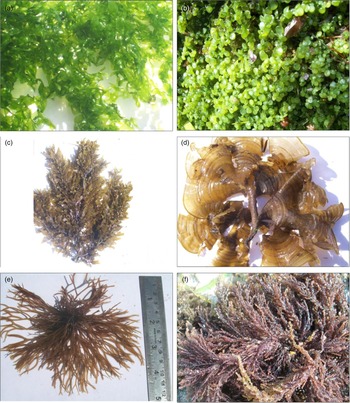
Algae belong to the primitive group of plants which evolved very early in the universe. Algae are both microscopic (microalgae) and macrophytic (macroalgae) occurring in freshwater as well as marine waters. In the marine ecosystem, the micro-algae are the major primary producers and the macro-algae are called as seaweeds, which flourish on surfaces of rocks, dead coral, stones, pebbles and any other suitable substrata are available for their attachment. Macro-algae are green algae (Chlorophyceae), brown algae (Phaeophyceae) and red algae (Rhodophyceae). Seaweeds are used as human food from 600 to 800 BC. In China, seaweeds were used from prehistoric time. In China and Japan, seaweeds are used as a stable diet item for a very long period. Fresh, dried and processed seaweeds are utilized for human consumption. Many types of seaweeds are used as food in Japan, China, Philippines and other countries of Indopacific regions. Seaweeds are one of the commercially important marine living and renewable resources of India. Commercial exploitation of marine algal species commenced in India since 1966 (Oza and Zaidi, Reference Oza and Zaidi2001). One of the reports indicates that 1518 t of (dry weight) red algae and 2285 t of (dry weight) brown algae are utilized for manufacture of agar, alginate and liquid fertilizer (Kaliaperumal et al., Reference Kaliaperumal, Kalimuthu and Ramalingam2004). Seaweeds grow abundantly along the coastal waters of Tamilnadu, Gujarat, Andhra Pradesh, Orissa, West Bengal, Kerala, Maharastra, Lakshadeep and Andaman Nicobar Islands. There are also rich seaweed beds around Mumbai, Ratnagiri, Goa, Karwar, Vizhijzn, Pulicot and Chilka. Among the 20,000 species of seaweeds enumerated in the world, 271 genera and 1153 species are present in India with a total standing crop of 6, 77, 309–6, 82, 759 t fresh (Subba Rao and Mantri, Reference Subba Rao and Mantri2006). According to Anantharaman et al. (Reference Anantharaman, Balasubramanian and Thirumaran2006), the total potential seaweed wealth is 8, 70,000 t fresh, present natural collection is 22,000 t fresh and through seaweed cultivation is 150 t dry. Natural habits of some of the prominent marine algae are presented in Fig. 1.
Some common medicinally important seaweeds. fam. Chlorophyceae: (a) Ulva retivulata, (b) Caulerpa racemosa; fam. Phaeophyceae: (c) Sargassum tennerium (d) Padina gymnospora; fam. Rhodophyceae: (e) Gracillaria edulis, (f) Acanthophora spicifera.

Medicinal potential of seaweeds
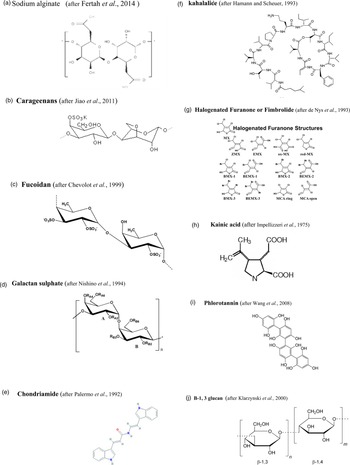
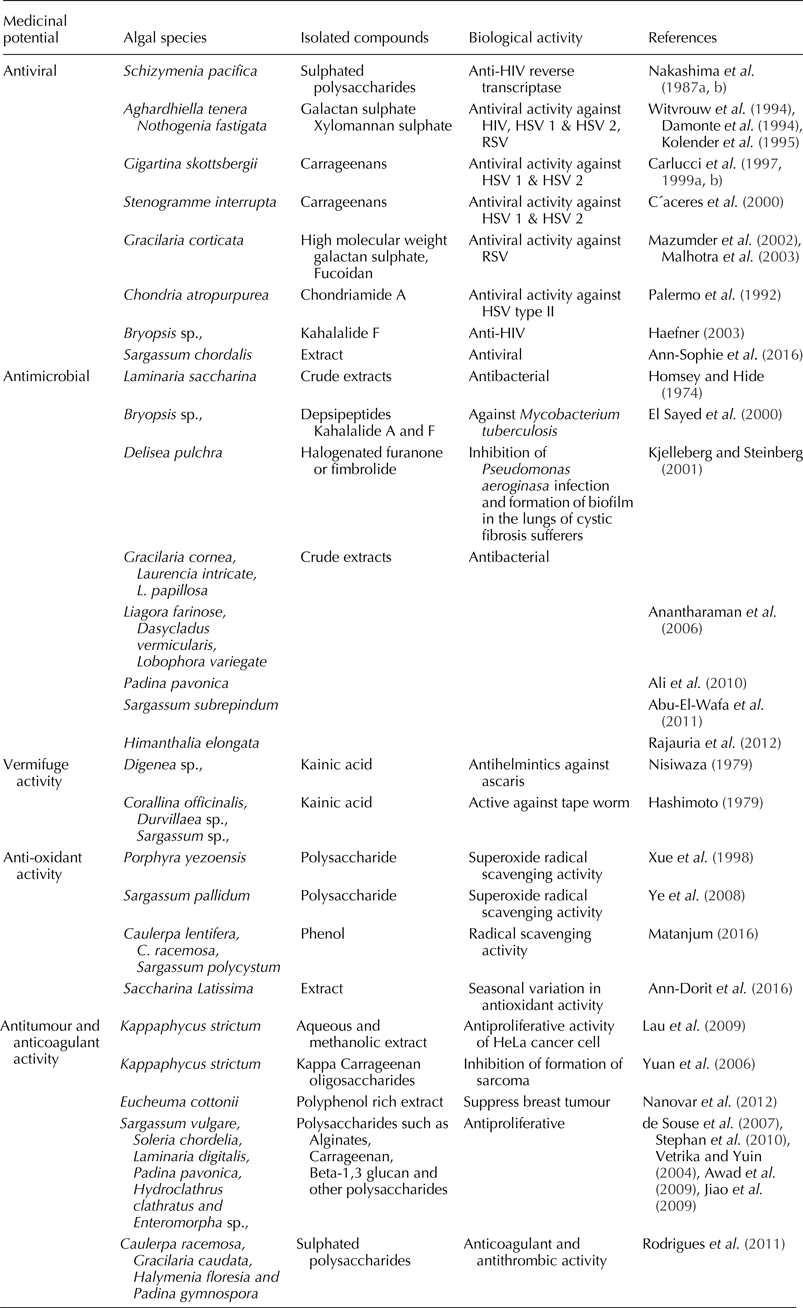
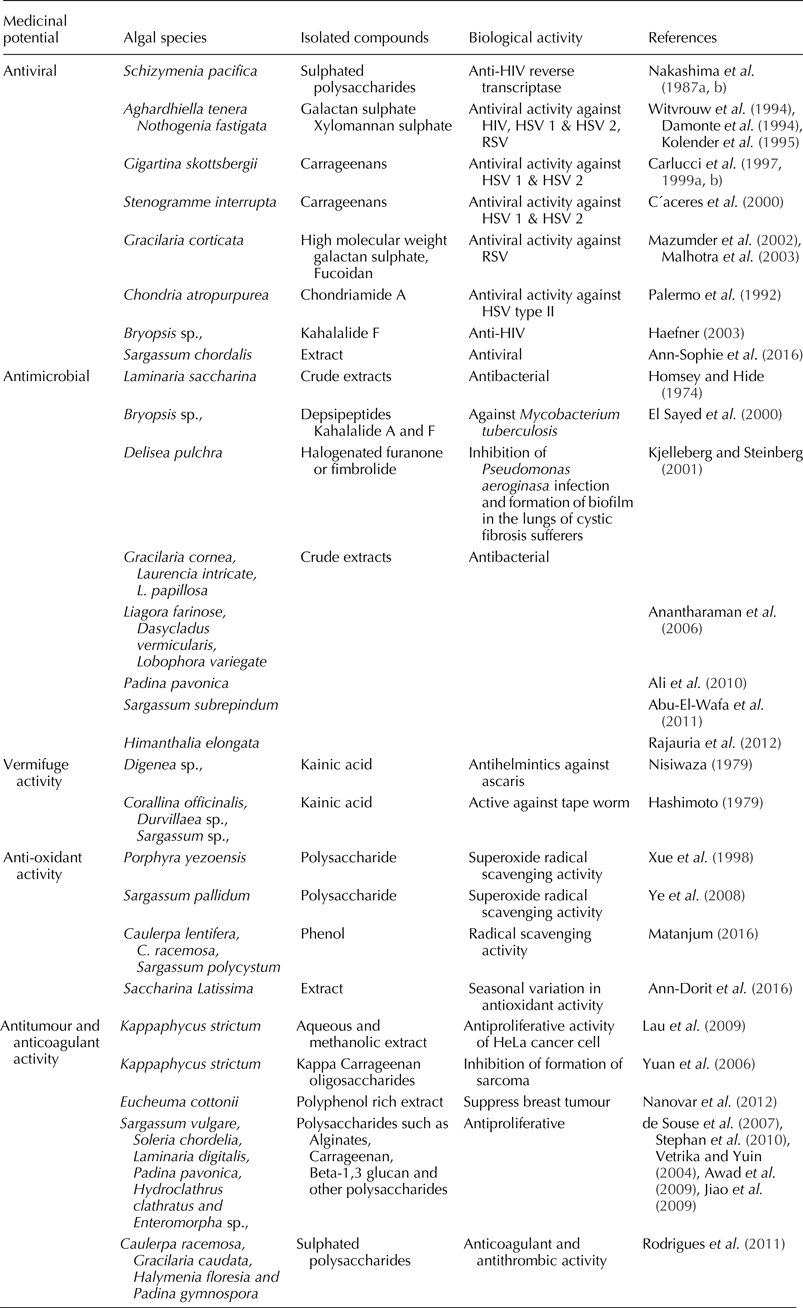
Seaweeds were considered to be of medicinal value in the orient as early as 3000 B.C. The Chinese and Japanese used them in the treatment of goitre and other glandular diseases. Romanians used the seaweeds for healing the wounds, burns and rashes. The British used Porphyra to prevent scurvy (vitamin C deficiency diseases) during long voyages. Seaweeds in general are used as verimifuge, for cough, stomach and chest ailments, bladder and kidney ailments (Schimmer and Schimmer, Reference Schimmer and Schimmer1955, Reference Schimmer, Schimmer and Jackson1968; Hoppe, Reference Hoppe, Hoppe, Levring and Tanaka1979; Stein and Borden, Reference Stein and Borden1984; Smit, Reference Smit2004; Anantharaman et al., Reference Anantharaman, Balasubramanian and Thirumaran2006). Alginates from seaweeds are known to be used in the preparation of the moulds for denture (Fig. 2(a)). A survey of literature on the potential of the products obtained from marine algae for medicinal use indicates the wide range of remedial compounds against several ailments. There is a very good potential in the seaweeds for obtaining novel compounds to be used as drugs against simple ailments and chronic diseases such as cancer, cardiac disorders, respiratory problems, diabetes, and virus attacks such as human immunodeficiency virus (HIV). The promise and potential appear enormous and the search has been on for over several years. The products so far encountered are antivirus, antibiotic, antitumour, antioxidant and vermifuges or antiparasitic. Table 1 gives the details of the algal species, the type of compounds obtained and their medicinal importance. However, only few products have found application in pharmaceutical preparations. Research work done for over four decades are presented below.
Structure of compounds isolated and identified from marine algae. (a) Sodium alginate (after Fertah et al., Reference Fertah, Belfkira, Taourirte and Brouillette2014). (b) Carageenans (after Jiao et al., Reference Jiao, Yu, Zhang and Ewart2011). (c) Fucoidan (after Chevolot et al., Reference Chevolot, Foucault, Chaubet, Kervarec, Sinquin, Fisher and Boisson-Vidal1999). (d) Galactan sulphate (after Nishino et al., Reference Nishino, Takabe and Nagumo1994). (e) Chondriamide (after Palermo et al., Reference Palermo, Flower and Seldes1992). (f) Kahalalide (after Hamann and Scheuer, Reference Hamann and Scheuer1993). (g) Halogenated Furanone or Fimbrolide (after de Nys et al., Reference de Nys, Wright, König and Sticher1993). (h) Kainic acid (after Impellizzeri et al., Reference Impellizzeri, Mangiafico, Oriente, Piattelli, Sciuto, Fattorusso, Magno, Santacroce and Sica1975). (i) Phlorotannin (after Wang et al., Reference Wang, Xu, Bach and McAllister2008). (j) B-1, 3 glucan (after Klarzynski et al., Reference Klarzynski, Plesse, Joubert, Yvin, Kopp, Kloareg and Fritig2000).

Medicinally important compounds from marine algae
Antiviral activity
Seaweeds contain certain compounds that possess antiviral activity. Sulphated polysachharides such as galactan sulphate was tested in the laboratory to be effective against HIV and Herpes simplex virus (HSV). Xylomannan sulphate is anti-HIV and respiratory syncytial virus (RSV). Carrageenn, Fucoidion, Chondrion and dollabellans show anti-HSV activity. Fucoidion is also against RSV and human cytomegalovirus. These studies have been carried out using human cell lines and in some cases animal sources. A sulphated polysaccharide from Schizymenia pacifica was first shown to possess anti-HIV reverse transcriptase in vitro (Nakashima et al., Reference Nakashima, Kido, Kobayashi, Motoki, Neushul and Yamamoto1987a, Reference Nakashima, Kido, Kobayashi, Motoki, Neushul and Yamamotob). Certain sulphated polysaccharides such as galactan sulphate from Aghardhiella tenera and xylomannan sulphate from Nothogenia fastigiata showed antiviral activities against HIV, HSV types 1 and 2 and RSV tested in the laboratory (Damonte et al., Reference Damonte, Neyts, Pujol, Snoeck, Andrei, Ikeda, Witvrouw, Reymen, Haines, Matulewicz, Cerezo, Coto and De Clercq1994, Reference Damonte, Matulewicz and Cerezo2004; Witvrouw et al., Reference Witvrouw, Este, Mateu, Reymen, Andrei, Snoeck, Ikeda, Pauwels, Bianchini, Desmyter and de Clercq1994) and Kolender et al. (Reference Kolender, Matulewicz and Cerezo1995). These polysaccharides are shown to be active during the first stage of the RNA virus replication when the virus adsorbs onto the surface of the cell (De Clercq, Reference De Clercq1996) and have very low cytotoxic activities towards mammalian cells. Carrageenans (Fig. 2(b)) from Gigartina skottsbergii have potent antiviral effects against different strains of HSV types 1 and 2 during the virus adsorption stage (Carlucci et al., Reference Carlucci, Pujol, Ciancia, Noseda, Matulewicz, Damonte and Cerezo1997, Reference Carlucci, Ciancia, Matulewicz, Cerezo and Damonte1999a, Reference Carlucci, Scolaro and Damonteb). Carrageenans from cystocarpic and tetrasporophytic stages of Stenogramme interrupta had similar activity (C´aceres et al., Reference C´aceres, Carlucci, Damonte, Matsuhiro and Z'ueniga2000). High molecular weight galactan sulphate (Fig. 2(d)) from Gracilaria corticata (Mazumder et al., Reference Mazumder, Ghosal, Pujol, Carlucci, Damont and Ray2002) and Fucoidan (Fig. 2(c)) had potent antiviral properties towards viruses such as RSV (Malhotra et al., Reference Malhotra, Ward, Bright, Priest, Foster and Hurle2003). Malhotra et al. (Reference Malhotra, Ward, Bright, Priest, Foster and Hurle2003) found that fractions containing an uncharacterised polysaccharide from Caulerpa sp., Corallina sp., Hypnea charoides, Padina arborescens and Sargassum patens have high antiviral activity against HSV types 1 and 2 and have low levels of cytotoxicity. Besides polysachchardes, antiviral activity by Chondriamide A (Fig. 2(e)) from Chondria atropurpurea against HSV type II (Palermo et al., Reference Palermo, Flower and Seldes1992) and Kahalalide F (Fig. 2(f)) from Bryopsis for its anti-HIV qualities are reported (Haefner, Reference Haefner2003). Recently, methanolic extracts of three species of Sagassum were shown to possess anti-herpes property (Zhu et al., Reference Zhu, Ooi, Chan and Ang2003) and hepatoprotective activity (Hiren et al., Reference Hiren, Siltana, Haque and Athou2016). The red seaweed Solieria chordalis was abundant in coastal area of France. The extract of S. chordalis from the coast exhibited potential antiviral activity (Ann-Sophie et al., Reference Ann-Sophie, Bedoux and Bourgougnon2016). Structures of certain compounds obtained from marine algae are presented in Fig. 2
Antimicrobial activity
The methodology used for investigating the antimicrobial potential of the marine algae in the laboratory is the simple diffusion plate technique. The extracts of the selected seaweed obtained from water or organic solvents are tested against Gram-positive and Gram-negative pathogenic bacteria. The antagonistic compounds such as fatty acids, bromophenols, tannins, phloroglucinol and terpenoids are useful as antibiotics for killing of bacteria, fungi and viruses (Hashimoto, Reference Hashimoto1979). Such compounds are from Phaeophyceae (Glombitza, Reference Glombitza, Hoppe, Levring and Tanaka1979) and halogenated compounds and laurinterol from several members of the Florideophyceae (Fenical, Reference Fenical1975) In a screening of 151 species of British marine algae, 54 were found to be antibacterial (Homsey and Hide, Reference Homsey and Hide1974) and in Laminaria saccharina (L.) Lamouroux (Phaeophyceae) maximum activity was in extracts from older parts of the thallus. Bryopsis sp. contained depsipeptides Kahalalide A and F, which were noted for their in vitro activity against Mycobacterium tuberculosis (El Sayed et al., Reference El Sayed, Bartyzel, Shen, Perry, Zjawiony and Hamann2000). Halogenated furanone or fimbrolide (Fig. 2(g)) that belong to a class of lactones extracted from Delisea pulchra (Kjelleberg and Steinberg, Reference Kjelleberg and Steinberg2001). These are active against chronic Pseudomonas aeruginosa infection and formation of a ‘biofilm’ in the lungs of cystic fibrosis sufferers (Høiby, Reference Høiby2002). Antibacterial activity was studied in several seaweeds and positive results are obtained in Gracilaria cornea, Laurencia intricata, Laurencia obtusa and Laurencia papillosa. The extracts of Liagora farinose, Dasycladus vermicularis and Lobophora variegate have the highest inhibition zones and a wide spectrum of antibacterial activity (Anantharaman et al., Reference Anantharaman, Balasubramanian and Thirumaran2006). Ali et al. (Reference Ali, Taki, Boudabban and El Bour2010) found a seasonal variation in the production of compounds of antibacterial activity in Padina pavonica (L.) Thivy from Tunisian coasts. The extracts from algae during the warmer months showed best activities against Gram-positive and Gram-negative strains of several bacteria. Sargassum subrepindum (Abu-El-Wafa et al., Reference Abu-El-Wafa, Shaaban, Elnaggar and Shabaan2011) from Egypt and Himanthalia elongata from West Coast of Ireland (Rajauria et al., Reference Rajauria, Jaiswal, Abu-Gannam and Gupta2012) are the recent reports of antibiotic potential of brown algae. Extracts of several marine algae from various localities have been shown to possess antimicrobial characteristics (Shanmughapriya et al., Reference Shanmughapriya, Manilal, Sujith, Selvin, Kiran and Natarajaseenivasan2008; Alang et al., Reference Alang, Kaur, Singh, Budlakoti, Singh and Singla2009; Demirel et al., Reference Demirel, Yilmaz-Koz, Karabay-Yavasoglu, Ozdemir and Sukatar2009; Cox et al., Reference Cox, Abu-Ghannam and Gupta2010; Manivannan et al., Reference Manivannan, Karthikaidevi, Anantharaman and Balasubramanian2011; Ferreres et al., Reference Ferreres, Lopes, Gil-Izquierdo, Andrade, Sousa, Mouga and Valentão2012; Kayalvizhi et al., Reference Kayalvizhi, Vasuki, Anantharaman and Kathiresan2012; Arunkumar et al., Reference Arunkumar, Sivakumar and Shanthi2013; Elnabris et al., Reference Elnabris, Elmanama and Chihadeh2013; Al-Saif et al., Reference Al-Saif, Abdel-Raouf, El-Wazanani and Aref2014).
Vermifuge activity
Marine algae were largely used in Asian marine regions for remedies and preventives since the people of the area were involved in maritime activities. Extracts of the red alga Digenea (Ceramiales) and other marine algae have been used as vermifuges or anthelmintics (killing intestinal worms, such as Ascaris) for over a thousand years as a most efficient vermifuge (Nisiwaza, Reference Nisiwaza, Hoppe, Levring and Tanaka1979). The active component is kainic acid (Fig. 2(h)), which kills the tape worm.The red alga Corallina officinalis L., species of the brown algae Durvillaea and Sargassum and the green alga Viva spp. are also sources of vermifuges (Hashimoto, Reference Hashimoto1979).
Antioxidant activity
Seaweeds are known to contain compounds such as glutathione peroxidase, catalase, superoxidedismutase and polyphenols with antioxidant or free radical scavenging properties. Specific techniques were used for the antioxidant or radical scavenging assays such as ABTS radical decolourization (beta-carotene bleaching) assay, DPPH radical scavenging assay and Ferric Reducing Antioxidant Assay (FRAP assay). Antioxidant properties of polysaccharides in scavenging superoxide radicals in Porphyra yezoensis was reported by Xue et al. (Reference Xue, Yu, Hirata, Terao and Lin1998), Sargassum pallidum in Yellow sea, China (Ye et al., Reference Ye, Wong, Zher, Liu and Zeng2008) and certain brown algae by Liu et al. (Reference Liu, Liu, Gu, Zhang, Shen, Guo, Liu and He2007). Matanjum (Reference Matanjum2016) analysed the antioxidant activities and phenolic contents and found Caulerpa lentifera, C. racemosa and Sargassum polycystum possessed very good radical scavenging activity. Brognioutella sp., had best antioxidant activity among 24 red algal species tested from Brittany Coast, France (Zubia et al., Reference Zubia, Fabne, Kerjean and Deslandes2009). In Porphyra sp., activity of the endogenous enzymes was increased by sulphated galactans (Mohamed et al., Reference Mohamed, Haslim and Rahman2012). Seaweeds occurring in South Indian coasts were screened for antioxidant activities (Vadiapudi and Chandrasekhara Naidu, Reference Vadiapudi and Chandrasekhara Naidu2010; Karthika Devi et al., Reference Karthika Devi, Manivannan, Thirumaran, Rajathi and Anantharaman2011; Vijayabaskar and Shyamala, Reference Vijayabaskar and Shyamala2012; Indu and Srinivasan, Reference Indu and Srinivasan2013). Gracilaria changii has very good free radical scavenging property (Chan et al., Reference Chan, Matunjun, Md Yasir and Tan2014). Natural antioxidants derived from marine algae have the potential for improving oxidative stability of lipids in food systems. The phlorotannin compounds (Fig. 2(i)) with better antioxidant activity were identified through HPLC–DAD–ECD–QTOFMSn (Ditte et al., Reference Ditte Hermund, Jacobsen and Nielsen2016). The seasonal variation in the antioxidant activity of sugar Kelp (Saccharina latissima) in different cultivation sites were recently reported (Ann-Dorit et al., Reference Ann-Dorit, Safafar, Pedersen, Marinho and Holdt2016).
Antitumour activity/anticoagulant activity
Marine algae have been a good source of compounds that could be used for antitumour treatments. Kashiwagi et al. (Reference Kashiwagi, Mynderse, Moore and Norton1980) showed antitumour activity against lymphocytic leukaemia and Ehrlich ascites tumour in mice in extracts obtained from marine algae from Pacific islands. Chinese have used decoctions of Sargassum spp., Laminaria spp. as herbal medicines to treat cancer and a preliminary study reveals inhibition of leukaemia tumours (Yamamoto et al., Reference Yamamoto, Nagumo, Yagi, Tominaga and Aoki1974). Cho et al. (Reference Cho, Rhee and Park1997) found that several red and brown algae had compounds that inhibited colon cancer cell growth. Iodine rich kelps, Laminaria (Funahashi et al., Reference Funahashi, Imai, Mase, Sekiya, Yokoi, Hayashi, Shibata, Hayashi, Nishikawa, Suda, Hibi, Mizuno, Tsukamura, Hayakawa and Tanuma2001), Champia feldmanni, Undaria pinnatifida (Maruyama et al., Reference Maruyama, Tamauchi, Hashimoto and Nakano2003), Dictyopteris divaricata and Sargassum thumbergia (Kim et al., Reference Kim, Ham, Moon, Kim, Kim and Lee2009) were all found to be good sources of antiproliferative and antitumour-producing compounds. Lau et al. (Reference Lau, Vitta, Cheo and Yong2009) have shown that both aqueous and methanolic extracts from Kappaphycus strictum had higher antiproloferative activity of HeLa cancer cells compared with K. alverezii. The role of k-carrageenan oligosaccharides from K. strictum in the inhibition of the formation of sarcoma was reported by Yuan et al. (Reference Yuan, Song, Li, Li and Dai2006). Polyphenol-rich extracts of Eucheuma cottonii suppressed breast tumour via hormone modulation and apoptosis induction (Nanovar et al., Reference Nanovar, Mohammed, Fard, Behrvam, Mustafa, Alithean and Oltman2012). Alginates from Sargassum vulgare, carrageenan from Soleria chordelia, B-1,3 glucan (Fig. 2(j)) from Laminaria digitalis, unknown polysaccharides from Padina pavonica and Hydroclathrus clathratus and Enteromorpha intermedia were shown to be antiproliferative (Vetrika and Yuin, Reference Vetrika and Yuin2004; de Souse et al., Reference de Souse, Torres, Pesra, Morae, Filo, Alue and Costa-Lotrofo2007; Awad et al., Reference Awad, Motaune, Setum and Motiobe2009; Jiao et al., Reference Jiao, Li, Li, Jiang, Zhang, Wu and Zhiang2009; Stephan et al., Reference Stephan, Eric, Sophie, Christian and Yu2010). Fucoidan is found to be effective against bile duct cancer and breast cancer. Examples of algal extracts inhibiting various steps of cancerous tumour development or cell proliferation are outlined in detail by Mohamed et al. (Reference Mohamed, Haslim and Rahman2012). Several green, brown and red seaweeds are reported to contain sulphated polysaccharides (in the aqueous extract) which has anticoagulating and antithrombic activity. Caulerpa racemosa, Gracilaria caudata, Halymenia floresia and Padina gymnospora are reported in studies from Brazilian coast to be the source of anticoagulating substances (Rodrigues et al., Reference Rodrigues, Linada Queinz, Besse, Carve, Amorin and Zen2011).
Pharmaceutical importance of seaweeds
Seaweeds have already found application as household medicine and pharmaceutical formulations in Southeast Asia and other parts of the world. Some of the instances are cited below.
-
(i) Obesity and diabetes: Extracts of Pelvetia babingtonii and Ascophyllum nodosum had potent alpha-glucosidase activity to support post parandial hyperglycaemia (Kim et al., Reference Kim, Nam, Kurihara and Kim2008). Extracts of pacific edible brown alga contain antidiabetic insulin-like and insulin-secreting activity (Kang et al., Reference Kang, Jin, Ko, Choi, Hwang, Whang, Kim, Shin, Jeong and Kim2008). The brown seaweeds contain high-dietery fibres and Fucoxanthin the main carotenoid showed antiobesity effects and reduced blood glucose (Abidov et al., Reference Abidov, Ramazanov, Seifulla and Grachev2010). A recent Korean National Health survey revealed that seaweed consumption decreased diabetic risk in men (Lee et al., Reference Lee, Kim, Vitek and Nam2010). The effects of seaweed extracts in preventing antiobesity and peroxidation in rats were studied via assessing the plasma lipids and plasma and organs malondialdehyde concentrations. These findings showed positive effects in inhibiting weight gain and have promising value in preventing obesity (Matanjum et al., 2016).
-
(ii) Obstetrical uses: The dried stipes of Laminaria spp. have been used in obstetrical and gynaecological practices as a natural dilator of the cervix, thus making gynaecological treatment easier (Strauss et al., Reference Strauss, Wilson, Caldwell, Otterson and Martina1979; Ye et al., Reference Ye, Yamamoto and Tyson1982). Laminaria was found to be particularly effective in intrauterine devices (IUD) for birth control (Manabe et al., Reference Manabe, Manabe and Sakaguchi1982).
-
(iii) Goitre treatment: Goitres are due to low iodine content in food. Marine algae are excellent sources of iodine and ‘goitre sticks’ made of Phyllogigas. Dried Ulva and Porphyra are used in the Peruvian Andes. The Chinese have used Sargassum as a remedy since 2700 BC. Vitamin A deficiency occurring in restricted areas of Burma can also be overcome by use of seaweed supplements in the diet (Michanek, Reference Michanek, Hoppe, Levring and Tanaka1979).
-
(iv) Hypertension: Seaweed hydrolyzates have antihypertensive properties and the examples are peptides from Undaria pinnatifida (Sato et al., Reference Sato, Nakano, Takeuchi, Kanno, Nagahisa and Sato1996) and phlorotanins from Eklonia stolonifera (Jung et al., Reference Jung, Hyun, Kim and Choi2006). Carrageenans from red algae have dislepidaemic and lipids and bring down levels of cholesterol.
-
(v) Wound healing: Carbohydrate polymers like alginic acid are used in wound management. Alginates are highly viscous bio-absorbable guluronic and mannuronic acid polysaccharides. Hydrophilic sponges produced from calcium alginate have good absorption property of both blood and wound exudates as well as pain-stimulating compounds (Lloyd et al., Reference Lloyd, Kennedy, Methacamm, Petera and Kail1998; Matou et al., Reference Matou, Helley, Chabut, Bros and Fischer2002).
-
(vi) Pharmaceutical formulations: The pharmaceutical uses of algae involve the phycocolloids isolated from the selected members of brown and red algae. Carrageenan can be used in cough syrup emulsions (Chapman, Reference Chapman, Hoppe, Levring and Tanaka1979). Carrageenan and the other phycocolloids, such as fucoidan are used as binding agents for medical tablets. The bioactive ultra-high viscosity gels from alginates obtained from Lessonia trabeculata and Lessonia nigrescens are promising biomaterial approach for tissue engineering has been reported (Michel et al., Reference Michel, Schulz, Dobringer, Vasquez, Gentile and Neubauer2016). Sulphated polysaccharides from marine algae show very good anticoagulant activity. Alginates are a family of polysaccharides from brown seaweeds namely Laminaria hyperborean in Norway. The characterized alginate gels with chitooligosaccharides of varying composition as cross linkers for tissue engineering, cell immobilization and drug release has been established in Norway (Yiming et al., Reference Yiming, Kopplin and Varum2016).
Conclusion
The potential of the marine algae as source of compounds of medicinal importance is enormous. The general consensus of scientists is that the marine algae are less exploited and new formulations with novel compounds obtained from them could yield more useful and effective drugs. The search for remedies of human maladies appears to be a continuous process. It is our wish and hope that the marine algae will play a major role in the protection of human health.
Acknowledgements
We thank Professor R. Rengasamy, Former Director CAS in Botany, the University of Madras, Dr N. Kaliaperumal, Former Scientist In-charge CMFRI, Mandapam Camp; Dr K. Arunkumar, Central University, Kasargode, Kerala for useful suggestions and providing literatures. We thank all the scientists who have provided support in the form of reprints and for lending figures of compounds. We thank Professor N. Mathivanan, Director CAS in Botany, the University of Madras for facilities.