Introduction
Hoarding disorder (HD), as newly defined in DSM-5, is characterized by persistent problems with discarding personal possessions, regardless of their value, due to the overwhelming desire to save, and distress or indecision about what to discard. Unless a third-party intervenes, these symptoms lead to over-accumulation and clutter, such that use of living or work space is compromised. Many individuals with HD also demonstrate difficulties with executive function tasks, with impairments in procrastination, categorization, concentration and attention, and speed of task completion (i.e. slowed performance) (Grisham et al. Reference Grisham, Norberg, Williams, Certoma and Kadib2010; Mathews et al. Reference Mathews, Perez, Delucchi and Mathalon2012). Furthermore, accumulated clutter and cognitive deficits are associated with functional impairment, danger, distress, and disability (APA, 2013). Although HD is clearly an independent disorder (Ayers et al. Reference Ayers, Saxena, Golshan and Wetherell2010; Hall et al. Reference Hall, Tolin, Frost and Steketee2013), hoarding symptoms frequently co-occur within an individual across the lifetime and co-segregate with obsessive-compulsive disorder (OCD) in families (Mathews et al. Reference Mathews, Nievergelt, Azzam, Garrido, Chavira, Wessel, Bagnarello, Reus and Schork2007; Morein-Zamir et al. Reference Morein-Zamir, Papmeyer, Pertusa, Chamberlain, Fineberg, Sahakian, Mataix-Cols and Robbins2014), complicating the dissection of the etiologies and pathophysiologies of these disorders. However, a new line of evidence suggests the presence of divergent neural substrates corresponding to each of these two disorders (Tolin et al. Reference Tolin, Witt and Stevens2014).
We and others have previously hypothesized that HD impairments in cognitive and affective processing following simple errors may arise from abnormalities in the brain's error detection system, which can be interrogated using electrophysiological methods (e.g. Nieuwenhuis et al. Reference Nieuwenhuis, Nielen, Mol, Hajcak and Veltman2005). The error-related negativity (ERN), a frontocentrally distributed negative deflection in the response-locked event-related potential (ERP) peaks around 80 ms following incorrect responses during reaction-time tasks. ERN is thought to occur when the brain's online error monitoring system detects a mismatch between actual (incorrect) and intended (correct) responses on error trials (Falkenstein et al. Reference Falkenstein, Hohnsbein, Hoormann and Blanke1991; Gehring et al. Reference Gehring, Goss, Coles, Meyer and Donchin1993), in response to a reinforcement learning signal (Holroyd & Coles, Reference Holroyd and Coles2002), or if the amount of response conflict is varied probabilistically (Botvinick et al. Reference Botvinick, Braver, Barch, Carter and Cohen2001; Yeung et al. Reference Yeung, Botvinick and Cohen2004; Brown & Braver, Reference Brown and Braver2005). Specifically, it has been shown that participants adjust their processing strategy according to a simple probability heuristic (Gratton et al. Reference Gratton, Coles, Sirevaag, Eriksen and Donchin1988). Using a flanker task, Botvinick et al. (Reference Botvinick, Nystrom, Fissell, Carter and Cohen1999) found that incongruent (high-conflict) trials following congruent (low-conflict) trials produced greater error-related anterior cingulate cortex (ACC) activation than did incongruent trials following other incongruent trials. The neural generator of ERN has been intimately linked to the ACC (van Veen & Carter, Reference van Veen and Carter2002; Ridderinkhof et al. Reference Ridderinkhof, Ullsperger, Crone and Nieuwenhuis2004; Debener et al. Reference Debener, Ullsperger, Siegel, Fiehler, von Cramon and Engel2005), and there are robust findings of error-related ACC abnormalities in OCD patients (Ursu et al. Reference Ursu, Stenger, Shear, Jones and Carter2003; Fitzgerald et al. Reference Fitzgerald, Welsh, Gehring, Abelson, Himle, Liberzon and Taylor2005; Maltby et al. Reference Maltby, Tolin, Worhunsky, O'Keefe and Kiehl2005). Importantly, ERN has repeatedly been shown to be hyperactive in individuals with OCD compared to controls (Gehring et al. Reference Gehring, Himle and Nisenson2000; Johannes et al. Reference Johannes, Wieringa, Nager, Rada, Dengler, Emrich, Munte and Dietrich2001; Santesso et al. Reference Santesso, Segalowitz and Schmidt2006; Endrass et al. Reference Endrass, Klawohn, Schuster and Kathmann2008, Reference Endrass, Schuermann, Kaufmann, Spielberg, Kniesche and Kathmann2010, Reference Endrass, Riesel, Kathmann and Buhlmann2014; Hajcak et al. Reference Hajcak, Franklin, Foa and Simons2008; Hanna et al. Reference Hanna, Carrasco, Harbin, Nienhuis, LaRosa, Chen, Fitzgerald and Gehring2012; Carrasco et al. Reference Carrasco, Harbin, Nienhuis, Fitzgerald, Gehring and Hanna2013; Klawohn et al. Reference Klawohn, Riesel, Grutzmann, Kathmann and Endrass2014; Weinberg et al. Reference Weinberg, Dieterich and Riesel2015) reviewed in (Mathews et al. Reference Mathews, Perez, Delucchi and Mathalon2012).
No ERN studies to date have explicitly focused on individuals with a primary diagnosis of HD. However, in a previously published meta-analysis of ERN studies of OCD and obsessive compulsive symptoms, we retrospectively identified individuals who reported hoarding symptoms based on data obtained from the authors of the included studies (Mathews et al. Reference Mathews, Perez, Delucchi and Mathalon2012). The results of the meta-analysis comparing ERN in OCD-affected individuals with co-occurring hoarding symptoms (OCD+H) to those without hoarding symptoms (OCD-H) indicated reduced (though not significantly) ERN in OCD+H relative to OCD-H in response conflict tasks and enhanced (again, not significantly) ERN in OCD+H for probabilistic learning tasks. More recently, work by Riesel et al. (Reference Riesel, Kathmann and Endrass2014) in 72 individuals with OCD suggested that those with hoarding/symmetry symptoms had a reduced ERN relative to those without such symptoms (note that ERN in these individuals was still enhanced relative to healthy controls, however). Although multiple lines of evidence exist to support the separation of HD and OCD into distinct entities (Saxena, Reference Saxena2007; An et al. Reference An, Mataix-Cols, Lawrence, Wooderson, Giampietro, Speckens, Brammer and Phillips2008; Pertusa et al. Reference Pertusa, Fullana, Singh, Alonso, Menchon and Mataix-Cols2008; Iervolino et al. Reference Iervolino, Perroud, Fullana, Guipponi, Cherkas, Collier and Mataix-Cols2009; Tolin et al. Reference Tolin, Witt and Stevens2014), as yet little work has been done to investigate the neural substrates of HD independent of OCD.
One critical component of the investigation into the pathophysiological distinctions between HD and OCD involves group age differences. Although hoarding symptoms often begin by age 15, they do not typically become problematic until the 20s or 30s, and treatment-seeking for HD is uncommon before age 40 (Frost & Gross, Reference Frost and Gross1993; Kim et al. Reference Kim, Steketee and Frost2001; Grisham et al. Reference Grisham, Frost, Steketee, Kim and Hood2006), as symptom severity worsens progressively over time (Ayers et al. Reference Ayers, Saxena, Golshan and Wetherell2010). For these reasons, individuals with HD available for study are often in an older age range, usually 40–65 years (Pertusa et al. Reference Pertusa, Fullana, Singh, Alonso, Menchon and Mataix-Cols2008; Ayers et al. Reference Ayers, Saxena, Golshan and Wetherell2010). By contrast, OCD typically comes to attention much earlier, as symptoms, which also appear during childhood or adolescence, are more often clinically significant or impairing early in life. In addition, neurodevelopmental and aging effects on the neurophysiological activity underlying the brain's error monitoring system have been reported. ERN amplitudes appear to increase throughout adolescence and into adulthood (Davies et al. Reference Davies, Segalowitz and Gavin2004; Santesso & Segalowitz, Reference Santesso and Segalowitz2008), decreasing with normal aging at the other end of the lifespan (Falkenstein et al. Reference Falkenstein, Hoormann and Hohnsbein2001; Nieuwenhuis et al. Reference Nieuwenhuis, Ridderinkhof, Talsma, Coles, Holroyd, Kok and van der Molen2002), although not all studies have found this relationship (Friedman et al. Reference Friedman, Nessler, Cycowicz and Horton2009). Therefore, given the changes in ERN with age, and the older age of most HD participants relative to OCD participants, studies comparing ERN in HD and OCD should explicitly investigate putative pathophysiological differences while accounting for possible normal aging effects. In addition, given the increasing severity of hoarding symptoms over time, and the increasing rates of HD with age, possible interactions between HD, age, and ERN amplitude warrant investigation.
Accordingly, the present study examined ERN in individuals with HD relative to healthy controls (HC), to individuals with OCD but without hoarding symptoms, and to individuals with co-morbid HD+OCD diagnoses. We also examined the age trajectory of ERN in each group. Previous studies of ERN and OCD have shown that response conflict tasks, particularly the Flanker task, are highly reliable (Meyer et al. Reference Meyer, Riesel and Hajcak Proudfit2013; Riesel et al. Reference Riesel, Weinberg, Endrass, Meyer and Hajcak2013), and stable (Olvet & Hajcak, Reference Olvet and Hajcak2009); however, studies of ERN and OCD using probabilistic learning or other tasks are more heterogeneous (Nieuwenhuis et al. Reference Nieuwenhuis, Nielen, Mol, Hajcak and Veltman2005; Grundler et al. Reference Grundler, Cavanagh, Figueroa, Frank and Allen2009; Hammer et al. Reference Hammer, Kordon, Heldmann, Zurowski and Munte2009; Endrass et al. Reference Endrass, Schuermann, Kaufmann, Spielberg, Kniesche and Kathmann2010). Given the reliability and stability of response conflict tasks for OCD, and the heterogeneity seen for other tasks, we chose to use a Flanker task for our comparisons.
Based on the results of the meta-analysis, and supported by the Riesel et al. (Reference Riesel, Weinberg, Endrass, Meyer and Hajcak2013) findings, we hypothesized that individuals with HD would have a reduced electrophysiological response to errors relative to individuals without HD on a response conflict task. We also hypothesized that individuals with HD would demonstrate an abnormality in the developmental age trajectory of ERN.
Method
Participants
Participants included 14 individuals with HD, 28 individuals with OCD, 10 individuals with HD and OCD, and 47 HC spanning the age range of the patient groups. Participants were recruited through mental health clinics, through the Mental Health Association of San Francisco (MHA-SF), and through media advertisements, and were aged ⩾18 years. For all groups, individuals with psychosis, intellectual disability, neurocognitive disorders, active substance use, a history of head trauma with loss of consciousness, or any medical conditions known or suspected to affect cognitive function were excluded. Individuals were compensated $20 per hour for their participation in the study. The study was approved by the Institutional Review Board at UCSF, and all participants provided written informed consent.
Clinical assessments
All participants were assessed for HD using the Structured Interview for Hoarding Disorder (SIHD; Mataix-Cols et al. Reference Mataix-Cols, Billotti, Fernandez de la Cruz and Nordsletten2012), the Saving Inventory – Revised (SI-R; Frost et al. Reference Frost, Steketee and Grisham2004), the UCLA Hoarding Symptom Scale (UHSS; Saxena et al. Reference Saxena, Brody, Maidment and Baxter2007), and the Clutter Image Rating Scale (CIR; Tolin et al. Reference Tolin, Frost and Steketee2007). OCD was assessed using the Yale–Brown Obsessive Compulsive Scale (YBOCS; Goodman et al. Reference Goodman, Price, Rasmussen, Mazure, Fleischmann, Hill, Heninger and Charney1989), and the Structured Clinical Interview Diagnosis of DSM disorders (SCID; Spitzer et al. Reference Spitzer, Williams, Gibbon and First1992). Current symptoms of anxiety and depression were assessed using the Beck Anxiety Inventory (BAI; Beck & Steer, Reference Beck and Steer1993) and the Beck Depression Inventory (BDI; Beck et al. Reference Beck, Ward, Mendelson, Mock and Erbaugh1961). Clinical assessments for acute symptoms (YBOCS, BDI, BAI) were conducted within 1 month of the electroencephalographic (EEG) assessment.
Inclusion/exclusion criteria
All psychiatric diagnoses were assigned blinded to group by a psychiatrist (C.A.M.) with experience in HD and OCD according to DSM-5 criteria. HD participants were eligible for the study if they met DSM-5 criteria for HD but did not have OCD symptoms (YBOCS score of <5). OCD participants were eligible if they met DSM-5 criteria for OCD without significant hoarding symptoms, defined as scores of ⩽20 on the SI-R, ⩽10 on the UHSS, and ⩽8 on the CIR. HD+OCD participants were considered eligible if they met DSM-5 criteria for both HD and OCD diagnoses. HC participants were age- and education-matched to both the HD and OCD participants, and were included if they did not have hoarding symptoms (as defined above) or OCD symptoms (as defined above). HC participants with a lifetime history of HD, OCD, or any current DSM-5 psychiatric disorder were excluded. However, HC with a lifetime history of a mood or anxiety disorder other than HD and OCD were included if the disorder was in remission at the time of the assessment. HC participants who had first-degree biological relatives with a diagnosis of HD or OCD or clinically significant hoarding or OCD symptoms by report were also excluded. Participants in all groups were excluded if taking antipsychotic medication. Antidepressants were allowed as they have not been clearly shown to affect ERN (Stern et al. Reference Stern, Liu, Gehring, Lister, Yin, Zhang, Fitzgerald, Himle, Abelson and Taylor2010).
Behavioral task
A variant of the Eriksen flankers paradigm (Eriksen & Eriksen, Reference Eriksen and Eriksen1974) was used to assess error processing in two separate probability conditions. Contextual flanker stimuli consisted of four letters (‘EE EE’ or ‘FF FF’; ‘MM MM’ or ‘NN NN’; ‘UU UU’ or ‘VV VV’) presented for 100 ms, followed immediately by presentation of a central target letter belonging to the same letter set (e.g. ‘E’ or ‘F’ within the ‘EE EE’ or ‘FF FF’ context) for 100 ms. Inter-trial intervals were pseudo-randomly jittered between 1250 and 1400 ms in 50 ms increments. The two probability conditions were defined where probability (P) was manipulated such that one condition had 75% congruent trials (‘EEEEE’ or ‘FFFFF’) and 25% incongruent (‘EEFEE’ or ‘FFEFF’) while the other condition had 75% incongruent and 25% congruent (referred to as P25 and P75, respectively, throughout). Participants were instructed to press the right or left button corresponding to the target letter, using the respective index finger on a response box; response mapping of target letter-to-button location was randomized within subject. Subjects were not informed about the probabilities, but a practice run was completed for each letter set, and probability order was randomized within each of three blocked letter combinations (EF, MN, UV). There were six runs, three per condition, with 200 trials each. Participants were instructed to respond as quickly as possible without sacrificing accuracy and received feedback at the end of each run based on overall accuracy: >90% correct: ‘Please try to respond faster’; between 90% and 75%: ‘Please continue’; <75% correct: ‘Please try to be more accurate’. For each participant, error rates and median reaction times (RT) were calculated for each trial type (congruent, incongruent) and probability condition (P75 and P25).
EEG data acquisition
EEG data were acquired using a 64-channel, high-impedance BioSemi ActiveTwo recording system. Continuous EEG data were sampled at 1024 Hz, referenced offline to averaged earlobe electrodes, band-pass filtered 0.1–15 Hz using zero-phase shift Butterworth filters, and segmented into 1050 ms epochs time-locked to the button press responses (−100 to 950 ms). Electro-oculogram (EOG) data were recorded from electrodes placed above and below the right eye and at the outer canthi of both eyes to capture vertical (VEOG) and horizontal (HEOG) eye movements that were used to correct the EEG for artifacts using a regression-based algorithm (Gratton et al. Reference Gratton, Coles and Donchin1983). Following baseline correction (−100 to 0 ms), epochs were rejected if they contained amplitudes greater than ±100 µV in any of the Fz, FCz, Cz, or Pz electrodes. Due to low error rates in congruent trials in the P75 condition [N = 63 with <6 errors (Olvet & Hajcak, Reference Olvet and Hajcak2009; Pontifex et al. Reference Pontifex, Scudder, Brown, O'Leary, Wu, Themanson and Hillman2010)], ERN analyses assessed incongruent trials only. All participants except three had ⩾6 incongruent trial errors in P75 and P25 after artifact rejection. These three participants were excluded from subsequent analyses. The remaining participants included 14 individuals with HD, 27 individuals with OCD, 10 individuals with HD+OCD, and 45 HC as described in Table 1. Response-locked ERP averages for each probability condition (P75, P25) were calculated separately using a 10% trimmed mean approach (Leonowicz et al. Reference Leonowicz, Karvanen and Shishkin2005). ERN was then measured in each participant's ERP as the amplitude value at the latency of the most negative peak between 0 and 100 ms in Fz, FCz, and Cz.
Demographic characteristics of the participant sample

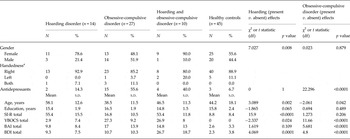
SI-R, Saving Inventory – Revised; YBOCS, Yale–Brown Obsessive-Compulsive Scale; BAI, Beck Anxiety Inventory; BDI, Beck Depression Inventory.
a The Crovitz & Zener (Reference Crovitz and Zener1962) questionnaire was used to measure handedness.
Correction for normal aging effects
In order to directly compare the patient groups, whose ages significantly differed (Table 1), it was necessary to first remove the effects of normal aging from ERN. Using a previously published approach (Perez et al. Reference Perez, Ford, Roach, Woods, McGlashan, Srihari, Loewy, Vinogradov and Mathalon2012), we derived a single age-corrected value for each participant for ERN peak amplitude at each electrode in incongruent trials, separately for the P75 and P25 probability conditions. First, raw ERN amplitudes were regressed on age in the HC group (age range 18.4–78.1 years). Next, the resulting HC age-regression models were used to derive age-specific predicted ERN values that were subtracted from the observed values and divided by the standard error of regression, yielding age-corrected ERN z scores (ERNz) for each participant at each electrode and for each probability condition. An identical approach was applied to median RT and error rate performance measures. The resulting age-corrected z scores reflect deviations, in standard units, from the values expected for a normal healthy participant of a given age. The method is preferable to using age as a covariate in an ANCOVA because it removes normal aging effects while preserving any pathological aging effects present in the patient data.
Statistical analysis
Behavioral Flanker task error rates were analyzed using repeated-measures analysis of variance (rmANOVA) with two between-subjects factors: HD (present, absent) and OCD (present, absent), and two within-subjects factors: probability (P75, P25) and trial type (incongruent, congruent). Due to a lack of congruent errors, the error RT rmANOVA model had no trial type factor. Electrophysiological ERN data were analyzed using a three-way rmANOVA with two between-subjects factors: HD (present, absent) and OCD (present, absent), and two within-subjects factors: probability (P75, P25) and electrode (Fz, FCz, Cz) for incongruent trials only. Age-corrected ERNz values were used to compare factors in all analyses involving HD and OCD. Because age-corrected ERNz have the expected value of ‘0’ for all HC averages, within-subject effects (probability, electrode, and probability × electrode) were assessed with raw ERN (ERN-raw) scores. We assessed age-related patient group differences in ERNz amplitude using a regression analysis to test patient group (HD, OCD) × ERNz interaction effects. The interaction terms tested for slope differences between patient groups.
Results
Clinical characteristics
Table 1 shows the clinical and demographic characteristics of the sample. The HD group had significantly more females than males relative to the other groups. Because of gender differences between participant groups, we conducted secondary analyses (see online Supplementary material) to test effects in female participants only (since there were too few males in the HD group to permit an analysis of gender effects).
Behavioral data
Error rate
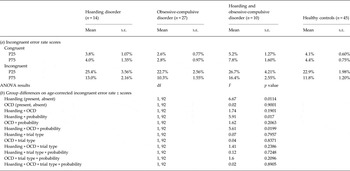
Table 2 presents the error rate descriptive statistics and rmANOVA results. There was a significant probability×trial type interaction (F 1,92 = 237.23, p < 0.001), driven by a significant increase in the incongruent trial error rate (mean ± s.e.) at the 25% (24.42 ± 1.59%) relative to 75% (12.83 ± 0.97%) probability level, but no change in the congruent error rate with change in probability (P25: 3.94 ± 0.48% v. P75: 4.75 ± 0.61%). There was also a significant OCD×HD×probability interaction (F 1,92 = 5.61, p = 0.02). Follow-up models at each probability level were used to parse this effect. While there was no OCD×HD interaction effect in the 25% probability-level model (F 1,92 = 0.53, p = 0.4673), there was a marginal OCD×HD interaction effect in the 75% model (F 1,92 = 2.98, p = 0.087). This was driven by a marginally significant reduction in age-corrected error rates in OCD-only patients compared to HC (t 70 = −1.93, p = 0.057). HD-only patients did not differ from HD+OCD patients in age-corrected error rates for the 75% probability level (t 22 = 0.74, p = 0.465). This was driven by significantly greater age-corrected error rates in HD+OCD patients compared to OCD patients (t 35 = 2.55, p = 0.015). HD patients and HC did not differ in age-corrected error rates for the 75% probability level (t 57 = 1.0, p = 0.323).
Error rate scores comparing hoarding disorder, obsessive-compulsive disorder, hoarding and obsessive-compulsive disorder, and healthy control groups

OCD, Obsessive-compulsive disorder.
Reaction time
There were no significant between-subjects effects or patient-group × probability interactions on median incongruent error RT. There was a significant effect of probability (F 1,92 = 17.8, p < 0.001), with longer median error RTs (mean ± s.e.) in the P75 (350.37 ± 7.29) relative to the P25 condition (334.77 ± 5.81). Descriptive statistics and RT rmANOVA results are presented in the online Supplementary material.
Group differences in ERN
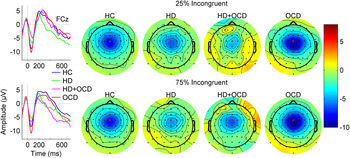
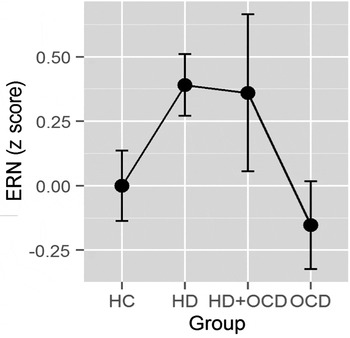
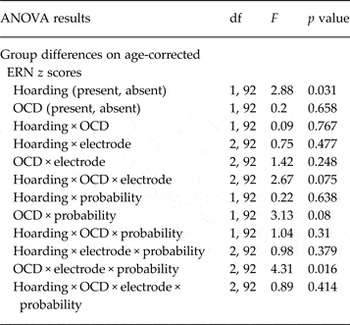
Errors elicited a large frontocentral (Fz, FCz, Cz) ERN peaking at approximately 55.9 ms (s.d. = 22.3 ms) post-response (Fig. 1). Table 3 presents the results of the rmANOVA of ERNz. A significant main effect of hoarding (p = 0.031) was observed, driven by reduced ERNz amplitude in the HD relative to non-HD subjects. Planned group comparisons confirmed that HD-only had significantly reduced ERNz relative to OCD-only participants (t 39 = 2.148, p = 0.038, Cohen's d = 0.77) and similarly reduced ERNz, though not significantly, relative to HC (t 57 = −2.1497, p = 0.13, Cohen's d = 0 0.54) but not relative to HD+OCD (t 22 = 0.1037, p = 0.981, Cohen's d = 0.04) participants. A significant three-way OCD × probability × electrode interaction (p = 0.0162) was driven in part by differences in the OCD × probability effects at electrode FCz. In particular, subjects without OCD had little, if any, probability effect, whereas those with OCD appeared to have larger probability effects in the opposite direction at FCz in particular (i.e. larger ERNz in the 75% congruent condition). However, the OCD×probability effect was only marginal (p = 0.06) at FCz, and within that individual electrode, there was no OCD effect at either 25% incongruent (p = 0.94) or 75% incongruent (p = 0.25) probability levels. Secondary analyses limiting the participants to females showed similar results (see online Supplementary material for details). Summary plots in Fig. 2 present the ERNz averaged across probability conditions and frontocentral electrodes for the HD, OCD, HD+OCD, and HC groups.
Left: Grand average ERP waveforms. Grand average ERP waveforms for response-locked error trials for age-matched healthy control (HC; blue), hoarding disorder (HD; green), co-morbid HD and obsessive-compulsive disorder (HD+OCD; magenta) and obsessive-compulsive disorder (OCD; red) participants. Waveforms are from FCz (indicated by red dot on topographic maps). The x-axis presents time in milliseconds from −100 ms (pre-response) to 750 ms (post-response) relative to the button press at 0 ms (vertical dotted line). The y-axis presents amplitude in microvolts (μV). Right: Scalp topography maps display error-related negativity (ERN) amplitudes averaged over a time window centered on the grand mean ERP peak latency (50–60 ms after the response event). Color bar indicates amplitude values in μV. Note the frontocentral distribution of the ERN, and the attenuated ERN for HD-positive individuals relative to HC and OCD groups for the 25% (top panel) and the 75% (bottom panel) probability conditions in incongruent trials.

Mean (± s.e.) error-related negativity (ERN) amplitude age-corrected z scores, averaged across probability and electrode in incongruent trials, plotted for each group. Note larger age-corrected ERN deficits (i.e. less negative ERN) in HD-positive individuals relative to HC and OCD participants. HC, Healthy controls; HD, hoarding disorder; HD+OCD, co-morbid hoarding disorder and obsessive-compulsive disorder; OCD, obsessive-compulsive disorder.

Results of repeated-measures analysis of variance analysis on age-corrected error-related negativity (ERN) amplitude z scores comparing hoarding disorder), obsessive-compulsive disorder, and healthy control groups

OCD, Obsessive-compulsive disorder.
In the rmANOVA of ERN-raw amplitudes used to assess within-subject effects of probability, electrode, and their interactions, no significant main effect of probability was found (F 1,92 = 0.23, p = 0.631). A significant main effect of electrode (F 2,92 = 46.35, p < 0.001) and simple follow-up contrasts indicated that ERN was smaller at Fz than at FCz (t 92 = −8.97, p < 0.001) and Cz (t 92 = −4.71, p < 0.001). There was no significant probability × electrode interaction (F 2,92 = 1.84, p = 0.1646).
Effects of symptom severity and age on ERN
There were no significant associations between ERNz and symptom severity within a combined HD, HD+OCD group for anxiety (BAI: r = 0.158, p = 0.506), depressive (BDI: r = −0.059, p = 0.81), hoarding (SI-R: r = −0.28, p = 0.195), or obsessive-compulsive (YBOCS: r = 0.178, p = 0.439) symptoms. There was a relationship between age and age-corrected ERNz for the combined HD group such that younger HD had larger ERN abnormalities (r = −0.479, p = 0.018). ERNz amplitude showed no age relationship in the OCD (p = 0.959) or HC (p = 0.66) groups (see online Supplementary material). Similar patterns of correlations were observed using ERN-raw amplitude values.
Discussion
Although impaired error processing has been hypothesized to be associated with hoarding behaviors (Mathews et al. Reference Mathews, Perez, Delucchi and Mathalon2012; Riesel et al. Reference Riesel, Kathmann and Endrass2014; Tolin et al. Reference Tolin, Witt and Stevens2014), this study is the first to directly examine a neurophysiological measure of error detection in individuals with HD. We found a significant reduction in ERN amplitude in individuals with HD relative to individuals without HD, independent of OCD diagnosis. Moreover, a significant reduction in ERN was detected in individuals with an HD diagnosis only relative to those with only an OCD diagnosis, even after correcting for age. These findings were not related to behavioral performance, since none of the clinical groups showed significantly poorer accuracy on any aspect of the Flanker task than the HC group.
ERN amplitude has been shown to be enhanced in most previous studies of adults with OCD (Endrass & Ullsperger, Reference Endrass and Ullsperger2014), with some exceptions (Nieuwenhuis et al. Reference Nieuwenhuis, Nielen, Mol, Hajcak and Veltman2005; Grundler et al. Reference Grundler, Cavanagh, Figueroa, Frank and Allen2009; Hammer et al. Reference Hammer, Kordon, Heldmann, Zurowski and Munte2009). Amplification of the error response has been theoretically linked to recurring obsessional thoughts and compulsive actions (Pitman, Reference Pitman1987), though neural correlates of clinical symptoms are inconsistent (Endrass & Ullsperger, Reference Endrass and Ullsperger2014). Our previously published meta-analysis suggests that ERN enhancement in OCD may be task-dependent (Mathews et al. Reference Mathews, Perez, Delucchi and Mathalon2012), with more consistent enhancement effects shown in response-conflict tasks. Despite using a response-conflict task in the current study, we did not find a significant enhancement of ERN in the HD+OCD patients relative to HD only patients, nor did we find a significant ERN enhancement in OCD patients relative to HC. The fact that HD+OCD participants had ERN amplitudes that were very similar to the HD participants is particularly striking, as, based on the previous OCD literature, co-occurring OCD would be expected to attenuate the observed differences between these patient groups. While evidence from literature examining reliability of ERN across various response conflict tasks have demonstrated the Flanker task to be consistently more reliable and stable relative to other response conflict tasks in OCD samples (Riesel et al. Reference Riesel, Weinberg, Endrass, Meyer and Hajcak2013), there remains much task-specific variance which may lead to unique influences on error-related brain activity across individuals that are specific to the sample within this study (Nieuwenhuis et al. Reference Nieuwenhuis, Nielen, Mol, Hajcak and Veltman2005; Grundler et al. Reference Grundler, Cavanagh, Figueroa, Frank and Allen2009; Riesel et al. Reference Riesel, Weinberg, Endrass, Meyer and Hajcak2013).
For example, our study systematically varied the probability of an incongruent trial in the Flanker task in order to manipulate the degree to which incongruent trials elicited conflict v. top-down control (van Veen & Carter, Reference van Veen and Carter2002; Bartholow et al. Reference Bartholow, Pearson, Dickter, Sher, Fabiani and Gratton2005). When incongruent trials are improbable relative to congruent trials, it is thought that the prepotent tendency to be influenced by the flankers is enhanced with minimal need to recruit top-down control processes to respond correctly. This leads to higher conflict and lower cognitive control when an incongruent trial appears. When incongruent trials are probable relative to congruent trials, it is thought the prepotent tendency to be influenced by the flankers is minimized by additional recruitment of top-down control processes, since the conflict induced by incongruent flankers must be overcome on most trials in order to respond correctly. This leads to relatively lower conflict and higher cognitive control on incongruent trials. In our study, the 25% incongruent condition produced a higher error rate and a faster RT than the 75% incongruent condition, consistent with its producing higher conflict and recruiting less cognitive control. However, susceptibility to these effects was similar across the three groups. Compared to controls, neither patient group was more prone to heightened conflict when incongruent trials were infrequent relative to when they were frequent. Similarly, neither patient group was deficient in increasing cognitive control when incongruent trials were frequent, relative to when they were infrequent. In other studies manipulating task difficulty, ERN amplitude decreased with increasing difficulty (Kaczkurkin, Reference Kaczkurkin2013; Riesel et al. Reference Riesel, Richter, Kaufmann, Kathmann and Endrass2015b ), and these studies also failed to replicate the ERN enhancement in individuals with OCD in tasks with increasing difficulty. However, the apparently normal ability to modulate ERN amplitude according to task conditions in the patient groups is superimposed on a substantial overall deficit in ERN amplitude in response to errors seen only in patients with HD, suggesting that the neural substrates of ERN itself are deficient while the neural inputs that modulate ERN according to task conditions are intact.
The broad age range represented in our HC sample allowed us to examine the effects of normal aging on error monitoring in healthy adults and to control for this when addressing whether pathological age relationships are evident in either HD or OCD. Early studies have shown smaller ERN amplitudes in older adults relative to younger adults (Falkenstein et al. Reference Falkenstein, Hoormann and Hohnsbein2001), although later studies have not identified a relationship between age and ERN amplitude (Friedman et al. Reference Friedman, Nessler, Cycowicz and Horton2009). In line with the later studies, we did not observe any significant age-related effects on ERN in our HC participants. However, we did find that the reduced ERN amplitude observed in HD was most prominent in younger participants, and tended to normalize (i.e. become more negative) in older participants. Although younger HD participants were more likely to have OCD, and higher YBOCS scores were associated with younger age in the HD sample, the change in the degree of ERN abnormality with age is not likely to be due to co-occurring OCD symptoms, as ERN was not attenuated in individuals with OCD, and we did not observe age-related ERN changes in the OCD group. Although requiring further study, the observed group differences in ERN abnormalities with age where only individuals with HD showed age-related ERN trajectories provide further evidence for a pathophysiological distinction between HD and OCD.
Our results converge with the small number of recent neuroimaging studies that have directly compared individuals with HD and OCD and found differential neural abnormalities between these clinical populations (Tolin et al. Reference Tolin, Stevens, Villavicencio, Norberg, Calhoun, Frost, Steketee, Rauch and Pearlson2012, Reference Tolin, Witt and Stevens2014). The current findings also corroborate several studies predating DSM-5 that support a neurobiological distinction between OCD-affected individuals with and without hoarding symptoms (Saxena et al. Reference Saxena, Brody, Maidment, Smith, Zohrabi, Katz, Baker and Baxter2004; An et al. Reference An, Mataix-Cols, Lawrence, Wooderson, Giampietro, Speckens, Brammer and Phillips2008; Mathews et al. Reference Mathews, Perez, Delucchi and Mathalon2012). We and others have previously suggested that, for individuals with HD, fear of making an error may lead to an inability to decide what to discard, and ultimately result in hoarding (Mathews et al. Reference Mathews, Perez, Delucchi and Mathalon2012). While we did not observe a relationship between ERN and specific HD or OCD symptoms, Riesel et al. (Reference Riesel, Endrass, Auerbach and Kathmann2015a ) recently demonstrated the stability of the error monitoring system by comparing OCD patients before and after symptom reduction through cognitive-behavioral therapy (CBT). OCD patients consistently displayed abnormal ERN patterns, even after post-intervention symptom reduction. Given that the neural substrates of OCD have been characterized by a hyperactivity of the orbitofrontal-striatal loop (Rotge et al. Reference Rotge, Guehl, Dilharreguy, Cuny, Tignol, Bioulac, Allard, Burbaud and Aouizerate2008), and that orbitofrontal cortex and ACC show dissociable roles in decision-making (Luk & Wallis, Reference Luk and Wallis2013), it may be that the ACC [strongly supported as the focal neural generator of ERN (Gehring et al. Reference Gehring, Goss, Coles, Meyer and Donchin1993; van Veen & Carter, Reference van Veen and Carter2002)] may also play a differential role in the pathophysiology of HD and OCD. As suggested by Weinberg et al. (Reference Weinberg, Dieterich and Riesel2015), the interactions between patient co-morbidities may present distinct pathophysiological profiles due to complex differential activation of the ACC. ERN may reflect variation in the strength of these inputs based on these transdiagnostic classifications (Weinberg et al. Reference Weinberg, Dieterich and Riesel2015).
The diverging ERN patterns seen between individuals with HD and OCD, and the deficient error monitoring system in HD relative to non-HD individuals, indicate ERN abnormalities may ultimately provide a useful biomarker for establishing diagnostic specificity between OCD and HD, as previously suggested (Riesel et al. Reference Riesel, Endrass, Kaufmann and Kathmann2011). Although symptoms often begin in adolescence, HD is typically diagnosed late in life, and symptoms appear to progressively worsen over time (Grisham et al. Reference Grisham, Frost, Steketee, Kim and Hood2006; Ayers et al. Reference Ayers, Saxena, Golshan and Wetherell2010). Interestingly, in the present study, it was evident that the younger HD patients demonstrated the greatest degree of ERN abnormalities. Therefore, it may be that the pathophysiological error monitoring system observed in HD is less related to symptom severity, but instead may be an underlying biomarker of the illness, as Carrasco et al. (Reference Carrasco, Harbin, Nienhuis, Fitzgerald, Gehring and Hanna2013) suggested in a sample of OCD youth and their unaffected siblings. While there have not yet been reports of evidence of an ERN biomarker predating hoarding symptoms, biomarker identification in young individuals who are at-risk for HD could facilitate early diagnosis and have implications for treatment, as the standard treatments for OCD (SSRIs and behavioral therapy) are generally less effective for HD; treatments that are more specific to HD are currently being developed (Ayers et al. Reference Ayers, Saxena, Espejo, Twamley, Granholm and Wetherell2013).
Limitations
This study has several potential limitations. Although the healthy comparison group was matched to the patient groups on key characteristics, the HD and OCD groups differed on some factors, including gender, age, and rate of antidepressant use. We have controlled for age differences in our analyses, and feel confident that age is not a confound; in fact, the broad age range in our sample allowed us to identify a relationship between age and ERN within the HD group that was not present in the HC or OCD groups. Although the participants differed in antidepressant use, these medications have not been clearly shown to significantly affect ERN, either in OCD patients or in healthy individuals (de Bruijn et al. Reference de Bruijn, Sabbe, Hulstijn, Ruigt and Verkes2006; Stern et al. Reference Stern, Liu, Gehring, Lister, Yin, Zhang, Fitzgerald, Himle, Abelson and Taylor2010). Given the divergent patterns between OCD and HD, future studies should carefully control for co-occurring OCD and perhaps also for antidepressant use. Additionally, the majority of HD participants were female; thus, we cannot say with confidence whether the same ERN effects are present in males with HD. Finally, the present study included small sample sizes. Further studies that include larger samples may better define the neurophysiological characteristics of co-morbid HD+OCD individuals, taking into account our unexpected finding that ERN amplitudes were more similar to HD amplitudes than to OCD amplitudes.
In conclusion, this is the first study to directly examine an electrophysiological measure of error monitoring in individuals with primary HD. As expected, we found a reduced ERN amplitude in HD patients relative to individuals without HD. Of note, ERN was significantly attenuated in HD patients relative to OCD patients. We also found a relationship between age and ERN amplitude in the HD group that was not evident in the OCD or HC groups. These results add to the emerging evidence that, although they may co-occur, HD and OCD have distinct pathophysiologies. Dissociable HD and OCD error-related brain activity may inform future studies of the pathophysiological mechanisms and aging trajectories across these two illnesses, and perhaps, further the understanding of the divergent courses of illness for these complex disorders.
Supplementary material
For supplementary material accompanying this paper visit http://dx.doi.org/10.1017/S0033291715001889.
Acknowledgements
This study was supported by the National Institutes of Mental Health (CAM: R21MH087748) and by the Althea Foundation.
Declaration of Interest
Dr Mathalon has served as a consultant for Amgen and Roche for matters unrelated to this study. The remaining authors report no financial relationships with commercial interests.