Introduction
Worldwide, an estimated 35% of ever-partnered women experience either physical or sexual violence (Garcia-Moreno et al., Reference Garcia-Moreno, Jansen, Ellsberg, Heise and Watts2006). Intimate Partner Violence (IPV) is deep-rooted in South Asian societies (Jejeebhoy et al., Reference Jejeebhoy, Santhya and Acharya2013; Decker et al., Reference Decker, Latimore, Yasutake, Haviland, Ahmed, Blum and Astone2015), where women are at considerably higher risk of experiencing IPV than those from other parts of the world. The World Health Organization estimates a huge 42% prevalence rate of IPV in South Asia, against the global average of 30% (WHO, 2013). Research has highlighted the negative health consequences and decreased well-being of women who experience violence (Wang & Pillai, Reference Wang and Pillai2001; Garcia-Moreno, Reference Garcia-Moreno2002; Mukanangana et al., Reference Mukanangana, Moyo, Zvoushe and Rusinga2014; Herrmann, Reference Herrmann2014; García-Moreno et al., Reference García-Moreno, Hegarty, d’Oliveira, Koziol-McLain, Colombini and Feder2014; Kismödi et al., Reference Kismödi, Cottingham, Gruskin and Miller2015). The demonstrated consequences of IPV include unintended pregnancy, abortion, fetal loss, depression and HIV infection (Chowdhary & Patel, Reference Chowdhary and Patel2008; Zablotska et al., Reference Zablotska, Gray, Koenig, Serwadda, Nalugoda, Kigozi and Wawer2009; Alio et al., Reference Alio, Nana and Salihu2009; Antai, Reference Antai2011; Stöckl et al., Reference Stöckl, Filippi, Watts and Mbwambo2012; Pallitto et al., Reference Pallitto, García-Moreno, Jansen and Heise2013; WHO, 2013). The effect on the gynaecological health of women who experienced IPV is persistent and long-lasting. Women experiencing IPV are more likely to report gynecological morbidity, sexually transmitted infections and urinary tract infections (Campbell, Reference Campbell2002; Raj et al., Reference Raj, Liu, McCleary-Sills and Silverman2005). Those who experience physical or sexual violence are more likely to suffer adverse pregnancy outcomes, including delivery by Caesarean section, kidney infections, premature labour and trauma due to falls or blows to the abdomen (Cokkinides et al., Reference Cokkinides, Coker, Sanderson, Addy and Bethea1999; Chalmers & Hashi, Reference Chalmers and Hashi2000; Silverman et al., Reference Silverman, Gupta, Decker, Kapur and Raj2007; Mechanic et al., Reference Mechanic, Weaver and Resick2008; Nunes et al., Reference Nunes, Ferri, Manzolli, Soares, Drehmer, Buss and Schmidt2010). In spite of the damaging effects of violence against women, historically it has been seen as a private matter within an intimate partner relation and hence a neglected priority of the state in South Asian countries.
Adolescents and young women are at high risk of intimate partner violence. Gender-based violence prevention is the third most important research priority area for adolescent sexual and reproductive health in low- and middle-income countries (Hindin et al., Reference Hindin, Christiansen and Ferguson2013). World Health Organization estimates suggest that violence against women is higher at young ages, indicating the onset of violence early in the marriage (WHO, 2013). Nationally representative data from India and Nepal reveal that the mean age of the first experience of IPV is relatively low in India (20.68 years) and Nepal (20.35 years). Almost 86% of married women had experienced their first act of violence before they reached age 24 in India and Nepal. Adolescence is a period where women are more likely to be victims of physical violence, and the younger a woman at marriage, the higher the chances of first sex being non-consensual or forced (Watts & Zimmerman, Reference Watts and Zimmerman2002; Jejeebhoy & Bott, Reference Jejeebhoy and Bott2003; Raj et al., Reference Raj, Saggurti, Lawrence, Balaiah and Silverman2010). Violence during adolescence and at a young age can, as in adult women, cause long-lasting psychological and physical harm.
Unintended pregnancy infringes the reproductive rights of a woman: the right to bear children according to their wish, the right to decide the number of children they intend to bear and the right to decide the timing of conception. Approximately 40% of pregnancies worldwide, or 85 million pregnancies in total, were unintended in 2012 (Sedgh et al., Reference Sedgh, Singh and Hussain2014). The proportion of unintended pregnancy is the highest in the South-East Asia region (Singh et al., Reference Singh, Wulf, Hussain, Bankole and Sedgh2009). A growing body of research in South Asia has explored levels of unintended pregnancies among adult victims of IPV (Silverman et al., Reference Silverman, Gupta, Decker, Kapur and Raj2007; Begum et al., Reference Begum, Dwivedi, Pandey and Mittal2010; Puri et al., Reference Puri, Tamang and Shah2011; Shabnam & Mukherjee, Reference Shabnam and Mukherjee2013; Raj & McDougal, Reference Raj and McDougal2015). Some studies suggest that IPV is an independent covariate of unintended pregnancy (Silverman et al., Reference Silverman, Gupta, Decker, Kapur and Raj2007; Cripe et al., Reference Cripe, Sanchez, Perales, Lam, Garcia and Williams2008; Begum et al., Reference Begum, Dwivedi, Pandey and Mittal2010; Ismayilova, Reference Ismayilova2010; Puri et al., Reference Puri, Tamang and Shah2011; Shabnam & Mukherjee, Reference Shabnam and Mukherjee2013; Bergmann & Stockman, Reference Bergmann and Stockman2015; Raj & McDougal, Reference Raj and McDougal2015). However, other studies have identified IPV as an intermediate factor of unintended pregnancy rather than a direct and independent factor (Bergmann & Stockman, Reference Bergmann and Stockman2015; Raj & McDougal, Reference Raj and McDougal2015).
Previous research on the relationship between IPV and unintended pregnancy specifically among young and adolescent women is limited. Adolescents and young married women are at high risk of physical violence and sexual coercion (Jejeebhoy et al., Reference Jejeebhoy, Santhya and Acharya2013). Research into the relation between IPV and unintended pregnancy among young married women necessitates them being in the early years of courtship, not likely to have attained their desired family size and likely to be sexually active leading to high conception rates. India, Bangladesh and Nepal are the three countries representing a substantial proportion of the population in South Asia. Moreover, they have similar socioeconomic and cultural characteristics. Therefore, these three countries are studied in a comparative frame. Pakistan could not be included in the study due to lack of information available on sexual violence in the Demographic and Health Survey data of Pakistan.
Methods
Data were from the Demographic and Health Surveys (DHSs), which are nationally representative datasets. Data for India were from the National Family Health Survey (2005–06), those from Nepal were from the Nepal Demographic Health Survey (2011) and those from Bangladesh were from the Bangladesh Demographic Health Survey (2007). The relationship between IPV and unintended birth was analysed within a comparative framework to provide a multifaceted occurrence of violence within different societies. The terms ‘unintended pregnancy’ and ‘unintended birth’ are used interchangeably in the study.
The DHS is a cross-sectional, household sample survey of women in the reproductive age group (15–49 years). It provides reliable information on fertility, fertility intentions, maternal and child health and domestic violence. The interviewers sought informed consent from the participants before starting an interview. Their privacy and confidentiality on the information provided was emphasized and assured. The domestic violence module was randomly administered to only one woman in a household to ensure her privacy in the household. All interviewers who administered the domestic violence module were females and had received special training to conduct interviews. This study selected ever-married respondents aged 15–24 who had given birth to at least one child in the last five years preceding the survey and who had provided information on fertility preference pertaining to the child after the child was born. The analysis consists of a total sample of 9788 women in India, 934 in Bangladesh and 574 in Nepal.
Computation of unintended last pregnancy
Accurate measurement of birth intentions was important to understand the fertility behaviour of the women. Measurement of pregnancy intention in the DHS was based on a retrospective question, posed to the woman for every live birth: ‘When she was pregnant with [Name] whether she wanted the pregnancy then, later or not at all’. Those who responded that their last birth was ‘wanted later’ or ‘not wanted at all’ were categorized to have an unintended pregnancy and those who responded ‘wanted birth then’ were considered to have an intended pregnancy.
Computation of IPV
The DHS collected information on three different forms of violence: physical, sexual and emotional. Any act of physical or sexual violence experienced by a woman in the study is considered as a case of intimate partner violence. The domestic violence module used in the DHS is based on questions constructed from the Conflict Tactic Scale (CTS) (Straus, Reference Straus1979).
Physical violence
A woman was considered to have experienced physical violence if her partner ever: pushed, shook or threw something at her; slapped her; twisted arm or pulled her hair; punched her with his fist or with something that could hurt her; kicked, dragged or beat her; tried to choke or burn her on purpose; threatened or attacked her with a knife, gun or any other weapon.
Sexual violence
Sexual violence was defined as any violence that includes physical force used by the husband to have sexual intercourse when a woman did not want to do so; or if she was forced to perform an unnatural sexual act.
Covariates
Selected demographic and socioeconomic characteristics, along with the reproductive health behaviour of women, were considered as covariates drawn from previously tested covariates of violence (Atteraya et al., Reference Atteraya, Gnawali and Song2014; Santhya et al., Reference Santhya, Haberland, Ram, Sinha and Mohanty2007; Koenig et al., Reference Koenig, Stephenson, Ahmed, Jejeebhoy and Campbell2006; Speizer & Pearson, Reference Speizer and Pearson2011). The analysis focused on three sets of independent characteristics associated with violence: a) household characteristics; b) women’s characteristics; and c) husband’s characteristics.
Type of place of residence (urban/rural), socioeconomic status of household (poor/middle/rich) and religion of the household (Hindu/Muslim/other) were the household characteristics. Age group of the women (15–19/20–24), levels of education (no education/primary/secondary/higher), current working status of the women (yes/no), ever used contraception (yes/no), ideal family size as per her wish (0–2/3+) and decision-making status (low/high) were the women’s characteristics analysed. In the DHS, women were asked a few questions regarding their decision-making for health care, household purchases, daily need household purchases, visits to family and friends and final say on their husband’s earnings. A score of ‘1’ was assigned in cases where the woman decided on her own on the matters mentioned above and a score of ‘0’ otherwise. The score of each woman was added to compute a decision-making index. Women who scored less than three were considered to have low decision-making status, and those who scored three and above were considered as having high decision-making status. Characteristics of the husband used as covariates included education (educated/uneducated), occupation (not working/agricultural/non-agricultural/manual labour) and alcohol consumption (yes/no).
Statistical analysis
The association between intimate partner violence and unintended pregnancy was assessed by cross-tabulation and Pearson’s χ 2 test. Multivariate binary stepwise logistic regression models were employed to calculate the influence of different covariates on unintended pregnancy. The net and gross effects of IPV on unintended pregnancy were analysed using a stepwise logistic regression model through multiple models. In the first model, the gross effects of physical or sexual violence on unintended last birth were calculated. In the second model, variables related to women’s fertility intention and decision-making, i.e. ever used contraception, ideal family size and her decision-making status, were assessed. Finally in the third model, along with variables included in the first and second models, the socio-demographic characteristics of the women and their husbands were included. In the binary model, the outcome variable, i.e. unintended last birth, was assigned a value of ‘1’ and ‘0’ to those who reported otherwise. The results are presented as odds ratios and 95% confidence intervals. Appropriate domestic violence weights were applied for the bivariate analysis. The analyses were performed using Stata 13 and IBM SPSS 22.
Results
Profile of the respondents
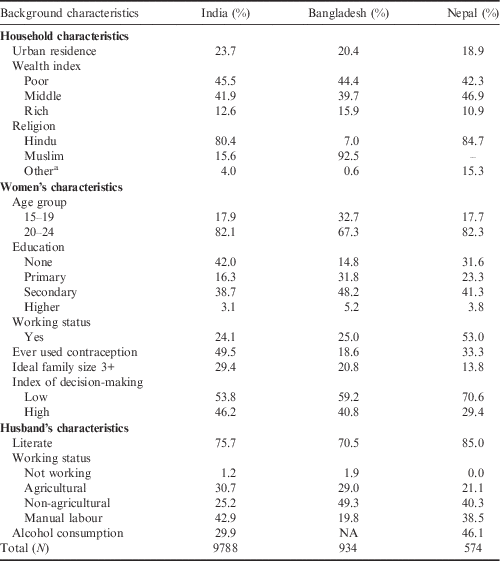
The majority of the respondents (76.3% from India, 79% from Bangladesh and 81% from Nepal) were from rural areas (Table 1). Nearly 40% belonged to poor households in all three countries, and the percentage with a higher wealth index varied between 11 and 16% (11% in Nepal, 16% in Bangladesh and 13% in India). Most of the respondents from India and Nepal belonged to the Hindu religion, while a majority in Bangladesh followed Islam. Around 80% were in the age group 20–24 in India and Nepal. Sixty-eight per cent of respondents from Bangladesh were in the age group 20–24. Almost half of the respondents from all three countries were either illiterate or had only up to primary levels of education. A quarter of respondents from India and Bangladesh were working, while half of those in Nepal were working. Half of the respondents from India and around one-third from Nepal had ever used contraception, whereas a little less than two-fifths (18%) in Bangladesh had ever used contraception. About 40–46% of the respondents from India and Bangladesh showed high levels of decision-making power, whereas this was only 30% in Nepal. Most husbands were educated: 75% in India, 70% in Bangladesh and 85% in Nepal. In India, most of the husbands were engaged in manual labour and agriculture-related employment. About half of the husbands in Bangladesh were in non-agricultural-related employment. Similarly, about 40% of the husbands in Nepal worked as manual labourers and another 40% in the non-agricultural sector.
Selected characteristics of married women aged 15–24 years who had given birth in the last five years in India, Bangladesh and Nepal
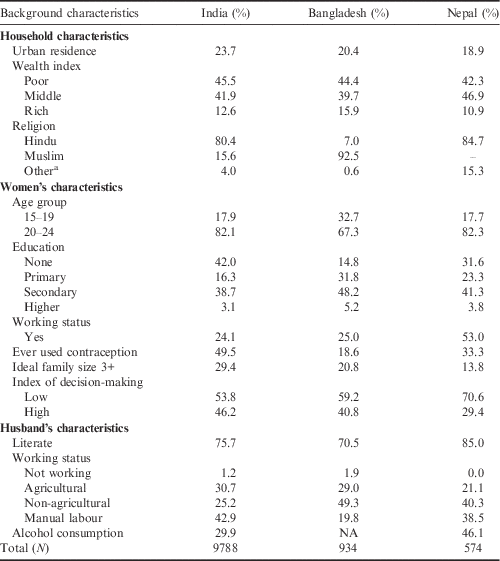
Percentages are weighted and N represents un-weighted count. NA, data not available.
a Other religions includes Christian, Jain, Sikh, Buddhist and Parsi. For Nepal, ‘other’ religion includes all religions except Hindu.
Prevalence of violence and unintended last pregnancy
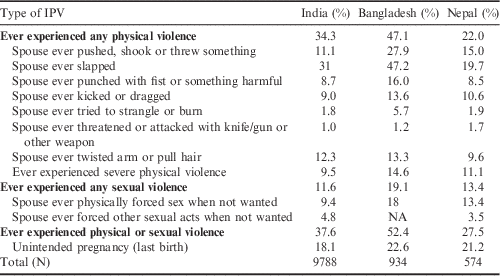
The prevalence of physical violence was the highest in Bangladesh (47%), followed by India (34%) and Nepal (22%) (Table 2). In all three countries, slapping was the most common form of physical violence reported. Every second woman in Bangladesh, every third woman in India and every fifth woman in Nepal reported having been slapped by their spouse. Similarly, every fifth woman in Bangladesh was a victim of sexual violence. In Nepal, around 13% and in India around 12% of the women reported sexual violence. The experience of either physical or sexual violence was the highest in Bangladesh (52%), followed by India (38%) and Nepal (28%). The rate of unintended last births was also the highest in Bangladesh (23%), followed by Nepal (21%) and India (18%).
Percentage of respondents who reported any form of IPV by their current husband and unintended pregnancy by country
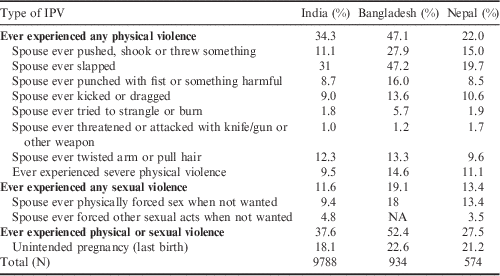
NA, data not available.
Association between IPV and unintended last births
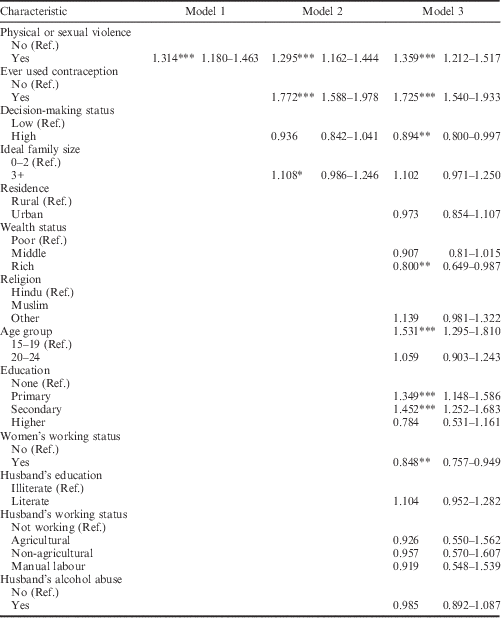
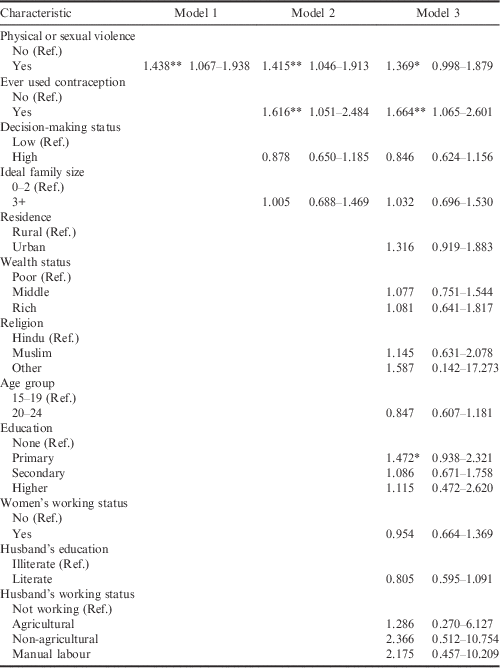
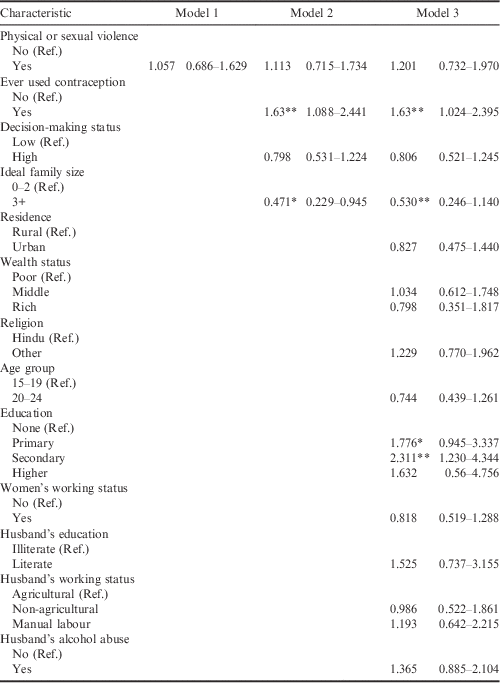
The relationship between IPV and unintended pregnancy was examined using bivariate analysis and statistical significance was assessed using Pearson’s χ 2 test (results not shown). The results showed a statistical significance in India and Bangladesh, but not in Nepal. Nevertheless, logistic regression analysis was carried out for all three countries to identify the factors associated with unintended last births. Odds ratios were calculated for each country using three different models. The odds ratios of physical or sexual violence and other control variables are presented in Tables 3, 4 and 5 for India, Bangladesh and Nepal, respectively.
Odds of unintended last birth by selected characteristics of the respondent in India
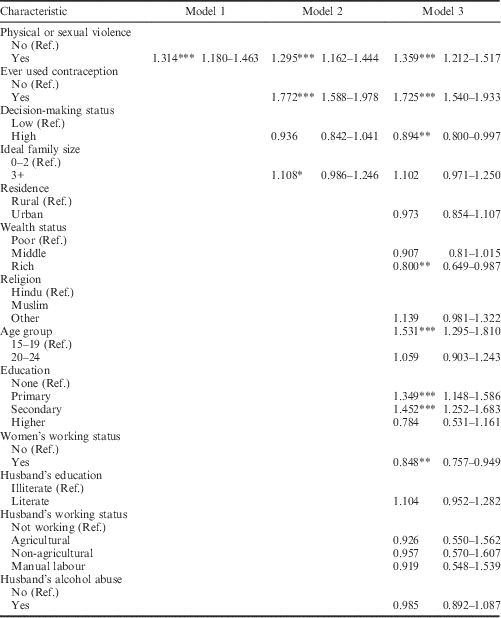
***p<0.001; **p<0.05; *p<0.1; based on 9788 women.
Odds of unintended last birth by selected characteristics of the respondent in Bangladesh
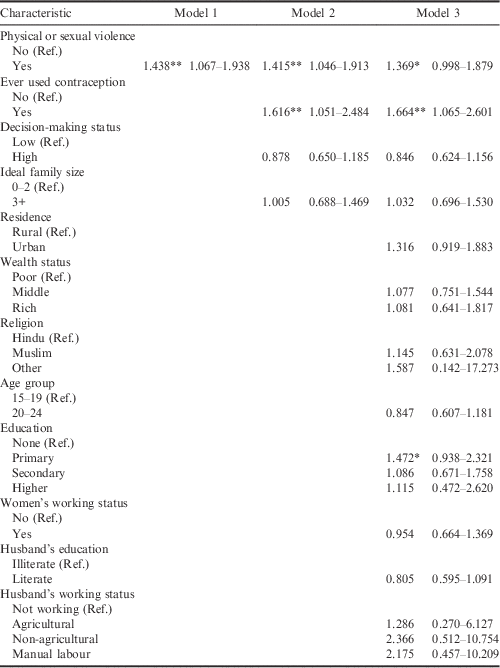
**p<0.05; *p<0.1; based on 934 women.
Odds of unintended last birth by selected characteristics of the respondent in Nepal
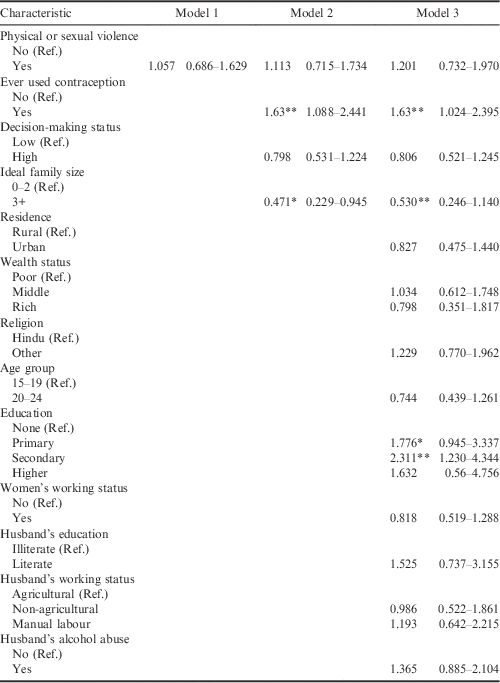
**p<0.05; *p<0.1; based on 574 women.
Physical or sexual violence was significantly associated with unintended births in India and Bangladesh across the three models. The gross effect of physical and sexual violence on unintended births in India and Bangladesh (Tables 3 and 4) showed statistical significance. Women who experienced physical or sexual violence were more likely to report an unintended birth in India and Bangladesh (OR=1.314, p<0.001; OR=1.438, p<0.05, respectively). Women with a rich wealth index were less likely to report unintended birth than poor women in India (OR=0.799, p<0.001). Those who followed ‘other’ religions were more likely to report unintended birth (OR=1.535, p<0.001) than Hindu women in India. Those who worked were less likely to report unintended birth (OR=0.812, p<0.001) than those who did not work in India. Women with primary and secondary levels of education were more likely to report unintended birth than women with no education in India and Nepal. The odds of unintended birth increased as the levels of education increased (OR=1.349, p<0.001 for primary level and OR=1.451, p<0.001 for secondary level in the case of India; OR=1.776, p<0.10 for primary level and OR=2.311, p<0.05 for secondary level in the case of Nepal). Similarly, unintended birth was more likely among women who ever used contraception in India, Bangladesh and Nepal (OR=1.725, p<0.001; OR=1.664, p<0.05 and OR=1.566, p<0.05 respectively).
Discussion
This paper examined the association between IPV and last unintended birth among married adolescent and young adult women in India, Bangladesh, and Nepal. Intimate partner violence comprised both physical and sexual violence. The respondents were married women who had had at least one birth in the five years preceding the survey. The rate of experience of physical or sexual violence ranged between 27 and 52% among the respondents. Around 20% reported that their last birth had resulted from an unintended pregnancy (Table 2). Unintended pregnancy was significantly higher among women who had experienced physical or sexual violence in India and Bangladesh, and the results are consistent with those of previous studies (Silverman et al., Reference Silverman, Gupta, Decker, Kapur and Raj2007; Stephenson & Koenig 2008; Raihana et al., Reference Raihana, Shaheen and Shafiqur Rahman2012). However, in the case of Nepal this association was not significant, but this could have been due to small sample size. Although abortion is legal in the selected countries, it is more liberal in Nepal than in India and Bangladesh (WHO, 2013). Liberal abortion law in Nepal may be a factor leading women to seek abortion services whenever a pregnancy is unintended. There is evidence for a strong relationship between abortion and violence (Leung et al., Reference Leung, Leung, Chan and Ho2002). However, further studies are necessary to test the relationship between abortion and violence under different policy circumstances.
The results found a relationship between IPV, use of contraception and unintended births. Women who ever used contraception were more likely to report unintended birth. Although some previous studies have suggested the use of contraception to be higher among women who reported unintended childbirth (Begum et al., Reference Begum, Dwivedi, Pandey and Mittal2010; Raihana et al., Reference Raihana, Shaheen and Shafiqur Rahman2012; Shabnam & Mukherjee, Reference Shabnam and Mukherjee2013), the reasons for this are uncertain. In countries with moderate to high contraceptive prevalence, the majority of unintended or unplanned pregnancies are the result of either contraceptive discontinuation or contraceptive failure (Black et al., Reference Black, Gupta, Rassi and Kubba2010). Intimate partner violence is associated with more rapid discontinuation of contraception (Allsworth et al., Reference Allsworth, Secura, Zhao, Madden and Peipert2013) leading to unintended pregnancy outcome. Community and individual perception about contraception is an important determinant of contraceptive use; therefore, misconceptions about the use and discontinuation of contraception may be leading to unintended pregnancies (Adhikari et al., Reference Adhikari, Soonthorndhada and Prasartkul2009). It may also be argued that misconceptions about contraception are widely prevalent in South Asian countries. Women reporting IPV are more likely to use traditional methods of contraception (Taft et al., Reference Taft, Powell and Watson2015). The chances of failure with traditional methods are high and may give rise to unintended pregnancies. A recent study by Raj and McDougal (Reference Raj and McDougal2015) has pointed out that women with a history of IPV, particularly sexual violence, had a higher prevalence of contraceptive failure. The births that followed contraceptive failure were most likely to be considered unintended (Curtis et al., Reference Curtis, Evens and Sambisa2011). Thus, it is possible that IPV may lead to contraceptive failure or discontinuation, resulting in unwanted births. Previous studies also indicate that due to fear of violence women fail to access contraception or abortion services (Shedlin & Hollerbach, Reference Shedlin and Hollerbach1981; Fort, Reference Fort1989; Bawah et al., Reference Bawah, Akweongo, Simmons and Phillips1999). Consistence use of contraception undoubtedly reduces the chances of unintended pregnancy, but the use of contraception may be associated with IPV and other factors.
The current study is a departure from earlier studies in a several ways. Previous studies have focused mostly on women in their childbearing years (15–49), whereas this study presents a more generalized picture of the relationship between IPV and unintended pregnancy among sexually active adolescents and young married women. It is important to study adolescents and young women because conception rates are higher at younger ages. Besides, marriage at an early age, i.e. before the age of 18, is associated with increased risk of intimate partner violence (Raj et al., Reference Raj, Saggurti, Lawrence, Balaiah and Silverman2010; Singh & Anand, Reference Singh and Anand2015). The social norms and sanctions in the South Asian regions pressurize women to prove their fertility soon after marriage. The reproductive rights of women are little respected in a society where a woman’s status is dependent on her ability to conceive and give birth. Therefore, young women are under tremendous pressure to give birth. Young women who experience sexual violence are likely to compromise in exercising their reproductive rights, which may lead to an unintended or coerced pregnancy. Under coercive circumstances, adolescent and young married women are prey to non-consensual sex out of fear of the consequences of refusal, which may range from physical abuse, loss of economic support to accusations of infidelity (Santhya et al., Reference Santhya, Haberland, Ram, Sinha and Mohanty2007). This behaviour has been reported as ‘defensive acquiescence’ (Rance, Reference Rance1994; Goldblatt & Meintjes, Reference Goldblatt and Meintjes1998; Heise et al., Reference Heise, Ellsberg and Gottemoeller1999), where a woman surrenders herself to her husband’s desire.
This study has a few limitations. The inferences drawn are based on cross-sectional data, so causal inference may not be drawn. Intimate partner violence is a self-reporting measure which may be under-reported as it is a very sensitive issue to discuss. Recall bias may also lead to under-reporting while sharing experiences of IPV. The retrospective measure of unintended birth is hugely affected by post-birth rationalization of pregnancy and maternity happiness, which may lead to under-reporting of an unintended birth outcome. The study did not capture those women who may have had an unintended pregnancy that resulted in miscarriage or induced abortion. Socially desirable behaviour often leads woman to report a child who has already been born as a wanted child. The probability of reporting the last pregnancy as wanted or mistimed may be higher than reporting it as unwanted. Therefore, it is assumeed that mistimed pregnancy may be an unwanted pregnancy but may have been reported as mistimed. Therefore, both mistimed and unwanted last pregnancies were categorized as unintended pregnancies.
Conclusion
The investigation of the association between IPV and unwanted births is critical for developing intervention programmes in order to reduce the health and social costs attached to these. The very high level of fertility in South Asian countries is a grave concern and unintended births are an added burden. Unintended pregnancies due to IPV reduce the health and well-being of women. Unintended pregnancy is a form of gross reproductive rights violation. The toll of unintended fertility intentions experienced by these women is often suppressed under the pretext of post-birth rationalization. The happiness attached to being a mother as ‘the source of life’ is heavily praised in South Asian society. It is therefore likely that women are inclined to suppress their reproductive rights. However, unintended births not only harm the health and well-being of women, but affect the larger demographic goals of resource-poor countries and add a burden to their already strained public health systems.
There is a greater need to recognize the sexual and reproductive health rights of married adolescent and young women in South Asia, since they are prone to unwanted or forced sex due to persistently disadvantaged gender equity norms. A strong involvement of the health sector in the lives of distressed women is essential. Violence against women needs to be considered and treated as a public health concern. Frontline community-level workers can play an important role in identifying the victims of IPV and refer them for treatment in appropriate health facilities. Awareness about various methods of contraception that best suit a woman must be imparted at the community level. Long-term and non-terminal methods of contraception must be promoted as a way of helping women who are forced to take part in sexual acts to prevent pregnancy. The emergency contraceptive pill is an available option to prevent unwanted pregnancies; this can be provided by Accredited Social Health Activists (ASHAs) or Auxiliary Nurse Midwives (ANMs). However, the prevalence of the IUD, for example, is very low in India, Bangladesh and Nepal due to a lack of awareness and fear of side-effects. Efforts must be made to increase the use of reversible contraceptive methods that are acceptable to users, and violence prevention programmes must be accompanied by a more responsive health care system.
Acknowledgments
An earlier version of this paper was presented at a seminar entitled ‘Unintended Pregnancy among the Young: Correlates and Consequences’ organized by the Asian Population Association’s scientific group on Pathways to Adulthood in Asia and the Institute for Population and Social Research, Mahidol University, held in Bangkok in 2014. The authors gratefully acknowledge the comments made by reviewers and participants, especially Dr Shireen Jejeebhoy, whose valuable comments reshaped this paper.