The Paris Commune cartoon collection
The University of Sussex is extremely lucky to hold within its Special Collections the Eugene W Schulkind Paris Commune archive (SxMs162). A large and varied collection, it consists of around 2,500 items, including a huge number of newspapers from 1870–1871, posters, photographs and a valuable selection of satirical cartoons.
The Paris Commune
The 1871 Paris Commune (La Commune de Paris) lasted only 73 days. Although a relatively short time, this period constituted a dramatic and bloody moment in France's history. The insurrection of liberal Paris against the Thiers’ Conservative government of France saw the staunchly anti-clerical and socially progressive Communards fight for equality for all. Ahead of their time, the Collective established new ideals; seeking better provisions for the poor, the creation of feminist movements, and the introduction of civil partnerships. The Commune was unable to survive the force of the government and its army; on the 21 May 1871, thousands were killed and, along with them, the dreams of the Communards.
The revolution may have been short lived, but its ideals have had a profound impact, which can be felt in current politics. There is a historical message from this period that clearly still has resonance, which makes this collection even more interesting.
The collection
The collection was acquired by the University of Sussex in 1968, thanks to the ‘efforts and enthusiasm’ of Sussex academic Dr Eugene Schulkind.Footnote 1 The archive held within Special Collections is the only one of such breadth on the subject of the Commune available within the UK.
Newspapers published during the lifetime of the Commune form a considerable part of the collection, alongside contemporary photographs, posters and pamphlets. There are also secondary items, such as commemorative exhibition catalogues and academic reflections on the Commune. In addition to the wealth of original artefacts, Schulkind gathered surrogate material from a number of international institutions to complement and develop the collection.
The real attraction of this collection however is the large number of illustrations and sartorial cartoons/caricatures. With the collection largely in French, the presence of these vibrant and politically charged images provides not only a visual treat, but an access point into the collection allowing all who are interested to obtain an understanding of the values and fears driving the cause of the Communards.
Cartoons as political tools
Cartoons have a long relationship with political insurgency. France in particular has a history of using the artistic format to communicate with and engage the population. From the French Revolution through to the twenty-first century, with magazines such as Charlie Hebdo, the politically charged cartoon has been - and continues to be - used as a powerful tool in challenging the status quo, ‘question [ing] the hegemonic ideologies and query[ing] accepted social constructs’.Footnote 2 The challenge to the dominant ideology the political cartoon and caricature presented places the art form in the hands of the left. The overt ridicule of satire is aimed upwards, it is about supporting the ideals, values and social position of the masses,Footnote 3 its adoption by the Communards is therefore unsurprising.
It is commonly acknowledged that the artistic merit of cartoons and caricatures is ignored or at least considered less deserving serious attention than the oils and watercolours adorning the walls of our most treasured galleries. Whether this disregard is due to it being the art of the underdog is something for further discussion. The award-winning cartoonist Steve Bell states in his introduction to the Cartoon Museum's latest exhibition:
If you are prepared to open your eyes to this wonderful collection of drawings. The artistry on display here defies description because of its sheer variety. Yet one quality unites all the works here: they stand alone, autonomous, resisting even rudimentary categorisation. They are works of art with an ulterior motive. They observe, report, disturb. amuse, attack, poke fun and pontificate. They are elegant, crude, tasteful, disgraceful, kind, cruel, and unruly. They have no viewpoint, other than that of being human in a particular time and place. They come singly or in serried ranks. Their biases are manifold, and tell us more about ourselves than any number of think-pieces in any distinguished journal ever could.Footnote 4
The cartoons of the Paris Commune are beautiful examples of 19th century art. Artists such as Pilotell (Georges Raoul Eugène Pilotelle), Moloch (Alphonse Hector Colomb), Charles Frondas, (Napoléon Charles Louis de Frondas) and Saïd (Alphonse Lévy) all lent their talents to create mass-produced artwork to widely promote the Commune's message, reaching those whom the governing powers usually ignored. But despite Bell's statement it could be argued that this is not art with an ‘ulterior motive’ but art with a clear purpose, and that purpose was to undermine the Thiers’ government and organised religion.
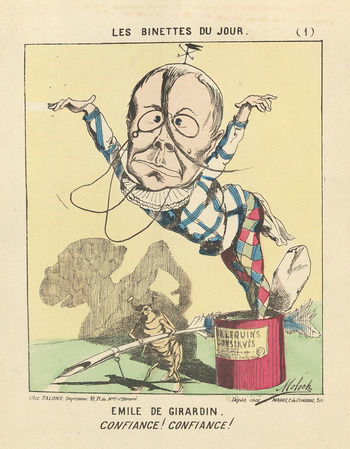
The collection is packed full of imagery that ridicules. An example of which is a drawing of the politician, Emile de Girardin (Fig. 1). The artist has cleverly combined obvious derision of the politician with subtle aspects of mockery. The image is of De Girardin jumping out of a jack in the box, dressed in a jester's costume, an obvious jibe implying he was a joke. Further condemnation is shown behind the main image where it can be seen that his shadow is appearing as a monkey - an unflattering metaphor for mischief or primitivism. This cartoon is a fine example of not only the satirical prowess of the Communards but also the artistic merit of cartoons.
Cartoon from the Paris Commune collection, part of the University of Sussex Special Collections held at The Keep (SxMs162).

The hand-produced cartoons were painted using a select palette of colours, at a staggering pace and volume. The sheer scale of production of such material had not been seen before and indeed has rarely been experienced since.Footnote 5 The Communards recognised that they could communicate their politically charged messages in a format that transcended the need for understanding the written word. This allowed them to spread their message far and wide, reaching those usually ignored by the ruling elite. The cartoon was their ‘quickest and cheapest weapon’Footnote 6 and they fired it right into the heart of Paris.
Teaching with archives
The Paris Commune collection highlights the versatility of archival collections, and their ability to be used in learning and research across multiple disciplines. The University of Sussex Special Collections is in a particularly unique position as part of the comprehensive Library Service provided by the University Library while being physically based in a purpose-built archival centre, The Keep. The Keep is a public access archive centre, bringing together the teams and collections from East Sussex County Council, Brighton and Hove City Council, and the University of Sussex. Making use of its state-of-the art facilities and highly experienced staff, the Special Collections team led by the Special Collections Archivist provide teaching to students from across the academic community at Sussex, using materials and objects from the range of collections. Sessions can take the form of introductions to using archives for research or be subject focused. For example, a popular session is provided for Accounting students from the Business School, which utilises objects such as Leonard Woolf's Household Account Book 1914–1953 (SxMs-13/2/R/A/65).
As Watson and Pattrick discuss in their recent article, there is true academic value in sharing archives with students, and the opportunity to develop critical thinking skills from hands on learning.Footnote 7 Object-based learning is an important and valuable skill, which compliments traditional information literacy skills.Footnote 8 Introducing students to the concept of object literacy ‘encourages analysis and critical reflection as students are encouraged to read meaning and text within objects and discuss how they can be interpreted…incorporating sensory elements, such as touch’ into their research toolkit.Footnote 9
Finding materials/collections which can support this technique is always exciting, and the Paris Commune collection is one such example. With its wealth of posters, photographs and pamphlets, it encourages one to pick up, touch and feel the history within the objects. It is therefore important we practice and promote metaliterate teaching methods, and understand the information behaviours of our whole learning community, to ensure repeated engagement with these valuable primary resources.
Decoding cartoons
As previously mentioned, the use of images removes the requirement of literacy as a barrier to understanding. An obvious accessibility problem with the Commune archive is the majority of material being in the French language; the cartoons therefore provide a route into understanding the period and context in which the Commune developed. To state, however, that cartoons and caricatures merely provide an introduction to written word materials would be incorrect. As Buck discusses, cartoons are more than just a page filler in the comments section of the newspaper, the political cartoon is a complex set of imagery and words complete with its own language.Footnote 10 From the Commune cartoons we can not only gain insight into this historical episode, but also begin to learn the language which cartoonists use to promote opinion. As Godioli and Pedrazzini highlight in their article Falling stars and sinking ships: framing and metaphors in cartoons about Brexit, cartoons can ‘help us further explore the discursive implications of the “fractures” produced by Europe's recent political, economic and social crises.’Footnote 11 By learning the language of cartoons we open up the opportunity to view contemporary events through a new lens.
Conclusion
There is so much more that could be said about this collection of cartoons, and the long-lasting impact the Commune has had upon not only the political and social climate of France, but also the rest of Europe. An area which this article has not had a chance to discuss is the significant role of women during the commune and their depiction within the illustrated material. As is often seen in discussions of feminist movements, opinions vary widely; the Paris Commune is no different. Female Communards were seen as both men-hating immoral creatures, and as radicals, fighting against social inequalities for all.Footnote 12
With the 150th anniversary of the Commune coming up in 2021, now is an appropriate time to properly investigate this poignant collection and consider how we will use it to mark and remember those remarkable 73 days in 1871.
Author's Note: The Special Collections of the University of Sussex represent the interdisciplinary nature of the teaching and learning which takes place at the institution. The collection includes the papers of Virginia and Leonard Woolf, the archive of Lord Richard Attenborough, and the Archive of Resistance Testimony. Stored at The Keep, the collections can be viewed Tuesday – Saturday.
Full details of the Paris Commune collection can be found on The Keep website https://www.thekeep.info/collections/getrecord/GB181_SxMs162