Introduction
In recent times, several natural disasters and terrorist attacks, such as the 2015 Nepal Earthquake and the 2013 Boston Marathon bombing (Massachusetts USA), have led to mass-casualty events world-wide.Reference Giri, Risnes and Uleberg1, Reference Kellermann and Peleg2 Japan too has had its share of mass-casualty events related to terrorism, as well as natural and radiation-associated disasters, such as the 1995 Tokyo subway sarin gas attack, the 2011 Great East Japan Earthquake, and the 2016 Kumamoto Earthquake.Reference Okumura, Hisaoka and Yamada3, Reference Nagamatsu, Maekawa, Ujike, Hashimoto and Fuke4 However, on-field medical activity policies for mass casualties after terrorist attacks or disasters are currently insufficient, and the level of preparedness to receive casualties in medical institutions is low in Japan. Indeed, the radiation disaster caused by a nuclear power plant accident in the Great East Japan Earthquake was met by a lack of experience and preparedness for such disasters.Reference Tsuda, Lindahl and Tokinobu5
In preparation for the 2020 Tokyo Olympic and Paralympic Games, there is an urgent necessity for Japan to organize systems to provide timely remedies, including emergency surgery, to casualties of mass-casualty incidents (MCIs) such that they are transported appropriately to medical institutions. It is essential for medical institutions, fire departments, the police force, and related government institutions and agencies to have a shared understanding of tasks and to co-develop measures adapted to the characteristics of each region, based on knowledge gained from previous cases.
In July 2016, an MCI occurred at the Tsukui Yamayuri-en facility (hereinafter, Yamayuri-en), a facility for disabled persons located in Sagamihara City, Kanagawa Prefecture. With the exception of some shooting incidents, this was among the largest murder and injury incidents caused by a single perpetrator, using a knife, world-wide. The attack resulted in 45 casualties, including 19 deaths. As the only Level I trauma center in the vicinity, including the site of the incident that accepts severe casualty cases, the study hospital dispatched physicians on doctor cars to the field and admitted multiple casualties.
This report aims to reflect on the case that involved the collaboration of multiple institutions, from a medical standpoint, to review the experiences and challenges elucidated through the incident to provide insights for the formulation of response measures for similar incidents in the future.
Report
Ethics Approval
This study was approved by the Independent Ethics Committee of the Kitasato University (Sagamihara, Kanagawa, Japan; approval number B16 – 165) and was conducted in accordance with the Declaration of Helsinki. However, given the retrospective nature of the study, based on fire department records and medical charts of the institution, the Independent Ethics Committee waived the need to obtain individual consent.
Case Outline and Medical Management On-Scene
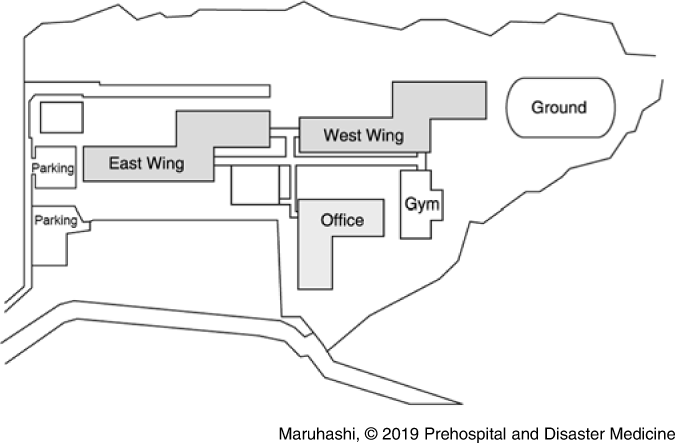
Yamayuri-en is a facility for disabled individuals and is located in Sagamihara City. The facility comprises 21 buildings, including two-storied residential wards on the east and west wings, spread across approximately 30,000 square meters (Figure 1). At the time of the incident, there were 157 residents (99 men and 58 women; aged 19 to 75 years) and eight staff members on the premises.
Layout of the Facility.

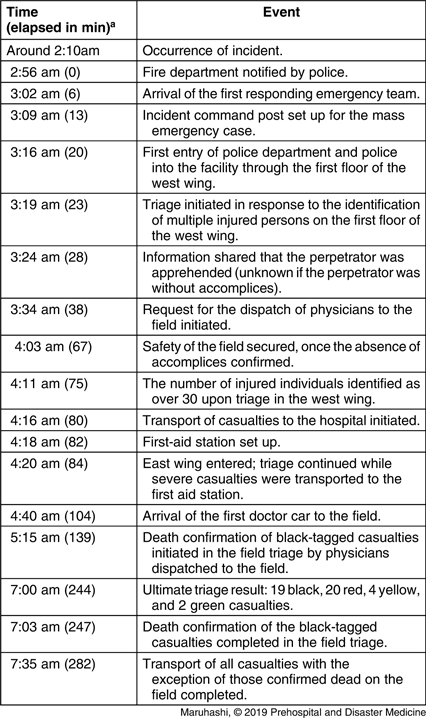
The perpetrator, armed with a knife, entered the premises through the first floor of the east wing at 2:10am on the day of the incident. After tying the facility staff with zip-ties, he stabbed residents one after another with the knife and migrated from the east wing to the west wing before escaping. The incident was reported by a staff member who alerted the police after the perpetrator escaped. The fire department was notified at 2:56am by the police. Information provided at the time of notification included the fact that there were three or more casualties with stab injuries, so the fire department established an incident command post (ICP) and emergency operations center in the parking lot at the side of the facility (Figure 2). The emergency team that had arrived earlier entered the facility from the first floor of the west wing at 3:16am along with the police. Casualties stabbed multiple times, including those in cardiopulmonary arrest, were already identified; thus, there was a requirement for triaging. The Simple Triage and Rapid Treatment (START) method was used. At 3:34am, the ICP requested for additional emergency staff and shared information with nearby medical institutions, and also requested that physicians be dispatched from three medical institutions to the field. The perpetrator was apprehended by the police at 3:24am in the west wing during triage by the first responding team. At the time of the completion of the triage in the west wing, the number of casualties had already exceeded 30, so the fire department set up a first aid station next to the premises and initiated the priority-based transport of casualties with severe triage categories from the facility to the first aid station. Furthermore, once multiple casualties were identified in the east wing as well, triage was initiated in that wing by a separate emergency team. The first doctor car arrived at 4:40am; it entered the facility with the fire department and the doctors continued performing triage. Ultimately, a total of five physicians from three medical institutions entered the field. On the field, physicians provided blood transfusions and fluid infusions, along with hemostatic treatments, including the suturing of the stab wound site, and also administered analgesics. Blood, meant for transfusions, were stored in a portable refrigerator and transported in the car of the first doctor. Type O RhD (+) red blood cells were administered to two cases, which were suspected of hemorrhagic shock in the field, from just one blood pack.
Field Medical Activity.

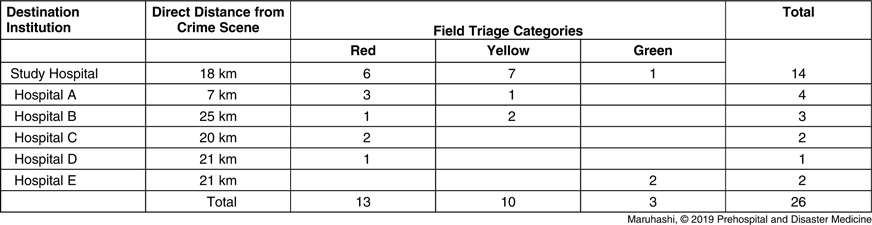
Patients given red tags in the triage were distributed across several medical institutions for prioritized transport, and triage was repeated by several physicians dispatched to the field for cardiopulmonary arrest casualties. Death was confirmed on the field for all the casualties given black tags. The transportation of all the casualties was completed at 7:35am, four hours and 39 minutes after the notification to the police department (Table 1). The final field triage category count was: 20 red, four yellow, two green, and 19 black tags. All the casualties (n = 26) except the 19 black tag casualties were transported to one of the six neighboring medical institutions (Table 2). This incident involved 30 emergency teams and 12 fire department teams, with assistance from neighboring fire departments.
Time Course

a Course of events from the time of notification to the fire department.
List of Destination Hospitals and Number of Transported Persons

Treatment
The study hospital is located approximately 25km away from Yamayuri-en, requiring approximately 40 minutes of transportation by land. It supervises the medical control of the area and is the only Level I trauma center in the vicinity, with a total of 41 physicians, including three surgeons in the critical care center, one plastic surgeon, and 19 residents. At the time of the incident, there were five emergency physicians on night duty, including two emergency staff and three residents. During normal operational hours (5:00am-5:00pm), physicians are dispatched to the field for severe casualties on a doctor car, but this was not available at the time of the incident, and staff members such as physicians and drivers had to be called on emergency; thus, the doctor car was dispatched two hours and 42 minutes after notification by the fire department. Based on the information received from the physicians dispatched to the field, the critical care center led the preparation in the hospital. First, a disaster response headquarters was set up in the hospital, and all staff physicians at the critical care center were called on an emergency basis at 5:40am. Plastic surgeons and otorhinolaryngologists were also called, and all surgeries scheduled for that day across departments were temporarily suspended so as to allow for the casualties of this incident to be operated on with a high-degree of urgency and priority. Fourteen casualties were received in the three hours and 26 minutes between 5:46am and 9:12am. The field triage categories of the 14 casualties were: eight red, four yellow, and two green tags. A total of 104 staff members from the study hospital responded, including 42 physicians and nurses, administrative staff, and radiology technicians.
A temporary disaster response headquarters and triage area were set up at the entrance of the critical care center to re-triage the casualties on arrival, and they were transported to care areas by triage categories. Teams comprising two to four physicians and nurses were formed to examine and treat each casualty.
The median age of the transported casualties was 41 (interquartile range [IQR] = 35.5 – 42.0) years. Their vital signs on arrival at the hospital were systolic pressure 115 (95.5 – 130.0) mmHg, heart rate 91.5 (81.25 – 96.75) bpm, respiratory rate 20 (19 – 22) breaths/min, and consciousness level Glasgow Coma Scale 11 (11 – 12). Three casualties (21.4%) were in hemorrhagic shock on arrival at the hospital, but rapidly recovered after the first transfusion.
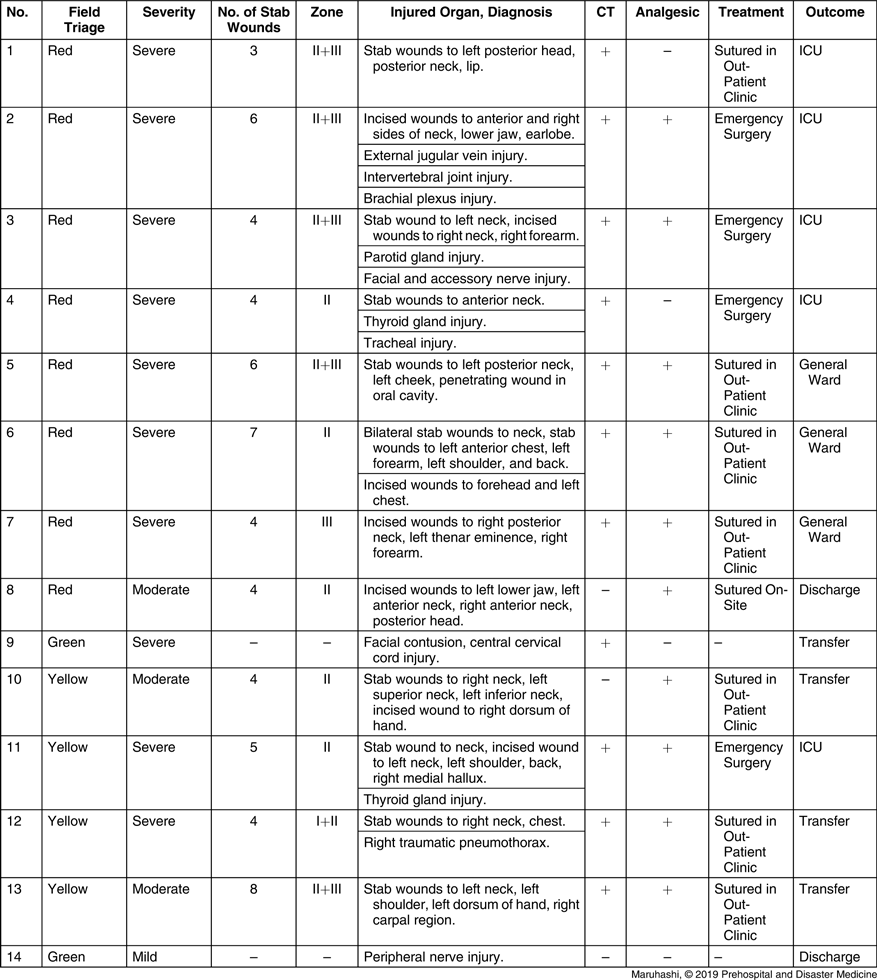
All 12 facility residents had multiple cervical stab wounds (median four wounds; IQR = 3.75 – 6.0). A total of 91.7% of these stab wounds were in mid-neck Zone II region, between the cricoid and the angle of the mandible.Reference Gonzalez, Falimirski, Holevar and Turk6 One patient had a stab wound to the chest as well, resulting in pneumothorax, and a drain was inserted into the thoracic cavity. Of the 12 patients, 10 (83.3%) could not remain in a relaxed state during the examination and testing, so the administration of analgesics was required. Of the 12 patients with cervical stab wounds, four (33.3%) required emergency surgery, and the rest were sutured on an out-patient basis. One patient had already been sutured on the field. All patients requiring emergency surgery had deep wounds, and trauma surgeons led surgery to treat injuries to the carotid vein, thyroid gland, nerves (brachial, facial, and accessory nerves), and the trachea.
Eight of the casualties, including five who entered the intensive care unit, were hospitalized at the study institution. Since their conditions stabilized after the initial treatment, four were transferred to other hospitals, and two were discharged home after receiving out-patient treatments. Of the eight patients who were hospitalized at the institution, three were transported to a neighboring hospital within the first day. Of the five casualties who were hospitalized for treatment, one was discharged home, and four were transferred to other neighboring medical institutions at a later date. There were no deaths among the casualties transported to the study hospital (Table 3).
Casualties Transported to Study Hospital

Abbreviations: CT, computed tomography; ICU, intensive care unit.
The standard medical services provided at the hospital resumed at 8:00am when the final number of casualties to be received was more or less known. The disaster response headquarters was dismissed at 3:55pm upon the completion of all transfers.
Discussion
In this incident, a majority of the victims were severely disabled individuals, and this was further complicated by the fact that they were all casualties of stabbing by a third party. Furthermore, the interactions between several factors, such as geography and the time of day in which it occurred, made the execution of medical activities on the field noticeably challenging. Many of the casualties had impaired communication skills and were unable to provide direct descriptions of the situation. Thus, it was extremely difficult for the first responder emergency team to gain an understanding of the incident in the initial stages; it took approximately one hour and 20 minutes for all the information to be collected. The locations of the residential wards of the facility, which were dispersed over a vast area, also contributed to the challenge. Furthermore, it was a case of murder and injury inflicted by a third party; thus, the safety of the field was not secured when the emergency team entered the residential wards. Cooperation with the police department was crucial, as the fire department alone could not perform the medical activities.
The START method used by the Japanese fire department was used for the field triage. There are numerous triage methods for MCIs, each with its own advantages and disadvantages. The limitations of each method should be recognized, and the optimal method should be selected based on the characteristics of the casualties or type of disaster.Reference Garner, Lee, Harrison and Schultz7–Reference Christopher, Brooke, David, Koenig and Schultz9 Almost all the casualties of this incident received stab wounds, including wounds to the neck. Unlike in the case of trauma to the limbs, temporary hemostatic devices such as tourniquets cannot be applied to active bleeding from the neck; therefore, the only methods to control hemorrhage are suturing or astriction in the field. The severity of sharp wounds tends to be worse when inflicted by others, compared to that of self-inflicted wounds.Reference Leow, Lingam, Lim, Go, Chiu and Teo10 Previous studies have reported that computed tomography is effective for the diagnosis of the severity or indication of surgery for penetrating neck trauma.Reference Nasr, de Oliveira and Mazepa11 It is extremely difficult to accurately diagnose the depth or severity in field settings; thus, a more severe triage category must be assigned to casualties on the field for safety reasons. However, only 12% of penetrating neck trauma cases require surgical treatment; the majority can be treated conservatively.Reference Thoma, Navsaria, Edu and Nicol12 The majority of MCIs occurring in foreign countries are a result of guns and explosives. Stab wounds like in this incident, particularly to the neck, are extremely rare in MCIs world-wide. Thus, an optimal triage method has not yet been established. Physicians dispatched to the field performed further triage by severity to prioritize the order of transport to the hospital, thereby complementing the limitations of the existing triage methods. As such, the dispatch of physicians to fields such as this, with a high-degree of peculiarity and difficulty in making medical judgments, is paramount.
In the case of MCIs, multi-institutional collaboration is extremely important. This was emphasized in a report on the response to the Boston Marathon terrorist attacks.Reference Kellermann and Peleg2 Medical institutions, as well as fire and police departments, must cooperate on the following: cooperation with the police in a crime scene for discussions on the safety of the field; information sharing between medical institutions and dispatching physicians to the field between the first knowledge of the MCI and initiation of the first action; performance of field medical services, including triage by dispatched physicians and the fire department; and decision making on the priority of transport or the destination hospital. Impromptu collaborations on an emergency-basis for disaster events are not always effective, and there is a requirement for joint drills and conferences to increase shared awareness and preparedness. Furthermore, it is also crucial to encourage collaborations between medical institutions in an area.
Limitations
In this report, several limitations should be taken into account concerning the emergency medical system in Japan. The START method is prevalent as a method of triage for such incidents as MCIs because what the paramedics can enforce at the site is limited. This also affects the efficiency of doctors that are dispatched to the scene for such penetrating trauma in Japan. In other countries where paramedics are allowed to start medical treatment at the site, dispatching doctors to the scene may extend the time taken before transportation. Furthermore, in such cases of MCI involving killings, from safety management perspective, before the criminal is apprehended and the site secured, medical practices on the field may have to be restricted.
Conclusion
In MCIs, it is extremely challenging to devise individual measures aimed at the various hazards and groups, and it is essential to adapt responses flexibly to make optimal changes according to the type of disaster or characteristics of the casualties. In local disasters, the regional medical control board plays a major role, and it must take on a central role in not only admitting patients to the hospital, but also in dispatching physicians to the field or leading collaborations with neighboring medical institutions. Furthermore, horizontal communication and interactions should be reinforced by the formulation of protocols and conduction of joint training for effective inter-department collaborations on the field.
Acknowledgements
The authors would like to thank Editage (www.editage.jp; Cactus Communications, Inc.; Trevose, Pennsylvania USA) for the English language review.