Political scientists' current understanding of principal–agent relationships in the study of public bureaucracy centers on how politicians control policy administration via delegated authority to bureaucratic organizations. A major element of inquiry on this topic involves the analysis of information asymmetries that constrain political principals' ability to shape the performance of bureaucratic agents (e.g., Banks 1989, Hammond and Miller 1985, and Miller and Moe 1983). Niskanen's (1971) seminal research on agency budget maximization, for example, maintains that bureaucratic organizations are able to exploit politicians' information deficiencies to extract budgetary resources that exceed the level of output that they produce.
Information problems, however, are not limited to political principals. Bureaucratic agents also face a similar dilemma because of their uncertainty concerning budgetary resources and task activities, among other items relevant to organizational performance, including the future needs of the agency, the nature of outputs and outcomes (March 1988), and the spatial ideological location of political actors (Krause 2003a). Thompson (1967, 159) claims that uncertainty is the fundamental problem for complex organizations, and coping with this issue is at the core of the administrative process (see also Crozier 1964). A bureaucratic agency's decision-making response to uncertainty can inform our understanding of how it chooses to cope in the presence of imperfect information (e.g., Downs 1967, Simon 1976, Stinchcombe 1990, and Wilson 1989). This, in turn, can provide us with direct insight into its risk-bearing behavior, rather than merely treating it as a simplifying fixed assumption or ignoring it altogether, as has been done in existing scholarship. Notwithstanding research on parallel systems and redundancy in bureaucratic organizations (Bendor 1985; Heimann 1997), political scientists have yet to place much effort in assessing how administrative agendas respond to uncertainty (but see Carpenter 2000 for a notable exception). The requisite first step toward understanding how administrative agencies handle these information limitations involves proposing theory-laden criteria that can enable scholars empirically to demarcate risk-aversion, risk-neutrality, and risk-acceptant decision making.
Estimating these agency risk propensities can uncover the extent to which bureaucratic agencies value organizational maintenance in the face of an uncertain world. Specifically, an agency that behaves in a more (less) risk-averse (risk-acceptant) manner places a greater premium on its own organizational maintenance, all else being equal. This is consistent with the view that bureaucratic agencies wish to buffer themselves from uncertainty (e.g., Crozier 1964, Downs 1967, and Thompson 1967). Conversely, an agency behaving in a more (less) risk-acceptant (risk-averse) manner places less emphasis on its own organizational maintenance when confronting uncertainty, ceteris paribus. Such behavior might reflect an agency's greater willingness to act in a risk-acceptant fashion either because it is performing beyond its own expectations (March 1999, 20) or because it desires to appease politicians' preference for limiting administrative resources (Banks 1989; Miller and Moe 1983).
The main contribution of this study is providing a direct statistical test of agency risk-bearing behavior. This test is derived from a simple theoretical analysis of bureaucratic budgetary decision making under uncertainty developed elsewhere (Krause 2002). It is predicated on the utility that the agency receives from seeking greater funding1
As a general rule, this implicitly presumes that an agency's actual funding will be a monotonically increasing function of its own budget requests distinct from the Office of Management and Budget (OMB)/Presidential figures. Thus the agency will always obtain positive marginal utility from the BR since it is presumed that the agency will prefer more money as opposed to less, all else being equal. What the agency does not ask for in terms of budgetary resources, it will not likely acquire from political principals. This is because it is generally rare for agencies to receive greater appropriations than are directly requested. Data on the SEC for the 1949–97 period support this view.
vis-á-vis the utility it derives from the uncertainty (i.e., volatility) that it experiences. For the purposes of this study, uncertainty is synonymous with resource and task volatility. This conceptualization of uncertainty, which is compatible with scholarship on organizational decision making (
March 1999, 180–83;
Thompson 1967), follows from agencies' desire to protect or buffer their technological cores from environmental influences (
Thompson 1967, 67).
2 Thompson specifically uses the concept of buffering applied to boundary spanning of organizational subunits, whereas in this study it pertains to agency resource preferences. Both usages treat buffering as a means of coping with uncertainty experienced by administrative organizations.
Rather than treating budgetary resources as an “end” to be maximized in order to create organizational wealth (e.g.,
Niskanen 1971; but see
Blais and Dion 1991 and
Miller and Moe 1983), I focus on how agencies view these resources as a “means” of coping with omnipresent uncertainty (e.g.,
Cyert and March 1963;
Downs 1967, 138–39; and
Wilson 1989). The aim here is to examine the behavioral range of possibilities employed by an agency in handling resource and task uncertainty in its policy environment.
3 The approach adopted here is decision theoretic, as opposed to game theoretic. This is because the purpose of this study is to gauge the risk-bearing preferences or proclivity of agency decisions, rather than to explain equilibrium outcomes from the budgetary process. Furthermore, game theoretic models require a priori assumptions concerning risk-bearing behavior underlying decision making, such as the risk-averse agent and risk-neutral principal applied in standard principal–agent theory (Miller and Whitford 2002). As a result, one can neither derive nor infer variable risk propensities from such decisions since they are treated as the initial conditions for such models. Game theoretic models try to determine the strategy undertaken by an actor while assuming a particular form of risk-bearing behavior in his/her decision making. The aim here is both to identify analytically and to quantify empirically the nature of risk-bearing involved in agency decision making, which is often assumed from the outset rather than investigated in its own right. Therefore, my concern is with directly analyzing the first principles of agency risk-bearing behavior, which provides both theoretical and substantive insight into how bureaucratic agencies cope with uncertainty. Legislative influence, however, is not ignored here since the agency budget request residual (BR) is operationalized in relation to what it received last year via appropriations in both the theoretical and the empirical analysis. In addition, political factors that might affect the manner in which an agency seeks budgetary resources are controlled for in the statistical estimation of agency risk coefficients analyzed later in this study.
In addition, I posit that bureaucratic agencies formulate budget requests in a heterogeneous fashion with respect to uncertainty in two distinct ways. First, agencies should behave in a relatively more risk-averse fashion in response to uncertainty that is determined outside of their decision-making locus than to uncertainty emanating from within. This is because an agency will possess relatively less information and ability to handle external uncertainty, which is determined by elected officials outside of its purview, than internal uncertainty (Pfeffer and Salancik 1978). Therefore, an agency should exhibit relatively greater uncertainty avoidance when it possesses less formal authority over its environment (Cyert and March (1963:166–167); Thompson 1967, 12). Agency budgetary behavior is also hypothesized to be at least as, if not more, risk-averse during divided government for a given discrete form of risk-bearing behavior, all else being equal. This expectation reflects the weaker policy coherence and less stable policy expectations in the political environment associated with divided government.
DERIVING A STATISTICAL TEST OF AGENCY BUDGETARY RISK-BEARING BEHAVIOR FROM FIRST PRINCIPLES
In the United States, an agency's funding request serves as a choice variable that is distinct from the Office of Management and Budget (OMB)/Presidential request. Agency budget requests represent one of the few mechanisms whereby bureaucratic preferences are actually revealed. These items provide an appropriate vehicle for analyzing the risk-bearing proclivities of administrative organizations. These funding requests yield insight into how agencies seek fiscal resources with the purposes of creating slack resources for their organizational and policy missions (Cyert and March 1963; Downs 1967; Thompson 1967; Wilson 1989). The perspective advanced in this study differs from Niskanen's (1971) budgetary maximization principle by viewing these resources as a hedge against uncertainty (Downs 1967, 138–39). An agency preoccupied with uncertainty (risk) avoidance, for instance, will seek resources to remove dependence upon other institutional actors (Pfeffer and Salancik 1978).
In constructing a statistical test of agency risk propensities, it is preferable to link it to the theoretical microfoundations of such behavior. I argue elsewhere (Krause 2002) that an agency's utility is a function of two variables–-its budgetary residual (BR; i.e., the difference between its request in the current year and actual appropriation from the prior year) and the uncertainty that it experiences (σ). By holding the agency utility at some fixed positive level (
), thus serving as an implicit budget constraint, one can isolate the relationship between agency budgetary decisions reflected in the BR and uncertainty (σ). To reiterate, my aim is not to set forth a full-blown model of the budgetary process explaining appropriation outcomes, but to determine how an agency copes with uncertainty via its budget request, for a given fixed level of utility. I formally derive comparative-static analytical results consistent with the theoretical conditions of budgetary risk-aversion, risk-neutrality, and risk-acceptant behavior within the context of divided and unified party government elsewhere (Krause 2002). As in other treatments of uncertainty in bureaucratic organization settings (March 1988, 1999), risk aversion (risk acceptance) implies that an agency will disfavor (favor) uncertainty, while risk neutrality connotes indifference to uncertainty.
For purposes of brevity, I characterize the basic theoretical foundations by a simple power function that assumes agency budgetary risk aversion:
4 Equation (1) can also be recast for risk-acceptant behavior, where agency utility is a positive function of uncertainty—i.e., U = c + BRα + σβ (see also footnote 13). The power function is employed here for ease of interpretation regarding empirically testable propositions. The mathematical results for the general solution for each type of risk-bearing agency budgetary behavior are robust to alternative functional forms. A full technical exposition of this theoretical analysis can be found elsewhere (Krause 2002).
where agency utility is an additive function of the agency's BR,
5 The budgetary residual (BR) refers to the marginal increment being sought by the agency compared to what it obtained in appropriations the previous year. This concept differs from (positive) economic rents that remain once an organization's functional needs are met (Niskanen 1971). The BR is premised on a linear decision rule that is commonplace in budgetary decision-making models (Davis, Dempster, and Wildavsky 1966; Padgett 1980, 355)—i.e., FRt = FAt−1 + ξt, where ξt is defined as the BR sought by the agency. Rearranging terms yields BR ≡ ξt = FRt − FAt−1. This is a plausible assumption consistent with the adaptive nature of administrative behavior.
that is, the difference between its request for the current year and what it received for last year's congressional appropriation—i.e., BR
t = [(
FRt)-(
FAt−1)], and also the level of uncertainty that it experiences (σ). I assume that the agency seeks a level of funding that is greater than what it received the previous year—i.e., BR < 0.
6 This simplifying assumption is for purposes of mathematical tractability because a negative root might exist in certain circumstances when using a power functional form. However, an actual budget appropriation reduction from one year to the next is not precluded since the current year budgetary appropriations are not germane for this assumption to hold. Relaxing this assumption does not alter the analytical results generated from the comparative statics (see footnote 4).
Further, the agency will always obtain positive marginal utility from the BR—i.e., agency utility increases as the BR rises—since it is safe to presume that more funding is preferable to less funding, all else being equal.
7 The positive marginal utility assertion does not necessarily imply that agencies will actually pad budgets in a conspicuous manner since there are other factors that can constrain this type of behavior, including the ideological orientation of political institutions, macro-level budgetary constraints induced by macroeconomic performance, and agency task activities. The present theoretical analysis treats these items and other considerations as being fixed in order to have a tractable problem that can be analytically solved. As stated in footnote 3, political factors are controlled for in the statistical analysis to ensure that the empirical risk coefficients represent valid estimates of agency budgetary risk-bearing behavior.
This is because budgetary resources that are not sought by the agency will typically not be granted to them by political principals, all else being equal. This proposition is assumed to be true, irrespective of the type of agency budgetary risk-bearing behavior. A risk-averse agency is assumed to obtain
increasing positive marginal utility from the BR since it places greater emphasis on budgetary resources, and thus organizational maintenance, than do agencies acting in accordance with risk neutrality and risk acceptance. Likewise, a risk-neutral agency is assumed to exhibit
constant positive marginal utility from the BR, while a risk-acceptant agency is assumed to possess
decreasing positive marginal utility from the BR.
Uncertainty is defined as the degree of budgetary appropriations or task volatility experienced by the agency (March 1999, 180–83; Thompson 1967). This definition reflects a generalized form of uncertainty that is germane to the operation of bureaucratic organizations (Downs 1967; March and Olsen 1976; Wilson 1989). Uncertainty is assumed to be inversely related to agency utility under risk-aversion, orthogonal with respect to agency utility under risk-neutrality, and positively related to agency utility under risk-acceptant behavior. These assumptions are consistent with standard applications found in financial economics (Hirshleifer and Riley 1992; Tobin 1958).
These alternative forms of risk-bearing behavior are captured by allowing the theoretical model's parameters to take on either negative, zero, or positive values. Solving for BR from (1) and also holding agency utility equal to a fixed positive level (U =
) yields
where
thus
serves as a supremum for c by definition since BR > 0 by assumption. Before proceeding any further, the parameters α and β, representing the first principle assumptions concerning the relationship between BR and σ with respect to agency utility, are substituted with the derived parameters of the predicted theoretical relationship between BR and σ, denoted by the corresponding terms α* and β*.
8 While α and β play a determinative role for the predictions derived from comparative-static analysis in Krause 2002, these “assumption” parameters are not mathematically equivalent to the “prediction” parameters α* and β*, capturing the direction and shape of the theoretical relationship between BR and σ.
Dropping the fixed terms (
, c) in (2) for simplicity's sake, without any loss of generality, the simple deterministic nonlinear relationship between BR and σ is obtained:
Taking the natural logarithm of (3) not only linearizes this relationship, but also provides a fixed-elasticity interpretation to β*/α*:
A 1% change in uncertainty results in a (β*/α*) % change in BR. The β*/α* parameter term represents a risk coefficient that generally reflects the ratio impact on agency utility attributable to uncertainty (β) and the agency BR (α), respectively.
9 This direct interpretation is valid, except for budgetary risk-acceptant behavior during unified government. This special case entails a more complex relative positive marginal utility expression (RPMUE) involving these “assumed” parameters relative to σ, discussed later in this section.
On a substantive level, the risk coefficient value captures the agency's relative desire for organizational maintenance in response to changing uncertainty. Therefore, the BR represents the agency's aggregate organizational response to the uncertainty that it encounters.
The agency's budgetary risk propensity might also uniquely vary between a divided and a unified government regime since these particular states are assumed to infer differential effects that uncertainty has on agency utility. This is due to the agency's less stable expectations about its political environment resulting from the weaker institutional stability often associated with divided government (Davis, Dempster, and Wildavsky 1966). Under this regime, bureaucracies are also supplied with less policymaking flexibility via the contents of enacting legislation (Epstein and O'Halloran 1999, 77–81). This, in turn, creates a greater challenge for bureaucratic units to construct coherent public policies during such political regimes. This qualitative distinction in agency risk-bearing behavior is consistent with the admonition that risk preferences should be supplemented with context-dependent considerations, rather than being treated in a generic fashion (March 1999, 244–45).
The effect of the divided/unified government distinction portrayed here suggests that the relative extent to which the agency wishes to be protected from political and policy uncertainty varies by context. Therefore, bureaucratic agents, like political principals, confront information asymmetries of their own when making decisions whose effects are accentuated under divided government. This is distinct, however, from the “power accrual” hypothesis, which predicts that an agency will seek to exploit the greater discretion that it enjoys under divided government because of the greater collective action and information asymmetry problems experienced by political institutions in such circumstances, all else being equal (e.g., Bryner 1987, Dahl and Lindblom 1953, and Hammond and Knott 1996).10
Even if the typical adopted policy is of a more moderate ideological nature, and perhaps closer to the agency's ideal point, due to the presence of divided government (Alesina and Rosenthal 1995; Fiorina 1996), this partisan configuration will also result in greater conflict among political principals during such eras. Hence, it is not unreasonable to surmise that greater variance exists surrounding the equilibrium ideal point under divided government compared to unified government, all else being equal.
These hypotheses are not mutually exclusive since the former pertains to the contextual, indirect impact divided government has on agency budgetary behavior in relation to uncertainty, while the latter refers to the direct effect this political regime has on such decisions. Theoretical attention is placed on the former issue, which emphasizes the information asymmetry facing bureaucratic agents, since this study is concerned with the decision making of these organizations under conditions of uncertainty.
11 The direct effect reflecting the “power accrual” hypothesis will be the coefficient on the divided government dummy variable. This is accounted for later in the regression analysis.
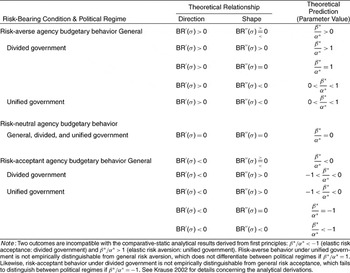
Summary information on the comparative-static results analytically derived in Krause 2002, and its implications for empirical hypothesis testing are given in Table 1. Under risk aversion, agencies must seek greater increases in BR when σ rises—i.e., β*/α* > 0. Risk-averse behavior implies that administrative agencies place a greater relative emphasis on organizational maintenance because it is assumed that they receive increasing positive marginal utility from the budgetary residual and negative utility from uncertainty. Thus, organizational slack serves as a rational response for obtaining bureaucratic flexibility in the face of uncertainty (Cyert and March 1963; Downs 1967, 138–39; Wilson 1989). Moreover, changes in uncertainty during divided government will have a relatively more adverse impact on the rate of change of the agency's marginal utility since the stability of its institutional environment, and hence agency expectations, is comparatively weakened.
Under divided government, risk-averse agency budgetary decision making can be β*Divided/α*Divided, > 1, β*Divided/α*Divided =1, or 0 < β*Divided/α*Divided < 1. The risk coefficient value depends upon whether the relative rate of positive utility accrued to the agency by seeking additional funding (α outweighs the rate of disutility from rising uncertainty (β). When uncertainty has a greater (lesser) impact on agency utility relative to that of the BR being sought by the agency, the risk-averse agency will seek a larger (smaller) than proportional increase in BR compared to the rise in σ—i.e., β*Divided/α*Divided > 1 (0 < β*Divided/α*Divided < 1). If uncertainty and the agency BR each have the same magnitude of impact on agency utility, then the BR will rise proportionally with σ—i.e., β*Divided/α*Divided = 1. During unified government, the risk-averse agency will seek increased budgetary funding that is less proportional than changes involving uncertainty—i.e., 0 < β*Unified/α*Unified < 1. This is because uncertainty will have a less deleterious impact on agency utility relative to the positive utility garnered from the BR. When β*Unified/α*Unified = 1 is empirically observed under unified government, this implies that uncertainty has a regime-neutral effect on agency utility (i.e., βUnified = 1) and, also, that the increasing positive marginal utility of the BR is sufficiently small such that it approaches a constant positive marginal utility of BR so that limαUnified → 1+ (βUnified/αUnified) = 1. A clear empirical distinction cannot be made between the unified government regime and a general form of budgetary risk aversion under this limiting case. To summarize, budgetary risk aversion indicates that agency requests will rise less than proportionally to a unit increase in uncertainty (inelastic risk aversion) during times of unified government, whereas it might do likewise, rise proportionally (unit elastic risk aversion), or greater than proportionally (elastic risk aversion), under divided government.12
This holds true for the analytically derived theoretical results, except when
under risk-aversion and
in the risk-acceptance case.
Under risk neutrality, the agency's budgetary decision making will not be responsive to uncertainty in any circumstances—i.e., β*/α* = 0. Risk-neutral budgetary behavior suggests that administrative agencies will obtain a constant positive marginal utility from additional funding, yet utility remains unaffected by uncertainty. This type of risk-bearing behavior implies that bureaucratic agencies are indifferent with respect to uncertainty and, hence, place neither a greater nor a lower premium on organizational maintenance as uncertainty changes. Therefore, a risk-neutral agency will refrain from altering its funding request as an organizational response to uncertainty.
General risk-acceptance budgetary behavior will be reflected by an inverse relationship between the agency's BR and the uncertainty it experiences—i.e., β*/α* < 0, whereby it is assumed to receive a declining positive marginal utility from the BR and positive utility from uncertainty.13
Recall from footnote 4 that budgetary risk acceptance will possess the opposite sign in front of σ than what appears in Eq. (1) since U = c + BRα + σβ and, hence, subsequently yields BR = − σβ*/α*.
Agency budgetary risk-acceptance behavior indicates that organizational maintenance is deemphasized, as reflected by a smaller BR in response to rising uncertainty, all else being equal.
14 Although risk-acceptance behavior by administrative agencies is atypical (Thompson 1967), it is unwise falsely to preclude this possibility on a theoretical level. Research has documented certain situations in which administrative agencies will seek smaller gains in budgetary resources as a response to the conditions of their policy environment relating to uncertainty or other factors affecting agency budgetary decision making (Johnson 1992; Khademian 1992). Thus one cannot preclude the theoretical possibility of budgetary risk-acceptant behavior, whereby administrative agencies might request relatively smaller increases in budgetary resources in response to rising uncertainty.
This type of agency behavior might be indicative of the stronger preference it holds for meeting politicians' desire to limit funding growth (e.g.,
Banks 1989 and
Miller and Moe 1983). This is because politicians' concern for inefficiency and undesirable policy effects that risky budgetary investments can bring about exceeds their preference for creating slack resources as a means to help the agency cope with a rising tide of uncertainty. Conversely, budgetary risk acceptance might reflect the agency's willingness to return some amount of slack resources to politicians since they possess a high degree of confidence that it is performing above expectations (
March 1999, 20).
Like risk aversion, risk-acceptant behavior might also contextually vary depending upon the presence of a divided or unified government regime. Divided government is assumed to exert a less positive impact on the agency's rate of marginal utility with respect to uncertainty than unified government. Thus, agency budgetary decisions that entail risk-acceptant behavior will reflect less than proportional changes in the BR sought by the agency in response to a change in uncertainty during the divided government regime—i.e., −1 < βDivided*/αDivided* < 0 (inelastic risk acceptance). This is because uncertainty will have a greater adverse impact on agency utility during periods of divided government vis-à-vis unified government. In the special case where βDivided*/αDivided* = − 1 (unit elastic risk acceptance) under divided government is observed, no clear empirical distinction can be inferred between this regime and a general form of budgetary risk acceptance for analogous reasons discussed earlier regarding unit elastic budgetary risk aversion under unified government.
In an era of unified government, risk-acceptant behavior will be βUnified*/αUnified* < 0 by definition. This is because the second derivative (shape) of the BR with respect to uncertainty is indeterminant and can be positive, zero, or negative. The shape of this relationship depends upon the level of uncertainty in relation to the relative balance between the rate of positive marginal utility attributable to uncertainty and the ratio of positive marginal utility with respect to both uncertainty and the agency's BR—or relative positive marginal utility expression (RPMUE).15
The logic and interpretation of these analytical results are elaborated on elsewhere (Krause 2002).
If the level of uncertainty is less than the RPMUE, then β
Unified*/α
Unified* < −1 (
elastic risk acceptance); and −1 < β
Unified*/α
Unified* < 0 when the converse is true. Finally, if the level of uncertainty is equal to the RPMUE, then the BR will decline proportionally with increasing σ —i.e., β
Unified*/α
Unified* = −1.
To ensure that the ensuing statistical estimate of the risk coefficient (β*/α*) is valid, the deterministic bivariate relationship captured in (4) can be viewed within the context of a statistical model by including an intercept parameter (γ), a k-dimensional column vector of control variables (Xk) with corresponding parameter vector (πk), and a random disturbance (ε),
Equation (5) represents a general log–log econometric specification with respect to the empirical relationship between BR and σ yet takes on a semilogarithmic form for the vector of control variables, which are initially assumed not to require a logarithmic transformation for data or substantive reasons.
16 This issue is explicitly considered when the vector of control variables are introduced later.
HETEROGENEITY OF AGENCY BUDGETARY DECISION MAKING UNDER UNCERTAINTY
An agency's risk-bearing behavior can vary in relation to the source of uncertainty and, also, the context in which it is experienced (March 1999, 244–45). Specifically, an agency's desire for organizational maintenance might well vary based on distinctions between external and internal sources of uncertainty, as well as along the contextual lines of divided versus unified party government. Regarding the former distinction, uncertainty can either be completely outside of the agency via decisions made by political principals (external uncertainty) or occur within the administrative organization in a manner that is beyond its full decision-making authority (internal uncertainty). For instance, appropriations volatility is one type of external uncertainty since congressional appropriation decisions are not made by the agency but, instead, are legally determined by the President and Congress (Kiewiet and McCubbins 1991). Task or enforcement workload volatility captures the internal uncertainty that occurs within the agency's organizational sphere. One might be skeptical of enforcement workload volatility as a valid measure of agency task uncertainty. Public organizations, however, do not perfectly control the volume of regulatory enforcement violations that transpire in a given year because these activities are largely conditioned as a response to the policy environment. The budget request reflects the agency's organizational expectations of its task activities for the upcoming year, subject to imperfect and incomplete information. These measures are compatible with the view that an administrative organization is part of a larger environment in which it has imperfect control over (Barnard 1938; Selznick 1949).
Agencies should be in a comparatively weaker position when attempting to cope with external uncertainty relative to internal uncertainty. This leads to the first hypothesis.
Hypothesis 1.
An administrative agency will behave in a relatively more risk-averse manner in response to external (appropriations) uncertainty vis-à-vis (internal) task uncertainty, ceteris paribus.
The logical basis to this hypothesis is simple—a bureaucratic agency will be relatively less concerned with organizational maintenance in relation to those factors that it possesses greater information and decision-making influence over (e.g., enforcement outputs) compared to those decisions that are made explicitly outside of the organization (e.g., appropriations). This is because an agency has less capacity in coping with uncertainty in which it possesses no formal authority compared to when it possesses limited organizational control (Thompson 1967, 12). As a result, one should observe an agency placing greater emphasis on organizational maintenance with respect to appropriations uncertainty relative to enforcement workload uncertainty. Put simply, an agency will place a stronger premium on the creation of slack resources as a means to cushion the agency from dealing with budgetary (external) uncertainty compared to task (internal) uncertainty, all else being equal.
Shifting budgetary decision rules reflect the contextual nature of such decisions (Kiewiet and McCubbins 1991; Wildavasky 1988). As elaborated elsewhere (Krause 2002), the contextual distinction between divided and unified party government is assumed to manifest itself through the rate of change in marginal utility with respect to uncertainty. Uncertainty is assumed to exert a more deleterious impact on agency utility during periods of divided government than under unified government, all else being equal.17
Risk-neutral behavior is unaffected by this particular divided/unified government distinction since it is perfectly inelastic (i.e., unresponsive) with respect to uncertainty by definition.
Therefore, agency budgetary risk aversion reflects marginally greater agency disutility from uncertainty under divided government compared to unified government, while agency budgetary risk-acceptant behavior exhibits marginally smaller gains in positive agency utility from a rise in uncertainty during a time of divided government relative to unified government. The analytical results, however, show that it is also possible under certain conditions for agency budgetary risk-bearing behavior to be observationally equivalent for unified and divided government contexts.
Notwithstanding this observational equivalence condition, one should expect relatively greater risk-averse agency behavior under divided government compared to unified government because of less stable policy expectations (Davis, Dempster, and Wildavsky 1966).18
To reiterate, under special conditions mentioned in footnote 12, one might observe the opposite pattern in a discrete sense constrained to the inelastic risk-averse and risk-acceptant cases, respectively.
Bureaucratic agencies will also experience a more difficult time administering public policies in a coherent fashion since less discretionary authority is afforded by political institutions, which prefer the use of legislation to policy delegation in these circumstances (
Epstein and O'Halloran 1999, 80–81). Administrative agencies will become relatively more protective of their organizational interests and mission and will act accordingly. Put simply, bureaucracies will seek comparatively greater slack resources under divided government as a rational means to obtain administrative and policy flexibility (
Downs 1967) and, also, to increase the coherence of their organizational mission (
Wilson 1989),
ceteris paribus.19 Please refer to footnote 10 for a logical justification of this line of reasoning.
Therefore, an administrative agency should typically exhibit an equal or a greater discrete preference for organizational slack during periods of divided government compared to unified government, all else being equal. This leads to the second hypothesis.
Hypothesis 2.
An administrative agency will generally behave in the same or a relatively more discrete risk-averse manner under divided government compared to unified government, ceteris paribus.
In other words, one should expect agencies to behave in a relatively more risk-averse fashion under divided government for substantive reasons discussed earlier. The analytical results listed in Table 1, however, demonstrate that risk propensities under both risk aversion and risk acceptance will be observationally equivalent in discrete terms (i.e., inelastic agency response) when the analytical values range between zero and unity in absolute terms. In extremely restricted special cases, it remains possible for the agency operating during a time of divided government to be less risk averse (risk-aversion case) or, conversely, more risk acceptant (risk-acceptance case) in its budgetary decision making (see footnote 12). Nonetheless, Hypothesis 2 suggests that bureaucratic agencies will typically place at least as much, if not a relatively greater, emphasis on organizational maintenance during times of divided government compared to unified government, all else being equal. This is because agencies will be operating in a less stable policymaking environment with less delegated authority during divided government.
EMPIRICAL LABORATORY: THE SECURITIES AND EXCHANGE COMMISSION
The Securities and Exchange Commission (SEC) is the empirical vehicle used to test these two hypotheses and, more generally, determine the risk propensities underlying agency budgetary decisions. The SEC was established as an independent regulatory commission in 1933 by Congress. This agency's creation was the result of public demand for increased economic regulation following the stock market crash of 1929 and Great Depression in the United States during the 1930s. The SEC's policy mandate is to enforce the securities and commodities laws under the Securities Act of 1933 and the Securities and Exchange Act of 1934 and its subsequent amendments (Khademian 1992).
The SEC is a suitable choice for empirically analyzing the risk-bearing nature of agency budgetary decisions. The SEC case provides a more conservative test of Hypothesis 2 since this agency has typically received strong bipartisan political support (Khademian 1992). Any notable distinction in agency budgetary risk-bearing behavior between eras of divided and eras of unified government will be more difficult to discern than if an agency were analyzed whose policy tasks elicit strong partisan cleavages from political institutions. The SEC, like many other regulatory agencies commonly studied by political scientists, can be classified as a production agency whose outputs and outcomes are easily observable (Wilson 1989, 158–71). One expects production agencies to behave in a relatively less risk-averse manner compared to craft or coping organizations, whose outputs are difficult to discern, and, to a lesser extent, procedural organizations, whose outputs are observable but whose outcomes are not. This is because production agencies experience less severe information asymmetries (i.e., less uncertainty) concerning production technologies than other agency types. Thus, investigation of SEC budgetary decision making should be relatively less likely to reveal empirical evidence of risk aversion, compared to investigation of a procedural, craft, or coping agency. This is not a trivial issue given that bureaucratic agents are assumed to be risk averse in standard principal–agent theories (Miller and Whitford 2002), and most agencies examined by political scientists involve production-oriented agencies engaged primarily in regulatory policymaking.
Another advantage of studying the SEC is that it is an independent regulatory commission. This means that SEC funding requests submitted to political overseers represent a more accurate measure of its true budgetary preferences, compared to executive bureaus that can internally adjust these funding requests within the larger executive department before their eventual submission to the OMB.20
Executive-branch agencies that do not possess the budgetary bypass authority enjoyed by independent regulatory commissions can be empirically analyzed (see Padgett 1980). Their budgetary decisions, however, might contain measurement bias that plagues statistical estimates of the risk coefficients.
Each new President appoints his own SEC chair, yet other commission members who served a previous administration will occasionally stay on. The final reason for studying the SEC pertains to data availability. Data on agency budgetary requests is rather difficult to obtain for a time series since it does not appear in
The Budget of the U.S. Government, and other data sources such as congressional hearings do not contain this information on a consistent basis.
21 The Budget of the U.S. Government has Presidential (OMB) budgetary request and Congressional appropriation information but does not contain data on budgetary requests submitted by federal agencies.
The SEC has published its own budgetary requests since 1949 in its
Annual Report of the (SEC) Commission.
MEASUREMENT AND ANCILLARY HYPOTHESES FOR CONTROL VARIABLES
To reiterate, the budgetary residual (BR) variable captures agency budgetary decision making by measuring the first difference between its current real funding request (FRt) and the actual real Congressional appropriation obtained from the previous year (FAt−1). The dependent variable is then transformed into logged first differences such that ln BRt = [ln(FRt)-ln(FAt−1)] × 100 for the purposes of linearizing the relationship with uncertainty consistent with (4). Multiplying this expression by a constant of 100 also has the advantage of providing an annual percentage change interpretation to this variable.
The external uncertainty measure is operationalized as the unconditional standard deviation of the first difference in actual SEC budget appropriations based on a moving average from the preceding three years.22
This time frame is chosen on substantive grounds. Carpenter (1992, footnote 19), for instance, notes that Presidents are cognizant of this three-year window for administrative agencies, as evident, for example, in Eisenhower's statements when submitting his final budget to Congress (Budget of the United States Government, FY 1962, M53–M54). Regression analysis employing four-year weighted moving-average measures of appropriations and task uncertainty was conducted in preliminary data analysis. While some substantive differences occur between the results of these measures and those reported in this article the former set of findings is entirely consistent with the analytically derived results listed in Table 1. These statistical results are also compatible with the two hypotheses proposed in this study, except with respect to the SEC's response to approprations uncertainty (combined-regime models only). A comparative summary of these results can be obtained from the author.
Internal uncertainty is defined as the unconditional standard deviation of the first difference from a lagged three-year moving average of SEC annual enforcement workload outputs comprised of summing up administrative proceedings, investigations, and injunctive actions. Both uncertainty measures are transformed in the same logarithmic fashion as the dependent variable to facilitate meaningful comparisons when assessing the relationship between BR and σ consistent with (4). The presumption that agencies respond in a retrospective manner to uncertainty is consistent with commonly accepted models of budgetary processes grounded in naive or sophisticated adaptive behavior that reflects limited cognitive and information processing capabilities (
Bendor and Moe 1985;
Davis, Dempster, and Wildavsky 1966; March and Simon 1958;
Simon 1976;
Wood and Waterman 1993).
23 In the preliminary analysis an alternative uncertainty measurement scheme was considered that viewed the agency's information processing capabilities in a more sophisticated manner. This approach involved utilizing relevant available information to generate a prospective forecast of uncertainty at a single point in time consistent with Bayesian updating. These measures were generated from a GARCH (1,1) process by computing a one-step-ahead conditional standard deviation for appropriations and task uncertainty. With few exceptions, these measures produced multivariate results that did not differ substantively from those generated from the lagged adaptive measurement approach adopted in this article. The exceptional cases provide SEC risk coefficient estimates that are compatible with the analytically derived results and, also, yield substantively similar inferences with respect to Hypotheses 1 and 2 compared to the findings presented here. A comparative summary of these results can be obtained from the author.
In other words, the agency is assumed to formulate its budget request for the current year (
t) by observing the volatility of actual real budget appropriations (external uncertainty) or agency aggregate enforcement workloads (internal uncertainty) from the previous three years. In the regression models testing for varying risk propensities under unified and divided party government, the uncertainty measure(s) is interacted with a dummy variable that equals one when agency budgetary decisions are made under divided government and zero otherwise.
24 Alternative divided government dummy variables constructed involved making ordinal distinctions between the extent of supermajority control of Congressional institutions by the party which did not occupy the White House. These alternative results neither alter the general conclusions drawn regarding Hypotheses 1 and 2 nor are incompatible with the analytical comparative-static results. A comparative summary of these results can be obtained from the author.
This binary variable is accounted in a separate manner to assess the direct impact of this political regime on agency budgetary decision making. The “power accrual” hypothesis is empirically substantiated if the coefficient corresponding to this binary variable is significantly greater than zero since the BR should be higher under divided government.
A vector of control variables is incorporated to ensure reliable risk coefficient estimates that accurately capture agency budgetary risk-bearing behavior. Task activities placed on the agency include a three-year moving average of the annual percentage growth rate (in log-first differences) of the SEC's enforcement workload outputs. This measure accounts for the positive impact of recent past workload activity on current budget requests submitted by the agency.25
Given that budget requests made on behalf of the agency for fiscal year t actually occur in year t − 1, these agency performance measures reflect observable information at time t − 1 from the time when the actual decision was made. This same logic is also the basis for using GNP growth at time t − 2. For the industry size and political variables, it is reasonable to presume that this effect is contemporaneously observed in the period when the actual budget request is being submitted in year t − 1 given that both the ideological behavior of elected officials and the industry size are known at the time of the request.
This variable provides a crude, yet insightful empirical test of
Niskanen's (1971) thesis that a bureaucracy wishes to extract positive real economic rents from its political overseers by seeking resource growth that exceeds its recent level of average output growth. The Niskanen thesis is corroborated by the data if task growth yields a greater than proportional rise in BR—i.e., this variable's coefficient will be greater than positive unity.
26 If this coefficient is equal to positive unity, then zero economic rents (in real terms) are sought by the agency based on the enforcement workload that it handled over the previous three years. When its value lies between zero and positive unity, the agency seeks negative economic rents (in real terms) since their resource preferences are increasing at a rate slower than the recent growth in task activities.
Also, the natural log of the number of individuals employed in the securities and commodities industry at year
t − 1 captures the effect that industry size has on SEC budget requests. The three-year moving average of the annual percentage growth rate in SEC real budgetary appropriations captures the positive impact of recent past budgetary resources on current budget requests submitted by the agency. Inclusion of this variable ensures that a potential spurious relationship between BR and σ is avoided when uncertainty is amplified due to a period of sustained robust annual budget growth experienced by the agency.
27 Supplemental SEC agency appropriations are not considered because they pertain to statutory mandated pay increases for existing agency personnel that are of a nondiscretionary nature not subject to agency choice. These ancillary resources do not affect the agency's production process through either increasing staff personnel or nonhuman (e.g., capital) inputs vital to organizational performance.
The SEC has experienced two notable surges in administrative responsibility for the sample period. The 1964 Amendments to the Securities and Exchange Act were a response to the rapid growth in the volume of industry transactions and scandals of the 1950s and early 1960s imposing SEC disclosure requirements on a majority of the firms whose stocks were traded on the market (Khademian 1992, 53, 62–64, 140). A dummy variable that equals zero for the 1949–64 period and takes on a value of one for the 1965–97 period accounts for the impact of the 1964 Amendments. Also, the SEC was required by Congress in 1987 to create a separate office within the agency for the Electronic Data and Gathering Retrieval (EDGAR) Management system instead of its remaining in the Executive Director's Office (Khademian 1992, 190–96). This had the net effect of the SEC's seeking additional resources so as not to shortchange funding of its other agency activities (Khademian 1992). This dummy variable equals one in the 1988–97 period and zero otherwise. A positive coefficient associated with this dummy variable indicates that the SEC budgetary residual has risen with the advent of a separate office and operations within the agency for the EDGAR system.
The ideological preferences of elected officials are also important for understanding bureaucratic decision making (e.g., Scholz, Headrick, and Twombly 1991 and Wood and Waterman 1993). This is measured by five separate variables representing the real Americans for Democratic Action (ADA) scores for the President, the median House (sub)committee member score pertaining to both oversight and appropriations separately, and the median Senate (sub)committee member score for both oversight and appropriations in year t−1 when the request is being submitted by the agency.28
The Senate Banking and House of Representatives Energy and Commerce committees are used for the 1948–54 period, and the Senate Securities subcommittee and House Oversight subcommittee of these committees are employed for all subsequent years in the sample period. The appropriations (sub)committee data for the 1948–54 period come from the entire House and Senate Appropriations Committees, and those for subsequent years come from the subcommittees (House—Independent Offices, 1955–66; Independent Offices and/or Housing and Urban Development (HUD), 1967–72; HUD, Space, and Science, 1973–74; and Commerce, Justice, State, and Judiciary, 1975–96; Senate—Independent Offices, 1955–70; HUD, Space, and Science, 1971–74; and Commerce, Justice, State, and Judiciary, 1975–96). The real ADA scores for Congress come from Groseclose, Levitt, and Snyder (1999), and the real Presidential ADA scores for the 1948–94 period are from Krause (2000, footnote 12). The Presidential ADA scores for 1995 and 1996 were generously provided to me by Dan Ponder. The 1996 measure is the inverse of the ACU Presidential score since this datum is unavailable for that particular year.
The hypothesized relationship is ambiguous. A positive relationship between each of these variables and the SEC budget request is indicative of more positive (liberal) scores, resulting in higher resource demands. Conversely, the SEC may seek higher budget requests as electoral institutions become more conservative as a way of offsetting the latter's relative preference for lower government spending and support for administrative agencies. A vibrant economy can provide the agency an incentive to seek greater budgetary resources. The general state of the economy is measured as real gross national product (GNP) growth from year
t−2 to year
t−1. Finally, short-lived or nonsystemic political shocks experienced by the agency should result in larger budgetary requests. These effects are controlled for by a dummy variable that equals one in a given year when partisan control of the White House or at least one chamber of Congress changes hands and zero otherwise.
STATISTICAL FINDINGS
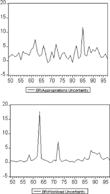
Figure 1 shows graphical plots of the time series for the log ratio of BR to σ—i.e., ln BR/ln σ—with respect to budgetary appropriations (APP) and enforcement workloads (EW) volatility during the 1949–97 annual period. The most striking specific aspect of both graphs is the large spike that occurs in 1963 with respect to the latter measure. This data point reflects a year with a very large agency budget request (22.63% growth over 1962 appropriations) under Manuel Cary's activist tenure as SEC chairman, coupled with only modest changes in task activities around this time. This resulted in an insufficient administrative enforcement apparatus for effectively regulating an ever-expanding and increasingly complex industry.29
This issue is highlighted in the House's Securities Markets Special Study of 1961–63, which resulted in the enactment of the 1964 Amendments to the Securities and Exchange Act (Khademian 1992, 60–62).
Two broader features, however, are also of interest. Even when allowing for the presence of a large spike in the log ratio of BR to σ
EW for 1963, this measure still has a smaller median value than the corresponding log ratio of BR to σ
APP (median
APP = 2.34, median
EW = 0.79; Mann–Whitney
U-test statistic =4.16,
p≈0.00).
30 The difference-in-medians Mann–Whitney U test is preferred over the less conservative difference-in-means t test since these variables are heavily skewed based on Jarque–Bera normality test results.
This pattern is compatible with Hypothesis 1 since agency budgetary decisions reflect an overall higher level of responsiveness to appropriations (external) uncertainty compared to enforcement workload (internal) uncertainty in a positive direction. Relatedly, visual inspection of these graphs indicate that the log ratio of BR to σ
APP appears noticeably more volatile compared to the log ratio of BR to σ
EW.
31 If one drops the overly influential observation in 1963, a Brown–Forsythe (B–F) equality-of-variance test supports this conjecture (mean absolute median difference for the log ratio of BR to σApp = 1.43, mean absolute median difference for the log ratio of BR to σEW = 0.80; B–F test statistic = 4.93 [p ≈ 0.03]).
In addition, the log ratio of the SEC's BR–appropriations volatility is noticeably higher under divided government compared to unified government consistent with Hypothesis 2 (median
APP-Divided = 2.51, median
APP-Unified = 1.71;
U-test statistic = 2.13,
p ≈ 0.034). This hypothesis is also supported in terms of the log ratio of the SEC BR to its enforcement workload volatility (median
EW-Divided = 0.93, median
EW-Unified = 0.45;
U-test statistic = 2.41,
p ≈ 0.016).
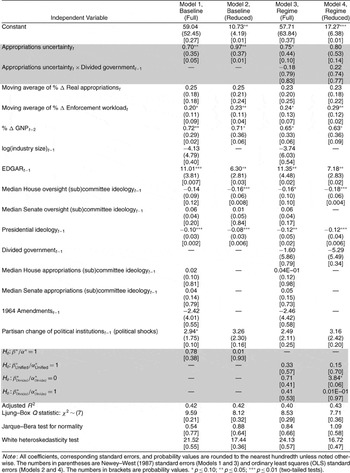
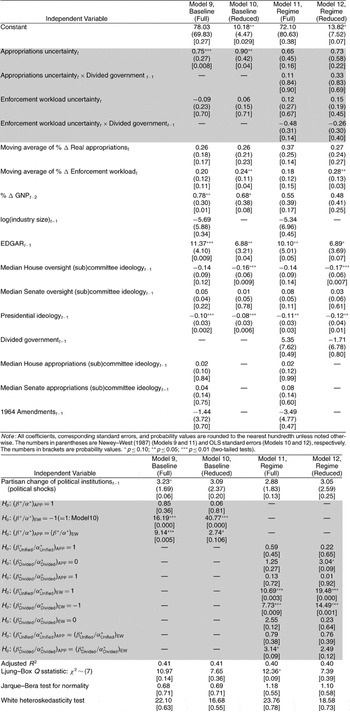
The regression results and corresponding Wald coefficient restriction tests are listed in Tables 2–4.32
The BR variable is a stationary time series based upon the augmented Dickey–Fuller (ADF) unit root test: ADF(1) = −4.05 (p < 0.01). Also, residual normality and heteroskedasticity assumptions are not violated for these estimated models. When at least one of the lags involved in computing the Ljung–Box Q statistic is significant at p ≤ 0.10, the covariance matrix of the standard errors is corrected via the Newey and West (1987) approach with [ell ] = 3, where [ell ] is the truncation lag parameter chosen based on their analytical suggestion that
.
The first set of findings in
Table 2 examines whether the SEC seeks additional or fewer resources in response to appropriations uncertainty.
33 A skeptic might claim that these uncertainty variables are a by-product of spurious long-term trends in the moving-average growth variables from which they are derived, as opposed to capturing the true volatility that the agency is experiencing. Augmented Dickey–Fuller (ADF) unit root tests performed on the moving average of SEC real appropriations and agency enforcement workload growth variables refute this claim: appropriations, ADF(2) = −3.78 (p < 0.01); enforcement workload, ADF(5) = −4.22 (p < 0.01).
These findings suggest that the SEC typically prefers additional organizational resources as the recent past appropriations it has received becomes more volatile. These positive risk coefficients indicate that the SEC exhibits budgetary risk aversion in a general form, i.e., β*/α* > 0, but also under unified government, i.e., 0 < β
Unified*/α
Unified*≤1 (Model 3), as well as under divided government, i.e., β
Divided*/α
Divided* > 0, β
Divided*/α
Divided* = 1 (Model 4). In an inferential sense, the SEC's budgetary risk aversion when confronting external uncertainty is unit elastic since the hypothesis that these risk coefficients are equal to positive unity cannot be rejected by the data. This suggests on an empirical level that the SEC's dispreference for appropriations uncertainty (β) is proportional to its preference for obtaining additional funding (α) in Models 1–4. Furthermore, these parameter estimates are compatible with the hypothetical parameter values based on the theoretical predictions displayed in
Table 1. The SEC's budgetary behavior during divided government lies inconclusively somewhere between no effect (i.e., risk neutrality) and unit elastic responsiveness to uncertainty (i.e., risk aversion)—i.e., 0 ≤ β
Divided*/α
Divided*≤1. The risk coefficients pertaining to each regime are not statistically discernible from one another based on the parameter estimates involving the interaction term for the Appropriations Uncertainty
t × Divided Government
t−1 variables in both Model 3 and Model 4. Put simply, the SEC is no more budgetary risk-averse during periods of unified government than under divided government in response to appropriations uncertainty. The relevant Wald coefficient restriction tests appearing at the bottom of
Table 2 corroborate this finding in the fully specified model (Model 3), yet this result is rejected by the data in the reduced specification (Model 4) consistent with Hypothesis 2.
The other exogenous variables capture the other information affecting SEC budgetary decisions. The findings from the baseline-full model (Model 1) reveal that agency budget requests are inelastically responsive to variations in its enforcement workload over the preceding three-year cycle. For instance, each 1% rise in this task variable in the full model produces a 0.20% rise in the SEC's BR per annum during the sample period. This coefficient is noticeably less than positive unity, thus indicating that the SEC prefers less than proportional increases in budgetary resources with respect to task outputs. One possible explanation for this finding is that, as a production agency, the SEC enjoys economies of scale that allows it to economize task activities relative to those organizations with different processes for generating outputs. Based on this crude empirical test of the budget–output relationship, Niskanen's (1971) rent seeking hypothesis can be rejected for the SEC case.34
Based on the reported and preliminary data analysis, the coefficient associated with this variable ranges between 0.19 and 0.51. These values are well below the break-even point of positive unity.
Economic growth also exerts a positive impact on agency budgetary decisions, with each 1% increase in GNP growth resulting in a 0.72% rise in the BR. The movement of the EDGAR system from the Executive Director's Office to its own special unit corresponds to an 11.01% and a 6.30% per annum rise in the agency BR on average since the late 1980s in Models 1 and 2, respectively. Moreover, the ideological preferences of the President and the legislative branch's oversight (sub)committees also play a vital role in shaping SEC budgetary decisions.
35 Alternative specifications omitting these variables produced a substantially weaker fit to the data (
declined by the amount ranging between 0.13 [32.5%] and 0.24 [58.5%]) and also generated an omitted variable bias problem.
This relationship, however, is negative concerning both House oversight and Presidential ideological preferences. As House oversight (sub)committee ideology becomes more conservative (i.e., declines) by one ratings point in the baseline-reduced model (Model 2), the SEC's BR rises by an average of almost 2% (−0.16 × 11.863 = −1.90) per annum.
36 The political ideology coefficients have a semilogarithmic interpretation. The average slope coefficient for these variables is computed as β ·
, where β is the unstandardized regression coefficient appearing in the table and
is the average value of the dependent variable (see Gujarati 1995, 169–178 for more details).
Likewise, as Presidential ideology becomes more conservative by one rating unit, the SEC's BR increases in a given year by a little more than 1% (−0.10 × 11.863 = −1.19) per annum in Model 1. The countervailing relationship between SEC budgetary decisions and the ideology of political institutions has two interpretations. It might infer that the SEC will seek additional funding because conservative elected officials will support stricter enforcement of securities laws and regulations relative to more liberal counterparts (
Moe 1982; but see
Kohlmeier 1969 and
Khademian 1992). An alternative, yet more plausible interpretation of these findings is that the political component of SEC budgetary decision making is made in a countercyclical fashion with respect to its political environment. Therefore, the SEC engages in a form of “ideological counterbalancing” analogous to that which voters employ (
Alesina and Rosenthal 1995;
Fiorina 1996), whereby it seeks additional slack resources from a more conservative House oversight committee or Presidential administration. The basis for this type of agency behavior might lie with the SEC's desire to compensate for the ideological composition of political institutions that they do not endogenously determine yet must obtain resources from as a means of smoothing the funding stream that it receives through time. The ideological compositions of the Senate oversight (sub)committee and both the House and the Senate Appropriations (sub)committees all consistently fail to influence SEC budgetary decision making.
37 Besides the statistically insignificant divided government dummy in each model specification, political–institutional ideological fragmentation effects on SEC budgetary decisions were also examined in a preliminary analysis not reported here. Variables consisting of the median ideological difference between Presidents and each Congressional oversight (sub)committee, and between Presidents and each appropriations (sub)committee, were shown to have no independent effect on the dependent variable and not to alter the risk coefficients in any statistically meaningful way in any case except in a revised version of the baseline (full) Model 1, where its p value rises from 0.05 to 0.22. However, the overall fit of this revised specification is inferior to the one reported in Table 2 that does not consider these measures.
This pattern also holds true regarding the divided government dummy variable's direct impact on agency budgetary decisions. The “power accrual” hypothesis, which suggests that an agency will seek to exploit the greater fragmentation of political actors under divided government, is not supported by the data on SEC budgetary decision making.
38 There was also a paucity of consistent statistical evidence in favor of the “power accrual” hypothesis in preliminary data analysis. A summary of these results can be obtained from the author.
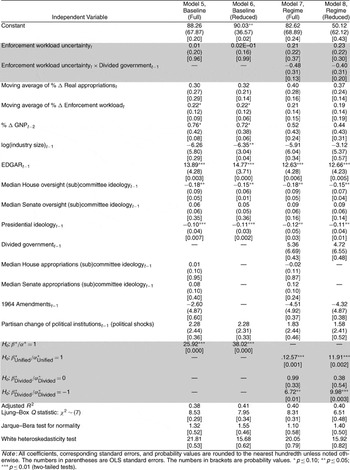
Table 3 contains the regression results that examine how SEC budgetary decisions are affected by internal uncertainty, defined in terms of the three-year moving standard deviation in the SEC's enforcement workload. Both t and Wald restriction tests of the risk coefficient lead one to infer that the SEC exhibits budgetary risk neutrality with respect to task uncertainty—i.e., β*/α* = 0. In other words, the SEC's desire to seek budgetary resources is indifferent with respect to changes involving uncertainty coming from its task activities. This result provides additional support for Hypothesis 1 by showing that the SEC's response to appropriations volatility (external uncertainty) is noticeably more risk–averse than its response task volatility (internal uncertainty).39
The evidence in favor of Hypothesis 1 is further corroborated by the univariate log ratio results presented earlier.
In fact, statistically discernible differences in SEC budgetary risk propensities between unified and divided government do not transpire since each political regime substantively reflects risk-neutral behavior.
The other exogenous variables produce results that are generally consistent with those in Table 2. SEC budget requests are influenced by the enforcement workload of the agency, the ideological preferences of the President and House oversight committee, and policy innovation emanating from within the agency in the form of EDGAR. Once again, neither the ideology of Congressional appropriations committees nor the moving-average growth in agency real appropriations affects SEC budgetary decisions. Neither the size of the industry that the SEC is responsible for regulating, nor divided government influences its budgetary decision making. These results conform to existing wisdom on the politics of the SEC (Khademian 1992; Kohlmeier 1969; Moe 1982).
The final set of regression models in Table 4 incorporates both appropriations and enforcement workload uncertainty measures into the same specification.40
Preliminary analysis indicated that the estimates of appropriations and workload uncertainty do not suffer from multicollinearity because of their joint inclusion in these model specifications. This is hardly surprising given the modest bivariate correlation coefficient between these variables (r = 0.33).
The risk coefficients for appropriations uncertainty are generally higher than the corresponding ones for task uncertainty, except under both regimes in Model 12 and during only unified government in Model 11. Generally, the SEC displays budgetary risk aversion with respect to appropriations (external) uncertainty, while behaving in a manner consistent with budgetary risk neutrality in response to task (internal) uncertainty. This implies that the SEC's disutility obtained from uncertainty (β) vis-á-vis the utility acquired from budgetary resource preferences (α) is comparatively greater for appropriations volatility than it is for task volatility. These findings corroborate the previous sets of empirical results showing that the SEC is indifferent to task uncertainty under its administrative jurisdiction. At the same time, however, this agency's distaste for external uncertainty is at most equal to, if not less than, its preference for obtaining additional budgetary resources.
41 While this finding is obvious based on the t tests of the regression coefficients, Wald coefficient restriction tests yield more precise corroborative evidence. In the baseline models, the difference between appropriations and task uncertainty-generated risk coefficients is statistically significant at conventional levels (p = 0.005, Model 9; p = 0.106, Model 10). Moderate support exists for this hypothesized pattern under divided government (p = 0.09, Model 11; p = 0.12, Model 12). However, no discernible difference in agency risk-bearing decision making between these sources of uncertainty during periods of unified government transpires (p = 0.38, Model 11; p = 0.39, Model 12).
The regression evidence does not reveal any significant difference for agency risk-bearing behavior between eras of divided and eras of unified government compatible with the derived propositions embodied in Hypothesis 2. Therefore, the SEC's less stable policy expectations and, hence, eroding institutional stability under divided government do not translate into relatively less budgetary risk aversion compared to that under unified government.
DISCUSSION
In the realm of administrative politics, uncertainty is regarded as the major obstacle limiting a political principal's ability to control a bureaucratic agent to whom it has delegated policymaking authority. Although this standard perspective is useful for understanding how political institutions can effectively shape policy administration in a top-down hierarchical manner, it also gives short shrift to analyzing the uncertainty that is experienced by bureaucratic agents. This is especially troubling because the predominant paradigm used to analyze this principal–agent problem fails to provide sufficient detail concerning how public bureaucracies arrive at decisions. For instance, Niskanen's (1971) seminal research on the “budget maximizing bureaucrat” emphasizes the uncertainty that politicians experience with respect to monitoring administrative agencies. This line of research does not consider the substantive uncertainty that poses an inherent challenge to bureaucratic decision making. This is not a trivial oversight since seminal scholarship on public organizations concurs that the manner in which administrative agencies make decisions in response to uncertainty is, perhaps, the most fundamental act that they undertake (Crozier 1964; Downs 1967; March 1999; Simon 1976; Stinchcombe 1990; Thompson 1967; Wilson 1989).
With few exceptions, this topic has received scant scholarly attention within both political science and public administration. In a handful of studies that do explicitly consider bureaucratic responses to uncertainty, agency risk-bearing behavior is either treated as a fixed a priori simplifying assumption (Bendor and Moe 1985; Bendor, Taylor, and Van Gaalen 1985, 1987) or derived in a manner in which the agency's range of responses to this uncertainty is restricted to the risk-neutral case (Carpenter 2002). Thus, little is actually known on either the theoretical or the empirical level regarding how bureaucratic agencies make decisions under conditions of uncertainty. If scholars wish to understand how public bureaucracies cope with uncertainty, then it is essential that the risk propensities underlying agency decisions are directly examined, rather than merely assumed or omitted altogether.
This study addresses this issue by proposing a statistical test of agency risk-bearing behavior that is formally derived from a comparative-static analysis of budgetary decision making. This test is predicated on the relative change in the rate of agency utility accrued from uncertainty vis-á-vis the budgetary resources that it wishes to obtain. Consistent with seminal research on organizational theory (Cyert and March 1963; Downs 1967; Thompson 1967; Wilson 1989), budget requests serve as a way for the agency to acquire slack resources for organizational maintenance purposes. These resources create administrative flexibility by allowing the agency to hedge against the uncertainty that it encounters (Downs 1967, 138–39). The willingness of a bureaucratic agency to extract additional (or fewer) slack budgetary resources in response to uncertainty cannot be determined unless its risk-bearing behavior can be theoretically articulated in a manner that lends itself to empirical inquiry.
The formulation of the agency's utility function in this study has allowed for a qualitative distinction between divided and unified party government regimes. As a result, heterogeneous agency budgetary decision making can be considered by treating an agency's risk propensities as conditionally varying in relation to the context in which uncertainty is experienced (March 1999, 244–45). The agency's response to two types of uncertainty is also investigated—that over which it possesses no formal decision-making authority (external uncertainty) and that over which it has some limited formal decision-making power (internal uncertainty). The empirical results indicate that the SEC's budgetary decision making generally reflects risk aversion concerning appropriations (external) uncertainty, while it exhibits risk neutrality regarding task (internal) uncertainty. These empirical findings challenge the common generic assumption implicit in principal–agent models that bureaucratic agents are risk-averse with respect to the task that they are obligated to perform (e.g., see Miller and Whitford 2002). On a broader level, this statistical evidence suggests that while agencies might wish to balance organizational mission goals with a desire for maintaining a positive reputation with their political principals (Kaufman 1981; Wilson 1989), the former goal takes greater precedence with respect to external uncertainty. This is borne out by the SEC's risk coefficient estimate regarding appropriations uncertainty being consistently less than positive unity yet greater than zero. This inelastic budgetary risk aversion is suggestive less of a distaste for uncertainty by the agency than of a preference for obtaining additional funds.
Although the SEC is a single case that involves an independent regulatory commission that fits the profile of a production agency (Wilson 1989, 157–71), the approach proposed in this study is applicable for analyzing the risk propensities of bureaucratic decision making for other types of administrative agencies. This line of inquiry, for instance, can be extended to the study of public agencies exhibiting varying degrees of political insulation. One might expect that less insulated agencies should experience greater instability arising from the vagaries of the political process than agencies that possess greater independence from the executive branch (Lewis 2003). Therefore, one can infer that executive-branch agencies should be expected to behave in a relatively more risk-averse fashion in relation to external uncertainty compared to independent regulatory commissions. This difference is attributable to the structural characteristics of the latter type of agency design, which enhances its autonomy, including staggered appointment terms, legislative and budgetary bypass authority, and partisan balance requirements for commissioners.
Likewise, agencies that yield outputs that are not easily observable should also exhibit relatively greater risk aversion with respect to internal task uncertainty for a given type of risk-bearing behavior. This is because it will be more difficult for the agencies to gauge their task demands in these circumstances. Since the approach proposed in this study allows for varying decision rules within an uncertain decision-making environment, it has broad applicability for analyzing the information asymmetries that bureaucratic agents experience for other types of agency decisions, such as the willingness to obtain discretion from political principals (Krause 2003b) or the handling of administrative policy actions. In closing, bureaucratic agents possess their own information problems. Analyzing this dilemma not only is substantively important for the study of decision making by public organizations, but also has vital implications for understanding how institutional politics shapes policy administration.






Comments
No Comments have been published for this article.