


Introduction
Depressive and anxiety disorders are among the most common mental disorders in children and adolescents between the ages of 5 and 17 years (worldwide prevalence: depressive disorder 6.2%; anxiety disorder 3.2%) (Erskine et al., Reference Erskine, Baxter, Patton, Moffitt, Patel, Whiteford and Scott2017). Affected individuals also show a considerable risk for adverse development, such as co-morbid mental disorders, an increased risk of suicide, and substantial psychosocial impairments like school abstinence and drop-out, unemployment, and peer problems (Beesdo et al., Reference Beesdo, Knappe and Pine2009; de Lijster et al., Reference de Lijster, Dieleman, Utens, Dierckx, Wierenga, Verhulst and Legerstee2018; Naicker et al., Reference Naicker, Galambos, Zeng, Senthilselvan and Colman2013). Unsurprisingly, treatment of these young people incurs high costs for the health care system (Pella et al., Reference Pella, Slade, Pikulski and Ginsburg2020; Ssegonja et al., Reference Ssegonja, Alaie, Philipson, Hagberg, Sampaio, Moller and Feldman2019).
Accordingly, adequate treatment for affected individuals is crucial (Lepine and Briley, Reference Lepine and Briley2011). Over the last decades, intensive research has been conducted to develop and examine effective treatments (Higa-McMillan et al., Reference Higa-McMillan, Francis, Rith-Najarian and Chorpita2016; Weersing et al., Reference Weersing, Jeffreys, Do, Schwartz and Bolano2017; Weisz et al., Reference Weisz, Kuppens, Ng, Eckshtain, Ugueto, Vaughn-Coaxum and Fordwood2017), and treatment guidelines based on empirical evidence for depression and anxiety in youth have been formulated (National Institute for Health and Care Excellence, 2014; National Institute for Health and Care Excellence, 2019). These guidelines consistently recommend cognitive behavioural therapy (CBT) as a first-line treatment for depression and anxiety. Additionally, depending on the severity of the disorder, the patients’ impairment, and the effects of CBT, additional pharmacotherapy should be considered, although the empirical evidence for pharmacotherapy remains much poorer (National Institute for Health and Care Excellence, 2014; National Institute for Health and Care Excellence, 2019).
This strong evidence in favour of CBT was derived from efficacy trials using randomised controlled study designs, which are considered as the gold standard within psychotherapy research. However, their external validity has been criticised because treatment settings often differ considerably from routine care conditions (Weisz et al., Reference Weisz, Doss and Hawley2005). Accordingly, it has been argued that randomised controlled trial (RCT) results cannot be generalised to routine care situations (Bear et al., Reference Bear, Edbrooke-Childs, Norton, Krause and Wolpert2019; Carr, Reference Carr2009; Weisz et al., Reference Weisz, Ugueto, Cheron and Herren2013). By contrast, effectiveness studies provide a high external validity, as they can provide evidence that a particular intervention works under real-life conditions. Thus, both efficacy and effectiveness studies are needed in psychotherapy research. Many researchers call for effectiveness studies to determine the replicability of effects found in RCTs under routine care conditions (Bear et al., Reference Bear, Edbrooke-Childs, Norton, Krause and Wolpert2019; Carr, Reference Carr2009; Roest et al., Reference Roest, Siebelink, van Ewijk, Vermeiren, Middeldorp and van der Lans2021; Weersing and Weisz, Reference Weersing and Weisz2002; Weisz et al., Reference Weisz, Doss and Hawley2005).
There is extensive evidence to support the short-term efficacy of CBT in children and adolescents with anxiety and depressive disorders under controlled conditions (RCTs). The study findings have been aggregated in various meta-analyses, yielding moderate to high between-group effect sizes (ES) ranging from d=0.54 to d=0.88 (Eckshtain et al., Reference Eckshtain, Kuppens, Ugueto, Ng, Vaughn-Coaxum, Corteselli and Weisz2020; Higa-McMillan et al., Reference Higa-McMillan, Francis, Rith-Najarian and Chorpita2016; Kreuze et al., Reference Kreuze, Pijnenborg, de Jonge and Nauta2018; Reynolds et al., Reference Reynolds, Wilson, Austin and Hooper2012; Weersing et al., Reference Weersing, Jeffreys, Do, Schwartz and Bolano2017; Weisz et al., Reference Weisz, Kuppens, Ng, Eckshtain, Ugueto, Vaughn-Coaxum and Fordwood2017; Weitz et al., Reference Weitz, Kleiboer, van Straten and Cuijpers2018; Wergeland et al., Reference Wergeland, Riise and Ost2021).
However, far fewer studies have examined whether the changes found in RCTs can be replicated in routine care conditions (Lee et al., Reference Lee, Horvath and Hunsley2013; Mahdi et al., Reference Mahdi, Jhawar, Benett and Shafran2018). In a large multicentre study encompassing n=9895 patients (age M=22.7 years, SD=5.3), McAleavey et al. (Reference McAleavey, Youn, Xiao, Castonguay, Hayes and Locke2019) assessed the effectiveness of all forms of routine psychotherapy. The authors reported a medium pre–post reduction for depression (d=0.64) and a small reduction for generalised anxiety disorder (d=0.47). A recent meta-analysis encompassed 58 studies, including eight examining CBT for depression and 22 for anxiety (Wergeland et al., Reference Wergeland, Riise and Ost2021). All studies were conducted in a non-university setting such as school, community mental health centres, or other clinical routine care facilities (Wergeland et al., Reference Wergeland, Riise and Ost2021). The medium treatment duration in the studies investigating anxiety or depression was M=12.5 weeks (M=11.7 treatment sessions). The authors reported statistically significant, large pre–post symptom reductions in the treatment groups for depression (d=1.24) and anxiety (d=1.32). Overall, these results provide first evidence for the short-term effectiveness of CBT under routine care conditions in terms of reducing symptoms of internalising disorders. Nevertheless, several important limitations must be kept in mind (McAleavey et al., Reference McAleavey, Youn, Xiao, Castonguay, Hayes and Locke2019; Wergeland et al., Reference Wergeland, Riise and Ost2021). First, the treatment ingredients were poorly described or differed within studies, leaving it unclear which type of intervention was examined. Second, a substantial number of trials lacked detailed study information (e.g. information on setting or sample characteristics), impeding the classification of these studies as effectiveness trials. Third, most of the studies examined very small samples. Fourth, the majority of studies applied a limited treatment intensity of 12 sessions or less. Finally, the role of pharmacotherapy was frequently not reported (Wergeland et al., Reference Wergeland, Riise and Ost2021).
Beside short-term effects, the question of the stability of the obtained treatment effects is crucial. Several highly controlled efficacy studies have provided results regarding shorter stability periods, which were aggregated by Weersing et al. (Reference Weersing, Jeffreys, Do, Schwartz and Bolano2017) and Wergeland et al. (Reference Wergeland, Riise and Ost2021). The authors included studies investigating a follow-up period of 12–18 months and found remission rates to be higher at follow-up (depression 66.7%; anxiety 70.0%) than at post-treatment (depression 55.5%; anxiety 60.3%), indicating symptom improvements during the follow-up period. Less controlled effectiveness studies, which investigated all forms of psychotherapy including CBT and examined a comparable follow-up period of up to 1.5 years, mostly replicated these findings (Wergeland et al., Reference Wergeland, Riise and Ost2021).
While such results seem promising, in addition to the above-mentioned shortcomings, it is important to note some further important aspects that particularly concern the follow-up period. First, a substantial proportion of the study samples was lost to follow-up. Most of the studies dealt with this methodological problem by using the last observation carried forward method (Lachin, Reference Lachin2015), but this procedure leads to a bias in favour of the assumption of stability (Newgard and Lewis, Reference Newgard and Lewis2015). Second, the amount of professional help during follow-up (i.e. further therapy, medication) mostly remains unclear. Lastly, only shorter follow-up periods with a maximum of 1.5 years were considered, while evidence on long-term effects remains unknown.
To contribute further knowledge to the research field, the present study investigated the effectiveness and long-term stability of CBT using a large, clinically referred sample, employing a broader follow-up range of 1–10 years, and applying a more conservative and elaborated method for handling missing data. Besides symptoms of depression and anxiety, further psychological symptoms and information concerning life satisfaction were rated by patients and their parents. Based on the current state of research, we hypothesised (1) statistically and clinically significant reductions in self- and parent-rated symptoms of depression, anxiety, and other behavioural and emotional symptoms during treatment; (2) no statistically significant deteriorations at follow-up assessment; and (3) statistically larger symptom reductions at post-treatment based on self- and parent ratings in patients receiving additional anti-depressant medication compared with those without pharmacotherapy.
Method
Participants
The following inclusion criteria were applied: (1) meeting the ICD-10 criteria for an anxiety and/or depressive disorder based on clinical judgement, (2) a minimum of ten treatment sessions, and (3) outpatient CBT between 2006 and 2015. Children and adolescents either self-referred to outpatient treatment or were referred by their parents, other inpatient or outpatient departments at the University of Cologne, or other clinics and private psychotherapy or psychiatry practices in the greater Cologne area. The study was approved by the ethics committee of the University of Cologne and written informed consent was obtained from all patients and parents.
Procedure
Study eligibility was assessed 1–10 weeks before the start of treatment and participants were consecutively included in the study. The first assessment took place within the first treatment sessions (pre-assessment) and consisted of standardised questionnaires. The second assessment took place at the end of treatment (post-assessment). Depending on the patient’s age and the specialist outpatient clinic in which they were treated, an individualised set of standardised self- and parent-rated questionnaires was selected. For the follow-up assessment, patients who had completed treatment between 1 and 10 years earlier were contacted by one of the authors (U.B.), who provided information on the follow-up assessment. Standardised questionnaires were again completed, and a semi-structured telephone interview was conducted.
Measures
Basic Documentation Form
The standardised ‘Basic Documentation Form’ (Doepfner and Steinhausen, Reference Doepfner and Steinhausen2012) captures sociodemographic data such as gender and age, as well as treatment characteristics such as treatment duration and number of sessions. In addition, the form encompasses the following clinical ratings: (1) intelligence level [ranging from 1 (very high) to 8 (severely impaired)]; (2) global functioning [ranging from 0 (very good functioning in all areas) to 8 (needs persistent support 24/7)] based on Axis Six of the Multiaxial Classification of Child and Adolescent Psychiatric Disorders (World Health Organization, 1996); (3) overall clinical improvement [ranging from 1 (very much improved/remitted) to 5 (worsened)] (short version of the Clinical Global Impressions Scale-Improvement; Busner and Targum, Reference Busner and Targum2007); and (4) the cooperation of children/adolescents and parents [ranging from 1 (no cooperation) to 5 (very good cooperation)].
Diagnostic interviews
All clinical diagnoses at the start of treatment were based on clinical examinations applying the clinical rating scales of the ‘Diagnostiksystem für psychische Störungen nach ICD-10 und DSM-5 für Kinder und Jugendliche’ (DISYPS) (Doepfner and Goertz-Dorten, Reference Doepfner and Goertz-Dorten2017; Doepfner et al., Reference Doepfner, Goertz-Dorten and Lehmkuhl2009). Good internal consistency (range from αr=.69–.95) was found in both the clinical and the field sample. The correlations between clinical ratings according to the adolescent and the parent interviews were in the moderate range (Doepfner and Goertz-Dorten, Reference Doepfner and Goertz-Dorten2017).
Telephone interview
The semi-structured interview conducted at follow-up with either the patients or their parents (if patients were minors) was designed to obtain the following information: current anxiety and depressive symptoms [clinical rating on a 5-point Likert scale ranging from –2 (large deterioration) to +2 (large improvement)] [i.e. ‘Compared to treatment end, how do you currently perceive depressive symptoms of your child (such as depressive mood, reduction of energy or decrease in activity)?’, ‘Compared to treatment end, how do you currently perceive symptoms of anxiety of your child (such as fear of scrutiny by other people of fear of open spaces)?’], educational level (e.g. school diploma, professional training), occupational functioning (e.g. current employment, previous employment, changes of employment), current living situation, partnership, treatments due to mental health problems within the follow-up period, and delinquent behaviour (police contacts, convictions).
Parent and self-rating scales
At the pre-, post- and follow-up assessments, the German versions of the parent-rated Child Behavior Checklist (CBCL) and the self-rated Youth Self Report (YSR) (Doepfner et al., Reference Doepfner, Plueck and Kinnen2014) were administered to assess emotional and behavioural problems. The CBCL consists of 118 items while the YSR consists of 112 items; for both forms, items are aggregated into eight narrowband syndrome scales and three broadband scales (Internalizing problems, Externalizing problems, Total problems). Representative German norms have been published for both parent rating and self-rating, and reliability and validity of the German versions have been demonstrated (Doepfner et al., Reference Doepfner, Plueck and Kinnen2014). At all three assessment time points, the occurrence of specific depressive and anxiety symptoms was assessed using the following scales from the DISYPS: the FBB-DES (parent rating) and SBB-DES (self-rating) for depressive symptoms, and the FBB-ANZ (parent rating) and SBB-ANZ (self-rating) for anxiety symptoms (Doepfner and Goertz-Dorten, Reference Doepfner and Goertz-Dorten2017; Doepfner, 2000).
Life satisfaction
The German-language Questionnaire on Life Satisfaction (FLZ; Fahrenberg et al., Reference Fahrenberg, Myrtek, Schumacher and Braehler2000) is a self-rating scale used in the present study to assess different aspects of life satisfaction. The following subscales were assessed: Health, Job/Career, Financial Situation, Leisure/Recreational Activities, One’s Own Person, Sexuality, Relationships with Others, Living Conditions and General Life Satisfaction. Each subscale consists of seven items that are rated on a 7-point Likert scale [ranging from 1 (very dissatisfied) to 7 (very satisfied)]. Reliability and validity of the questionnaire have been demonstrated (Fahrenberg et al., Reference Fahrenberg, Myrtek, Schumacher and Braehler2000). The FLZ was assessed at the follow-up assessment for patients aged 16 years or over.
Brief Symptom Checklist (BSCL)
The BSCL by Franke (Reference Franke2017) is a self-rating questionnaire assessing mental health problems within the last 7 days. It consists of 53 items that are grouped into the following nine scales: depression, anxiety, hostility, somatisation, obsessive-compulsive, interpersonal sensitivity, anxiety, paranoid ideation and psychoticism. All items are rated on a 5-point Likert scale ranging from 0 (not at all) to 4 (very much). The BSCL was normalised on a representative sample of the population and separate norm values are available. In the present study, the BSCL was assessed at follow-up from the age of 18 years.
Outpatient treatment
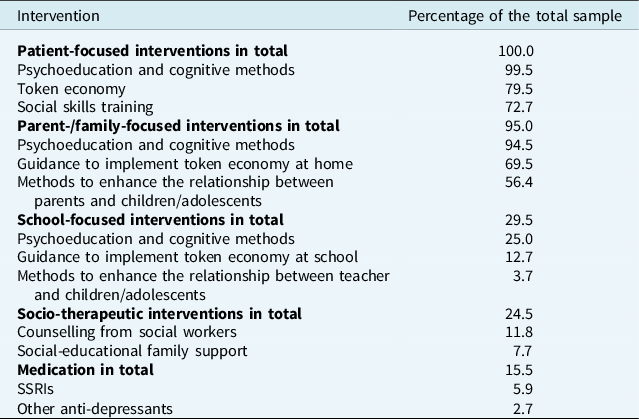
Treatment took place at the university outpatient clinic of a school for child and adolescent cognitive behavioural therapy in Germany. The German health insurance system covers treatment costs up to a maximum of 100 treatment sessions of CBT based on an individualised treatment plan that has to be examined by a certified reviewer. Therapies were conducted by postgraduate students with a Master’s degree (psychology or education) that were in the second half of their 5-year training in CBT. During the second half, 600 sessions of psychotherapy have to be delivered and these sessions are guided by an accredited CBT supervisor (one supervision session every four therapy sessions). Therapies were based on currently recommended cognitive behavioural methods. Information on the individual treatment modules, as rated by the therapists in the Basic Documentation Form at post-treatment, is provided in Table 1. All treatments included patient- and parent-focused interventions. Interventions with the patient included psychoeducation, graduated exposure or cognitive methods such as cognitive restructuring, whereas parent-focused interventions focused on psychoeducation, help to implement token systems or interventions enhancing the relationship of parents and patients. Fifteen per cent of patients additionally received psychopharmacological treatment (usually SSRIs). The average treatment length was M=15.88 months (SD=7.75, range 3–43) and the average number of sessions was M=41.59 (SD=19.96). The German health insurance system covered all treatment costs.
Most frequent interventions of the main sample (n=220)

Statistical analysis
First, we checked the representativeness of the sample by comparing the data of the main sample (n=220) with youth who could not be contacted and therefore did not participate (n=277). The main sample of n=220 was used for all further analyses. t-tests for dependent samples (continuous variables) or chi-squared tests (dichotomous variables) were used to compare sociodemographic and pre-assessment data in parent and self-rating and clinical ratings of treatment characteristics and effects. ES for dependent samples ((M incomplete–M complete)/SD pooled) (Cohen, Reference Cohen1988) or odds ratios were calculated to determine the magnitude of differences.
To examine overall changes from pre- to post-, pre- to follow-up, and post- to follow-up assessment, a repeated measures ANOVA was conducted. Partial eta squared was calculated to determine the magnitude of changes (Keppel, Reference Keppel1991). For all analyses, the significance level was set at α<5%.
Following the clinical interview at follow-up, a range of standardised questionnaires were administered. Due to a substantial proportion of missing data from these questionnaires at follow-up (up to 14.2 % at post-assessment and up to 88.2% at follow-up), missing data at pre-, post- and follow-up assessments were replaced using multiple imputation for the main scales of the CBCL, YSR, FBB-DES, SBB-DES, FBB-ANZ and SBB-ANZ (Rubin, Reference Rubin1987). All variables were imputed together and n=20 datasets were created. To examine the robustness of symptom reductions in patients with complete data, the imputation data sets were subsequently post-processed by factor multiplication and addition of offsets (tipping point analysis; the symptom severity of missing data was decreased at pre-assessment and increased at post- and follow-up assessment) (Van Buuren, Reference Van Buuren2018). Imputed data were modified by up to 50% for the symptom scales and 80% for the total scales. Again, repeated measures ANOVAs were conducted to examine significance following imputation and modification.
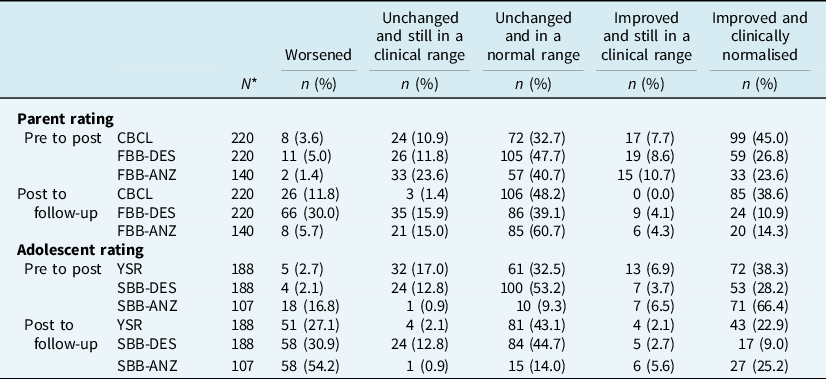
To assess clinical relevance, we combined two criteria (Jacobson and Truax, Reference Jacobson and Truax1991). First, we analysed whether participants had changed to normal functioning (t<60, Stanine<7), and second, we calculated the reliable change index (RCI; Jacobson and Truax, Reference Jacobson and Truax1991) to analyse the statistical reliability of the changes. We conducted these analyses for the total scores of the CBCL, YSR, FBB-DES/ANZ and SBB-DES/ANZ. Patients were divided into five groups: (1) improved and clinically normalised; (2) improved but still in a clinical range; (3) unchanged and in a normal range; (4) unchanged and still in a clinical range; (5) worsened.
Finally, we examined whether patients who received monotherapy (CBT) differed from patients who additionally received pharmacotherapy regarding the total scales of the CBCL, YSR and FBB/SBB-DES/ANZ (ANCOVAs with post-assessment scores as dependent variables and pre-assessment scores of the analysed scales as covariate).
Results
Sample characteristics
In total, 497 children and adolescents fulfilled the inclusion criteria between January 2006 and December 2015 and received treatment at the outpatient unit, University Hospital Cologne. Of these, 432 (86.2%) had complete pre- and post-test data for self-ratings and parent ratings; n=262 (57.6%) could not be contacted at follow-up, n=15 (3.0%) actively refused to participate, and one former patient had died.
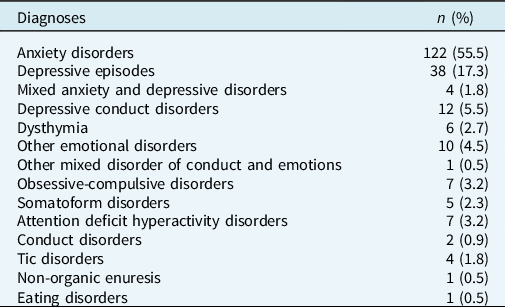
Two hundred and twenty of the 497 (44.3%) former patients (124 female; 56.4%) agreed to participate in the present study. This sample was used for the main analyses. The mean age was M=14.1 years (SD=2.86, range 6–18 years) at the start of treatment and M=20.89 (SD=3.80, range 11–28 years) at follow-up; n=168 (76.4%) had an average intelligence level, n=37 above-average (16.8%), and n=15 below-average (6.8%). The most common ICD-10-based clinical diagnoses were (see Table 2): anxiety disorders (n=122; 56.0%), depressive episodes/recurrent depressive disorders (n=38; 17.0%), depressive conduct disorders (n=12; 6.0%), and other emotional disorders (n=10, 5.0%). Over half of the patients had more than one mental disorder: n=103 (46.8%) had two and n=29 (13.8%) had three or more; n=96 (43.6%) patients had one or more family members with a mental disorder and n=68 (31.0%) had separated parents. Global functioning at the start of treatment was: 1 (superior functioning and satisfactory; n=12, 5.5%); 2 (mild impairment, n=28, 12.7%); 3 (moderate impairment, n=79, 35.9%); 4 (serious impairment in at least one area, n=79, 35.9%); 5 (serious impairment in most of the areas, n=20, 9.1%); or 6 (severe and profound impairment in most of the areas, n=2, 0.9%).
Axis I diagnoses of the main sample (n=220)

Representativeness of complete data
Table S1 (see Supplementary material) shows the comparison of patients with complete data and participants with missing interview data who were excluded. Most variables showed no statistically significant differences between the two groups. The following statistically significant, small differences emerged: the main sample showed a lower YSR Externalizing problems score at pre-assessment (d=–0.20), better global functioning at post-assessment (d=–0.23), higher therapist-rated treatment success regarding psychological symptoms (d=–0.22) and overall life functioning (d=–0.32), and better cooperation of parents and patients (d=0.24).
Treatment effectiveness
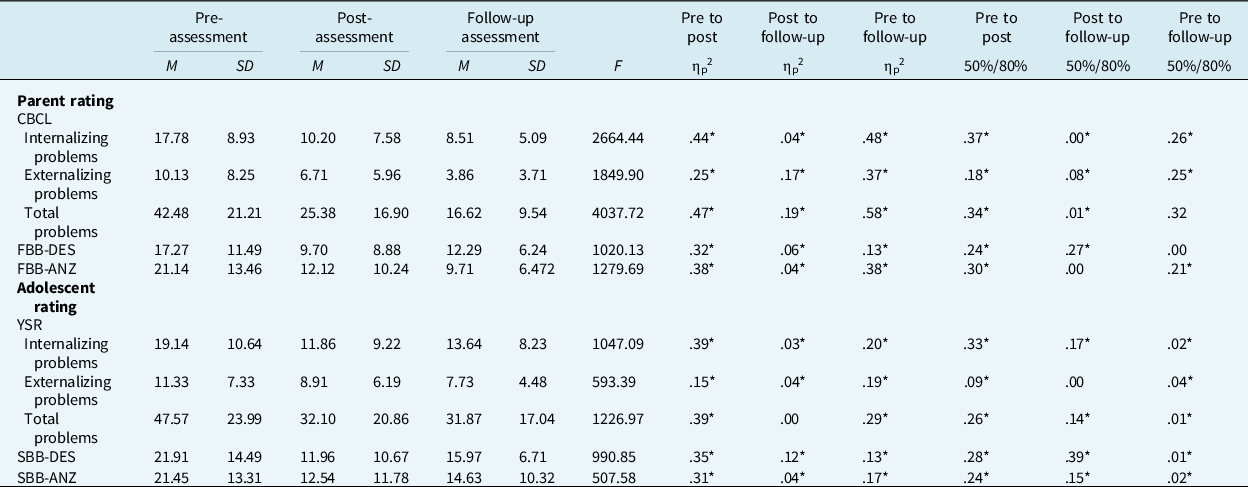
Table 3 presents changes of the main sample after imputation for all assessment points including effect sizes and modifications of the imputed data.
Changes in behavioural and emotional problems from pre-, post- and follow-up assessment on the broadband scales of the CBCL, YSR, and the total scales of the FBB-DES/ANZ and SBB-DES/ANZ for the main sample using imputed data (n=220)

*p<0.001.
The results revealed highly significant parent-rated symptom reductions from pre- to post-assessment, with large ES ranging from ηp 2=.25 to ηp 2=.47 for parent rating and medium to large ES for adolescent rating (ηp 2=.15 to ηp 2=.39). After modification of the imputed data (tipping point analyses), the results remained stable [parent rating: medium to large symptom reductions (ηp 2=.18 to ηp 2=.37); self-rating: medium to large reductions (ηp 2=.09 to ηp 2=.33)].
Treatment stability and state of health at follow-up
Post- to follow-up assessment revealed statistically highly significant, small to medium symptom reductions in parent rating (ηp 2=.04 to ηp 2=.19) and self-rating (ηp 2=.03 to ηp 2=.12; YSR total scale: no significant change). Again, these results remained stable when using tipping point analyses (except for the FBB-ANZ-Total and the YSR Externalizing problems scale, which became non-significant at a 50% deterioration of the imputed data).
From pre- to follow-up assessment, statistically highly significant, large symptom reductions in parent rating (ηp 2=.13 to ηp 2=.58) and self-rating (ηp 2=.13 to ηp 2=.29), which remained stable when using tipping point analyses (except for the CBCL-Total problems scale and the FBB-DES-Total scale, which became non-significant at 50% deterioration).
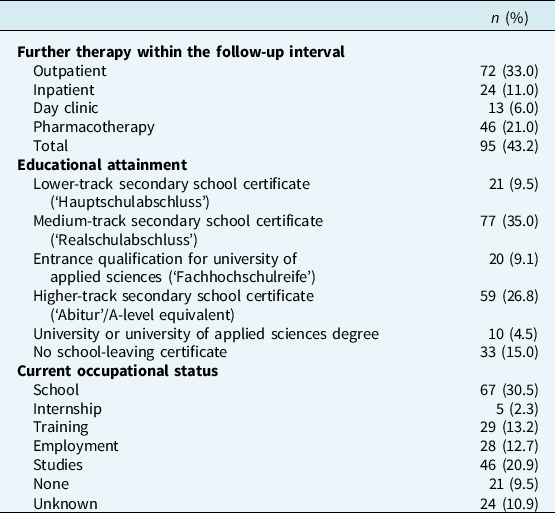
The analysis of the telephone interviews revealed that 70.5% of the sample reported an improvement or large improvement in anxiety symptoms since discharge, whereas 5.4% reported a deterioration or a large deterioration (depressive symptoms: 57.3% improvement or large improvement, 7.7% deterioration or large deterioration, respectively). The overall life functioning was most often reported as largely improved (50.0%) or improved (29.1%); 43.2% of the participants reported some form of treatment due to mental health problems. Only 9.5% had no current occupation at all. Further details are presented in Table 4.
Results of the clinical interview at follow-up for the main sample (n=220)

BSCL and FLZ
Results of the BSCL and FLZ at follow-up assessment are presented in Table S2 of the Supplementary material. Between 2.7 and 5.5% of the sample reported mental symptoms in the clinical range; 19.7% of the former patients reported below-average general life satisfaction.
Clinical significance
Results on the clinical significance of the changes on the total scales of the CBCL, YSR and FBB/SBB-DES/ANZ for the main sample are presented in Table 5. In parent rating, between 23.6 and 45.0% of the sample who were in the clinical range at the start of treatment were normalised at the end of treatment (self-rating: 28.2 to 66.4%). From post- to follow-up, between 10.9 and 38.6% were improved and clinically normalised according to parent rating, and between 9.0 and 25.2% according to self-rating. At the end of treatment, 18.6% remained in the clinical range on the CBCL total score (YSR: 23.9%). At follow-up, between 50.0 and 86.8% were clinically normalised according to parent rating and between 39.2 and 66.0% according to self-rating.
Clinical significance of changes of the imputed parent and adolescent ratings of the CBCL, YSR, FBB-DES/ANZ and SBB-DES/ANZ total scales

* Dependent on age at start of treatment and the specialist outpatient clinic.
Effects of additional anti-depressant pharmacotherapy
A comparison between the group of patients receiving monotherapy and the group additionally receiving anti-depressant pharmacotherapy (n=34; 15.5%) revealed the following statistically significant differences: patients receiving psychopharmacotherapy were older at the start of treatment (t=–2.18; p<.05; d=–.41) and reported higher scores at pre-assessment on the following scales: CBCL: Internalizing problems (t=–2.239; p<.05; d=–.42), Total problems (t=–3.037; p<.01; d=–.57); YSR: Internalizing problems (t=–4.153; p<.001; d=–.83); FBB-DES (t=–4.426; p<.001; d=–.83), SBB-DES (t=–3.305; p<.01; d=–.66), FBB-ANZ (t=–2.00; p<.05; d=–.53).
When pre-assessment scores were entered as covariates, almost all scales differed significantly between the groups at post-assessment, insofar as symptom scores were higher at the end of treatment in the group receiving combined treatment (CBCL Internalizing problems F 1,189=8.44, p<.01, ηp 2=.23; CBCL Total problems F 1,189=8.13, p<.05, ηp 2=.04; YSR Externalizing problems F 1,161=12.90, p<.001, ηp 2=.07; YSR Total problems F 1,161=8.80, p<.01, ηp 2=.05; FBB-DES F 1,182=7.49, p<.01, ηp 2=.04; SBB-DES F 1,159=16.36, p<.001, ηp 2=0.9; FBB-ANZ, F 1,121=4.8, p<.05, ηp 2=.04 and SBB-ANZ F 1,94=7.58, p<.01, partial ηp 2=.08).
Discussion
The aim of the present study was to extend existing knowledge about evidence-based CBT under routine care conditions by investigating the changes in mental symptoms, and their long-term stability, in a large sample of clinically referred adolescents with anxiety/depressive disorders who received CBT at a university outpatient clinic. We assessed pre- to post-, post- to follow-up and pre- to follow-up changes in parent- and adolescent-rated behavioural and emotional symptoms. Moreover, we investigated whether patients who received monotherapy (CBT) differed from those who received additional pharmacotherapy. Lastly, a standardised telephone interview was conducted at follow-up.
Overall, we found large, statistically significant reductions in depressive and anxiety symptoms as well as other emotional and behavioural symptoms during treatment. Moreover, the analysis of clinical significance revealed that a large percentage of patients were clinically normalised at the end of the treatment. These results are in line with previous efficacy trials (Eckshtain et al., Reference Eckshtain, Kuppens, Ugueto, Ng, Vaughn-Coaxum, Corteselli and Weisz2020; Higa-McMillan et al., Reference Higa-McMillan, Francis, Rith-Najarian and Chorpita2016; Kreuze et al., Reference Kreuze, Pijnenborg, de Jonge and Nauta2018; Reynolds et al., Reference Reynolds, Wilson, Austin and Hooper2012; Weersing et al., Reference Weersing, Jeffreys, Do, Schwartz and Bolano2017; Weisz et al., Reference Weisz, Kuppens, Ng, Eckshtain, Ugueto, Vaughn-Coaxum and Fordwood2017; Weitz et al., Reference Weitz, Kleiboer, van Straten and Cuijpers2018; Wergeland et al., Reference Wergeland, Riise and Ost2021) and effectiveness trials (McAleavey et al., Reference McAleavey, Youn, Xiao, Castonguay, Hayes and Locke2019; Wergeland et al., Reference Wergeland, Riise and Ost2021), which reported similar symptom reductions during treatment. Therefore, the findings of our study, which investigated a large clinical sample and describes the different treatment modules, add important knowledge to the research field and support the assumption that CBT interventions may be delivered effectively in a routine care setting. This confirms our first hypothesis.
The analyses of post- to follow-up changes revealed significant, small to medium symptom reductions, therefore indicating possible evidence for the long-term stability of changes achieved during therapy as well as for additional improvements after the end of therapy. The results of the clinical interview at follow-up showed a further considerable reduction in anxiety and depressive symptoms and an improvement of daily-life functioning since the end of treatment. Moreover, according to our results on clinical significance at follow-up, a further substantial proportion of the sample that had been in the clinical range at post-assessment had transitioned into a clinically normalised range during the follow-up period. These findings support comparable effectiveness studies that examined much shorter follow-up periods, mostly of less than 12 months (James et al., Reference James, James, Cowdrey, Soler and Choke2015; Wergeland et al., Reference Wergeland, Riise and Ost2021). As such, our findings add evidence for the long-term stability of changes during treatment and for further symptom reductions during follow-up. Taken together, our second hypothesis can therefore be confirmed.
The additional information on mental symptoms and life satisfaction provided at follow-up (BSCL and FLZ) point in the same positive direction: only 6–12% of the sample reported symptoms in the clinical range, which is comparable to population-based epidemiological data (11% in the clinical range) (Franke, Reference Franke2017). Moreover, most of the former patients reported average or above-average life satisfaction. Interestingly, several researchers have reported a negative relationship between internalising disorders and life satisfaction (Mahmoud et al., Reference Mahmoud, Staten, Hall and Lennie2012; Meule and Voderholzer, Reference Meule and Voderholzer2020; Rissanen et al., Reference Rissanen, Viinamäki, Honkalampi, Lehto, MHintikka, Saharinen and Koivumaa-Honkanen2011), insofar as life satisfaction improves with decreasing depressive and/or anxiety symptoms. Similarly, our follow-up assessment revealed a decrease in depressive and anxiety symptoms during treatment, a stability or further symptom decrease after the end of treatment, and high life satisfaction at the follow-up assessment. When interpreting these results concerning the follow-up period, it is important to keep in mind that about 43% of the sample reported having received further professional help due to mental symptoms in the interim, in the form of counselling, psychosocial treatments, or pharmacotherapy. Future studies therefore need to disentangle the effects of this kind of professional support during follow-up from the treatment stability of the initial therapy.
Our comparison between patients who solely received CBT and those who additionally received anti-depressant medication revealed differences on most of the examined variables at post-treatment. Adolescents additionally receiving anti-depressants showed higher self- and parent-rated mental problems at post-treatment, even after controlling for pre-treatment differences between these two groups. Our third hypothesis was therefore not confirmed. Based on our data, it seems that patients with more severe symptoms may require a combination of CBT and pharmacotherapy to achieve a significant symptom reduction, but nevertheless remain more impaired at the end of treatment compared with those receiving CBT alone (Vitiello and Ordóñez, Reference Vitiello and Ordóñez2016). However, it should be noted that we did not assess the exact medication dosage and were therefore unable to investigate the role of dosage effects, which may have affected our findings.
Although the present study provides important evidence on the effectiveness and stability of CBT, some important limitations should be mentioned. First, a substantial proportion of the sample did not participate in the follow-up assessment, and others participated in the interview but did not complete the questionnaires, leading to the possibility of a substantial selection bias. This large proportion of missing data is a substantial weakness of the present study. Nevertheless, our analyses of representativeness and missing data revealed small (though significant) or no differences between completers and non-completers. Moreover, our results using imputed data demonstrated a considerable robustness of the data: even after deteriorating the imputed data up to 80%, most of the findings remained statistically significant. However, we cannot definitively rule out the possibility of unsystematic missing data. Second, due to the lack of a direct control condition, we cannot rule out that the changes observed were attributable to confounding factors such as natural developmental trends. However, the 1- to 3-year stability of mental disorders in adolescents has been demonstrated in several studies, including a representative cross-sectional study in Germany consisting of almost 3000 4- to 18-year-olds, which reported no significant decreases in behavioural and emotional problems (assessed using the CBCL and YSR) with increasing age over a 2- to 3-year period (Doepfner et al., Reference Doepfner, Plueck, Berner, Fegert, Huss, Lenz and Lehmkuhl1997). Third, while the therapists received guidance from supervisors and had regular discussions regarding the implementation of CBT, we did not assess treatment integrity formally. The therapies were conducted in a university outpatient clinic by therapists with advanced CBT training; therefore, future studies should examine whether the results differ for therapy delivered in outpatient units or private practice under routine care conditions. Similar analyses should examine the generalisability of the present results obtained in Germany (including a large number of treatment sessions that goes beyond treatment intensities in most other international studies) to other countries. Studies on differential effects should be conducted to determine the specific effect of each treatment ingredient (e.g. additional effects of parent-focused interventions). Fourth, although we assessed professional support due to mental problems during the follow-up period, we did not investigate the intensity and frequency of this support in detail. Therefore, we cannot quantify the potential effect of this professional support on the stability of the changes. Future research should prospectively assess both the type and intensity of professional support during a follow-up period.
In conclusion, the present study demonstrates the potential benefits and stability of routine CBT for youth within a natural treatment setting and in a large sample of clinically referred youth over a period of up to ten years after the end of treatment. As such, our findings support the results of RCTs that demonstrated the efficacy and shorter-term stability of CBT for children and adolescents under more controlled but less representative conditions.
Supplementary material
To view supplementary material for this article, please visit: https://doi.org/10.1017/S1352465823000073
Data availability statement
The data that support the findings of this study are available on request from the corresponding author, D.W.
Acknowledgements
None.
Author contributions
Daniel Walter: Conceptualization (equal), Formal analysis (equal), Investigation (equal), Methodology (equal), Project administration (equal), Supervision (lead), Validation (equal), Writing – original draft (equal), Writing – review & editing (equal); Ulrike Behrendt: Data curation (equal), Formal analysis (equal), Investigation (equal)Eva MatthiasFormal analysis (equal), Methodology (equal), Writing – original draft (equal), Writing – review & editing (equal); Martin Hellmich: Formal analysis (equal), Methodology (equal); Lydia Dachs: Data curation (equal); Hildegard Goletz: Data curation (equal); Anja Goertz-Dorten: Data curation (equal); Daniela Perri: Data curation (equal); Christiane Rademacher: Data curation (equal); Stephanie Schuermann: Data curation (equal); Katrin Woitecki: Data curation (equal); Tanja Wolff Metternich-Kaizman: Data curation (equal); Manfred Doepfner: Conceptualization (equal), Supervision (equal), Writing – review & editing (equal).
Financial support
This research received no specific grant from any funding agency, commercial, or not-for-profit sectors.
Conflicts of interest
All authors work or worked at the School of Child and Adolescent Cognitive Behavior Therapy (AKiP).
Ethical standards
This study was conducted according to the guidelines of the Declaration of Helsinki and subsequent revisions, and was approved by the Ethics Committee of the Medical Faculty of the University of Cologne (protocol code 16-022).




Comments
No Comments have been published for this article.