




No CrossRef data available.
The Canadian shift in Montreal
Published online by Cambridge University Press: 03 May 2005
Abstract
Based on an impressionistic study of 16 young Canadians, mostly from Ontario, Clarke, Elms, and Youssef (1995) reported that the short front vowels of Canadian English are involved in a chain shift, the “Canadian Shift,” triggered by the merger of  in low-back position, whereby
 is retracted to low-central position, and
 are lowered toward the low-front space vacated by
 . This article extends the study of the Canadian Shift to the English-speaking community of Montreal, Quebec, using acoustic rather than impressionistic analysis and a larger and more diverse sample. The new data motivate a revised view of the Shift, at least as it operates in Montreal, in which the three front vowels are retracted in a set of parallel shifts, rather than rotating in a chain shift.An earlier version of this paper was presented at NWAVE 32 (University of Pennsylvania, October 10, 2003). Thanks are due to members of the audience at that presentation, as well as to anonymous reviewers of the present version of the article, for helpful comments. In the preparation of the present version, the author is especially indebted to Anicka Fast and Erika Lawrance for research assistance and to Myrtis Fossey for assistance with statistical analysis. This research received financial support from three sources: the Research Grants Office of McGill University, the Canadian Foundation for Innovation, and the Fonds québécois de la recherche sur la société et la culture (Grant #2003-NC-81927).
Information
- Type
- Research Article
- Information
- Copyright
- © 2005 Cambridge University Press
In 1991, Labov demonstrated that the major dialects of North American English could be categorized in three groups, based on two phonological criteria. These involved the organization of the low-front and low-back corners of the vowel space. One criterion was the split of

into tense and lax phonemes (tense

in past vs. lax

in pat). The other was the merger of

(cot) and

(caught) as a single, low-back phoneme (the “low-back merger”). Labov further showed that these criteria were the structural basis for chain shifts affecting whole subsystems of vowels in the dialects of two of the groups, giving each a distinctive sound. These chain shifts—the Northern Cities Shift, affecting the Inland Northern region of the United States, and the Southern Shift, affecting the Southern United States—have been widely reported and discussed since their initial exposition in Labov, Yaeger, and Steiner (1972). Labov grouped most of the remaining varieties of North American English—those spoken in New England, Western Pennsylvania, the Western United States, and Canada—into a “Third Dialect.” The basis for this geographically discontinuous group was that all of its members feature single phonemes in both corners of the low vowel space. In the low-front space they have a single

phoneme with purely phonetic tensing and raising only and always before anterior nasal consonants. In the low-back region they have a single phoneme created by the merger of pairs of words like cot and caught, Don and dawn, stock and stalk, and collar and caller. The systematic effect of these structural conditions appeared to be stability. Labov found that the dialects involved were characterized by an absence of the extensive chain shifts observed in the Northern and Southern dialects.
The accuracy of Labov's characterization of the Third Dialect was challenged in the case of Canadian English by Clarke, Elms, and Youssef (1995), writing a few years later in this journal. They reported that, contrary to Labov's generalization, Canadian English exhibits its own set of phonetic shifts. These were similar in nature to those Labov had identified in the Northern and Southern dialects and arose from one of Labov's pivotal conditions—the low-back merger. In a study of 16 young Canadians, Clarke et al. found that

was retracting from its low-front position into low-central position (a development first observed in Vancouver English by Esling & Warkentyne 1993), that

was descending to fill the low-front space vacated by

, and that

was in turn descending to fill the space vacated by

. They labeled this coordinated set of developments the Canadian Shift (Figure 1) and suggested that it was triggered by the large empty space made available in the low-central region by the low-back merger (Clarke et al., 1995:212). An associated development, the centralization or lowering of

, could not be causally linked to the low-back merger in the same way, so that its status as part of the Canadian Shift was not clear.

The Canadian Shift, as reported by Clarke et al. (1995:212).
Clarke et al.'s article represented an important advance in the study of Canadian English, being the first general study of the Canadian vowel system since the well-known analyses of Canadian Raising (Chambers, 1973; Joos, 1942).
1Previous work on Canadian English had been dominated by the use of written questionnaires to study nonphonetic variables, for example Avis (1954–1956), Scargill and Warkentyne (1972), and Chambers (1994). Important exceptions to this tradition include the studies of Canadian Raising already referred to, and of several phonetic and phonological variables in Vancouver and Ottawa (De Wolf, 1992), among others. However, general studies of the vowel system like that of Labov, Yaeger, and Steiner (1972) in the United States were not well represented in research on Canadian English before 1995. An early impressionistic study of the vowels of Vancouver English (Gregg, 1957) did not give rise to a tradition of similar studies in other regions.

. In Southern Ontario, home to the largest concentration of speakers of Canadian English, this development of

contrasts sharply with the tensing and raising of

directly across the border in American cities like Buffalo and Detroit, where the Northern Cities Shift holds sway. As a result of these opposing shifts, the pronunciation [hat] corresponds to different words on either side of the border. In Ontario, it is an item of headwear,

, whereas in Western New York State and Southeastern Michigan, it is the opposite of cold,

.
2The transborder opposition of the Inland Northern and Canadian vowel systems was examined by Boberg (2000).
The value of Clarke et al.'s contribution in providing the first description and analysis of the Canadian Shift cannot be doubted. Like most initial studies, however, theirs gives rise to several questions for further research. The first arises from the fact that all of the participants in their main sample of 16 people were in their 20s, except one, aged 33. This narrow range of ages prevented the authors from carrying out an apparent-time analysis that might have revealed whether a shift was in fact in progress, and in what direction it was moving. A secondary sample of six older subjects (in their 50s and 60s) was studied in an attempt to address this question, but the comparison of the two age groups proved inconclusive; the authors found the older group was “clearly too small to permit much in the way of generalization” about the effect of age (Clarke et al., 1995:217). An analysis of acoustic data from older and younger speakers involved only two speakers in each group, one female and one male (1995:218–219). The operation of the Canadian Shift was therefore largely inferred from a comparison with non-Canadian speech, or from untested assumptions about the original position of the short front vowels in Canadian speech, rather than directly demonstrated by means of statistically valid generational differences.
A second question arising from Clarke et al.'s study is the application of their findings to other regions of Canada, given that all of their participants came from Ontario, except for one from each of Alberta and British Columbia. Apart from the question of whether the 14 young Ontarians they studied are in fact representative of Ontario speech as a whole, the limited geographic range of their sample calls into question whether the Canadian Shift is really just an Ontario Shift, or a development that characterizes Canadian English in general, from British Columbia to Newfoundland. Although Ontario is the most populous province in Canada, its 8 million native speakers of English in fact represent less than half of the Canadian total of over 17 million.3
These figures refer to the number of people who claimed English as their only mother tongue in the 2001 Census of Canada. The total populations of Canada and Ontario in 2001 were 30 million and 11.3 million, respectively. (Canada. Statistics Canada, 2001.)
A third question concerns Clarke et al.'s method of data collection. They measured a total of 1,900 tokens of

, approximately 24 tokens per vowel per participant, certainly an adequate number. However, their main analysis was based on impressionistic transcription of these tokens rather than on acoustic analysis, which served only to supplement the auditory analysis in a few cases (1995:212). A reliance on impressionistic transcription can sometimes introduce various sources of error, ranging from the imprecision of the analytical categories used in impressionistic transcription to problems of intertoken and intercoder reliability and objectivity. The level of accuracy and reliability attained by Clarke et al. was no doubt very high. Nevertheless, the inherent limitations of auditory-impressionistic analysis suggest that our knowledge of the nature and progress of the Canadian Shift could be advanced by further study using large-scale acoustic analysis.
There are, in fact, independent reasons to reexamine the nature of the Canadian Shift. In particular, two subsequent, small-scale, acoustic studies of the Shift in Ontario have failed to find clear evidence for the lowering of

, the central component that ties the Shift together, linking the retraction of

with the lowering of

. Data from these studies suggest that the major development of

is centralization rather than lowering. If this finding were substantiated by a larger study, it would indicate that the nature of the Canadian Shift is not so much a rotation of the short vowels down and around the front periphery of the vowel space, as a set of parallel retractions. The mental process underlying this development would not then be the maintenance of adequate margins of security between neighboring phonemes, which is thought to be the basis for chain shifts, but rather a kind of analogy that produces identical alterations in the production of phonologically similar vowels.
The first indication that

was not following the development reported by Clarke et al. came from preliminary analyses of the data collected for the Atlas of North American English (Labov et al., forthcoming). This project interviewed ten speakers of Ontario English during the 1990s. The sample included four men and six women, aged 17 to 55, from cities and towns across the province. Acoustic analysis was performed on tokens of both spontaneous and formally elicited speech. Pearson coefficients showing correlations between age and the first and second formants of the five vowels studied by Clarke et al. are given in Table 1. Only two of the acoustic measures show a noteworthy correlation with age. The strongest of these is the F2 of

, for which r = 0.64, a positive correlation: the younger the speaker (i.e., the lower the age), the lower the F2 of

. Because F2 is directly correlated with the advancement of a vowel, this means that younger speakers have a more retracted pronunciation of

, a direct confirmation of what was reported by Clarke et al. However, a similar correlation, slightly weaker at r = 0.47, was found for the F2 of

, indicating that

is also more retracted among younger speakers. By contrast, no correlation was found with the F1 of

(r = 0.16), which directly contradicts Clarke et al.'s report that

is descending into the low-front space vacated by

. In short, this small sample of Ontario speakers suggests that

is retracting rather than descending.
Pearson coefficients (r) showing the influence of age on acoustic measures of the Canadian Shift

A second acoustic study of the Canadian Shift in Ontario was carried out by Lawrance (2002), who examined the effect of community size and distance from Toronto, Ontario's largest city, on the vowels studied by Clarke et al. Lawrance performed acoustic analysis on the speech of 27 young women from a wide range of cities and towns in Ontario, including Toronto. Because all her subjects were between the ages of 18 and 25, her data cannot support an apparent-time analysis, but her analysis of geolinguistic factors revealed a pattern of variation that matches that of Table 1, rather than that of Clarke et al. Lawrance found that the main parameters differentiating the speakers involved F2, or advancement, rather than F1, or height. The subjects from smaller and more distant towns showed less retracted articulations of

than the subjects from larger towns closer to Toronto, or from Toronto itself. There was comparatively little evidence for variation of these vowels up or down the front periphery. This suggests that the Canadian Shift may be diffusing outward from its point of origin in Toronto, in a hierarchical pattern like that identified by Trudgill (1974). We can only reach this conclusion, however, if we take the Shift to involve parallel retraction of

, rather than retraction of

with consequent downward shifts in

. The conflict between these data and those of Clarke et al. calls the essential nature of the Canadian Shift into question.
This article seeks to augment our understanding of the Canadian Shift by addressing all three of the questions arising from Clarke et al.'s study. It presents acoustic rather than impressionistic data; it expands our view of the Shift beyond Ontario to Montreal, Quebec, a distinct speech community;4
Greater Montreal's half-million speakers of English are a small minority of the metropolitan population, which is two-thirds French-speaking. This makes Montreal a speech community distinct from Ontario or Toronto in more than the geographic sense. In particular, physical and cultural isolation from the majority of English-speaking Canada, along with intense contact with French, may have an important influence on Montreal English that has no equivalent elsewhere in North America. Historically, while Montreal's English-speaking community was established at about the same time as Ontario's (the late 18th century), its earliest period was dominated by direct immigration from Britain, rather than by the northward migration of Loyalist refugees from the American Revolution.
Labov's term. See, for example, the discussion of the “embedding problem” in the study of the mechanism of linguistic change (Labov, 1972:162).
METHOD
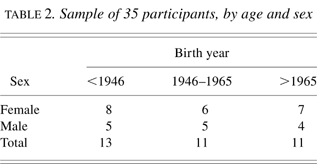
The study presented in this article involved the acoustic analysis of over one thousand tokens of the six short vowels of English,

, produced by 35 native speakers of Montreal English from three ethnic groups (9 Irish, 15 Italian, and 11 Jewish
6The sample was originally recruited for a study of ethnic differences in the phonetics of Montreal English (Boberg, 2004), which determined its ethnic composition. In that study, ethnicity was not found to influence the articulation of the vowels involved in the Canadian Shift, though it did have important effects on other vowels. The 2001 Census of Canada showed that the 161,235 people of Irish ancestry in Greater Montreal represent the largest portion of the historically English-speaking community, outnumbering those of English or Scottish ancestry, whereas the 224,460 people of Italian origin and 80,390 people of Jewish origin are the most populous of the groups of non-British people who have joined the English-speaking community since immigrating to Montreal. (Canada. Statistics Canada, 2001.) The sample of this study therefore represents a cross-section of the ethnic diversity that characterizes the English-speaking community of Montreal.
These generational groups are derived from the analysis of Howe and Strauss (1993), who argued that they represent significant shifts in outlook, experience, and popular culture. The first group's socialization was dominated by the Depression and the Second World War; the second by the Cold War and the counter-cultural and civil rights movements of the 1960s; and the third by the aftermath of the 1960s.
Sample of 35 participants, by age and sex

Age, sex, ethnicity, education, and occupation of individual participants

All subjects participated in a tape-recorded sociolinguistic interview, carried out by an undergraduate linguistics student from McGill University, usually in the participant's home.
8The interviews were recorded on Type II (CrO2) analog cassette tapes, using Marantz PMD 221 cassette recorders and Audiotechnica AT 803b omnidirectional lavalier microphones.

read by each participant were dead, deck, set, step, sell, and ten. While allophonic conditioning of the Canadian Shift was examined by Clarke et al. (1995:213–216), it will not be addressed here. Allophonic effects were, however, controlled for by having each participant read the same words, and by ensuring that each vowel was represented by a comparable set of allophonic environments.
9Each short vowel was represented by at least one token before /d/, one before /t/, and one before /l/. All of them except

were also represented by a token before /n/. There were four tokens of

before nasal consonants, but these were not included in the analysis, because prenasal

often shows a clearly separate distribution from other tokens of

in North American English, and the degree to which

is fronted or raised before nasals is subject to ethnic variation in Montreal. The word list also included tokens of the short vowels before /r/ (e.g., spirit, berry, carry), but these were excluded from the analysis because prerhotic vowels generally form a separate subsystem from the main, nonprerhotic system in most North American dialects. Finally, the representation of the main vowels of interest in the Canadian Shift—

—was augmented by including tokens before /p/ and /k/ as well as /t/. The number of tokens analyzed for each participant was therefore 30: six of

; five of

; four of

, and three of

.
Acoustic analysis of the word list tokens was performed with the Computerized Speech Lab system developed by Kay Elemetrics (Model 4400). Waveform, spectrogram, and linear predictive coding (LPC) analyses were carried out on each token. The frequency of the first and second formants was measured using the LPC analysis. The measurement was made at the point that best represented the central tendency of the vowel. This was usually the maximum value of F1, or the middle of a steady state in F1. In a few cases, the trajectory of F2 was used as a guide to establishing a more precise point of measurement within an F1 steady state. All of the measurements thus obtained were normalized to eliminate interspeaker differences related to the size or shape of the vocal tract, using the Constant Log Interval procedure of Nearey (1977).10
Nearey's Constant Log Interval Hypothesis involves a single scaling factor for F1 and F2. It calculates a scaling factor for each participant as the antilog of the difference between the natural logs of the combined F1/F2 means of the participant and the group (all 35 participants). The participant's formant values are then multiplied by the scaling factor to produce the normalized values. The F1/F2 mean for the group of 35 speakers was 1110.6, of which the natural log is 7.01. The scaling factors ranged from 0.86 for the woman with the highest voice to 1.16 for the man with the lowest voice. The mean F1/F2 means were 1184 for women and 1012 for men; the mean scaling factors were 0.94 for women and 1.10 for men.
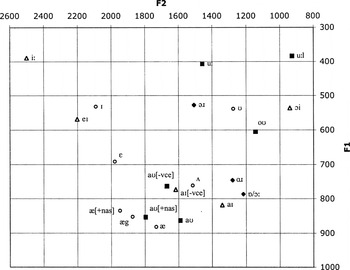
Figure 2 shows the mean F1 and F2 values for all of the stressed vowels of English, with important allophones, for the 35 speakers.
11The values in Figure 2 actually reflect a mean of the means for the three ethnic groups. It will be shown that ethnicity has no effect on the vowels involved in the Canadian Shift, but it does affect other vowels. The interethnic mean prevents the representation of Montreal English as a whole from being unduly subject to the influence of one ethnic group more than another.

in the lower-mid-back region, held by Clarke et al. to be the trigger for the Canadian Shift. The short front vowels involved in the Shift do, in fact, appear to be somewhat shifted relative to their position in some other English dialects:

are fairly low, and the main distribution of

(excluding its allophones before nasals and before /g/) is low-central, not far from the main distribution of

. The position of

is lower-mid-central, near the raised allophones of

that occur in Canadian Raising environments (before voiceless obstruents). This also appears to reflect the operation of the shifts indicated in Clarke et al. Other features characteristic of Montreal English are the relatively retracted and raised positions of

, and the moderate centralization of the main distribution of

relative to its allophone before /l/, which remains in back position. The latter development, without a parallel centralization of

, is typical of Canadian English as a whole.

Normalized F1/F2 measurements for 35 speakers of Montreal English, showing means for stressed vowel phonemes and major allophones. Mean of three ethnic groups (Irish, Italian, and Jewish). Short vowels are indicated by open circles, except for (cot), which is merged with long (caught). Back-upgliding vowels are indicated by black squares, front-upgliding vowels by white triangles, non-upgliding long vowels by black diamonds.
The mean F1 and F2 values for each vowel for each participant, together with each participant's demographic data, were analyzed statistically with the General Linear Model of SPSS (Statistical Package for the Social Sciences, Version 10 for the Macintosh). The dependent variables were the F1 and F2 of the six short vowels,

, indicating their height and advancement, respectively. The last of these vowels,

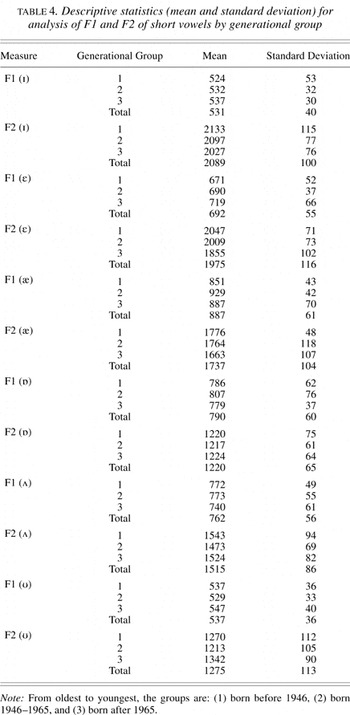
, was not included in Clarke et al.'s analysis but was included here so that the behavior of the entire subsystem of short vowels might be studied. The independent variables were the generational group, sex, ethnicity, and education of the participants. Table 4 gives descriptive statistics (mean and standard deviation) for each of the dependent measures according to generational group.
Descriptive statistics (mean and standard deviation) for analysis of F1 and F2 of short vowels by generational group

RESULTS AND ANALYSIS
The first step in the statistical analysis of the acoustic data was to see whether they showed, as a set, a correlation with generational group that might indicate a change in progress of the sort proposed by Clarke et al. A multivariate analysis of covariance (MANCOVA) was therefore carried out, with generational group as the fixed factor; sex, ethnicity, and education as covariates; and the F1 and F2 of the six short vowels as dependent variables. The result of this analysis was F(2, 36) = 2.961; p < .005. From this we can conclude that age does have a significant effect on the articulation of the short vowels of Montreal English, and that this effect is independent of any effect of sex, ethnicity, or education.
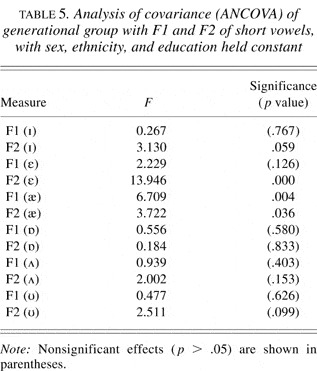
The next step was to see which of the 12 dependent measures showed a significant correlation with generational group. This was accomplished with an analysis of covariance (ANCOVA), with the same design as the MANCOVA previously described. The results are shown in Table 5. According to this analysis, generational group has a significant independent effect on four measures: the F1 of

; and the F2 of

.
12Probabilities of less than 0.05 were taken to be significant. The probability for the F2 of

, p = .059, was taken to be marginally significant, since it is only slightly higher than 0.05.

, or for either measure of the back vowels. These data contradict the position of Clarke et al. that the Canadian Shift involves a lowering of

. Instead, they support the view that emerges from the acoustic studies of Ontario speech cited previously, in which the main parameter of variation in the articulation of

is advancement rather than height. The descriptive statistics in Table 4 show that the significant effects in Montreal English involve a lower F2, or more retracted vowels, for younger participants. In fact, the especially large F value for the F2 of

(F = 13.946, p = .000) suggests that the retraction of

is the most active part of the Canadian Shift in Montreal.
Analysis of covariance (ANCOVA) of generational group with F1 and F2 of short vowels, with sex, ethnicity, and education held constant

It must be admitted that the effect of generational group on the F1 or height of

was fairly close to being significant, at p = .126, and that Table 4 shows what appears to be a steady if moderate increase in the F1 of

with each generation. This suggests that the development of

in Montreal may involve some degree of lowering as well as retraction, which might attain statistical significance in a larger sample. However, where Clarke et al.'s diagram of the Canadian Shift (Fig. 1) shows lowering to be the primary direction of change in the articulation of

, with the limited degree of associated retraction no more than what might be imposed by the shape of the vowel space, in Montreal the trajectory of

involves a much greater degree of retraction than of lowering. Both reports identify a diagonal trajectory, but they can be clearly distinguished by the main direction of the diagonal. Moreover, they differ very clearly on the development of

. Whereas Clarke et al. reported a lowering of

with virtually no retraction, the Montreal data show a retraction of

with no evidence of lowering.
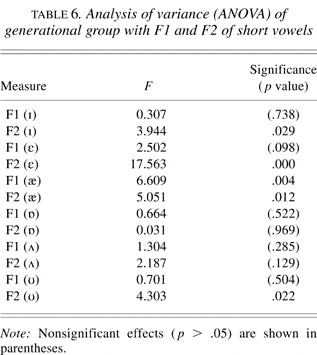
To develop a more detailed view of generational differences in the articulation of the short vowels, a multivariate analysis of variance (MANOVA) was next performed, as a preliminary step in carrying out Tukey HSD post-hoc tests of the differences between individual generational groups for each measure. The MANOVA tested the effect of generational group on the F1 and F2 of the six short vowels, without the other demographic factors as covariates. Like the MANCOVA, this test found a significant main effect of generational group: F(2, 42) = 3.386; p < .001. An analysis of variance (ANOVA) was also performed, for which the results are given in Table 6. In general, these data confirm the results of the ANCOVA shown in Table 5, with the difference that other demographic factors are not held constant. Significant effects were again found for the F1 of

, and for the F2 of

. The F2 of

once again shows the largest F value, whereas the F1 of

still falls just short of significance at p = .098.
Analysis of variance (ANOVA) of generational group with F1 and F2 of short vowels

One difference between Tables 5 and 6 is that the F2 of

shows a significant correlation with generational group in the ANOVA that did not appear in the ANCOVA, suggesting that age has an effect on this measure that is not independent of other social factors. The descriptive statistics in Table 4 do not show a linear correlation, but the decline in F2 from the oldest to the middle group appears small beside the large rise in F2 from the middle to the youngest group, suggesting that

has begun to centralize among young speakers. As before, the other back vowels show no correlation with generational group.
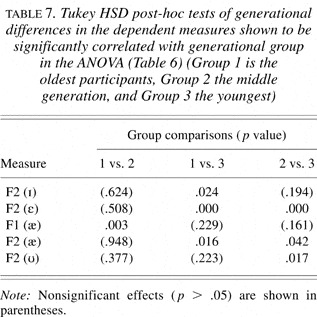
The results of the Tukey HSD post-hoc tests are given in Table 7. The table shows only the five measures that were found to be significantly correlated with generational group in the ANOVA (Table 6). By comparing Table 7 with the descriptive statistics in Table 4, it is possible to develop a more precise view of the diachronic progress of the Canadian Shift in Montreal, as reflected in apparent time. None of the generational effects differentiates all three groups. Groups 1 and 2, the oldest and middle generations, differ significantly only with respect to the F1 of

, which is higher for the middle group, suggesting that

began to move lower among baby-boomers but reached the maximum extent of this shift (the bottom of the vowel space) by the mid-1960s. Groups 2 and 3, the middle and youngest generations, differ significantly with respect to three measures: the F2 of

. The first two of these differences show that the principal development of the Canadian Shift in Montreal—the parallel retraction of

—is a comparatively recent phase that was introduced by the children of baby-boomers after the mid-1960s. The highest front vowel,

, shows a less vigorous retraction, which is significant only when the youngest group (3) is compared with the oldest group (1). As suggested previously, the centralization of

appears to be a recent innovation, introduced by the youngest generation. Its structural connection with the Canadian Shift is not clear; it may, in fact, be a purely coincidental development.
Tukey HSD post-hoc tests of generational differences in the dependent measures shown to be significantly correlated with generational group in the ANOVA (Table 6) (Group 1 is the oldest participants, Group 2 the middle generation, and Group 3 the youngest)

At this point, we have answered two of the three questions posed in the introduction. The Canadian Shift, or something very similar to it, is active in Montreal, but its phonetic character is not identical with the version of the Shift reported for Ontario English by Clarke et al. The two reports agree on the retraction of

, which is likely to be the most perceptually salient element of the Shift, because it directly opposes the development of

in Inland Northern speech. However, where Clarke et al. found that the retraction of

had triggered a lowering of

in a chain shift relationship, the Montreal data show instead a parallel retraction of

, the former more vigorous than the latter. The retraction of

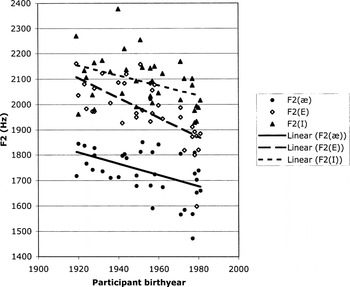
in fact appears to be the most active component of the Shift in contemporary Montreal speech. The parallel retraction of all three front vowels is shown in Figure 3, which plots each participant's mean F2 of

against his or her year of birth. The three linear regression lines show how the mean F2 declines as birth year increases: the younger the participant, the more centralized the vowel. The slope of the line for

is steeper than those for the other vowels, indicating that the retraction of

is more marked than the other changes.

Parallel retraction of front short vowels : the principal phonetic character of the Canadian Shift in Montreal. Mean second formant as a function of participant birth year, with linear regression of each distribution, for 35 speakers of Montreal English. Lower F2 values indicate more retracted vowels.
SOCIAL EMBEDDING OF THE CANADIAN SHIFT
The third question posed in the introduction was how the Canadian Shift is socially embedded. What are the social characteristics of the speakers who are leading this change? Clarke et al. found that women were ahead of men in adopting the Canadian Shift (1995:216–217), but the limitations of their sample did not permit an analysis of other social factors. The Montreal sample is more diverse, including three different ethnic groups and two educational groups, as well as a division between men and women. It will be seen, however, that the analysis of social factors permitted by this diversity adds very little to what was established by Clarke et al.
To see whether any social factors other than generational group have a significant independent effect on the Canadian Shift in Montreal, a MANCOVA was conducted for each factor, holding the others constant. Of the three, only sex had a significant effect (F(1, 12) = 2.358; p < .05). The result for ethnicity was F(2, 24) = 1.394; p > .05. That for education was F(1, 12) = 1.320; p > .05. The Canadian Shift therefore appears to be implemented in a socially uniform manner, but with some differences according to the sex of the speaker.
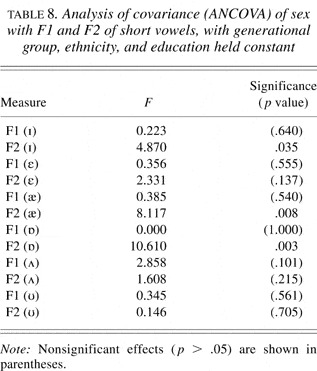
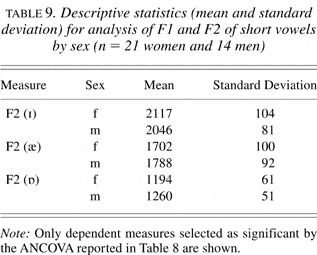
The nature of these sex differences was investigated by carrying out an ANCOVA with sex as the fixed factor and the other social factors as covariates. The results are shown in Table 8. Only three acoustic measures show a significant effect of sex: the F2 of

. Remarkably, one of these, the F2 of

, is the weakest component of the Shift in Montreal, and another, the F2 of

, is not involved in the Shift at all; in fact,

appears to be diachronically stable. Of the most vigorous components of the Shift, only the retraction of

shows a correlation with sex, while sex appears to have no significant effect on retraction of

. This is an unexpected result, given the general view that women tend to lead active sound changes (Labov, 1990:215).
Analysis of covariance (ANCOVA) of sex with F1 and F2 of short vowels, with generational group, ethnicity, and education held constant

The descriptive statistics for the analysis of the effect of sex are given in Table 9. Only those measures shown to be significantly affected by sex in the ANCOVA (Table 8) are listed. The data in Table 9 show that women are ahead of men in the retraction of

, the most active part of the Canadian Shift among those that are correlated with sex. This conforms both to general views of the role of women in sound change, and specifically to the findings of Clarke et al. The retraction of

shows the opposite sex pattern, with men slightly ahead of women, but we have seen that this is a less active part of the Shift in Montreal, so perhaps this contradiction is not as noteworthy as it might otherwise be. In any event, it is not immediately evident why women should lead in the retraction of one vowel while men lead in the retraction of another, unless perhaps these two vowels have different sociosymbolic values attached to them. This question could well be the subject of future research on the Canadian Shift.
Descriptive statistics (mean and standard deviation) for analysis of F1 and F2 of short vowels by sex (n = 21 women and 14 men)

As for the third vowel that shows a correlation with sex, it is perhaps not surprising that women show a lower mean F2 of

than men, as they also have a lower mean F2 of

. The further back the articulation of

, the more room there is in the low-central region for the retraction of

. There appears to be a more or less constant distance between the front and back corners of the vowel space. The entire lower space is further back for women than for men. Clearly, however, the social embedding of the Canadian Shift is a subject that would benefit greatly from further research, both in Montreal and elsewhere.
DISCUSSION
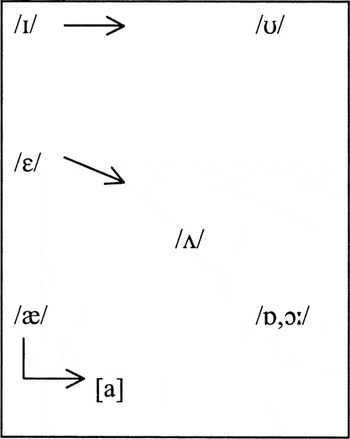
The data we have reported motivate a revised view of the Canadian Shift, at least as it operates in Montreal, which is illustrated in Figure 4. It is difficult to know how to reconcile this view with that of Clarke et al., reproduced in Figure 1, other than to suggest that the Shift may operate differently in Ontario and Quebec. To test this hypothesis, data identical to those on Montreal English reported here were collected from seven undergraduate students (five women and two men) from several regions of Ontario
13Two of the students were from Greater Toronto, one from Southern Ontario, three from Eastern Ontario, and one from Northern Ontario.

than the Montreal subjects (that is, higher mean F1 and lower mean F2 measurements), the inconsistency between the two studies could be confidently ascribed to a regional difference.

The Canadian Shift in Montreal.
In making the regional comparison, the same word list was used for the Ontario subjects, and their production of the six short vowels was measured in the same way as for the Montreal participants. Their acoustic data were normalized in reference to the group mean for the Montreal participants, so that the two groups could be directly compared. A MANCOVA was then carried out to test whether region (Ontario vs. Montreal) was correlated with any differences in the acoustic measures. Sex was held constant as a covariate. The result was F(1, 12) = 3.191; p > .05; from which it can be concluded that there is no significant difference between Ontario and Montreal productions of the vowels involved in the Canadian Shift. Of course, the small size of the Ontario sample means that this conclusion can only be tentative at this point, but it seems likely that a robust regional difference would have appeared even with a small sample.
Clearly, the nature of regional differences in the operation of the Canadian Shift, like the effect of social factors, represents a promising opportunity for future research. Acoustic analyses of the speech of large samples of comparable subjects from all of Canada's regions should prove particularly valuable in this respect. Labov et al. (forthcoming) offer a first view of the national picture. Based on a limited sample of only a few subjects in each of Canada's urban regions, they find that the Shift does not operate consistently in Atlantic Canada,14
This finding partly contradicts Clarke et al. (1995:220), who report an incipient retraction of

in St. John's, Newfoundland, led by middle-class women. The adoption of

-retraction by young women in St. John's has more recently been confirmed by D'Arcy (2002).
If Montreal's participation in the Shift now seems clear, however, the phonetic nature of the Shift remains a puzzle. The multivariate analysis of acoustic data on Canadian English carried out by Labov et al. (forthcoming) reveals a pattern that conforms to both versions of the Shift discussed here: that of Clarke et al., in which the major development of

is a descent towards

(Figure 1); and that of the present analysis, in which the major development of

is a centralization parallel with the retraction of

(Figure 4). In other words, Labov et al. found that

is moving diagonally, both down and inward.
It is particularly difficult to reconcile this result with the preliminary analysis of the Ontario data from Labov et al.'s (forthcoming) study, presented in Table 1, which showed no correlation between age and the F1 of

(r = .16). Ontario is the only region of Canada in which Labov et al. have a large enough sample to support an apparent-time analysis without appealing to speakers from other regions. When the analysis is expanded to include speakers from regions outside Ontario, however, an age correlation with the F1 of

emerges. This analysis probably raises as many questions as it answers, given the problems of regional differences and a small sample in each city, combined with the fact that the data on each speaker are not always strictly comparable (unlike in the present analysis, many of the tokens analyzed for each subject were from spontaneous speech, so that allophonic environment and conditions of elicitation were not controlled). Nevertheless, this view of the development of

gains further support from anecdotal, impressionistic observations of the speech of young Canadians. Among young Canadian women in particular, the pronunciation of

is sometimes low enough to produce potential confusion with

, at least when taken out of context, as when left and bet sound somewhat like laughed and bat. It is not clear why this development is not reflected in the data presented here. If it is not simply a regional difference, the discrepancy may result from characteristics of the sample on which the present study is based, such as the high proportion of certain ethnic groups, or to the role of aspects of the speech signal other than the height of the first two formants. At this point, the development of

represents an interesting opportunity for future research.
Perhaps the most engaging issue in research on the Canadian Shift, particularly for linguists not closely concerned with the study of Canadian English, is the extent to which the Shift can be seen as an automatic response to its phonological input condition—the space opened up by the low-back merger—rather than as an idiosyncratic development with a local, sociosymbolic value in Canadian English. Clarke et al. (1995:224) correctly pointed out that the obvious way to answer this question is to examine other dialects in which the same input condition is present: the other members of Labov's Third Dialect group. Is the retraction of

, with its associated effect on the other short front vowels, found in every dialect that exhibits the low-back merger? A positive answer would argue for an explanation of the Shift in terms of automatic processes of vowel shifting governed by structural considerations, in particular by the need to maintain equal margins of security around each vowel phoneme. A negative answer, in the absence of other structural impediments to retraction in the other dialects, would suggest that the retraction of

may have a sociosymbolic value in Canadian English that has less currency in other regions of North America.
The continental overview of vowel pronunciation offered by Labov et al. (forthcoming) shows little evidence of the Canadian Shift outside Canada, but this broad perspective should be confirmed by detailed local studies of larger samples of speakers in each region. These studies will have to contend with the possibility that the presence of a low-back merger may not be the only input condition relevant to the operation of the Canadian Shift. In each Third Dialect region, as it happens, additional structural factors may come into play. Traditional Eastern New England speech features a low-central vowel, /a:/ (father, palm, car), not present in Canadian English, that might merge with

if the latter were shifted to low-central position. It was observed earlier that the Canadian Shift pronunciation of hat as [hat] matches the Inland Northern pronunciation of hot. In Boston, by contrast, it is similar to the traditional pronunciation of heart as [ha:t]. Does the possibility of this merger prevent the retraction of

? Western Pennsylvania English (at least the traditional dialect of Pittsburgh, the largest city in the region) also has a low-central vowel not present in Canadian English, though from a different historical source, in this case the monophthongization of

. Does the pronunciation of mouth and mouse as [ma:θ] and [ma:s] discourage the pronunciation of math and mass in the same way?
15McCarthy (2004) presented data from an acoustic study of Pittsburgh English that suggested a structural relation between the retraction of

and the monophthongization of

. Retracted

was only observed among participants for whom monophthongization was strongly recessive or absent.

are diphthongs, and historical /a:/ (father) is merged with

(bother), which in turn is merged with

. The phonetic realization of this three-way merger, however, is different. In some parts of the West, it is considerably further forward and less rounded than in Canada, approaching the low-central region, so that cot and caught are both pronounced as

rather than as

. Does this configuration of the low vowel space preclude the retraction of

?
16The same condition is true of Newfoundland English, which has a low-central rather than low-back articulation of

. This may help to explain the observation of Labov et al. (forthcoming) that the Canadian Shift does not operate in Newfoundland (but see note 14).
Further research on the retraction of

in various dialects may also help to illuminate the mental processes that underlie the Canadian Shift. The version of the Shift presented in Clarke et al. is a classic chain shift, suggesting a clear causal relation between its three principal elements. The basis of this causal relation is the maintenance of maximal margins of security in phonological space to prevent confusion with neighboring phonemes, a key component of the structural economy of vowel systems, as conceived by Martinet (1955) and further developed by Labov (1994). Structural economy of this sort was shown by Moulton (1960, 1962) to explain the articulation of vowels in Northern dialects of Swiss German, in a powerful demonstration of the effect of phonemic structure on phonetic output. It has a clear psycholinguistic basis. By contrast, the version of the Shift presented in Figure 4 is a parallel shift. Parallel shifts have been observed before (e.g., the parallel centralization of the back upgliding vowels

in the Midland and South of the United States, or in Southern British English), but their relation to structural economy is less obvious than that of chain shifts. Although structural economy can be evoked to explain the original retraction of

in Canadian English, parallel retractions of

can only be explained as analogical developments, or as the generalization of a phonetic change from one member to the other members of a vocalic subsystem.
A generalization of this type may achieve a certain mental economy, but it is difficult to argue that it enhances structural economy. On the contrary, in the Northern Cities Shift, the retraction of

follows in a chain shift behind the retraction of

, thereby maintaining margins of security, whereas in the Canadian Shift,

remains in place (at least according to the ANCOVA reported in Table 5). Neither Clarke et al. nor the present study found

to be shifting back toward the rear periphery; in fact, Clarke et al. suggested that it is moving forward. Figure 2 shows it in lower-mid central position in Montreal, not far from the most retracted allophones of

. The retraction of

therefore diminishes the margin of security between

, potentially causing deck and best to sound somewhat like duck and bust. In this case, apparently, the structural integrity of vocalic subsystems takes precedence over the need to maintain maximal contrast between neighboring phonemes. Whether Canadian English, or Montreal English, in fact, shows an approximation or incipient merger of

will be left as a subject for future research.
References
REFERENCES
Avis, Walter S.
(1954–1956).
Speech differences along the Ontario–United States
border.
Journal of the Canadian Linguistic Association
1:13–18, 1:14–19, and
2:41–59.Google Scholar
Boberg, Charles.
(2000).
Geolinguistic diffusion and the U.S.–Canada border.
Language Variation and Change
12:1–24.Google Scholar
Boberg, Charles.
(2004).
Ethnic patterns in the phonetics of Montreal English.
Journal of Sociolinguistics
8(4):538–568.Google Scholar
Canada. Statistics Canada.
(2001).
Census, 2001.
Ottawa:
Minister of Industry, Science and Technology.
538–568.
Also available on-line at www.statcan.ca.
Chambers, J. K.
(1994).
An introduction to dialect topography.
English World-Wide
15:35–53.Google Scholar
Clarke, Sandra,
Elms, Ford, &
Youssef, Amani.
(1995).
The third dialect of English: Some Canadian evidence.
Language Variation and Change
7:209–228.Google Scholar
D'Arcy, Alex.
(2002).
Caught in the act: Dialect change in St. John's English.
Paper presented at NWAVE 31, Stanford University, October
12.
De Decker, Paul.
(2001).
Hangin' & retractin': Adolescent social practice and
sound change in an Ontario small town.
Paper presented at NWAVE 30, North Carolina State University,
October 12.
De Decker, Paul, &
Mackenzie, Sara.
(1999).
Slept through the ice: A Further look at lax vowel lowering in
Canadian English.
Paper presented at NWAVE 28, University of Toronto, October
16.
De Wolf, Gaelan Dodds.
(1992).
Social and regional factors in Canadian English.
Toronto:
Canadian Scholar's Press.
Esling, John H., &
Warkentyne, Henry J.
(1993).
Retracting of /æ/ in Vancouver English. In
Sandra Clarke (ed.),
Focus on Canada.
Amsterdam:
Benjamins.
229–246.
Gregg, R. J.
(1957).
Notes on the pronunciation of Canadian English as spoken in
Vancouver, B.C.
Journal of the Canadian Linguistic Association
3:20–26.Google Scholar
Hoffman, Michol.
(1998).
Looking for a theng: The progress of lax vowel lowering.
Paper presented at NWAVE 27, University of Georgia, October
2.
Hoffman, Michol.
(1999).
Really expansive: The progress of lax vowel lowering in a chain
shift.
Paper presented at NWAVE 28, University of Toronto, October
16.
Howe, Neil, &
Strauss, Bill.
(1993).
13th Gen: Abort, Retry, Ignore, Fail?
New York:
Vintage Books.
Joos, Martin.
(1942).
A phonological dilemma in Canadian English.
Language
18:141–144.Google Scholar
Labov, William.
(1972).
Sociolinguistic patterns.
Philadelphia:
University of Pennsylvania Press.
Labov, William.
(1990).
The intersection of sex and social class in the course of linguistic
change.
Language Variation and Change
2:205–254.Google Scholar
Labov, William.
(1991).
The three dialects of English. In
P. Eckert (ed.),
New ways of analyzing sound change.
New York:
Academic Press.
1–44.
Labov, William.
(1994).
Principles of linguistic change. Vol. I: Internal factors.
Oxford:
Blackwell.
Labov, William,
Ash, Sharon, &
Boberg, Charles.
(forthcoming).
Atlas of North American English: Phonetics, phonology, and sound
change.
Berlin:
Mouton de Gruyter.
Labov, William,
Yaeger, Malcah, &
Steiner, Richard.
(1972).
A quantitative study of sound change in progress
(Vol. 1).
Philadelphia:
U.S. Regional Survey.
Lawrance, Erika.
(2002).
A shift in focus: A new, geolinguistic perspective on the Canadian
Shift (and old questions revisited).
Unpublished Master's paper,
McGill University.
Martinet, André.
(1955).
Economie des changements phonétiques.
Berne:
Francke.
McCarthy, Corrine.
(2004).
Language Change in Pittsburgh: The Decline of
/aw/-Monophthongization and the Canadian Shift.
Poster presented at NWAVE 33, University of Michigan, October
1.
Moulton, William G.
(1960).
The short vowel systems of Northern Switzerland: A study in
structural dialectology.
Word
16:155–182.Google Scholar
Moulton, William G.
(1962).
Dialect geography and the concept of phonological space.
Word
18:23–32.Google Scholar
Nearey, Terence M.
(1977).
Phonetic feature systems for vowels.
Bloomington, IN:
Indiana University Linguistics Club.
Scargill, M. H., &
Warkentyne, Henry J.
(1972).
The Survey of Canadian English: A report.
English Quarterly
5:47–104.Google Scholar
Trudgill, Peter.
(1974).
Linguistic change and diffusion: Description and explanation in
sociolinguistic dialect geography.
Language in Society
3:215–246.Google Scholar
Sample of 35 participants, by age and sex

Age, sex, ethnicity, education, and occupation of individual participants
Normalized F1/F2 measurements for 35 speakers of Montreal English, showing means for stressed vowel phonemes and major allophones. Mean of three ethnic groups (Irish, Italian, and Jewish). Short vowels are indicated by open circles, except for (cot), which is merged with long (caught). Back-upgliding vowels are indicated by black squares, front-upgliding vowels by white triangles, non-upgliding long vowels by black diamonds.
Descriptive statistics (mean and standard deviation) for analysis of F1 and F2 of short vowels by generational group
Analysis of covariance (ANCOVA) of generational group with F1 and F2 of short vowels, with sex, ethnicity, and education held constant
Analysis of variance (ANOVA) of generational group with F1 and F2 of short vowels
Tukey HSD post-hoc tests of generational differences in the dependent measures shown to be significantly correlated with generational group in the ANOVA (Table 6) (Group 1 is the oldest participants, Group 2 the middle generation, and Group 3 the youngest)
Parallel retraction of front short vowels : the principal phonetic character of the Canadian Shift in Montreal. Mean second formant as a function of participant birth year, with linear regression of each distribution, for 35 speakers of Montreal English. Lower F2 values indicate more retracted vowels.
Analysis of covariance (ANCOVA) of sex with F1 and F2 of short vowels, with generational group, ethnicity, and education held constant
Descriptive statistics (mean and standard deviation) for analysis of F1 and F2 of short vowels by sex (n = 21 women and 14 men)
The Canadian Shift in Montreal.
 You have
Access
- 82
- Cited by