Introduction
The Nordiska Juridiska Bibiloteksmötet is a very special occasion for information professionals working in the five Nordic countries of Norway, Sweden, Denmark, Iceland and Finland. The total population of all five nations is only around 23 million and this population is dispersed between five different jurisdictions and languages, spread over thousands of miles. When the meeting takes place, every three years, allowing information professionals in these states to get together, it is a welcome opportunity for them to share the problems facing their own jurisdictions and to analyse what common ground is shared with those working in the other countries. For an outsider like me, it is a great chance to discover the concerns faced in other jurisdictions and the ways in which they are meeting the challenges thrown up.
Conference themes
This June saw the 8th meeting gather in Helskinki, against an economic background much different to the one that had existed at the time of the Copenhagen conference in 2006. Given the circumstances, the attendance of nearly 100 librarians and information professionals was amazing. The theme of the conference was the common Nordic legal heritage but, of course, participants from every country were also affected by the recession, from which no legal jurisdiction has been immune. The papers given on the first day went over recent developments in each country, enabling us to observe the similarities, but also differences, in the approaches taken in each jurisdiction. All of these reports were of great interest. The second day saw papers given on the development of Nordic law, the prospects for future co-operation between Nordic jurisdictions, the archiving of web pages and a panel debate on continuing cooperation. These were all of interest, but it is two papers given on the Finnish project to establish a national digital library that I will be concentrating on.
Background to the National Digital Library project
The two papers were on “The project for a national digital library – towards a European digital library” and “The national digital library – user interface new dimensions,” and were given respectively by Miina Karvonen, General Secretary at the Finnish Education Ministry and Kristiina Hormia-Poutanen, Director of the National Library Services at the Finnish National Library.
Understandably, the two papers shared some common ground but Karvonen concentrated mainly on how and why the service was being created and how it would operate. Hormia-Poutanen dealt with how the service would look and how it would operate technically. This was a useful way of ordering things, as delegates were able to understand the concept of the undertaking before being exposed to its technical underpinnings and functions.
The idea for the digital library was inspired by a number of factors, global, local, operational and administrative. The advances in IT around the world have led to challenges to the way that knowledge is produced and used. This, combined with the prospect of an ageing population, the migration of more and more services to the internet, and changes in service structures of government and other institutions, are among the factors contributing to the advent of the digitalisation project.
Underpinning the project is the National Information Society Policy in Finland. This encompasses a National Information Society Strategy for the years 2007–2015; a Government Resolution on the National Information Society Policy for the years 2007–2011 and an Information Society Action Plan for 2007–2011. The project is supervised by the Ministry of Education and the first phase of its installation is under way.
National Digital Library
The National Digital Library (NDL) is intended to achieve the following:
• Introduce a common interface for the resources of libraries, archives and museums
• Undertake the digitisation of the most essential information resources of these institutions
• Develop a long-term preservation solution for electronic cultural heritage materials
• Increase competence
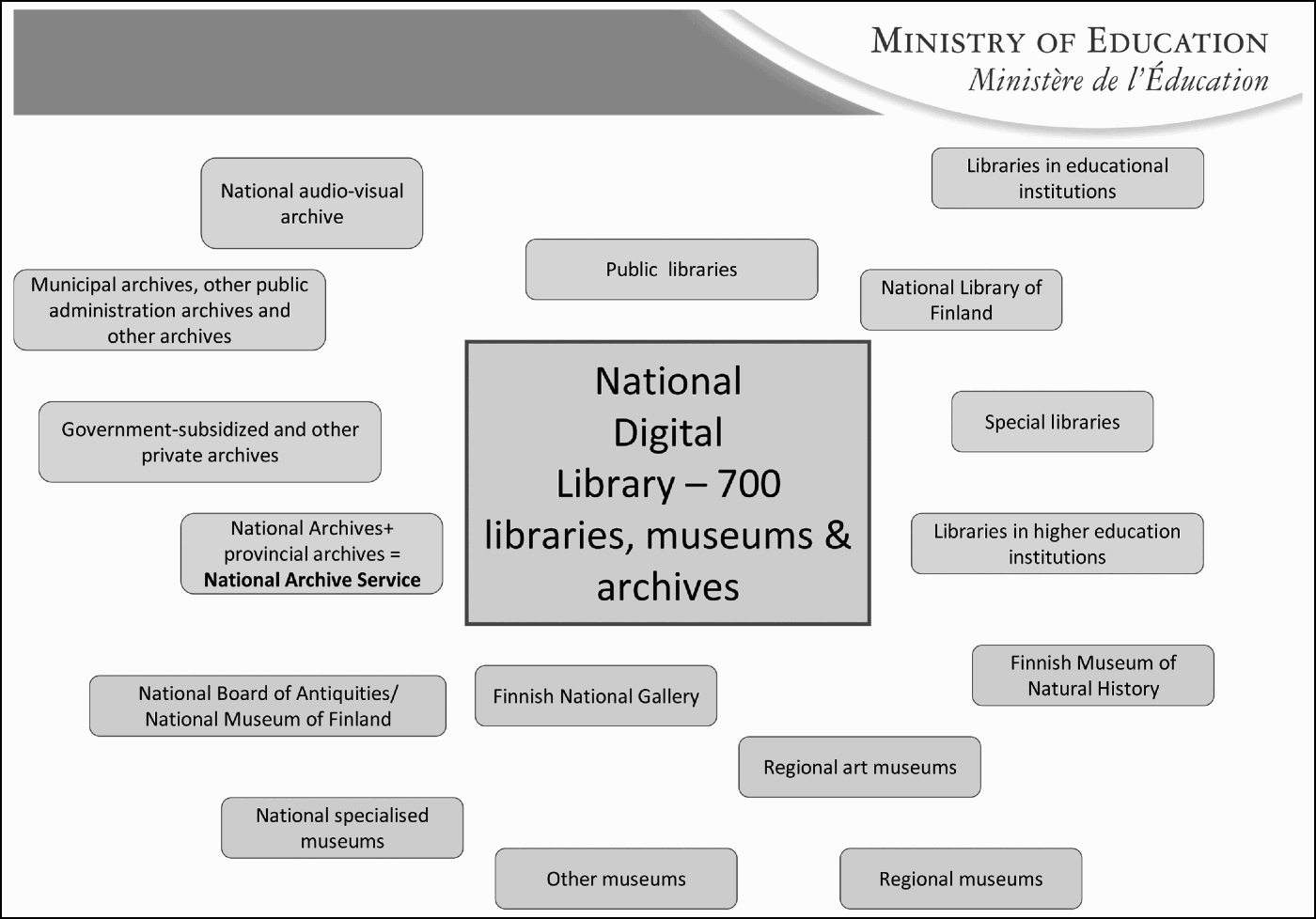
The NDL will work as an aggregator for the European Digital Library. More than 700 libraries, museums and archives will link in to the NDL mainly, but not exclusively, from the public sector. The hope is that access to the digital materials of libraries and other organisations included in the project will be opened. Naturally, there will be some barriers and obstacles. The use of licensed material will incur the same restrictions as it does anywhere else and archived material that has a restricted display will also present a problem to universal access. Nonetheless, it is envisaged that by 2011, 1.3 million pages of newspapers, hundreds of thousands of photographs and museum objects, one million pages of archive material, 50 million database references, and 300,000 ebooks and 20,000 emagazines and other licensed material, will be searchable. It will then be possible to link in to EUROPEANA, the common access point for European collections and the NDL will work as an aggregator for it.
Contributors to the National Digital Library

There are a number of benefits which it is hoped will accrue from the NDL project. The availability of electronic resources should improve, as should their ease of use. Overlapping expenses from the digitisation of resources across a myriad of sectors and organisations will be reduced. Cultural heritage material should be more effectively accessed as a source for education, research and business projects. Most interestingly, co-operation across sectoral and organisational borders will be strengthened. When organisations can see that their time and effort can be reduced through participation in the NDL, they will have a massive incentive to take part. Of course, common procedures and standards will be required and national guidelines will be essential to ensure that these are in place. The project also needs to be able to draw on all necessary resources, something that may become harder over the coming years, especially when it comes to the sustainability and content of the library. As well as these administrative and managerial issues, the NDL is naturally dependent on technical input and this represents a massive challenge.
This challenge takes in many strands. Among them are the wider use of metadata, involving Europeana and Google amongst others; the accurate collection of statistics; the integration of various functions, such as loans, orders, sales and reservations; the integration with external actors and aggregators, such as Google Books, Library Thing and RefWorks; and, of course, Web 2.0. Work has already begun and the preparation for acquisitions should be completed by September 2009. A pilot scheme, involving groups from a number of small organisations, will begin in 2010. It is hoped that work on an active system can begin in 2010 for completion in 2011.
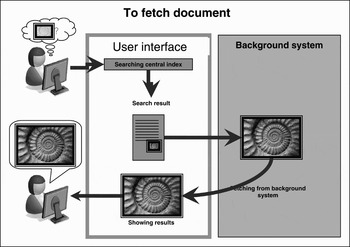
Ease of use is also an important factor. The illustration gives a visual idea of how a user will obtain information and receive a response to requests.
How a user will obtain information and receive a response to requests

This is a massive project, but the sheer number of organisations involved should, if all goes well, be a good indication of increased and increasing co-operation between these organisations in the years ahead.
Conclusion
Finland is a great country with a unique and distinct culture. The NDL should mean that the Finnish people are better placed to engage with their own culture, and that foreigners will, with a bit of effort, have a way into it.
If anybody would like further information on this project or would like to view the power point slides, please let me know. If you require a translation from Swedish to English I will be happy to do this.