Introduction
Corn leaf aphid, Rhopalosiphum maidis (Fitch) (Hemiptera: Aphididae), is a worldwide pest of such economically important crops as sorghum, wheat, barley, and corn. The whole corn plant can be attacked by this aphid species; however, the insects are concentrated in the whorl, affecting pollination and reducing kernel production (Carena & Glogoza, Reference Carena and Glogoza2004). Rhopalosiphum maidis is a vector of corn common mosaic virus, which can cause crop losses of 50% (Mello et al., Reference Mello, Negri and Souza2015). Chemical control is the most used method to control aphid pests in cereals, with risks of environmental contamination and side effects on non-target insects and natural enemies. Therefore, implementation of more sustainable control options, such as plant resistance, is desirable for cereal aphids management (Poehling et al., Reference Poehling, Freier, Klüken, van Emden and Harrington2007), including R. maidis in corn crops.
Plants have a sophisticated arsenal of defenses against herbivore attack, including toxic, anti-feedant, or repellant secondary substances and a variety of physical barriers (War et al., Reference War, Paulraj, Ahmad, Buhroo, Hussain, Ignacimuthu and Sharma2012). Plant defenses can be constitutive or induced by herbivore attack (War et al., Reference War, Paulraj, Ahmad, Buhroo, Hussain, Ignacimuthu and Sharma2012; Heidel-Fischer et al., Reference Heidel-Fischer, Vogel and Musser2014; Bruce, Reference Bruce2015) or by soil amendment with silicon (Liang et al., Reference Liang, Nikolic, Bélanger, Gong, Song, Liang, Nikolic, Bélanger, Gong and Song2015; Hartley & DeGabriel, Reference Hartley and DeGabriel2016; Reynolds et al., Reference Reynolds, Padula, Zeng and Gurr2016). Constitutive resistance to R. maidis has been reported in different corn genotypes (Carena & Glogoza, Reference Carena and Glogoza2004; Razmjou & Golizadeh, Reference Razmjou and Golizadeh2010; Betsiashvili et al., Reference Betsiashvili, Ahern and Jander2015); however, breeding programs have resulted in very few commercially available varieties resistant to corn leaf aphid (Carena & Glogoza, Reference Carena and Glogoza2004; Moraes et al., Reference Moraes, Goussain, Carvalho and Costa2005). The use of plants with constitutive resistance may have regional limitations, since resistance expression can be greatly affected by the environment (Carena & Glogoza, Reference Carena and Glogoza2004). The use of silicon applications to induce resistance and complement constitutive resistance is an important tool in integrated pest management.
Silicon is the second most abundant element in the earth's surface, surpassed only by oxygen, comprising about 27% of all matter on the planet (Korndörfer, Reference Korndörfer2015). Silicon is absorbed by plant roots as monosilicic acid (H4SiO4) and deposited as polymerized silicic acid (SiO2.nH2O – amorphous silica) in plant epidermis (Lux et al., Reference Lux, Luxova, Hattori, Inanaga and Sugimoto2002). Amorphous silica accumulation on cell walls increases cell rigidity (Balasta et al., Reference Balasta, Perez, Juliano, Villareal, Lott and Roxas1989; Barbosa Filho et al., Reference Barbosa Filho, Snyder, Prabhu, Datnoff and Korndörfer2000; Korndörfer, Reference Korndörfer2015). Moreover, silicon is associated with anti-stress compounds in plants, inducing resistance against abiotic and biotic stresses. Silicon increases the detoxicating enzymes in oxidative metabolism (e.g., polyphenol oxidase, catalase, superoxide dismutase, and peroxidases), as well as enhancing the activity of non-enzymatic cleaning compounds of this metabolism (tannins) that lower the levels of reactive oxygen species, such as hydrogen peroxide (Chérif et al., Reference Chérif, Asselin and Belanger1994; Gomes et al., Reference Gomes, Moraes, Santos and Goussain2005; Han et al., Reference Han, Li, Gong, Yang, Wen and Hou2016; Yang et al., Reference Yang, Han, Li, Li, Ali and Hou2017). Silicon is also associated with key enzymes in the aromatic metabolism (phenylalanine ammonia lyase) (Yang et al., Reference Yang, Han, Li, Li, Ali and Hou2017) and associated with lignin and other cell wall components (Gomes et al., Reference Gomes, Moraes, Santos and Antunes2008). There is even evidence that this element might be associated with the modulation of cell walls by triggering the action of hydrolases (β-1,3-glucanase) (Yang et al., Reference Yang, Han, Li, Li, Ali and Hou2017). Silicon also lowers the nutritional quality of plants, decreasing the soluble proteins in the leaves (Han et al., Reference Han, Li, Gong, Yang, Wen and Hou2016).
However, such positive effects of silicon are not always evident, since its accumulation differs among plant species and among genotypes of the same species (Epstein, Reference Epstein1999; Deren, Reference Deren, Datnoff, Snyder and Korndörfer2001; Ma & Takahashi, Reference Ma and Takahashi2002; Hodson et al., Reference Hodson, White, Mead and Broadley2005; Mitani & Ma, Reference Mitani and Ma2005; Keeping & Reynolds, Reference Keeping and Reynolds2009; Guntzer et al., Reference Guntzer, Keller and Meunier2012). Several studies have found that silicon application can induce insect resistance by enhancing non-preference, reducing rates of plant colonization, or by antibiosis, reducing insect fecundity, or increasing mortality of phytophagous insects (Moraes et al., Reference Moraes, Goussain, Basagli, Carvalho, Carvalho and Sampaio2004, Reference Moraes, Goussain, Carvalho and Costa2005; Gomes et al., Reference Gomes, Moraes, Santos and Goussain2005; Costa et al., Reference Costa, Moraes and Antunes2007; Dias et al., Reference Dias, Sampaio, Rodrigues, Korndörfer, Oliveira, Ferreira and Korndörfer2014; Almeida et al., Reference Almeida, Silva, Jesus, Nogueira, Souza Neto and Cunha2015; Reynolds et al., Reference Reynolds, Padula, Zeng and Gurr2016; Alvarenga et al., Reference Alvarenga, Moraes, Auad, Coelho and Nascimento2017; Jeer et al., Reference Jeer, Telugu, Voleti and Padmakumari2017). Genotypes with a high degree of constitutive resistance absorb greater amounts of silicon, further enhancing their resistance (Reynolds et al., Reference Reynolds, Keeping and Meyer2009, Reference Reynolds, Padula, Zeng and Gurr2016).
Our study goals were to evaluate the constitutive resistance of commercial corn hybrids against R. maidis under field and greenhouse conditions and measure silicon's ability to induce resistance in corn hybrids with different degrees of constitutive resistance against R. maidis.
Materials and methods
Resistance identification trials
Comparative resistance levels in commercial corn hybrids to R. maidis were determined by field trials (Exp. #1) at three locations. Resistance effects on aphid population growth were separately determined in a greenhouse trial (Exp. #2). In Exps. #1 and #2, resistance and aphid infestation was determined when corn plants were near tasseling, when large colonies of R. maidis have usually formed (Carena & Glogoza, Reference Carena and Glogoza2004).
Exp. #1: field trial of hybrid varieties and their resistance against R. maidis
In Exp. #1, we assessed corn aphid densities on 22 corn hybrids to identify those with the largest (most susceptible) and smallest (most resistant) numbers of R. maidis just before tasseling. Because aphid numbers were due to natural infestation, aphid numbers were the result of two simultaneous resistance mechanisms, antibiosis, and non-preference. The experiment was done at three commercial corn plantations, each in a different county in the Triângulo Mineiro region, State of Minas Gerais, Araguari (−18,688379°; −48,139848°), Tupaciguara (−18,538452°; −48,713426°), and Patos de Minas (−19,088690°; −46,390797°), Brazil.
At each site, corn was sown manually at 65,000 plants per hectare, and fertilized following soil analysis, according to Ribeiro et al. (Reference Ribeiro, Guimarães and Alvarez1999). Each plot consisted of four rows, 5 m long and 50 cm apart, with three replications at each location. Hybrids evaluated were: AG7088PRO2, AG7098PRO, AG8676PRO, AG8677, AS1555PRO, AS1625PRO, AS1633PRO, BJ9450NYK1, BM8850, BM8940, BM9288, BM9337, DAS2B587HX, DKB175PRO, DKB310PRO, DKB340PRO, DKB390PRO2, P30F35H, P30F53H, P3646H, P3862H, and STATUS VIP.
The number of plants infested with R. maidis aphids was determined at pre-flowering by visually inspecting all plants within a plot in the two central rows to determine the proportion (on average 32 per plot) infested with corn aphids by visually inspecting the two or three most external leaves of the whorl of each sampled plant, and identifying those plants with established colonies of corn aphid. An average of 32 plants per plot was inspected this way (96 per location and 288 in the whole experiment). Aphid densities of hybrids were then compared.
Rearing of R. maidis used to infest plants in screenhouse and greenhouse trials
Aphids used in experiments #2 (population growth) and #3 (effect of silicon addition) were from a laboratory colony initiated with R. maidis aphids collected in commercial corn fields and reared in a screenhouse (fig. 1) measuring 60 × 60 m, with sides and top covered with screens able to exclude aphids, maintained with drip irrigation and located at the Experimental Station of Monsanto Brazil, in Uberlândia, Minas Gerais State.
Diagram of the screenhouse, depicting the location of aphid rearing and the experiment of silicon-induced resistance in corn hybrids with different degrees of constitutive resistance against Rhopalosiphum maidis. Si+ = with silicate soil amendment; Si− = without silicate soil amendment.

We used corn plants from a Monsanto corn line with high susceptibility to corn aphids to rear R. maidis. These susceptible plants were sown on 28 April 2016 inside the screened area, in 5 m long plots containing four rows spaced 0.76 m apart, with 3.5 plants per meter. When plants reached the V8 (eight fully expanded leaves) stage (May 2016), they were infested with R. maidis collected in three counties in the Triângulo Mineiro region, in the State of Minas Gerais, Uberlândia (−18,998616°; −48,086129°), Uberaba (−19,191516°; −48,156660°) and Indianópolis (−18,890522°; −47,881639°). New plots in the screenhouse continued to be sown at 15-day intervals until December 2016 to provide for the natural colonization of R. maidis by maintaining plants in vegetative and pre-flowering stages of the crop throughout the experimental period.
Exp. #2: population growth rates of R. maidis in a greenhouse trial
In Exp. #2 (aphid population growth rates in greenhouse), corn plants were manually infested with R. maidis and aphid population growth was evaluated, with the goal of evaluating antibiosis as the resistance mechanism.
The experiment was conducted in a 15 × 15 m greenhouse with cement floor and sides covered with transparent plastic, maintained with irrigation and temperature control (28°C), located at the Experimental Station of Monsanto Brazil, in Uberlândia, Minas Gerais State, on 30 June 2016. Pots (29 cm diameter × 29 cm high) were filled with 13 kg of soil collected from the Experimental Station, immediately fertilized with a 10:30:10 (N, P, K) ratio fertilizer according to a soil analysis, and two seedlings were maintained per pot. Nitrogen fertilization with urea was done 20 days after sowing (DAS), with 3 g per pot.
Treatments consisted of nine corn hybrids selected from the field experiment, with four replications (pots) each. The hybrids (treatments) were AG7088PRO3, AG7098PRO2, AG8677PRO2, AS1633PRO2, DKB310PRO2, DKB390PRO2, P30F35YH, P30F53YH, and STATUS VIP3. The transgenic version of some hybrids was different from that of the field experiment, due to the replacement of the commercial hybrid available in the market: three hybrids with version PRO (AG7098PRO, AS1633PRO, and DKB310PRO), presenting resistance to some Lepidoptera, were replaced by version PRO2 (which incorporated the gene conferring tolerance to the herbicide glyphosate); two hybrids with version H (P30F35H and P30F53H), also with resistance to some Lepidoptera, were replaced by version YH (with the incorporation of a second resistance gene against Lepidoptera); the hybrid STATUS VIP (resistant to some Lepidoptera) by version VIP3 (with the incorporation of a second resistance gene against Lepidoptera and tolerance to the herbicide glyphosate); the hybrid AG7088PRO2, by version PRO3 (with the incorporation of the gene that confers resistance to root-feeding beetle larvae) and the hybrid AG8677 by version PRO2. The hybrid DKB390PRO2 was maintained in the same version. The lack of hybrids on the market was why some varieties were replaced with newer transgenic versions.
The procedure for manual infestation of plants with aphids started 46 DAS. Two hundred and fifty-two adult aphids collected from the screenhouse rearing colony were placed with a paint brush in 36 Petri plates with a 5 cm diameter (seven aphids per plate), each containing 3 cm of corn leaf blade and covered with organza. Leaf turgor was maintained by lining the bottom of the plates with a 10 mm-thick 1% agar–water solution.
This set of plates was maintained in a growth chamber at 25°C and a 14:10 h L:D photoperiod for 2 days, after which the adults were transferred to a fresh set of 36 new Petri plates similar to the first. Nymphs produced during this period were maintained in the original plates and used in the experiment when they were 3–4 days old. Adult aphids were maintained in the growth chamber to produce more offspring for another 2 days, i.e., 50 DAS, after which they were removed and their nymphs used in the experiment (as 1–2 days old nymphs) to infest the whorl leaves, for a total of 20 nymphs per plant (12 nymphs 3–4 days old and eight nymphs 1–2 days old).
A second round of infestation with aphids was conducted using a new collection of 252 adults from the screenhouse rearing colony at 54 DAS. These procedures were repeated, and at 58 DAS, the experimental plants were further infested with an additional 15 nymphs per plant (ten 4-day-old nymphs and five 2-day-old nymphs). In total, each plant was infested with 35 nymphs of R. maidis after the second cycle of infestation.
One of the two plants in each pot was cut at 69 DAS (19 and 11 days after the first and second infestations, respectively), when corn plants had 15–16 fully expanded leaves. The plants were packed in paper bags and stored in a freezer for subsequent insect enumeration under a stereo microscope. The remaining plants were harvested at the pre-flowering stage, at 76 DAS (26 and 18 days after the first and second infestations, respectively), and again, all aphids were counted.
Exp. #3: silicon-induced resistance against R. maidis in a screenhouse trial
This experiment measured the silicon-induced resistance against R. maidis in corn hybrids with different degrees of constitutive resistance (as previously determined). The experiment was carried out in the same screenhouse where aphids were reared for use in the other experiments. The screenhouse was sited over soil with a low Si content (3.95 mg kg−1), providing the possibility to conduct an experiment examining the effect of addition of this element, according to Korndörfer et al. (Reference Korndörfer, Coelho, Snyder and Mizutani1999).
In Exp. #3 (effect of silicon addition), aphid population growth was evaluated on corn plants that were naturally infested by winged R. maidis, with the goal of evaluating non-preference and antibiosis resistance mechanisms, and manually infested with R. maidis to evaluate antibiosis as the resistance mechanism. Natural infestation of the test corn plants by winged R. maidis was assured by installing the experiment in the same screened area as the aphid maintenance rearing colony, at the opposite end of the structure, 36 m away (fig. 1). Test corn plants of two varieties were sown directly into the soil on 22 October 2016, in an area corresponding to 270 m2 (9 × 30 m), in a split-plot design. The plots (3 × 5 m) were amended (6000 kg ha−1) with either Agrosilício Plus Agronelli® (10.5% Si, 35% CaO, and 10% MgO), being silicon at 600 kg ha−1, or with lime Ercal® (37–38% of CaO and 8–10% of MgO) (representing the control with no silicon) at the same dosage, to balance the soil contents of calcium and magnesium. Silicon and lime were applied 97 days before planting, and materials were incorporated in the top 20 cm of soil. The experiment (fig. 1) consisted of split plots, each two rows 3 m long and 0.5 m apart of either DKB310PRO2 (susceptible) or P30F53YH (resistant to R. maidis), planted in the center of each plot. Six plants of the first row of each hybrid were used to measure the level of aphid infestation, and the second row of plants to estimate kernel yield. Twenty seeds were sown in each row and thinned to ten plants. Each treatment had nine replications.
The procedure for manual infestation with aphids of two plants per split plot started at 39 DAS, when 360 adult insects were collected in the maintenance rearing area and placed in 36 Petri plates with 5 cm diameter, at ten adults per plate, as previously described. Adults were removed from the plates 2 days later and the nymphs maintained until 4 days old, when they were used for infesting the plants. This procedure was repeated three times, infesting two plants of the first row in each split plot at 43, 45, and 47 DAS, with five insects per plant, each time on the same plants, for a total of 15 insects per plant.
Seven days after the last infestation (54 DAS), when plants were in the advanced vegetative stage (with two to three leaves in the whorl), the whorls of the plants that had been manually infested with aphids were cut to determine the total number of insects per plant. Similarly, whorls from four plants in the first row of each split plot were cut to determine the number of aphids per plant that resulted from natural infestation by winged R. maidis adults. Two plants naturally infested were examined per split plot at 54 DAS (with two to three leaves in the whorl) and two plants at 61 DAS (one leaf in the whorl). The plants were packed in paper bags and stored in a freezer for subsequent insect enumeration. At these same intervals, all plants with aphid colonies on the whorl were counted in each split plot to determine the percentage of plants naturally infested by R. maidis.
Leaves below the corn ear were collected at the flowering stage (72 DAS), from five plants in the first row of the plants, stripped of the mid rib, placed in identified paper bags, dried at 65°C until a constant weight, ground, and analyzed for Si leaf contents.
The plants in the second row of the split plots were grown until harvest at 151 DAS to evaluate kernel yield and final plant population. All ears were harvested, threshed, weighed, and kernel moisture determined. Final plant population was estimated by counting the number of plants in the second row of the experimental unit.
Data analysis
A randomized block design was used in all three experiments. The normality of the distribution of residuals in the data was confirmed by Kolmogorov–Smirnov's test, homogeneity of variances by Levene's test, and the averages were compared by F or Scott–Knott's tests at 5% probability in all experiments.
For Exp. #1, the percentage of field plants infested by R. maidis was analyzed by two-way analysis of variance (ANOVA), considering the hybrids, the three localities (Patos de Minas, Tupaciguara, and Araguari), and their interaction as independent variables.
For Exp. #2, to analyze the effect on R. maidis population growth of different corn hybrids under greenhouse conditions, the numbers of aphids per plant were log transformed to meet the necessary assumptions (normality of residual distribution and homogeneity of variances), after which transformed data were analyzed using a repeated-measures ANOVA (evaluations at 69 and 76 DAS) to compare numbers of aphids per plant among hybrids.
For Exp. #3 on the silicon-induced resistance against R. maidis, data were log transformed to determine final plant population. Analyses were done using split-plot data for leaf silicon content, number of aphids per plant, proportion of plants with aphids, final plant population, and kernel yield. For natural infestation by R. maidis, evaluations at 54 and 61 DAS were analyzed using a repeated-measures ANOVA. Otherwise, data were analyzed using two-way ANOVA considering hybrids, the presence or absence of silicon additions, and their interaction as the independent variables.
Results
Exp. #1: effect of corn variety on field infestation by R. maidis
Significant differences were found in the percentage of plants infested by R. maidis among the hybrid varieties tested in Exp. #1 in commercial corn fields (Patos de Minas: F 21,65 = 2.8645; P = 0.0018; Tupaciguara: F 21,65 = 3.6341; P = 0.0002; Araguari: F 21,65 = 3.3877; P = 0.0004). A significant interaction between genotypes and environment was also observed (F 42,126 = 2.3238; P = 0.0168).
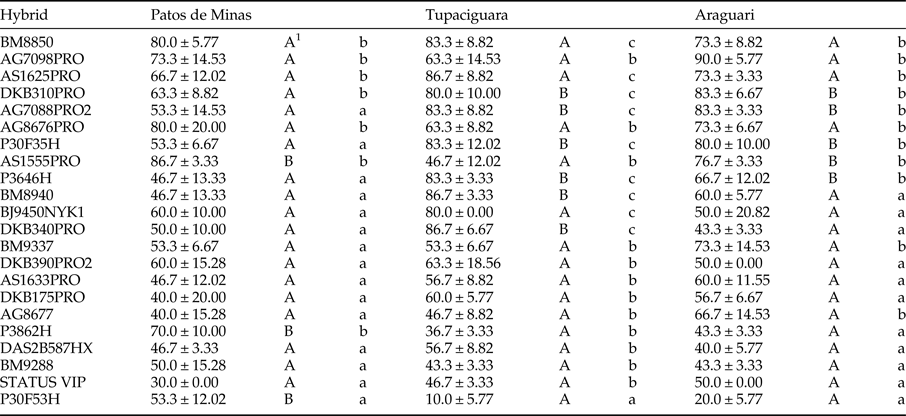
The hybrids BM8850, AS1625PRO, and DKB310PRO had the highest percentage of plants infested by R. maidis in the three localities evaluated, while STATUS VIP, BM9288, DAS2B587HX, DKB175PRO, AS1633PRO, and DKB390PRO2 had the lowest levels of aphid infestation in Patos de Minas and in Araguari, and intermediate level of infestation in Tupaciguara, while P30F53H was the only hybrid that had the lowest rate of aphid infestation at all three localities (table 1).
Percentage of plants (average ± SE) infested with Rhopalosiphum maidis, in 22 field-grown corn hybrids in the counties of Patos de Minas-MG, Tupaciguara-MG, and Araguari-MG, Brazil.

1 Averages followed by different letters, lower case in the columns and capital in the rows, differ from each other by Scott–-Knott's test at 0.05 significance.
Exp. #2: population growth of R. maidis in greenhouse trial
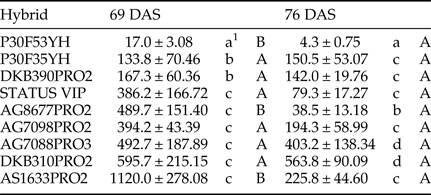
The hybrid P30F53YH had the lowest number of R. maidis per plant at 69 DAS (F 8,71 = 9.585; P ≤ 0.0001) and at 76 DAS (F 8,71 = 13.789; P ≤ 0.0001), demonstrating the greatest constitutive resistance by antibiosis to this pest. Aphids on this hybrid were <50% of the inoculation number by 69 DAS, and only about 12% of initial levels by 76 DAS. In contrast, the hybrids DKB310PRO2 and AG7088PRO3, the most susceptible varieties, had the greatest aphid numbers at both 69 and 76 DAS. Corn aphid numbers increased 17- and 16-fold in DKB310PRO2 and 14- and 11-fold in AG7088PRO3 at 69 and 76 DAS, respectively. The hybrids STATUS VIP3, AG7098PRO2, and AS1633PRO2 were initially susceptible to the aphid; however, at 76 DAS the aphid population on the plants was reduced to levels similar to the hybrids P30F35YH and DKB390PRO2, which presented intermediate resistance, as well as AG8677PRO2, which was susceptible on the first evaluation and intermediate on the second evaluation (table 2).
Number (average ± SE) of Rhopalosiphum maidis per plant, in nine corn hybrids, at 69 and 76 days after sowing (DAS) in pots with aphid inoculation, under greenhouse conditions.

1 Averages followed by different letters, lower case in the columns and capital in the rows, differ from each other by Scott–Knott's and F tests, respectively, both at 0.05 significance.
The number of aphids on most corn hybrids was constant in both evaluations (69 and 76 DAS) (table 2). In contrast, this number decreased at 76 DAS in the hybrids P30F53YH (F 1,71 = 4.523; P = 0.0427), AG8677PRO2 (F 1,71 = 16.999; P = 0.0003), and AS1633PRO2 (F 1,71 = 5.611; P = 0.0253).
The hybrid P30F53H, resistant in all three field locations, remained, in the version YH, the most resistant hybrid in the evaluations of aphid population growth at both time points. The most susceptible hybrid (DKB310PRO) in all three localities, likewise, had the greatest R. maidis population growth in both evaluations, on the version PRO2. Thus, the hybrids P30F53YH and DKB310PRO2 were considered to be the standards for resistance and susceptibility, respectively, and were used in Exp. #3.
Exp. #3: silicon-induced resistance against R. maidis in screenhouse
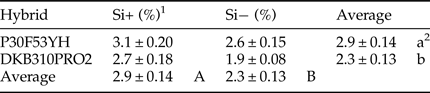
All evaluated genotypes were responsive to soil application of silicon (F 1,35 = 27.738; P = 0.0008), containing higher levels of silicon after soil application of silicate (table 3). Moreover, P30F53YH (the most resistant hybrid) had higher levels of silicon than did DKB310PRO2 (the most susceptible hybrid) (F 1,35 = 10.366; P = 0.0054).
Leaf silicon content (average ± SE) of two corn hybrids, sown in soil with or without silicate amendment, inside a screenhouse.

1 Si+ (%) = leaf silicon content with silicate fertilization; Si– (%) = leaf silicon content without silicate fertilization.
2 Averages followed by different letters, lower case in the columns and capital in the rows, differ from each other by F test at 0.05 significance.
DKB310PRO2 plants manually infested with R. maidis had more aphids per plant than did P30F53YH (F 1,35 = 5.196; P = 0.0367), while there was no effect of silicate addition on the number of aphids in plant whorls (F 1,35 = 0.003; P = 0.9611) (table 4). Rhopalosiphum maidis populations increased 8–12-fold in the susceptible hybrid (DKB310PRO2) and fourfold in the resistant hybrid (P30F53YH), confirming antibiosis as the mechanism of action against aphids in the greenhouse trial (Exp. #2).
Number (average ± SE) of Rhopalosiphum maidis per corn plant at 54 days after sowing (DAS), with manual aphid infestation in two corn hybrids, sown in the soil with or without silicate soil amendment, inside a screenhouse.

1 Si+ = with silicate fertilization; Si− = without silicate fertilization.
2 Averages followed by different letters, lower case in the columns and capital in the rows, differ from each other by F test at 0.05 significance.
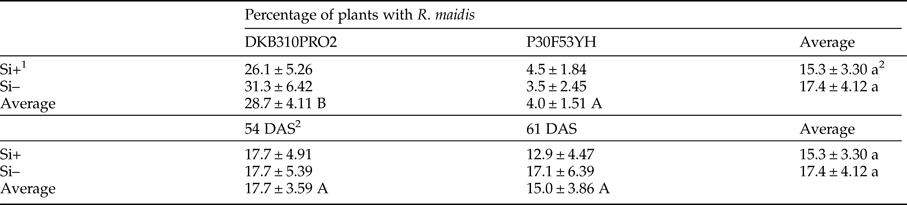
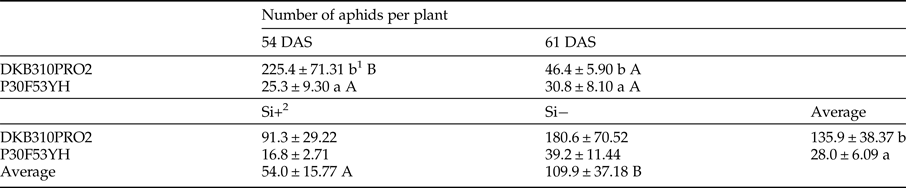
The susceptible hybrid DKB310PRO2 had a higher percentage of plants infested by R. maidis in the natural infestation test than did the resistant hybrid P30F53YH (F 1,71 = 32.264; P ≤ 0.0001); however, there were no significant effects of silicon addition (F 1,71 = 0.034; P = 0.8577) or date of evaluation (F 1,71 = 1.679; P = 0.2043) on the percentage of plants infested with corn aphid (table 5). The hybrid DKB310PRO2 had more aphids per plant under natural infestation than P30F53YH at both time points where aphid numbers were evaluated (54 DAS: F 1,71 = 87.384; P ≤ 0.0001; 61 DAS: F 1,71 = 11.872; P = 0.0012), even with a 79.4% reduction in aphid population on the hybrid DKB310PRO2 at the second time point for aphid density evaluation (table 6). Soil silicon application also reduced the number of aphids on the plants (F 1,71 = 7.431; P = 0.0260) (table 6). The hybrid DKB310PRO2 had greater kernel yield than P30F53YH (F 1,35 = 15.2; P = 0.0013), with no differences in the final plant population (F 1,35 = 0.773; P = 0.3922). Silicate fertilization did not affect kernel yield (F 1,35 = 0.0001; P = 0.9893).
Percentage of plants (average ± SE) naturally infested with Rhopalosiphum maidis at 54 and 61 days after sowing (DAS), in two corn hybrids, sown in the soil with or without silicate soil amendment inside a screenhouse.

1 Si+ = with silicate fertilization; Si− = without silicate fertilization.
2 Averages followed by different letters, lower case in the columns and capital in the rows, differ from each other by F test at 0.05 significance.
Number (average ± SE) of Rhopalosiphum maidis per naturally infested plant, at 54 and 61 days after sowing (DAS), in two corn hybrids, sown in soil with or without silicate soil amendment inside a screenhouse.

1 Averages followed by different letters, lower case in the columns and capital in the rows, differ from each other by the F test at 0.05 significance.
2 Si+ = with silicate fertilization; Si− = without silicate fertilization.
Discussion
Constitutive resistance of corn hybrids against R. maidis
In both field and greenhouse trials, corn hybrids demonstrated different degrees of susceptibility and resistance to R. maidis, with at least one (P30F53YH) showing a high degree of resistance against the corn leaf aphid.
Either of two types of resistance, non-preference and antibiosis, could have been responsible for the differences in aphid populations among the hybrids in the field trials. Non-preference affects plant colonization by winged aphids, which have the ability to cover great distances and are responsible for plant colonization (Blackman, Reference Blackman, Campbell and Eikienbary1990). After the winged aphids reach a host plant, non-winged forms are produced, and large colonies can be formed, since this aphid has high reproductive potential (Blackman & Eastop, Reference Blackman and Eastop2000; Boquel et al., Reference Boquel, Giordanengo and Ameline2011). At this stage, antibiosis can cause colonies to be smaller on resistant plants based on nutritional or plant defense factors. It is impossible to determine in the field if aphid densities on particular hybrids are the result only of non-preference, or of antibiosis, or of both acting together to suppress R. maidis.
In contrast, in the greenhouse experiments when the plants were infested with aphids, resistance by antibiosis clearly was responsible for the formation of smaller colonies of R. maidis on the hybrid P30F53YH than on DKB310PRO2. In Exp. #3, silicon-induced resistance against R. maidis confirmed that both non-preference and antibiosis played a part in aphid resistance in P30F53YH, since a smaller percentage of plants of this hybrid were naturally infested, demonstrating non-preference, and colonies with smaller numbers of aphids were found in natural and manual infestations of R. maidis, demonstrating antibiosis.
According to Smith & Clement (Reference Smith and Clement2012), plant resistance against a given insect should be heritable, and it is desirable that resistance expression be stable under different climate conditions. However, the expression of resistance against R. maidis in corn is greatly affected by environmental factors (Carena & Glogoza, Reference Carena and Glogoza2004). Moreover, there is evidence that the addition of genes conferring resistance against caterpillars increases plant susceptibility to R. maidis (Faria et al., Reference Faria, Wäckers, Pritchard, Barrett and Turlings2007; Ren et al., Reference Ren, Yang, Gao, Pu, Shi, Ye, Shen and Chen2016). Thus, conflicting results between field and greenhouse trials could be expected due to the use of hybrids with the incorporation of resistance genes against caterpillars, or tolerance to glyphosate in the greenhouse trial (Exp. #2). However, both susceptible (DKB310PRO) and resistant (P30F53H) hybrids, at the three locations in the field trial (Exp. #1) showed consistent levels of susceptibility (DKB310PRO2) or resistance (P30F53YH) with those found in the greenhouse trial (Exp. #2).
The plant defense mechanisms that confer greater constitutive resistance against R. maidis involve signaling molecules, such as salicylic and jasmonic acids, which are mediated by proteins and secondary metabolites (Thaler et al., Reference Thaler, Humphrey and Whiteman2012). Known defense metabolites in corn include chlorogenic acid, maysin, and benzoxazinoids (Cortés-Cruz et al., Reference Cortés-Cruz, Snook and McMullen2003; Frey et al., Reference Frey, Schullehner, Dick, Fiesselmann and Gierl2009). Among these materials, the benzoxazinoids are the most extensively studied and are the most specialized class of metabolites that confer resistance against herbivores in grasses (Jonczyk et al., Reference Jonczyk, Schmidt, Osterrieder, Fiesselmann, Schullehner, Haslbeck, Sicker, Hofmann, Yalpani and Simmons2008). One of the dominant benzoxazinoids in corn leaf tissue is 4-dihydroxy-7-methoxy-1,4-benzoxazin-3-one glucoside (DIMBOA-Glc) (Frey et al., Reference Frey, Schullehner, Dick, Fiesselmann and Gierl2009), which is secreted in the apoplast during aphid infestations (Ahmad et al., Reference Ahmad, Veyrat, Gordon-Weeks, Zhang, Martin, Smart, Glauser, Erb, Flors, Frey and Ton2011) and can regulate defense mechanisms against insect feeding (Meihls et al., Reference Meihls, Handrick, Glauser, Barbier, Kaur, Haribal, Lipka, Gershenzon, Erb, Kollner and Jander2013; Betsiashvili et al., Reference Betsiashvili, Ahern and Jander2015), halting their growth and causing allelopathic effects (Niemeyer, Reference Niemeyer2009; Ahmad et al., Reference Ahmad, Veyrat, Gordon-Weeks, Zhang, Martin, Smart, Glauser, Erb, Flors, Frey and Ton2011). Future studies can use our results to determine the substances involved in the resistance of P30F53YH against R. maidis.
Silicon-induced resistance against R. maidis in screenhouse
Although we found no evidence of reduction in populations of R. maidis as a function of silicate soil applications in Exp. #3 for those plants where hybrid corn varieties were manually infested with corn aphids, the plants in Exp. #3 that were naturally infested (by alate aphids from the rearing colony), and that were also in soil amended with silicate, did support fewer R. maidis. The number of aphids per plant was smaller in plants with silicate soil amendment, in both the susceptible and in the resistant hybrids.
Similar to what was observed in the field, the evaluation of natural infestation by R. maidis did not discriminate the effects of resistance by non-preference from those of antibiosis. Plants whose infestations began only due to colonization by winged aphids, from the colony being reared inside the screened area, were affected by differences in non-preference between control and treated plants. Silicon soil amendment induction of non-preference in grasses against aphids has been observed under laboratory conditions in other studies (Carvalho et al., Reference Carvalho, Moraes and Carvalho1999; Moraes et al., Reference Moraes, Goussain, Carvalho and Costa2005; Dias et al., Reference Dias, Sampaio, Rodrigues, Korndörfer, Oliveira, Ferreira and Korndörfer2014; Almeida et al., Reference Almeida, Silva, Jesus, Nogueira, Souza Neto and Cunha2015), but extrapolating such laboratory results to field conditions is possible only in a limited way due to possible effects unique to their experimental conditions. For instance, laboratory studies were conducted with potted plants, or using detached leaves or cages (Moraes et al., Reference Moraes, Goussain, Carvalho and Costa2005; Dias et al., Reference Dias, Sampaio, Rodrigues, Korndörfer, Oliveira, Ferreira and Korndörfer2014; Almeida et al., Reference Almeida, Silva, Jesus, Nogueira, Souza Neto and Cunha2015), and some studies used only non-winged aphids (Carvalho et al., Reference Carvalho, Moraes and Carvalho1999; Moraes et al., Reference Moraes, Goussain, Carvalho and Costa2005; Almeida et al., Reference Almeida, Silva, Jesus, Nogueira, Souza Neto and Cunha2015), which would have no effect on host plant selection in the field, due to the limited mobility in comparison with the winged forms (Blackman, Reference Blackman, Campbell and Eikienbary1990). Since inside the screenhouse in our study (Exp. #3) the winged aphids had to fly a relatively long distance (about 36 m) to colonize corn plants and were not confined by a cage, the reduction in aphids on plants on silicon-amended soil could have been caused by non-preference in conditions closer to field conditions.
When naturally infested corn plants were evaluated for R. maidis infestation, mostly non-winged forms were found, which were descendants of the winged forms that started the infestation. Thus, any reductions in aphid numbers on plants growing in soil amended with silicon could have been caused by antibiosis. Several studies have confirmed the negative effect of silicon on the biology of aphids in grasses, such as sorghum and wheat, with the reduction of aphid fertility and survival and, consequently, a reduction in insect population growth on plants on silicon-amended soil (Carvalho et al., Reference Carvalho, Moraes and Carvalho1999; Basagli et al., Reference Basagli, Moraes, Carvalho, Ecole and Gonçalves-Gervásio2003; Moraes et al., Reference Moraes, Goussain, Basagli, Carvalho, Carvalho and Sampaio2004; Gomes et al., Reference Gomes, Moraes, Santos and Goussain2005; Costa et al., Reference Costa, Moraes and Antunes2007; Dias et al., Reference Dias, Sampaio, Rodrigues, Korndörfer, Oliveira, Ferreira and Korndörfer2014). Silicon can confer resistance against insects by forming a physical barrier by its deposition on tissue cell walls (Dayanandam et al., Reference Dayanandam, Kaufman and Frakin1983; Epstein, Reference Epstein1994; Barbosa Filho et al., Reference Barbosa Filho, Snyder, Prabhu, Datnoff and Korndörfer2000), by injuring the midgut of insects (Jeer et al., Reference Jeer, Telugu, Voleti and Padmakumari2017), as well as by inducing the production and activation of plant defense compounds (Fawer et al., Reference Fawer, Abou-Zaid, Menzies and Bélanger1998; Gomes et al., Reference Gomes, Moraes, Santos and Goussain2005; Gomes et al., Reference Gomes, Moraes, Santos and Antunes2008; Han et al., Reference Han, Li, Gong, Yang, Wen and Hou2016; Yang et al., Reference Yang, Han, Li, Li, Ali and Hou2017).
Studies indicate that there is a relation between a plant's ability to absorb silicon and constitutive resistance based on silicon, in which the most resistant plants absorb more silicon than do susceptible plants, conferring on such plants greater resistance to insect attack (Reynolds et al., Reference Reynolds, Keeping and Meyer2009, Reference Reynolds, Padula, Zeng and Gurr2016; Korndörfer et al., Reference Korndörfer, Grisoto and Vendramim2011). This study found that the hybrid P30F53YH, which was the most resistant against R. maidis, had greater silicon concentration than the susceptible hybrid (DKB310PRO2), regardless of soil silicon amendment. Our results, therefore, concur with other studies that demonstrated the ability of absorbing silicon to be a characteristic of plants with greater resistance against insects (Reynolds et al., Reference Reynolds, Keeping and Meyer2009).
Conclusions
Corn hybrids tested had different levels of constitutive resistance against R. maidis. In the field, it was not possible to discriminate the effects of antibiosis and non-preference, and the hybrids BM8850, AS1625PRO, and DKB310PRO were deemed susceptible to R. maidis, while P30F53H, STATUS VIP, BM9288, DAS2B587HX, DKB175PRO, AS1633PRO, and DKB390PRO2 were categorized as resistant to the aphid. The evaluation of antibiosis, measured as effects on aphid population growth, demonstrated that the hybrids AG7088PRO3 and DKB310PRO2 were susceptible, while P30F53YH was resistant to R. maidis due to antibiosis.
When natural aphid infestation was evaluated, wherein the effects of antibiosis and non-preference could not be discriminated, soil applications of silicon-induced resistance in corn plants against R. maidis, regardless of the degree of constitutive resistance of the hybrid, and the hybrid with the greatest leaf Si concentration had the smallest population of R. maidis, regardless of soil amendment silicon.
Acknowledgements
The authors thank the National Council of Scientific and Technological Development (CNPq), the Coordination of Improvement of Higher Education Personnel (CAPES) and the São Paulo Research Foundation (FAPESP) for the financial support to the INCT-HYMPAR, and Agronelli Insumos Agrícolas, Ercal Calcário, and Monsanto do Brasil Ltda for providing support to develop this research.