

%20--%3e%3c!DOCTYPE%20svg%20PUBLIC%20'-//W3C//DTD%20SVG%201.0//EN'%20'http://www.w3.org/TR/2001/REC-SVG-20010904/DTD/svg10.dtd'%3e%3csvg%20version='1.0'%20id='Layer_1'%20xmlns='http://www.w3.org/2000/svg'%20xmlns:xlink='http://www.w3.org/1999/xlink'%20x='0px'%20y='0px'%20width='64px'%20height='64px'%20viewBox='5.5%20-3.5%2064%2064'%20enable-background='new%205.5%20-3.5%2064%2064'%20xml:space='preserve'%3e%3cg%3e%3ccircle%20fill='%23FFFFFF'%20fill-opacity='0'%20cx='37.785'%20cy='28.501'%20r='28.836'/%3e%3cpath%20fill='%23595959'%20d='M37.441-3.5c8.951,0,16.572,3.125,22.857,9.372c3.008,3.009,5.295,6.448,6.857,10.314%20c1.561,3.867,2.344,7.971,2.344,12.314c0,4.381-0.773,8.486-2.314,12.313c-1.543,3.828-3.82,7.21-6.828,10.143%20c-3.123,3.085-6.666,5.448-10.629,7.086c-3.961,1.638-8.057,2.457-12.285,2.457s-8.276-0.808-12.143-2.429%20c-3.866-1.618-7.333-3.961-10.4-7.027c-3.067-3.066-5.4-6.524-7-10.372S5.5,32.767,5.5,28.5c0-4.229,0.809-8.295,2.428-12.2%20c1.619-3.905,3.972-7.4,7.057-10.486C21.08-0.394,28.565-3.5,37.441-3.5z%20M37.557,2.272c-7.314,0-13.467,2.553-18.458,7.657%20c-2.515,2.553-4.448,5.419-5.8,8.6c-1.354,3.181-2.029,6.505-2.029,9.972c0,3.429,0.675,6.734,2.029,9.913%20c1.353,3.183,3.285,6.021,5.8,8.516c2.514,2.496,5.351,4.399,8.515,5.715c3.161,1.314,6.476,1.971,9.943,1.971%20c3.428,0,6.75-0.665,9.973-1.999c3.219-1.335,6.121-3.257,8.713-5.771c4.99-4.876,7.484-10.99,7.484-18.344%20c0-3.543-0.648-6.895-1.943-10.057c-1.293-3.162-3.18-5.98-5.654-8.458C50.984,4.844,44.795,2.272,37.557,2.272z%20M37.156,23.187%20l-4.287,2.229c-0.458-0.951-1.019-1.619-1.685-2c-0.667-0.38-1.286-0.571-1.858-0.571c-2.856,0-4.286,1.885-4.286,5.657%20c0,1.714,0.362,3.084,1.085,4.113c0.724,1.029,1.791,1.544,3.201,1.544c1.867,0,3.181-0.915,3.944-2.743l3.942,2%20c-0.838,1.563-2,2.791-3.486,3.686c-1.484,0.896-3.123,1.343-4.914,1.343c-2.857,0-5.163-0.875-6.915-2.629%20c-1.752-1.752-2.628-4.19-2.628-7.313c0-3.048,0.886-5.466,2.657-7.257c1.771-1.79,4.009-2.686,6.715-2.686%20C32.604,18.558,35.441,20.101,37.156,23.187z%20M55.613,23.187l-4.229,2.229c-0.457-0.951-1.02-1.619-1.686-2%20c-0.668-0.38-1.307-0.571-1.914-0.571c-2.857,0-4.287,1.885-4.287,5.657c0,1.714,0.363,3.084,1.086,4.113%20c0.723,1.029,1.789,1.544,3.201,1.544c1.865,0,3.18-0.915,3.941-2.743l4,2c-0.875,1.563-2.057,2.791-3.541,3.686%20c-1.486,0.896-3.105,1.343-4.857,1.343c-2.896,0-5.209-0.875-6.941-2.629c-1.736-1.752-2.602-4.19-2.602-7.313%20c0-3.048,0.885-5.466,2.658-7.257c1.77-1.79,4.008-2.686,6.713-2.686C51.117,18.558,53.938,20.101,55.613,23.187z'/%3e%3c/g%3e%3c/svg%3e)
%20--%3e%3c!DOCTYPE%20svg%20PUBLIC%20'-//W3C//DTD%20SVG%201.0//EN'%20'http://www.w3.org/TR/2001/REC-SVG-20010904/DTD/svg10.dtd'%3e%3csvg%20version='1.0'%20id='Layer_1'%20xmlns='http://www.w3.org/2000/svg'%20xmlns:xlink='http://www.w3.org/1999/xlink'%20x='0px'%20y='0px'%20width='64px'%20height='64px'%20viewBox='5.5%20-3.5%2064%2064'%20enable-background='new%205.5%20-3.5%2064%2064'%20xml:space='preserve'%3e%3cg%3e%3ccircle%20fill='%23FFFFFF'%20fill-opacity='0'%20cx='37.637'%20cy='28.806'%20r='28.276'/%3e%3cg%3e%3cpath%20fill='%23595959'%20d='M37.443-3.5c8.988,0,16.57,3.085,22.742,9.257C66.393,11.967,69.5,19.548,69.5,28.5c0,8.991-3.049,16.476-9.145,22.456%20C53.879,57.319,46.242,60.5,37.443,60.5c-8.649,0-16.153-3.144-22.514-9.43C8.644,44.784,5.5,37.262,5.5,28.5%20c0-8.761,3.144-16.342,9.429-22.742C21.101-0.415,28.604-3.5,37.443-3.5z%20M37.557,2.272c-7.276,0-13.428,2.553-18.457,7.657%20c-5.22,5.334-7.829,11.525-7.829,18.572c0,7.086,2.59,13.22,7.77,18.398c5.181,5.182,11.352,7.771,18.514,7.771%20c7.123,0,13.334-2.607,18.629-7.828c5.029-4.838,7.543-10.952,7.543-18.343c0-7.276-2.553-13.465-7.656-18.571%20C50.967,4.824,44.795,2.272,37.557,2.272z%20M46.129,20.557v13.085h-3.656v15.542h-9.944V33.643h-3.656V20.557%20c0-0.572,0.2-1.057,0.599-1.457c0.401-0.399,0.887-0.6,1.457-0.6h13.144c0.533,0,1.01,0.2,1.428,0.6%20C45.918,19.5,46.129,19.986,46.129,20.557z%20M33.042,12.329c0-3.008,1.485-4.514,4.458-4.514s4.457,1.504,4.457,4.514%20c0,2.971-1.486,4.457-4.457,4.457S33.042,15.3,33.042,12.329z'/%3e%3c/g%3e%3c/g%3e%3c/svg%3e)
Despite its title, La nueva novela (The new novel) is unlikely to be considered a novel. The strange book was first assembled in 1971 by Chilean poet Juan Luis Martínez. Though called poetry, its diverse contents are likely to situate it even at the edges of that genre. Martínez himself, growing up in Valparaíso and moving later to Viña del Mar, likewise, strictly speaking, did not occupy a central place in the geography of twentieth-century Chilean poetry. And in its early years, La nueva novela struggled to reach an audience. Martínez sought its publication with the University of Valparaíso press, but, having been rejected, it was not until 1977’s self-publication of five hundred copies, and later, 1985’s one-thousand-copy facsimile edition, that the book began to generate more widespread attention. During these years, as Scott Weintraub (Reference Weintraub2015, 1) notes, La nueva novela “would circulate in a clandestine manner in literary circles and cafés in Santiago, Valparaíso, and Viña del Mar.” Although less well known now than his former brother-in-law Raúl Zurita, for example, Martínez has been considered an important figure for Chile’s “neovanguardia,”Footnote 1 and his influence at home and among successive generations of poets and artists is indisputable. But the book, and the poet, have occupied a relatively marginal position in the rest of the world until very recently. This is in part a deliberate strategy and in part due to the nature of Martínez’s work. He published only two collections of poetry during his lifetime, both of which radically upend expectations of what poetry—even experimental poetry—is, does, and is made of. Of these two collections, La nueva novela is better known but is also a deliberately confusing, often nonsensical material object that, even for its most intimate readers, is very hard to know at all.Footnote 2 Martínez the poet is equally unconventional. An autodidact who left formal schooling behind as a “rebellious, car-stealing, motorcycle racing” (and crashing) adolescent (Reference WeintraubWeintraub 2015, 2), Martínez’s rigorous engagement with philosophy, mathematics, poetry, and art took shape outside of institutional settings and at the margins of more cohesive artistic movements taking place in Chile at the time.
Despite his status as a cult figure, his poetic output worked constantly to displace the cult of authorship. In the case of La nueva novela, in place of any kind of authorial “I” is a series of material components including drawings, cartoons, math problems, paradoxes, photographs, other people’s poems, homework assignments, and, in one case, actual fishhooks taped to the page, among many other things. Each of these components “constitutes a poem; but at the same time they are all fragments of the whole which is the book itself” (Reference MartínezMartínez 2016).Footnote 3 There is no value difference between these fragments, and the more readily recognizable poetry within the book is as much poetry as any of the book’s other parts, as Figure 1 suggests.
Martínez and Martínez Reference Martínez and Martínez1985, 48. All illustrations reproduced by permission from Alita Martínez and the Fundación Juan Luis Martínez.
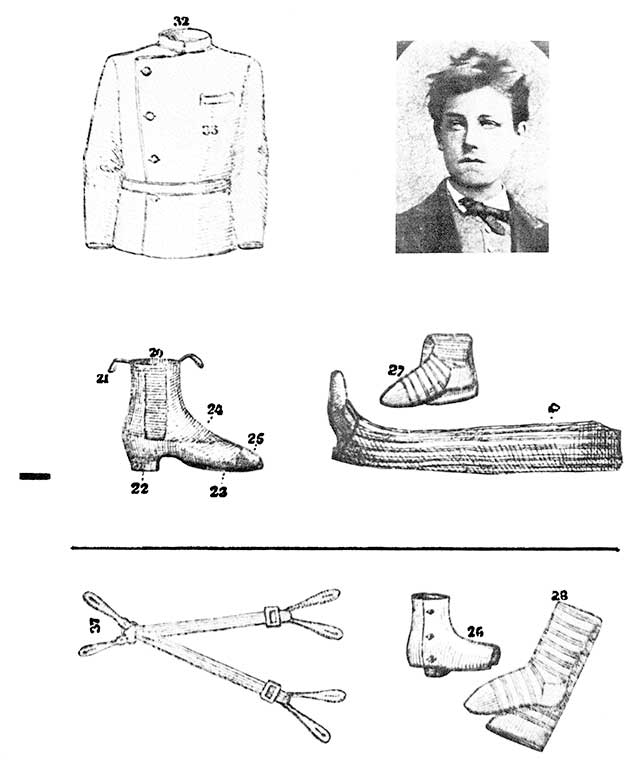
There, the equation of apparently unequal parts is staged literally and visually. This is just one of several appearances of Étienne Carjat’s famous 1871 photograph of Arthur Rimbaud, which circulates with and alongside a well-known 1875 photograph of Karl Marx by John Jabez Mayall throughout La nueva novela. Though equations like this one, which make up section 3 of the book, “Tareas de aritmética” (Arithmetic homework),Footnote 4 do not clearly make sense, they are, like much of the book, made of sensible material.
Together, La nueva novela’s components constitute what I will call a material poetics of relation, and this requires first of all accepting that the apparently non- and extra-poetic elements of La nueva novela are poetry. In part, my acceptance follows from Martínez’s suggestion that they are poetry, but it also grows from well-established multimedia poetic practices in Chile which include such examples as Vicente Huidobro’s visual poems, at the beginning of the twentieth century,Footnote 5 and the work of Cecilia Vicuña today.Footnote 6 In Chile, poets have long incorporated material practices into their poetry; understanding these material practices is important for understanding poetics within that context, and, for the purposes of this study, the poetry assembled by Juan Luis Martínez.
As a material poetics of relation, this concept intersects with relation as it has already been theorized by Martinican poet and theorist Édouard Glissant. In his book The Poetics of Relation, Glissant makes use of Gilles Deleuze and Félix Guattari’s theory of the rhizome to rethink, among other hierarchies, the problem of center and periphery. As an alternative, Glissant’s poetics of relation “make every periphery into a center,” prizing errantry over rootedness, and proposing “unities whose interdependent variances jointly piece together the interactive totality” (Reference GlissantGlissant 2010, 29, 93). As a political poetics, this would level what Pascale Casanova (Reference Casanova and DeBevoise2004, 83) calls “the opposition between the great national literary spaces, which are also the oldest—and, accordingly, the best endowed—and those literary spaces that have more recently appeared and that are poor by comparison.” In a world poetics of relation, the artistic output of former colonies and other so-called peripheries would instead come to hold a position equal in value to that of the “centers” because, in the rhizome, there is no center. This idea is important to this essay in that its center is a book constructed in the margins of what might usually count as poetry, outside of what Casanova deems “the great national literary spaces.” But for the most part I will engage with Glissant’s poetics of relation from a literal and material perspective.
In other words, if the Poetics of Relation has been read primarily as a politics of relation, this study is interested primarily in its poetics. It is interested in what a de-centering poetics of relation looks like inside a single, if ambitious, book of poetry. The materialism of this essay, too, is literal. Here, “materialism” is not a placeholder for a politics but more akin to the so-called new ways this word is in use today.Footnote 7 In this discussion, “material” refers to La nueva novela and the parts it is made from—its language, its ink, its images, its paper, and so on. Further, this essay will bring together Glissant’s theorization of relation with Manuel DeLanda’s elaboration of assemblage theory, both of which extend from Deleuze and Guattari’s work with the rhizome, in order to consider how La nueva novela materially constructs relation as a poetics. In this, it will show how this book-object creates a staging ground for the ways its parts make and are made as sense, and the ways they do or do not belong to, or in, the book at all.
That is not to say there is no politics in La nueva novela. There is. Importantly, the book was initially assembled just before the golpe de estado that established Pinochet’s military dictatorship in 1973. It later appeared in its published forms during the dictatorship, and among its many components are politically suggestive and referential words, images, and things. The final section of the book, “Epígrafe para un libro condenado: La política” (Epigraph for a condemned book: Politics), is partially obscured by a fragile paper Chilean flag and is the most straightforwardly political of the book’s sections. The first part of this section’s title is also the title of the Spanish translation of Charles Baudelaire’s poem “Épigraphe pour un livre condamné,” which was planned for the second edition of Les fleurs du mal after portions of the first were condemned for obscenity. Likewise, this section includes a copy of Ezra Pound’s letter to the censors during his internment in Pisa. Also, Marx’s and Rimbaud’s portraits appear pasted into a wanted poster. All these factors suggest a relation between radical politics and poetics and point to the difficulty Martínez had in finding a publisher for the book during the repressive regime.
The many non-Chilean political actors that appear in the book can be read as ways of avoiding directly antagonizing this regime, as scholars have pointed out. Jesús Sepúlveda (Reference Sepúlveda2016, 121) writes that “Martínez finds his way to euphemistically address political issues censored at the time in Chile through an image of Hitler as representation of Pinochet and the notion of nonexistence as a reference to the detained-disappeared.” Weintraub (Reference Weintraub2015, 1) describes how Chilean presses at the time showed a “stifling reticence” to publishing the work which was apt to be negatively received by censors and critics alike. The likelihood of a negative reception can be pinned as much to politics as to the book’s absolute oddness and suggestive volatility, which together ensure that the book would have been sufficiently suspicious even though, while certainly open to allegory, the book simultaneously frustrates efforts to read it in terms of a direct stance-taking—political or otherwise. Marx’s portrait, for example, appears five times but always in different contexts and outside of a context that might be called “his,” always positioned in relation to other visual or textual materials that don’t seem to belong together.
The book is politically meaningful, but the kind of meaning to be found, like much of the meaning in La nueva novela, is suggestive rather than directive, often paradoxical, and extremely open to interpretation. Glissant (Reference Glissant2010, 32) writes that a poetics of relation “remains forever conjectural and presupposes no ideological stability,” and this is true of La nueva novela, in that its political and ideological engagements, while frequent, are hard to pin down. Within the book, images and references to politics constantly move, reappear, and recontextualize themselves, and these references are always open to not making sense. There is also so much more that cannot be subsumed under political relation alone. My aim is to attempt to account for how all the book’s distinct, unstable components constitute and set in motion a material poetics of relation. Among these relations are political ones but also many other kinds, and this essay will not subject La nueva novela to a purely allegorical reading in which these other confusing and apparently illogical parts come to be chaotically representative of the “context of social and political instability in Chile” (Reference KirkpatrickKirkpatrick 1999, 227). As Gwen Kirkpatrick points out, this book is not that simple, and it “covers themes that are philosophical as well as literary and political” (Reference Kirkpatrick1999, 227). What’s more, the book resists any absolute rootedness and proposes in its place a rhizomatic horizontality where there is no hierarchy between these various “themes.” Thus this study intends to let the book be what it seems to be: a strange assemblage of mismatched materials that do not communicate a unified message and often do not appear to belong together, or in a book of poetry.
That question of belonging extends to what might usually be called the author or the poet—the subject from which the poetic utterance could be said to have sprung. La nueva novela doesn’t have an author of this sort, but “is made of variously formed matters” (Reference Deleuze, Guattari and MassumiDeleuze and Guattari 1987, 3). I take pains in this essay to avoid saying “Juan Luis Martínez’s La nueva novela” as a way of resisting, with the book, its belonging to a single author, something the book calls into question before it is even opened. On its cover, the title appears, along with the author’s name twice repeated, crossed out, and set inside parentheses as (Juan Luis Martínez) and (Juan de Dios Martínez).Footnote 8 Already doubled, the “de Dios” (of God) in the second name hints at a God who, in the Catholic tradition, is a thrice split subject. And the book is full of other authors and their work, along with authors who appear not in the subject position as unified authorial “I”s, but as the subjects of other texts.
For example, preceding the table of contents are two dedications “encontradas por (el autor) en un ejemplar del libro de Miguel Serrano: ‘Antología del verdadero cuento en Chile’” (that were found by [the author] in an edition of the book by Miguel Serrano: “Antología del verdadero cuento en Chile”) (unpaginated preface). Then, there appear what are made to look like two order forms inviting the reader to request by mail Rimbaud Cyclists and Was Marx a Satanist? by Rev. Richard Wurmbrand ( Figure 2).Footnote 9 Though the latter sounds the more improbable (or maybe it doesn’t), Was Marx a Satanist? is available today in English, German, or Russian. Each sales slip contains a portrait of the book’s subject beneath the Nietzsche-referencing heading, “El eterno retorno” (The eternal return). This heading previews the at least occasional return of these two images throughout the rest of the book. They appear, for example, as the heads on the bodies of Superman (Marx) and a naked, Lois Lane–style damsel (Rimbaud). Or in a wanted poster advertising a $2,000 reward. Or as components of math problems. In their first appearance, before the book even officially claims to begin, they are the subjects of other books. Before arriving at the table of contents, this book works to establish itself not as a singular creation that belongs to a single authorial subject, but as “a system of references that operate permanently in every direction” (Reference MartínezMartínez 2016).
Order forms (Reference Martínez and MartínezMartínez and Martínez 1985, unpaginated preface).

To “read” La nueva novela is to engage with a labyrinthine library of other books, ideas, objects, images, and so forth that aren’t necessarily La nueva novela’s alone. Though bound together as this book, its parts work equally to unbind it, to point out toward other things, people, and places. The same might be said for any book which, made of language, is only ever a holding place for a series of word-parts it has gathered into a whole, but La nueva novela makes this fact manifest, and in more than just language. It may be a system of references, but these references are not just alluded to; they are made by and with materials borrowed from all kinds of things. The famous portraits of Rimbaud and Marx, for example, are images that have circulated through lots of other compositions. Also included in the book are constructions of clippings from newspapers and other preprinted materials. And the fishhooks that are taped to page 75 are really there and may have been tied to the end of a line and stuck through a fish’s lip before composing part of what is titled “Icthys” ( Figure 3). That these things are all copies, including the fishhooks, is only an extension of La nueva novela’s already confused borders.
“Icthys” (Reference Martínez and MartínezMartínez and Martínez 1985, 75, detail).

As Zenaida Suárez (Reference Suárez2013, 88) points out about La nueva novela and La poesía chilena, “all of the objects [inside the books] possess a specific function outside of the system that we call ‘the poetic works of Juan Luis Martínez.’” For Suárez, the objects that appear in La nueva novela are “the Chinese calligram, the blank page, the parchment paper, the transparency, and the fishhooks” and can be separated into “invulnerable” and “vulnerable” categories (88). Objects belonging to these categories either do or do not, according to Suárez, “maintain, even after being introduced into [the book’s] system, the mark of their primary objectual domain” (88). She would categorize the fishhooks, for example, as invulnerable, and the transparency (a clear piece of plastic that acts like a window through pages 41 and 42) as vulnerable. For me, these five objects do not exhaust the potential “vulnerabilities” of La nueva novela’s parts. Like the found dedications that open the book, or Marx and Rimbaud’s portraits, or the references that appear on almost every page to other authors, other books, theorists, artists, and so on, essentially all of La nueva novela is assembled from parts that, as Manuel DeLanda (Reference DeLanda2006, 10) writes about the assemblage, “may be detached from it and plugged into a different assemblage in which [their] interactions are different.”
These are what DeLanda, after Deleuze and Guattari, refers to as “relations of exteriority” and what characterize an assemblage. Though, for DeLanda, assemblage theory is much bigger than the book, for Deleuze and Guattari, the book grounds the theory. As they write: “In a book, as in all things, there are lines of articulation or segmentarity, strata and territories; but also lines of flight, movements of deterritorialization and destratification. Comparative rates of flow on these lines produce phenomena of relative slowness and viscosity, or, on the contrary, of acceleration and rupture. All this, lines and measurable speeds, constitutes an assemblage. A book is an assemblage of this kind, and as such is unattributable. It is a multiplicity” (Reference Deleuze, Guattari and MassumiDeleuze and Guattari 1987, 3–4).
To be a multiplicity, the book can’t belong to a single author. This is an important goal of Martínez’s poetics broadly speaking, and of La nueva novela in particular, and is something the poet and Guattari discussed when they met at Martínez’s house in 1991. During this conversation, included in the posthumously published Poemas del otro, Guattari tells Martínez, “I don’t speak of ‘I’ but rather of existential territories that integrate the I” (Reference MartínezMartínez 2003, 84). This position stakes out a theory that would disperse authorship, in general, but for Martínez, dissolving the “I” is a poetic project. As he tells Guattari in their conversation, “my primary interest is the absolute dissolution of authorship, anonymity, and the ideal, if that word can be used, is to make a work in which almost no line belongs to me, a long work articulated by many fragments” (Reference MartínezMartínez 2003, 82). As a value shared by the poetics of relation, this notion also recalls Glissant’s claim that the author “is done away with, to be revealed in the texture of his creation” (Reference GlissantGlissant 2010, 25).
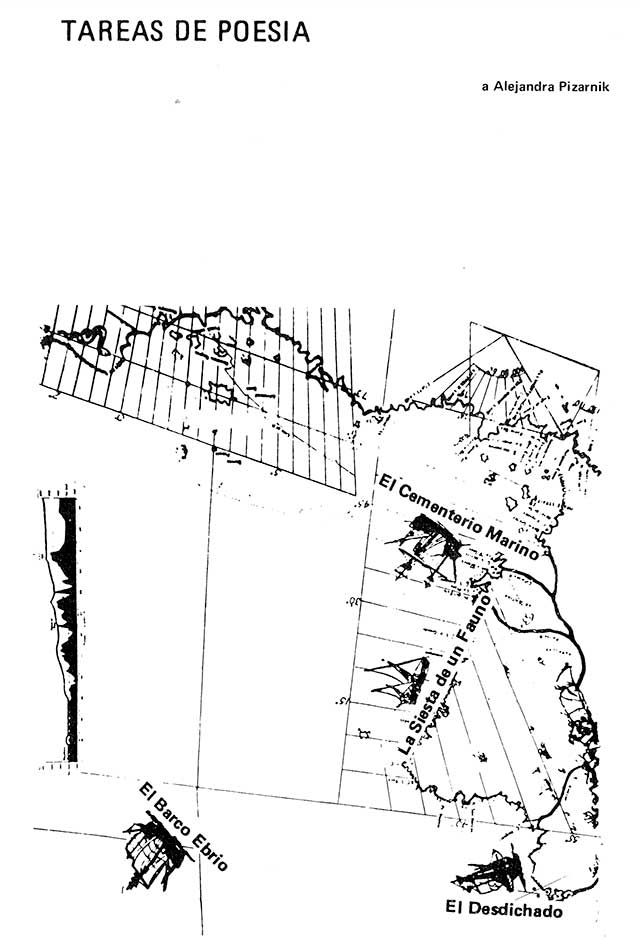
But though the stakes of this process are at play in La nueva novela, the crossing out and doubling of the author’s name on the book’s title is not merely a game, and the apparent absurdities that abound within the book’s binding are not just paradoxical jokes but ways of achieving the “deterritorialization” that Deleuze and Guattari describe. For Martínez, as Figure 4 shows, this is the task of poetry.
“Tareas de poesía” (“Poetry homework” or “Tasks of poetry”) (Reference Martínez and MartínezMartínez and Martínez 1985, 26).
La nueva novela is an assemblage, one which puts into practice a material poetics of relation, undermines single-authorship, and reveals in its stead the book’s construction in, and as, parts that bind and unbind it. These parts extend, in DeLanda’s terms, from “a purely material role at one extreme of the axis, to a purely expressive role at the other extreme” (Reference DeLandaDeLanda 2006, 12, original emphasis). I will call these poles the sensible and the sensical. And though an emphasis on a human’s ability to “sense” this book leads toward a reconstitution of the subject, I wish to distinguish between the authorial subject and reading subjects. Though La nueva novela works to dissolve the authorial subject, its reading subjects are already dispersed, as the numerous dedications—to Roger Caillois, Pablo Neruda, Yoko Ono, Maurice Blanchot, and many more—that appear throughout the book demonstrate. The human does not vanish because the book is, as Deleuze and Guattari (187, 3–4) call it, “unattributable,” but it is, rather, also multiple. La nueva novela doesn’t have a reader. It has readers.
Describing these poles as sensible and sensical does not mean that the two have no overlap. As DeLanda (Reference DeLanda2006, 12) indicates, these are not distinct categories but ends of a spectrum on which “a given component may play a mixture of material and expressive roles.” This is, in fact, almost always the case with the components composing La nueva novela, which is not only full of expressive (and material) language but, as Suárez (Reference Suárez2013, 88) writes, “promotes a kind of extremely complex coding where objects that already have a meaning and function outside of [the work] come to have their meaningful and functional possibilities multiplied, and operate within the work like interpretable texts in the literary context to which they are attached.”
But, though I agree with Suárez that the more material objects (like the fishhook and transparency) can be read for meaning within the text, the material cannot simply be subsumed under the meaningful in La nueva novela. And it should be reiterated that the sensible and sensical are poles between which the book constructs itself. Because just as the objects that might be more readily identified as sensible can be interpreted meaningfully, the more apparently meaningful portion of the book—the text—is constantly calling into question its ability, in any straightforward manner, to make sense.
The Sensible
The question of sense-making will return, but first I would like to attempt to describe the book as a sensible object and temporarily resist, as much as possible, reading it. This is a challenging proposition. On the one hand, there is the problem, as Stephen Best and Sharon Marcus point out in their introduction to “surface reading,” of “whether we can ever set aside our responses in order to produce undistorted accounts of things” (Reference Best and MarcusBest and Marcus 2009, 18). We cannot. But, it is worthwhile to attempt anyway, and especially so in the case of La nueva novela. The reasoning for this claim is bound up in another of the book’s particular challenges to its being described as a sensible object: it is incredibly complex. Weintraub (Reference Weintraub2015, 35) criticizes the “overwhelming tendency in Martínez studies towards the proliferation of the kind of summative laundry lists—and extensive, unanalyzed citations (often of unattributed citations!)—that tend to dominate critical work on Juan Luis Martínez’s poetry.” While this essay will contribute another of these lists, I would claim that this tendency is not critical laziness in the face of a hermetic and challenging text, but a particular kind of reading that is demanded by La nueva novela itself—one that doesn’t disregard a hermeneutic approach, but also requires a mode of surface reading, akin to the kinds Best and Marcus discuss. Besides, to read the book for meaning, which will follow in the next section, readers are first owed the chance to familiarize themselves with the book as a whole. More than for other books, this is needed in La nueva novela’s case. Its extreme complexity makes description urgent. (It also makes exhaustive description impossible.)
Because its complex contents do not really belong together in any way other than the fact of their belonging together in the book, it is also not easy to summarize them. The only account of the book which might be considered “undistorted” would end up looking like the unwieldy map in Borges’s “On Exactitude in Science” in which “the Cartographers Guilds struck a Map of the Empire whose size was that of the Empire, and which coincided point for point with it” (Reference BorgesBorges 1999, 325). With this in mind, it would be productive, for example, to offer an account of some of the images in the book. But if a picture is worth a thousand words, how many are readers willing to read? And if, as a shortcut, some of these images are reproduced here, has this essay left the domain of description and begun to create a partial “Map of the Empire”? Also, if the book is a sensible object, which of its sensible aspects should be mentioned? A mapmaker can indicate a forest without drawing every tree, but, in the case of La nueva novela, the forest is not trees. It is hundreds of dissimilar pieces without a taxonomic relation.
I will leave all those hesitations on the table but will work to offer an account of the book-object anyway. To begin simply, La nueva novela is approximately 27 × 19 × 1.5 cm. It is printed entirely in black ink and has 147 pages, not counting the colophon or the final blank page before the back binding. As the colophon notes, it was initially a single original, and transformed later in a “very limited edition,” something which, for Oscar Sarmiento, “suggests that it effectively insists on its presence as a dissonant object” (Reference SarmientoSarmiento 2010, 158). It should be added that this dissonance is not just against a background of other objects and books but is also a good way of describing the clash of La nueva novela’s contents. This begins on the book’s cover, where, in addition to the two crossed-out, parenthetical names there is a black and white, overexposed photographic image of houses that appear to be tumbling into one another ( Figure 5).
La nueva novela, cover (Reference Martínez and MartínezMartínez and Martínez 1985).

The back cover is a graph-paper-like grid with instructions that read: “Dibuje el contorno de cada cuarto incluyendo puertas y ventanas. Marque dos rutas de escape para cada miembro de su familia. Cada cuadradito equivale 2 cm.2” (Draw the contour of every square, including doors and windows. Mark two escape routes for every member of your family. Each little square equals 2 cm.2)Footnote 10 The table of contents separates the book into seven sections plus two extra: “I: Respuestas a problemas de Jean Tardieu,” “II: Cinco problemas para Jean Tardieu,” “III: Tareas de aritmética,” “IV: El espacio y el tiempo,” “V: La zoología, VI: La literatura,” “VII: El desorden de los sentidos,” plus “Notas y referencias” and “Epígrafe para un libro condenado: (La política).” Each section begins with the section’s title set alone on the page and contains additional pages that are usually, but not always, broken out with their own titles or headings.
So far, this is a description of the La nueva novela’s skeleton, those things that bind it together as a book—its covers, and the sections its contents are divided into. But there is lots more to it. The first section, “Respuestas a problemas de Jean Tardieu” (Answers to the problems of Jean Tardieu), doesn’t so much contain “answers” as more problems; for example, on a page titled “El tiempo” (Time), there is the instruction, “Medir en décimos de segundo el tiempo que se necesita para pronunciar la palabra ‘eternidad’” (Measure in tenths of a second the time required to pronounce the word “eternity”) (13). Elsewhere, there are images, or calls for images such as, following a page titled “La psicología” (Psychology), the question: “¿Cómo se representa usted la falta de pescado?” (How do you represent the lack of fish?) (17). On the following page, there are three examples that show how this might be done.
The second section, “Cinco problemas para Jean Tardieu” (Five problems for Jean Tardieu), has more than five problems, which include, for example, a page titled “El lenguaje” (Language) on which appears images of a five-fingered hand spelling out the Spanish alphabet in sign language, below which is the caption, “Tardieu, a partir de la afirmación de que generalmente no se usa el sexto dedo porque su existencia no es físicamente perceptible, modifique el alfabeto que aparece en la lámina superior.” (Tardieu, beginning with the affirmation that the sixth finger is not generally used because its existence is not physically perceptible, modify the alphabet that appears in the illustration above) (39). This section also marks the appearance of the transparency, which works as a window through a page titled “Un problema transparente” (A transparent problem) and reveals, depending on which way the page is turned, one of the following: either “Si La Transparencia se observara a sí misma, ¿Qué observaría?” (If Transparency observed itself, what would it observe?) or “La Transparencia no podrá nunca observarse a sí misma.” (Transparency will never be able to observe itself).
Section 3, “Tareas de aritmética” (Arithmetic homework), contains arithmetic problems like the one featuring Rimbaud shown at the opening of this essay, and others, such as “Una máquina de coser × Una lámpara de lágrimas = Una viuda con 12 hijos” (A sewing machine × A torch of tears = A widow with 12 children), which carries the footnote “En el estricto plano del lenguaje nada más triste que una lámpara de lágrimas.” (Strictly on the level of language, nothing sadder than a torch of tears) (51).
“El espacio y el tiempo” (Space and time) is the title of section 4, and also the title of individual subsections in sections 1 and 2. Section 4 has an image on every page except 62, which is blank other than its heading—“La proximidad” (Proximity)—and a footnote to that heading—“Si La Proximidad se acercara un poquito más a las cosas, se convertiría en las cosas.” (If Proximity approximated things a little more, it would become things) (62). Most of the other images in this section are reproductions of photographs, including three images of the Parthenon that are overexposed similarly to the image of the three crumbling houses on the book’s cover. These appear under the title “La curvatura del tiempo” (The curvature of time), dedicated to Deleuze, followed by the caption below:
Existe un lugar (Ej. La Ruinas del Partenón) cuyo interés no reside ya en la importancia arqueológica que alguna vez haya tenido, sino en la creciente inquietud que provoca vislumbrar fugazmente en los alrededores del Templo, la coincidencia du un momento y un lugar privilegiados y desde cuyo ángulo es posible verificar que el espacio transparente y azul que rodea a las columnas, exhibe ya también, visibles señales de deterioro.
(There is a place [e.g., The Ruins of the Parthenon] whose interest no longer lies in the archeological importance that it may have once had, but in the growing uneasiness provoked by a fleeting glimpse of the Temple’s surroundings, the coincidence of a privileged moment and place from whose vantage point it is possibly to verify that the transparent blue space surrounding the columns also now shows visible signs of deterioration.) (63)
Section 5, “La zoología” (Zoology), features the fishhooks page, along with other references to animals (imaginary and not), including a “Bibliografía general sobre los gatos” (General bibliography on cats) that lists T. S. Eliot’s Old Possum’s Book of Practical Cats among other titles (77). There are also two images—negative and positive—of a fox terrier that appears elsewhere in the book, including on the title page, and following the colophon on the last page, where he is there labeled “El Guardián del Libro” (The Guardian of the Book). In “La zoología,” the terrier is split in four by two intersecting avenues, each named after mathematicians ( Figures 6 and 7).
Martínez and Martínez Reference Martínez and Martínez1985, 80.

Martínez and Martínez Reference Martínez and Martínez1985, 82.

The opposing pages are titled “Fox terrier desaparece en la intersección de las avenidas Gauss y Lobatchewsky” (Fox terrier disappears in the intersection of Gauss and Lobatchewsky avenues) and “Fox terrier no desaparecido no reaparece en la no-intersección de las no-avenidas (Gauss y Lobatchewsky)” (Non-disappeared fox terrier doesn’t reappear in the non-intersection of the non-avenues (Gauss and Lobatchewsky)) (81, 83). As note 4 in the notes and references section points out, the terrier’s name, “Sogol,” is “Logos” in reverse.
“La literatura” (Literature), the sixth section, is home to “La página en blanco” (The blank page), a semitransparent piece of vellum with that title on it, along with a footnote that reads “(El Cisne de Ana Pavlova sigue siendo la mejor página en blanco).” (Ana Pavlova’s Swan continues to be the best blank page) (87). The page that follows is actually a blank page. This section is also home to what Suárez calls the “Chinese calligram,” a thin piece of paper, smaller than the rest of the book which is folded in half and tucked between pages 96 and 97 on which Chinese characters appear. There is also a repeating photograph by Lewis Carroll of a young Alice Liddell (86 and 105), an image of musical notations that look to be spilling from the mouths of birds (88), and, a page titled “Meditaciones sobre René Magritte” (Mediations on René Magritte) (93).
In the final numbered section, “El desorden del los sentidos” (Disorder of the senses), the first page is titled “El oído” (The inner ear) (108), but none of the remaining pages are titled after sense organs. Instead, they reference and picture Napoleon (109–111), Hitler (113), and Tania Savich (114). Hitler’s and Savich’s photos appear inside a line drawing of a square and circle, respectively under the titles “Adolf Hitler y la metáfora del cuadrado” (Adolf Hitler and the metaphor of the square) and “Tania Savich y la fenomenología de lo redondo” (Tania Savich and the phenomenology of roundness).Footnote 11 The last two pages of this section reproduce, in positive and negative, a photograph of Dennis Oppenheim’s Rocked Circle in which the artist can be seen standing inside a rectangular patio stone, inside a circle (116–117).
This description of each of the book’s main sections has been, I expect, both dull and interesting. Dull because this has mostly been a list of the materials that compose the book, and interesting for the same reason. These materials are themselves interesting and, because they refer to or are borrowed from so many other things and people, they invite curiosity. Readers want to know what they mean and why they are there, not just that they are there. And that makes an account like this frustrating. As a methodological approach, it provides the opportunity to “show” much more of the book than a more purely interpretational account would have the time to do. But it also means an exhaustive interpretation of these materials does not arrive. This is in line with the book’s playful provocations, and so in some ways this description replicates the effect La nueva novela has on its readers—it opens a series of questions but it does not answer them all.
La nueva novela does offer a section of “Notas y referencias” (Notes and references), though, which contains notes and references to prior sections. As might be expected by now, these are not in the usual style of other books’ notes and references. For example, note 4, which refers to the negative image of the fox terrier from section 5, contains images of a dog’s potential belongings—leash, collar, whistle, and so on—but no image of a dog. It also includes a quote from Stéphane Mallarmé: “mi obra es un callejón sin salida” (my work is a dead end).Footnote 12 At the bottom is a bibliography that lists only one text: “La Transversalité; Félix Guattari., Rev., Psychothérapie institutionnelle, núm. 1” (125). The cover of Hobbes’s 1669 Quadratura circuli, cubatio sphaerae, duplicatio cubi, breviter demonstrata appears as note 12, referring back to the images of Hitler and Tania Savich (133).
The book’s final section, “Epígrafe para un libro condenado: La política” (Epigraph for a condemned book: Politics), opens as noted earlier with a tissue paper version of the Chilean flag, tucked just before the section’s title page; it contains, among other things, a stack of rats under the heading “La estructura del pensamiento político” (The structure of political thought) ( Figure 8).
“La estructura del pensamiento político” (The structure of political thought) (Reference Martínez and MartínezMartínez and Martínez 1985, 139).

There is also a pink page, the thickness of cardstock, on one side of which appears the text from its facing page printed in mirror image, and the other side of which is titled, in English, “Throught [sic] the Looking Glass, and What the Poet Found There” (141–142). A reproduction of Albrecht Dürer’s rabbit also appears there, as well as on the section’s second page (136). Near the end of the section are two more appearances of Marx and Rimbaud, in the wanted poster (145) and as heads pasted onto a drawing of the bodies of Superman (Marx) and a naked woman (Rimbaud) (147). Between these two pages is the reproduction of Ezra Pound’s letter about The Cantos to his censors in Pisa.
Coming to the end of this description, it is clear that though I have tried to avoid interpreting what is described above, inevitably, my intervention deeply marks the material, and implicit value judgments about what ought to be included in the description, when to include images from the book, and even what “counts” as material for it have affected what appears in the preceding pages. There is no discussion of the smell of the pages, though the smell of books likely holds a special nostalgic importance for many of their readers. Though its dimensions are listed, its weight, or how heavy it feels when carried, does not appear. As expected, La nueva novela cannot be described simply. It is not, for example, a story about two lovers torn apart by circumstance, or a series of poems about the forest. It is not obviously a book about anything, except in the sense that “there is no difference between what a book talks about and how it is made” (Reference Deleuze, Guattari and MassumiDeleuze and Guattari 1987, 4). Instead, La nueva novela is a collection of parts both sensible and sensical that, as DeLanda describes following Deleuze and Guattari, also vacillate along a second axis between “territorialization” and “deterritorialization.” In DeLanda’s words, these terms refer to the process whereby an assemblage’s components “either stabilize the identity of an assemblage, by increasing its degree of internal homogeneity or the degree of sharpness of its boundaries, or destabilize it” (Reference DeLandaDeLanda 2006, 12). Because the assemblage under consideration is a book, I have been calling these processes binding and unbinding. Though, as DeLanda (Reference DeLanda2006, 12) notes, “one and the same component may participate in both processes,” and there are parts of the book which act more deeply in one or the other direction. The front and back covers, for example, literally help to bind the book. And the table of contents and section headings, not surprising things to find in books, generically speaking, help to bring this book’s diverse contents together into a whole, even though the contents themselves perform the unbinding work of constantly reminding the reader that La nueva novela exists in, and as, relations of exteriority. The rabbit, for example, is part of the book but is also Dürer’s rabbit. Rimbaud’s and Marx’s images are part of this book, but they are also someone else’s photographs, not to mention someone else’s faces. To try, as a scholarly exercise, to give readers a sense of this book demands some kind of thorough description, precisely because its contents are so diverse and overtly operate along the spectrums DeLanda describes, as materials that are, at once, binding and unbinding, sensible and sensical.
The Sensical
To move toward the sensical, then, is not as simple as turning to consider, now, what this book means. Neither is it as simple as treating what were its material facts as, now, material symbols, though many of the book’s materials can and do function symbolically.
In “Meditaciones sobre René Magritte” (Meditations on René Magritte), both visual and the verbal materials work, and in an almost identical manner, to convey meaning ( Figure 9). Or it might be said that a visual functioning is part of the verbal functioning of this poem, as the words pipa (pipe), taza (cup), and kilo are split with a slash that works visually to break the words in the same way that the drawings are broken. In a twist on the idea, in the words of Foucault (to whom this page is dedicated), that “things and language happen to be separate” (Reference FoucaultFoucault 1994, 132) in this poem, things and language happen to be separated.
“Meditaciones sobre René Magritte” (Reference Martínez and MartínezMartínez and Martínez 1985, 93).

That this separation happens on a page meditating on Magritte makes sense. The page’s title is a reference to the artist’s famous commentary on the very separation to which Foucault refers, 1929’s The Treason of Images, a painting which depicts a pipe above the caption “Ceci n’est pas une pipe.” (This is not a pipe.) The Treason of Images points to the fact that neither the word pipe nor the painting of the pipe are, in fact, a pipe. And the image and text on La nueva novela’s page all work together to make, and remake, this point. But at the same time, both the words and the drawings resist being pulled entirely to the expressive end of DeLanda’s spectrum. Though these things mean, they also matter. And yet, the meaning of the words and things pictured in the center of the page—pipe, cup, and kilo—largely does not matter. The pipe does make it easier to connect, along with the page’s title, to Magritte’s painting. But it could easily be anything else, as the cup and kilo show. These words and drawings are not there because they mean pipe, cup, or kilo. Instead, they function as words uttered for their own sake, as when someone says, for example, “take the word pipe.” On this page, that “ta/za” can refer to a real cup has little importance. Instead, what matters, and what means, is that the word and the image of the cup are split.
This is another way of thinking about the territorialization-deterritorialization axis of the assemblage. It is possible to see this page working to bind materials that are also at work unbinding it—“cups” that want to be cups, so to speak. And though cups do go on being cups, that “ta/za” isn’t really about a cup for this page means that it also succeeds in resisting the separation between words and things because the word “ta/za” really is about “ta/za.” This is underscored by the parenthetical “mis propiedades” (my belongings) that introduces the three image/word pairs on the page. Whether the image or word belongs to the thing it represents is mostly irrelevant here. The images and words, themselves, are belongings—components that bind this page as it constructs itself as part of an even larger assemblage, the book.
Word and image function together in “Meditaciones sobre René Magritte” to convey meaning, but it’s not always the case that the book’s materials function expressively. For one thing, there are lots of parts of this book that would find themselves performing “a purely material role” (Reference DeLandaDeLanda 2006, 12) like the glue or stitching of the binding. But it’s also the case that much of La nueva novela actively resists making sense. One way in which this works is through the book’s use of what Weintraub (Reference Weintraub2010, 150) refers to as “a series of illogical investigations, constructed in a general sense as paradoxes or aporias, but that only serve to interrupt and confound [the book’s] reading.” These paradoxes do interrupt, and, by interrupting, they prevent readers from moving smoothly through language to the things it means to mean. Consider, for example, “Un problema transparente” (A transparent problem), which asks, “Si La Transparencia se observara a sí misma, ¿Qué observaría?” (If Transparency observed itself, What would it observe?) (40). This is just one of the many paradoxes that appear throughout the book. It’s unsolvable, and in this way, it can’t be read “transparently” and instead claims, as Glissant (Reference Glissant2010, 194) has phrased it “the right to opacity.”
In this case, readers aren’t able to move from the words on this page to the meaning outside of it. There is no seeing out of this “transparent problem.” And so, a resistance to meaning also performs the role of binding this book. It’s not just the glue and thread that keeps it together. La nueva novela’s paradoxes do, too. Imagining an extraliterary transparency that might be capable of observing itself, will not be of much help. So, there is nowhere to turn outside the book, and instead, readers are forced back inside the question, and to the real transparency that appears on the following page—a piece of plastic fixed inside the paper.
Bill Brown (Reference Brown2001, 1) describes a novel in which the protagonist “looks up at a filthy window and epiphanically thinks, ‘I must have things,’” arguing that “the interruption of the habit of looking through windows as transparencies enables the protagonist to look at a window itself in its opacity” (Reference BrownBrown 2001, 4; all emphasis original). Though Brown goes on to use this as a way of distinguishing objects from things, this observation could be applied to La nueva novela’s “A transparent problem.” There, both the language-based paradox and the actual transparency serve to force attention onto the “opacity” of this book-object instead of allowing readers to look cleanly through the window that language often functions as. In this book, the words themselves resist making sense and function like the object on the following page to disrupt the transparency of both language and, literally, transparencies. As a result, this object demands that readers look at it, consider the alignment and size of the words on the page, which match the size and position of the transparency so that, when the page is turned, the nontransparent question remains visible, even when readers do look through the window.
This paradox turns a resistance to expressivity into a performance of territorialization, but it also provokes questions about how the object is capable of acting and what the object is. If taken seriously, the question of what the transparency would observe if it could observe itself reveals one way that this book constructs itself as relations of exteriority. The transparency is transparent, meaning that, if it could observe itself, it wouldn’t be limited to observing its surface. It could observe right on through. This fact may provoke readers to wonder whether, if it is possible to get past the object’s surface, it might also be possible to get down to the heart of things. On a page titled “La metafísica” (Metaphysics) a similar question is posed: “¿La Esencia está mezclada con los objetos en forma de polvo? ¿O como un líquido? ¿O bien como raíces muy sutiles inmersas en el centro de las cosas?” (Is Essence blended with objects in the form of dust? Or as a liquid? Or like extremely delicate roots immersed in the center of things?) (31). This question, like other of the book’s paradoxes, asserts a similar resistance to transparently making sense. But the notion that “essence” could be a dust, liquid, or root is not nonsense. Instead it is an insistence that the interiority of material objects is other material objects. DeLanda makes this claim when discussing genes, arguing that “the interactions of genes with the rest of a body’s machinery should not be viewed as if they constituted the defining essence of that machinery.” Instead, genes “are simply one more component entering into relations of exteriority” (Reference DeLandaDeLanda 2006, 16). The transparency suggests the same thing in a slightly different way—that what is observable on the outside is also what is inside. The surface is also “the center of things,” and the “delicate roots” that the question about essence references, then, do not grow down, but out. This is one way the book demonstrates its partaking of the notion that “all multiplicities are flat” (Reference Deleuze, Guattari and MassumiDeleuze and Guattari 1987, 9).
The flatness of the multiplicity that is La nueva novela may, ironically, best be seen on a page whose component parts actually stick out, the page titled “Icthys,” onto which two metal fishhooks are fixed with plastic tape ( Figure 10). For Suárez, the fishhook is invulnerable, meaning “upon introducing it to La nueva novela, it doesn’t lose any of the principal axioms it participates in outside of the book” (Reference SuárezSuárez 2013, 92). If we think about this as contributing to deterritorialization, it is possible to see how the fishhooks work to unbind La nueva novela. In a very material sense, because they stick out, they put pressure on the book’s binding. But metaphorically speaking, perhaps more clearly than other of the book’s component parts, they point away from the book. It is possible they were actually used to perform the job with which we associate them. And even if not, they were likely bought from a seller who had this in mind, as the catalog-style text in the “Quorum” section at the bottom of the page suggests. But, their deterritorializing function also doesn’t hurt the book as a whole. Rather, it is exactly in the outward pull of unbinding, and inward push of binding, that the book happens. The title “Icthys” points to this again and again. “Icthys,” from the Greek (icthys) for “fish,” is also the word for the symbol of the fish that stands for Christ. There are, in this, at least seven movements of deterritorialization, likely more: (1) the word “icthys,” meaning “fish”; (2) fish; (3) Jesus, the once-living man; (4) Jesus, the religious symbol; (5) “Jesus” as a name for both the man and the symbol; (6) “ ” as a symbol for fish; and (7) “” as a symbol for Jesus. It is in these moving parts that La nueva novela constructs itself, and how the book becomes “all the more total for being fragmented” (Reference Deleuze, Guattari and MassumiDeleuze and Guattari 1987, 6).
“Icthys” (Reference Martínez and MartínezMartínez and Martínez 1985, 75).

The book insists on itself as a fragmented whole repeatedly and via its very repetitions. The unbinding pull of deterritorialization doesn’t just lead to some other exterior thing but back to the book itself. If the fishhooks point out that they, and all the other circulating “fishes” that “Icthys” sets in motion, are not bound only to this book, that does not threaten the book as a whole. It can let them swim away. Even the hole they leave behind can work to bind this book whole, a point the La nueva novela makes overtly when it includes a space to “represent the lack of fish” ( Figure 11).
Martínez and Martínez Reference Martínez and Martínez1985, 18.

A lack of fish, then, is not an emptiness that threatens the wholeness of La nueva novela. For one, their lack contributes materially to the book. But also their movement in and out of the book is precisely what makes La nueva novela. This is how the book shows its parts to be in a rhizomatic, if not taxonomic, relation with one another. It is not just a collage of dissonant materials. In collage, juxtaposition is a dominant factor, and the proximity of unlike things enables these things to be seen in a new comparative light. In La nueva novela, materials are not just juxtaposed but are always in relation with everything else, however dissonant.
The book makes this manifest by keeping its parts moving and by having them constantly show up in new places, where they can then expose new relations that the book consists of, and exists as. “La página sesenta y uno” (Page sixty-one) and “La página noventa y nueve” (Page ninety-nine), for example, emphasize the movement of the book’s parts, inside, out of, and around, itself ( Figures 12 and 13). Here, the book’s “lines of flight” (in Deleuze and Guattari’s words) aren’t just between the images of legs and other objects exterior to the book, like the legs that posed for these photographs. Their movements are also within the book itself, as notes “E.” on both of the pages (among others) show. In English, these notes read “The person seen in the foreground of this frame is (the author) of this book who, desiring not to delay his reader, is rushing off to wait for her/him on page 99” and “It was the (author’s) intention to wait for the reader in this frame but, as the reader lagged behind in his/her reading, (the author) is already back on page 61, waiting for a subsequent reader who, faster in his/her reading, may manage to find him on this page.”
“La página sesenta y uno” (Page sixty-one) (Reference Martínez and MartínezMartínez and Martínez 1985, 61).

“La página noventa y nueve” (Page ninety-nine) (Reference Martínez and MartínezMartínez and Martínez 1985, 99).
On pages sixty-one and ninety-nine, “(author)” is proposed to be inside the book, and shown to be literally inside the text in the form of a pair of parentheses. So, even though the word “author” could suggest a separate subject that might pull away from this book, the book binds the word to it, without limiting its freedom to move about. The same is true of its readers, who, though moving at different speeds, are also pulled into the frame by the book.
In this way, the book shows itself capable not only of having parts that can detach from it and attach to a different assemblage, but parts that can detach and attach in different places within this same assemblage. Though its sections and pages are numbered, they are not ordered, and the book “has no beginning or end; it is always in the middle” (Reference Deleuze, Guattari and MassumiDeleuze and Guattari 1987, 25). In this way, it is not just that every periphery becomes a center but that an assemblage like La nueva novela, in Glissant’s words, “abolishes the very notion of the center and periphery” (Reference GlissantGlissant 2010, 29) and brings everything into its edgeless middle. It turns surfaces into essences, outsides into insides. As a poetic project, La nueva novela is more than just a catalog of references its readers can trace; it is a sensible and sensical assembling of them—a material poetics of relation.
To read La nueva novela as a sensical object, then, is not just to turn from description to interpretation. It also requires that interpretation and description both attend to the material aspects of the book—the parts it is made from and how they are bound together. Though this essay tried to separate the two approaches to “reading” that this book’s material-expressive axis demands, they are inevitably inextricable. Part of what allows sense to be made from, for instance, the question of authorship for this book, is also the fact that the author or (author) or (authors) appear in different places, looking different ways, within the text. Those are material facts of the book as well as meaningful opportunities the text offers to its readers. It is a book-object where the dash that separates those categories doesn’t represent a gap between them but their coincidence. This is one of many ways that La nueva novela insists on relation. And the outcome of this insistence on, and material practice of, a poetics of relation is broad. It binds together what might appear on many fronts to be a marginal object—an experimental work of poetry put together by a relatively little-known Chilean poet—and positions it as a center in which relations of all kinds are staged. In doing this, it demonstrates that poetry can provide the space for this staging, expanding what is often considered to be an ever-narrowing genre out into what might previously have been assumed to be unrelated territories. Along the way, it works to achieve what Glissant (Reference Glissant2010, 32) ambitiously describes as “a poetics that is latent, open, multilingual in intention, directly in contact with everything possible.” The ambition of La nueva novela is no less than this, and its material realization comes rather close to achieving it.
Acknowledgements
I am grateful to Alita Martínez and the Fundación Juan Luis Martínez for permission to reproduce the images drawn from Juan Luis Martínez, La nueva novela (Reference Martínez and MartínezSantiago de Chile: Ediciones Archivo, 1985).


 Open access

