Implications
Cadmium (Cd) is known as a toxic element for living organisms. However, low levels of Cd added to rations are also reported to have positive effects. In the present study, high levels of added Cd were toxic; however, when added in small amounts, positive effects were observed. There was a negative correlation between Cd and boron concentration in bones.
Introduction
Numerous reports have shown that exposure to cadmium (Cd), which is very toxic and non-essential for poultry, results in limitations on growth, increased mortality and decreased egg production (EP) and eggshell quality (Leach et al., Reference Leach, Wang and Baker1979; Nolan and Brown, Reference Nolan and Brown2000; Sant’Ana et al., Reference Sant’Ana, Moraes and Bernardi2005; Rahman et al., Reference Rahman, Sasanami and Mori2007). Leach et al. (Reference Leach, Wang and Baker1979) indicated that the addition of Cd (48 mg/kg) to the diets of laying hen markedly decreased EP and eggshell thickness during a 48-week trial period. Similarly, Rahman et al. (Reference Rahman, Sasanami and Mori2007) showed that exposure to Cd (0.1 to 10 mg/kg BW injection) decreased EP and eggshell thickness in quails.
Bones not only provide structural support for birds but are also an important mineral source for metabolic requirements such as for the formation of the eggshell in female birds. Cd has adverse effects on minerals such as calcium (Ca), which is the main component of bones and the eggshell. It has been reported that exposure to Cd decreased bone resistance and mineral levels in bones in rats (Brzoska and Moniuszko-Jakoniuk, Reference Brzoska and Moniuszko-Jakoniuk2004; Brzoska et al., Reference Brzoska, Majewska and Moniuszko-Jakoniuk2005).
Cd is known to be toxic for humans and animals (Friberg et al., Reference Friberg, Elinder and Kjellstrom1992; Jarup, Reference Jarup2002; Satarug et al., Reference Satarug, Baker, Urbenjapol, Haswell-Elkins, Reilly, Williams and Moore2003; Jemai et al., Reference Jemai, Messaoudi, Chaouch and Kerkeni2007), but the results of some studies indicate that it may be useful when low levels are added to diets (Leach et al., Reference Leach, Wang and Baker1979; Bokori and Fekete, Reference Bokori and Fekete1995; Pribilincova and Marettova, Reference Pribilincova and Marettova1996; Rahman et al., Reference Rahman, Sasanami and Mori2007). Leach et al. (Reference Leach, Wang and Baker1979) reported a positive effect of Cd supplementation (3 mg/kg) on EP during a 12-week study in laying hens. Pribilincova and Marettova (Reference Pribilincova and Marettova1996) reported that fertilisation rates and hatchability were not affected by Cd administration, with the best results observed in hens fed 3 mg/kg Cd. Similarly, Rahman et al. (Reference Rahman, Sasanami and Mori2007) reported that Cd administration significantly increased the shell membrane weight after injections of 0.1 and 0.3 mg/kg BW in quails. The mechanisms behind these effects are unknown, and may be the result of antibiotic or pharmacological actions (NRC, 2005).
The purpose of this study was to determine the effect of different levels of dietary Cd supplementation on performance, egg quality, tibia biomechanical properties and mineral contents of bone and eggshell in laying quails. Another objective of this study was to determine whether low levels of Cd added to the diets of quails had a positive effect on these parameters.
Material and methods
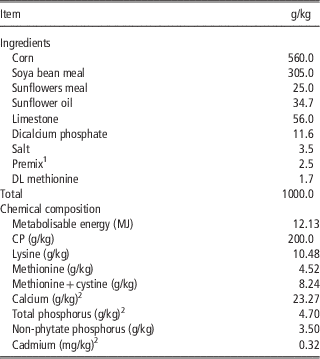
A total of 96 Japanese layer quails that were 21 weeks old were randomly distributed among six experimental groups. In each experimental group, there were four replicates, each with four quails. For 10 weeks, the birds were fed six experimental diets containing six levels of Cd as Cd sulphate (Sigma-Aldrich Chemie GmbH, Steinheim, Germany) (0, 5, 10, 20, 40 and 80 mg/kg). The experimental diets were balanced to meet or exceed the nutrient requirements of the Japanese quail (NRC, 1994) and formulated to be isocaloric and isonitrogenous, with only the levels of Cd in the diets being different (Table 1). The birds were housed in an environmentally controlled room, equipped with 24 metal battery cages (30×35×20 cm). They were offered feed and water ad libitum throughout the experiment (21 to 32 weeks of age). Light was provided for 16 h/day from 0600 to 2200 h throughout the experimental period. They were housed in individual layer cages in an environmentally controlled room (23 to 25°C). Criteria specified by the National Institute of Health Guide for the Care and Use of Laboratory Animals were followed during the study period.
Composition of basal diet

1 Supplied per kg diet; Manganese: 60 mg; Iron: 30 mg; Zinc: 50 mg; Copper: 5 mg; Selenium: 0.1 mg; Vitamin A: 8.800 IU; Vitamin D3: 2.200 IU; Vitamin E: 11 mg; Nicotine acid: 44 mg; Cal-D-Pan: 8.8 mg; Riboflavin: 4.4 mg; Thiamine: 2.5 mg; Vitamin B12: 6.6 mg; Folic acid: 1 mg; D-Biotin: 0.11 mg; Coline: 220 mg.
2 Analysed value as feed.
The BW of the hens was recorded by weighing the hens at the beginning and at the end of the experiment. EP was recorded daily. Feed intake (FI) was calculated as the average for the sub-group, and egg weight (EW) was recorded bi-weekly. Egg mass (EM) was calculated from the bi-weekly EP and EW data by: EM=(EP×EW)/Period (days). The feed conversion ratio was calculated using the following formula: FCR=FI/EM. The eggs were examined to determine the eggshell quality characteristics (specific gravity, shell breaking strength, shell weight and shell thickness) for all the collected eggs produced during the last 3 days of the study. Specific gravity was determined using graded salt solutions ranging from 1.060 to 1.100. Eggshell breaking strength was measured using a cantilever system by applying increasing pressure to the broad pole of the shell using an Egg Force Reader (Orka Food Technology Ltd, Ramat Hasharon, Israel). The eggs were subsequently broken, and the eggshell, albumen and yolk were separated and weighed. Eggshells were weighed using a 0.01 g precision scale. Eggshell weight was calculated using the following formula: eggshell weight (% of EW)=[eggshell weight (g)/EW (g)]. Eggshell thickness (including the membrane) was determined at three points on the eggs (one point on the air cell and two randomised points on the equator) using a micrometre (Mitutoyo Inc., Kawasaki, Japan).
Bone mechanical properties were determined from the load-deformation curve generated from a three-point bending test (ASAE, 2001) using an Instron Universal Testing Instrument (Model 1122; Instron, Canton, MA, USA) and the TestWorks 4 software package (version 4.02; MTS System Corporation, Eden Prairie, MN, USA). The cross-head speed was constant at 5 mm/min. The full-scale load of the load cell was 5.000 N. Shear tests were performed on the tibia using a double-shear block apparatus. The shear force was exerted over a 6.35-mm (0.25 inch) section located at the centre of the diaphysis. These tests enabled the ultimate shear force and shear stress to be evaluated for each bone. An average wall thickness (cortex thickness) of the tibia was measured using digital callipers (precision of 0.001 mm) at two points on the central axis of the broken tibia that was used to determine the mechanical properties. These mechanical properties of the bone are described by Wilson and Ruszler (Reference Wilson and Ruszler1996) and Armstrong et al. (Reference Armstrong, Flowers, Spears and Nielsen2002).
Tibia and eggshell mineral contents were determined using MarsXpress Technology Inside and an Inductively Coupled Plasma Atomic Emission Spectrometer (Vista AX CCD Simultaneous ICP-AES, Varian, Mulgrave, Australia). Approximately 0.20 g of dried sample (bone with marrow removed) was introduced into a burning cup and 5 ml nitric acid, 3 ml perchloric acid and 2 ml hydrogen peroxide were added. The sample was incinerated in a MARS 5 Microwave Oven (CEM, Corp., Mathews, NC, USA) at 190°C and 1.207 kPa pressure, and subsequently diluted to 50 ml with distilled water. The mineral concentrations were determined using an ICP-AES (Skujins, Reference Skujins1998).
Data were analysed by one-way ANOVA using the SPSS 18.0 software package (SPSS Inc., Chicago, IL, USA), using the cage mean as an experimental unit. A probability value of P<0.05 was considered statistically significant. Orthogonal polynomial contrasts were used to assess the significance of linear and quadratic models to describe the response of the dependent variable to a rising Cd level.
Results
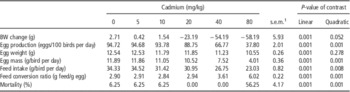
The body weight change (BWC), EP, EW, EM, FI, FCR and mortality results are presented in Table 2. In the present study, the addition of Cd to the diets influenced BWC, EP, EW, EM, FI, FCR and mortality. The addition of increasing levels of Cd to the diets caused the BWC and EW to decrease linearly (P<0.001). The dietary supplementation of Cd quadratically influenced EP, EM and FI (P<0.001, P<0.001 and P<0.01, respectively). The EP, EW and FI were unaffected by increasing Cd levels to 10 mg/kg and then declined with further supplementation. The diets supplemented with Cd also showed significant quadratic (P<0.001) effects on FCR and mortality in the quails. The diet supplemented with 80 mg/kg Cd increased FCR and mortality markedly in the quails.
Effect of dietary supplementation of cadmium on the performance in quails

1 Each value represents the mean of four replicates.
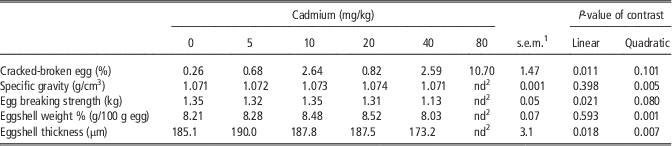
The eggshell quality parameters such as cracked-broken egg, specific gravity, egg breaking strength, eggshell weight and eggshell thickness are presented in Table 3. The eggshell parameters were not examined in the group that received 80 mg/kg Cd because these birds did not produce enough eggs. There was a linear effect of Cd on cracked-broken egg (P<0.05) and egg breaking strength (P<0.05); therefore, the cracked-broken egg and egg breaking strength were negatively influenced by the additional dietary Cd. In this experiment, the specific gravity and eggshell weight were affected quadratically (P<0.01 and P<0.001, respectively) by the addition of Cd, reaching a maximum with a supplementation level of 20 mg/kg Cd in the diet. However, it decreased considerably with further addition of Cd. The eggshell thickness increased quadratically (P<0.01) with the addition of Cd, but it was minimised by the addition of 40 mg/kg of Cd.
Effect of dietary supplementation of cadmium on the eggshell quality in quails

1 Each value represents the mean of four replicates.
2 nd: not determined (because of insufficient eggs).
The biomechanical properties of the bones in the quails supplemented with Cd are shown in Table 4. The cortex thickness and cortex cross-sectional area were not significantly affected by the dietary Cd levels. The shear force decreased quadratically (P<0.05) when Cd was supplemented in the diets of quails. The shear stress also decreased linearly (P<0.001) in quails supplemented with Cd.
Effect of dietary supplementation of cadmium on tibia biomechanical properties

1 Each value represents the mean of four replicates.
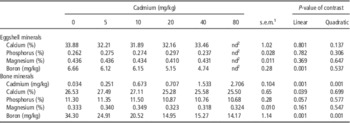
The dietary Cd supplementation did not significantly change the Ca, phosphorus or magnesium contents in the eggshell, or phosphorus and magnesium concentrations in the bones (Table 5). Cd could not be detected in the eggshells. The boron concentration in the eggshells decreased linearly (P<0.001) with dietary Cd levels. The addition of Cd to the diet caused the concentration of Cd in the bones to increase quadratically (P<0.001). In contrast, the concentration of boron in the bones decreased quadratically (P<0.001) with the addition of Cd. The Ca content in the bones was influenced (P<0.05) by dietary Cd supplementation and the effect was maximal at the supplementation level of 5 mg/kg Cd.
Effect of dietary supplementation of cadmium on the mineral content of eggshells and bones in quails

1 Each value represents the mean of four replicates.
2 nd: not determined (because of insufficient eggs).
Discussion
In the present study, the addition of Cd, especially 40 and 80 mg/kg, to the diet had a negative impact on performance parameters. These results agree with previous reports (Vodela et al., Reference Vodela, Lenz, Renden, McElhenney and Kemppainen1997; Nolan and Brown, Reference Nolan and Brown2000; Sant’Ana et al., Reference Sant’Ana, Moraes and Bernardi2005; Rahman et al., Reference Rahman, Sasanami and Mori2007). However, some studies have reported that low levels of Cd added to diet (3 mg/kg) or water (1.5 mg/l) had a positive effect on performance parameters (Leach et al., Reference Leach, Wang and Baker1979; Pribilincova and Marettova, Reference Pribilincova and Marettova1996; Toman et al., Reference Toman, Massanyi, Luka, Ducsay and Golian2005). In this study, the FCR was the best in quails fed 10 mg/kg Cd.
In the present study, cracked-broken egg and egg breaking strength were linearly influenced by dietary Cd supplementation. The specific gravity and eggshell weight quadratically increased up to 20 mg/kg of Cd. The highest eggshell thickness value was obtained in quails receiving 5 mg/kg Cd. However, the addition of 40 mg/kg Cd to the diet deteriorated eggshell quality parameters. Rahman et al. (Reference Rahman, Sasanami and Mori2007) demonstrated that the injection of 0.3 mg Cd/kg BW into quails caused a significant decrease in eggshell thickness. Leach et al. (Reference Leach, Wang and Baker1979) noted that eggshell thickness was significantly reduced by 48 mg/kg dietary Cd supplementation during a long-term study (48 week), but the addition of Cd to the diet did not affect eggshell thickness in laying hens during the 12-week study. Nevertheless, Korenekova et al. (Reference Korenekova, Skalicka, Nad, Saly and Korenek2007) and Skalicka et al. (Reference Skalicka, Korenekova, Nad and Saly2008) noted that eggshell thickness was not affected by Cd in quails. On the other hand, Pribilincova and Marettova (Reference Pribilincova and Marettova1996) stated that eggshell parameters were best in hens fed 3 mg/kg Cd. Similarly, Olgun and Yildiz (Reference Olgun and Yildiz2014) reported that the addition of 20 mg/kg to the diet had a positive effect on eggshell quality in quails. Ca is the main component of the eggshell, and the Ca concentration in the eggshell was not affected by the addition of Cd to the diet. For all that, the eggshell quality improved with the addition of 20 mg/kg Cd to the diet; at present, there is no explanation for this observation.
The addition of Cd to the diet resulted in a quadratic weakening of the tibia shear force. These results agree with previous reports (Brzoska and Monioszko-Jakoniuk, Reference Brzoska and Moniuszko-Jakoniuk2004 and Reference Brzoska and Moniuszko-Jakoniuk2005). Brzoska and Monioszko-Jakoniuk (Reference Brzoska and Moniuszko-Jakoniuk2004) demonstrated that exposure of female rats to Cd (1 mg/l) significantly decreased the ultimate load and stiffness. Another study by the same researchers revealed that exposure to 1 mg/l Cd did not affect the mechanical properties of the bone, but exposure to 50 mg/l Cd markedly reduced mechanical properties such as bone resistance, displacement at yield and bone stiffness in male rats (Brzoska and Monioszko-Jakoniuk, Reference Brzoska and Moniuszko-Jakoniuk2005). However, Comelekoglu et al. (Reference Comelekoglu, Yalin, Bagis, Ogenler, Sahin, Yildiz, Coskun, Hatungil and Turac2007) noted that femur resistance was not affected by 0.5 mg/kg BW injections into rats. Moreover, Brzoska et al. (Reference Brzoska, Majewska and Kupraszewicz2010) indicated that low chronic exposure to Cd (1 mg/l) did not have an effect on bone resistance to fracture, whereas moderate (5 mg/l) or relatively high (50 mg/l) exposure seriously increased the risk of fracture of the long bones in males. The addition of Cd to the diet decreased the shear stress of the tibia linearly. Comelekoglu et al. (Reference Comelekoglu, Yalin, Bagis, Ogenler, Sahin, Yildiz, Coskun, Hatungil and Turac2007) showed that injection of 0.5 mg Cd/kg BW in rats had no effect on the stress of the femur.
The addition of Cd to the diets decreased the boron content of the eggshells linearly. Previously, Cd supplementation in diets was not shown to affect the boron content of eggshells. However, to our knowledge, only one report concerning the influence of Cd on the mineral content of eggshells is available. Mas and Arola (Reference Mas and Arola1985) noted that copper, iron, nickel and zinc contents in eggshells were not affected by injection of 100 μg Cd in 12th-day incubated eggs; however, the nickel and zinc contents of the eggshells were markedly decreased by the injection of 100 μg Cd in 17th-day incubated eggs.
The Cd content of the tibia was quadratically increased by Cd supplementation in the diet. Similar results have also been reported by Brzoska et al. (Reference Brzoska, Moniuszko-Jakoniuk, Jurczuk, Gałażyn-Sidorczuk and Rogalska2001) and Brzoska and Monioszko-Jakoniuk (Reference Brzoska and Moniuszko-Jakoniuk2005). Brzoska et al. (Reference Brzoska, Moniuszko-Jakoniuk, Jurczuk, Gałażyn-Sidorczuk and Rogalska2001) showed that 50 μg/ml Cd added to the water decreased the levels of Ca, zinc and iron in the tibia and increased the Cd content, but did not affect the magnesium or copper contents. Brzoska and Monioszko-Jakoniuk (Reference Brzoska and Moniuszko-Jakoniuk2005) showed that Cd levels in the blood and femurs of male rats were increased by the addition of Cd (1, 5 and 50 mg/l) to the water. The Ca concentration of the tibia was linearly influenced by dietary Cd supplementation. These results are in agreement with previous reports by Brzoska and Monioszko-Jakoniuk (Reference Brzoska and Moniuszko-Jakoniuk2004 and Reference Brzoska and Moniuszko-Jakoniuk2005). The addition of Cd to the diets resulted in a decrease in boron concentrations in the tibia.
Cd added to the diets of quails resulted in a deterioration of biomechanical parameters (shear force and shear stress) of the tibia (Table 4) and a decrease in the boron concentrations in the tibia (Table 5). Dietary addition of boron is known to improve the biomechanical properties and mineral concentration of bones (Wilson and Ruszler, Reference Wilson and Ruszler1997 and Reference Wilson and Ruszler1998; Armstrong et al., Reference Armstrong, Spears, Crenshaw and Nielsen2000; Olgun et al., Reference Olgun, Yazgan and Cufadar2012) and stimulate cartilage growth and maturation (Hunt et al., Reference Hunt, Herbel and Idso1994). In this study, we observed a negative relationship between Cd and boron. Therefore, one reason for the negative effect of Cd on bones may be due to a reduction in the boron content of bones.
After consuming a diet containing Cd, especially 40 and 80 mg/kg, for 10 weeks, the quails showed a number of well-known Cd effects such as decreased EP, EW and FI, deteriorated FCR and biomechanical properties of bones and increased mortality. However, the specific gravity, eggshell weight and eggshell thickness improved when low doses of Cd were added to the diet. Cd may be an element that is ultra-trace essential or has a pharmacological effect.
In conclusion, the layer quails fed a diet supplemented with 20 mg/kg Cd showed deteriorated performance parameters. The addition of 40 mg/kg Cd to the diet had a negative effect on eggshell quality parameters. The specific gravity, eggshell weight and eggshell thickness improved upon the addition of 20 mg/kg Cd to the diet. The bone biomechanical properties were negatively affected by dietary Cd supplementation. The eggshell and bone boron content decreased after the addition of Cd to the diets.
Acknowledgements
The quails used in this study were obtained from quails sold commercially by the Selcuk University, Turkey.