Introduction
A psychiatric presentation where an individual becomes convinced that he or she gives off an unpleasant smell, which others notice, was first described by Potts (Reference Potts1891). A year later, Séglas (Reference Séglas1892) gave an account of another case. Further cases were reported and the disorder was given names such as bromidrosiphobia (Sutton, Reference Sutton1919), olfactory phobic syndrome (Walter, Reference Walter1965) and chronic olfactory paranoid syndrome (Videbech, Reference Videbech1966). The Japanese concept of taijin-kyofu-sho, which encompasses a range of disorders where there is social anxiety, also includes a ‘severe’, ‘offensive’ or ‘delusional’ type termed jiko-shu-kyofu, where the patient believes he/she offends others by giving off a smell (Suzuki et al. Reference Suzuki, Takei, Iwata, Sekine, Toyoda, Nakamura, Minabe, Kawai, Iyo and Mori2004).
Pryse-Phillips (Reference Pryse-Phillips1971) gave a detailed description of 36 cases of the disorder and also gave it its modern name, olfactory reference syndrome (ORS). He emphasized that the patients' belief that they smelled was accompanied by a characteristic ‘contrite’ reaction: they washed repeatedly, used perfumes and deodorants excessively, changed their clothes with more than usual frequency and restricted their travel and social life. Many had consulted physicians, surgeons or dermatologists on multiple occasions. Ideas of reference were a further notable feature, with the patients believing that people around them made remarks or gestures in response to the smell, particularly in enclosed spaces and when travelling on buses or trains. Although the patients in his series had usually been given diagnoses of depression, schizophrenia or paranoid states, Pryse-Phillips (Reference Pryse-Phillips1971) argued that they could not be accommodated within these diagnostic categories, but instead suffered from a distinct disorder.
Although the existence of ORS is now widely accepted, in some respects it remains controversial. This applies particularly to its nosological status. Munro (Reference Munro1980 a, Reference Munro1988, Reference Munro1999) influentially argued that ORS, along with delusional parasitosis and some cases of dysmorphophobia, represented a hypochondriacal form of delusional disorder (‘monosymptomatic hypochondriacal psychosis’). As a result, the syndrome, which had been classified as an atypical somatoform disorder in DSM-III, was re-assigned to delusional disorder, somatic subtype in DSM-III-R and DSM-IV. However, several authors have questioned this categorization (Dominguez & Puig, Reference Dominguez and Puig1997; Stein et al. Reference Stein, Le Roux, Bouwer and Van Heerden1998; Suzuki et al. Reference Suzuki, Takei, Iwata, Sekine, Toyoda, Nakamura, Minabe, Kawai, Iyo and Mori2004; Phillips et al. Reference Phillips, Gunderson, Gruber, Castle, Brewer, Castle and Pantelis2006; McGoldrick et al. Reference McGoldrick, Begum and Brown2008), arguing that the core belief in ORS is not always held with delusional intensity and that the patients can show a spectrum of insight. This nosological uncertainty spills over into the literature on treatment. Munro (Reference Munro1980 a, Reference Munro1988) considered that monosymptomatic hypochondriacal psychoses show a good response to antipsychotic drug treatment, especially pimozide. On the other hand, Phillips et al. (Reference Phillips, Gunderson, Gruber, Castle, Brewer, Castle and Pantelis2006) and Phillips & Castle (Reference Phillips and Castle2007) have argued that antidepressants can also be effective in ORS, sometimes after an antipsychotic had failed. They also found some evidence that behavioural interventions could be beneficial.
The aim of this review was to examine the status of ORS by means of a systematic review of case reports in the world literature. We used this evidence base to address questions about the existence of ORS as a distinct disorder, its phenomenology and its outcome and response to treatment.
Method
Relevant articles were searched using Pubmed, Medline, PsycINFO, EMBASE, Cinahl and Google Scholar, up to April 2009. We entered the following search terms: olfactory delusional; bromidrosiphobia; delusions of bromosis; chronic olfactory paranoid; body smell delusion; olfactory reference syndrome; monosymptomatic hypochondriacal psychosis; jiko-shu-kyofu; imagined halitosis; delusional halitosis; halitophobia; autodysosmophobia; delusion of malodour; delusional disorder somatic. There were no restrictions on language or year of publication.
One of the authors (M.B.) examined the titles and abstracts of publications identified by the electronic search and obtained the full versions of all relevant articles (including case reports, case series, clinical trials, review articles and book chapters), as well as articles on related topics such as paranoia, monosymptomatic hypochondriacal psychosis and taijin-kyofushu (the broad category to which jiko-shu-kyofu belongs). To identify further cases, the reference lists of all obtained articles were checked. We also obtained theses by Pryse-Phillips (Reference Pryse-Phillips1968) and Munro (Reference Munro1981), which included descriptions of cases. Information from all cases was summarized and tabulated.
DSM-IV and ICD-10 do not provide separate diagnostic criteria for ORS, which is instead specified only as one of the subtypes of delusional disorder. In view of this and the fact that, as noted in the Introduction, there is controversy as to whether the core belief in ORS is always delusional, we decided to use diagnostic criteria proposed for the disorder by Phillips et al. (Reference Phillips, Gunderson, Gruber, Castle, Brewer, Castle and Pantelis2006). These criteria require the following:
(1) A persistent false belief that one emits a malodorous smell; this belief may encompass a range of insight (i.e. it does not have to be delusional).
(2) The belief causes clinically significant distress, is time consuming (i.e. preoccupies the individual for at least 1 h per day) or results in significant impairment in social, occupational or other important areas of functioning.
(3) The belief is not better accounted for by another mental disorder or a general medical condition.
The decision as to whether a particular case report met these criteria was made by consensus. With regard to the criterion of persistence, we specified a duration of at least 6 months (either explicitly stated or implied, e.g. from multiple visits to doctors). The case report also had to provide concrete instances of time-consuming activities (e.g. bathing, changing clothes, checking underwear frequently, repeated visits to doctors for physical investigation/treatment) and/or objective evidence of clinically significant distress/impairment (e.g. hospitalization, suicide attempts, anxiety or depressive symptoms, missing school or college, leaving jobs, avoidance of social situations, restriction of use of public transport, social isolation).
With regard to criterion 3, we excluded patients who showed evidence of a major psychiatric disorder (schizophrenia, major depression, or bipolar disorder) before, at the same time as or at any time after the onset of ORS symptoms. Because co-existent depressive symptoms were commonly reported, we only excluded cases on the basis of having major depression if they showed one or more of the following features: (i) two or more biological symptoms; (ii) ideas of guilt or worthlessness; (iii) retardation; (iv) psychotic symptoms (other than the ORS symptom); (v) the depression predated the onset of ORS or the patient had subsequent episodes of depression without ORS; (vi) the authors of the case report considered that major depression was the diagnosis. We also excluded patients in whom the disorder developed in the setting of pre-existing drug/alcohol abuse. Cases where there was learning disability, organic brain disease (current or developing subsequently) or epilepsy were also excluded.
Results
We located 180 case reports from 78 articles and two theses published between 1891 and 2009. Out of these, 84 cases (1962–2008) met the inclusion criteria (shown with an asterisk in the references). Forty-two cases were excluded because of lack of information, duplication or duration <6 months and 44 were excluded because they showed evidence of another diagnosis before or around the same time that they developed ORS symptoms [schizophrenia/psychosis (15), major depression (18), bipolar disorder (two), organic disorder (six), drug/alcohol abuse (two), medical diagnosis that could account for symptoms (one)]. There were 10 cases that initially showed ORS symptoms and later went on to develop another disorder and they were also excluded (schizophrenia/psychosis: seven; mania: two; major depressive disorder: one). Sixty-two of the included cases were in English and the remaining were in French (one), German (three), Japanese (15), Czech (three).
Demographic features
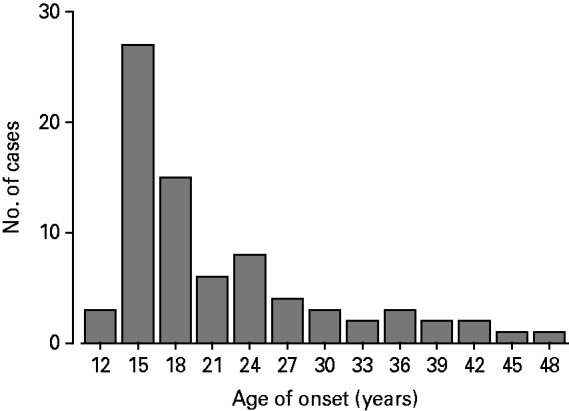
There were 52 male and 32 female cases (62% v. 38%). The mean age at presentation was 29 years (range 16–60) and the mean age of onset was 21 (range 11–48). As shown in Fig. 1, the distribution of ages of onset was skewed to the left: 58% of the cases had an onset <20 years old. The mean duration of illness was 8 years with a very wide range, from 6 months to 48 years.
Age of onset in 79 cases of olfactory reference syndrome.

Only 18 of the 84 cases provided family history information [schizophrenia/psychosis (one), depression (two), alcoholism (three), obsessive-compulsive disorder (one), anxiety/neurosis (seven), sociopathy (one) or unspecified mental illness (three) – some cases had a family history in more than one relative].
Associated features
Low mood was described as being present in 33 of the cases (39%). Anxiety as defined broadly (including feeling nervous, tense or uptight) was referred to in 35 cases (42%). However, anxiety with autonomic accompaniments was described in only five cases (6%).
In total, 33 case reports commented on pre-morbid personality traits. Of these, 22 (67%) reported one or more features suggestive of ‘cluster C’ traits, (obsessional: five; avoidant: seven; dependent: one; combinations: eight) and three (9%) reported traits suggestive of ‘cluster A’ traits (schizoid: two; combination of schizoid and paranoid: one). There were no descriptions of ‘cluster B’ traits. In five of the remaining eight reports there were statements implying good personality adjustment (e.g. many friends, confident, active, outgoing, high self-esteem, open and good natured, cheerful).
Precipitating events
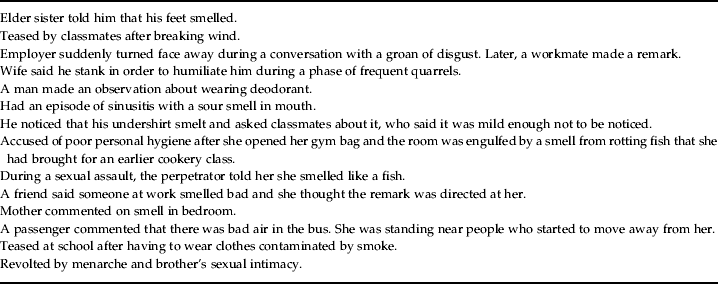
In 41 of the reports (49%), events were described that the authors regarded as significant precipitants. These fell into two broad classes: (a) sources of unrelated stress around the time the illness developed (n=7, 17%); (b) smell-related key experiences, which launched the patient's concern about smelling (n=35, 85%) (one patient had both). Examples of the former included: guilt over an affair; lover left him; hitting a pupil in class; mother being treated for bowel cancer; bullying at school. Examples of smell-related experiences that immediately preceded the onset of symptoms are shown in Table 1.
Examples of smell-related precipitating events in patients with olfactory reference syndrome
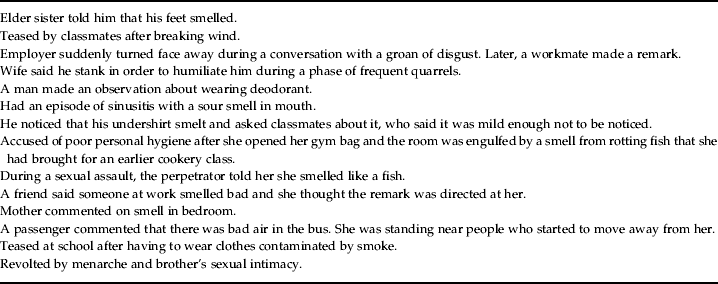
Phenomenology
The smells reported were usually bodily smells. They included odour from the feet, underarms or groin, sweat, urine, flatus, faeces, bad breath, anal, genital and sexual odours. A minority of cases described other smells, such as garbage, dirty socks, gases, burning fish, medicines, old cheese or rotten eggs. Nevertheless, in accordance with the diagnostic criteria, these patients believed that the smells emanated from their own bodies.
In total, 27 cases provided information about whether the patient could actually smell the odour. Only six (22%) stated unreservedly that the patient could do so. Another five (19%) were ambiguous or stated that the patient could only smell the smell occasionally or intermittently. There were 16 cases (59%) where it was stated that the patient could not smell the smell him- or herself.
A total of 40 reports commented on the nature of the central belief. Of these, 23 (57%) described it as fixed or firmly held. Relevant statements included: absolutely certain smelt of stool; voiced fixed conviction, did not think it was irrational; he was in no doubt of the reality of his bad breath; adamant about his halitosis; could not believe it was her imagination; all efforts to reassure her were unsuccessful. In 17 cases (43%), however, there was evidence that the belief was held with less than full conviction, e.g. admitted that his preoccupations about the odour were excessive and unreasonable; the thoughts were ego-dystonic; overvalued idea but not delusional; oscillated between fear and conviction; while she had a phobia, it was not delusional; could be persuaded to some extent that she did not smell.
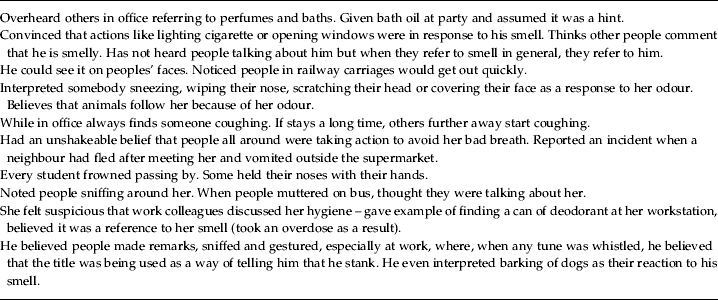
Referential ideas were noted in 62 of the 84 reports (74%). These took the form of misinterpretations of the comments, gestures and actions of others as indicating a bad smell. The ideas were commonly reported in relation to public transport, social situations, classrooms or the workplace. Some examples are given in Table 2.
Examples of referential ideas in patients with olfactory reference syndrome

Outcome
For this, cases were assigned to categories of recovered, improved or unimproved. Improvement or recovery required that the case document a reduction in olfactory symptoms (to some degree or complete/virtually complete, respectively) and not just improvement in associated depression or anxiety. However, reduction in preoccupation with the smell and its interference with life were counted as improvement.
A total of 76 cases reported outcome data over follow-up periods ranging from 2 weeks to 10 years (average 21 months). Of these, 23 (30%) were reported as recovered, 28 (37%) improved and 25 (33%) unimproved or worse (including one patient who committed suicide). The rates were not greatly different when the analysis was restricted to cases with ⩾6 months of follow-up [recovered 18/48 (37%), improved 19/48 (40%), unimproved/worse 11/48 (23%)] or ⩾12 months of follow-up [recovered 12/34 (35%), improved 14/34 (41%), unimproved/worse 8/34 (24%)].
Treatment
In order to make the analysis here more manageable, we assigned cases to categories of unimproved or improved only. Improvement was defined as above. For drug treatments, we considered neuroleptics (all types) and antidepressants (all types, including MAOIs); successive trials of different neuroleptics or different antidepressants in the same patient were considered as a single treatment episode. Benzodiazepines and mood stabilizers were not considered. Under the heading of psychotherapy, we included any form of treatment designed to address symptoms, but not supportive therapy or counselling.
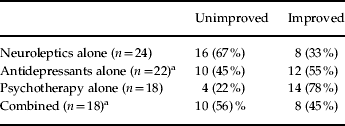
The results are shown in Table 3. Concerning biological treatments, it can be seen that eight of 24 (33%) patients showed improvement with neuroleptics and 12 of 22 (55%) with antidepressants. Only one of five cases treated with ECT showed improvement and none of three patients who underwent leucotomy improved. Fourteen out of 18 patients (78%) improved with psychotherapy.
Effects of different treatment modalities in olfactory reference syndrome

a Includes any combination of neuroleptics, antidepressants or other somatic treatments, with or without psychotherapy.
There were too few cases who received atypical neuroleptics to compare the response rate between typical and atypical neuroleptics. Concerning the response to different classes of antidepressant drug, three out of five patients improved on tricyclics, three out of four improved on clomipramine, three out of four improved on selective serotonin re-uptake inhibitors and one out of two improved on MAOIs; the remainder received multiple or unspecified drugs. Breaking the therapies down, seven out of eight patients improved with behaviour therapy, none out of two with cognitive behavioural therapy, three out of three improved with eye movement desensitization and reprocessing (EMDR), two out of four improved with psychodynamic therapy and three out of four with psychotherapy not otherwise specified (three cases received more than one form of therapy).
Discussion
After searching the world literature, we were able to identify 84 case reports of patients whose predominant clinical feature was a conviction that they gave off a smell that others noticed. These patients did not meet criteria for another psychiatric disorder and appeared to show a consistent clinical profile characterized by distress, preoccupation and engaging in time-consuming activities to try and reduce the effect of the smell on others. This systematic review therefore supports the existence of ORS as a primary psychiatric syndrome.
This is not to say that ORS never develops in association with other psychiatric disorders. We found, but excluded from the analysis, a number of case reports where patients developed ORS symptoms in the context of schizophrenia or as the initial symptom of an illness that ultimately revealed itself to be schizophrenia. There were also a few cases where something resembling ORS developed against a background of brain damage or dementia. We found a number of cases who also suffered from major affective disorder; here, the affective symptoms could appear concurrently with, before or after the development of ORS. Co-morbid major depression appeared to be particularly common. However, it should be noted that we used quite broad exclusion criteria for this disorder in order to focus on a ‘core’ group of primary ORS patients. Therefore, it is possible that we excluded cases as having co-morbid major depression that others might have considered to be ORS with only secondary depression.
Demographic and clinical features of ORS
In terms of the core features of the syndrome, our findings are by and large similar to those of Pryse-Phillips (Reference Pryse-Phillips1971). However, there were two important differences. We found that the syndrome had a somewhat younger mean age of onset than in his series (21 v. 25); indeed, it developed in the teenage years in many instances. Pryse-Phillips (Reference Pryse-Phillips1971) also considered that 75% of his cases had true hallucinations, stating that it ‘was a real and immediate perception for the patient’. In contrast, we found that actually smelling the odour was not a prominent feature of the syndrome: in nearly 80% of cases where this aspect of psychopathology was commented on, the patients stated that they could not smell the odour or were uncertain whether they smelt it or only smelt it intermittently.
Like Pryse-Phillips (Reference Pryse-Phillips1971), we found that even after excluding cases that showed evidence of co-morbid major depressive disorder, depression was a commonly reported associated symptom, present in around 40%. Anxiety was reported with approximately equal frequency; however, anxiety with autonomic accompaniments was unusual, being recorded in only six of the 84 case reports. A further prominent accompanying symptom was ideas of reference, which were present in over three-quarters of the cases. Although these ideas were irrational and at times bordered on the ridiculous, they invariably consisted of misinterpretations of gestures, actions and comments in response to the supposed smell. There were no examples of patients noticing references to themselves in newspapers or on television or believing people were recording their movements, i.e. there were no delusions of misinterpretation as defined by Wing et al. (Reference Wing, Cooper and Sartorius1974). Referential ideas in ORS therefore appear to be examples of what Freeman and co-workers (Freeman et al. Reference Freeman, Garety, Bebbington, Smith, Rollinson, Fowler, Kuipers, Ray and Dunn2005; Green et al. Reference Green, Freeman, Kuipers, Bebbington, Fowler, Dunn and Garety2008) have termed ideas of social reference, which are seen in non-psychotic as well as in psychotic individuals.
Although ORS was sometimes reported as arising in patients with a good personality adjustment, a striking finding was that two-thirds of the 33 case reports in which personality was commented on alluded to one or more avoidant, dependent and obsessional personality traits, i.e. those in the ‘cluster C’ or anxious category of the DSM-IV classification. In contrast, we found only three cases where there were statements suggestive of schizoid or paranoid traits; antisocial, borderline, histrionic or narcissistic traits were never referred to.
Precipitating events were reported in a substantial proportion of the cases. Many but not all of these involved smells in circumstances that might have been expected to produce shame or embarrassment. It is certainly possible that some of these apparent precipitants were not real events but instead early symptoms of the disorder itself – especially referential ideas – which the patients retrospectively construed as triggering it off. On the other hand, the true rate might have been higher, given the vagaries of reporting and differing interests of the authors. In this respect, it is interesting that McGoldrick et al. (Reference McGoldrick, Begum and Brown2008) found that, during the course of treatment of four patients with ORS using EMDR, initial traumatic smell-related experiences could be elicited from all of them. The authors considered these events to be crucial to the success of the treatment.
Outcome and response to treatment
In an earlier review of the literature, Phillips et al. (Reference Phillips, Gunderson, Gruber, Castle, Brewer, Castle and Pantelis2006) commented that the course of ORS was typically chronic, persisting for years or even decades and worsening over time. However, while we certainly found some cases with very longstanding and treatment-refractory illnesses, around two-thirds showed improvement or recovery. This rate did not seem to be an artefact of short duration of follow-up, in that it was maintained after excluding patients who were followed for only brief periods, although beyond 12 months there were too few cases to provide reliable data. At the same time, the possibility that publication bias contributed to the findings here cannot be excluded. Patients who had a good outcome, perhaps as a result of receiving a particular form of treatment, might be more likely to be written up as case reports and these might in turn be more likely to be accepted for publication.
Similar to previous reviews (Phillips et al. Reference Phillips, Gunderson, Gruber, Castle, Brewer, Castle and Pantelis2006; Phillips & Castle, Reference Phillips and Castle2007), we found that improvement in ORS could take place with all modalities of treatment, from neuroleptics and antidepressants to psychotherapy, both interpretative and behaviourally oriented. Beyond this, the data provide no support for Munro's (Reference Munro1980 a, Reference Munro1988) contention that ORS is a disorder that responds particularly to neuroleptic treatment – at 33%, the response rate to these drugs was lower than that to antidepressants (55%). The response rate to psychotherapy (78%) was the highest of all the treatments. A favourable response here was seen with the most frequently employed form of psychotherapy, behaviour therapy. However, other modalities of therapy were also sometimes effective in the small number of cases in which they were employed.
Nosology of ORS
ORS is currently classified in DSM-IV and ICD-10 as a subtype of delusional disorder. Nevertheless, in nearly half the cases where the quality of the belief was commented on, the authors considered that it was not delusional in nature or expressed reservations about this. This was typically because the patients acknowledged that the belief was unrealistic, the degree of conviction fluctuated or they could be temporarily reassured. One way to deal with the classification problem that such cases present is to propose that there are separate delusional and non-delusional forms of ORS. This is what DSM-IV does with regard to body dysmorphic disorder and hypochondriasis, where there are delusional forms, categorised as delusional disorder, somatic subtype, and non-delusional forms under the heading of somatoform disorder. DSM-IV even allows a dual classification of obsessive-compulsive disorder, recognizing a delusional variant where patients hold their obsessional concerns with fixed conviction and believe that they are reasonable. Such a view faces opposition, however. Concerning body dysmorphic disorder, Castle et al. (Reference Castle, Rossell and Kyrios2006) have argued that the beliefs in the delusional variant are not bizarre but can be seen as an extreme form of the same beliefs that occur in the non-psychotic form and so a dual categorisation is unparsimonious. Furthermore, Phillips (Reference Phillips2004) has demonstrated that patients with ‘delusional’ and ‘non-delusional’ variants of body dysmorphic disorder share many features, including demographics, symptoms, co-morbidity and treatment response. In these authors' view, a continuous or dimensional model better fits the data for this disorder.
It is also possible that the belief in ORS can be understood categorically, rather than dimensionally, as an overvalued idea. As reviewed by McKenna (Reference McKenna1984), this refers to a solitary abnormal belief, which is preoccupying to the extent of dominating the sufferer's life. Overvalued ideas are considered to be distinguishable from both delusions and obsessions on phenomenological grounds. On the one hand, they lack the ‘alien’ or qualitatively different nature of delusional belief and, on the other, they are not considered absurd or resisted. More recently, Veale (Reference Veale2002) has argued that an overvalued idea cannot be understood simply as a belief that is held with less conviction than a delusion, because strength of belief (and lack of insight) is not an adequate measure of whether or not a belief is delusional. He gives the example that patients with anorexia nervosa may hold the belief that they are too fat with extreme tenacity, but they are not considered delusional because current diagnostic systems dictate that anorexia nervosa is not a delusional disorder. To this, it might be added that authors from Jaspers (Reference Jaspers1959) to Wing et al. (Reference Wing, Cooper and Sartorius1974) have regularly made the point that delusions themselves are not always held with full conviction.
Conclusions
Review of the world literature supports the existence of a primary psychiatric syndrome whose defining characteristic is a preoccupying concern about giving off an odour. When severe, the degree of conviction that the patients show conforms to some definitions of delusion; however, not all cases are delusional according to any definition. On these grounds, the current classification of ORS under delusional disorder is inappropriate and should be changed in future editions of DSM-IV and ICD-10. How it should be classified is problematic, but in the absence of compelling evidence that there are two forms of the disorder with different outcomes and response to treatment, there is no justification for a dual classification of delusional and non-delusional types. Similar considerations might apply to body dysmorphic disorder and hypochondriasis and, possibly, in the future these disorders will be classed together.
As far as treatment is concerned, the only strong recommendation that can be made is that neuroleptics should probably not be the first line of treatment. At the same time, it is evident that ORS is a disorder that sometimes responds to a variety of quite different treatments and sometimes to none. Like its nosological status, treatment response does not appear to divide along conventional lines.
Acknowledgements
We thank William Pryse-Phillips for his help and encouragement. We also thank Angela Beaton of the Maria Henderson Library, Gartnavel Royal Hospital, for her assistance in tracking down a large number of difficult to locate articles. We are grateful to Dr Keith Brown and Therese McGoldrick for their valuable support. We are indebted to Yuki Yoshida, Dr Gordon Barclay, Dr Michael Gotz, Dr Van Rhin Martin and Dr Martin Benez for their translations of papers and to Dr Mary Stewart for obtaining further material. P.J.M. is supported by the Instituto de Salud Carlos III, Centro de Investigación en Red de Salud Mental, CIBERSAM.
Declaration of Interest
None.