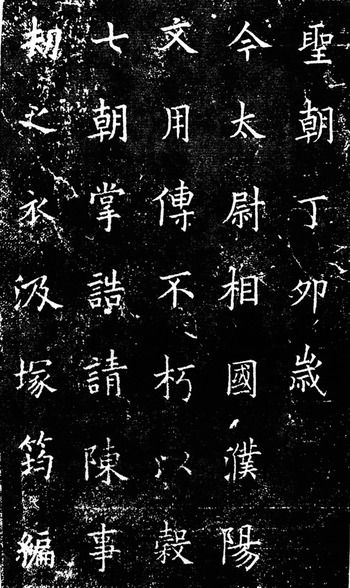
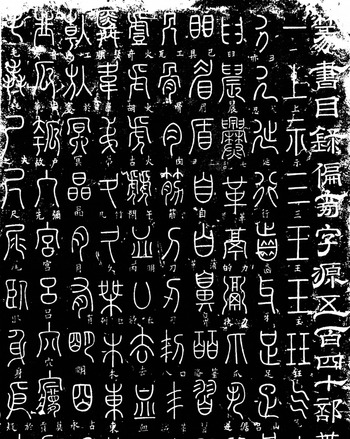
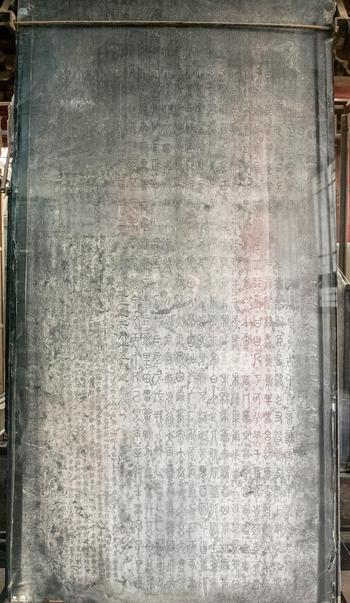
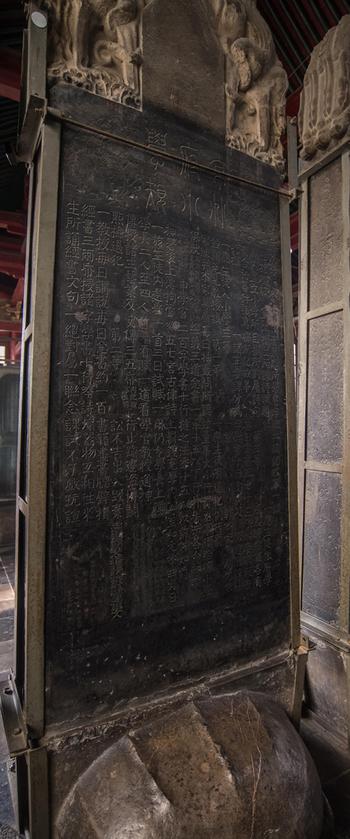
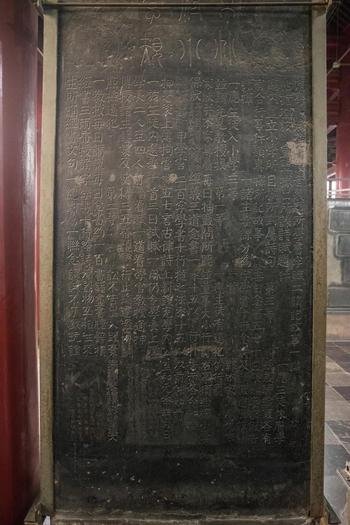
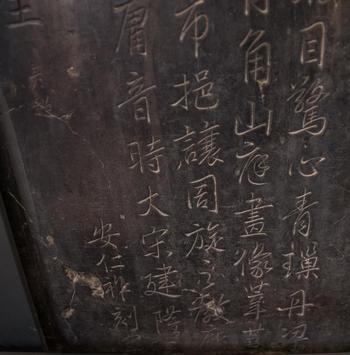
“Bird-tracks” and “tadpoles” are both names for ancient script. As customs changed, the script came to be used less and less, until any basis for knowledgeable discussion was lost and it was known only from hearsay. The Grand Preceptor said: “When the [forms of the] rites are lost, search for them in the countryside.” Might not ancient script be even better than the countryside? Footnote 1
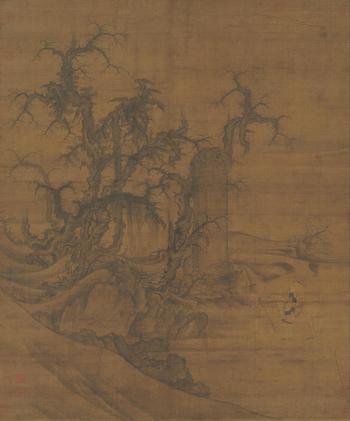
The names of dozens of artists from the tenth century have come down to us, for the most part with very little information about their lives and scarcely more about their art. Fortunately, the life and professional career of Guo Zhongshu 郭忠恕 (928–977) can be reconstructed in enough detail to give a sense of the personality of the artist and the world that he experienced. Indeed, we are doubly fortunate because Guo, it turns out, had no ordinary life. Known to art historians today primarily as one of the great painters of architectural subjects in Chinese history, Guo entered adult life in a different guise, as a brilliant young paleographer and calligrapher. This aspect of his career, no less important than his painting, is the subject of the present study. Although specialists have recognized his scholarly and calligraphic achievements, we still lack a contextualized account that incorporates what can be known of his biography and social circumstances. More important for the theme of this special issue, the material dimension of Guo's paleographic and calligraphic activities also remains to be explored. Any discussion can only be very partial, however, since no manuscripts or autograph calligraphies survive, only stone steles; fortunately, Guo's engagement with stele production is in itself of the highest historical interest. The chronologically organized text that follows tells a biographical story, with as much detail as the available sources allow, which eventually opens out onto the material world of steles, before returning to biography to recount the last chapter of Guo Zongshu's life. Rather than offering a conclusion, I end with a reflection on the materialities of transmission of paleographic and calligraphic knowledge. For the purposes of this article I have not thought it necessary to choose between the very different lenses of biography and material culture, since my goal is not to prove a thesis but to reconstruct an unfamiliar world. As I hope to show, the understanding of one person's life can enrich the understanding of artifacts associated directly and indirectly with the person, and vice versa.
Luoyang and Bian, 928–948
Guo was born in Luoyang in 928 under the Later Tang dynasty, during the relatively peaceful and enlightened reign of Mingzong (r. 926–933).Footnote 2 The Later Tang at that moment controlled most of north China, and during the previous year had absorbed the Shu kingdom in Sichuan as well (Sichuan would secede again in 934). In his later years, Guo claimed his ancestral home to be Fenyang 汾陽 in Shanxi, just south of Taiyuan, where there was a famous branch of the Guo family descended from the Tang general Guo Ziyi (697–781). The eleventh-century art historian, Liu Daochun 劉道醇, however, records Guo's home as the area of Wudi 無棣 and Dihe 滴河 counties in modern Shandong, north-east of Jinan 濟南.Footnote 3
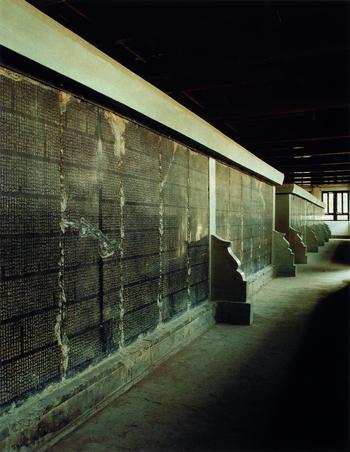
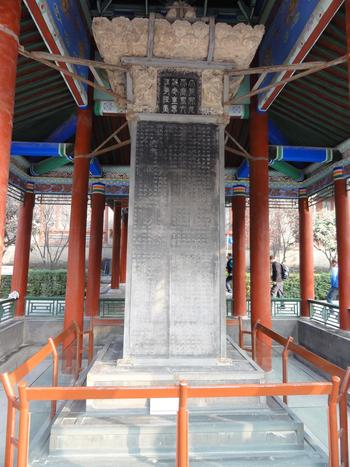
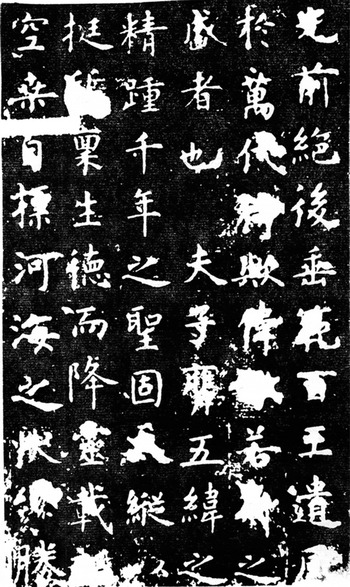
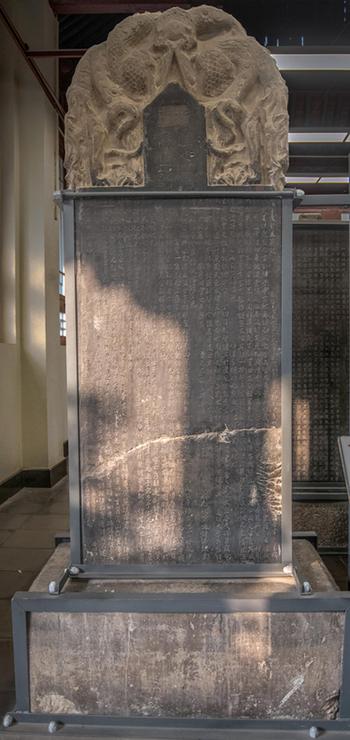
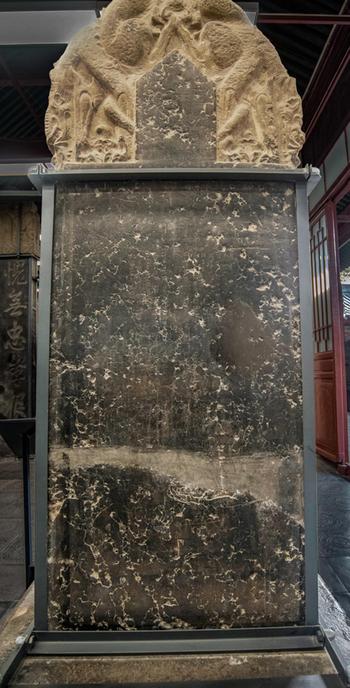
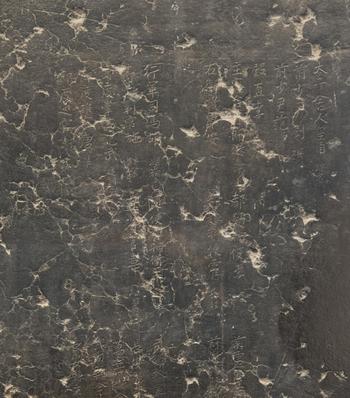
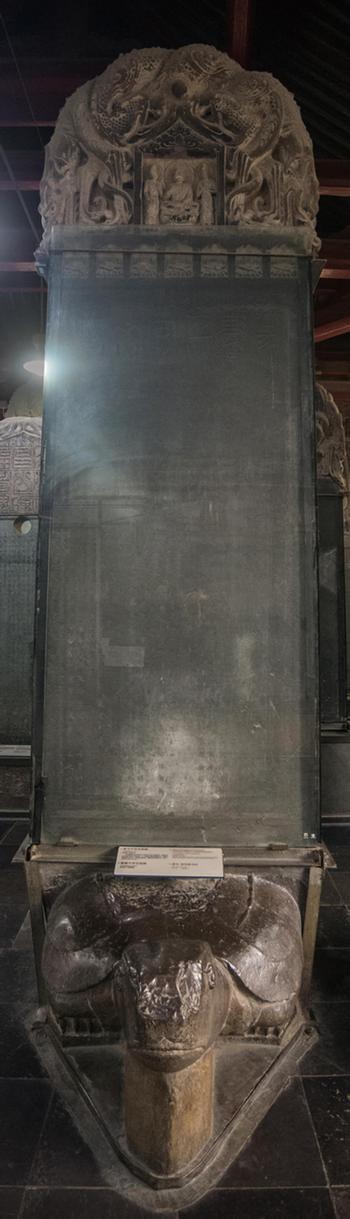
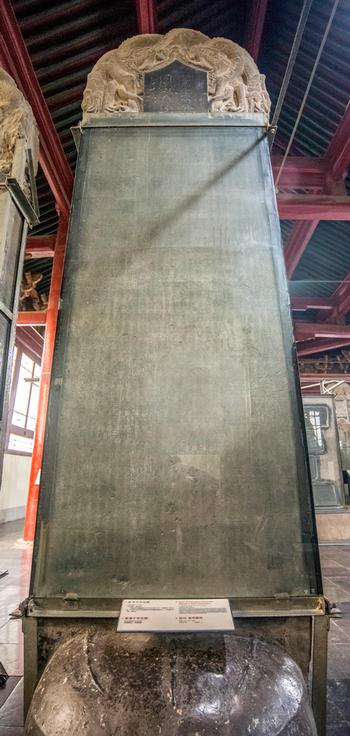
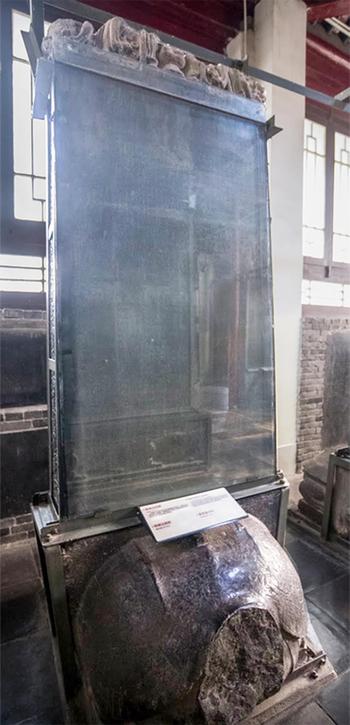
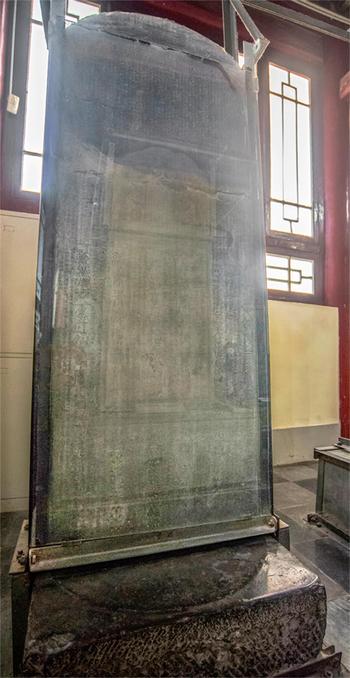
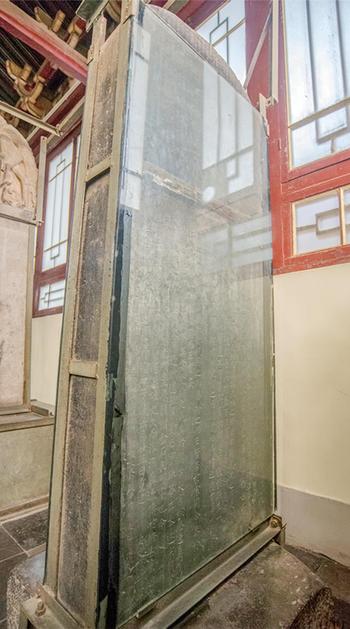
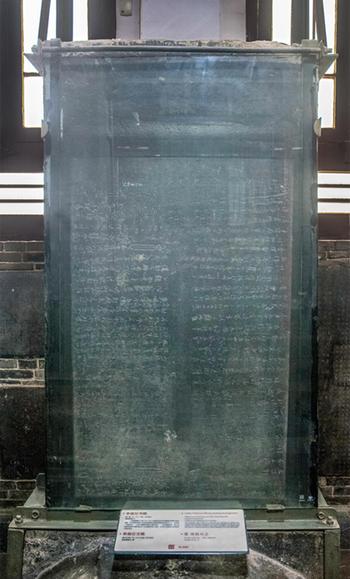
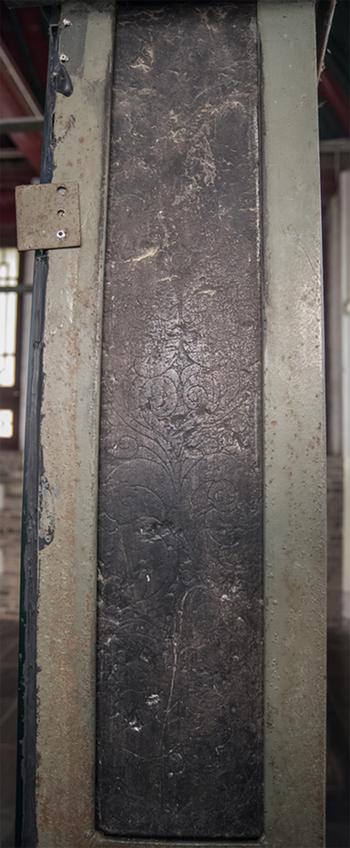
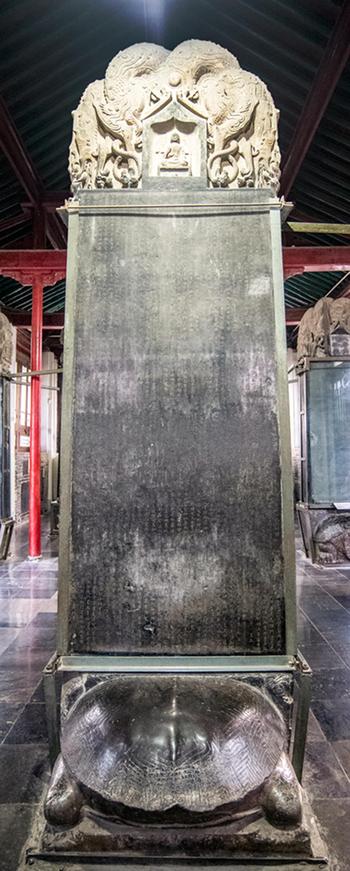
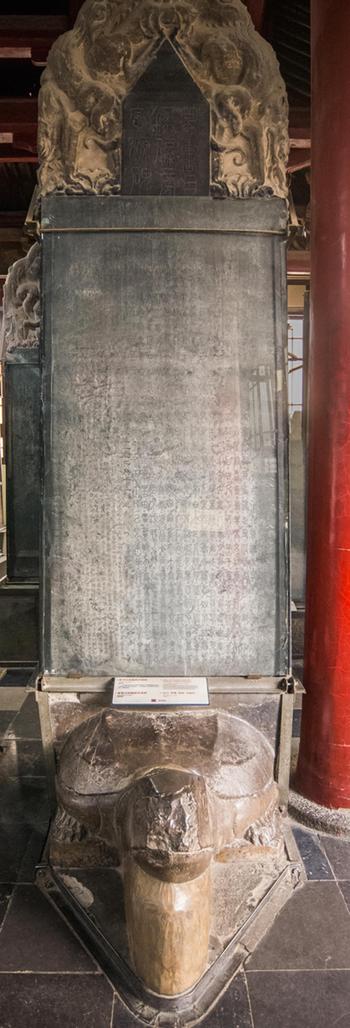
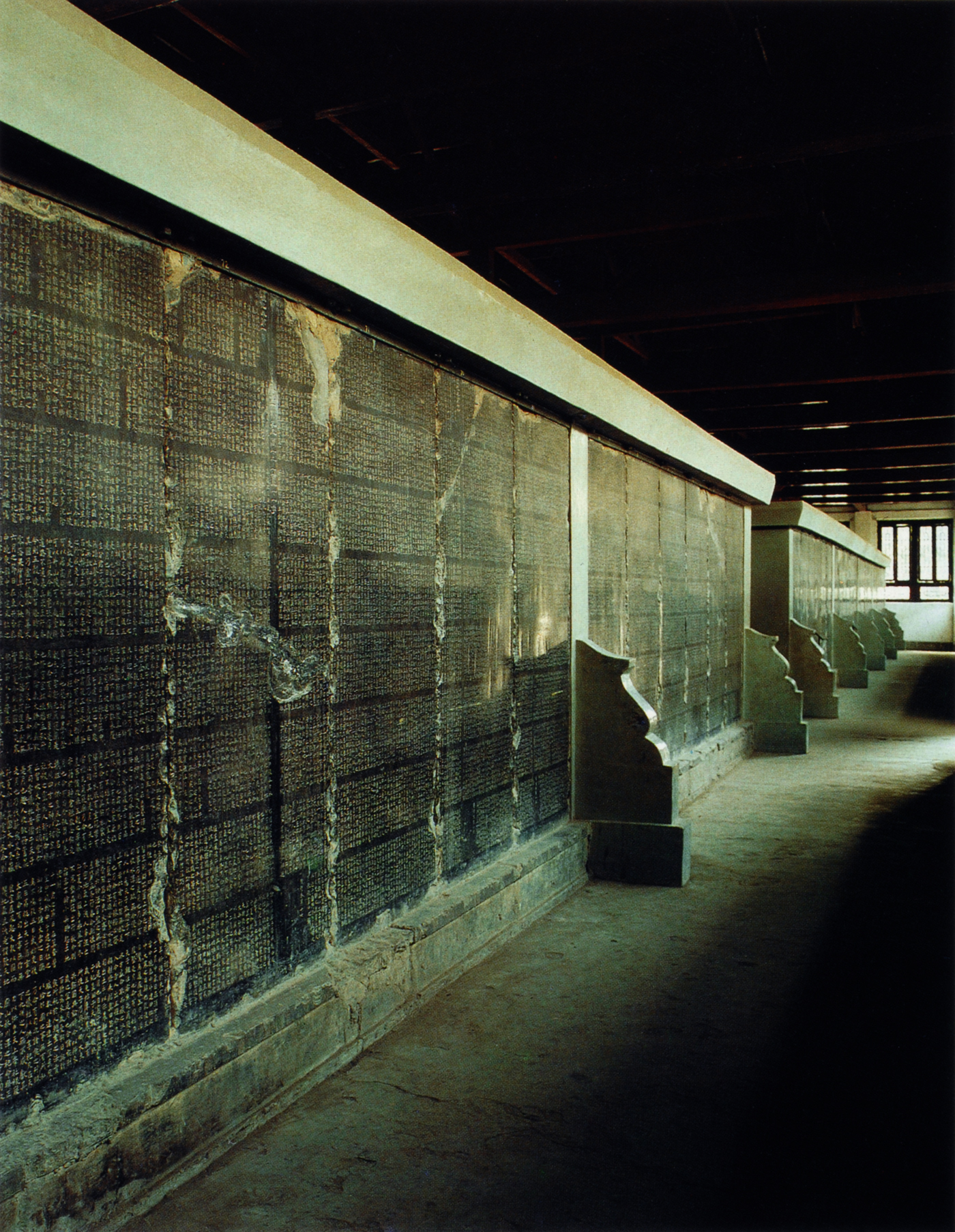
Compared to nearby Bian (modern Kaifeng), Luoyang was an old-fashioned place where the attachment to classical education was widely shared in the population. In Guo's case, “he learned to read from his maternal grand-uncle Zai Tianxing 宰天興.”Footnote 4 Guo turned out to be a child prodigy. He appears to have been fiercely interested in writing and calligraphy and was able as a boy to “master the Nine Classics” (tong jiujing 通九經).Footnote 5 The Nine Classics did not simply refer broadly to the canonical Confucian texts, but more specifically to the stone-engraved editions of the Classics dating from the Kaicheng period (836–840), when sets of stones were engraved in standard script to stand in front of the National University (Taixue 太學) buildings within the Tang dynasty Directorate of Education (Guozijian 國子監) complex in Chang'an (Figure 1).Footnote 6 It was presumably rubbings taken from these Stone Classics that Guo used as a child, allowing him to pass the special tongzi examination for gifted children at the age of seven sui, one of nine children nominated by local officials as Prefectural Nominees (xianggong 鄉貢) who received the degree that year.Footnote 7 The bureaucratic records inform us that Guo Zhongshu and the other eight boys first gave an account of their family circumstances and submitted the documentation of their nomination for verification, then were given an identification tablet and led into the examination hall.Footnote 8 Guo's earliest biographer, Wang Yucheng 王禹偁 (954–1001), reports that during the examination Guo was able to “recite the Book of History (Shang shu 尚書) from memory and write out the Analects of Confucius (Lunyu 論語).”Footnote 9 Apparently, the examination Guo took conformed to the Tang regulations of 866, which called for the student to be able to recite from memory one complete classic plus sections of the Analects and the Classic of Filial Piety (Xiaojing 孝經), and also to be able to write as required.Footnote 10 Having successfully passed the examination, Guo and the other boys reported orally their official certification to the Bureau of Appointments in the Ministry of Personnel.Footnote 11 This procedure existed because the tongzi examination qualified the successful child for later appointment as an official, even though the child might take no further interest in study. The absurdity of this system led to the temporary abolition of the tongzi examination from 940 to 943 under the Later Jin.Footnote 12 The date of Guo's participation in the tongzi examination has long been in dispute, because the date of 924 recorded in the documentary collection Models from the Archives (Cefu yuangui 冊府元龜, completed 1013), which would imply a birth date of 918, is incompatible with the statements in Song shi 宋史 that Guo was ruoguan 弱冠 (around twenty sui or slightly older) in 948 and must therefore have been born ca. 927–928.Footnote 13 As it turns out, 927 can be ruled out as a birth date because a separate documentary record of successful candidates exists for the corresponding 933 tongzi examination, which lacks Guo's name; thus we may conclude that Guo was born in 928.Footnote 14
Partial view of The Kaicheng Stone Classics (Kaicheng shijing 開成石經), ca. 836–840. Xi'an Beilin Museum. Shenxi Provincial Museum, ed., Sui Tang Wenhua (Hong Kong: Zhonghua shuju; Shanghai: Xueshu, 1990), 148. (color online)
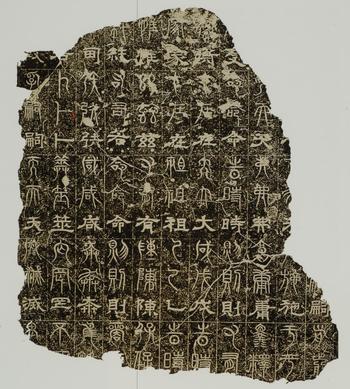
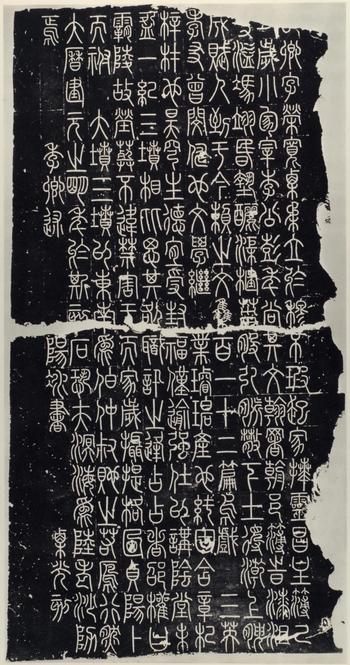
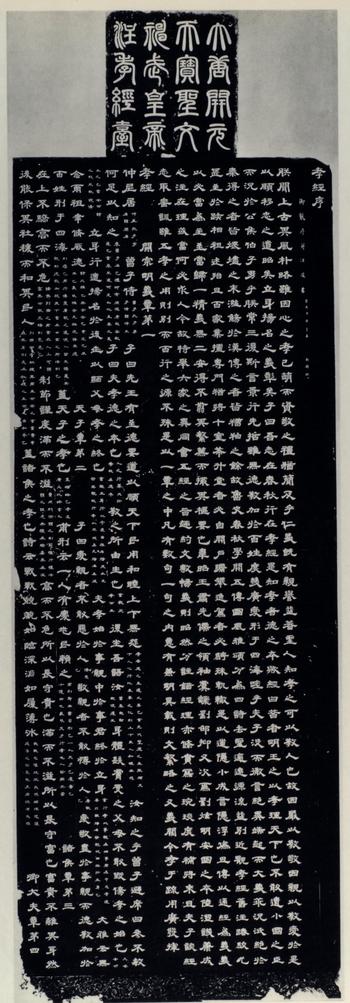
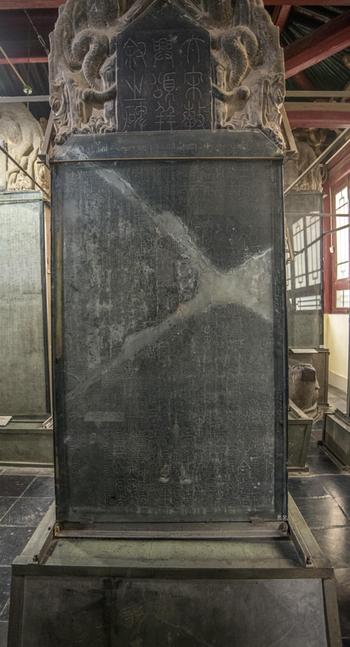
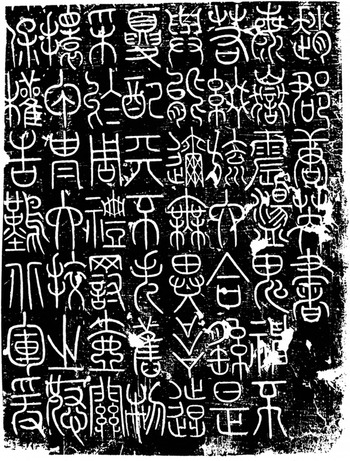
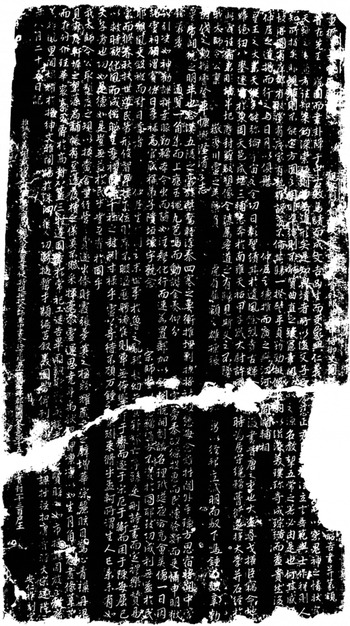
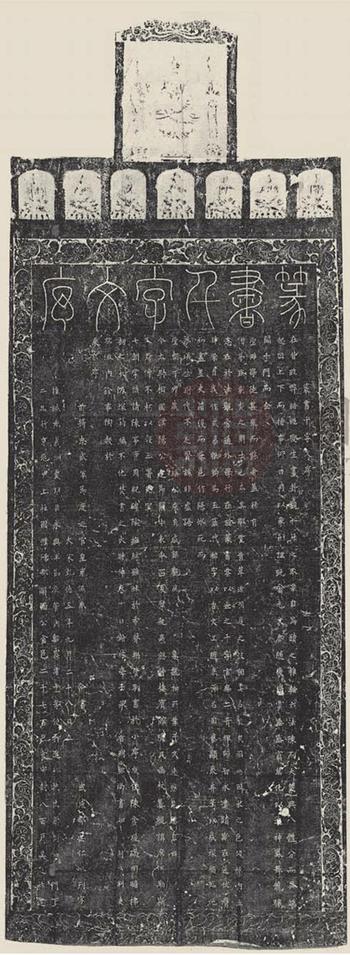
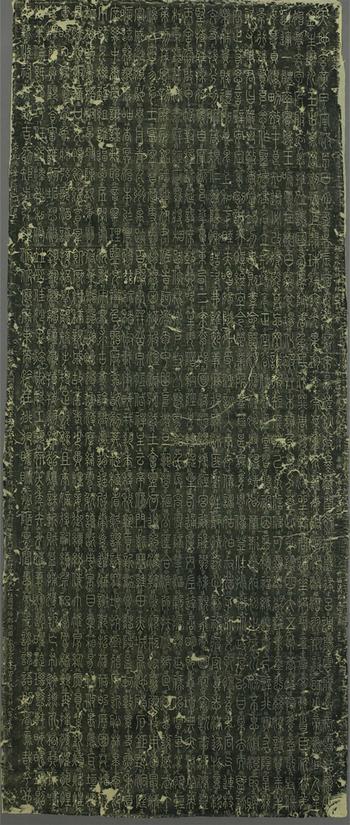
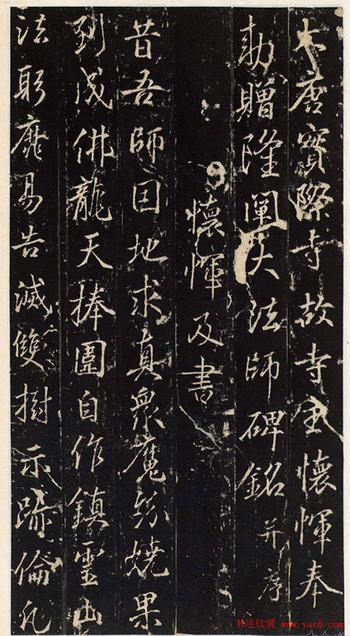
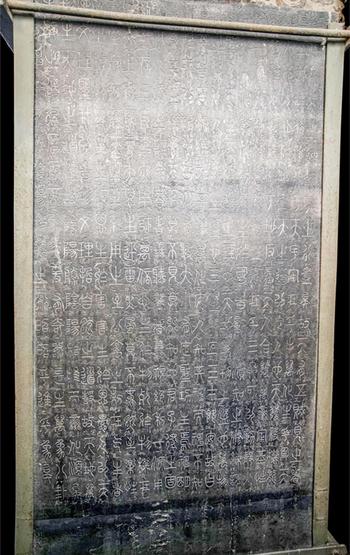
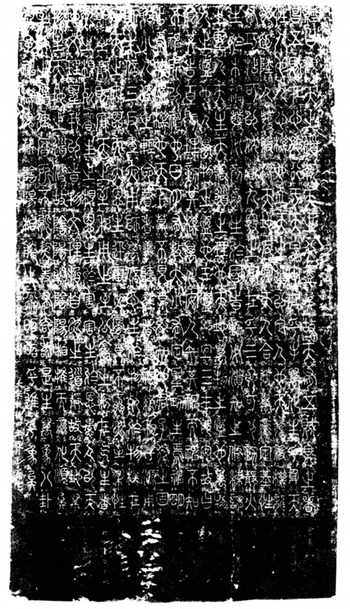
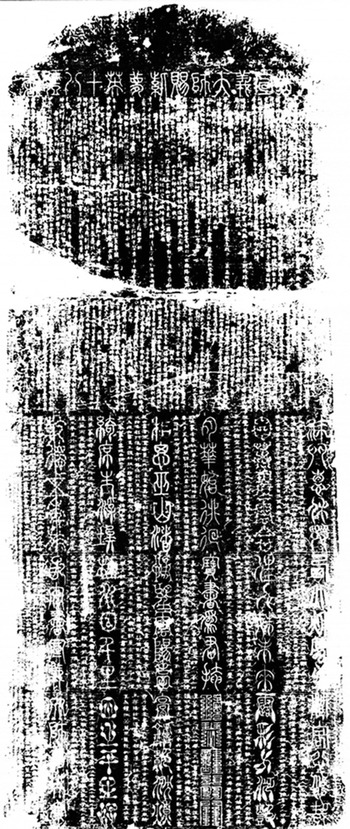
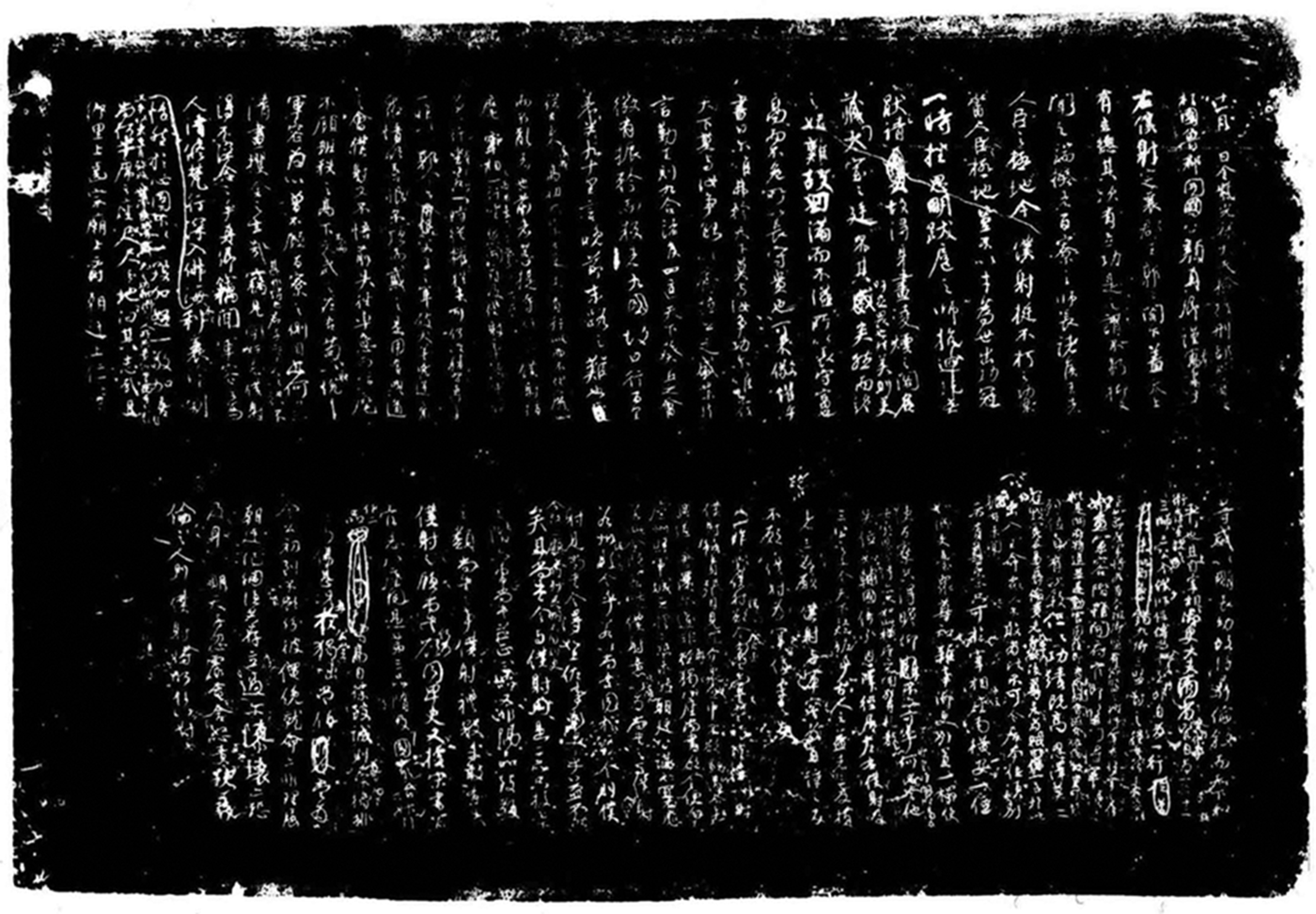
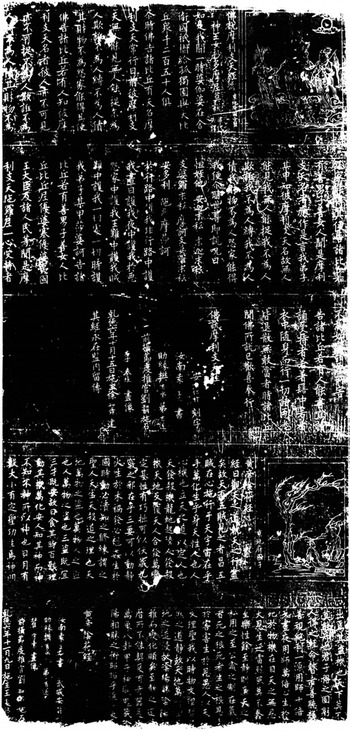
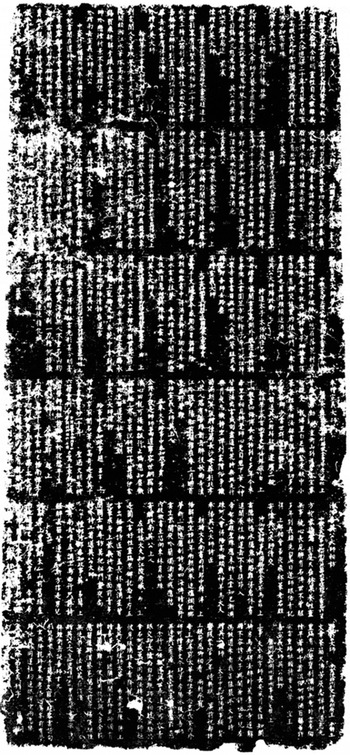
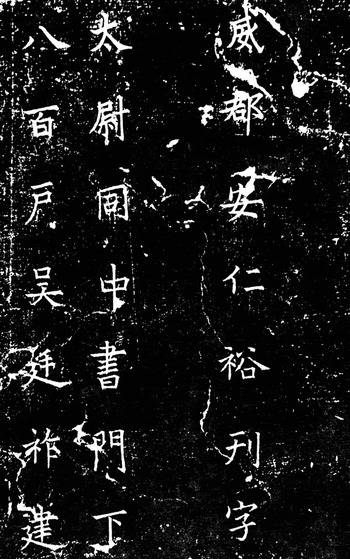
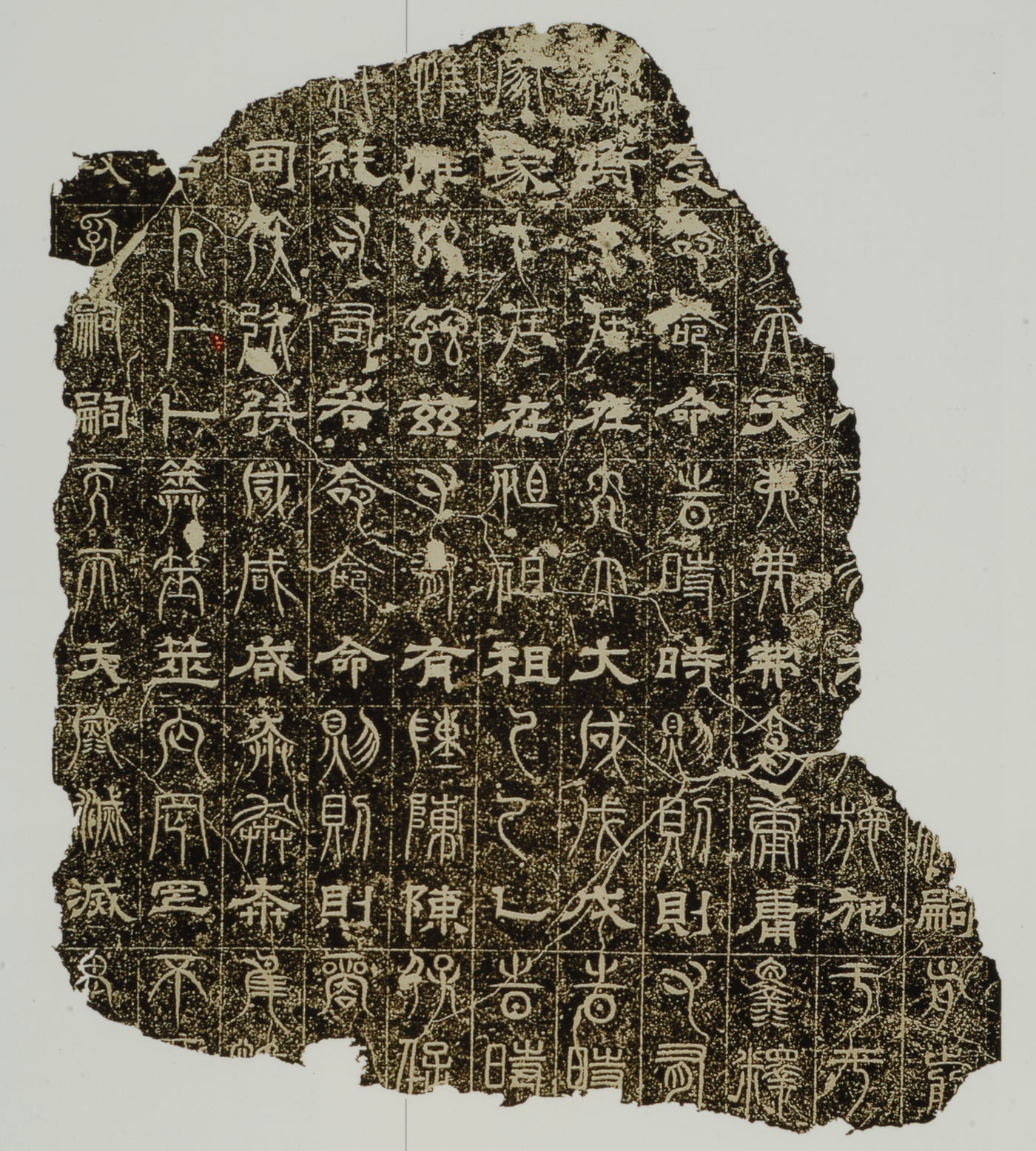
Guo Zhongshu was in no danger of resting on his laurels, for he had an exceptional interest in study. According to Zhu Changwen 朱長文 (1041–1100), writing ca. 1066, “In his youth, he was able to compose prose, excelled at the histories, the classics, and paleography (xiaoxue 小學), and was especially good at regular script calligraphy” (少能屬文, 善史書小學, 尤工真楷).Footnote 15 Although no direct information is available on the paleographic texts to which he had exposure, pride of place must go to the great Han dynasty dictionary, Shuowen jiezi (Discussion of Single-Graph Characters and Explanation of Compound Characters 說文解字) compiled by Xu Shen 許慎 (ca. 58–ca. 147 CE), which was the point of reference for all paleographic studies. Other obvious candidates are two Tang-period dictionaries, Single-Graph and Compound Characters of the Five Classics (Wujing wenzi 五經文字, 776) by Zhang Can 張參, and Compound-Character Graphs of the Nine Classics (Jiujing ziyang 九經字樣) by Tang Xuandu 唐玄度 (active first half ninth century) that were appended to the Kaicheng Stone Classics. He may also have had access through rubbings to an earlier stele-published edition of the Classics: the Wei dynasty Stone-Engraved Classics in Three Scripts (Santi shijing 三體石經, ca. 241), which employed ancient script (guwen 古文), seal script (zhuanshu 篆書), and clerical script (lishu 隸書) (Figure 2). For a studious child in Luoyang, the logical next step after success in the tongzi examination was attendance at one of the schools run by the Directorate of Education. The several schools of the Tang dynasty had at this point effectively been reduced to two: the School for the Sons of the State (Guozixue 國子學) and the National University (Taixue 太學).Footnote 16 Through an expansion in 930, the two universities together were able to accept as many as 200 students in any given year. The School for the Sons of the State was reserved for the children of prominent families; as a student who was not from such a family, Guo is more likely to have entered the National University, whose students were largely from poor elite families (rank 7 and higher) whose entry was sponsored by civil officials.Footnote 17 In Guo's day there seems to have been no formal program of teaching. From 929 on, National University students were encouraged to follow their own interests, and were tutored accordingly.Footnote 18 As a poor student, Guo would probably not have been considered eligible for the jinshi examination, which in this period was socially extremely restrictive.Footnote 19 The 1120 Xuanhe Inventory of Paintings (Xuanhe huapu 宣和畫譜) states that he obtained the less prestigious but still highly desirable mingjing 明經 degree in the Classics, which would have superseded his tongzi degree as the basis for his subsequent government appointments.Footnote 20 Although there were mingjing tracks of differing degrees of difficulty at the National University, the examination might examine only two classics and was not considered to be very rigorous. As a result, it attracted anywhere between 500 and upwards of a thousand candidates each year, most of whom had no real education beyond rote learning, and very few of whom had National University training. This led the Directorate of Education to disband the examination from 940 to 944, and also, in years when the examination was administered, to allow candidates to take the examination only once.Footnote 21
Ink rubbing of a fragment of The Stone-Engraved Classics in Three Scripts, ca. 241. Fragment in the collection of the Palace Museum, Beijing. Jin Weinuo and Xing Zhenling, eds., Zhongguo meishu quanji, 19, Shufa 1 (Hefei: Huangshan shushe, 2010), 167. (color online)
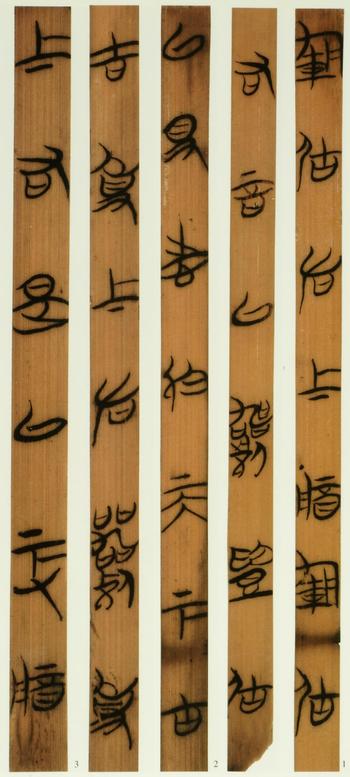
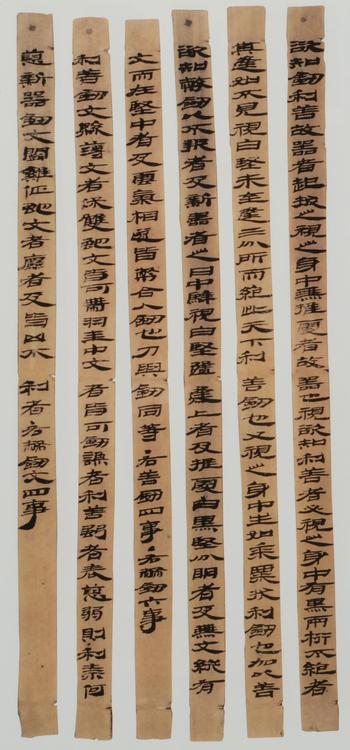
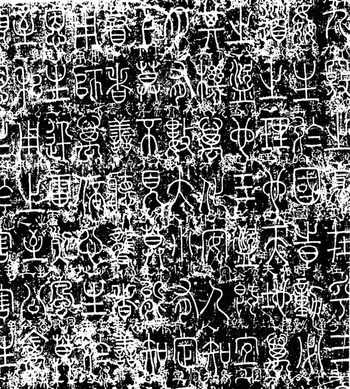
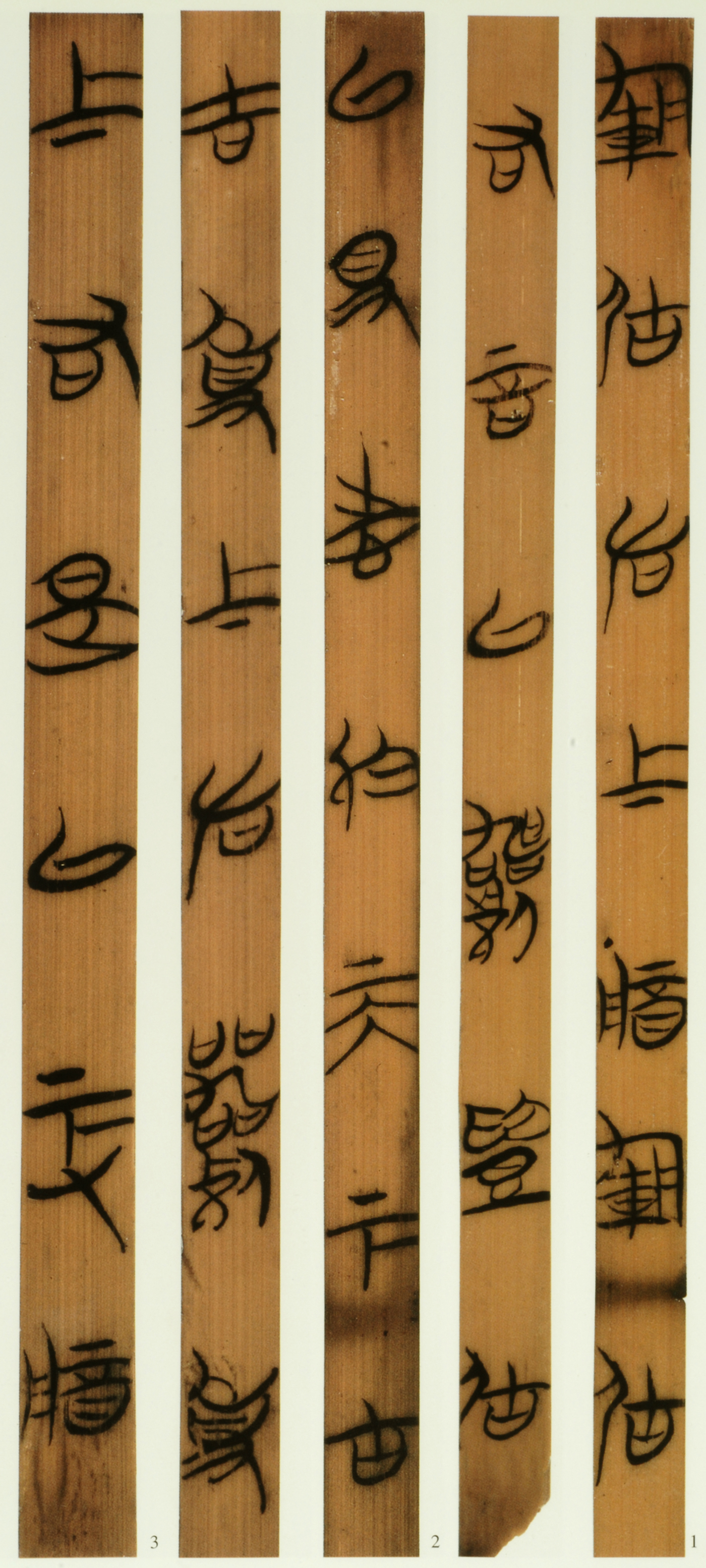
Until 935 the Directorate of Education was located solely in Luoyang, but when the Later Jin relocated the headquarters of the Directorate to Bian, in 936, the Luoyang Directorate reverted (at least nominally) to its former secondary status. Since students younger than fourteen sui were not usually accepted, Guo in principle would not have entered the National University until 941 under the Later Jin, and he would have passed the mingjing examination in either 946 or 948 (there was no examination in 947). His tuition fees were 2,000 cash at the start of his studies and a further 1,000 cash upon receiving his degree.Footnote 22 Not enough is currently known about the operation of the Directorate's universities during that period, however, for it to be possible to determine whether he pursued his studies and took the examination in Luoyang or Bian, or some combination of the two.Footnote 23 These student years laid the basis for Guo's subsequent multi-faceted reputation as a gifted prose writer, a calligrapher proficient in seal, clerical, and standard scripts, and a scholar specializing in paleography. A revealing anecdote recorded in Wudai shi bu 五代史補 refers to this period. “Someone showed him bird-trace writings that he had obtained at Dragon Mountain, and Zhongshu immediately read out the whole text for him, as if he had learnt it by heart” (嘗有人於龍山得鳥跡篆。忠恕一見輒誦如宿習。).Footnote 24 The Dragon Mountain referred to here is probably the one known today as Square Mountain 方山, located in central Henan to the south-east of Luoyang, just west of Yuzhou 禹州.Footnote 25 Yuzhou was an ancient habitation site that legend designated as the site of the capital of the Xia dynasty and subsequently as the fiefdom of the descendants of the Xia ruling house under the Shang. More reliably, under the Western Zhou, Yuzhou was the fiefdom of a younger brother of King Wu and his descendants. The city later became part of the state of Zheng 鄭, and then became the capital of one of the city-states, Han 韓, that emerged from the break-up of the state of Jin 晉 in the late fifth century BCE. The term “bird-track seal script” refers to the mythical invention of writing by Cang Jie on the basis of his observation of the tracks left by birds; it is thus a generic reference to ancient writing. Thus, although the material form of the writing that Guo Zhongshu saw is not stated, it is likely to have been an excavated object. The artifact was probably not an inscribed oracle bone from the Shang or early western Zhou period, first because oracle bones with writing have not been found in southern Henan, and second because Guo would not have been able to read the script with the ease reported in the anecdote. More likely, it was either a bronze vessel with an inscription or a fragment of a bamboo slip manuscript. However, the fact that the anecdote states only that bird-track writings were obtained suggests that writing was the very purpose of the artifact, and it may therefore have been a Warring States manuscript (Figure 3).Footnote 26 The anecdote demonstrates that already as a teenager Guo Zhongshu had developed a specialized knowledge of the history of writing.
Five bamboo slips from a fragmentary manuscript of the Daodejing, ca. fourth century BCE. Excavated from a Chu tomb at Guodian, Hubei. Collection of Jingmen Municipal Museum. Zhongguo fashu quanji, 1, Xian-Qin Qin-Han, Song Zhenhao editor-in-chief (Beijing: Wenwu, 2009), 78. (color online)
In a different direction, Guo's National University experience in the 940s must have been colored by the Directorate of Education's commitment to publishing new editions of the classics using the modern technology of woodblock printing. This innovative project entailed close attention to paleography, since the Directorate sought to establish standardized texts without the many variant characters that littered the Stone Classics.Footnote 27 Guo would certainly also have been aware that the Directorate's enterprise was a response to recent state-sponsored printing projects in the contemporary Wu-Yue and Southern Tang kingdoms, and thus belonged to a larger quasi-international world of scholarship.Footnote 28 Guo Zhongshu studied at the National University during a period of intense publishing activity by the Directorate of Education. In 927, the Luoyang Directorate had published its first printed book, a new edition of the Tang political text, Essentials of Government in the Zhenguan Reign (Zhenguan zheng yao 貞觀政要) by Wu Jing 吳兢 (670–749).Footnote 29 And in 932, at the urging of two Confucianist ministers, Li Yu 李愚 (d. 935) and Feng Dao 馮道 (882–954), the Directorate began work on an official woodblock-printed edition of the Nine Classics that, as it turned out, would take twenty-one years to complete.Footnote 30 Unflaggingly supported by the long-serving Feng Dao, the printing project continued under both Later Jin emperors, Shi Jingtang 石敬瑭 (r. 936–942) and Shi Chonggui 石重貴 (Chudi, r. 942–947). In 943, the Directorate published the Five Classics, offering it for sale ahead of the complete set of Nine Classics.Footnote 31 This would have been a major event in the life of a sixteen-sui student on the mingjing track. All editorial work must have come to a halt, however, when the Khitan army occupied Bian in 947 for several months, bringing the Later Jin to a brutal end. Yet, as early as the following year, under the short-lived Later Han dynasty, the Directorate resumed work on the remaining four Confucian classics (Zhou li, Yi li, and the Gongyang and Guliang commentaries on the Spring and Autumn Annals), which would eventually be published as part of a complete set of Nine Classics under the Later Zhou in the summer of 953.Footnote 32
The Khitan occupation of Bian was unprecedented. Shatuo rulers had generally maintained friendly relations with the Liao. But whereas Shi Jingtang had allowed the Later Jin to be a client state of an increasingly powerful Khitan empire, Shi Chonggui turned against the Liao. The Liao emperor, Yelü Deguang 耶律德光, led his troops down into Hebei at the end of 946 and defeated the Later Jin army. He then entered the capital, Bian, on the first day of the New Year, 947, and for a few months occupied the city, making the administrative changes appropriate to the absorption of Later Jin into the Great Liao empire. These changes included the downgrading of the capital to Bianzhou, corresponding to its former status within the Tang empire. Then Yelü Deguang abruptly changed course and instead decided to head back north, taking with him the Later Jin court's assets of personnel, repositories of knowledge, ritual tools, and military matériel. In the view of Naomi Standen, whose reconstruction I am following here, no central government official would have been exempt. If he did not lay low in order to avoid being caught up in the events, Guo's lowly student status would conceivably have protected him from becoming a prisoner of war. He certainly knew of, if not witnessed, the rounding-up of useful individuals and the pillaging of useful things, including the Directorate of Education's libraries, to take back to Liao territory.Footnote 33
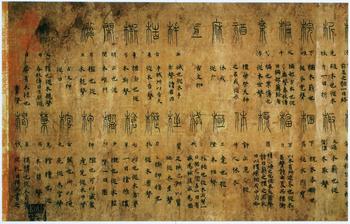
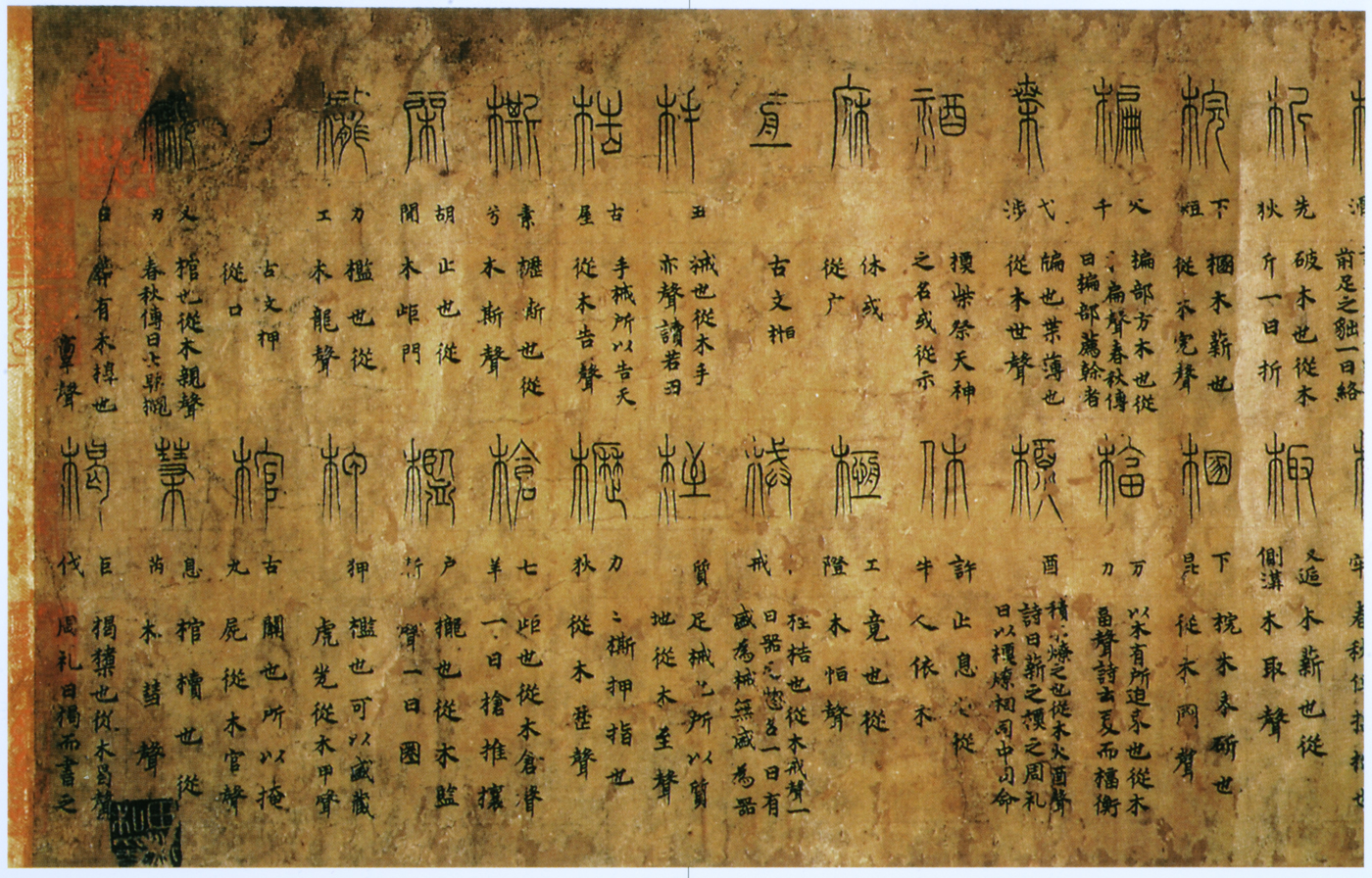
In an unexpected turn of events, Yelü Deguang took ill and died on the way north. Subsequently many of the captured Later Jin officials, including Feng Dao, were released. They returned to Bian, which in the interim had become the capital of the Later Han dynasty.Footnote 34 Indeed, the founding of Later Han in northern Shanxi in early 947 by Liu Zhiyuan 劉知遠 (895–948), who continued Shi Chonggui's hostility to the Liao, had been one of the factors precipitating Yelü Deguang's abandonment of Bian. Having escaped the Khitan net himself, Guo made his first public intervention as a scholar in 948 under the Later Han, in either Bian or Luoyang. In the fourth month of 948, Guo, still only 20 sui, composed a preface to the Buddhist Tripitaka, Preface on the Purpose of the Triptaka (Dacangjing zhixu 大藏經旨序), which was engraved on a stele. Guo wrote the seal-script title for the stele himself, but it was another young man, Yuan Zhengji 袁正己, from Runan 汝南 in southern Henan, who wrote out the text itself in regular script (kaishu 楷書) calligraphy, probably in the Ouyang Xun style for which Yuan was to become known.Footnote 35 Neither the inscription nor the text has survived, but there are reasons to think that it was connected to a former Confucian scholar turned Buddhist monk, Kehong 可洪. In 939, Shi Jingtang had ordered the inclusion in the Tripitaka of the 450 juan of Compendium of Sounds and Meanings in the Tripitaka (Dacangjing yinyi suihan lu 大藏經音義随函录), which Kehong had just submitted to the throne.Footnote 36 Kehong's text was modelled on Textual Explanations of Classics and Canons (Jingdian shiwen 經典釋文) by the Tang classicist, Lu Deming 陸德明, of which the Directorate of Education would print a new edition in 959 (see Figure 10). In his preface to Compendium of Sounds and Meanings, Kehong states, “without written language there is no way to transmit the purpose [of sutras]” (非文字無以傳其旨).Footnote 37 If the shared word “purpose” is not simply a coincidence, therefore, the text transcribed by Yuan Zhengyi with a seal script title by Guo Zhongshu may have been this very preface to the Compendium of Sounds and Meanings. The Compendium, it is worth noting, made good use of Xu Shen's Discussion of Single-Graph Characters and Explanation of Compound Characters, seen in Figure 4 in a ninth-century manuscript version, on which Guo himself would soon publish his own specialist study.Footnote 38
Xu Shen, Discussion of Single-Graph Characters and Explanation of Compound Characters (Shuowen jiezi), ninth century. Manuscript handscroll, Japanese private collection. Jin Weinuo and Xing Zhenling, eds., Zhongguo meishu quanji, 20, Shufa 2 (Hefei: Huangshan shushe, 2010), 389. (color online)
Xuzhou, 948–950
Later in 948 Guo obtained his first appointment as an official, when he was recruited by Liu Zhiyuan's nephew and adopted son, Liu Yun 劉贇. Liu had just been appointed Military Commissioner (jiedushi 節度使) of the Wuning Circuit, based in Xuzhou due east of Bian at the edge of Later Han territory, in the north of present-day Jiangsu province, on the eastern frontier with Southern Tang.Footnote 39 The unexpected death of a seasoned general had created a vacancy, which Liu Zhiyuan filled by appointing Liu Yun, on the eve of his own unexpected death on March 10. All sources concur that Guo Zhongshu was ruoguan 弱冠 when he entered Liu Yun's entourage, and the circumstantial evidence of examinations presented earlier confirms that he was exactly 20 sui. Xuzhou was a place of strategic military importance for any Luoyang- or Bian-based dynasty's relations with the Southern Tang kingdom to the south and the Liao empire to the north. Guo Zhongshu's role on Liu Yun's staff is not entirely clear. According to the Song History, he was an advisor (congshi 從事) with the official rank of Judge (tuiguan 推官), but these titles give no indication of the range of his actual functions. In a general sense, though, Guo was following what was perhaps the most effective path to advancement that a mingshi graduate could take, which was to join the secretariat of a powerful man, either a high civil official in the central government or a Military Commissioner away from the capital. Military Commissioners, who founded all of the Five Dynasties and most of the Ten Kingdoms, constituted a military aristocracy with princely powers in the areas they controlled.
These generals and their families developed a distinctive visual and material culture. In recent years, archaeologists have excavated several lavish tombs of Military Commissioners, some turned rulers, in north-central China and beyond.Footnote 40 To these tombs can be added a few recently excavated, imperially authorized honorific steles (dezhengbei 德政碑) that were originally erected above ground as public monuments in honor of their achievements.Footnote 41 A number of Buddhist chapels also survive from the period of the Guiyi Commandery's control of Dunhuang. These tombs, steles, chapels, and temples, together with descriptive texts from the period, attest to a pattern in the way the generals’ two worlds of military action and civil life were represented. The professional military life of the Commissioners was represented largely textually, on epitaph tablets (muzhiming 墓誌銘) placed in the tombs, and on honorific steles above ground. Visual references to the military life are rarer: the most common are depictions of guardian deities in tombs, temples, though one also finds representations of military processions and orchestras, as well as depictions of the animals pursued in hunting (tomb of Meng Zhixiang). The Chinese Military Commissioners, whatever their ethnic origins, differed from their contemporary Khitan counterparts in not including portraits of their favorite horses in their tombs. The bulk of the visual representations depicted instead the pleasurable domestic life of the palace residence. In fact, in several of the tombs the Commissioners were buried together with their wives, or the wife had her own adjoining tomb. The tombs reveal a striking devotion not only to luxury but also to the latest fashions. Every excavated tomb has proven to be large; every tomb has its own unique design. The tomb decorators were always the best available, working in the latest styles of painting, sculpture, or sculptural relief. The tomb as a whole had as one of its purposes to enact an inhabited underground mansion or palace with equally up-to-date and luxurious furniture, objects, and wall decoration. Female attendants are depicted wearing fashionable attire. These characteristics of tomb decoration are echoed in the paradise scenes of chapels and temple halls associated with the military aristocracy, which translate the vision of a pleasurable life (spiritually earned in this case) into an exotic register.
The preoccupation with pleasure seen in the art that the generals sponsored chimes with Tao Gu's 陶穀 (903–970) near-contemporary description of the Five Dynasties fashion for elaborate banquets:
During the fifty years of the Five Dynasties, family names claimed dynasties one after another like wheatcakes being flipped from the oven, and the officials and nobles were ever more excessive [in their conduct]. People of no merit encountered the magnanimity of the rulers, and became rich and powerful for no reason, treating the security of their states as if Qin and Yue had not plotted against each other. And so generals, ministers, and men of high status came to steal pleasure from the [ephemeral] enjoyment of banqueting. These, the powerful men of the day, had even more appreciation for the paraphernalia of banquets, and wherever there was luxurious food from land or water they would gather in front of it. Banquets on the scale of a hundred square feet were not unusual, where they would set up two tables, one on either side, supporting lustrous flowers and jade-like fruit; vegetables, bamboo shoots, and minced fish; sweetmeats and intoxicants, to the tune of several hundred varieties. They called this practice “paired platforms for dishes,”Footnote 42 and no imperial banqueting kitchen or official's household was able to match it.
五代五十年間, 易姓告代。如翻鏊上餅然, 官爵益濫。小人乗君子之器, 富貴出於非意, 視國家安危如秦越不相謀。故將相大臣得以竊亨燕安。當時貴勢以筵具更相尚。陸珍水異, 畢集於前。至於方丈之案不勝列, 傍挺二案, 翼之珠花玉果, 蔬荀鮓醢, 糖品香劑, 參差數百, 謂之綽楔臺盤。御宴官家例不能辨。Footnote 43
Given that Military Commissioners were men of action, it is not surprising that in addition to these outdoor banquets they also felt a deep affinity for arts of performance. Visual representations of music, dance, and storytelling, and references to their own practice of “flying white” (feibai 飛白) calligraphy or their polo-playing, are variously found on epitaph tablets and steles, and in pictorial representations in tombs, chapels, and temple halls.
This is the distinctive world that Guo Zhongshu entered when he joined Liu Yun's entourage in Xuzhou as a fresh-faced National University graduate from a modest family background. With an insecure new eighteen-sui emperor, Liu Chengyou 劉承祐, on the throne, who was surrounded by powerful generals with designs on power, Liu Yun's own position was very uncertain. The brief account of his Wuning Commandery tenure in Jiu wudai shi 舊五代史 begins with a discussion of portents, which give a sense of the tense atmosphere in his entourage. Although Liu's tenure began auspiciously enough in the eighth month of 948 with the appearance of a multi-colored cloud, in the winter of 949 a flock of unusual birds resembling phoenixes congregated in a tree in the courtyard of Xianbi Hall (probably the main hall of the yamen). Xianbi 鮮碧, meaning rare jade, is a homophone for the Xianbi or Xianbei 鮮卑 people; the name may have been chosen as a reference to the Liu family's Shatuo origins. A visitor who observed the birds is said to have commented sadly and ominously: “When wild birds enter a residence, it means that the master of the house is going to disappear, no-one knows where” (野鳥入室, 主人將去).Footnote 44
Aside from his military duties, Liu Yun also had ideological responsibilities. His adoptive father, Liu Zhiyuan, sought to reinforce the legitimacy of the Later Han dynasty by claiming to be descended from the founder of the Han dynasty, Liu Bang, who was born near Xuzhou. An ancestral temple already existed on Mt. Mangdang 芒碭山 to the east of the city. To reinforce the claim of ancestry, however, Liu Zhiyuan ordered the construction of a second ancestral temple on a site not far from that of the original temple, on the grounds that textual evidence showed the new site to be Liu Bang's correct birthplace. The construction of this temple was Liu Yun's administrative and, no doubt, financial responsibility as Wuning Military Commissioner. When the building was completed in 949, it was Guo Zhongshu who transcribed in bafen clerical script calligraphy the text of a stele inscription commemorating the temple's construction, Stele Commemorating the Renovation of the Ancestral Temple of Emperor Gaozu of the Han Dynasty (Chongxiu Gaozu miao bei 重修高祖廟碑).Footnote 45 The stele was erected at the site of the temple.
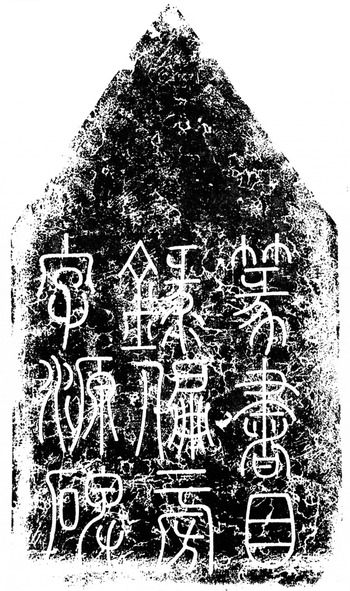
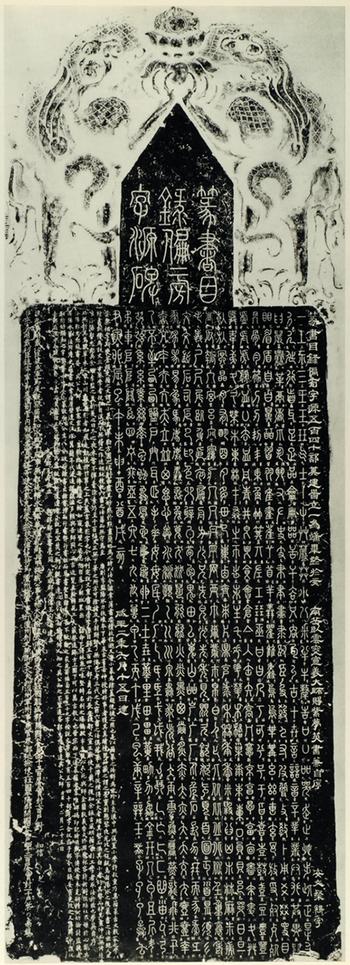
Guo must have spent much of the two years or so that he spent in Liu Yun's entourage on scholarship. The proof is that the following year, 950, in the seventh month, he completed his first scholarly study at the age of only 22 sui. Entitled Origins of Compound Characters in the “Shuowen” (Shuowen ziyuan 說文字源), the now-lost book was a paleographic study of Xu Shen's Discussion of Single-Graph Characters and Explanation of Compound Characters. This was not simply a private project, however. Guo's transcription of Origins of Compound Characters in the “Shuowen” was engraved at the time on a stele in Xuzhou, perhaps in the grounds of the city's Confucius Temple or prefectural school. We owe our knowledge of the stele to the great compendia of inscriptions by Ouyang Xiu 歐陽修 (1007–1072) and Zhao Mingcheng 趙明誠 (1081–1129).Footnote 46 Both writers discuss the stele rubbing as an example of Guo Zhongshu's xiaokai小楷 calligraphy, but Zhao's table of contents, which gives the more precise date, lists it as a combination of seal script (zhuan 篆) and xiaokai. This probably does not mean that there was a seal script title above a stele text written entirely in xiaokai, but rather that the characters Guo was explaining were basically in small-seal script (following the model of Discussion) with commentaries in xiaokai. If Ouyang and Zhao did not comment on the seal script headings as calligraphy, it may be because the headings were not entirely in small-seal script. Discussion included a number of rare ancient script (guwen 古文) characters for which there were no seal script equivalents, and Guo is likely to have done the same. From the point of view of the eleventh-century writers, ancient script, current in the Warring States period, belonged more to the realm of writing than calligraphy.
To understand why Guo Zhongshu wrote Origins of Compound Characters in the “Shuowen,” and why his efforts should still concern us today, one has to know something about Discussion of Single-Graph Characters and Explanation of Compound Characters itself and how it circulated in Guo's time. The author, Xu Shen, composed the dictionary in order to give his Eastern Han contemporaries access to the meanings of words in texts that had originally been written in scripts that few people could read any more. In Xu Shen's time these texts largely circulated in versions that used small-seal script or clerical script—the two new scripts that had been introduced in the third century BCE to replace the earlier scripts, and which had been imposed at the price of the deliberate destruction of manuscripts written in the earlier scripts. Most important for Xu's purposes was ancient script, since this was the script used in surviving or excavated bamboo slip manuscripts, but the dictionary also included characters drawn from even earlier scripts. Wherever possible, Xu Shen presented the word in small-seal script form; but when no seal script equivalent existed for a character, he used the original ancient script or an even earlier script. The dictionary's explanations, meanwhile, were in clerical script. Xu Shen recognized that Chinese writing had an organizing principle: when characters combined graphs, one of the graphs identified a group of related characters to which the compound character belonged. The individual graphs were called wen when they appeared on their own as single-graph characters, and pianpang (what we know todays as radicals) when they became organizing components of a compound character. Much like a modern Chinese zidian dictionary, Discussion had individual entries for both the organizing character component and all its related compound characters.
In Guo Zhongshu's time, when the Classics had long since been translated into the more modern regular script, Discussion of Single-Graph Characters and Explanation of Compound Characters remained the major reference work for understanding the meanings of Chinese characters, no matter what script they were written in. Xu Shen's original version no longer existed, however; instead, tenth-century scholars used an updated version created by the eighth-century paleographer and calligrapher, Li Yangbing 李陽冰 (ca. 713–787) (see Figure 4). Li Yangbing's version of Discussion translated all the remaining ancient and earlier script headings into small-seal script as well. Yet Li Yangbing's updating did not make the dictionary any easier to use. One of Guo Zhongshu's older contemporaries, Lin Han 林罕 (897–949 or later), complained:
For us today, the Shuowen is huge, is dense with text, and takes up many scrolls; it is hard to find what one is looking for, and going back and forth one ends up confused and not knowing where to go.
今以《說文》浩大, 備載群言, 卷軸煩多, 卒難尋究, 翻致懵亂, 莫知指歸。Footnote 47
Moreover, tenth-century scholars were starting to be aware that the translation of ancient script into any more recent script had a potential for error that compromised access to the wisdom and knowledge of the Ancients. Ancient script itself, which had never completely disappeared, was becoming an object of fascination and paleological study.
The aforementioned Lin Han, a scholar from Sichuan, was a pioneer. During the years 926 to 933, Sichuan was briefly absorbed into the Later Tang empire, and in 931 Lin took advantage of the resulting travel possibilities to visit Luoyang. A period of illness during his visit led him to start compiling a new edition of Discussion of Single-Graph Characters and Explanation of Compound Characters.Footnote 48 After falling ill again in 935, back in Chengdu, a year after the establishment of the Later Shu regime, Li returned to his research. Since his illness lasted some years, he had the time to revise his earlier work. In 937 he completed the now-lost edition, entitled Comprehensively Annotated “Shuowen” (Shuowen jijie 說文集解), which circulated in manuscript form. For this edition, Lin Han combined the explanations in Li Yangbing's earlier edition with material from elsewhere, such as the explanations of clerical script characters in another eighth century text, Imperially Established Sounds and Meanings of Single-Graph and Compound Characters (Sheng zhi Kaiyuan wenzi yinyi 聖製開元文字音義, 753).Footnote 49 Lin Han then went on to address the difficulties that using Discussion entailed in a new work that again has not survived, Brief Discussion of the Origins of Compound Characters [in Relation to] Character Components (Ziyuan pianpang xiaoshuo 字源偏旁小說).Footnote 50 Lin here isolated the 541 single-graph characters of the dictionary, which he probably wrote out in seal script. Beneath each one, he listed the compound characters that were derived from the single-graph character when it was used as a radical, and specified the pronunciation in each case, using a clerical script homophone when the character was well known and the qieyun system when the character was more obscure. Lin Han's innovative reference work provided the user of Discussion with a convenient way of seeing and exploiting the logic of Chinese writing that Xu Shen had identified, but which the organization of his dictionary tended to obscure. Lin Han had Brief Discussion of the Origins of Compound Characters [in Relation to] Character Components engraved on a stele in Chengdu in 949 “to avoid the errors of copying” and the labor associated with manuscript transmission, since ink rubbings could be made from the stele.
Guo Zhongshu's Origins of Compound Characters in the “Shuowen” appears to have been lost before the end of the Song dynasty. All we concretely know about it comes from a brief comparison that Guo made in the 960s with a similarly titled work by a third scholar, a Buddhist monk from the former territory of Chu, Mengying 夢英 (934/6–999 or later). Commenting on Mengying's Tabulation of Character-Component Origins of Compound Characters (Mulu pianpang ziyuan 目錄偏旁字源, see Figures 73–74), Guo wrote: “I notice that in what you sent me there are 539 [actually 540] characters listed as character components. Now, Origins of Compound Characters in the “Shuowen” only had 540 [actually 539] headings, because jie 孑 is listed under the zi 子heading, but now your Tabulation has rashly changed it back again [to a heading of its own]” (見寄偏旁五百三十九字, 按《説文字源》唯有五百四十部, 「孑」字合收於子部, 今《目録》妄有更攺之。).Footnote 51 Comparing these remarks with Tabulation of Character-Component Origins of Compound Characters, which does survive as a stele inscription (Figures 69–70), one can infer that Guo's earlier book made a similar tabulation of the character components (pianpang 偏旁) from which compound characters are generated. In the same letter, Guo Zhongshu goes on to note the deficiencies of Lin Han's Comprehensively Annotated “Shuowen,” and also writes disparagingly of Lin's Brief Discussion of the Origins of Compound Characters [in Relation to] Character Components:
Moreover, in Comprehensively Annotated the character ei is listed under the qu heading in the accompanying note. And, checking his character components, he is short five characters—jing, suo, zhi, gui, and xuan. So you can see that Lin's work is not properly grounded and will mislead later investigators. If you see his Brief Discussion, you might as well burn it.
又《集解》中「誒」收去部, 在注中。今點檢偏旁, 少「晶、惢、至、龜、弦」五字, 故知林氏虛誕, 誤於後進者, 《小説》 見,冝焚之 。.Footnote 52
For all Guo's bluster, it is hard to avoid the conclusion that his Origins of Compound Characters in the “Shuowen” of 950 was directly modelled on Lin Han's Brief Discussion of the Origins of Compound Characters [in Relation to] Character Components, published in 949. Mengying's later Tabulation of Character-Component Origins of Compound Characters—the only one of these three very similar studies to survive—no doubt owed a debt to both.
Scholarship was one thing, personal survival in murderous times another. In the course of the year 950, it became clear that the Later Han emperor, Liu Chengyou, would not be able to retain his throne in the face of the rising power of Guo Wei 郭威, a Han Chinese general reportedly descended from Guo Ziyi's brother who was determined to free the Central Plains region from Liao encroachment. Guo Wei had served Shatuo rulers with distinction since the Later Jin, but now saw himself as more qualified to rule than the young Liu Chengyou, who unsuccessfully tried to have him murdered in 950. In 950, having indeed eliminated Liu Chengyou, Guo Wei proposed Liu Yun as successor and sent senior ministers, including Feng Dao, to persuade Liu to come to Bian. The ominous portents associated with Liu Yun accumulated. As Liu Yun set out to welcome Feng Dao at the outskirts of Xuzhou, his usual horse shied, forcing him to use a different horse, an incident that onlookers took as inauspicious. And as he left the city, the clouds parted and a band of sunlight lit up the city behind him like a painting, while thunder rumbled. This time the contemporary comment was that the heavens were splitting apart.Footnote 53 The invitation to become emperor was patently dangerous, and Liu Yun eventually accepted it with great hesitancy. On the way to Bian, he and his entourage, including Guo Zhongshu, accompanied by the senior ministers, stopped overnight at Shangqiu, and awoke to discover 700 cavalry led by Guo Chongwei 郭崇威 outside the yamen compound blocking their way forward. They quickly learned that Guo Wei had seized power. With Guo Zhongshu at their head, Liu's entourage turned on the ministers, whom they accused of having betrayed them:
When Zhongshu learned of the changed situation, he self-righteously remonstrated with [Feng] Dao: “Your excellency has been a senior minister under successive dynasties. Your honesty is famous throughout the world. When scholars everywhere speak of you, it is always with admiration for your conduct, which they uniformly consider exceptional. But now suddenly you baselessly propose to abandon the enterprise of Han and its predecessors. Does this leave your excellency easy in your heart?” Dao said nothing in reply. Zhongshu then argued to Liu Yun that he should kill Dao and flee to Hedong [northern Shanxi]. Liu Yun vacillated and could not bring himself to do it, then was overtaken by disaster. Zhongshu went into hiding for a long time.
忠恕知事變, 乃正色責道曰:”令公累朝大臣, 誠心著於天下, 四方談士無賢不肖, 皆以為長者。今一旦反作脫空, 漢前功業並棄, 令公之心安乎?” 道無言以對。忠恕因勸湘陰公殺道, 以奔河東。公猶豫未決, 遂及於禍。忠恕竄迹久之。Footnote 54
This account, from Wudai shi bu 五代史補, is corroborated by a broadly similar account in Jiu wudai shi that does not mention the name of Feng Dao's attacker.Footnote 55 In contrast to his later, Song dynasty reputation, in his own lifetime Feng Dao, the unwavering supporter of the Directorate of Education, was a much admired figure, exactly as Guo is reported to have described him.Footnote 56 Feng, as a sixty-nine-sui veteran of the administrations of three dynasties plus the Liao occupation, had faced down more formidable opponents than the twenty-three-sui Guo Zhongshu. Moreover, in this case Feng was unfairly accused, since he had in fact opposed an earlier attempt by Guo Wei to seize power and moreover had no prior knowledge of the events of the previous hours that had suddenly brought Guo Wei to the throne. From other accounts it seems that the man who had Liu Yun's ear during this critical time was Dong Yi 董裔, the manager of official paperwork (panguan 判官) on Liu Yun's staff.Footnote 57 It makes sense, therefore, that after Guo Zhongshu “clashed with the Record Keeper Dong Yi (despite the fact that the latter is said to have been giving similar advice to Liu Yun), he resigned and left” (與記事董裔争事, 拂衣而去).Footnote 58 This was fortunate for Guo, given that within hours Guo Chongwei executed Dong Yi and Liu Yun's other lieutenants.Footnote 59 No wonder Guo Zhongshu went into hiding and laid low for a long time. For, compounding the problem, his intemperate intervention subsequently took on a dangerous resonance from the fact that Liu Yun's biological father, Liu Min 劉旻, went on to establish a Shatuo Northern Han 北漢 kingdom (950–979) at Taiyuan during the same year. A troublesome irritation to both the Later Zhou and the Song, the kingdom survived until 979 as a client state of the Liao.
Bian, 952–953
In the first month of 951 Guo Wei established his own [Later] Zhou dynasty. He then executed Liu Yun and attacked his remaining followers in Xuzhou, eliminating them after a two-month siege.Footnote 60 Guo Zhongshu was fortunate: his proven talents as a paleographer were more useful to the Zhou government than would have been his elimination. The Directorate of Education was then under the directorship of Tian Min 田敏 (b. 880), a specialist of the Classic of History (Shang shu 尚書) with whom Guo, given his fascination for the same text, may have studied at some point. The Later Zhou Directorate recruited Guo Zhongshu, probably not before 952 given the dangerous situation he was in in 951, but probably not later either, to judge by what he achieved by the end of 953. The occasion of his recruitment was most likely an imperial order to “seek out sages” (zhao xian 召賢). “Seeking out sages” was a time-honored recruitment strategy for governments when the supply of degree holders was insufficient or when qualified candidates for official positions were reluctant for political reasons, and there were several such orders under the Later Zhou. Official appointments at that time followed Tang practice, commonly combining functional titles (guan 官), prestige titles (sanguan 散官), and merit titles (xun 勳). The combination fixed the official's status within a complex hierarchy, but his functional title determined the design and color of the robes he wore and the corresponding basic salary.Footnote 61 Guo Zhongshu's initial titular appointment was to the School for the Sons of the State, as Erudite with Responsibility for the Study of Calligraphy (Guozi shuxue boshi 國子書學博士).Footnote 62 He is the only known Erudite to have had this responsibility under any of the Five Dynasties (though he had a counterpart in the Later Shu kingdom), and he was not to have a successor in Bian until after Taizu's reign ended in 976.Footnote 63 Calligraphy and paleography both fell under the shuxue boshi rubric, defining his actual function within the Directorate of Education. His corresponding prestige title was Grand Master for Closing Court (Chaosan dafu 朝散大夫, rank 5b2 under the Tang dynasty) within the Court of the Imperial Clan (Zongzheng si 宗正寺), where his merit title was vice-director (cheng 丞).
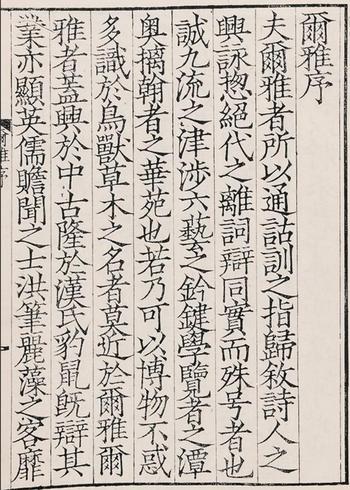
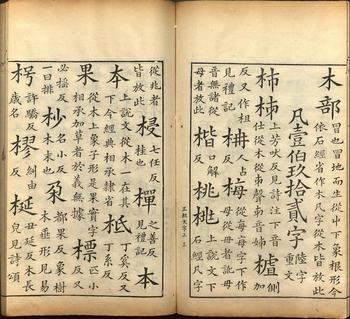
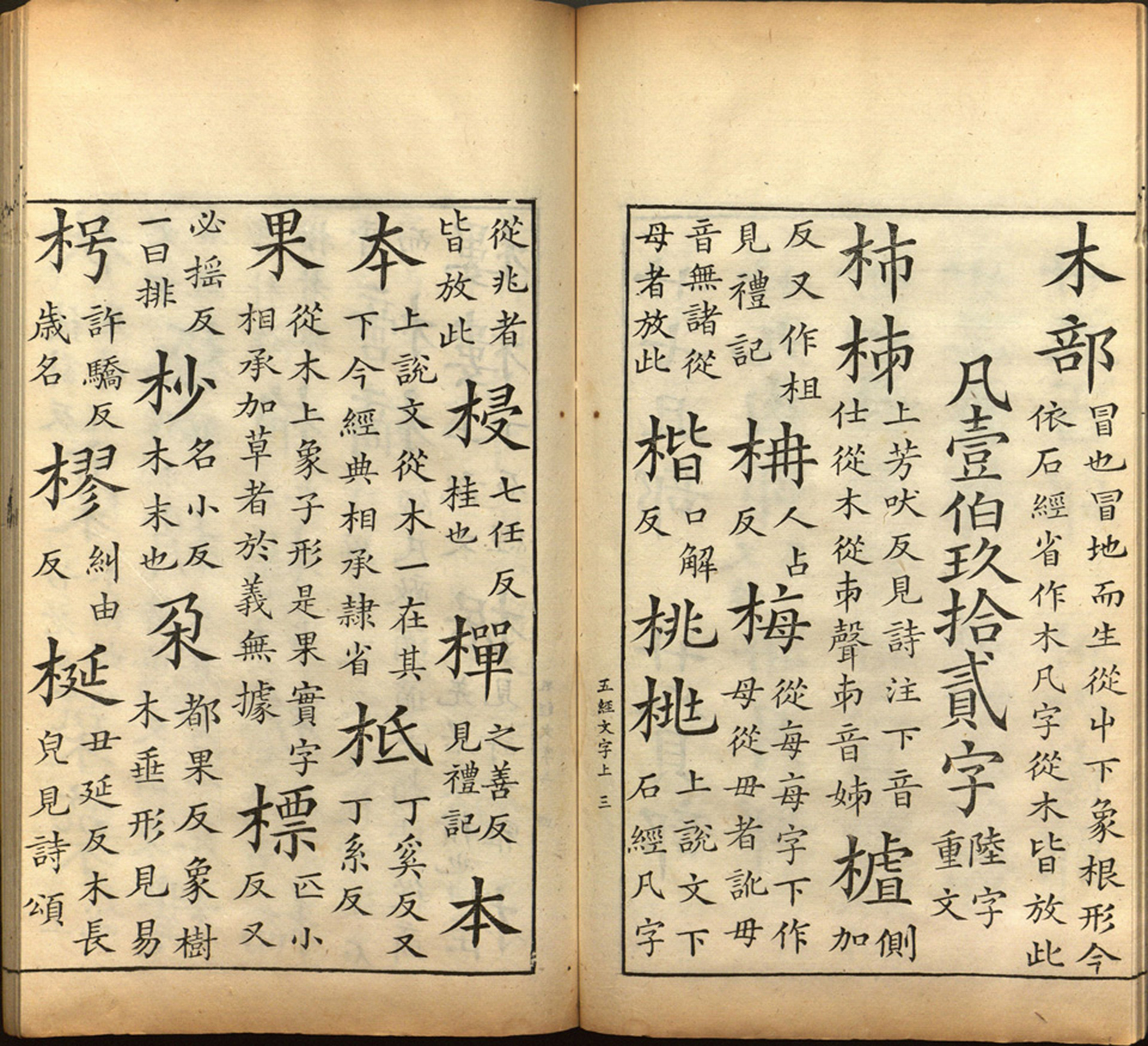
Under the Later Zhou in the 950s, the Directorate of Education continued to operate as much or more as a center of publishing as it did as a teaching institution. Completing a longstanding institutional project, in 953 the complete set of the Nine Classics was finally printed and offered for sale. Like the Kaicheng Stone Classics before them, the Five Dynasties editions printed by the Directorate of Education employed a standardized regular script calligraphy, made possible by the use of a few particularly disciplined calligraphers. The calligrapher for most of the Nine Classics was Li E 李鶚, whose work for the project can still be seen today in facsimile due to a Muromachi-period reprint of a Southern Song Directorate of Education reprint of the 953 Erya edition (Figure 5).Footnote 64 By this time, the Directorate had also expanded its printing activities to include reference works beyond the Erya, the original lexicographic guide to the Classics. The additional reference works were useful to the Directorate's ongoing professionalization of the examination system, since they helped to create consensus over the identification of characters, the identification of tones, and the interpretation of meaning. The first of these ancillary texts to be published, also in 953, were new editions of Single-Graph and Compound Characters of the Five Classics (Wujing wenzi 五經文字), here shown in an eighteenth-century edition (Figure 6), and Compound-Character Graphs of the Nine Classics (Jiujing ziyang 九經字樣); the latter work had previously also been printed privately in 946.Footnote 65 It was almost certainly in order to work on these two books that Guo was recruited to the Directorate of Education, since he wrote in 953 that he had “recently been serving as an official paleographer, verifying and correcting the identification of compound characters in the Stone Classics” (臣頃以小學蒞官, 校勘正經石字).Footnote 66 For this work, the research leading up to his Origins of Compound Characters in the “Shuowen” (Shuowen ziyuan 說文字源) of 948 had prepared him perfectly.
Muromachi-period facsimile reprint of a Southern Song Directorate of Education facsimile reprint of the 953 Later Zhou Directorate of Education printing of Guo Pu's Erya, transcribed by Li E (detail). Guyi congshu (Tokyo: Chinese Embassy, 1884) facsimile reprint. (color online)

Zhang Can, Single-Graph and Compound Characters of the Five Classics (Wujing wenzi 五經文字). Yangzhou: Qimen Ma shi Congshulou, Qianlong period, based on a rubbing of the engraved edition appended to the Kaicheng Stone Classics. (color online) Downloaded from GMZM.org. http://www.gmzm.org/?gujitushu/wujingwenzi.html.
Guo Zhongshu made the paleographic principles of his editorial work at the Directorate of Education available through a second book of his own entitled Bamboo Slip Writing (Han jian 汗簡), which he completed and submitted before the end of 953; Figure 7 illustrates an eighteenth-century edition (Figure 7).Footnote 67 Bamboo Slip Writing takes the basic organization of his earlier Origins of Compound Characters derived from Lin Han as the basis for a much more ambitious reference work than either Lin or he had been able to produce. Whereas the earlier works had used seal script for the entry headings, Bamboo Slip Writing uses ancient script itself. The bulk of the book is a “Tabulation” 目錄 in which related compound characters are listed under each heading in ancient script but are identified in regular script. To establish the orthography of the ancient script characters, Guo drew on seventy-one sources, which are noted at each use. Guo explained at the beginning of the book:
In bamboo slip manuscripts [see Figure 3] the different compound characters corresponding to each single-graph radical (zimu 字母) are so numerous that they cannot all be recorded here. Moreover, they are published elsewhere. For ease of consultation, therefore, I have only made separate records for the radicals, and for all the other compound characters [related to each radical], I have used regular script [to identify them] in a note underneath.
Guo Zhongshu, Bamboo Slip Writing (Han jian 汗簡), Sibu congkan xubian, 70, juanxia 2.81a. (color online) Downloaded from Wikisource.
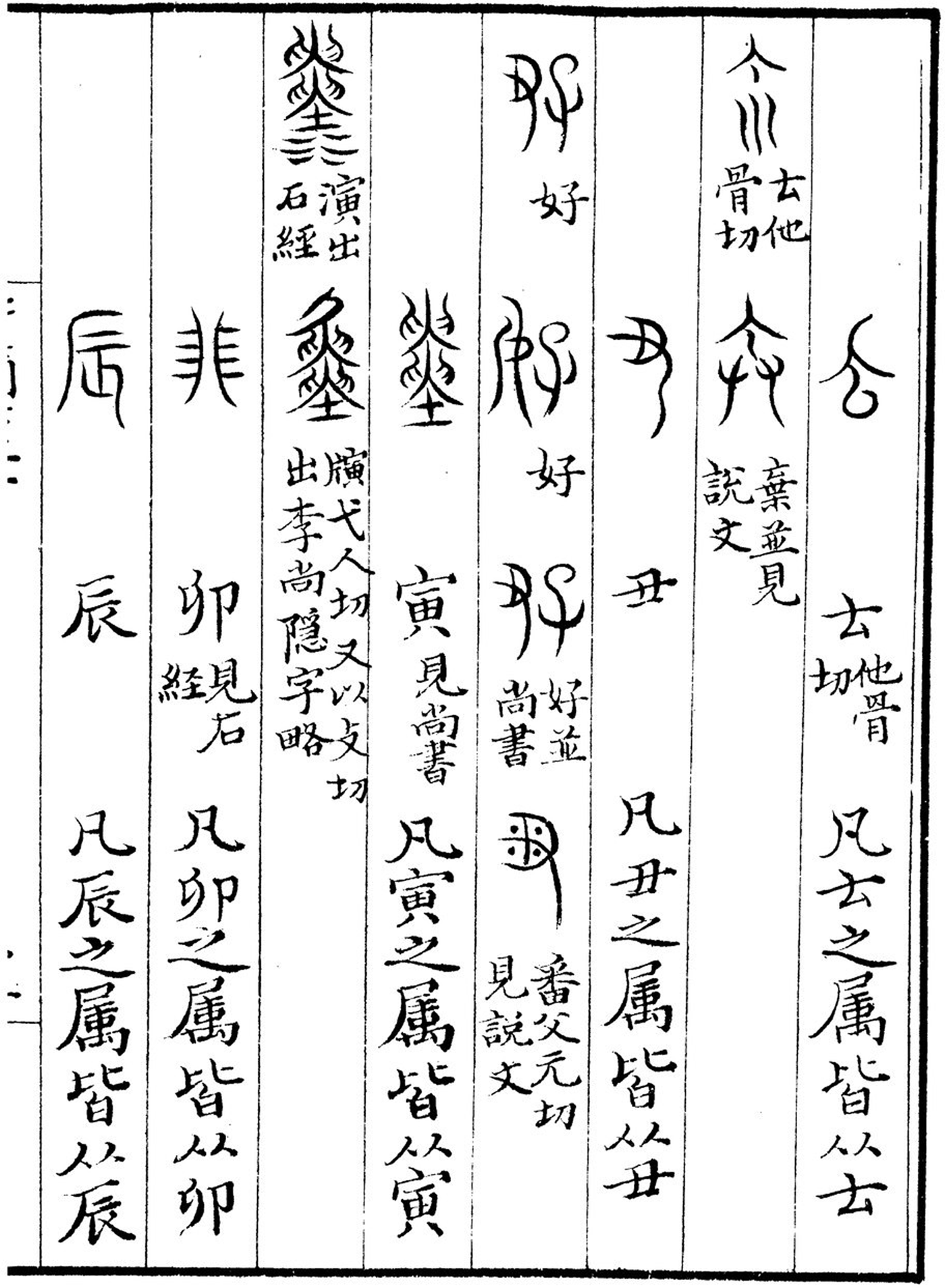
汗簡字母篆文繁多, 不能備載, 且世有刋本, 故僅錄字母, 其餘諸字, 悉以楷書列註其下, 以便檢閱).
I take this to mean that identifying the ancient-script equivalents for all the small-seal script compound characters in Li Yangbing's edition of Discussion of Single-Graph Characters and Explanation of Compound Characters would have been too big a job. Clearly, Guo intended his book to be used in conjunction with Discussion, in which the reader could find the seal script (though not ancient script) version of any given compound character. This also allowed Guo to eschew any philological explanation of the characters’ meanings, since this too could be found in Discussion.
Guo Zhongshu prefaced his book with a short explanation in which he argued for the importance of studying ancient script directly:
Bamboo slip writing, which transmits the image of antiquity, is the progenitor of later [forms of writing]. It started from Cang Jie and stopped with Shi Zhou. We thus follow the Stone Drum inscriptions, from which one can get some idea of it. But there are many errors of transcription, and it is impossible to understand the text completely. Your humble subject recently served as an official paleographer, verifying and correcting the identification of compound characters in the Stone Classics. This involved consulting a vast range of sources and drawing on existing dictionaries; whenever I gathered useful information, I immediately wrote it up in scroll form. [In this dictionary] I have prioritized first the Classic of History, then the Stone Classics and Discussion of Single-Graph Characters and Explanation of Compound Characters, and have supplemented these with information patched together by later writers. Following Mr. Xu's example [in Discussion], I have divided the characters according to category, so that they will not get mixed up with each other and for ease of consultation. I have also noted the source for each character, so that [the contributions of different sources] can be distinguished. In addition, beneath each compound character, I have explained the design of the character without translating it into clerical-script form, to aid the reader's understanding. All characters that are the same as in modern script have been excluded, because it would add nothing to the phonological or paleographic literature. Are also omitted: redundant forms, characters that are difficult to transcribe with the brush, and anything beyond my knowledge.
汗簡者, 古之遺象, 後代之宗師也。蒼頡而下, 史籀已還。爰從漁獵, 得其一二。傳寫多誤, 不能盡通。臣頃以小學蒞官, 校勘正經石字。繇是諮詢鴻碩, 假借字書, 時或採掇, 俄成卷軸。乃以《尚書》為始, 《石經》《說文》次之, 後人綴緝者殿末焉, 遂依許氏, 各分部類, 不相間雜, 易於檢討, 遂題出處, 用以甄别。仍於本字下, 直作字樣之釋, 不為隸古, 取其便識。與今文正同者, 惟目錄之外, 不復廣收。《切韻》、《玉篇》, 相承紕繆。體既煩冗, 難繕牋毫, 有所不知, 盡闕如也.
The book ends with an appendix, “Brief Comments on the Tabulation” (Luexu mulu 略叙目錄), that gathers together earlier discussions of the script down to the late Tang dynasty.
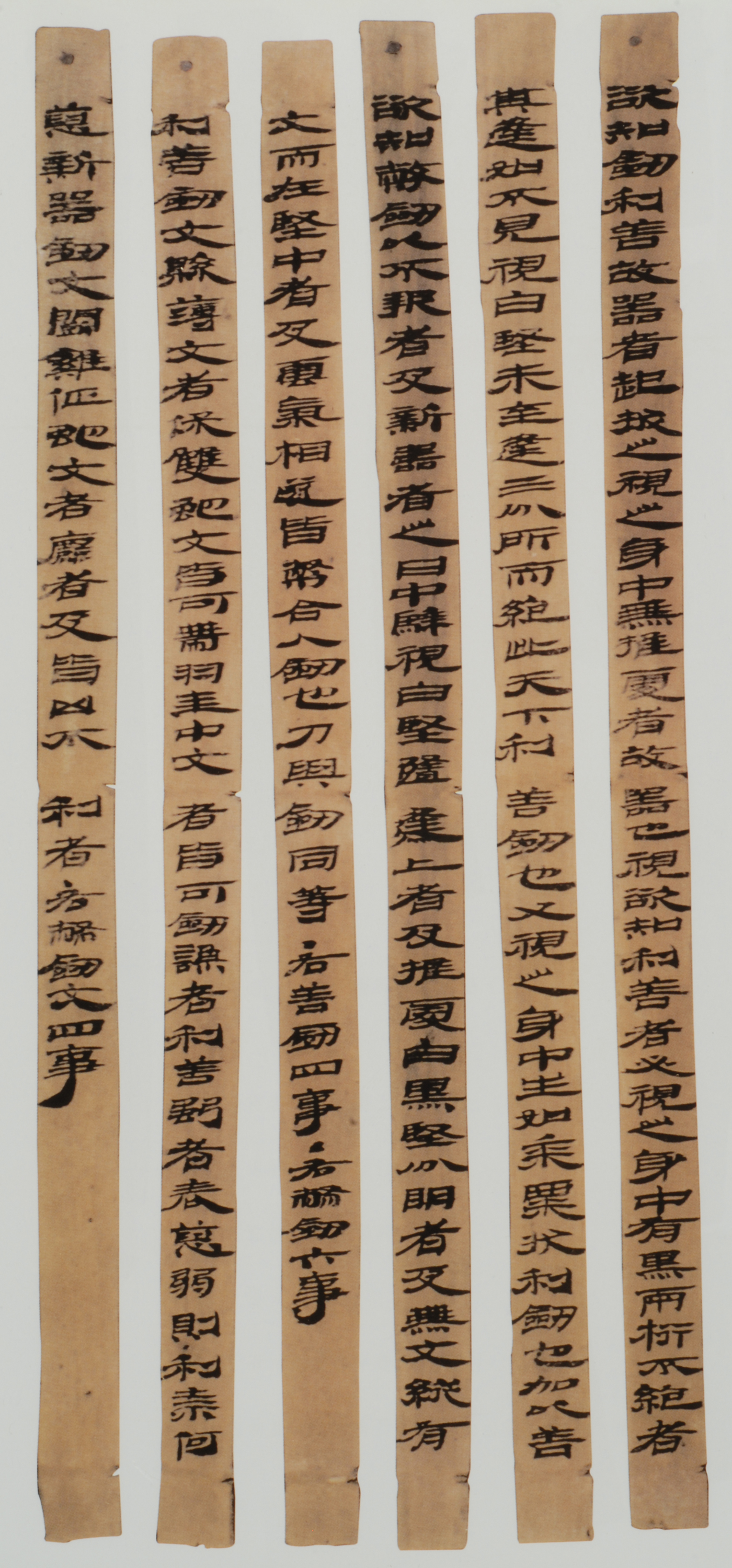
As Zheng Sixiao 鄭思肖 (1239/41–1316/18) perceptively inferred, Guo wrote Bamboo Slip Writing to defend the chronological precedence of the characters in the ancient-script versions of the Classic of History over those in the “modern-script” version. The latter version had been orally transmitted by the scholar Fu Sheng 伏生 (active late third-early second century BCE), and written down using the clerical-script characters in use at the beginning of the Han dynasty (Figure 8). But there had also been several ancient-script versions, of which one championed by the fourth-century scholar Mei Ze 梅賾 survived; however, that version was a scholarly reconstruction “reverse-engineered” from the clerical-script version. Both the clerical-script and ancient-script versions were considered authoritative, but scholars differed as to which represented the earlier version of the Classic. This was an important paleographic issue, because Xu Shen had cited characters from both ancient-script and clerical-script versions in Discussion of Single-Graph Characters and Explanation of Compound Characters. Footnote 68 Guo stated his own position bluntly at the end of his appendix:
“Bird-tracks” and “tadpoles” are both names for ancient script. As customs changed, the script came to be used less and less, until any basis for knowledgeable discussion was lost and it was known only from hearsay. The Grand Preceptor said: “When the [forms of the] rites are lost, search for them in the countryside.” Might not ancient script be even better than the countryside? This is your humble subject's purpose. Although only in small fragments, [ancient script] has not disappeared from the world, so I have given an account here [of people's continued awareness of it], by collecting references to [ancient script] and presenting them in chronological sequence.
鳥跡, 科斗通謂古文。歷代從俗, 斯文患寡, 目論臆斷, 可得而聞。太史公曰:”禮失求諸野。”古文不愈於野乎?亦下臣之志也。塵露雖㣲, 山海不却, 畧叙其事, 集而次之。
In Mei Ze's ancient-script version of the Book of History, the characters included a combination of ancient-script graphs that were current during the Warring States period and ancient-script graphs that came into circulation at a later date. In Guo Zhongshu's time, no-one had yet misinterpreted the inclusion of the latter anachronistic graphs as evidence of deliberate forgery. On the contrary, Guo seems to have recognized that the Mei Ze ancient-script version was an imperfect reconstruction. So what he was really defending was the chronological precedence of an ideal ancient-script version that remained to be properly reconstructed. His confidence in the correctness of this view was based on the 71 sources cited in his notes to the entries.Footnote 69
On Judging Good-Quality Swords and Knives (Xiang li shan jiandao 相利善劍刀), wooden-slip manuscript written in bafen clerical script, early first century CE. Excavated from the ancient site of Jianshuijin Guan in Jinta County in Juyan, Gansu. Collection of Gansu Provincial Cultural Relics Research Institute. Zhongguo fashu quanji, 1, Xian-Qin Qin-Han, Song Zhenhao editor-in-chief (Beijing: Wenwu, 2009), 237. (color online)
While Bamboo Slip Writing did not have a wide circulation under the Song dynasty, it did have notable admirers. At the end of Taizu's reign the noted calligrapher Li Jianzhong 李建中 (945–1013) found an unattributed manuscript copy. A Hanlin Academician, the formerly Southern Tang calligrapher Xu Xuan 徐鉉 (916–991), brother and scholarly collaborator of the paleographer, Xu Kai 徐鍇 (920–974), identified for Li its authorship. Li Jianzhong then made his own manuscript transcription of Bamboo Slip Writing, which he submitted to Song Taizong in 976 in a successful attempt to get himself noticed as a calligrapher.Footnote 70 Later, the paleographer Xia Song 夏竦 (985–1051) used Bamboo Slip Writing as the basis for a new dictionary, Pronunciations and Tones of Ancient Script (Guwen sisheng yun 古文四聲韻), in which he replaced Guo's ancient script transcriptions of the radicals with transcriptions in clerical script. Other admirers included Ouyang Xiu 歐陽修 (1007–1072), the antiquarian Lü Dalin 呂大臨 (1046–1092), the poet Su Shi 蘇軾 (1037–1101),Footnote 71 and the philosopher Zhu Xi 朱熹 (1130–1200).Footnote 72 As late as the end of the eighteenth century, the compilers of the Siku quanshu, themselves deeply involved in archaeological scholarship, were similarly impressed. In their view, Bamboo Slip Writing was the basis for all paleological study of ancient script following it.Footnote 73 In the course of the nineteenth century, however, Bamboo Slip Writing gradually came to be marginalized as Qing philologists focused their attention on inscriptions on excavated Shang and Zhou bronze vessels, which employed an even more archaic form of script. Moreover, Guo Zhongshu's own Warring States archaeological evidence was doubted. One prominent eighteenth-century figure, Bi Yuan 畢沅 (1730–1797), had gone so far as to accuse Guo Zhongshu of having fabricated characters. By the end of the nineteenth century, Bamboo Slip Writing was considered by many to be completely untrustworthy, while others attributed its unfamiliar elements to the currency of late versions of ancient script in the centuries immediately preceding Guo's book. The latter characterization was not entirely wrong—Guo did not always get the reconstruction right—but there was a tendency to overestimate vastly the number of anachronistic characters he included. The reputation of Bamboo Slip Writing has recovered, however, with the arrival of scientific archaeology, as more and more of the very forms that puzzled later writers have turned up on excavated bamboo slips. It is now recognized that although Bamboo Slip Writing is not devoid of ancient script characters whose forms were invented by post-Han writers, it is basically an accurate reflection of the script in use in the Warring States period. Correspondingly, in recent decades Bamboo Slip Writing has proved to be an invaluable reference work for scholars involved in deciphering the vast numbers of bamboo slips that have been recovered from Warring States tombs in central and south-central China.Footnote 74 Guo Zhongshu's scholarly reputation has soared in consequence. Since the year 2000, his paleology has become the object of many articles, dissertations, and books in China.Footnote 75
Ruzhou, 954
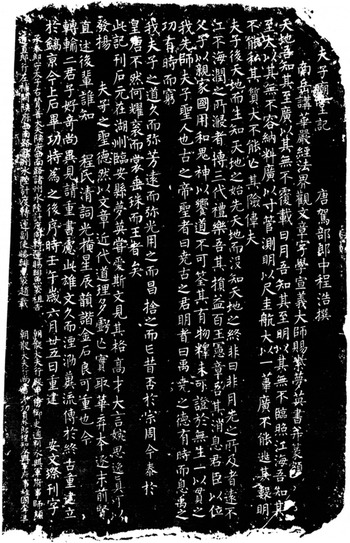
Guo Wei died suddenly at the beginning of 954. After the accession of his nephew-in-law Chai Rong 柴榮 as Shizong 世宗 (r. 954–959), Guo Zhongshu's Directorate of Education position lapsed. He was reassigned to serve as District Magistrate (xianling 縣令) in an unidentified county of Ruzhou in southern Henan, to the south of Luoyang, located “within a bend of the Ru river to the west of Mt. Song” (在汝水之汭, 嵩山之陽).Footnote 76 Although it might at first seem odd that Guo should have switched to the field administration, one of the policies of the Later Zhou emperors (later continued by the early Song rulers) was to strengthen central government control over local administration by appointing civil officials from the center.Footnote 77 It was as District Magistrate that on the fifteenth day of the fourth month of 954, he signed a stele inscription, Record of the Temple to the Exalted King of Culture (Confucius) (Wenxuan wang miao ji 文宣王廟記), which he had composed as well as transcribed (see Figure 13). Guo chose the less easily readable small-seal script (rather than bafen 八分 clerical or xiaokai) for the transcription, as if he wanted to use writing to displace the reader back into the pre-Han past. Confucius Temples (variously called Wenxuan wang miao 文宣王廟, Wen miao 文廟, Kongzi miaotang 孔子廟堂, or Kong miao 孔廟,) were state institutions, often associated with a prefectural or county school. This was the second stele inscription that Guo Zhongshu contributed to the network of Confucian institutions in north-central China, following his Shuowen ziyuan stele in Xuzhou. The text of the 954 stele inscription, Record of the Temple to the Exalted King of Culture, carried its own heavy political meaning. Two years earlier, Guo Wei had visited Qufu in Shandong. When challenged about the propriety of the Son of Heaven paying homage to a mere mortal, Guo Wei replied: “Confucius has been the teacher of rulers for a hundred generations—how could I not venerate him?” (文宣王, 百代帝王師也, 得無敬乎).Footnote 78 With this, he signaled that Confucian ideology would be central to the Later Zhou enterprise in a way that had not been the case for the Later Han, Later Jin, Later Tang, or Later Liang.
Bian, 955–959
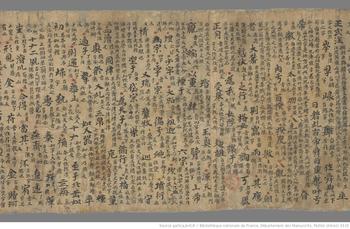
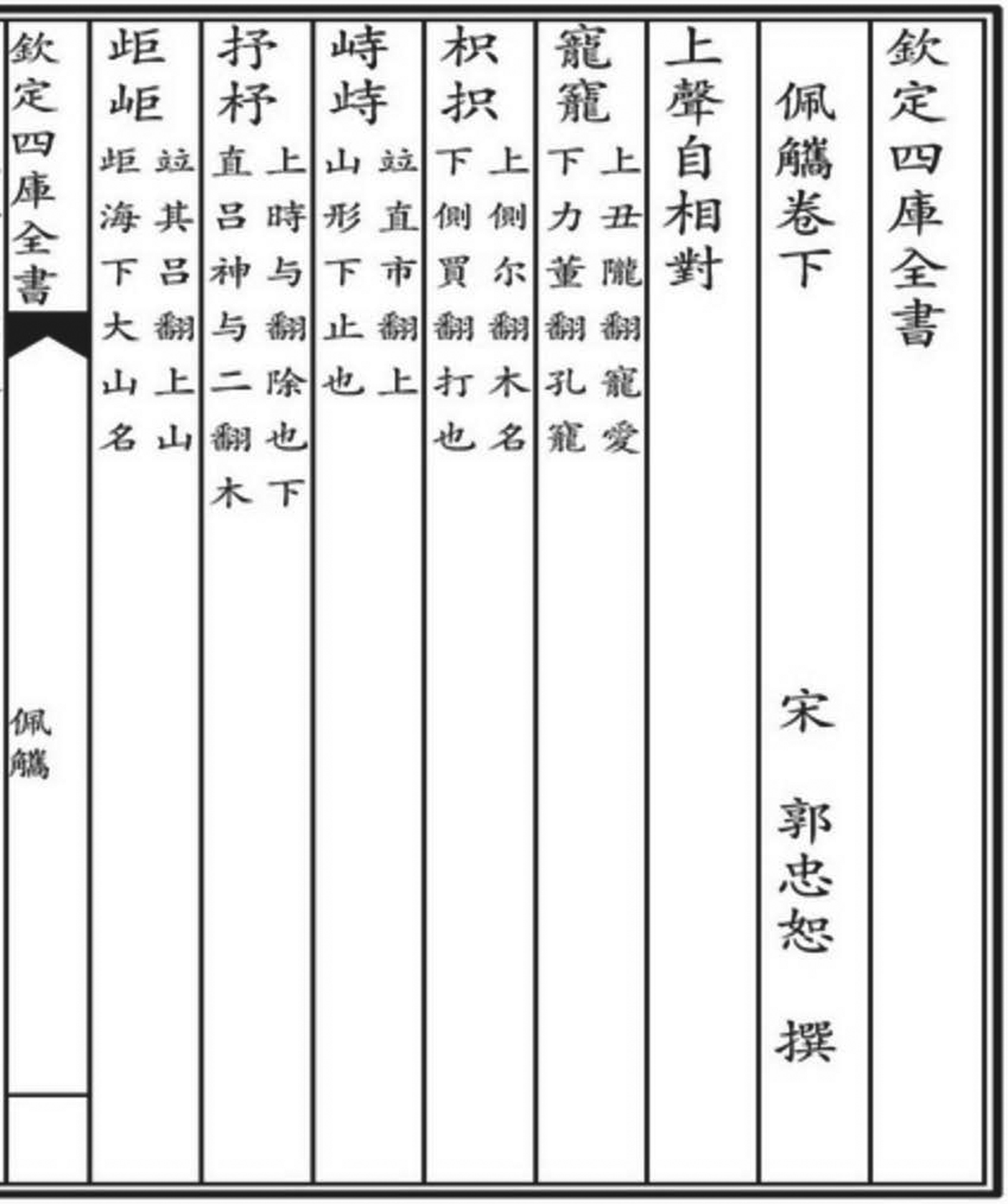
Guo did not stay long in Ruzhou. Shizong's administration quickly brought him back to the School for the Sons of the State. In 955, the Directorate of Education in Bian was relocated to a monastery (Tianfu puli chanyuan 天福普利禪院). During this period, from perhaps as early as 955 until the end of the dynasty in 959, Guo worked on two scholarly books. The first to be completed was another dictionary, Bodkin (Peixi 佩觿), illustrated in a Kangxi edition in Figure 9, its title as much a reference to the intricacy of paleographic and philological work as to the book's function as a tool. Bodkin, which circulated as a manuscript that gained a printed version in the Qing dynasty, was another outgrowth of Guo's work on the Directorate's reference publications. At the head of the text, Guo Zhongshu identifies himself as Erudite of the Five Classics Specializing in the Book of Changes (Guozi Zhou Yi boshi 國子周易博士), holding the prestige title Grand Master for Court Audiences (Chaoqing dafu 朝請大夫, 5b1 under the Tang), representing a slight promotion within the Court of the Imperial Clan from his Later Han position as Grand Master for Closing Court. His merit title was similarly a promotion, in this case a notable one, to Pillar of the State (zhuguo 柱國).Footnote 79 Given his ongoing paleographic work during this period, the shift in his responsibilities as Erudite from shuxue (paleography and calligraphy) to the Zhouyi (i.e., the Yijing) probably means that he was adding rather than changing responsibilities. A plausible explanation is that Guo Zhongshu had been assigned to the team of scholars that started work in 955 on a new edition of Lu Deming's Textual Explanations of Classics and Canons (Jingdian shiwen, Figure 10), mentioned earlier as Kehong's model for Compendium of Sounds and Meanings in the Tripitaka.Footnote 80
Guo Zhongshu, Bodkin (Peixi), Qinding siku quanshu, juanxia, 1a. Downloaded from Guoxuedashi.com. (color online)
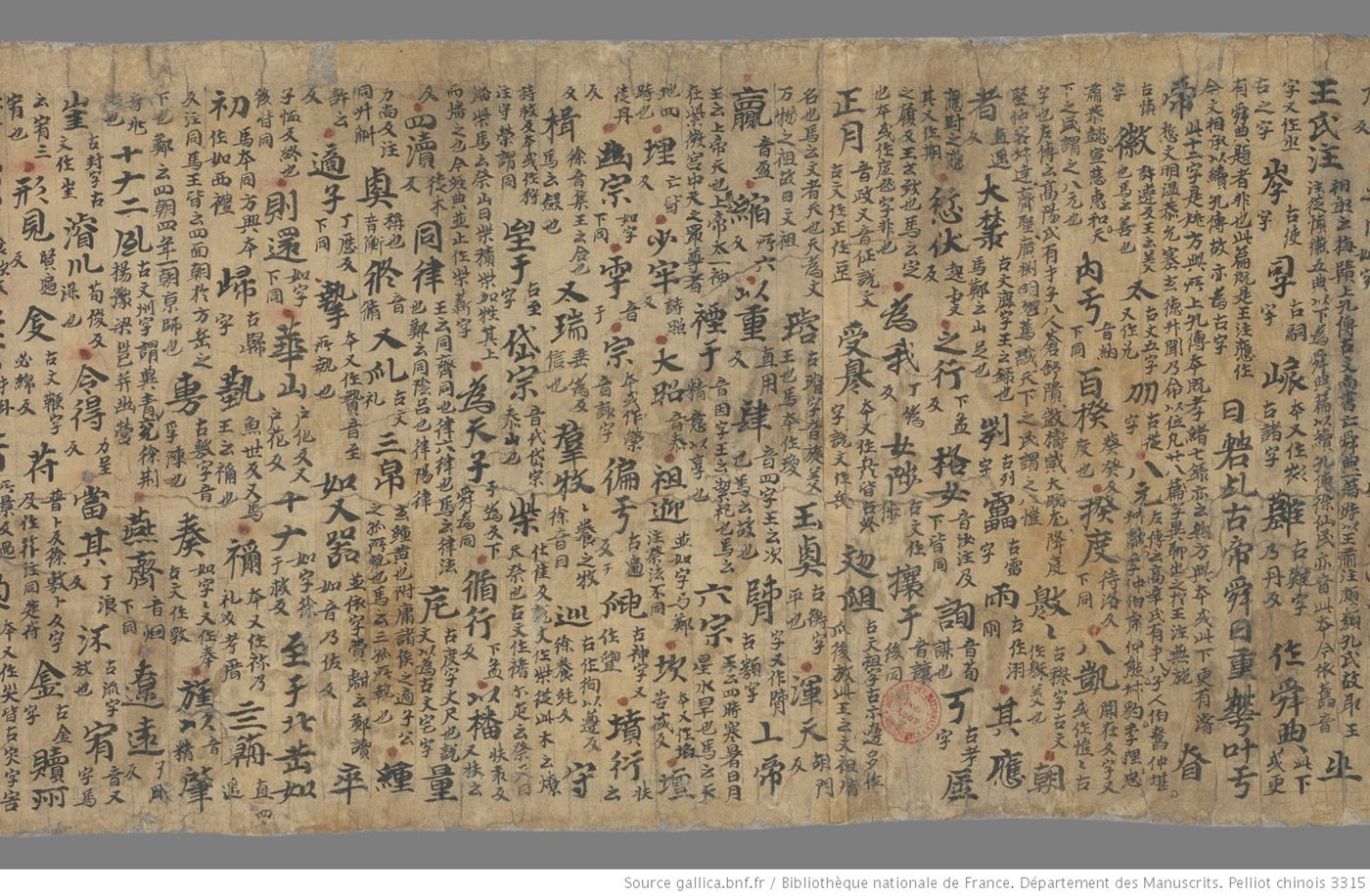
Lu Deming, “Textual Explanations of the Book Of History” (Shangshu shiwen 尚書釋文), from Textual Explanations of Classics and Canons (Jingdian shiwen), fragmentary ink-on-paper manuscript from Dunhuang Mogao Cave 17, late Tang dynasty. Bibliothèque nationale de France, Pelliot chinois 3315. Photo: Bibliothèque nationale de France. (color online)
Like the other Tang dynasty dictionaries on which Guo had worked, Textual Explanations attempted to remove some of the confusion caused by inconsistent transcriptions when the Classics were originally written down, reflecting the fact that at the point when ancient script was current the Chinese written language had not yet stabilized. The various dictionaries also addressed the further confusion created by historical distance, since the more (but not completely) standardized regular script of the Tang, like the clerical script from which it had developed, in itself often contradicted the use of the equivalent characters during the Warring States period. In the course of his work, Guo came to realize that all this inconsistency and confusion was susceptible to morphogenetic analysis of the visual forms of characters and the association with pronunciation. The bulk of Bodkin (scrolls two and three of the three-scroll work) comprises a compendium of pairs of compound characters with similar shapes or sounds written in regular script, where the second character is the one that can be used to establish the shared meaning (Figure 9). For each pair of characters, Guo specifies the specific process responsible for the first character's association with the second character's meaning, which takes him back into ancient script. Preceding the dictionary proper, however, is a one-scroll treatise on paleography and linguistics establishing the rationale of the dictionary; although the treatise has obvious philological implications, Guo leaves these to others to explore. Instead, Guo lays out discursively the patterns of inconsistency that he has identified, and provides detailed reasons for why they occurred, identifying basic historical processes that led to confusion, and further breaking down each of these processes into more specific processes. In just a short space, therefore, Guo pithily sketches out the landscape of the morphogenetic development of the written Chinese language, from Warring States ancient script to modern regular script—the first person to do so.Footnote 81 Like Bamboo Slip Writing, Bodkin had a limited circulation under the Song, but it was much appreciated by those who had access to it, including the statesman and paleographer, Song Xiang 宋庠 (996–1066), who considered his own annotated edition of Guo's text to be one of his treasures.Footnote 82
Guo's second and in political terms more consequential project of the later 950s was nothing less than a Revised Ancient-Script [Edition of the] Classic of History with Explanations of Characters (Ding guwen shang shu bing shiwen 定古文尚書并釋文). Guo aimed to replace the Mei Ze ancient-script reconstruction with a more accurate reconstruction of his own. Revised Ancient-Script [Edition of the] Classic of History with Explanations of Characters fitted better than his earlier books (Origins of Compound Characters in the “Shuowen”, Bamboo Slip Writing, and Bodkin) into the Directorate's program of printed publications stretching across three decades and three dynasties, and Guo apparently prepared a woodblock-printed edition. For this we have the testimony of the late Southern Song scholar, Wang Yinglin 王應麟 (1223–1296), who notes a 959 version in “carved woodblocks [for printing]” (keban 刻板).Footnote 83 Wang's mention may indicate that Revised Ancient-Script [Edition of the] Classic of History with Explanations of Characters was actually part of the Directorate's new edition of Textual Explanations of Classics and Canons published that year.Footnote 84 This hypothesis seems more likely than the alternative: that Guo's ancient-script edition of the Classic of History was a separate, stand-alone book printed by the Directorate. Among the manuscripts recovered from the Dunhuang library cave is a fragmentary late Tang manuscript preserving part of the Classic of History section of Lu Deming's multi-volume dictionary (Figure 10).Footnote 85 It shows that Guo is likely to have compiled the book with the text in ancient script for the main text and xiaokai regular script for the notes and commentary. Chao Gongwu 晁公武 (1105–1180) mentions that Guo's now-lost text was later engraved in stone, which leaves open the possibility that a rubbing from this stele edition may some day surface.Footnote 86 In 959, Shizong gave every sign of being able to reunify China under the Later Zhou. The partial success of his campaigns against the Southern Tang the previous year had forced its ruler Li Jing (r. 943–961) to declare nominal allegiance to the Later Zhou. In 959, there was no thought of a Song dynasty. Guo Zhongshu must have known that his edition of the Classic of History had the potential to influence general understanding of one of the canonical Five Classics. The scholarly stakes, for him, were enormous.
Guo Zhongshu's four major books (some other short works, now lost, are recorded) were produced within the short span of ten years, and followed a logical progression.Footnote 87 Guo began with a study of Discussion of Single-Graph Characters and Explanation of Compound Characters (Origins of Compound Characters in the “Shuowen”), then produced his own alternative dictionary of ancient script characters (Bamboo Slip Writing), and continued with an innovative study of the historical development of writing (Bodkin). Finally, Guo applied his broad knowledge of ancient script to establishing a more reliable ancient-script edition of the Classic of History (Revised Ancient-Script [Edition of the] Classic of History with Explanations of Characters). In 959 Guo, at the age of 32 sui, was a scholar and calligrapher of high reputation who aspired to change the course of Confucian scholarship through his paleographic and linguistic work.
Guo Zhongshu's Early Calligraphy
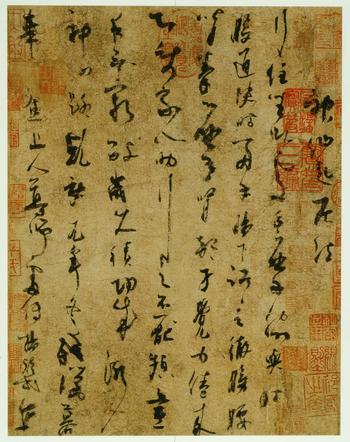
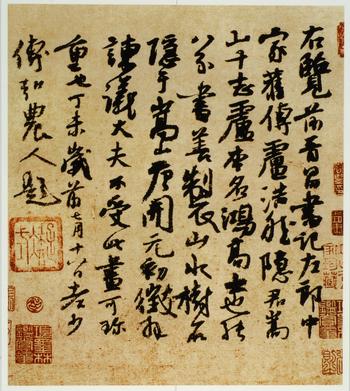
Guo's years in Luoyang and Bian under the Zhou—the 950s—overlapped with the final years of one of the great modern practitioners of running and draft scripts, Yang Ningshi 楊凝式 (873–954), from Huayin 華陰, just west of the bend of the Yellow River on the way from Luoyang to Chang'an. A follower of the great regular-script calligrapher Yan Zhenqing 顏真卿 (709–785), Yang's radical innovation was to introduce elements of running and draft script into regular script (Figures 11, 12). Here, as in so many other areas of culture and social life in the tenth century, modern practice entailed the breaking down of categorical divisions through attention to the transitions between formerly compartmentalized categories.Footnote 88 Under the Later Tang, as Mingzong built up the state library, Yang Ningshi was a Directorate of Education librarian and editor in Luoyang, but in the years before his death in 954 he became an eminent administrative official in the Zhou government, a Junior Preceptor (shaoshi 少師), posted to Luoyang as the Regent in charge of the Western Capital (Xijing liushou 西京留守). Few works by Yang Ningshi survive today, even though his work was much in demand at the time. Tao Gu relates the following story:
The calligraphy and painting of the Junior Preceptor, Yang Ningshi, was preeminent in its time. The scrolls of paper left by those who sought calligraphy from him were piled high like a smooth [white] wall. The Junior Preceptor gave a great sigh, and said: “What am I to do with so many ‘creditors’—they're really like armed bullies! When I was a boy, I found strange [the story of] Yan Liben warning his younger relatives not to study painting; now that I am old, I start to realize that talent really can be a burden.”
少師楊凝式, 書畫獨步一時。求字者紙軸堆疊若坦壁。少師見則浩歎曰:“無奈許多債主, 真尺二寃家也。少時怪閻立本戒子弟勿習丹青, 年長以來始覺以能為累” 。Footnote 89
One of Yang's preferred practices was to write on the interior walls of temples, often next to or on the surface of significant mural paintings. His inscriptions of this kind were, in effect, colophons, but of a kind that, like the wall paintings, had a certain built-in ephemerality. Many of Yang's inscriptions could be seen in the temples of Later Zhou and early Song Luoyang, where they were much imitated, most famously by the man who would later submit a copy of Guo Zhongshu's Bamboo Slip Writing to Taizong, Li Jianzhong. (Later, in Chang'an, the Buddhist monk-paleographer Mengying would follow Yang's example, leaving inscriptions on the interior walls of temples all over the city.) Only a few of Yang Ningshi's inscriptions, however, were ever engraved in stone to circulate as rubbings later.Footnote 90
Yang Ningshi (873–954), On the Daily Life of Transcendents (Shenxian qiju fatie 神仙起居法帖). Autograph manuscript on paper, 27 x 21.2 cm., Palace Museum, Beijing. Jin Weinuo and Xing Zhenling, eds., Zhongguo meishu quanji, 20, Shufa 2 (Hefei: Huangshan shushe, 2010), 401. (color online)
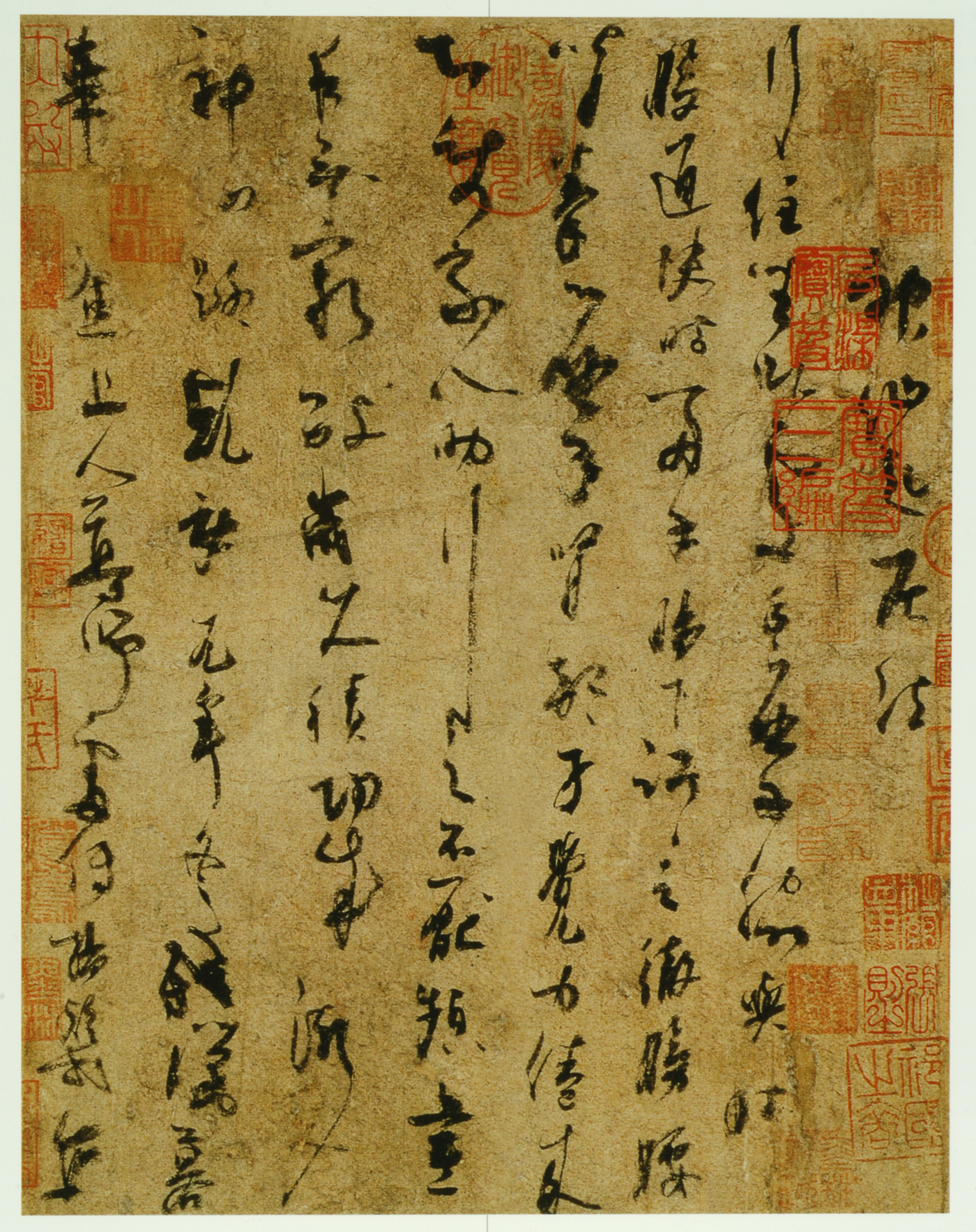
Yang Ningshi (873–954), Colophon to “Ten Episodes at Lu Hong's Thatched Cottage” (“Lu Hong caotang shizhi tu” ba 《盧鴻草堂十志圖》跋). Ink on paper, National Palace Museum, Taipei. Jin Weinuo and Xing Zhenling, eds., Zhongguo meishu quanji, 20, Shufa 2 (Hefei: Huangshan shushe, 2010), 403. (color online)

Yang's fame in mid-century Luoyang left Guo Zhongshu unmoved. Guo held running script and draft script in low esteem; by temperament and principle he preferred the disciplined order of regular script (particularly small regular script, or xiaokai), bafen clerical script, seal script, and ancient script. Although Guo Zhongshu's xiaokai calligraphy has not survived, we have Ouyang Xiu's enthusiastic testimony that it was outstanding. Here, Ouyang Xiu comments on the rubbing he had acquired of Guo's 950 Origins of Compound Characters in the “Shuowen” stele in Xuzhou:
The item to the right is the Origins of Compound Characters in the “Shuowen,” written in the hand of Guo Zhongshu who served in the imperial court and whose career is documented in the Veritable Records. He was a particularly eccentric character. Today people know him only for his calligraphy in small seal script and are ignorant of his skill in regular script, which is equally exquisite. However, [examples of] his regular-script characters carved in stone are not [usually] to be seen; that this work is the only surviving example is indeed a great shame. Amid the violence and disorder of the Five Dynasties, schools and academies fell into ruin and the way of scholarly gentleman slid deep into decline. Yet, even in such dire circumstances as these, there were men of Guo Zhongshu's calibre. Today our great state has ruled for a hundred years, peace reigns under heaven and Confucian learning flourishes once more, yet in the art of calligraphy alone has there been no comparable renaissance, so much so that the art itself stands on the brink of dying out. So if one were to seek the likes of Zhongshu's small character regular script today it simply could not be done. When I have occasion to speak with Junmo (Cai Xiang 蔡襄, 1012–1067) on the subject, this matter gives us no small cause for lament. The stele itself is to be found in Xuzhou.Footnote 91
右小字說文字源。郭忠恕書。忠恕者。集本有「五代漢周之際為湘陰公從事」十二字。及事皇朝。其事見實錄。頗奇怪。世人但知其小篆。而不知其楷法尤精。然其楷字亦不見刻石者。蓋惟有此耳。故尤可惜也。五代干戈之際。學校廢。是謂集本作為。君子道消之時。然猶有如忠恕者。國家為國百年。天下無事。儒學盛矣。 獨於字書忽廢。幾於中絕。今求如忠恕小楷。不可得也。故余每與君謨歎息於此也。石在徐州。集本無此四字。嘉祐八年十二月廿日書。
In contrast to this high assessment of Guo's early xiaokai regular script, Zhao Mingcheng considered the bafen clerical script of Guo's 949 Stele Commemorating the Renovation of the Ancestral Temple of Emperor Gaozu of the Han Dynasty, a rubbing of which he owned, to be weak in comparison to Guo's later bafen work. Be that as it may, in Bodkin, Guo left one of the most interesting discussions of the origin of the term bafen:
In the common understanding there are two theories on bafen. Some say that bafen (the eight distinctions) is the method of seal-script, while erfen (the two distinctions) is that of lishu clerical script. Others maintain that its characters all resemble the character “eight” (ba 八), with a configuration like waves coming to rest. Your subject (chen 臣) believes that neither theory is correct. Today it can be explained as follows: the Han dynasty scholar, Cai Yong, thought that clerical script was made up of eight distinct (fen 分) form-types, and that it was only after all these eight form-types evolved that this craft came into existence, which he called bafen, or “the eight distinctions. This is closer to the truth”.Footnote 92
八分之說, 流俗有二。或曰八分篆法, 二分隸文。又云, 皆似八字, 勢有偃波。臣以為二說皆非也。今按, 書有八體, 漢蔡邕以隸作八分體, 盖八體之後又生此法, 謂之八分, 近矣。
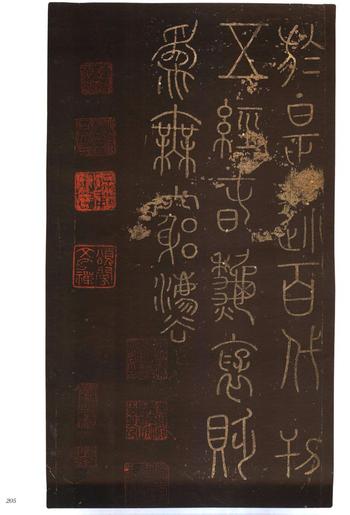
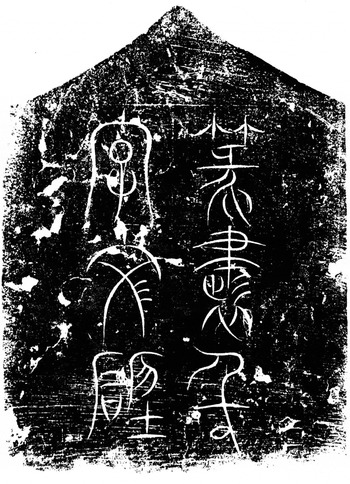
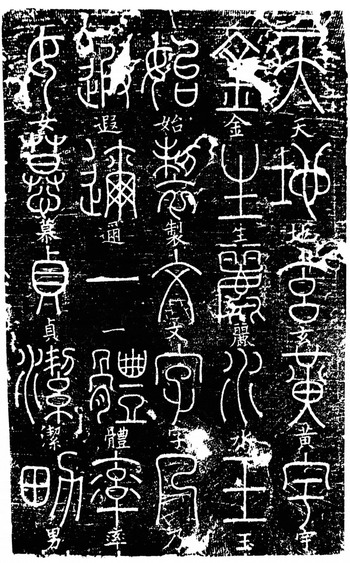
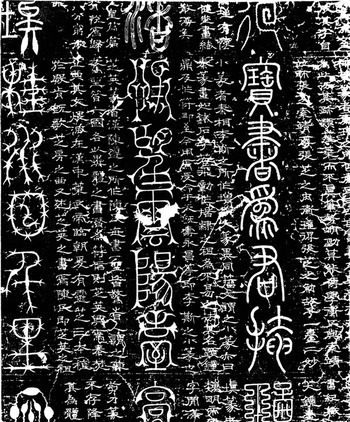
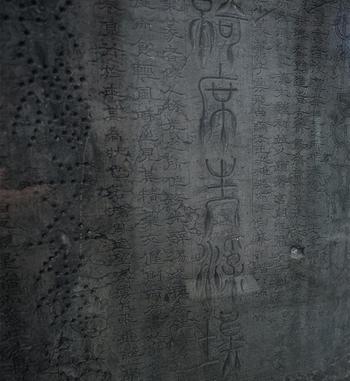
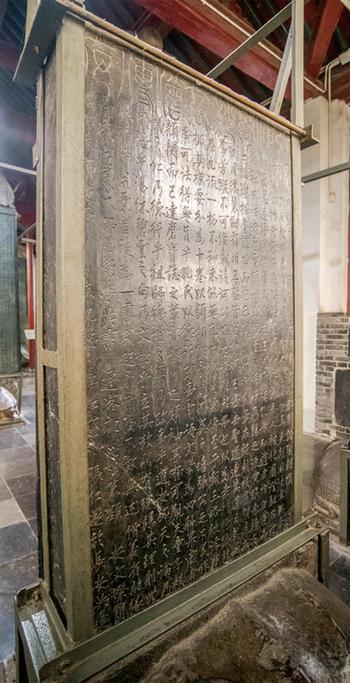
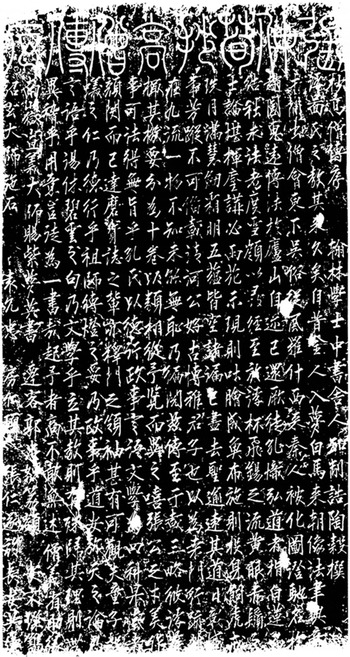
Today we can see from this period only Guo Zhongshu's seal script, represented by a single work, the 954 Record of the Temple to King Wenxuan (Confucius), a fragment of which survives in the form of rubbings (Figure 13).Footnote 93 Seal script had a widespread presence in mid-tenth century Luoyang and Bian. In the early 950s, for example, the eminent minister, He Ning 和凝, transcribed in seal script his own collected works, all one hundred juan of them, and had them privately woodblock-printed.Footnote 94 Surviving examples of Later Zhou seal script include the title inscription of a Later Zhou stele (Figure 14). But Guo had little time for recent seal script (see below). His own model was Li Yangbing (Figure 15), whose approach to seal script derived in part from that of Li Si 李斯 (third century BCE). Li Yangbing's approach generates an immediately recognizable architectonics, which conveys an austere and profound decorum. In Li's own words:
From heaven, earth, and mountainscapes I apprehend the script's square and round shapes; from the sun, moon, and astral formations I apprehend the complementarity of its organizing principles; from caps, robes, and insignia of rank I apprehend its deferential and ceremonious appearance; from eyebrows, mouths, and noses I apprehend its distinctions of pleasure and anger or sorrow and ease; from fish, birds, and beasts I apprehend its rules for extension, diminution, and propulsion; and from horns and teeth I apprehend its wavering and chewing motions. The hand thus gives rise to a myriad of transformations, as the mind creates what it will. The script fully manifests all the moods and images of Heaven, earth, and man, and it describes the appearance of the ten thousand things.
于天地山川, 得方圆流峙之形;于日月星辰, 得经纬昭回之度;于云霞草木, 得霏布滋蔓之容;于衣冠文物, 得揖让周旋之礼;于鬓眉口鼻, 得喜怒, 惨舒之分;于虫鱼禽兽, 得屈伸飞动之理;于骨角齿牙, 得摆拉咀嚼之势。随手万变, 任心所成, 可谓通三才之气象, 备万物之情状者矣。Footnote 95
Given his paleographic interests, Guo Zhongshu's calligraphic engagement with Li Yangbing's seal script was understandable. Still, Guo was aware of being out of step with his times—not only because of his predilection for this particular script, but because of his archaeological approach. In a later letter, “Reply to Mengying,” he writes:
Since the Southern Dynasties ended, few [calligraphers] have mastered the zhuan (small-seal) and zhou 籀 (large-seal) scripts. Only on steles, epitaphs, and seals do people today use a few characters. Those who teach [the scripts] are unable to do high-quality research themselves, and though there is nothing to stop them from inquiring, the partisans of received wisdom ridicule those who like to ask questions, and offer far-fetched interpretations [of the correct way of writing the characters]. As Zhaizhong [Xie Lingyun 謝靈運, 385–433] says in his preface, “After small-seal script dispersed, bafen script was born; when bafen was destroyed, clerical script made its appearance. Clerical script is orderly but running script is harmful; running script is [pushed to] madness, and draft script becomes wild. From clerical script onwards, these are not scripts I wish to look at.”
晉宋而下,通篆籒者寡。唯碑碣印記,時用數字傳授者,未克研精,何 妨檢討。盜聽者恥於好問,加之穿鑿。齋中序云:「小篆散而八分生, 八分破而隷書出。隷書序而行書弊,行書狂而草書聖。自隷已下,吾不欲觀之矣。」Footnote 96
Guo's antiquarian insistence on historically founded correct ways of writing characters represented an alternative form of modern thinking to Yang Ningshi's breakdown of category distinctions; we can fairly call it a questioning scientific attitude. For Guo Zhongshu, calligraphy as the art of writing had to be rooted in a true historical understanding of writing itself. This is what he understood Li Yangbing to have done within the limits of his eighth-century knowledge; in Bamboo Slip Writing he cites Han Yu's account of Li Yangbing's ability to read ancient script fluently.Footnote 97 It is also what he was trying to do himself under a modern horizon of knowledge. What he opposed was seal-script calligraphy that took inherited conventions of writing as timeless truths. The fragment of Guo Zhongshu's Record of the Temple to the Exalted King of Culture (Confucius) that survives (see Figure 13) is slightly disjointed in its composition and tentative in its execution, showing a calligrapher whose skills did not yet match his ambition.
Guo Zhongshu, Yao Shun tie, ink rubbing (detail), fragment of Record of the Temple to the Exalted King of Culture [Confucius] (Wenxuan wang miao ji 文宣王廟記), 954, in Further Rubbings from the Orchid Pavilion (Lanting xutie 蘭亭續帖, vol. 6), Southern Song dynasty. After Zhongguo fatie quanji, 6: 52. (color online)
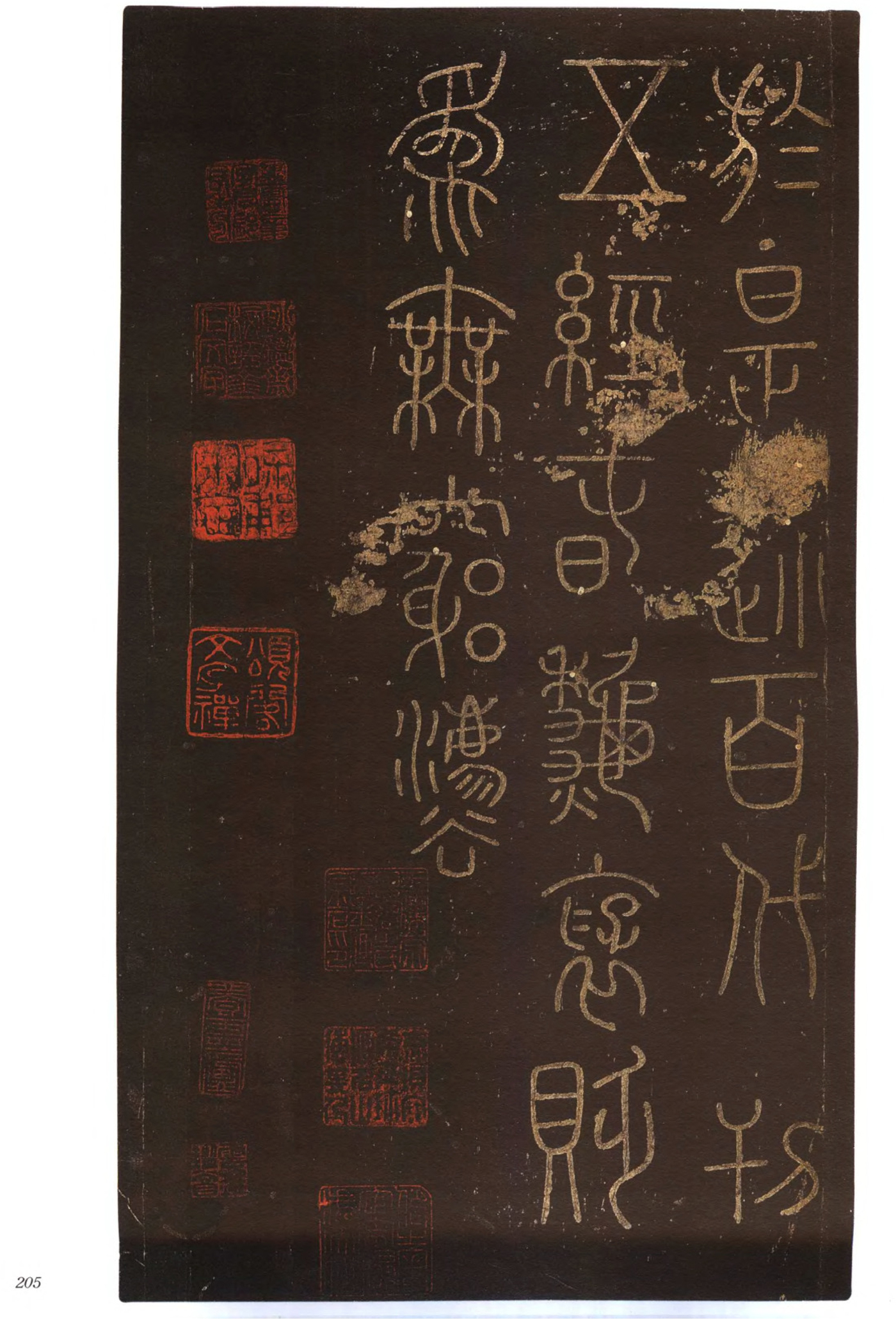
Zhang Mu, Seal-script Title to “Stele [Commemorating] the Suppression of Bandits” (Pingdao bei zhuan'e 平盜碑篆額), 955. Ink rubbing. Ge Zhaosheng, “Wudai Hou Zhou ‘Pingdao bei’ de shufa yishu tedian,” shufabao.net 2017/04/28. (color online)
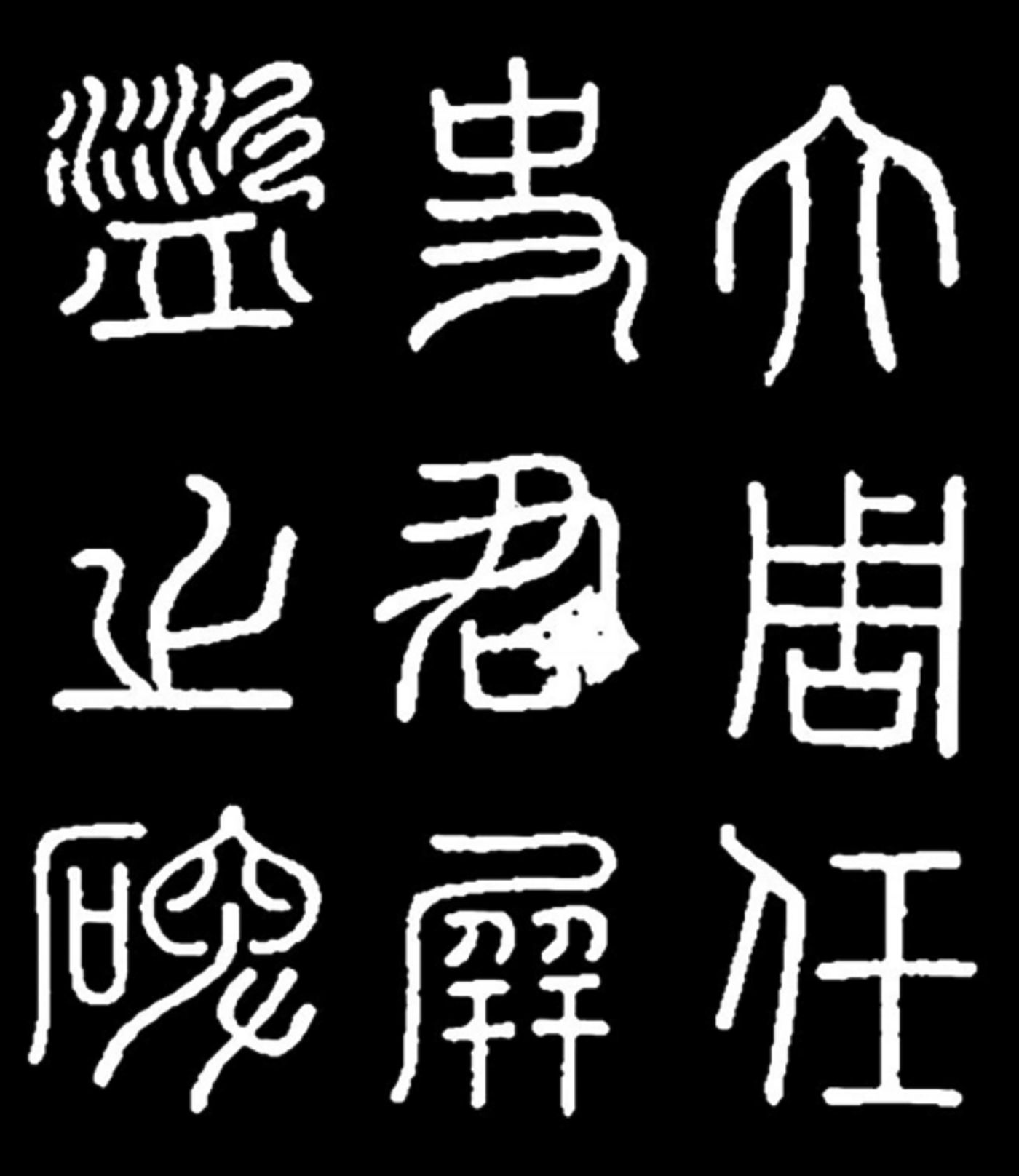
Record of the Three Graves (San fen ji 三墳記) transcribed by Li Yangbing, 767. Ink rubbing (detail). Xi'an Beilin Museum. Yasushi Nishikawa et al., Seian hirin (Tokyo: Kodansha, 1966), fig. 84. (color online)
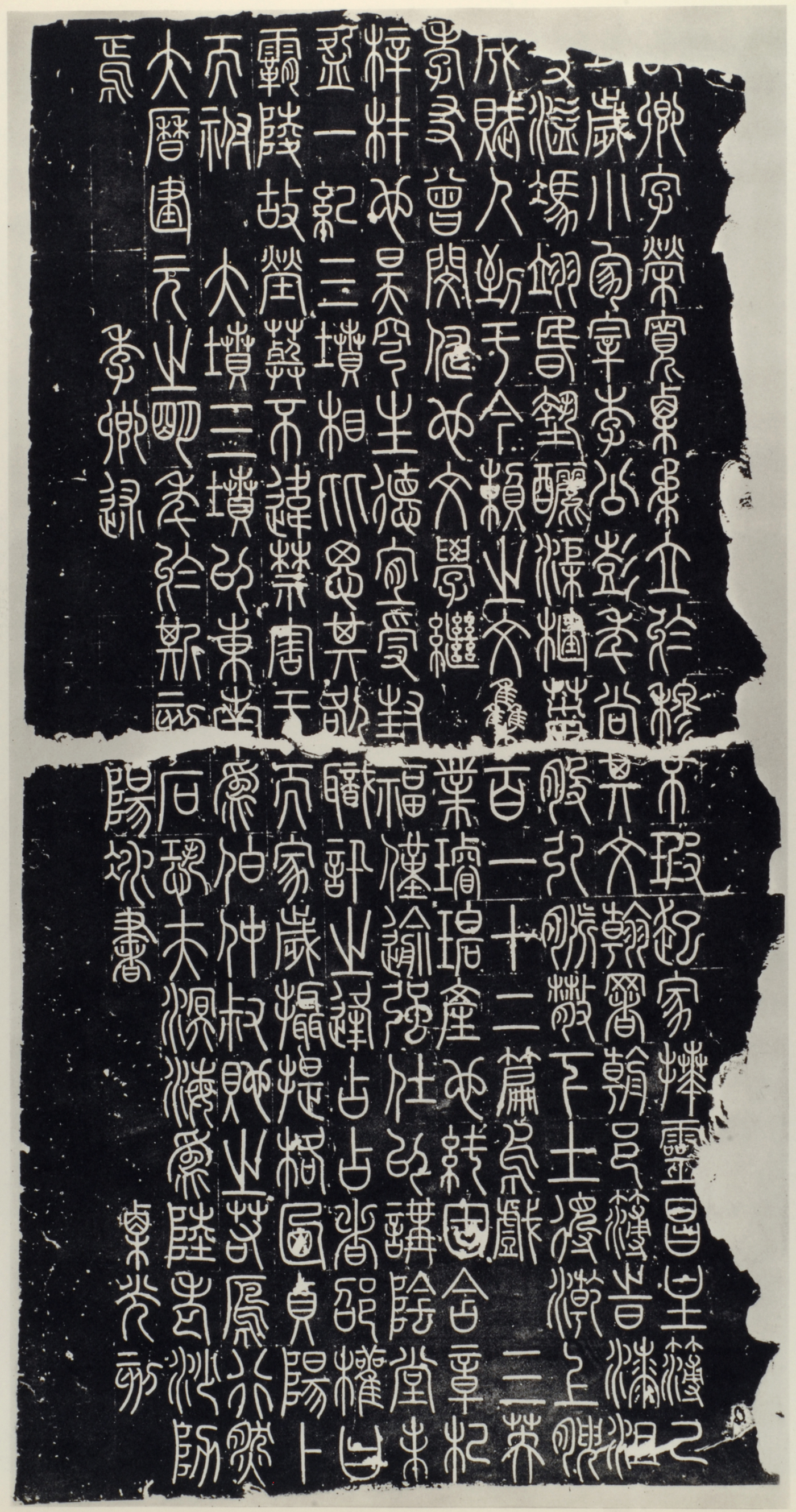
One cannot take the full measure of Guo's profile as a calligrapher, however, without also taking into account his work in ancient script. As we saw earlier, ancient script was not generally considered to be a calligraphic script—understandably, since so few calligraphers mastered its forms. But Guo Zhongshu was in a different position, since his scholarly work required that he be able to write the script fluently. In at least one case, he wrote an entire document in ancient script that surely has to be taken as an example of calligraphic art. It was a transcription of the Classic of Filial Piety (Xiaojing 孝經), and there is good reason to think that he wrote it during the 950s. Although undated, Guo's transcription was recorded in the twelfth century as having been submitted to the throne, and thus must have been executed while he was employed at the Later Zhou Guozijian.Footnote 98 In the appendix to Bamboo Slip Writing Guo cites two Tang discussions of a partial ancient-script transcription of the Classic of Filial Piety that circulated in the late Tang period. In 766 this ancient-script version of the Classic of Filial Piety on silk was found in a stone sarcophagus and acquired by a certain Li Dai 李帶. Li's father, Li Shixun 李士訓, showed it to Li Bai 李白 (701–762), who in turn showed it to Li Yangbing. Realizing its importance, Li Yangbing acquired it in order to present to the Heir Apparent, Li Kuo 李适 (742–805), the future Dezong emperor.Footnote 99 Before presenting the rare manuscript to the prince, however, Li Yangbing apparently made his own copy, which was later mounted in a single scroll together with Li Yangbing's ancient-script transcription of Wei Hong's 衛宏 (Han dynasty) Guan shu 官書.Footnote 100 Li Yangbing's son, Li Fuzhi 李服之, later showed the copy to Han Yu 韓愈 (768–824) who kept it for more than a month. Han's friend, Zhang Ji 張籍 (767–830), commissioned a further, abbreviated copy from He Bashu 賀拔恕.Footnote 101 Guo Zhongshu never saw the excavated Classic of Filial Piety manuscript, or Li Yangbing's copy, or the partial copy commissioned by Zhang Ji. Guo's transcription, therefore, is unlikely to have been a copy of Li Yangbing's scroll; rather, it was a loving imaginary recreation by Guo Zhongshu of a work by the great Tang calligrapher whom he venerated. In this work of calligraphy, as in his scholarship, Guo sought to repair the frayed cord of cultural transmission that writing embodied.
Bianjing, 960–961
Zhao Kuangyin's establishment of the Song dynasty in 960 almost immediately revealed that the elements of an alternative cultural tradition to that of the Tang had been emerging for some time. The modern—and now Song—cultural alternative had three facets. The first was inherited from the Later Zhou, which had already developed an ideology of ritual formalism in order to reinforce imperial legitimacy. The second facet was more specific to the Song, but only because the Later Zhou had not had the time to engage with it. The Song sponsored the institutionalization of cultural skills, finding governmental roles for every kind of talent. Institutions that had ceased to function were revived, and agencies were expanded and professionalized. The third facet revealed itself slightly later, starting with the conquest of Jingnan in 963. Over a period of some twenty years the Song relentlessly integrated the cultural traditions and personnel of the south, the west, and the far north, mitigating the influence of the Zhongyuan region. In a remarkably short time, a Song “break” forced individuals in the cultural arms of government either to adapt to the new rules or, if they could not adapt, undergo marginalization as partisans of a nostalgic attachment to Tang tradition. As we shall see, a similar process affected the military. In these much altered circumstances under Taizu, Guo Zhongshu's sense of his own cultural identity and personal destiny took a dramatic turn.
Guo's Directorate of Education appointment as Erudite of the Five Classics Specializing in the Book of Changes initially carried over under the new regime.Footnote 102 Despite his earlier altercation with Feng Dao, a man venerated within the Directorate for his unfaltering support of the institution, Guo had flourished under the Director of the 950s, Tian Min 田敏. Tian had been one of the supervisors of the Nine Classics project since the early 930s. Guo Zhongshu's paleographic and philological talents perfectly suited the priorities of the Later Zhou period, which were still largely geared toward publishing works that would be useful for students taking the examinations. But the change of dynasty brought a change of institutional direction. A new and very different kind of Director, the career politician Cui Song 崔頌 (919–968), was charged with refurbishing the Directorate of Education, which due to the pressure of space in Bian continued to be located in the temple Tianfu puli chanyuan. As he tended to do with important construction projects, Taizu took a personal interest, inspecting the renovation work three times as it progressed. In the Directorate's renovated buildings, starting in 962 the National University once more held classes, though the intake proved to be very restrictive: a total of 70 students for Taizu's entire reign, all sons of officials.Footnote 103 Under Cui Song, the Directorate drew back temporarily from its program of publishing a series of reference works for use in reading the classics. Only one more commentary was published for the moment, Textual Explanations of the Book of Rites (Liji shiwen 禮記釋文, 962), perhaps because it was already so far advanced, but more likely because a second new priority was state ritual and because Nie Chongyi 聶崇義 (ca. 920–ca. 964), a specialist of the Book of Rites (Li ji 禮記) and effectively the Vice-Director of the Directorate of Education, was probably its principal author.Footnote 104 Textual Explanations of the Book of Rites was the first wholly post-Tang reference work to receive the honor of a Directorate woodblock-printed edition.
Nie Chongyi had long been a significant figure in the Directorate of Education. Like Guo Zhongshu, he was a Luoyang native who first became an Erudite under the Later Han. In the late 940s and early 950s, as Erudite with responsibility for the Book of Rites, he had edited that text and also the Gongyang Commentary for inclusion in the second group of four Classics published in 953, following the printing of the first five Classics in 943. Under Shizong, in 958, he became Director of Studies for Sons of the State (guozi siye 國子司業) at the Directorate of Education, with a concurrent appointment as Erudite in the Court of Imperial Sacrifices (taichangboshi 太常博士). Nie was thus as much concerned with the practice of state ritual as with its history and theory. In 956 the Later Zhou Directorate of Education assigned Nie to work on state ritual equipment and before the year was over he drew up designs for sacrificial vessels, which were fabricated according to his designs in 957. The next year, following a court discussion of the new vessels, he started work on updating the existing dictionaries of ritual equipment known under the name Illustrations to the Ritual Classics (Sanli tu 三禮圖), a project we now understand much better due to the research of François Louis.Footnote 105 Nie Chongyi finally completed the work on May 25, 961, submitting it to the throne a month later. Nie's book ignored the evidence of archaeology, basing its visual reconstructions on earlier painted illustrations that were themselves ultimately based on textual descriptions in the Classics; in spirit, it was completely opposed to Guo Zhongshu's paleographic approach to scholarship, but in its own way was equally original. Illustrations to the Ritual Classics epitomized the abovementioned strategy employed by Later Zhou and Song governments of using ritual formalism to reinforce imperial legitimacy. By associating the court and the state with ritual forms that transcended changes of dynasty, such formalism emphasized the cosmic underpinnings of the dynastic time that the emperor embodied. Even as he acted within history, the emperor stood outside it.
Nie Chongyi and Guo Zhongshu clashed. In a brief but famous encounter at a distance in 960 or 961, during a drinking session Guo composed a ditty that made a sarcastic play on Nie's surname 聶, the character for which is made up of three “ear” graphs:
Nie, however, gave as good as he got, making an equally sarcastic play on Guo's given name, Zhongshu, whose two characters 忠恕 each include the graph 心 meaning “heart”:
Nie, the ritualist, was implying that Guo, now serving the Song dynasty, retained loyalties from his service under prior dynasties. This truly poisonous riposte inevitably resuscitated the Feng Dao incident of 950. In the face of Feng Dao's unwavering loyalty to the Mandate of Heaven as it passed from one dynasty to the next, the young Guo Zhongshu had chosen the alternative path of loyalty to a single regime, and in the process had flirted with both rebellion and (as it may have seemed retrospectively in the light of the Northern Han regime's existence) complicity with the Khitan enemy.
With the emphasis now on state ritual, and the atmosphere of the Directorate of Education suddenly more conservative, it may have been clear to Guo Zhongshu at the beginning of the 960s that he was likely to be marginalized. Indeed, his new ancient-script version of the Classic of History was to be eclipsed before the end of Taizu's reign by an official Song edition prepared by a team of scholars.Footnote 107 Guo's unhappiness festered for more than a year after Taizu came to the throne. A second incident, this time involving a non-Directorate colleague, occurred in the eighth month of 961. The official version of the events paints the picture of a man who had developed a serious drinking problem.Footnote 108 His alcoholism disinhibited him, with dire consequences. Arriving drunk at court one day, Guo quarreled loudly with Fu Zhaowen 符昭文, a military aristocrat who was a Secretary in the Secretariat of the Heir Apparent (Taizi zhongshe 太子中舍).Footnote 109 An Investigating Censor (yushi 御史) impeached Guo on the spot. But Guo, astonishingly, far from accepting the impeachment, scolded the attendant (taili 臺吏) to whom the document was handed, seized the impeachment from him, and tore it up.Footnote 110 In consequence, Guo was cashiered and transferred to a minor administrative post far from the capital region, and also barred from returning to the Directorate of Education.Footnote 111 Guo's own version of the events, however, is very different, and hints at a more substantial reason for the quarrel. Guo's account can initially be glimpsed from a poetic couplet he wrote about the incident that was transmitted by a late Northern Song writer, Chao Yuezhi 晁說之 (1059–1129). Chao records Guo's couplet with the following explanatory comment: “at the beginning of the Jianlong reign (960–963), all officials who had been appointed under the Five Dynasties were ordered to submit a document making their case for reappointment:”Footnote 112
To avoid having to use the excuse of returning to the Buddha [i.e. by becoming a monk]/ I did not seek to justify, to the [pertinent] official, reappointment by the new emperor's grace.Footnote 113
為逢未刼歸依佛, 不就新恩叙理官
As we will see, this is by no means the only evidence that once the Song came to power Guo actively sought ways of leaving the Directorate of Education and government.
Qianzhou and Lingwu: 961 to 963
Among Taizu's first priorities after his accession was the regularization of tax revenues. This partly explains why Guo's demotion resulted in a posting to Qian Prefecture 乾州 (in Xianyang 咸陽, just west of Chang'an) to serve as a Revenue Manager (sihu canjun 司戶參軍). As we shall see shortly, however, viewed from Guo Zhongshu's perspective, his new posting simply deferred the problem of how to leave government service. To be sure, given that Qian Prefecture was located within an area west of Chang'an that was saturated with Tang cultural history, the place to which he had been sent cannot have been uninteresting to Guo. But he seems to have been unable to take his new role as a tax collector seriously. According to the Song History, he further misbehaved in Qianzhou: “In a state of inebriation, he abused an Assistant, Fan Di [范滌] and left his post of demotion without permission; he was then removed from the registration rolls of his birthplace [Luoyang] and sent under guard to Lingwu 靈武 [in northern Ningxia, not far from the Gobi desert.].” (乘醉毆從事范滌, 擅離貶所, 削籍, 配隸靈武).Footnote 114 Since his arrival in Qianzhou cannot have predated the end of 961, his exile to the distant Lingwu Commandery is likely to have started well into 962. On the face of it, Guo's career had reached its nadir.
Yet, exile was perhaps not quite the disaster it seems. Unlike the painter Li Cheng 李成 (919–967), whose precisely contemporary marginalization did not take him outside the world of Confucianist officials, Guo Zhongshu seems to have been a hardy sort, comfortable with the culture of military commanderies. Although Guo had spent most of his career in Luoyang and Bian, he had started his career on the staff of a Military Commissioner, Liu Yun. The Lingwu Military Commissioner at the moment of Guo's exile was Feng Jiye 馮繼業, who the previous year, 961, had brought five hundred horses to Bian as a present to Taizong. Feng, though ruthless when he needed to be (he had murdered his brother in order to inherit his father's command), was more businessman than soldier. Feng's personal qualities did not impress the emperor, himself a great general, but Taizu had need of the revenues that Feng and other military governors along the frontiers could provide, and Feng went on to enjoy a long tenure in Lingwu.Footnote 115 Within Feng's sphere of influence, Guo Zhongshu apparently had full freedom of movement in Lingwu and beyond. A recently established temple in the area was Yongfu Temple 永福寺, which housed the mummified and lacquered statue of its founder, a Chan monk, Daozhou 道舟, preserving the moment of his death on the sixth day of the second month of 941, in a position of meditation.Footnote 116 A biography of Daozhou mentions that
During the Jianlong period (960–963), there was a certain Guo Zhongshu who was learned in every kind of text, and possessed a particular mastery of paleography, as well as ability in seal and clerical script calligraphy. Due to repeated bullying behavior he was exiled to the northern regions. He inquired about [Dao]zhou's prior merit and composed a stele text in praise of him.Footnote 117
建龍中, 郭忠恕者, 博覽群籍, 小學尤長, 篆隸為能, 多事凌轢, 因過投於北裔。詢舟前烈著碑頌焉
Lingwu, Qizhou, Chang'an, and Beyond: 964 to 968
Several biographies pass over Guo's Lingwu exile, stating only that after he had completed his tour of duty, he left officialdom. These repeated references to completing a tour of duty (zhiman 秩滿) suggest that even in Lingwu he may have occupied some sort of minor post. He seems also to have been free to travel elsewhere in the country. In the course of 964 or shortly after, Guo Zhongshu became the beneficiary of the patronage of another general, the powerful Shatuo Governor of Hezhong 河中尹 (southern Shanxi), Guo Congyi 郭從儀 (909/911–973), who was based at Puzhou 蒲州 due west of Luoyang within the bend of the Yellow River. Guo Congyi was the son of one of the most trusted commanders of the Later Tang, and, following his father's death, he had been raised in the Later Tang imperial palace in Luoyang. While still a young man he became a Military Commissioner under the Later Jin, based in northern Shanxi. Under the subsequent Later Han dynasty, Guo Congyi won famous victories over Liao armies before occupying a series of military posts in different parts of Later Han territory. He made the transition to Later Zhou rule without trouble, initially becoming Military Commissioner of Heyang and the Three Cities (Heyang sancheng jiedushi 河陽三城節度使), based in Xuzhou 許州 (modern Xuchang 許昌). Xuzhou was located south of Zhengzhou, about equidistant from Luoyang and Bian. In 960, Guo Congyi transferred his allegiance seamlessly from the Later Zhou to the Song, and initially continued in a jiedushi role as Wuning Military Commissioner, based in Xuzhou.Footnote 118 However, he soon found himself among the former Later Zhou military generals, many of them Shatuo, whom Taizu had targeted for retirement. The first sign of his changed status came when Taizu refused to let him participate in the Yangzhou campaign of 960 against the Military Governor of Huainan, Li Zhongjin 李重進 (d. 1960). A celebrated anecdote recounts the clever manner in which Taizu made it clear to Guo Congyi four years later in 964 that he was one of yesterday's men. The emperor summoned him from Xuzhou to Bian to receive a promotion:
At the beginning of the Qiande reign era, [Guo Congyi] came to court to be instituted as Protector-of-the-Nation Military Commissioner (Huguojiedushi 護國軍節度). Taizu summoned him to a leisure palace to play polo. Congyi changed his clothes and mounted a horse, then diligently showed off his skills in order to make a good impression on Taizu. When the match was over, he was ordered to ascend into the palace and sit with the emperor. Taizu then said to him: “Your skills are truly marvelous, but this is not something that a great general should be doing.” Congyi was deeply humiliated.
乾德初 (963) 拜護國軍節度使來朝。太祖召於便殿擊踘。從儀易衣跨馬, 精心呈技 以卜太祖之知。及罷, 命升殿賜坐。太祖謂曰:”卿之技誠妙矣, 然非將相所為也”。從儀大慚。Footnote 119
Taizu wanted to remake the military on a new model more appropriate to peacetime. He had advertised the policy as early as 962, when on the occasion of the Directorate of Education resuming the teaching of students, he sent his congratulations with the message: “Today military officials, too, should be required to study the Classics; I want them to understand the proper way of governing” (今之武臣, 亦當使其讀經書, 欲其知為治之道也).Footnote 120 As a further step toward Guo Congyi's full retirement, in 964 Taizu appointed Guo Congyi to the post of Governor of Hezhong, with the expectation that he withdraw from active duty.
The general initially found it hard to adjust: “After Congyi took up the Hezhong Governorship he was often depressed and unhappy. He said to an assistant, ‘I am a major supporter [of the state] who has been demeaned. Decrepit like this, I should be laughed at by heroes!’” (從義移鎮河中, 常鬱鬱不樂。謂僚佐曰:”從義齷齪蕃臣, 摧頹如是, 當為英雄所笑矣!)Footnote 121 However, Guo Congyi did eventually adjust to retirement. He was in fact a man of wide-ranging talents. One Song biographer reports that “as a general, Congyi was a talented strategist, and as a person he was held in high esteem; he had a broad and deep knowledge of technical skills, and was also good at “flying-white” calligraphy” (從義為將軍有謀略, 為人持重;博通技藝, 善飛白書).Footnote 122 He was also immensely rich: “Congyi's household had accumulated great wealth in gold, had a thousand servants in its service, and more than a thousand horses in its stables” (從義家累鉅萬金, 僕童千人, 廄馬千餘匹。).Footnote 123 The general also possessed a splendid mansion in Luoyang and a country retreat at Mt. Qi 歧山 in Fengxiang 鳳翔, to the west of Xianyang. Puzhou, where the headquarters of the Hezhong Governor was located, was not a cultural center. It was most famous as the site of a major bridge across the Yellow River, Daqingqiao 大慶橋, whose massive iron figures of oxen and strongmen, cast in 725, can still be seen today.Footnote 124 It seems that during his time as Governor of Hezhong, he often spent time at his Shaanxi retreat instead, most likely during the summer months.
It is not clear how Guo Zhongshu became acquainted with Guo Congyi. Alexander Soper suggested that the general may already have known Guo Zhongshu from the period of his posting in Xuzhou (Henan) in the second half of the 950s, since the general would have been visiting Luoyang from time to time to inspect the mansion he was building there.Footnote 125 Whether their acquaintance was of long standing or not, as Hezhong Governor from 964 until 968, Guo Congyi took Guo Zhongshu under his protection, treating him as an honored guest. “When Guo Congyi was based in Qizhou [at Mt. Qi], he often received [Guo] for long visits in his mountain villa.” Part of his appeal for the Governor seems to have been as a painter:
White silk would be spread out, with chalk and ink arranged alongside. Several months might go by; and then all at once, in the excitement of drink [Zhongshu] would make a picture. He might paint nothing more than a far-away mountain range with several peaks, down in one corner [of the silk]; but [the Governor] would cherish it jealously all the same
郭從儀鎮歧下, 每延止山亭, 張素設粉墨於旁, 經數月, 忽乘醉就涂之, 一角作遠山數峰而已。郭氏亦珍惜之.
A second story concerning this period, transmitted in the same late eleventh-century text, confirms Guo's new identity as a painter. It shows that in Qizhou Guo also painted for others, in this case the son of a wine merchant:
There was a rich man in Qi, a dealer in high-class wines, whose son was an amateur of paintings. One day [the latter] plied Guo with an excellent wine, set outs stands and tables with silks and several rolls of good paper, and repeatedly invited [his guest to display his talents]. Zhongshu suddenly took a roll of paper in several tens of sections; painted at the head a small boy with his hair in tufts, holding on to a line on a reel; made a paper kite at the end of the paper; and in between drew a line several tens of feet long. The young plutocrat failed to see anything remarkable [in what had been done] and turned it down.
歧有富人主官酒酤, 其子喜畫, 日給醇酎, 設几案絹素及好紙數軸, 屢以情言。忠恕俄取紙一軸, 凡數十番, 首畫一丱角小童持線車, 紙窮處作風鳶, 中引一線長數丈, 富家子不以為奇, 遂謝絕焉。Footnote 126
The impression one gets is of an artist nurturing a reputation as an eccentric, perhaps in order to compensate for his limited pictorial skills.
Mt. Qi was one of the cultural pulse points of dynastic China. It was indelibly associated with the Zhou dynasty of antiquity, since the original capital of the Zhou was located below Mt. Qi. To this day, a shrine, the Temple of the Duke of Zhou (Zhougong miao 周公廟), commemorates the eleventh century BCE regent, to whom (along with King Wen) the authorship of the Book of Changes was traditionally ascribed. In modern times, archaeologists have demonstrated that Mt. Qi was the site of the Western Zhou dynastic cemetery. Not surprisingly, bronze vessels have been found there since the Han dynasty, and one would like to know whether Guo Zhongshu had the opportunity to see any bronze inscriptions from the early Zhou period or even oracle bone inscriptions, since many inscribed oracle bones were buried in the area. Since the supposedly ideal practice of early Zhou government was the point of reference for every later dynasty, Mt. Qi was effectively the original home of dynastic government. Mt. Qi was also the birthplace of China's most famous military strategist, Zhuge Liang, whose ties to the area are still commemorated in another shrine that already existed in Guo Zhongshu's day. To reach Mt. Qi, the road from Chang'an took the traveler through a series of important Tang locations: Xianyang, where so many famous Tang poems were written; Liquan, where the Tang emperors and many of their courtiers were buried; and Famen, whose famous temple was the repository of the finger bone of the Buddha—perhaps the single most important Buddhist relic. The nearest town to Mt. Qi, Qizhou, was the base for the Fengxiang Military Commissioner (Fengxiang jiedushi 鳳翔節度使), which may partly explain Guo Congyi's attraction to the area. There were successively two Fengxiang Military Commissioners during the period when Guo Zhongshu periodically visited Qizhou. In principle, both would have been congenial to him. The first, Liu Xigu 劉熙古 (903–976), who occupied the post during the latter part of 963 and much of 964, very unusually was a jinshi graduate known for his military as well as administrative capacities. More pertinently, Liu had a scholarly side: he compiled a rhyme dictionary for use in the selection of officials on the basis of skill in poetry, of which he later submitted a woodblock-printed edition to the Directorate of Education for distribution.Footnote 127 The general who replaced Liu in 964, Wang Yanchao 王彥超 (914–986), held the post until 969. If Liu was a scholar who doubled as a military man, Wang was a military man with scholarly interests. Notably, in 962 during his prior posting in Chang'an Wang had refurbished the Confucius Temple in the city, initiating a revival of scholarly monuments in which Guo Zhongshu would soon come to participate. It is likely that Guo visited Chang'an particularly frequently around 966 to 967, when he contributed calligraphic work to three steles in Jingzhao Prefecture 京兆府, that is, Chang'an, two at the Confucius Temple and one at the monastery Yong'an Yuan 永安院.Footnote 128
It is probably in reference to the period 964–968 that Guo is said to have “no longer sought office and [to have] wandered freely between Qi-Yong and Shaan-Luo.” (不復仕, 縱放歧雍、陝洛之間).Footnote 129 The region designated here is where Shaanxi, Shanxi and Henan provinces meet, with Chang'an and Luoyang as the major cities. All four names refer to prefectures (zhou 州). Qizhou is where Guo Zhongshu visited Guo Congyi, while Yongzhou was an old name for Chang'an. Shaanzhou (modern Sanmenxia) was the town in western Henan through which one reached Puzhou if one was coming from the Chang'an-Luoyang road, and Luozhou was an old name for Luoyang. Thus, given Guo's association with Guo Congyi, we might explain his travels within this region as being determined partly by the locations of the general's three residences on Mt. Qi, in Puzhou, and in Luoyang. A separate factor was presumably the need to avoid Bianjing, since he was still officially exiled to Lingwu.
Guo genuinely seems to have been an enthusiastic traveler. A persistent story concerns his physical hardiness:
When he met people, be they noble or mean, he would refrain from discussing politics or serious matters.Footnote 130 When he encountered fine mountains and waters, he would linger for ten days at a time, sometimes going without food. At the height of summer heat he did not break a sweat, and in the depths of winter he broke the ice to bathe.
逢人無貴賤, 口稱猫。遇佳山水, 輒留旬日, 或絕粒不食。盛夏暴日中無汗, 大寒鑿冰而浴。Footnote 131
Guo's travels during the mid-late 960s certainly took him beyond the Qi-Yong-Shaan-Luo region and the east–west highway that traversed the Central Plains region from Qizhou to Luoyang and beyond. Traveling south from Lingwu to spend time in Chang'an or to visit Guo Congyi at Mt. Qi, he would necessarily have passed though some rugged terrain. Guo's journeying at this time may also have taken him much further south, since he is recorded as having spent time in Anlu 安陸, located just across the Hanjiang river from Henan in northern Hubei. Anlu was indelibly associated with the great Tang poet, Li Bai (a relative of Guo's hero, Li Yangbing, who was the initial editor of Li Bai's poems, and in whose house Li Bai died). Li Bai wrote many of his most famous poems during the decade he spent in Anlu. An anecdote concerning Guo's stay confirms that by this point Guo had acquired a reputation as a painter:
When Guo Zhongshu sojourned in Anlu, the Prefect asked him for a painting but was unsuccessful in his request. So he gave silk to the Buddhist monks [of the temple] where he was lodging, asking them to wait for a moment when Guo was getting drunk and then make the request [for a painting]. Then he ordered them to get ink ready, which he splashed over [the silk], then quickly dripped water on it, before calmly using the brush to follow the patterns of light and dark in order to create landscape forms.Footnote 132
郭忠恕僑寓安陸, 郡守求其畫莫能得。陰以縑屬所館之寺僧, 時俟候其飲酣請之。乃令濃為墨汁, 悉以潑漬其上, 亟攜就澗水滌之, 徐以筆隨其濃淡為山水之形勢。
Once again, we glimpse an artist who was self-consciously engaged with the performative dimension of painting. Steeped as he was in late Tang culture, Guo was undoubtedly aware of the rich history of performative ink paintings by scholar-artists from the late eighth century onwards, and he must have initially seen himself as working in that tradition, which was greatly admired among the scholarly elite. Although literary descriptions can give the impression that the “splashed ink” (pomo 潑墨) approach was spontaneously expressionistic in the manner of Ming Zhe School or Qing “eccentric” painting, this was undoubtedly not the case. The visual evidence suggests only a limited spontaneity of brushwork and a particular focus on gradations of inkwash.Footnote 133 Of all the traditions of painting that were available to him as models, this was one of the most accessible for a man whose major artistic identity was as a calligrapher.
Friendship with Mengying
South of Anlu lay the former Jingnan kingdom, on the north side of the Yangzi, and beyond it the territory of the former kingdom of Chu. In 963 Jingnan had capitulated to the Song. Chu's formal existence as an independent kingdom had ended much earlier, with its conquest by Southern Tang in 951, but it had remained informally independent under a succession of Chu generals from 952 until Song armies conquered its territory in 963. The painstaking research of Lu Yuan has demonstrated that among the southerners who came north after the Southern Tang conquest of Chu was a young monk, the aforementioned Mengying, from Hengzhou 衡州 near Mt. Heng in former Chu territory.Footnote 134 In addition to his expertise in the Flower Garland Sutra 華嚴經, Mengying was a highly talented calligrapher with strong paleographic interests. At the age of nineteen sui Mengying's precocious brilliance came to the attention of the Zhou founder, Guo Wei, who convoked him for an imperial audience, during which Mengying expounded Meditational Perspectives on the Huayan Dharmadhātu (Huayan fajie guan men 華嚴法界觀門). The emperor in return bestowed on him the purple robe that was an established mark of imperial favor for Buddhist clerics.Footnote 135 Mengying may well have left the audience with a second mark of imperial favor as well: an imperially bestowed style-name (hao 號), Master of the Promulgation of Righteousness from the Sacred Mountain of the South (Nanyue xuanyi dashi 南嶽宣義大師).Footnote 136 The literary evidence suggests that Mengying may have remained in the north for the rest of his life.
The time frame for Mengying's arrival in Bian—952 to 954—overlaps with Guo Zhongshu's initial tenure at the Directorate of Education in 952–953. Since, like Guo, Mengying considered himself a follower of Li Yangbing, and since he also shared Guo's paleographic interest in ancient script, there is every reason to think that the two men would have met at that time. A rare poem by Guo Zhongshu, probably written circa 964, confirms that they did:
Guo states clearly that he and Mengying were already acquainted from a prior interaction or interactions a long time before, in which they had discovered an immediate affinity. Rediscovering this affinity, they had now decided to collaborate on an unspecified project.
The two men did indeed develop an intense friendship around the practice of calligraphy and the study of ancient script. For this we have the testimony of both. In matching texts they recalled some years later a period of several months spent together, from the summer through the winter, most likely of 964–965. Guo Zhongshu:
With you I found a close and sincere friendship, burning incense and studying Buddhism, trading winecups until we were drunk and crazy, and forming a partnership without either of us having to worry about being upset by the other. We both had mastered the brush methods of [Li] Yangbing, and had both received the transmission of the clerical-script Classics [probably a reference to the Xiping Stone-Engraved Classics of 175 CE]. We often lamented that the remnant texts found in the walls [of Confucius's residence], which drew on the [ancient-script writing of] the old bamboo slips [found in] tombs, with the passage of time had become prey to many errors of misinterpretation. I depended on my [Buddhist] Master to share my interest in correcting [the modern vision of] antiquity. After examining your letters written in regular script, your experience shows in the way you conceal the shape and hold back the brush tip, keep the top parts square and the lower parts round—[your writing] is a model for the ages.
與師金蘭敦義, 香火修因, 飛杯容許於醉狂, 結社不嫌於心亂, 共得陽冰筆法、同傳史籒書蹤。常痛屋壁遺文、汲塚舊簡, 年代浸遠,謬誤滋多,頼與吾師同心正古。 近覽真翰, 轉見工夫。藏勢遏鋒, 方上圓下, 可以萬古教人也。
Mengying:
After [Li] Yangbing, the methods of seal script calligraphy were lost. Only Guo Zhongshu of Fenyang and I have developed the beauty of Director Li's [art]. There was not a summer day or a winter evening when we did not take up our brushes and soak silk [with ink], to the tune of over a thousand lengths of material; only when we were back to back, without any room to let our brushes descend, did we willingly stop, and with our hands and wrists exhausted, chatted without ever tiring. We investigated the writings of the three ancient dynasties [Xia, Shang, and Zhou], and delved deeply into the methods of the Six Scripts. There were no blockages when we let our brushes descend; vertical and horizontal strokes went as we wanted them to. For the large-scale characters, we compressed their designs and filled up the white spaces, while for the small-scale ones, we balanced their designs and gave more prominence to the brushstrokes; the extensions did not lead to a lack of balance, and the changes of direction did not lead to breaks [in the energy flow]. As for the signs evoking the forms of birds, animals, plants, and trees, or mountains, rivers, [insects, and fish], they were as if flying over, or running along, or planted in the surface of bamboo or silk, which is why we call them pictographs.
自陽冰之後, 篆書之法, 世絕人工。惟汾陽郭忠恕共余繼李監之美。於夏之日, 冬之夜, 未嘗不揮毫染素, 乃至千百幅。反正無下筆之所, 方可捨諸, 及手肘胼胝,了無倦色。考三代之文, 窮六書之法, 俱落筆無滯, 縱橫得宜。大者縮其勢而滿其白, 小者均其勢而利其畫, 伸而無倚, 撓而無折。其鳥獸草木之象、山川蟲魚(二字原碑損毀, 以十八體篆碑「迴鸞篆」之「篆體緣起」補之)之形者, 如飛走動植於竹帛之上矣, 蓋言象形字也。Footnote 139
What the two men recall is not simply friendship and a shared passion. As explained below, this was a specific project in Chang'an sponsored by the Governor of Chang'an (Jingzhao yin 京兆尹), Wu Tingzuo 吳廷祚 (918–971).
Although Guo was subsequently obliged to return north from Chang'an to Lingwu, presumably to fulfill the terms of his banishment, he was not forgotten by Mengying. A long letter survives that Guo sent to his friend in reply to a letter he had received. Treasured by Mengying, Guo's reply was later engraved at his friend's behest on two steles (Figures 43, far left; 69, far left). Given that Guo wrote from Lingwu, his letter probably dates from no later than 968, after which he seems to have returned to the metropolitan region (see below). Above I cited the part of the letter that bears on calligraphy and paleography, and on the memory of the time he spent together with Mengying in 964–965. The opening sentences of the letter are equally illuminating, for they give Guo's own account of his motives for quitting the Song administration:Footnote 140
Guo Zhongshu of Fenyang writes in reply to Master Yinggong: The clouds float high above this frontier fortress distant from the roads of the present dynasty. Each time I receive one of your letters, it's like catching sight of you in the room next door. I dropped out of the imperial administration of my own volition, because I was weary of fulfilling imperial commands. I had already developed a taste for woods and streams, so I stubbornly refused the sphere of fame and wealth. My hair was already half white, and I had long since ceased to feel any confusion.
汾陽郭忠恕致書答英公大師:紫塞雲髙、皇朝路遠,毎捧報瑤之翰, 如窺連璧之姿。忠恕自落朝班, 累丞(承)詔命。已得林泉之味, 堅辝(辭)名利之塲。鶴髮半生, 猨心久死。
In Guo's telling, he felt trapped at the Directorate of Education, apparently assigned to tasks that did not interest him and that he felt were crushing his spirit. However much he omits to mention, including his alcoholism, one cannot doubt the sincerity of these words to a trusted friend. Guo Zhongshu introduces himself as a native of Fenyang 汾陽 in Shanxi, just south of Taiyuan. Could he have been stripped of his Luoyang registration, leading him to fall back on his ancestral home? To this day, Fenyang is known as the origin of the Guo clan.Footnote 141 The Fenyang affiliation also suggests that Guo Zhongshu may have been of Shatuo heritage on his father's side—a possibility of some relevance to his association with Guo Congyi.Footnote 142
The Chang'an Confucius Temple Project
Although Mengying's whereabouts in the late 950s and early 960s are a mystery, by 964 at the latest he was in Chang'an, where he soon developed a close relationship with the aforementioned Governor of Chang'an, Wu Tingzuo. Like Guo Congyi, Wu was a powerful general now being edged toward retirement. Wu arrived in Chang'an as Governor in 964, and stayed there until he fell ill during a visit to the capital in 970, where he died the next year. Wu certainly appreciated Mengying's Buddhist credentials, for he sponsored a stele on which Mengying transcribed in regular script the exposition of Meditative Perspectives on the Huayan Dharmadātu that had gained him imperial favor under the Later Zhou.Footnote 143 The date of this stele is unknown, but Mengying's association with Wu with regard to Chang'an's Confucius Temple began no later than 965. The importance of this site in the tenth century far exceeded its normal ritual function. The collapse of the Tang had immediately rendered Chang'an unworkable as a city in its original Tang form. As early as 904 an earlier Governor of Chang'an (and Youguojun Military Commissioner 佑國軍節度使), Han Jian 韓建, had redrawn the boundaries of the city to make a much smaller but viable urban center. Among the many architectural casualties of the decision, however, was the Tang dynasty Directorate of Education complex with its various schools, including the National University, which lay far outside the new city walls. No doubt, as happened with other public buildings in Chang'an, what remained of the Directorate of Education buildings was cannibalized for new construction in Luoyang and Bianjing. Standing unprotected in the ruins of the Directorate of Education in 904 were the 114 adjoining steles on both sides of which the Classics had been carved in standard script during the 830s (the Stone Classics, see Figure 1), as well as such other famous steles as the four-sided Stone Platform Classic of Filial Piety (Shitai xiaojing 石台孝經) which preserves a commentary on the Classic of Filial Piety composed and transcribed by Emperor Xuanzong himself (745, Figures 16–17). In the face of the prospective destruction of a crucial part of China's cultural heritage, between 904 and 909 Han Jian and one of his successors as Governor, Liu Xin 劉鄩 (861–923), relayed each other in moving the Stone Classics and the Stone Platform Classic of Filial Piety to a new home in the grounds of the Confucius Temple, located in the grounds of the former Tang Department of State Affairs (shangshu sheng 尚書省).Footnote 144 This was the first incarnation of the city's “Forest of Steles 碑林.” Not until 1087 would the initial site come to be considered an inadequate home for the Kaicheng Stone Classics and for the Confucius Temple, which at that point were moved to the grounds of the Prefectural School (Fuxue 府學), which had been established in 1034. Then, in 1103, the Stone Classics, the Confucius Temple, and the Prefectural School were together relocated to the site of today's Xi'an Beilin Museum.Footnote 145
Stone Platform Classic of Filial Piety (Shitai xiaojing 石台孝經), commentary on the Classic of Filial Piety composed and transcribed by Emperor Xuanzong, 745. Stele recto. Downloaded from https://hsiangming.blogspot.com/2011/04/blog-post_8692.html. (color online)
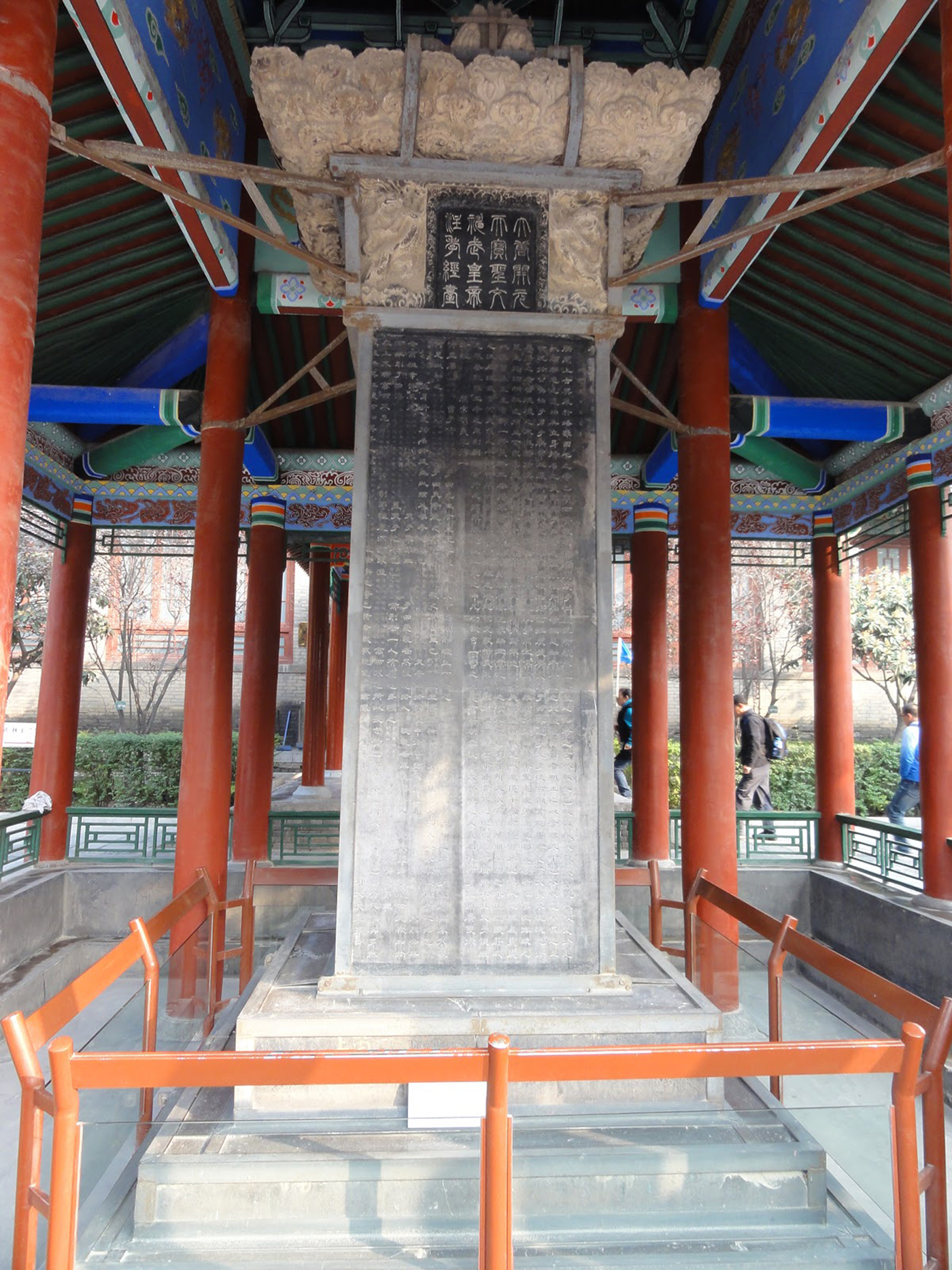
Stone Platform Classic of Filial Piety (Shitai xiaojing 石台孝經), commentary on the Classic of Filial Piety composed and transcribed by Emperor Xuanzong, 745. Stele recto. Ink rubbing. Xi'an Beilin Museum. Yasushi Nishikawa et al., Seian heirin (Tokyo: Kodansha, 1966). (color online)
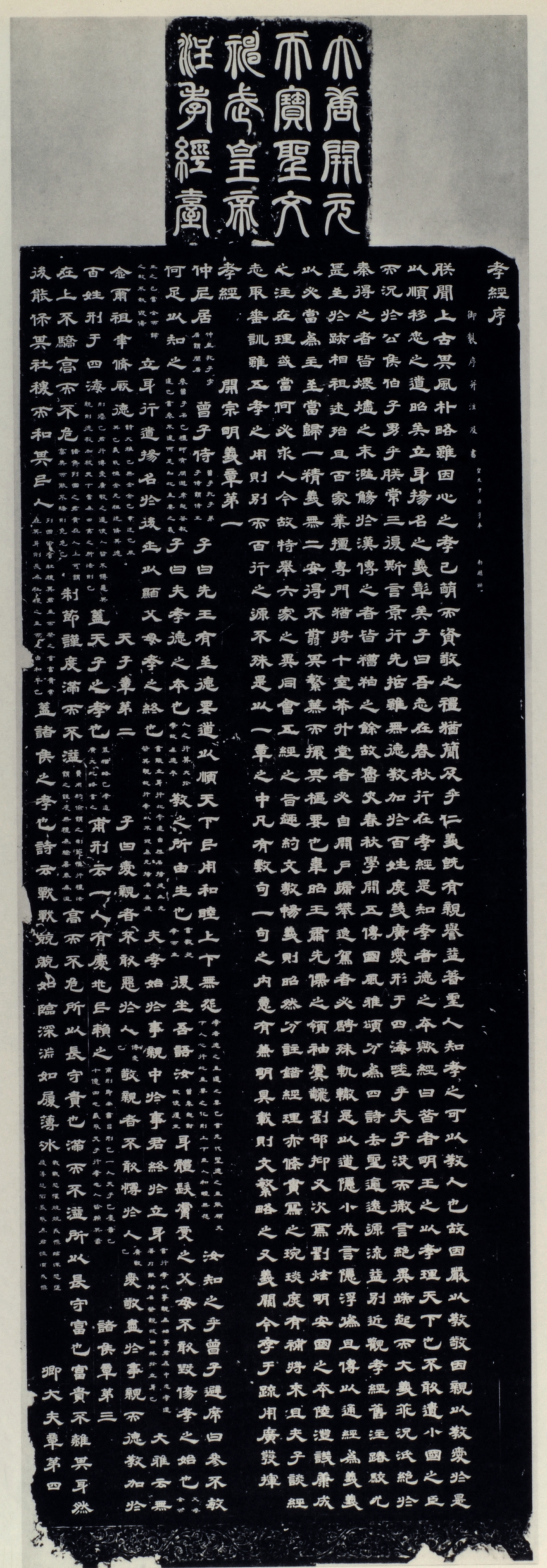
At the founding of the Song dynasty in 960, the original Confucius Temple was in a sorry state. During his second tenure in Chang'an as Yongxingjun Military Commissioner 永興軍節度使 and Governor of Chang'an from 961 to 964 (he had previously held these positions under the Later Zhou), Wang Yanchao took the initiative of refurbishing it and giving the steles that had been moved there some architectural protection from the elements. The earliest new stele that Wang sponsored was a recarving (fanke 翻刻) ca. 961–962 of the Record of the Temple of Confucius (Kongzi miaotang ji 孔子庙堂記). The recto of the stele reproduced from a rubbing the original inscription that Yu Shinan 虞世南 (558–638) had composed and transcribed in 626.Footnote 146 The new stele replaced the original one commissioned by Emperor Taizong (r. 627–649) and erected 629–630 (Figures 18–20).Footnote 147 In 962 a second new stele was erected alongside the Kaicheng Stone Classics to record the completion of the refurbishment of the site: Record of the Refurbishment of the Temple of Confucius (Chongxiu Wenxuanwang miao ji 重修文宣王廟記碑, Figures 24–25). The calligrapher responsible for the running-script transcription and the seal-script titlepiece was the otherwise unknown Ma Zhaoji 馬昭吉. The verso of the stele records the names of the many donors (Figures 26–27).
Record of the Temple of Confucius (Kongzi miaotang ji 孔子廟堂記) composed and transcribed in regular script by Yu Shinan, 961–962 recarving of the original 626 transcription, on a recycled Tang stele. Stele recto. Photo: Ma Yujiang and Leonardo Amiri. (color online)
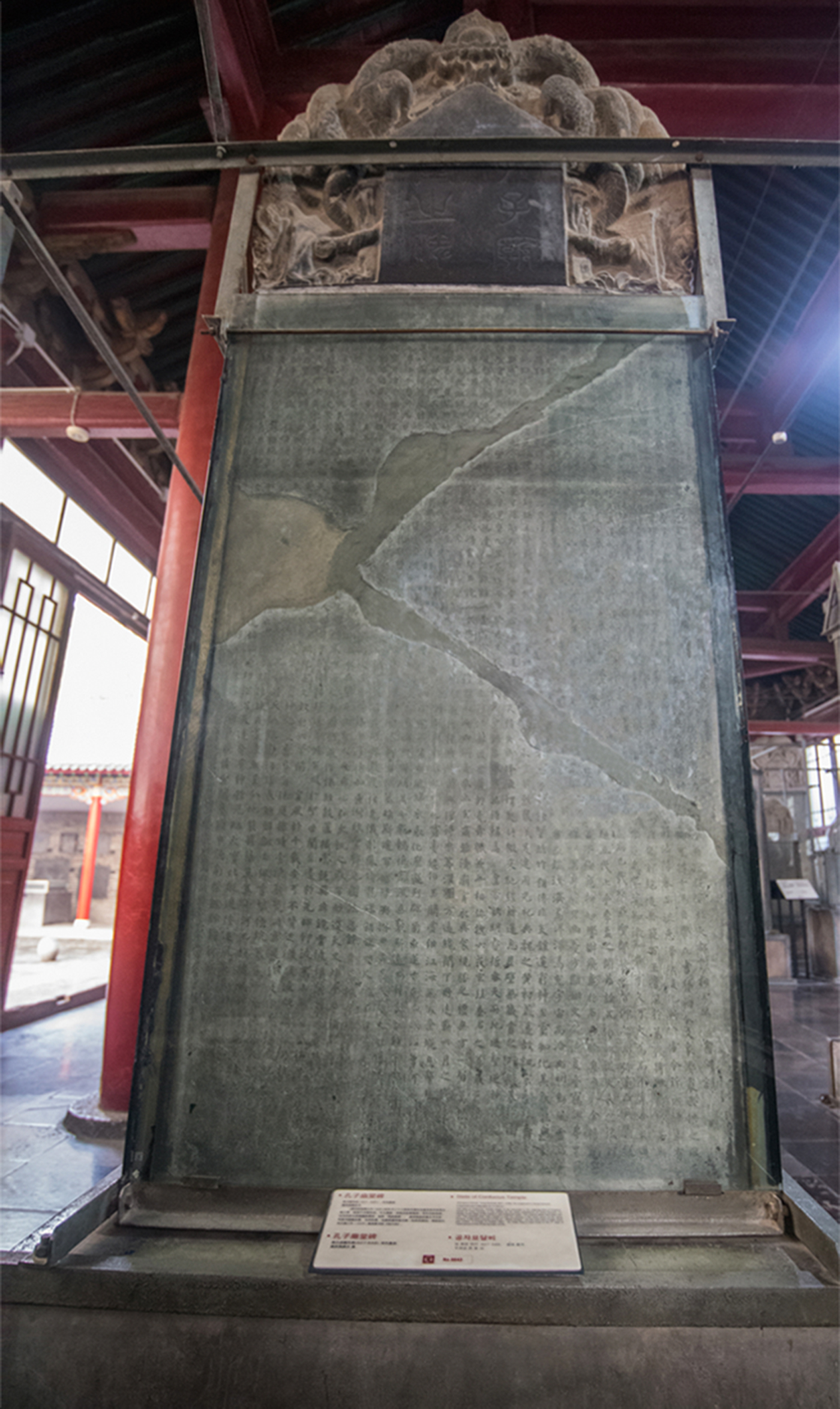
Record of the Temple of Confucius composed and transcribed in regular script by Yu Shinan, 961–962 recarving of the original 626 transcription, on a recycled Tang stele. Stele recto. Ink rubbing. Shenxi Provincial Museum, ed., Sui Tang Wenhua (Hong Kong: Zhonghua shuju; Shanghai: Xueshu, 1990), 131. (color online)
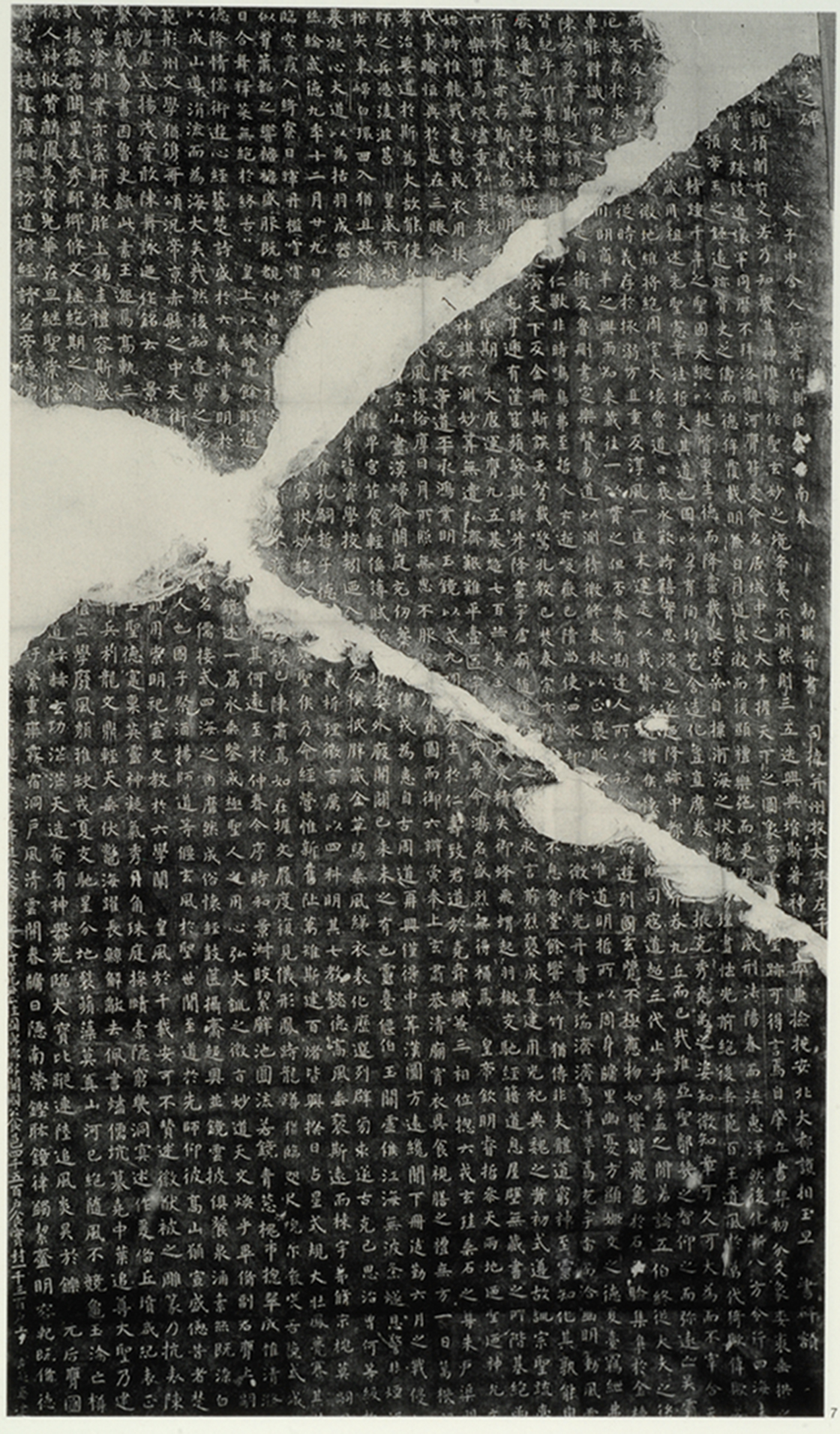
Record of the Temple of Confucius composed and transcribed in regular script by Yu Shinan, 961–962 recarving of the original 626 transcription, on a recycled Tang stele. Stele recto. Ink rubbing (detail). Gao Xia et al., Xi'an Beilin quanji, 4, Beike (Guangzhou: Guangdong jingji, Shenzhen: Haitian, 1999), 363. (color online)
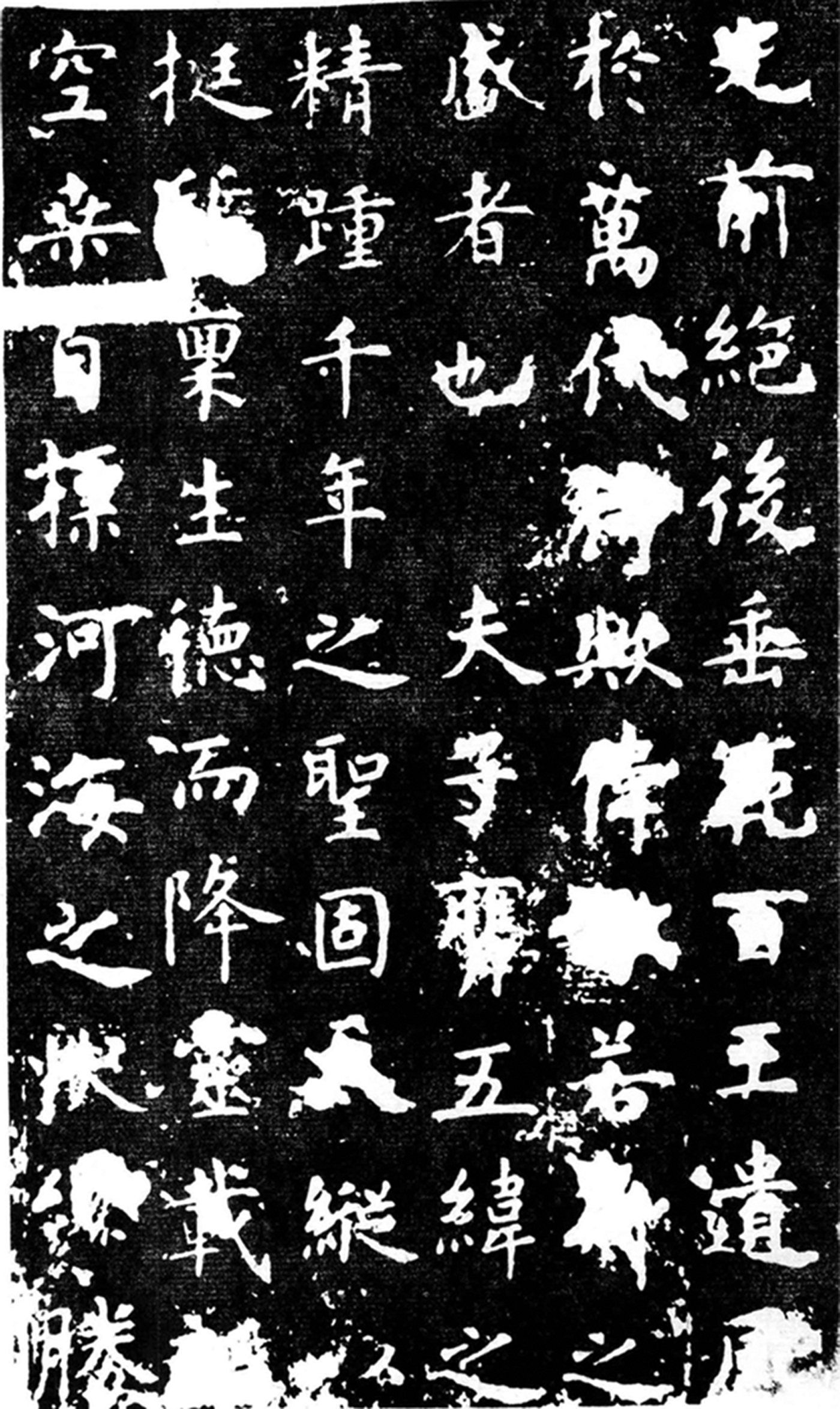
Eulogy of the Surge of the Great Song, with a Preface (Da Song Boxing song bing xu 大宋勃興頌), transcribed in seal script by Tang Ying, 1019. Verso of Record of the Temple of Confucius transcribed by Yu Shinan. Photo: Ma Yujiang and Leonardo Amiri. (color online)
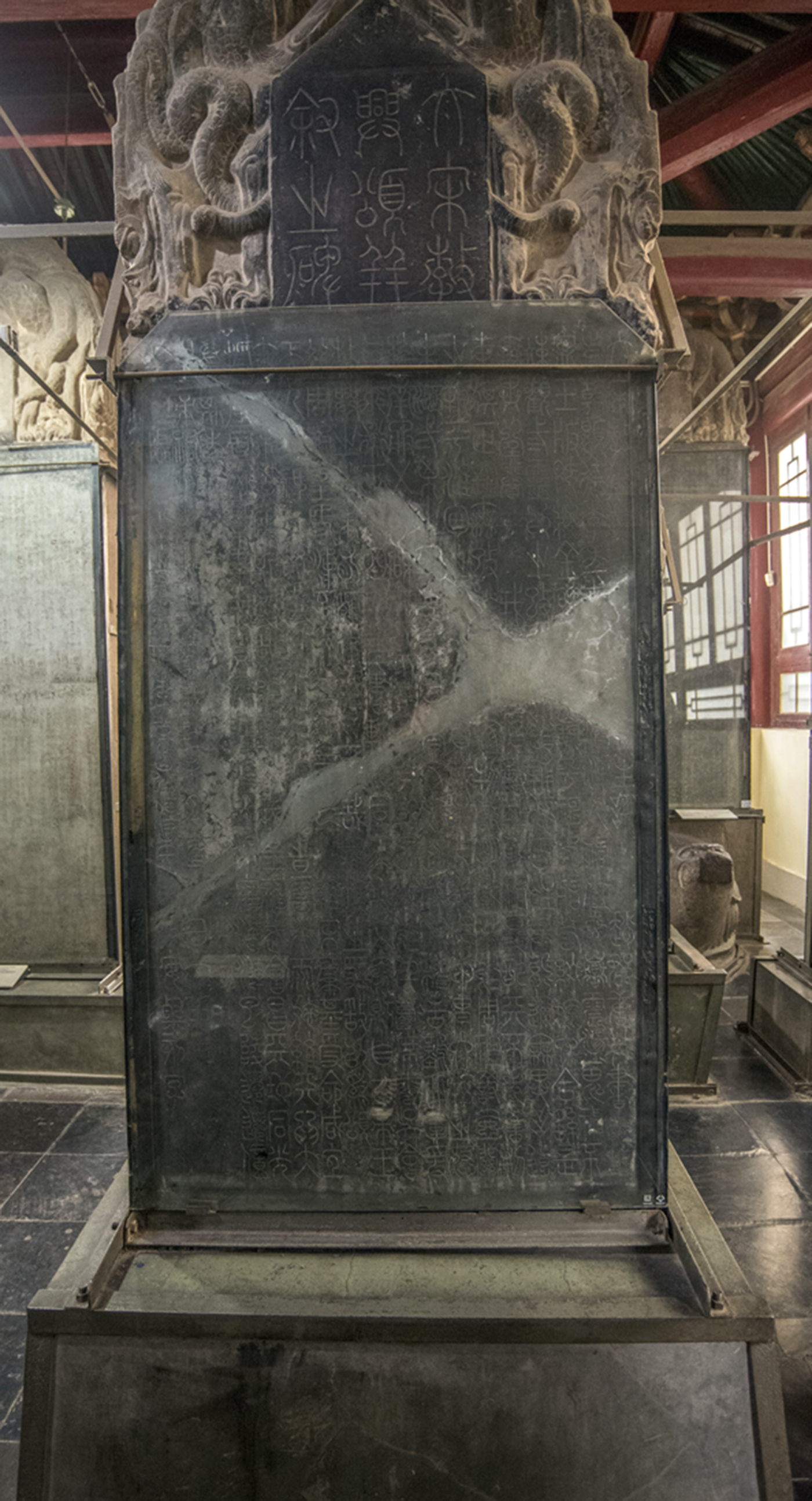
Eulogy of the Surge of the Great Song, with a Preface, transcribed in seal script by Tang Ying, 1019. Ink rubbing (detail). Verso of Record of the Temple of Confucius transcribed by Yu Shinan. Gao Xia et al., Xi'an Beilin quanji, 27, Beike (Guangzhou: Guangdong jingji, Shenzhen: Haitian, 1999), 2733. (color online)
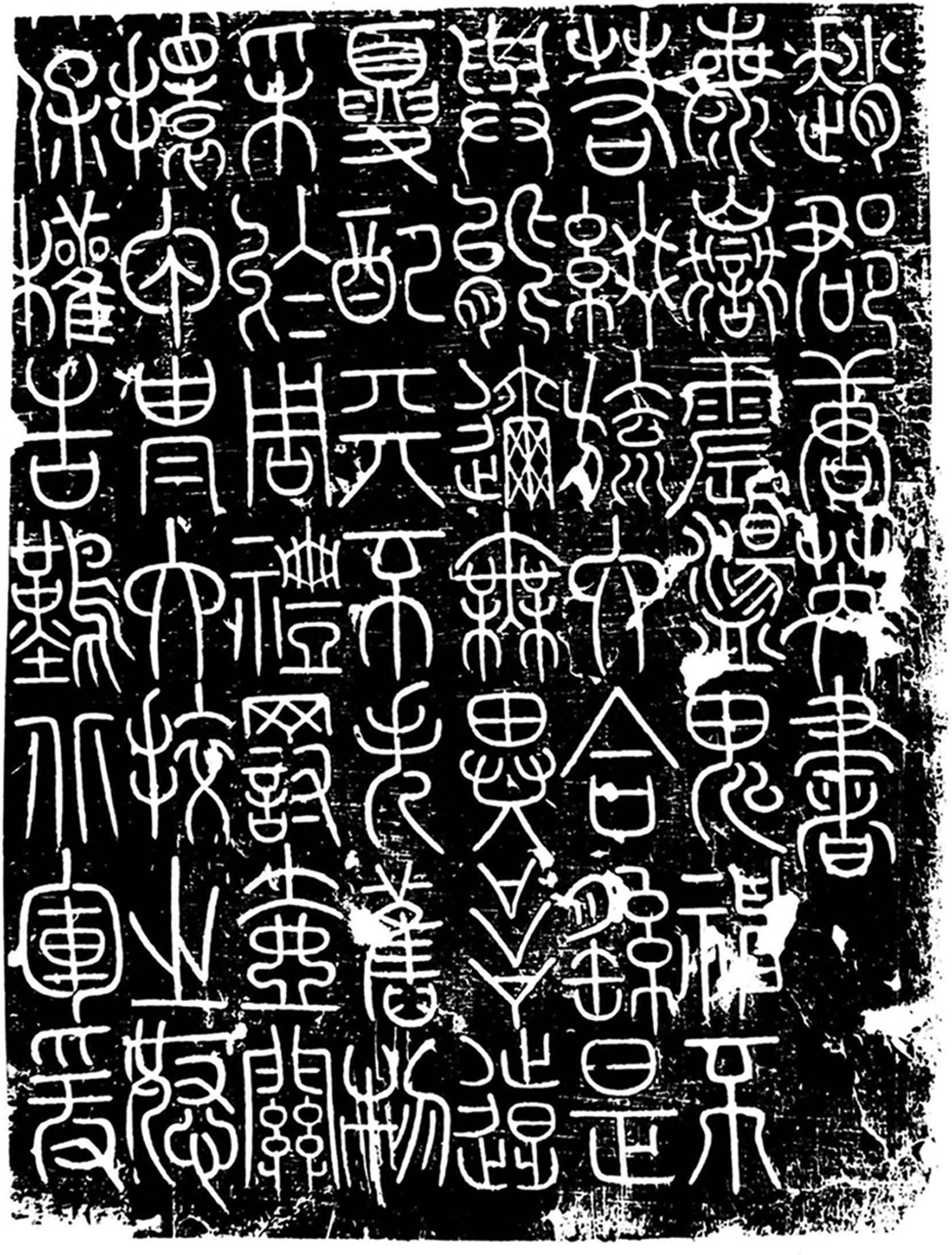
Decorative carving, Tang dynasty. Detail of one side of the stele bearing Record of the Temple of Confucius transcribed by Yu Shinan. Photo: Ma Yujiang and Leonardo Amiri. (color online)
Record of the Refurbishment of the Temple of Confucius (Chongxiu Wenxuanwang miao ji 重修文宣王廟記) transcribed in running script by Ma Zhaoji, 962, carved on a recycled Tang stele. Stele recto. Photo: Ma Yujiang and Leonardo Amiri. (color online)
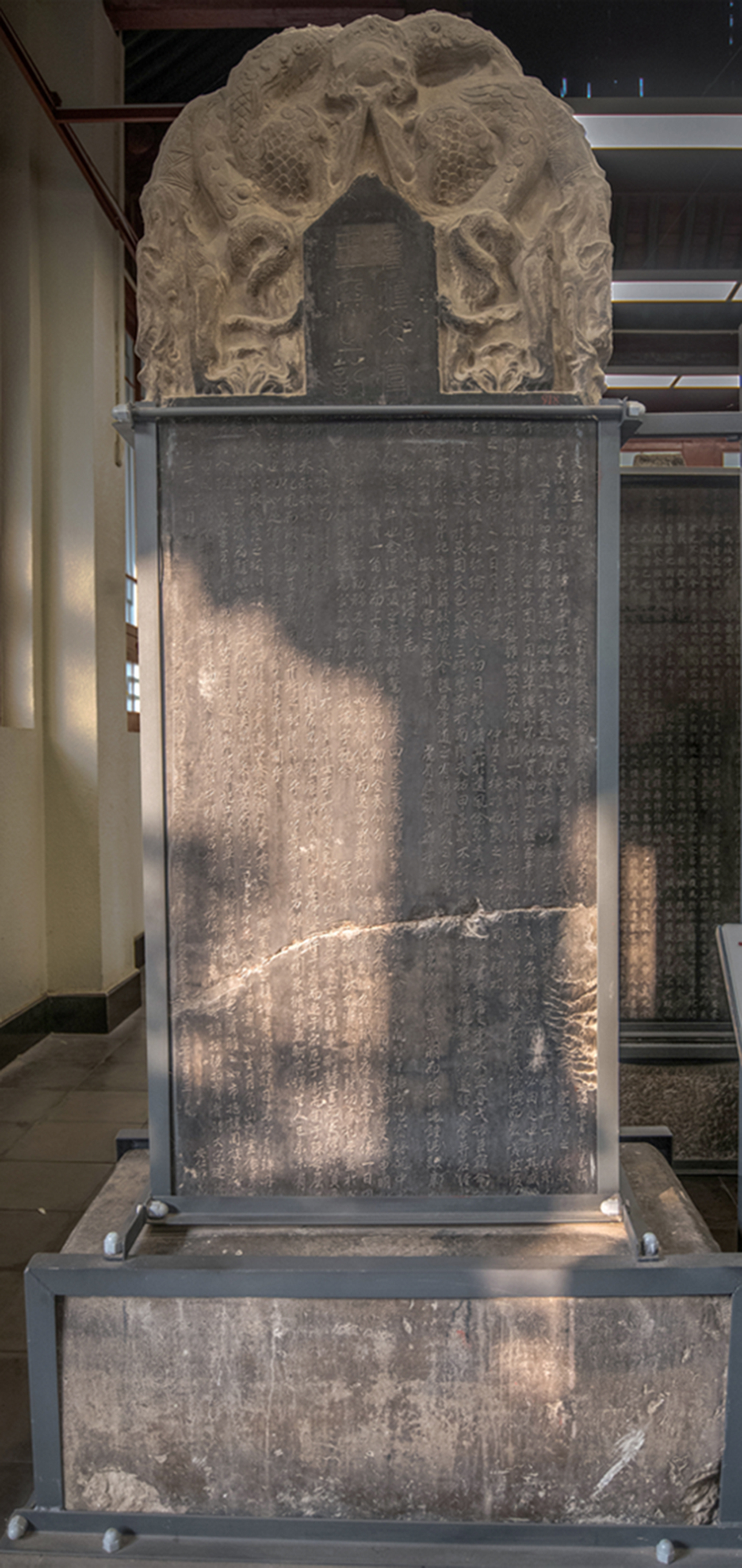
Record of the Refurbishment of the Temple of Confucius transcribed in running script by Ma Zhaoji, 962. Stele recto. Ink rubbing. Gao Xia et al., Xi'an Beilin quanji, 25, Beike (Guangzhou: Guangdong jingji, Shenzhen: Haitian, 1999), 2503. (color online)
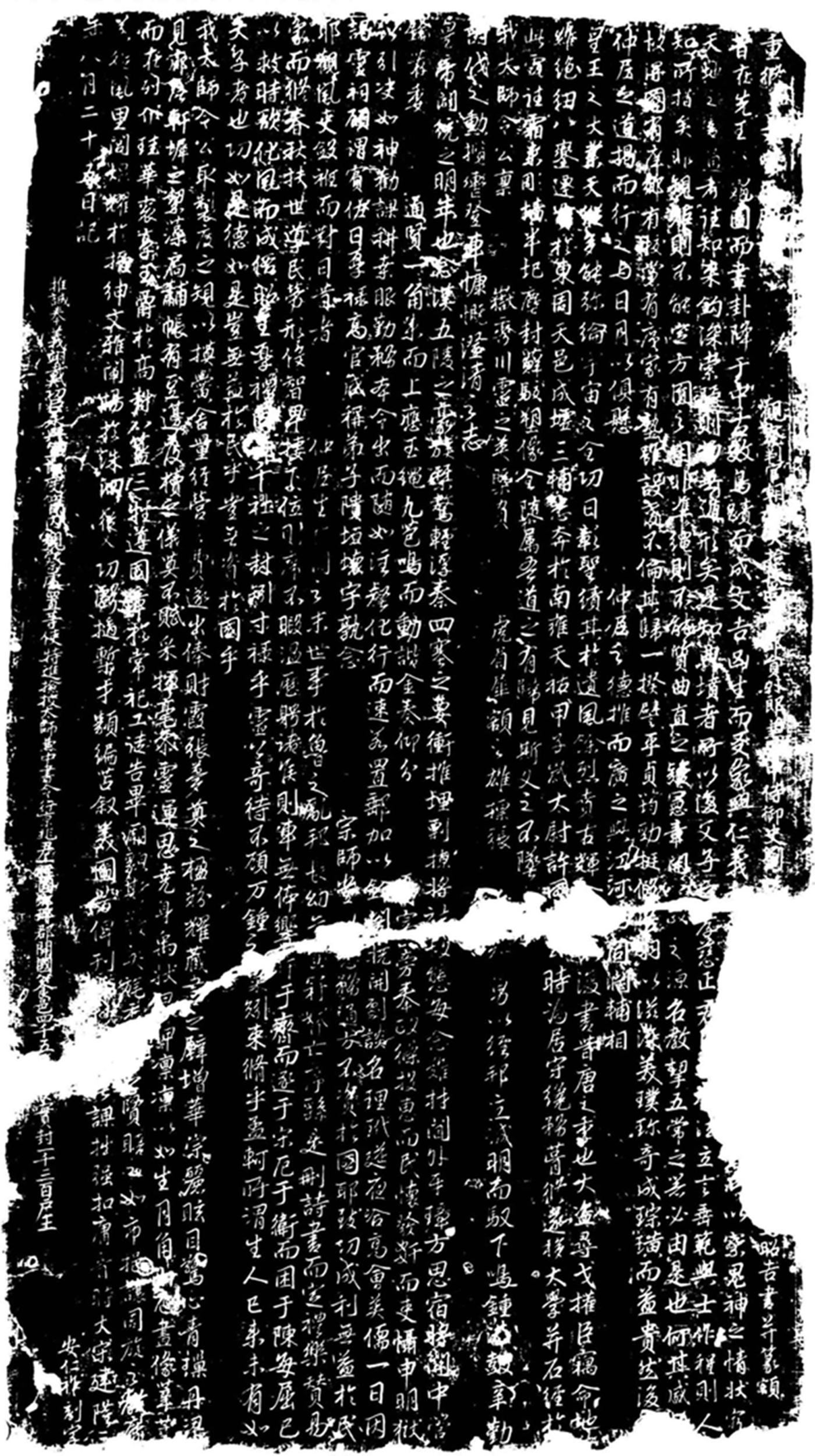
Running-Script Record of Donors, 962. Verso of stele bearing Record of the Refurbishment of the Temple of Confucius. Photo: Ma Yujiang and Leonardo Amiri. (color online)
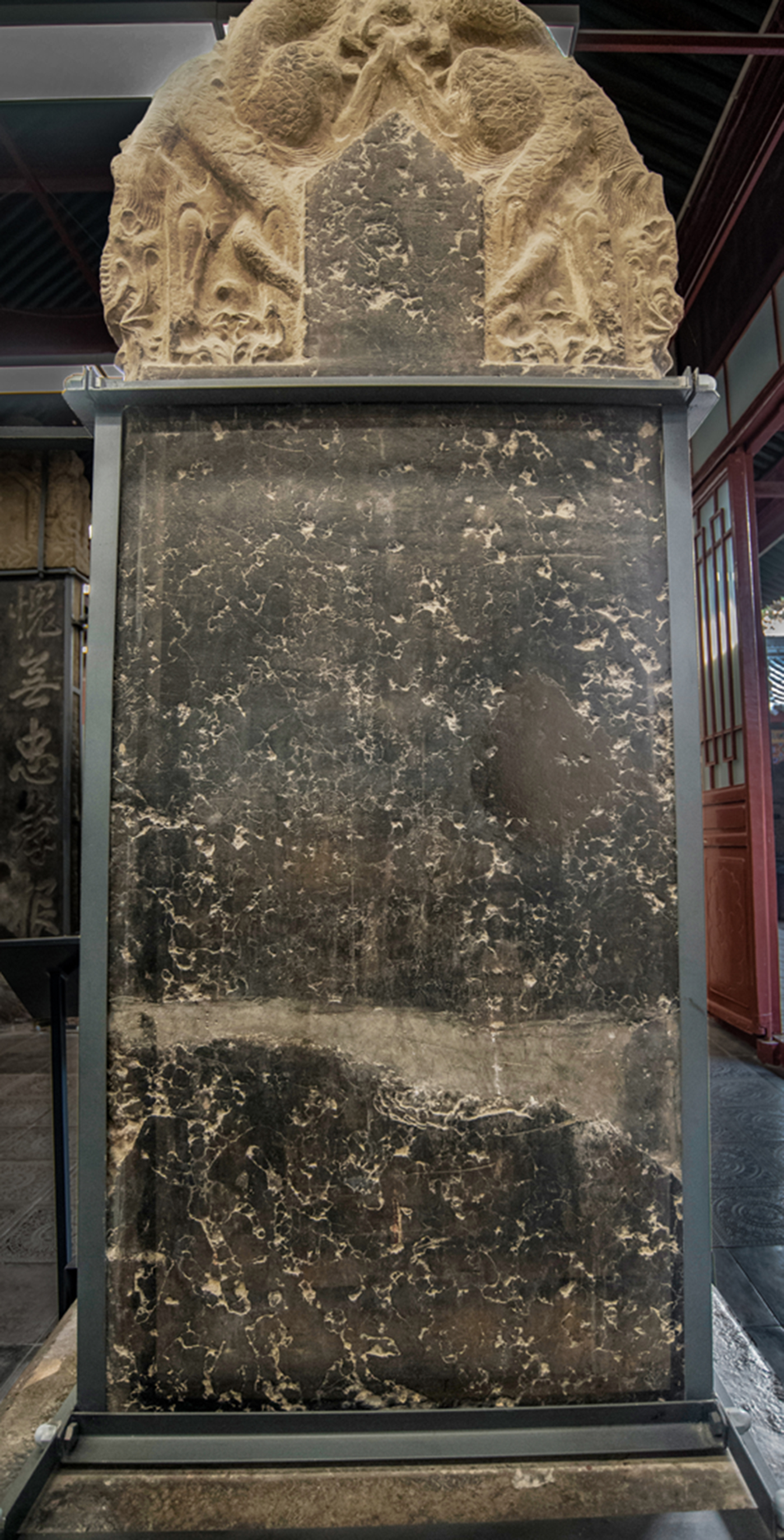
Running-Script Record of Donors, 962 (detail). Verso of stele bearing Record of the Refurbishment of the Temple of Confucius. Photo: Ma Yujiang. (color online)
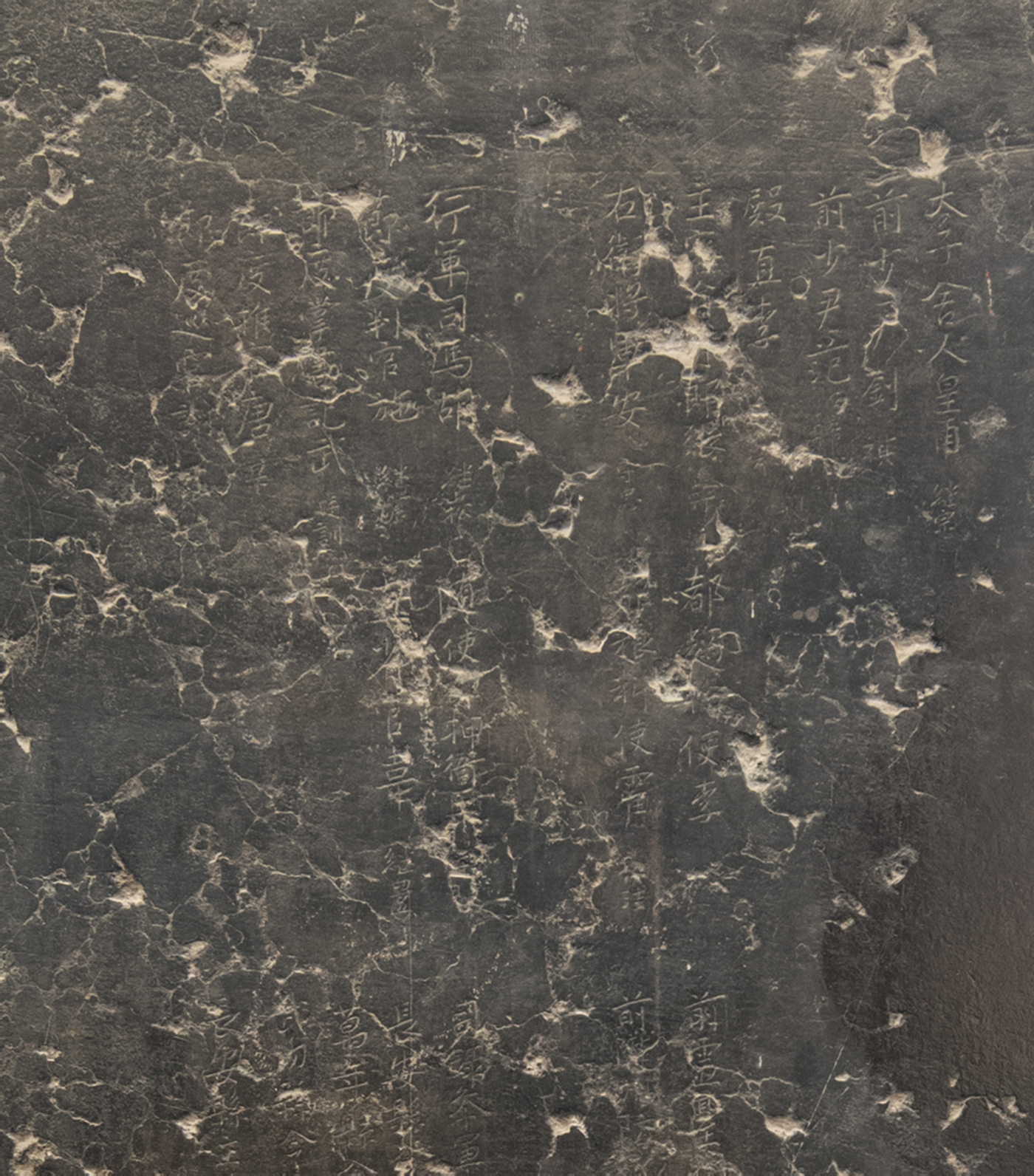
After his arrival in Chang'an as Wang's successor in 964, Wu Tingzuo initiated a second stage of refurbishment that expanded the range of steles at the site. Whether on his own initiative, or at Mengying's suggestion, he decided to add a stele on which would be engraved Mengying's seal-script transcription of the Thousand-Character Classic (Qianzi wen 千字文) (Figures 31–34). Thousand-Character Classic steles were also being erected elsewhere in China at this time; the Classic in question introduced to students a thousand of the most common characters.Footnote 148 Mengying's seal-script version, with the corresponding regular-script characters written beneath each character, effectively functioned as a seal-script dictionary.
As it turned out, this stele erected in 965 was only the first of seven additional steles at the Chang'an Confucius Temple, five of which were carved by 968, while the seventh, carved in 999, preserves further work by Mengying and Guo Zhongshu from the 960s. To fully appreciate the context of this evolving Song dynasty project, which is laid out in detail below, one has to take into account the fact that it complemented, and intersected with, a second program of bringing Tang steles with exceptional calligraphy from in and around Chang'an to the same site. The latter program began with the 961–962 recarving of Yu Shinan's Record of the Temple of Confucius (see Figures 18–20) The two programs first intersected in 966, when a work by Guo Zhongshu (see Figures 38–40) was added to the verso of Master Longchan Stele (Longchan fashi bei 隆阐法师碑, 743), whose running-script calligraphy by an unidentified calligrapher is in Wang Xizhi style (see Figures 36–37). They intersected again in 998, when an inscription was added to the verso of Ouyang Tong's 歐陽通 (625–691) regular-script Master Daoyin Stele (Daoyin fashi bei 道因法師碑, 663) (see Figures 58–63). By then, however, Yan Zhenqing's 顔真卿 (709–785) late masterpiece in regular script, Yan Family Ancestral Temple Stele (Yan shi jiamiao bei 顔氏家廟碑), had also been moved to the Confucius Temple, around 982, an event commemorated in a lost text by Mengying. So, too, had several other models of regular script, making a visual history of Tang regular-script calligraphy one of the great strengths of the collection. The relocated steles included Chu Suiliang's 褚遂良 (596–658) Master Meng Stele (Meng fashi bei 孟法师碑, 642), Yan Zhenqing's Many Treasures Pagoda Stele (Duobao ta ganying bei 多寶塔感應碑, 752), Xu Hao's 徐浩 (703–782) Monk Amoghavajra Stele (Bukong heshang bei 不空和尚碑, 781), Wu Tongwei's 吳通微 Chan Master Chujin Stele (Chujin chanshi bei 楚金禪師碑, 805, verso of Yan Zhenqing's Many Treasures Pagoda Stele), and Liu Gongquan's 柳公權 (778–865) Record of Xuanmi Pagoda (Xuanmi ta bei 玄秘塔碑, 841). The early Song collection of pre-Song models also came to include examples of other scripts. In addition to the aforementioned Master Longchan Stele, the Wang Xizhi tradition of running script may also have been represented by Monk Huairen's 672 compilation of Wang's characters (including a small number in regular and draft script as well) in Stele with Preface to the Holy Teachings in Collated Characters Written by Wang [Xizhi] (Ji Wang Shengjiao xu bei 集王聖教序碑). As for seal script, although we do not know when Li Yangbing's Stele Recording Three Graves (Sanfen ji bei 三坆記碑) and Stele Recording the Xixian Ancestral tombs (Xixian ying bei 拪先塋記碑), both dating from 767, entered the collection, they were already part of it in 1010 when the inscriptions on the two steles were restored. Given Mengying's veneration of Li Yangbing, it would be surprising if these steles had not already come to the Confucius Temple during Mengying's lifetime. On the other hand, we can be certain that another seal-script model entered the collection in 993. In that year the Deputy Transport Commissioner for Shaanxi, Zheng Wenbao 鄭文寶 (953–1013), sponsored a recarving of Li Si's Qin dynasty Yishan Stele (Yishan bei 嶧山碑), based on a copy by the recently deceased Xu Xuan. Finally, by 993 there was probably at least one Tang dynasty clerical-script model at the site as well, the 736 Chan Master Dazhi Stele (Dazhi chanshi bei 大智禪師碑) with calligraphy by Shi Weize 史維則.Footnote 149 Moreover, in 988 Zheng Wenbao joined with other officials in Chang'an to erect a stele engraved with a clerical-script transcription by the monk Yunsheng 雲勝 of Song Taizong's Sagely Preface to a New Translation of the Tripitaka (Da Song xinyi Sanzang shengjiao xu 大宋新譯三藏聖教序).Footnote 150 We owe this detailed knowledge of the evolving pre-Song stele collection once again to the remarkable detective work of Lu Yuan.Footnote 151 From Lu's work we also learn that it may only have been after the 1103 move that the many steles which had clustered around the Stone Classics in the tenth century rejoined the Stone Classics.
The new Song stele inscriptions associated with Mengying and Guo Zhongshu (like those separately added by others from 988 onwards, which do not concern us here) thus found themselves in increasingly distinguished calligraphic company. Several of the calligraphers participating in the seven-stele project—Yuan Zhengji, Huangfu Yan 皇甫儼, Pang Renxian 龐仁顯, and Yuan Yunzhong 袁允忠, as well as Mengying himself—defended the honor of contemporary regular-script calligraphy.Footnote 152 But the Song stele inscriptions no doubt stood out more for the prominence they gave to seal script and ancient script in contributions by Mengying and Guo Zhongshu. The texts transcribed on the seven steles are very diverse, including not only major paleographic and epigraphic works by Mengying and Guo but also a Buddhist sutra, Daoist scriptures, and a text about the Confucius Temple, as well as numerous poems and several prefaces. Additional materials relating to both Mengying and Guo Zhongshu are carved on two of the steles (3 and 6). These include Guo's letter to Mengying cited above, and variously dated poems dedicated to Mengying from no fewer than 39 contemporaries, including luminaries such as Song Bai 宋白 (936–1012), as well as younger artists who would go on to become famous, such as the calligrapher Li Jianzhong and the painter Xu Daoning 許道寧.Footnote 153 Most of the poems seem to have been occasioned by one or other of his two summonses to court ca. 952–954 and 976, at the command of Guo Wei and Taizong respectively. Two prefaces written by the former Jingnan Kingdom and later Song dynasty academician, Tao Gu 陶穀 (903–970), the author of Qingyi lu 清異錄, comment on works by Mengying. Several other people were involved as calligraphers, carvers, and painters, including Guo Zhongshu's collaborator as calligrapher on his very first stele project in Luoyang in 948, Yuan Zhengji, who in the interim had spent a period as a prefectural judge in Jingzhou in Shaanxi.Footnote 154 None of the three painters who contributed illustrations to the project, Li Fenggui 李奉珪, Zhai Shousu 翟守桊, or Bai Tingcan 白廷 璨 is recorded in any of the biographical histories of painting.Footnote 155
All seven of the steles in the second stage of the project re-used existing Tang dynasty steles. The Tang inscriptions were effaced as necessary in order to create a clean surface for new engraving, with the result that some of the steles exist today as combinations of old and new inscriptions.Footnote 156 In order to allow the reader to visualize the second stage of the project fully, including both its ancient and modern components, Figures 28–73 document it stele by stele. I use a combination of photographs, which give a sense of the physicality of these stone monuments, and ink rubbings, which usually provide a clearer image of the engraved inscriptions. Unfortunately, the quality of the photographs is limited by the fact that many of the inscriptions are currently protected by glass. The sequence of production of the early Song inscriptions was as follows.
Stele 1 recto: Regular-Script Transcription of Tao Gu's 967 “Preface to Mengying's Seal-Script Transcription of the ‘Thousand-Character Classic’” (Kaishu Tao Gu juan Mengying zhuanshu Qianzi wen 楷書陶穀撰夢英篆書千字文序) by Huangfu Yan, with an ancient-script title by Mengying, 967, carved on a recycled Tang stele. Photo: Ma Yujiang and Leonardo Amiri. (color online)
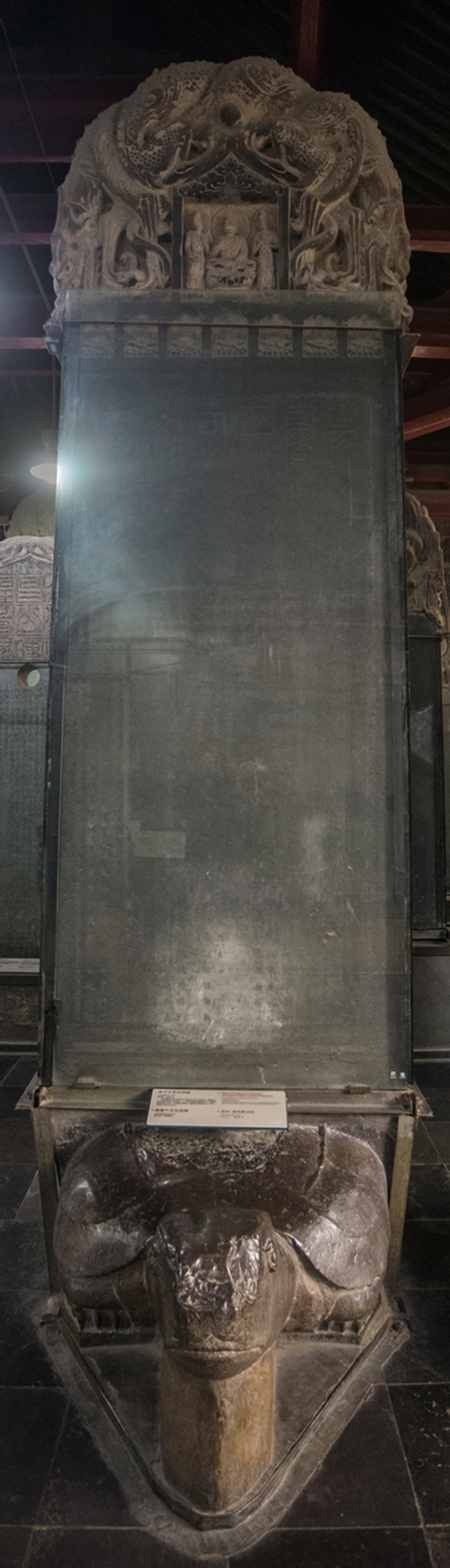
Stele 1 recto: Regular-Script Transcription of Tao Gu's 967 “Preface to Mengying's Seal-Script Transcription of the ‘Thousand-Character Classic’” by Huangfu Yan, 967. Ink rubbing. National Palace Museum, Taipei. After Lu Sufen, “Qianzi chuan qiangu: Menging Zhuanshu Qianzi wen,” Gugong wenwu yuekan 316 (2009), 45. (color online)
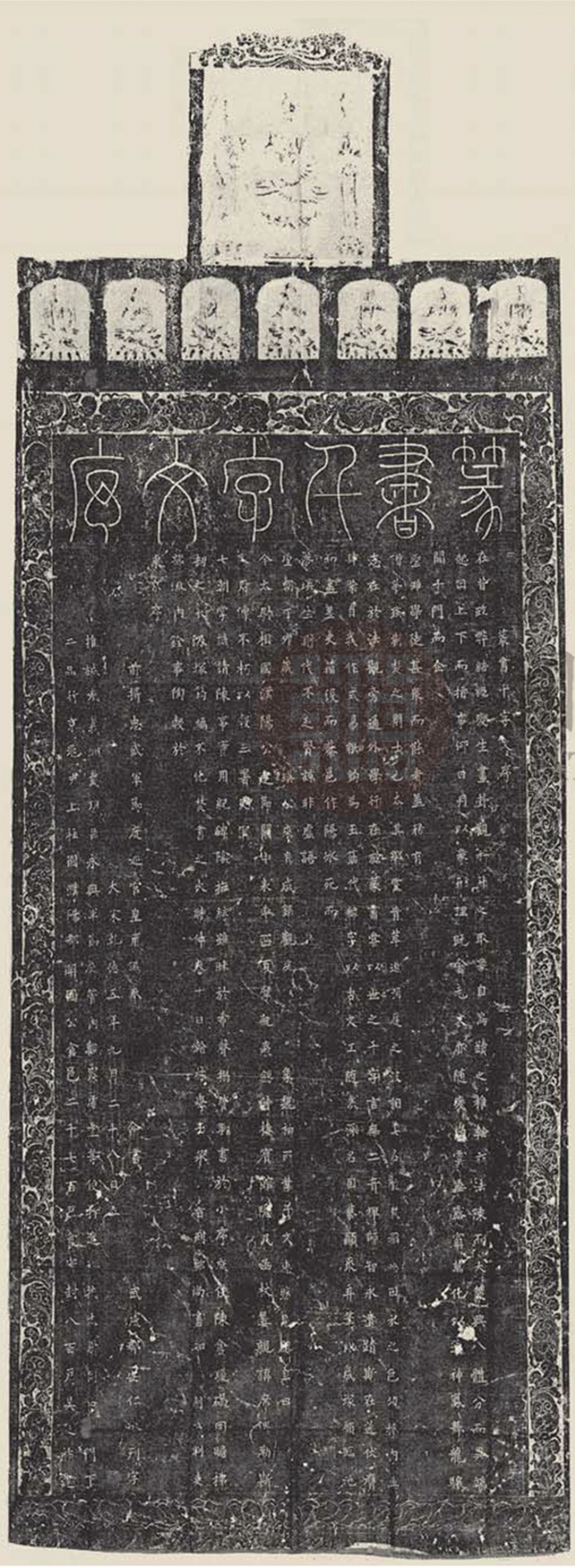
Stele 1 recto: Regular-Script Transcription of Tao Gu's 967 “Preface to Mengying's Seal-Script Transcription of the ‘Thousand-Character Classic’” by Huangfu Yan, 967. Ink rubbing (detail). Gao Xia et al., Xi'an Beilin quanji, 25, Beike (Guangzhou: Guangdong jingji, Shenzhen: Haitian, 1999), 2600. (color online)
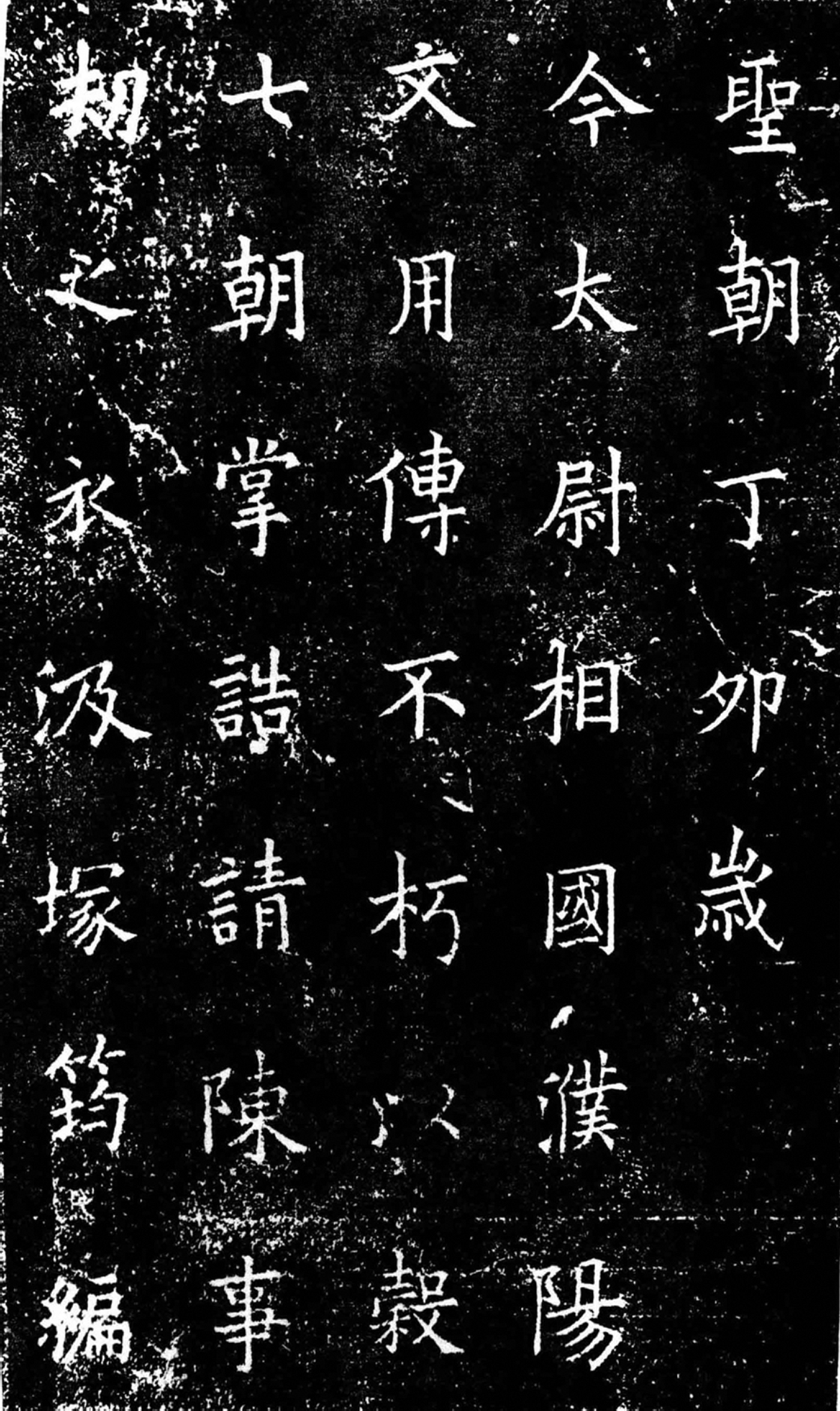
Stele 1 verso: Ancient-Script Title and Seal-Script Transcription of the “Thousand-Character Classic” (Guwen e zhuanshu Qianzi wen 古文額篆書千字文) transcribed by Mengying, with preface and explanatory regular-script characters by Yuan Zhengji, 965. Photo: Ma Yujiang and Leonardo Amiri. (color online)
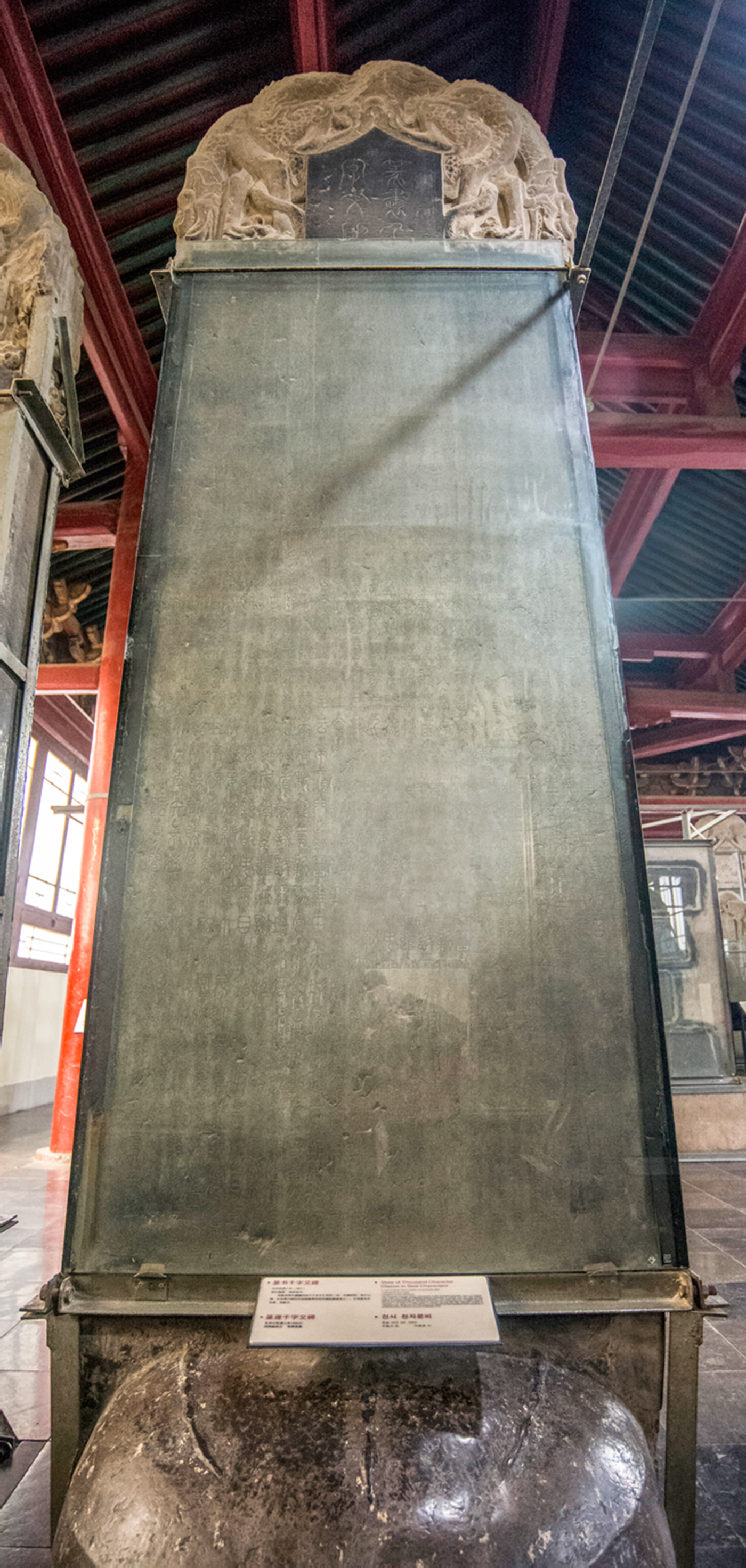
Stele 1 verso: Ancient-script Title (Guwen e 古文額) by Mengying to his own “Seal-Script Transcription of the ‘Thousand-Character Classic’” (Zhuanshu Qianzi wen 篆書千字文), 965. Ink rubbing. Gao Xia et al., Xi'an Beilin quanji, 25, Beike (Guangzhou: Guangdong jingji, Shenzhen: Haitian, 1999), 2548. (color online)
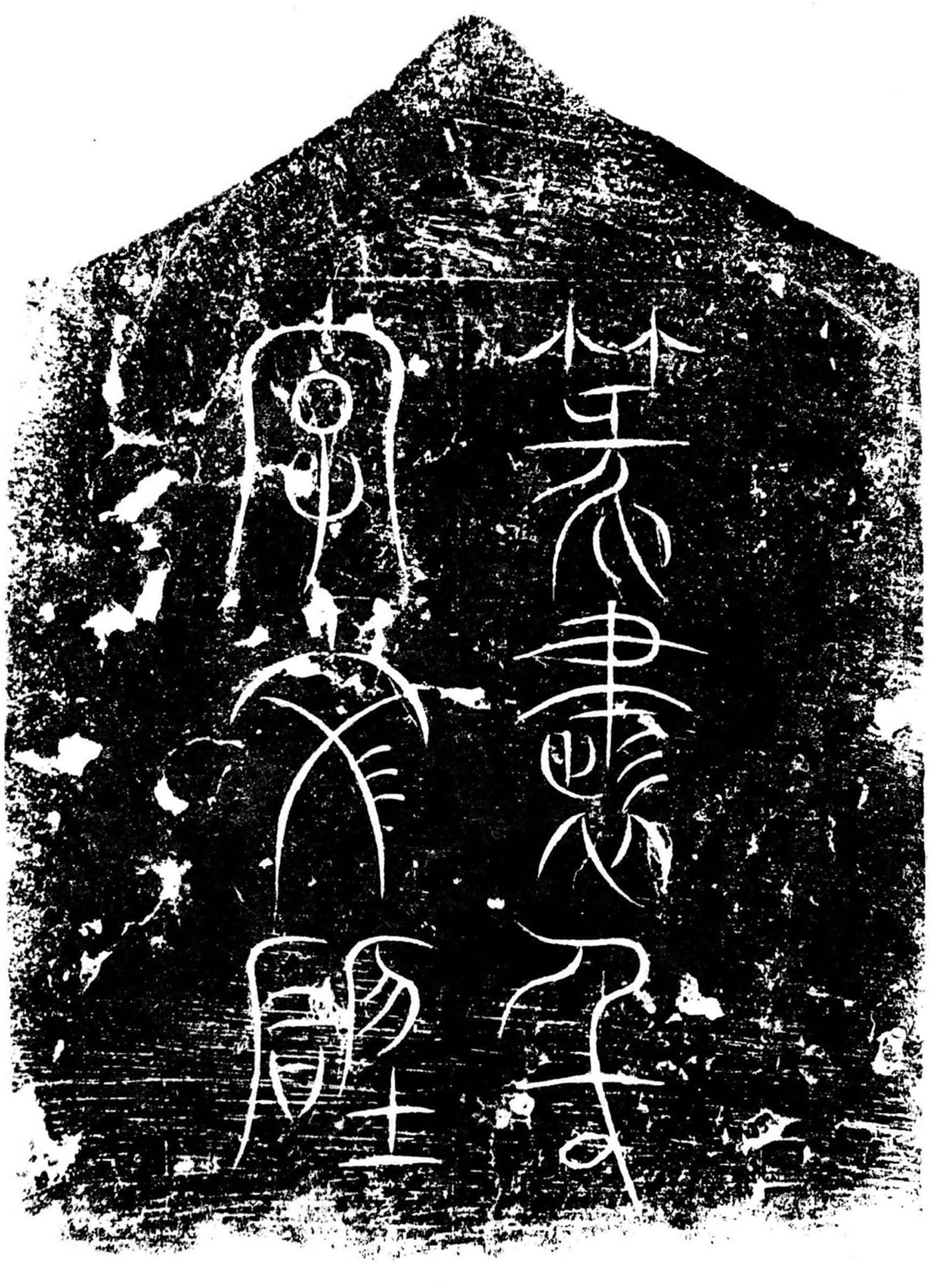
Stele 1 verso: Ancient-Script Title and Seal-Script Transcription of the “Thousand-Character Classic” transcribed by Mengying, with preface and explanatory regular-script characters by Yuan Zhengji, 965. Ink rubbing. “‘Xiaoxiang sizeng’ zhi Mengying Zhuanshu qianziwen bei!” xuehua.us, 2018/08/20 (color online)
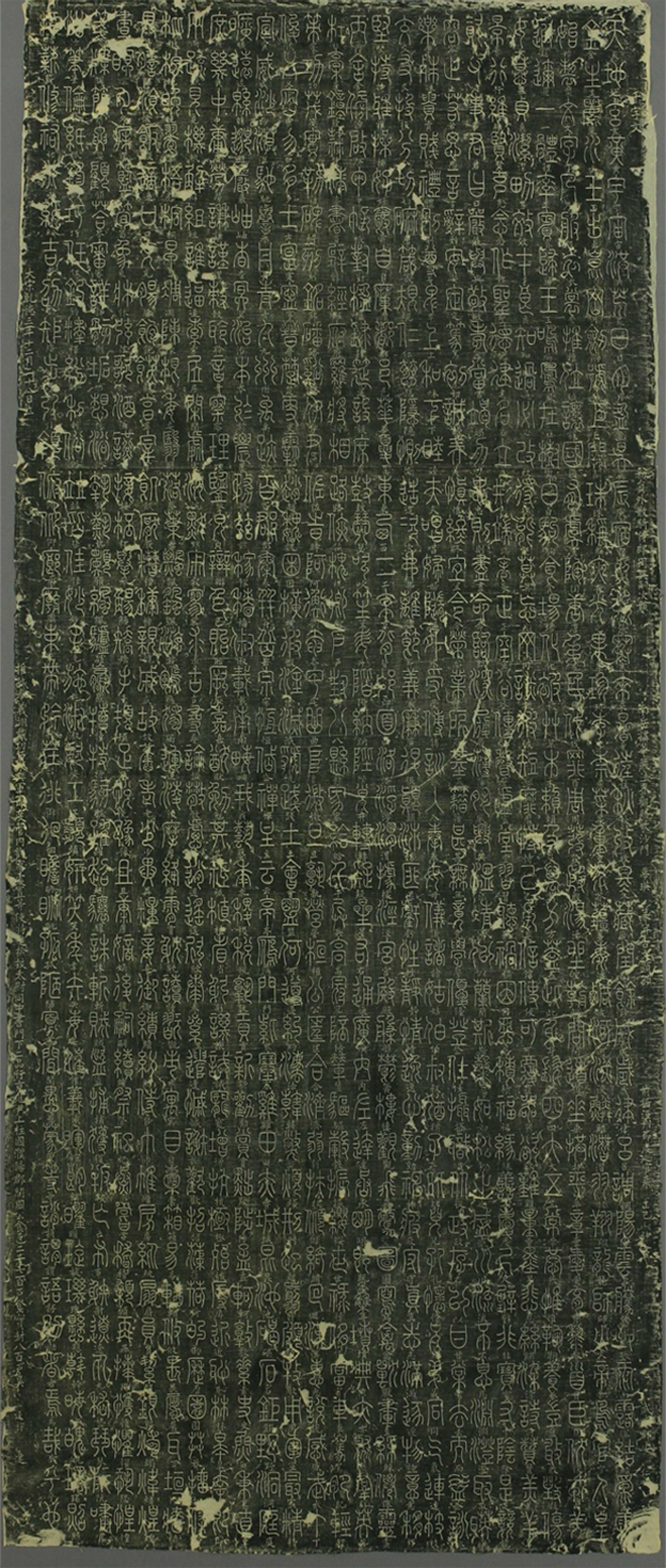
Stele 1 verso: Seal-Script Transcription of the “Thousand-Character Classic” transcribed by Mengying, with preface and explanatory regular-script characters by Yuan Zhengji, 965. Ink rubbing (detail). Gao Xia et al., Xi'an Beilin quanji, 25, Beike (Guangzhou: Guangdong jingji, Shenzhen: Haitian, 1999), 2549. (color online)
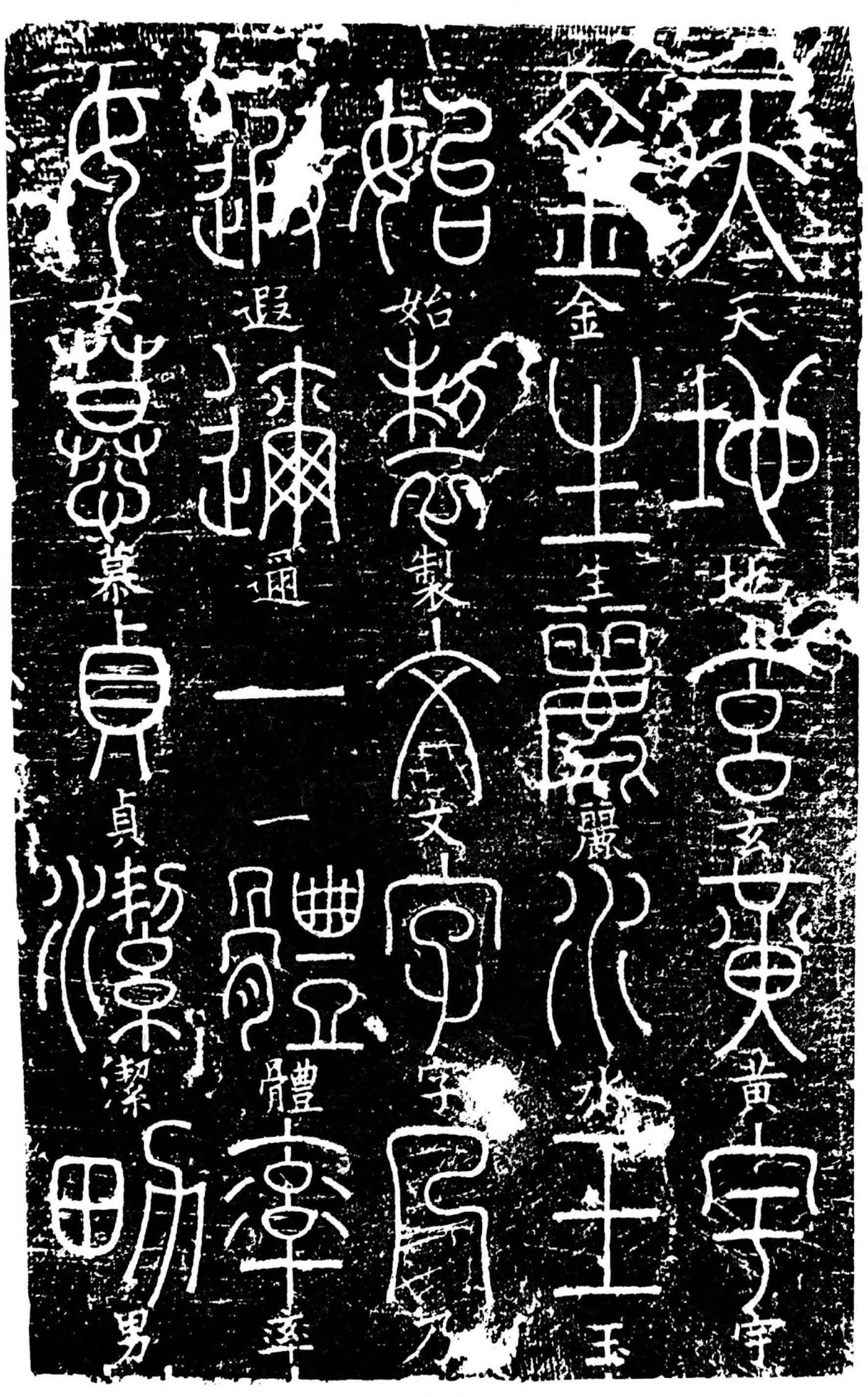
Decorative carving, Tang dynasty. Detail of one side of Stele 1. Photo: Ma Yujiang and Leonardo Amiri. (color online)
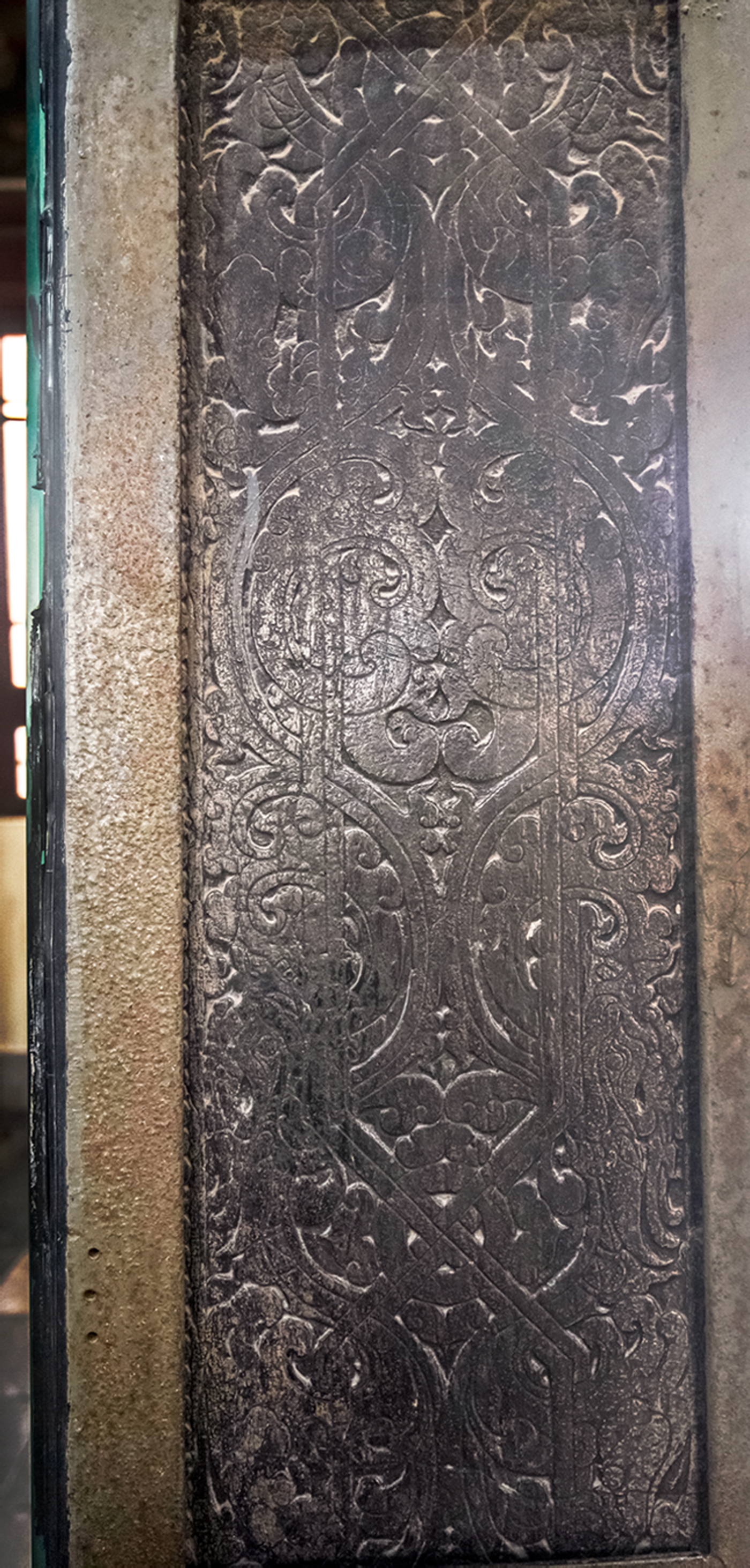
Stele 2 recto: “Memorial to Chan Master Longchan, with a Preface” (Longchan fashi beiming 隆闡法師碑銘), transcribed in running script by an unidentified calligrapher, 743. Photo: Ma Yujiang and Leonardo Amiri. (color online)
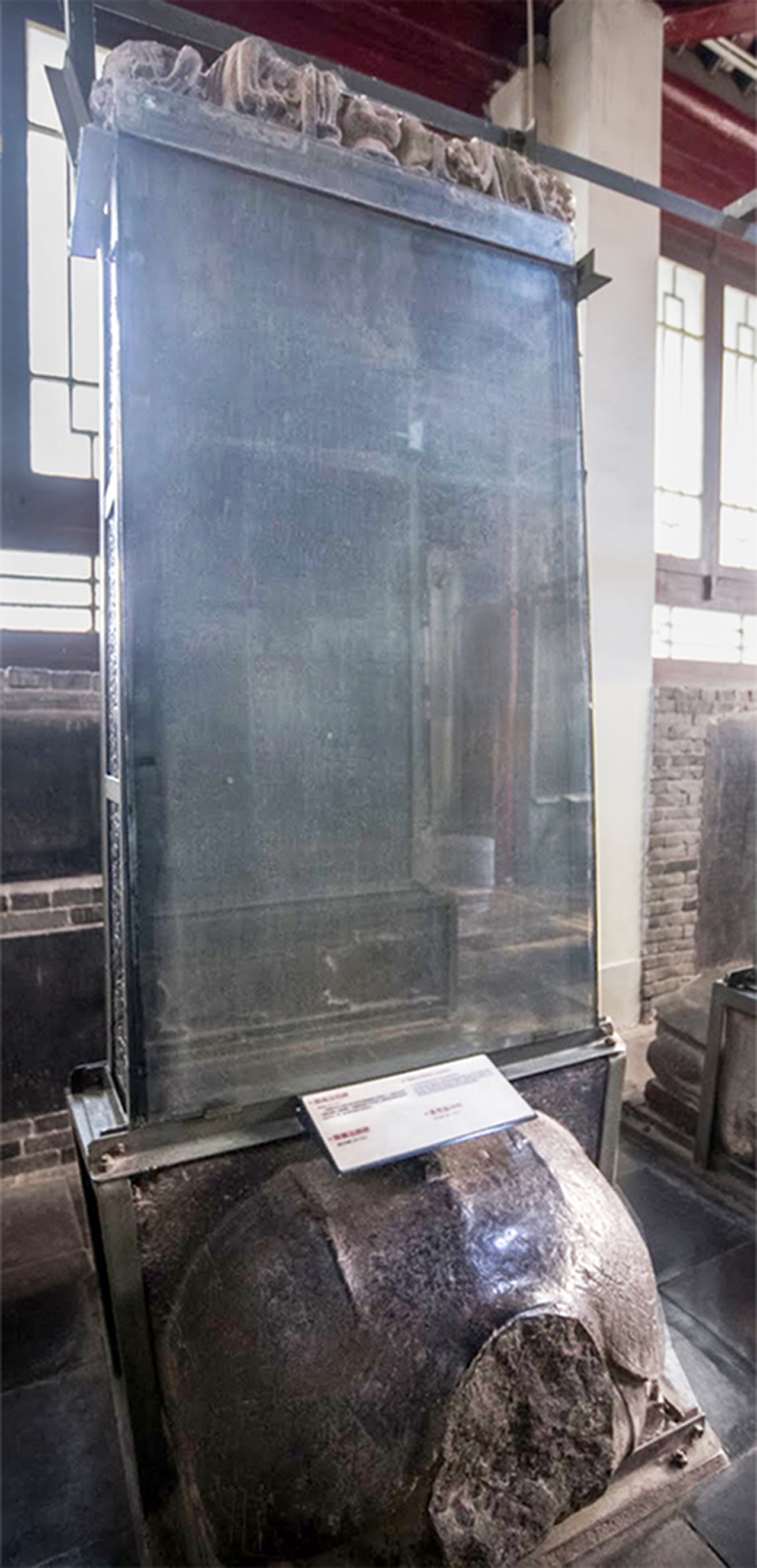
Stele 2 recto: “Memorial to Chan Master Longchan, with a Preface” (Longchan fashi beiming bing xu 隆闡法師碑銘並序), transcribed in running script by an unidentified calligrapher, 743. Ink rubbing re-ordered to fit the album format (detail). “Tangdai xingshu beike Longchan fashi beiming,” Shufa xinshang www.yac8.com. (color online)
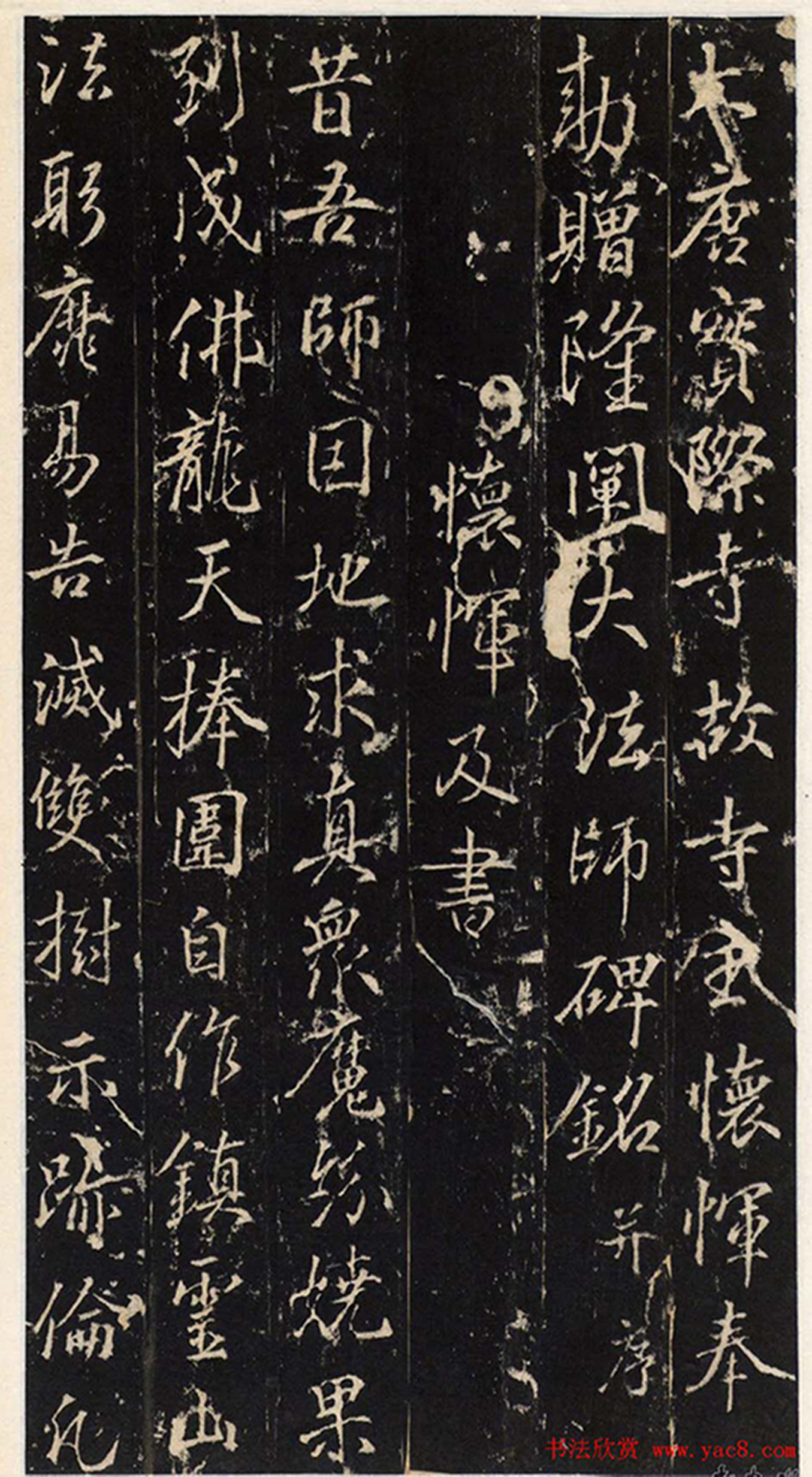
Stele 2 verso: “The Hidden Talisman Scripture” in Three Scripts (Santi Yinfu jing 三體陰符經), transcribed by Guo Zhongshu, 966. Photo: Ma Yujiang and Leonardo Amiri. (color online)
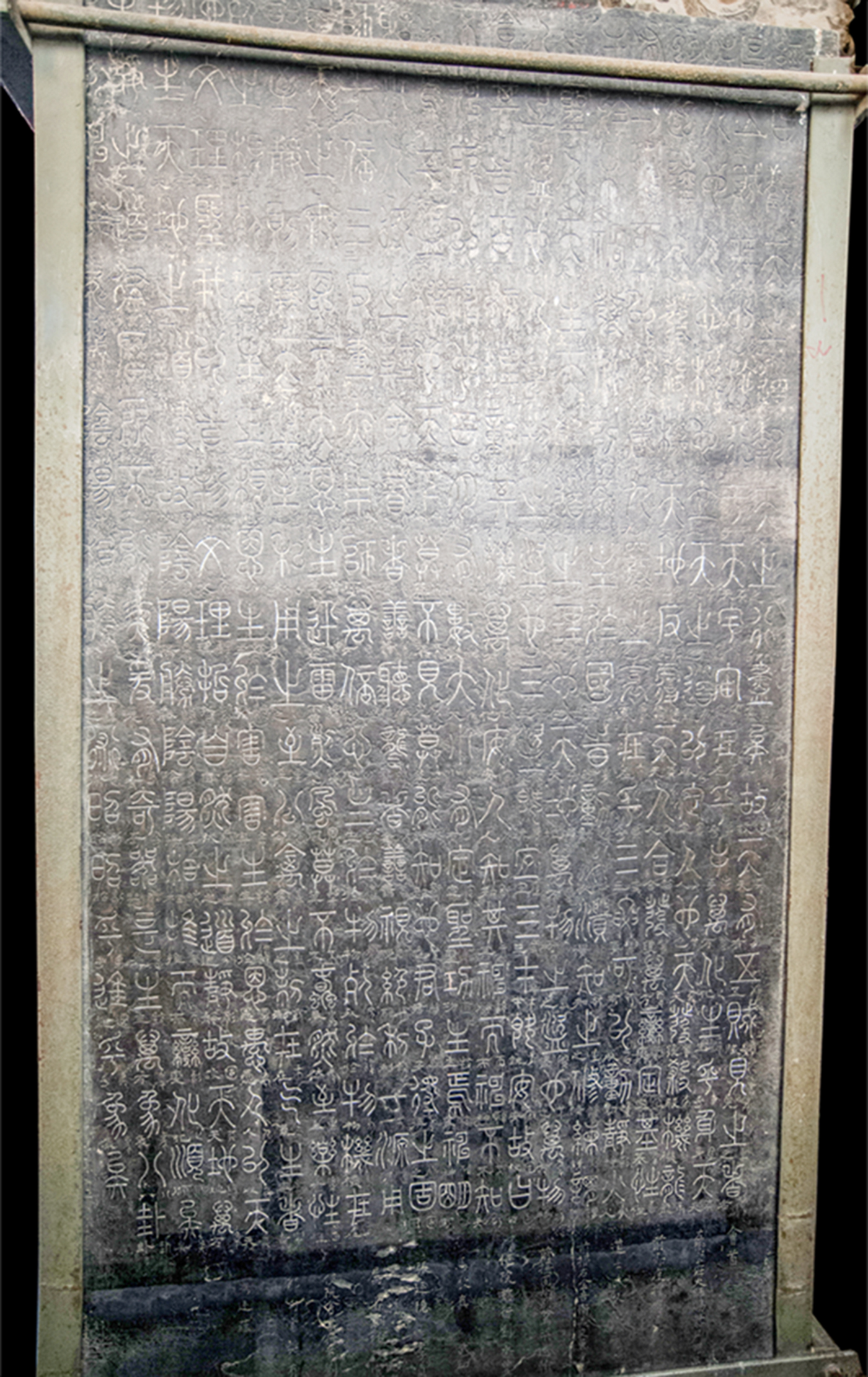
Stele 2 verso: “The Hidden Talisman Scripture” in Three Scripts, transcribed by Guo Zhongshu, 966. Ink rubbing. Gao Xia et al., Xi'an Beilin quanji, 26, Beike (Guangzhou: Guangdong jingji, Shenzhen: Haitian, 1999), 2612. (color online)
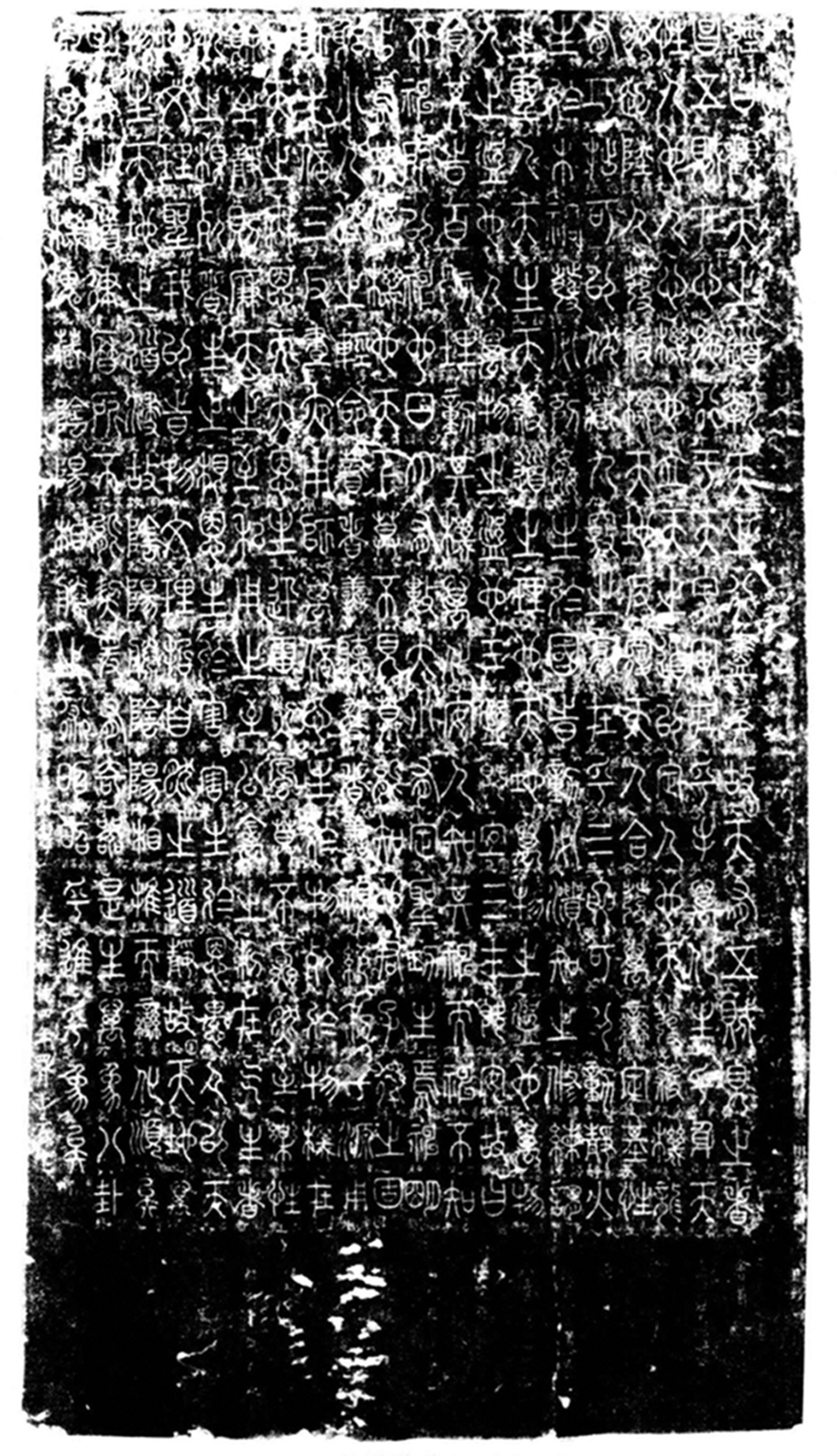
Stele 2 verso: The “Hidden Talisman Scripture” in Three Scripts, transcribed by Guo Zhongshu, 966. Ink rubbing (detail). Gao Xia et al., Xi'an Beilin quanji, 26, Beike (Guangzhou: Guangdong jingji, Shenzhen: Haitian, 1999), 2617. (color online)
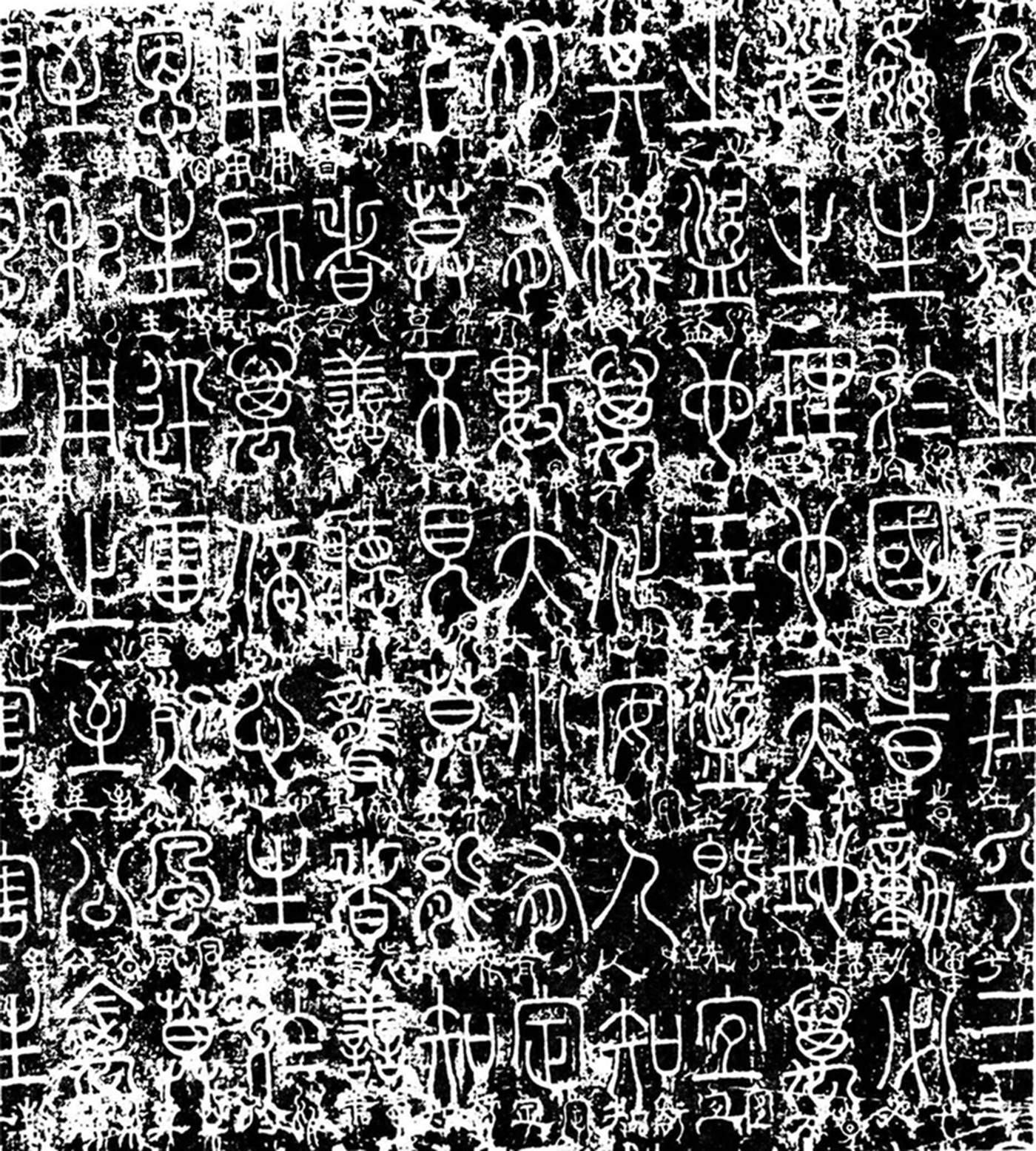
Decorative carving, Tang dynasty. Detail of one side of Stele 2. Photo: Ma Yujiang. (color online)
Stele 3 recto: “Eighteen Types of Seal Script” (Shibati zhuanshu 十八體篆書), composed and transcribed by Mengying, 967, carved on a recycled Tang stele. Photo: Ma Yujiang and Leonardo Amiri. Yuan Yunzhong, Regular-Script Transcription of Poems to Mengying by 29 Writers (Kaishu Sanshijiu jia zengshi 楷書二十九家贈詩); Yuan Yunzhong, Regular Script Transcription of Guo Zhongshu's “Reply to Mengying” (Kaishu Guo Zhongshu zhi Mengying shu 郭忠恕致夢英書) (color online).
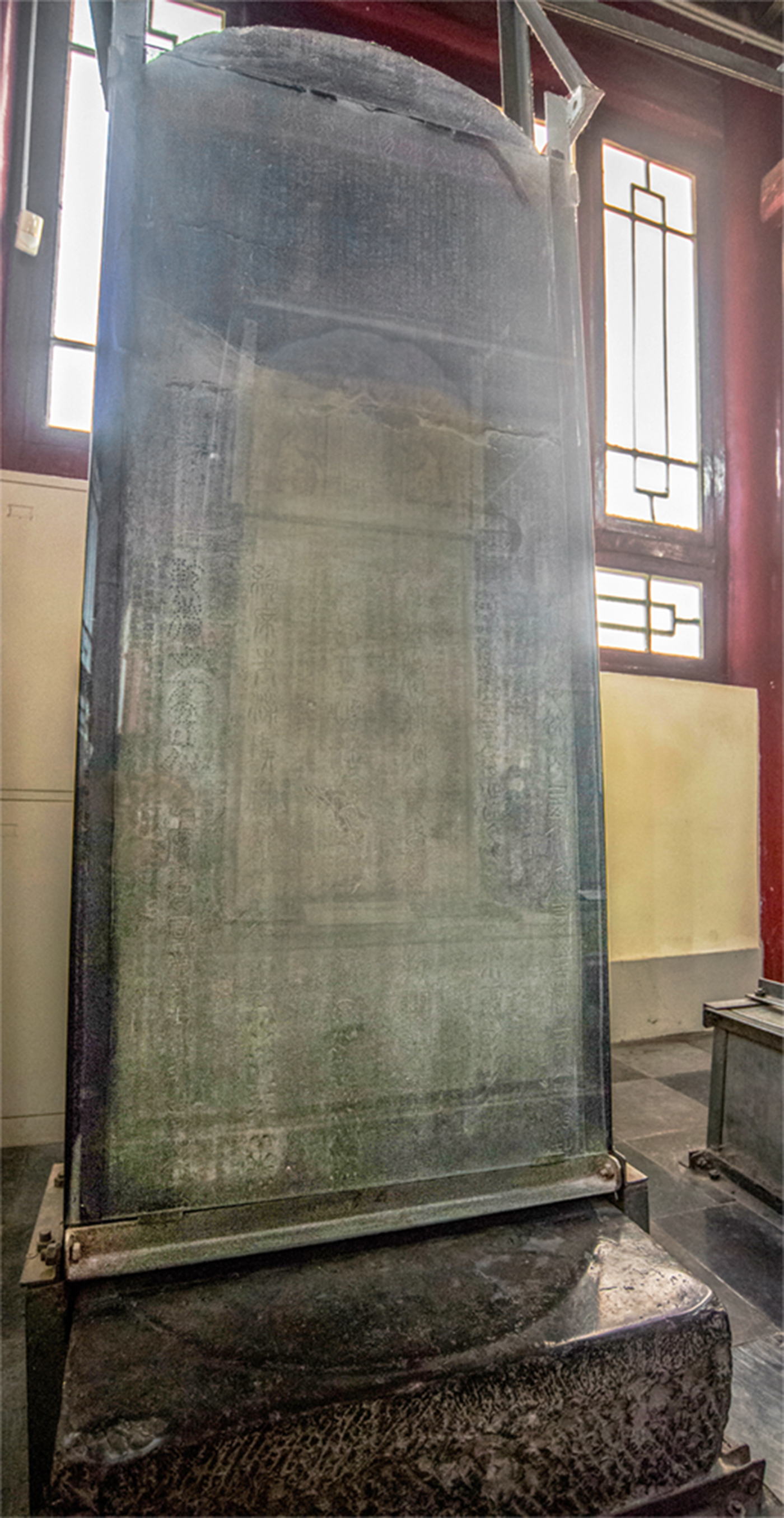
Stele 3 recto: “Eighteen Types of Seal Script”, composed and transcribed by Mengying, 967. Ink rubbing. Gao Xia et al., Xi'an Beilin quanji, 26, Beike (Guangzhou: Guangdong jingji, Shenzhen: Haitian, 1999), 2623. Yuan Yunzhong, Regular-Script Transcription of Poems to Mengying by 29 Writers; Yuan Yunzhong, Regular Script Transcription of Guo Zhongshu's “Reply to Mengying.” (color online)
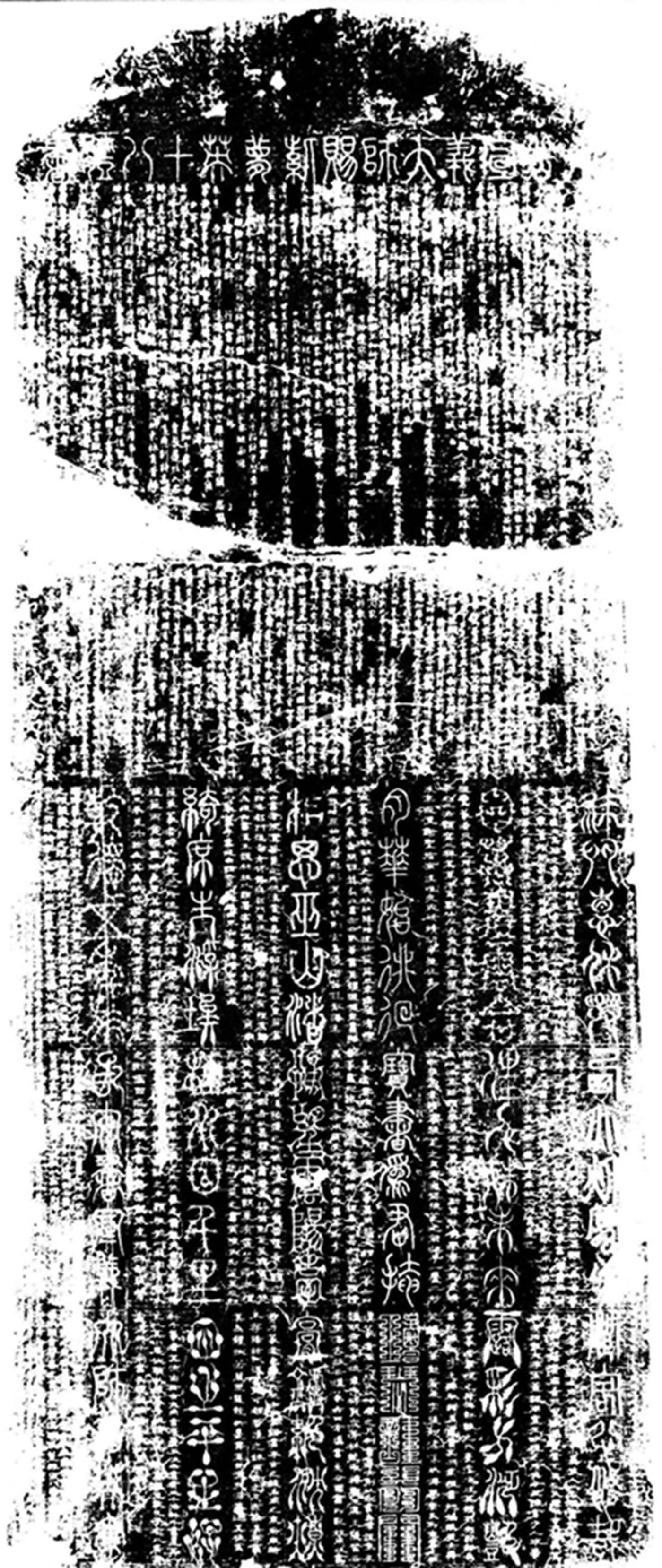
Stele 3 recto: “Eighteen Types of Seal Script”, composed and transcribed by Mengying, 967. Ink rubbing (detail). Gao Xia et al., Xi'an Beilin quanji, 26, Beike (Guangzhou: Guangdong jingji, Shenzhen: Haitian, 1999), 2629. (color online)
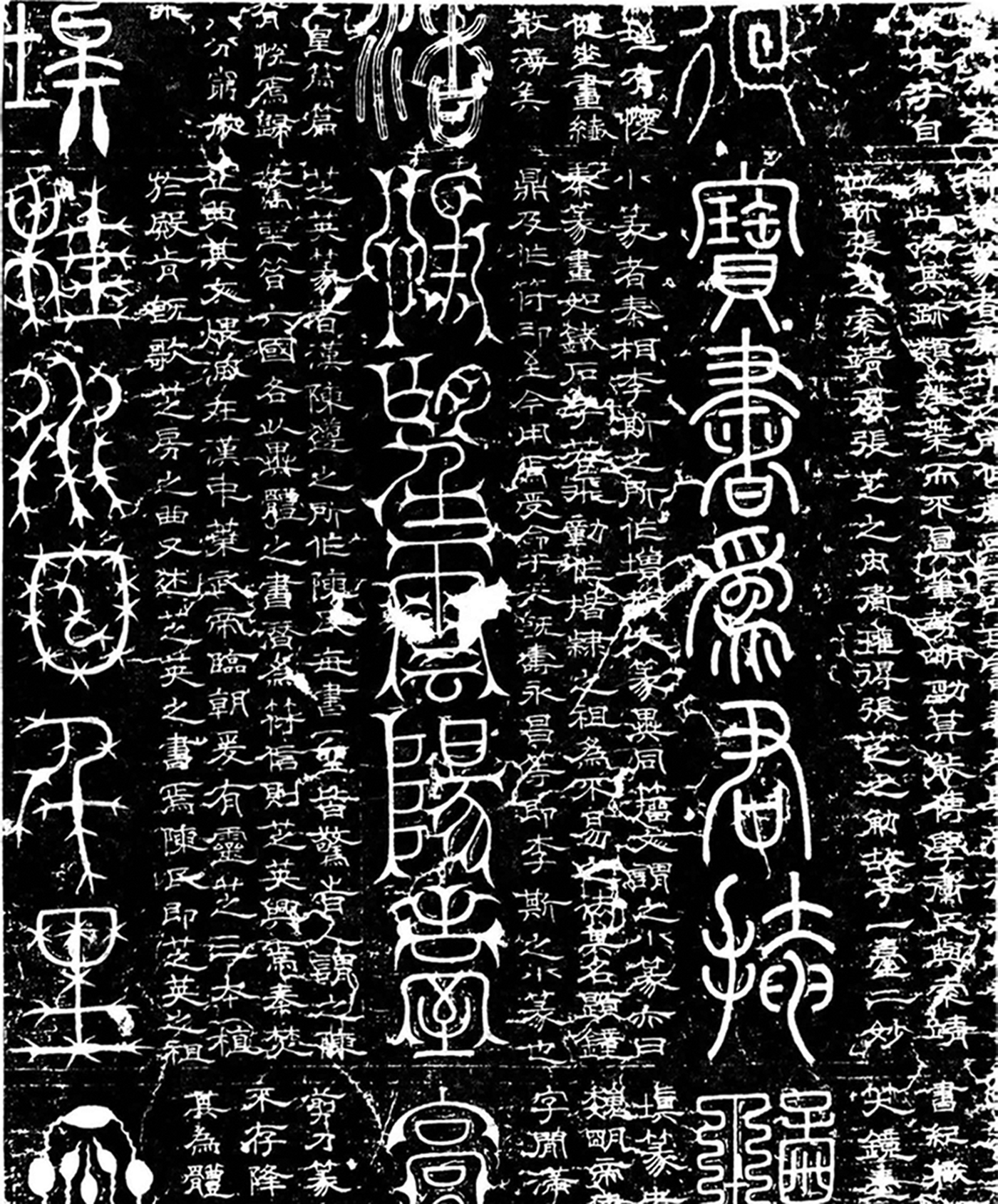
Stele 3 recto: “Eighteen Types of Seal Script”, composed and transcribed by Mengying, 967 (detail). Photo: Ma Yujiang. (color online)
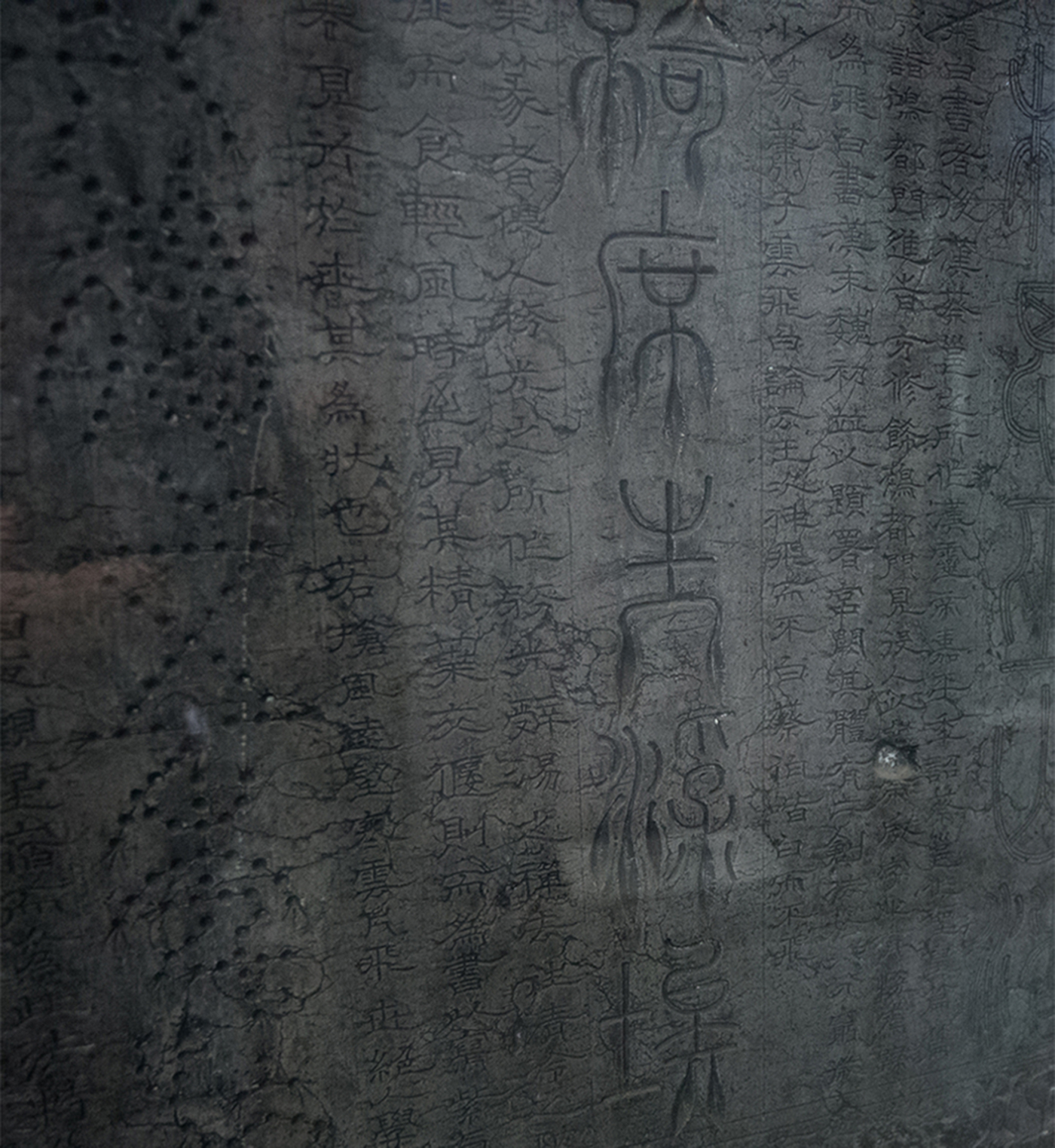
Stele 3 verso: “Record of the Temple of Confucius” (Fuzi miaotang ji 夫子廟堂記), transcribed in regular script by Mengying, 982. Photo: Ma Yujiang and Leonardo Amiri. (color online)
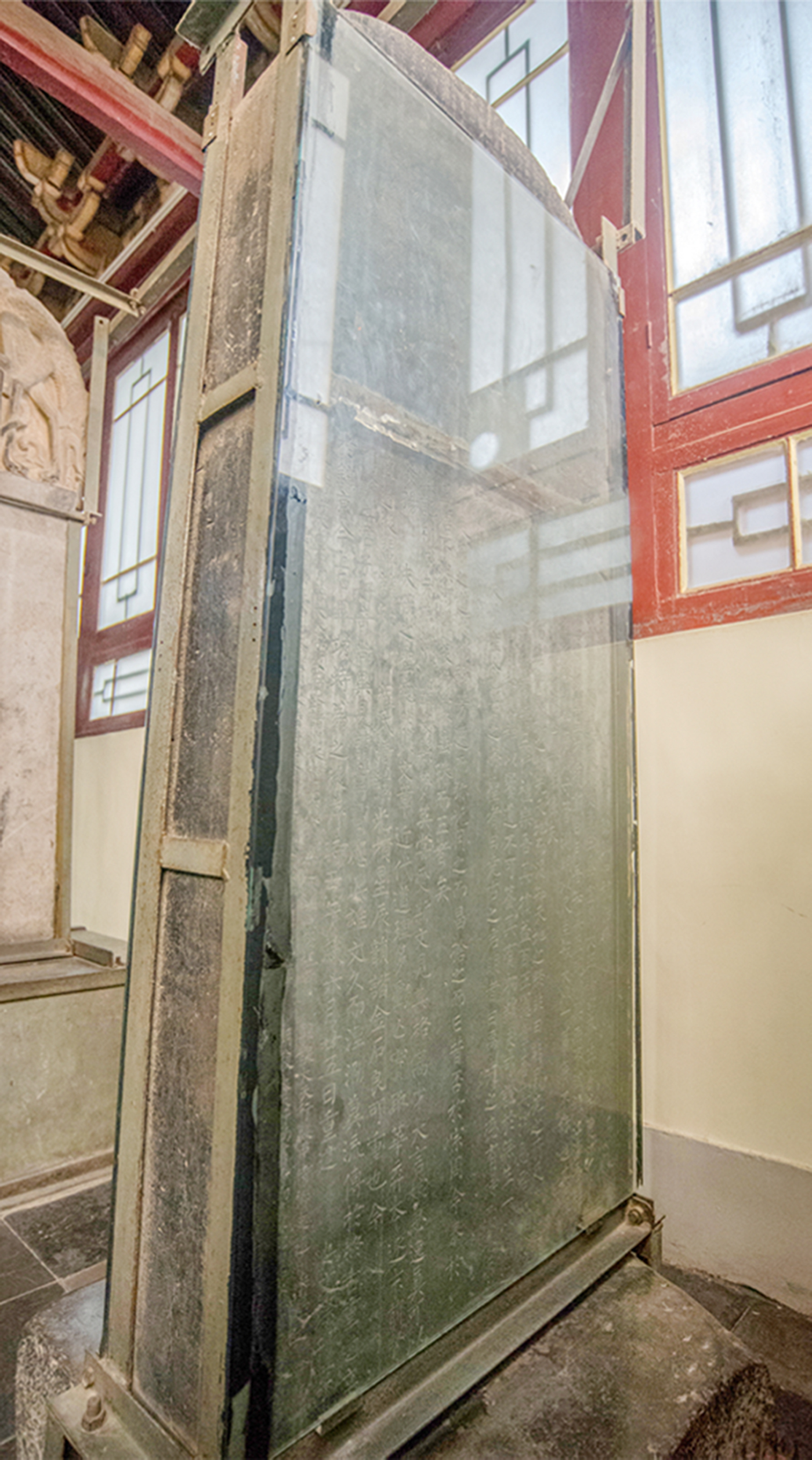
Stele 3 verso: Record of the Temple of Confucius, transcribed in regular script by Mengying, 982. Ink rubbing. Gao Xia et al., Xi'an Beilin quanji, 26, Beike (Guangzhou: Guangdong jingji, Shenzhen: Haitian, 1999), 2649. (color online)
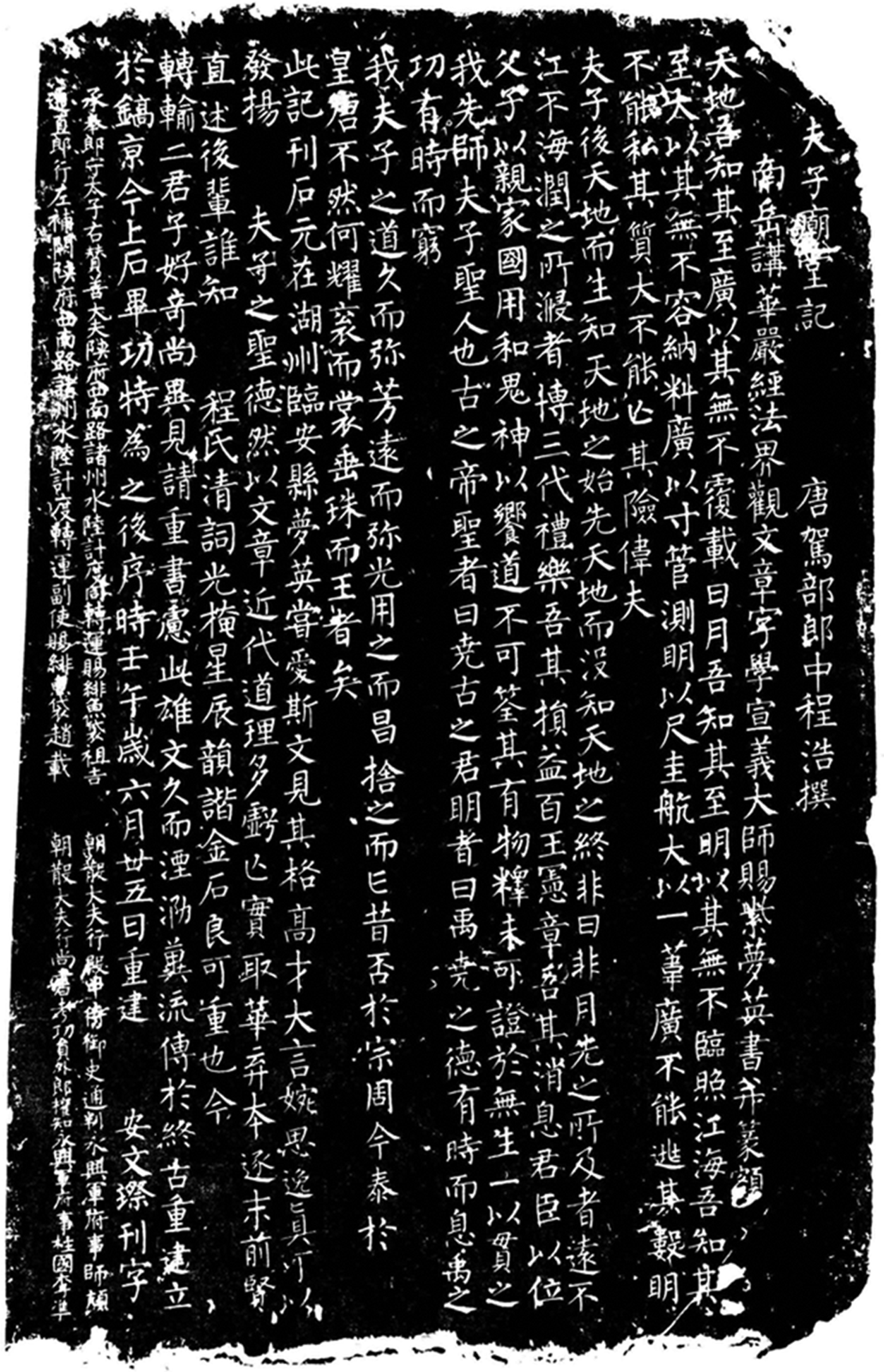
Stele 4 recto: Draft of “Controversy over Seating Protocol” (Zheng zuowei gao 爭座位稿) by Yan Zhenqing, 764, running-draft script, carved ca. 1073–1075 on a recycled Tang stele. Photo: Ma Yujiang and Leonardo Amiri. (color online)
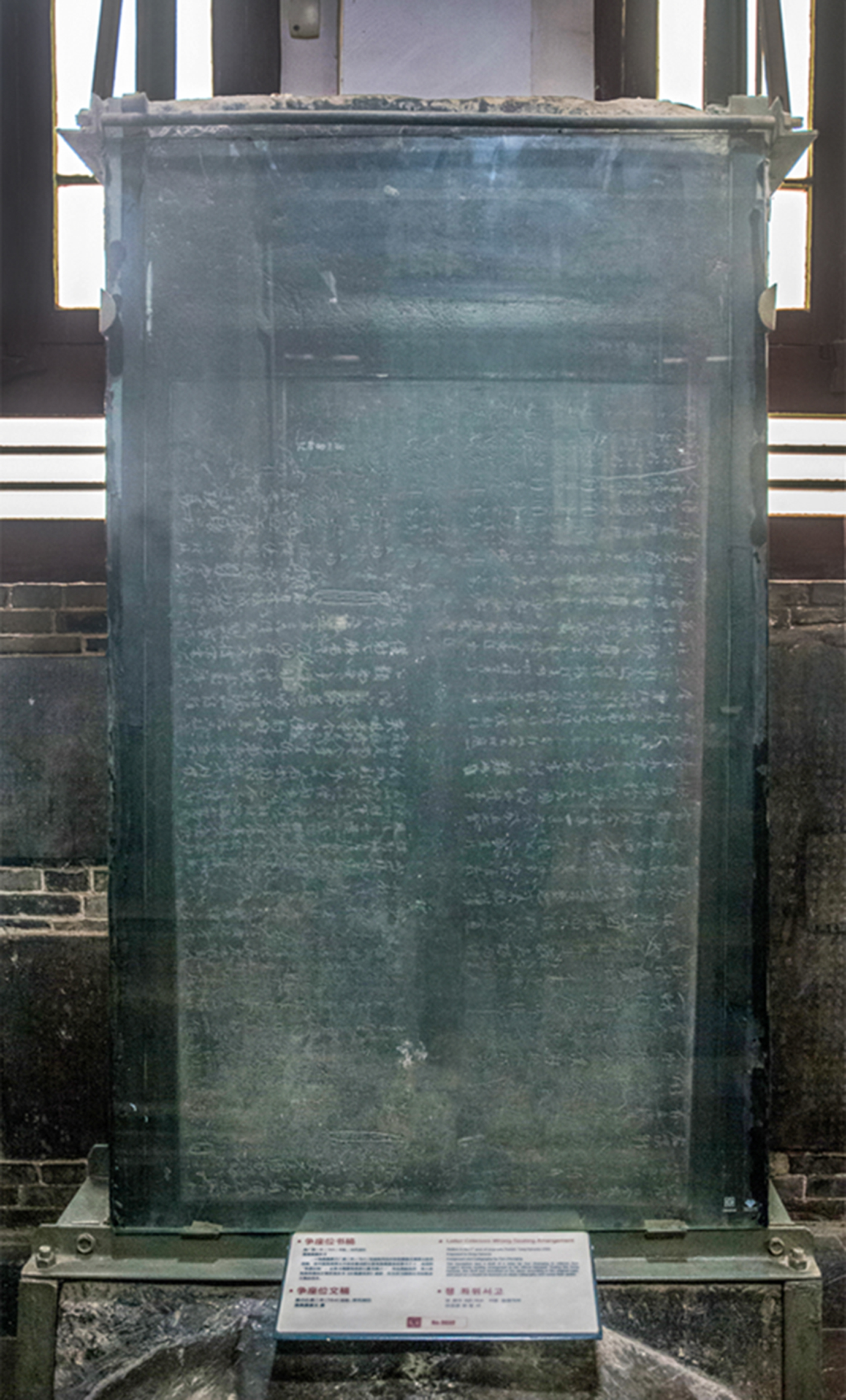
Stele 4 recto: Draft of “Controversy over Seating Protocol” by Yan Zhenqing, 764, running-draft script, carved ca. 1073–1075. Ink rubbing (detail of stele recto, rotated 90 degrees). Gao Xia et al., Xi'an Beilin quanji, 15, Beike (Guangzhou: Guangdong jingji, Shenzhen: Haitian, 1999), 1576. (color online)
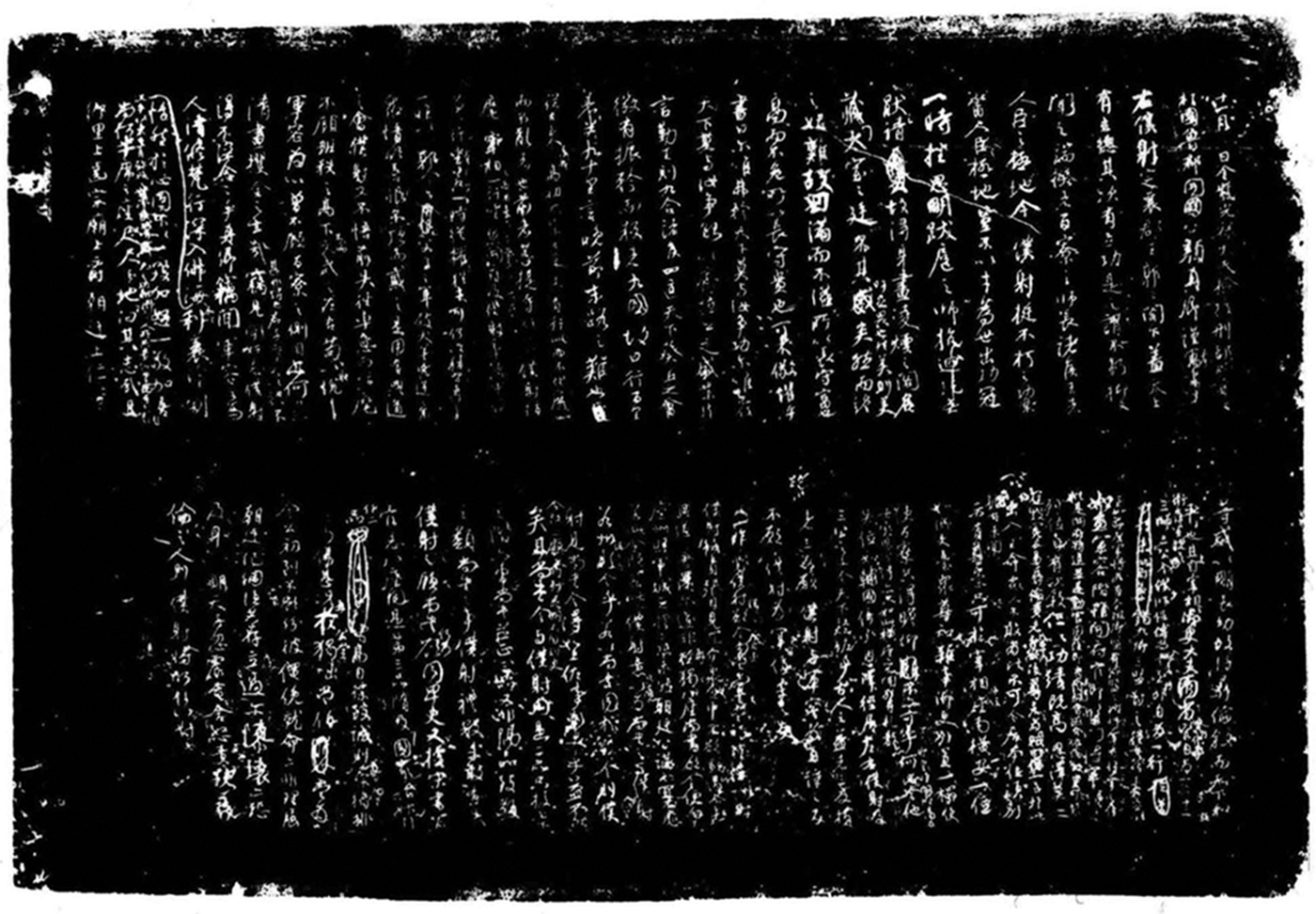
Stele 4 verso: Zhang Zhongxun's Copy of Tao Gu's “Preface to ‘Biographies of Eminent Monks’” (Zhang Zhongxun chao Tao Gu juan Gaoseng zhuan xu 行書張仲荀抄陶穀撰高僧傳序), transcribed in running script by Mengying, with a seal-script title transcribed by Guo Zhongshu, 967–968. Photo: Ma Yujiang and Leonardo Amiri. (color online)
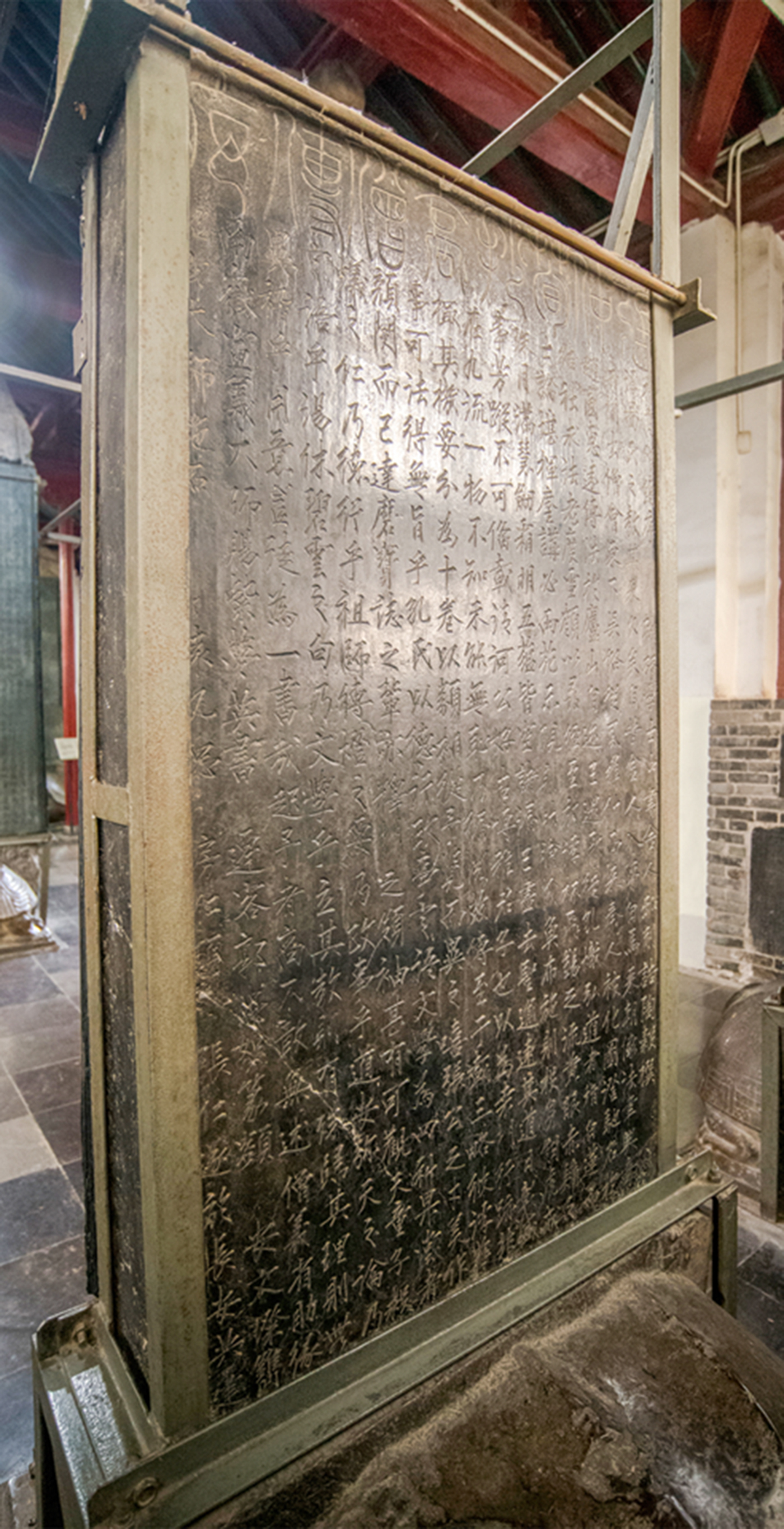
Stele 4 verso: Zhang Zongxun's Copy of Tao Gu's “Preface to ‘Biographies of Eminent Monks’”, transcribed in running script by Mengying, with a seal-script title transcribed by Guo Zhongshu, 967–968. Ink rubbing. Gao Xia et al., Xi'an Beilin quanji, 26, Beike (Guangzhou: Guangdong jingji, Shenzhen: Haitian, 1999), 2641. (color online)
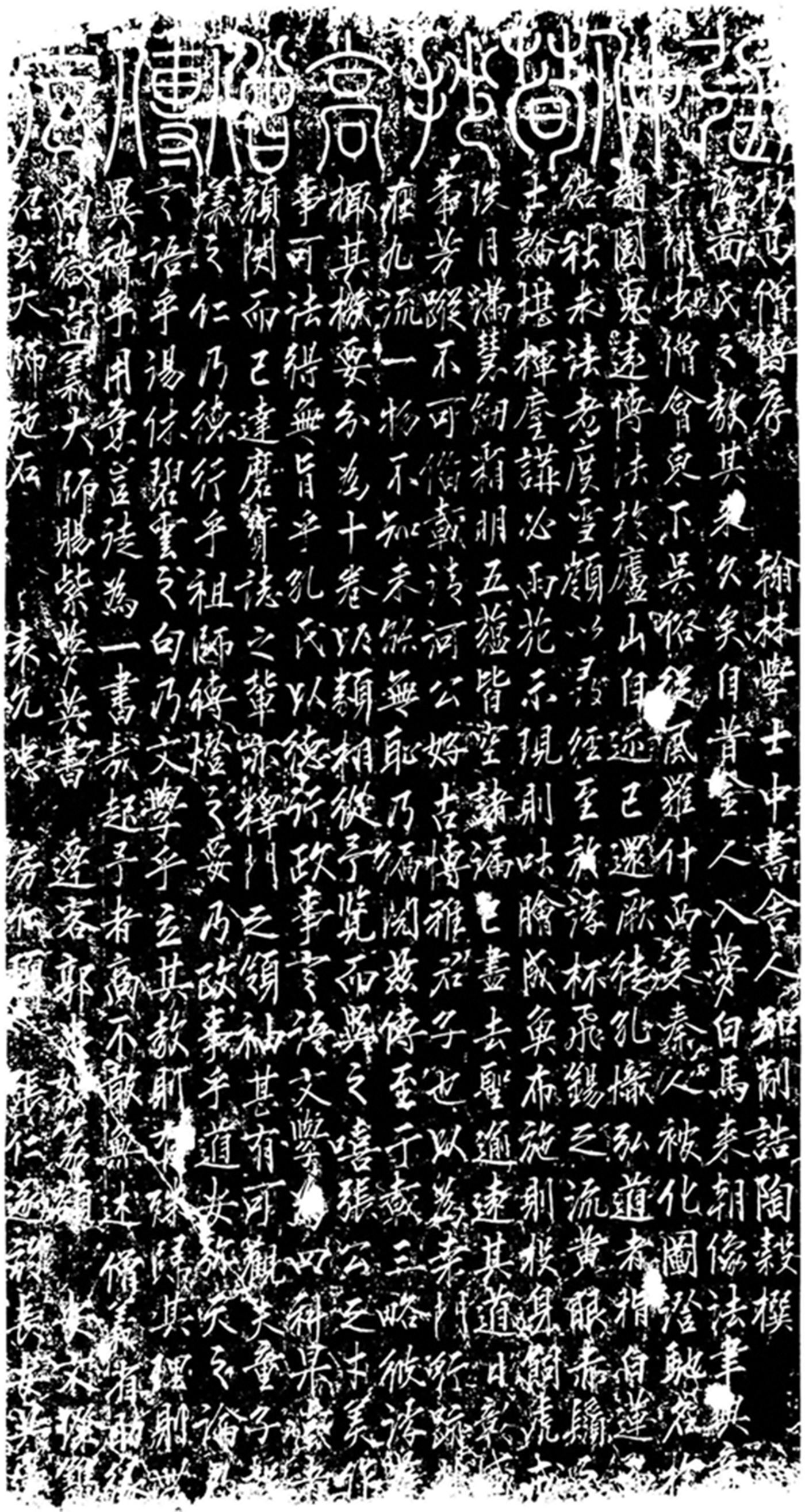
Decorative carving, Tang dynasty. Detail of one side of Stele 4. Photo: Ma Yujiang. (color online)

Stele 5 recto: Regular-Script Transcription of the “Molizhi Sutra” (Kaishu Fo shuo molizhi tian jing 楷書佛說摩利支天經) by Yuan Zhengji, with titlepiece illustration by Li Fenggui; Regular-Script Transcription of the “Hidden Talisman Scripture” (Kaishu Yinfu jing 楷書陰符經) by Yuan Zhengji, with titlepiece Illustration by Zhai Shousu, 968, carved on a recycled Tang stele. Ink rubbing. Gao Xia et al., Xi'an Beilin quanji, 26, Beike (Guangzhou: Guangdong jingji, Shenzhen: Haitian, 1999), 2634. (color online)
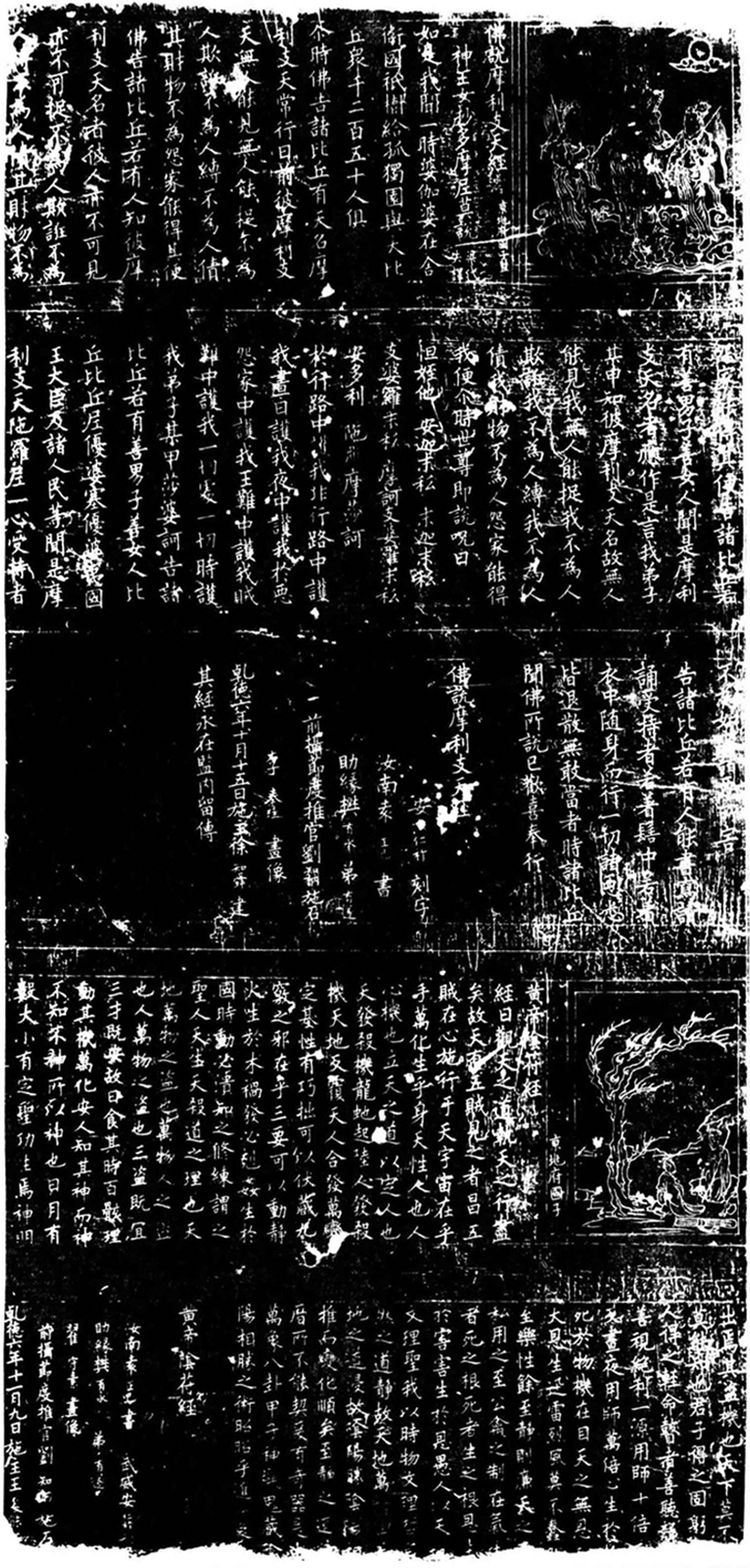
Stele 5 recto: Regular Script Transcription of the “Molizhi Sutra” by Yuan Zhengji, with titlepiece illustration by Li Fenggui, 968 (detail). Ink rubbing. Gao Xia et al., Xi'an Beilin quanji, 26, Beike (Guangzhou: Guangdong jingji, Shenzhen: Haitian, 1999), 2635. (color online)

Stele 5 recto: Regular-Script Transcription of the “Hidden Talisman Scripture” by Yuan Zhengji, with titlepiece illustration by Zhai Shousu, 968 (detail). Gao Xia et al., Xi'an Beilin quanji, 26, Beike (Guangzhou: Guangdong jingji, Shenzhen: Haitian, 1999), 2638. (color online)

Stele 5 verso: Regular-Script Transcription of “Scripture of the Grand Supreme Elderly Lord on Clarity/Purity and Stillness/Tranquility” (Kaishu Taishanglaojun changqingjing jing 楷書太上老君常清靜經) by Pang Renxian, with titlepiece illustration by Bai Tingcan; Regular-Script Transcription of “Scripture of the Grand Supreme [Numinous Treasure] on Ascending to Mystery on Staving off Calamity and Protecting Life” (Kaishu Taishang shengxuan xiaozai huming jing 楷書太上升玄消災護命經) by Pang Renxian; Regular-Script Transcription of “Scripture of the Grand Supreme Lords of Heaven on Living through Heaven and Attaining the Dao” (Kaishu Taishangtianzun shuo shengtian dedao jing 楷書太上天尊說生天得到經) by Pang Renxian, 980. Ink rubbing. Gao Xia et al., Xi'an Beilin quanji, 26, Beike (Guangzhou: Guangdong jingji, Shenzhen: Haitian, 1999), 2643. (color online)
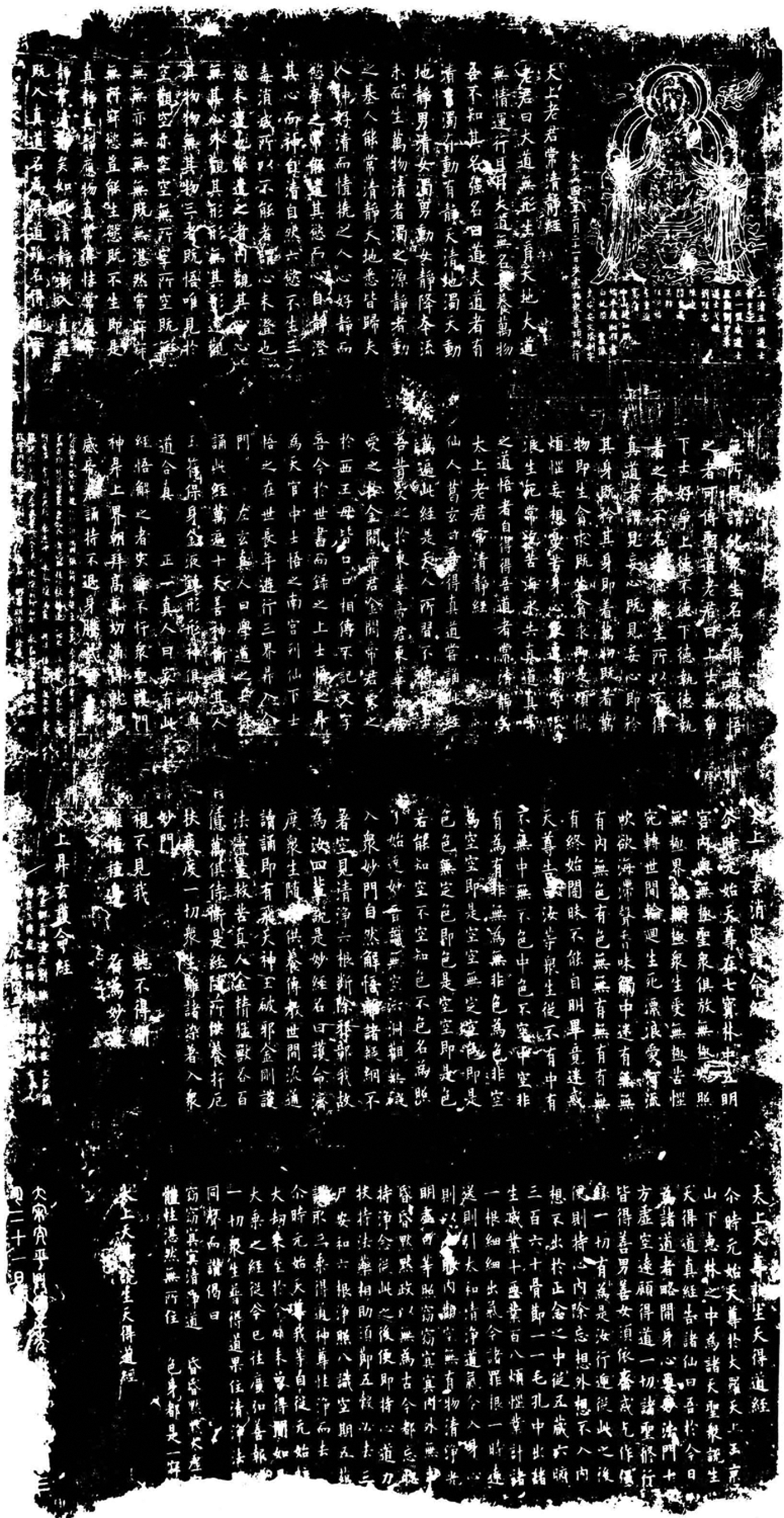
Stele 5 verso: Regular-Script Transcription of “Scripture of the Grand Supreme Elderly Lord on Clarity/Purity and Stillness/Tranquility” by Pang Renxian, with titlepiece illustration by Bai Tingcan, 980. Ink rubbing (detail). Gao Xia et al., Xi'an Beilin quanji, 26, Beike (Guangzhou: Guangdong jingji, Shenzhen: Haitian, 1999), 2644. (color online)
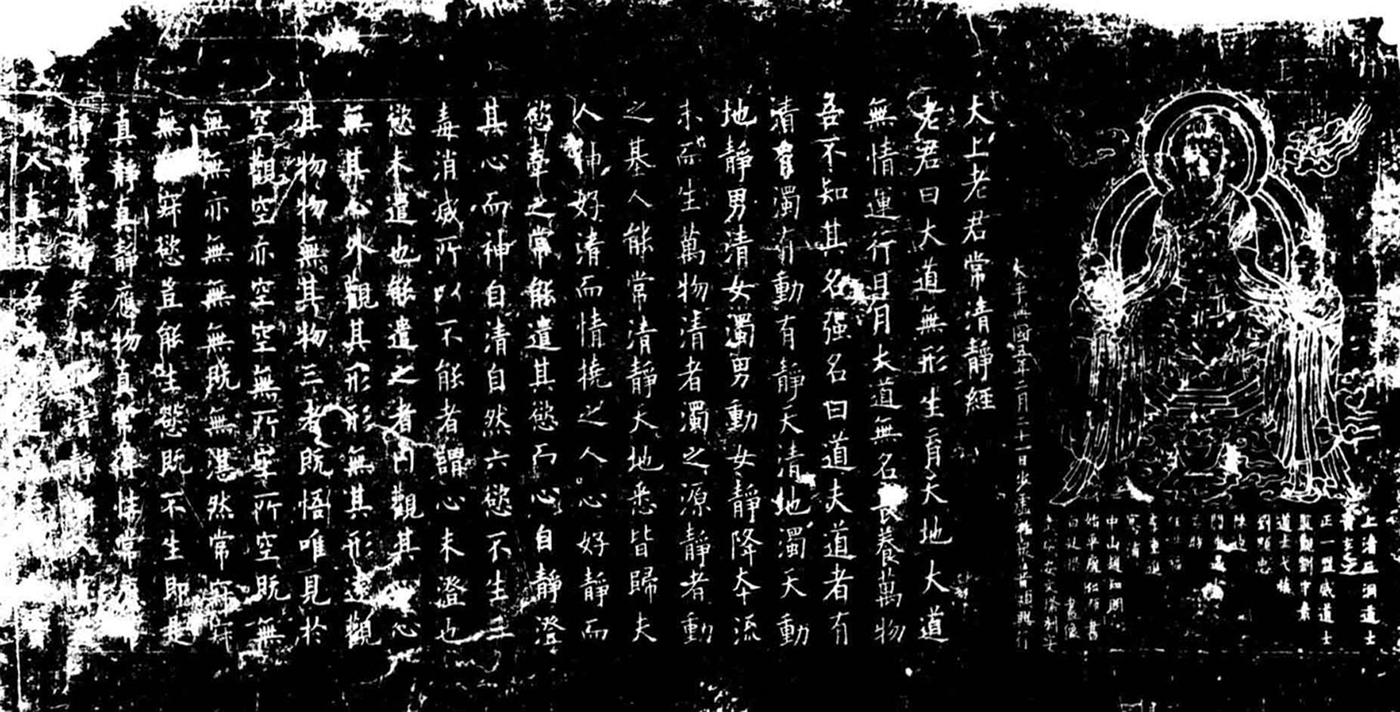
Stele 6 recto: Memorial to Master Daoyin (Daoyin fashi beiming 道因法師碑銘) transcribed by Ouyang Tong, 663. Photo: Ma Yujiang and Leonardo Amiri. (color online)
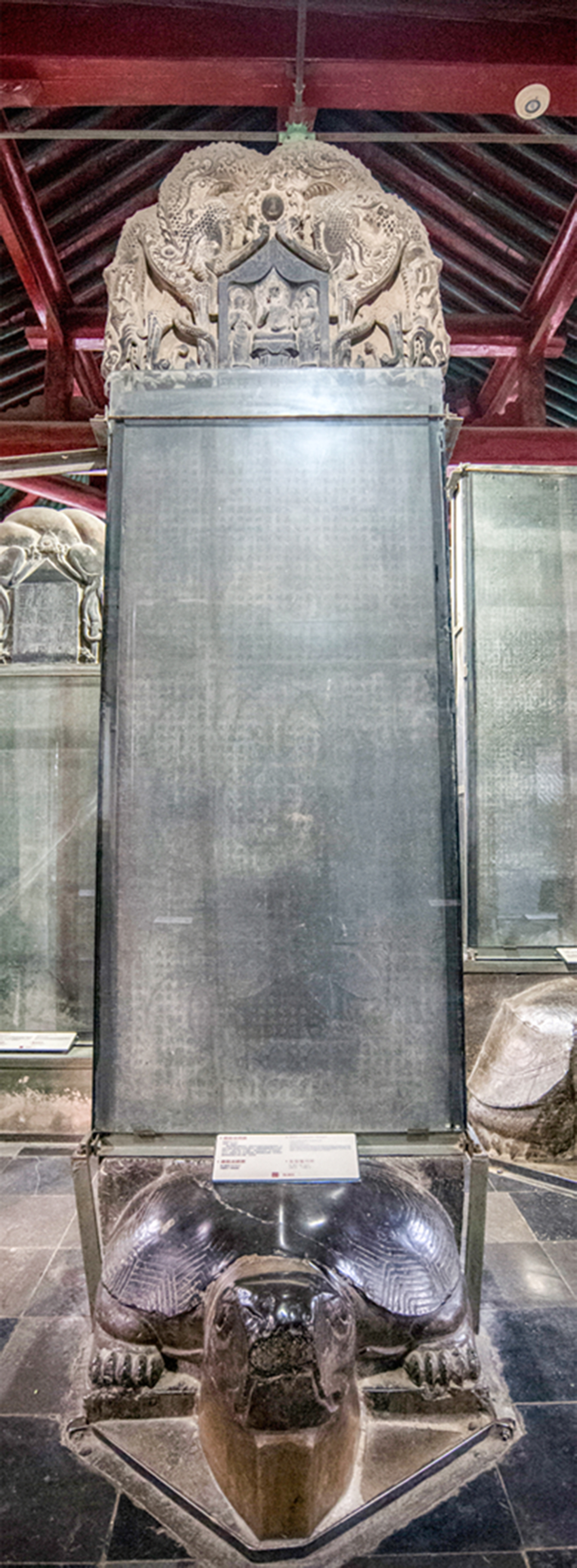
Stele 6 recto: Memorial to Master Daoyin transcribed by Ouyang Tong, 663. Ink rubbing. Yasushi Nishikawa et al., Seian hirin (Tokyo: Kodansha, 1966), fig. 57. (color online)
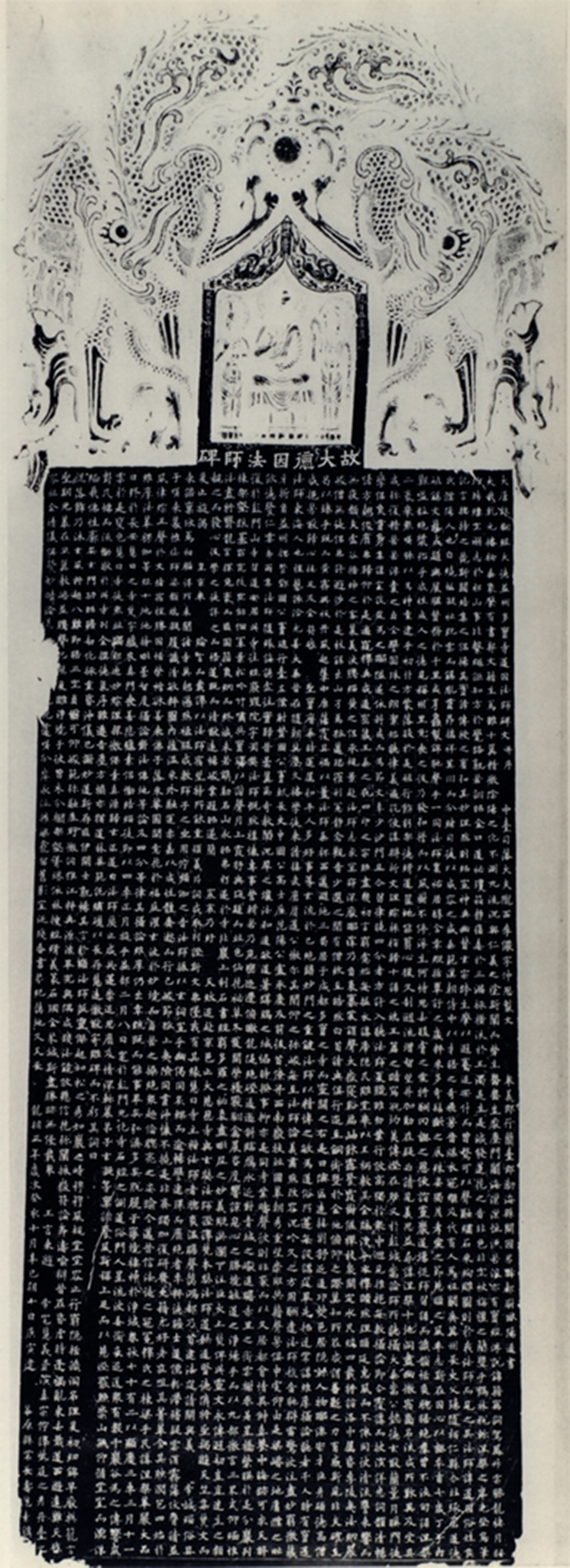
Stele 6 recto: Memorial to Master Daoyin transcribed by Ouyang Tong, 663. Ink rubbing (detail). Yasushi Nishikawa et al., Seian hirin (Tokyo: Kodansha, 1966), fig. 58. (color online)
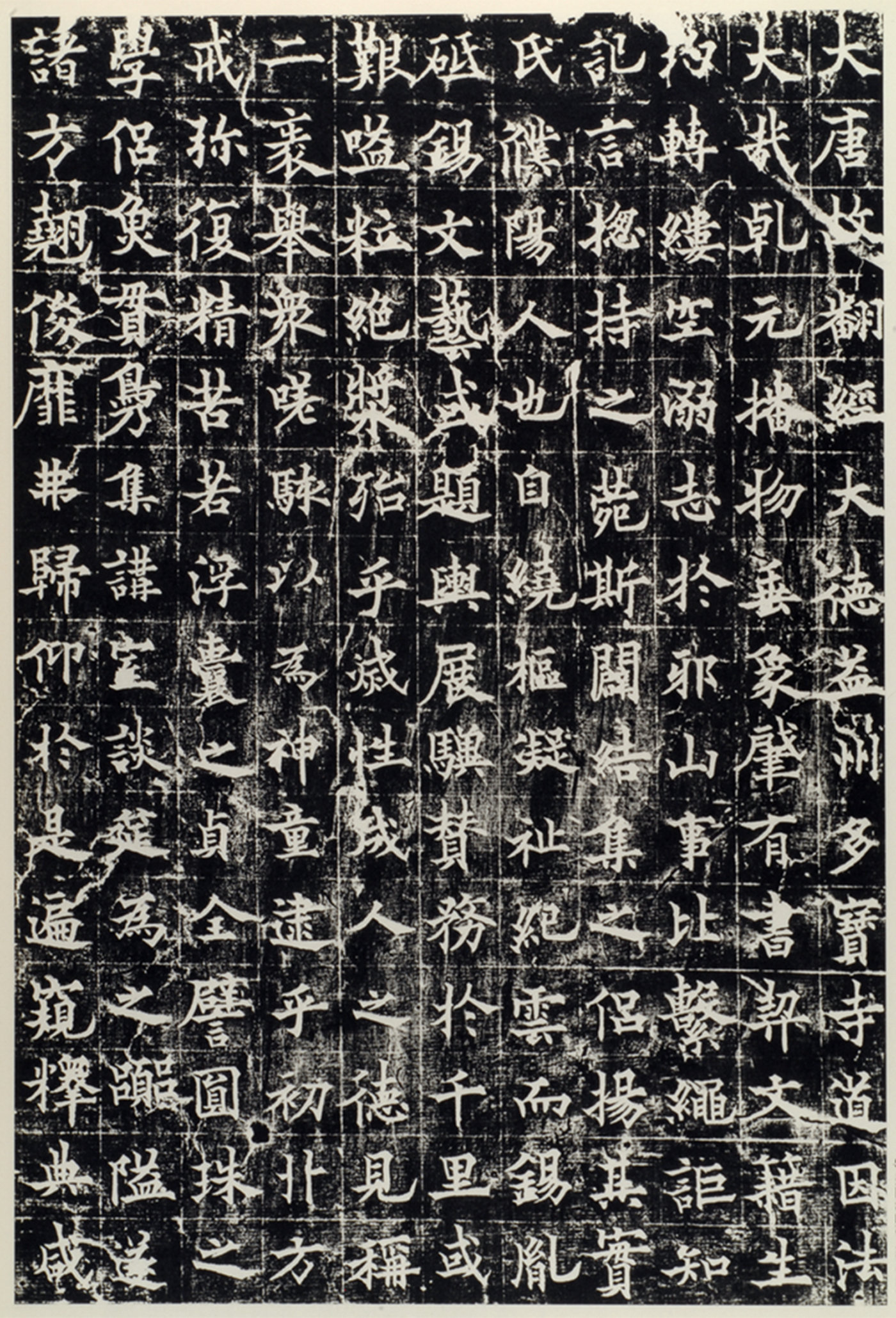
Stele 6 verso: Regular-Script Transcription of Poems to Mengying by 32 Writers (Kaishu sanshiyijia zengshi 楷書三十一家贈詩) by Zhengmeng, 998. Photo: Ma Yujiang and Leonardo Amiri. (color online)
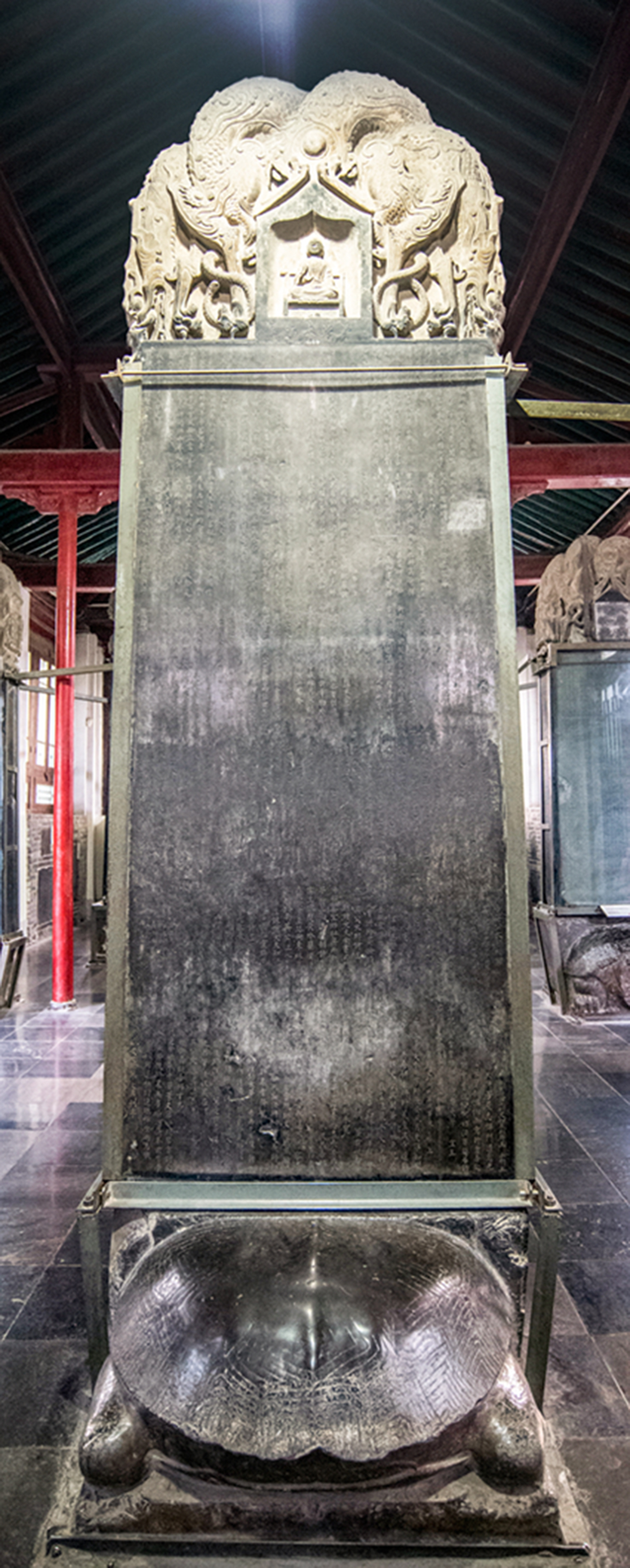
Stele 6 verso: Regular-Script Transcription of Poems to Mengying by 32 Writers by Zhengmeng, 998. Ink rubbing. Gao Xia et al., Xi'an Beilin quanji, 26, Beike (Guangzhou: Guangdong jingji, Shenzhen: Haitian, 1999), 2666. (color online)
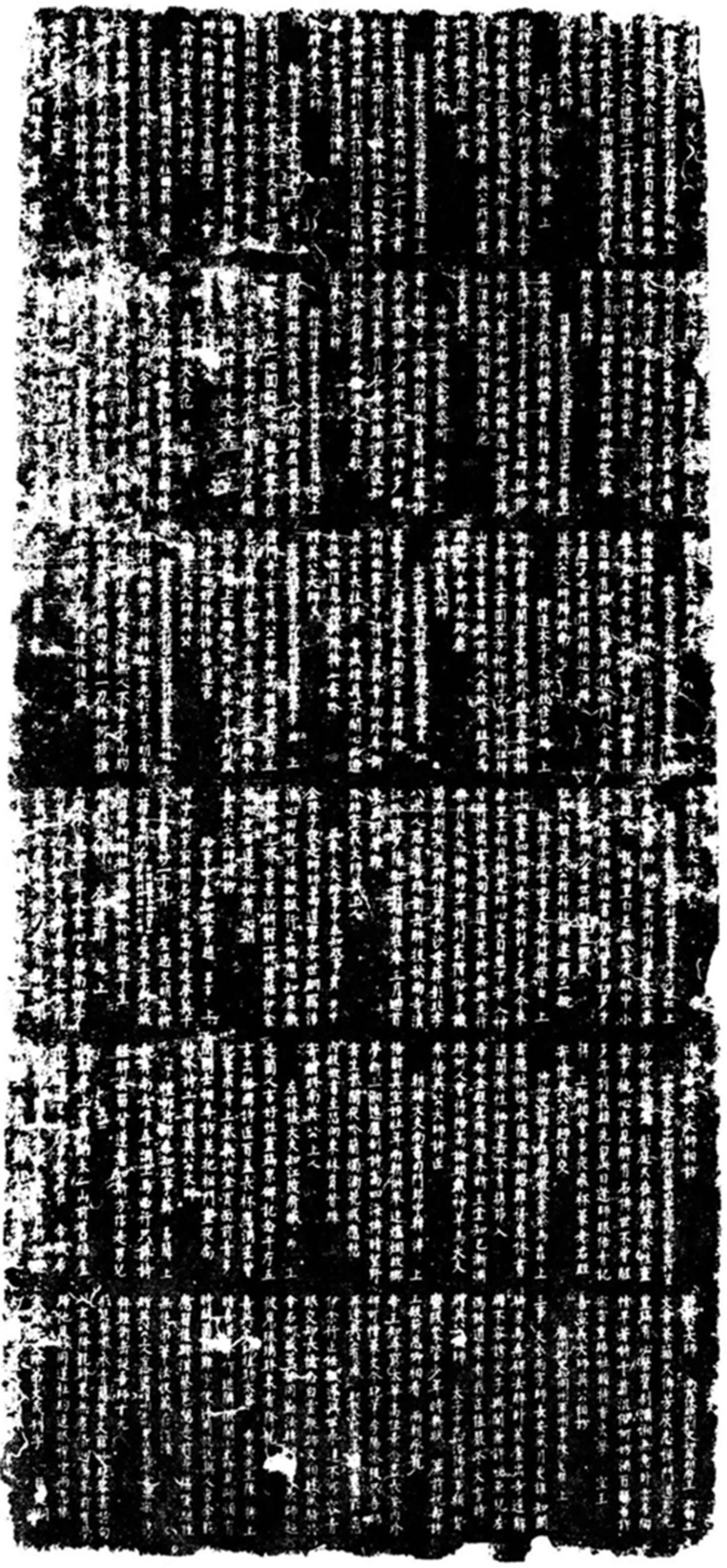
Stele 6 verso: Regular-Script Transcription of Poems to Mengying by 32 Writers (Kaishu sanshiyi jiazengshi) by Zhengmeng, 998. Ink rubbing (detail of poem by Guo Congyi). Gao Xia et al., Xi'an Beilin quanji, 26, Beike (Guangzhou: Guangdong jingji, Shenzhen: Haitian, 1999), 2669. (color online)
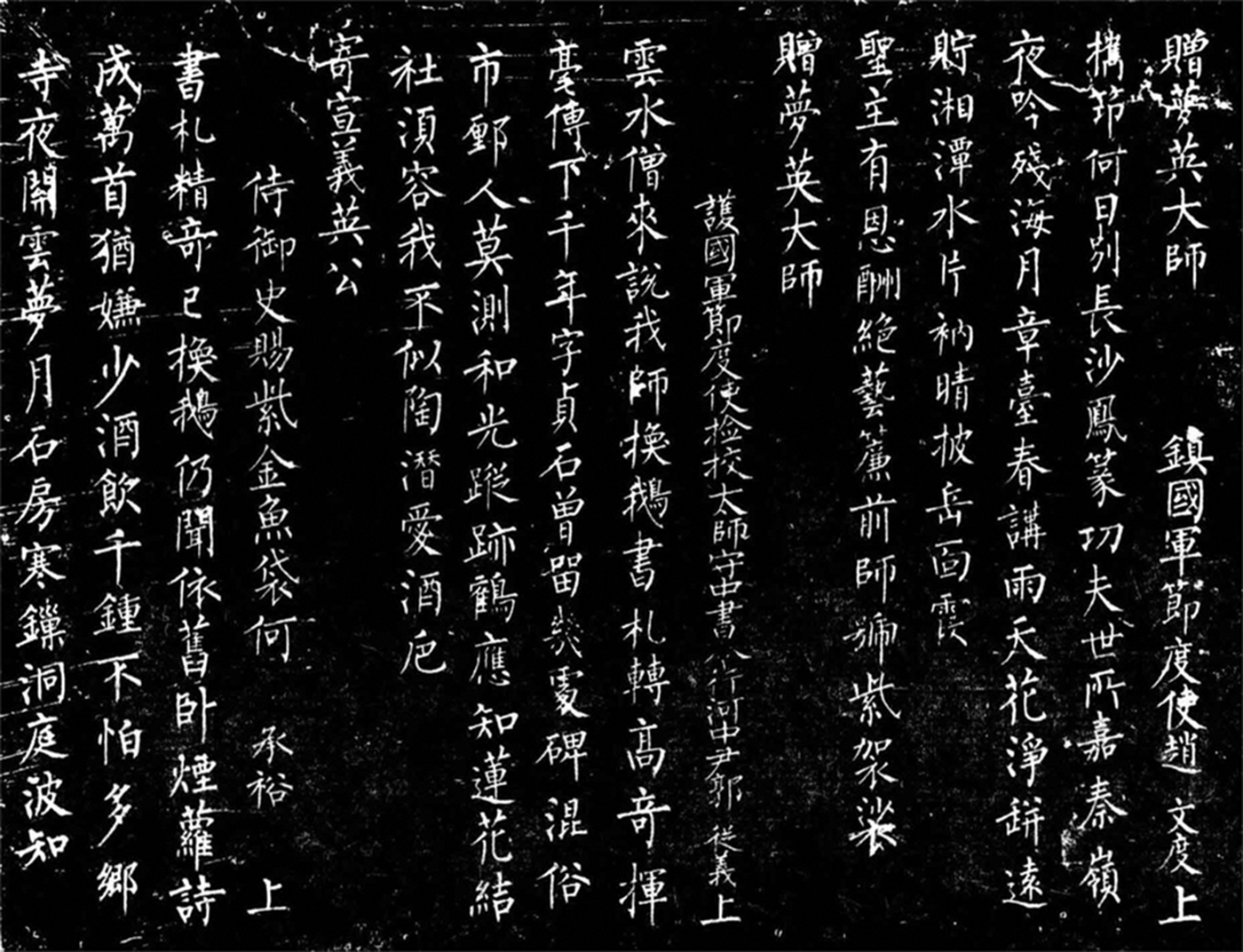
Decorative carving, 663. Detail of one side of Stele 6. Photo: Ma Yujiang. (color online)
Engraved figural scene on the base of Stele 6, 663. Ink rubbing. Shenxi Provincial Museum, ed., Sui Tang Wenhua (Hong Kong: Zhonghua shuju; Shanghai: Xueshu, 1990). (color online)
Engraved figural scene on the base of Stele 6, 663. Ink rubbing. Shenxi Provincial Museum, ed., Sui Tang Wenhua (Hong Kong: Zhonghua shuju; Shanghai: Xueshu, 1990). (color online)
Stele 7 recto: Seal Script Transcription of “Tabulation of Character-Component Origins of Compound Characters” (Zhuanshu Mulu pianpang ziyuan 篆書目錄偏旁字源), with their regular-script equivalents at a smaller scale written by Guo Zhongshu, and seal-script title written by Mengying; accompanied by Mengying's Regular-Script Transcription of His Own Preface (Kaishu zixu 楷書自序); and by Mengying's Regular-Script Transcription of Guo Zhongshu's “Reply to Mengying” (Kaishu “Guo Zhongshu zhi Mengying shu” 楷書郭忠恕致夢英書), 999, carved on a recycled Tang stele. Photo: Ma Yujiang and Leonardo Amiri. (color online)
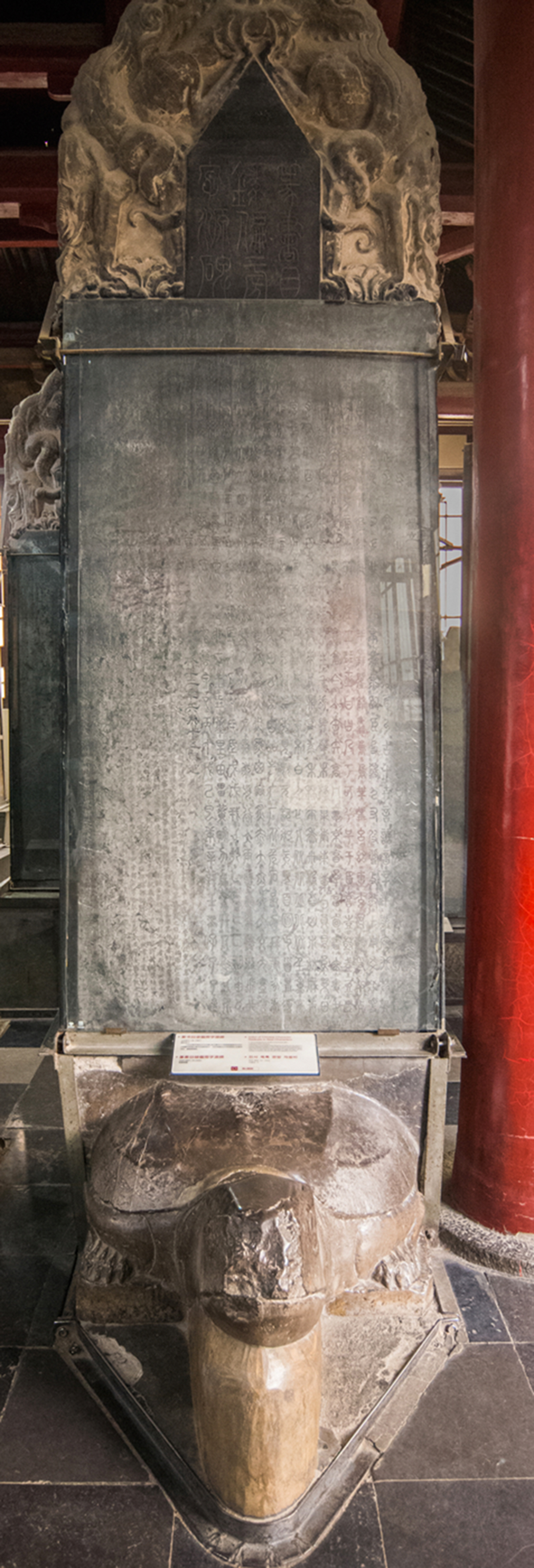
Stele 7 recto: Seal-Script title to Mengying's Seal-Script Transcription of “Tabulation of Character-Component Origins of Compound Characters” written by Mengying, 999. Ink rubbing. Gao Xia et al., Xi'an Beilin quanji, 26, Beike (Guangzhou: Guangdong jingji, Shenzhen: Haitian, 1999), 2681. (color online)
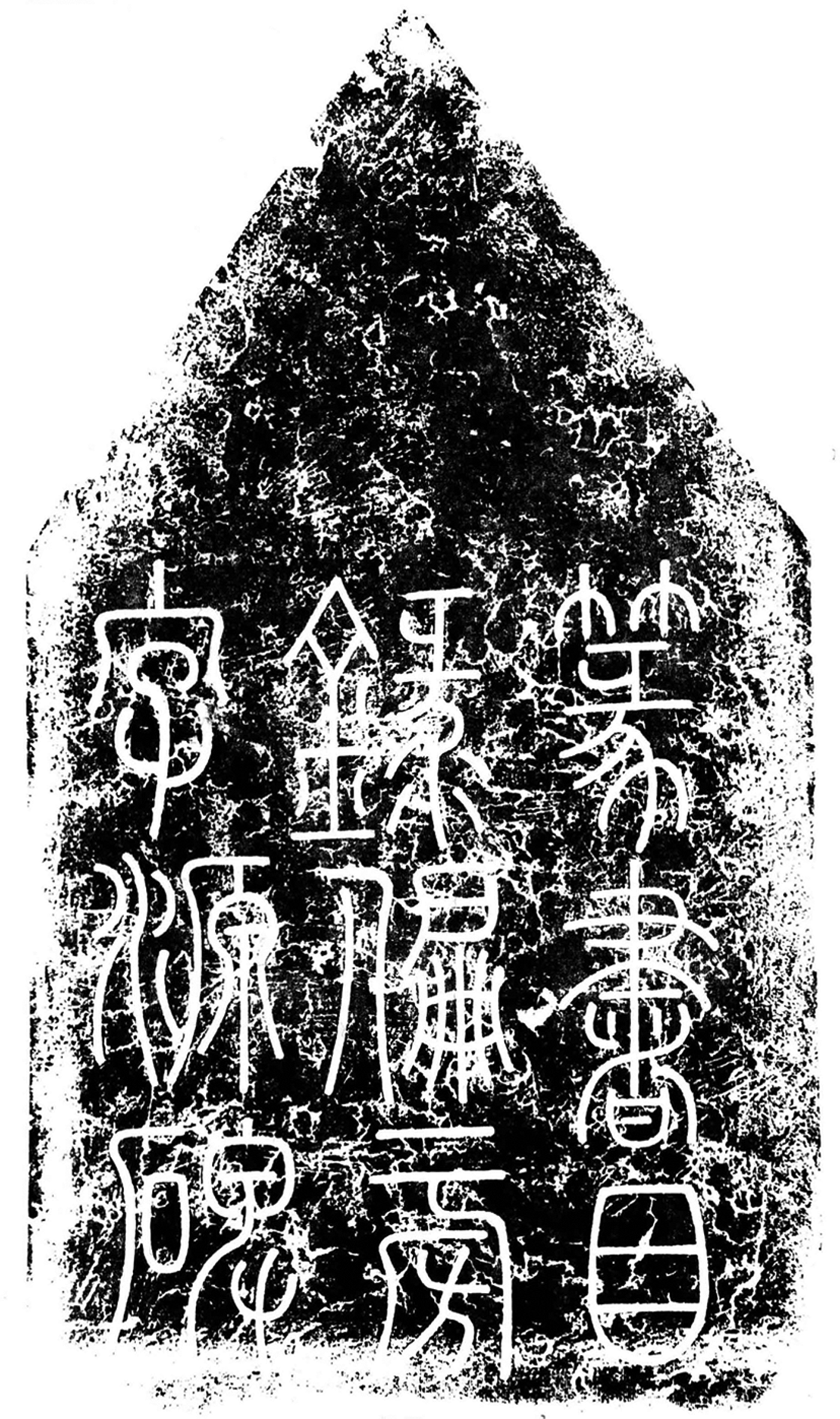
Stele 7 recto: Seal-Script Transcription of “Tabulation of Character-Component Origins of Compound Characters”, with their regular-script equivalents at a smaller scale written by Guo Zhongshu, and seal-script title written by Mengying; accompanied by Mengying's Regular-Script Transcription of His Own Preface; and by Mengying's Regular-Script Transcription of Guo Zhongshu's “Reply to Mengying”, 999. Ink rubbing. Yasushi Nishikawa et al., Seian hirin (Tokyo: Kodansha, 1966), fig. 111. (color online)
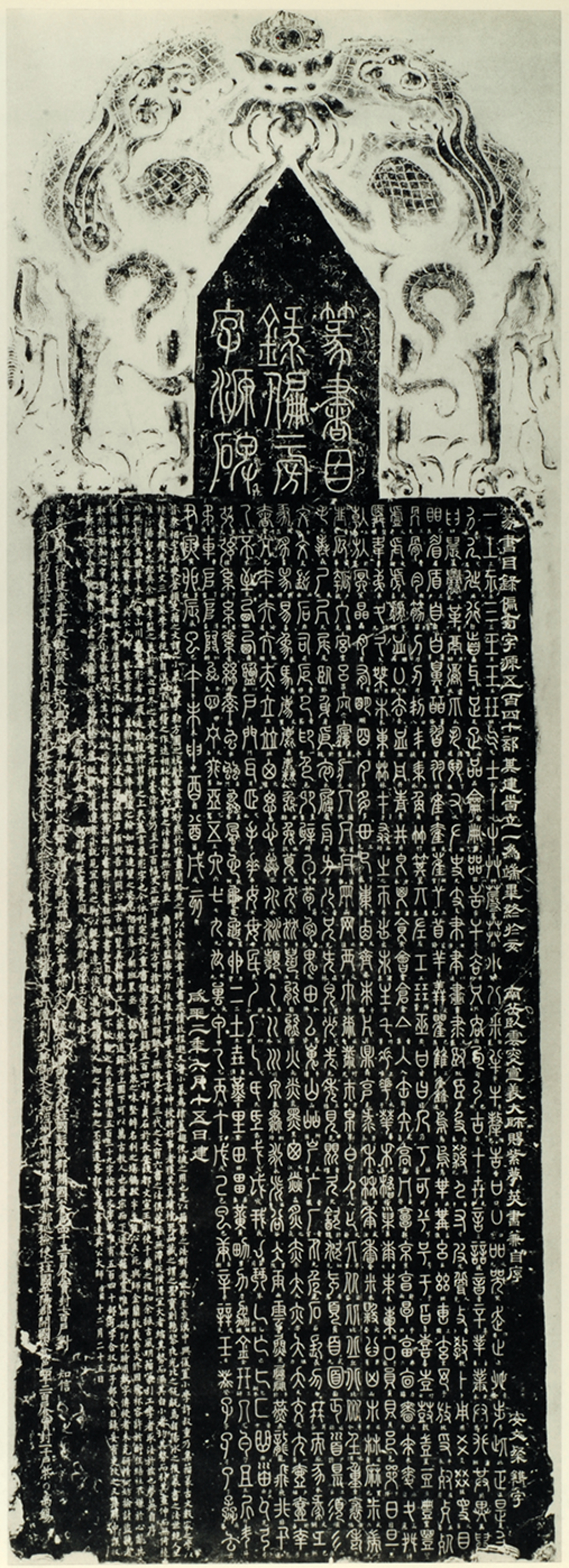
Stele 7 recto: Seal-Script Transcription of “Tabulation of Character-Component Origins of Compound Characters” by Mengying, with their regular-script equivalents at a smaller scale written by Guo Zhongshu. Ink rubbing (detail). Gao Xia et al., Xi'an Beilin quanji, 26, Beike (Guangzhou: Guangdong jingji, Shenzhen: Haitian, 1999), 2682. (color online)
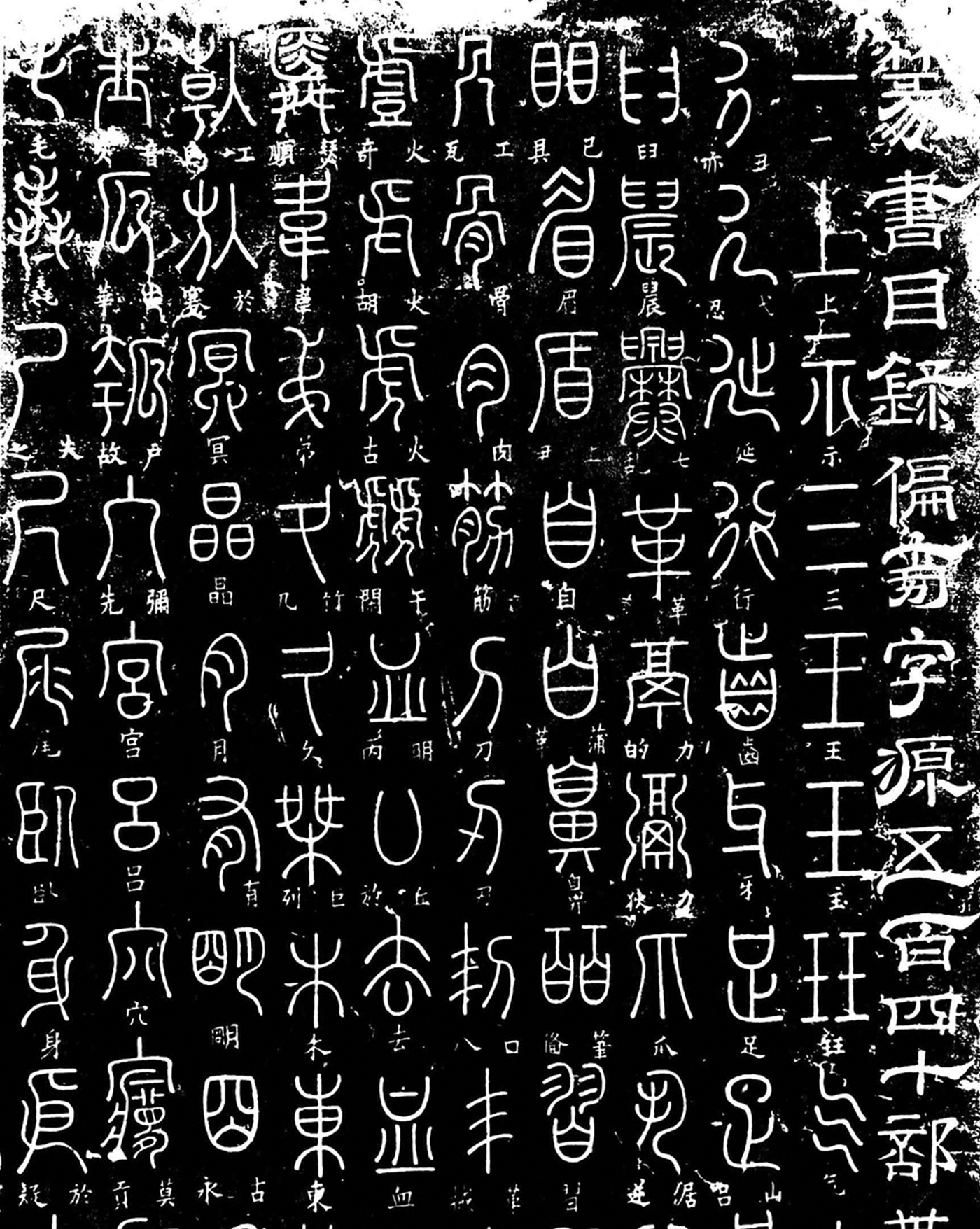
Stele 7 recto: Seal-Script Transcription of “Tabulation of Character-Component Origins of Compound Characters”, with their regular-script equivalents at a smaller scale written by Guo Zhongshu; accompanied by Mengying's Regular-Script Transcription of His Own Preface; and by Mengying's Regular-Script Transcription of Guo Zhongshu's “Reply to Mengying”, 999 (detail). Photo: Ma Yujiang and Leonardo Amiri. (color online)
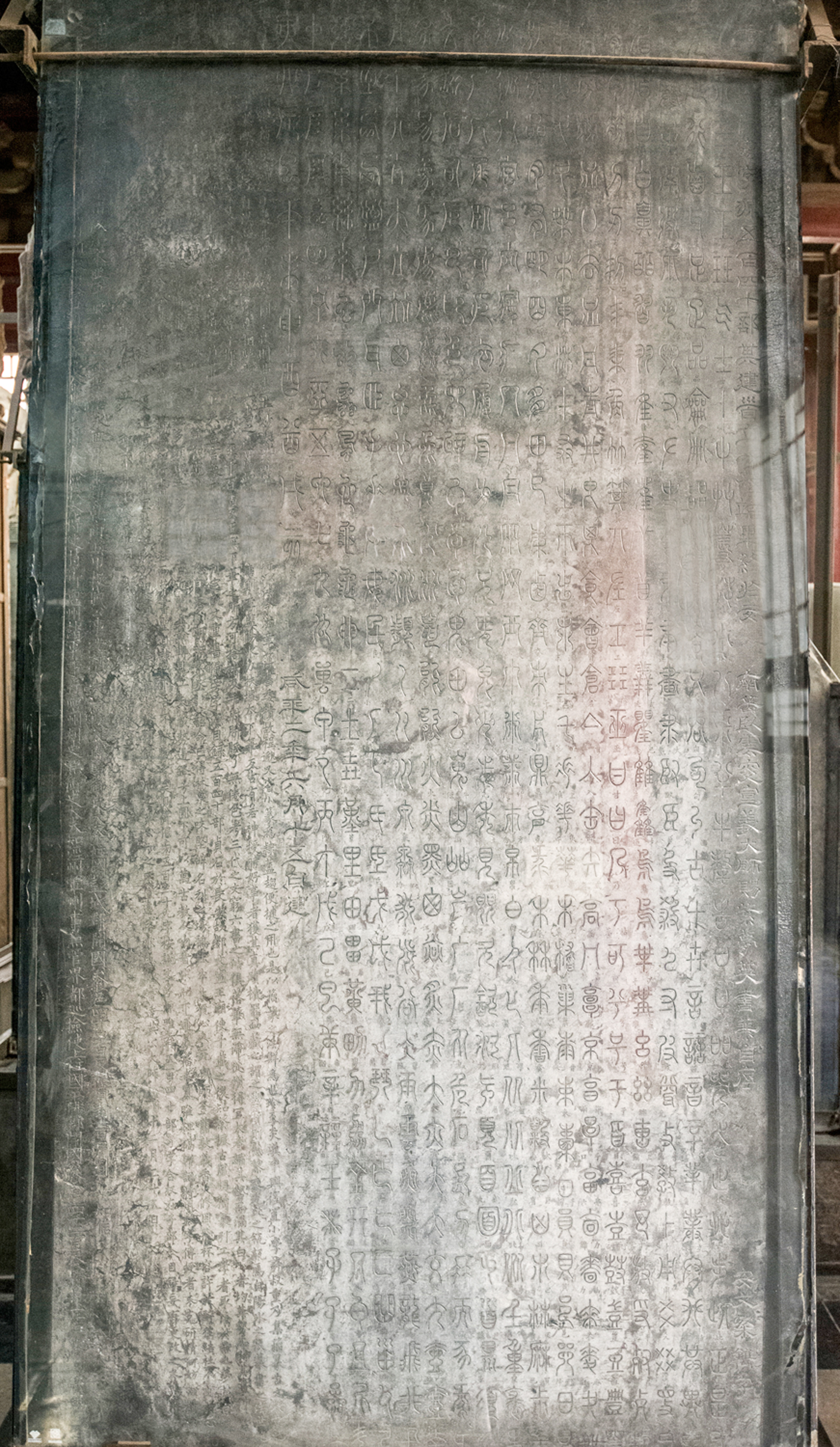
Stele 7 verso: Regulations of Jingzhao Prefecture School for Boys (Jingzhao fu xiaoxue gui 京兆府小學規), 1054. Photo: Ma Yujiang. (color online)
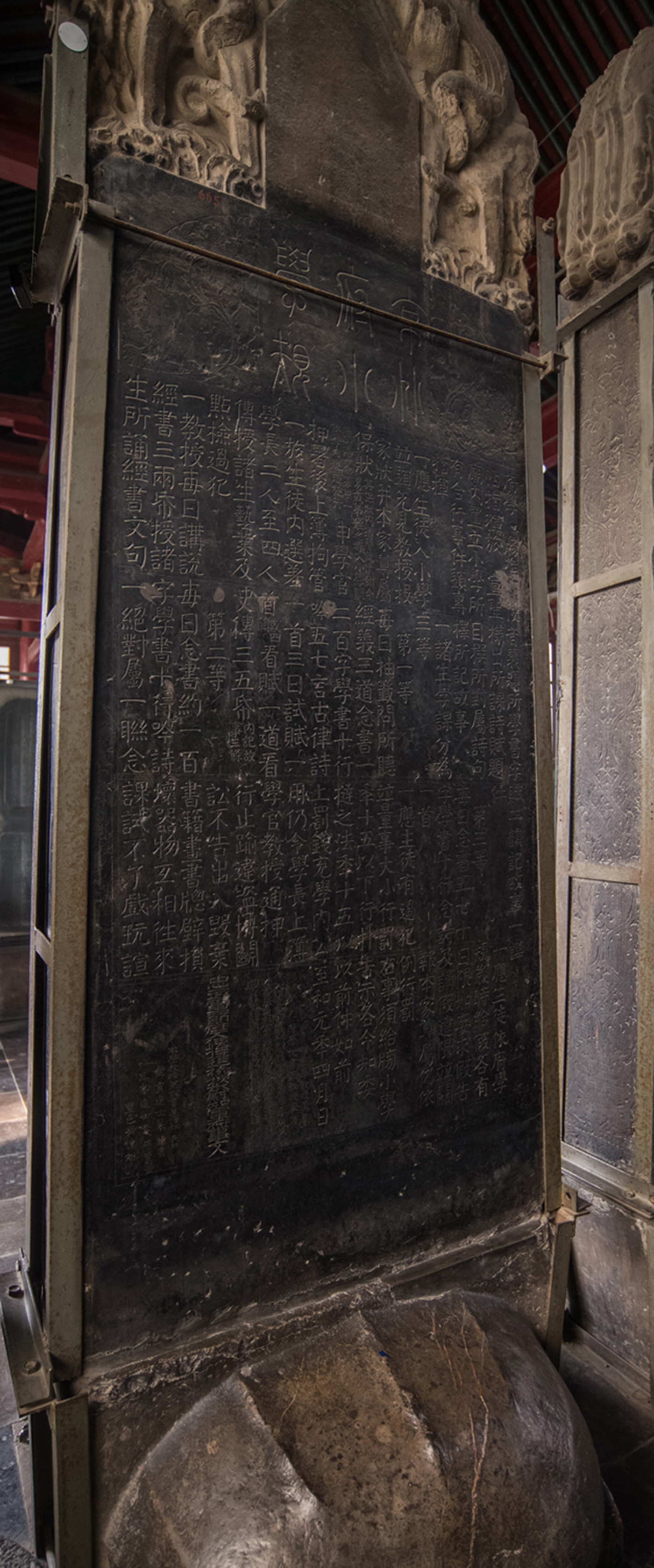
Stele 7 verso: Regulations of Jingzhao Prefecture School for Boys, 1054. Photo: Ma Yujiang. (color online)
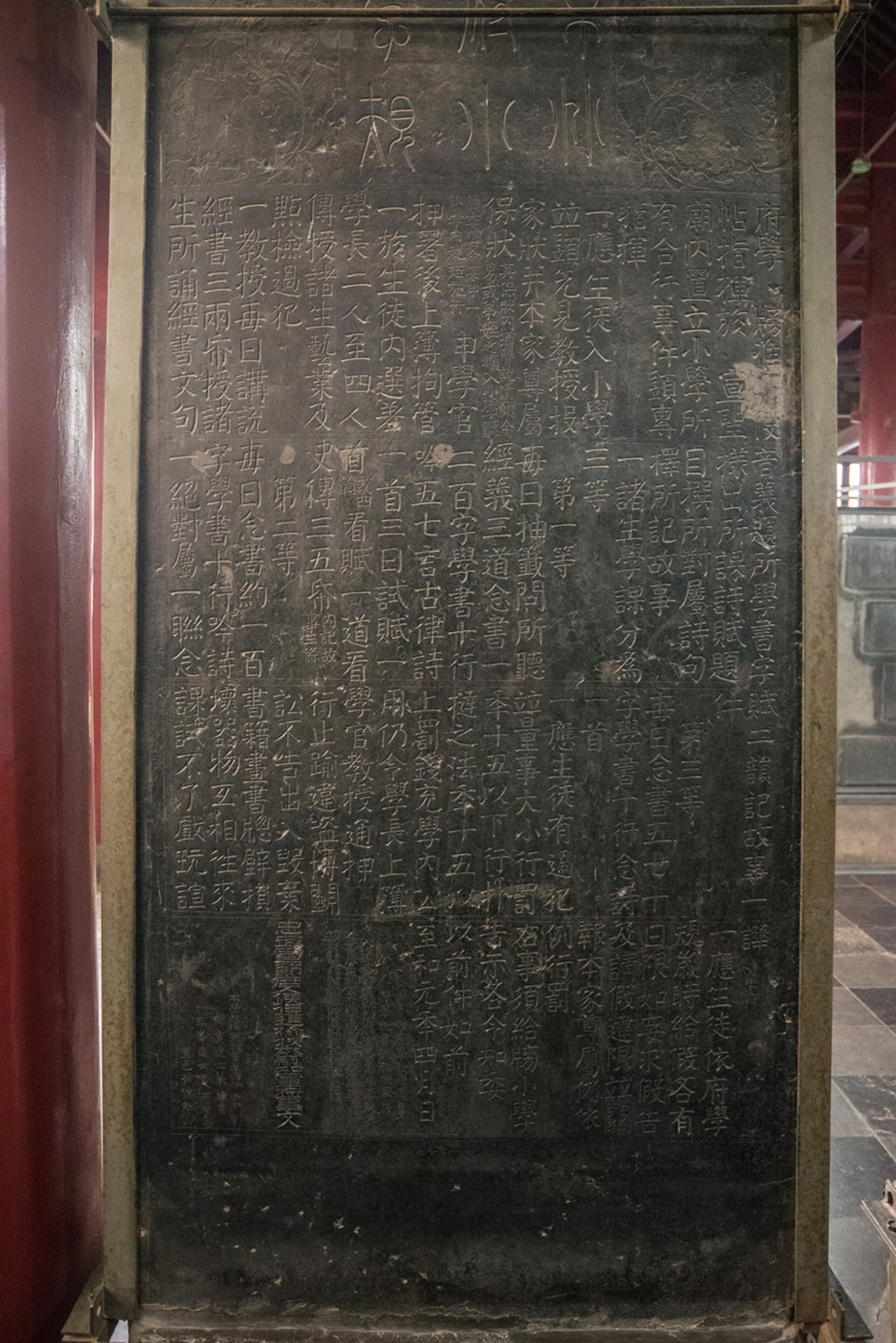
965 (28th day of the 12th month). Stele 1 (verso): Mengying, Ancient-Script Title and Seal-Script Transcription of the “Thousand-Character Classic” (Guwen e zhuanshu Qianzi wen 古文額篆書千字文) with preface and explanatory regular-script characters by Yuan Zhengji (Figures 31–34).
966 (12th day of the 4th month). Stele 2 (verso of Master Longchan Stele, originally erected at Shiji si 實際寺 in 743 in memory of the monk Huaiyun 懷惲): Guo Zhongshu, Transcription of the “Hidden Talisman Scripture” in Three Scripts (Santi Yinfu jing 三體陰符經) (Figures 43–46).
967. Stele 1 (recto): Huangfu Yan, Regular-Script Transcription of Tao Gu's 967 “Preface to Mengying's Seal-Script Transcription of the ‘Thousand-Character Classic’” (Kaishu Tao Gu zhuan Mengying shu Qianzi wen xu 楷書陶穀撰夢英篆書千字文序), with an ancient-script title by Mengying (Figures 38–40).
967. Stele 3 (recto): Mengying, Eighteen Types of Seal Script (Shibati zhuanshu 十八體篆書), with clerical script explanations, together with his own seal-script title (Figures 42–45).
ca. 967–968. Stele 4 (verso of what is now the “Zheng zuowei gao” Stele 爭座位稿碑, Figures 48–49,): Mengying, Running-Script Transcription of Zhang Zhongxun's Copy of Tao Gu's “Preface to ‘Lives of Eminent Monks’” (Xingshu Zhang Zhongxun chao Tao Gu Gaoseng zhuan xu 行書張仲荀抄陶穀撰高僧傳序), with a seal-script title by Guo Zhongshu (Figures 50–51).
968. Stele 5 (recto). Yuan Zhengji, Regular-Script Transcription of the Discourse on the Goddess Mārīcī (Kaishu Foshuo molizhitian jing 楷書佛說摩利支天經), with titlepiece illustration by Li Fenggui; Yuan Zhengji, Regular-Script Transcription of the “Hidden Talisman Scripture” (Kaishu Yinfu jing 楷書陰符經), with titlepiece illustration by Zhai Shousu (Figures 53–55).
980. Stele 5 (verso). Top to bottom: Regular-Script Transcription of Scripture of the Grand Supreme Elderly Lord on Clarity/Purity and Stillness/Tranquility (Kaishu Taishanglaojun chang qingjing jing 楷書太上老君常清靜經) by Pang Renxian, with titlepiece illustration by Bai Tingcan; Regular-Script Transcription of Scripture of the Grand Supreme [Numinous Treasure] on Ascending to Mystery on Staving off Calamity and Protecting Life (Kaishu Taishang shengxuan xiaozai huming jing 楷書太上升玄消災護命經) by Pang Renxian; Regular-Script Transcription of Scripture of the Grand Supreme Lords of Heaven on Living through Heaven and Attaining the Dao (Kaishu Taishangtianzun shuo shengtian dedao jing 楷書太上天尊說生天得到經) by Pang Renxian (Figures 56–57).
982. Stele 3 (verso): Mengying, Regular-Script Transcription of Cheng Hao's Stele for the Temple of Confucius (Kaishu chongshu Cheng Hao Fuzi miaotang ji 楷書重書程浩夫子廟堂記) (Figures 46–47).
984 or later. Stele 3 (recto): Yuan Yunzhong, Regular-Script Transcription of Poems to Mengying by 29 Writers (Kaishu Sanshijiu jia zengshi 楷書二十九家贈詩); Yuan Yunzhong, Regular Script Transcription of Guo Zhongshu's “Reply to Mengying” (Kaishu Guo Zhongshu zhi Mengying shu 郭忠恕致夢英書) (Figure 43 upper half and lower left).Footnote 157
998. Stele 6 (verso of 663 Master Daoyin Stele 唐道因法師碑): Zhengmeng 正蒙, Regular-Script Transcription of Poems to Mengying by 32 Writers (Kaishu Sanshijiu jia zengshi 楷書三十二家贈詩) (Figures 61–63).
999. Stele 7 (recto): Mengying, Seal Script Transcription of “Tabulation of Character-Component Origins of Compound Characters” (Zhuanshu Mulu pianpang ziyuan 篆書目錄偏旁字源), with their regular-script equivalents at a smaller scale written by Guo Zhongshu and a seal-script title written by Mengying; accompanied by Mengying's Regular-Script Transcription of His Own Preface (Kaishu Zixu 楷書自序), and by Mengying's Regular-Script Transcription of Guo Zhongshu's “Reply to Mengying” (Kaishu Guo Zhongshu zhi Mengying shu 楷書郭忠恕致夢英書) (see Figures 67–71).
Collectively, these various inscriptions had several interlocking purposes. They spoke to a broad and flexible Confucianist attitude of respect for other religious and philosophical traditions, and vice versa. They provided educational materials for future young scholars at the Prefectural School, since it did not yet exist and as it turned out would not come into existence until 1034 elsewhere in the city;Footnote 158 the fact that there are several references in the stele inscriptions to the Directorate of Education expresses both a nostalgia for the original home of the Kaicheng Stone Classics and a hope for the future. The inscriptions also highlighted the importance of contemporary paleographic scholarship outside the court, and advertised the importance of seal script and ancient script calligraphy. The steles in addition demonstrated the enlightened patronage of Wu Tingzuo, as well as the more modest financial support of many others. Finally, the initial project of the 960s created a monument to Mengying and Guo Zhongshu, which, as it turns out, the later additions of the 980s and 990s would make even more impressive.
Today the seven steles stand, in their various states of preservation, in Xi'an Beilin Museum. They are, for the most part, destinations of choice only for calligraphy specialists familiar with the names of Mengying and Guo Zhongshu. How many, among those who gaze respectfully at Yan Zhenqing's Draft of “Controversy over Seating Protocol” stele (see Figures 48–49), bother to examine the tenth-century calligraphies on the other side of it (see Figures 50–51), or realize that they are older, in artifactual terms, than the “Tang” calligraphy that one might easily take to be that stele's raison d’être? Nowadays the Chang'an stele project for the most part leads a scattered, disembodied, and incomplete existence through ink rubbings and their reproductions. Indeed, the seven steles are rarely discussed or reproduced together. Moreover, rubbings rarely transmit more of a stele than the surface covered by the text. Furthermore, they often show only a part of this surface, and in cases where a rubbing has been transferred to the album format, the cut-up and recomposed rubbing sacrifices the original compositional arrangement of the calligraphy. In the original Chang'an context, however, the viewer/reader would have been intensely aware of each stele's imposing size, often much taller than a human being, its heavy stone materiality, and the diverse ways in which the calligraphed texts are framed. Most of the steles are in a standard Tang format in which the main text occupies a plain rectangular surface that is paired with a tablet-shaped titlepiece above. What the rubbings tend to omit, though, are the elaborately carved dragons that surmount the vertical slab and frame the titlepiece, together with the base that is carved in the round in the shape of a turtle, on which the rectangular slab sits; in most cases these two framing elements only partially survive today. Ink-rubbing reproduction thus elides the triadic symbolism of the Human (represented by writing) placed between Heaven (dragons) and Earth (the turtle) that is fundamental to the format. No two steles are exactly alike. The recto of Stele 1, for example, replaces the titlepiece tablet with a relief-carved Buddha niche; immediately below this large niche is a row of seven smaller Buddha niches (Figure 28). The titlepiece calligraphy is correspondingly displaced to the rectangular surface of the stele, where it takes the form of a horizontal row of characters. An elaborate border depicting a lotus scroll frames the titlepiece and the main text. Stele 3, meanwhile, conforms to a much simpler format in which the vertical slab rises to an arched, lintel-like summit, across which the title is written horizontally; the slab stands on a simple rectangular base (see Figures 42; 46). Whereas the sides of Stele 1 retain elaborately carved Tang dynasty scrollwork (see Figure 35), as do also the sides of Steles 2, 4, and 6 (see Figures 41, 52, 64), those of Stele 3 are devoid of decoration. Stele 6 retains the original seventh-century pictorial designs on its base (Figures 65–66).
A further benefit of paying attention to the physical reality of the steles is a deepened understanding of the rhetorical structure of their visual self-presentation. Those modern scholars who consult only ink rubbings sometimes designate recto and verso of a given stele on the basis either of the perceived relative importance of the two inscriptions, or of chronology. In fact, the stone steles in most cases obey a different principle determined by their stone structure. Six of the seven have a turtle base, and the fact that the turtle only faces one way imposes a clear directionality. This reveals some rhetorical decisions. On Stele 1, the 967 Preface (see Figures 28–30) on the recto is meant to preface, literally, Mengying's 965 Large-seal Script Transcription of the “Thousand-Character Classic” on the verso (see Figures 31–34). On Stele 2, the fact that Guo Zhongshu's Transcription of the “Hidden Talisman Scripture” in Three Scripts was placed on the verso (see Figures 38–40) demands explanation; neither the content nor the authorship of the anonymous Tang calligraphy on the recto would have required deferring to it (see Figures 36–37). Instead, the reason may lie in the calligrapher's faithful evocation of the running-script style of the patriarch of modern calligraphy, Wang Xizhi. On Stele 3, on the other hand, Mengying's Eighteen Types of Seal Script (see Figures 42–45) occupies the rhetorically more important recto; on the upper side of the verso, meanwhile, above a second calligraphy by Mengying, are the remnants of an original anonymous Tang inscription, unfortunately not clearly visible in my illustration (see Figure 46). These remnants clearly were slated for an eventual replacement that for some reason did not happen. Stele 4 must once have carried a Tang inscription important enough for Mengying to defer to it by situating on the verso his Running Script Transcription of Zhang Zhongxun's Copy of Tao Gu's “Preface to ‘Lives of Eminent Monks” in the style of Yan Zhenqing (see Figures 50–51). But we will probably never know, since the Tang inscription originally on the recto was effaced in the late eleventh century to accommodate Yan Zhenqing's Zheng zuowei gao which, not coincidentally, is an example of Yan's running script (see Figures 48–49). In the case of Stele 5, when the 968 recto (see Figures 53–55) was followed twelve years later by the 980 verso (see Figures 56–57) the decision was taken to create visual continuity between the two sides of the stele. The continuity masks the fact that the verso upsets the original balance between Buddhism and Daoism by including only Daoist texts. Stele 6, with a calligraphy by Ouyang Tong on the recto (see Figures 58–60), suggests that when an inscription was the work of a reputed Tang calligrapher, it was allowed to take rhetorical precedence over the Song replacement (see Figures 61–63) of the verso inscription. Finally, on Stele 7, Mengying's Seal Script Transcription of “Tabulation of Character-Component Origins of Compound Characters”, together with its ancillary documentary and calligraphic materials (in which Guo Zhongshu looms large) occupies the recto and dominates rhetorically (see Figures 67–71). Although it once overshadowed a Tang inscription on the verso, in 1054 that unidentified inscription was replaced with Regulations of Jingzhao Prefecture School for Boys (see Figures 72–73).
How did Mengying and Guo Zongshu become involved in this sustained and expensive project?Footnote 159 Here, we can turn to the poems dedicated to Mengying on Steles 3 and 6. Although both versions of the poems were probably engraved long after 968, a number of the poems themselves date from the 960s. This is the case, for example, for Guo Zhongshu's poem cited earlier and also for the poem that Guo Congyi contributed, since he signs himself Governor of Hezhong, the post that he held from 964 to 968. Guo Congyi's poem was clearly meant as an expression of support:
A monk came from the waters of Yunmeng, and spoke of my teacher [Mengying];
He carried with him a letter of approach that conveyed [the latter's] lofty originality.Footnote 160
He wields his brush to transmit the characters of a thousand years ago,
And has left steles of special stone in several locations.
He mixes with the masses of the marketplace, who don't know what to make of him;
His behavior has a softened glare, to which cranes knowingly respond.Footnote 161
If you form another Lotus Society, you must let me join;
I am not like Tao Qian, who [only] loved to ladle wine.Footnote 162
雲水僧來說我師, 換鵝書札轉高奇。
揮毫傳下千年字, 貞石曾留幾處碑;
混俗市鄽人莫測, 和光蹤跡鶴應知。
蓮花結社須容我, 不似陶潛愛酒巵。
The general's poem confirms that it was Mengying, aware of the scholarly and cultural importance of the stele collection in Chang'an, and no doubt aware also of the stele sponsorship of Wang Yanchao, who approached Wu Tingzuo, probably with a proposal that he sponsor a series of steles. The monk had significant credentials: imperial favor from Guo Wei and, as we learn from the general's poem, prior experience in stele publishing. To be sure, much remains unclear. Had Mengying heard that Wu was interested in building on Wang Yanchao's prior patronage of the Confucius Temple? Did he make his approach through Wu's and Wang's colleague and peer, Guo Congyi, rather than directly? And if so, did he do so at Guo Zhongshu's suggestion? Each of these possibilities is plausible without being certain. For Guo Zhongshu, meanwhile, participation in the project had additional personal meaning. At a time when he no longer had anything to do with the Directorate of Education, from which he was thoroughly alienated, the Chang'an project allowed him to inscribe his work within the longer history of paleographic scholarship at the most resonant scholarly site outside the Song capitals, while at the same time advertising his calligraphic achievement. It associated him directly with the heritage of the Tang dynasty through the Kaicheng Stone Classics and the Chang'an location. This self-conscious association with the imperial Tang past, as we shall see, would also become a recurrent theme in his paintings.
Guo Zhongshu's Song-Period Calligraphy
Guo Zhongshu's major contribution to the Confucius Temple project, Transcription of the “Hidden Talisman Scripture” in Three Scripts on the verso of Stele 2, is in every respect an extraordinary work (see Figures 38–40).Footnote 163 Like Mengying's Seal-script Transcription of the “Thousand-Character Classic” (see Figures 31–34), it is effectively a dictionary, in this case of seal script (zhuanshu) and ancient script (guwen). Guo modelled it on a stele inscription that he had known all his life, the Wei dynasty Stone-Engraved Classics in Three Scripts, which presented each character first in ancient script, then seal script, and finally in bafen clerical script (lishu), making vertically stacked groups of three (see Figure 2). Guo, on the other hand, gave seal script pride of place, appending the ancient-script and clerical-script equivalents below the relevant character at a much smaller scale. Few calligraphers in Guo's day could have successfully transposed the approach of the Stone-Engraved Classics in Three Scripts to the Transcription of the “Yinfujing” in Three Scripts; the result is a paleographic tour-de-force. But it is also a calligraphic masterpiece of austerely elegant power in which Guo demonstrates his mastery of not just three but four scripts, since he also includes a standard-script title and signature. The seal script characters follow closely the style of Li Yangbing while mitigating the latter's geometric rigor in favor of a slightly less austere effect; moreover, Transcription of the “Yinfujing” displays a new strength and precision in comparison to Guo's 954 Record of the Temple to King Wenxuan (Confucius) (see Figure 13). The same approach can be seen in his seal script titlepieces to Mengying's contributions to Stele 4 (see Figure 51) and Stele 7 (see Figure 68). Beyond the individual script components, in his Transcription of the “Yinfujing” the overall organization of the calligraphic surface is impressive in its own right, creating an elastic grid that accommodates a dense yet uncrowded field of signs and pathways in pulsating equilibrium.
Guo Zhongshu's Taizu-period calligraphy had its admirers during the Northern Song period. Writing about Transcription of the “Hidden Talisman Scripture”, of which he owned a rubbing, Ouyang Xiu maintained that Guo's “proficiency in the seal script remains unrivalled since the days of Li Yangbing in the Tang.” (郭忠恕書, 篆法自唐李陽冰後, 未有臻於斯者) and that “although there are many in recent times who seek to emulate his style, there are none who can match his skill” (近時頗有學者, 曾未得其髣髴也).Footnote 164 Song Xiang singled him out among north-Chinese calligraphers: “Of the calligraphers of the interregnum [between Tang and Song], only Guo Zhongshu can be compared with the Xu brothers [Xu Xuan and Xu Kai]” 中朝書人, 惟郭忠恕可對二徐.Footnote 165 A plausible anecdote has Zhao Bingwen 趙秉文 (1159–1232) echoing these favorable judgments in the early thirteenth century:
On another day Lei [Xiyan] acquired several sheets of seal script calligraphy by Guo Zhongshu, which he treasured. He showed them to the honorable Zhao, who also delighted in them. So Lei asked him to add a colophon at the end, and in this colophon the honorable gentleman wrote: “Shuxian's seal script calligraphy had nothing to envy that of his Tang predecessors, yet when it came to the Song, more than a hundred years passed without anyone of note promoting its merits.” Lei Xiyan [then] happily sold the work. His sharpness was like this.
又一日雷得郭忠恕篆數幅, 甚珍之。以示趙公, 公亦喜。雷因求跋尾。公跋云: “恕先篆不減唐人, 然迄宋百餘年, 不經諸名士發揚”。雷希顏趣售之。其鑑裁如此。Footnote 166
On the other hand, when Zhu Changwen in the 1060s included Guo in his Rankings of Calligraphers, Continued 續書斷, not only did he consign him to the able category (nengpin 能品) but he also passed over Guo's seal script entirely, mentioning only a special proficiency in regular script, seemingly in reference to Guo's early work.Footnote 167 Since Zhu can hardly have been unaware of Guo Zhongshu's seal script, his silence probably reflects the taste of a southern admirer of Xu Xuan's more polished and elegant approach to that script, which Zhu rated very highly.
Finally, Guo's work in clerical script after 960 also attracted admiration. Zhao Mingcheng 趙明誠 (1081–1129) had in his collection an autograph bafen transcription of Li Deyu's 李德裕 (787–850) “Record of The Tower for Recollecting Mt. Song” (Huai Song Lou ji 懷嵩樓記) dating from Guo's late years, and praised the “long experience and mental toughness [visible in] the strength of his brush” (筆力老勁).Footnote 168
Guo Zhongshu and Taizong
On present evidence, around 968 Guo Zhongshu left behind him his earlier scholarly involvement with paleography, transferring his analytic skills to a new endeavor: the pictorial rendering of architecture, other carpentered objects, and machinery. Since he seems to have been loosely attached to Guo Congyi's entourage, the decisive factor in his shift of direction may have been a change in the general's circumstances. In 968, Guo Congyi returned to the Luoyang-Bian area due to illness and the next year was forced into full retirement together with several other generals of the same generation. Simultaneously he was appointed to what was effectively an honorary post, as Generalissimo of the Imperial Insignia Guard of the Left (zou jinwuwei shangjiangjun 左金吾衛上將軍). This was followed by his appointment in 970 as Grand Preceptor of the Heir Apparent (taizi taishi 太子太師). During his years as Military Governor based at Heyang in the 950s, the general had built a sumptuous retirement residence in Luoyang. But now that it came time to take advantage of its existence, the retired general found his mansion wanting and commissioned improvements. In the meantime, he chose to live in Bian, closer to the center of power. The Luoyang mansion was impressively situated close by the imperial palace, in Shangshan Ward 尚善坊 on the east side of the north–south axis that led directly out of the imperial palace (where the general had spent his childhood), across the impressive Tianjin Bridge 天津橋, to the city's main gate, Dingdingmen 定鼎門. Tianjin Bridge was renovated in 961, and the imperial palace itself was refurbished and expanded in 962, and again in 975.Footnote 169 Assuming that Guo Zhongshu continued to be a sometime member of the general's entourage, he would have followed the general east around 968.
Although there is no direct proof, his emergence as a painter of architectural subjects (very different from his earlier, highly performative practice of painting) suggests that he may have become directly involved in the refurbishment of the general's mansion. The opportunity to observe the architectural transformation of Luoyang during Taizu's reign first-hand would help to explain how Guo was able to make such an unexpected shift. It would also provide a plausible context for his well-attested attraction to the nostalgic pictorial theme of historical palaces of Chang'an and Luoyang. The architectural transformation of Luoyang during Taizu's reign allowed the city to emerge as a historically resonant center of leisure for the Song elite. When Taizu, a native of Luoyang, in 976 finally renounced moving the capital back to Luoyang, the city's effective status as the Song's cultural capital was confirmed. Even though no examples of Guo Zhongshu's highly influential palace paintings have survived, early textual descriptions and the surviving works of later followers confirm that their context lies in the city's early Song architectural renaissance, famously documented in Li Gefei's 李格非 retrospective Account of Famous Gardens of Luoyang (Luoyang mingyuan ji 洛陽名園記, ca. 1095). Guo's pictorial response to this renaissance visualized an implicit nostalgia for a Tang dynasty that was only now definitively entering history.
Following Guo Congyi's death in 973, Guo Zhongshu re-entered government on an entirely different basis from before, as an official in the Directorate of Imperial Construction in Bianjing. As I have discussed elsewhere, until the end of Taizu's reign Guo appears to have worked as an architectural painter, collaborating with painter colleagues on preparing pictorial renderings of planned projects and documenting completed projects, while also collaborating with builder-architects in the architectural design process.Footnote 170 Two pictorial compositions on which Guo Zhongshu collaborated in the mid-970s survive today, and they amply justify his enduringly high reputation as a painter of architectural and related subjects.Footnote 171 These works demonstrate that far from approaching architectural representation in a scholastic manner, Guo was interested in the practicalities of construction, also engaging collaborators skilled in figure painting in order to show buildings, boats, and machinery as actually used by people.Footnote 172 Thus, at the moment of Taizu's death in 976 Guo Zhongshu could be said to have reinvented himself: once a paleographic scholar, he was now a painter of architectural and engineering subjects contributing to real-life construction at the highest level. (The practice of calligraphy, of course, remained a constant in Guo Zhongshu's life). The new emperor, however, turned out to have a different vision of Guo's future role.
Zhao Kuangyi 趙匡義 ascended the throne as Taizong in late 976, following sixteen years as Metropolitan Governor of Bian (Kaifeng yin 開封尹). Zhao Kuangyi had been a very powerful figure during Taizu's reign, so much so that he is often thought to have been responsible for preventing Taizu from carrying out his plan to move the capital from Bian to Luoyang. It is worth noting that whereas Taizu had been born in Luoyang, Taizong was born in Bian, in a county of Kaifeng Prefecture 開封府, Junyixian 浚儀縣.Footnote 173 Zhao Kuangyi commanded a significant army, contemporary commentators noting the scale of his entourage as he moved through the streets of the capital.Footnote 174 Zhao Kuangyi had not originally been considered next in line to succeed Taizu, since Taizu had two sons, the eldest of whom, Zhao Dezhao 趙德昭 (951–979) was 25 in 976. Popular opinion therefore suspected Taizong of having murdered his brother, Taizu, who was not known to be ill. The fact that Taizong immediately brought back Zhao Pu 趙普 (922–992) from his exile for corruption to lead the government did nothing to quiet the rumors, which were perpetuated by the subsequent deaths under suspicious circumstances in 979 and 981, respectively, of Zhao Dezhao and his younger brother Zhao Defang 趙德芳 (959–981). Other likely murders include that of Qian Chu 錢俶 (929–988), the former ruler of the Wuyue Kingdom, who died after drinking wine sent to him by Taizong on his sixtieth birthday. None of these events are at all surprising in the bloody context of Five Dynasties history, which, in a sense, they brought to a close.
On the other hand, Zhao Kuangyi was far less of a military man than his brother. By temperament and calculation, he was drawn to the civil side of government. As Metropolitan Governor, he had surrounded himself with scholars, laying the basis for his subsequent initiatives as emperor. It was under Taizong's rule that the jinshi examination would be reformed and turned into a major tool of recruitment, whereas Taizu had continued the Five Dynasties practice of only sparingly granting jinshi degrees. The corps of scholar-officials was to be vastly expanded after Taizu's death, and scholar-officials would displace military men as the dominant force in government. As Taizong, Zhao Kuang yi also had an acute sense of the necessary role of ideology in ensuring the coherence of an empire, which led him to restore and expand all the official government organisms that were responsible for scholarship and cultural production. During Taizu's reign, Zhao Kuangyi had taken a great interest in the arts, including calligraphy and painting. In the wake of the conquest of the Shu kingdom, the great Sichuanese painter Gao Wenjin 高文進 was his artist-in-residence, and he also had contact with an artist from the northern frontier with the Liao, Gao Yi 高益. Both artists subsequently became Painters-in-Attendance after Zhao Kuangyi ascended the throne. We also know of his acquisition of a major set of luohan paintings by the Southern Tang artist, Wang Qihan 王齊翰, just sixteen days before Taizu's death. Zhao Kuangyi had been so engaged with the world of painters, in fact, that he wrote a biographical history of painters since the fall of the Tang dynasty, unfortunately now lost.Footnote 175 Guo Zhongshu surely figured in that book.
Guo came to Taizong's attention at the very beginning of his reign when the calligrapher Li Jianzhong submitted his own transcription of Bamboo Slip Writing.Footnote 176 Possibly as a consequence of Li Jianzhong's intervention, Taizong, soon after coming to the throne in November 976, affirmed that he had long known Guo by reputation and restored him to the Directorate of Education, from which he had been banished fifteen years earlier. Guo's new appointment was as Recorder (guozijian zhubu 國子監主簿), with the assignment of preparing historical works on paleography for printed publication. It was thus not just Guo's reputation as a calligrapher that justified the appointment, but also the scholarly reputation he had amassed through the books he had written. Various sources stress the imperial largesse that accompanied this extra-ordinary appointment. Guo was granted the right to wear a dragon robe and a gold belt, and was given 50,000 cash.Footnote 177 Yet, honor though it was, the appointment plunged Guo Zhongshu into despair. His early biographer, Wang Yucheng 王禹偁 (954–1001), is unambiguous:
Unlike his old friend Mengying, who was similarly summoned to court by Taizong, Guo Zhongshu could not refuse the imperial command. Mengying, as a monk, had leeway to decline an official appointment, and requested that he be allowed to return to Mt. Zhongnan (Chang'an). Taizong granted Mengying's request, bestowing on him the purple robe. Guo Zhongshu stayed behind in the Directorate of Education.
From Taizong's point of view, the appointment of Guo Zhongshu—a great paleographer, calligrapher, and painter—must have seemed inspired. Taizong made much greater use of printing than any of his predecessors had, and he seems to have come to power with a vision already in place for a program of official printed publications. In order to realize the program it was necessary to develop library resources, building on earlier efforts by Taizu and before him the Later Zhou emperor, Shizong. The enterprise involved both palace institutions and institutions of outer government. Under the Five Dynasties, the Institute for the Veneration of Literature (Chongwen yuan 崇文院) had fallen into desuetude. Under the Southern Tang, by contrast, it had continued to be important, a fact of which Taizong was well aware. Since the Tang dynasty, this august institution had been made up of three divisions—the Historiography Institute (Shiguan 史館), the Institute for the Glorification of Literature (Zhaowen guan 昭文館), and the Academy of Scholarly Worthies (Jixian dian shuyuan 集賢殿書院). The Historiography Institute was responsible for compiling and revising dynastic histories, while the Institute for the Glorification of Literature aided in the composition of imperial pronouncements and the Academy of Scholarly Worthies had responsibility for compiling imperially sponsored scholarly works. Naturally, the work carried out by the three divisions of the Institute for the Veneration of Literature required an appropriate supporting library, and under the Song efforts had been made to expand it during Taizu's reign through the acquisition of libraries from defeated kingdoms. Libraries had been confiscated from Jingnan in 963, and others acquired in Shu after its defeat in 966.Footnote 179 By far the greatest contribution, however, was to come from Southern Tang, whose palace library, according to Johannes Kurz, “was the largest and most comprehensive library of its time.”Footnote 180 The library also had a separate function as an archive that included paintings and calligraphies alongside court documents. In 977–978, Taizong, dissatisfied with the cramped quarters of the existing building, built larger premises to house the Institute for the Veneration of Literature and an expanded library.Footnote 181 Located within the imperial palace compound, the Institute for the Veneration of Literature was the palace equivalent of the outer-government Directorate of Education, the latter falling under the jurisdiction of the Chancellery (menxiasheng 門下省). Under the Song, the Directorate did not further develop its Five Dynasties tradition of printing texts in which Guo Zhongshu had participated under the Later Zhou. Instead, this work was taken over by the Institute for the Veneration of Literature, where it could be more closely supervised by Taizong.
If Taizong brought Guo Zhongshu back in order to prepare a printed collection of philological works, why then did he reappoint him within the Directorate of Education system and not at the Institute for the Veneration of Literature? The latter institution, after all, was the center for the emperor's compilations projects. Kurz has shown that Taizong's compilations had an explicitly political purpose. “Such compilations were a means to emancipate southern scholarship and integrate it into the united empire, and at the same time to make manifest the position of Taizong as the legitimate successor to the Tang heritage.”Footnote 182 Among the Southern Tang scholars whom Taizong appointed to the Hanlin Academy and assigned to compilation projects in the Institute for the Veneration of Literature was Xu Xuan, surviving brother and former scholarly collaborator of Xu Kai. Xu Kai had demonstrated on textual grounds that Li Yangbing's version of Discussion of Single-graph Characters and Explanation of Compound Characters could not be trusted, and had proposed a new reconstruction of the original form of the Han dynasty dictionary. By imperial order Xu Xuan was one of the group of four scholars who in 979 were given the charge of establishing an official edition. Not surprisingly, Xu Kai's break-through study, entitled An Annotated Edition of “Shuowen jiezi” (Shuowen jiezi xizhuan 說文解字繫傳), with ancient script characters written by Xu Xuan, would provide the basis of the official Song edition of Discussion of Single-graph Characters and Explanation of Compound Characters published by the Directorate of Education in 986.Footnote 183 It would seem, therefore, that Taizong had little practical need of Guo Zhongshu's scholarly talents. One cannot rule out the possibility that Taizong added him to the Directorate staff in much the same way as he added rare artworks to the imperial collection, as an enhancement of the symbolic capital of the Song regime.
Guo's return to the Directorate of Education lasted less than a year. Thanks to complementary accounts in the biographies by Wang Yucheng, Liu Daochun, and Su Shi, and in those included in Xu zizhi tongjian changbian and the Song History, the circumstances of his brief tenure are relatively well understood.Footnote 184 Taizong, certainly conversant with Guo's wild behavior, initially lodged him with a eunuch official, Dou Shenxing 竇神興, perhaps as a signal to Guo to behave. If so, it did not work. One morning, Guo shaved off the beard and moustache for which he was known. Dou Shenxing, meeting him that day, asked the reason, to which Guo, with his usual inability to hold his tongue, replied: “To make myself look like you.” The implication, I take it, was that his appointment had emasculated him. Offended, as was no doubt Guo's intention, Dou Shenxing lodged an official complaint that Guo could not keep his behavior within bounds. As a result, Guo lost his Registrar position and moved his lodgings to the Directorate of Education. Taizong started to cool toward him, but in recognition of his talent continued to treat him benevolently. Guo, however, “gave way all the more to drink and reckless commentary on current affairs, repeating many slanderous rumors, and moreover sold government property.”Footnote 185 What catches one's eye in this account, of course, is the mention of slanderous rumors: could these refer to the gossip that Taizong had murdered Taizu? If so, one can well understand that Guo, sobering up and realizing what he had done, and realizing also that there was no way to apologize, simply fled.Footnote 186 In Wang Yucheng's words:
One can also understand that Taizong was enraged when Guo's words were reported. Guo Zhongshu was tracked down and arrested. Wang Yucheng again:
In the ninth month of 977, Guo was given a suspended death sentence, and sent in stocks to prison at Dengzhou on the Shandong coast.Footnote 188 Escorted under guard, he got as far as Linyi 臨邑 just north of Qizhou 齊州 (modern Jinan) before dying by the side of the road.
The reported manner of Guo's death was still more particular, and it attracted attention all the way up to Taizong himself. Guo was said by the guard escorting him to have announced his imminent death, and then to have dug a shallow grave, in which he laid himself out before expiring and being buried there by the guard. Taizong, given the news, sighed in regret for the loss of such a talent. We may today be skeptical of the guard's account and think it more likely either that he was murdered or that he goaded the guard into killing him. Guo's contemporaries may have had their suspicions as well. A few months later, friends tracked down the grave with the intention of recovering his corpse in order to provide him with a proper burial. When they uncovered the grave, they are variously said to have found just the clothes, or a body that weighed almost nothing. For many, the conclusion was clear: Guo had escaped his own body and disappeared into the landscape as a transcendent. Taizong himself sent officials to erect a shrine at the site, an act that lent still more legitimacy to a story that suited the powers that be.Footnote 189 The myth of Guo's transcendence was, perhaps, a safer way of framing Guo's demise than dwelling on the obvious; that he had been trapped like a wild bird and put in a cage that he could not tolerate. It may also have been, for Guo's Song dynasty admirers, a way of expressing metaphorically their admiration for someone who was open to political criticism. The myth was an enduring one, repeated by late Northern Song writers, including Su Shi.Footnote 190 It also found its way into the material record. In 1080, when Wang Lin 王臨 (d. 1087) was the prefect of Qizhou, he came across two large-scale characters, “Shen zai 神在,” written on the east corridor wall of the Taishan Temple to the south of Xingde. An oral tradition, encouraged no doubt by the knowledge that Guo Zhongshu had died nearby, attributed the inscription to Guo, and Wang thought highly enough of the calligraphy to have a copy engraved on a stone stele.Footnote 191 The inscription, at once declarative and enigmatic, can be interpreted in different ways, one of which is “My spirit is here.”Footnote 192
Materialities of Transmission
In his letter to Mengying, Guo Zhongshu makes reference to “the old bamboo slips [found in] tombs” as the most secure evidence for ancient script writing, which even Xu Shen in the early second century CE had not always been able to interpret correctly. Guo underscored the importance of archaeological evidence by giving his major surviving work the title, Bamboo Slip Writing. Since the 1930s, inscribed bamboo slips have been recovered by the tens of thousands from tombs in Hubei and Hunan in the south, Shandong in the east, and Sichuan and Gansu in the west and northwest, as well as in Henan. It seems unlikely to be coincidental that Mengying, with whom Guo was in such close scholarly agreement, came from Hunan where large numbers of Warring States-period bamboo slips have been excavated. And as we saw at the beginning of this article, Guo himself probably encountered bamboo-slip manuscripts as early as his teenage years. The fact that modern archaeologists are able to make use of Bamboo Slip Writing in deciphering excavated writings confirms that Guo made use of such archaeological material.Footnote 193 One must also wonder whether he did not have access to inscriptions on Shang and Zhou bronze vessels and implements as well. In modern times the Zhongyuan region in which he spent most of his life has yielded countless examples of inscribed bronzes through both controlled excavations and illegal looting. Since tomb-robbing was a time-honored activity, with a long history prior to Guo Zhongshu's lifetime, and since urban construction was liable to turn up traces of the past, it stands to reason that an archaeologically minded paleographer would have come into contact with such artifacts.Footnote 194 On the other hand, specialists of calligraphy are unanimous in their judgment that Guo's calligraphy shows no archaeological influence. It thus seems that for Guo, in contrast to his Qing dynasty counterparts, scholarly inquiry into the history of writing had no specifically stylistic implications for the creative practice of calligraphy.
Guo Zhongshu's paleographic achievements are a reminder that the antiquarian movement of the late Northern Song had an important precursor in the mid-tenth century. In the circumstances of China's post-Tang fragmentation into independent states, antiquarian inquiries into the history of writing had a quasi-international character, involving a small number of highly committed scholars in Shu (Lin Han), Chu (Mengying), and Southern Tang (Xu Kai, Xu Xuan), as well as the dynasties based in Luoyang or Kaifeng (Guo Zhongshu). Sometimes competing, sometimes collaborating, they were well aware of each other's work, which focused on the role played by ancient script in mediating access to ancient texts. The paleographic, phonological, and semantic dimensions of the problem all attracted their attention, as did the implications for new editions of the ancient texts. The enterprise had a contemporary urgency, because these texts—the Classics—were modern points of reference for rulership, administration, and moral behavior. Moreover, the prestige of seal script in the broadest sense was immense, contributing to the legitimacy of the state through its presence in visual culture. The Song reunification of China did not, however, lead to a general consolidation of the mid-century antiquarian efforts, but rather to the dominance at court of the Southern Tang current, institutionalized in major printed texts. The contributions of scholars such as Guo Zhongshu and Mengying from other polities were transmitted in less visible ways within the Song antiquarian community. Crucial to this process of transmission were steles. Perhaps due to the close connection between paleography and calligraphy, and to the enduring importance of steles for the transmission of calligraphic models,Footnote 195 the reproductive technology of ink impressions from steles proved highly effective in transmitting certain key works by Mengying (Large-seal Script Transcription of the “Thousand-Character Classic”, Eighteen Types of Seal Script, and Tabulation of Character-Component Origins of Compound Characters) and Guo Zhongshu (Transcription of the “Hidden Talisman Scripture” in Three Scripts). Other of their works, though, like Guo's Bamboo Slip Writing and Bodkin, circulated as calligraphic manuscripts that were eventually translated into printed form.
Indeed, Guo's career highlights how artifactual and material is the transmission not only of calligraphy but also textual knowledge, something that he and his contemporaries understood better than we moderns. The two dimensions of transmission of textual knowledge—circulation in the present and survival into the future—were of equal concern to them. The platform with which a text became associated—manuscript, stone stele, or printed book—had an enormous bearing on how many readers had access to the text, and whether the text survived into later centuries or not. In Guo's time, a text's passage from manuscript to stone-engraved or woodblock-printed version significantly increased its chances on both counts. Manuscript copying, which was to remain an essential part of scholarly and literary culture as late as the Qing dynasty, at this historical moment prior to the development of bookshops kept a text within the framework of private libraries. The engraving of a text on a stone stele, which by definition stood in a public or semi-public place, made it much more accessible to contemporaries and future generations, the degree of accessibility multiplied by the reproductive technology of ink rubbing, which made the stone-engraved transcription portable. Ink rubbing was the medium of stele publishing. The stele rubbing and the manuscript copy were not in competition, however, but on the contrary often had a symbiotic relationship. To engrave the preface to a book was in this period an encouragement to readers to seek out a manuscript copy of the whole text, and conversely, of course, any stele inscription could generate a manuscript copy. For Guo and his contemporaries, woodblock printing was a narrower option. Although private printings had started to appear, the technology was for the moment largely associated with the state. This restricted its availability to cases where one's scholarly work could be conducted under state auspices, as was the case for Guo's ancient-script edition of the Book of History. Such a printed edition was a guarantee of increased circulation and an enhancement (but not a guarantee) of the text's chances of historical transmission. It was also highly prestigious, the prestige deriving not only from the edition's official character but also from its artifactual quality. The quality was visible in the paper, the facture of the book, the standardized calligraphy entrusted to prominent calligraphers, and the care taken with the printing itself.
Yet, the broader option of stele publication was no less subject to artifactual quality control. A striking feature of several steles in the Chang'an Confucius Temple project is that the engraver (always a member of the same Gansu Wuwei 武威 family) is given equal billing alongside the calligrapher/transcriber of the text (Figures 74–75; see also Figures 30, 47, 51). Thus, An Renzuo 安仁祚 engraved the 961–962 Recarving of Yu Shinan's Record of the Confucius Temple (see Figures 18–20), the 962 Record of the Refurbishment of the Temple of Confucius (see Figures 24–25), the 966 Transcription of the “Hidden Talisman Scripture” in Three Scripts (see Figures 38–40), and the Buddhist sutra and Daoist scripture on the 968 recto of Stele 5 (see Figures 53–55). The engraver of the 965 Large-seal Script Transcription of the “Thousand-Character Classic” (see Figures 31–34) was An Renyu 安仁裕. An Wencan 安文, meanwhile, engraved the 967 Eighteen Types of Seal Script (see Figures 42–45), the ca. 967–968 Running Script Transcription of Zhang Zhongxun's Copy of Tao Gu's “Preface to ‘Lives of Eminent Monks’” (see Figures 50–51), the three Daoist scriptures on the 980 verso of Stele 5 (see Figures 56–57), the 982 Regular-Script Transcription of Cheng Hao's Stele for the Temple of Confucius (see Figures 46–47), and the 999 Seal Script Transcription of “Tabulation of Character-Component Origins of Compound Characters” (see Figures 67–71). Lastly, An Wencan and An Wencheng 安文晟 jointly engraved the 998 Regular-Script Transcription of Poems to Mengying by 32 Writers (see Figures 61–63). An Renzuo and An Renyu probably belonged to an earlier generation than An Wencan and An Wencheng, and Wencan was probably older than Wencheng since the latest recorded engraving by the former is from 1019 (Figures 21–22), whereas the latter is recorded as the engraver of works in 1030 and 1031.Footnote 196 The An family of stone engravers continued to be active in Chang'an down to the early twelfth century.Footnote 197
Signature of the engraver, An Renzuo, at the end of Record of the Refurbishment of the Temple of Confucius (Chongxiu Wenxuanwang miao ji 重修文宣王廟記), transcribed in running script by Ma Zhaoji, 962. Photo: Ma Yujiang. (color online)

Signature of the engraver, An Renyu, at the end of Regular-Script Transcription of Tao Gu's 967 “Preface to Mengying's Large-seal Script Transcription of the “Thousand-Character Classic” by Huangfu Yan, 967. Stele 1, recto. Ink rubbing. Gao Xia et al., Xi'an Beilin quanji, 25, Beike (Guangzhou: Guangdong jingji, Shenzhen: Haitian, 1999), 2609. (color online)
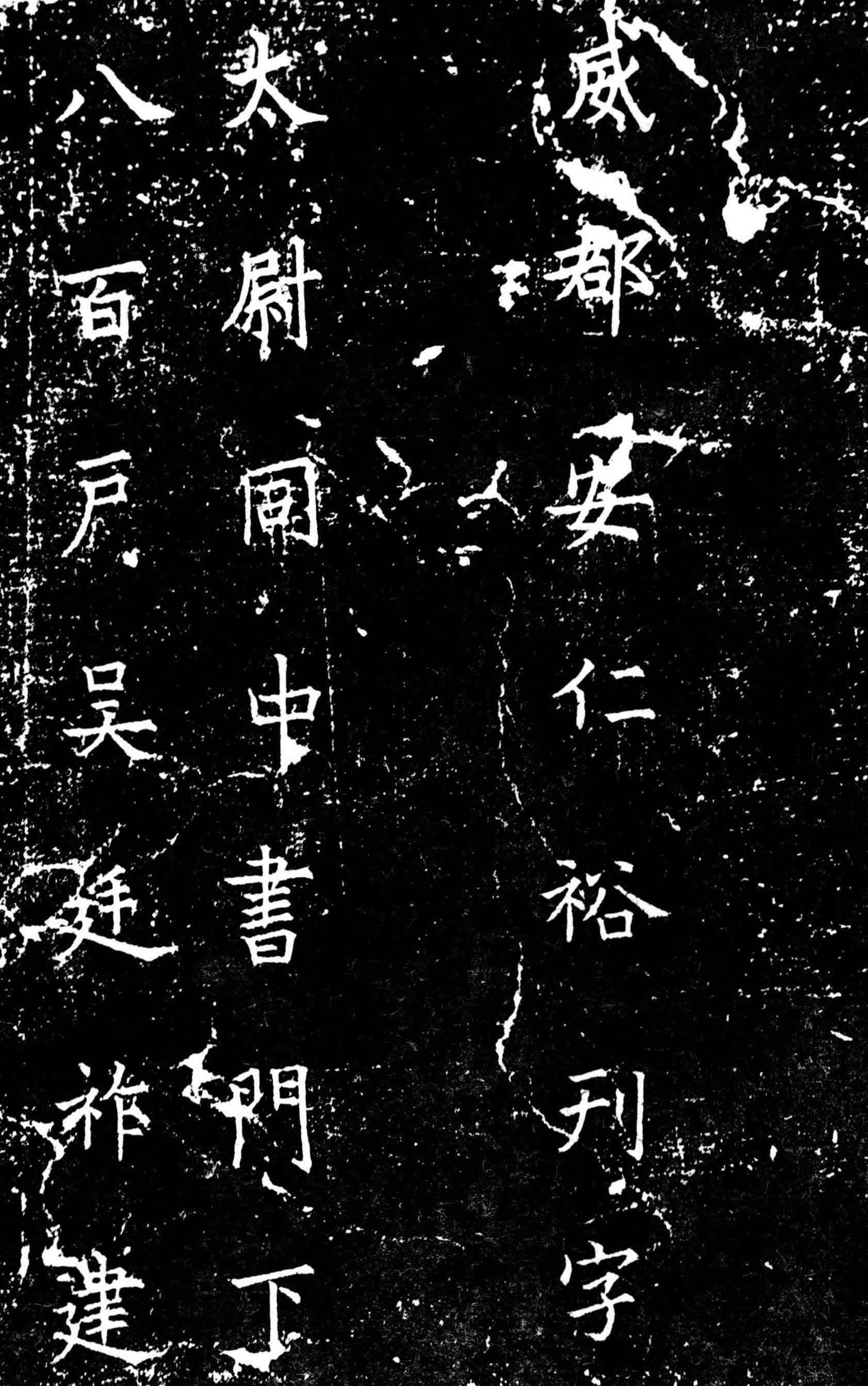
Given the importance of stele publishing in Guo Zhongshu's time, it can hardly be a coincidence that a major pictorial composition dating from this period, known today through a facsimile copy, takes as its theme the act of reading the text on a stele (Figure 76). The work was painted by two Shandong artists: Guo's older contemporary, the great landscapist Li Cheng, and a specialist of birds and human figures, Wang Xiao 王曉. Li's family, a branch of the Tang imperial family, had moved to Shandong from the Chang'an area, which explains the fact that one of his known styles—the one used here—evokes the loess landscape of southern Shaanxi.Footnote 198 Although the depicted scholar (and thus the historical context of the scene) cannot be securely identified, the stele is of a recognizably Tang type.Footnote 199 The absence of writing on the stele should not be taken literally: with one famous exception, which does not resemble the depicted one closely enough to be the artist's subject, all Tang and Five Dynasties steles were inscribed. The fact that the scholar gazes at the stele is enough to show that the viewer is meant to understand writing to be present. By leaving the writing unshown, and the text unidentifiable, the artist created a participatory space for the viewer's imagination to introduce its own candidates for an appropriate text or type of text. The approximate date of this otherwise enigmatic composition, which probably dates from Li Cheng's late years, coincides with the efforts of Wu Tingzuo and Mengying at the beginning of the Song dynasty to reassert the importance of Chang'an's Confucius temple as a museum and gallery of religious and philosophic instruction, scholarship, and calligraphy. By drawing attention to the way in which a stone stele inscribed a scholar's contribution in the physical landscape of China, whether through the composition of a text or its calligraphic transcription, the painting highlights the role of stele publishing in cultural transmission. What aspects of contemporary experience did this image bring to mind for viewers in the 960s? For some, the wilderness setting must have evoked the legacy of the destruction of the Tang capital, which reduced formerly flourishing temples to ruins and left Tang dynasty steles standing in untended countryside. For more informed viewers, though, of whom Li Cheng himself is likely to have been one—those viewers aware of the local administration's efforts to relocate and repurpose surviving Tang steles at Chang'an's Confucius Temple, and of the revitalization of stele publishing that this implied—the image may have taken on additional associations. If it is evident that the artist created this image as a reflection on history, it is no less plausible that the painting simultaneously paid tribute to the enduring importance of stele publishing for scholars under the new dynasty.
After Li Cheng (919–967) and Wang Xiao, Reading the Stele (Du bei tu 讀碑圖). Hanging scroll, ink and color on silk, 126.3 x 104.9 cm. Osaka Municipal Museum of Fine Art. Downloaded from Wikimedia Commons. (color online)
Acknowledgements
I am grateful to the two anonymous manuscript reviewers, Dorothy Ko, and my research assistant, Che-ying Hsü, for their close readings of the text and its translations. Vivi Xie, Fangjie Deng, Tian Mi, and Kunhua Liu provided invaluable additional research help. All remaining errors are my own.