


‘Exponence’ is the relation between abstract morphological information and its phonological realisation.Footnote * Because exponence is situated in the juncture between morphosyntax and phonology, understanding the mechanisms at work is – at least in principle – an important step towards understanding the workings of human language in general. This volume, which assembles chapters on various aspects of exponence, is thus a welcome contribution.
Most of the chapters in the volume are primarily state-of-the-art surveys, intended to cover the theoretical issues revolving around the specific topic. Indeed, the different authors generally show a thorough knowledge of the literature and offer meticulous scrutiny of the various theoretical aspects of the topic under consideration. It is thus a very useful book for any student wishing to explore any of the topics studied.
Having said this, the book certainly has more good scholarly work than innovation. With three exceptions, I found little that could be classified as truly novel insight. Indeed, except for the final chapter of the book, none of the chapters claim to provide a new analysis. For this reason, considerably more space will be devoted to this chapter in the current review.
This review is arranged as follows way. In §1, I present the questions that, in my opinion, should be central in the study of exponence. In §2, I provide short summaries and discussions of the various chapters. Finally, in §3, I will discuss in some detail the final chapter of the book, on non-concatenative morphology as an epiphenomenon.
1. What there is to study in morphology and exponence
In this section, I present the perspective from which I examined the chapters in this volume. The principle goal of the research in morphophonology from a generative perspective, as I understand it, is to ask what a possible morphophonological phenomenon is. In other words, the morphologist seeks to delimit his object of study in a way that is able to make predictions about what is possible and what isn't. This goal should be accomplished by the basic architecture of morphological theory: the specific data cannot be used to define what morphophonology is.
Consider the data from Tigre in (1). For the set of adjectives in (1a), it is possible to establish what the exponent of (feminine) gender is: it is a suffix -it (the changes in the base are due to vowel harmony). This is the general adjectival suffix in Tigre, not just for items such as those in (1a). For the set in (1b), however, the feminine form does not have -t; instead, it has a vowel [a] where the masculine has [i]. The rules in (1c) describe these facts.Footnote 1
-
(1)

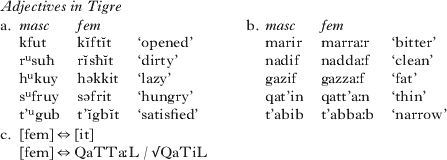
(1c) states that the exponent of [fem] is [it] unless the root (or rather, the base) has a form QaTiL, in which case the feminine is QaTTaːL, with a long [aː] and a medial geminate.
Most morphologists are happy with the statement of rules such as those in (1c), and are ready to move on to the next phenomenon. However, with respect to the goal of morphological theory, the reformulation of phenomena in terms of rules is not important. We cannot stop at the description of phenomena; we must make sure that the way the phenomena are described sheds light on their nature. In other words, linguists cannot be satisfied by asking what is going on, but should also answer why exactly that is going on. Indeed, the formulation is only the first, relatively less important part of the morphologist's task; the next step, that of explanation, is much more important, because it allows one to see the logic behind morphophonology. Such questions make it possible to define the limits of morphophonology: instead of listing the things that morphophonology can do (and wait for the next phenomenon to be added to that list), we can endow this linguistic component with a constrained shape, which can have cognitively significant results.
This is not to say that data should be ignored or that their importance should be underestimated: they should be thoroughly studied in an attempt to falsify the theory. But the discussion should not be of how to enable the theory to describe the data: it should be of what data are ruled out by the theory. Otherwise, the study is doomed to be limited only by the number of phenomena to cover, and will end up being no more than a restatement, like the rules in (1c).
As an example, let us return to gender in Tigre. As can be seen in (1), it is not just any masculine that has a feminine in QaTTaːL: only masculines of the form QaTiL do. What does this tell us? This is an important fact, but it is not expressed by the formulation in (1c), which in principle could have anything on the right of the slash symbol. Even the rule in (2), which has QaTTaːL as an allomorph of QaTiL, only states – but does not explain – the fact that the input to the templatic feminine must be itself templatic.
-
(2)

Why is this so? While I do not have an answer to this question, I think it exemplifies the sort of question that morphologists and students of exponence should ask. It is with such questions in mind that I examined the book. For each of the chapters, I asked myself the two questions in (3).
-
(3)

A word of caution is called for here. One might claim that the book under review is a sort of ‘handbook’, and therefore individual chapters are not required to have the far-reaching theoretical implications defined in (3). Rather, the claim would go, the intention is to present the theoretical discussion around the different aspects of exponence. This is a valid goal, and one which, as I have already mentioned, is accomplished in this volume. Nevertheless, in my opinion, both reference books like this one and reviews of such books also present an opportunity to take a broad perspective of the topic under discussion, tackling such fundamental questions as those in (3).
2. Chapter-by-chapter review
Chapters in the book are grouped around specific topics related to exponence. The topics selected adequately represent the various aspects of exponence. Furthermore, good editing work has interrelated most of the chapters in this book. It is interesting to see how the claims of the Chapter 2, for example, are implemented technically in the final chapter of the book, or how the two chapters on polarity complete each other. Other chapters contradict each other: most notably, the chapter on truncation and subtractive morphology concludes that these are valid morphological patterns, a conclusion that the chapters on morphophonology rule out completely.
In what follows, I present a chapter-by-chapter review of the book, although not adhering strictly to the order in which they appear.
2.1 Dividing the labour between morphology and phonology
Ricardo Bermúdez-Otero's chapter, ‘The architecture of grammar and the division of labor in exponence’, is intended to argue for a specific view on the following question: what aspects of morphophonology can be regarded as phonologically motivated? The author answers this question in the shape of the four hypotheses in (4).
-
(4)

These hypotheses are supplemented by a theory of lexical storage, which the author calls ‘a refined dual-route model of morphophonology’. In this model, the correspondence between two morphologically related forms can be expressed in one of three ways: (i) listed and arbitrary (e.g. English past tense string–strung): no rule; (ii) listed but systematic (e.g. English divine–div[ɪ]nity (but ob[iː]sity): such words are derived by lexical redundancy rules, and then listed non-analytically); (iii) completely systematic, not necessarily listed (English regular past tense): derived by simple rule, listed analytically if at all.
Employing a dense style of writing, and exhibiting a profound knowledge of the literature on this vast topic, the author shows that the hypotheses and storage model above are adequate for the coverage of a series of sample phenomena.
My first question in (3a) concerned how convincingly the chapter explains the data that it discusses. I found that this long chapter lacked focus, because of the many points made in it. In the end, the author's claims emerge as more of a principled set of opinions than a fully developed theory.
This leads me to my second question, (3b): in what way does the chapter strive to limit what morphophonology is? By adopting the four hypotheses in (4), the chapter seems to constitute a genuine, serious attempt in this direction. This set of hypotheses incorporates insights from several morphological theories – with their own advantages – and it is in this respect that the attempt is successful. However, the success is only partial: little beyond the incorporation of past ideas, such as the four hypotheses, is proposed.
Moreover, it seems to me that little proof is proposed for the validity of these hypotheses. The different analyses take one of either two forms. In one, the data under discussion are shown to be problematic, but not under the author's view: this, of course, supports the author's view only if it is more restricted than the view being criticised. For instance, the fact that the ‘refined dual-route model’ above may admit exceptions like ˈArabic (with antepenultimate instead of the expected penultimate stress) cannot be taken as evidence for its adequacy, since it is for such exceptions that the model was ‘refined’. In the second type of analysis, it is shown that the four hypotheses may be successfully applied to data that had previously been analysed in a way that contradicts these hypotheses (this is the case of the longest analysis in the chapter, a new, more fine-grained take on Saba Kirchner's 2010 analysis of ‘stem expansion’ by mora suffixation in Kwak'wala). However, one still wants to know what new insight may be achieved by the adoption of the hypotheses: this can be explored by tackling data that are problematic for the approach, but no such effort is made.
Let us examine the predictions of the hypotheses. As the author emphasises, they rule out, in principle, both non-concatenative morphology (4a) and morpheme-specific phonology (4b). In contrast, they do allow for at least three ways in which phonology and morphosyntax can interact: (i) phonological allomorph selection, (ii) alignment requirements (4b) and (iii) cyclic effects (4d).
Of all these implications, the ruling-out of non-concatenative morphology seems to me to be the most controversial. I deal with this claim in §3 of this review, because it is the main claim of the last chapter in the volume. Let me only mention here one criticism, which is also relevant in this context: it seems surprising to make such a claim without examining Semitic data such as the Tigre adjectives in (1) above. The second type of phenomena categorically ruled out is morpheme-specific phonology. Many linguists would agree with the author on this point; nevertheless, many would not, and there is a significant body of literature that should not be discarded by simply saying that it does not match the four hypotheses.
The three types of interactions between phonology and morphosyntax that are categorically ruled in are not entirely uncontroversial either. Several cases of non-optimal allomorph selection have been identified (Embick Reference Embick2010), and alignment and cyclic phonology require much more in-depth exploration of the nature of cyclic domains and alignment options than the chapter mentions. In the case of cycles, a question which arises is what determines the number of cycles in a derivation; no answer is provided in the chapter. For alignment constraints, it could be asked what entity should be allowed to be aligned with what other entity and why, and what the consequences are for a theory that allows – if only in principle – entities like ‘word’, ‘stem’, ‘affix’, ‘[+continuant]’, etc. to be aligned to syntactic constituents.
This is not to say that the chapter should have included discussion of all of these potential objections – this would surely add at least 30 more pages to its existing 75 – it only serves to claim that the four hypotheses above are more asserted than argued for. If this is the case, while the chapter is certainly valuable in discussing more than one interesting angle of the ‘division of labour’ between morphosyntax and phonology, I think it does not really address the question of how exponence is constrained by linguistic competence.
2.2 Exploring the theory: haplology and contextual allomorphy
Two chapters in this volume stand out in that they offer a novel type of theoretical self-inspection. Rather than take a phenomenon that has a name and survey the solutions that have been provided for it in the past, these chapters take the theory and explore its consequences for what the data may be, or what kind of data can be described.
The first of the two is Andrew Nevins' chapter on haplological dissimilation, i.e. cases in which one of two identical linguistic entities is altered so that it may not be identical to the other. Working in the tradition of Distributed Morphology (Halle & Marantz Reference Halle, Marantz, Hale and Keyser1993), Nevins assumes a ‘road to exponence’ from syntax to phonology and identifies four stages along this road: linearisation, prosodification, Morphological Word formation and Vocabulary Insertion. Each stage is characterised by limitations with respect to (i) syntactic features and constituents, (ii) phonology, (iii) locality and (iv) a possible repair strategy. The different stages are described in the introduction and explored in more detail and exemplified in the body of the chapter.
It seems to me that this is an innovative chapter, the first to explore and flesh out in such detail what one theory has to say about this phenomenon, which turns out to be much more multi-faceted than expected. In this sense, it is not only a reference for students wishing to study this phenomena, but also addresses my second question, regarding the limits of morphophonology.
The second chapter in this vein in Eulàlia Bonet & Daniel Harbour's chapter on contextual allomorphy. Like Nevins' chapter, the aim here is to not to argue in favour of a specific view, but to clarify what a specific view predicts. Again, in my opinion this is a positive approach if we are to construct a rigorous theory. Moreover, in the specific case of contextual allomorphy, there has been no exploration of how the simple device that is used to describe and analyse the phenomenon might delimit it – a direct answer to my second question.
First, the chapter delimits the phenomenon of contextual allomorphy by excluding data that may be accounted for through the workings of other modules (phonology, syntax) or through other principles within morphology (such as impoverishment). As a second step, the chapter adopts and explores in detail the notation of allomorphy in (5), which takes a feature set [F] and associates it to a realisation in a specific context.
-
(5)

Questions are asked as to what may appear as [F] (can roots do so?; category heads?), what may count as an environment (the __ notation), what the curly bracket stands for, how many allomorphs the dotted line may represent, and what the exact relation is which is denoted by the double-headed arrow. I found this discussion very interesting, because it makes the use of this common tool less banal, leading to a deeper understanding of the phenomenon described. Although the chapter does not claim to propose a theory of contextual allomorphy or have any clear-cut findings, it is certainly a milestone in the study of this phenomenon.
2.3 The limits of polarity
The volume has two chapters on the concept of polarity. In a discussion of polarity, we have to distinguish between surface polarity and conceptual polarity. Surface polarity is most straightforwardly defined as in (6).
-
(6)

This situation is found in many languages. However, the question is whether speakers conceptualise what they learn as being polar. For this to hold, it must be proved that the speakers internalise a rule that says ‘if X is [a], then Y must be [b]; and if X is [b], then Y must be [a]’. If, in one of those languages that show polarity, there are items that have [c] as the exponent of Y, then the rule does not work, and the phenomenon does not count as conceptual polarity.
The first chapter on polarity, by Paul de Lacy, examines cases of morphophonological polarity, i.e. where the implication from [a] to [b] can be treated as a (morphologically conditioned) phonological process. The chapter examines in depth one possible example of such a pattern, Dholuo pluralisation, and using the logic above shows that it does not qualify as polarity. Morphological polarity, it is claimed, is a different matter.
This different matter is considered in the second article on polarity, by Dieter Wunderlich. The many examples examined in this article all have in common that they exhibit surface polarity that cannot be viewed as a morphophonological process. Possible surface polarities are examined from a formal point of view, and it is shown that many of them do not qualify as polar systems, and should more accurately be described as displaying ‘diagonal syncretism’ or ‘reversal’. Accounts are given of such systems, using the somewhat problematic constraint Contrast (which demands that two morphologically distinct forms not be identical) and the equally intriguing feature [exceptional], which, depending on the noun, is associated to one inflectional value or its inverse. Especially interesting is the analysis of Old French: in this language, the only marker available is -s, and the logic of its appearance is derived by a set of contrast constraints.
Both chapters conclude that polarity is an epiphenomenon. Wunderlich asserts that it is ‘too complex a concept to be used as a basic principle’ (p. 194), whereas de Lacy shows how, if for some reason morphophonological polarity would emerge, it would not be possible to maintain it for long. These interesting and convincingly portrayed findings aside, how can we rule out polarity in principle? How does the theory prevent it from being possible? I do not know what form the answer to this question could take, but did not find a clearly stated answer in these chapters.
2.4 Syncretism, truncation, reduplication and iconicity
The chapters on these topics are good, comprehensive overviews. They each provide solid starting points for more in-depth case studies, and discuss various aspects of the topic in question.
Adam Albright & Eric Fuß's chapter on syncretism discusses the parameters according to which we can distinguish between meaningful syncretism, which must be captured by rule, and accidental syncretism, which should not, because it does not constitute an essential structural property of the language. The chapter reviews the different types of treatments that have been applied to syncretic phenomena, from underspecification through impoverishment and rules of referral to the phonologically motivated syncretism of McCarthy's (Reference McCarthy, Downing, Hall and Raffelsiefen2005) ‘optimal paradigms’. The advantages and disadvantages of each treatment are examined, mainly through case studies from German. Other topics approached are the factors that trigger syncretism and the evolution of syncretism.
In the next chapter, Birgit Alber & Sabine Arndt-Lappe provide an overview of the phenomenon of truncation. Whether templatic or subtractive, truncation is often deemed unpredictable or unsystematic, and thus excluded from ‘grammar’ and not regarded as a morphophonological operation. Alber & Arndt-Lappe argue against this view, showing that regularities can be observed once we accept that not all truncated forms in a particular language adhere to the same logic. In addition to a discussion of the various views on truncation and a typology of truncation strategies, the authors also devote a section to the form and meaning of truncation. The reader will also find several tools used within Optimality Theory to account for truncation, e.g. Anchor, Coincide and several subtypes of output–output constraints. The chapter is thus another useful overview of past treatments of truncation. Insofar as the exclusionary view had previously convinced those wishing to study the phenomenon, the chapter is a step forward in its research.
The chapter on reduplication by Sharon Inkelas likewise provides an overview of the many types of base–reduplicant relations and the accounts that have been proposed for them. As the author shows, reduplication is a fertile ground for morphological and morphophonological advances, and has often been used to provide evidence for different morphological points. Although the chapter does not provide new insights into the topic (which has been widely studied), it nevertheless constitutes a good summary and point of departure for students of this cross-linguistically common phenomenon.
The chapter on iconicity by Laura J. Downing & Barbara Stiebels is another useful overview, written with noteworthy objectivity. It discusses several different types of cases where some formal aspect of the item reflects some aspect of its function or meaning. The phenomenon of iconicity has received much less attention than the other phenomena discussed in the volume, even though iconicity itself, as the chapter shows, is ubiquitous in language: it appears in morphological complexity, in the phenomenon of isomorphism, in linearisation patterns and in the varying degree of cohesion between parts of constructions. The chapter illustrates these instances of iconicity, thus raising open questions for future studies to answer.
I have grouped these four chapters in the same subsection because I feel that the two guiding questions in (3) are irrelevant for their evaluation: the chapters are not intended to shed new light on the phenomena under discussion, but rather to describe the theoretical issues that arise in the discussion of these phenomena and provide a state-of-the-art account. My second question in (3), regarding the shape and limitations that the architecture of the theory must attribute to linguistic knowledge in this respect, remains unaddressed with respect to these four topics.
2.5 Ø-exponence and zero morphemes
The chapter on Ø-exponence is by the editor of the volume, Jochen Trommer. It is especially interesting, because its topic represents one case where ‘morphology’ and ‘exponence’ could (in principle) be regarded as not being the same: whereas a ‘zero’ morpheme is distinct from nothing, Ø-exponence is the relation between any abstract morphological information and lack of overt realisation, where one would or could expect such a realisation. Ø-exponence includes, for example, the non-realisation of the head n in the structure for the word cat: [[n √cat]nˈ]nP; but there is – at least according to one view – no zero morpheme involved.
Once Ø-exponence is defined in these terms, it is immediately apparent that this type of exponence is everywhere, in any morphological analysis. From this premise, the author sets out to list all the types of Ø-exponence that are attested and all the theoretical devices that are used to describe (or generate) them in the different morphological frameworks. In Distributed Morphology, for example, fusion, impoverishment and reanalysis are such devices. In A-morphous Morphology (Anderson Reference Anderson1992), spell-out rules that do not modify their input result in Ø-exponence.
The survey of Ø-exponence ingeniously includes phonological research. Trommer treats the sound [t] as partially Ø-exponential, because on a spectrogram it is indistinguishable from silence. Analyses are mentioned in which linguists have proposed several phonological entities – e.g. vowels, moras and skeletal positions – that are never realised. Towards the end of the chapter, cases where verbs with no realisation have been proposed are mentioned.
The second part of the chapter is called ‘Restrictions on Ø-morphology’. The restrictions mentioned are principled rejections of some of the types of Ø-exponence mentioned above. For example, Trommer reports that in a previous paper (Trommer Reference Trommer2003), he had eliminated impoverishment, fusion and readjustment rules from the framework of Distributed Optimality, because these ‘can be emulated’ by other assumptions.
This chapter stands out in this collection because it is both a survey and a very original, thought-provoking contribution, even though it lacks any empirical content. One important question that remains unanswered, for example, is the following: are all the cases of Ø-exponence to be treated as different facets of the same phenomenon, as was the case with truncation and haplology? One might think that the spirit of the chapter is closer to the chapter by Bonet & Harbour, where the theoretical device and its implications were explored. But here again, Trommer's chapter is not quite like that, because it does not explore a specific device, but rather lists many devices that may be equated because they have similar effects. Even the part of the chapter that discusses the restrictions on Ø-exponence, which could in principle answer question (3b), does not really do so: rather than show how different restrictions follow from the architecture of this or that approach, it lists the views of several researchers on the issue, all roughly based on economy. So, although the chapter certainly stands out with respect to both interest and originality, both my questions are left unanswered for Ø-exponence in general, and for this chapter in particular.
3 Non-concatenativity as an epiphenomenon
The last chapter in this volume, by Patrik Bye & Peter Svenonius, deals with the thorny issue of non-concatenative morphology. Its main claim is that all non-concatenative phenomena can be accounted for in a concatenative model. Non-concatenativity can thus be viewed as an epiphenomenon, i.e. a phenomenon that only seems to be true, but is actually not a phenomenon at all.
The chapter contains new, concrete theoretical proposals on how to deal with seemingly non-concatenative phenomena in a strictly concatenative manner. Use is made of constraints such as Uniformity (banning coalescence, i.e. the expression of a morpheme as the mutation of an edge segment), Linearity (roughly demanding that morphemes should appear on one edge of the stem), Contiguity (which assures the internal contiguity of a base), Integrity (no splitting of IO correspondences; this constraint has a sub-type Initial Integrity, banning the same in only the initial part of the input–output relation) and LocalCopy (militating in favour of local copies of segments). All of these constraints are gradient, and can be specified for edges of ‘words’, ‘phonological phrase’ and ‘stem’. Motivation is not always provided for each constraint (beyond its successful participation in the analysis); however, most of the proposed constraints seem to be arguably intuitive notions. In the context of the volume as a whole, this chapter thus stands out as the only chapter that explicitly contains novel proposals, and should be commended for this.
Having said that, it is my opinion that the chapter does not make a convincing case for any of its arguments. There are four reasons for this, which I now elaborate upon.
(i) The treatment of data: This treatment is (as the authors admit, and as we shall see presently) not as careful as it could be. The phenomena are assembled from the literature in small bundles, and the rest of the language under consideration is completely ignored. For this reason, the specific analyses can only be treated as non-rigorous snippets, because it is unclear whether they work for the language in its entirety. A general objection to such criticism is that one should be able to take it on faith that the authors have checked the validity of their claims beyond the specific set of data. In the present case, it is quite clear that they mostly haven't, as they themselves admit with relation to one specific case, namely morphological voicing in Aka, which is worth considering here. Like many of the data in the chapter, the Aka data are taken from Akinlabi (Reference Akinlabi1996), itself a survey, which cites unpublished field notes by another author. As the authors of the present chapter observe in a footnote, a reviewer commented to them that an expert on Aka is of the opinion that the phenomenon is not productive and has to be listed for every item. Nevertheless, the authors – who are not experts on the language – explicitly claim in the introduction that the chapter is limited to productive phenomena. The reader has to assess whether equal caution was taken in the examination, verification and falsification attempts of the other phenomena and analyses in the chapter.
(ii) The examination of predictions: Another facet of the same criticism is that the authors rarely engage in examining the predictions of their proposed analyses, either within the language or for the theory. Especially in OT, in which almost any phenomenon can be formalised, the formalisations have to be checked with respect to the predictions which they make. In other words, the fact that some constraint ranking was deliberately arranged so that it may result in one candidate being optimal cannot be regarded as an important result; it is its predictions for other phenomena in the language and for language in general that must be the focus of the discussion. This effort is not undertaken in this chapter, and thus the outcome, rather than arguing for the correctness of the author's view, can be regarded as an indication of the unconstrained nature of the theory as it is sometimes practised nowadays. In other words, question (3a) is answered poorly; (3b) is not even considered.Footnote 2
(iii) The definition of ‘non-concatenative’: The authors define non-concatenativity negatively, as ‘anything that falls short of the concatenative ideal’ (p. 429). The concatenative ideal says that morphemes do not overlap (no floating-and-docking morphemes, no infixes), do not affect the form of their bases (no templates, no mutation, no mora/foot-suffixation), are not discontinuous (cannot be disjoint) and are additive (cannot cause subtraction). If any of the phenomena mentioned occur, it is considered to be a case of non-concatenativity. The authors also classify as non-concatenative cases that I will call ‘crazy exponents’, i.e. exponents that do not appear at the edge that they are expected to appear at for some reason (usually syntactic).
Most of the phenomena above can be described as essentially concatenative, because – crucially – they start out either on one side of the base or the other. This is certainly the case for most infixes and floating features, and must be the case for familiar problems such as edge mutation and subtraction (not just any consonant is mutated or subtracted – edge consonants are). Mora suffixation is, of course, suffixation. Disjoint morphemes, which are problematic for a theory that linearises morphemes provided by the syntax, nevertheless appear on both sides of the base, and could be prespecified as doing so, so there is no real violation of concatenativity.Footnote 3 If such prespecification is an analytic option, then the same is true for ‘crazy exponents’: they might be specified to appear in unexpected positions. It thus seems that most of the phenomena discussed are non-concatenative only if one adheres to ‘the concatenative ideal’ (no evidence is provided to show that the human cognitive system has to adhere so strictly to that ideal). In actual fact, any account of the phenomena listed in this paragraph that does not mention a linear direction for concatenation (right or left edge) will run into serious trouble.
Thus most of the phenomena discussed in the chapter are demonstrably linear, in that they can be shown to designate an edge of the base that they are added to. What then is a real non-concatenative phenomenon? Consider the definition in (7).
-
(7)

Where can such a phenomenon be found?
(iv) Semitic languages: Consider the non-native Modern Hebrew noun [katalog] ‘catalogue’ and the verb [kitleg] ‘to catalogue, classify’. Because this is a loanword, the direction of derivation N→V is clear. A straightforward account of such derivations is found in Bat El (1994, 2003) and related work: the set of floating vowels <i, e> is added to the base and the rest of the work is done by phonology. This work, the argument goes, will first consist in overwriting the vowels of the base.
The linearity of the procedure is not trivial. Because the base is trisyllabic, if <i, e> were to be implemented from either side, only the first two vowels from that side will be erased, and the wrong result will be yielded (8a, b). If, instead, the floating vocalisation is formalised as a sort of floating circumfix, it is the middle vowel that will be incorrectly predicted to persist (8c).
-
(8)

In Bat-El (Reference Bat-El1994), where this case is discussed, the circumfix status in (8c) is achieved by asserting that the mapping is done ‘edge-in’. In modern optimality terms, the same could be achieved by alignment constraints, demanding that the syllables headed by the melodic elements <i, e> be aligned with the edges of the base (9a). The residue, i.e. the middle vowel in kit a leg, is erased under stray erasure, whereby whatever is not syllabified with the melodic elements is erased (9b). In Bat-El (Reference Bat-El2003), this is achieved by constraints on size that rule out trisyllabic items, which can be summarised as Word=Foot. However, these constraints should be restricted to verbs, because both native and non native nouns are very often trisyllabic.
-
(9)
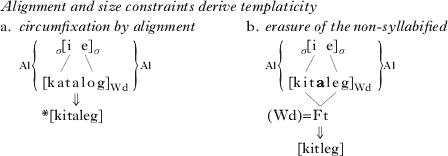
Is this phenomenon non-concatenative? Whatever edge the analysis in (9) begins from, the alignment and size constraints will derive the same output. However, we cannot conclude from this that the derivation is concatenative, because the constraints were formalised to make it concatenative in the first place. A better definition of non-concatenativity is given in (10).
-
(10)

If this definition is adopted, then we have shown that non-concatenativity is not an epiphenomenon: it is alive and kicking in the Semitic languages, which are notorious (or popular) for their non-concatenative morphology. The chapter under discussion claims that non-concatenativity is an epiphenomenon without discussing any Semitic language in this respect.Footnote 4 It is surprising that a chapter with this title does not contain such a discussion.Footnote 5
To summarise, the chapter by Bye & Svenonius illustrates several novel strategies in dealing with problem of morpheme alignment. These strategies are not always argued for, and their predictions are not properly explored, but they nevertheless constitute valid proposals. That said, the chapter is far from proving that non-concatenativity is an epiphenomenon, as its title suggests, because the phenomena it deals with are largely concatenative.
4 Conclusion
Most of the chapters in The morphology and phonology of exponence are useful surveys of the different aspects of exponence. Two chapters, on haplology and on the formalisation of contextual morphology, venture beyond survey status, and explore the consequence that the theory must have for the data. As we have seen, two others propose new analyses; while both offer reasonable accounts of how the data may be treated, neither seems to constitute real progress in the understanding of the relevant aspects of exponence, either in rigour or in argumentation. Most importantly, neither of the two engages with the data that would be most problematic for either: non-concatenative morphology.
This book's strong point is that it will serve those studying the various aspects of exponence as a starting point in their linguistic explorations. The individual surveys show that such students have much to explore in terms of the limitations and form of exponence and the constraints which govern it.


