Introduction
Urban processes have been influencing the distribution of mosquito species (Culicidae), affecting the composition of their communities and the emergence or re-emergence of infectious diseases (Morse Reference Morse1995; Abella-Medrano et al. Reference Abella-Medrano, Ibáñez-Bernal, MacGregor-Fors and Santiago-Alarcon2015). A notable effect of anthropogenic disturbance is the transformation of natural water bodies into urban runoff channels, open sewage canals, or drinking water ponds for livestock (Environmental Protection Agency 1993). Anthropogenic alterations can create new breeding habitats (for some species), leading to ecosystem distortion and loss of endemic biodiversity (Balvanera et al. Reference Balvanera, Siddique, Dee, Paquette, Isbell and Gonzalez2014). The presence of successful invasive species can cause the loss of endemic species and the presence of vector-borne diseases (in addition to endemic dengue, Zika, and Chikungunya diseases).
Endemic mosquito larvae play a significant role in ecosystem processes, such as regulating the populations and spatial distributions of other species (Adler and Courtney Reference Adler and Courtney2019). The potential impact of ongoing urbanisation on mosquito larvae habitats and diversity is unknown. At many periurban interfaces, larval breeding sites are now mixtures of natural, modified, and artificial water bodies; therefore, biodiversity conservation will also play a crucial role in improving mosquito management.
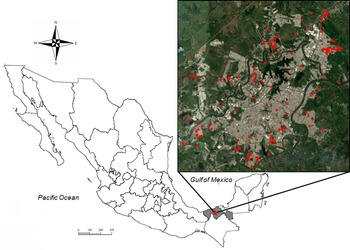
Mexico has been experiencing rapid legal and illegal urbanisation, resulting in the loss of about 1.1% per year of its lowland tropical forest area and associated water bodies (Food and Agriculture Organisation of the United Nations 2015), while the remaining water bodies in close proximity to urban areas have been severely disturbed. However, studies of larval diversity and measures of ecological, chemical, and physical attributes in these disturbed breeding sites are limited. In this study, larvae were collected to analyse the number of species present in the habitats of the urban and periurban interface area of the city of Villahermosa, Tabasco, southeastern Mexico, the state’s capital and most populous municipality, which is located in the region’s centre (Fig. 1). The eco-physicochemical features of each collection site were also measured to assess the relationship between larval species and habitats.
Map of the collecting sites in Villahermosa, Tabasco, Mexico.

Over recent decades, the city has experienced significant landscape modification, loss of forest cover, and sediment transport due to increased watershed erosion (Perevochtchikova and Lezama de la Torre Reference Perevochtchikova and Lezema de la Torre2010). These factors have caused constant flooding near rivers (Areu-Rangel et al. Reference Areu-Rangel, Cea, Bonasia and Espinosa-Echavarria2019). It is important to consider how urbanisation and pollution might affect the physicochemical parameters of water bodies, affecting their associated fauna and ecological processes. Tabasco has the second-highest mosquito richness of all Mexican states (105 species; Rodríguez-Martínez et al. Reference Rodríguez-Martínez, Yzquierdo-Gómez, González-Acosta and Correa-Morales2020). In its central region, where Villahermosa is located, adults of 15 species belonging to seven genera (Aedeomyia, Aedes, Anopheles, Coquillettidia, Culex, Mansonia, and Uranotaenia) have been reported in home environments (Torres-Chable et al. Reference Torres-Chable, Baak-Baak, Cigarroa-Toledo, Zaragoza, Arjona-Jiménez and Moreno-Perez2017); however, little is known about the diversity of species occurrence in aquatic habitats that are in or close to urban areas. Our study serves as a starting point for ongoing research to track changes in the species composition in the city’s water bodies and contribute to determining the risk of vector-borne diseases transmission beyond dengue.
Methods
Study area
The study was conducted from July to September 2019 (rainy season) in the City of Villahermosa (17° 59′ 16″ N, 92° 55′ 09″ W; Fig. 1). The city is 10 m above sea level, between the Carrizal and De La Sierra Rivers, within the hydrological region of the Grijalva–Usumacinta river basin. A tropical monsoon and a trade-wind littoral climate dominate the area. The mean annual temperature is 27.1 °C, with a range of 28.2 °C in summer to 26.3 °C in winter (Instituto Nacional de Estadística y Geografía 2017). Villahermosa has a high prevalence of Aedes (Stegomyia) aegypti mosquitoes Linnaeus, 1762 and dengue fever. New and recurrent cases of dengue have been observed in flooded areas of Villahermosa (Jiménez-Sastré et al. Reference Jiménez-Sastré, Boldo-León, Priego-Álvarez, Quevedo-Tejero and Zavala-González2012).
Larval collection
Larval habitats were sampled using a standard dipper (350-mL capacity) according to World Health Organisation (2013) procedures. A total of 30–100 dips were taken at intervals along the edge, depending on the size of each water body. The collected larvae for each breeding site were placed separately in plastic containers, labelled, and transported to the laboratory. Larvae were counted, and third- and fourth-instar larvae were identified to species using a stereomicroscope. Due to lack of human resources, a random subset of the larvae from each collection site was identified using published taxonomic morphological identification keys (Ibañez-Bernal and Martínez-Campo Reference Ibañez-Bernal and Martínez-Campos1994). The collected material was deposited at the Bioassays and Entomological Research Unit (Unidad de Bioensayos e Investigación Entomológica) in Tabasco, México.
Eco-physicochemical analysis
Water body surface area was calculated in square metres. A water chemistry meter (HI–98130, Hanna Instruments, Woonsocket, Rhode Island, United States of America) was used to measure pH, temperature, electrical conductivity, and total dissolved solids. The sum of predator occurrence (0 = none, 1 = birds, 2 = amphibians, 3 = fishes, 4 = crustaceans, and 5 = predatory insect) and shade (none = 0, low = 1, medium = 2, high = 3), water turbidity (turbid/clear), water flow (none/low/moderate/fast), and permanence of the habitat (permanent/temporary) were considered as ordinal variables. Permanency was determined based on water body size and previous experience. Habitats were georeferenced with a handheld GPS.
Breeding sites analysis
A Kruskal–Wallis nonparametric test was performed to determine differences in continuous/ordinal eco-physicochemical parameters (area, pH, electrical conductivity, total dissolved solids, predators, shade, number of larvae collected, and larvae density) among breeding habitats. Larval densities (regardless of species) were calculated as mean number of larvae per dip. A chi-square analysis was conducted to determine whether proportions of qualitative parameters (turbidity, flow, and permanence) differed among type of habitats. Pearson correlations were used to assess the association among parameters (pH, temperature, electrical conductivity, total dissolved solids, area, predators, shade) and total larvae and density. Data were analysed using Statistica, version 13.0 (TIBCO Software Inc., Palo Alto, California, United States of America; https://www.tibco.com/), and JMP, version 6.0 (SAS Institute Inc., Cary, North Carolina, United States of America; https://www.jmp.com). Values were considered significantly different if P ≤ 0.05.
Species analysis
Species frequency was determined as the number of species sites divided by the number of all sampling sites where a species was observed, expressed as a percentage. Species density was calculated as the number of specimens of each mosquito species collected divided by the total number of all specimens collected, expressed as a percentage. The density classes were satellite species (SD < 1%), subdominant species, (1 < SD < 5%), and dominant species (SD > 5%; Bashar et al. Reference Bashar, Rahman, Nodi and Howlader2016). We used a chi-square analysis to determine if the proportions of species among habitat types differed significantly. Data were analysed using JMP, version 6.0 (SAS Institute Inc.). Values were considered significantly different if P ≤ 0.05.
Multivariate analysis of species
A redundancy discriminant analysis with forward selection was used to examine the relationship between the mosquitoes and eco-physicochemical parameters. We first performed an indirect gradient analysis to carry out the detrended correspondence analysis. The axis lengths of the detrended correspondence analysis were less than 3; therefore, the redundancy discriminant analysis was more suitable with a short gradient. The statistical significance of eigenvalues and species–environment correlations generated by the redundancy discriminant analysis were tested by Monte Carlo permutations tests (1000 permutations). The analysis was performed with the Canoco, version 4.5, software package (http://www.canoco5.com); graphics were generated in CanoDraw for Windows, version 4.1 (Ter Braak and Smilauer Reference Ter Braak and Smilauer2002).
Results
Breeding sites
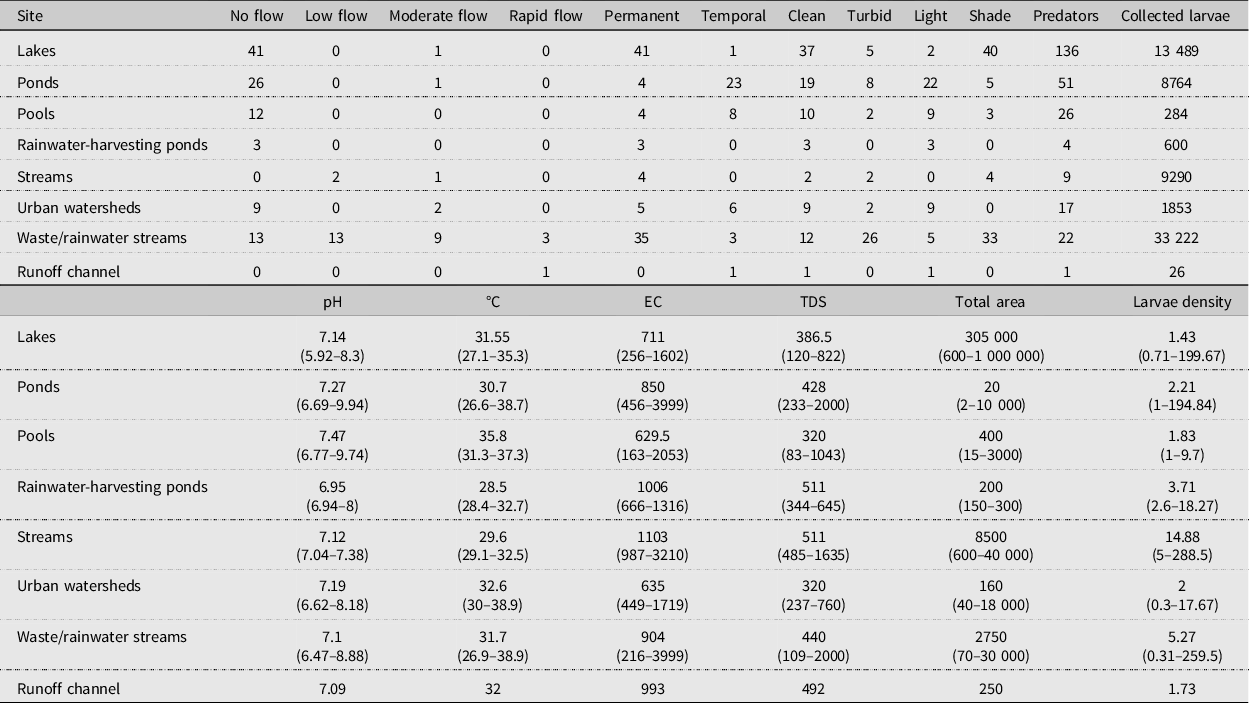
A total of 138 water bodies were surveyed: lakes (N = 42), waste/rain streams (N = 38), ponds (N = 27), pools (N = 12), urban watersheds (N = 11), streams (N = 4), rainwater-harvesting ponds (N = 3), and a water runoff channel (N = 1). Most of the eco-physiochemical parameters differed significantly among sites. Lakes and streams had the largest surface areas (comparison among type of water bodies: H = 94.9, P < 0.001; Table 1). Lakes, pools, pond, and urban watersheds showed the highest number of no-flow sites, whereas streams and waste/rainwater streams exhibited fast and moderate water flow (comparison among type of breeding sites: χ 2 = 102.7, P < 0.001). Compared to other sites, ponds, pools, and urban watersheds were mainly temporary (χ 2 = 78.8, P < 0.001). The runoff channel and waste/rainwater streams showed the higher number of sites with turbid water (comparison among type of breeding sites: χ 2 = 35.4, P < 0.001; Table 1). Compared to other habitats, lakes, ponds, and waste/rain water streams showed the highest number of predators (comparison among type of breeding sites: H = 21.7, P = 0.0029). Pools and urban watersheds had the higher temperatures (comparison among type of breeding sites: H = 20.95, P = 0.003), whereas rainwater-harvesting ponds and streams had the highest electric conductivity (comparison among type of breeding sites: H = 17.24, P = 0.01). The waste/rainwater streams and water runoff channel contained the highest total dissolved solids; nonetheless, no differences were detected (comparison among type of breeding sites: H = 13.14, P = 0.06; Table 1). Urban watersheds, ponds, and pools showed the highest number of unshaded sites; waste/rainwater streams and lakes showed the highest number of sites with medium and large shaded areas (comparison among type of breeding sites: H = 56.22, P < 0.001). Lakes, waste/rainwater streams, and streams showed the higher number of larvae, but no differences among breeding sites were detected (H = 12.06, P = 0.09). Among sites, no significant differences for pH (H = 9.49, P = 0.21) or larva density (H = 9.68, P = 0.20; Table 1; Supplementary material, Fig. S1) were detected.
Eco-physicochemical variables of each type of water body in Villahermosa, Tabasco, Mexico. For pH, °C, electric conductivity (EC), total dissolved solids (TDS), and total area (m2), the median and mínimum–maximum values (in parenthesis) were used.

Habitat parameters and larvae densities correlations
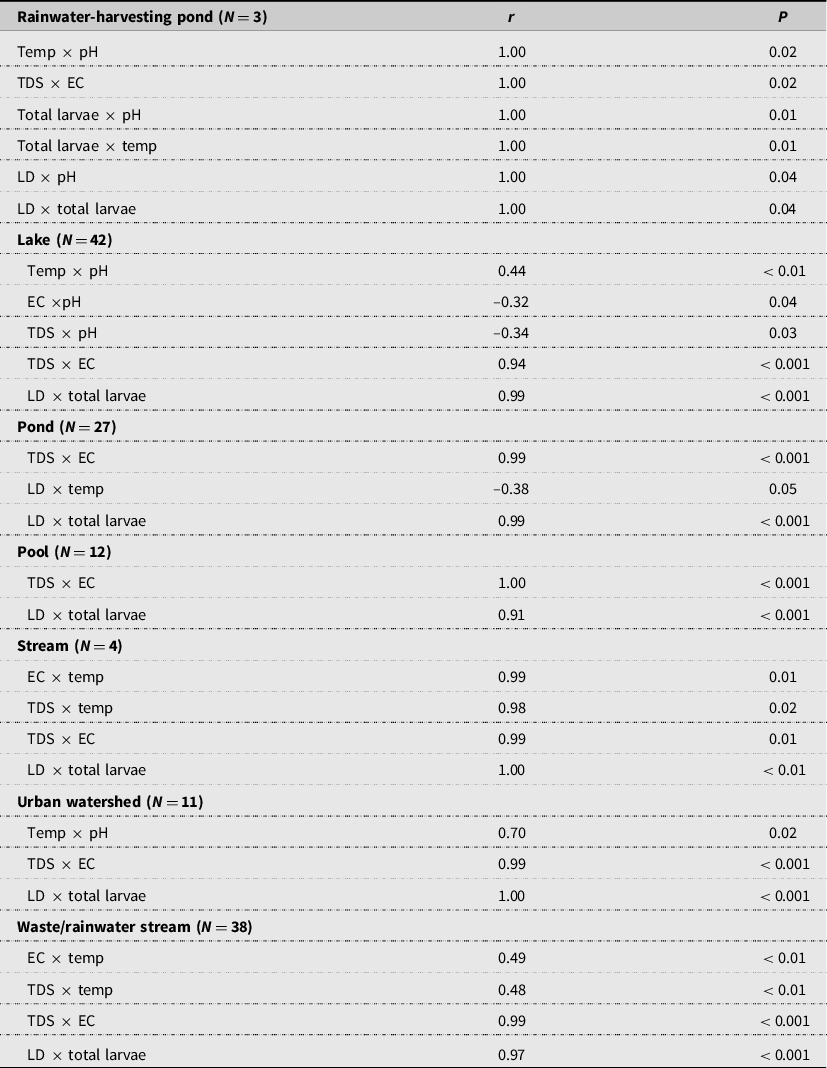
For each type of habitat, the analyses demonstrate the existence of positive correlations, suggesting that some of the variables examined were dependent. Total dissolved solids, temperature, electric conductivity, pH, larvae density, and collected larvae were the only parameters that presented significant correlations among themselves, always showing positive coefficients. The parameter “total dissolved solids” showed the most correlations. However, the number of correlations varied among type of breeding sites (Table 2). Pools, ponds, and urban watersheds had the lowest number of correlations, whereas rainwater-harvesting ponds and lakes showed the highest number of significant correlations.
Correlation coefficients among eco-physicochemical parameters, density and total larvae in eight types of water bodies in Villahermosa, Tabasco, Mexico. Only significant correlations are shown. Temp, temperature; TDS, total dissolved solids; EC, electric conductivity; total larvae, total collected larvae; LD, larvae density.

Larvae species
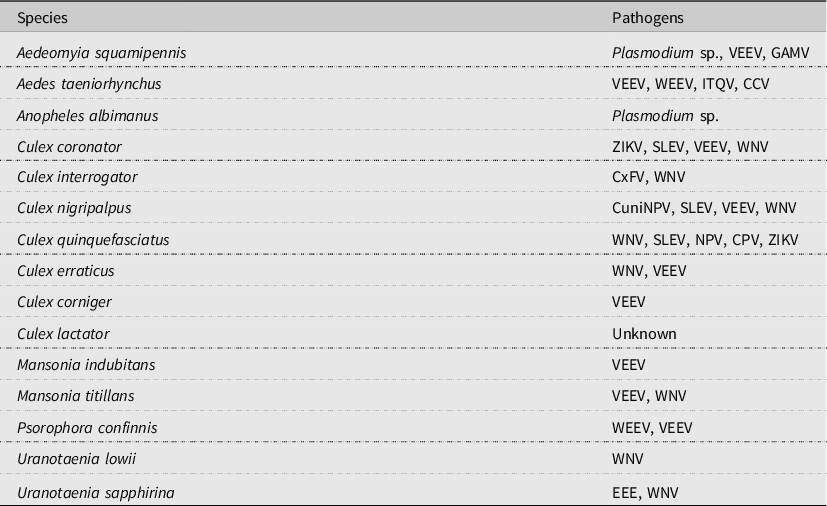
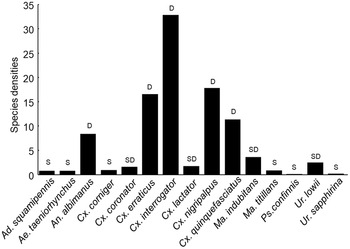
A total of 67 528 mosquito larvae were collected (1366 larvae were identified to species level), and 15 species from 7 genera were detected. The dominant species were Culex (Culex) interrogator Dyar and Knab, 1906 (density: 32.8%), Cx. (Cx.) nigripalpus Theobald, 1901 (17.79%), Cx. (Melanoconion) erraticus Dyar and Knab, 1906 (16.54%), Cx. (Cx.) quinquefasciatus Say, 1826 (11.35%), and Anopheles (Nyssorhynchus) albimanus Wiedemann, 1820 (8.35%). The subdominant species were Mansonia (Mansonia) indubitans Dyar and Shannon, 1925 (3.59%), Uranotaenia (Uranotaenia) lowii Theobald, 1901 (2.49%), Cx. (Phenacomyia) lactator Dyar and Knab, 1906 (1.76%), and Cx. (Cx.) coronator Dyar and Knab, 1906 (1.61%). Culex (Phe.) corniger Theobald, 1903 (0.95%), Ma. (Ma.) titillans Walker, 1848 (0.88%), Aedeomyia (Aedeomyia.) squamipennis Lynch-Arribalzaga, 1878 (0.81%), Aedes (Ochlerotatus) taeniorhynchus Wiedemann, 1821 (0.81%), Ur. (Ur.) sapphirina Osten-Sacken, 1868 (0.22%), and Psorophora (Crabhamia) confinnis Lynch-Arribalzaga, 1891 (0.07%) were satellite species. Fourteen of the species collected have been identified as possible carriers of parasitic and viral infections (Table 3).
Mosquito species collected in water bodies in Villahermosa City and associated pathogens of human medical importance.

CPV, Cytoplasmic polyhedrosis virus; CuniNPV, Cx. nigripalpus nucleopolyhedrovirus; CVV, Cache Valley virus; CxFV, Culex flavivirus; GAMV, Gamboa virus; ITQV, Itaqui virus; NPV, nucleopolyhedrovirus; SLEV, Saint Louis encephalitis virus; VEEV, Venezuelan equine encephalitis virus; WEEV, western equine encephalomyelitis virus; WNV, West Nile virus; ZIKV, Zika virus.
Species composition at each habitat
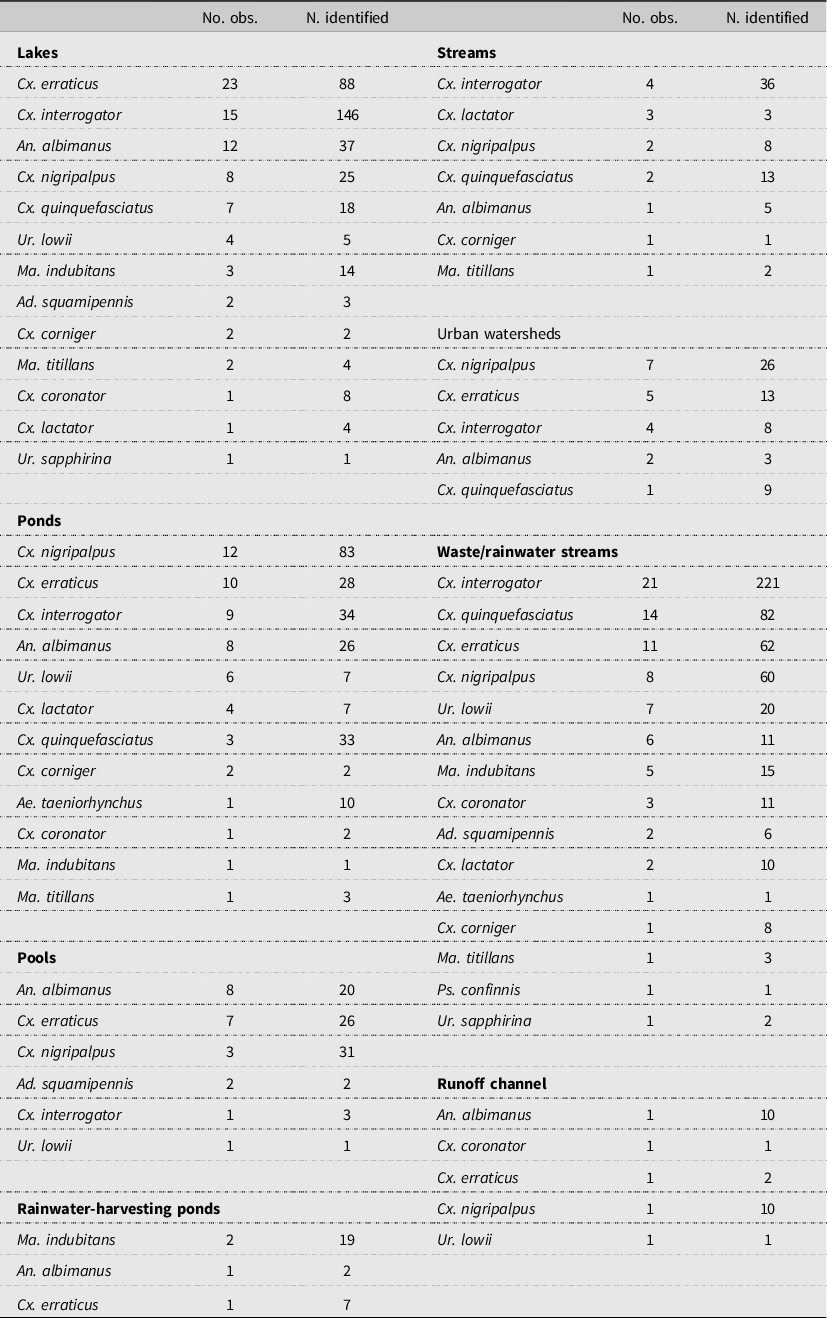
Differences in species composition among habitats were detected (χ 2 = 130.75, P = 0.015; Table 4). Although lakes presented the largest areas, waste/rainwater streams showed the highest number of species. Waste/rainwater streams were the only habitat type containing all 15 species, followed by lakes and ponds, with 13 and 12 species, respectively. The rainwater-harvesting ponds, urban watersheds, and runoff channel showed the lowest number of species (three, five, and five species, respectively). Although An. albimanus was not the most collected species, it was the only species present in all breeding site types. Culex erraticus showed the highest number of individuals (Table 4) and was collected in all types of water bodies except streams. Culex nigripalpus was found in all breeding site types except rainwater-harvesting ponds. Culex interrogator was found in all types of breeding sites except rainwater-harvesting ponds and the runoff channel. Meanwhile, Ur. sapphirina was collected only from lakes and waste/rain streams, and Ae. taeniorhynchus was collected in ponds and waste/rainwater streams. Psorophora confinnis was the least common species collected; it was collected only from waste/rainwater streams (Supplementary materials, Table S1; Fig. 2).
Species distribution in each water body. The number of observations (No. obs.) of each species per site and the number of larvae identified (N. identified) per species at each site are shown.

Species densities. Classified as: satellite species (S < 1%), subdominant species (1 < SD < 5%), and dominant species (D > 5%).

Multivariate analysis of species and habitat variables
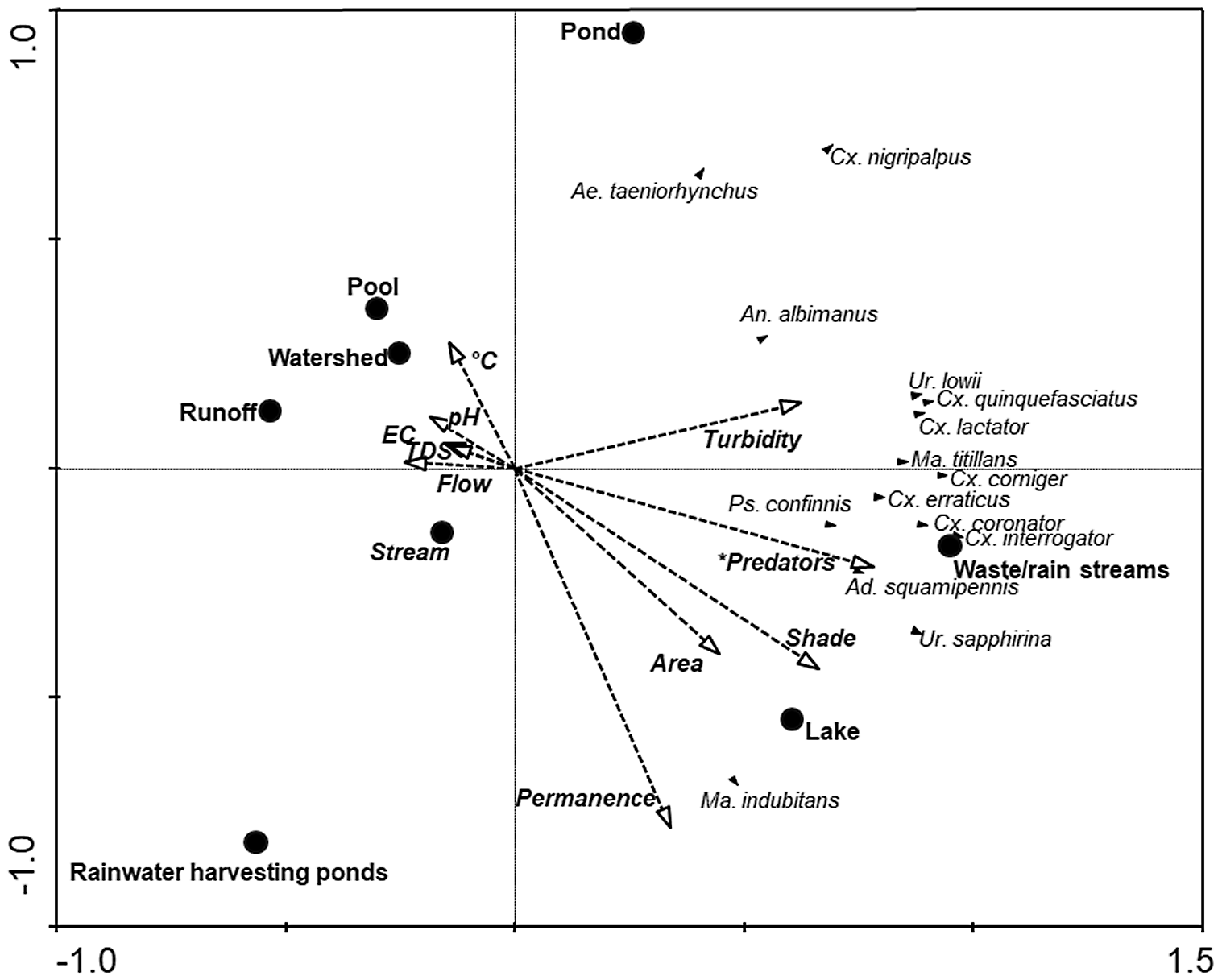
A redundancy discriminant analysis triplot of larval habitats, mosquito species, and eco-physicochemical parameters showed that the first-, second-, third-, and fourth-axis eigenvalues were 0.749, 0.104, 0.086, and 0.031, respectively. However, the Monte Carlo permutations test indicated that none of the canonical axes were significant (P > 0.05). Presence of species was associated with turbidity, predators, shade, and area (Fig. 3). Mansonia indubitans was more likely to be affected by the permanency of water bodies. Interestingly, a low effect of parameters such as total dissolved solids, pH, temperature, electric conductivity, and water flow on the presence of species was observed. The forward redundancy discriminant analysis showed that predators was the only significant variable (Monte Carlo test checking: P = 0.007; Fig. 3). The pools, watersheds, runoff channel, and streams could be characterised by temperature, pH, electrical conductivity, total dissolved solids, and water flow, whereas rain harvesting pond did not appear to be significantly affected by any eco-physicochemical parameter (showing the lowest number of species).
Ordination plot of mosquito larvae and breeding site parameters (environmental, physicochemical, and ecological) based on redundancy analysis. Breeding sites variables are represented by circles. Triangles indicate larva species (with abbreviated names).

Discussion
Our results indicated that ponds, rainwater collection ponds, runoff channels, and watersheds appear to be unsuitable breeding sites for sustaining large numbers of larvae. In contrast, water bodies such as lakes, waste/rainwater streams, and ponds were the most common and important breeding habitats for maintaining mosquito species diversity and abundance. Their large size, number of shaded areas, water cleanness, and water flow may favour the presence of several species and the maintenance of ecological processes. For example, the number of predators has an effect on community structure, controlling the relative proportions of prey species at each site (Peckarsky et al. Reference Peckarsky, Cowan, Penton and Anderson1993; Culler and Lamp Reference Culler and Lamp2009; Collins et al. Reference Collins, Bonds, Quinlan and Mumford2019). However, chemical pollution, habitat reduction, and other anthropogenic disturbances could create unfavourable environments for predators (Sergio et al. Reference Sergio, Caro, Brown, Clucas, Hunter and Ketchum2008; Ortega-Morales et al. Reference Ortega-Morales, Méndez-López, Garza-Hernández, González-Álvarez, Ruiz-Arrondo and Huerta-Jiménez2019).
A large variation of each eco-physicochemical parameter within water bodies was observed. Interestingly, total dissolved solids, temperature, electrical conductivity, pH, and larvae density were often associated with each other and occasionally with the number of larvae and other parameters (flow, predators, permanency, cleanness). Due to anthropogenic factors such as inadequate drainage planning, changes in land use and constant flooding have been reported (Areu-Rangel et al. Reference Areu-Rangel, Cea, Bonasia and Espinosa-Echavarria2019). It could be expected that chemical parameters would change continuously, resulting in the observed variability; therefore, the association of eco-physicochemical parameters and larval number may also change. All sites surveyed are located in or near disturbed areas, where changes in water quality due to organic and nutrient pollution can affect the replacement of native mosquito species or their adaptation to polluted breeding habitats (Huzortey et al. Reference Huzortey, Kudom, Mensah, Sefa-Ntiri, Anderson and Akyea2022).
The most dominant and common genera in all breeding sites was Culex. Some Culex species have been recognised as adaptable—capable of developing within a variety of habitat types. Pollution could be a major factor in habitat suitability for certain Culex species. The genus often breeds in turbid waters, where it feeds on fine organic matter (Becker et al. Reference Becker, Petrić, Zgomba, Boase, Madon, Dahl and Kaiser2010; Ortega-Morales et al. Reference Ortega-Morales, Méndez-López, Garza-Hernández, González-Álvarez, Ruiz-Arrondo and Huerta-Jiménez2019). For example, Cx. interrogator and Cx. quinquefasciatus, the most common species in this study, have been found in nonnatural breeding sites such as stormwater drains, ground pools, septic tanks, flooded basements under buildings, and oxidation ponds (Manrique-Saide et al. Reference Manrique-Saide, Uc, Prado, Carmona, Vadillo and Chan2012; Baak-Baak et al. Reference Baak-Baak, Arana-Guardia, Cigarroa-Toledo, Lorono-Pino, Reyes-Solis and Machain-Williams2014; Shin et al. Reference Shin, O’Meara, Civana, Shroyer and Miqueli2016; Pérez-Menzies et al. Reference Pérez-Menzies, Cutiño-Alba, Cid-Acosta, Torres-Guayanes, Castillo-Quesada and Alfonso-Herrera2018). This could explain the great productivity of species in this study region’s waste/rainwater streams. However, the present study also revealed species – e.g., Cx. lactator, Cx. coronator, and Cx. Corniger – with lower numbers of individuals, suggesting breeding restrictions in some habitats.
An interesting finding was the presence of An. albimanus in all types of water bodies. Previous reports have indicated that anopheline species are usually collected in natural habitats with still and clear water. However, An. albimanus appears to be a more generalist species in terms of breeding-site preferences (Villarreal-Treviño et al. Reference Villarreal-Treviño, Ríos-Delgado, Penilla-Navarro, Rodríguez, López and Nettel-Cruz2020). The species may have a greater tolerance to environmental change and pollution. Conversely, habitat disturbance could explain the low occurrence of species such as Ur. sapphirina and Ps. confinnis. Further studies to investigate the influences of pollution and habitat disturbance on each species’ population densities are needed.
Redundancy discriminant analysis revealed a weak association between water bodies’ characteristics, especially in terms of chemical variables and larvae species. This could be related to the variation observed within water bodies. Although turbidity, shade, permanence, and surface area could have an association, predators was the only variable that correlated significantly with presence of species and habitat type. From a public health perspective, we emphasise the role of vertebrate predators in larvae abundance. Predators may also be a major source of blood for adult mosquitoes; a reduction in vertebrate predators could change mosquito food preferences. For instance, Cx. quinquefasciatus usually feeds on mammals and birds, but a fraction of its meals come from humans (Farajollahi et al. Reference Farajollahi, Fonseca, Kramer and Marm-Kilpatrick2011); consequently, a reduction in the preferred source of blood would increase the frequency of humans being bitten. Constant biological surveys of mosquitoes and their related fauna should be conducted for each water body type as part of ecological risk assessments (Suter Reference Suter2007).
The association between water bodies’ characteristics and species seems to be time and region dependent. Although some studies have detected correlation between physicochemical attributes and the presence of species (Tadesse et al. Reference Tadesse, Yohannes and Assmelash2011; Adebote et al. Reference Adebote, Oniye and Muhammed2019), others have shown specific or insignificant correlations between them (e.g., Kengluecha et al. Reference Kengluecha, Singhasivanon, Tiensuwan, Jones and Sithiprasasna2005; Bashar et al. Reference Bashar, Rahman, Nodi and Howlader2016). The relationship between physicochemical factors and the presence of mosquito larvae in water bodies in and around Villahermosa City seems to depend on the current ecosystem characteristics that may be associated with urban development.
We did not collect larvae during the dry season and could not identify all collected organisms; therefore, other species may be present. Consequently, we do not have comprehensive evidence of seasonal changes in population densities and species diversity. However, the presence of 14 species previously reported as possible carriers of parasites and viruses (Torres-Chable et al. Reference Torres-Chable, Baak-Baak, Cigarroa-Toledo, Zaragoza, Arjona-Jiménez and Moreno-Perez2017; Ortega-Morales et al. Reference Ortega-Morales, Méndez-López, Garza-Hernández, González-Álvarez, Ruiz-Arrondo and Huerta-Jiménez2019) and the species’ abundances provide information regarding the transmission risk for the city during the rainy season. The larvae collected in the present study did not represent the entire diversity of species found in the region. However, our data and previous records (Torres-Chable et al. Reference Torres-Chable, Baak-Baak, Cigarroa-Toledo, Zaragoza, Arjona-Jiménez and Moreno-Perez2017) of Ae. (Och.) angustivittatus Dyar and Knab, 1907, Ae. (Stegomyia) aegypti Linnaeus, 1762, An. (An.) pseudopunctipennis Theobald, 1901, An. (An.) quadrimaculatus Say, 1824, Cx. (Mel.) pilosus Dyar and Knab, 1906, Coquillettidia (Coq.) perturbans Walker, 1856, Ma. (Ma.) dyari Belkin et al., 1970 indicate that at least 22 species occur in the region. Little is known about how urban expansion caused by a growing human population impacts water bodies and mosquito larvae. This knowledge would improve understanding of how changing landscape variables influence mosquito diversity and the risk of vector-borne diseases, better informing policies to address urban disease-vector controls.
Acknowledgements
This article is dedicated to the memory of Professor Américo D. Rodríguez. Professor Américo was an inspiring researcher, a committed and encouraging colleague, and a beloved friend. The authors thank the staff of the Unidad de Investigación Entomológica y Bioensayos in Villahermosa, Tabasco, Mexico for assisting with larval collection. This research did not receive any specific grants from public, commercial, or nonprofit sector funding agencies.
Supplementary material
To view supplementary material for this article, please visit https://doi.org/10.4039/tce.2023.9.