Manufacturing supply chains grew enormously in size, speed, and complexity with the flowering of global trade after 1960. For some firms, this meant the import of intermediate inputs sourced from foreign manufacturers, or even outsourcing the manufacture of final products overseas. For an even smaller group of firms, efficiency improvements in transport, reduced trade barriers, and improving institutions in host markets permitted the movement of production facilities abroad. Although few in number, these offshore outsourcers and multinationals control an enormous quantity of manufacturing output and world trade. Beyond this elite, many more producers have come to benefit from imported intermediates, or through incorporation into the supply networks of export-competitive firms. The globalization of the supply chain implicates all producers, if not equally.
How has this reorientation of supply chains outside national boundaries affected the politics of international trade? Building on the literature on foreign investment and producer preferences over trade policy,Footnote 1 I argue that a complete account of industrial preferences over trade policy in the current era must place the globalization of supply networks at its center. The sourcing or production of both intermediate and final goods abroad is now a critical element of firms’ production strategies. The development of a successful global supply chain often means the difference between profitability and going out of business, and trade agreements facilitate these networks’ flourishing.Footnote 2 Employing evidence on the public positions of US firms and trade associations toward all US trade agreements since the North American Free Trade Agreement (NAFTA), I show that opportunities to multinationalize production and source intermediate inputs are now the primary drivers of producer preferences over US trade agreements.
The predicted effects of globalization of the supply chain are large. For a typical industry, increasing the quantity of imported intermediates from its first quartile to its third quartile in the data more than doubles the number of firms supporting trade. The probability that an industry's association supports an agreement jumps by 60 percent. The effects of increased production of final products by foreign subsidiaries, a second facet of globalization of the supply chain, are nearly as great. These effects are politically important: US firms and trade associations are the primary supporters of US trade agreements and of global integration generally. Their multifaceted campaigns on behalf of trade are sophisticated and highly publicized. Industrial input is solicited and recorded by US trade negotiators and the Congress at all stages in the creation of trade policy. The large effects of the supply chain's globalization on industrial support therefore have large effects in determining US trade policy.
By contrast, the two remaining drivers of industrial preferences over trade that I examine here are important but secondary. Firms are vicariously integrated into the global economy through the supply of intermediates to export-competitive downstream industries located in their own home market. Where opportunities for such relationships are great, support for trade agreements increases as the benefits of globalization propagate upwards through the domestic supply chain. Direct export opportunities and import competition also determine industrial preferences over trade, especially in industries producing homogeneous commodities where the effects of trade are sharp and unambiguous. In industries where such impacts are muted, the globalization of the supply chain is therefore especially important as a determinant of attitudes toward trade.
Existing studies show that foreign production drives preferences in particular industries, or affects the design of trade agreements. However, the literature lacks systematic evidence across all tradables industries that the globalization of production drives preferences over trade policy. A similar gap is even more glaring in the study of intermediate inputs. The results I present fill these voids. This paper also adds to the literature by developing the theory of indirect export opportunities; creating new measures of reliance on upstream imports and downstream exports; and introducing new data on public position taking.
Spurred by recent studies on the harmful labor market consequences of trade with low-wage nations,Footnote 3 and the resurgence of trade as a topic of electoral contestation in the 2016 presidential election, many have questioned why America rushed headlong into globalization. While strategic and diplomatic reasons are certainly important,Footnote 4 public debate over US trade agreements suggests that a coalition of US firms, industries, and peak associations constitute the most important constituency in the push to liberalize trade. But what drove their demands for more globalization? I argue that globalization of the supply chain and the multinationalization of production were the prime movers in generating their demands. And who will support free trade in an era of renewed hostility towards globalization? At least in the United States, the firms and industries that are most integrated into international supply chains must come to globalization's defense if an open, global economic order is to survive.
Global Supply Chains and Industry Attitudes toward Trade
What considerations determine industry attitudes toward free trade agreements? The literature on trade politics has always focused on direct export opportunities and import competition, relegating the role of firms as vertically engaged and global consumers of inputs and final products to a secondary status. The shared fate of firms and downstream industries they supply appears to have been almost totally neglected as a systematic area of study.
Of these three factors—offshore production, input sourcing, and the supply of downstream industries—multinationalization has received the most attention as a determinant of industrial preferences over trade. Case studies of particular industries or agreements have shown that multinational firms have contributed to the defense of liberal economic order and the rise of regionalism.Footnote 5 A second strand of the literature has used systematic data collection across a broader array of industries to examine how trade barriers and preferential trade agreements (PTA) formation are shaped by multinational activity.Footnote 6 I fill a gap between these by examining the impact of opportunities for multinationalization on the preferences of a broad array of US industries for all trade agreements since 1990, precisely the era in which global supply chains have flowered.Footnote 7 In comparison to the literature on multinationalization and trade preferences, the scale of work on sourcing intermediates abroad is small. This is especially true given the extent to which international trade consists of trade in inputs. While extant work shows that a greater scope for importing intermediates generates lobbying, campaign contributions, and lower tariffs,Footnote 8 complementary work linking opportunities to source intermediates and industrial preferences over trade is much more scarce.Footnote 9 The impacts of trade liberalization on upstream industries via the downstream industries they supply has received even less scholarly attention, though this is not for lack of substantive importance: think of the stakes for the US machine tools or auto parts industry associated with the success of the auto industry, or of the links between US agriculture and food exports. The systematic examination of the impact of export competitiveness “by proxy” is therefore a ripe target for both theoretical development and empirical investigation. Surveying the existing literature, the outstanding opportunity is to show that supply chains matter critically for determining preferences over trade policy—in our present era of global production networks more than ever.
Growth in Global Sourcing
Global trade has expanded enormously since the reconstruction of global economic order after World War II. Total world imports, which accounted for only 9 percent of world GDP in 1950, reached 14.5 percent by 1975, 21.5 percent by 2000, and 27.8 percent in 2011.Footnote 10 The growth of world trade has been accompanied by increasingly global production networks. For the largest and most successful firms, these networks comprise complex and transnational supply chains; a global division of management, marketing, and other headquarters services; and, an increasingly international orientation for sales.Footnote 11
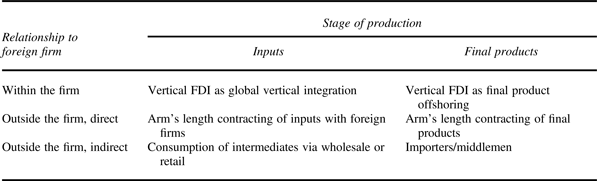
I concentrate on the first of these aspects—the rise of global sourcing of inputs and final products. Table 1 heuristically divides up the global sourcing options available to a firm that wishes to import foreign products along two dimensions. First, the firm may choose to source only inputs—goods and services purchased by the firm to create its products—or to source the final product itself from abroad. Second, firms may choose to internalize production of the foreign-made good through a strategy of vertical foreign direct investment; to contract at arm's length with a particular foreign producer or producers; or, to purchase foreign-made goods on the open market, with no direct relationship with the foreign producer.Footnote 12 The growth of global sourcing can be seen in part by charting the growth of traded intermediate inputs (corresponding to the first column of Table 1). Intermediate inputs account for a substantial share of the expanded global trade just described. One estimate holds that around 56 percent of worldwide trade in goods is in intermediates.Footnote 13 The share of intermediates that are imported in the USA and elsewhere grew substantially over the 1970s and ‘80s, and has held steady since.Footnote 14
Heuristic breakdown of the choices available to a firm seeking to source goods abroad
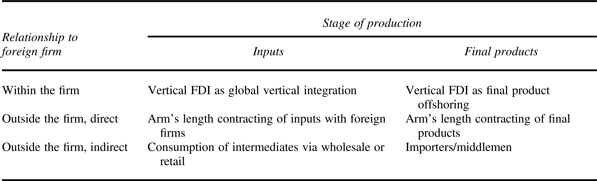
The growth of global sourcing is also seen in the growth of multinational production within the boundaries of the firm (corresponding to the first row of Table 1). FDI has grown enormously in relation to world trade.Footnote 15 The UN Conference on Trade and Development (UNCTAD) reports that annual flows of inward and outward FDI expanded from around 4 percent of world trade flows in 1970 to a high of nearly 22 percent of world trade flows in 2000, and have remained between 8 and 15 percent in each year since. Consequently, the total stock of inward FDI grew from around 6 percent to nearly 30 percent of world GDP from 1980 to 2011. Of course, not all FDI is oriented towards the import of inputs or final goods to the home market, as with horizontal FDI strategies that use foreign production to sell in foreign markets. As an alternative, the scale of intrafirm trade, which is more directly indicative of vertical sourcing strategies, can be seen in US data on trade with related parties. Related party imports accounted for 46 percent of all US imports in 1991, the same in 2001, and 48 percent in 2011.Footnote 16
The lower right-hand square of Table 1, made up of wholesalers and retailers of imported products, is not examined here. So only arm's-length contracting of final products remains to be considered. Systematic data on this phenomenon are not publicly available, nor is there a plausible strategy available for recovering estimates on the growth of outsourcing of final products. The scale of such activities must be significant, though: think of Foxconn, which manufacturers the iPhone and iPad for Apple, and other contract manufacturers of electronics. In the rest of this paper I therefore examine the foreign sourcing of final products only within the boundaries of the firm while examining sourcing of intermediates both within and beyond the boundaries of the firm.
Sourcing, Sales, and Supply: Distributive Consequences of Comprehensive Liberalization
Global sourcing complicates the distributive implications of broad trade liberalizations of the kind undertaken in comprehensive trade agreements.Footnote 17 While there are many effects arising from the increasing complexity of global production networks, building a model of supply chain politics requires some simplifying assumptions. I emphasize three dimensions along which firms and industries might differ to explore the manifold impacts of trade liberalization for a given industry.
The first of these is that trade liberalization can affect trade in own-industry final products; trade in intermediate inputs used by the industry; and trade in the products made by downstream firms who use that industry's products as inputs. For example, when evaluating a proposed trade agreement the US beef industry might consider direct exports of meat, imports of intermediates like feed or veterinary pharmaceuticals, and indirect exports via downstream industries like processed or frozen foods.
The second dimension determining trade liberalization's distributive implications is the firm's location. I consider evidence from firms that are all owned in a particular country (here, the US) but that may produce their goods either at home or abroad. These two cases may be referred to as “local producers” and “offshore producers” respectively, with the latter making up both offshore production within the bounds of the firm (i.e., multinationalization) and offshore outsourcing to a foreign contract manufacturer. For example, a US textile producer might have supported the Dominican Republic–Central America Free Trade Agreement (CAFTA–DR) if it either owned manufacturing facilities in Central America or outsourced production to a company there. Producers located in the US naturally hold the opposite opinion. This reversal is general: what firms producing in the United States welcome in terms of trade flows, US firms in the same industry that offshore production will generally oppose.
The final dimension along which firms and industries might differ is that some will face the trade flows I identified in greater scale than others. Some industries face severe import competition, while others are highly export competitive, and so will benefit from liberalization. Likewise, some industries are able to deepen their global sourcing strategies and expand their exports by proxy when trade agreements are signed with particular partners. Other industries lack such opportunities, and so the distributive consequences of liberalization are less sharp.
The Proposed Model and Hypotheses
Given this range of forces, I propose a model of trade politics in a world of globalizing supply chains. Some of the forces I described are treated in greater depth than others. These decisions in part reflect limitations in data, but also an informed hunch about which elements of liberalization are likely to be most impactful. The hypotheses's development is also shaped by two empirical regularities about corporate political activity: public industrial opposition to trade is rare, and larger firms have greater incentive and ability to lobby on trade issues than smaller ones. The hypotheses therefore concentrate on the difference between support and no support, and emphasize the preferences of the largest firms.
Globalizing the Supply Chain
Consider an industry that faces significant import competition in its own product from some potential trade partner. A natural guess would be that this is an industry opposed to liberalization with that country. But what if that import competition is actually from domestically owned firms with factories located in the foreign country? Such trade flows should be associated with a greater intensity of support for liberalization with that country among firms that can take advantage of new opportunities created (and existing relationships consolidated) by trade liberalization. To the extent that such firms influence an industry's trade association, the association may also publicly support freer trade.
Of course, vertical multinationalization by US firms may also generate opposition to trade liberalization among those firms that continue to produce at home. And while vertical multinationalization has indeed generated overt opposition to US trade agreements, public manifestations of opposition to US trade agreements are generally scarce and so not the focus of my empirical analysis here.Footnote 18 Relatedly, the firms that lobby or otherwise participate in US trade politics are generally large.Footnote 19 These firms have higher stakes (in absolute terms), are more politically experienced and informed, have greater resources, and may be more influential. These are the sort of firms whose support for trade is enhanced by greater opportunities for vertical FDI.
These facts push me to emphasize the positive impacts of vertical FDI on producer support for trade in the theoretical development. But because there may be distributive consequences within an industry associated with greater vertical FDI, I also consider an observable implication of intra-industry disagreement: that firm support for trade liberalization might be more robustly associated with vertical FDI than association support. This expected difference is rooted in the idea that associations are more likely to represent the interests of a broad array of firms in an industry, including both multinationals and those that produce only in the home market. Because some trade associations are mainly composed of (or dominated by) larger firms, and some industries have more variation in ability to multinationalize than others, I still expect association support to increase in opportunities to multinationalize production of final goods, but less strongly.
H1
Industries that offshore a greater amount of production of their final products to foreign affiliates in a particular country are more likely to have support for trade liberalization with that country, especially among individual firms.
Turning from final to intermediate goods, I note that industries that rely heavily on imported intermediates have very strong stakes in trade liberalization. Sourcing intermediates at a reasonable cost can make the difference between corporate life and death for firms in an open economy.
H2
Industries that source a greater amount of intermediate imports from a country should be more likely to feature support for trade liberalization with that country, especially among individual firms.
As with own-industry trade flows, the import of intermediates can be disaggregated into inputs that are imported from foreign-based upstream subsidiaries and inputs imported from abroad either through contracting with foreign firms or via intermediaries. Because relatively few firms are multinationals, it seems especially likely that firm support for trade might be driven by both related and nonrelated party intermediate inputs while association support is driven by nonrelated party inputs only. The main results do not make this distinction because the two measures are highly correlated, however I do examine it in separate models as a tentative additional finding.Footnote 20
More generally, firms may differ in their ability to take advantage of opportunities to source intermediates. Such disagreements may be less overt than the very direct competition engendered by vertical FDI, especially if intermediates are homogeneous or not relationship specific.Footnote 21 For the reasons described earlier, I do not examine here sourcing of intermediates as a driver of overt public opposition—or diminished support—for trade among smaller firms. However, I do consider the differences between association and firm position taking and I expect that firms will be more responsive to greater opportunities to import intermediates than associations.
The Domestic Supply Chain and Exporting by Proxy
Some firms benefit from exporting directly by sending their goods abroad to foreign consumers. Others benefit from export sales indirectly by selling to local producers who then incorporate those inputs into their direct exports. This leads to support for trade liberalization “by proxy”: the export-competitive firms and industries that an input-producing industry supplies are the direct beneficiaries of liberalization, but the intermediate producer's inputs end up embodied in exports, too. This argument suggests an alternative image for how supply chains might expand support for trade.
H3
Industries whose goods end up incorporated into downstream products that are then exported to a particular country should be more likely to have support for trade liberalization with that country.
Direct Import and Export Competition
The standard Ricardo-Viner interpretation of trade politics holds that industries should be in favor of trade if they are export competing and opposed to liberalization if they import competing. It is therefore essential to account for the overall competitiveness of the industry when it comes to the “ordinary trade flows” that have dominated the study of trade politics. To do so, all models include controls for the total exports of each industry, and the total quantity of imports not originating from US multinationals.
A more recent literature argues that the Ricardo-Viner model is inappropriate in industries where products are differentiated.Footnote 22 Product differentiation is the leading explanation for intra-industry trade flows, which make an industry both import and export competing. Where intra-industry trade is significant, the key determinant of a firm's preferences over trade policy is whether a firm is an exporter, not the overall trade orientation of the industry as a whole.Footnote 23 Only an exporter has any hope of benefiting from liberalization, while nonexporters face enhanced home market competition from foreign varieties even if their home industry exports relatively more than the foreign industry.Footnote 24 I therefore re-examine the argument that product differentiation moderates the impact of comparative advantage on support for trade.
The Political Context of Firm and Association Position Taking on US Trade Agreements
To translate the hypotheses into testable implications, I examine public expressions of support for US preferential trade agreements (PTAs) from NAFTA to the present. These agreements are valuable because they generate variation on the key dependent and independent variables. Firms and trade associations take pains to publicly support these agreements but with significant variation across industries and agreements. These agreements also vary enormously in their trade implications because they span countries that differ markedly in size, endowments, comparative advantage, and the extent of FDI. PTAs have received enormous attention from scholars interested in international agreements, regionalism, and the evolution of the liberal order.Footnote 25 My evidence complements work showing that opportunities to multinationalize drive PTA terms and creation.Footnote 26
Using public expressions of support for PTAs raises several questions. Can we can draw a straight line between the underlying preferences of firms and their public expressions of support? Doing so requires a theory of public position taking. I treat position taking as a form of outside lobbying: a show of force by special interests directed toward government and society, and designed to convince both that there is genuine support for a given policy.Footnote 27 Under this approach, private and public preferences ought to coincide closely, if not perfectly. Firms or trade associations publicly declaim their support for a trade agreement because they genuinely support an increase in trade. One exception involves those industries that avoid liberalization as a part of trade agreements, for example, the US sugar industry. In such cases, public support for an agreement is in affirmation of opposition to free trade. Overall, these carve-outs from liberalization seem to be rare. Another concern is that firms or associations are deterred from publicly expressing support for agreements in some systematic way that biases the revelation of genuine support. While this is a possibility, it is not consistent with the wide array of support across industries, across agreements, and over time.
In contrast to public support for US PTAs, public opposition to these trade agreements by firms and associations is scarce. Some of these agreements are with relatively small trade partners: if globalization concentrates gains from trade in elite firms and spreads the costs of additional competition across many firms, there may not be a strong motive to oppose PTAs. Similarly, if intra-industry trade or variation in ability to multinationalize the supply chain divides industries, then the smaller and politically disorganized firms may be undermined in their efforts to oppose liberalization, especially if their trade association remains on the sidelines. Firms may also self-censor public expressions of opposition, for fear of being labeled “protectionists” or because of political inefficacy. Given the paucity of public opposition, I focus on the main variation: industries where there was public support for the PTAs and industries where there was not.
Trade agreements are not unopposed, however. Labor unions, human and labor rights NGOs, environmental groups, and ordinary US voters regularly fight these trade agreements. There remain bastions of protectionism in industry, too. The steel and machine tools industries featured significant public opposition to the US-Korea trade agreement, for example, and certain agricultural industries have fought to exclude their products from substantive liberalization. By comparison, the political coalition that strongly supports these agreements is unidimensional. Corporate America is the special interest pushing these agreements, and its efforts absolutely dwarf the activity of any other groups that arise to support these PTAs. The public expressions of support that I examine are therefore not only valuable as evidence of corporate attitudes, but also politically important: there are virtually no other organized interests defending globalization.
There is every indication that the US government takes the positions of corporate America seriously, too. The Department of Commerce and Office of the United States Trade Representative solicit extensive feedback from firms and industry associations through individual submissions and Trade Advisory Committees (TACs). Firms and corporations participate in great numbers, and these groups' positions are reported to the Congress, which also holds hearings on US trade agreements that generally highlight testimony by firms and associations. Formal lobbying on US trade agreements is also extensive: hundreds of firms and associations lobby on any given agreement. Public position taking is even larger in scale—and highly organized among pro-trade forces—suggesting that corporate America believes its lobbying activities are impactful.
The Political Consequences of the Globalization of the Supply Chain
Growth in global value chains has expanded the intensity and extent of the corporate pro-trade coalition in the United States. Reciprocal trade liberalization is not just about opportunities to export: many US firms and industries already have completely free access to their most important market—the US—and therefore are focused on opportunities to cut costs relative to domestic and foreign competitors. Foreign sourcing is a prime way to achieve this aim.
This growth in the weight of support for trade is likely to have three effects. First, the literature on endogenous trade policy has always emphasized the importance of special interests in driving trade policy. Globalization of the supply chain reweights the preferences of producers in a pro-trade direction—especially among large, politically active firms—and so encourages further liberalization.Footnote 28 Second, the policy issues of greatest interest to firms will change. Rather than pushing for either protection or market access abroad, firms with global supply chains will be concerned with market access at home, lax rules of origin, predictable customs, protections for foreign investment, and a stable regulatory environment for offshore affiliates and partners. Finally, these strong supporters of trade may also make up for the diffident attitudes toward trade among ordinary American consumers, unpersuaded as they are by a bounty of low-priced foreign-made varieties. Special interests are at the center of trade agreement formation and passage; and firms with global supply chains are at the center of special-interest activity over trade.
The rise of global production networks has also recreated fault lines over trade among producers. One way this occurs is by creating new cleavages among “pro-globalization” firms on issues that divide tradables producers and firms that both produce and consume tradables. For example, among some US industries it is not uncommon to hear vociferous complaints over both exchange rate manipulation and unequal tax treatment resulting from the US's origin-based system of corporate taxation. Absent global supply chains, producers of tradable goods would likely agree that the dollar ought to be weaker and that the US should adopt a destination-based tax system. But firms that extensively source abroad are likely to hold the contrary positions.Footnote 29 The political influence of US corporations with global supply chains helps explain the relative inaction on exchange rates, and the frosty reception toward recent proposals for a destination-based tax system.
Globalization of the supply chain has also redefined the pro-trade coalition by creating support for trade liberalization in industries that would otherwise be united in opposition to trade.Footnote 30 For example, US firms in an uncompetitive industry might find that their efforts at opposition are undermined by a few firms in the industry that have successfully offshored production. Because the firms that import intermediates and open foreign affiliates tend to be large, globalizing firms are especially likely to be politically influential. They have the resources and political experience to make their voice heard, and so undermine trade's opponents, creating an additional factor that pushes toward greater liberalization.
Data and Measurement of Concepts
Producer Support for US Trade Agreements
My outcome variables are built using an archive of public expressions of support by US manufacturing, mining, and agriculture firm and industry associations for all thirteen US free trade agreements from NAFTA to the present.Footnote 31 These public expressions of support come in various forms. By far the largest source of data on public expressions are ad hoc coalitions, which have formed to support every trade agreement from NAFTA to the present with the sole exception of the Jordan–US Free Trade Agreement. Congressional testimony is the second main source of information on firm and associations attitudes, but I also make use of submissions to the US Trade Representative (USTR), government reports, and press releases. These sources require careful reading to determine if an unambiguous position was taken on the trade agreement. Many firm and association expressions of support are repeated across multiple venues, improving confidence that public expressions are meaningful.
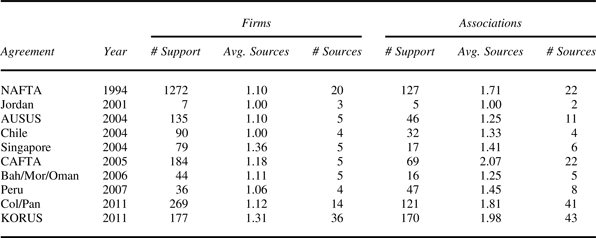
The top half of Table 2 illustrates these properties of the data.Footnote 32 On the left-hand side are summary statistics on the number of firms that supported each trade agreement in the # Support column. For example, 1,272 unique firms supported NAFTA. These codings are drawn from twenty separate sources of data recorded in the # Sources column (three pro-NAFTA coalitions and seventeen Congressional hearings). The average number of sources for each firm, contained in the Avg. Sources column, was only 1.10 because most firms appear in a single large coalition. The analogous information on industry associations is included in the final three columns of the table.
Counts of US firm and association support for FTAs
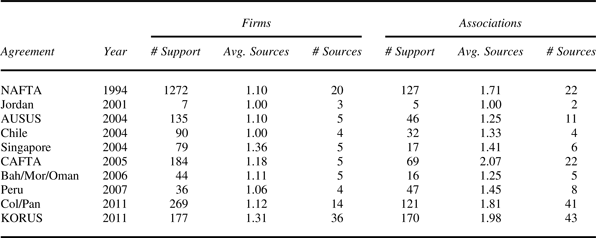
Firm and association positions are used to construct two industry-level measures of the extent of support for a given trade agreement which are the main outcome variables in the analysis. These variables are constructed at the six-digit North American Industry Classification System (NAICS) level for each individual agreement so the unit of analysis for this study is the industry-agreement. The data cover 403 NAICS industries in agriculture, mining, and manufacturing across ten agreements (or agreement clusters), so the total number of observations for most models is 4,030. Some of the robustness checks employ variables not observed in particular sectors or industries, reducing the sample size.
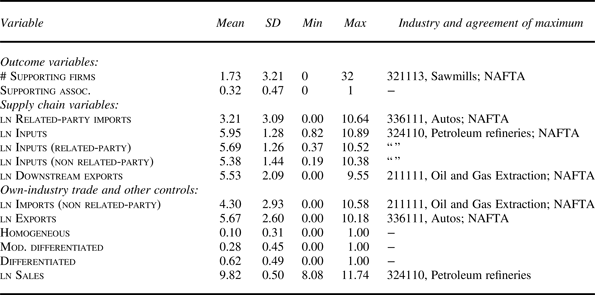
The first outcome variable is a count of the number of firms that supported a given agreement in a particular industry, and is written in the regression tables as # Firms. Note that a single firm might span multiple six-digit NAICS industries creating dependence among the observations that is addressed later. About 48.9 percent of agreement-industries have at least one firm supporting the agreement, while the average across all observations is 1.73 firms. The second outcome variable is a dichotomous measure of whether an industry trade association publicly expressed support for the trade agreement in question. A trade association publicly supported the trade agreement in about 32 percent of the agreement-industry cases.
I hypothesize that producers’ evaluations of trade agreements are driven by trade flows with partner countries, past, present, and future. Past trade flows are a guide to the comparative advantage of, and opportunities to invest in, foreign countries. Of course, such flows are limited by barriers to trade that may be reduced by trade agreements, so an approach focusing on past trade flows might fail to capture opportunities generated by reductions in barriers that are highly uneven across industries. However, if trade agreements expand trade evenly across industries, or serve to guarantee existing trade patterns,Footnote 33 current trade flows are a sound guide to future trade flows.Footnote 34 From this perspective, trade flows are relatively stable across countries, industries, and time, and agreements serve mainly to lock in and build on existing successes. Such an approach seems especially apposite for US trade agreements, all of which have been concluded with partners that are already members of the WTO.
Summary statistics for all variables
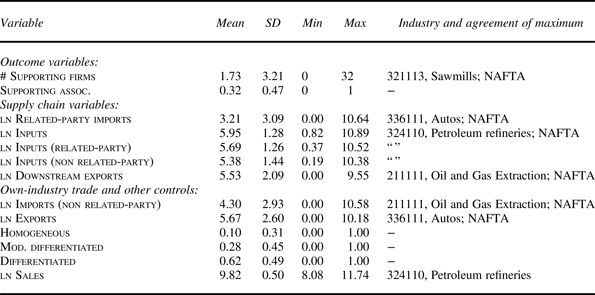
Notes: The total sample is 403 industries across ten agreements (or agreement clusters) for N = 4,030. All trade and sales variables are measured in logged dollars and averaged over available years from 2005 to 2009.
This still leaves a variety of valid approaches to measure the importance of an agreement to a particular industry, so the one taken here is chosen for breadth, robustness and simplicity. I consider trade flows between two countries over a long span of time (2005–2009 and, as robustness check for every model, 2010–2014) to smooth over year-to-year variation in trade. These flows are used as a snapshot of the stakes involved for an industry that might secure (and give) preferential access to some country as part of a PTA. I assume that the impact of a PTA is proportional to the size of these stakes. I discuss in the robustness checks a number of alternative approaches, including using trade prior to and after the agreement's entry into force.
Measurement of Imports Arising from US Multinationals
To measure the scale of intra-firm trade, I employ data on imports from related parties provided by the US Census Bureau at the six-digit NAICS level.Footnote 35 As with all trade data employed in this paper, the related-party imports of an industry from the specific trade agreement partner are always used to explain support from that industry for that trade agreement. For example, US-related-party imports in motor vehicle engine parts (NAICS 336310) from South Korea are used to explain support in that industry for the KORUS agreement.
While imports originating from the foreign affiliates of US corporations are related-party imports, other relationships also count as related-party transactions, including familial relationships and business partnerships. These types of related-party transactions are likely to be small in scale: multinationals and large firms dominate trade flows. Foreign firms invested in the US that import from their home-market parent companies also fall under the related-party-imports umbrella. This error is mitigated by the fact that the US generally invests more in its trade-agreement partners than they do in the US. Among all of the US trade-agreement partners I examine, US foreign direct investment in those countries exceeded their investment in the US by a factor of 2.4. For the manufacturing sector only, the number is even higher, at 2.7. I therefore employ average related-party imports from 2005 to 2009 as a proxy for imports from US multinationals. This variable is referred to as related-party imports and is always added to one and logged.
Measures of Imported Inputs and Downstream Exports
The measure of imported inputs for each six-digit NAICS industry from each set of agreement partners is constructed using the Benchmark Input-Output table for 2002 from the Bureau of Economic Analysis. The Supplementary Direct Requirements Table reports the percentage of value added in the industry in column i which is accounted for by an input from the industry in row j.Footnote 36 I refer to this matrix of input-output coefficients as IO, and IO ji represents the proportion of industry i's value accounted for by input j.Footnote 37 The IO matrix is used to determine the total value of each input used by each industry, which is denoted here as I ji. For industry i, the total value of input j used is I ji = IO jiR i where R i is total industry revenue. For example, if the US auto industry is a 100 billion dollar industry and 1 percent of its value comes from manufactured glass products according to the input-output table, then its total glass inputs employed are $1 billion = .01 × $100 billion.Footnote 38
The percentage of each domestically employed input that is imported from a trade partner k is given by 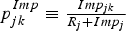 $p_{jk}^{Imp} \equiv \textstyle{{Imp_{jk}} \over {R_j + Imp_j}}$, where Imp j represents all imports of input j and Imp jk represents only those imports of input j coming from country k. The denominator represents the total value of all of input j used in the US. To illustrate, Canada and Mexico supply about 4 percent of all glass products that US industries consume, whether made in the US or abroad. At this point, it is assumed that imported inputs are deployed proportionally across all US industries. So if a proportion
 $p_{jk}^{Imp} $ of input j is imported from country k then
 $p_{jk}^{Imp} I_{ji}$ represents the total amount of imports from country k of input j used by industry i. Using our running example, it would be estimated that Canada and Mexico supply
 $.04 \times{\rm \$} 1{\rm billion} = {\rm \$} 40$ million in glass to the US auto industry annually.
To measure the total dependence of the US auto industry on imported inputs from Mexico and Canada, one must then sum across all of the inputs supplied to the auto industry by Mexican and Canadian industries, like glass, fabric, steel, leather, and auto parts. This yields the measure of dependence on inputs from a particular country:
Definition 1
The total estimated value of intermediate inputs used by industry i imported from country k is equal to
 $${\rm INPUT}{\rm S}_{ik} \equiv \sum\limits_j p_{\,jk}^{Imp} I_{\,ji}.$$
This variable is referred to in the tables below as inputs, and is averaged across all years from 2005 to 2009 before being logged.
The quantity of locally sold intermediate goods that end up as downstream goods that are then exported is defined analogously. The percentage of downstream (i.e., final) goods that are exported to country k is 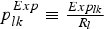 $p_{lk}^{Exp} \equiv \textstyle{{Exp_{lk}} \over {R_l}}$ where Exp lk is the total exports of industry l to country k. As before, I use the expression I il, the total amount of input i used by industry l. I also define
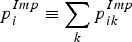 $p_i^{Imp} \equiv \sum\limits_k p_{ik}^{Imp} $ as the percentage of a particular input that is imported from the world to subtract off imported inputs that are repackaged into downstream exports. (US input-producing industries garner no benefits from imported inputs incorporated into exports.) For example, if the US hand-tools industry employed $1 billion in US-made milled steel each year as an input, and then exported 0.4 percent of its products to South Korea annually, we would estimate that about $4 million = .004× $1 billion of US steel ends up in South Korea via the export of US-made hand tools. To determine the total dependence of US steel mills on indirect exports to South Korea, I sum across all of the downstream industries supplied by US steel mills, like tools, electronics, transportation equipment, and machinery.
The formal definition of total US-made intermediates that are then exported as downstream goods is then given by the following:
Definition 2
Downstream export sales for input i to country k are equal to
 $${\rm DOWNSTREAM}\quad {\rm EXPORTS}_{ik} \equiv \sum\limits_l (1 - p_i^{Imp} )I_{il}p_{lk}^{Exp}. $$
As with the other trade measures, this variable is averaged across the years 2005–2009 and logged.
Direct Import and Export Sales, Product Differentiation, and Industry Size
All of the models examined include controls for own-industry imports and exports to the relevant agreement partner(s) to ascertain the effects of own-industry competition on support for liberalization. The export variable is simply the average exports of the industry over 2005–2009 measured at the six-digit NAICS level taken from the NAICS Related-Party Trade web application hosted by the United States Census Bureau. Related party imports are separated from all other imports. This measure of import competition with related-party imports removed is referred to as imports in all regression tables, leaving the parenthetical “non related party” implied.
These trade variables are interacted with a measure of product differentiation.Footnote 39 The original measure classifies industries as exchange-traded products available on an organized commodities exchange; reference-priced products priced in industry trade publications; and all other products. This measure is concorded into the six-digit NAICS industries employed here, and its three levels are referred to as homogeneous, moderately differentiated, and differentiated, respectively. Exchange-traded products share a common price and are freely substitutable, and so are homogeneous. Products that are neither exchange traded nor reference priced are likely to be differentiated, with each variety garnering a different price based on its product characteristics and attributes of the company producing it. All of the models include a control for industry size which is based on total sales from 2005 to 2009. As a result of changes in the NAICS nomenclature, this measure is only available in 2007 for some industries. Total sales over these years are always divided by the number of years in which sales data are available.
Empirical Aims and Model Specification
My hypotheses suggest a set of correlations that I seek to demonstrate are present in the data. Rather than pursue bivariate relationships, each correlation is examined conditionally, holding constant other determinants of support for trade agreements. Because it is not clear theoretically which of the explanations of support for trade is causally prior, the relationships among all variables are considered simultaneously. This approach provides some confidence that a correlation between related party-imports and support for trade, for example, is not spurious and in fact driven by the impact of non related party imports on support for trade.
All of these relationships are modeled using generalized linear models. The linear predictor for the regression models is:
 $$\eqalign{\theta _{ik} & = \beta _0 + \beta _1\ln {\rm Rel}{\rm.} \; {\rm party}\; {\rm import}{\rm s}_{ik} + \beta _2\ln {\rm Input}{\rm s}_{ik} + \beta _3\ln {\rm Downstream}\; {\rm export}{\rm s}_{ik} \cr & \quad+ \beta _4\ln {\rm Sale}{\rm s}_i + {\bi \beta} _{{\bi 5} - {\bf 12}} \cdot {\rm Differentiatio}{\rm n}_{\rm i} \,{\ast}\, {\rm (}\ln {\rm Export}{\rm s}_{{\rm ik}} + \ln {\rm Import}{\rm s}_{{\rm ik}}{\rm )}.} $$
Note that i refers to the six-digit NAICS industry and k refers to the particular agreement partner(s). The index of firm support for each trade agreement is a count variable modeled using negative binomial regression
 $${\rm E}[\# \;{\rm Firm}{\rm s}_{ik}] = {\rm Poisson}(\varsigma {\rm Exp}[\theta _{ik}])$$
where ς models over- or under-dispersion in the data and is distributed gamma. Association support is modeled using logistic regression:
 $${\rm E}[{\rm Assoc}{\rm. suppor}{\rm t}_{ik}] = {\rm InvLogit}(\theta _{ik}).$$
As noted, there is dependence among the units across industries, especially within particular agreements. To partially deal with these dependencies, standard errors are clustered at the agreement-three-digit NAICS level for all regression models presented. This clustering adjusts the standard errors for idiosyncratic shocks to industries for each agreement which might raise or lower the chances of support.Footnote 40 A series of random intercept models is examined in the online appendix towards the same end. In separate specifications, random intercepts are considered for the agreement; agreement-three-digit NAICS dummies; for each six-digit NAICS industry; and for both agreement and six-digit NAICS industries. I also check the same models with fixed effects to describe the relevant sources of variation in the data.
All of the results in the text are presented as expected differences. The clustered variance-covariance matrix is used to draw from the estimated sampling distribution of the coefficients and the empirical distribution of the covariates is used for all simulations (but the variable under consideration). For example, a reported expected difference of .95 on the # firms outcome for the inputs variable indicates that increasing inputs from their twenty-fifth to their seventy-fifth percentile would predict an increase of .95 extra firms supporting an agreement for a typical industry. All estimates are based on the median expected difference. This mainly affects the # firms outcome which is skewed. Its mean is 1.73 in the data, but the median expected number of firms is 1.12 and so all differences should be interpreted with respect to the latter number. For example, the .95 estimate implies increasing the median expected number of firms from 0.76 (when inputs is held at its 25th percentile) to 1.71 (when inputs is held at its 75th percentile). Hypothesis tests are conducted using quantiles of the simulated differences.
Results
Globalizing the Supply Chain
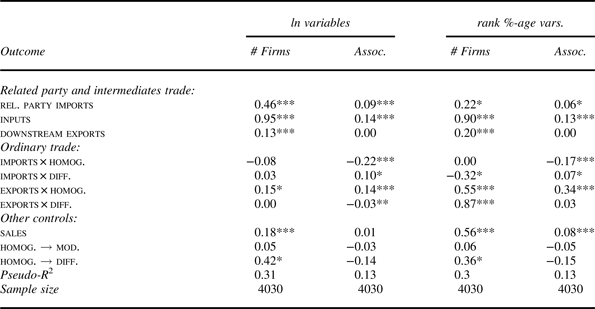
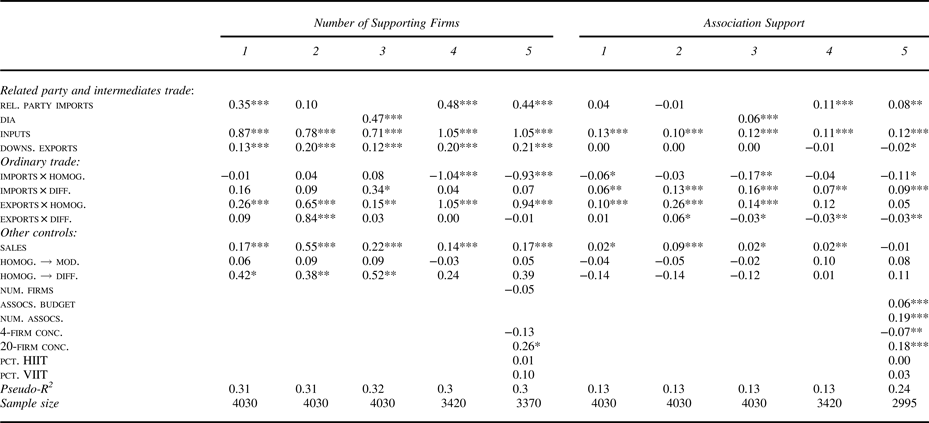
Does greater potential for globalization of the supply chain through foreign direct investment or the import of foreign-made intermediates increase expected support for free trade agreements? Table 4 shows that, among firms, the answer to this question is unequivocally yes. The measure of the ability to multinationalize production of final products, related party imports, is positively associated with support for liberalization among firms. For a typical industry, increasing related party imports from its twenty-fifth to its seventy-fifth percentile increases the average number of firms expected to support that trade agreement from about .91 to 1.38, a difference of .46 firms. The third column of Table 4 also presents a first check of this finding by converting the trade flows into flows as a percentage of industry sales.
Predicted changes in support among firms and associations for US trade agreements

Notes: All estimates are first differences; changes in continuous variables are from 25th to 75th percentile. Median expected number of firms supporting is 1.13; median expected probability of association support is .29. Standard errors are clustered at three-digit NAICS-agreement level. *p < .05; **p < .01; ***p < .001.
Among trade associations, the links between related-party imports and support for liberalization are also positive and substantively significant. Moving from the twenty-fifth to the seventy-fifth percentile of the related party imports variable increases the probability of association support by around .09, from .24 to .33. In the robustness checks, these effects are found to be somewhat smaller or insignificant using alternative model specifications and measures, while the results on firm position taking and related-party imports are quite stable. I conclude that opportunities for imports coming from foreign affiliates are a key driver of firm preferences, while the evidence is somewhat weaker that such imports drive association position taking.
Opportunities to source intermediate inputs are strongly associated with support for US free trade agreements. Increasing the measure of imported intermediates coming from a particular agreement partner(s) from its twenty-fifth to its seventy-fifth percentile increases the predicted number of firms supporting the agreement in that industry by .95, more than doubling expected support for the agreement from .76 firms to 1.71 firms. The expected difference is also large among associations, where a similar change in imported inputs increases the probability of an association supporting the agreement from .23 to .37. The predicted differences are very similar using the trade flows as a percentage of sales versions of the variables. Opportunities to import intermediates are a key driver of industrial preferences.
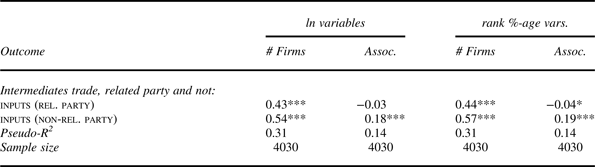
It is plausible that related-party intermediates and non related-party intermediates might have different impacts. Opportunities to source intermediates via direct investment in foreign affiliates would seem to be restricted to relatively few firms, and so not a likely driver of broad industrial preferences as embodied in trade associations. Table 5 reports results from the same models as 4, but with the intermediate inputs variable disaggregated between related-party imports and non related-party imports (expected differences for the other variables are suppressed to conserve space). The results suggest that there is a meaningful difference between firms and associations. Firm positions are driven by opportunities to multinationalize intermediates production both within and outside the bounds of the firm. In contrast, trade association positions are not meaningfully associated with related-party imports of intermediates.
Predicted changes in support among firms and associations for US trade agreements
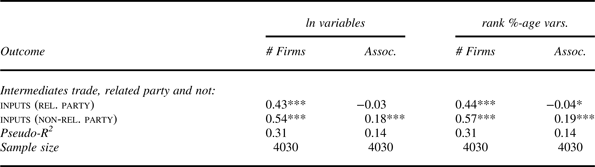
Notes: All remaining variables suppressed. All estimates are first differences; changes in continuous variables are from 25th to 75th percentile. Median expected number of firms supporting is 1.13; median expected probability of association support is .29. Standard errors are clustered at three-digit NAICS-agreement level. *p < 05; **p < .01; ***p < .001.
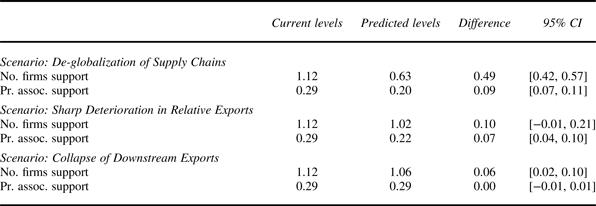
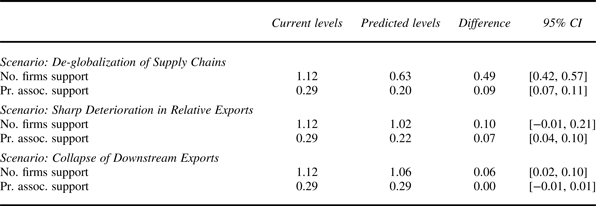
A key argument of this paper is that the globalized supply chain has fundamentally altered the scale of industrial support for trade liberalization. I therefore consider the extent to which the rise of global sourcing via imported intermediates and FDI have increased the rate of public expressions of support for trade liberalization among US industries. Table 6 presents a series of counterfactual simulations that generate predictions about rates of support for trade liberalization under a variety of scenarios. The first scenario (called “Current levels”) considers the US industrial map across all thirteen agreement cases examined in this paper as they are in real life. A median expectation of 1.12 firms per industry express public support across all agreement cases; 29 percent of industries have at least one association in support of a given trade agreement.
Counterfactual simulations of number of firms or association supporting trade liberalization
Notes: All estimates are first differences from models 1 and 2 of Table 4 among the complete sample (N = 4,030). Changes in variables are 1/10 the observed value or ten times the observed value. Standard errors are clustered at three-digit NAICS-agreement level.
The first counterfactual considered is where the related-party imports and total imported inputs of those industries are decreased by 90 percent for every observation in the entire data. This drastic reduction is meant to mimic a world with few opportunities to globalize the supply chain. One way to interpret these estimates is the following: what type of support for liberalization would we expect to see for a typical industry if we removed almost all global sourcing opportunities while holding all other industry characteristics constant? The second way to interpret the counterfactuals is somewhat fanciful because of concerns over partial versus general equilibrium and extrapolation, but also more vivid. What would happen to support for trade liberalization in the United States if trade agreements governed just trade in final goods, with virtually no opportunity to increase imported inputs or to multinationalize production?
In either interpretation, the scale of the impact of intermediates and FDI on support for trade is enormous. These estimates are presented in the top third of Table 6. Reducing these opportunities to very low levels is predicted to reduce the number of firms supporting these agreements by 44 percent; the proportion of industries with trade associations that support trade liberalization is cut by 31 percent. To draw out the comparison with other determinants of support for liberalization, the middle third of Table 6 considers an alternative counterfactual scenario, reducing opportunities to export (to 10 percent of their current totals) and increasing import inflows (by a factor of 10). Despite these extreme changes, the predicted change in support for liberalization among firms is dwarfed by the changes induced by a reduction in opportunities to globalize the supply chain. Among trade associations the changes in predicted support are comparable, although they are still greater for the “de globalizing the supply chain” scenario. Overall, the evidence overwhelmingly supports the proposition that globalizing the supply chain has grown the base of support for free trade and increased the scale of the pro-trade industrial coalition in the United States.
Indirect Exports via Supply of Downstream Exporters
Table 4 shows that downstream exports have a statistically significant and meaningful impact on the number of firms supporting trade liberalization. Increasing the downstream exports variable from its twenty-fifth to its seventy-fifth percentile increases the expected number of supporting firms from 1.10 to 1.24. I hypothesized that the links between downstream exports and association support for trade agreements would be similarly positive, but the results do not support that contention. This is also true across a wide variety of robustness checks and so does not seem to be something idiosyncratic about the specifications in Table 4.
To provide a sense of the impact of downstream exports, the bottom third of Table 6 considers a reduction of all of the observations’ downstream exports by 90 percent from the actual observed level. The predicted reduction in firm support for trade liberalization is statistically significant but somewhat modest compared to the other factors explored in this study. As a determinant of firms’ preferences over trade agreements, it seems that indirect exports via inputs sales to downstream firms and industries that are export competitive are a consistent but second-order driver of preferences, especially in comparison with opportunities to globalize production and supply.
“Ordinary Trade”: Import Competition and Export Opportunities
The third set of results considers the impact of own-industry trade flows of the sort that are usually believed to drive trade politics. The literature has found that imports' and exports’ impact is conditional on the extent of product differentiation. On the associations side, the results strongly support this claim. Where products are relatively homogeneous, greater import flows have very negative effects on the chances that a trade association supports the trade agreement. Greater export flows strongly increase support. To illustrate, increasing imports from their twenty-fifth to their seventy-fifth percentile generally reduces the probability a homogeneous good industry's association supports an agreement by .22. (Note the proportion of homogeneous good industries with public support for an agreement is .37.) An increase in exports increases support for an agreement by .14. In contrast, where products are relatively differentiated, these relationships generally fade to insignificance or even change sign.
Among firms these relationships are generally variable in their direction across specifications. This likely reflects a lack of firm position taking in homogeneous product industries. Just under 60 (59.3) percent of homogeneous good industries have no firms at all taking a position, while 45.3 percent of all differentiated good industries have no firms taking positions. Among industries where at least one firm took a position, that firm was the only firm doing so among 59.4 percent of homogeneous good industries but only 33.9 percent differentiated good industries. More starkly, the average number of firms taking a position in homogeneous industries is just over 1, while for differentiated product industries the same figure is over 2. In other words, firm position taking in homogeneous good industries is scarce and idiosyncratic as a source of data, explaining the variable results.
Returning to the counterfactual claims in Table 6, it is worth pointing out again how impactful changes in opportunities to globalize the supply chain are compared to the ordinary trade channels that drive trade preferences in the Ricardo-Viner approach. Even the drastic proposed counterfactual (a reduction of an industries export-import ratio by a factor of 100) has only modest effects on firm position taking, reducing support from 1.12 to 1.02 firms. The effects on associations are somewhat stronger, reducing the probability of association support from .29 to .22, although they remain smaller than the effects of a major reduction in opportunities to globalize the supply chain.
Robustness of the Main Claims
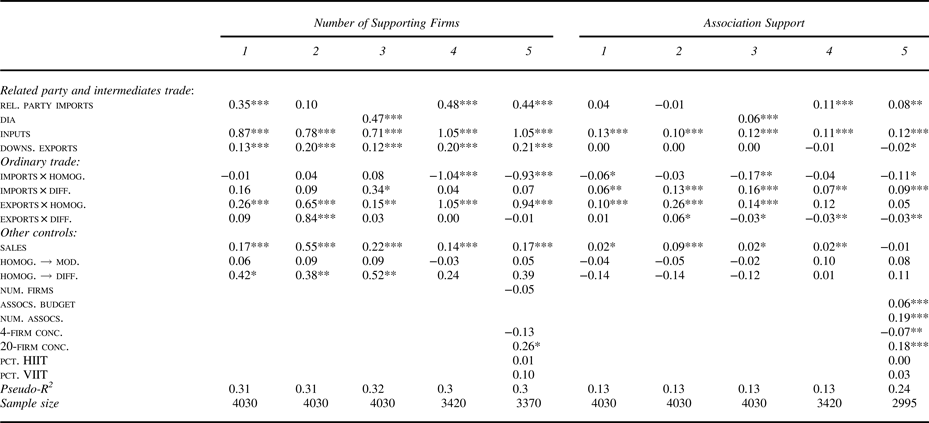
To assess how robust the main claims presented in Table 4 are to alternative measures and model specifications, columns 1 and 2 consider the same model specifications from Table 4, but all variables are based on the years 2010 to 2014 rather than 2005 to 2009. The main results are similar, especially for the variables describing opportunities to globalize the supply chain. An alternative set of specifications using trade flows two years prior to, and two years after, agreement implementation shows substantively identical results. These are provided in the online appendix. Column 3 in Table 7 uses an alternative proxy for US multinationalization constructed using data on US direct investment abroad (the variable is called dia and is described in the online appendix).
Robustness of models from Table 4
Notes: All estimates are first differences; changes in continuous variables are from 25th to 75th percentile. Median expected number of firms supporting is 1.13; median expected probability of association support is .29. Standard errors are clustered at three-digit NAICS-agreement level. *p <.05; **p <.01; ***p <.001.
Columns 4 and 5 consider only industries that produce manufactures, excluding agricultural and mining industries that might have very different patterns of public position taking because of systematic differences in industrial structure. Column 5 also considers an additional set of control variables (some of which are available for manufacturing industries only) that are related to lobbying on trade policy. These include: the number of firms in the industry, the number of associations in a given industry and the total budgets of those associations, the four-firm and twenty-firm concentration ratios from the US Economic Census, and the percentage of industry trade represented by horizontal and vertical intra-industry trade.Footnote 41 The main findings are entirely robust to these additional controls. The impact of vertical (that is, price-driven) intra-industry trade, an indicator of potential gains from multinationalization in North-South agreements, is strongly associated with firm support for trade agreements.Footnote 42 If multinationalization of sourcing and production is so important for public position taking, a natural question is whether these forces also drive formal lobbying by firms and associations. I examine this question in the online appendix using analogous outcomes (the number of firms that lobbied and a dummy variable for whether an association lobbied.) I find that the main results of this paper carry over to the case of formal lobbying. Related party imports, inputs, and downstream exports are positively associated with firm lobbying on US trade agreements, though the results are strongest for the inputs variable.
Conclusion: The Changed Nature of the Pro-Trade Coalition
Opportunities to source intermediates and multinationalize production are the most important drivers of industrial preferences over trade agreements. Import competition and export opportunities, whether direct or indirect, play important but secondary roles. What impact has this elevation of the global supply chain as the main motive of support for globalization had on American trade politics? Rather than focus on the role of intermediates and FDI as drivers of the formation of trade agreements or in stabilizing a liberal international order, points that are well covered in the literature, I instead focus on an intermediate outcome: the changing size and shape of the pro-trade coalition in the United States. Each of the three consequences for the nature of America's pro-trade coalition described below have the effect of pushing US trade policy toward greater openness and so are proximate explanations for the broader trade policy outcomes emphasized in the extant literature.
Growth of multinational supply chains has created more support for trade liberalization than would otherwise exist. The growth of intermediates sourcing from abroad has made US tradeables producers into consumers, too. But unlike the ordinary American consumer who also benefits from trade, these firms and their associations are politically organized and highly influential.Footnote 43 They publicly support trade, they form coalitions to push their pro-trade agenda, and they lobby members of Congress to pass agreements. The growth in multinationalization of production has had a similar effect, creating new opportunities for American business that expand the weight of interest groups pushing for free trade. And while the growth of multinationals must also create new opposition to trade among uncompetitive US firms producing in the US, the political advantage lies with pro-trade multinational corporations owing to their size and political resources.
Global supply chains have also changed the nature of US trade politics by creating support for trade in uncompetitive industries. In the Ricardo-Viner model of trade preferences commonly used to describe early postwar American trade politics, comparative advantage industries benefit from trade while comparative disadvantage industries are harmed by it. We therefore do not expect to see support for trade liberalization in industries at a comparative disadvantage. Do opportunities to source abroad fundamentally change this dynamic? This amounts to a question of whether there are differential effects of opportunities for FDI and importing intermediates across the competitiveness spectrum. If these opportunities increase support for liberalization in net-exporting industries only, we might say that the intensity of support for trade has changed but not its nature.
To examine this question, I replicate the main models from Table 4 by dividing up industries according to their tercile in the distribution of the export-import ratio.Footnote 44 These tests show that the nature of trade politics has indeed changed. Related-party imports and intermediate inputs are associated with big increases in support for liberalization in uncompetitive industries as well as competitive or neutral industries. So even as these forces have super-charged support for trade in net-exporting industries, they have undermined opposition to trade in net-importing industries by creating a vocal constituency in favor of liberalization. This is true among both firms and trade associations. For example, increasing inputs from their twenty-fifth to their seventy-fifth percentile is predicted to increase the probability an association supports an agreement from .16 to .36 in a typical net-importing industry. This undermining of opposition is also abetted by the rise of product variety, which turns the largest firms in relatively uncompetitive industries into supporters of trade liberalization, perfectly able to find a home for their varieties in export markets. These forces combine to sharply undermine efforts to oppose liberalization in net-importing industries.
Finally, the rise of global supply chains has changed the focus of trade politicking from associations to firms. In earlier eras of American trade politics, industries were represented politically by their associations. In the present era, firms are just as likely to strike out on their own. Foreign direct investment is a natural explanation for such a pattern, but so is product differentiation which turns the largest firms into trade winners even in uncompetitive industries. Sourcing intermediates can have similar effects if those inputs are relationship-specific, and only the largest firms are able to contract directly with foreign input suppliers. Each of these forces has the same outcome: only a subset of firms in any given industry can benefit from these opportunities. While one consequence of this is that industries might see internal divisions, another is that the largest firms see highly concentrated gains from trade liberalization. And those outsized gains also coincide with financial resources for lobbying efforts, experience in dealing with politicians, and any other political advantage associated with scale. These large US firms, many of them multinationals, stand as the vanguard of the pro-trade coalition in the United States. And they have succeeded in their aim of knitting the US economy ever more tightly into the global marketplace.
Supplementary Material
Supplementary material for this article is available at <https://doi.org/10.1017/S002081831800005X>.