One of the many challenges faced by the second language (L2) learner is the recognition and extraction of lexical forms in the L2 speech stream. The processes of spoken word recognition entail that the listener identify discrete lexical units in a continuous and highly variable auditory signal. Although native listeners manage effortlessly to segment the acoustic stream into words, anyone who has undertaken the study of a L2 as an adult has encountered the disparity between the ease of native speech processing and the targeted effort that can be required in the aural comprehension of a L2.
An ever-growing body of research centered on native language (L1) speech processing has established that multiple phonetic and phonological cues, in addition to top-down (lexical) information, are employed by the listener to identify where word boundaries lie and to segment running speech. These cues can include the syllabic structure of a language (Mehler, Dommergues, Frauenfelder, & Segui, Reference Mehler, Dommergues, Frauenfelder and Segui1981), stress placement (Cutler & Norris, Reference Cutler and Norris1988), and phonotactic constraints (McQueen, Reference McQueen1998), among others. Listeners are also sensitive to subphonemic acoustic-phonetic variation that occurs at multiple levels of linguistic organization. Nakatani and Dukes (Reference Nakatani and Dukes1977) were among the first to test acoustic cues to segmentation in natural speech and to show that listeners can exploit the presence of noncontrastive phonetic detail to parse sequences that would be considered identical at the phonemic level. Specifically in English, for example, they showed that listeners are sensitive to the presence of word-initial aspirated voiceless plosives in differentiating potentially ambiguous phrases such as loose pills and Lou spills (both are represented in broad transcription as /lu:spɪlz/). Word-initial /p/ is produced with aspiration in loose pills, whereas /p/ as part of an initial cluster in Lou spills is not.
A great deal of research on native speech processing has since confirmed and extended these findings. The bulk of this work has demonstrated that the most reliable acoustic cues to word boundaries are located in word onsets (as opposed to codas). The beginnings of words can be marked by aspiration, as previously discussed, but also by laryngealization and glottal stops preceding vocalic onsets (Lehiste, Reference Lehiste1960; Nakatani & Dukes, Reference Nakatani and Dukes1977), the occurrence of full vowels (Cutler, Reference Cutler and Altmann1990; Cutler & Carter, Reference Cutler and Carter1987; McQueen & Cutler, Reference McQueen, Cutler, Ohala, Neary and Derwing1992), more careful articulation of vowels (Gow & Gordon, Reference Gow and Gordon1995), and the lengthening of phonemes in initial position (Quené, Reference Quené1992; Shatzman & McQueen, Reference Shatzman and McQueen2006; Shoemaker, Reference Shoemaker2014), as well as changes in fundamental frequency (Welby, Reference Welby2007).
Complicating spoken word recognition processes for learners of a L2 is the fact that the majority of word boundary recognition strategies are language specific. In acquiring speech segmentation strategies in the L2, learners must therefore learn to map acoustic and phonological information that may not be employed in the L1 to identify word boundaries in the L2. In a review of research on nonnative listening processes, Cutler (Reference Cutler2001) points out that segmentation strategies are located in the listener, not in the signal. In other words, it is not the inherent nature of the acoustic signal in a particular language that triggers the use of a particular segmentation routine in a listener but rather his or her language experience. Furthermore, the challenge faced by the learner is twofold in that not only may learners lack recourse to an unfamiliar L2 strategy, but also inexperienced learners may employ inappropriate L1 segmentation routines in the processing of the L2. This may hinder processing in that L1 strategies may not be efficient when applied to L2 input. She further maintains that it is unlikely, if not impossible, that a learner will acquire a novel L2 strategy to native levels, concluding that the L2 learner is in effect “disabled” by L1 processing strategies (2001, p. 3).
Further research has indeed suggested that the processing of a L2 can be constrained by the transfer of L1 segmentation routines. For example, Weber and Cutler (Reference Weber and Cutler2006) examined sensitivity to phonotactic patterns in German learners of L2 English. These listeners showed evidence of exploiting both English and German phonotactic constraints when monitoring for English words in a word-spotting task, suggesting that, though participants had gained some sensitivity to L2 constraints, they were not able to inhibit the effect of L1 constraints. Regarding the use of rhythmic structure in processing a L2, Cutler and Otake (Reference Cutler and Otake1994) found evidence that Japanese listeners retain sensitivity to moraic structure when listening to English. Work by Cutler, Mehler, Norris, and Segui (Reference Cutler, Mehler, Norris and Segui1989) also suggested that even early bilinguals may have recourse to only one dominant rhythm-based processing strategy.
However, further work has called Cutler’s claims regarding the limits of L2 speech processing into question by showing evidence of nativelike levels of processing performance in highly advanced bilinguals. Golato (Reference Golato2002) showed that late-learning French-English bilinguals who were English dominant were able to implement multiple processing strategies, using a stress-based strategy when listening to English and a syllable-based strategy when listening to French, which suggests equal mastery of the two processing strategies. Shoemaker (Reference Shoemaker, VanPatten and Jegerski2010) showed that highly advanced English-speaking learners of French performed like natives in the exploitation of differences in segmental duration at word boundaries in the processing of homophonous sequences in French (e.g., un nerf “a nerve” and un air “a melody,” both [œ̃nɛʁ]) when durational differences are acoustically enhanced. These results are inconsistent with claims of strict limitations on the plasticity of phonological learning and perceptual processing in adult learners.
In particular, the capacities of L2 learners concerning the exploitation of noncontrastive detail in the segmentation of continuous speech remain poorly understood. Evidence from gating experiments has shown that bilinguals are indeed sensitive to fine-grained acoustic differences between their languages. Both Grosjean (Reference Grosjean1988) and Li (Reference Li1996) showed that bilinguals can detect in which language a word is produced given very little acoustic information, demonstrating that fine phonetic detail is encoded in the phonological grammars of both of a bilingual’s languages. Although the perception and acquisition of L2 phonemic contrasts have generated an extensive body of work in the study of L2 phonological acquisition, much of which is centered on ways in which nonnative phonemes may be classified by L2 learners (Best & Tyler, Reference Best, Tyler, Munro and Bohn2007; Flege, Reference Flege and Strange1995) and by naïve listeners (Best, Reference Best and Strange1995), the role of subphonemic detail in the processing of L2 speech has received far less attention to date.
One notable exception is Altenberg (Reference Altenberg2005), who examined acoustic cues to word juncture in L2 English in a partial replication of the Nakatani and Dukes (Reference Nakatani and Dukes1977) study previously discussed. Altenberg explored cues to the segmentation of potentially ambiguous sequences in English by both native speakers of English and native Spanish-speaking learners of English. Acoustic analyses of the stimuli in this study showed the presence of many of the same juncture cues found in the original Nakatani and Dukes (Reference Nakatani and Dukes1977) study (e.g., durational variation, glottalization before vowel-initial words, aspiration of word-initial voiceless stops). Altenberg found that Spanish speakers at both intermediate and advanced levels of English proficiency performed significantly above chance in the identification of potentially ambiguous stimuli (M accuracy = 76%, with no significant difference between the two proficiency groups) but that they also performed significantly worse than native speakers, who performed at ceiling (M accuracy = 97%). Stimuli that included glottalization as a cue were identified with significantly more precision by Spanish speakers (e.g., an ice man vs. a nice man; M accuracy = 88.4%) than those that included aspiration as a cue (e.g., keeps ticking vs. keep sticking; M accuracy = 58.5%). Altenberg attributes this discrepancy primarily to L1 transfer, noting that glottal stops occur often in emphatic speech in Spanish, whereas the aspiration of plosives is rare. She also explores the possibility that markedness could play a role, in that the insertion of a glottal stop before vocalic onsets may be unmarked because it is a “universal phonetic default” (p. 345) and therefore the exploitation of this cue is easily acquired. Though participants in Altenberg’s (Reference Altenberg2005) study performed significantly worse on stimuli incorporating aspiration as a segmentation cue, it should be noted that they performed significantly above chance. This point is important in that these L2 learners acquired the use of a noncontrastive acoustic-phonetic cue that is not exploitable in the L1. However, given that there was no difference between the two proficiency groups and that Altenberg (Reference Altenberg2005) did not include a monolingual Spanish control group, it remains uncertain whether perceptual performance was specifically due to L2 experience or rather to general auditory perception.
In an extension of Altenberg’s study, Ito and Strange (Reference Ito and Strange2009) tested 30 Japanese-speaking learners of English whose length of residence in the United States ranged from 2 weeks to 12 years. Participants were tested on a forced-choice identification task that used the same 42 pairs of potentially ambiguous stimuli used by Altenberg (Reference Altenberg2005) recorded by a different speaker. Overall mean accuracy for the Japanese-speaking L2 learners was 83.8%, which was significantly lower than a control group of 10 native speakers of English (M accuracy = 96.8%). Ito and Strange replicated the results of Altenberg (Reference Altenberg2005) in that Japanese learners also identified glottal stop stimuli better than aspirated stimuli (91.3% vs. 73.1% correct, respectively), which these authors also attributed mainly to transfer from the participants’ native language. Prevocalic and utterance-final glottal stops are commonly observed in Japanese, whereas Japanese plosives are only weakly aspirated word initially: Voice onset time (VOT), the principle acoustic correlate of aspiration, tends to be less than 50 ms in Japanese, whereas in English VOT measurements are usually twice that (e.g., Riney, Takagi, Ota, & Uchida, Reference Riney, Takagi, Ota and Uchida2007). Of particular note, however, is the fact that not only did Japanese speakers perceive glottal stops better than aspiration, but they also performed better on aspirated stimuli than the Spanish speakers in Altenberg’s study (73.1% vs. 58.5% correct, respectively). As Ito and Strange point out, a direct comparison of the two studies (i.e., their study with Altenberg, Reference Altenberg2005) is not possible, given that the stimuli were recorded by different speakers and therefore have different acoustic realizations. Nevertheless, the differential use of aspiration in the two languages could account for this pattern in that Japanese exhibits weak aspiration of voiceless plosives, whereas Spanish shows almost none. Proficiency measures were not reported in Ito and Strange (Reference Ito and Strange2009); however, a positive correlation was observed between identification accuracy and length of residence in the United States, which the authors interpret as an effect of language exposure on the acquisition of these allophonic cues.
As noted previously, a great deal of research has focused on the fact that segmentation cues are language specific and may therefore inhibit L2 speech processing. However, there is also evidence that some acoustic cues can be exploited universally regardless of a listener’s language background. Using an artificial language-learning paradigm, Tyler and Cutler (Reference Tyler and Cutler2009) tested the perception of vowel length and pitch movement by native speakers of English, French, and Dutch. These authors found that speakers of all three languages can use the lengthening of vowels in word-final position to locate and segment lexical forms, suggesting that this particular acoustic cue can be exploited crosslinguistically. Pitch movement, in contrast, was used by speakers of the three languages in very different ways. Speakers of English used pitch movement as a segmentation cue in word-initial position only, and speakers of French in word-final position only, whereas speakers of Dutch were sensitive to pitch in both initial and final positions. Tyler and Cutler take the ensemble of these results as evidence that final-vowel lengthening may be universally salient due to general auditory mechanisms common to all humans, whereas the exploitation of pitch variation depends on the phonological structure unique to each language. What this implies for learners is that certain cues used in the L1 may be applicable to all languages, whereas others are not transferable. Specifically, with reference to the segmentation cues tested by Altenberg and Ito and Strange in the studies cited previously, this could indicate that differential sensitivity to glottal stops and aspirated plosives in the segmentation of L2 English is not only the result of L1 transfer but that glottal stops are universally more salient and may be more exploitable regardless of a learner’s linguistic experience. Indeed, glottal stops are claimed to be crosslinguistically the most frequent epenthetic consonants word initially and are used to fill empty onset positions in many of the world’s languages (Lombardi, Reference Lombardi2002).
The current study explores this particular question while expanding on the findings of Altenberg (Reference Altenberg2005) and Ito and Strange (Reference Ito and Strange2009) by testing the perceptual capacities of native speakers of French learning English. An extension of previous findings to include speakers of French furthers our knowledge of the acquisition of L2 segmentation cues as well as of the role of L1 transfer versus the universality of segmentation cues. Neither aspirated voiceless plosives nor glottal stops have been shown to play any systematic role in the marking of word boundaries in spoken French, though both are present to a minimal degree in various phonological environments. The aspiration of syllable- or word-initial voiceless plosives is rare in French.Footnote 1 Furthermore, Fougeron (Reference Fougeron2001) showed that VOT in French does not vary significantly as a function of prosodic position, making it unlikely that this acoustic information could efficiently be exploited in speech segmentation by listeners.
Glottal stop insertion as a strategy to mark vocalic onsets or resolve hiatus is also rare in French, in which vocalic onsets are often masked by the resyllabification of preceding word-final consonants through the phonological processes of liaison and enchaînement. Liaison is a phenomenon of external sandhi that entails the realization of a normally latent word-final consonant when preceding a vowel-initial word (e.g., un ami “a friend” /œ̃#ami/ realized as [œ̃.na.mi] versus un livre “a book” [œ̃.li.vʁ]).Footnote 2 This process can render word boundaries ambiguous in French in that, once a liaison consonant surfaces before a vowel-initial word, it is resyllabified across the word boundary to become the onset of that word through a process called enchaînement or “linking” (e.g., un ami is realized as [œ̃.na.mi] instead of [œ̃n.a.mi], in which word boundaries are respected; see Côté, Reference Côté2005, for a review of theoretical approaches to liaison). Hiatus in French is primarily resolved by strategies including liaison (vous /vu/ + avez /ave/ is realized as [vu.za.ve] “you have”) or elision, whereby the final vowel of a grammatical word is dropped when preceding a vowel-initial lexical word (e.g., le /lø/ + ami /ami/ is realized as l’ami [la.mi] “the friend, masc”). In French, glottal stops can appear at word boundaries in some environments, including with hesitations, to avoid liaison (visites [ʔ] officielles “official visits”), to avoid resyllabification of a liaison consonant (e.g., ils ont [tʔ] eu “they had”; Durand & Lyche, Reference Durand and Lyche2008), or in environments of emphatic stress; however, the occurrence of glottal stops is rare, particularly in comparison to English. No work to date has shown glottal stops to be a systematic cue to word boundaries in modern French (see Fônagy, Reference Fônagy1979, for discussion).
Altenberg (Reference Altenberg2005) as well as Ito and Strange (Reference Ito and Strange2009) found that Spanish- and Japanese-speaking learners use the presence of glottal stops more efficiently than the presence of aspiration as a cue to the location of word boundaries in L2 English, which raises the question as to whether this differential sensitivity is based primarily in L1 transfer or whether some cues to segmentation may be universally more exploitable than others, as hypothesized by Tyler and Cutler (Reference Tyler and Cutler2009). French uses both of these allophonic cues to a far lesser extent than Japanese. With regard to Spanish, differences with French are less pronounced. Neither French nor Spanish systematically employs aspiration as a boundary cue. Prevocalic glottal stops can occur in emphatic speech in both languages, though they are infrequent relative to English. A difference in perceptual sensitivity on the part of French listeners would therefore provide further evidence that glottal stops are universally more salient for learners than the aspiration of plosives.
An additional contribution of the current study is that it further investigates the developmental aspects of speech processing strategies in L2 learners. Though Altenberg (Reference Altenberg2005) tested two groups of learners classified as intermediate and advanced, no difference in performance was observed between the two groups; therefore the study offers little insight as to the developmental path that learners may follow in acquiring these phonetic cues to segmentation. Ito and Strange (Reference Ito and Strange2009), in contrast, observed significant correlations between learners’ length of residence in the United States and performance on the forced-choice identification task, indicating an effect of exposure. They found that overall accuracy increased rapidly in the first years of immersion and later leveled off; however, how this increase was related to proficiency or the amount of exposure to the L2 was not thoroughly explored.
In the current study, two relatively homogeneous groups of French-speaking learners were tested at two specific points in their L2 development (first and third years of study in an English-language undergraduate program) on their ability to discriminate potentially ambiguous phrases in English (e.g., see neither vs. seen either) in a forced-choice identification task. Biographical information, self-reported proficiency, and amount of weekly exposure to both written and spoken English, as well as the effect of the lexical frequency of individual items, were examined in an effort to pinpoint more precisely what factors may contribute to the acquisition of allophonic detail as a segmentation cue in the L2.
METHODS
Participants
Participants were native speakers of French enrolled in English language studies at a Parisian university. Twenty-five first-year students (M age = 19.1 years) and 25 third-year students (M age = 21.7 years) took part in the study as part of a course on English phonology. At the time of testing, the first-year group had studied English for an average of 8.7 years and the third-year group for an average of 11.2 years, a difference that was statistically significant, F(1, 48) = 14.57, p < .001.
Before beginning the perceptual experiment, participants completed a biographical questionnaire in which they provided information pertaining to language background and use. Questions included the period of time studying English; the proportion of time spent on a weekly basis hearing, reading, writing, and speaking English; and self-reported proficiency in the comprehension and production of both written and spoken English on a scale of 0 to 10, in which 0 represented a total lack of competence and 10 represented competence equal to that of a native speaker.Footnote 3
It was decided not to test a control group of native English speakers given that the current study employs the same recordings as used in Ito and Strange (Reference Ito and Strange2009), and a control group was tested in that study. Altenberg (Reference Altenberg2005) also tested a native English-speaking control group using most of the same materials, although they were recorded by a different speaker. In both of these studies, native speaker control groups tested at or near ceiling.
Stimuli
The current study employed the same recorded stimuli used in Ito and Strange (Reference Ito and Strange2009). Forty-two pairs of potentially ambiguous two-word phrases (84 phrases total) were recorded by a female speaker of American English and were produced in the carrier phrase “Say _______ again” to maintain intonation constant. The 42 ambiguous pairs of phrases were divided into three types: 18 aspiration pairs (e.g., +aspiration: loose pills vs. −aspiration: Lou spills), 18 glottal stop pairs (e.g., +glottal stop: seen either vs. −glottal stop: see neither), and six double cue pairs, which included either a glottal stop and no aspiration (e.g., grape in) or aspiration and no glottal stop (e.g., grey pin). The aspiration and glottal stop stimulus groups were further divided into subgroups. The aspiration stimuli were divided according to the segments that surround the word boundary; these divisions resulted in a vowel-s-consonant (VsC) group (e.g., loose pills vs. Lou spills), a consonant-s-consonant (CsC) group (e.g., keeps parking vs. keep sparking), and a consonant-s-consonant-consonant (CsCC) group (e.g., cook’s prints vs. cook sprints). The glottal stop stimuli were subdivided according to the class of the pivotal consonant; these divisions resulted in a nasal group (e.g., seen either vs. see neither), a fricative group (e.g., wife ill vs. why fill), and a liquid group (e.g., sail east vs. say least). See the Appendix for a complete list of stimuli.
Acoustic Analyses
Acoustic analyses were performed by Ito and Strange (Reference Ito and Strange2009) on the 84 items included in the present study.Footnote 4 In the aspiration stimuli, VOT, the durations of the vowel preceding /s/, the /s/ itself, and the stop occlusion were measured. Voice onset time, the primary acoustic correlate of aspiration, was defined as “noise between the onset of the stop burst and the first striation of the following vowel” (Ito & Strange, Reference Ito and Strange2009, p. 2351). Voice onset times were significantly longer in the +aspiration stimuli (range = 40–114 ms) than in the −aspiration stimuli (range = 0–53 ms). Ito and Strange also found that the duration of /s/ was significantly shorter in the +aspiration stimuli than in the −aspiration stimuli.
In the glottal stop stimuli, the primary acoustic cue was the presence of a “silent gap or aperiodic sound preceding the word-initial vowel” in the positive stimuli (Ito & Strange, Reference Ito and Strange2009, p. 2352). None of the −glottal stop stimuli included these acoustic cues. However, two of the +glottal stop stimuli were not produced with glottal stops (an ice man and save amps). The effect of this discrepancy on participant performance is discussed in the Results section. Ito and Strange also measured the durations of the vowel preceding the pivotal consonant, the glottal closure itself (if present), the pivotal consonant (liquid, fricative, or nasal), and the following vowel. They reported that pivotal consonants in the nasal and fricative groups were significantly longer in the −glottal stop stimuli than in the +glottal stop stimuli; durational differences in the liquid group were not reported. The double cue stimuli group, characterized by either +aspiration and −glottal stop or −aspiration and +glottal stop, also showed similar acoustic cues. The +aspiration and −glottal stop group showed significantly longer VOTs as well as an absence of silence that would indicate a glottal stop, whereas the −aspiration and +glottal stop stimuli showed significantly shorter VOTs coupled with the presence of a glottal closure. Additional durational measurements also showed that the segment preceding the pivotal consonant was significantly shorter in the +aspiration and −glottal stop stimuli.
Procedure
The present study employed a two-alternative forced-choice identification task. Participants were tested in small groups of approximately 10 students on individual desktop computers in a university language lab. Stimuli were presented binaurally through headphones. Each experimental trial had the following structure: Participants heard a carrier phrase (“Say _____ again”) and were instructed to indicate what they had heard by circling either A or B on a paper answer sheet. For example, if participants heard “Say loose pills again,” they would choose between (A) loose pills and (B) Lou spills on the answer sheet. To diminish any possible effect of response bias, the order of responses was counterbalanced; for example, a minimal pair would appear on the answer sheet the first time as (A) loose pills, (B) Lou spills and the second time as (A) Lou spills, (B) loose pills. The position of the correct response was randomized. No stimulus appeared directly before or directly after the other member of the minimal pair. After completing a training portion of six trials, participants heard each of the 84 stimuli presented once in semirandomized order (four blocks of 21 stimuli were presented in a different order to each of the groups). The interstimulus interval was 5 s, an interval that was determined through piloting to give participants sufficient time to respond.
RESULTS
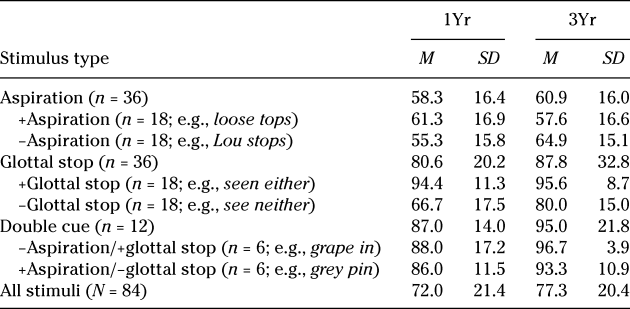
Table 1 shows mean accuracy across participants (the dependent measure in all of the analyses to follow) as a function of cue type and participant group. Global mean accuracy scores were 72.0% for the first-year students and 77.3% for the third-year students. An ANOVA showed that this difference was significant, F(1, 48) = 10.59, p = .002, suggesting an effect of increased exposure to the L2 on the exploitation of these segmentation cues.
Mean accuracy (% correct) and standard deviations on a forced-choice identification task by stimulus type for first-year (1Yr) and third-year (3Yr) participant groups

Mean accuracy scores were further examined according to cue type (aspiration, glottal stop, and double cues), which showed a significant difference in sensitivity among the three stimulus groups, F(2, 144) = 178.66, p < .001, as well as a difference between the two participants groups, F(1, 144) = 17.27, p < .001, but no interaction between cue type and group, F(2, 144) = 1.42, p = .245, indicating that differential sensitivity to the three cue types was equivalent between the two learner groups. Scheffé post hoc tests showed that the double cue stimulus group was identified significantly better than both the glottal stop stimulus group (p < .001) and the aspiration stimulus group (p < .001) and that the glottal stop stimulus group was in turn identified significantly better than the aspiration stimulus group (p < .001).
Next, responses to only the aspiration stimuli subgroups were examined. No significant difference was observed among the three different aspiration sequences (VsC, CsC, and CsCC), F(2, 144) = 0.56, p = .574, or between the two participant groups, F(1, 144) = 1.19, p = .276, nor was there was an interaction between aspiration type and participant group, F(2, 144) = 1.25, p = .290.
Possible differences in response patterns among the three classes of consonants included in the glottal stop stimuli (nasal, liquid, and fricative) were also explored. This analysis revealed a main effect of consonant class, F(2, 144) = 9.99, p < .001, and of group, F(1, 144) = 18.30, p < .001. There was no interaction between consonant class and group, F(2, 144) = 0.92, p = .399, suggesting that the effect of consonant class was equivalent for the two groups. Scheffé post hoc analyses showed that there was no difference between responses to liquid and nasal stimuli, whereas the glottal stop stimuli containing fricatives were identified significantly worse than liquids (p = .022) and nasals (p < .001). Note also that the two +glottal stop stimuli that were produced without a glottal closure (an ice man and save amps) were the only +glottal stop stimuli with identification rates below 90% accuracy for both participant groups (an ice man: first year = 84.0% and third year = 88.0%; save amps: first year = 52.0% and third year = 64.0%; see the Appendix for mean accuracy rates for individual items).
Response patterns for cue presence were then analyzed by examining whether the positive cue stimuli, in which the acoustic cue under investigation was present in the signal (e.g., glottal stop in seen either), were identified differently than the negative stimuli, in which the acoustic cue was absent from the signal (e.g., no glottal stop in see neither). Analyses revealed that there was no difference between +aspiration stimuli (e.g., keeps parking) and −aspiration stimuli (e.g., keep sparking), F(1, 96) = 0.17, p = .681, but that there was a significant interaction between cue presence and the two participant groups, F(1, 96) = 4.96, p = .028. In the glottal stop stimuli, analyses of variance showed that +glottal stop stimuli (e.g., seen either) were identified significantly better than −glottal stop stimuli (e.g., see neither) by both participant groups, F(1, 96) = 157.06, p < .001. Furthermore, a significant interaction was again revealed between cue presence and the two groups, F(1, 96) = 12.50, p = .001. Both of these significant interactions can be attributed to the fact that the third-year group performed better than the first-year group in the identification of the negative stimuli in both the glottal stop and aspiration stimulus groups.
Response patterns for only the double cue stimuli were subsequently examined. There was a significant difference between accuracy rates for +aspiration and −glottal stop stimuli (e.g., grey pin) and −aspiration and +glottal stop stimuli (e.g., grape in), F(1, 96) = 32.91, p < .001. Stimuli of the grape in type were identified significantly better, which we interpret as further evidence of heightened sensitivity to the presence of glottal stops. A main effect of group was also observed, F(1, 96) = 8.11, p = .005, as was a significant interaction between group and double cue stimuli, F(1, 96) = 6.92, p = .010. Post hoc analyses showed that the third-year students showed higher sensitivity to stimuli including −aspiration and +glottal stop (p = .005), indicating more sensitivity either to the presence of aspiration or to the absence of a glottal stop.
The possibility that participants were influenced by the lexical frequency of stimuli and were therefore more likely to choose the phrase in each minimal pair that included higher frequency words was also explored. To this end, the lexical frequencies of the words in each stimulus pair were examined as a function of participant responses. Word frequencies were recorded from Kucera and Francis (Reference Kucera and Francis1967).Footnote 5 Stimulus pairs in which one or both phrases in the pair contained a function word (e.g., team at vs. tea mat) were excluded so as not to skew analyses due to the extremely high frequencies of grammatical words relative to lexical words (the frequency of at is 5,383, whereas the frequency of mat is 5). Stimulus pairs that included proper nouns (e.g., Lou spills vs. loose pills) were also excluded. This resulted in the removal of 36 of the 84 phrases (i.e., 18 out of 42 pairs). Of the remaining 48 phrases (24 pairs), three frequency values were recorded: the frequency of the word preceding the word boundary (W1; e.g., lay in lay scar), the frequency of the word following the word boundary (W2; e.g., scar in lay scar), and the combined frequency of W1 and W2 (e.g., the combined frequencies of lay and scar).
Spearman rank-order correlations were calculated between lexical frequencies and the mean accuracy of responses for each participant group separately. No significant correlations were found for either participant group between mean accuracy and the frequency of W1 (first year: ρ = −.05, p =.710; third year: ρ = −.05, p = .726) or between mean accuracy and the combined frequencies of W1 and W2 (first year: ρ = .14, p = .329; third year: ρ = .10, p = .491). Note that rho values for correlations between mean accuracy and the frequency of W1 were actually negative. Significant positive correlations were observed, however, between mean accuracy and the frequency of W2 for both participant groups (first year: ρ = .44, p = .002; third year: ρ = .32, p = .025), indicating that participants’ responses were influenced by the lexical frequency of the final word in each potentially ambiguous phrase.
Biographical data provided by participants were also examined in relation to performance on the forced-choice identification task. The data include self-reported proficiency in listening, reading, writing, and speaking as well as amount of overall English study and weekly language use. No significant correlations were observed between overall mean accuracy scores and self-reported proficiency in oral comprehension (ρ = .19, p = .189), written comprehension (ρ = .08, p = .600), written expression (ρ = .03, p = .852), or oral expression (ρ = .05, p = .720), nor was a significant correlation found between overall accuracy and overall self-reported proficiency, measured as an average of the four proficiency measures (ρ = .09, p = .547). Furthermore, no significant correlations were observed between accuracy and amount of English usage, including number of hours per week spent listening to English (ρ = −.08, p = .589), speaking English (ρ = −.12, p = .397), reading English (ρ = .01, p = .965), or writing English (ρ = .07, p = .648). One correlation with overall accuracy scores approached significance, which was that of overall length of time studying English (ρ = .25, p = .083), providing further evidence for an overall effect of language exposure on the acquisition of allophonic cues.
DISCUSSION
The current study examines the exploitation of subphonemic acoustic variation at word boundaries in English by native speakers of French. Learners were tested on their ability to use the presence of word-initial aspirated voiceless plosives and prevocalic glottalization in the localization of word boundaries in English. The results of the present study make three specific empirical contributions. First, these findings contribute to an expansive body of work demonstrating that late learners can be constrained in the auditory processing and segmentation of a L2 and may not process speech with the same efficiency as native speakers (Cutler, Reference Cutler2001). Previous research has shown that native speakers of English perform at or near ceiling in the disambiguation of phonemically identical sequences such as those employed here (Altenberg, Reference Altenberg2005; Ito & Strange, Reference Ito and Strange2009; Nakatani & Dukes, Reference Nakatani and Dukes1977). Globally, our French-speaking participants performed significantly above chance, but below native levels, in the perception of the two allophonic word boundary cues examined here. They correctly identified 74.6% of potentially ambiguous stimuli, which demonstrates that processing is not as efficient as it is for native speakers.
Second, whereas L2 learners may not process speech at L1 levels, our results do show a clear effect of language exposure in that third-year participants identified potentially ambiguous stimuli better than first-year participants. An effect of language exposure on the acquisition of noncontrastive acoustic detail is particularly provocative in that subphonemic acoustic variation is an aspect of L2 phonology that is rarely the object of explicit classroom instruction. Phonological instruction normally places great emphasis on the learning of phonemic contrasts (e.g., through the study of minimal pairs) but rarely gives equal attention to the types of allophonic variation discussed here. Neither of the cues examined here is systematically used to mark the edges of words or other prosodic domains in French; however, learners were nonetheless able to use these cues in the disambiguation of phonemically identical phrases in English, providing evidence of the implementation of L2 segmentation strategies not employed in the L1. Also, in line with previous work, the identification of stimuli by L2 learners was greatest when both cues were present in the signal (i.e., in the double cue stimuli), which suggests a cumulative effect in the acquisition of L2 word boundary cues. Ways in which within-category variation in the L2 may be acquired are discussed later in this section.
Third, these results add to research that shows differential sensitivity to various acoustic cues to L2 speech segmentation. Participants identified stimuli that incorporated glottal stops better than stimuli that incorporated aspirated voiceless plosives, even though neither of these cues is exploitable in the participants’ L1. Furthermore, a significant difference between positive and negative stimuli was observed for glottal stop stimuli but not for aspiration stimuli, further attesting to the salience of glottal stops. This particular pattern of results was also observed in Ito and Strange (Reference Ito and Strange2009). This finding, along with the results of previous work, leads to the following question: To what extent can differential exploitation of glottal stops versus aspiration be attributed to general auditory mechanisms, the transfer of L1 processing routines, or both? In other words, is it the learner’s L1 background that determines which cues can efficiently be exploited in the segmentation of the L2, or are some segmentation cues universally more salient regardless of linguistic experience, as suggested by Tyler and Cutler (Reference Tyler and Cutler2009)?
Support for a theory of L1 transfer comes from a comparison of the current results with previous work by Altenberg (Reference Altenberg2005) and Ito and Strange (Reference Ito and Strange2009). Direct comparisons among these three studies must be made with caution, given that they did not employ exactly the same recorded stimuli, and participants were not tested under the same conditions. However, if L1 transfer is indeed a factor in the perception of L2 word boundary markers, Japanese speakers would be expected to identify aspiration stimuli substantially better than both Spanish and French speakers, because the Japanese language shows more systematic aspiration of initial voiceless plosives than both Spanish and French (see Riney et al., Reference Riney, Takagi, Ota and Uchida2007, for Japanese data; Williams, Reference Williams1977, for Spanish data; and Fougeron, Reference Fougeron2001, for French data). Indeed, of the L2 groups in the three relevant studies, the Japanese speakers performed best on aspiration stimuli overall (73.1% accuracy) as compared to both Spanish speakers (58.0% accuracy) and French speakers (59.5 % accuracy). A theory of L1 transfer would predict this pattern.
A comparison of the three studies with regard to the perception of glottal stop stimuli is more challenging to interpret given that accuracy rates did not show such substantial differences. Japanese speakers in the Ito and Strange (Reference Ito and Strange2009) study correctly identified 91.3% of glottal stimuli, whereas Spanish speakers in Altenberg (Reference Altenberg2005) correctly identified 88.4% of glottal stimuli. In the current study, French speakers had a rate of 84.8% correct identification. Support for a theory of the universal saliency of glottal stops, as opposed to one based primarily on L1 transfer, comes from the fact that both French and Spanish employ glottal stops substantially less than Japanese and yet learners from both L1s are still significantly more sensitive to the presence of glottal stops than to that of aspiration. The ensemble of these three studies would lead us to conclude that glottal closures may be universally more salient and therefore more easily perceived than aspiration, regardless of linguistic background. Though increased exposure to the L2 plays a vital role in the acquisition of speech processing strategies, as evidenced by a clear effect of exposure on the part of the third-year participants as compared to the first-year participants, our results suggest that the effects of exposure may not be equally robust for all acoustic cues found in the speech signal.
There is one other possible explanation for differential sensitivity to glottal stops as opposed to aspirated plosives that is based in neither of these theories. The aspiration stimuli in the current study included consonant clusters at the word boundary, whereas the glottal stop stimuli did not. Complex clusters at word onsets as seen in the current stimuli are rare in French as compared to English (Dell, Reference Dell1995), which could have led to decreased performance on aspiration stimuli. If the complexity of clusters played a role in the perception of word boundaries, a difference among the three aspiration subgroups for French-speaking participants would be expected, with performance decreasing from simpler to more complex clusters (VsC > CsC > CsCC); however there was no observed difference in performance among the three types of stimuli. Nonetheless, the fact that all of the aspiration stimuli included clusters at the word boundaries, whereas the glottal stop stimuli contained one single pivotal consonant at the word boundary, could have rendered segmentation more difficult for speakers of French.
It is also important to note that there are further acoustic (and phonological) cues at play in the localization of word boundaries in running speech. Although we have focused here on two specific acoustic cues used in the segmentation of English, listeners (both native and nonnative) have access to myriad others. For example, in the aspiration stimuli employed here, VOT was assumed to be the most salient acoustic cue; however, Ito and Strange (Reference Ito and Strange2009), in their detailed acoustic analyses of these stimuli, also noted that the +aspiration stimuli (e.g., loose tops) showed shorter frication of /s/ and shorter durations of the preboundary vowel than −aspiration stimuli (e.g., Lou stops). The +glottal stop stimuli, in addition to the presence of glottal closure and laryngealization, also showed shorter nasal murmur in the nasal group (e.g., seen either) and shorter frication of /f/ and /v/ in the fricative group (e.g., loaf ate) than −glottal stop stimuli (e.g., see neither or low fate). Further acoustic cues not discussed in Ito and Strange include the presence of unreleased word-final stops (e.g., the final /t/ of light is not completely released in light old ) as well as velarized word-final /l/ (e.g., in seal of as opposed to see love). These cues, among others, likely also aided participants in the localization of boundaries.
Lexical frequency also played a role in participants’ responses. The frequency of W2 in each phrase (e.g., scar in lay scar and car in lace car) was positively correlated with mean accuracy for both groups. Correlations between W2 and mean accuracy were stronger for the first-year group than for the third-year group, suggesting that the first-year learners relied more heavily on lexical frequency in interpreting the potentially ambiguous phrases. The fact that the third-year learners showed a weaker (though still significant) correlation between accuracy and frequency could indicate that more advanced learners were less influenced by top-down information and based their responses more on the physical acoustic signal than did the first-year participants. This result could be interpreted as further evidence of increased sensitivity to allophonic acoustic variation on the part of the third-year participants relative to the less experienced first-year learners. Any conclusions about the role of lexical frequency in the current results must remain tentative, however, given that the analysis included only 48 of the 84 stimuli.
The current results also suggest that learners are dependent on the presence of acoustic cues for segmenting speech, which contrasts with the performance of native speakers, who show no functional difference in the identification of positive stimuli compared to negative stimuli. In other words, native speakers can use the absence of a cue as efficiently as the presence of a cue to locate a word boundary, identifying, for example, tea mat as readily as team at. Participants in both learner groups performed better in the identification of +glottal stop stimuli (e.g., an ice man) than −glottal stop stimuli (e.g., a nice man). The aspiration stimuli showed no global difference between the identification of positive and negative stimuli (e.g., lace peach and lay speech). However, what is particularly interesting from a developmental point of view is the fact that in both the aspiration and the glottal stop stimuli, significant interactions between cue presence and participant group revealed that the third-year group performed significantly better in the identification of negative stimuli than the first-year group. In other words, the third-year students are moving toward more nativelike behavior in that they are developing sensitivity to the absence of cues. This particular result suggests that French-speaking learners are learning to map not only the presence but also the absence of nonnative segmentation cues to word boundaries in L2 English. A further contribution of the current study is, therefore, that we are able to pinpoint a specific pattern of L2 phonological development that has not been identified in previous work.
A great deal of L2 research has dealt with the acquisition of nonnative categories—that is, phonemic contrasts that may not be a part of the L1 phonology (e.g., Best, McRoberts, & Goodell, Reference Best, McRoberts and Goodell2001; Flege, Reference Flege and Strange1995, Reference Flege, Burmeister, Piske and Rohde2002). Where research is currently lacking, however, is in discussion of how within-category acoustic information may be acquired and exploited by L2 learners. In other words, how do late learners come to use acoustic information that does not serve to differentiate sounds at the phonemic level but that plays an essential role in the processing of continuous speech? One other specific question that arises from our findings is how learners learn to map the absence of segmentation cues.
One way to view the acquisition of allophonic or fine phonetic detail is from the perspective of models of acquisition of phonetic systems based on general statistical learning. According to models of statistical learning, phonological acquisition is shaped by statistical regularities in the acoustic input such that the phonological system in effect organizes itself according to the distributional properties of the phonological environment (e.g., Maye, Weiss, & Aslin, Reference Maye, Weiss and Aslin2008; Saffran, Newport, & Aslin, Reference Saffran, Newport and Aslin1996). Peperkamp, Le Calvez, Nadal, and Dupoux (Reference Peperkamp, Le Calvez, Nadal and Dupoux2006) propose specifically that rules governing instances of allophony emerge from a distributional analysis that exploits the fact that phonemes and their allophones are in complementary distribution. This could be applied to the current English data in that, for example, an aspirated /t/ is in complementary distribution with an unaspirated /t/, and prevocalic glottal stops are in complementary distribution with consonantal onsets. This fact could aid the listener in the acquisition of boundary marker cues and could further offer an explanation for the increase in third-year students’ sensitivity to the absence of cues in that if an entire distribution is acquired rather than just one particular acoustic cue, sensitivity to the absence of the cue is implicit.
We stress that the current study was not designed to specifically test a statistical learning paradigm, and therefore any conclusions as to the role of statistical learning in the current results are purely conjectural. Further support for a model based on statistical learning, however, is provided by the effects of word frequency that were observed in the current study. Participants identified more frequent items better than less frequent items, which suggests that learners are sensitive to and track the distribution of these items in the L2 input.
CONCLUSION
The present study investigated the exploitation of allophonic cues to word boundaries in English by native speakers of French. Participants completed a forced-choice identification task in which they were asked to identify potentially ambiguous phrases differentiated by the presence of prevocalic glottal stops and the aspiration of word-initial plosives. Results showed a clear effect of language exposure in that third-year participants identified stimuli significantly better than first-year participants. Additionally, learners in both groups better identified stimuli in which the segmentation cue under investigation was present in the signal (i.e., the positive stimuli) than those in which the cue was absent from the signal (i.e., the negative stimuli). The third-year participants correctly identified more of the negative stimuli, suggesting that the more advanced learners are developing more complex and nativelike perceptual strategies in that they are developing sensitivity to the absence of cues in the signal.
Participants also showed greater sensitivity to the presence of glottal stops than to the presence of aspiration, adding to previous work that has shown the same differential sensitivity in Spanish- and Japanese-speaking learners of English. Earlier research has suggested that heightened sensitivity to glottal stops relative to aspiration may be attributable to transfer from the L1, universal markedness, or both. Given that neither of these cues is used systematically in French and yet French learners also showed increased sensitivity to glottal stops, the current results suggest that glottal stops represent for learners a more salient boundary cue than the aspiration of plosives, regardless of their linguistic background.
Further research is needed to establish whether the current findings are limited to the populations that have already been studied or if the glottal stop is universally more salient, both in general auditory perception and specifically as a word boundary cue. One way to test the role of L1 transfer versus universality in differential sensitivity to segmentation cues would be to test speakers of a L1 that uses these acoustic cues contrastively. For example, in testing learners of English who are native speakers of languages that use aspiration contrastively, such as Thai or Hindi, one could test whether glottal stops continue to be more salient when the linguistic experience of the learner includes heightened sensitivity to aspiration. Equivalent sensitivity to pairs distinguished by aspiration relative to pairs distinguished by glottal stops or increased sensitivity to aspiration pairs on the part of these learners would be a strong argument in favor of L1 transfer. Conversely, if glottal stops were perceived better by speakers of L1s that use aspiration contrastively, this would offer further evidence of the universal salience of this cue.
Establishing the universal perceptual salience of particular word boundary cues has broad implications for the study of L2 phonological acquisition. A hierarchy of cues would allow us to gain insights into the processes of L2 acquisition and allow us to better predict what and why certain phonological phenomena are more easily acquired than others.
APPENDIX MEAN IDENTIFICATION ACCURACY (% CORRECT WITH STANDARD DEVIATIONS) FOR EACH STIMULUS ITEM FOR EACH PARTICIPANT GROUP