On Tuesday, August 9, 1864, the New York Times published an unassuming editorial titled “Adirondack.”Footnote 1 Despite consuming nearly a full column down the right side of the page, to a causal reader that day the topic might have seemed trivial, or at the very least indistinguishable from the news that surrounded it. Included was a report of the city’s expenses for the coming year, intelligence of Admiral Farragut’s campaign against the port of Mobile, and a letter praising the good people of New York for providing blackberry wine “for our noble and suffering soldiers” entrenched in their third year of civil war.Footnote 2 Inspired perhaps by the oppressive summer heat, the unnamed author—long suspected to be Charles Loring Brace—felt compelled to extol the advantages of the vast North Woods, where “within an easy day’s ride of our great City,” there exists, “a tract of country fitted to make a Central Park for the world.”Footnote 3
By 1864, the city of New York had swelled to more than 800,000 inhabitants, easily surpassing Philadelphia as the most populous city in America. Over a span of less than twenty years, New York had doubled in size into a metropolis that rivaled the great commercial and manufacturing centers of the world.Footnote 4 But its working class was increasingly wedged into a dense labyrinth of tenements, where close quarters made tempers boil between racial and immigrant groups, and where stale air and stagnant water made living dangerous for everyone. Newspapers sometimes published weekly reports of the city’s dead, summing into neat columns the numbers of those who had fallen victim to contagious diseases like typhus, cholera, and consumption.
It was not until 1865 that a report on the sanitary condition of the city was finally released, sympathizing with the plight of families routinely exposed to “repulsive and nauseous scenes in the abodes of misery and want, and to the infectious localities and homes of disease and death.”Footnote 5 And it was not until 1865, after decades of conflict between the city and the state, that construction finally began on an ambitious network of aqueducts and sewers to amend the problem.Footnote 6 It was, as Theodore Roosevelt later recalled, “the worst decade in the city’s political annals.”Footnote 7
The suffocating realities of the industrial age must have made the solitude of wilderness seem irresistibly attractive. According to the editors of the New York Times, the Adirondacks were a place “to which we can easily escape during the intervals of business, and where we can replenish our fountains of vitality, exhausted by the feverish drain of over-effort.”Footnote 8 Moreover, it was a destination well within reach of the newspaper’s urban subscribers, given the steady advance of stage lines and railroads. They noted that “the jaded merchant, or financier, or litterateur, or politician, feeling excited within him again the old passion for nature … has only to take an early morning train, in order, if he chooses, to sleep in the same night in the shadow of kingly hills, and waken with his memory filled with pleasant dreams, woven from the ceaseless music of mountain streams.”Footnote 9
That anyone could have recommended untamed forest land as a spiritual retreat might have seemed lunatic (or at the very least eccentric) to someone living a generation before. On his journey through the United States in the 1830s, Alexis de Tocqueville observed that Americans rarely gave the wilds around them a second thought. They were, he said, “insensible to the wonders of inanimate nature and they may be said not to perceive the mighty forests that surround them till they fall beneath the hatchet.” He lamented the sight of men “draining swamps, turning the course of rivers, peopling solitudes, and subduing nature.”Footnote 10 The trouble in rural America, quite simply, was that the whole of society lived too close to nature to appreciate it.Footnote 11
Yet by the mid-nineteenth century, a shift in popular sentiment was under way, one that would eventually replace Puritan fear of hostile wilderness with a romanticized vision of opportunity and adventure.Footnote 12 It was a movement begun, as Roderick Nash later wrote, “in the cities,” where its inspiration was fueled not by the rural pioneer, but by “the literary gentleman wielding a pen.”Footnote 13 Novelists like James Fenimore Cooper developed fictional characters that soon competed with history itself in the creation of homespun heroes from Natty Bumppo to Daniel Boone. Henry David Thoreau and George Perkins Marsh explained in words what artists of the Hudson River School of painting portrayed in portraits of lush landscapes, or what William Henry Jackson and Seneca Ray Stoddard documented in albumen photographs.
The mass-marketing of nature—of the idea of wilderness itself—was crucial in creating an attentive audience for those who would later push for political reform on the pages of city newspapers. For families unable to spend lavishly on excursions to Saratoga Springs or Niagara Falls, the sale of dime novels, travel guides, and stereoviews meant that almost anyone could develop a vicarious appreciation for the wilds of New York without ever leaving home.Footnote 14 More important, it also meant that almost anyone could feel a stake in its survival. By the time the American frontier was officially closed by the U.S. Census Bureau in 1890, men of industry once revered for their resourcefulness would find themselves scorned as “vandals” and “pirates of the forest.”Footnote 15
But in 1864, outrage over the loss of wilderness was still nascent, hibernating beneath the surface of a world inching closer to the Gilded Age. According to the editorial published in the New York Times in August of that year, the Adirondack territory was a “realm of mystery” to be prized for its pristine mountains and lakes, rocks, and rivulets. They wrote optimistically of securing access by railroad, and of the “enormous possessions” that would soon be at the feet of humanity, including timber and iron ore. Conveying an uneasy mix of pride and apprehension, they knew the Adirondacks would soon become “a suburb of New-York.” So here, they said,
We venture a suggestion to those of our citizens who desire to advance civilization by combining taste with luxury in their expenditures. Imitating the good example of one of their number, who upon the eastern slopes of Orange Mountain has created a paradise, of which it is difficult to say whether its homes or its pleasure-grounds are more admirable, let them form combinations, and, seizing upon the choicest of the Adirondack Mountains, before they are despoiled of their forests, make of them grand parks, owned in common, and thinly dotted with hunting seats, where, at little cost, they can enjoy equal amplitude and privacy of sporting, riding and driving, whenever they are able, for a few days or weeks, to seek the country in pursuit of health or pleasure. In spite of all the din and dust of furnaces and foundries, the Adirondacks, thus husbanded, will furnish abundant seclusion for all time to come; and will admirably realize the true union which should always exist between utility and enjoyment.Footnote 16
At the time those words were penned, there were no nature parks in the state of New York, or anywhere else in the world for that matter. What the city did have was its new “Central Park,” where construction had begun in earnest in 1857. Over the next few years New Yorkers watched in astonishment as Frederick Law Olmsted and Calvert Vaux’s design for a pastoral landscape filled with sweeping scenic vistas, lawns, woodlands, and meadows began to rise like a phoenix out of existing tenements, quarries, pig farms, and swamp land. But Olmsted and Vaux’s plan had been for a public park in the English romantic tradition, one where residents could stroll along wide promenades, or follow gently curving carriage roads to poetically named destinations like the Ramble or the Esplanade.Footnote 17 Whether they knew it or not, what the editors of the New York Times had dared to suggest in the Adirondacks was something else entirely.Footnote 18
To protect wilderness in its natural state was a strikingly novel idea in 1864. When George Catlin suggested a “nation’s Park” in a remote area of the American west near the mouth of a river that Lewis and Clark called “Yellowstone,” most Americans had no way of knowing what he meant.Footnote 19 Throughout history, parks had been defined by acts of creation, not preservation. They were, in essence, manufactured public spaces, designed on paper by men like Olmsted and brought to life by crews of thousands who went about their work grading soil and planting trees. The Lake on which skaters glided in the wintertime in Central Park was there in precise size and shape because of how it had appeared in the architects’ vision. An island hovered near its eastern shore because workmen placed it there. Portions of the park appeared coarse and rustic to be sure, but they too were assembled in an effort to encourage moments of quiet contemplation.Footnote 20
In contrast, by the Victorian standards of the day, virtually nothing had been altered in the Adirondacks. Visits to the region brought to mind an island of a different kind, surrounded as it was by the turbulent seas of modern civilization:
No railroads, or canal, or turnpike traverses it; no steam-whistle is heard in all its borders; no boat for commerce or pleasure larger than a row-boat cuts the silent waters of its hundreds of lakes and streams. Here, alone in the Eastern States, the whirl of the factory or the hum of commerce is not heard. Around this enchanted island, the waves of business and the currents of traffic, and all the storm of the busy American world seem to beat in vain, leaving its sylvan solitudes and still lakes and ancient forests as peaceful and lonely as they were when the Pilgrims first landed.Footnote 21
For the Times to propose the creation of a “park” in the Adirondacks in the summer of 1864 meant preserving much of the land as it was. As unlikely as it may have seemed, it meant preserving nature itself.Footnote 22
On September 8, 1894, just one year after Frederick Jackson Turner delivered his famous address on the closing of the American frontier at the World’s Columbian Exposition in Chicago,Footnote 23 representatives to the state constitutional convention in Albany, New York, unanimously approved a new article stating that nearly three million acres of public land in the Adirondack mountains “now owned or hereafter acquired” would be “forever kept as wild forest lands.” The proposal met with virtually no opposition among the delegates, most of whom, according to the New York Times, were “wonderfully impressed by the magnitude of the problem presented” and thought the action of “vital importance.”Footnote 24 After the passing of thirty years, the issue of wilderness preservation was no longer the subject of raucous debate. In a series of incremental steps, beginning with the creation of a forest preserve in 1885, and a state park seven years later, the idea had finally achieved political legitimacy. It was overwhelming public sentiment that pressed to have the matter written into the state constitution.Footnote 25
The delegates’ decision that day—combined with thirty other amendments from the convention—was ratified by the citizens of New York through a popular vote two months later. There were, as the editors of the Times noted, some “objectionable propositions in the lot,” including a prohibition against several forms of gambling that they thought to be “provincial, narrow and puritanical.” It was, however, a long and patient list that contained other amendments that in their view “would be a public misfortune to lose.”Footnote 26 The Forestry Amendment was one of them.
This article explores the language and symbols that newspapers used to advance the creation of the Adirondack Park between 1864 and 1894. By doing so, it explains how an idea and an ideology came together in the politics of nineteenth century America to produce one of the most appealing myths in environmental history.Footnote 27 The idea spawned a movement to create the world’s first nature parks and forest preserves; the ideology was democracy itself. In theory, their convergence was instrumental in the creation of the parks by lending political voice and legitimacy to growing public demands for wilderness preservation. Yet as the following pages attest, the origins of a “people’s park” in the Adirondacks reveal a tangled fusion of rhetoric and reality that is far more complex.
THE DEMOCRACY THESIS
In the decades separating the New York Times editorial in 1864 from the addition of the “forever wild” clause to the New York State Constitution in 1894, much had changed. The popularity of the Adirondacks as a tourist destination soared, especially following the publication of the Reverend W. H. H. Murray’s book Adventures in the Wilderness; or, Camp-Life in the Adirondacks in 1869.Footnote 28 With the number of “rusticators” multiplying at first by the hundreds, then by the thousands, opportunists like John Hurd and William Seward Webb proposed the construction of railways along the west shore of Lake Champlain to Plattsburgh, from Malone to Mohawk, and from Herkimer to Old Forge. Overuse and exploitation fed demand for forest preservation on the part of activists like Verplanck Colvin and the Adirondack League Club. The precedent of public land acquisition in Yosemite and Yellowstone made protecting wilderness more salable and less revolutionary. But above all, the quest for a park in the Adirondacks became inexorably tied to democracy itself.
Today, scholars attribute the success of the park movement—both in the Adirondacks and around the country—to a variety of factors. In “The American Invention of National Parks,” Roderick Nash points to four in particular. He writes of the nation’s reliance on wilderness as a part of its cultural identity; of the availability of large tracts of undeveloped land for preservation; of the affluence that allowed Americans the luxury of concern for nonutilitarian goals; and of the importance of democratic ideology.Footnote 29
The relationship between parks and democracy has always been appealing. Presidents from Theodore Roosevelt to George H. W. Bush have embraced parks as uniquely American institutions that “by their very existence” serve to justify democratic government.Footnote 30 For others, parks are “a public estate” and “a pact between a nation and all its people,”Footnote 31 existing in a world where few places “demonstrate a commitment to egalitarianism more honestly.”Footnote 32 The writer Wallace Stegner thought simply that parks were “the best idea we ever had. Absolutely American, absolutely democratic, they reflect us at our best rather than our worst.”Footnote 33
Roderick Nash’s article on the invention of the parks may be less expressive in words than these, but it is more interesting and ambitious because it is explicitly causal. “Without the existence of a democratic ideology,” he says, the idea of the parks would have been “inconceivable.”Footnote 34 He argues that democratic norms and ideals acknowledged the value of nature for all people in a way that denied European tradition, which granted monopoly to the rich and the royal. Democratic institutions, meanwhile, provided a framework in which parks could succeed politically. “Along with sentiment for saving wilderness, the idea of governmental responsibility was necessary to set the stage for actual preservation.”Footnote 35 In short, two elements are key in what might be called the democracy thesis: a commitment to egalitarianism on the one hand, and a respect for popular sovereignty on the other. Whether those ideals were in fact catalysts in the creation of the Adirondack Park will be explored here through a content analysis of period newspapers.
THE NEWSPAPER AS NARRATOR
For scholars of American history and mass communication, the Gilded Age press is an important source of information because newspapers had both persuasiveness and political authority on their side.Footnote 36 Indeed, as James Bryce writes in the American Commonwealth (1888), newspapers were potent “advocates of political doctrine” that were both “universally read” and “often ably written.”Footnote 37 So it should come as so surprise that for the park movement, in particular, it was newspapers that provided the narrative that gave the movement its identity.
By the late nineteenth century, Bryce’s confidence in the power of the press was supplemented by the work of others, whose training encouraged them to test simple observations with new, rigorous, and increasingly scientific techniques. In 1893, John Gilmer Speed, a former and disgruntled managing editor of the New York World, used a primitive form of content analysis to prove that the newspapers of the day were shifting their coverage away from serious political and literary topics, toward gossip and salacious scandal.Footnote 38 Soon after, researchers adapted the methodology to the activities of the tabloid press, its impact on social behavior, and even “the establishment of a systematic psychology of newspapers.”Footnote 39
The power that Bryce and his followers saw in the press was largely one of issue framing. It was the “organ” through which a narrative story could be told; one that might, through careful language, emphasize one set of causal conditions over another. Footnote 40 In other words, newspapers had a unique ability to create what Frank Graham Jr. called “a constituency for the Adirondacks.”Footnote 41
Within this context, editorials were especially significant. Over the course of the nineteenth century, journalists increasingly embraced a norm of objectivity when reporting the news, but on the editorial page they continued to promote issues and agendas explicitly.Footnote 42 This makes the text ideal for later systematic study because it allows scholars not only to identify and track the use of certain symbols—for instance, the expressions of egalitarianism or popular sovereignty so vital in the Adirondacks—but also to measure fluctuations in attention and changes of attitude toward them.Footnote 43
Today, newspaper editorials are frequently subjected to qualitative methods on a wide range of topics. They have been used to examine America’s mobilization for entry into World War I, forms of political propaganda printed in Nazi Germany and Communist Russia, and even the ideologies espoused by U.S. Supreme Court justices.Footnote 44 In short, the use of content analysis to study media communications has a long and fruitful history, one that creatively merges two strains of academic inquiry, the politics of language and the science of politics.
Any study that attempts content analysis must first begin by selecting a source. As the largest city in mid-nineteenth-century America, New York boasted several major, long-standing newspapers, among them the Sun, the Herald, the Tribune, and the Times. I chose the Times here largely because of its centrist position. Of the four, it was more serious and less sensationalistic than either the Sun or the Herald, and while Republican in tone, it reflected a less radical ideology than Horace Greeley’s notorious Tribune.Footnote 45 According to one biographer, by the start of the Civil War the Times “had already won itself a place as one of the great papers in America.” It was influential and widely read.Footnote 46 Finally, unlike its peers, the Times today has the benefit of a full-text online database, which allows researchers not just to sample, but to reconstruct the entire population of editorials published on any given subject, thereby avoiding the typical biases that are leveled against content analysis by its critics.Footnote 47 For all these reasons, the New York Times has long been a preferred source for scholars in the field, which more than justifies its use as a primary source here.Footnote 48
PROMOTING A PEOPLE’S PARK
In the summer of 1871, the New York Times reported on a recent Sportsmen’s Convention held in Utica, where the following resolution was offered for the consideration of its members: “Resolved, That in the opinion of this Convention, the forests of the Adirondacks, being a natural reserve for the recreation of the public, should be preserved by an act of the Legislature of the State, as a public forest, inalienable and indestructible forever, for the uses of the public.”Footnote 49 The language of that proposal stands in interesting contrast to the one made by the editors of the Times seven years earlier.Footnote 50 When promoting the creation of “grand parks” in the Adirondacks in 1864, they had overlooked the involvement of government, or the possibility of securing land through public ownership. When they wrote of forming “combinations,” their message was directed to private citizens who had the financial means to purchase large tracts of property on their own initiative.Footnote 51 The editors may have compared the Adirondacks to Central Park with the best of intentions, but unlike Olmsted and Vaux’s egalitarian design for the latter, the plan they envisioned was not truly public. What the sportsmen of New York provided (that the 1864 editorial did not) was both a means and a rationale for the creation of a people’s park.
As a slogan, the notion that parks for were for “the people” was undeniably attractive in the politics of the mid-nineteenth century. According to Joseph Sax, it “harmonized with a principle that was then at the very crest of its influence in American land policy.”Footnote 52 Beginning with the Homestead Act in 1863, the federal government offered those willing to settle in remote areas of the western frontier such as Nebraska, Minnesota, and the Dakotas, up to 160 acres of land free of charge. The only legal condition was that families maintain residence and provide proof of improvements (such as the construction of log homes, barns, and corncribs) within five years time. In other words, almost anyone, regardless of financial circumstances, could aspire to own land free from the monopolization of the rich, simply by applying hard work. As Sax argues, the “application of that principle to the great scenic wonders” could not be realized by granting a sequoia grove or Grand Canyon to each citizen. But it was possible to preserve the spectacular sites for the average citizen by holding them as public places to be enjoyed by all.Footnote 53
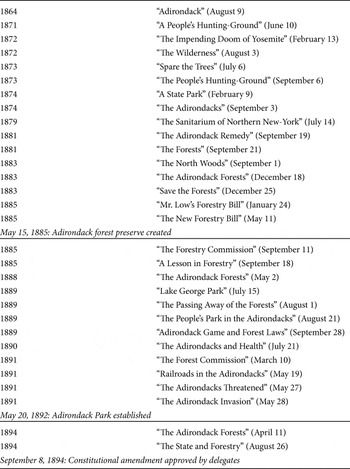
That idea succeeded first in Yosemite in 1864, then again in Yellowstone eight years later. With those precedents in mind, growing confidence in the value of a “people’s park” in the Adirondacks spilled over onto the editorial pages of the New York Times. Between 1864 and 1894, thirty editorials were published on topics specific to the region (see Table 1).Footnote 54 Several took no position on the issue of a park at all, promoting little more than the medicinal value of mountain air, or the weaknesses of state laws that allowed the slaughter of game out of season. Others pressured the state legislature with vague and imprecise directives, insisting that it should fulfill its “duty” in preserving and maintaining the state’s water supply, or in protecting the forests from rapacious lumbermen and railroad barons. But a majority of the columns—seventeen in all—had one particular solution in mind: the creation of a public park or forest preserve. Most interesting of all, each of those justified the decision (at least in part) on democratic grounds.
Timeline of Editorials Appearing in the New York Times, 1864–1894

Note
Articles were identified by using ProQuest’s full-text database of the New York Times (1851–2006). Search dates were restricted to the period between 1864 and 1894, while search terms of the document text included this combination: Adirondack* OR North Woods. An asterisk was used as a wild card to capture both singular and plural forms. In total, the search produced 4,928 matches, which included articles of all kinds and style (e.g., news items, correspondence, social notices, real estate listings, etc.). By examining the content and placement of each article, that list was narrowed to 30 editorials.
The editors of the New York Times agreed enthusiastically with the sportsmen in Utica in 1871 that the Adirondacks “would indeed make a superb people’s park for all future centuries.”Footnote 55 They wondered in 1874 when “this lovely region, so fitted for the enjoyment of the people” would at last be preserved as a “’People’s Park’ for the whole nation.”Footnote 56 Varying the cadence of their appeal only slightly in 1885, the Times lobbied for the creation of a “people’s forest” and a “people’s pleasuring ground.”Footnote 57 They envisioned a place where even “an underpaid clerk and saleswoman in New-York [would] find it within his or her means to spend vacation in one of the most delightful spots on the face of the globe.”Footnote 58 Since those refrains amounted to but a handful among many, it might have seemed to the newspaper’s subscribers that equality and opportunity were everywhere in the Adirondacks.
The setting aside of wild lands for public ownership and common use was an unusual practice that distinguished the United States from its European counterparts, and Americans knew it. Editorials eager to defend the “people’s park” were written in a manner that reflected the egalitarian sentiments of the day, but they were equally nationalistic in purpose and design.Footnote 59 Lacking heroic castles, grand cathedrals, and ancient ruins, Americans found within the park ideal a way to assuage their lingering sense of cultural inferiority.Footnote 60 According to the Times, what “princes and millionaires enjoy in the Old World—their own solitudes and undisturbed forests and preserves, would here be offered to the people, without price or condition.”Footnote 61 Public parks were “worthy of the dignity of modern democracy.”Footnote 62 They were places where Americans could “show to the benighted European as a proof of what nature—under a republican form of government—can accomplish.”Footnote 63
If egalitarianism offered a compelling reason to create a public park in the Adirondacks, then surely government would be the mechanism through which it was achieved. When it came to the scenic beauty of Tupper Lake or the primitive wilderness of Mount Marcy, the principles of Jacksonian democracy could easily be extended to support equality of access for rich and poor alike. But after years of legislative inaction and delay, appeals to equality alone were not enough. By the 1880s, what the New York Times had learned to invoke in addition were the republican principles on which the nation was founded. By insisting that all legitimate governments base their decisions on the will and consent of the people, they openly summoned the power of popular sovereignty. Only with a “general and aroused public opinion” did they believe the deprecators of the forest could be stopped.Footnote 64
James Bryce noted in his book the American Commonwealth that if public opinion was the “sovereign to whose voice every one listens,” newspapers might be described as its “chief organ.” The dailies, he said, were “narrators” that reported on events, “advocates” that defended ideological positions, and “weathercocks” that sensed shifts in the direction of popular sentiment.Footnote 65 In 1885, the year in which a forest preserve was first established in the Adirondacks, the New York Times insisted that no measure had appeared before the legislature in Albany with “more popular feeling and intelligent interest.” In pressing for action themselves, they noted that the proposal was backed by the “immense majority of the voices of the State.”Footnote 66 By the time the Adirondacks were placed under the protective aegis of the state constitution in 1894, public demand for a park had been demonstrated—at least according to the Times—“over and over again,” emphatically and deliberately.Footnote 67
While it is interesting that the editors of the New York Times chose to inject democratic rhetoric into political debates on the creation of an Adirondack park, it is vital to note that language alone says little about how effective that argument was, either in persuading the state legislature to take action, or in rallying popular support for the cause. While newspaper editorials can tell us much about the messages that are directed toward a reader, they capture little or nothing of the reader’s response. Proving media persuasion ultimately requires “a persuader, a message and measurable change in the mental state of the recipient,” and reliable indicators of the latter are difficult, if not impossible, to find in an age prior to the advent of modern survey research.Footnote 68 Yet as Gary King, Robert Keohane, and Sidney Verba point out in Designing Social Inquiry, the broader theoretical challenge, which hinges not on public opinion per se, but rather on the rhetorical devices newspapers used—is not insurmountable. If democratic ideals were instrumental in creating the park, it should be possible to observe certain implications of that theory, and subject them to standard rules of causal inference.Footnote 69
Legislative Delay
First, chronology is important. For intuitive and obvious reasons, a theorized cause must occur prior to its supposed effect in time. Even more important here, however, is the expectation that it also be causally proximate to it. Since democratic principles were invoked in political debate as early as 1864, and became commonplace on the editorial pages of the New York Times within the following decade, it seems unlikely that those values would have played a major role in influencing the state legislature’s decisions to create a forest preserve in 1885, a public park in 1892, or a constitutional amendment in 1894. When viewed as a time sequence, what is most striking about the park debate is not the use of democratic rhetoric per se, but rather the length of the legislature’s delay in responding at all.
A Multitude of Variables
Second, while the Times frequently cited democratic principles in justifying the park, so too were a host of other considerations, all of which muddy the causal waters by introducing additional variables. For example, from an urban perspective, the idea was easily defended on utilitarian grounds alone. Throughout the nineteenth century, large stands of white pine and spruce were routinely cut for lumber, hardwoods reduced to charcoal to fire iron forges, and hemlocks stripped of their bark for the acids that tanneries needed to produce sole leather out of cowhide. While those activities generated commercial value in the northern counties of the state, they also set into motion a complex chain of ecological effects, explained by pioneers in the science of forestry, including George Perkins Marsh and Verplanck Colvin.Footnote 70
The sheer size of the Adirondack wilderness contributed to the climatology of the state, influencing rainfall, winds, and temperature.Footnote 71 Lands denuded of dense forests and root systems were vulnerable to soil erosion, and to forest fires started by careless hunters, or the sparks of passing steam engines.Footnote 72 The resulting sediment from both then combined with manure and minerals drained from the tilled soil of farmers’ fields to pollute mountain streams, which flowed into principal waterways like the Mohawk, the Raquette, and the Au Sable. It was feared that the overharvesting of timber at the headwaters of the Hudson, in particular, would dangerously reduce the volume of water available to power mills and factories downstream, and hinder the navigability of the river itself, which fed a system of canals linking merchants in Albany by boat to New York City.Footnote 73 In short, for the state’s city centers, protecting the North Woods was of “paramount importance” to commerce by securing a safe and ample water supply for the future.Footnote 74
Threats to the Adirondacks were not purely a matter of political economy, however. According to one park commissioner’s report, there were “social and moral reasons” to preserve the forests as well.Footnote 75 In an article bluntly titled “What People Die Of,” the New York Times noted that just over 100,000 people passed away in the state in 1889. According to mortality schedules, the leading cause of death was “acute respiratory disease,” followed closely by consumption (better known today as tuberculosis). The numbers tallied in that report indicate that nineteenth-century New Yorkers were six times more likely to succumb to a respiratory or pulmonary illness than to accidents and violence combined.Footnote 76
The pure mountain air of the Adirondacks was New York’s salvation. It was heralded as the state’s “breathing place” and as the “the lungs of the metropolis.”Footnote 77 Sensational stories of the climate restoring patients to health were widely followed in the cities, where close quarters allowed contagions to pass from one person to the next at epidemic speed. Eager for a cure at a time when drug therapies for the disease were virtually unknown, many people sought out Adirondack sanatoriums. There, surrounded by “miles of unbroken forest, largely of pine, balsam, and other evergreen trees,” there was hope that fresh air and sunlight would serve as a “powerful disinfectant for diseased lungs.”Footnote 78 In 1887, a young physician named Edward Livingston Trudeau would largely prove that theory correct in his laboratory at Saranac Lake.Footnote 79
If the Adirondacks protected commerce for some, and restored health to others, it meant recreation for nearly everyone else. Inexpensive travel guides like J. T. Headley’s the Adirondack; or, Life in the Woods (1849), S. H. Hammond’s Wild Northern Scenes (1857), and W. H. H. Murray’s Adventures in the Wilderness (1869), lured visitors to the North Woods with promises of an “open air life” filled with idle hours of rowing, camping, fishing, and hunting.Footnote 80 Murray’s book was stunningly popular, in particular, because of its practical advice. He told readers how much it would cost to visit the Adirondacks ($125 for a one-month trip, including transportation from New York City or Boston), what routes were most convenient in getting there (by train to Albany, then by steamboat from Whitehall to Port Kent, and by coach through Keeseville to Saranac Lake), what gear to pack (hunting knife, rifle, single-handed fly rod), and what to wear when they arrived (felt hat, buckskin gloves, and “stout pantaloons” made of wool or flannel).Footnote 81
Within two years of the book’s publication, the New York Times estimated that 30,000 tourists were crowding into the Adirondacks during the summer months. Taunted by some as “Murray’s Fools,” they nevertheless infused the upstate economy with cash, and became an active constituency for the proposed park.Footnote 82 After all, as the Times warned in 1891: “How many of the poor or of the rich, of the robust or of the suffering, will care to visit the Adirondack forest when the interlacing railroads have reduced it to the uninteresting condition of the Jersey meadows or the Long Island barrens?”Footnote 83
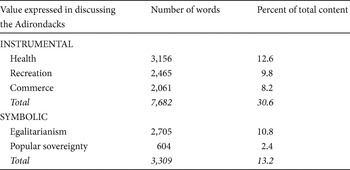
Between 1864 and 1894, more than twenty-five-thousand words were devoted to Adirondack topics on the editorial pages of the New York Times. Thematic coding of that content demonstrates that nearly half of those words were used to justify the value of the region and the act of preserving it, while the remaining were employed on topics ranging from inoffensive geographic description to outright partisan gossip. In the end, more than twice as much space was devoted to commerce, health, and recreation—all of which offered benefits that were tangible and direct—than to democratic ideals, which were largely symbolic (see Table 2).Footnote 84 While the language of democracy was invoked frequently and evocatively, appearing in varied form in each of the seventeen editorials that were written in support of the park, utilitarian values generated more collective ink.
Content of Editorials Appearing in the New York Times, 1864–1894

Note
To create an accurate word count, the full text of each editorial was converted into electronic form and then thematically coded using the sentence as a statistical unit of analysis.
Evidence also suggests that utilitarian arguments were more influential with the state legislature during each of its key decisions. When the newly appointed park commissioners filed their first report in 1873, they did not favor the creation of a public park “for mere purposes of recreation,” but rather for “the preservation of the timber as a measure of political economy.”Footnote 85 When 715,000 acres of land were set aside for a forest preserve in 1885, its value was explained in commercial terms once again, relying heavily on concerns for the state’s water supply and for forest fires sparked by the rail lines that operated along the periphery of the region.Footnote 86 In 1892, when the legislature set aside 2.8 million acres of land for the creation of a state park, “open for the free use of all the people for their health and pleasure,” they were quick to explain that forest land was “necessary to the preservation of the headwaters and the chief rivers of the state, and as a future supply of timber.”Footnote 87 Democratic appeals may have played a role in selling the park to a broad constituency, but evidently politicians stayed a more practical course.
Lack of Consensus
Third, while the editors of the New York Times were quick to invoke democratic ideals, a lack of consensus on the egalitarian purpose of the parks undermined its power and potential as an influence on park legislation. On occasion, the editors of the Times conceded that perhaps nature should be protected both by the people and from the people. Sobered by the overcrowding of tourists into the Adirondacks, they wrote in 1872:
A man cannot now sit down on the border of Tupper’s Lake to fish through a quiet hour, without becoming the centre of a score of interested and fashionably dressed spectators. He cannot shoot at an imaginary deer without running the risk of wounding a New-York belle, while his life is placed in perpetual jeopardy as he wanders along the crowded wood-paths, by the unskillfull [sic] rifle practice of the young gentlemen who lie in ambush behind every tree to shoot at casual robins. In fact, if those who have latterly made the trip through the Adirondack region are to be believed, that once imposing forest solitude is now rather more crowded, and decidedly gayer, than the Central Park on a Summer’s Saturday afternoon.Footnote 88
With that image in mind, even the Times could not help wondering whether it was prudent to open the area to the “indiscriminate public,” rather than reserve it for “the true sportsman and the reverent lover of nature.”Footnote 89
Over time, editorials became impatient even with those in search of a cure for pulmonary disease. They complained of the sick, who “dragged themselves over the rough roads leading to the Adirondack lakes,” turning pristine wilderness into a morose hospital. “Wan women and haggard men occupied every inch of good camping-ground” in the summer of 1881, they said, creating an odd symphony of convulsive coughs alongside ”the song of the wild birds and the music of the pines.”Footnote 90
Ultimately, the editors of the New York Times embraced the symbolic language of a “people’s park,” but not the improvements in transportation or amenities that would allow one to travel there inexpensively, comfortably, or conveniently. W.H.H. Murray may have embodied the democratic ideal, but in their eyes he was also to blame for the picnic parties, railroad builders, stagecoach drivers, telegraph agents, and hotel keepers who flocked to the woods in search of it.Footnote 91 They felt little sympathy for the poor, who lacked the financial means to travel circuitously by railroad, steamboat, and stage line, or for invalids unable to endure slow travel on broken roads.Footnote 92 It was a message that was shamelessly (and even consciously) contradictory.Footnote 93
Multiple and Diverse Constituencies
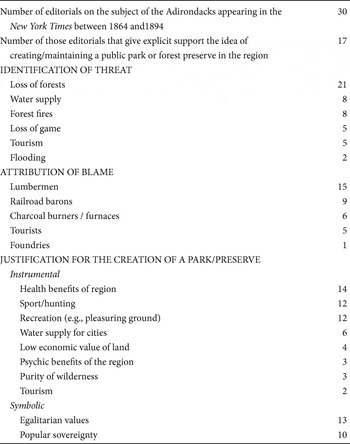
Finally, while editorials in the New York Times referred liberally to the will of “the people,” in reality there was no universal voice for the state legislature to follow.Footnote 94 Appeals to popular sovereignty may have had rhetorical power when directed toward lawmakers, but those words did little to acknowledge, let alone resolve, the class and regional conflicts of the day.Footnote 95 The various interests involved in promoting the creation of a park identified different threats to the region’s survival, attributed blame to different groups, and justified their positions on different grounds (Table 3). City newspapers three hundred miles away felt a paternal need to protect Adirondack forests from “the unsparing ax of the rapacious lumberman,” and from the pioneer intent on building himself a “wretched farm” that would waste hundreds of miles of beautiful scenery. Footnote 96 But in other towns, where the local economy depended upon resource extraction, the dailies told a different and less romantic story.
Content of Editorials Appearing in the New York Times, 1864–1894

Note
To create an accurate word count, the full text of each editorial was converted into electronic form and then thematically coded using the editorial itself as the statistical unit of analysis. Because the arguments made in each article were complex and diverse, the categories assigned to each frequently overlap. In other words, a single editorial might make use of two or more issue frames.
In the late nineteenth century, the proposed boundaries of the Adirondack Park spanned six northern counties: Essex, Franklin, Hamilton, Herkimer, St. Lawrence, and Warren. While the size of those counties in square miles combined represented 20 percent of the state of New York, in 1890 they remained sparsely populated with just 230,000 inhabitants (just 4 percent of the state’s total). Even so, local residents owned land, fences, and buildings valued at $67 million, from which they operated 20,000 farms, and produced nearly $13 million annually worth of hay, hops, potatoes, and dairy products.Footnote 97 To them, there were no “pirates” or “timber thieves,” only hard-working neighbors “engaged in a business where competition is severe and profits precarious.”Footnote 98
Granted, the stumps and stones that riddled farmland in the Adirondacks meant that fields there were not as productive as others (generating crop values of two dollars less per acre when compared to the state average), but for the New York Times to dismiss the land as “perfectly useless” in order to minimize the apparent cost of setting it aside was clearly overstating the case.Footnote 99 As Fred Seaver, a newspaperman from Malone rejoined: “Are not these facts sufficient to establish that all the Adirondacks are not so utterly worthless. … I respectfully submit that a county which can make such a showing is something more than a mere Siberian region, as some of the New-York journals seem to regard it.”Footnote 100
From the perspective of urban newspapers, however, Adirondack residents were not solely to blame for the destruction of the forests. Anger and frustration were also directed toward prominent industrialists, such as Dr. William Seward Webb, who for many represented the corrupting power and wealth of the Gilded Age. Corporate interests in favor of railroads were said to have influenced the board of the Adirondack Park Association, and even the Forest Commission itself. According to the New York Times, appointees to both were driven by impulses of greed and self-interest, rather than “the wishes of the thousands who use the forest as a pleasure ground or as a health resort.” If men like Webb were to have their way, they believed that the interests of the people would be “contemptuously disregarded.”Footnote 101
Those interests, however, were fully open to debate. For fashionable tourists who traveled to the Adirondack Mountains to “rusticate” in grand style, railroads were the key to securing access, and railroad builders were their allies. The editors of the Times may have pleaded for the sanctity of wilderness on the editorial page, but the society columns of the day gaily noted the arrivals and departures of wealthy patrons to the area in a column titled “The Social World,” which went so far as to report on the daily weather conditions for lawn tennis at Adirondack resorts. For tourists, the primary threat to the region came not from entrepreneurs, or even the local residents who provided guide services, sleeping quarters, and hearty meals. Instead, it came from private clubs and sportsmen’s associations that quietly purchased “the best sporting grounds and the most attractive lakes” for their use alone.Footnote 102
Finally, to those who considered themselves genuine sportsmen and true lovers of nature, the goal in the Adirondacks was to preserve a “howling wilderness,” not a romantic backwoods experience. In particular, they resented the plague of tourists that followed Murray into the woods, the vast majority of whom, they thought, had “no more taste for Nature than a rosebud has for a hurricane.”Footnote 103 Sportsmen, like those who convened in Utica in 1871, did indeed purchase tracts of land for their use, but they also pressed for the creation of a public park or forest preserve, provided that it would attract in small numbers “the better class of campers,” and not bands of “hoodlums” or other “disreputable characters.”Footnote 104
A CENTRAL PARK FOR THE WORLD
If James Bryce was correct in the American Commonwealth when he concluded that a newspaper was “effective only when it takes hold of some fact (real or supposed), and hammers it into the public mind,” the connection between parks and democracy must have seemed strong in nineteenth-century New York.Footnote 105 Between 1864 and 1894, the various constituencies involved in the Adirondack debate identified different threats to the region, and as a result sought different remedies from the state legislature. In response, the New York Times used the “changing vocabulary” of democracy to frame the debate patiently according to each worldview, even if those arguments in the end were shamelessly contradictory.Footnote 106 On behalf of the cities, they demanded that the state purchase and “manage the forests for the public interest,” in order to ensure an ample supply of water downstream.Footnote 107 With sportsmen in mind, they favored the creation of a “people’s hunting-ground,” for tourists a “people’s pleasure ground,” and for the sick a “people’s … sanatorium.”Footnote 108 Local residents preferred, quite simply, that “matters should rest as they are,” but even they acknowledged that if the “wisdom of the State” dictated that “the greatest good of the greatest number” meant the purchase of public lands, they would consent, if only offered fair relief.Footnote 109
In reflecting on the history of public parks in the United States, Roderick Nash believed that democracy was instrumental in their creation. A commitment to egalitarianism, on the one hand, meant that natural wonders could be set aside for the use and enjoyment of all people, not just for the wealthy few, or for royalty. Meanwhile, institutions governed by popular sovereignty reminded lawmakers that growing public demands for forest preservation should be heeded. But in overemphasizing consensus on democratic norms and traditions, Nash overlooked important class and regional conflicts that continue to shape the tension between conservation and preservation today. In the end, rather than serving as a catalyst for the creation of the Adirondack Park, perhaps in an ironic way democracy contributed to its delay. Throughout the nineteenth century, those ideals acted much like a Pandora’s box in allowing the “people’s park” to symbolize different (and often antagonistic) things to different people.Footnote 110 With a restless amalgam of public and private lands within its boundaries still, the Adirondack Park of the twenty-first century may not be much different.