Introduction
There has been a recent resurgence of interest in the role of childhood adversity in the etiology of psychotic disorders, including schizophrenia and bipolar disorder (Etain et al. Reference Etain, Henry, Bellivier, Mathieu and Leboyer2008; Varese et al. Reference Varese, Smeets, Drukker, Lieverse, Lataster, Viechtbauer, Read, van Os and Bentall2012). Adverse experiences may interfere with the development of a number of processes, including formation of the stress-response system, attachment and cognition (Phillips et al. Reference Phillips, McGorry, Garner, Thompson, Pantelis, Wood and Berger2006; Bentall & Fernyhough, Reference Bentall and Fernyhough2008). One adverse experience that has received some attention in this regard is parental loss during childhood. Although parental loss has been widely studied as a risk factor for depression (e.g. Crook & Eliot, Reference Crook and Eliot1980; Harris et al. Reference Harris, Brown and Bifulco1986; Kendler et al. Reference Kendler, Neale, Kessler, Heath and Eaves1992; Kendler et al. Reference Kendler, Sheth, Gardner and Prescott2002), studies of its association with psychotic disorders are fewer. Parental loss has been defined in these studies as parental death (Mortensen et al. Reference Mortensen, Pedersen, Melbye, Mors and Ewald2003; Tsuchiya et al. Reference Tsuchiya, Agerbo and Mortensen2005; Laursen et al. Reference Laursen, Munk-Olsen, Nordentoft and Mortensen2007; Clarke et al. Reference Clarke, Tanskanen, Huttunen and Cannon2013), parent–child separation (Walker et al. Reference Walker, Cudeck, Mednick and Schulsinger1981; Anglin et al. Reference Anglin, Cohen and Chen2008; Räikkönen et al. Reference Räikkönen, Lahti, Heinonen, Pesonen, Wahlbeck, Kajantie, Osmond, Barker and Eriksson2011) or a combination thereof (Pfohl et al. Reference Pfohl, Stangl and Tsuang1983; Erlenmeyer-Kimling et al. Reference Erlenmeyer-Kimling, Rock, Squires-Wheeler, Roberts and Yang1991; Furukawa et al. Reference Furukawa, Mizukawa, Hirai, Fujihara, Kitamura and Takahashi1998, Reference Furukawa, Ogura, Hirai, Fujihara, Kitamura and Takahashi1999; Agid et al. Reference Agid, Shapira, Zislin, Ritsner, Hanin, Murad, Troudart, Bloch, Heresco-Levy and Lerer1999; Mallett et al. Reference Mallett, Leff, Bhugra, Pang and Zhao2002; Pert et al. Reference Pert, Ferriter and Saul2004; Morgan et al. Reference Morgan, Kirkbridge, Leff, Craig, Hutchinson, McKenzie, Morgan, Dazzan, Doody, Jones, Murray and Fearon2007, Reference Morgan, Fisher, Hutchinson, Kirkbride, Craig, Morgan, Dazzan, Boydell, Doody, Jones, Murray, Leff and Fearon2009; Rubino et al. Reference Rubino, Nanni, Pozzi and Siracusano2009; Stilo et al. Reference Stilo, Di Forti, Mondelli, Falcone, Russo, O'Connor, Palmer, Paparelli, Kolliakou and Sirianni2012). The distinction between parental death and separation is an important one, as the two exposures may reflect distinct experiences that have different implications for mental health. Some have suggested that parent–child separation may be more psychologically detrimental to adolescents than parental death (Canetti et al. Reference Canetti, Bachar, Bonne, Agid, Lerer, De-Nour and Shalev2000). There is also evidence that the two exposures are not associated with the same mental health outcomes in adulthood (Kendler et al. Reference Kendler, Neale, Kessler, Heath and Eaves1992, Reference Kendler, Neale, Prescott, Kessler, Heath, Corey and Eaves1996). Studies that have estimated associations specifically between separation and psychotic disorders have reported mixed results (Furukawa et al. Reference Furukawa, Mizukawa, Hirai, Fujihara, Kitamura and Takahashi1998, 1999; Agid et al. Reference Agid, Shapira, Zislin, Ritsner, Hanin, Murad, Troudart, Bloch, Heresco-Levy and Lerer1999; Mallett et al. Reference Mallett, Leff, Bhugra, Pang and Zhao2002; Morgan et al. Reference Morgan, Kirkbridge, Leff, Craig, Hutchinson, McKenzie, Morgan, Dazzan, Doody, Jones, Murray and Fearon2007, 2009; Anglin et al. Reference Anglin, Cohen and Chen2008; Rubino et al. Reference Rubino, Nanni, Pozzi and Siracusano2009; Horesh et al. Reference Horesh, Apter and Zalsman2011; Räikkönen et al. Reference Räikkönen, Lahti, Heinonen, Pesonen, Wahlbeck, Kajantie, Osmond, Barker and Eriksson2011; Stilo et al. Reference Stilo, Di Forti, Mondelli, Falcone, Russo, O'Connor, Palmer, Paparelli, Kolliakou and Sirianni2012).
Little evidence exists regarding factors that might modify any effect of parental separation on psychosis risk. In animal studies, the developmental timing of separation, as well as its duration, are important determinants of the types of effects observed and whether they persist into adulthood (Marco et al. Reference Marco, Adriani, Llorente, Laviola and Viveros2009; Parker & Maestripieri, Reference Parker and Maestripieri2011; Nishi et al. Reference Nishi, Noriko, Sasagawa and Matsunaga2012). Research indicates that timing and duration of childhood adversity are also important in humans (Kaplow & Widom, Reference Kaplow and Widom2007; Fisher et al. Reference Fisher, Jones, Fearon, Craig, Dazzan, Morgan, Hutchinson, Doody, McGuffin and Leff2010; Pesonen et al. Reference Pesonen, Räikkönen, Feldt, Heinonen, Osmond, Phillips, Barker, Eriksson and Kajantie2010), and that stressors occurring across childhood and adolescent development may influence risk for psychotic disorders (Mortensen et al. Reference Mortensen, Pedersen, Melbye, Mors and Ewald2003; Laursen et al. Reference Laursen, Munk-Olsen, Nordentoft and Mortensen2007). However, the few epidemiological studies that have investigated the influence of age and duration of parental separation in relation to psychosis have yielded mixed results (Agid et al. Reference Agid, Shapira, Zislin, Ritsner, Hanin, Murad, Troudart, Bloch, Heresco-Levy and Lerer1999; Morgan et al. Reference Morgan, Kirkbridge, Leff, Craig, Hutchinson, McKenzie, Morgan, Dazzan, Doody, Jones, Murray and Fearon2007; Anglin et al. Reference Anglin, Cohen and Chen2008; Räikkönen et al. Reference Räikkönen, Lahti, Heinonen, Pesonen, Wahlbeck, Kajantie, Osmond, Barker and Eriksson2011). Moreover, researchers have long recognized that family and parental characteristics shape the mental health effects of parental separation (Harris et al. Reference Harris, Brown and Bifulco1986; Tennant, Reference Tennant1988; Kendler et al. Reference Kendler, Neale, Kessler, Heath and Eaves1992). One characteristic that may be particularly relevant for parent–child separation is the presence of mental disorder in family members (Tennant, Reference Tennant1988). However, few previous studies of the association between parental separation and psychotic disorders have included information on parental mental health (Walker et al. Reference Walker, Cudeck, Mednick and Schulsinger1981; Agid et al. Reference Agid, Shapira, Zislin, Ritsner, Hanin, Murad, Troudart, Bloch, Heresco-Levy and Lerer1999; Mallett et al. Reference Mallett, Leff, Bhugra, Pang and Zhao2002; Morgan et al. Reference Morgan, Kirkbridge, Leff, Craig, Hutchinson, McKenzie, Morgan, Dazzan, Doody, Jones, Murray and Fearon2007; Anglin et al. Reference Anglin, Cohen and Chen2008).
A further limitation of many epidemiological studies of parental separation, and childhood adversity more broadly, is the need to measure adverse experiences via retrospective recall (Morgan & Fisher, Reference Morgan and Fisher2007; Scott et al. Reference Scott, Smith and Ellis2010). Reliance upon recall may introduce bias if individuals with and without disorder recall childhood experiences differently (Susser & Widom, Reference Susser and Widom2012). Few studies of parental separation and psychosis used a prospective, independent measure of exposure (Anglin et al. Reference Anglin, Cohen and Chen2008; Räikkönen et al. Reference Räikkönen, Lahti, Heinonen, Pesonen, Wahlbeck, Kajantie, Osmond, Barker and Eriksson2011). To our knowledge, no population-based studies have used prospective data to estimate associations of maternal and paternal separation across the course of development with risk of schizophrenia and bipolar disorder in adulthood.
The goal of this study was to characterize associations of parent–child separation with schizophrenia and bipolar disorder using prospectively collected exposure measures. We investigated three types of separations occurring across development, paternal, maternal, and those from both parents, with respect to age and number of years separated. We included information regarding mental disorder in family members to assess both confounding and modification of associations between parental separation and psychotic disorder. We estimated associations with three outcomes – narrowly defined schizophrenia, broadly defined schizophrenia (including schizo-affective disorder) and bipolar disorder – to assess the degree of risk factor specificity or overlap. This study was conducted among a nationwide, population-based cohort for which prospectively and independently collected exposure data were available from birth.
Method
Study population
We established a population-based cohort among those born in Denmark between 1 January 1971 and 30 June 1991 using the Danish Civil Registration System (CRS; Pedersen et al. Reference Pedersen, Gøtzsche, Møller and Mortensen2006). This registry contains continuously updated information on all Danish residents, including date of birth, sex, identity of parents and siblings, place of birth and residence, and vital status. We included individuals if the identity of both legal parents was known and the individual was alive and residing in Denmark on his or her 15th birthday. Because immigrant status has been associated with both parental separation and psychosis (Morgan et al. Reference Morgan, Kirkbridge, Leff, Craig, Hutchinson, McKenzie, Morgan, Dazzan, Doody, Jones, Murray and Fearon2007; Cantor-Graae & Pedersen, Reference Cantor-Graae and Pedersen2013), we excluded individuals with parents born outside Denmark. These requirements resulted in a cohort of 1 110 676 individuals. We conceptualized parent–child separation as a distinct exposure from both parental death and being born into a single parent household. We therefore further excluded 125 618 individuals who did not live with both parents at birth or who experienced a parental death before their 15th birthday. The final study cohort consisted of 985 058 individuals.
Psychiatric diagnoses and family history
The study population and their parents and siblings were linked to the Danish Psychiatric Central Register using a unique personal identifier (Mors et al. Reference Mors, Perto and Mortensen2011). This registry contains information on all admissions to in-patient psychiatric facilities since 1969, and out-patient and emergency room visits since 1995. Diagnoses were made by treating clinicians and assigned according to the International Classification of Diseases, 8th revision (ICD-8; World Health Organization, 1967) prior to 1994 and the ICD-10 (World Health Organization, 1992) from 1994 onwards. We used two classifications of schizophrenia: narrow schizophrenia was identified by ICD-8 code 295 (excluding 295.79) or ICD-10 code F20 and broad schizophrenia was identified by ICD-8 codes 295, 297 and 298.39, or ICD-10 codes F20–F29. Bipolar disorder was identified by ICD-8 codes 296.19 and 296.39, or ICD-10 codes F30 and F31. Date of onset was defined as the first day of the first visit during which the diagnosis was assigned. Recent validity studies have found good agreement between registry diagnoses of schizophrenia and those generated from case note review (Jakobsen et al. Reference Jakobsen, Frederiksen, Hansen, Jansson, Parnas and Werge2005; Uggerby et al. Reference Uggerby, Østergaard, Røge, Correll and Nielsen2013).
Parental and sibling psychiatric diagnoses were measured over the course of follow-up. For schizophrenia outcomes, family members were classified with the following order of precedence: narrow schizophrenia, broad schizophrenia, any other mental disorder, or none. For bipolar disorder, family members were classified with the following order of precedence: bipolar disorder, another affective disorder [ICD-8 code 296 (excluding 296.19 and 296.39), 298.09, 298.19, 300.49 and 301.19 or ICD-10 codes F32–F39], any other mental disorder, or none. For interaction tests, a binary parental history variable indicated whether either parent had any psychiatric diagnosis.
Parental separation
Residential addresses have been continually recorded in the CRS since 1971. One permanent address is recorded per person for a given time period, and addresses are updated without deleting the prior information. Danish residents are required by law to inform the authorities of permanent address changes within 5 days; failure to do so jeopardizes access to schools, healthcare, and other government services such as unemployment and sickness benefits. In addition, residential information in the CRS is used daily by the Danish administrative system and errors are corrected whenever they are encountered (Pedersen et al. Reference Pedersen, Gøtzsche, Møller and Mortensen2006). Municipality and street codes were used to determine whether each individual lived with his/her parents on each birthday from birth to the age of 15 years. Separation status at each age was classified as: no separation (living with both parents), paternal separation (living with mother but not father), maternal separation (living with father but not mother), separation from both parents (living with neither parent), or missing (unknown or residing abroad). Less than 1% of separation statuses were missing for any given age.
Binary measures indicated whether each separation type was observed at any point during the exposure period. Cumulative exposure to each separation type measured the number of years during which that status was observed (consecutive or non-consecutive), categorized as 0, 1–5, 6–10, or 11–15 years. The age of first separation was calculated for each separation type using the earliest age at which it was observed, ignoring missing statuses.
Other measures
Age, birth period, sex, parental age and urbanicity at birth were obtained from the registry. Categorical age bands spanned 1–5 years. Birth period was categorized as 1971–1980, 1981–1985, and 1985–1991. Maternal and paternal age at birth was categorized as <22, 22–25, 26–29, 30–34, and 35 years or older. Urbanicity at birth was classified according to previous studies (Mortensen et al. Reference Mortensen, Pedersen, Westergaard, Wohlfahrt, Ewald, Mors, Andersen and Melbye1999).
Study design and analysis
Data were analysed prospectively. Follow-up began on the 15th birthday and ended at disorder onset, death, emigration from Denmark, or 31 December 2011, whichever came first. Age, calendar year and family history of mental disorder were measured over follow-up and were time-varying, while birth period, sex, parental age at birth, urbanicity at birth and parental separation were treated independently of time. Log-linear Poisson regression, implemented in the GENMOD procedure of SAS 9.3 (SAS Institute, 2008), was used to estimate relative risks (RRs) with likelihood ratio-based 95% confidence intervals and to conduct likelihood ratio tests, approximating Cox regression (Laird & Olivier, Reference Laird and Olivier1981). Score tests were used to check for overdispersion (Breslow, Reference Breslow1996). All RRs were controlled for birth period, age, sex, their interaction, calendar year, urbanicity at birth, parental age and family history of mental disorder.
This study was approved by the Danish Data Protection Agency.
Results
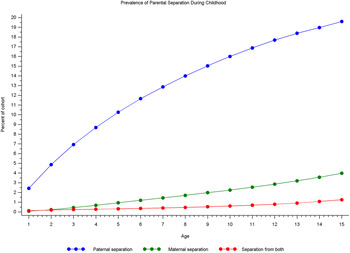
Among 985 058 individuals born 1971–1991 and followed to 2011, there were 6469 cases of narrow schizophrenia, 11 464cases of broad schizophrenia and 2821 cases of bipolar disorder over about 15.8 million person-years of follow-up. Fig. 1 depicts the proportion of cohort members living apart from their fathers, mothers, and both parents, by age. Paternal separation was the most common separation type at all ages, with 19.6% of cohort members living apart from their fathers by the age of 15 years. By design, all cohort members lived with both parents at birth.
Prevalence of paternal separation (black line; blue online), maternal separation (light gray line; green online) and separation from both parents (dark gray line; red online), between the ages of 1 and 15 years, among a cohort of 985 058 individuals born in Denmark 1971–1991 who lived with both parents at birth.

Occurrence and number of years of separation
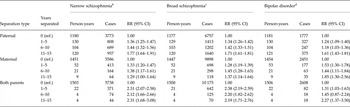
Table 1 displays RRs of each disorder for those with any separation between birth and the age of 15 years compared with those with none. Each separation type was associated with increased risk of all three outcomes, controlling for one another. Associations of paternal and maternal separation with disorder were similar in magnitude across outcomes, with RRs ranging from 1.28 to 1.52. Separation from both parents, however, was more strongly associated with narrow and broad schizophrenia (RRs = 2.23 and 2.30, respectively) than with bipolar disorder (RR = 1.39).
RR of narrow schizophrenia, broad schizophrenia and bipolar disorder by the occurrence of any parental separation between the ages of 1 and 15 yearsa

RR, Relative risk; CI, confidence interval; ref., reference.
a Person-years are per 10 000. RRs are adjusted for age, sex, birth period, calendar year, urbanicity at birth, parental age, mental disorders in parents and siblings, and other separation types. The analysis was conducted among those with fully observed separation status and includes 6227 cases of narrow schizophrenia, 11 012cases of broad schizophrenia and 2726 cases of bipolar disorder over about 15.3 million person-years.
RRs according to the total number of years separated are displayed in Table 2. Likelihood ratio tests revealed that the number of years of separation was important above and beyond any separation for paternal separation only (see Table 2 footnotes). Risk of narrow and broad schizophrenia increased with the number of years of paternal separation, while risk of bipolar disorder was higher for those with 11–15 years of paternal separation compared with 1–5 or 6–10 years. RRs were similar across outcomes for those with 11–15 years of paternal separation (range: 1.61–1.77).
RR of narrow schizophrenia, broad schizophrenia and bipolar disorder by cumulative duration of parental separation between the ages of 1 and 15 years a

RR, Relative risk; CI, confidence interval; ref., reference; LRT, likelihood ratio test df, degrees of freedom.
a Person-years are per 10 000. RRs are adjusted for age, sex, birth period, calendar year, urbanicity at birth, parental age, mental disorders in parents and siblings, and other separation types. The analysis was conducted among those with fully observed separation status and includes 6227 cases of narrow schizophrenia, 11 012cases of broad schizophrenia and 2726 cases of bipolar disorder over about 15.3 million person-years.
b LRTs for number of years of separation versus ever/never (df = 2): paternal: χ 2 = 32.69 (p > 0.001); maternal: χ 2 = 0.10 (p = 0.950); both: χ 2 = 1.53 (p = 0.464).
c LRTs for number of years of separation versus ever/never (df = 2): paternal: χ 2 = 47.55 (p < 0.001); maternal: χ 2 = 2.49 (p = 0.277); both: χ 2 = 3.14 (p = 0.208).
d LRTs for number of years of separation versus ever/never (df = 2): paternal: χ 2 = 17.28 (p < 0.001); maternal: χ 2 = 1.61 (p = 0.447); both: χ 2 = 3.61 (p = 0.164).
Separation status by age
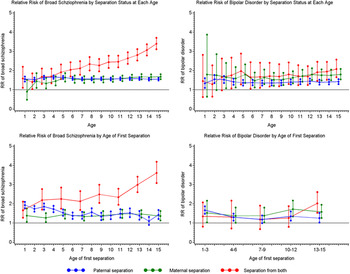
We first estimated associations with separation status by age to assess whether risk associated with living apart from parents changed with age. The top panel of Fig. 2 depicts RRs associated with separation status for each age 1–15 years, compared with those living with both parents at that age, disregarding separation status at other ages. Because results for narrow and broad schizophrenia were similar, only those for broad schizophrenia are displayed (for narrow schizophrenia results, see the online Supplementary material). Each type of separation was associated with increased risk of broad schizophrenia at all ages, with the exception of maternal separation at the age of 1 year. RRs of broad schizophrenia appeared stable across age for maternal and paternal separation, while RRs for separation from both parents increased with age. Each separation type was also associated with bipolar disorder across the range of ages, with minor exceptions related to early separation. RRs of bipolar disorder for all three separation types appeared relatively stable across age.
Relative risk of broad schizophrenia (left) and bipolar disorder (right) associated with separation status (top) and age of first separation (bottom) for paternal separation (black line; blue online), maternal separation (light gray line; green online) and separation from both parents (dark gray line; red online) during each year of age. Estimated among 11 463 cases of broad schizophrenia and 2821 cases of bipolar disorder over about 15.7 million person-years and adjusted for age, sex, birth period, calendar year of follow-up, history of mental disorders in mothers, fathers and siblings, urbanicity at birth and parental age.

Age of first separation
We next estimated associations with age of first separation to assess whether risk associated with the event of separation changed with age. The bottom panel of Fig. 2 depicts adjusted RRs according to age of first separation, compared with those with no separations between birth and the age of 15 years. For broad schizophrenia, ages of first maternal separation and separation from both parents were grouped into 2-year bands for ages 1–14 years; for bipolar disorder all ages are in 3-year bands. Each separation type was entered into its own model with full adjustment. For first paternal separation, the largest RRs were observed earlier in childhood. Only for maternal separation was risk of both disorders significantly increased at all ages; RRs fluctuated slightly across childhood without displaying a clear trend. RRs of broad schizophrenia associated with first separation from both parents showed a marked increase with age, while for the corresponding RRs for bipolar disorder this pattern was much less pronounced.
Interaction with parental history of mental disorder
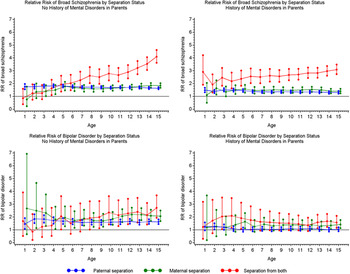
Fig. 3 displays adjusted associations of separation status with broad schizophrenia and bipolar disorder, by parental history of psychiatric diagnosis (note the difference in scale relative to Fig. 2). Significant interactions were detected for all ages for schizophrenia and ages 2–15 years for bipolar disorder (likelihood ratio tests not shown). For maternal and paternal separation, all significant differences indicated that the increase in risk associated with separation was less when parental history was present compared with when it was absent. However, these reductions were small and no associations were reduced far enough to indicate a protective effect of separation when parental history was present. For separation from both parents, the trend of increasing RR of broad schizophrenia with age was apparent only under the absence of parental history. When parental history was present, RRs appeared higher in early childhood and more stable across development. For associations for first separation, by parental history of psychiatric diagnosis, see the online Supplementary material.
Relative risk of broad schizophrenia (top) and bipolar disorder (bottom) associated with paternal separation status (black line; blue online), maternal separation status (light gray line; green online) and separation from both parents (dark gray line; red online) during each year of age, under the absence (left) and presence (right) of parental history of mental disorder. Estimated among 11 463 cases of broad schizophrenia and 2821 cases of bipolar disorder over about 15.7 million person-years and adjusted for age, sex, birth period, calendar year of follow-up, history of mental disorders in siblings, urbanicity at birth and parental age.

Discussion
In a nationwide cohort for whom prospectively and independently collected information on parent–child separation was available from birth, we found that separation from parents during childhood was associated with increased risk of psychotic disorders. Maternal separation, paternal separation and separation from both parents were each associated with elevated risk of narrowly defined schizophrenia, broadly defined schizophrenia and bipolar disorder. Associations were present after adjustment for other separation types, family history of mental disorders, parental age and urbanicity at birth. These results are consistent with previous studies documenting associations between parental separation and psychotic disorders (Mallett et al. Reference Mallett, Leff, Bhugra, Pang and Zhao2002; Morgan et al. Reference Morgan, Kirkbridge, Leff, Craig, Hutchinson, McKenzie, Morgan, Dazzan, Doody, Jones, Murray and Fearon2007, 2009; Anglin et al. Reference Anglin, Cohen and Chen2008; Rubino et al. Reference Rubino, Nanni, Pozzi and Siracusano2009; Räikkönen et al. Reference Räikkönen, Lahti, Heinonen, Pesonen, Wahlbeck, Kajantie, Osmond, Barker and Eriksson2011) and indicate that these associations are not entirely attributable to recall bias. Our associations were somewhat smaller than some reported previously (Morgan et al. Reference Morgan, Kirkbridge, Leff, Craig, Hutchinson, McKenzie, Morgan, Dazzan, Doody, Jones, Murray and Fearon2007; Räikkönen et al. Reference Räikkönen, Lahti, Heinonen, Pesonen, Wahlbeck, Kajantie, Osmond, Barker and Eriksson2011), which may be due to methodological differences. Morgan et al. (Reference Morgan, Kirkbridge, Leff, Craig, Hutchinson, McKenzie, Morgan, Dazzan, Doody, Jones, Murray and Fearon2007) reported stronger associations for maternal and paternal separation when separations were restricted to those resulting from family breakdown that lasted at least 1 year. Räikkönen et al. (Reference Räikkönen, Lahti, Heinonen, Pesonen, Wahlbeck, Kajantie, Osmond, Barker and Eriksson2011) reported slightly stronger associations for separation from both parents when restricting to those from an upper socio-economic background. Overall, our findings corroborate the results of other studies using prospective data that indicate an etiological role of childhood adversity in psychosis (Mortensen et al. Reference Mortensen, Pedersen, Melbye, Mors and Ewald2003; Laursen et al. Reference Laursen, Munk-Olsen, Nordentoft and Mortensen2007; Räikkönen et al. Reference Räikkönen, Lahti, Heinonen, Pesonen, Wahlbeck, Kajantie, Osmond, Barker and Eriksson2011; Scott et al. Reference Scott, Smith and Ellis2010).
Greater total time in years of paternal separation was associated with slightly greater risk of both schizophrenia and bipolar disorder. Previous studies of psychosis have not reported on the importance of duration for paternal separation specifically. However, Anglin et al. (Reference Anglin, Cohen and Chen2008) found that duration of maternal separation before the age of 2 years was positively associated with the trajectory of schizotypal symptoms from the age of 9–39 years. To confirm that total time in years of separation in our study was not simply a proxy for earlier first paternal separation, we repeated the likelihood ratio test comparing only those who were first separated from their fathers at a young age with those who were never separated. The association between number of years separated and each outcome persisted in these analyses (not shown). Greater total years of paternal separation in our study could also indicate prolonged exposure to other early childhood stressors such as economic hardship (Wicks et al. Reference Wicks, Hjern, Gunnell, Lewis and Dalman2005; Werner et al. Reference Werner, Malaspina and Rabinowitz2007).
We considered two possible forms of developmental sensitivity to parental separation: sensitivity to the state of being separated (separation status), and sensitivity to the event of separation (age of first separation). We generally found that associations for first separation displayed more change across development than did associations for separation status, which could imply a greater degree of developmental sensitivity to the stress associated with the event of separation. This was most evident for paternal separation; there appeared to be greater sensitivity earlier in childhood when considering first separations (Fig. 2, bottom panel), while there was little developmental change when considering separation status (Fig. 2, top panel). This may be because as the cohort ages, separation status associations become diluted by the addition of separations that confer less risk because they occur later and are therefore necessarily shorter in duration. In addition, the reference group for each separation status association includes those with prior and subsequent separations. Overall, we interpret our results to indicate that paternal separations may be associated with greater risk when they occur early.
Maternal separation and separation from both parents each showed different age-related patterns of risk than that of paternal separation. RRs associated with maternal separation were relatively stable across age for both outcomes, possibly indicating a wide developmental window of vulnerability that is general rather than specific. In contrast, RRs associated with separation from both parents tended to increase with age, implying greater vulnerability during late childhood and adolescence. However, the magnitude of this increase was greater for schizophrenia than for bipolar disorder, suggesting some specificity of effect. This mirrors the stronger association with schizophrenia compared with bipolar disorder presented in Table 1.
Our results indicate risk factor overlap between schizophrenia and bipolar disorder with respect to maternal and paternal separation, implying mechanisms that are relevant to both disorders. Stressful experiences in early childhood hold theoretical importance for the development of psychological processes such as attachment and emotion regulation (Woodward et al. Reference Woodward, Fergusson and Belsky2000; Morris et al. Reference Morris, Silk, Steinberg, Myers and Robinson2007; Anglin et al. Reference Anglin, Cohen and Chen2008). Early stressors can also affect programming of the hypothalamic–pituitary–adrenal (HPA) axis (Tottenham & Sheridan, Reference Tottenham and Sheridan2010), and a number of studies have demonstrated differences in HPA axis function in adults who experienced childhood parental loss (Nicolson, Reference Nicolson2004; Bloch et al. Reference Bloch, Peleg, Koren, Aner and Klein2007; Tyrka et al. Reference Tyrka, Wier, Price, Ross, Anderson, Wilkinson and Carpenter2008; Pesonen et al. Reference Pesonen, Räikkönen, Feldt, Heinonen, Osmond, Phillips, Barker, Eriksson and Kajantie2010; Kumari et al. Reference Kumari, Head, Bartley, Stansfeld and Kivimaki2013). HPA function, in turn, is linked to dopamine function (Walker et al. Reference Walker, Mittal and Tessner2008) and implicated in the pathogenesis of bipolar disorder (Daban et al. Reference Daban, Vieta, Mackin and Young2005). In contrast to maternal and paternal separation, separation from both parents appeared more strongly associated with schizophrenia compared with bipolar disorder and during adolescence compared with early childhood. Adolescence is a period of rapid brain development that has long held importance in neurodevelopmental models of schizophrenia (Feinberg, Reference Feinberg1983; Andersen, Reference Andersen2003). The frontal cortex continues to develop during adolescence and may be especially sensitive to stressors experienced during this time (Lupien et al. Reference Lupien, McEwen, Gunnar and Heim2009). Abilities that are impaired in schizophrenia, such as executive function and social cognition (Penn et al. Reference Penn, Sanna and Roberts2008; Freedman & Brown, Reference Freedman and Brown2011), also continue to develop during adolescence, and are placed under increasing demand as adolescents face the challenges of emerging adulthood (Paus, Reference Paus2005; Blakemore & Choudhury, Reference Blakemore and Choudhury2006). The potential for different developmental pathways to disorder is consistent with prior research indicating that the association of abuse with psychosis differs according to the perpetrator and timing during childhood (Fisher et al. Reference Fisher, Jones, Fearon, Craig, Dazzan, Morgan, Hutchinson, Doody, McGuffin and Leff2010) and highlights the potential importance of considering the developmental timing of adversity in relation to adult mental health.
We found evidence for effect modification of parental separation according to history of mental disorder in parents. To our knowledge, this is the first study of parental separation and psychotic disorder to test for interaction with parental mental disorder. While our results require replication, they underscore the potential importance of family characteristics and context in shaping the effects of family-based exposures (e.g. Tyrka et al. Reference Tyrka, Wier, Price, Ross, Anderson, Wilkinson and Carpenter2008). For example, in a 20-year follow-up study of offspring of depressed and non-depressed parents, family discord was more strongly associated with mental disorder among offspring of non-depressed parents (Nomura et al. Reference Nomura, Wickramaratne, Warner, Mufson and Weissman2002; Pilowsky et al. Reference Pilowsky, Wickramaratne, Nomura and Weissman2006). In this study we are unable to differentiate between the genetic liability associated with family history of disorder and the experience of living with a parent with a mental disorder. It is also important to keep in mind that our estimates are generated from a multiplicative model, and the direction of interaction estimates depends on the type of model used (Zammit et al. Reference Zammit, Owen and Lewis2010). Nevertheless, the higher risk associated with separation from both parents early in childhood when parental mental disorder is present is striking. It raises questions about the implications of separation from both parents under each circumstance. One possibility is that when parental mental disorder is present, separations from both parents are more likely to result in the child being placed in institutional or foster care. A recent study found that Danish children have about a 6-fold risk of entering the out-of-home care system before the age of 3 years if their mother has a psychiatric history, and about a 3-fold risk if their father has a psychiatric history (Ubbesen et al. Reference Ubbesen, Petersen, Mortensen and Kristensen2013). Although we cannot verify this possibility in the current study, it is consistent with previous work emphasizing the importance of parental care after separation (Harris et al. Reference Harris, Brown and Bifulco1986). Overall, the higher RRs of schizophrenia observed in this study for children separated from both parents speaks to their status as a potentially vulnerable subgroup.
Strengths and limitations
This study carries some limitations that should be kept in mind when interpreting the results. As mentioned above, separation may be a proxy for other childhood experiences such as parental discord or family breakdown, poor caretaking, economic disadvantage or childhood trauma (Rutter, Reference Rutter1971; Harris et al. Reference Harris, Brown and Bifulco1986; Kendler et al. Reference Kendler, Neale, Kessler, Heath and Eaves1992; Read et al. Reference Read, Os, Morrison and Ross2005; Morgan et al. Reference Morgan, Fisher, Hutchinson, Kirkbride, Craig, Morgan, Dazzan, Boydell, Doody, Jones, Murray, Leff and Fearon2009). Isolating effects of specific forms of adversity, which often cluster together (Kessler et al. Reference Kessler, McLaughlin, Green, Gruber, Sampson, Zaslavsky, Aguilar-Gaxiola, Alhamzawi, Alonso, Angermeyer, Benjet, Bromet, Chatterji, de Girolamo, Demyttenaere, Fayyad, Florescu, Gal, Gureje, Haro, Hu, Karam, Kawakami, Lee, Lepine, Ormel, Posada-Villa, Sagar, Tsang, Ustun, Vassilev, Viana and Williams2010), requires detailed information on family characteristics that were unfortunately not available in the current study. However, to the extent that such exposures are associated with psychiatric diagnoses in parents, they do not appear to fully explain the associations documented here. We lacked information on socio-economic status, which could possibly confound or modify separation associations (Räikkönen et al. Reference Räikkönen, Lahti, Heinonen, Pesonen, Wahlbeck, Kajantie, Osmond, Barker and Eriksson2011). Outcome measurement relied on clinician diagnosis, and we lacked symptom-level or clinical information that would allow us to eliminate any effect of protopathic bias (i.e. reverse causation; Salas et al. Reference Salas, Hotman and Stricker1999). We lacked information on reasons for parent–child separation, which would have enabled more refined exposure measurement. Some age-specific associations with bipolar disorder may have had limited power due to the low prevalence of maternal separation and separation from both parents. Additional limitations include lack of information on the whereabouts of children separated from both parents, possible missed short periods of separation due to measurement on each birthday, and possible limited generalizability of our findings.
A major strength of this study is the method of exposure measurement. Separation data were collected prospectively, independently of the outcome, and without relying on participant or parent recall. This is advantageous because of potential validity problems associated with measuring childhood experiences via retrospective report (Susser & Widom, Reference Susser and Widom2012). It also allowed us to consider separations occurring across development, highlighting the importance of developmental timing. Another strength of this study is the use of a nationwide psychiatric registry, which permitted assessment of the confounding and modifying roles of family and parental history of mental disorder. Family history is perhaps the most important confounder of environmental risk factors for psychosis, and in this study it was measured prospectively and independently of the exposure.
Conclusion
We found that parental separation during childhood is a risk factor for schizophrenia and bipolar disorder among a cohort with prospectively and independently collected exposure information and adjustment for family history of psychiatric disorder. We found differences in risk according to type of separation and developmental timing, highlighting the importance of considering these factors in studies of the long-term mental health effects of childhood adversity. We also found differences in age-related patterns of risk under the presence or absence of parental history of mental disorder, underscoring the importance of taking family characteristics into account. Characterizing adversity with respect to developmental timing and other characteristics may ultimately help elucidate pathways to adult mental disorder.
Supplementary material
To view supplementary material for this article, please visit http://dx.doi.org/10.1017/S0033291715000781
Acknowledgements
This work was supported by the National Institute of Mental Health (NIMH; grant 5T32MH014592), the Intramural Research Program of the NIMH, the National Institute on Drug Abuse (W.W.E., grant R01 026652), the Stanley Medical Research Institute (P.B.M. and C.B.P.) and The Lundbeck Foundation (P.B.M. and C.B.P).
This study was conducted when D.P. was with the Department of Mental Health, Johns Hopkins Bloomberg School of Public Health, Baltimore, MD. She is now with the NIMH, Bethesda, MD. The views and opinions expressed in this paper are those of the authors and should not be construed to represent the views of any of the sponsoring organizations or agencies or the US government.
Declaration of Interest
None.