I. INTRODUCTION
In December 1924, Edgar Lawrence Smith published a monograph, Common Stocks as Long Term Investments, which not only had an immediate impact on the financial community but also has had an enduring influence that can still be felt almost a century later. The larger part of the monograph was devoted to a series of tests comparing the returns achieved by various hypothetical equity and corporate bond portfolios over periods of around twenty years between 1866 and 1922. The results were so overwhelmingly favorable to equities that Smith concluded that he had refuted the conventional wisdom on “conservative investment,” which stated that:
“Common stocks are, in general, regarded as a medium for Speculation—not for Long Term Investment. Bonds, on the other hand, are generally held to be the best medium for Long Term Investment—free from the hazards of Speculation” (Reference Smith1924, p. 3).
Such eminent commentators as Irving Fisher (Reference Fisher1930b, p. 99), Kenneth Van Strum (Reference Strum and Kenneth1925, p. v), and Benjamin Graham (Reference Graham and Dodd1934, p. 312) subsequently agreed that Smith’s monograph had materially influenced market psychology, playing an instrumental role in the Great Crash—a point to be discussed further in section VII.Footnote 1
Smith’s monograph was not merely a piece of empirical work, for, having identified the phenomenon of rising equity market values over the long term, he then provided a generally accepted theoretical explanation based on a unique insight into the implications of corporate dividend policy. That this insight is obvious to modern eyes demonstrates the power of his original perception. Neither did Smith leave it there because in the final chapter, a mere five pages, he set out a program of practical portfolio management.
On the basis of this, the briefest of summaries, we can see that, in his monograph, Smith made significant contributions to financial economics in a number of fields: finance theory—with his ideas on the excess return of equities over bondsFootnote 2 and the role of retained earnings; empirical finance—with the design and execution of his tests on equity versus bond returns; portfolio management practice—with his seven-point program, which can be regarded as a forerunner of the current conventional approach; and the psychology of asset owners—with the notion of the “cult of the equity,” for which his monograph is the original source. This “small and rather sketchy volume,” as Benjamin Graham (Reference Graham and Dodd1934, p. 312) described the monograph, embodies Smith’s main contributions, but we should not ignore his short 1927 article, “Market Value of Industrial Equities” (supplemented by his Reference Smith1931 article), which introduced the idea of an equally weighted portfolio, also fifty years ahead of its time.
In passing, we note that Smith’s other main writings, two books (Reference Smith1939, Reference Smith1959) and one article (Reference Smith1963), focused on “sunspots.” Whereas the literature from the 1970s onwards employed this term “to represent extrinsic uncertainty, that is, random phenomena that do not affect tastes, endowments, or production possibilities” (Cass and Shell Reference Cass and Shell1983, p. 194), Smith was actually trying to establish a direct relation between solar activity and meteorological factors such as temperature and rainfall, on the one hand, and business cycles, on the other.Footnote 3
Our purpose in this article is to examine critically Smith’s immediate impact and his enduring influence. Insofar as his name is recognized, it tends to be in connection with the Great Crash.Footnote 4 Indeed, Benjamin Graham (Reference Graham and Dodd1934, p. 312) argued that the new-era theory, which characterized the latter stage of the 1929 bull market, had sprung from the monograph. However, leaving it at that would ignore Smith’s other contributions identified above. So, we aim to fill the lacuna by providing a balanced assessment of Smith’s mainstream work.
To achieve this objective, we must first place it in context. So, in section II, we discuss such relevant concepts as speculation and investment and also outline the ideas motivating Smith’s tests. Section III contains a resumé of the tests, together with our commentary—additional detail is relegated to the appendix. Then, in section IV, we see how Smith ingeniously employed his “unique insight” to produce numerical estimates of the probability of capital losses: in retrospect, this can be seen as an early, perhaps the first, attempt to quantify “risk.”Footnote 5 In section V, we turn to Smith’s approach to portfolio management. We consider in section VI a selection of journal reviews in the year following publication of the monograph, including one by John Maynard Keynes, in order to examine the monograph’s immediate impact and, in section VII, the assessments by Irving Fisher and Benjamin Graham over the following decade. In section VIII, we examine how far Smith can be regarded as a precursor of current theory and practice under six headings, including the five identified above—the “cult of the equity,” the equity risk premium, the approach to institutional portfolio management, risk measurement, and equally weighted portfolios. Section IX contains our overall assessment of Smith’s work, in which we contrast his investment philosophy with that of Benjamin Graham.
A Biographical Note
Smith is, surprisingly, an elusive character. Not much is known of his life, the New York Times obituary recording merely that he graduated from Harvard in 1905, and “in 1924 founded an early mutual company which he sold to the Irving Trust Company in 1929 … and for a time [afterwards] served as president” (20 June 1971). In the foreword to his 1959 book, he discusses his experiences in the 1907 financial crisis, when he was working as “an assistant in the mortgage department of the United States Mortgage and Trust Co.” (p. 13). Thus, it would seem that he was employed in the financial sector from graduation at least until sometime in the 1930s.
II. BACKGROUND
Price Movements and Asset Returns
The fundamental question that Smith addressed was the relation between consumer price movements and asset returns: specifically, which asset class, equities or bonds, would achieve the higher return in an inflationary era and which in a deflationary era? The conventional wisdom of the time, summarized in the introduction to the monograph, was that equities should be preferred under rising prices and bonds under falling prices. As there did not appear to be supporting evidence for such a two-part theory, Smith decided to investigate. Was he operating in vacuo? A difficult question to answer, but he might have been aware of the collection of essays published in 1912, How to Invest When Prices Are Rising, by Irving Fisher and others. The consensus of a survey reported there was in line with conventional wisdom for an inflationary era.
As Smith demonstrated in the chart prefacing chapter 1 of the monograph, after the inflationary era, 1896 to 1920, the immediate post-World War period was characterized by deflation. In fact, the Consumer Price Index fell by 17% during the 1920s and 12% during the 1930s, exceeding its end-1920 value only in 1946 (source: Bureau of Labor Statistics). It is, therefore, reasonable to suppose that Smith considered the possibility that the post-1920 decades would resemble the three post-Civil War decades. If so, which would be the preferred asset class? In his 1925 New York Times article, he revealed his preconception: “My studies were undertaken with the intention of proving the probable future advantage to be gained from bonds over stocks.”
Speculation and Investment
We can gain an idea of the prevailing type of thinking in the decade before Smith’s monograph appeared by briefly reviewing the content of Albert William Atwood and Thomas Conway’s Investment and Speculation, published in 1911. Containing thirty chapters, it covered both theoretical and practical issues, as indicated by its subtitle, A Description of the Modern Money Market and Analysis of the Factors Determining the Value of Securities. Footnote 6 It gave an account of the organization and operation of securities markets and the types of securities, and opened with the chapter “Difference between Speculation and Investment.” “Every man is in a sense a speculator. Every prudent person sooner or later becomes an investor” (p. 1). Atwood and Conway offered various criteria for distinguishing between investment and speculation: for example, “the investor buys securities or some productive piece of property in order to secure an income, while the speculator buys not to secure a steady return upon his money but to take advantage of an increase in the price of his purchase” (p. 2)—the “[stereotypical investor] buys a government bond.” They also referred to a second, “very generally accepted distinction: when paid for in full—that is called an investment. The great bulk of dealings in bonds are [sic] for investment. When a security is bought on margin and held for sale as soon as the price advances—that is speculation. The bulk of the dealings in [equities] is speculative” (p. 3). As we can see, there was a well-established distinction between investment and speculation, associated with which were equally well-established associations between the former and bonds, on the one hand, and the latter and equities, on the other.Footnote 7
Smith’s Motivating Ideas
Before presenting a resumé of the tests, we note two main ideas motivating Smith’s research on equities versus bonds. The first, identified in the opening chapter of the monograph, is that, as they represent ownership of property and processes, equities are a real asset whereas bonds are a nominal asset because the associated cash flows are denominated in monetary terms. The real, or inflation-adjusted, value of equities would tend to increase with economic growth, whereas the real value of bonds would increase in a period of deflation. Of course, these observations are now commonplace, have been for decades, and were current even a century ago.Footnote 8
The second motivating idea, which appeared in chapter 11, is that corporate management would naturally tend to take the side of the shareholder rather than the bondholder. For example, given appropriate redemption clauses and falling yields, management of financially sound companies would exercise their right to redeem bonds and issue new bonds at lower interest rates. Recognizing the need to maintain or improve their company’s credit rating, management would be looking “to sell more bonds if such additional sale … can be made to show a profit to the [shareholders]” (Smith Reference Smith1924, p. 86).
III. A RESUMÉ OF THE TESTS
Smith’s Tests
Smith was testing the hypothesis that equities would outperform bonds in an inflationary era but underperform in a deflationary one. Anyone undertaking such an exercise nowadays would be faced with a plethora of indices for each asset class, creating the obvious problem of selection. Smith had the opposite problem because, in the absence of indices, he had to construct his own data sets.
First, he identified 1866 to 1897 as a deflationary era and the subsequent quarter-century as an inflationary one. He conducted three tests on the former, nine on the latter, in all of which the period examined was around twenty years and income was notionally remitted.Footnote 9
For the equity portfolios, to avoid the criticism of hindsight bias, he adopted an “arbitrary method” of stock selection, which we might instead call “mechanistic.” Ten stocks sufficed for diversification, in his view. Turning to bonds, Smith used a notional portfolio in ten tests: he took the prevailing yield at the starting date of high-grade bonds of appropriate maturity as the par gross redemption yield for the particular test. In each test, given equal initial capital ($10,000) for each portfolio, Smith then estimated annual income and terminal capital value, using market data. His metric for comparison was “total advantage,” defined as cumulative income plus capital gain for equities minus the corresponding sum for bonds.
Smith found that bonds outperformed equities on his metric in only one test, which was for a deflationary period. The average total advantage for equities over the twelve tests was $9,945.
Smith concluded that these empirical results provided prima facie evidence for rejecting his hypothesis and, instead, supported the thesis that equities might be suitable as long-term investments because they outperformed bonds in deflationary, as well as inflationary, periods.
Brief Commentary
The first comment is that, of Smith’s twelve tests, only three related to a deflationary era. As the results confirmed his preconception that equities would tend to outperform bonds in an inflationary era, his case would have been even stronger if he had conducted more tests under deflation, especially as prices were falling immediately post-World War.
The next two comments are from a present-day perspective. Our second comment concerns diversification: an eyebrow might be raised by the claim that a ten-stock portfolio was “diversified.” Our third comment relates to the bond portfolios: Smith used mainly notional corporate bond portfolios, whereas nowadays comparisons between equity and bond returns would normally involve government bonds.
Our fourth comments also relates to the bond portfolios, which, as noted above, were notional in ten tests, thereby ruling out capital gains and losses. Smith was, in effect, making a favorable assumption for bond versus equity returns in an inflationary period because bonds would most likely suffer capital losses. However, bonds could easily experience capital gains in a deflationary period.
A more detailed explanation of, and commentary on, Smith’s tests are contained in the appendix.
IV. SMITH’S INGENUITY—RETAINED EARNINGS AND PROBABILITIES
The Role of Retained Earnings
Conceding that his test results were not in themselves conclusive, Smith realized that he had to provide a theoretical explanation. He demonstrated his ingenuity in doing so by, first, constructing a chain-linked portfolio covering the period from 1837 to 1922 by splicing four overlapping test portfolios for 1866 to 1922 and then adding one for 1837 to 1866.Footnote 10 On the resulting Chart of Equity market value (No. 6, p. 74), he inserted two curves based on a compound growth rate of 2.5%, one from an early market peak (1847), the other from an early market trough (1857). As these two curves contained virtually all year-end market values, Smith reasoned that this compound growth rate was what he had to explain. He identified the underlying causal factor as one that accorded “with common knowledge of the practice aimed at by directors of conservatively managed corporations” (p. 77)—he was referring to retained earnings reinvested in the business. As this was a factor “inherent in the nature of the security,” the increase in portfolio market value was not speculative, he asserted. This was a crucial step in the argument because Smith was providing an explanation of long-term capital gains for equities.Footnote 11
Probabilities of Capital Gains and Losses
This was not the limit of Smith’s ingenuity because he then proceeded to use the data underlying his chain-linked portfolio to estimate the probabilities of capital loss over different periods—a remarkable insight.
Of the eighty-six observations of year-end market values, Smith calculated, first, the number of occasions when there was a capital gain: as there were fifty-four such, he asserted that the probability of no loss was 63.0% (= 100% × 54/86). Next, he calculated that there were thirteen occasions where there was a capital loss of only one year, giving a probability of 15.1%; and so on. So, Smith concluded that he could provide estimates of the probabilities of capital loss over various periods and, thus, educate market participants on one aspect of the risk-return trade-off. As he concluded:
These figures, which imply the total absence of any judgment in the selection of the time when purchases are made, suggest that in buying a well diversified group of representative common stocks in essential industries, our chances of coming out even or of making a profit in principal values are: within 1 year, 78 out of 100; 2 years, 87 in 100; 4 years, 94 in 100. (p. 82; emphasis added)
This is a crucial sentence, as we shall see in the discussion below.
V. PRACTICAL INVESTMENT MANAGEMENT
With his estimates of the probabilities of capital loss over various periods, Smith was extending his compass, so to speak, from empirical and theoretical finance into the field of practical portfolio management, culminating in the five-page final chapter “Investment Management.” His test results, using mechanistic security selection criteria for equities, constituted the necessary foundation for his preferred approach to portfolio management based on fundamental analysis and the exercise of judgment, which called for investment management as distinct from investment, which involved only the once-for-all activity of buying an asset. In this context, he regarded the three supplementary tests (described in the appendix) as “particularly significant” because they demonstrated that “[an investor] must … exercise judgment from time to time in wisely reinvesting his surplus income” (p. 114). For example, in Test No. 3, the total advantage was $21,955, but, in the supplementary test where surplus income was reinvested, it rose to $35,578. The supplementary tests illustrated just one aspect of investment management—“and not the most important [one]”—with reference to the proportion of income to be reinvested: more important was “appraising current economic and industrial conditions as they tend to affect the holdings of the fund” (ibid.). What Smith had in mind here was shifting from equities into bonds and back again “at different stages of shorter economic cycles” (p. 116), which, as we shall see in the next section, bears some similarity to the approach adopted by John Maynard Keynes.
Investment management involved not only asset allocation decisions between equities and bonds but also industry and individual security selection. In all this, it was essential to adhere to the principle of diversification, “but diversification may be carried to excess” (p. 117). There was a limit to the number of securities that could be adequately covered by an individual or even a group, a point with which Keynes agreed: “As time goes on I get more and more convinced that the right method in investment is to put fairly large sums into enterprises which one thinks one knows something about and in the management of which one thoroughly believes. It is a mistake to think that one limits one’s risk by spreading too much between enterprises about which one knows little and has no reason for special confidence” (Keynes Reference Keynes and Moggridge1983, p. 57). We might also note here Graham’s view that for “adequate though not excessive diversification,” Graham considered a portfolio with “a minimum of ten different issues and a maximum of about thirty” (1974, p. 54; emphases added).
To conclude the final chapter of his monograph, Smith set out his seven-point conception of investment management, which we summarize as follows: (1) establish a sound investment plan suitable for the investor; (2) determine the allocation between equities and bonds in current conditions; (3) monitor changes in the conditions and be prepared to alter the allocation correspondingly; (4) study the conditions of various industries, selecting a diversified group of the more promising ones, using reliable data; (5) within these industries, examine the management and financial structure of the leading companies; (6) monitor changes in the conditions of these industries and companies and be ready to change investments correspondingly; (7) retain diversification as the fundamental principle of investment management but avoid excessive diversification (pp. 117–118).
VI. THE IMMEDIATE IMPACT OF SMITH’S MONOGRAPH
Reviews in Academic Journals
As Smith’s study was devoted to USA securities, it is not surprising that space was given to it in leading American journals. However, not all reviewers understood the gist of his argument. For example, Milton N. Nelson in the American Economic Review (June Reference Nelson1925) explained the long-run 2.5% p.a. compound growth of capital values in terms of the average rate of population growth, 2.43% p.a., since 1820. The reinvestment of retained earnings was merely incidental, according to the reviewer, who ignored what Smith had to say in chapter 9 about corporate dividend policy.
By contrast, the reviewer in the Journal of the American Statistical Association (December 1925), H. K. Herwitz, clearly understood the point about investing retained earnings, drawing the implication that “the market does not fully discount this condition” (p. 577). He also understood what we referred to in section II as Smith’s “first motivating idea” that equities were a real asset and bonds a nominal asset.
The reviewer in the Journal of Political Economy (December Reference Jackson1925), James Roy Jackson, was also sympathetic to Smith’s line that the investment possibilities of equities, compared with that of bonds, had been overlooked. He, too, recognized the role of investing retained earnings but argued that the empirical case had not been fully made because there had been an insufficient number of tests and actual bond portfolios had not been employed. On the former, it may have been that this reviewer and, indeed, the others were unaware of Van Strum’s work (Reference Strum and Kenneth1925), mentioned in the appendix.
Keynes’s Review
To gauge the reaction to Smith’s monograph across the Atlantic, we can turn to Keynes. By the mid-1920s, he was First Bursar of King’s College, Cambridge, with full discretion over the college’s assets; these were not the only assets he either managed or was otherwise involved with.Footnote 12 So, as well as being an academic, he brought a practitioner’s perspective to questions of portfolio theory and practice. Keynes would naturally have been interested in Smith’s monograph: so interested, in fact, as to review it in the 2 May 1925 issue of The Nation and Athenæum, a periodical with which he was closely involved. His review, very favorable as it turned out, was actually more comprehensive than those in the three American academic journals discussed above.
He thought Smith’s monograph “an interesting little book” with “striking” results. Indeed, concluding that Smith had provided prima facie evidence supporting equities as a long-term investment, Keynes made two points. First, he wondered whether a similar study of the UK would produce comparable results, inviting the investment department of one of the large insurance companies to undertake the task—a topic to which we shall return in section VIII. Second, on the basis of Smith’s evidence, Keynes proposed the following remarkable investment hypothesis: “the prejudice of investors and investing institutions in favour of bonds as being ‘safe’ and against common stocks as having, even the best of them, a ‘speculative’ flavour, has led to a relative over-valuation of bonds and under-valuation of common stocks” (Keynes Reference Keynes and Moggridge1983, pp. 247–248). Keynes recognized that markets were not pricing assets accurately—in effect, he was questioning market efficiency, in modern parlance.Footnote 13
Keynes fully recognized the danger of extrapolating purely empirical findings, however convincing, without identifying the causal factors that had operated in the past and were likely to be at work in the future: he identified five in Smith’s monograph. The first and third were the two motivating ideas identified in section II. The second was that “[t]he purchaser of a selection of common stocks can afford to make an occasional mistake; the purchaser of bonds cannot … [because] no bond ever pays more than the stipulated rate of interest” (Reference Keynes and Moggridge1983, p. 249; emphasis in original). The fourth was based on Smith’s distinction between investment and investment management, discussed in section V: “The purchaser of a bond is an investor, but he exercises none of the functions of investment management with regard to his invested funds” (ibid.). Keynes referred to the fifth factor—reinvesting retained earnings—as “perhaps Mr Smith’s most important, and certainly his most novel, point” (ibid., p. 250; emphasis added): this was, of course, Smith’s conclusion that “there is an element of compound interest operating in favour of a sound industrial investment” (ibid.; emphasis in original).
On this subject of compound interest, it was Smith’s supplementary tests in chapter 13 that Keynes found “the most overwhelming of all. … The capital appreciation of the holding over a period of about twenty years varies from 104 per cent in the least favourable case to 355 per cent in the most favourable case—a calculation which certainly provides a big margin against the unexpected” (Reference Keynes and Moggridge1983, p. 251). In purely monetary terms, this was certainly correct but, as recorded in Table 2 of the appendix, reinvestment of surplus earnings did not necessarily enhance the rate of return.
A final comment: Keynes’s generally favorable review may have had something to do with the fact that Smith’s approach to portfolio management in chapter 14 of the monograph bore more than a passing resemblance to that employed by Keynes during the 1920s: namely, credit cycling, which “means in practice selling market leaders on a falling market and buying them on a rising one” (Reference Keynes and Moggridge1983, p. 100). Compare this with Smith’s reference to “the opportunities open to investment management at different stages of shorter economic cycles, through shifting from common stocks representing equities into maturing obligations and thereafter returning to common stocks” (Reference Smith1924, p. 106). As we know, Keynes abandoned credit cycling by the early 1930s in favor of an approach resembling that of Benjamin Graham.Footnote 14
VII. SMITH’S MONOGRAPH AND THE GREAT CRASH
Irving Fisher on Smith
We have just seen that not all the academic reviewers of Smith’s monograph understood the gist of his argument. Yet, as noted in our introduction, Irving Fisher and Benjamin Graham agreed that it had materially influenced market psychology. Indeed, in his foreword to Kenneth Van Strum’s 1925 book, Footnote 15 Fisher stated that those two publications “are rightly having a profound influence on the investing world,” observing that “Several Investment Trusts have already sprung up” (p. v) implementing the Smith–Van Strum approach. Brief as it is, Fisher’s foreword is noteworthy for a couple of reasons. First, he pointed out that Smith’s monograph had provided “[t]he first statistical demonstration of the most important [aspects of how to invest in conditions of unstable prices].” Second, considering what had happened in equity and bond markets over the previous half-century, Fisher drew an important general conclusion on asset pricing: “It seems, then, that the market overrates the safety of ‘safe’ securities and pays too much for them, [and] that it underrates the risk of risky securities and pays too little for them” (Van Strum Reference Strum and Kenneth1925, p. vii). As we saw in the previous section, Keynes drew exactly the same conclusion around the same time. Remarking that market participants suffered from myopia and inflation illusion, Fisher concluded, “In steadiness of real income, or purchasing power, a list of diversified common stocks surpasses bonds” (ibid.).
A few years later, Fisher confirmed these immediate observations on, and conclusions about, Smith’s monograph and Van Strum’s book. In the 1930 edition of his treatise The Theory of Interest, he reiterated, first, that “economists have pointed out that the safety of bonds is largely illusory,” and, second, that “[t]he public have come to believe that they have paid too dearly for the supposed safety of bonds and that stocks have been too cheap” (Reference Fisher1930a, p. 220). His assessment of the impact of the Smith–Van Strum studies was more explicit in his other 1930 book, The Stock Market Crash—and After:
It was only as the public came to realize, largely through the writings of Edgar Lawrence Smith, that stocks were to be preferred to bonds during a period of dollar depreciation, that the bull market began in good earnest to cause a proper valuation of common shares. This movement was overdone, at any rate during the months immediately preceding the panic. As speculation became uncontrolled, stocks rose too fast and the investing public entered rapidly the phase of marginal overextension. (Reference Fisher1930b, p. 99; emphases added)
In a sentence, “These writings threw a bombshell into the investing world” (Reference Fisher1930b, pp. 202–203).
Benjamin Graham on Smith
If Benjamin Graham and Irving Fisher took opposing views on the content of Smith’s monograph, as they did, at least they agreed on a couple of matters. First, Graham echoed Fisher’s point that “[d]uring the latter stage of the bull market culminating in 1929, the public acquired a completely different attitude towards the investment merits of common stocks” (Reference Graham and Dodd1934, p. 307). Second, they both assigned the key influential role in this to Smith’s monograph—in this context, recall Graham’s reference, implied in our introduction, to a “small and rather sketchy volume” as the fons et origo of the “new-era theory,” incorporating the common-stocks-as-long-term-investments doctrine.
In one sense, part IV of Security Analysis, entitled “Theory of Common-Stock Investment. The Dividend Factor,” can be regarded as Graham’s critique of Smith’s monograph. Given the scope of its four chapters and the depth of its analysis, its correspondingly detailed assessment of Smith’s contribution warrants attention. Central to Graham’s conception, not only in part IV but also throughout Security Analysis, was his distinction between investment and speculation: “An investment operation is one which, upon thorough analysis, promises safety of principal and a satisfactory return. Operations not meeting these requirements are speculative” (p. 54). The essence of Graham’s line was that the new-era theory was speculation disguised as investment.Footnote 16
Graham argued that, in researching a company, practitioners of the new-era theory disregarded such essential factors as a suitable, established record of dividends and earnings and a satisfactory asset backing, assigning central importance instead to the trend of earnings (p. 309). The combination of this with the common-stocks-as-long-term-investments doctrine, based on Smith’s empirical research,
supplied the ‘investment theory’ upon which the 1927–1929 stock market proceeded…. [T]he theory ran as follows: 1. ‘The value of a common stock depends on what it can earn in the future.’ 2. ‘Good common stocks are those which have shown a rising trend of earnings.’ 3. ‘Good common stocks will prove sound and profitable investments.’ (ibid.)
The flaw in this doctrine was that it ignored the role of market price—or, rather, the relation between market price and intrinsic value—in determining whether a particular purchase was an investment.Footnote 17 Of course, what Graham was referring to here was the margin of safety, his “Central Concept of Investment” (Reference Graham1973, ch. 20).Footnote 18 With a mechanistic approach not only to security selection but also to the timing of purchases in his tests, Footnote 19 Smith made no reference to market price at all and, hence, according to Graham, could not have been engaged in examining an investment hypothesis.
Graham had a further line of argument, based on common ground with Smith and Fisher: that reinvestment of retained earnings would “with good management and reasonable luck” result in an increase in the “fair value of the stock” pari passu with its book value.Footnote 20 Graham’s point was that, given this theory, “The attractiveness of common stocks for the long pull [depended upon] the fact that they earned more than the bond-interest rate upon their cost” (p. 312). When the earnings yield no longer exceeded the bond yield, “the advantage disappeared, and with it disappeared the entire theoretical basis for investment purchases of common stocks” (p. 313; emphasis in original). What was valid in isolation at the individual security level with respect to price was not necessarily valid if implemented wholesale. As Graham put it: the “rush [of the new-era exponents] to take advantage of the inherent attractiveness of common stocks itself produced conditions entirely different from those which had given rise to this attractiveness and upon which it basically depended” (ibid.). In other words, there was a fallacy of composition: indeed, it was “a radical fallacy … starting with a sound premise [being twisted] into a woefully unsound conclusion” (pp. 312–313). So, it was Smith’s theory that was thereby undermined.
While recognizing the potential merits of “plowing-back” earnings, Graham questioned whether they would necessarily be reinvested profitably.Footnote 21 In this context, he also identified a potential paradox: while such reinvestment plausibly explained the growth of common-stock values, the very new-era theory that employed this finding did not attribute any significance to the resulting asset values. Even more telling was Graham’s argument that “the validity of Mr. Smith’s conclusions rested necessarily upon the assumption that common stocks could be counted on to behave in the future as they had in the past. Yet the new-era theory threw out of account the past earnings of corporations except in so far as they were regarded as pointing to a trend for the future” (p. 313).
Graham’s criticisms were ultimately levelled against those practitioners implementing the new-era theory, particularly the investment trusts who adopted this new doctrine:
Under its canons investment had now become so beautifully simple that research was unnecessary and elaborate statistical data a mere incumbrance. The investment process consisted merely of finding prominent companies with a rising trend of earnings and then buying their shares regardless of price. Hence the sound policy was to buy only what every one else was buying—a select list of highly popular and exceedingly expensive issues, appropriately known as the ‘blue chips’. The original idea of searching for the undervalued and neglected issues dropped completely out of sight. (p. 311)
This is a devastating critique of an approach to which Smith had made a, if not the, major contribution.
VIII. SMITH AS A PRECURSOR
In his foreword to Van Strum (Reference Strum and Kenneth1925), Fisher stated that Smith’s monograph had been the first statistical demonstration of how to invest in conditions of unstable prices. This in itself is sufficient to establish Smith’s status as a pioneer in applied economics, specifically empirical financial economics. However, this is not the only field of economics, applied or theoretical, that Smith influenced or where he can be regarded as a precursor. As we argue below, Smith’s monograph and his subsequent 1927 article had widespread implications: first, for both theoretical and empirical economics in terms of the equity risk premium, risk measurement, and the notion of efficient markets; and, second, for the theory and practice of asset management through the “cult of the equity,” the conventional approach to institutional portfolio management, and equally weighted portfolios—in total, an impressive list of six fields resulting from two short publications (Reference Smith1924, Reference Smith1927).
The Cult of the Equity
The phrase “the cult of the equity,” can certainly be applied to the USA market in the second half of the 1920s. Smith also played an influential, if silent, role in the establishment of the “cult” in the UK, albeit with some delay, in the post-1945 period. This was initially through the good offices of Keynes with the suggestion in his review of the monograph: “It would be of great interest to know the results of a similar investigation applied to British investments…. Will not the investment department of one of our great insurance companies put the work in hand?” (Reference Keynes and Moggridge1983, p. 252). One of them, the Legal and General Assurance Company, did: a senior actuary there conducted a smaller scale study, covering only the period from 1912 to 1927, the results, which endorsed Smith’s thesis, appearing in Harold Raynes (Reference Raynes1928).Footnote 22 It would be almost another decade before Raynes (Reference Raynes1937) produced an updated study, which confirmed his previous conclusions. Raynes’s papers were published in the Journal of the Institute of Actuaries, which included, as a matter of course, a summary of the discussion of the paper at the institute.
Opening the discussion, Mr. Leslie Brown “thought that sufficient evidence was now available to support the author’s contention that ordinary shares deserved at the present time to take an important place in the portfolios of life assurance companies” (Raynes Reference Raynes1937, p. 497). Given that he was an actuary, subsequently chief investment manager, at the Prudential Assurance Company, one of the world’s largest insurance companies, we can reasonably interpret Mr. Brown’s contribution as an early indication of a profound shift in the thinking of an entire profession influential in institutional portfolio management.
Of course, change did not occur overnight, especially in the pre–war environment.Footnote 23 Post-1945, it was Ross Goobey, with his all-equity policy at the Imperial Tobacco Pension Fund, and others who took the idea forward in the inherently conservative pension fund world. Part of Ross Goobey’s actuarial training had been at Legal and General in the 1930s, where Raynes was actuary, and it was to Raynes’s two articles that Ross Goobey referred in justifying his unconventional policy to the Imperial Tobacco Trustee Board.Footnote 24 So, Smith’s influence was initially direct via Raynes and then indirect via Raynes via Ross Goobey. By the 1990s, equities accounted for between 75% and 80% of the average asset allocation of UK pension funds, with bonds in the 10% to 15% range, whereas, in the early 1960s, the average allocation was approximately 45% UK equity and 50% UK fixed interest (UBS 2017, fig. B.2, p. 112).
The Equity Risk Premium
The equity risk premium (ERP) is the difference between the return on an equity portfolio and the return on a minimum-risk asset, which is usually taken as a government bond of appropriate maturity. It can be used prospectively or retrospectively. Evidently, the ERP is relevant to asset-allocation decisions between equities and bonds, in which context it is the prospective premium that is relevant. However, that depends on expectations, which will be informed to some extent by what has happened in the past: in other words, the expected ERP is influenced by the realized ERP. As the premium is usually expressed in terms of a rate of return, a metric Smith did not employ, we may reasonably enquire how he may be involved. There are two aspects to the answer: first, conceptual because Smith argued, in effect, using his total advantage metric, that the ERP was positive regardless of the direction of consumer price inflation; and, second, practical because he demonstrated how the underlying data on market values and income should be estimated, even if he did not calculate rates of return. So, Smith can be regarded as one of the originators of the equity risk premium.Footnote 25
The Conventional Approach to Institutional Portfolio Management
The conventional approach is embodied in the following five-stage process:
1. Determine a strategic, market-based benchmark asset allocation.
2. Construct an implementation plan around that benchmark—typically combining a mix of specialist managers in both active and passive strategies.
3. Conduct a manager search to fulfil the implementation plan.
4. Fund and monitor the managers.
5. Repeat every three to five years.Footnote 26
It can be seen immediately that this approach bears a strong resemblance to Smith’s seven-point conception of investment management summarized at the end of section V. In particular, the first two points in his blueprint correspond exactly to the first stage; points 4–7 of the blueprint on security selection correspond to stages 2–4; and point 3 relates to stage 5. In both Smith’s blueprint and the five-stage process, the asset-allocation decision is predominant. Given this correspondence, we can regard Smith as an unwitting parent of this essential part of current conventional institutional management practice.
This topic is clearly related to the previous two, with the strategic asset-allocation decision determined in the conventional approach at least partly by the equity risk premium; and, as noted above, the strategic benchmark was increasingly characterized in the last quarter of the twentieth century by the “cult of the equity.”
Risk Measurement
The modern approach to risk and risk measurement originated with Harry Markowitz’s 1952 article “Portfolio Selection,” in which he introduced mean-variance analysis. Peter Bernstein has argued that this article “revolutionized the profession of investment management by elevating risk to equal importance with expected return…. Together with [Markowitz (Reference Markowitz1959), it] provided the groundwork for just about all of the theoretical work in finance that followed” (Reference Bernstein1996, p. 257). As Smith does not figure among the references in Markowitz (Reference Markowitz1952, Reference Markowitz1959, Reference Markowitz1987), it would appear that the connection between the two is tenuous, even non-existent. However, that would be to ignore both essential dimensions in Smith’s conception. First, there is the definition of risk: in chapter 10, “Time Hazard in the Purchase of Common Stocks,” in the monograph, he defined risk in terms of the loss of nominal capital value—a perfectly reasonable, if nowadays an unconventional, definition. Second, risk measurement was then by reference to the frequency of nominal capital loss over specified numbers of years. Using his chain-linked portfolio, Smith found that there were, for example, eight instances out of eighty-six where nominal capital loss lasted for two years, so that, converting this frequency to a numerical probability, he arrived at 9.3% as his estimate, and so on. Evidently, Smith’s approach bears no resemblance to Markowitz’s and other subsequent approaches except for the use of a probabilistic measure, based on estimated frequencies, Footnote 27 of whatever was defined as risk; and probabilistic measures of “risk” are nowadays absolutely predominant, being an essential component of stage 1 of the five-stage process. So, it is in this particular sense, relating to the use of such a metric, that Smith can be regarded as a precursor in the field of risk measurement.
However, that put Smith in opposition to both Keynes and Graham, both of whom contended that the use of frequency or probabilistic metrics was fundamentally unjustified. For example, in his 1937 Quarterly Journal of Economics article, Keynes argued that markets were characterized by uncertainty, not risk—the difference being that, under the former, the distribution of outcomes was not known.Footnote 28 Graham eschewed quantitative measures of risk because “[they placed] too much emphasis on market fluctuations” (1974, p. 61n2), preferring to define risk as “the result of the payment of an excessive price in relation to the intrinsic worth of the security” (p. 61) or the absence of a margin of safety, a view with which Keynes concurred.Footnote 29
Equally Weighted Portfolios
Smith’s 1927 article, “The Market Value of Industrial Equities,” does not appear to have attracted any subsequent attention despite presenting an idea that achieved prominence half a century or so later. In that article, Smith criticized “average price charts [which result] from giving as much weight to a movement of five points in a high-priced stock as to a five point change in one selling at a low figure” (Reference Smith1927, p. 37), inter alia. Instead, he proposed what we would now identify as the prototype of an equally weighted price index covering the period from 1901 to 1926. There were two main differences in portfolio construction from that in the monograph: first, there was rebalancing to equal weights at the end of each year rather than purely buy-and-hold; and, second, security selection was deliberate rather than mechanistic because Smith chose “companies which appeared to be outstanding in their respective industries in the year 1926…. Unlike the investment tests recorded in our earlier studies, the object in view was to build a chart for current use” (Reference Smith1927, p. 38). The principle of diversification was retained, with one security for each industry, of which there were twenty for 1901 to 1914 and twenty-five for 1915 to 1926. Post-1970, both aficionados and critics of indexation recognized that indices based on market capitalization had the tendency to induce managers to buy securities that had risen in price and sell those that had fallen—such “buying high and selling low” was the very opposite of sensible practice. Smith’s equally weighted approach is a simple and practicable portfolio management technique embodying the “sell high and buy low” principle. It may be of interest to compare the capital gain of Smith’s portfolio with that of the Cowles Index (1938) for the twenty-five-year period—the respective annualized returns being 8.9% and 2.5% (calculations by the author).
Smith’s 1931 article reported the results of tests in which he compared, by means of charts, the movements of his equally weighted portfolio from 1900 to 1930 and such metrics as “the volume of credit released for trading purposes” and its velocity. Somehow, this enabled him to conclude that “a correct method of charting price changes in a limited number of the larger industrial stocks, each chosen from a separate major industry, produces a reliable index of the general level of industrial stock prices” (p. 135).
Of these two articles, it is the shorter 1927 one that provides additional supporting evidence that Smith was an individual at least half a century ahead of conventional thinking in some respects.
Efficient Markets
The efficient markets hypothesis (EMH) was first formally proposed in the 1960s by Eugene Fama (Reference Fama1965a, Reference Fama1965b, Reference Fama1970) and Paul Samuelson (Reference Samuelson1965). There had not previously been any attempt to connect Smith with the notion of market efficiency, but, given the conclusions drawn by Keynes (Reference Keynes and Moggridge1925), Fisher (1925), and H. K. Herwitz (Reference Herwitz1925), it is evident that his empirical results demonstrating the mispricing of risk constituted a prima facie case against the EMH some four decades before it was formulated!Footnote 30 Insofar as Smith was, in effect, arguing that asset markets were inefficient, to use modern terminology, his seven-point approach to investment management was designed to exploit anomalies as and when they arose.
IX. CONCLUSIONS
Of the three comprimarii in our account, Fisher was a strong supporter of the leading character, Smith, and Graham was a severe critic. Initially, Keynes had also agreed with Smith’s line, as evidenced not only by his favorable review but also by his reference to the studies of Smith and Raynes in his speech to the 1928 annual meeting of the National Mutual Life Assurance Society.Footnote 31 In that speech, Keynes justified the National Mutual’s higher equity weighting compared with its peers: “We have been pioneers amongst the life offices in the practice of employing a substantial part of our funds in the purchase of ordinary shares” (Reference Keynes and Moggridge1983, p. 155). He rationalized this on two grounds: first, diversification—“The advantage of spreading the fund between assets such as bonds, expressed in terms of money values, and assets representing real values” (p. 156); and, second, the increased range of available investments—“The public joint stock company has taken a tremendous leap forward and now offers a field for the investment of funds which simply did not exist even 20 years ago” (pp. 156–157). The companies Keynes had in mind were those mid- and large-market capitalization companies that would nowadays be represented in the FTSE 350. “These represent the live large-scale business and investment world of today, and any investment institution which ignores or is not equipped for handling their shares is living in a backwater” (p. 157). However, by the early 1930s, Keynes had switched sides, so to speak, adopting an approach to portfolio management similar to Graham’s, while retaining an equity emphasis in his discretionary funds. Although he did not subsequently criticize Smith, neither did Keynes refer to him or his monograph.
Smith’s enduring contributions rest on a couple of short publications: the 1924 monograph and the 1927 article. Of these, it is the monograph that is by far the more significant for the reasons identified by Fisher, Keynes, Graham, Herwitz, and Jackson in their reviews. First, there is the path-breaking nature of the exercise, as recognized by Fisher—it was the first statistical demonstration of its kind; second, Smith’s perception that reinvestment of retained earnings was the fundamental determinant of rising equity values; third, his ingenuity in constructing a chain-linked portfolio for analytical purposes; fourth, the range of topics in theoretical and empirical finance, including the equity risk premium, the efficient markets hypothesis, and the use of a probabilistic measure of risk; fifth, the portfolio management schema outlined in the monograph’s final chapter that bears a strong resemblance to the current conventional approach; and, sixth, the monograph’s immediate impact on the behavior of asset owners, noted by Fisher and Graham, an aspect that Smith himself acknowledged.Footnote 32
The ultimate question we might ask is whether Smith was a speculator or an investor in the Keynes–Graham sense.Footnote 33 To address this question, we might first consider these two passages: “To an individual a temporary decline in the market quotations on his security holdings is not of such serious import, provided he knows that his assets are sound and of real value”; and “No one may be regarded as having invested conservatively whose funds have suffered a permanent loss of real as opposed to nominal value.” These might have been written by Graham but are, in fact, extracts from Smith’s monograph (pp. 12–13 and 91, respectively). We might also note that one of the sections in chapter 2 of the monograph is entitled “Safe Bonds Imply Safe Stocks,” which reminds us that, when Graham was discussing the “principles guiding the selection of common stocks for investment as distinguished from speculation [long before the new-era gospel was being preached], broadly speaking, an investment stock was required to meet the same tests of safety and stability as were exacted of a bond” (p. 8). Finally, we might recall what Smith reported towards the end of chapter 2 of his 1959 book: arguing that he had implemented the principles in chapters 10 and 14 of the monograph by pointing out, “In September 1929 our funds were approximately 67% in short-term maturities yielding high current income and safeguarding us against sudden depreciation, should the speculative situation become overbalanced” (Reference Smith1959, p. 42).
On the other hand, we might note once again the extract from the monograph quoted at the end of section IV, which seems to suggest that the exercise of judgment in security selection is not required because equity outperformance of bonds over relatively short time horizons is almost automatically assured. Related to this is the consideration that Smith engaged in what Graham called market analysis rather than security analysis. As Graham argued, this meant that Smith could not avail himself of the margin of safety—the criterion of investment in Graham’s lexicon—and, hence, was a speculator.
Edgar Lawrence Smith’s contributions to different areas of finance—theoretical, empirical, and practical—have, indeed, been enduring. However, there is a supreme irony in that his blueprint for investment (i.e., active) management should have provided a structure for passive management and tactical asset allocation, both of which are subject to Graham’s critique.
APPENDIX
This appendix contains a detailed summary of Edgar Smith’s tests, including a commentary on performance metrics, a brief account of his chain-linked portfolio, a paragraph on Kenneth Van Strum’s tests replicating Smith’s and, finally, a paragraph on Gilbert Harold’s results extending those of three of Smith’s tests.
AI. SUMMARY OF SMITH’S TESTS
In total, Smith performed twelve tests and three supplementary tests, reporting the results in the main body of his monograph, with three appendices devoted to further analysis of bond returns.Footnote 1 Four of his tests, including two supplementary tests, related to the deflationary era, and eleven, including one supplementary test, to the inflationary era. In the original tests, income was notionally remitted for both equity and bond portfolios. This feature was retained for the bond portfolios in the supplementary tests but not for the equity portfolios, where Smith assumed that dividend income in excess of bond coupons would be reinvested.Footnote 2
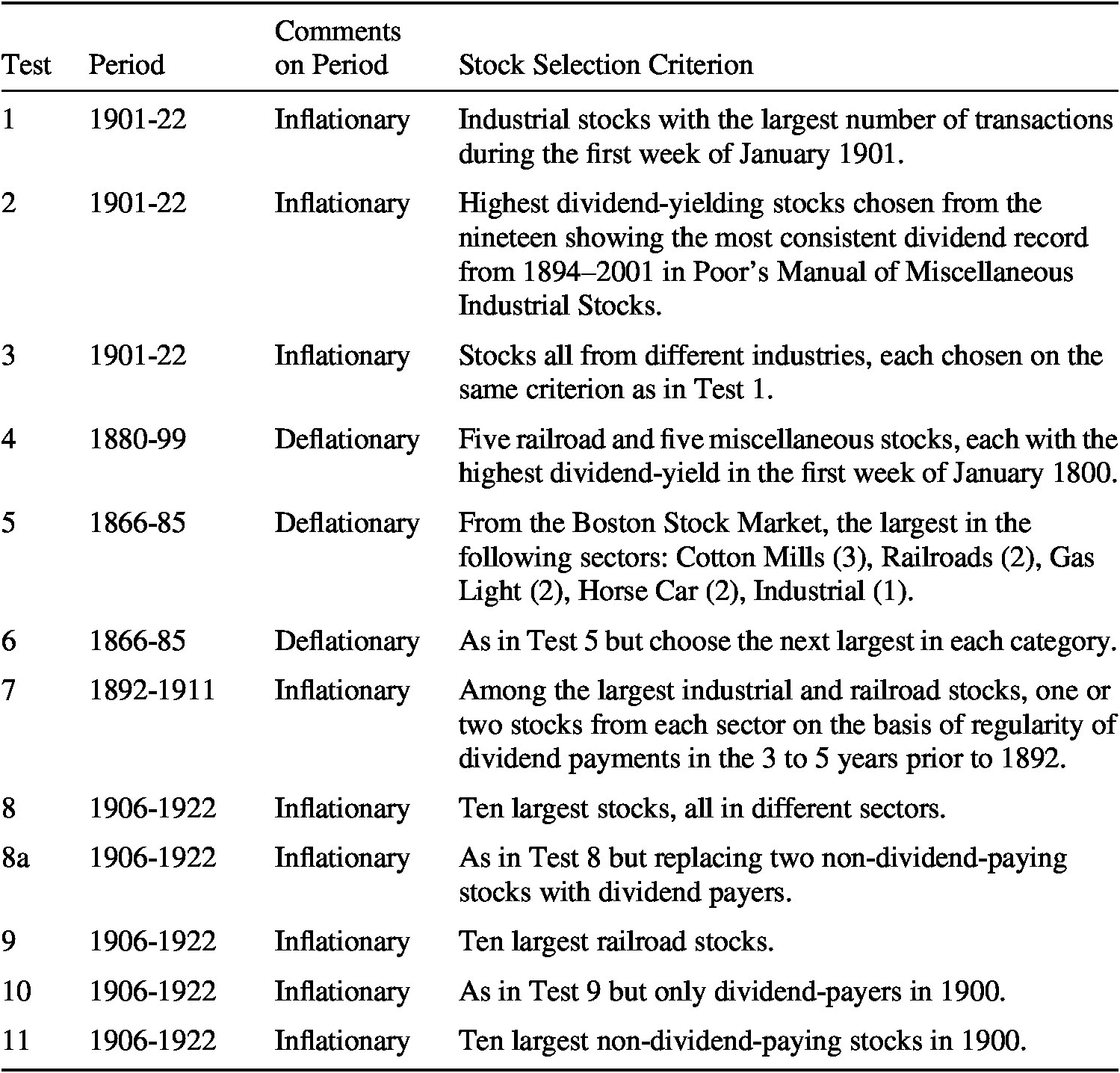
Table 1 summarizes the security selection criteria for equities employed in the tests. Turning to bonds, Smith used a notional portfolio in twelve of the fifteen tests, numbers 5 and 6 being the ones where actual securities were employed, specifically railroad bonds, each with a gross redemption yield of either 6% or 7%, seven of which matured before the terminal date of 1885: so, he had to specify their replacements (detailed in his Appendix I).

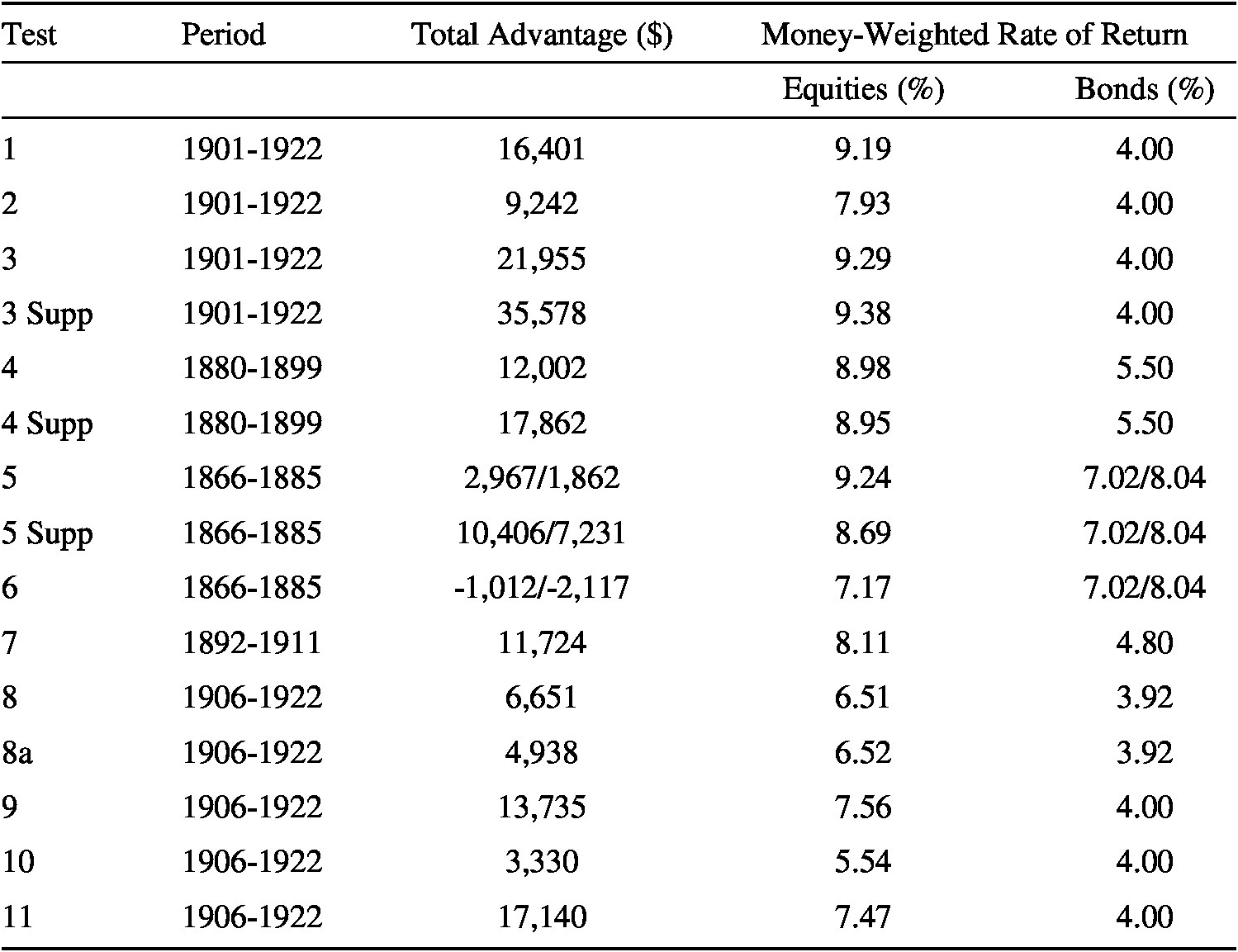
For the equity portfolio in each test, Smith assumed an initial capital value (close to $10,000) and estimated the annual income generated and the terminal capital value from market data. He performed similar calculations for the bond portfolios in tests 5 and 6; the calculations for the bond portfolios in all the other tests were much simpler because he assumed a par gross redemption yield. Then, for each portfolio in each test, he added up all the annual income numbers to produce an aggregate income statistic and, by subtracting the initial market value from the terminal, he obtained the capital gain. Comparing the aggregate income numbers, he calculated the excess income from equities over bonds and, similarly, the excess capital gain. Adding excess income to excess capital gain produced what he called “total advantage,” his metric for comparing equity and bond portfolios. To illustrate from Test No. 1: aggregate income from equities was $19,780.94 compared with $8,800 from bonds (twenty-two years at 4%), producing excess income of $10,980.94; the initial market value of equities was $10,002 and the terminal market value $15,422, producing a capital gain of $5,420; as the hypothetical bond portfolio was bought and redeemed at par, there was no capital again so that the excess capital gain was $5,420. So, adding the excess income of $10,980.94 to the excess capital gain of $5,420 produced the total advantage of equities over bonds of $16,400.94. He performed similar calculations for all the other tests, the total advantages being shown in Table 2.
Summary of Smith’s Results

Source: E. L. Smith (Reference Smith1924); the author for money-weighted rates of return.
Notes: Total Advantage = (Aggregate Equity Income + Equity Capital Gain) – (Aggregate Bond Income + Bond Capital Gain). In each test, E. L. Smith provided initial and terminal capital values and annual income for the equity portfolio, enabling the MWRR to be calculated. In each test except numbers 5 and 6, he assumed a bond (portfolio) of corresponding maturity with a given par yield which was, therefore, the MWRR. In tests 5 and 6, Smith employed two specific bond portfolios: as he provided initial and terminal capital values and annual income in each case, it is possible to calculate the corresponding MWRRs.
Smith concluded that his empirical results provided prima facie evidence for the case that equities might be suitable as long-term investments because they outperformed bonds in deflationary, as well as inflationary, periods.
Commentary on Methodology and Results
In addition to the four comments made in section III, we add the following.
A fifth comment relates to the security selection criteria. Of course, we are now well aware of the value premium in equities, which might induce us to question the use of high dividend yield as a selection criterion, but that was unknown in Smith’s time. On the other hand, we are now aware of a small cap premium, and there were tests in which only large cap securities were chosen.Footnote 3 So, perhaps it is a case of six of one and half a dozen of the other. Turning to bonds, we see that it was only in tests numbers 5 and 6 that specific securities were actually chosen: in all the other tests, the bond portfolio was represented in effect by a bond of appropriate maturity with a par yield corresponding to the prevailing gross redemption yield at the starting date. So both capital gains and losses were thereby excluded, as were, more importantly, defaults. In an inflationary (respectively, deflationary) era, it is likely that bond yields will rise (respectively, fall), generating capital losses (respectively, gains). By employing a par gross redemption yield in an inflationary era, Smith was, therefore, making the most favorable assumption for the bond portfolio. On the other hand, a favorable case for bonds in a deflationary era would involve the selection of very long-dated securities likely to experience capital gains. Taken in aggregate and noting the groundbreaking nature of his exercise, we might reasonably accept Smith’s security selection criteria.
A sixth comment that would occur to a reader nowadays is that, with one exception (Test No. 9), the initial dividend yield on the equity portfolio was higher, in some cases much higher, than the income yield on the bond portfolio.Footnote 4 Maintenance of the dividend would then tend to make the overall result a foregone conclusion.
This leads to a seventh comment: the stability of dividends. Accustomed as we have been for decades to corporate policy that avoids cutting dividends as far as possible and, hence, relatively low volatility of dividend growth, we might be surprised by some of the statistics emerging from Smith’s tests. For example, the standard deviation of dividend growth was 23.5% in Test No. 1, 27.0% in Test No. 11, but only 11.7% in Test No. 10 and 9.9% in Test No. 5. In Test No. 11, dividends increased tenfold over the piece, generally in an upward direction, whereas in tests numbers 5 and 6, they more or less halved over the twenty-year period, again not uniformly. Examining Smith’s dividend series reminds us not to base expectations of the pattern of dividends on current conceptions and assumptions.
An eighth comment concerns Smith’s metric used in comparing equity and bond portfolios: total advantage, which is a monetary measure. To modern eyes, this is an unconventional, at best auxiliary, metric, the preference being for the rate of return in either its time- or money-weighted versions. In this instance, it is not possible to calculate time-weighted rates of return because we do not have all the year-end market values; however, Smith has provided us with annual cash-flow data and the initial and terminal market values, which are exactly what is required for the money-weighted rate of return (MWRR). So, in the final two columns of Table 2, we show the MWRRs for both portfolios in each test. We can see that, in most cases, the MWRR and total advantage criteria provide the same answer: the equity portfolio has the higher MWRR and a positive total advantage. However, in Test No. 6 with the first bond portfolio, the criteria produce different answers: the equity portfolio has the higher MWRR but the total advantage is negative. Note that, in the same test with the second bond portfolio, the conclusion is unambiguous, the equity portfolio having the lower MWRR and a negative total advantage. The main criticism of the total advantage metric is that it ignores the time dimension altogether, both of its components being calculated on a simple arithmetic basis without any reference to time: on the other hand, the MWRR metric, being based on discounting, necessarily assigns an important role to time.Footnote 5 What we are illustrating here—of course, with the benefit of hindsight, educated by almost a century of accumulated knowledge—is that the MWRR is a useful metric when investigating whether income should be retained or reinvested.Footnote 6
A.II. SMITH’S CHAIN-LINKED PORTFOLIO
To isolate the underlying factor generating capital gains, Smith first constructed a chain-linked portfolio covering the period from 1866 to 1922 by splicing four overlapping test portfolios—those for 1866 to 1885 (No. 5), 1880 to 1899 (No. 4), 1892 to 1911 (No. 7), and 1901 to 1922 (No. 3). From Table 2, we can see that these portfolios were all different: so, if they were to be combined by chain-linking, there had to be a consistent basis at each switch point. Smith selected the switch point between each consecutive pair as the year in which they stood on the “same investment rating” (i.e., dividend yield), illustrated in his Chart No. 5 (p. 71). Having completed this, Smith then added another portfolio (p. 75) on the same basis to cover the preceding thirty years so that he could construct Chart No. 6 (p. 74) of market value for 1837 to 1922. The point to make is that Smith’s methodology was impeccable.
A.III. A RESUMÉ OF VAN STRUM’S RESULTS
The publication of Smith’s monograph inspired Kenneth Van Strum to conduct an even larger number of similar tests covering the period from 1873 to 1924. In a series of articles in the magazine Barron’s, between February and May 1925, Van Strum reported on the results of a further eighteen tests, each covering a period of twenty to twenty-five years and conducted along generally the same lines as Smith’s, although there were some differences in implementation. For example, Van Strum’s equity portfolio of ten securities consisted of just one share in each name rather than being initially equally weighted by market value; in some of the tests, the “Bond list [was] shifted so as always to keep [the] fund invested in long-term bonds and in this way to increase principal” (Reference Strum and Kenneth1925, p. 98); and, using the same metric of total advantage, Van Strum reported in both nominal (“Actual dollars”) and real (“Purchasing power”) terms. Of the thirty-six results displayed, bonds had a total advantage in less than a handful of cases (in fact, three). The results in Van Strum’s articles, subsequently collected and published as Investing in Purchasing Power, confirmed those in Smith’s tests and, in that sense, provided further empirical support for Smith’s thesis.
A.IV. A RESUMÉ OF HAROLD’S RESULTS
We refer to Gilbert Harold’s 1934 article on the common-stock theory, in which inter alia he extended the results of three of Smith’s tests—numbers 2, 3, and 11—to the end of 1932. The end-August 1929 market values for the respective equity portfolios were $90,437, $35,447, and $60,958, all from an initial market value close to $10,000 at the beginning of 1901; the corresponding values at end-December 1932 were $44,241, $9,037, and $8,404. Using the Smith–Van Strum metric of total advantage, all three portfolios still significantly outperformed the bond portfolio based on a par gross redemption yield of 4%: in Test No. 2, the equity portfolio generated total income of $41,596 compared with $12,800 for bonds, the corresponding equity numbers for tests numbers 3 and 11 being $33,231 and $27,609.Footnote 7