Most research on second language (L2) acquisition looks either at production or processing, and comparisons between the two domains are rare. The study of verb placement is not exceptional in this respect. Scholars have investigated how L2 learners acquire verb placement by looking at spontaneous or elicited production data, taken from interviews or production tasks. Such studies have typically led to the characterization of the acquisition process as a series of successive stages, each with their own internal logic and increasing similarity to the grammar of the target language (Cancino, Rosansky, & Schuman, Reference Cancino, Rosansky, Schuman and Hatch1978; Clahsen, Reference Clahsen1983). In contrast, researchers have studied how L2 learners deal with verb placement in controlled processing experiments (Beck, Reference Beck1998; Eubank & Grace, Reference Eubank, Grace, Stringfellow, Cahana-Amitay, Hughes and Zukowski1996). In the latter studies, not much information is generally available about learners’ production, apart from measures taken from judgement or translation tasks that serve to group learners according to proficiency.
A robust finding in L2 research on verb raising languages is that light verbs such as modal and auxiliary verbs precede negation from their first emergence, whereas lexical verbs initially follow negation (Clahsen, Reference Clahsen, Jordens and Lalleman1988; Hawkins, Reference Hawkins2001; Haznedar & Schwartz, Reference Haznedar, Schwartz, Hughes, Hughes and Greenhill1997; Meisel, Reference Meisel1997; Parodi, Reference Parodi2000; Tomaselli & Schwartz, Reference Tomaselli and Schwartz1990). In particular, auxiliaries have been claimed to fulfill a crucial role: unlike lexical verbs, such verbs lack a clear lexical meaning of their own and occur with nonfinite lexical verbs (past participles). Various researchers have argued that, due to these properties, such verbs play an important role in the acquisition of verb placement. Vainikka and Young-Scholten (Reference Vainikka and Young-Scholten1996a, Reference Vainikka and Young-Scholten1996b) analyzed longitudinal production data from Korean and Turkish learners of German and found that these learners only started to (optionally) raise verbs over negation and adverbs after the acquisition of subject–verb agreement, which was typically instantiated after the acquisition of auxiliary verbs. They also observed that verb placement with auxiliaries was more targetlike than with lexical verbs. Becker (Reference Becker and Hendriks2005) and Dimroth (Reference Dimroth2008) found that Italian and Russian learners of German only raised lexical verbs over negation after they had acquired the auxiliary verb haben. They concluded that the acquisition of auxiliary verbs constitutes a major step toward targetlike verb placement in L2 German.
The observation that auxiliary verbs are important for the acquisition of verb placement is solely based on evidence from production data. As noted by several L2 researchers, however, there are clear drawbacks to relying on production data alone as a measure of learners’ linguistic competence (Epstein, Flynn, & Martohardjono, Reference Epstein, Flynn and Martohardjono1996; Grondin & White, Reference Grondin and White1996; Grüter, Reference Grüter2005/2006; White, Reference White1992). Beginning L2 learners often use formulas that do not yet reflect the application of a rule, but are taken over from the input as unanalyzed forms. The inclusion of such forms can easily lead to an overestimation of learners’ linguistic knowledge. At the same time, however, linguistic knowledge might be present in the L2 learners’ mental grammar that does not yet make its way into production. Grondin and White (Reference Grondin and White1996, p. 5) noted in this respect that “one should be wary . . . that if something does not occur in production, it is absent from the grammar.” There is evidence that learners can have linguistic knowledge of a particular linguistic phenomenon before they can use this knowledge for production (Beck, Reference Beck1998; Grüter, Reference Grüter2005/2006; Naiman, Reference Naiman1974). An important purpose of the present study is therefore to investigate L2 verb placement by considering data from different experimental techniques, including methods that are assumed to tap into linguistic competence more directly than (spontaneous or elicited) production. The study builds on the idea that auxiliaries lead to the acquisition of targetlike verb placement in L2 German and investigates whether this finding can be confirmed for L2 Dutch. Dutch is typologically similar to German, but it has thus far not often been investigated in L2 studies on verb placement. In particular, the study addresses the question whether there is evidence for the important role of auxiliaries when data other than production data are investigated: controlled data from an elicited imitation and a sentence processing task. Do learners who produce auxiliaries behave differently from learners who do not produce auxiliaries in such tasks? Do learners show linguistic knowledge in imitation and processing that is not yet visible in their production?
The paper is organized as follows: the next section presents an overview of earlier studies on the production and processing of verb placement in L2 acquisition. Subsequently, the main typological properties of the languages under study are outlined, and the study's research questions and methodology are described. Three types of task were conducted: elicited production, elicited imitation, and sentence matching. The results from the elicited production tasks will be described first. The main aim of the study, then, is to compare these data with elicited imitation and sentence-matching data from the same learners. Finally, the main findings from the different tasks will be summarized and evaluated.
BACKGROUND
Production studies
There is ample evidence from L2 production studies that learners of verb-raising languages initially place lexical verbs in a position following negation, resulting in ungrammatical structures. The development towards a targetlike placement of such verbs is gradual and there is often a long phase at which verbs can follow and precede negation. With auxiliaries, in contrast, verb placement is targetlike from the time such verbs first emerge: these verbs consistently precede negation and there is no stage in the acquisition process at which auxiliary verbs follow negation (Meisel, Reference Meisel and Andersen1983; Parodi, Reference Parodi2000; Schwartz & Sprouse, Reference Schwartz and Sprouse1996; Vainikka & Young-Scholten, Reference Vainikka and Young-Scholten1996a, Reference Vainikka and Young-Scholten1996b).Footnote 1 There is an extensive literature on the acquisition of verb raising: studies have looked at raising past negation and adverbs, raising of different types of verb, and in various source and target language combinations (Eubank, Reference Eubank1993/1994; Schwartz & Sprouse, Reference Schwartz and Sprouse1996; Vainikka & Young-Scholten, Reference Vainikka and Young-Scholten1996a, Reference Vainikka and Young-Scholten1996b; White, Reference White1991, Reference White1992). As the focus of the current study is on the acquisition of auxiliary and lexical verb placement in relation to negation in a Germanic language (Dutch), the following summary is restricted to studies on L2 German that have differentiated between auxiliary and lexical verbs.
For L2 German, it has been proposed that auxiliary verbs play a crucial role in the acquisition of verb placement such that the acquisition of auxiliaries would lead to targetlike placement of all verbs. Vainikka and Young-Scholten (Reference Vainikka and Young-Scholten1996a, Reference Vainikka and Young-Scholten1996b) found that lexical verbs are initially placed behind negation in the L2 productions from Turkish and Korean learners of German. No auxiliary verbs are used at this stage. To explain this pattern, the authors propose that only bare verb phrases can be projected at this early stage. At the next stage, learners learn to project an underspecified functional projection (FP), which provides a position for raised verbs as well as modals and auxiliaries. Because FP is still underspecified for tense and agreement at this stage, verb raising is optional: verbs can precede as well as follow negation. Finally, learners project an AgrP: they now use modals and auxiliaries, and verb placement of lexical verbs is largely correct. Of importance, Vainikka and Young-Scholten assume that this final stage is triggered by “the productive usage of a functional element, particularly one lacking in semantic content such as the auxiliary” that indicates the acquisition of a syntactic position for finite verbs (Vainikka & Young-Scholten, Reference Vainikka and Young-Scholten1996b, p. 168). That is, they assume that the acquisition of auxiliary verbs enables L2 learners to create a syntactic position for finite verbs that can then be used as a landing site for raised lexical verbs.
The idea that auxiliaries are important for the acquisition of verb placement has also been put forth in a series of studies that take a functional perspective on L2 acquisition (Becker, Reference Becker and Hendriks2005; Dimroth, Reference Dimroth2008). Becker (Reference Becker and Hendriks2005) investigated naturalistic longitudinal data of three Italian learners of German and found, like Vainikka and Young-Scholten (Reference Vainikka and Young-Scholten1996a, Reference Vainikka and Young-Scholten1996b), that three stages characterize the acquisition of verb placement in L2 German. At the first stage, only lexical verbs are produced and such verbs consistently follow negation in negated sentences. Following other authors (Bernini, Reference Bernini, Dimroth and Starren2003; Klein, Reference Klein, Dittmar and Penner1998), Becker explains this ordering in terms of a semantic principle: semantic scope marking. According to this principle, the negator precedes the elements in a sentence over which it has scope, that is, the elements that it semantically affects. Thus, in a sentence such as Mein Vater nicht schlafen “My father not sleep,” nicht precedes schlafen because the verb is in its semantic scope domain (Becker, Reference Becker and Hendriks2005, p. 287).Footnote 2 The next stage is characterized by the acquisition of auxiliary verbs. These verbs differ from lexical verbs in that they do not have a clear meaning of their own, but only mark aspect. Crucially, auxiliary verbs appear in a targetlike position from the start in L2 acquisition. Becker explains this in terms of these verbs’ semantic properties: due to their lack of clear semantic content, they fall outside the scope of negation. More precisely, in a German sentence such as Er hat nicht lese “He has not read” (Becker, Reference Becker and Hendriks2005, p. 293) negation follows the auxiliary verb because the negator only has scope over the lexical verb lese “read.” Becker finds that the targetlike placement of auxiliaries is extremely consistent: auxiliaries never follow negation in her corpus. Moreover, auxiliary verbs consistently appear with correct finiteness marking. Becker attributes this finding to the auxiliaries’ co-occurrence with forms that are clearly marked for nonfiniteness (i.e., past participles). The co-occurrence of a clearly finite form (the auxiliary) and an overtly marked nonfinite form (a past participle) would make the finite/nonfinite distinction transparent to the L2 learner. Consequently, at the final stage, learners learn to extend finiteness marking to all verbs: they start to produce finite lexical verbs and raise such verbs over negation. This results in targetlike sentences such as Er liest nicht “He reads not,” in which the negator follows the lexical verb. In such utterances, the preference for transparent scope relations is given up in favor of a grammatical rule of the target language according to which finite verbs must be placed in a higher position in the clause. The transition from a semantically based system to a syntactic system is not a one-step development, however, and Becker notes that it is not uncommon that advanced learners may “backslide” into constructions typically used at earlier stages.
In short, previous evidence from production studies suggests that auxiliaries play an important role in the acquisition of verb placement. In a syntactic-oriented, “structure-building” approach, such verbs are assumed to create a syntactic position to which finite, lexical verbs can raise. In functionalist studies, auxiliaries are assumed to precede negation due to their “thin” semantics and trigger finiteness marking due to their co-occurrence with overtly marked nonfinite forms (i.e., past participles). In the current study, a number of predictions for L2 Dutch will be derived from the idea that auxiliaries fulfill a special role in the acquisition of verb placement in production, imitation, and processing. Before these predictions will be outlined, the next section addresses the main outcomes of studies that have looked at verb placement in L2 processing.
Processing studies
Very few studies on verb placement in L2 processing have appeared, and without exception they have focused on the question of whether verb morphology and verb raising are interrelated in L2 acquisition. The reason for investigating this relation is that, within universal grammar (UG), a relation is assumed between finiteness and verb raising: finite verbs should occur in a raised position and nonfinite verbs should appear in a nonraised position (Chomsky, Reference Chomsky1995). More specifically, verbs can have strong or weak verb features, and this has consequences at the syntactic level: in verb raising languages like Dutch, German, and French, verbs with strong verb features raise overtly to the functional category inflection for their features to be checked, but verbs with weak inflection features raise covertly. There have also been attempts to relate the complexity of the verbal agreement paradigm to verb raising (Rohrbacher, Reference Rohrbacher1994; Vikner, Reference Vikner1995) by defining the “strength” of the agreement paradigm in terms of overtly detectable morphological properties. For example, Rohrbacher (Reference Rohrbacher1994) considered agreement as “strong” when the first and second person are distinctively marked from each other, from the third person and from the infinitive, in at least one number (singular or plural) of one tense of regular verbs.
In L2 acquisition studies, researchers have looked at the possible relation between finiteness and verb raising, that is, whether L2 learners place finite verbs in a raised position, but nonfinite forms in a nonraised position. Such a contingency between finiteness and verb raising could be taken as evidence that UG is still accessible to L2 learners. A random placement of finite and nonfinite forms in raised and nonraised position, in contrast, would indicate that UG can no longer be accessed.
Verb placement with respect to adverbs rather than negation has typically been used to investigate verb raising (and its relation to finiteness) in L2 processing. Within a UG-based framework, the same relation has been assumed between verb raising, on the one hand, and adverbs and negation, on the other hand: the finite verb is assumed to raise to a higher position and leave negation and adverbs behind.Footnote 3 Although the questions asked in these studies differ from the ones investigated here, the main outcomes of processing studies on the acquisition of verb raising in sentences with adverbs are relevant for the current purposes, so they are summarized below.
In a reaction-timed study with English learners of German, Beck (Reference Beck1998) tested the two conflicting views on verb raising in L2 acquisition: (a) the acquisition of finiteness leads to verb raising versus (b) finiteness does not lead to verb raising. She performed a sentence-matching task, in which participants were asked to judge two visually presented sentences as being the same or different. In such a reaction-timed task, the time it takes participants to make this judgement is measured and taken as an indication of the sentences’ grammaticality (Chambers & Forster, Reference Chambers and Forster1975; Duffield & White, Reference Duffield and White1999; Freedman & Forster, Reference Freedman and Forster1985). The rationale behind this measurement is that native speakers take less time to match two identical grammatical sentences than two identical ungrammatical sentences. Because the task will be described in more detail below, it suffices to point out here that the task measures the processing of grammaticality and that it is covert. Participants are not directly asked for their judgements about grammaticality, but about whether two sentences are the same. When applied to L2 learners, the assumption is that longer times reflect ungrammaticality for the learner in the same way as for native speakers, with, as a major difference, that what is grammatical for the learner need not be grammatical in the target language and vice versa.
The task used by Beck contained German sentences in which a verb either was or was not raised over an adverb, as exemplified in (1a) and (1b).
(1a) Der Vater liest selten die Zeitung “The father reads seldom the paper”
(1b) *Der Vater dann schreibt ein Lied “The father then writes a song”
These sentences were presented to native speakers and English learners of German. The learners had been subdivided into different groups on the basis of their scores on a written translation task: (a) learners who used agreement versus learners who did not and (b) learners who used subject–verb inversion versus learners who did not.Footnote 4 The results showed that both agreement groups responded equally fast to sentences with raised and nonraised verbs. Surprisingly, the no-inversion group responded faster to raised than nonraised verbs, whereas no effect was found for the inversion group. To explain the effect for the no-inversion group, Beck assumed that these learners lacked FPs and represented the raised sentences as English-type sentences with heavy NP shift.Footnote 5 She also assumed that the agreement and inversion groups did not demonstrate a processing preference because verb raising was optional for these learners.
Eubank and Grace (Reference Eubank, Grace, Stringfellow, Cahana-Amitay, Hughes and Zukowski1996) performed a similar study in which they investigated the processing of verb raising by native speakers and Chinese learners of English (both languages lack verb raising). The authors found a grammaticality effect for native speakers: processing times were shorter for nonraised verbs as in “Mary often watches TV” than for raised verbs as in “*Mary watches often TV.” For the advanced Chinese learners of English, who were assumed to have acquired subject–verb agreement based on their scores on an online translation task, no differences in response times were found. On the basis of this result, the authors conclude that verb raising is optional for these learners, even though their L1 does not have verb raising and despite learners’ relatively advanced level of acquisition.
Taken together, the results of these studies do not support the idea of a relation between agreement and verb raising in L2 acquisition. The lack of effects might also be due to a number of methodological problems, however. First, the two studies seem to have compared “apples and oranges,” namely, the production of agreement/inversion with the processing of verb raising. It is well established in the L2 literature that learners may show knowledge in comprehension or processing before they can use this knowledge for production (Epstein et al., Reference Epstein, Flynn and Martohardjono1996; Krashen & Terrell, Reference Krashen and Terrell1983). For this reason, it may be problematic to compare production and processing to find out whether two linguistic phenomena are related. It is conceivable that the learners in Beck's study had knowledge of agreement or inversion that they were not yet able to engage in production. A second problem is that no production data on verb raising were collected, making it hard to interpret the results. In Beck's study, for example, we cannot be sure that “optional verb raising” in the advanced group did not result from conflating two learner groups: a group that used verb raising in production and a group that did not. To avoid such problems, the present study looks at one linguistic phenomenon (verb raising over negation) in data from different “domains”: production, imitation, and processing.
VERB PLACEMENT AND NEGATION IN DUTCH, MOROCCAN ARABIC, AND TURKISH
Before the study's research questions and predictions are presented in the next section, a brief summary of the main typological properties is given below for the three languages under study.
Dutch
Dutch has verb raising and it is a verb-second language, which means that finite verbs must appear in second position in main clauses. This can be seen in (2), where the finite verb leest “reads” has been raised over the free negation morpheme niet “not.”
(2)


Nonfinite verbs do not raise and remain in final position. Thus, such verbs occur to the right of negation in negated sentences with modal and auxiliary verbs:
(3)
In subordinate clauses, finite verbs do not raise, but they remain in final position (i.e., Ik denk dat Peter nooit de afwas doet “I think that Peter never the dishes does”). In addition, Dutch allows scrambling of direct and indirect objects that can appear to the left or the right of negation and adverbs. For example, in (3) above, the direct object de afwas may also precede the auxiliary: Peter heeft de afwas niet gedaan.Footnote 6
Moroccan Arabic
Moroccan Arabic has verb–subject–object (VSO) as its basic word order (Ennaji, Reference Ennaji2005). SVO order is also used, but this order is restricted to specific discourse conditions, for example, when the subject is focused. Finite verbs and even whole verb complexes are raised: strong features attract the verb from head to head until the entire verbal complex (including auxiliary verbs, if present) is raised to Agr, where person and number features are checked (Ouhalla, Reference Ouhalla, Lightfoot and Hornstein1994). The example in (4) illustrates a negated declarative sentence and shows that negation is expressed with a split morpheme (ma- -š) that is attached to the finite verb.
(4)
In sentences with auxiliaries, the negative morphemes ma- and -š are attached to the auxiliary:
(5)
Turkish
Turkish is a pro-drop language with SOV as its basic word order, but scrambling also occurs, depending on information structure (Erguvanlı-Taylan, Reference Erguvanlı-Taylan1984; Kornfilt, Reference Kornfilt1997). Turkish does not have overt verb raising. Instead, each of the verb suffixes projects a functional head and the verb moves through these heads to AgrP (Haznedar, Reference Haznedar, Hughes, Hughes and Greenhill1997). This movement is vacuous, because it does not change the surface order of clausal elements: the negative suffix follows the verb root but precedes tense and agreement morphemes and the finite verb is placed in final position. The following sentence illustrates that verbal predicates are marked with the negation suffix –mA:
(6)
Turkish has two other ways to express negation: (a) substantive predicates are negated by the negative copula değil “not,” which is also marked by inflectional suffixes, and (b) existential and possessive predicates are negated with the negative predicate yok “not existent.” In (7) and (8) the use of değil and yok are illustrated.Footnote 7 See Erguvanlı-Taylan (Reference Erguvanlı-Taylan1984) and Tura (Reference Tura1981) for a detailed analysis of Turkish negation.
(7)
(8)
RESEARCH QUESTIONS
The aim of this study is to investigate the acquisition of verb placement in negated sentences in L2 Dutch, using various elicitation tasks. As a first step, production data will be analyzed to test whether the acquisition stages that were found for (Italian) L2 learners of German also hold for Moroccan and Turkish learners of Dutch. The results of this analysis mainly serve to set up a comparison with data from controlled language tasks that are less subject to performance factors than production and hence can be assumed to tap into learners’ linguistic competence more directly. Two groups of learners will be compared: a −AUX group consisting of learners who did not produce the Dutch auxiliary hebben “have” and a +AUX group consisting of learners who did. There are two research questions.
1. Do the two groups differ in their placement of verbs in negated sentences in production?
2. How do the groups deal with verb placement in elicited imitation and processing?
A number of predictions can be derived from these questions. First, based on Becker's findings for L2 German, the −AUX group is expected to place lexical verbs in a position following negation in production, because they have not yet acquired auxiliary verbs and are thus not expected to use verb raising. The +AUX group is predicted to raise lexical verbs over negation. Verb raising may still coincide with no raising in this group, however, given that targetlike verb placement is assumed to develop gradually. In auxiliary sentences, the +AUX group is expected to place auxiliaries in a correct position with respect to negation in a consistent manner. As for imitation and processing, earlier research makes no clear predictions. If learners have a preference for the structures they produce themselves, the −AUX group can be predicted to prefer lexical verbs in a position following negation. Similarly, it can be hypothesized that the +AUX group prefers both lexical verbs and auxiliaries to precede negation. The preferred pattern for auxiliary verbs for learners in the −AUX group remains an open question: these learners do not yet use such verbs in their own speech, so it is difficult to predict whether they will show a preference for auxiliaries to precede or follow negation, or no preference at all.
Learners may also prefer raised or nonraised verbs, dependent on how verb placement and negation are expressed in their native language. Opposing views have been put forward in the L2 literature as to whether verb raising can be transferred from learners’ first language (L1). Researchers have argued for full transfer of FPs, implying that learners’ syntactic knowledge of the L1 presents the initial state of L2 acquisition (Schwartz & Sprouse, Reference Schwartz and Sprouse1996). Under such a view, the Moroccan learners would have less trouble acquiring the placement of Dutch verbs than the Turkish learners, because Moroccan Arabic has verb raising, but Turkish has not. Other theories hold that learners cannot transfer higher FPs above the verb phrase (Vainikka & Young-Scholten, Reference Vainikka and Young-Scholten1996a, Reference Vainikka and Young-Scholten1996b). If we assume that there is no transfer of functional categories, no difference is predicted between the Moroccan and Turkish learners with respect to the acquisition of verb raising. For the current study, it remains an open question whether the Moroccan learners have an advantage in acquiring verb raising. If so, this would constitute evidence that higher functional categories can be transferred into the L2. Except for differences in verb raising, the two native languages also differ in whether they have auxiliary verbs. Moroccan Arabic has a large set of auxiliary verbs marking tense and aspect, but Turkish lacks such verbs. Thus, if the mere existence of auxiliaries in learners’ L1 is a facilitating factor in acquiring such verbs in the L2, Moroccan learners of Dutch can be predicted to have fewer problems with the acquisition of auxiliaries than Turkish learners.
THE STUDY
Participants
Fifty-five Moroccan learners and 46 Turkish learners of Dutch participated in the study. These learners were recruited at schools in The Netherlands where they took Dutch courses that are obligatory for new immigrants. They received about 9 hr of teaching per week but the main class activities involved content-driven exercises such as role play, and almost no explicit grammar instruction was given. All participants had a beginning level of acquisition: they were at Level 1 or 2 out of five proficiency levels, as indicated by school tests.Footnote 8 They were poorly educated in their home country: most learners had only been at primary school, some of them had passed a few years at secondary school, but none of them had studied at university. The average number of years of schooling in their home country was 9 years for the Moroccan and 7.6 years for the Turkish learners. Five Moroccan and 3 Turkish learners were illiterate in their native language and had received between 0 and 3 years of education only.Footnote 9 Length of residence in the Netherlands varied across participants, with a mean of 3.6 and 5.3 years for the Moroccan and Turkish learners, respectively. For both language groups, ages ranged between 19 and 42, and the average age was 28. Most of the Turkish learners were monolingual, but 13 learners reported (rudimentary) knowledge of English, 2 learners spoke a little bit of German and 1 learner reported to have some knowledge of French. As for the Moroccan learners, 38 learners had some knowledge of French (varying proficiency levels, mostly in oral language only), 4 had a good command of Spanish, and 16 spoke Berber in a native or near-native manner. However, with respect to the relevant typological properties, Berber does not seem to differ significantly from Moroccan Arabic.Footnote 10
In addition to these learners, a control group of 28 Dutch native speakers carried out the sentence-matching task.Footnote 11 A subset of these (10 learners) also carried out the production tasks.Footnote 12 All of the native speakers were recruited at secondary vocational educationFootnote 13 and thus were also relatively poorly educated. They ranged between 16 and 21 years in age, with an average age of 18.
Tasks: What they measure and how
Two types of production task were used to elicit negated utterances: film-retelling and picture story tasks. To test learners’ processing of lexical verb and auxiliary placement in negated sentences, a sentence-matching task was used. As we have seen above, participants judge two sentences as being the same or different in such a task and the time it takes them to give this judgement is measured. On the assumption that grammatical structures are processed faster than ungrammatical ones, participants’ processing times are taken as an indication of a sentence's grammaticality (for a given participant). In addition to these tasks, an elicited imitation task was used. In elicited imitation, participants repeat sentences that are manipulated for linguistic structure. These sentences can be grammatical or ungrammatical, and ideally, they are constructed in such a way that they cannot easily be imitated verbatim, that is, they should be of sufficient length not to be stored as chunks. The rationale behind the task is that, because the sentences are too long to be stored as chunks in memory, they have to be reconstructed by participants.Footnote 14 For (beginning) L2 learners, the task has proven useful in investigating learners’ linguistic knowledge: learners make changes to the stimuli sentences and these changes are assumed to reflect subconscious, abstract grammatical knowledge (Munnich, Flynn, & Martohardjono, Reference Munnich, Flynn, Martohardjono, Tarone, Gass and Cohen1994). It has also been shown that elicited imitation can reflect grammatical knowledge that learners cannot (yet) actively use (Naiman, Reference Naiman1974). It cannot be excluded that participants might sometimes repeat sentences verbatim, however. Also, unlike in a sentence-matching task, where participants need not produce language themselves but only give motor responses, language production (repetition) takes place in elicited imitation. For these reasons, it seems safe to assume that both tasks can tap into linguistic knowledge that is not available for active language production (creation), but that such knowledge is more likely to show up in sentence matching. Thus, the three tasks used in this study form a scale representing the degree to which “active” linguistic knowledge is involved: elicited production > elicited imitation > sentence matching. Although the ability to actively produce a certain form is necessary to be able to use this form in a film retelling or picture story task, more “passive” knowledge can do the job in elicited imitation, and this is even more clear in sentence matching, where participants need not produce any language themselves.
Production tasks
Four production tasks were used: a 10-min fragment from a silent movie (Charlie Chaplin's “Modern Times”), an animated movie (“The finite story”; Dimroth, Reference Dimroth2005), and two picture stories. The first film-retelling task aimed at the elicitation of auxiliaries and negation and the second one mainly aimed at eliciting negation. Both films were cut into small fragments and participants retold what had happened immediately after they had watched a fragment. Altogether, the films elicited between 4 and 10 negated utterances from the native speakers (mean = 5.8). The picture stories depicted simple events and so-called “target events” to increase the likelihood that participants would produce auxiliary verbs. More precisely, pictures like the following were included where it can be concluded from the last picture that the dog has eaten the cake, even though the eating event itself is not depicted. By showing the resultant state of some event without giving participants the opportunity to describe the event as ongoing (i.e., De hond eet de taart “The dog is eating the cake”), optimal conditions for the use of auxiliaries were created.

Note, however, that the use of an auxiliary is never obligatory in such contexts, because speakers may always describe the story from a different perspective and use a passive sentence (i.e., De taart is opgegeten door de hond “The cake has been eaten by the dog”) or a construction expressing the resultant state (i.e., De hond zit vol “The dog is full”).
Elicited imitation task
In elicited imitation, participants repeat sentences of which the grammatical structure is manipulated. The rationale behind this task is that the sentences are too long to be stored as “chunks” in memory, and therefore, participants have to reconstruct them on the basis of their own linguistic knowledge. Because such changes are typically made subconsciously, participants’ imitations are assumed to reflect abstract grammatical knowledge or linguistic competence (Munnich et al., Reference Munnich, Flynn, Martohardjono, Tarone, Gass and Cohen1994). Although there has been a debate in the literature on the validity of this task (Bley-Vroman & Chaudron, Reference Bley-Vroman, Chaudron, Tarone, Gass and Cohen1994; Markman, Spilka, & Tucker, Reference Markman, Spilka and Tucker1975), most researchers currently agree that the task is reconstructive, although there are clear interacting variables such as sentence length, time pressure, and the instruction given to participants (Erlam, Reference Erlam2006; Vinther, Reference Vinther2002).
The current task contained four sentence types that together presented two variables with two levels each: “negation” (postverbal vs. preverbal) and “verb type” (lexical verb vs. auxiliary):
LEX – NEG: De minister praat niet over het grote probleem
“The minister talks not about the big problem”
*NEG – LEX: *De minister niet praat over het grote probleem
“The minister not talks about the big problem”
AUX – NEG: De minister heeft niet over het probleem gepraat
“The minister has not about the problem talked”
*NEG – AUX: *De minister niet heeft over het probleem gepraat
“The minister not has about the problem talked”
There were 3 items per type, resulting in 12 experimental items.Footnote 15 Twenty-four filler items were included to distract learners’ attention from the target structures. Half the filler items were ungrammatical and the other half were grammatical so that the overall the grammatical/ungrammatical ratio was 1:1. The fillers involved (violations of) subject–verb inversion and (violations of) subject–verb agreement marking, as can be seen below:
Inversion: Elke dag rookt de oude meneer een sigaret
“Every day smokes the old man a cigarette”
*No inversion: *Elke dag de oude meneer rookt een sigaret
“Every day the old man smokes a cigarette”
Agreement: De man geeft een mooi cadeau aan de directeur
“The man gives a nice present to the director”
*No agreement: *De man geven een mooi cadeau aan de directeur
“The man give a nice present to the director”
Item frequency and sentence length were kept constant across all experimental and filler items. To control for frequency, only nouns and verbs from a combined frequency list of Dutch were used.Footnote 16 All verbs were regular, and all items contained eight or nine words and 12 or 13 syllables. In order to keep sentence length equal across the different types, the auxiliary items often lacked an adjective or noun that was present in the corresponding lexical verb items. Although this was not considered ideal, the alternative of comparing long auxiliary items to shorter lexical verb items was considered even less desirable (see Appendix A for a list of items).
Four counterbalanced, pseudorandomized lists were constructed. To avoid ordering effects, an additional version was constructed for each list in which the order of presentation of the items was varied (i.e., the second list started with the second half of the first list, followed by the first half). All lists began with the same two warm-up items. The entire task was administered in two sessions. Half of the participants performed the lexical verb session first, whereas the other half carried out the auxiliary session first. To reduce carryover effects, the production tasks were administered to the participants between these two sessions.
All items were prerecorded by a female native speaker of Dutch in a soundproof cabin and played to the participants via earphones. Participants were instructed to start their repetition only after they had listened to the entire sentence, and they were kept ignorant about the ungrammaticality of half of the items. When participants were not able to imitate the stimulus for some reason, it was played again with a maximum of three repetitions.
Sentence matching
In a sentence-matching task, two sentences are presented to participants, and the time it takes participants to judge whether these sentences are the same or different is measured (Chambers & Forster, Reference Chambers and Forster1975; Duffield & White, Reference Duffield and White1999; Duffield, White, Bruhn de Graviot, Montrul, & Prévost, Reference Duffield, White, Bruhn de Gravito, Montrul and Prévost2002; Freedman & Forster, Reference Freedman and Forster1985). The task is based on the finding that participants respond more quickly to grammatical sentence pairs like those in (9) than to ungrammatical pairs like those in (10) (Freedman & Forster, Reference Freedman and Forster1985):
(9) Dogs growl
Dogs growl
(10) *Growl dogs
*Growl dogs
The faster response time to (9) has been taken as evidence that the available structure in the grammatical sentences facilitates the same/different choice. A participant's reaction time to a given pair can thus be considered a function of the grammaticality of the paired sentences. Of importance, such a facilitation of grammatical over ungrammatical sentences typically holds for native speakers; the distinction between grammaticality and ungrammaticality becomes less clear-cut when the task is applied to language learners. Previous research has shown, however, that faster reaction times also reflect grammaticality for the learner, so the sentence-matching task has been considered a helpful tool for finding out what is grammatical in the L2 learner's grammar at a given point in development (Bley-Vroman & Masterson, Reference Bley-Vroman and Masterson1989). That L2 learners have a different mental grammar entails that they may show facilitation for structures that are ungrammatical in the L2 as well as inhibition for structures that are grammatical.
The task was auditory, in contrast to earlier sentence-matching tasks that were all performed in a visual mode. Piloting showed that auditory presentation of the stimuli yielded a grammaticality effect among native speakers, enabling investigations into the processing of grammaticality in populations that do not have (automatized) reading skills, such as children and beginning L2 learners. In the current study, auditory stimuli were used because participants were not proficient readers in the L2.
The experimental items were similar to those in the elicited imitation task, with the exception that proper names instead of full nouns were used as sentential subjects. The reason for this was a pragmatic one: only a few animate nouns appeared to be frequent enough in the target language to be used. Another exception is that the task contained only plural subjects of the type “John and Anne.” This was done in order to obtain sentences that were as similar as possible to the structures that learners produced themselves. More precisely, the production data had shown that nonraised verbs overwhelmingly ended in -en instead of in a correct agreement suffix. To ensure that possible effects in the sentence-matching data were not due to an interaction between verb placement and agreement marking rather than to verb placement alone, only plural verb forms ending in -en were used (as plural verbs are homophonous with infinitives in Dutch).
The same conditions were used as in the elicited imitation task. These are repeated below. Note that sentences were presented in pairs such that the first sentence was presented twice, the second sentence was presented twice, and so on.
LEX – NEG: Anna en Frank koken niet in de keuken
“Anna and Frank cook not in the kitchen”
*NEG – LEX: *Anna en Frank niet koken in de keuken
“Anna and Frank not cook in the kitchen”
AUX – NEG: Anna en Frank hebben niet in de keuken gekookt
“Anna and Frank have not in the kitchen cooked”
*NEG – AUX: *Anna en Frank niet hebben in de keuken gekookt
“Anna and Frank not have in the kitchen cooked”
Six pairs per condition were presented, which resulted in a total of 24 experimental items. There were also 36 filler pairs, resulting in an overall experimental/filler ratio of 1:1.5. The sentences in a filler pair differed either lexically or syntactically from each other, and these differences occurred at different positions within the sentence (initial-medial-final). All experimental items occurred as matching pairs, and of the filler pairs, 30 were nonmatching and 6 were matching, resulting in an overall matching/nonmatching ratio of 1:1. Half of the filler sentences were grammatical and the other half were ungrammatical. Thus, equal numbers of “grammatical” versus “ungrammatical” pairs and “matching” versus “nonmatching” pairs were used to prevent any biases in the experiment. For an overview of the items, see Appendix B.
Four counterbalanced, pseudorandomized lists as well as four additional lists in which the stimuli order was varied were constructed. Each list started with the same two filler pairs. The stimuli were prerecorded in a soundproof cabin by the same female native speaker of Dutch who read the stimuli for the elicited imitation task, and they were implemented in the software program NESU (Baumann, Nagengast, & Wittenburg, Reference Baumann, Nagengast and Wittenburg1992). In the presentation during the experiment, a 150-ms break occurred between the two sentences of a pair, and reaction times were measured from the offset of the second sentence. At this point, a picture on the computer screen indicated that participants could give their responses. It is important that yes/no questions were presented after each experimental item (after participants had given their responses) and at variable intervals after a third of the filler items. These questions served as a measure to find out whether participants stayed “online” during task performance.Footnote 17 Participants responded to the questions by pressing the “different” button for “no” and the “same” button for “yes.” Prior to the experiment, participants received oral instructions and performed a short training session. A self-paced break was allowed after participants had performed half of the task.
General procedure
All participants carried out the tasks individually in a quiet room at their schools. The order of task presentation was as follows: film retelling 1 (“Modern Times”), elicited imitation (Session 1: lexical verbs or auxiliaries), film retelling 2 (“Finite Story”), sentence matching, elicited imitation (Session 2: lexical verbs or auxiliaries), picture stories. The entire session lasted approximately 1.5 hr, and at the end of the session participants were paid 10 euros. All participants completed the tasks in one session.
RESULTS FOR PRODUCTION
Two learner groups
First of all, learners were divided into two groups on the basis of whether or not they produced auxiliary verbs in the production tasks. Thirty-one learners out of all the 55 Moroccan learners produced at least one auxiliary, and 25 out of all the Turkish learners did. From now on, these learners will be referred to as the +AUX group and those learners who did not use auxiliary verbs will be referred to as the −AUX group. At first sight, a group split based on only one auxiliary production might seem too strict. Previous studies have shown, however, that the acquisition of auxiliaries by Moroccan and Turkish learners of Dutch is a sudden development (Jordens, Reference Jordens2004). Within a short period of time, there is a steep increase in the use of auxiliary verbs, and they are used with different lexical verbs from their first emergence. Based on this evidence, it was chosen to use the rather strict criterion of only one auxiliary production for learners to be included in the +AUX group. The utterance Ik heb vergeten “I have forgotten,” was not taken into account, however, as this utterance is likely to be used as an (unanalyzed) formula.
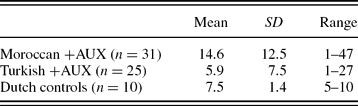
Table 1 shows the mean number of auxiliaries, standard deviations, and ranges for the Moroccan +AUX group, the Turkish +AUX group, and the Dutch native speakers. Because only 10 native speakers completed all three production tasks, the native speaker group is relatively small in comparison to the L2 groups.
Auxiliary use in the production data of the Moroccan +AUX group, Turkish +AUX group, and Dutch controls
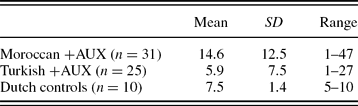
The table shows a wide range in auxiliary use: some speakers (five in the Moroccan group and three in the Turkish group) produce only 1 auxiliary, whereas other use more than 40. On average, the Moroccans produce more auxiliaries than the Turkish learners and even more than the Dutch natives. The difference between the two language groups might be due to L1 influence, given that Moroccan Arabic, but not Turkish, has auxiliary verbs. The higher occurrence of auxiliaries in the learner group when compared to the Dutch controls is clearly due to a general difference in length of retellings: the learners’ retellings were generally more detailed and less elliptical than the natives’ retellings, and hence, there were more occasions to use auxiliary verbs in the former group.
Verb placement in production in the −AUX and +AUX groups
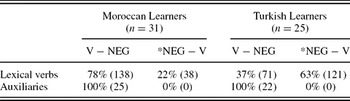
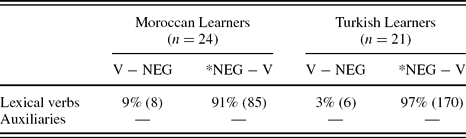
All sentences containing a negator and a lexical or auxiliary verb in the learners’ productions were analyzed for whether the verb preceded or followed the negator. Table 2 and Table 3 provide the absolute and relative frequencies of the placement of lexical verbs and auxiliaries for the +AUX and −AUX groups. In these tables, “V” refers to both lexical verbs and auxiliaries. Thus, in the second row of the tables, V – NEG indicates that the auxiliary preceded the negator, whereas NEG – V indicates that it followed the negator, which was never the case, however.
Verb placement in the production data of the +AUX group

Verb placement in the production data of the −AUX group
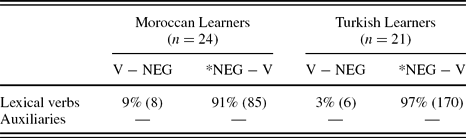
In the +AUX group, auxiliaries consistently precede negation, whereas lexical verbs are found on both sides of negation. For the Moroccan learners, verb raising is the dominant pattern (78%), whereas for the Turkish learners, nonraised verbs are more frequent than raised verbs (37% raised verbs only). This difference between the two language groups is significant by Pearson chi-square value, χ2 (1) = 64.231, p < .001. In the −AUX group, verb raising is almost negligible: over 90% of all verbs appeared in a nonraised position. Again, the predominant use of nonraised verbs is clearer for the Turks (97%) than the Moroccans (91%) in this group, but this difference is not significant, χ2 (1) = 3.326, p > 1.Footnote 18
Taken together, these results provide a positive answer to research question 1: The learners in the +AUX group produce raised verbs (in addition to nonraised ones), but the −AUX group almost exclusively produces verbs in a nonraised position. The differences between the −AUX and +AUX learners are significant for both language groups: χ2 (1) = 119.478, p < .001 for the Moroccans; χ2 (1) = 62.544, p < .001 for the Turks.
The question arises whether the relation between auxiliaries and verb raising is a causal one, as claimed in previous studies, or whether the two develop in parallel. The data show that verb raising is rather widespread in the +AUX group: 29 out of the 31 Moroccan learners use verb raising and 23 out of the 25 Turkish learners do. The remaining four learners could be classified as “Stage 2” learners in terms of Becker's (Reference Becker and Hendriks2005) model: they produce auxiliaries but no verb raising, suggesting that auxiliary acquisition precedes the acquisition of verb raising rather than vice versa. This is important, as the reverse pattern would be hard to reconcile with the idea that auxiliaries lead to verb raising. The data also show that some learners in the −AUX group can produce verb raising, an unexpected finding if one assumes that auxiliaries drive verb raising. A closer look suggests, however, that these cases may not reflect productive use of verb raising. Out of all the 14 examples, six are self-corrections of the type in (11), that were uttered hesitantly, and seem to reflect the application of a meta-linguistic rule rather than productive grammatical knowledge: in (11), a # symbol indicates a 2-s pause. Four utterances are cases of constituent negation of the type in (12) where negation has narrow scope over boven “up.”
(11)
(11)
If we leave aside these cases, it appears that only one learner in the −AUX group produces verb raising in a targetlike manner. This finding together with most but not all learners in the +AUX group use verb raising tentatively suggests that auxiliaries cause verb raising. In line with earlier claims in the literature, auxiliaries would provide a landing site for lexical verbs to be raised to (Vainikka & Young-Scholten, Reference Vainikka and Young-Scholten1996a, Reference Vainikka and Young-Scholten1996b) or lead to the acquisition of finiteness marking, and concomitantly verb raising, because they spell out finites marking to the learner (Becker, Reference Becker and Hendriks2005). However, this evidence is not very robust. It remains for further research to check whether auxiliaries drive verb raising or whether the two phenomena only develop in parallel. Thus, the clear finding is that there is a clear difference between auxiliary users and “nonauxiliary users” in L2 Dutch such that the former almost always produce verb raising, but the latter do not, or only very rarely so. In the next sections, the results of the elicited imitation and sentence-matching experiments will be discussed to see whether the same patterns are found when other types of data are considered.
RESULTS FOR ELICITED IMITATION
Coding and scoring
The results from the elicited imitation task showed that learners frequently changed the original stimuli in their responses. Syntactic, morphological, and semantic changes were found, suggesting that the learners did actively reconstruct the stimuli rather than repeat them verbatim, at least in the overwhelming majority of cases. The responses in (13) and (14) illustrate a semantic and morphosyntactic change, respectively:
(13) Stimulus: *De burgemeester niet werkt op een groot kantoor
“The mayor not works in a big office”
Response: *Die burgemeester niet werk op de postkantoor
“The mayor not work in the post office”
(14) Stimulus: De mannen hebben niet naar de muziek geluisterd
“The men have not to the music listened”
Response: Die mannen hebben niet luisteren muziek
“The men have not listen music”
For all responses, whether the verb preceded or followed negation was determined. When learners repeated a sentence more than once or produced a self-correction, only their last response was considered. Responses in which a lexical verb had been changed to another lexical verb (e.g., praten > luisteren “talk > listen”) were retained for analysis.
Results
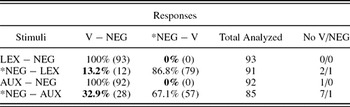
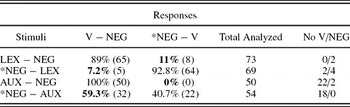
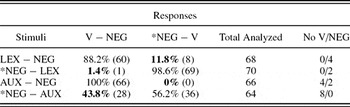
Table 4 and Table 5 show the data for the Moroccan and Turkish +AUX groups. The numbers in bold indicate the changes that learners made in their responses concerning the position of the verb relative to negation for a given sentence type. Thus, 13.2% in the second column of Table 4 indicates that 12 out of all 91 responses to stimulus sentences with a lexical verb following negation (*NEG – LEX) were changed into sentences with a lexical verb preceding negation (LEX – NEG). The tables also show how many utterances could be analyzed (“total analyzed”) and how often learners left out the verb or the negator in their responses (2/1 in the last column indicates that out of all responses in a given condition, two responses lacked a verb—a lexical verb or auxiliary depending on the condition—and one had a missing negation).Footnote 19
Results from elicited imitation for the Moroccan +AUX group (n = 31)

Note: The numbers in bold indicate the changes that learners made in their responses concerning the position of the verb relative to negation for a given sentence type.
Results from elicited imitation for the Turkish +AUX group (n = 25)

Note: The numbers in bold indicate the changes that learners made in their responses concerning the position of the verb relative to negation for a given sentence type.
Table 4 shows that the Moroccan learners changed lexical verbs from a position following negation to a position preceding negation in their responses, but not vice versa (13.2% vs. 0%). The same holds for auxiliaries, where an even stronger preference for auxiliaries to precede negation was found: 32.9% of all auxiliary sentences in which the auxiliary followed negation were changed into a grammatical sentence, but the opposite type of change was never made. The following responses illustrate both types of change made by the Moroccan +AUX group: a change from *NEG – LEX into LEX – NEG and from *NEG – AUX into AUX – NEG, respectively.
(15) Stimulus: *De jongens en meisjes niet lopen op het strand
“The boys and girls not walk on the beach”
Response: Die jongens en meisjes loopten niet in het strand
“The boys and girls walk not on the beach”
(16) Stimulus: *De meisjes niet hebben op het strand gelopen
“The girls not have on the beach walked”
Response: De meisjes hebben niet op het strand gelopen
“The girls have not on the beach walked”
Comparing these findings to the data from the Turkish learners in Table 5, a clear difference can be observed: whereas the Moroccan learners shifted verbs from a position following negation to a position preceding negation, but never vice versa, the Turkish learners also switched lexical verbs to a position following negation. This is exemplified in (17) and (18):
(17) Stimulus: De mannen luisteren niet naar de mooie muziek
“The men listen not to the nice music”
Response: *Die mannen niet luisteren in de muziek
“The men not listen in the music”
(18) Stimulus: De burgemeester werkt niet op een groot kantoor
“The mayor works not in a big office”
Response: De burgemeester niet werk op een kantoor
“The mayor not work in an office”
They produced this type of response more often than the opposite type, in which they shifted a verb from a nonraised to a raised position (11% vs. 7.2%). Just like the Moroccan learners, however, the Turkish learners showed a clear preference for auxiliaries to precede negation: no less than 59.3% of all sentences were changed from *NEG – AUX into AUX – NEG order in this language group, but the opposite type of change did not occur. Consider (19) for an example:
(19) Stimulus: *De koningin niet heeft naar de mensen gelachen
“The queen not has to the people laughed”
Response: De koning heeft niet naar de mensen gelacht
“The queen has not to the people laughed”
For both language groups, the differences between the lexical verb and auxiliary condition are significant, χ2 (1) = 9.766, p = .002, for the Moroccans; χ2 (1) = 38.965, p = .001, for the Turks, showing that both groups switched auxiliaries more often into a correct position in their responses than lexical verbs. Note, however, that the number of analyzable responses in the auxiliary condition is much lower than in the case of lexical verbs, in particular, in the data from the Turkish learners. A look at the last column shows that this is due to the large number of responses in which the auxiliary was not repeated. The Turkish learners left out the auxiliary in 22 and 18 of all responses to *AUX – NEG and NEG – AUX items, respectively, which constituted 22% and 30% of all responses. We will come back to this finding below and discuss it further in the discussion section.
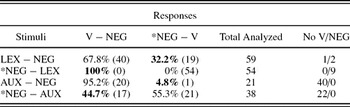
Table 6 and Table 7 present the data for the Moroccan and Turkish −AUX groups. As in Tables 4 and 5, the values in bold indicate the changes that learners made in their responses concerning the position of the verb relative to negation. With one exception, the learners in the −AUX groups did not change nonraised lexical verbs into raised lexical verbs, so they behaved differently from both +AUX groups. Instead, they frequently switched lexical verbs from a raised into a nonraised position: 11.8% in the data from the Moroccans and 32.2% in the data from the Turks. This difference is significant, χ2 (1) = 11.655, p = .001, showing that the Turkish learners changed raised into nonraised lexical verbs significantly more often than the Moroccan learners.
Results from elicited imitation for the Moroccan −AUX group (n = 24)

Note: The numbers in bold indicate the changes that learners made in their responses concerning the position of the verb relative to negation for a given sentence type.
Results from elicited imitation for the Turkish −AUX group (n = 21)

Note: The numbers in bold indicate the changes that learners made in their responses concerning the position of the verb relative to negation for a given sentence type.
It is striking that Tables 6 and 7 also show that the −AUX group often changed auxiliaries from a position following negation to a position preceding negation. These changes are remarkable given that the learners in the −AUX group could not produce auxiliaries. The number of “corrected” auxiliary sentences produced by the Moroccan −AUX group outnumbers those made by the Moroccan +AUX group: 43.8% versus 32.9%. The Turkish –AUX group also frequently shifted the auxiliary from a position following to a position preceding negation (44.7%), but they did not do so more frequently than the Turkish +AUX group (59.3%).
Just as was observed for the +AUX group, the learners in the −AUX group often left out the auxiliary verb in their responses: 65.5% of the responses to AUX – NEG stimuli in the Turkish −AUX group did not contain an auxiliary and the same held for 36.7% of all responses to *NEG – AUX stimuli.Footnote 20 For an illustration, consider (20) and (21):
(20) Stimulus: De mannen hebben niet naar de muziek geluisterd
“The men have not to the music listened”
Response: De mannen 0 niet muziek luisteren
“The men not music listen”
(21) Stimulus: De meisjes hebben niet op het strand gelopen
“The girls have not on the beach walked”
Response: De meisjes 0 niet op het strand lopen
“The girls not on the beach walk”
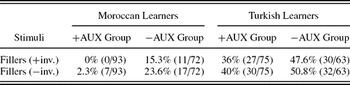
An interesting question is why learners left out hebben so frequently. To find out whether the phenomenon was somehow related to the presence of negation, the filler items containing auxiliaries were analyzed to see whether the learners showed the same behavior for these items. Recall from above that (some of) the filler items involved inversion/no-inversion sentences of the following type: Elke dag heeft de meneer een sigaret gerookt versus *Elke dag de meneer heeft een sigaret gerookt (“Every day has the man/*the man has a cigarette smoked”). Table 8 shows for all four learner groups how often they “dropped” hebben in their responses to these items out of the total number of (analyzable) responses.
Auxiliary drop in the filler sentences from the elicited imitation task

Again, the tendency is particularly strong in the Turkish group: the Turkish −AUX group left out hebben in about half of the cases and even the learners of the Turkish +AUX group often “dropped” the auxiliary (36% and 40%, respectively). The Moroccan −AUX group also left out hebben relatively often, but much less often so than the Turkish −AUX group, χ2 (1) = 26.786, p < .001, when both filler types are collapsed. For the Moroccan +AUX group, “auxiliary drop” is close to absent, so the learners in this group performed very differently from the Turkish +AUX group. In the discussion, we will come back to these findings and propose an explanation of why learners “dropped” the auxiliary as well as why the Turkish learners did so more often than the Moroccan learners.
Summary
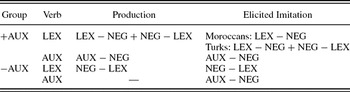
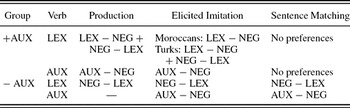
The elicited imitation data show some clear parallels to the production data. First, the +AUX group changed lexical verbs from a nonraised to a raised position, whereas the −AUX group changed lexical verbs from a raised to a nonraised position. Second, the +AUX group never shifted auxiliaries to the right of negation in their responses. Third, a difference between the two language groups was found: the Turkish learners had a stronger preference for nonraised verbs overall, because in the +AUX and −AUX group the changes from raised into nonraised verbs were more frequent than in the data from the Moroccan learners. The elicited imitation results also differed from the production data, however. First, the Moroccan +AUX group never switched raised lexical verbs into nonraised ones even though their production data did contain verbs in nonraised position. Second, and of the most interest, the −AUX group frequently switched auxiliary verbs to a correct position, even though they did not use such verbs in production. This finding suggests that learners who do not yet produce auxiliary verbs can be sensitive to the placement of such verbs relative to negation. The findings for production and elicited imitation are summarized in Table 9. This table shows for both groups and for each verb type separately which structures learners produced in the production tasks (first column) and preferred in elicited imitation (second column).
Result summary for production and elicited imitation

RESULTS FOR SENTENCE MATCHING
Before presenting the results, the next section addresses the analyses that were performed on the data from the sentence matching task.
Analyses of the sentence matching data
As is standard in sentence-matching experiments, only reaction times to matching pairs were considered for analysis. All responses to nonmatching pairs as well as incorrect responses to matching pairs were removed. Furthermore, all responses for which yes/no questions were wrongly answered were excluded. In determining the overall error rate for each participant, however, responses to nonmatching pairs were taken into account, because it was assumed that such responses provide an indication of participants’ overall task performance. In the control group, two participants with an error rate greater than 15% were excluded from the analysis (see also Duffield et al., Reference Duffield, White, Bruhn de Gravito, Montrul and Prévost2002). For the learner group, no such criterion was applied, because it was assumed that learners’ errors, unlike native speakers’ errors, could be due to problems with vocabulary or phonetic decoding instead of merely “bad processing.”
Means and standard deviations were calculated for the scores of each participant on each of the four conditions separately. The reaction times that fell beyond the cutoff value of 2 SD above or below a participant's individual mean for a given condition were excluded. As a result of error deletion and cleaning, 2.5% of all responses of the control group and 8.5% of all responses of the learner group were removed.
The remaining reaction times were analyzed with the general linear model repeated-measures procedure in SPSS for the native speakers and learners separately. In the analysis of the native speakers, there were two within-subject factors: Verb Placement, with two levels (raised vs. nonraised) and Verb Type, with two levels (lexical verb vs. auxiliary). In the analysis of the learner data, there were the same two within-subject factors as well as two between-subject factors: Language, with two levels (Moroccan Arabic and Turkish) and Learner Group, with two levels (+AUX and −AUX group). In line with earlier sentence-matching studies, both F1 and F2 were calculated, which means that separate analyses were performed over subjects and items.
Results for the native speakers
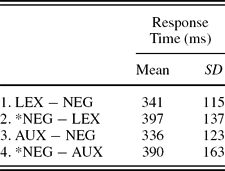
The mean response latencies and standard deviations for the control group are presented in Table 10. A repeated-measures analysis of variance showed that there was a main effect of verb placement, both by subject, F1 (1, 25) = 10.297, p = .004, and by item, F2 (1, 23) = 4.508, p = .045. This effect indicates that responses were faster to sentences with raised than to sentences with nonraised verbs.
Results from sentence matching for the native speakers (n = 26)
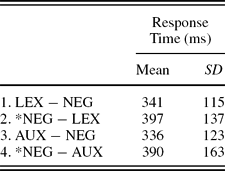
No interaction with verb type was found, indicating that speakers responded faster to sentences with raised verbs independently of whether these sentences contained a lexical verb or an auxiliary. These results show that the sentence-matching task taps into the processing of grammaticality in the case of verb raising, at least when data from native speakers are considered.
Results for the +AUX group
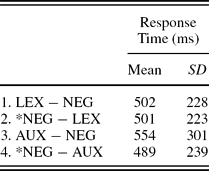
No effects were found for the learners in the +AUX group. The factor Verb Placement did not yield a significant result, F1 (1, 55) = 1.285, p > .1 and F2 (1, 23) = 0.005, p > .1, and neither did the factor Verb Type, F1 (1, 55) = 1.179, p > .1 and F2 (1, 23) = 0.006, p > .1. The interaction between Verb Placement and Verb Type was also not significant, F1 (1, 55) = 0.983, p > .1. Table 11 presents the mean reaction times and standard deviations for this group.
Results from sentence matching for the +AUX group (n = 56)
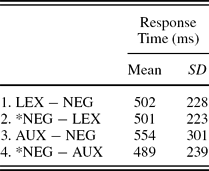
The data show that responses were equally fast to raised and nonraised verbs (lexical verbs) or even slightly faster to nonraised verbs (auxiliaries). A low power value (0.2) suggests, however, that there was high within-group variation in the +AUX group. Therefore, a series of post hoc (covariate) analyses was performed to test whether general response speed, number of postverbal negations in production, and number of auxiliaries in production influenced the results. Only “auxiliary use” turned out to significantly influence the results of the Moroccan learners. More precisely, an interaction effect between verb placement and auxiliary use, F1 (1, 30) = 4.659, p = .039, showed that the Moroccan learners who used less than 15 auxiliaries in the production tasks responded faster to nonraised lexical verbs, whereas the Moroccan learners who produced more than 15 auxiliaries responded faster to raised lexical verbs. For the auxiliary sentences, no effects were found.
In sum, the results of the +AUX group did not show effects, with the exception of a preference for raised or nonraised verbs lexical verbs in the Moroccan group, depending on how frequently learners used hebben in production.
Results for the −AUX group
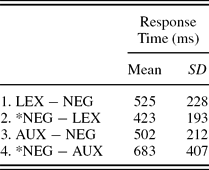
For the −AUX group, whose data are presented in Table 12, a main effect of verb placement was found, both by subject and by item, F1 (1, 44) = 8.544, p = .005, and F2 (1, 23) = 12.822, p = .002. There was also an interaction effect between verb placement and verb type, F1 (1, 44) = 18.597, p < .001, and F2 (1, 23) = 11.359, p = .003. These effects show that learners responded significantly faster to nonraised verbs in the case of lexical verbs and raised verbs in the case of auxiliaries. A post hoc paired t test showed that these differences were significant for the lexical verb sentences, t (44) = 3.235, p = .002, and auxiliary sentences, t (44) = 3.437, p = .001.
Results from sentence matching for the −AUX group (n = 45)
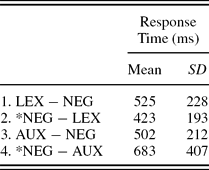
The finding that nonraised lexical verbs were processed faster than raised lexical verbs is in line with learners’ production. Learners’ faster processing of raised auxiliaries than nonraised auxiliaries is clearly ahead of production, given that the −AUX group did not produce auxiliary verbs. Both results are comparable to those from the elicited imitation task, where the −AUX group changed lexical verbs from raised to nonraised, but showed the opposite type of response in sentences with auxiliaries.
Summary
Like the results from elicited imitation, the sentence matching results showed that the −AUX group preferred auxiliaries in a position preceding negation, but lexical verbs in a position following negation. For the +AUX group, no clear effects were found except that Moroccan learners who produced more than 15 auxiliaries preferred raised over nonraised lexical verbs, whereas learners who produced fewer auxiliaries preferred nonraised over raised lexical verbs. The results for production, elicited imitation, and sentence matching are summarized in Table 13.
Overall result summary

DISCUSSION
The results of this study corroborate earlier findings for the acquisition of verb raising in production (Becker, Reference Becker and Hendriks2005; Dimroth, Reference Dimroth2008; Vainikka & Young-Scholten, Reference Vainikka and Young-Scholten1996a, Reference Vainikka and Young-Scholten1996b) and add to these findings a number of observations from elicited imitation and sentence matching. Most important, these findings show that learners can be sensitive to the grammaticality of structures before they are able to produce such structures in their own speech. In the current study, this early sensitivity to grammaticality reflects which structures learners will produce when they become more proficient in the L2.
How can we explain the finding that the learners preferred auxiliary verbs in a correct position before they produced such verbs? A possible answer is that the same principle is at work as in production, namely, semantic scope marking. According to this idea, sentences in which the negator precedes its domain of application are processed faster than sentences in which the negator is placed within this domain (LEX – NEG) or takes extra elements in its scope (NEG – AUX). Alternatively however, the results might be accounted for in terms of input frequency. Although the negator follows finite verbs in Dutch main clauses, both the complex “negator-lexical verb” and the complex “negator-auxiliary” occur in the input. The former sequence occurs in imperatives (Niet kijken! “Not watch!”), sentences with modal verbs (Ik wil niet werken “I want not work”), and subordinate clauses (Ik denk dat zij niet werken “I think that they not work”). However, the sequence negator-auxiliary is only found in subordinate clauses (Ik denk dat zij niet hebben gewerkt “I think that they not have worked”). That the negator-auxiliary occurs less frequently than the negator-lexical verb could thus explain why learners at a certain stage of acquisition prefer lexical verbs to follow negation, but auxiliaries to precede negation. It seems unlikely, however, that the results are due to input frequency alone: the preference for auxiliaries in a correct position with respect to negation in the −AUX group was remarkably strong and it does not seem very plausible that relatively small differences in input frequency caused this preference.
One finding that deserves further discussion is the null result for the +AUX group in the sentence-matching task. The absence of an effect for lexical verb sentences is not surprising, because the +AUX group produced both raised and nonraised lexical verbs in negated sentences. It is less clear, however, why the +AUX group did not prefer auxiliaries in a correct position. A question is why these learners did not show a processing preference for the type of structure they consistently produced in their own speech and never changed into an incorrect alternative in elicited imitation.
As discussed above, Beck (Reference Beck1998) also found that the least advanced learners in her study showed a processing preference for raising over nonraising that was not found for more advanced learners. Similarly, Eubank and Grace (Reference Eubank, Grace, Stringfellow, Cahana-Amitay, Hughes and Zukowski1996) found that learners of English did not respond differently to raising and nonraising even though they were highly advanced in the L2. In both studies, optionality was proposed as an explanation: verb raising is optional for these learners and therefore no processing preferences are found. Although optionality might explain the present null result for lexical verbs, it is less clear how it could account for the lack of an effect for auxiliary sentences. Rather, the results might be due to a task artifact: the presentation of negated auxiliary sentences with incorrect auxiliary placement might have led to what could be called “task-induced optionality.” In other words, on the basis of the ungrammatical sentences that were presented to them, learners might have created ad hoc representations in which auxiliaries follow negation, in addition to their already existing representations in which auxiliaries precede negation. To test this idea, the responses of the +AUX group in the first half of the task were compared to those in the second half. The results were not significant, F1 (1, 55) = 0.000, p = .992, which suggests that responses did not change as a function of learners’ exposure to the stimuli items.
Another possible explanation of the null result for the +AUX group could be a problem with the sentence-matching task. Several studies using the sentence-matching paradigm have found null results in nonnative speakers (Beck, Reference Beck1998; Eubank & Grace, Reference Eubank, Grace, Stringfellow, Cahana-Amitay, Hughes and Zukowski1996; Gass, Reference Gass2001) as well as for certain syntactic violations in native speakers (Freedman & Forster, Reference Freedman and Forster1985). This casts doubt on the appropriateness of the task. Gass (Reference Gass2001) conducted a visual sentence-matching task with native speakers and learners of French to investigate what people actually are doing when they perform a sentence-matching task. She found that reading times for the second sentence were about 1000 ms shorter than for the first sentence and she concluded that “most likely, learners were attempting to do a word-by-word match rather than reading and processing” (p. 439). She proposed that sentence-matching tasks may be valid with a certain level of proficiency only. Even though word-by-word matching seems less likely when the task is performed auditorily, it cannot be excluded that participants process sentences in a sentence-matching task differently from processing language in more natural situations.
An alternative way to account for the null result, then, is to assume that learners processed the sentences in a special manner. In studies on sentence processing, it has been argued that instead of creating fully specified syntactic representations of sentences, language users may create less detailed representations that are mainly based on lexical–semantic information. For native speakers, such “shallow processing” has been found for ambiguous sentences (Ferreira, Christianson, & Hollingworth, Reference Ferreira, Christianson and Hollingworth2001; Ferreira & Patson, Reference Ferreira and Patson2007) as well as certain types of ungrammaticality (Tabor, Galantucci, & Richardson, Reference Tabor, Galantucci and Richardson2004). For L2 processing, it has been argued that “shallow processing” is even more plausible: learners’ grammars are incomplete or different from the target language, so learners mainly rely on semantic information (Clahsen & Felser, Reference Clahsen and Felser2006). If the +AUX group merely processed sentences for meaning, this could explain why they did not respond differently to grammatical and ungrammatical sentences: both had the same meaning and the only difference between the two conditions concerned the ordering of the elements. An important question that remains, then, is the following: Why did the −AUX group show clear effects instead of shallow processing? A speculative answer would be that optionality and shallow processing go together in L2 processing. That is, learners who have alternative representations of one linguistic phenomenon (i.e., optionality) might be more susceptible to the relaxation of formal constraints than learners who do not have optional syntactic structures. Under this idea, the optional raising of lexical verbs in the +AUX group may have led to optionality with auxiliary verbs. Thus, because learners’ grammars allow for the coexistence of different syntactic structures with the same meaning, it might have enhanced learners’ relaxation of syntactic constraints, resulting in a greater reliance on semantic information. No firm conclusions can be drawn on the basis of the current data, however, and the idea that optionality might promote shallow processing needs further investigation.
Learners’ frequent omission of auxiliary verbs in elicited imitation may also be due to “shallow processing.” This idea is immediately plausible: auxiliaries lack a clear lexical meaning and therefore constitute good candidates for omission when sentences are mainly processed for semantic information. Other elements that were often left out by learners were also poor in meaning: articles, agreement morphemes, connectives such as “and,” and prepositions. In addition, the position of hebben in a sentence might have facilitated its omission. Previous research has shown that L2 learners find it easier to imitate structures at the beginning of sentences than those at the end, which in turn are easier than those in the middle (Naiman, Reference Naiman1974). Clearly, auxiliaries might then also be difficult to process (and imitate) because of their sentence medial position.
The finding that the Turkish learners dropped hebben more frequently than the Moroccan learners is likely to be due to L1 influence. First, unlike Dutch and Moroccan Arabic, Turkish lacks auxiliary verbs, which probably makes it harder for Turkish learners to perceive hebben in the input and/or figure out its function. Second, Moroccan Arabic and Turkish differ in their basic word order in that finite verbs occur in initial or second position in Moroccan Arabic, but sentence-finally in Turkish. Earlier research has demonstrated that this difference shapes word order preferences of Moroccan and Turkish learners of Dutch in production: Moroccan learners typically place verbs in sentence medial position, whereas Turkish learners typically put them in final position (Jagtman, Reference Jagtman1994; Jansen, Lalleman & Muysken, Reference Jansen, Lalleman and Muysken1981). These patterns have been argued to result from L1-based processing differences: although Moroccan learners focus their attention on the middle part of a sentence, where they expect to find a verb, Turkish learners of Dutch look for the verb in final position. The finding that the Turks left out hebben far more often than the Moroccan learners (and sometimes even left out lexical verbs in the lexical verb sentences) fits well with this idea. Of interest, this tendency was extremely persistent: even those Turkish learners who used over 20 auxiliaries in the production tasks abundantly left out hebben in elicited imitation.
Independent evidence for the idea of L1-based processing differences between Moroccan and Turkish learners of Dutch comes from the offline (accuracy) data collected in the sentence-matching task, where some nonmatching fillers involved a lexical difference between the two sentences of a pair. Crucially, these changes could occur in first position (nonmatching subjects), middle position (nonmatching verbs), or final position (nonmatching objects). An analysis of learners’ accuracy scores showed that the Turks correctly judged 59% of all nonmatching pairs with a change in the middle as being different, whereas the Moroccan learners correctly judged 73% of such pairs. No clear differences were found for the other filler pairs. This finding provides further support for the idea that the typological characteristics of the L1 may influence L2 processing.
Thus, how exactly does L1 influence relate to the acquisition of auxiliaries? Clearly, the Moroccan speakers outperformed the Turkish speakers. This seems to be because verb raising is an option in the Moroccan learners’ L1 and perhaps because of the above-explained L1-based processing differences that would make Moroccan learners focus on the verbal part of the sentence in the L2 input. Another important finding was that the +AUX group outperformed the −AUX group, regardless of learners’ L1. This suggests that Moroccan learners cannot take advantage of their L1 until auxiliaries come into play: it is only after auxiliaries have been added to the system that Moroccan learners of Dutch can transfer their L1 FPs. Such a developmental account is in line neither with the predictions made by the full transfer account (Schwartz & Sprouse, Reference Schwartz and Sprouse1996) according to which the complete L1 syntactic system is transferred to the earliest stages of L2 acquisition nor with the predictions made by the minimal trees hypothesis (Vainikka & Young-Scholten, Reference Vainikka and Young-Scholten1996a, Reference Vainikka and Young-Scholten1996b), according to which FPs can never be transferred.
Taken together, the results of this study corroborate earlier findings on the relation between auxiliaries and verb placement in production from L2 German for Dutch, and demonstrate that these findings also hold for imitation and sentence processing. More specifically, the results show that L2 learners can have grammatical knowledge of auxiliary placement before they are able to use this knowledge in production. These outcomes not only provide evidence for the different behavior of auxiliaries and lexical verbs in early L2 Dutch but also show that combining production and imitation/processing data may lead to a more complete picture of L2 development.
APPENDIX A: ITEMS OF THE ELICITED IMITATION TASK
To preserve space, only one sentence type is given for each experimental item and only example items of the fillers are provided.
Experimental items
1. De minister praat niet over het grote probleem
(“The minister talks not about the big problem”)
*De minister niet praat over het grote probleem
(“The minister not talks about the big problem”)
De minister heeft niet over het probleem gepraat
(“The minister has not about the problem talked”)
*De minister niet heeft over het probleem gepraat
(“The minister not has about the problem talked”)
2. De koningin lacht niet naar de aardige mensen
(“The queen laughs not to the nice people”)
3. De burgemeester werkt niet op een groot kantoor
(“The mayor works not at a big office”)
4. De oude leraren dansen niet op het feestje
(“The old teachers dance not at the party”)
5. De mannen luisteren niet naar de mooie muziek
(“The men listen not to the nice music”)
6. De jongens en meisjes lopen niet op het strand
(“The boys and girls walk not on the beach”)
Examples of filler items
1. De man geeft een mooi cadeau aan de directeur
(“The man gives a nice present to the director”)
*De man geven een mooi cadeau aan de directeur
(“The man give a nice present to the director”)
De man heeft een cadeau aan de directeur gegeven
(“The man has given a nice present to the director”)
*De man hebben een cadeau aan de directeur gegeven
(“The man have given a present to the director”)
2. Elke dag rookt de oude meneer rookt een sigaret
(“Each day smokes the old man a cigarette”)
*Elke dag de oude meneer rookt een sigaret
(“Each day the old man smokes a cigarette”)
Elke dag heeft de meneer een sigaret gerookt
(“Each day has the man a cigarette smoked”)
*Elke dag de meneer heeft een sigaret gerookt
(“Each day the man has a cigarette smoked”)
APPENDIX B: ITEMS OF THE SENTENCE-MATCHING TASK
Only one sentence of a pair is given for the experimental items, because all pairs were matching. For the filler items, both sentences are presented, but only one example is provided.
Experimental items
1. Nadia en Bushra dansen niet op het feest
(“N. and B. dance not at the party”)
*Nadia en Bushra niet dansen op het feest
(“N. and B. not dance at the party”)
Nadia en Bushra hebben niet op het feest gedanst
(“N. and B. have not at the party danced”)
*Nadia en Bushra niet hebben op het feest gedanst
(“N. and B. not have at the party danced”)
2. Hans en Sara dansen niet in het café
(“H. and S. dance not in the ”afé”)
3. Roos en Hessa eten niet bij hun vriendin
(“R. and H. eat not at their friend's”)
4. Sam en Peter eten niet in de klas
(“S. and P. eat not in the class”)
5. Abdul en Nada fietsen niet in de stad
(“A. and N. bike not in the city”)
6. Yassir en Edwin fietsen niet op het gras
(“Y. and E. bike not on the grass”)
7. Anna en Frank koken niet in de keuken
(“A. and F. cook not in the kitchen”)
8. Gul en Nermin koken niet voor het kind
(“G. and N. cook not for the child”)
9. Dirk en Hans luisteren niet naar de radio
(“D. and H. listen not to the radio”)
10. Hanif en Thara luisteren niet naar de muziek
(“H and T listen not to the music”)
11. Jos en Wim praten niet over de vakantie
(“J. and W. talk not about the holiday”)
12. Femke en Lotte praten niet met de meneer
(“F. and L. talk not with the man”)
13. Marie en Rashid roken niet in de kamer
(“M. and R. smoke not in the room”)
14. Kees en Sander roken niet in de trein
(“K. and S. smoke not in the train”)
15. Habib en Haifa slapen niet op de bank
(“H. and H. sleep not on the couch”)
16. Marieke en Chris slapen niet in de bus
(“M. and C. sleep not in the bus”)
17. Daan en Ed studeren niet in Turkije
(“D. and E. study not in Turkey”)
18. Bert en Freek studeren niet in Marokko
(“B. and F. study not in Morocco”)
19. Piet en Engin werken niet in een restaurant
(“P. and E. work not in a restaurant”)
20. Elmas en Pinar werken niet in een dorp
(“E. and P. work not in a village”)
21. Ayse en Ozlem wonen niet in Nederland
(“A. and O. live not in The Netherlands”)
22. Nasser en Asli wonen niet in Rotterdam
(“N . and A. live not in Rotterdam”)
23. Mehmet en Anke wachten niet op het meisje
(“M. and A. wait not for the girl”)
24. Anneke en Suzan wachten niet op de trein
(“A. and S. wait not for the train”)
Examples of filler items
1.
2.
3.
4.
ACKNOWLEDGMENTS
This study was carried out at the Max Planck Institute for Psycholinguistics in Nijmegen and the Free University Amsterdam and formed part of the research project “Information structure in language acquisition.” I thank Christine Dimroth, Peter Jordens, Sarah Schimke, Wolfgang Klein, Leah Roberts, Melissa Bowerman, and two anonymous reviewers for their helpful comments on earlier versions of this paper.