Introduction
Iris yellow spot virus (IYSV) (Family Bunyaviridae, Genus Tospovirus) vectored by onion thrips Thrips tabaci (Lindeman) (Thysanoptera: Thripidae) is a major threat to both bulb and seed onion production in eastern Africa and globally (Gent et al., Reference Gent, Schwartz and Khosla2004, Reference Gent, du Toit, Fichtner, Mohan, Pappu and Schwartz2006; Pappu et al., Reference Pappu, Jones and Jain2009). IYSV was reported for the first time in East Africa (Birithia et al., Reference Birithia, Subramanian, Pappu, Sseruwagi, Muthomi and Narla2011), and it is known to cause up to 75–100% leaf drying in onions under unmanaged conditions. In addition to the transmission of IYSV, onion thrips cause direct damage by feeding on the parenchyma of leaves resulting in the reduction of photosynthetic ability and decreased onion bulb size and yield (Vierbergen and Ester, Reference Vierbergen and Ester2000; Rueda et al., Reference Rueda, Badenes-Perez and Shelton2007; Waiganjo et al., Reference Waiganjo, Mueke and Gitonga2008). Bulb onion yield losses of up to 60% have been reported in Kenya due to thrips damage alone (Waiganjo et al., Reference Waiganjo, Mueke and Gitonga2008). Thrips feeding lesions also enhance the entry and development of pathogenic fungi and bacteria (McKenzie et al., Reference McKenzie, Cartwright, Miller and Edelson1993). Large-scale application of insecticides to reduce the density of onion thrips vectoring IYSV can not only lead to serious environmental hazards, but also result in the development of pesticide resistance in onion thrips populations as reported in New Zealand (Martin et al., Reference Martin, Workman and Butler2003), New York (Shelton et al., Reference Shelton, Nault, Plate and Zhao2003) and Washington State (Wu et al., Reference Wu, Gotoh, Waters, Walsh and Lavine2013).
Host plant resistance (HPR) to insects is an effective, economical and ecologically sound management option with less dependence on synthetic insecticides and associated environmental hazards (Sharma and Oritz, Reference Sharma and Oritz2002). HPR can play a major role in the integrated pest management (IPM) strategy of T. tabaci and IYSV (Diaz-Montano et al., Reference Diaz-Montano, Fuchs, Nault and Shelton2010). Morphological plant characteristics such as leaf colour and leaf cross-section shape, and structural traits such as open plant architecture have been reported to be associated with low thrips densities (Brar et al., Reference Brar, Sidhu and Chadha1993; Terry, Reference Terry and Lewis1997; Alimousavi et al., Reference Alimousavi, Hassandokht and Moharramipour2007), therefore minimizing the spread of the virus (Diaz-Montano et al., Reference Diaz-Montano, Fuchs, Nault and Shelton2010). Although some progress has been made with respect to the evaluation of HPR to T. tabaci and IYSV elsewhere, information on resistance among commonly grown onion varieties in Kenya is lacking. Therefore, this study aimed to evaluate the resistance to T. tabaci and IYSV among common onion cultivars in Kenya, so that resistant onion cultivars can be included in the development of IPM strategies.
Materials and methods
Description of the experimental site
Field trials were conducted over two seasons between April 2011 and January 2012 at the Faculty of Agriculture Field Station, University of Nairobi, Kenya (1°17′S: 36°48′E and 1900 m above sea level). The soils at the experimental site are mainly loamy and the site is a hotspot for T. tabaci, the vector of IYSV (Gachu et al., Reference Gachu, Muthomi, Narla, Nderitu, Olubayo and Wagacha2012). The area has an annual mean temperature of 18 °C and receives bimodal rainfall averaging 1000 mm annually. Long rains occur from March to May, whereas short rains occur between October and December (Jaetzold and Schmidt, Reference Jaetzold and Schmidt1983).
Onion crop establishment and experiment layout
Seeds of five onion varieties (Red Pinoy, Red Creole, Green Bunching, Bombay Red and Texas Grano) purchased from Simlaw Seeds, Kenya, were sown in nursery beds and seedlings nurtured for 7 weeks before transplantation into the main field. Each treatment plot measured 3 × 3 m and each block measured 21 × 20 m with 1- and 2-m paths separating the plots and blocks, respectively. The onion seedlings were transplanted at a spacing of 30 × 20 cm between and within the rows, respectively, with a population of 140 onion plants per replicate per variety. The experiment was laid out in a randomized complete-block design, with each variety being replicated four times. Two onion infester rows of Red Creole were planted around the experimental site 2 weeks before transplantation of the experimental plants. The infester rows of Red Creole had natural infestation by T. tabaci and IYSV to act as their source for the experimental plants. During transplantation, diammonium phosphate (18% N and 46% P2O5) fertilizer was applied into shallow furrows at a dose of 200 kg/ha, while top dressing was done with calcium ammonium nitrate (26% N) at a dose of 300 kg/ha 1 month after transplantation. The crop was kept free of weeds and furrow irrigation applied when necessary to avoid drought stress. A fungicide, Tata Master 72 WG (Osho Chemical Industries Limited, Nairobi) (metalaxyl 8% and mancozeb 64%) was applied at a dose of 3 kg/ha to manage downy mildew 3 and 6 weeks after transplantation, while no insecticides were applied to the crop during the experimental period. In season 1, transplantation and screening for resistance were carried out between June and August 2011, while in season 2, screening was carried out between November 2011 and January 2012.
Evaluation of physical traits related to thrips and IYSV resistance
Observations on the physical traits related to thrips and IYSV resistance were started 12 days after transplantation and were undertaken at weekly intervals until the physiological maturity of the crop. Leaf colour and erectness were determined visually for the five onion varieties and leaf cross section was determined in five leaves picked at random from each variety 42 days after transplantation. To measure the angle of leaf, six plants of each cultivar were chosen randomly in two stages, 42 and 72 days after transplantation, and the angle of the second leaf towards the stem was measured with a protractor.
Estimation of IYSV disease incidence and severity, and thrips number
Disease incidence was determined as the percentage of infected plants in each plot. Disease severity was scored in 10 randomly selected plants per plot. The percentage of the leaf surface exhibiting IYSV disease symptoms was rated based on a scale of 0–5, where 0 = no damage, 1 = < 25% of foliage diseased, 2 = >26% and < 50% of foliage diseased, 3 = >51% and < 75% of foliage diseased, 4 = >76% of foliage diseased, and 5 = leaves completely dried (100% of foliage diseased) (Shock et al., Reference Shock, Feibert, Jensen, Mohan and Saunders2008). The number of thrips was determined in 10 randomly selected plants per plot by tapping each plant over a white enamel tray and by counting thrips that dislodged into the tray. The samples of thrips were preserved in 95% alcohol and identified after processing and mounting on slides as outlined in the LuCID keys ‘Pest thrips of the world’ (Moritz et al., Reference Moritz, Mound, Morris and Goldarazena2004) and ‘Pest thrips of East Africa’ (Moritz et al., Reference Moritz, Brandt, Triapitsyn and Subramanian2013). The data are expressed as the number of thrips per plant. Observations on IYSV disease incidence and severity and thrips population were undertaken at weekly intervals over 11 weeks after transplantation.
Detection and testing of IYSV intensity in tissues
Four leaves per onion variety were picked randomly at weekly intervals for 11 weeks in each season and individually bagged and stored at − 20 °C until processing. Double-antibody sandwich Enzyme-Linked ImmunoSorbent Assays (ELISA) were conducted in polystyrene microtitre plates (Fisher Scientific, Pittsburgh, PA, USA) as described by Adam et al. (Reference Adam, Peters and Goldbach1996) with slight modifications. The plates were coated with 100 μl of IYSV nucleocapsid polyclonal antibody (Agdia, Inc., Elkhart, IN, USA; AGDIA-BIOFORDS, Evry Cedex, France; DSMZ, Braunsweig, Germany) diluted to 1:200 in carbonate coating buffer (1.59 g of Na2CO3 and 2.93 g of NaHCO3 per litre of water, pH adjusted to 9.6) and incubated overnight at 4 °C covered in a plastic wrap and placed in a humid box. Each of the infected onion leaves was ground in 500 μl of extraction buffer (phosphate-buffered saline, pH 7.4, containing 0.01 m sodium sulphite, 2% polyvinylpyrrolidone (molecular weight 40,000), 0.02% sodium azide, 0.2% powdered egg albumin and 2% Tween 20) with a mortar and pestle. The extract was briefly centrifuged and the supernatant (100 μl) was added to an antibody-coated polystyrene microtitre plate.
Between each step, the plate was washed six times with ELISA wash buffer (0.8 g of KH2PO4, 0.8 g of KCl, 4.6 g of NaPO4 dibasic, 32 g of NaCl and 2 ml of Tween 20 in 4 litres of deionized water), pH 7.3. After washing, 100 μl of goat anti-rabbit alkaline phosphatase diluted in a conjugate of IYSV were added to each well, and the plate was incubated for 2 h at ambient temperature (23–28 °C). The plate was washed three times with ELISA wash buffer followed by the addition of 100 μl of substrate (1 mg/ml of p-nitrophenyl phosphate; Sigma-Aldrich) prepared in substrate buffer (97 ml of diethanolamine in 1 litre of water, pH adjusted to 9.8 with concentrated HCl). The plate was incubated at ambient temperature (23–28 °C) for 2 h in the dark to allow colour development, and the reaction was stopped using 1 m NaOH. IYSV concentration in the samples was determined by reading absorbance at 405 nm (A 405) using an ELISA plate reader (Model Elx 800; Bio-Tek Instruments). Samples were considered positive for IYSV presence if the A 405 for treatment was greater than the mean A 405 plus three times the standard deviation of the negative control.
Assessment of bulb yield
Manual harvesting was done at the physiological stage when 50–80% of the foliage had withered off and the roots were also cut off. The bulbs from each plot were weighed and bulbs with diameter >3 cm and non-split or non-double bulbs were graded as marketable according to the HCDA (1991). Bulb yield for each onion variety was extrapolated into tonnes per ha as follows:
 $$\begin{eqnarray} \end{eqnarray}$$
where Y is the yield in tonnes per ha, W is the total weight in kg of the harvested bulb onions extrapolated to the expected 140 plants per plot and A is the plot size in m2.
Data analyses
Analysis of variance (ANOVA) was carried out to compare the angle of divergence, IYSV disease incidence, IYSV disease severity, thrips numbers per plant and ELISA optical density (OD) values among the treatment groups, and means were separated using the Student–Newman–Keuls multiple range test. Pearson's correlation analysis was carried out to determine the relationship between thrips number, IYSV disease severity and IYSV intensity. All statistical analyses were conducted using R version 2.10 (R Development Core Team, 2009) using packages ‘Rcmdr version 1.5-3’ (Fox et al., Reference Fox, Ash, Boye, Calza, Chang, Grosjean, Heiberger, Kerns, Lancelot, Lesnoff, Ligges, Messad, Maechler, Muenchen, Murdoch, Neuwirth, Putler, Ripley, Ristic and Wolf2009).
Results
Morphological traits related to thrips
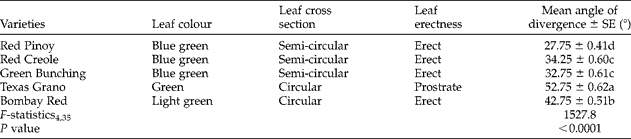
The five locally grown onion varieties had different leaf colour, leaf cross-section shape and leaf erectness. The five varieties could be divided into three groups based on leaf colour, glossiness and erectness. Red Pinoy, Green Bunching and Red Creole had blue-green, non-glossy and erect leaves, Texas Grano had green, glossy and prostrate leaves, and Bombay Red had light-green, glossy and erect leaves (Table 1). There was a significant difference among the varieties with regard to the angle of divergence of the two innermost leaves (F 4,35= 1527.8; P< 0.0001), with the smallest and the largest leaf angle being recorded in Red Pinoy and Texas Grano, respectively. Leaf cross section in the varieties screened was circular and semi-circular (Table 1).
Leaf characteristics of five onion varieties commonly grown in Kenya
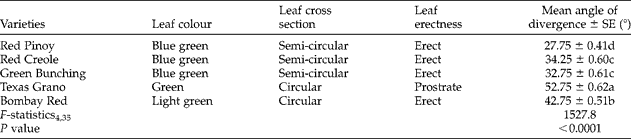
Means followed by different letters within a column are significantly different (P< 0.05, Student–Newman–Keuls multiple range test).
Thrips population dynamics and IYSV disease incidence
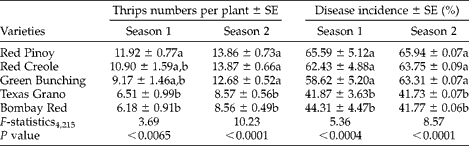
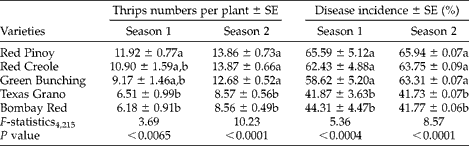
The mean number of thrips infesting the five onion varieties differed significantly in both season 1 (F 4,215= 3.69; P≤ 0.0065) and season 2 (F 4,215= 10.23; P< 0.0001). The thrips species infesting onions in the study area was mainly T. tabaci (>95%), with an insignificant number of other thrips species also being present. Red Pinoy had the highest number of thrips per plant, while Texas Grano and Bombay Red had the least numbers in both seasons (Table 2).
Mean thrips numbers per plant and Iris yellow spot virus disease incidence over 11 weeks in seasons 1 and 2
Means followed by different letters within a column are significantly different (P< 0.05, Student–Newman–Keuls multiple range test).
Straw-coloured, necrotic lesions with green islands typical of IYSV infection were observed 2 weeks after transplantation. The mean IYSV disease incidence in seasons 1 and 2 for all the varieties ranged between 42 and 69%. Among the five varieties, Texas Grano had the lowest disease incidence in both seasons, while in season 2, Bombay Red was not significantly different from Texas Grano in terms of disease incidence (Table 2). The varieties with a semi-circular leaf cross section had more thrips infestation and high IYSV disease severity than the varieties with a circular leaf cross section. There were significant differences among all the varieties with regard to IYSV disease incidence in season 1 (F 4,215= 5.36; P≤ 0.0004) and season 2 (F 4,215= 8.57; P< 0.0001) (Table 2).
Detection and disease severity of IYSV
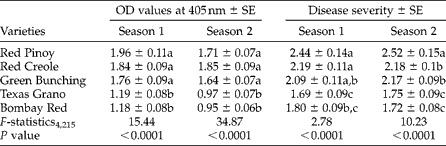
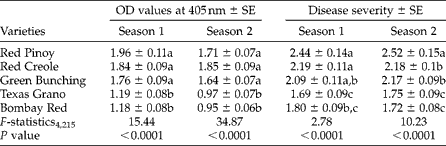
IYSV disease severity increased over time in all the varieties during the crop growth cycle. There were significant differences among the varieties with regard to the increase in IYSV severity in season 1 (F 4,215= 2.73; P< 0.0001) and season 2 (F 4,215= 10.23; P< 0.0001) (Table 3). Pearson's correlation between thrips numbers and disease severity was positive (R= 0.881; P= 0.05). OD values were also positively correlated with disease severity (R= 0.663; P= 0.05). IYSV intensity as reflected by the OD values varied significantly among the varieties in both season 1 (F 4,215= 15.44; P< 0.0001) and season 2 (F 4,215= 34.87; P< 0.0001) (Table 3). Red Pinoy had the highest virus intensity in season 1, while Red Creole had the highest virus intensity in season 2 (Table 3).
Mean optical density (OD) values and disease severity over 11 weeks in seasons 1 and 2
Means followed by different letters within a column are significantly different (P< 0.05, Student–Newman–Keuls multiple range test).
Effect of onion varieties on bulb yield
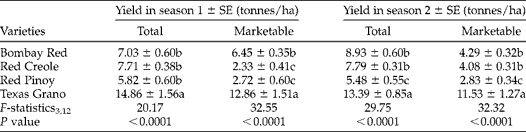
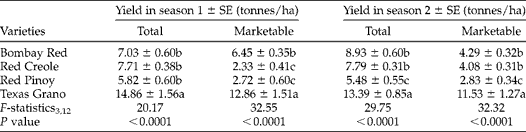
Total bulb yields varied significantly among four bulb onion varieties (Red Creole, Red Pinoy, Texas Grano and Bombay Red) in both season 1 (F 3,12= 20.17; P< 0.0001) and season 2 (F 3,12= 32.55; P< 0.0001) (Table 4). In both seasons, Texas Grano significantly produced highest total and marketable yield than all the other varieties screened. In season 1, Red Creole and Red Pinoy produced the least marketable bulb yield, while in season 2, Red Pinoy significantly produced the lowest total and marketable bulb yield. Hence, Red Pinoy and Red Creole were found to be susceptible to damage caused by thrips and IYSV.
Mean total and marketable bulb onion yields from different varieties in seasons 1 and 2
Means followed by different letters within a column are significantly different (P< 0.05, Student–Newman–Keuls multiple range test).
Discussion
Among the five varieties screened for HPR to IYSV and their thrips vector, Texas Grano and Bombay Red were moderately resistant to T. tabaci and IYSV. Red Pinoy, Red Creole and Green Bunching were the most susceptible varieties to both thrips and IYSV. The resistance to onion thrips in Texas Grano can be attributed to its morphological and structural traits, as demonstrated by the greatest angle of divergence of the two innermost leaves. This could enhance the exposure of thrips to adverse environmental conditions and natural enemies as thrips seek out narrow spaces on plants, such as leaf sheaths and inflorescences, to live and reproduce (Patil et al., Reference Patil, Nawale, Ajri and Moholkar1988; Alimousavi et al., Reference Alimousavi, Hassandokht and Moharramipour2007). Coudriet et al. (Reference Coudriet, Kishaba, McCreight and Bohn1979) observed a similar type of leaf structure in the variety ‘Nebuka’, which had less number of T. tabaci compared with three other onion varieties.
The colour of the foliage can also be attributed to play a major role in the level of resistance observed in Texas Grano. More number of thrips were found to be infesting varieties Red Pinoy, Red Creole and Green Bunching that had blue-green non-glossy foliage and hence higher virus spread, while less number of thrips and lower rate of disease incidence were observed in varieties Texas Grano and Bombay Red that had green glossy foliage. The greater attraction of T. tabaci to blue hues versus green hues could account for the large number of T. tabaci and high IYSV damage caused in Red Pinoy, Red Creole and Green Bunching. Our findings strengthened the hypothesis that leaf colour is a key factor associated with the resistance of onion varieties to T. tabaci. This is in agreement with the results of a previous study carried out by Diaz-Montano et al. (Reference Diaz-Montano, Fuchs, Nault and Shelton2010), who reported resistance to thrips in onion cultivars such Tioga, OLYSO5N5 and Peso with yellow-green colour, while cultivars such has SYN-G2 and Santana with blue-green colour were susceptible to thrips. Thrips tabaci is also known to prefer the blue-coloured traps than the green-coloured traps in onions (Kirk, Reference Kirk1984; Chu, Reference Chu1987; Lu, Reference Lu1990). The results of this study are concordant with those of the study carried out by Yousefi et al. (Reference Yousefi, Abasifar, Fathi and Jalali2011), who reported increased thrips infestation in genotypes Ghermez-e-Azarshahr, Sefid and Ghermez-e-Shahrood and attributed it to more wax and darker colour of the foliage when compared with the genotypes Sefid-e-Qom and Sefid-e-Kordestan, which have less wax and lighter colour. These three plant morphological characteristics reduced plant attractiveness to T. tabaci adults and could have played a vital role in the reduction of IYSV infection.
Three onion varieties, Red Pinoy, Red Creole and Green Bunching, had a semi-circular leaf cross section in young leaves closely pressed together, which could aid in the protection of thrips larvae against natural enemies and adverse weather. This structural trait played a key role in high IYSV disease severity and high virus intensity recorded in these varieties. This finding is supported by Alimousavi et al. (Reference Alimousavi, Hassandokht and Moharramipour2007) who reported highest leaf infestation by onion thrips in the genotype Sourati-e-Kurdistan that had flat leaf blades and young leaves closely pressed together. The number of thrips was high in season 2 than in season 1. This could be due to high temperatures normally observed during the months of September–December than in April–August in Nairobi. Relatively high temperatures have been reported to be associated with an increase in onion thrips population, while high relative humidity and rainfall cause a decrease in thrips population (Morsello et al., Reference Morsello, Groves, Nault and Kennedy2008; Waiganjo et al., Reference Waiganjo, Mueke and Gitonga2008).
Both Texas Grano (white variety) and Bombay Red (red variety) were found to exhibit moderate resistance to T. tabaci and IYSV. This is in line with the reports of McKenzie et al. (Reference McKenzie, Cartwright, Miller and Edelson1993), who suggested that the colour of the bulb does not influence the resistance of onion variety to thrips. There was an increase in virus intensity in different varieties over the crop growth cycle. In this study, none of the onion varieties screened was completely resistant to IYSV. However, Texas Grano and Bombay Red had some morphological and structural traits that decreased the number of onion thrips and thereby IYSV disease incidence. These traits can be used for further screening of other onion varieties and/or accessions for resistance to thrips and IYSV for the development of resistant varieties.
Texas Grano was the highest yielding variety and least susceptible to thrips and IYSV compared with Bombay Red, Red Pinoy and Red Creole. A similar bulb yielding variation between onion varieties has been reported to occur in Kabete, Kibirigwi, Ol Jorok and Marigat, Kenya, by Kimani et al. (Reference Kimani, Kariuki, Peters and Rabinowitch1993), who observed Bombay Red and KON3 to be the least and the highest yielding bulb onion varieties, respectively. Malik et al. (Reference Malik, Nawaz and Hafeez2003) also observed that thrips-resistant variety Chiltan-89 produced higher yields than susceptible onion variety Red Creole, in Balochistan, Pakistan.
Conclusion
Texas Grano could be recommended as a moderately resistant variety for cultivation along with other IPM strategies in Kenya for markets where pungency is not an important quality factor. For markets where pungency is an important factor, Bombay Red can be cultivated and integrated with other management strategies for onion thrips and IYSV. Kenya is not suitable for the cultivation of Red Pinoy, as this variety is highly susceptible to both thrips and tospoviruses.
Acknowledgements
This study was funded by the Federal Ministry for Economic Cooperation and Development (BMZ), Germany, through GIZ (Project No. 07.7860.5-001.00) and the German Academic Exchange Services (DAAD) through the African Regional Postgraduate Programme in Insect Science (ARPPIS) of icipe. The authors thank Miss Peris Kariuki for her technical assistance.