Introduction
The current paper unites two phenomena. The first is that bilingual speakers report experiencing greater emotion when using their first language compared to their second, especially for topics of personal significance (Marian and Kaushanskaya, Reference Marian and Kaushanskaya2004; Pavlenko, Reference Pavlenko2005). For example, in psychotherapy, the first language is frequently preferred for emotional topics and the second language for maintaining an aura of emotional distance (Altarriba and Santiago-Rivera, Reference Altarriba and Santiago-Rivera1994; Schrauf, Reference Schrauf2000). Anxiety-arousing stimuli such as taboo and sexual references are more easily expressed in the second language (Gonzalez-Regiosa, Reference Gonzalez-Reigosa, Spielberger and Diaz-Guerrero1976; Harris, Ayçiçegi and Gleason, Reference Harris [Caldwell-Harris], Ayçiçegi[-Dinn] and Gleason2003; Dewaele, Reference Dewaele2004a, Reference Dewaeleb). The second phenomenon is emotion words’ superior recall to neutral words (Rappaport, Reference Rappaport1942; Rubin and Friendly, Reference Rubin and Friendly1986; Reber, Perrig, Flammer and Walter, Reference Reber, Perrig, Flammer and Walter1994). Referred to as the emotion-memory effect, it is observed when participants perform a task on a list of words, and are later asked to recall as many words from the prior task as possible. Emotion words are proposed to have superior recall to neutral words because they automatically elicit a deeper level of processing than neutral words due to their inherent interest or because emotional stimuli recruit attention (MacKay and Ahmetzanov, Reference MacKay and Ahmetzanov2005; Jay, Caldwell-Harris and King, Reference Jay, Caldwell-Harris and King2008).
A combination of these two phenomena (L1 frequently experienced as more emotional than L2; emotion words recalled better than neutral words) suggests that emotion-memory effects will be stronger in a first language than in a second language. Anooshian and Hertel (Reference Anooshian and Hertel1994) pursued this exact question and found the predicted effect: emotion-memory effects were present in L1 but absent in L2. In their study, balanced Spanish–English bilingual participants rated neutral and emotion words for emotional intensity and then performed a surprise recall task. Emotional-memory effects were obtained by subtracting percent recall for emotion words from recall of the neutral words.
Conflicting findings have been obtained on emotion-memory effects in bilingual speakers. Ayçiçegi and Harris (Reference Ayçiçegi[-Dinn] and Harris [Caldwell-Harris]2004) attempted to extend Anooshian and Hertel's findings to individuals who had initially learned English as a foreign language. Participants were Turkish–English bilingual speakers who had arrived in the U.S. after age 17, judged Turkish to be their superior language, and rated their English proficiency as fair to very good. They had lived in the U.S. for an average of five years. Participants heard or read on a computer screen five types of emotion stimuli: positive, negative, and neutral words, mild-to-moderate taboo words (e.g., breast, whore), and childhood reprimands (short phrases such as Shame on you! and Go to your room!). Strong emotion-memory effects were obtained in both a first and a second language. Indeed, emotion-memory effects were stronger in English (L2) than in Turkish, particularly for the taboo words and reprimands.
Finding stronger emotion-memory effects in L2 was surprising because the same taboo words and reprimands had elicited larger skin conductance responses in Turkish-L1 compared to English-L2 in a prior study, also using Turkish–English bilingual speakers who were residing in the U.S. (Harris, Ayçiçegi and Gleason, Reference Harris [Caldwell-Harris], Ayçiçegi[-Dinn] and Gleason2003). Two additional studies that included more diverse types of emotional phrases confirmed that emotional phrases presented in a first language elicited higher skin conductance responses than emotional phrases in a second language, for Turkish–English bilinguals residing in Istanbul (Caldwell-Harris and Ayçiçegi-Dinn, under review) and Spanish-speaking immigrants residing in the U.S. (Harris, Reference Harris [Caldwell-Harris]2004). The physiological data is thus in line with the view that greater emotion is elicited by the first language. Why do the recall studies of Anooshian and Hertel (Reference Anooshian and Hertel1994) and Ayçiçegi and Harris (Reference Ayçiçegi[-Dinn] and Harris [Caldwell-Harris]2004) report conflicting findings? The following two possibilities are explored in the current paper, outlined in the next two sections.
English-L2 was more highly activated due to immersion context
Strong emotion-memory effects for English-L2 may have occurred because English was generally activated to a higher level due to participants’ immersion in an English-speaking environment at the time of testing (see Green, Reference Green1986). Many were permanent or long-term residents of North America. Would different results be obtained if bilingual speakers were tested while residing in their country of origin?
Some English-L2 items were processed more deeply during the initial emotional-intensity rating phase
Deeper processing leads to enhanced recall, as demonstrated by research on depth-of-processing effects (Craik and Lockhart, Reference Craik and Lockhart1972). English emotional stimuli could have attracted deeper processing than neutral stimuli in the study by Ayçiçegi and Harris (Reference Ayçiçegi[-Dinn] and Harris [Caldwell-Harris]2004) for a number of reasons. For example, the English taboo words and reprimands may have seemed more novel or amusing than their Turkish equivalents, and thus they could have been processed more deeply. Alternatively, the participants may have been silently translating English emotion words into Turkish to decide on a precise rating. They may have found it unnecessary to translate English neutral words, recognizing that they had low emotionality. Since translation is effortful, the English emotional words would have benefited from the additional depth of processing that accompanies translation. This would have selectively boosted recall for English emotional stimuli. Or, more generally, the need to judge emotional intensity for English emotional words could have been more effortful than for other stimuli, thus increasing processing effort and boosting recall. The need to translate or indeed to perform any deep processing could be avoided by asking participants to perform a shallow processing task, such as processing visual features of the display.
Varying the incidental study task is a method for controlling how deeply participants process the stimuli. In depth-of-processing studies (e.g., Craik and Lockhart, Reference Craik and Lockhart1972; Jay et al., Reference Jay, Caldwell-Harris and King2008), deep processing is elicited by asking participants to perform tasks which require processing words for their meanings, such as verifying whether the word is a congruent completion to a sentence template (e.g., in a task conducted in English, The ______ is blue) or making judgments about categorization (Is this a body part?). Tasks that require only shallow processing include verifying whether a word is in upper or lower case, or answering questions involving the letters in the word (e.g., Vilkki, Reference Vilkki1987; Fletcher, Stephenson and Carpenter, Reference Fletcher, Stephenson and Carpenter2003).
No prior research has investigated whether depth of processing effects vary for a first vs. a second language. We thus investigated two additional tasks, translation and word association, which have been used in bilingual research (Berny, Cooper and Fishman, Reference Berny, Cooper and Fishman1968; de Groot, Reference de Groot1992), but not in a depth-of-processing/recall framework. These tasks will likely facilitate deeper processing in the L1 than in the L2, as explained below. If superior recall is nonetheless obtained for L2 words, this superior recall can be interpreted as an emotion-memory effect or a novelty/interest effect.
Our goals in the current study were thus to investigate emotion-memory effects using a broader range of incidental study tasks than had been used previously, and to utilize college students who had acquired English as a foreign language while residing in the country of their first language. Participants were randomly assigned to one of the following four study conditions:
1. Rate the word for emotional intensity, which is the task used in Anooshian and Hertel (Reference Anooshian and Hertel1994) and Ayçiçegi and Harris (Reference Ayçiçegi[-Dinn] and Harris [Caldwell-Harris]2004).
2. Shallow processing task: How many letters contain a closed circle? (p, q, o, a, b, d, g)?
3. Translation task: If the word appears in Turkish, translate and report it to the experimenter in English; if in English, translate and report it in Turkish.
4. Word association task: Provide as many word associates as come to mind in 10 seconds.
The motivation for the four tasks is outlined below.
Emotion-intensity rating task
This is the basic task used in prior studies, and thus will serve to replicate Ayçiçegi and Harris (Reference Ayçiçegi[-Dinn] and Harris [Caldwell-Harris]2004), with the difference that the participants are immersed in the country of the first language. If emotion-memory effects are found to be stronger in L1 (Turkish), then we conclude that obtaining stronger emotion-memory effects for L1 may require testing in the country of L1.
Letter counting task
Word recall following a shallow task such as the letter-counting task is expected to be poorer than for a task that requires semantic processing. We thus expect lower recall in this task for both L1 and L2, compared to the emotional-intensity task. Since participants can perform the letter-counting task without attending to the meaning of the stimuli, we expect covert translation to be absent, and any obtained emotion-memory will reflect automatic or incidental processing. At present, the main task that has been used to compare automatic processing in a first vs. a second language is the Stroop task, where the meaning of words is generally found to be processed automatically, even if the task is to attend words printed color. In some studies with bilingual speakers, Stroop interference is reduced when color words appear in participants’ second language (Zied, Philippe and Karine, Reference Zied, Philippe and Karine2004). However, some studies find equivalent Stroop interference in both languages (Eilola, Havelka and Dinkar, Reference Eilola, Havelka and Dinkar2007; Sutton, Altarriba, Gianico and Basnight-Brown, Reference Sutton, Altarriba, Gianico and Basnight-Brown2007). Consciously controlling Stroop interference may be more difficult in a second language (Tzelgov, Henik and Leiser, Reference Tzelgov, Henik and Leiser1990). It is thus currently unclear whether equivalent encoding of words will occur when instructions do not require attention to word meaning.
Translation task
Translation is a “deep processing” task in that it requires attending to meaning. It is probably more effortful than emotion-intensity rating and we thus expect higher recall rates for this task than the emotion-rating and letter-counting tasks. However, because translation may be more difficult for some words than others, recall may be enhanced if deeper processing results for some words compared to other words, depending on translation difficulty. Bilingual researchers generally assume that translating from L2 to L1 is the easier translation direction, because during initial learning, L2 words may be learned as direct translations of L1 words (Kroll and Stewart, Reference Kroll and Stewart1994). Lexical access may be more efficient in L1 and slower or more arduous in the L2 (being the less proficient language). Translating from L2 means that one does not have to perform lexical access in the less proficient language. Greater translation difficulty for L1→ L2 could therefore result in deeper processing for the L1 words, leading to higher recall. Therefore, if the translation-task condition yields a finding of greater emotion-memory effects in L2 (as occurred in Ayçiçegi and Harris, Reference Ayçiçegi[-Dinn] and Harris [Caldwell-Harris]2004), this may represent a genuine example of L2 memorability, rather than being a by-product of deep processing following translation.
Word association task
A fourth task was chosen which, like the translation task, is expected to require deeper processing than the emotion-rating and letter-count tasks, and may also stimulate deeper processing in the L1. Bilingual speakers can generate a greater number of lexical associations in their more proficient language (Kroll and Stewart, Reference Kroll and Stewart1994). (Indeed, as described below, the current participants generated more words when asked to perform a word fluency task in their L1, Turkish, than in their L2, English). We thus expected the word association task to generate more words for Turkish items, and that this would enhance recall for the Turkish items. Consequently, a recall advantage for L2 over L1 would need to be attributed to factors other than depth of processing engendered by task demands during the study period.
Method
Participants
Native speakers of Turkish were recruited from among students at Istanbul University and the surrounding community (N = 59, 88% female). Participants were recruited by a teacher who knew them to have high levels of English ability, in order to make the participants comparable in English ability to those in our prior study, who had been residing in the U.S. for an average of five years.
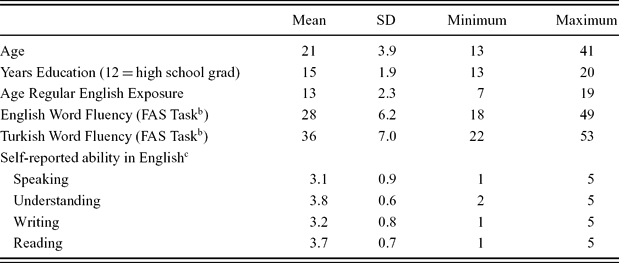
Demographic variables appear in Table 1. All participants identified themselves as native speakers of Turkish and reported Turkish to be their dominant language. Participants began regular English study (defined as at least five hours per week) when they entered middle school at age 12 or 13. Participants rated their English fluency in conversation, reading, understanding and writing on a 1-to-5 scale corresponding to some, fair, good, very good, native-like ability. All participants rated their English as either good or very good for understanding, and most rated themselves as good or very good for speaking, reading and writing. As a more objective measure of Turkish and English abilities, we administered a word fluency task in both languages (Delis, Kaplan and Kramer, Reference Delis, Kaplan and Kramer2001; Rosselli and Ardila, Reference Rosselli and Ardila2002). These required participants to generate as many words as they could beginning with the letters F, A and S (FAS task). The mean number of words generated in English was 29 (range 18–49), and in Turkish, 36 (range 22–53), a statistically significant difference, F(1,54) = 35, p < .0001. Self-ratings of language proficiency have been shown to correlate well with objective measures and thus are argued to be a reasonable method for bilingualism research (Delgado, Guerrero, Goggin and Ellis, Reference Delgado, Guerrero, Goggin and Ellis1999). To understand the associations in our different measures of language learning, we obtained correlations between age of regular exposure to English, self-ratings, and the two word fluency tasks. Age of exposure correlated with English FAS, r = −.29, and with self-reported speaking level, r = .29, both ps < .03, with English FAS and speaking level correlated at r = .27, p < .05. These were the strongest correlations.
Learning history and fluency for Turkish–English bilingual participants.

aAge at which participants took English classes for at least one hour a day.
bNumber of words generated beginning with letters F, A, S.
c1–5 scale (1 = some, 2 = fair, 3 = good, 4 = very good, 5 = near-native).
Participants were randomly assigned to the four task conditions (emotion-intensity rating, N = 15; letter counting, N = 16; translation, N = 14 and word association generation, N = 14). Because of random assignment, groups should be equivalent on demographic and proficiency measures. One-way analysis of variance (ANOVA) conducted on each of these measures revealed no differences among groups, except for self-rated English reading proficiency, F(3,55) = 4.1, p < .02. Participants assigned to the emotion-intensity rating task had a mean reading proficiency of 3.2, while the means of the other three tasks ranged from 3.7 to 4.0. Because none of the other ratings differed between groups, we will assume that the groups have similar English proficiency.
Design and materials
Stimuli were the same as those in Ayçiçegi and Harris (Reference Ayçiçegi[-Dinn] and Harris [Caldwell-Harris]2004) and Harris, Ayçiçegi and Gleason (Reference Harris [Caldwell-Harris], Ayçiçegi[-Dinn] and Gleason2003), and are listed in the Appendix. Positive, negative and neutral items (16 in each category) were selected using the pleasantness scale from the Handbook of semantic word norms (Toglia and Battig, Reference Toglia and Battig1978); words in these three categories did not differ overall in subjective familiarity, as measured by Toglia and Battig's ratings. The nine taboo words were modified from the list used by Gonzalez-Regiosa (Reference Gonzalez-Reigosa, Spielberger and Diaz-Guerrero1976) and did not contain the classic English four-letter taboo words. The seven reprimands include some that parents would frequently say to children and some used in adult contexts. Exact translation equivalents did not exist for all the reprimands or taboo words. The Turkish items in this category were selected to have similar frequency of use and emotional connotation. For example, for the English Go to your room! we used a Turkish phrase, used in similar reprimanding situation, that can be glossed as “I don't want to see you!” Turkish and English stimuli were presented intermixed, in random order. Two stimulus lists were constructed so that any given item was presented to different participants in English vs. Turkish. The same stimulus lists were used in all four tasks, with only instructions differing.
Procedure
The protocol was administered individually to participants. Participants were told that they would be seeing items displayed on a computer screen in both Turkish and English. They received their instructions via computer in Turkish and questions were answered in Turkish. Turkish was used as the sole language of instruction because it was the language of the immersion environment and it was the dominant language for all participants.
Shallow processing task
In each word or phrase, count the number of letters containing a closed circle. Note that these are the following letters: p, q, o, a, b, d, g. Enter the number using the computer keyboard. (Pilot testing revealed that this task took approximately the same length of time as the emotional rating and translation tasks.)
Emotion rating task
Rate the word for emotional intensity on a 1-to-7 scale, by typing the number on the computer keyboard.
Translation task
If the word or phrase appears in Turkish, translate it and report it to the experimenter in English; if in English, translate and report it to the experimenter in Turkish.
Word association task
Report as many words as come to mind that are associated with the displayed words, in 10 seconds, in the same language as the displayed word. (Participants reported words out loud verbally to the experimenter who wrote down the words immediately.)
Stimuli were presented on an Apple Macintosh laptop using PsyScope, experimental control software developed by Cohen, MacWhinney, Flatt and Provost (Reference Cohen, MacWhinney, Flatt and Provost1993). Participants responded to stimuli by typing on the computer's keyboard. The rating/study phase of the experiment, including instructions, took less than 15 minutes. Immediately afterwards all participants were given a surprise recall test, with instructions to write down as many words as could be remembered from the computerized presentation, in the language in which they had appeared on the computer screen, within a 10-minute time frame. Following the instructions in Anooshian and Hertel (Reference Anooshian and Hertel1994), if participants stopped their recall before 10 minutes, they were reminded by the experimenter that they had more time and could write down further words if more came to mind.
Only stimuli recalled in the target language were scored as correct. Percentage correct was calculated over participants and over items, in each task. Item percentages, averaged over tasks, are listed in the Appendix.
Results
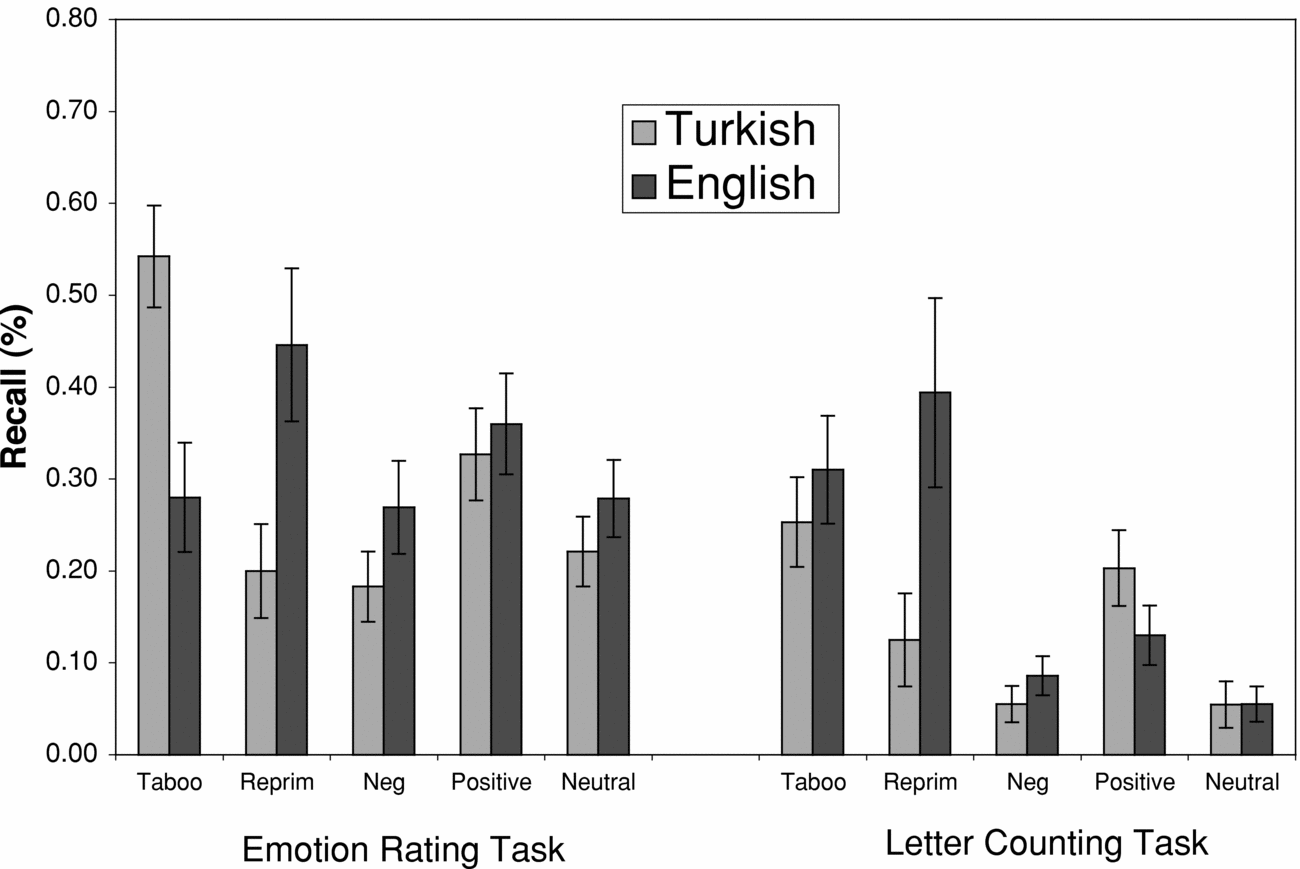
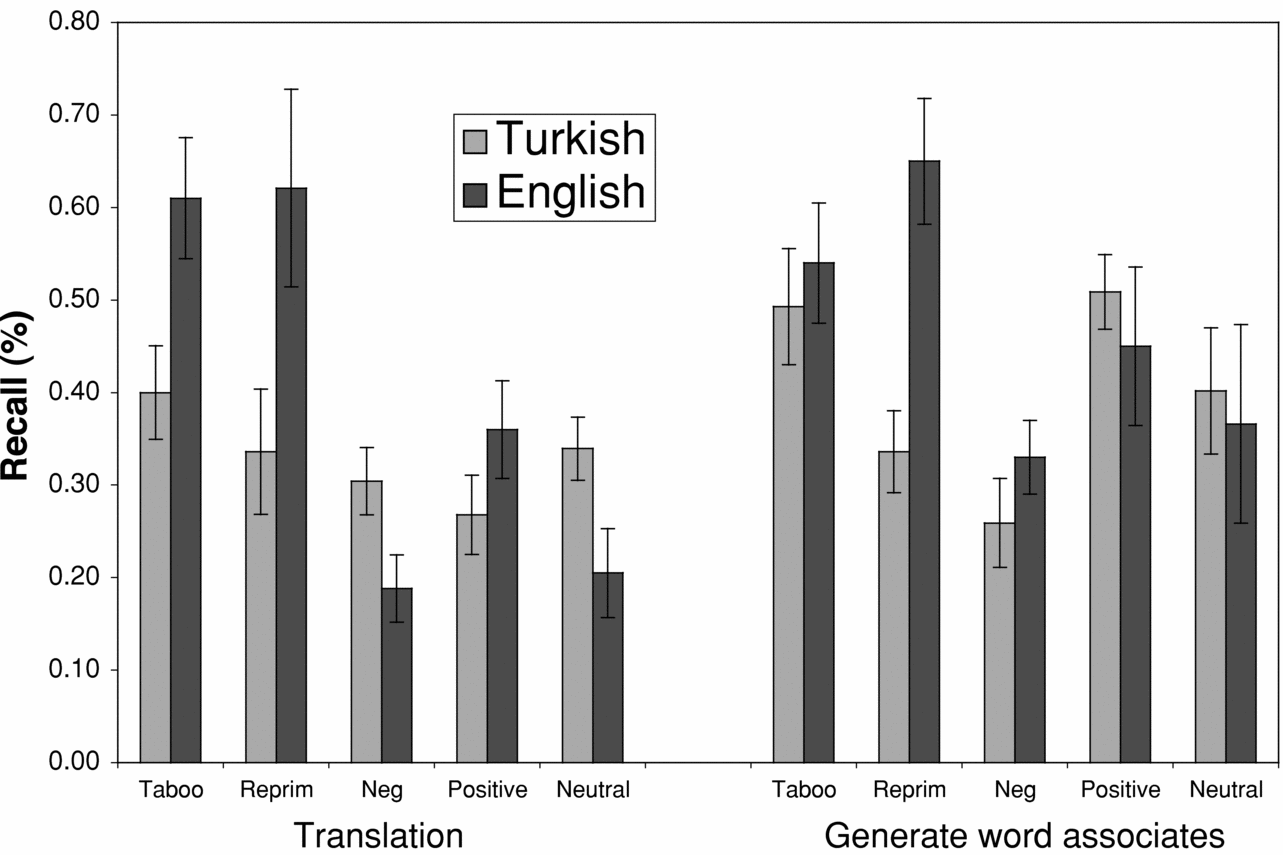
Our primary dependent measure was percent of items correctly recalled in each category, with only words recalled in the presented language scored as correct. (Words recalled in the opposite language of presentation are analyzed separately below.) Recall of items is plotted for each task in Figures 1 and 2. Error bars indicate standard error of the mean and can be used as a clue to likely statistically reliable differences (i.e., means that are within each other's error bars are most plausibly seen as differing only by chance).
Percent of trials recalled for the emotional-intensity rating (deep) task) and the letter counting (shallow) task.

Percent of trials recalled for the translation and word association tasks.

To validate our stimulus selection and translation procedures, emotional-intensity ratings (collected during the emotional-intensity task) were analyzed. Ratings were similar across the two languages and did not differ by more than one standard error of the mean. The mean ratings (7-point scale, 7 indicating high intensity) for L1-Turkish and L2-English were, respectively, 3.6 and 3.5 for neutral words, 5.6 and 5.5 for positive words, 5.6 and 5.8 for negative words, and 4.8 and 5.3 for reprimands. When data was subjected to ANOVA, no main effect of language and no language × stimulus category interaction occurred (all Fs < 1).
Recall characteristics common to all tasks
Scrutinizing the four graphs in Figures 1 and 2 reveals a number of commonalities which should be noted before investigating task differences. The basic emotion-memory effect of greater recall for emotional items over neutral items is present in each task. The exception to this is striking: in each task, the negative words were recalled at the same rate as the neutral. The emotional connotations of negative words thus did not boost recall, or some other property of the negative words may have inhibited recall (see further discussion below). The positive words were generally higher than the neutral. The two highly emotional categories, reprimands and taboo words, lead to high recall in every task.
An initial analysis of variance (ANOVA) conducted on the full three-factor design (language × emotion category × task) revealed a significant three-way interaction for analyses conducted by participants, F 1(12, 212) = 2.5, and items, F 2(12, 177) = 2.6, both ps < .01. To verify the statistical significance of stimulus conditions noted above, we compared negative versus neutral stimuli, positive vs. neutral, and taboo/reprimand vs. positive. Negative words had no recall advantage beyond neutral words (22% vs. 24%, respectively), p >.18, and word-type did not interact with language or task. Positive words elicited higher recall than neutral, F 1(1,55) = 11.6, p < .001, F 2(1,30) = 3.3, p = .08, and taboo items had higher recall than positive words, F 1(1,55) = 14.1, p < .001, F 2(1,23) = 3.2, p = .08. Reprimands had higher recall than positive words, but this was reliable only in the analysis by subjects, F 1(1,55) = 7.8, p < .01, F 2 < 1. Taboo items and reprimands did not differ from each other, F 1 and F 2 < 1.
The significant three-way omnibus ANOVA licensed conducting separate language × emotion categories comparisons on each task, but reporting these separate ANOVAs does not seem useful, since a language × emotion interaction would be almost guaranteed, at least in analysis by subjects, by the higher recall of reprimands in English than Turkish, a finding which occurred in every task. The higher recall of English reprimands is visible in Figures 1 and 2 (a listing of percent recall of each item, averaged across tasks, appears in the Appendix). The greater recall of reprimands in English than Turkish in each task was statistically verified by conducting a two-way ANOVA on just the reprimands, with task and language as independent factors. This was highly significant in an analysis by subjects, F(1,55) = 45.4, p < .001, but given that only seven reprimands were used, analysis by items was not statistically reliable, F(1,6) = 1.6, p = .24. Of these seven reprimands, all showed high recall (recalled by one-third or more of participants), except the English reprimand Go to your room, and Turkish Senden nefret ediyorum “I hate you” and Dur “Stop that”. There was particularly high recall of two English reprimands, Shut up (recalled by 73% of participants) and I hate you (recalled by 70%; see Appendix). High recall of the reprimands replicates Ayçiçegi and Harris (Reference Ayçiçegi[-Dinn] and Harris [Caldwell-Harris]2004). In that paper, we proposed that novelty and unusualness of English reprimands influenced recall, meaning that our study was tapping a novelty effect, and not purely an emotion-memory effect (McDaniel, Einstein, DeLosh, May and Brady, Reference McDaniel, Einstein, DeLosh, May and Brady1995). The reprimands in a second language could have been interpreted as more unusual and less expected than reprimands in a first language. Several participants laughed when they encountered the English reprimands and during debriefing commented on being surprised by them.
If we accept that the recall of the reprimands represents a novelty effect and not an emotion-memory effect, then it is worth setting aside the reprimands in our statistical analysis of the tasks and focusing on the remaining categories in order to draw general conclusions about processing emotional language in a first and second language.
Task-specific findings
We thus eliminated reprimands and obtained emotion-memory effects by subtracting each participants’ neutral score from each of the other scores. The task × language × emotion category ANOVA conducted on these differences scores revealed no main of language, F 1 and F 2 < 1. The three-way interaction was significant, F 1(6,110) = 3.4, F 2(9,132) = 3.0, both ps < .01, indicating that emotion-memory effects for the two languages varied across tasks.
Emotion-intensity rating task
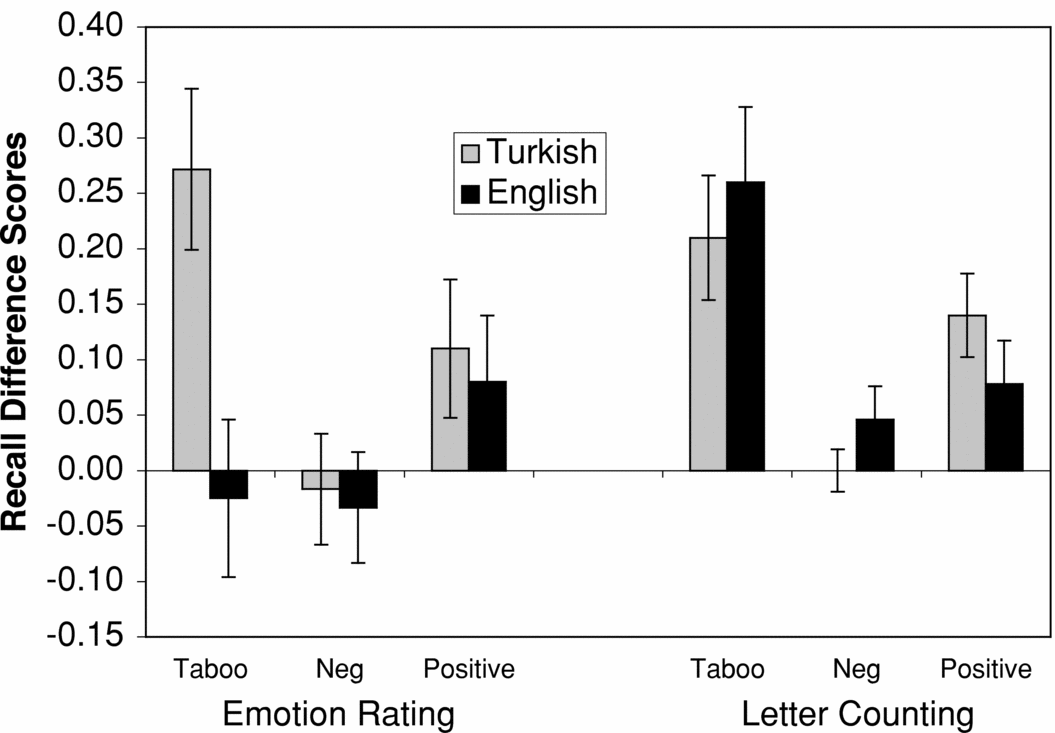
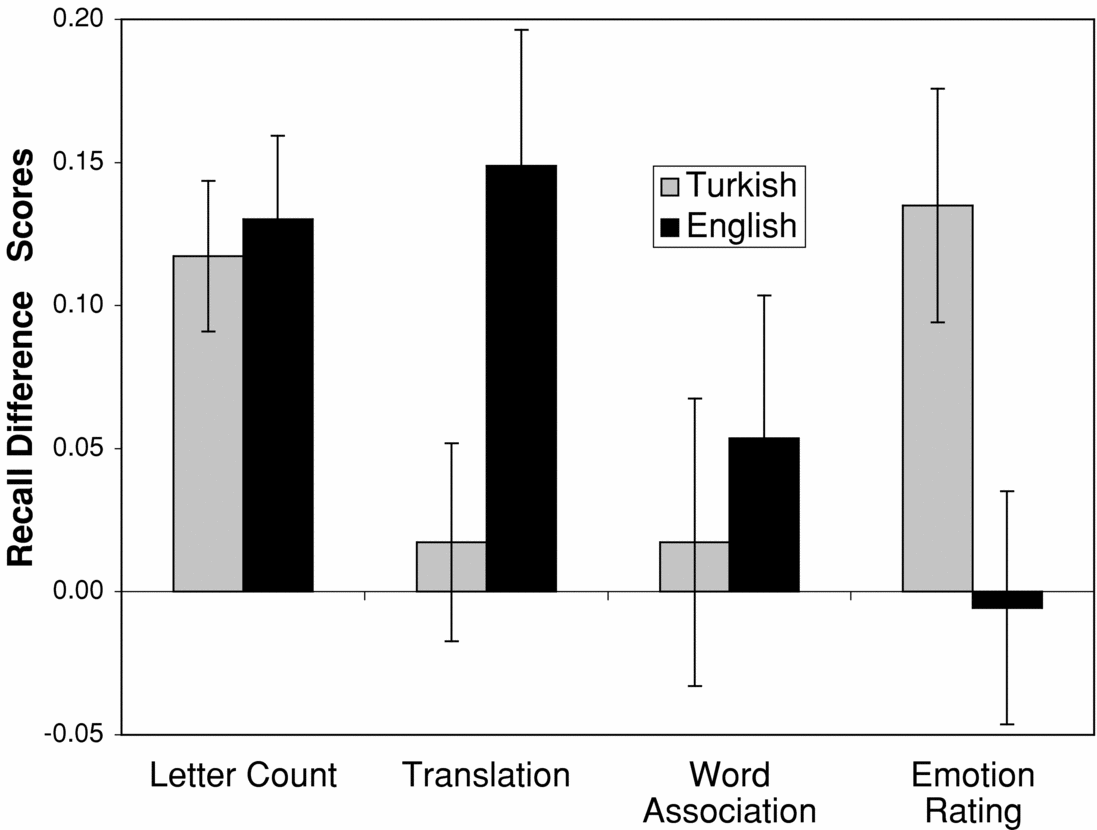
The emotion rating task is plotted in Figure 3 (lefthand panel). A two-way ANOVA revealed a significant interaction of language and stimulus category, F 1(2,28) = 3.4, F 2(2,38) = 4.7, both ps < .05. Emotion-memory effects were confined to the first language, Turkish. Here we see a pattern consistent with the classic view that L1 stimuli have greater emotional connotations than L2 stimuli.
Percent of trials recalled after subtracting neutral-word recall, for the emotion rating and translation tasks, with reprimands omitted.

Letter counting (shallow) task
As shown in Figure 3 (right-hand panel), both languages showed recall advantages for taboo and positive words, but not for negative words. No language differences in recall occurred: in the 2 × 3 ANOVA, there was no main effect of language and no language × stimulus type interaction. The main effect of stimulus type was significant, F 1(2,30) = 18, F 2(2,38) = 9.4, both ps < .001, and the pattern of Taboo > positive > negative follows the cross-task analysis reported above.
Translation task
A main effect of emotion category was revealed, following the general trend of taboo > positive > negative, F 1(2,26) = 18.3, F 2(2,38) = 7.9, both ps < .001 There was also an interaction of language and stimulus category, F 1(2,26) = 6.0, p < .01, F 2(2,38) = 3.2, p < .05. In contrast to the pattern observed for the emotion-intensity rating task, English had stronger emotion-memory effects (for taboo items and positive words, not negative words) than did Turkish.
Word association task
There was a strong main effect of emotion category, resulting from the standard recall pattern of taboo > positive > negative, F 1(2,26) = 5.9, F 2(2,38) = 5.5, both ps < .01. However, there were no language differences or interaction of language × emotion category, indicating that emotion-memory effects were similar across languages (Fs < 1).
To visualize how task influenced emotion-memory effects, Figure 4 graphs recall difference scores (with recall of neutral words subtracted, as in the above analysis), averaging over emotion-word category (again omitting the reprimands). Here we can see what was discussed above: the greater emotion-memory effect for L1-Turkish in the emotion rating task, the greater emotion-memory effect for L2-English in the translation task, and the similarity between English and Turkish for the letter counting task and association tasks.
Percent of trials recalled after subtracting neutral-word recall for all tasks, averaging over stimulus type, with reprimands omitted from analysis.

Incorrect recall: analysis of translation equivalents
During the recall period, fewer than half the participants wrote down even one translation equivalent of a studied word. This is consistent with prior reports that language-specific recall of previously presented words is performed well by bilinguals (Keatley, Reference Keatley and Harris1992). Despite the small number of recall errors, the pattern is worth examining. Recall of translation equivalents did not differ for items studied in Turkish and English. However, there were task and emotional category differences. Collapsing over categories, 14.5% of participants wrote down a translation equivalent for the emotion rating task, 17% for the translation task, and 19% for the word association task. In contrast, only 6% of participants wrote down a translation equivalent in the letter counting task. This lower rate of generation of translation-equivalents suggests that the shallow task was indeed successful in limiting processing of the meaning of words. Reprimands, neutral items, and taboo items were least frequently recalled in the alternative language (10%–14%), while aversive and positive words were more frequently recalled (17%–24%). Low generation of translation equivalents for neutral items likely occurred because there was overall low recall of these items in the studied language. Reprimand and taboo items had the highest correct recall of any items. Thus, the lack of recall of translation equivalents suggests that participants had good episodic encoding of these items. That is, they genuinely remembered the item (which includes its language), rather than recalling its meaning.
No emotion-memory effect for negative words?
As mentioned above, the negative words had no advantage in recall over the neutral words in any of the tasks (see Figures 1 and 2 above), in either language. We scrutinized the negative and positive words to determine if they differed along any dimensions other than valence (see listing in the Appendix). The positive words included basic concepts learned in early childhood, such as “mother”, “love”, “home”, and “happy”. Indeed, the higher-than-neutral recall for positive words was primarily carried by the very high recall (more than 50% of participants) for mother, father and love (in English) and for anne “mother”, baba “father” and ev “home” (in Turkish). No negative words approached these high rates of recall. The negative words included concepts that are typically acquired after early childhood (after age 4), such as “cruel”, “disease”, “poison”, and “crime”. Consulting age-of-acquisition (AoA) norms for English words (Iyer, Saccuman, Bates and Wulfeck, Reference Iyer, Saccuman, Bates and Wulfeck2001) revealed that positive words in our sample had mean AoA of 4.0 years, neutral had 4.2, and negative, 5.2; standard deviations about 1.4 years for these categories; difference between positive and negative, t(13) = 1.5, p = .15. This difference could well be statistically significant with a larger sample. Of course, these are norms for the acquisition of words in a first language. Words that are acquired late in a first language, such as “passport”, can be acquired early in a second language (Izura and Ellis, Reference Izura and Ellis2002). However, our stimuli were not selected to disentangle acquisition-age of words from acquisition-age of concepts, although this could be explored in future research. Whether larger emotion-memory effects hold for early acquired negative words than for late acquired negative words is also a topic worthy of future investigation.
Discussion
The primary goal of the current paper was to investigate whether emotion-memory effects, meaning the recall advantage of emotional stimuli over neutral stimuli, are stronger in a first language than in a second language, using study tasks that differed in degree of elaborative processing.
• Averaging over the four study tasks, emotion-memory effects were equally strong in a second language (English) as in a first language (Turkish), except for reprimands, which elicited higher recall in English. English reprimands may have benefited from novelty (McDaniel et al., Reference McDaniel, Einstein, DeLosh, May and Brady1995).
• Across tasks and languages, recall of emotion stimuli varied in this rank order: {taboo, reprimand} > positive > {negative, neutral}.
• Negative words (such as English war, fight, kill) showed no recall advantage over neutral words in any task or language, which may be due to their slightly later age-of-acquisition.
• Emotion-memory effects and recall differences in L1 vs. L2 depended on the task.
The finding of equivalent emotion-memory effects in a first and second language replicates our prior finding (Ayçiçegi and Harris, Reference Ayçiçegi[-Dinn] and Harris [Caldwell-Harris]2004). The prior findings could have occurred because the second language was activated to a higher degree due to L2 immersion environment. The current study rules this out since our bilingual participants were tested while residing in Istanbul, in the country of their L1.
The current study used multiple tasks in order to rule out a second explanation for the prior finding of strong L2 emotion-memory effects: these effects occurred because the emotion rating task of the prior study inadvertently encouraged participants to more deeply encode L2-English emotion words, in order to make subtle rating discriminations. Study-tasks were selected which would have required either similar processing in an L1 vs. an L2, or would be biased toward a deeper level of processing in L1. Therefore, if strong emotion-memory effects were nonetheless obtained in L2-English, these would indicate true emotion-memory effects, rather than being a by-product of deeper processing in the L2 induced by task demands. Task-specific finding were the following.
Emotion-intensity rating task
This was the basic task used in the two prior studies (Anooshian and Hertel, Reference Anooshian and Hertel1994; Ayçiçegi and Harris, Reference Ayçiçegi[-Dinn] and Harris [Caldwell-Harris]2004). In this task, emotion-memory effects were confined to L1-Turkish (Figure 3). The other tasks showed a different pattern and thus the results of the emotion-intensity rating task may be task or situation-specific. Evaluating the intensity of emotional stimuli may lead to more elaborative encoding (and thus better recall) for stimuli in the language which is most highly activated in the testing environment (L1-Turkish in the current study, L2-English in Ayçiçegi and Harris, Reference Ayçiçegi[-Dinn] and Harris [Caldwell-Harris]2004).
Letter counting task (shallow processing)
In the letter-counting task, participants counted the number of letters containing a closed circle. This task does not require any attention to the meaning of the stimuli, and is thus considered a shallow task in the levels-of-processing framework (Craik and Lockhart, Reference Craik and Lockhart1972; Jacoby and Dallas, Reference Jacoby and Dallas1981). We had hypothesized that greater emotion-memory effects would emerge for L1-Turkish than for L2-English because the meaning of words in L1 would be automatically processed even if shallowly processed. Instead, similar emotion-memory effects were obtained for both languages (Figure 4 above). Our finding of equivalent emotion-memory effects in L1 and L2 suggests that the shallow processing task allows equivalent automatic processing in both languages, similar to several Stroop task findings of equivalent color-word naming interference in an L1 and L2 (Eilola et al., Reference Eilola, Havelka and Dinkar2007; Sutton et al., Reference Sutton, Altarriba, Gianico and Basnight-Brown2007).
Note that the letter-counting task did succeed in its designation as a shallow-processing task, as overall recall was poorest in this task. However, stimuli were still processed for meaning in the letter-counting task, and were processed in a manner that resulted in similar recall for L1 and L2. Indeed, the letter-counting task showed the strongest overall emotion-memory effects of any task (12% advantage over the neutral stimuli, compared to 4% for the word association task, Figure 4). Shallow processing tasks frequently yield stronger emotion-memory effects than tasks requiring more elaborative processing. In recall tasks, neutral stimuli benefit more from elaborative processing than do emotional stimuli, because emotional stimuli are already processed more deeply than neutral stimuli even in a shallow task, due to their inherent emotionality (Jay et al., Reference Jay, Caldwell-Harris and King2008).
Translation task
This task was included because a key proposal in the bilingualism literature is that translating from the L2 to the L1 is the easier translation direction (Kroll and Stewart, Reference Kroll and Stewart1994). Consistent with this, some participants remarked during debriefing that translating from L1-Turkish was more difficult, because their Turkish taboo vocabulary was more extensive than their English taboo vocabulary. The unexpected result was that L2-English emotional stimuli showed greater emotion-memory effects than L1-Turkish. We infer that a second language is capable of demonstrating emotional-memory effects which are as strong as L1 effects, or stronger, at least for certain tasks such as translation.
Word association task
Because word associations can be more easily generated in a first language than in a second, this task was proposed to have at least some bias towards inducing more elaborative encoding in L1 than in L2. Other than the high recall of reprimands in English (present in all tasks), both recall and emotionality effects were similar in the two languages. This suggests that the word-association task induces a similar level of processing in both languages. Generating multiple associations for L1 words confers memorability, which leads to good L1 recall. But, for the L2 word association task, the difficulty of finding association for an L2 can also mean that it is processed deeply.
Future research
Emotion-memory effects need to be studied using different tasks rather than only using an emotion-intensity rating task or assuming that study-task is irrelevant. However, note that we were not able to predict which tasks would lead to language-specific effects. Future work needs to be grounded in models of bilingual memory and a theory of task difficulty in order to make more precise predictions.
A fruitful avenue may be to select tasks which lie on a continuum from shallow to deep processing. In the current study, the association task led to the highest overall recall rate (46% of items recalled), but the smallest emotion-memory effects (i.e., only a 4% advantage of emotional stimuli over neutral stimuli), because of the high recall of neutral stimuli. The high recall of neutral stimuli plausibly occurred because the association task conferred a great deal of elaborative encoding on the neutral words. In contrast, the letter counting task had the lowest overall recall rate (17%) but the highest emotion-memory effects (12% advantage over neutral), because emotional stimuli attract attention due to their inherent interest (see discussion in Jay et al., Reference Jay, Caldwell-Harris and King2008). It could be useful in future research to employ a shallow task which is less time-consuming than this one, which had been chosen to equate decision time with the other tasks. The classic upper/lower case decision would be a good test of automatic processing, similar in time-requirements to the Stroop task. Inspection of individual items suggests that words referring to early-acquired concepts had higher recall than later-acquired concepts, in both languages. Future research could determine if age-of-acquisition is more important for recall within a language than is age-of-acquisition of the lexical item, following the logic described by Izura and Ellis (Reference Izura and Ellis2002).
The methodology of study-task followed by surprise recall test is both simple and powerful. It does not require use of a computer and lends itself to a classroom setting or student-conducted projects. It would thus be easy to pursue variations in tasks and L1/L2 attributes to assemble a database of findings which can test models of emotionality and bilingual memory.
Conclusions
The thesis that the first language is experienced as more emotional is powerful, because it fits both with contemporary neuroscience ideas about the primacy of events from early childhood, and with many anecdotal impressions obtained in surveys, interviews and in the work of bilingual writers (Pavlenko, Reference Pavlenko2005). However, greater emotionality in a first language is not invariably found (e.g., Schrauf and Rubin, Reference Schrauf and Rubin2004; Dewaele, Reference Dewaele2006; Schrauf and Durazo-Arvizu, Reference Schrauf and Durazo-Arvizu2006). Bilingual speakers may dispute the claim that the first language is more emotional, noting the appeal, novelty or romantic difference of a newly learned language, as when an English speaker remarks on the cuteness of diminutives in German or Russian. The current finding of high recall for L2 reprimands may be a laboratory manifestation of this type of novelty effect. Aside from the reprimands, the overall finding of similar emotion-memory effects for a first and second language indicates that words’ emotional attributes are processed to a similar extent in both a first and a second language.
Appendix. English and Turkish stimuli with recall percent averaged over tasks
Within emotion category, items are listed in descending order of English recall.