Introduction
Carnivorous sponges exhibit an erect habit, usually branching, and have developed the ability to entangle, envelop, and digest small prey, mainly crustaceans. They represent an important exception to the filter-feeding behaviour that characterizes the phylum Porifera (Vacelet and Boury-Esnault, Reference Vacelet and Boury-Esnault1995). These sponges are classified into the family Cladorhizidae and constitute a monophyletic group (Hestetun et al., Reference Hestetun, Vacelet, Boury-Esnault, Borchiellini, Kelly, Ríos, Cristobo and Rapp2016), suggesting a single origin of carnivory in sponges. Usually, carnivorous sponges are associated with hard substrates in deep-sea habitats, close to hydrothermal vents or cold-water reefs (Lopes et al., Reference Lopes, Bravo and Hajdu2011; Ríos et al., Reference Ríos, Kelly and Vacelet2011; Lopes and Hajdu, Reference Lopes and Hajdu2014; Goodwin et al., Reference Goodwin, Berman, Downey and Hendry2017; Ekins et al., Reference Ekins, Erpenbeck and Hooper2020). However, these curious organisms have also been found in shallow waters in Antarctica or in oligotrophic environments such as marine caves (Vacelet and Boury-Esnault, Reference Vacelet and Boury-Esnault1995; Van Soest and Baker, Reference Van Soest and Baker2011).
Among Cladorhizidae, sponges in the genus Asbestopluma are characterized by the presence of usually palmate and/or arcuate anisochelae, sigmancistras, and basal acantho(sub)(tylo)styles, forceps being always absent. There are currently 39 species within this genus (de Voogd et al., Reference De Voogd, Alvarez, Boury-Esnault, Carballo, Cárdenas, Díaz, Dohrmann, Downey, Goodwin, Hajdu, Hooper, Kelly, Klautau, Lim, Manconi, Morrow, Pinheiro, Pisera, Ríos, Rützler, Schönberg, Turner, Vacelet, van Soest and Xavier2024), the majority of them (35) comprised in the subgenus Asbestopluma (Asbestopluma) Topsent, Reference Topsent1901 (defined as Asbestopluma without spear-shaped microtylostyles). The remaining four species belong to the subgenus Asbestopluma (Helophloeina) Topsent, Reference Topsent1929 (defined as Asbestopluma with a basal sheath of spear-shaped microtylostyles and microstrongyles) (see Lopes et al., Reference Lopes, Bravo and Hajdu2011).
During the past decade several Argentinian research expeditions explored the SW Atlantic Ocean, at the Burdwood Bank and surrounding areas, aiming to gain information on biology, ecology, and oceanographic processes at the Marine Protected Area (MPA) Namuncurá/Burdwood Bank, created in 2013 (Argentina, Law 26875/2013; see Falabella et al., Reference Falabella, Caille, Campagna, Krapovickas, Lovrich, Moreno, Michelson, Piola, Schejter and Zelaya2017), lately enlarged in 2018 (Argentina, Law 27490/2018; see also Schejter et al., Reference Schejter, Genzano, Gaitán, Pérez and Bremec2020; Schejter and Albano, Reference Schejter and Albano2021). During these expeditions, evidence was gathered that demonstrates the importance of these benthic communities and their conservation value, the high biodiversity, the existence of animal forests, and vulnerable marine ecosystems (Schejter et al., Reference Schejter, Rimondino, Chiesa, Díaz de Astarloa, Doti, Elías, Escolar, Genzano, López Gappa, Tatián, Zelaya, Cristobo, Perez, Cordeiro and Bremec2016, Reference Schejter, Martín and Lovrich2017a, Reference Schejter, Genzano, Gaitán, Pérez and Bremec2020; Schejter and Bremec, Reference Schejter and Bremec2019; Schejter and Albano, Reference Schejter and Albano2021). Regarding the sponge fauna of the area, besides some historic publications (i.e. Topsent, Reference Topsent1913, Reference Topsent1915; Burton, Reference Burton1932, Reference Burton1934; Burton et al., Reference Burton, Mawson, Johnston and Paisley1938), only a few contributions have been made in the past decade with the aim of improving knowledge of the regional sponge richness (Schejter et al., Reference Schejter, Rimondino, Chiesa, Díaz de Astarloa, Doti, Elías, Escolar, Genzano, López Gappa, Tatián, Zelaya, Cristobo, Perez, Cordeiro and Bremec2016, Reference Schejter, Bertolino and Calcinai2017b, Reference Schejter, Cristobo and Ríos2022a, Reference Schejter, Ríos, Cristobo and van Soest2022b) or relative to their high biomass in the area (Schejter and Albano, Reference Schejter and Albano2021), sometimes in association with corals (Schejter et al., Reference Schejter, Genzano, Gaitán, Pérez and Bremec2020). In the present study we provide new information for the carnivorous sponge Asbestopluma (Asbestopluma) magnifica, including the first record within the MPA Namuncurá/Burdwood Bank, update the distributional and bathymetric ranges of this species, and propose some amendments to the original description. Furthermore, we propose that Asbestopluma (Asbestopluma) sarsensis Goodwin, Berman, Downey & Hendry, Reference Goodwin, Berman, Downey and Hendry2017 and A. (A.) magnifica could be conspecific.
Materials and methods
The samples were obtained from the research cruises onboard the vessel ‘Puerto Deseado’ (Argentina) carried out between 26 March–25 April 2016 and 22 April–12 May 2017. Sampling was undertaken using a bottom trawl net (6 m total length, with a 25 mm mesh on the wings and 10 mm in the cod end), except at station 13, where a bigger bottom trawl (16 m total length with a 200 mm mesh) was employed. Additional samples came from the research cruise onboard the RVIB ‘Nathaniel B. Palmer’ (USA) carried out in April 2008. In this cruise, organisms were sampled using a Blake trawl of standard research size (see Schejter, Reference Schejter2008). All these samples were obtained from the Burdwood Bank region, and one of them was collected inside the MPA Namuncurá/Burdwood Bank (Figure 1). General characterization of the catches where the carnivorous sponges were collected can be found in Schejter (Reference Schejter2008) (for the RVIB ‘N.B. Palmer’ cruise) and in Schejter et al. (Reference Schejter, Genzano, Gaitán, Pérez and Bremec2020) and Schejter and Albano (Reference Schejter and Albano2021) (for the RV ‘Puerto Deseado’ cruises). The original denomination of cruises and stations was maintained to allow easier comparisons with other studies developed from the same cruises.
Map showing the sites where Asbestopluma (Asbestopluma) magnifica was recorded. ▴ type locality and ● paratype's locality (from Lopes et al., Reference Lopes, Bravo and Hajdu2011); ⋆ specimens collected during this study; ◊ records of Asbestopluma (Asbestopluma) sarsensis (from Goodwin et al., Reference Goodwin, Berman, Downey and Hendry2017).

All the samples were photographed onboard, then frozen and subsequently transported to the Benthos Laboratory of the Instituto Nacional de Investigación y Desarrollo Pesquero (INIDEP), Argentina. The preserved samples were then dried or transferred to formalin solution. Voucher samples were deposited in the Museo Argentino de Ciencias Naturales ‘Bernardino Rivadavia’, Buenos Aires, Argentina. Specimens were identified by applying traditional taxonomic techniques, by employing two approaches for the study of the spicules (see Hajdu et al., Reference Hajdu, Peixinho and Fernandez2011). For quick preparations, the organic matter was digested with a sodium hypochlorite solution, and then rinsed with water and ethanol before mounting on microscope slides. For scanning electron microscopy (SEM) studies and permanent slides small fragments of sponge tissue were dissolved in heated nitric acid, rinsed in water, and dehydrated in ethanol before mounting on microscope slides. The material was studied at the Benthos Laboratory (INIDEP), using a Leica DM 1000 stereomicroscope. For each spicule category 30 measurements were obtained and used for the estimation of average micrometric values. Measurements correspond to the length (as minimum–mean–maximum) × width (as minimum–mean–maximum), unless stated otherwise in the tables. For the acquisition of SEM images, dissociated spicules were transferred onto aluminium stubs and sputter-coated with gold. The SEM employed was the JEOL JSM 6460 LV at the National University of Mar del Plata (Argentina). Lastly, we re-analysed the type material of Asbestopluma (Asbestopluma) magnifica (schizoholotype) deposited at the Museu Nacional, Universidade Federal do Rio de Janeiro, Brazil and of Asbestopluma (Asbestopluma) sarsensis (holotype) deposited at the Museo Nacional de Historia Natural de Santiago de Chile. In both cases, we took new measures of the spicules. It is necessary to clarify that the holotype of A. (A.) magnifica (IZUA-POR 100) was destroyed in a fire occurred at the Austral University of Chile in 2007. Therefore, the type material of this species is currently limited to what is deposited at the Museum of Rio de Janeiro, Brazil. The classification used here is that adopted by the World Porifera Database (de Voogd et al., Reference De Voogd, Alvarez, Boury-Esnault, Carballo, Cárdenas, Díaz, Dohrmann, Downey, Goodwin, Hajdu, Hooper, Kelly, Klautau, Lim, Manconi, Morrow, Pinheiro, Pisera, Ríos, Rützler, Schönberg, Turner, Vacelet, van Soest and Xavier2024), mostly derived from the revisions compiled in Hooper and van Soest (Reference Hooper and van Soest2002) and Morrow and Cárdenas (Reference Morrow and Cárdenas2015).
Results
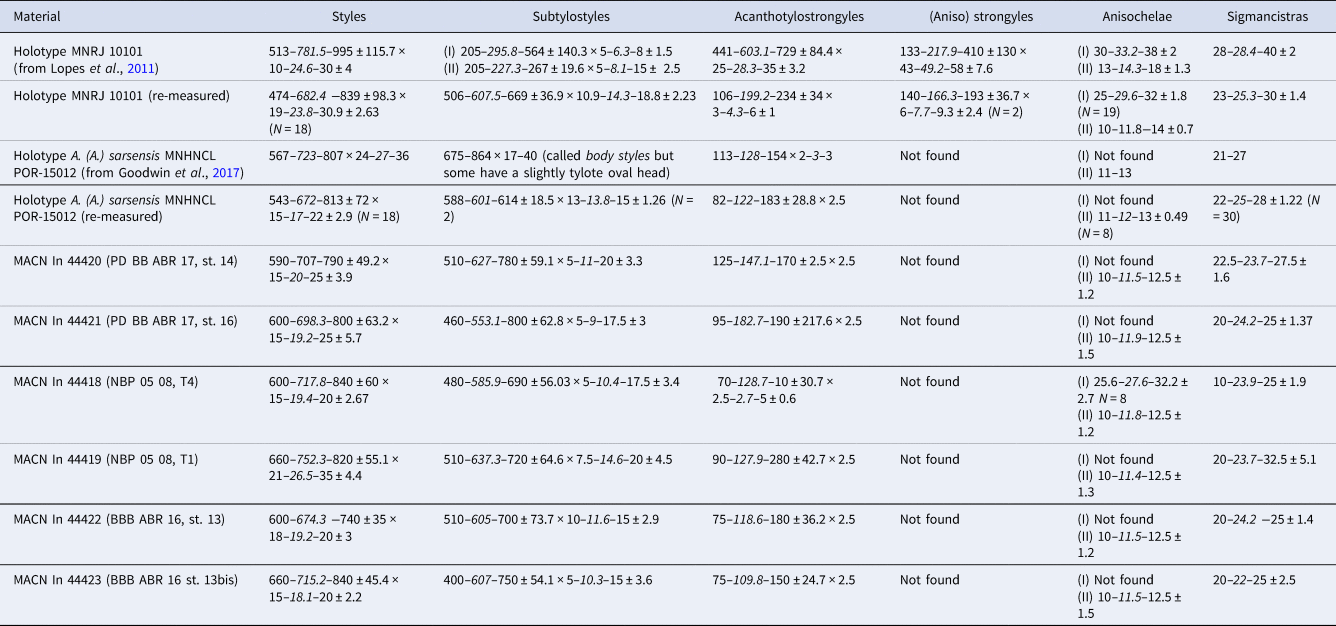
A total of 36 fragments of branches and shafts, correspond to various specimens and identified as Asbestopluma (Asbestopluma) magnifica were analysed (Table 1, Figure 2). Specimens were collected in six stations located in Argentinian jurisdictional waters, and one of these samples was collected inside the MPA Namuncurá/Burdwood Bank (labelled PD BB ABR17, St 16; 289 m). Sponges were living in deep-sea habitats (289–804 m depth). Voucher specimens were deposited at the Museo Argentino de Ciencias Naturales ‘Bernardino Rivadavia’ (MACN-In 44418–44423).
Comparative measurements of spicules of the holotype of Asbestopluma (Asbestopluma) magnifica (MNRJ 10101), holotype of Asbestopluma (Asbestopluma) sarsensis (MNHNCL POR-15012), and the specimens from the present study

All measurements are in μm: min–mean–max ± S.D. N, number of spicules measured when distinct from 30.
Asbestopluma (A.) magnifica Lopes, Bravo & Hajdu, Reference Lopes, Bravo and Hajdu2011: (A) external appearance of several specimens, arrow shows the rhizoid process; (B) subtylostyles large and straight; (C) styles of the main axis; (D) detail of the styles ends; (E) sigmancistras; (F) palmate anisochela II; (G) acanthotylostrongyles; (H) detail of the acanthotylostrongyles ends; (I) palmate anisochela I. Scales: A = 2 cm; B, C = 100 μm; D, G = 10 μm; E = 5 μm; F, H = 2 μm; I = 25 μm.

Systematics
Phylum PORIFERA Grant, 1836
Class DEMOSPONGIAE Sollas, 1885
Order POECILOSCLERIDA Topsent, 1928
Family CLADORHIZIDAE Dendy, 1922
Genus Asbestopluma Topsent, Reference Topsent1901
Asbestopluma (Asbestopluma) magnifica Lopes, Bravo y Hajdu, Reference Lopes, Bravo and Hajdu2011
(Figures 1 & 2, Table 1)
Material Examined
MACN-In 44418, cruise sample label NBP 05.08 T4, 22 April 2008, Burdwood Bank 54°29.07′S, 62°10.76′W, 804 m depth, Blake trawl; MACN-In 44419, cruise sample label NBP 05.08 T1, 21 April 2008, Burdwood Bank, 54°44.02′S, 62°12.98′W, 306 m depth, Blake trawl; MACN-In 44420, cruise sample label PD BB ABR17 st. 14, 28 April 2017, Burdwood Bank, 54°23.921′S, 62°51.72′W, 460 m depth, bottom trawl; MACN-In 44421, cruise sample label PD BB ABR17 st. 16, 28 April 2017, MPA Namuncurá/Burdwood Bank, 54°36.23′S, 61°30.088′W, 289 m depth, bottom trawl; MACN-In 44422, cruise sample label BBB ABR16 st. 13, 20 April 2016, Burdwood Bank, 54°33,54′S, 62°52,95′W, 618 m depth, fishing bottom trawl; MACN-In 44423, cruise sample label BBB ABR16 st. 13bis, 20 April 2016, Burdwood Bank, 54°35.9′S, 62°51.32′W, 608 m depth, bottom trawl. All the samples were collected by Laura Schejter.
Comparative Material Examined
Asbestopluma (A.) magnifica. MNRJ 10101 (Schyzo)holotype, Diego Ramírez Archipelago (57°11.63′S, 67°18.67′W, off Channels and Fjords of Southern Chile), 1831–2038 m depth.
Asbestopluma (Asbestopluma) sarsensis Goodwin, Berman, Downey & Hendry, Reference Goodwin, Berman, Downey and Hendry2017. MNHNCL POR – 15012, microphotographs of the spicules from the holotype, cruise sample number NBP1103-TO104-sponge08 Sars Seamount (59°43.430′S, 68°45.38′W), 570–820 m, 31.v.2011, otter trawl.
Description
External morphology: Erect and branched habit, with a main cylindrical axis (up to 43 mm thick) and lateral axes (up to 57 mm thick) that branch off from the main axis and have numerous short filaments (usually up to 3 mm long), arising perpendicularly to the axis. All the studied specimens are composed of broken fragments; one specimen deposited at MACN-In 44420 (labelled PDBB ABR17 St14) is the largest fragment in the collection, measuring about 12 cm in height. Colour yellowish beige in the living state and pale white when dried.
Skeleton. Styles and subtylostyles longitudinally arranged in the main and lateral axes. Short filaments project perpendicularly from the lateral axes and are mainly composed of styles and substylostyles. The acanthotylostrongyles are chiefly positioned at the base of the main axes. The small anisochelae and sigmancistras are more abundant in the lateral axes, constituting the typical velcro-like prey-capturing structure. A rhizoidal process or some part of body settled has been observed in four specimens from several stations (MACN-IN 44418; MACN-IN 44420; MACN-IN 44421; MACN-IN 44422) (Figure 2). However, the bigger anisochaelas were only found at the base of one specimen (MACN-IN 44418, labelled NBP 05 08, T4).
Spicules. Megascleres: styles of the main/lateral axes, smooth, straight or curved in the basal third, sub-terminally constricted, with short acerate point, 590–604.6–840 × 15–21–35 μm (Figure 2C, D). Subtylostyles of the main/lateral axes, straight and variably stout, base slightly widened, with short acerate ends, 400–602.6–800 × 5–11.8–20 μm (Figure 2B). Acanthotylostrongyles, small, thin, sinuous, and microspined, base with a prominent and rounded head-like-tyle, the other end thinner, narrowing towards the end, very abundant in the basal region, 70–151–280 × 2.5–2.8–5 μm (Figure 2G, H). Microscleres: palmate anisochelae I, head with large alae that seem attached to the shaft under light microscopy and central alae that look-like a frontal tooth, 25.6–28.6–32.2 μm (Figure 2I); palmate anisochelae II, similar to category I, 10–11.3–14 μm, (Figure 2F) very rare; sigmancistras, smooth, with sharp ends, 20–24.6–30 μm (Figure 2E) (Table 1).
Distribution and Ecology
The type locality of this species is located off southern South America, close to the Diego Ramírez Archipelago (southern Chile) in the southeastern limit of the Pacific Ocean, in deep waters from 1821 to 2115 m. In this study, we updated its distributional information providing new records from the southwestern limit of the Atlantic Ocean; we also recorded the species for the first time inside the MPA Namuncurá/Burdwood Bank. The shallowest depth range of the species is updated to 289 m. The specimens bearing rhizoids appeared to be settled on pebbles and small rock fragments. Cnidarians, other sponges and echinoderms were the main zoological groups at the benthic communities in the studied area (see Schejter et al., Reference Schejter, Genzano, Gaitán, Pérez and Bremec2020).
Remarks
The specimens recorded at Burdwood Bank are in accordance with the general spicule features and micrometries reported for A. (A.) magnifica. Nevertheless, the larger anisochelae could only be found in a single specimen (MACN-IN- 44418, labelled NBP 05 08, T4). All the studied specimens also lack anisostrongyles, but these were seemingly scarce in the type materials, with 4–5 spicules only reported from each specimen in the type series (Lopes et al., Reference Lopes, Bravo and Hajdu2011). A possibility that cannot be discarded is that these are merely malformed megascleres, as frequently reported from tetractinellids (e.g. Hajdu and van Soest, Reference Hajdu and van Soest1992, Figure 4E, F) and hexactinellids (Goodwin et al., Reference Goodwin, Berman, Janussen, Goecke and Hendry2016a, Reference Goodwin, Jones, Neely and Brickle2016b). There are some inconsistencies in the original description of A. (A.) magnifica by Lopes et al. (Reference Lopes, Bravo and Hajdu2011). Measurements of the acanthotylostrongyles and subtylostyles of the lateral branch in the text and from the SEM images do not match. According to the text, they measured 441–729 × 25–35 μm and 205–268 × 5–15, respectively, but the scale bar in Figure 10 of that publication indicates about 95 and 600 μm for those spicules, respectively. Re-measurements of the (schizo)holotype undertaken here establish the spicule range for acanthotylostrongyles as 106–234 × 3–6 μm and for the subtylostyles as 506–669 × 10–18 (see Table 1). We also considered that the thinner styles found in the (schizo)holotype should be considered as early growth stages of subtylostyles, and consequently, should be merged into these categories.
There are five known species of Asbestopluma (Asbestopluma) around Southern South America: A. (A.) bitrichela, A. (A.) gemmae, A. (A.) rhaphidiophora, A. (A.) magnifica, and A. (A.) sarsensis (Lopes et al., Reference Lopes, Bravo and Hajdu2011; Goodwin et al., Reference Goodwin, Berman, Downey and Hendry2017). The first three of these show important differences in the morphology of the anisochelae, to which A. (A.) bitrichela adds the further distinction of possessing desmas. We had some difficulties assigning our specimens because the general morphology and measurements of the spicules of the specimens of A. (A.) magnifica and A. (A.) sarsensis are very similar and remarkable. Goodwin et al. (Reference Goodwin, Berman, Downey and Hendry2017) refrained from comparing both species in greater detail; rather, they assumed the apparent lack of the larger category of anisochelae in their materials was decisive enough for both species non-conspecificity, inferred from their decision to compare A. (A.) sarsensis only to Asbestopluma spp. bearing a single category of anisochelae. Both species were described as erect, branching with numerous short filaments arising perpendicular to the main axis. Furthermore, they share the same megascleres: acanthotylostrongyles, styles, subtylostyles, and microscleres: anisochelae and sigmancistras, all in the same size range (Table 1). The difference that first catches the eye lies in the presence of two categories of anisochelae and the possession of anisostrongyles in A. (A.) magnifica, which were not reported for A. (A.) sarsensis. However, we would like to highlight the fact that the holotype of A. (A.) sarsensis appears to lack the rhizoidal process, while the other specimens were only branch fragments, similar to what happened with our specimens. The Cladorhizidae are known to show marked specialization of their spicules, with different forms occurring in specific sectors of their body (Vacelet, Reference Vacelet2006), e.g. the so-called ‘desmas’ which are located in the basal portion of the skeleton of A. (A.) bitrichela (Lopes et al., Reference Lopes, Bravo and Hajdu2011). In our opinion, the finding here that larger anisochelae showed up in one of our specimens, seemingly closer to its basal sector, might suggest that these spicules could fluctuate within the population, but above all, depend on more well-preserved materials to be spotted. Taking this into account we should not rule out the possibility that these spicules are present in a population, but cannot be found in every specimen, and above all, in every fragment of a given specimen. In our re-examination of the spicules from the holotype of A. (A.) sarsensis we failed to find larger anisochelae as well (Table 1). It is also important to highlight an inconsistency in the description of A. (A.) sarsensis as sigmancistras are reported with 11–14 μm in the text, but with 18–31 μm in the measurements reported in Table 4 in Goodwin et al. (Reference Goodwin, Berman, Downey and Hendry2017). The latter measurements are more consistent with their Figure 6-I and its scale. According to our re-examination, sigmancistras measured 20–28 μm (Table 1), a range coincident with the values observed in A. (A.) magnifica and the specimens studied here. Summarizing, the corrected values presented here for the spicules of the holotype of A. (A.) magnifica (Table 1) appear to us only marginally distinct from what we observed in our specimens, as well as to values exhibited by A. (A.) sarsensis (Table 1). Given the above rationale, this led us to confidently assign our specimens to A. (A.) magnifica, despite our inability to locate anisochelae I in most of them.
Discussion
Studies developed with additional species of sponges have documented that in some cases a wide variability in terms of the dimensions and categories of spicules among specimens may be present. In general, these have not been verified genetically yet, but even so seem to point to natural variability in species such as Nullarbora segonzaci (Vacelet, Reference Vacelet2006), Cinachyrella australiensis (Carter, 1886), Iophon proximum (Ridley, 1881), Monanchora arbuscula (Duchassaing & Michelotti, 1864), Mycale (Aegogropila) magellanica (Ridley, 1881), Suberites dandelenae Samaai et al., Reference Samaai, Maduray, Janson, Gibbons, Ngwakum and Teske2017 or Suberites latus Lambe, Reference Lambe1892 (see more, Lambe, Reference Lambe1892; Von Lendenfeld, Reference Von Lendenfeld1907; Burton, Reference Burton1934; De Laubenfels, Reference De Laubenfels1952; Koltun, Reference Koltun, Pavlovskii, Andriyashev and Ushakov1964; Sarà, Reference Sarà1978; Desqueyroux-Faúndez and Van Soest, Reference Desqueyroux-Faúndez and Van Soest1996; McDonald et al., Reference McDonald, Hooper and McGuinness2002; Austin et al., Reference Austin, Ott, Reiswig, Romagosa and McDaniel2014; Samaai et al., Reference Samaai, Maduray, Janson, Gibbons, Ngwakum and Teske2017; Van Soest, Reference Van Soest2017; Esteves et al., Reference Esteves, de Paula, Lerner, Lôbo-Hajdu and Hajdu2018; Santodomingo and Becking, Reference Santodomingo and Becking2018). In a few cases (e.g. Geodia barretti Bowerbank, Reference Bowerbank1858, Geodia phlegraei Sollas, Reference Sollas1880), observed morphological variability has been confirmed as confined to a single species instead of a possible set of cryptic taxa (Cárdenas and Rapp, Reference Cárdenas and Rapp2013; Cárdenas et al., Reference Cárdenas, Rapp, Klitgaard, Best, Thollesson and Tendal2013).
According to our results, we propose the hypothesis that Asbestopluma (Asbestopluma) magnifica and Asbestopluma (Asbestopluma) sarsensis maybe are conspecific species. The general morphology of the specimens, but also the type and size of the spicules are very similar and the absence of the larger anisochelae and anisostrongyles could be a consequence of the lack of well-preserved specimens owing to the sampling methodology, malformed spicules or the intrinsic variability of the species, as previously mentioned. In our opinion, the lack of a striking difference lead us not to discard this possibility, especially considering the nearby geographic distribution observed for both species. Future genetic and/or molecular studies may confirm or refute this hypothesis. A misidentification of a species might result in a cascade-like process with effects at several levels (ecology, biogeography, diversity, conservation, etc.) (Bortolus, Reference Bortolus2008; Thomson et al., Reference Thomson, Pyle, Ahyong, Alonso-Zarazaga, Ammirati, Araya, Ascher and Audisio2018); thus, molecular and integrative systematics should be applied to solve this question.
Lopez-Gappa and Landoni (Reference Lopes-Gappa and Landoni2005) published a checklist of Porifera from the Southwest Atlantic Ocean between 35° and 56°S, noting that the number of species in the Tierra del Fuego region and the Malvinas/Falkland Islands was slightly higher than in other areas studied, but no carnivorous sponges were reported at the area. Subsequently and until the present, less than 15 articles dealing with the records or descriptions of sponges from Argentinian marine waters were produced (Schejter et al., Reference Schejter, Calcinai, Cerrano, Bertolino, Pansini, Giberto and Bremec2006, Reference Schejter, Bertolino, Calcinai, Cerrano and Bremec2011, Reference Schejter, Chiesa, Doti and Bremec2012, Reference Schejter, Martín and Lovrich2017a, Reference Schejter, Bertolino and Calcinai2017b, Reference Schejter, Cristobo and Ríos2022a, Reference Schejter, Ríos, Cristobo and van Soest2022b; Bertolino et al., Reference Bertolino, Schejter, Calcinai, Cerrano and Bremec2007; Urteaga and Pastorino, Reference Urteaga and Pastorino2007; Goodwin et al., Reference Goodwin, Berman, Downey and Hendry2017; Gastaldi et al., Reference Gastaldi, De Paula, Narvarte, Lobo-Hajdú and Hajdu2018; Schejter and Giberto, Reference Schejter and Giberto2022), including the Malvinas (Falkland) Islands (Goodwin et al., Reference Goodwin, Jones, Neely and Brickle2011, Reference Goodwin, Berman, Janussen, Goecke and Hendry2016a, Reference Goodwin, Jones, Neely and Brickle2016b). The only studies describing species of carnivorous sponges from the area were those by Ríos et al. (Reference Ríos, Kelly and Vacelet2011), who described Cercicladia australis Ríos, Kelly & Vacelet, Reference Ríos, Kelly and Vacelet2011, occurring off the Patagonian shelf, at 1225–1728 m depth and (off, at seamounts) Macquarie Ridge in New Zealand, at 1060–1697 m depth; and more recently, Goodwin et al. (Reference Goodwin, Berman, Downey and Hendry2017) who described A. (A.) sarsensis from off the Burdwood bank, at 700–820 m depth.
The present study represents the first record of the species in Argentinian waters, updating the knowledge on its natural morphologic variability and distributional range, concluding that this is a relatively common, rather large species of carnivorous sponge, so far restricted to the slope of the Scotia plate. We also updated the shallowest bathymetric range of the species to 289 m depth. Finally, we provided necessary amendments to its original description correcting information on the length of its subtylostyles and acanthotylostrongyles. We consider it important to emphasize these findings to prevent future systematic errors when assigning specimens.
Portela et al. (Reference Portela, Acosta, Cristobo, Muñoz, Parra, Ibarrola, Del Río, Vilela, Ríos, Blanco, Almón, Tel, Besada, Viñas, Polonio, Barba, Marín and Cruzado2012, Reference Portela, Cristobo, Ríos, Acosta, Parra, Del Río, Tel, Polonio, Muñoz, Patrocinio, Vilela, Barba, Marín, Blanco and Roy2015) reported briefly on carnivorous sponges belonging to Asbestopluma, Chondrocladia, Euchelipluma, and Cercicladia incompletely identified, recorded along the Argentinian slope at depths less than 1500 m. The detailed taxonomic study of these specimens has the potential to more than double the knowledge on Argentinian cladorhizids, and seems like a natural follow-up to results presented herein. Also, Eck et al. (Reference Eck, Kröner and Janussen2024) described three new species of carnivorous sponges, two belonging to Abyssocladia and one to Cladorhiza, from the East Scotia ridge, Antarctica. It would be also desirable to explore the connections of the carnivorous sponges across the Scotia Arc, to which Burdwood Bank also belongs.
Data
Data available from the corresponding author upon request.
Acknowledgements
The authors would like to thank the scientific-technical staff of all the research cruises, including their crews. L. S. would like to express her gratitude to Javier Cristobo and Pilar Ríos for their help in identifying sponge species at Burdwood Bank during preliminary stages of this work. We also thank Mónica Oppedisano for her assistance during the acquisition of SEM images. Special thanks to Catalina Amanda Merino Yunnissi, administrator of the invertebrates' collection (Museo Nacional de Historia Natural) for providing the photographs of the holotype of A. (A.) sarsensis deposited with the code MNHNCL POR-15012. J. C. C. F. is grateful to the Programa de Pós-Graduação em Zoologia (PPGZOO) at Museu Nacional, Universidade Federal do Rio de Janeiro (UFRJ), and the Carlos Chagas Filho Foundation for Research Support in Rio de Janeiro (FAPERJ) for the Post-doctoral fellowships (grants FAPERJ NOTA 10 no. E-26/202.361/2019 and no. E-26/202.362/2019). This is INIDEP Contribution No. 2398 and MPA Namuncurá/Burdwood Bank Contribution No. 87.
Author contributions
M. P. N. analysed, interpreted the data, and contributed to writing and reviewing the manuscript. J. C. C. F. collaborated by providing data for the holotype review of A. (A.) magnifica and confirmation of this species. E. H. contributed to the confirmation of identity of the specimens, participated in manuscript writing and reviewing, and made substantial contributions to the conception of the work. L. S. collected and analysed the samples, provided the conceptual framework, and contributed to writing and reviewing the manuscript. All authors read and approved the final manuscript.
Financial support
The research cruises of RV Puerto Deseado were financed by Argentina through funding from National Law 26.875. This study was partially supported by Fund for Scientific and Technological Research (FONCyT)- PICT 2019-4233 to L. S.; and Conselho Nacional de Desenvolvimento Científico e Tecnológico (CNPq) for a Research Productivity fellowship (308303/2017-2) and Universal 2016 Grant (425839/2016-8), as well as FAPERJ for Scientist of Our State bench fellowships (E-26/102.292/2013, 305 E-26/202.624/2019, E-26/200.534/2023) to EH. EH and the SponBIODIV project further thank Biodiversa+, the European Biodiversity Partnership under the 2021-2022 BiodivProtect joint call for research proposals, co-funded by the European Commission (GA N°101052342) and with the funding organisations FAPERJ (grant E-26/210.286/2023).
Competing interests
None.