The development of Executive Functions (EF) starts early, as soon as a newborn is breast feeding, and continues for years afterwards, even beyond adolescence (De Luca et al, 2003; Diamond, Reference Diamond, Stuss and Knight2002; Kail & Salthouse, Reference Kail and Salthouse1994; Zelazo, Craik, & Booth, Reference Zelazo, Craik and Booth2004). There are various reasons why it is important to analyze the development of Executive Functions during the early school years. First, it appears that these functions are intimately linked to the acquisition of learning skills in areas such as mathematics (Berg, Reference Berg2008; Bull, Espy, & Wiebe, Reference Bull, Espy and Wiebe2008) and reading comprehension (Durand, Hulme, Larkin, & Snowling, Reference Durand, Hulme, Larkin and Snowling2005; van der Sluis, de Jong, & van der Leij, Reference van der Sluis, de Jong and van der Leij2007). Second, this knowledge facilitates the detection and prevention of common alterations in neurodevelopmental disorders (Roselli, Jurado, & Matute, Reference Roselli, Jurado and Matute2008).
EFs have been defined as high-level processes that help a subject adapt to new and/or complex situations where learned schemas result inadequate (Collette, Hogge, Salmon, & van der Linden, Reference Collette, Hogge, Salmon and van der Linden2006). Historically, the study of EFs has been undertaken within the framework of information processing psychology and by means of constructing models to explain behavior control (Sánchez Carpintero & Narbona, 2001). In this context, EFs are understood to exercise control on a subject’s behavior and thinking through a set of functionally independent processes (Burgess, Reference Burgess and Rabbitt1997; Godefroy, Cabaret, Petit-Chenal, Pruvo, & Rousseaux, Reference Godefroy, Cabaret, Petit-Chenal, Pruvo and Rousseaux1999; Lehto, 1996; Miyake, Friedman, Emerson, Witzki, & Howerter, Reference Miyake, Friedman, Emerson, Witzki and Howerter2000). The most studied executive components are cognitive flexibility (Anderson, Reference Anderson2002; Miyake et al., Reference Miyake, Friedman, Emerson, Witzki and Howerter2000; Stahl & Pry, Reference Stahl and Pry2005), working memory (WM) (Barcelo & Knight, 2002; Pennington & Ozonoff, Reference Pennington and Ozonoff1996; Sergeant, Geurts, & Oosterlaan, Reference Sergeant, Geurts and Oosterlaan2002; Welsh, Reference Welsh, Molfese and Molfese2002; Zelazo, Carter, Reznick, & Frye, Reference Zelazo, Carter, Reznick and Frye1997) and planning (Burguess & Shallice, 1996; Owen, Downes, Sahakian, Polkey, & Robbins, Reference Owen, Downes, Sahakian, Polkey and Robbins1990).
The empirical evidence obtained from juvenile populations shows that the development trajectory of these executive components is not linear, but is instead marked by stages of acceleration and deceleration (Huizinga, Dolan, & van der Molen, Reference Huizinga, Dolan and van der Molen2006; Klimkeit, Mattingley, Sheppard, Farrow, & Bradshaw, Reference Klimkeit, Mattingley, Sheppard, Farrow and Bradshaw2004). Further, these stages vary from one component to the other, leading to the conclusion that executive development is not a uniform process, but that rather each component has a different trajectory (Huizinga et al., Reference Huizinga, Dolan and van der Molen2006; Welsh, Pennington, & Groisser, Reference Welsh, Pennington and Groisser1991). This explains the performance variability that exists in subjects of different ages across the different EF evaluation tests (Bull, Espy, & Senn, Reference Bull, Espy and Senn2004; Soprano, Reference Soprano2009). As Lipina, Martelli, Vuelta, Injoque-Ricle, and Colombo (Reference Lipina, Martelli, Vuelta, Injoque-Ricle and Colombo2004) explain, the EF construct emerged from the application of different neurobiological paradigms to the study of the biological and functional development of different systems of cerebral processing in infants and children. Along with this conceptual structure (multifactorial in nature), a research and development paradigm for EF was developed that proposes the possibility of evaluating and intervening the basic components or intelligent behavior dimensions in children associated with the activation of prefrontal cerebral circuits (see Lipina et al., Reference Lipina, Martelli, Vuelta, Injoque-Ricle and Colombo2004). Therefore, the basic difference between this paradigm and the classic intelligence paradigm is that this one makes it possible to discriminate basic cognitive processes present in all individuals of the same species and implicated in what is considered intelligent behavior.
Studies on juvenile populations in our area that analyze the development trajectory of the different executive components are scarce and insufficient. In general, these studies focus mainly on the effects of poverty and socioeconomic strata on executive functions (Arán Filippetti, 2011; Lipina et al., Reference Lipina, Martelli, Vuelta, Injoque-Ricle and Colombo2004; Musso, Reference Musso2010). The present study, therefore, proposes an analysis of the development patterns of the executive components of WM, cognitive flexibility and planning in a group of children between 6 and 8 years of age; the objective is to establish relationships and comparisons, and identify the stages of acceleration and stagnation during the development of each component.
Working Memory, Planning and Cognitive Flexibility. Conceptual definitions and antecedents linked to the study of their development.
WM is one of the executive components analyzed in this study. The concept of WM refers to a cognitive system that allows for the temporary storage of information and its simultaneous manipulation, a feat that is necessary for the execution of complex cognitive tasks such as language, learning and reasoning (Baddeley, Reference Baddeley1992, Reference Baddeley and Gazzaniga1995, Reference Baddeley1997). The efficient functioning of this component sustains and, at the same time, imposes restrictions on the performance of such important activities as reading, reasoning and mental calculations (Miyake & Shah, Reference Miyake and Shah1999; Unsworth, Redick, Heitz, Broadway, & Engle, Reference Unsworth, Redick, Heitz, Broadway and Engle2009). In general, this function is evaluated through wide-ranging complex tasks that require the storage and simultaneous processing of one or more stimuli (Daneman & Carpenter, Reference Daneman and Carpenter1980), involve the manipulation or transformation of information (Dehn, Reference Dehn2008) and consume the subject’s cognitive resources; performance on these tasks helps establish the subject’s WM capacity. Backward Digit Span is a broadly used, traditional measure to evaluate WM (Lezac, 1995). This type of task has a long history and was first incorporated in an intelligence scale in 1905 (Binet-Simon scale). The task involves reciting numbers to the subject, who must then recite them back in reverse order. This requires the subject to store information while mentally transforming and manipulating the sequence of numbers (Chen & Stevenson, Reference Chen and Stevenson1988). The cognitive demand and the mental operation undertaken with reversing the numbers is evident in the lower scores this task receives compared to the task of simply storing and reciting the numbers in the same order as they were presented. Generally the range of numbers that can be retained in reverse order increases gradually and significantly between the ages of 7 and 15 (Isaacs & Vargha-Kxhadem, 1989). This progressive increase is due to fundamental changes in WM: the incorporation of rehearsal strategies, absent before the age of 7, and increases in rehearsal speed (Gathercole, Pickering, Ambridge, & Wearing, Reference Gathercole, Pickering, Ambridge and Wearing2004).
Planning is the executive component most intimately linked to the ability to solve new and complex problems. The ability to plan refers to the capacity to identify and organize a sequence of events for the purpose of achieving a specific goal (Lezak, Howieson, & Loring, Reference Lezak, Howieson and Loring2004). Its principal objective is to successfully guide and direct behavior towards a goal, evaluating different alternatives and strategies (Lezak, Reference Lezak1995). In this context, planning contributes significantly to behavior and thought control. A type of task that is commonly used in clinical practice and in research to evaluate planning and organization capacity is the pyramid-building test, of which there are several versions, including: the Tower of London (Shallice, Reference Shallice1982); the Tower of Hanoi (Simon, Reference Simon1975); and the Mexican Pyramid (Matute, Rosselli, Ardila, & Ostrosky-Solís, Reference Matute, Roselli, Ardila and Ostrosky-Solís2007). There are other variants (see Soprano, Reference Soprano2009), but basically the task requires the participant to reproduce a model in the least amount of moves and time possible while respecting pre-established rules (Matute et al., Reference Matute, Chamorro, Inozemtseva, Barrios, Rosselli and Ardila2008). The subject is presented with three vertical wooden pegs and discs of different colors and sizes. It is evident that to complete the task in an efficient manner, the child must establish a plan of action and a strategy before making a move. There is no question about the effect of age on performance in this type of task (Huizinga et al., Reference Huizinga, Dolan and van der Molen2006; Matute et al., Reference Matute, Chamorro, Inozemtseva, Barrios, Rosselli and Ardila2008; Luciana, Reference Luciana2003), there is a lack of consensus with respect to the stages at which significant and fundamental changes and progress take place to reach execution levels comparable to that of an adult. While some researchers indicate that the most notable changes take place at the ages of 4, 5–8 and 9–12 (Luciana, Reference Luciana2003), others maintain that planning skills continue to develop during adulthood (De Luca et al., 2003). Further, other studies (Matute et al., Reference Matute, Chamorro, Inozemtseva, Barrios, Rosselli and Ardila2008) have found that differences exist based on the performance index analyzed. For instance, if the number of correct designs is analyzed, children aged 5 to 6 standout from other groups, while if another index, such as the number of moves is analyzed, it is the children aged 5 to 6, as well as the children aged 7 to 8 that distinguish themselves form the rest (aged 9 to 16). In terms of execution time, researchers considered two variables: time spent on achieving the correct design and time spent on achieving the correct design with the number of moves. In both cases they found that execution time decreased in relation to age. The greatest difference was found between children 5 to 8 years of age and other age groups.
Lastly, cognitive flexibility is another executive component that is vital for learning. The concept is defined as the ability to rapidly change from one response to another using alternative strategies (Anderson, Reference Anderson2002). This involves a set of abilities, such as the production of a great diversity of ideas, the evaluation of alternative responses, and the modification of plans for the purpose of managing changing circumstances and long-term goals. Some researchers consider it necessary to discriminate between two types of flexibility: reactive flexibility, which refers to using environmental feedback to change schemes that are activated in a given moment; and spontaneous flexibility, which refers to the flow of divergent ideas and responses in the face of a problem (Eslinger & Grattan, Reference Eslinger and Grattan1993). Accordingly, different cerebral mechanisms are involved in reactive and spontaneous flexibility. While reactive flexibility involves the frontal-striatal circuit, spontaneous flexibility involves greater activation of the cortical system.
Reactive flexibility as a process is evaluated by the Wisconsin Card Sorting Test (WCST) (Grant & Berg, Reference Grant and Berg1948) and its variants. WCST is considered a measure of the executive function that requires skills to develop and maintain adequate problem solving strategies to achieve an objective in conditions with changing stimuli (Soprano, Reference Soprano2009). It constitutes a measure of reactive flexibility because the subject must be able to continually modify his/her response pattern based on the circumstances.
The ability to respond with flexibility to change and unpredictable messages, such as instructions and rules, improves substantially with age. The ability to alternate between bi-conditional rules (for example, “if X, then [1]” and “if Y then [2]”; see Zelazo & Reznick, Reference Zelazo and Reznick1991) and to substitute a new response to a stimulus in place of a habitual response (for example, saying “night” when shown a drawing of the sun; see Gerstadt, Hong, & Diamond, Reference Gerstadt, Hong and Diamond1994) is rarely present before the age of 4 or 5 (Deák, Reference Deák2004). It is generally accepted that a child’s ability to follow rules for classification tasks and to change from one category to another is present at a pre-school age, begins to improve at age 6, and attains an adult level at about 10 years old (Roselli et al., Reference Roselli, Jurado and Matute2008).
On the other hand, spontaneous flexibility is measured through tasks such as semantic verbal fluency (SF) and phonemic verbal fluency (PF). In the former, the subject is asked to generate as many words as possible corresponding to the same semantic category within a stipulated timeframe. In the latter, the subject is asked to generate as many words beginning with a certain letter as he/she can. Basically, what defines these activities as spontaneous flexibility tasks is the need to effect a category change in order to generate the greatest number of words possible within the stipulated timeframe (Nieto, Galtier, Barroso, & Espinosa, Reference Nieto, Galtier, Barroso and Espinosa2008).
Fluency test scores are also affected by age (Koren, Kofman, & Berger, Reference Koren, Kofman and Berger2005; Matute, Rosselli, Ardila, & Morales, Reference Matute, Rosselli, Ardila and Morales2004). In terms of SF, different research results show that at age 6 a child is capable of generating 10 animal names in one minute; this number increases to nearly 13 by age 9 and approximately 15 by age 15 (for a review, see Roselli et al., Reference Roselli, Jurado and Matute2008). Results obtained from an adult population (Baldo, Shimamura, Delis, Kramer, & Kaplan, Reference Baldo, Shimamura, Delis, Kramer and Kaplan2001; Villodre, et al., Reference Villodre, Sánchez-Alfonso, Brines, Nuñez, Chirivella, Ferri and Noé2006) and a juvenile population (Hurks et al., 2004; Matute et al., Reference Matute, Rosselli, Ardila and Morales2004) show that production in PF tasks is significantly less than production in SF tasks. In terms of evolutionary trajectory, in the case of PF, a considerable increase can be observed between the group of younger children (aged 6 to 7) and the groups of older children (aged 8 to 9 and 10 to 11). In SF tasks, on the other hand, the increase in the number of words generated is more progressive and the differences are consequently less marked; therefore, the only significant comparisons are between groups at the extremes of the age spectrum (Nieto et al., Reference Nieto, Galtier, Barroso and Espinosa2008).
In summary, in our area there is a lack of research analyzing the development patterns of these three executive components in a juvenile population. Therefore, we propose using different executive tasks to analyze two main issues. First, the relationships and interactions between the different executive components during development, and, second, the independent functioning of the two types of cognitive flexibility (spontaneous and reactive) as hypothesized by Eslinger and Grattan (Reference Eslinger and Grattan1991). With respect to the different types of flexibility, while these have been sufficiently studied in young adults and older adults, and in subjects with brain lesions, there is a lack of research analyzing the trajectory of the components in children without developmental alterations or brain lesions. For this reason, we believe that the study carried out by Eslinger and Grattan, besides facilitating the organization and interpretation of the data obtained from the different executive tasks, contributes additional evidence with respect to the distinction between the two cognitive flexibility types.
Method
Participants
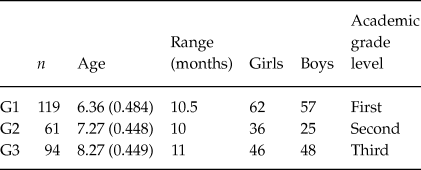
A cross-sectional research design was used. The study’s random sample was comprised of 274 schoolchildren (144 girls and 130 boys) between the ages of 6 and 8 enrolled in private schools in the City of Mar del Plata, Argentina, and of a middle-class socioeconomic background. The sample was subdivided in three groups: Group 1 (G1) comprised of first grade schoolchildren (n = 119) with a mean age of 6.36 years (SD = 0.484); Group 2 (G2) comprised of second grade schoolchildren (n = 61) with a mean age of 7.27 years (SD = 0.448); and Group 3 (G3) comprised of third grade schoolchildren (n = 94) with a mean age of 8.27 years (SD = 0.449). The educational institutions were selected via intentional sampling to assure that the selected schools were privately run; in Argentina there is a significant relationship between the type of school and the socioeconomic background of the community served, in the sense that public schools tend to serve communities of low socioeconomic background and private schools tend to serve communities of middle and high socioeconomic backgrounds (Narodowski & Nores, Reference Narodowski and Nores2000). Participating schoolchildren were selected via a simple random sampling with replacement of participants. The correspondence of age-to-grade level was used as inclusion criteria, since the presence of children older than expected for a given grade level could bias the results; these older children were therefore excluded from participating. In terms of gender, statistically significant differences were not detected in any of the three grade levels (p > .05), and therefore the analysis was undertaken without discriminating for this variable.
Instruments
The development of executive functions was evaluated using the Verbal Fluency scales (semantic and phonemic), Cognitive Flexibility, Mexican Pyramid and Backward Digit Span taken from the Neuropsychological Assessment of Children test battery (ENI) (Matute et al., Reference Matute, Roselli, Ardila and Ostrosky-Solís2007). Later, with the objective of simplifying the statistical analysis and reducing data on the basis of common factors, we created indices that synthesize the totality of the above-mentioned variables in four representative measures of executive performance.
EF Tasks and Indices
All the tasks used to evaluate the EFs belong to the Neuropsychological Assessment of Children test battery (ENI) (Matute et al., Reference Matute, Roselli, Ardila and Ostrosky-Solís2007).
Working Memory
Evaluated using the Backward Digit Span task. This task evaluates the subject’s capacity to store, manipulate and transform information; for this reason, it is regarded as a traditional measure of WM and executive functions (Lezac, 1995). The task involves reciting numbers to the subject, who must then recite them back in reverse order; the tester begins with two digits and increases the amount by one for each subsequent series. WM capacity is determined by the number of digits in the longest series the child is able to recite in reverse order.
Planning
Evaluated using the Mexican Pyramid task, a variant of the Tower of Hanoi and Tower of London. This task measures the capacity of the subject to generate and organize the sequence of steps necessary to complete a task based on a proposed goal (Lezak, Reference Lezak1995). The task uses three discs of different colors (green, white and red) and sizes (large, medium and small). Cards depict different constructions that can be built using the discs. The child had to use the discs to recreate the different constructions presented on the cards in the least number of moves possible and following specific instructions. There are diverse indices designed to evaluate the precision of the response in this type of task; we opted for: “the number of correct designs in the minimum number of moves” because this is the evaluation most frequently used in the literature (De Luca et al., 2003; Espy, Kaufmann, Glisky, & McDiarmid, Reference Espy, Kaufmann, Glisky and McDiarmid2001) and because we needed to simplify (or reduce) the number of performance measures tied to the different instruments.
Cognitive Flexibility
Reactive flexibility was evaluated using the Wisconsin Card Sorting Test (WCST) (Grant & Berg, Reference Grant and Berg1948). This task evaluates the capacity for abstraction and the ability to form concepts and to change cognitive strategies in response to changes in environmental contingencies (Heaton, Reference Heaton1981). The task requires the subject to discover the principal (color, shape or number) on which he/she is to group cards; the examiner informs the subject whether a match is correct or incorrect. We created the reactive flexibility index to evaluate performance and to reduce the many indices offered by the instrument; we believe the index we created represents the subject’s understanding of the classification principles. We arrived at our index by dividing the number of attempts made (30 to 54) by the number of categories completed (from 0 to 3). This index allows us to discriminate between children who have completed the same number of categories but in a different number of tries.
Spontaneous flexibility was evaluated using the semantic verbal fluency (SF) and phonemic verbal fluency (PF) scales. Two SF scales were applied. In the first, the child was asked to name as many animals as he/she could in a minute, and in the second he/she was asked to name as many fruits as possible in the same amount of time. In the PF task, the child was asked to name as many words starting with M as he/she could in one minute. Two indicators were evaluated to reflect a child’s performance on both fluency types (semantic and phonemic). The first indicator was the total number of animals and fruits named in the two SF scales. The second indicator was the total number of words starting with M produced in the PF scale.
Procedure
Evaluation instruments were administered to each subject individually by a single, especially trained professional. The order in which the instruments were administered was counterbalanced. Informed consent for participants was sought from the children’s parents or guardians, and included a detailed explanation of what the study consisted of and a guarantee of confidentiality with respect to the information obtained, as well as a guarantee that the information would only be used for scientific purposes under National Law 25.326, which protects personal information.
Results
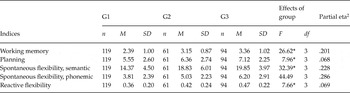
Table 1 presents the results of the application of the instruments, including the descriptive statistics of Mean and Standard Deviation for the standardizedscores of the variables being studied for the sample, discriminated by group. In general, it can be seen that the means of all the executive indices are higher for the older age groups, although, since this is a cross-sectional study of independent groups, we cannot deduce that this reflects an increase in the scores.
Mean (standard deviation) of each group’s age variable and the sample’s gender distribution

As can be observed in Table 2, the means of all the executive measures are higher in the older age groups. A single factor analysis of variance (ANOVA) was applied to determine if the means of the executive measures represent a significant differential effect for the three grade levels (1, 2 and 3). Table 2 also shows the results of an ANOVA to evaluate the differences between the means of the variances of the executive tasks.
Descriptive statistics and effects of grade level (group) on EF indices (explained variance and effect size)

Note:
* p < .001.
In the same table we can see that the value for all the executive indices is p = .001. These results indicate that age is a variable that is closely tied to performance in the executive measures; as age increases, the mean values become significantly higher. No difference among the three groups were found.
Development Pattern of Executive Processes
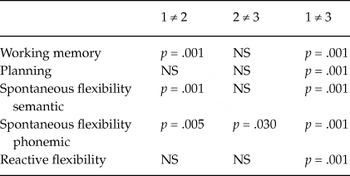
These findings led us to perform a Games-Howell post-hoc contrast test, since it is considered the most appropriate when great differences in variances between groups exist, as in this case (Kromrey & La Rocca, Reference Kromrey and La Rocca1995; Seaman, Levin, & Serlin, Reference Seaman, Levin and Serlin1991). Levene’s test showed that the variances of the executive indices are not homogenous across the three groups, with p < .01 in all cases. It has been demonstrated that when sample sizes are the same or similar, the variance analysis of a single factor is robust with respect to violations of the supposed homogeneity, with Type I and Type II errors not having considerable influence (Glass, Peckham, & Sanders, Reference Glass, Peckham and Sanders1972). Table 2 illustrates the differences in behavior in the groups.
As can be observed in the post-hoc analysis, WM and SF present significant differences at all ages, the only exception being between the second and third grades. A significant difference in the planning and reactive flexibility measures is only seen between the two extremes of the age spectrum (first and third grade). The only executive index that presents a statistically significant difference between the second and third grades is PF, which shows a development pattern with greater sensitivity in the measurement of changes between the ages of 7 and 8.
Relationships among Executive Functions in Each Group
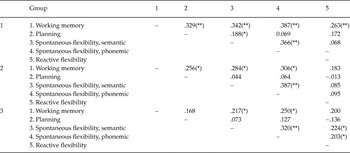
As can be observed in Table 4, there are significant coefficients with strengths between r = .217 and r = .387.
Summary of the Games-Howell post-hoc test: Comparison of mean scores between groups

Note:
** = p < .01 * = p < .05; NS = difference is not significant.
Correlations by age for all executive measures

Note:
** Significant correlation at the .01 level (bilateral). * Significant correlation at the .05 level (bilateral).
The correlation between the WM indices and all other measures decreases with age, being statistically significant in first and second grades. Which means that, at an older age, the relationship between these indices is weaker. The SF and PF indices present a correlation in the three grade levels, but one that becomes weaker in the older children (third graders). This difference may suggest that these executive indices differentiate themselves as the child grows older. In terms of the relationship over time between reactive and spontaneous flexibility, significant correlations between these variables were only observed in third graders, with the relationship between reactive flexibility and PF being slightly stronger.
Finally, we note that planning presents a low significant correlation in first and third grades.
Relationships between Executive Functions Controlling for Age (Group)
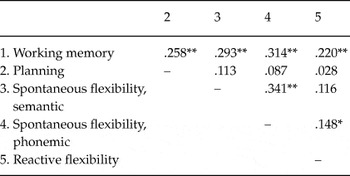
Partial correlations controlling for the group factor were used to analyze if the executive functions share a variance beyond those attributed to the changes in age reported by the ANOVA. As can be observed in Table 5, all the significant coefficients oscillate between the values of, r = .148 and r = .314.
Bivariate correlations controlling for the age factor (Group)

Note:
** Significant correlation at the .01 level (bilateral). * Significant correlation at the .05 level (bilateral).
The relationship between WM and the other variables is maintained since a significant correlation was found between it and all other executive measures, even when controlling for the group factor. A positive and significant relationship was also maintained between the indices of spontaneous flexibility. As Table 3 shows, only in the third group is there a relationship between reactive flexibility and SF and PF. When controlled for age, the relationship between reactive flexibility and PF is weak, although still statistically significant. Further, as shown in Table 3, no relationships were found between planning and both flexibility indices.
Discussion
The general goal of this study was to analyze the development patterns and relationships between different executive components in children between the ages of 6 and 8.
On the one hand, in terms of development, the results show that the means increase with age for all executive measures. Nonetheless, the development patterns and changes in the execution of the tasks vary depending on the executive component involved. Thus, while planning and reactive flexibility present a more progressive trajectory and differences that are less marked, other components, such as WM and spontaneous flexibility (phonemic and semantic) show more abrupt and less gradual changes. The most gradual and progressive change in terms of the trajectory of planning and reactive flexibility is seen only in the differences found between the groups at opposite ends of the age spectrum (G1 vs. G3), something that is not observed with the other components. Thus, in the case of spontaneous flexibility and WM, a notable change is observed between the children of G1 and G2.
In general terms, these findings support the conclusions of prior studies establishing different development trajectories for the different executive components (Diamond, Kirkham, & Amso, Reference Diamond, Kirkham and Amso2002; Welsh, Reference Welsh, Molfese and Molfese2002). Our study found that this is partially so for children between 6 and 8 years of age (G1 and G3), since reactive flexibility and planning have similar periods of acceleration and deceleration that are different from those of spontaneous flexibility and WM, which share their own development pattern. Further, the evolutionary pattern of PF is different form all others, with changes that are more marked, accelerated, and less progressive than others, as can be seen in the differences found among all the groups (G1 vs. G2 vs. G3).
In more specific terms, the results allow us to, in the first place, categorize the development of executive components in three types of patterns that vary by the degree of acceleration with which changes take place: first, a pattern with more gradual and progressive changes, as in the case of planning and reactive flexibility; second, a pattern with changes that are accelerated and sudden compared to the first type, as for example, in the case of WM and SF; and, third, a pattern with more accelerated and abrupt changes, with changes occurring at all three grade levels, as in the case of PF.
Second, the results associated with spontaneous flexibility are compatible with the findings reported by Nieto et al. (Reference Nieto, Galtier, Barroso and Espinosa2008), which studied children between the ages of 6 and 11 and found that, although differences between genders did not exist for PF and SF, age, on the other hand, clearly influenced both tasks. These differences were also reported in numerous studies undertaken with different age groups (Koren et al., Reference Koren, Kofman and Berger2005; Matute et al. Reference Matute, Roselli, Ardila and Ostrosky-Solís2007). In this regard, and in a more precise fashion, our data also provide evidence in favor of the existence of different development patterns for SF and PF, the pattern of the latter being less gradual and progressive than that of the former. These results are also consistent with those of Nieto et al. although in the case of PF, the changes appear to be more accelerated in our study since we found differences among all the groups. With respect to this matter, it should be clarified that our study analyzed three groups comprised of 6, 7 and 8 year olds in first, second and third grades, respectively, while in Nieto et al. children of age 6 and 7 where included in the same group.
Third, the analysis of development patterns helps us address the hypothesis that states that there is functional and anatomical independence between reactive flexibility, measured via WCST, and spontaneous flexibility, measured via PF and SF tasks. In this respect, the data support the Eslinger and Grattan (Reference Eslinger and Grattan1993) hypothesis, since the development patterns are markedly different. While the scores in the reactive flexibility task (a variant of WCST) point to a gradual and progressive increase, spontaneous flexibility (semantic and phonemic) appears to change in a more marked and accelerated fashion among the three groups studied.
Fourth, during the first cycle of the academic period, planning and reactive flexibility show similar trajectories (Zelazo et al., Reference Zelazo, Carter, Reznick and Frye1997; Zelazo & Frye, Reference Zelazo, Frye and Stamenov1997; Zelazo & Müller, 2002). In these cited studies, a model is proposed to explain the common functioning of EF; for example, the prototypical card classification task known as WCST (Pennington & Ozonoff, Reference Pennington and Ozonoff1996, p. 55) as well as pyramid-building tasks may require similar stages for their resolution. In the first stage, a representation of the problem must be constructed, identifying its dimensions. Later, a plan of action must be selected (for example, classify according to form or establish the moves needed to achieve the requested design). Then, the subject must: (a) maintain the plan in mind long enough to carry it out; and (b) execute the plan. Finally, the execution of the plan is evaluated, detecting errors and correcting them. According to Zelazo, any change in executive function can be attributed to changes in WM, which shows constant increases throughout most of one’s childhood (see Gathercole & Hitch, Reference Gathercole, Hitch, Collins, Gathercole, Conway and Morris1993; Gathercole et al., 2004; Hitch, Reference Hitch, Graf and Ohta2002). These increases in WM capacity may affect the executive functioning in any of the model’s stages, especially in the strategy planning and plan execution stages. Thus, the similar development patterns shown by planning and reactive flexibility, as measured through these tests, may be explained by the stages they share with WM and the supposed role it plays. Should this be the case, there then clearly exist relationships between WM and planning, and WM and reactive flexibility.
Fifth, with respect to WM, this component presents a pattern that is similar to the one described for SF; significantly higher scores were reported for the Backward Digit Span task between the ages of 6 and 7 (G1 and G2). This finding is consistent with research that maintains the absence of the rehearsal strategy before the age of 7, an element which produces notable increases in the retention capacity of WM (Gathercole & Hitch, Reference Gathercole, Hitch, Collins, Gathercole, Conway and Morris1993). The difference between these groups, therefore, can be explained by the use and implementation of incipient strategies that are fundamental to the efficient execution of the task. Spontaneous flexibility (phonemic and semantic) also presents significant changes between the ages of 6 and 7 (G1 and G2). It is probable that this increase in scores is explained in a similar manner by the more efficient use of processing strategies. In this respect, it is interesting to turn to Nieto et al. (Reference Nieto, Galtier, Barroso and Espinosa2008), which explores the effect of age on the use of strategies in SF and PF tasks; the study’s results show that significant differences exist among children in the age groupings of 6 and 7, 8 and 9, and 10 and 11. Additionally, the researchers found that the number of words generated in both tasks is strongly related to the number of subcategories (clusters) and the amount of changes made between them. In our study, the three indices of WM, SF and PF are the ones that present the largest effects.
In order to analyze the relationships and interactions among the executive components during development, we first analyzed the correlations among the different executive components for each group, and then analyzed if these correlations (for the entire sample) were maintained when the age factor (group) was controlled. The results of these analyses allowed us to distinguish two patterns of interaction: one on the relationships among age-dependent executive components, and the other on the relationships among components that are not attributable to the age factor.
With respect to the relationships among executive components attributable to age, we found interactions between SF, PF and reactive flexibility in G3 that probably overlap statistically for this particular group. It is possible to attribute the interactions between these components to the maturity and cognitive growth of the child.
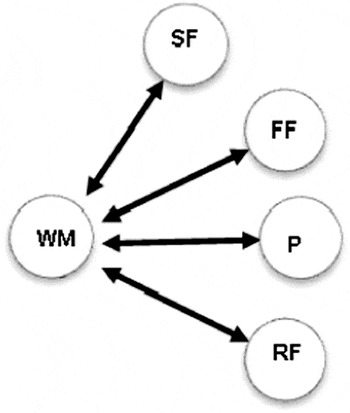
With respect to the relationships among executive components not attributable to age, we found interactions between WM and planning, reactive flexibility and spontaneous flexibility, and a relationship between PF and SF (see Figure 1).
Relationships between components not attributable to age (P, planning; WM, working memory; SF, spontaneous semantic flexibility; PF, spontaneous phonemic flexibility; RF, reactive flexibility). Bidirectional arrows indicate positive bivariate correlations between executive components.

WM and spontaneous flexibility present similar development profiles during the first years of schooling (G1 and G2) and, additionally, there exists a relationship between them. The same type of changes and the relationship between these variables can be explained by the type of activity necessary for optimum performance in spontaneous flexibility tasks; these tasks require the organized generation of words within a subcategory, and then changing to a different subcategory when the first is exhausted. The recognition that a subcategory is exhausted and that one should therefore move on to a new subcategory avoids the unnecessary loss of time and cognitive resources that would result from the attempt to continue generating low frequency words in the same subcategory (Troyer, Reference Troyer2000). Further, the increased generation of words is explained by avoiding words already said in the present and previous subcategories (avoid perseveration) and in not generating words that do not belong in the present subcategory (avoid intrusions). In the present study, we can assume that as WM capacity increases with age, one’s detection of words already mentioned becomes more efficient, as does one’s ability to recognize that a category is nearing exhaustion and to avoid mentioning words that are not related to the category. Further, we should recall that different researchers have indicated the predictive importance of WM on verbal fluency tasks and a person’s semantic capacity (Daneman, Reference Daneman1991).
In terms of the relationship between WM and reactive flexibility, the association between these processes does not seem to depend on age; the increase in their scores does not rely solely on the child’s growth, but rather in the fact that, during development, both processes share resources that make it possible to meet certain cognitive demands. It is logical to assume that the ability to effect modifications in strategies depends to a large degree on the ability to temporarily store information relevant to the task; in the case of a reactive flexibility task, this consists of storing the results (correct and incorrect) of each attempt made by the child. In other words, if the child were not capable of temporarily storing the results of each strategy implemented, we would note a tendency towards perseverance in the responses and, consequently, the task would require a greater number of attempts to complete. These results are consistent with prior studies that consider WM as an important predictor of performance in tasks such as WCST and its variants (Huizinga et al., Reference Huizinga, Dolan and van der Molen2006).
With respect to the relationship between planning and WM, both present significant correlations with each other. As stated previously, planning is a complex cognitive process that requires the intervention of many other cognitive processes, such as WM, which is the ability to retain information online in order to direct an organism’s behavior toward an objective (Baddeley, Reference Baddeley1992; Reference Baddeley1997). A number of studies have found correlations between WM and pyramid-building tasks (Gilhooly, Wynn, Phillips, Logie, & Della Sala, Reference Gilhooly, Wynn, Phillips, Logie and Della Sala2002; Welsh, Satterlee-Cartmell, & Stine, Reference Welsh, Satterlee-Cartmell and Stine1999). This assumes that the ability to maintain and develop in one’s memory different plans of action is an important predictor in tasks that require a child to be able to anticipate movements and calculate results simultaneously (Janssen, De Mey, Egger, & Witteman, Reference Janssen, De Mey, Egger and Witteman2010; León-Carrión & Machuca-Murga, Reference León-Carrión and Machuca-Murga2001).
Additionally, the statistical analyses show the relative independence among the different executive components. In general, all the relationships are weak and some are not statistically significant. This coincides with many studies that have used correlations and regressions to analyze the interactions among the different executive components; they found the relationship among them to be weak (generally less than r = .40 see Miyake et al., Reference Miyake, Friedman, Emerson, Witzki and Howerter2000). It is worth noting the independence of the components of spontaneous flexibility and planning, which, since the very beginning of a child’s schooling (G1), do not present significant relationships between them and manifest different development patterns. However, it is important to keep in mind that the tasks require different modalities (verbal and visual) to execute, and that the presence of differences may be attributable to the specific modality.
Reactive flexibility and planning can also be considered independent of each other given the absence of significant relationships between them, although they do show similar development patterns. Lastly, spontaneous flexibility and reactive flexibility present, as mentioned, different development patterns; while spontaneous flexibility has an accelerated development, reactive flexibility has a more gradual development.
In summary, based on the data we have identified three different patterns of development for the principal executive components; these patterns emerged from the study and analysis of the three groups of schoolchildren and the different interactions between the components that are not attributable to the mere cognitive growth and greater maturity of the child. Three empirical types were established based on the development patterns and relationships between components: (a) similar development pattern with the absence of interactions between the components; (b) similar development patterns with correlations between the components; and (c) dissimilar development patterns with independent components. The latter type provides evidence in favor of the Eslinger and Grattan hypothesis on the functional independence of spontaneous and reactive flexibility.
With respect to the above-mentioned conclusions, it should be noted that the greater means observed in the older age groups are also related to the fact that as children grow older and progress through the educational system, their reading and writing skills improve, and this has an effect on EF development. Thus, for example, the increases in a child’s vocabulary from one school year to the next affects the child’s memory capability (Gathercole & Hitch, Reference Gathercole, Hitch, Collins, Gathercole, Conway and Morris1993; Gathercole, Willis, Emslie, & Baddeley, Reference Gathercole, Willis, Emslie and Baddeley1992); similarly, increased language skills play a mediating and facilitating role in the development of numerous cognitive processes (Johnson & Munakata, Reference Johnson and Munakata2005). In this regard, the effects of literacy are evident in a subject’s performance on numerous neuropsychological tasks on verbal and semantic fluency (Ostrosky-Solis, Ardila, Rosselli, López-Arango & Uriel-Mendoza, Reference Ostrosky-Solis, Ardila, Rosselli, López-Arango and Uriel-Mendoza1998). Therefore, our results should be interpreted considering the effect that the acquisition of reading, writing and other skills learned at school have on executive function task performance.
In terms of these study’s limitations, we must first keep in mind that the disappearance of the relationships between WM and the other executive functions in later school years might be due to other intervening variables that are not discriminated by the measures used; this would mask other development relationships. Second, there are other techniques to evaluate working memory that impose even greater demands on the cognitive control system, such as complex span tasks that require the subject to retain some aspect of a stimulus while processing another; for example, the meaning of a statement. These are considered measures of WM because they involve the executive component, measuring processing skill and verbal storage (Gathercole & Pickering, Reference Gathercole and Pickering2001; Swanson & Howell, Reference Swanson and Howell2001).
For future research, we consider it important to continue studying the development of the different components in order to analyze whether the development patterns and interactions found in this study hold throughout a child’s school years.