

When I was a student, and even years later until the early 1990s, the now ‘old’ Musik in Geschichte und Gegenwart (MGG) was the central reference book for German-speaking scholars of musicology. The entry on ‘Lied’ in the old MGG states that the ‘Tenorlied’ was the first specifically German creation and one of Germany's first important contributions to polyphony.Footnote 1 Noticing a strange nationalistic undertone, one might wonder why this comparatively small and humble repertory should have such distinct importance, and so one might turn to the entry on ‘Deutschland’. The surprise and puzzlement will be even greater there. In section C. Spätgotik und Renaissance the author claims that
in the time from the mid-fifteenth century until the beginning of the Counter-Reformation a development took place that determined the destiny of German culture and in particular of German music for centuries … In these roughly twelve decades the German nation grew to join the group of the European ‘Musikvölker’ and developed a flourishing indigenous musical production. Within the German cultural area musical forms were invented or developed that stamp the character of German music until today … Hence the time from Germany's entry into the concert of musical nations until the end of a first heyday of German polyphony may rightly be considered as one of the most important periods in German music history. From it many characteristics of German music can be derived.Footnote 2
A few columns later the author continues with this idea, posing the question whether this music actually shows specific characteristics that could be called ‘genuinely German’. First he hesitates, but then he argues indirectly, with a double negative: ‘Even by taking into account French influences on Minnesang, one will be unable to assert that the lied melody of the fifteenth and sixteenth centuries is not originally German. This will also be true of the Protestant hymn, which – despite its Gregorian influence – must be considered as a typical German lied.’Footnote 3
Another central characteristic of the German repertory, he claims, is the so-called cantus firmus Gesinnung, a term introduced by Heinrich Besseler in his volume Musik des Mittelalters und der Renaissance of 1931. There Besseler presents the ‘Tenorlied’ as the focus of the world of German musical forms and describes the genre as a kind of cantus-firmus motet, with a ‘Cantus planus’ as the intellectual centre of the composition.Footnote 4 In the MGG article the term ‘Cantus firmus Gesinnung’ designates a stubborn allegiance to the primary melody in the ‘Tenorliedsatz’, which is paralleled in church music when the German composers respect the chorale tune.Footnote 5 This emphasis on the cantus firmus line would persist until the second half of the sixteenth century, when all the other musical nations had already developed their own musical styles along a different path. For the author it seems to be the normal German national character to adhere to authority, whatever was happening in the world around them and in whatever direction this authority was leading.Footnote 6
Is this article only about music, or is it also a political statement? To recall, this is a music dictionary from the late 1950s and early 1960s, a German dictionary that separated musicologists into Germans and foreigners, as is evident on the title page: ‘unter Mitarbeit zahlreicher Musikforscher des In- und Auslandes’ (with the collaboration of numerous musicologists from home and abroad). As a student I was somewhat irritated by this tone, as well as this attitude,Footnote 7 and not just on stylistic grounds. There was something between the lines that I could only suspect but did not fully understand then.Footnote 8 It is high time to shed light on it.
I. Early nationalism, moral concerns and the idea of ‘volkslied’
To study the historiography of the early German lied setting one has to start at the very beginning of the nineteenth century, when writing music history was more a personal mission than a strictly regulated academic occupation. Johann Nikolaus Forkel, one of the founding fathers of German musicology, introduced the genre in his unfinished music history, Allgemeine Geschichte der Musik (1801), in connection with Heinrich Isaac, to whom he refers as a famous German composer of counterpoint. Driven by the outspoken patriotism typical of his time, Forkel wanted to demonstrate that already in early music the Germans were at least on the same level as the composers of other nations, so-called ‘Ausländer’, with whom they could favourably compare. And Isaac, as one of the best of our men, he concludes, might even exceed them.Footnote 9
In addition to the spelling of his name and Glarean's mention of him in his Dodekachordon as ‘Henricus Isaac Germanus’, the fact that Isaac composed a considerable number of secular German songs is – in Forkel's eyes – the most compelling reason to be certain that he was indeed of German origin.Footnote 10 Specifically, in secular music he was far ahead of other contemporary musicians. To document this Forkel looked for appropriate music examples. Although he had access to a famous printed collection of German songsFootnote 11 that contains several works by Isaac, he hesitated to present them. The reason for this reluctance was the words of these songs, which were considered morally ambiguous. Although Forkel judged them in general as rough and on the same level as the primitive popular songs of his own time, he chose a four-part German lied setting ‘with the most tolerable text’ and presented a complete edition of it.Footnote 12 In this song the narrator addresses the young daughter of a farmer called Maruschka – the Slavonic version of the German name Maria – who does not want to be a maid any longer. Although it is not explicit, it becomes clear that her wish is not to be married but to lose her virginity, and the narrator is happy to help her out of that ‘misery’:
Ignoring this slippery topic, Forkel tries to focus the eye of the reader on the high quality of the composition, especially on its flowing style. However, the complex Franco-Flemish fabric of the musical setting is much more like a section of a motet than a typical German lied, and the threefold repetition of the same text demonstrates different compositional techniques.Footnote 13 But this is not the point, and Isaac was definitely not German, as we know today. What we can learn from this passage is that in the early nineteenth century the music of this genre would have been generally appreciated, not least for its Germanness, did not the texts preclude such recognition in music-historical literature.
The Textual Approach
It seems strange that it was precisely the lyrics of the songs – and in the first instance only the lyrics – that launched the genre's career in another field, the nineteenth-century German folk-song revival, an influential movement based on two different ideas. One goes back to the Enlightenment, when the search began for the pure and genuine human nature believed to be found in popular literature such as fairy tales or popular songs. Ennobling the common people, the poets of the Romantic period continued this project, collecting and editing their poetic products as a treasury of German literature. The other idea was based on the emergence of early German nationalism as a political movement. Its exponents, however, concentrated on culture and fostered scientific and intellectual interest in history, tradition, folklore and popular language as a symbol of typical Germanness. After the war of liberation against Napoleon's troops the German Confederation was formed as a loose political association of several German-speaking states. Owing to this heterogeneous territory without a political centre and the deep confessional separation within the country, it was the German language that formed the main common ground and was deliberately exploited to suggest cultural and political union. At this point both ideas merged in the interest in folk poetry, the ‘Volkslied’.
That these preconditions do not necessarily imply a narrow-minded approach is demonstrated by Johann Gottfried Herder, an intellectual founder of Weimar Classicism. As its title indicates, his famous collection Stimmen der Völker in Liedern (1807) reveals an astonishingly international approach and is based on a general interest in spiritual communities bound by common poetry and a common language. Although this work was a cornerstone for the following generations in collecting, editing and publishing folk songs, its liberal attitude did not last long.
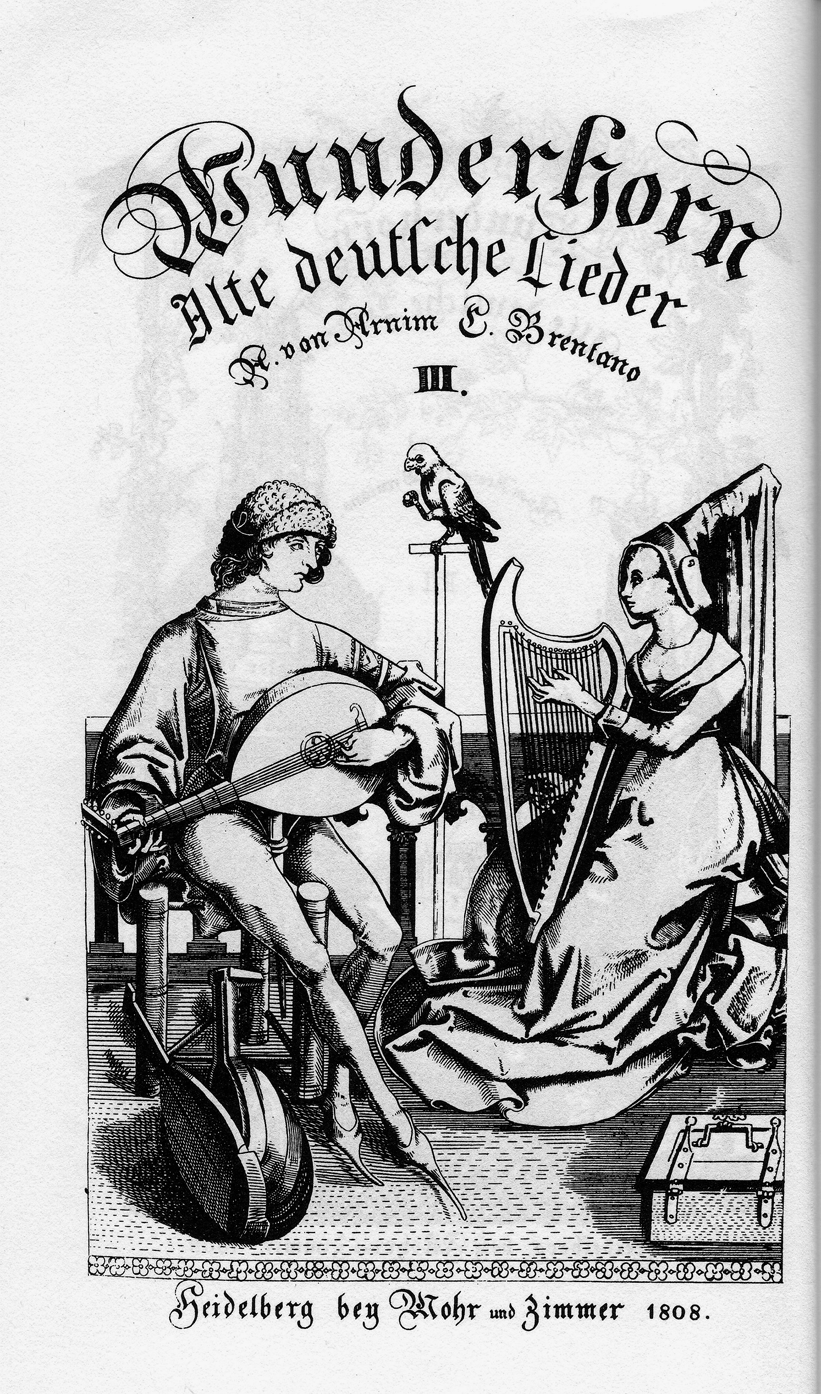
The German ‘Volksseele’ – a keyword for the first decades of the century – was a central issue in early German folk music research, which started with a huge collection by two other literary figures, Clemens Brentano and Achim von Arnim. Des Knaben Wunderhorn, published in three volumes between 1805 and 1808, was an enormously successful project that led to several new editions in the following decades and finally found a settled home on the shelves of almost every German household. Although the subtitle Alte deutsche Lieder suggests a historical approach (see Figure 1), the authors also included songs of their own unacknowledged composition. The other popular poems were either taken from oral transmission or stemmed from historical literary sources of various periods. That Brentano had a specific interest in the printed German song collections of the sixteenth century is well documented by several letters to friends and colleagues whom he asked for help in ferreting out such collections. Eventually he had access to five items, among them the same Ott print already known to Forkel.Footnote 14 The publication Brentano exploited most extensively was the comprehensive song collection Frische teutsche Liedlein, edited by Georg Forster, that appeared in five volumes between 1539 and 1565 (and several later editions). Although the authors generally indicate the source of the texts below the title, not all the twenty-nine borrowings from Forster can be detected at first sight. Only fifteen are designated as taken from the Frische Liedlein; the others are specified as transmitted orally. This strange procedure is connected with Arnim and Bretano's specific editorial practice. Out of concern for their readers who were not used to the rough language of the texts, they manipulated them in many ways. Whenever their interventions were more than metrical and linguistic smoothing, but involved cancelling or adding new verses, and adapting or remodelling parts to a greater degree, they often suppressed the original source.Footnote 15
Title page of the third volume of Des Knaben Wunderhorn: Alte deutsche Lieder, ed. A. v. Arnim and C. Brentano (Heidelberg, 1808), with a pseudo-medieval illustration after an engraving by Israhel van Meckenem presented in a typical burnished style

To give an example of this editorial practice, where the interventions seem to be quite substantial but the original source is still mentioned, let us take a closer look at Das Bäumlein (The little tree), published in volume 1 as no. 124:Footnote 16
1. Ein Bäumlein zart, / Geschlachter Art, / Von edlem Stamm, / Und gutem Nahm, / Ganz rein und pur, / Kein süßer Frucht / Nie Mensch versucht, / Wer möcht es lahn / Und nicht begehren Frucht davon. // O mein! O mein! / Ich gab mich ihr ins Herz hinein, / In ihrem grünem Röckelein.
2. Aus festem Grund, / In schönem Rund, / Dieß Bäumlein zart, / Gezieret ward, / Die Aestlein schlecht, / Schwank und gerecht, / Grün adlich fein / Die Blätter sein, / Der Früchte Zier / Wär süßer mir, / Als Zucker oder Malvasier. // O mein! O mein! / Ich gab mich ihr ins Herz hinein, / In ihrem grünem Röckelein.
3. So ich besinn, / Was gut Gewinn, / Dies Bäumlein klug, / Mit Nutz und Fug, / Eh es im Gart / Versperret ward, / Ertragen hat, / Ist Freud verzehrt / Des Herzens mein, / Ich schrei in Pein, / Gott segn dich zarts Bäumelein. // O mein! O mein! / Senk Zweigelein, / Daß ich mich schwenk zu dir hinein!
This poem stems from the first volume of Forster's collection, where it is set to the music of Laurenz Lemlin, a friend of Forster at Heidelberg. There each of the three stanzas consists of ten lines. Lines 11–13, given here in italic, are additions by the authors of Des Knaben Wunderhorn. They took these lines from two other songs of the same collections: O mein! O mein! / Ich gab mich ihr ins Herz hinein from no. 22, and the last line, which mentions the little green coat (grünes Röcklein), from no. 2. The last two lines of the third stanza, here printed in bold, are poetic additions by the modern editors themselves.Footnote 17
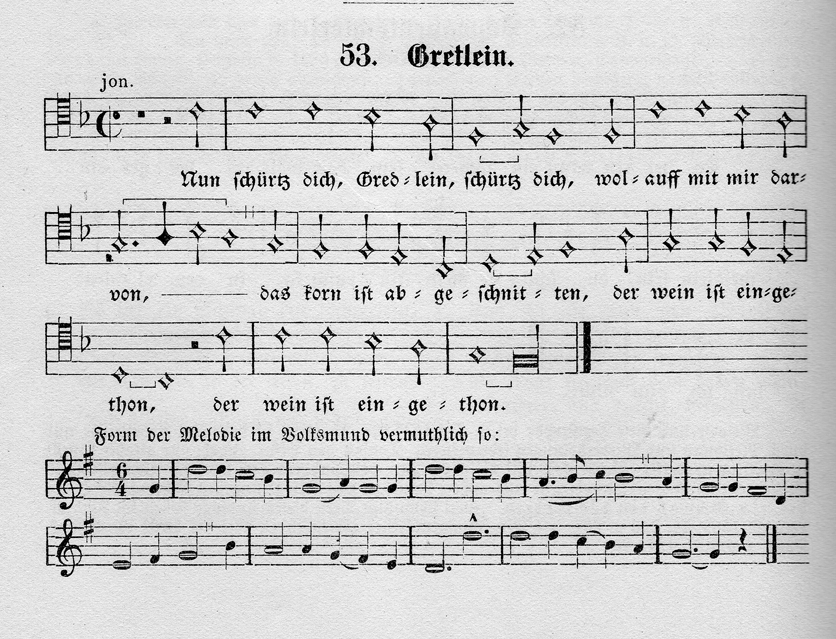
One might wonder why the moral concern that bothered Forkel in the case of Isaac's song texts did not arise here. While the publication of Des Knaben Wunderhorn was criticised on grounds of authenticity and the quality of the printed folk songs, the adaptations from the Forster song collections were always appreciated without objection. Goethe, for example, judged Das Bäumlein as ‘sehnsuchtsvoll, spielend und doch herzinniglich’ (longing, playful and yet heartfelt).Footnote 18 Did the great German writer not recognise the hidden sexual connotation of the last two added (!) verses? Heinrich Heine too seems to ignore the more or less openly described defloration welcomed by the maiden in the song text Nun schürz dich Gretlein, schürz dich (see Figure 2 below), also based on Forster's print, when he notes: ‘Aber auch unser Gretel sollt ihr kennenlernen. Es ist ein aufrichtiges Mädel, und ich liebe sie sehr!’ (But you should also get to know our little Gretel. She is a honest girl and I adore her a lot.)Footnote 19
Music example from F. M. Böhme, Altdeutsches Liederbuch: Volkslieder der Deutschen nach Wort und Weise aus dem 12. bis zum 17. Jahrhundert (Leipzig, 1877)
In general, the thirty-seven songs in the Wunderhorn collection taken from early printed song collections, thus representing the early German lied setting, comprise only a small percentage of the more than thousand songs published by Arnim and Brentano. Nevertheless, for the first time in the nineteenth century at least the lyrics of the songs found their way into a wide public community, and were appreciated as early folk song.
In the following decades, a flood of songbooks appeared. Many of them privileged a specific local repertory, old nursery rhymes or a repertory for specific professions, such as songs of soldiers, student music, and songs for gymnasts or craftsmen.Footnote 20 Early German songs could mostly be found in songbooks with a more common repertory, such as in Friedrich Karl Freiherr von Erlach's Die Volkslieder der Deutschen (Mannheim, 1834), a collection of the most exquisite German folk songs from the mid-fifteenth to the first half of the nineteenth century, as the subtitle says. But lyrics from the earliest centuries continued to appear only in small numbers.
The first publication to concentrate almost exclusively on the songs of the fifteenth and sixteenth centuries was edited by Ludwig Uhland, a writer, politician and professor of German literature at the University of Tübingen. In the several volumes of his Alte hoch- und niederdeutsche Volkslieder (1844–5), in which he made use of historical manuscripts and early prints, he broadened the number of sources remarkably. Uhland's approach to the texts was quite different from that of Arnim and Brentano and their successors. In the preface he speaks more like a politician than a poet when he states that the book is neither a moral nor an aesthetic collection but a contribution to the history of German folk life.Footnote 21 Moreover, as a professional scholar, he included for the first time a critical analysis of the sources, a method developed from classical philology, and painstakingly documented his decisions in a separate volume that was published after his death.Footnote 22 With this work the collecting of folk songs entered the scholarly world of the time. Worth mentioning as well is Hoffmann von Fallersleben's publication Die deutschen Gesellschaftslieder des 16. und 17. Jahrhunderts (Leipzig, 1844), which appeared almost concurrently, with a dedication to Uhland. Fallersleben, who was also a politically engaged man of letters and a trained specialist in German studies, was mostly interested in the repertory of the convivial bourgeoisie, which in his opinion overlapped the presumed folk songs from earlier times.Footnote 23
The Melodic Approach
All the song collections mentioned so far presented only the words of the songs, without music. A small number of songbooks with melodies had been published, but none of them gave more than a handful early German lied settings. The publication Deutsche Volkslieder mit ihren Original-Weisen (2 vols., Berlin 1838–40) by Anton Wilhelm von Zuccalmaglio, for instance, contains only a few examples from the fifteenth or sixteenth century, among them Ach Elslein, liebes Elselein mein, which was to become one of the most famous Senfl songs later in the century. Ludwig Christian Erk and Wilhelm Irmer's popular collection Die deutschen Volkslieder mit ihren Singweisen (Leipzig, 1838–45) did not include this early repertory.
Comprehensive publication of music did not commence until the beginning of the last quarter of the century. In the Altdeutsches Liederbuch from 1877 the author, Franz Magnus Boehme, makes it clear that Uhland's very valuable critical collection of folk poems was incomplete, since these texts were lyrics to songs still available in historical musical sources. Boehme was a musician himself: he composed and conducted a choir and was a teacher of music history and counterpoint at the Frankfurt and Dresden conservatoires. However, his editorial approach was also that of a scholar, working at the same level that Uhland started from. In the impressive introduction to his book, comprising more than seventy pages, Boehme discusses amongst other things the theoretical background of the contemporary folk song movement. In his opinion, true folk song was created by the public, sung by it, distributed by it and sustained by it. Its form is simple and the message of general humanity is easy to capture. Boehme stresses that in earlier times the notion ‘folk’ did not mean the underprivileged working class of society as it was understood at his time, but a whole nation with the same parentage, the same language and the same tradition.Footnote 24 Thus he excluded the Minne- and Meisterlieder as well as the Gesellschaftslieder from his collection as artistic products of a distinct class. At the same time it was clear that folk songs were monophonic, and Boehme asked himself (and the reader) if these melodies were really still available, and if so, where could they be found.Footnote 25 According to his theory we are lucky that the composers of earlier times used those melodies as a basis for their contrapuntal settings. Thus most of them survived in the German lied settings of the fifteenth and sixteenth century. He was convinced that they were indeed authentic popular songs and not the work of the composers themselves, and he lists the ways they can be detected. Popular melodies are characterised by few melismas and by repeated notes. Moreover, they are connected with genuine folk poetry, they are addressed indirectly with annotations such as ‘to the tune of …’ and they are used in fragmented form in quodlibet compositions.Footnote 26
Having access to early manuscripts, broadsheets and an enormous number of printed sourcesFootnote 27 – indeed almost all the song collections with lied settings known to us today – Boehme's principle of selection led him to choose the 660 melodies, reprinted in his Altdeutsches Liederbuch. His determined search for authenticity and his scholarly approach prompted him to present the music in diamond-shaped notes, imitating the original notation. Ligatures are indicated by the brackets we still use today, and clefs and mensuration signs are original (see Figure 2).Footnote 28 To make sure that the reader can understand the notation, he provides a comprehensive general introduction to the mensural system in the introduction to the book.Footnote 29 The melodies are followed by all the stanzas of the text as well as by detailed remarks on variants in the texts, concordant polyphonic sources and different versions. In some cases, for instance Heine's favourite Gretlein song, he also suggests a version which he believed to be the original one, the one that was sung by the common people before the composer adapted it. In doing this, he changed the irregular rhythmic pattern of the melody in Forster's songbook by squeezing the notes into a regular 6/4 metre, as can be seen at the bottom of Figure 2. This procedure could be compared with the adaptations of the words by the editors of the Wunderhorn collection, although their aims were different. While they wanted to adapt the texts to the prevalent literary taste of their readers, Boehme tried to reconstruct the original as closely as possible.
Both collections, however, share a moral claim. For instance, no. 52 in the Altdeutsche Liederbuch, ‘Schwabentöchterlein’, is the melody of Isaac's setting of the lament of the farmer's daughter who no longer wanted to be a virgin, condemned by Forkel on literary grounds. The words of this song are given without comment, but two other versions in another songbook are criticised as ‘dirty’ (schmutzig).Footnote 30 The song Das Bäumlein, so much appreciated by Goethe, is completely missing. And the text of the Gretlein song was harshly criticised by Boehme in a later publication, referring to the words by Heine quoted earlier: ‘With his effusive love Heine seems to be quite unique. Such immoral scenes, as unfolded in the Gretlein song, have long been put to an end by the penal code; also a refined feeling of decency prevents such texts from appearing any longer.’Footnote 31
Boehme's rich experience in the early lied repertory led to his appointment by the Prussian ministry of culture to work on the bequest of the royal Berlin music director Ludwig Erk, mentioned earlier. This famous folk song collector originally planned to publish his material in two volumes, one containing more recent melodies based on oral tradition, the other with older repertory based on early sources. As he only managed to publish the first volume, called ‘Deutscher Liederhort’ (Berlin, 1856),Footnote 32 Boehme revised and enlarged this collection into three volumes, now comprising also ‘altdeutsche Lieder’, thus covering the whole panorama of German folk song. Parallel to Des Knaben Wunderhorn, the revised Deutsche Liederhort of 1893 became a kind of house book for many generations to come.
The Full-Setting Approach
The next step in the revival of early German songs was the edition of full musical settings, which appeared in 1884, seven years after the Altdeutsche Liederbuch was published. In this year Rochus von Liliencron brought out a book with the title Deutsches Leben im Volkslied um 1530 (German life in folk song around 1530), which sounds more like an essay on this topic than a music collection. Like Uhland, Liliencron was a politically engaged professor of German studies, but he was also in touch with the music. Having published a five-volume edition of the text of early folk songs based on historical events (Die historischen Lieder der Deutschen vom 13. bis zum 16. Jahrhundert (Leipzig, 1865–9)), and while he was working on his fundamental Allgemeine Deutsche Biographie (Leipzig, 1875–1912), which contains the biographies of all Germans who were famous in their time, he was commissioned to add a volume on folk songs to the series ‘Deutsche National-Litteratur’.
Meanwhile the North German Bund and three south German nations had formed the new German Empire after the successful Franco-Prussian war. Emperor Wilhelm I, the King of Prussia, and his first Chancellor Otto von Bismarck undertook several national endeavours to strengthen the political union of the newly founded empire. Supported by these political developments, Liliencron exhibits a much stronger streak of nationalism in a political sense compared to that of Boehme. He considered the musical repertory of the sixteenth century to be an echo of the Germanic tribes' ancient common property (‘Nachklänge des uralten Gemeindeguts der germanischen Stämme’).Footnote 33 In his eyes, it was in the years around 1530 that for the last time folk songs were shared not only by the lower ranks of society but by the whole nation. Folk song involved all social classes and civic groups and linked them by means of their expression and sentiment. Therefore it was folk music in its original sense, coming from the folk, and representing an idealised time in German history. This attitude would be revived and pursued fifty years later, as we will see below.
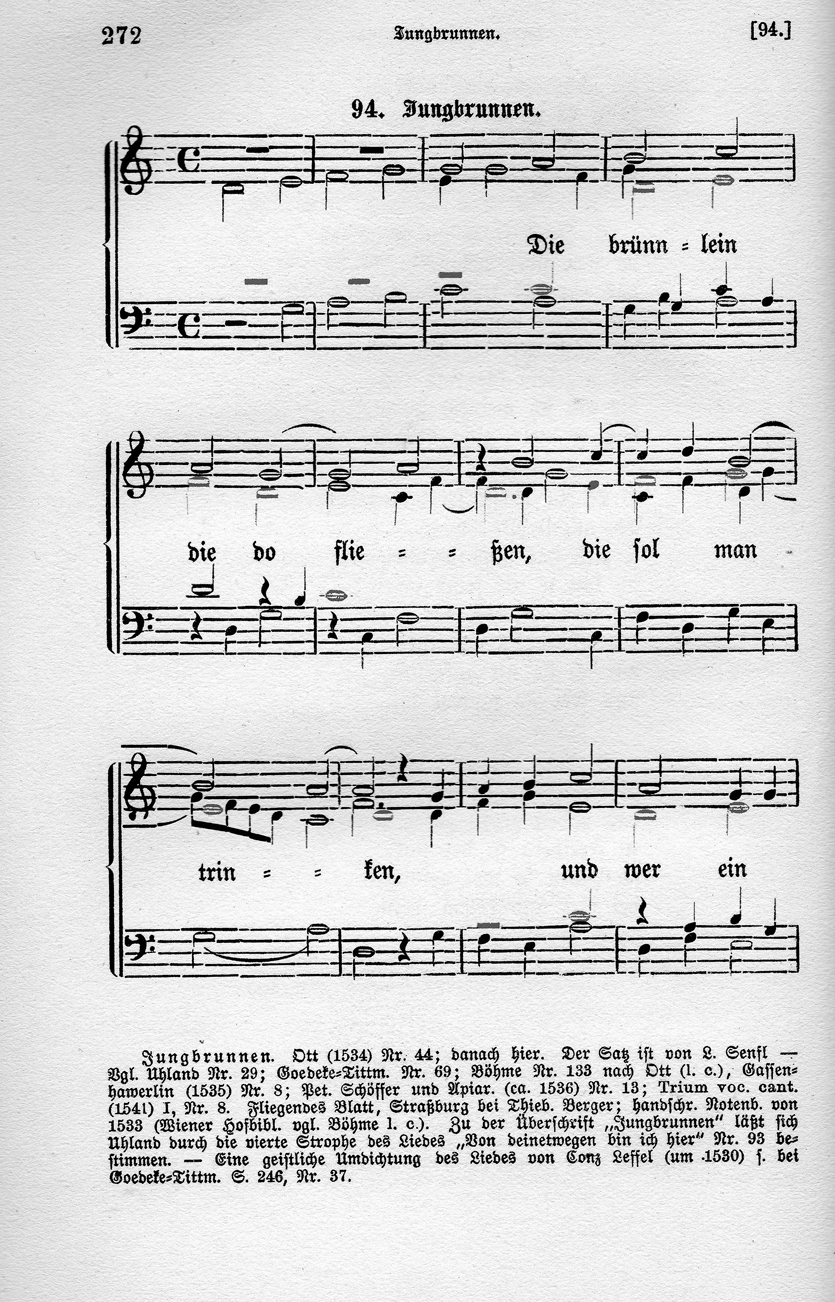
Another transformation with long-term consequences was the change in meaning of the notion of ‘old German folk songs’ (altdeutsche Volkslieder). Up to then this term denoted monophonic melodies separated from the polyphonic setting that preserved them. Liliencron, however, expanded this conception in the belief that the melodies had developed in ideal form in the polyphonic settings of the songs, which reached a pinnacle in the repertory between the song book of Oeglin (1512) and the last volume of the Forster collection (1549).Footnote 34 Singing in a choir was a very important practice in the sixteenth century, so that one could not understand the music, Liliencron argued, without taking the whole composition into account. In contrast to Boehme, he addressed his edition to amateurs as well and therefore decided to use a modern notation that they could easily read (see Figure 3). The decision to set the tenor line in red so that the main melody should be easily recognisable would also have future consequences for the performance practice of this repertory. This point, too, will be discussed below.
Music example from R. F. v. Liliencron, Deutsches Leben im Volkslied um 1530 (Stuttgart, Berlin and Leipzig, 1884). The tenor line (starting with the three floating rests in the first bars) is printed in red
Noteworthy too is the fact that the settings are given without the composer's name, suggesting that they stem from the common people. Only in the editorial comments can one read in small print that no. 94, called ‘Jungbrunnen’, is a composition by Ludwig Senfl. Liliencron's knowledge of concordant contemporary sources and several editions of the nineteenth century that included the same song was astonishingly comprehensive and demonstrates the high level of folk-song research that had developed from the beginning of the century until then.
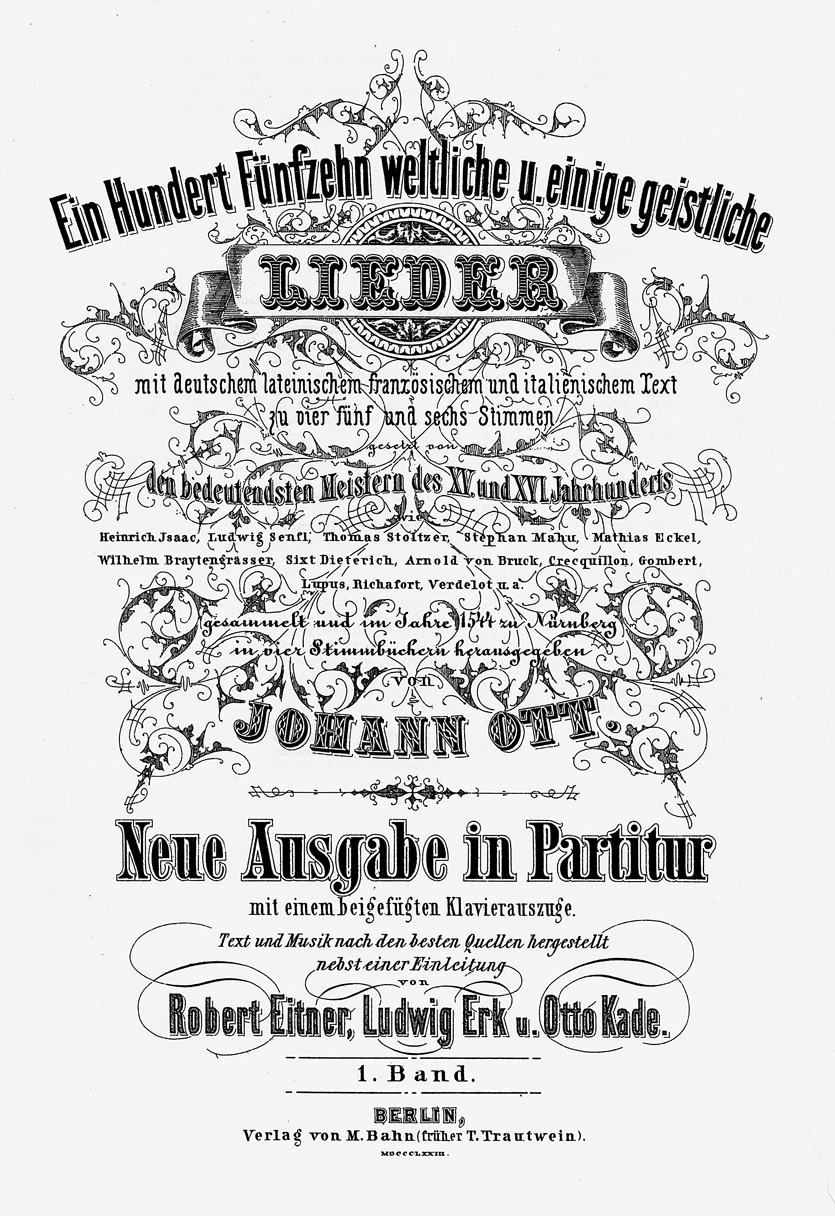
Most importantly, however, the appreciation of folk song increased enormously during the last decades of the nineteenth century, including its musical aspects. Boehme regards these songs as a dear friend or true companion in everyday life, a fellow in joy and misery, from the very early times of the Teutons until the present.Footnote 35 He condemns Forkel's negative judgement of this genre as narrow-minded (borniert),Footnote 36 revealing how far scholarly attitudes had changed over the years. It was the indefatigable bibliographer Robert Eitner in particular who advanced scholarly activity by publishing several editions and essays about the early German lied setting. His initial publication was the edition of the same Ott print that was already known by Forkel as the first four volumes of the series Publikationen älterer und theoretischer Musikwerke, sponsored by the Gesellschaft für Musikforschung, both founded by Eitner (see Figure 4). It appeared immediately before the Altdeutsche Liederbuch, between 1873 and 1876. How far the academic world became aware of current folk-song research and took advantage of its expertise is demonstrated by the fact that Eitner invited Ludwig Erk to be one of the co-editors (the other was Otto Kade, a music historian and good friend of Eitner's).Footnote 37 Typical for these early scholarly editions are the transcriptions in original clefs and a piano arrangement below the vocal score.Footnote 38 Three other editions, of Heinrich Finck, Oeglin's songbook and Forster's second volume of his collection, followed in the same series.Footnote 39 At the same time Eitner published two comprehensive essays on early German lied settings in the journal Monatshefte für Musikgeschichte, which was also edited by him. Both were accompanied by numerous complete music examples.Footnote 40
A typical 19th-century title page: Ein Hundert Fünfzehn weltliche u. einige geistliche Lieder … von Johann Ott. Vol. 1, ed. R. Eitner, L. Erk, and O. Kade (Publikation älterer praktischer und theoretischer Musikwerke, 1; Berlin, 1873)
It is interesting to see that the earlier moral strictures now seem to have vanished: all lyrics are printed without restraint. However, Eitner uses almost the same words as Forkel when it comes to the question of the position of these songs in music history. He states that they are the earliest music documenting that the Germans were not idle in contributing to musical development, but very active compared with other nations. In his opinion the songs equal the achievements of other peoples and are perfect examples of the warm sentiments that differentiated the Germans from and even exalted them over all other nations.Footnote 41 This new idea, that a specific musical character is typically German and by far surpasses foreign music, found a strong echo in the twentieth century.
Despite these various endeavours, at the end of the nineteenth century only learned circles, and hence a small section of the population, knew about the music of German lied settings. In the afterword of the Altdeutsches Liederbuch Boehme tries to explain why people of his time were no longer willing to sing this repertory: they found the texts too long, their content no longer attractive, the genre too small, and the melodies too colourless. Musical taste had changed and improved since Bach, and the great classical masters had created art works of superior dimensions. Early music sounded very strange in the ears of his contemporaries and had become, as he put it, ‘inedible’ (ungenießbar) for the modern artist.Footnote 42 However, it was a patriotic duty to excavate and preserve early German songs for their great significance in German national history. This was the reason why people took notice of the repertory, and not for its aesthetic value. As we will see, this attitude was to change considerably in the following century.
II. Early musicology and the question of performance practice: the evolution of the ‘tenorlied theory’
Schering's Revolution
At the beginning of the twentieth century, when the founding fathers of musicology had already started to explore early music, a new generation of musicologists took over. The main sources were known, the notation was decoded and one of the tasks of musicology was then to allow access to the music by publishing modern editions. In doing so, one of the central problems (which still remains) was the question of how to connect the text with the music. Musical sources of earlier times are much more careless in coordinating words and music than editors would wish, and sometimes there is even no text at all. The young Arnold Schering, later one of the leading scholars, recognised this problem as a basic methodological challenge and presented it in his publication Die Niederländische Orgelmesse im Zeitalter des Josquin (1912). Asserting that the appearance of music without words indicated a completely instrumental character, he asked in one of his chapter titles: Vocal or instrumental?Footnote 43
At this time the basic question of performance practice was already on the table. After the rediscovery of Palestrina in the nineteenth century it had been accepted as an unalterable fact that the music of the Netherlands as well as its climax, the masses of Palestrina, was pure vocal music and nothing else. It was Hugo Riemann who challenged that opinion by introducing a powerful voice-and-instruments hypothesis, modelled on secular Italian Trecento music.Footnote 44 Schering, Riemann's junior colleague at the University of Leipzig, went even further. He dared to examine the all-vocal thesis by employing a style-critical method based on ‘internal artistic insight’ (interne künstlerische Erkenntnis), as he called it, in prescribing four criteria to identify genuine instrumental parts: (1) a melodic ambitus exceeding the natural range of one of the four human voices; (2) absence of breathing pauses; (3) violation of the classical norms of a vocal setting, such as large melodic leaps, many syncopations or cumulative sequences; and finally (4) difficulties in underlaying the text in a ‘natural’ way. His assumption that melodies of this type were actually instrumental corresponds negatively to an astonishingly high degree with the characteristics of Palestrina's vocal music as formulated by E. T. A. Hofmann:
rarely do the single parts exceed the range of a sixth, and there is never an interval that would be hard to sing … It is clear that Palestrina, as it was customary then, composed only for voices without instrumental accompaniment, because the praise of the Highest and Holiest should flow directly from human breasts without the help of any other medium, without any alien admixture.Footnote 45
The consequences of Schering's stylistic studies were quite radical. He claimed that the great Netherlandish mass compositions were normally played on the organ; at most the cantus-firmus part was performed by singers.
These subversive ideas were also encouraged by the study of the song repertory. Parallel to his book on the organ mass, Schering published a small booklet entitled Deutsche Haus- und Kirchenmusik im 16. Jahrhundert. Grundzüge einer neuen geschichtlichen Auffassung, in which the first chapter was dedicated to German solo song of the sixteenth century, accompanied by instruments.Footnote 46 In it he completely reinterpreted the early German song repertory of Senfl's time, which until then had been understood as great a cappella music. He conceived it as a high art of polyphonic song, venerated by later generations, a popular art sung by the common people, which degenerated in a strange way in the following centuries. On the basis of his stylistic studies, based on the same four criteria fleshed out in his book on the Netherlandish organ mass, he put forward the following bold theses:
1. The early and high Renaissance (c. 1300–1550) was an era of highly developed solo song accompanied by instruments.
2. In this era, instruments and instrumental playing not only had an equal position with the human voice and vocal music and had its own literature, but the history of polyphonic music up to the beginning of the sixteenth century has to be understood in general as a specific history of polyphonic instrumental music.
This abrupt change of paradigm – from an all-vocal hypothesis to an all-instrumental hypothesis including the possibility of a scoring for voices and instruments – concerns primarily the German polyphonic song, which in Schering's view was accompanied solo song. Quoting Schering: ‘The solo part … in its calm, beautiful, natural and always welcome vocal line opposes the more vivid, unvocal line of the accompanying secondary parts, which are rich in figures and passages.’Footnote 47 He estimated that about 90 per cent of the repertory should be understood as solo song with two-, three- or four-part instrumental accompaniment and only at most 10 per cent might have been exclusively vocal. The latter group comprises songs that were strictly syllabic, without any polyphonic complications.Footnote 48 The above quotation and other passages in his writings clearly demonstrate that Schering's concept of music history was based on an evolutionary model according to which singing in earlier times was more natural (which meant simple) and less artistic than it developed into in later centuries. The fact that text is underlaid only in the cantus-firmus-carrying parts in many of the early sources seemed to be an independent confirmation of his theory.
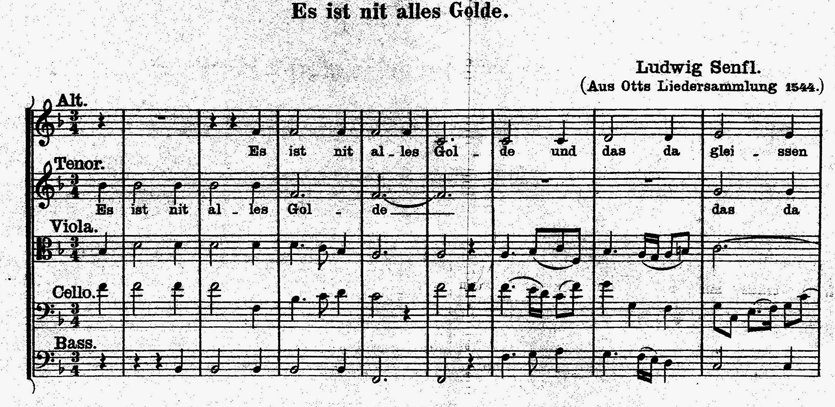
For the instrumental scoring of early German lied settings Schering recommended taking advantage of the different timbres of modern instruments: oboes, clarinets, bassoons, horns for a hunting song, and for a funeral song even trombones.Footnote 49 In the music example given in his appendix, Ludwig Senfl's song Es ist nit alles Golde, the instruments are specified as viola, violoncello and double bass. The two upper parts, presenting the song melody in a free canon, are meant to be vocal and are thus fully texted (see Figure 5).
Music example from A. Schering, Deutsche Haus- und Kirchenmusik im 16. Jahrhundert: Grundzüge einer neuen geschichtlichen Auffassung (Langensalza, 1912)
Schering was well aware how far-reaching the consequences of his new theory would be for music historiography. Not only did instrumental music gain considerably in value, it might have built the foundation for the much later orchestral suites. If his assumptions were correct, solo songs and arias accompanied by obbligato instruments (including the church music of Johann Sebastian Bach) would have started not in the seventeenth century but a hundred years earlier.Footnote 50
There is, however, another consideration hovering in the background of Schering's account of the early German lied setting as a primarily instrumental genre with a single vocal line, and that was his parallel treatment of early Protestant polyphonic music, which he discussed with the same arguments in the second chapter of the booklet. Although he made no definite pronouncement on this, his claims fit tacitly in the nationalistic spirit of the time. When the pure vocal music of the master Palestrina was celebrated as the climax of art music in the sixteenth century, then the early song repertory served as a complementary genre, played mainly on instruments. Instrumental music was esteemed as typically German, in contrast to the vocal music of the Italians, and it was taken to be absolute music that expressed the deep intellectual spirit of the German people.Footnote 51 There was also a gender connotation, as Schering frankly acknowledged when he stressed the importance of distinguishing these two opposed types of music. In his eyes vocal music related to feminine and instrumental music to masculine qualities.Footnote 52 However, this belief too was basically a nationalistic statement, as it is clear that Germans were the strong men while the Italians were identified with weak females.
The Critics of the New Theory
Immediately after the publication of Schering's treatise on the Netherlandish organ mass, the members of the International Music Society (IMS) met in public to discuss the explosive question of the role of instruments in early music.Footnote 53 On this occasion Johannes Wolf, university professor at Berlin and already a renowned specialist of music notation, was Schering's main antagonist. He put the screws on the young Leipzig lecturer in presenting strong counter-evidence: documents on early singing schools, contemporary illustrations depicting singing choirs and musical sources with carefully set words in all voices. Wolf also challenged Schering's view on the cantus firmus with the contrary assumption that the extremely long notes of the cantus-firmus-carrying part were more likely to have been played by instruments. But Schering did not give in. He interpreted the words connected with the supposed instrumental parts as an orientation device for the instrumentalists and defended his ideas based on general questions of method: he applied the criterion of pure musical feeling (‘Kriterium des rein musikalischen Empfindens’) and wanted to be refuted by arguments based on the same method. To meet this demand, one had to question the classical relationship between words and music and furthermore to distinguish between natural and artificial singing. All these points were also raised by Hugo Leichtentritt in a reply published in the journal of the Society.Footnote 54 Yet the time was not ripe for such fundamental questions and Schering remained undefeated.
Leichtentritt's review and the discussion at Berlin mostly concentrated on Trecento music and the music of the Franco-Flemish school. Accordingly, the question of performance practice of the sixteenth-century repertory remained a side issue. In passing, Wolf admitted as a unique concession to Schering that the early German lied settings by composers like Isaac or Senfl might have been played with instrumental accompaniment.Footnote 55 But even this acknowledgement found its critics, and one of the stubbornest among them was the Munich musicologist Theodor Kroyer. He had written a Habilitationsschrift on Senfl's motets and was thus much more focused on the later period. In the years 1918–20 he made his case twice emphatically – once in the Festschrift honouring Hermann Kretzschmar, Schering's Doktorvater, which gives his attack a perfidious touch, and the second time in the first volume of the Archiv für Musikwissenschaft, the journal of the German Musicological Society.Footnote 56 There Kroyer presented several different arguments for the tiresome a cappella question. He mentioned amongst others the extant lists of members of court chapels, which are completely dominated by singers; he evaluated the missing words as sloppiness and produced examples of later additions of the words in musical sources. Finally, he claimed that stylistic criticism is not the right ‘divining rod’. Its outcome is often deceptive and opens the door for arbitrariness.Footnote 57 On the question of correct performance practice Kroyer envisaged a kind of lawsuit where learned advocates would come to their wits' end and his arguments would become the prime factor in deciding the case. But Schering again stood up to this very strong and public criticism of his methods without wavering.
Moser's Support, Schering's Victory and Besseler's Confirmation
In the late 1920s, when the discussion about instrumentation was still going on, Hans Joachim Moser appeared on the stage. He was young, ambitious, with a nationalistic spirit, and had already written a history of German music that was meant to promulgate the native musical art among broader social classes. In this first book he did not follow Schering's harshly criticised approach and characterised the songs of Heinrich Finck (‘the first great German master’) as pure vocal quartets, corresponding to the Palestrina tradition.Footnote 58 A few years later, in a contribution to the Jahrbuch Peters of 1925, Moser changed his position and swung around to Schering's theory. The standard instrumentation for early German songs was now, in his view, a vocal tenor accompanied by instruments.Footnote 59 In his biography of Paul Hofhaimer of 1929, he called this ‘new’ genre ‘Solotenorlieder’ for the first time.Footnote 60
As a painstaking expert on sources, Moser soon recognised that around 1536 a considerable change took place in the presentation of the songs. Almost instantaneously in German music prints not only the tenor but also the other voices were underlaid with words carefully placed beneath the notes. In view of the overwhelming number of documents, Schering's earlier hypothesis that words would have been included so that the instrumentalists were able to discern the melody was now hard to defend. Therefore Moser modified Schering's theory, tracing a general development from the solo tenor song with instrumental accompaniment to the a cappella song for choir: in his words an undeniable and important part of the great musical change from the Gothic age to the Renaissance at the time of the Reformation.Footnote 61 The fact that Hofhaimer's songs were also fully texted in the Forster prints was explained through a later ‘a-cappellisation’ so that the older repertory would fit into the new theory of performance practice. Moreover the famous passage in Forster's preface, where he admitted that he not only corrected but also added words to the music when they were missing in his sources, seemed to corroborate this argument.Footnote 62
But let us go back to Schering, who did not fully assimilate Moser's enhancement of his theory. Two important publications that were disseminated in wider musical circles strengthened the idea that the ‘Tenorlied’ was based on an instrumental setting. The first one was Schering's own book Aufführungspraxis alter Musik of 1931, which received a great deal of attention and was reprinted as late as 1975. There the author questions the a cappella ideal after Palestrina in general, using more or less the same arguments he had already set forth in his book on the organ mass. The keyword in his argumentation is ‘naturalness’: it is natural when untexted parts are played by instruments and it is also natural that human voices are treated in a simpler and different musical style than instruments are.Footnote 63 As a logical consequence, Schering distinguishes within the early German song settings the accompanied ‘Tenorlied’ and the accompanied ‘Diskantlied’ (a kind of Tenorlied with the main melody transferred to the discant) from the ‘instrumentische Gesänge’ (instrumental songs) and makes an additional sociological argument for the change in performance practice: the middle and lower classes of the bourgeoisie, for whom the songs were written, could never sing the ambitious parts of the composition, but they were able to play them on instruments.Footnote 64
To support his theory that the song repertory is an intrinsically instrumental genre Schering refers, like Moser, to the Forster collection, however not to the first but to the second volume. At first glance this seems to be quite odd, as even this book contains mostly songs that are definitely meant to be sung and are not suited to instruments, as the editor states very clearly in the foreword:
But as not all lieder (as also other types of song) are suitable for instruments, I have separated those German songs at hand that are most suitable for singing and most cheerful for entertainment. Because they are – as already mentioned – best for singing, the words should be added most diligently. That is why they are somewhat more diligently underlaid than in the earlier volume.Footnote 65
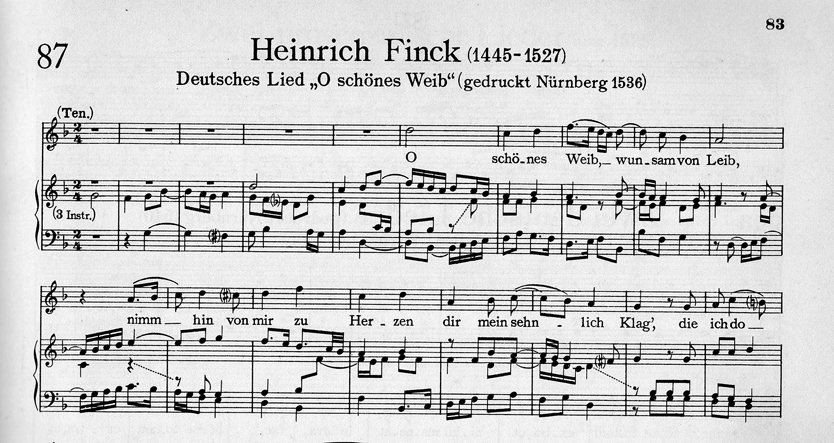
However, Schering's interpretation of this passage is quite the opposite of what we would understand as a ‘natural’ interpretation by twisting the meaning of one expression: when Forster invites the singers to add the words to the music and uses the word ‘dareinsingen’ (=sing into it, adding), Schering concludes from this instruction that the instruments play along and the vocal parts are added to them. The songs that are not suitable for instruments, such as the simple settings, would not have any effect played alone with instruments, so that singing parts have to be added – an opinion he thought he shared with Forster.Footnote 66 In addition to that book, Schering also published a collection of 350 prototypical compositions named Geschichte der Musik in Beispielen, a kind of extension and update of a similar collection by Riemann. There early German songs are edited with a tenor given on a separate stave and carrying the full text; the other ‘voices’ are put together in a piano score, without any words, merely denoted as ‘instruments’ (see Figure 6).Footnote 67
Music example from Geschichte der Musik in Beispielen: Dreihundertfünfzig Tonsätze aus neun Jahrhunderten, ed. A. Schering (Leipzig, 1931)
The second publication that became central in promoting the ‘Tenorlied theory’ was Heinrich Besseler's volume on music of the Middle Ages and the Renaissance in the renowned series Handbuch der Musikwissenschaft. Besseler, then a young and promising professor at the University of Heidelberg, placed the ‘Tenorlied’ as a type of cantus-firmus motet at the centre of the German genres, as mentioned earlier. He viewed the early German lied setting around 1500 as the culmination of the history of song since the Monk of Salzburg and Oswald von Wolkenstein, while the conservative appearance of the genre in the sixteenth century is ascribed to a continuing German tendency towards a religiously rooted brooding seriousness.Footnote 68 Besseler distinguishes two notions of early German songs: ‘Tenorlied’ as a compositional term, and ‘Gesellschaftslied’ as a sociological term, both relating to the same genre.Footnote 69 Noteworthy too is Besseler's rejection of the nineteenth-century Volkslied notion. He understood the leading melody line of these songs as the creation of an individual artist, composed from the start for a polyphonic setting, even when the melodies were initially sung or played without accompaniment.Footnote 70 He said nothing about performance practice but referred to another volume in the same series, Robert Haas's book on performance practice. There the author states in very clear words: ‘Today … the polyphonic German song of the fifteenth and the early sixteenth century is appraised as an instrumentally accompanied “Solotenorlied”.’Footnote 71 His music example is set out in exactly the same manner as the ‘Tenorlied’ in Schering's edition, with a ‘Tenor Solo’ on the top line, and the other parts in a piano reduction, labelled ‘Instrumente’.Footnote 72 Nothing could be more suggestive than such an instructive layout, so that this style of presentation became the model for performance practice for the next decades.
The simultaneous appearance of all these publications and Theodor Kroyer's polemical review of Schering's book on performance practice might have seemed like a breaking wave. As we have seen, Kroyer, from the very beginning of the dispute, was absolutely convinced that the a cappella ideal was still valid for early music in general; he listed a great number of counter-arguments to Schering's hypothesis, combining apposite documents with subjective opinions. Reverting to his forensic model, he adopts an extremely emotional tone, culminating in the outcry: “No and again no!”Footnote 73 But Kroyer was fighting a battle already lost – not only because Schering and particularly Moser were two hard-working and effective scholars who had published several music histories, handbooks and dictionaries that offered their hypothesis to a broad music public as common sense. Moreover, the fact that Besseler, with his influential handbook volume, had tacitly taken over the ‘Tenorlied theory’ counted heavily. However, most important for the success of the new strategy of instrumentation were the practical musicians who started to explore the early German lied setting for its own sake.
III. Musical practice in the hands of amateurs
The beginning of the twentieth century was characterised by an unparalleled increase in music production not only by professional musicians but also by amateurs who spent their leisure time in singing in choirs, playing instruments in small ensembles or in Hausmusik in general. In her important book Most German of the Arts: Musicology and Society from the Weimar Republic to the End of Hitler's Reich Pamela Potter even calls this period the ‘revolution’ of the amateurs.Footnote 74 These groups of amateur musicians contributed considerably to the revitalisation of the early German lied setting, although each of them had its own approach and different aims.
Jugendmusikbewegung
One of the most influential lay organisations of this time was the Wandervögel and its successor organisation, the Jugendmusikbewegung (youth music movement). They were part of a protest campaign supported by bourgeois students who revolted against the elite culture of their parents and against the trivialisation and mechanisation of society, in search of a liberal and self-determined life. Their central ambition was to make music together in intimate surroundings without any subjective emotional expression, contrasting with the highly virtuoso playing of professional musicians at that time. Furthermore, they believed that the wide gap between art and daily life should be abolished and all people should have the chance to participate in the musical scene.
In pursuit of an alternative, hitherto ‘untouched’, music that could be produced by anyone without higher music education, the leading figures of the Jugendmusikbewegung recovered early music, in particular the German songs of the fifteenth and sixteenth centuries. Singing the polyphonic settings was meant to imbue them with energy and lead to an ideal life style, although the melodies of the songs were far from easy. They were described as rough, as if carved in wood (harte, holzgeschnittene Melodien).Footnote 75 Polyphony was understood as a symbol of community among the young people, who regarded music-making as a specific service by their singing community that would promote the highest ideal (whatever this might be). Thus, the early song repertory became idealised: in these old songs everything was ‘real, simple and true’ (echt, schlicht und wahr). That was the reason why it elevated the spirits of the young. Singing was a spiritual issue, even a religious one.Footnote 76
In a songbook of 1922 the editor Walther Hensel – one of the two main proponents of the movement – gives an answer to the rhetorical question, why it would be worth going back to these early times:
Just simply listen, how those old songs shine in beauty and force! Exactly these are our songs. Hear them like a greeting, like an exhortation for self-determination! Receive them, sing them, sing them together with like-minded people or alone in your workplace. Then you prepare in your soul something like a ‘day of the Lord’ [Herrgottstag]. And then you will be free!Footnote 77
Parallel to this very subjective attitude, and connected with it, a general pedagogical effort appeared on the scene: a nationalistic approach to the early German songs, combined with social criticism and a political vision. The same Walther Hensel published a booklet with the title Im Zeichen des Volksliedes in which he made very clear what other function was intended besides the revival of this repertory:
Our people are sick. Their most confident friend and comforter, song, is mute and has disappeared…. For a long time the German people have no longer been, as they used to be, full of warm-hearted sentiment and inwardness, loyalty and uprightness, courage and confidence in God. The obsessive desire for wealth and power has corrupted them…. There was a time when the whole German people, literally from the prince to the beggar, took part in folk song. This was the case in the fifteenth and sixteenth centuries. And such a time must come back.Footnote 78
While the cantus-firmus type settings of later vocal compositions, with their leading upper part and the secondary accompaning lower parts, were politically condemned as a ‘Bedientenstruktur’ (servant structure), the earlier repertory, with its equal parts, conformed much better to the social ideal that everybody should belong to the community in the same way.Footnote 79
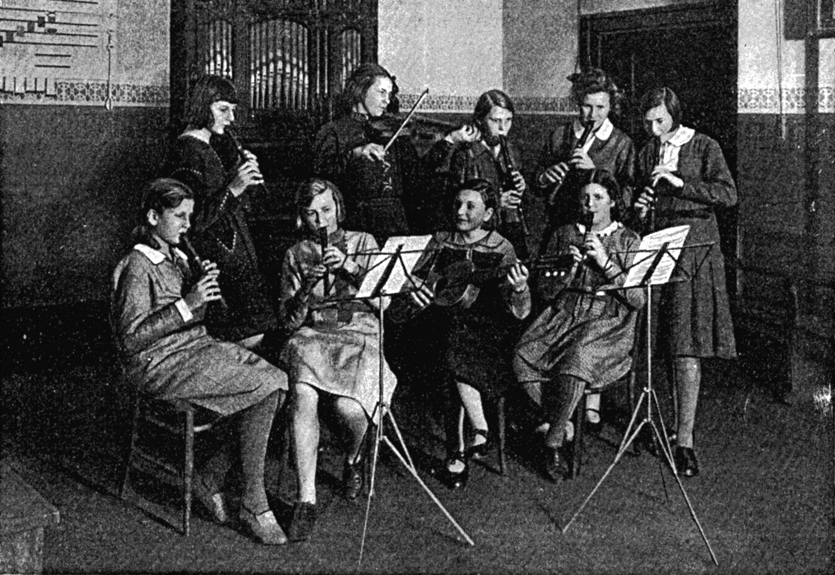
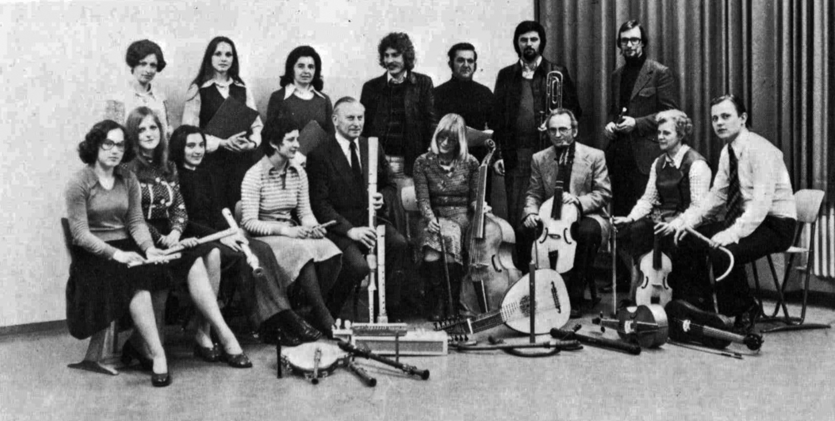
Compared with the public concert repertory of the time, the simple and short settings were easy to perform, either with untrained voices a cappella, with melody instruments, or with a combination of both. The Wandervogel movement had already introduced a plucked instrument that was a combination of the historical lute and guitar, called Zupfgeige. Other instruments like the recorder, fiddles and gambas were reinvented; with their relatively low technical requirements they fulfilled the ideals of the Jugendmusikbewegung. Moreover, mass production made them available at a low price. In the words of Peter Harlan, the main instrument maker of the movement, these instruments were ‘simple, uncomplicated, in tune with nature’ and symbolised the German ‘Volksseele’ in the wonderland of an art that was born within the folk community (see Figure 7).Footnote 80
Recorder ensemble of girls, reproduced in Die Musik, 24 (1932), where it is called ‘Blockflöten-Orchester’
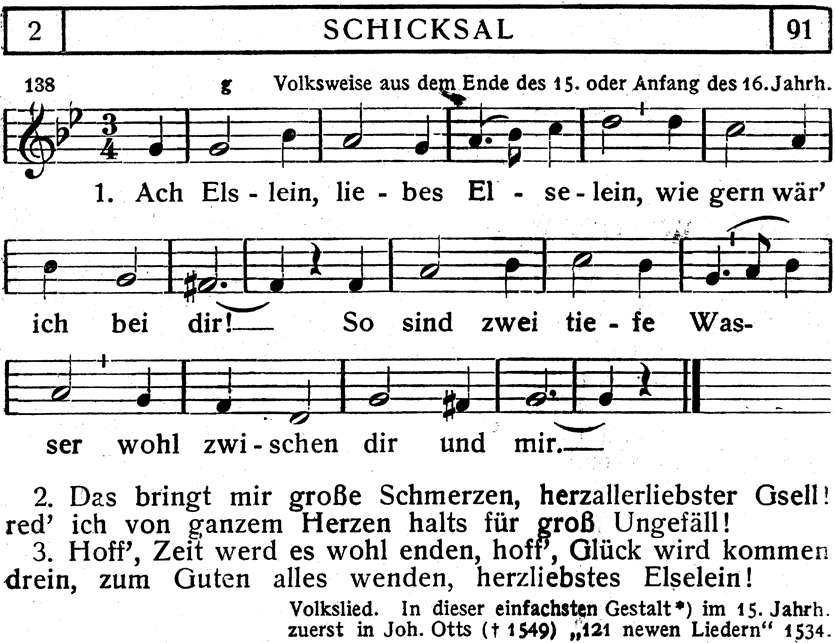
Soon the Jugendbewegung was no longer restricted to small communities that met for Singstunden (singing periods) in the countryside, but became a grassroots movement. They organised open singing sessions for all people interested in their music and broadcast these events on the radio, a mass medium that would be used for political propaganda in the coming years. The songbooks published in the 1920s by Walther Hensel and Fritz Jöde, the second leading figure of the movement, display titles like Altdeutsches Liederbuch, with polyphonic settings for two voices, or Strampedemi (a nonsense word from one of the early songs), a songbook with harmony letters for guitar or lute, a heritage from the earlier Wandervogel movement. An Austrian version of such a lutesong book, Anton Böhm's Fahrend Volk (Wayfarers), reacted to this trend, and considerably enlarged the number of early German songs in its second edition of 1927. Alongside these adoptions of the repertory were also several songbooks that presented the original full polyphonic settings for choir, e.g., the collection Alte Madrigale und andere A capella-Gesänge für gemischten Chor aus dem 16. und dem Anfang des 17. Jahrhunderts from the early 1920s. For these songbooks the editors not only took over titles from the Zupfgeigenhansl, the central music book of the Wandervögel that already contained several homophonic melodies of early German lied settings, mostly of the sixteenth century (see Figure 8);Footnote 81 they also included songs from the Lochamer Liederbuch, from Forster's song collections, the Finck print from 1536, the Souterliedekens (1540), the Berg & Neuber collection of 1550, the Reutterliedlein (1535), Gerle's tablature book (1546) and Rhau's Bicinia edition (1545), not always mentioning the authors Finck, Greiter, Hofhaimer, Isaac, Senfl, Lemlin or Johann Walther. The forewords or the subtitles of these collections often speak of ‘Volkslieder’, to tie in with the ideas of the folk music research that were emerging in the nineteenth century.
Music example from Wandervogel: Liederborn für die deutsche Jugend, ed. W. Werdemeister (Halle a/Saale, c. 1910)
The Jugendmusikbewegung could not have published its early German lied settings without the work of men like Franz Magnus Boehme, Ludwig Erk and Rochus Freiherr von Liliencron, mentioned earlier. The Altdeutsches Liederbuch from 1877 and the three-volume Deutscher Liederhort (1893–4) constituted the central source for their songbooks. It was specifically Rochus von Liliencron's idea that this specific genre had been a common repertory for the whole nation, and in this sense a real Volkslied, that attracted the leaders of the movement as fitting perfectly into their conception. Hensel too believed that the true German folk song had already started to die in the sixteenth century and spoke nostalgically about the early ‘noble folk song’ (Edelvolkslied), meant to awaken the slumbering people, with the potential to become a fountain of youth (Jungbrünnlein) for the next generation. He was sure that the old songs would lead to the songs of the future and thus reanimate the spirit of the German Volk and enhance its intellectual life.Footnote 82
The Male Choir Movement
A specific national approach was also characteristic of the male choir movement (Männerchorbewegung) at the turn of the century, a widespread movement united in the Deutsche Sängerbund. Although condemned by the proponents of the Jugendmusikbewegung as a bourgeois institution for its singing of fake folk songs by Silcher and others, fostering trivial songs of fraternity and primitive drinking songs, the male choir movement shared a common interest in the early repertory as true German music. This interest was promoted by Emperor Wilhelm II himself, who claimed that German song and German singing had always had a beneficial effect on the improvement of the ‘Volksseele’ and had thereby strengthened the nation.Footnote 83 To upgrade the repertory of the choirs he commissioned a Volksliederbuch für Männerchor, which appeared in 1906 in two volumes and was popularly called the ‘Kaiserliederbuch’. The editorial board, led by Liliencron, had been ordered to account for the ‘admirable heritage from the fifteenth and sixteenth centuries’, which – so the preface informs us – had until then been fostered almost exclusively in scholarly circles.Footnote 84 In order to satisfy the emperor's wish, several examples from the early song repertory were included, among them compositions from the Lochamer Liederbuch (All meine Gedanken), Isaac's Innsbruck, ich muss dich lassen and several other songs from appropriate collections. These songs were called ‘Volkslied’ or ‘Volksweise’ and were published without their composers' names.
The Hausmusik Movement
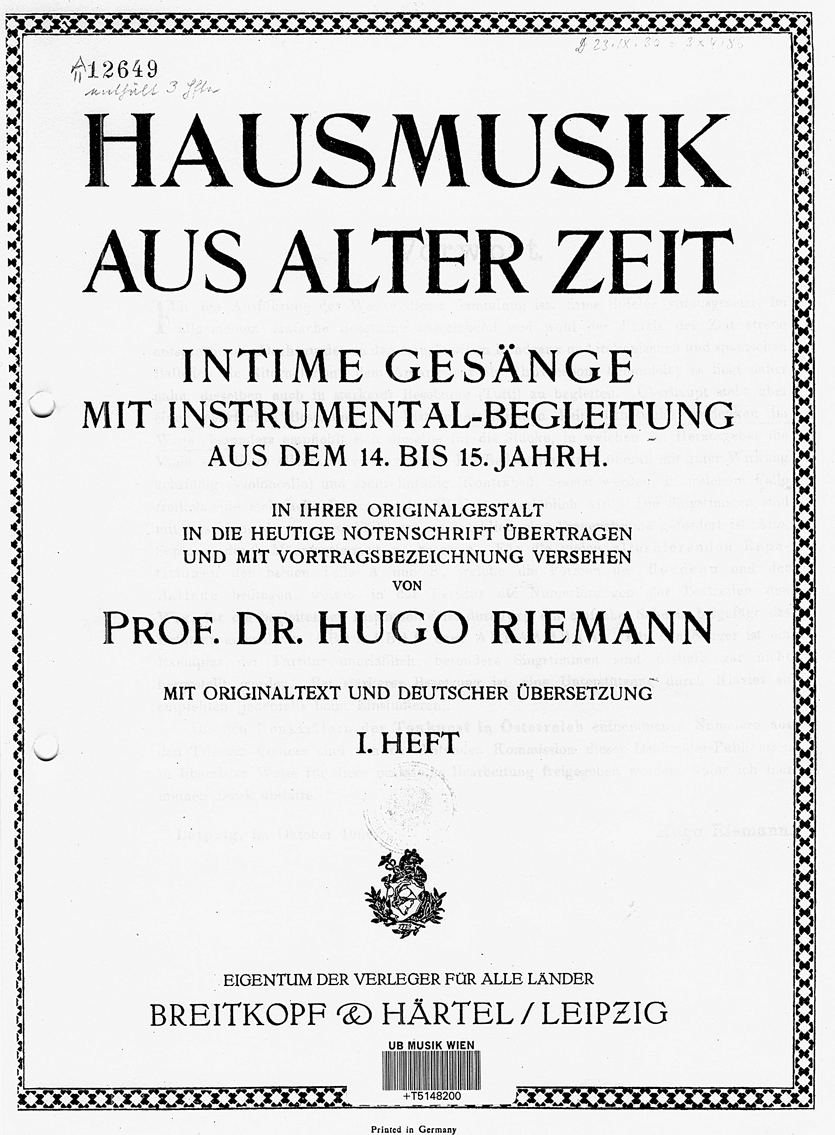
A further strand of musical culture in German-speaking countries that took on early German songs was music-making in bourgeois private homes, called ‘Hausmusik’ (house music). Formerly centred on piano-based classical chamber music or salon music, at the beginning of the twentieth century it expanded to embrace early music as a facet of general education in music history. The repertory was edited by well-known musicologists such as Hugo Leichtentritt (Meisterwerke Deutscher Tonkunst. Alte teutsche Liedlein, 1905; Deutsche Hausmusik aus vier Jahrhunderten, 1907), Hugo Riemann (Hausmusik aus alter Zeit, ‘Intimate Songs with instrumental accompaniment’, 1906; see Figure 9) and Johannes Wolf (Chor- und Hausmusik aus alter Zeit, 1926–7). Most of these scholars were members of the same higher social class. The music examples were based on the scholarly editions published in the Denkmäler editions of Germany, Bavaria and Austria, as well as the series Publikationen älterer praktischer und theoretischer Musikwerke (PÄMw). They reproduced the full settings of the songs, although in modern music notation and enriched with nineteenth-century designations of dynamics and tempo.
Title page of Hausmusik aus alter Zeit, ed. Hugo Riemann (Leipzig, 1906)
Since the 1920s the Hausmusik movement had been strongly influenced by the Jugendmusikbewegung in revealing an anti-bourgeois attitude. Claiming moral concerns about misguided cultural policies, the movement considered the recapture of the early German lied setting as a starting point to win back the ground for a ‘healthy’ Hausmusik that would serve the German nation well.Footnote 85
The Collegium musicum
Nearly at the same time, music departments in German universities started to establish their own singing groups, called ‘collegium musicum’. While Riemann at Leipzig tied it in with the local tradition of Bach's time to revive thoroughbass music, Wilibald Gurlitt at the University of Freiburg mainly concentrated on earlier music, an orientation adopted in many other musicology departments in Germany.Footnote 86 In these ensembles students and teachers performed together the repertory that was also part of academic education, often without any previous listening experience, owing to the lack of recordings or live concerts. Music series were started to make the music available in modern notation; others tried to approach the music of earlier times from the original sources. Hans Joachim Moser, for example, addressed his facsimile edition of the Gassenhauer- und Reutterliedlein from 1927 specifically to musicology seminars to be used as exercise pieces.Footnote 87
Those collegiate music ensembles also gave performances outside the university, thus enriching the local cultural life. Some groups even travelled throughout Germany. A programme note for a concert of a student group from Göttingen, which gave a concert in a school at Danzig, conveys an impression of how these events were performed and how they were received by the audience:
This is not really a concert but much more a kind of ‘Hausmusik’ in front of a larger circle. Danzig thus had the opportunity to get an impression of the lively musical renaissance in a way that gains more and more ground in the Jugendbewegung. The Göttingen group make music for music's sake, as do all similar groups, not to achieve applause. They work without external expenses, without famous leading names, without any individual names at all.Footnote 88
By mentioning the catchwords ‘Hausmusik’ and ‘Jugend[musik]bewegung’ in a concert of a collegium musicum, this review reveals that the various musical movements in the first decades of twentieth-century Germany were not isolated from each other but closely connected and overlapping. The Jugendmusikbewegung was also engaged in Hausmusik, many musicologists were active in the Jugendmusikbewegung, and the early folk song movement influenced all these different groups.
The changing titles of a journal published by Bärenreiter Verlag from 1924 onwards illustrates these interactions perfectly. Initiated by the Finkensteiner Bund, one of the main branches of the Jugendmusikbewegung, it started with the name Die Singgemeinde. From 1932 a supplement with music was offered, entitled Collegium musicum. Two volumes later it again changed its name and character and was now called Zeitschrift für Hausmusik.
To close this section, it is important to restate that in the first three decades of the twentieth century the revival of the early German lied setting in musical practice was mainly promoted by several different overlapping musical amateur organisations that had a remarkably broad effect on German society. In these circles, ‘Altdeutsche Lieder’, as they were called, were mainly understood as German folk songs, harking back to the nineteenth century, when these songs were rediscovered. The performance practice was liberal, depending on the needs, and the available options, of the specific occasion and ranged from a cappella interpretations with a full choir, mixed vocal–instrumental interpretations with pseudo-historical instruments, to pure instrumental renditions as well as arrangements for several different combinations and varying numbers of parts. German musicologists were involved in these movements, often as amateurs in musical performances or as suppliers of proper music editions. They were not, however, the leading figures in this mass movement.
IV. The politicisation of the repertory in the third reich
When Hitler assumed power in Germany in 1933, the glorification of the German lied was part of the political propaganda claiming the hegemony of German music over the art of all other nations. As contemporary cultural life was considered to be poisoned by foreign forces – and foreign meant not only Jewish but also French, Italian and American – the officials looked to the past to rediscover their cultural roots. The Federal Minister for Popular Enlightenment and Propaganda, Joseph Goebbels, gave an inaugural address, accompanied by a male choir, when he established the Reichskulturkammer in September 1933. There he declared:
The new national art of Germany will only then gain respect in the world and bear witness beyond our frontiers to the vivid ‘Kunstwille’ of the young Germany when it is rooted strongly and inseparably in the mother-soil of its own Volkstum. The world should learn anew what is German and true. The German art that returns to the people will receive the highest remuneration through the people's returning to it once more.Footnote 89
Although Goebbels did not name the kind of art he had in mind, in the case of music the signals provided by him were quite easy to interpret. It was folk music that formed the basis of all German music culture and made national identity meaningful; it distinguished the ‘self’ from the ‘other’ and recreated a mythological world of the past.Footnote 90 In his article ‘Die Liederstunde des Volkes’ Wilhelm Ehmann stated that the song established the basic form of German music with a specific individual German stamp.Footnote 91 In the focus of interest was the German folk song and the early German song repertory, because singing was understood to be a basic utterance of the German people, and, through communal performance, it realised the National Socialist community in a perfect way.
The conception of what counts as a folk song, however, was quite broad. An exhibition in the Preußische Staatsbibliothek zu Berlin with the title Das deutsche Volkslied. Eine Ausstellung aus 5 Jahrzehnten presented song collections from the fifteenth and sixteenth centuries, as well as the aria Ein Mädchen oder Weibchen from Mozart's Zauberflöte and the choir Wir winden dir den Jungfernkranz from Weber's Freischütz. Bach's Peasant and Coffee cantatas were also mentioned, as they were considered to be based on folk songs. The most recent objects in the exhibition were the new songs of the Third Reich, which were composed for the three central organisations established to unite the young German people for political indoctrination: the Hitler Youth and its subdivisions, the Jungvolk and the Bund deutscher Mädel (League of German Girls).Footnote 92 At the same time another kind of ‘Volkslied’ was pushed and financially boosted in an extraordinary way by establishing a new pressure group of ethnological folk research within the Staatliche Musikinstitut at Berlin.Footnote 93
The ‘Tenorlied’ as the First Genuine German Genre
For the Nazis' conception of history, with its final goal of the declared Thousand-Year Reich, the early German song repertory became an important anchor. Paraphrasing again Rochus von Lilienchron, those 500-year-old songs were the true Volkslied handed down to the present from an idealised golden age. The Germanness of this repertory was easy to capture: the German words left no room for questioning what in fact is typically German in this genre. Thus it is no wonder that Richard Eichenauer, in his satanic book Musik und Rasse, declared the early polyphonic German songs to be one of the most German art genres that ever existed. In his eyes they documented the struggle of the Nordic-Germanic race between 1400 and 1600 and symbolise its victory in this cultural dispute.Footnote 94
Another factor that helped to single out the early German lied settings in the music patronage of the Third Reich is a pedagogical-moral claim, which reminds one of the ideals of the Jugendmusikbewegung. They both wished to close the gap between the human being and art music and tried to achieve national solidarity. However, while the spearheads of the Jugendmusik movement aimed at a true and free individual human being, the Nazi regime turned this ideology into the opposite, in accordance with their political aims. In revitalising this repertory they wanted to forge a new and true relationship between art and nation (no longer the individual), while strengthening the sense of duty towards the Fatherland and obedience to the Führer, thereby abandoning all individual impulses. In bringing all cultural enterprises into line, the new government immediately dissolved the local organisations of the Jugendmusik movement. Their former leaders were either appointed to positions in newly founded public music schools or officially employed to organise the musical life of the Hitler Youth, the only legal youth organisation in the Third Reich. Nazi organisations devoted to culture, such as Kunst durch Freude, the NS-Kulturgemeinde or Deutsches Volksbildungswerk, finally helped to parade the political impact of the early German song.
The songbooks of the time served as an important tool for disseminating the repertory among the German people. An early national socialist Volksliederbuch from 1932 praises its repertory as a ‘flourishing bunch of fresh and unfading songs’ and invites the reader, especially SS and SA comrades, to sing music that had survived hundreds of years without wilting, without becoming outdated: ‘Sing those songs that are not sophisticated, not arduously contrived, but simply experienced. May you succeed every now and then in experiencing them anew.’Footnote 95 Most of the song collections of the following years do indeed contain a certain percentage of items stemming from early times to cultivate the musical heritage of the German nation and to document a vital singing tradition. To accommodate the specific requirements of music ensembles, the early songs of the Nazi songbooks are frequently arranged. This is the case, for example, in the Liederbuch des Bundes Deutscher Mädel (Wir Mädel singen), which offers two-part songs based on tunes from the Lochamer Liederbuch, from Forster's collections and from Rhau's Bicinia of 1545. Fritz Jöde was responsible for the arrangements of these songs, which had a specific function within the education of young people, as the preface reveals: ‘When an old song is heard at a folkloric evening it lets us understand and relive our people's struggle and bad times, greatness and victory of our people anew.’Footnote 96 In the Chorliederbuch für die Wehrmacht (1940) the four-part settings on early tunes were adapted for male choir by contemporary composers such as Armin Knab, Ernst-Lothar von Knorr and Kurt Thomas.Footnote 97 Many songbooks of the time, such as the one of the Hitler Youth (Unser Liederbuch, 1942) or the songbook of the 7th Corps from 1939, reprinted not only the melody but all stanzas of the songs from the early printed collections.
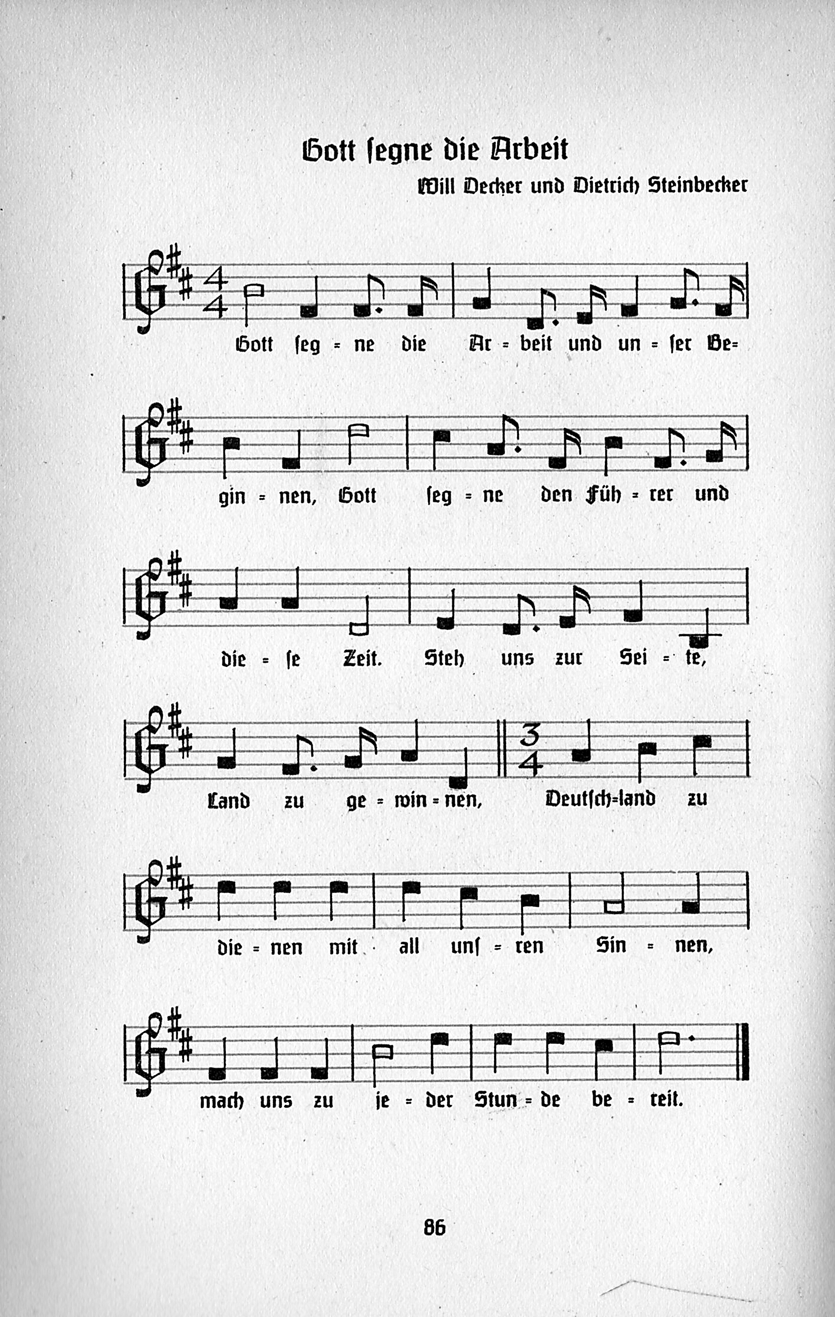
Parallel to the veneration of examples from the cradle of German song, the proponents of the National Socialist party advocated a newly composed type of tune that claimed to stand in the tradition of the early German song, calling it ‘völkisches Lied’. The layout of a songbook ‘for the new folk from the first quinquennium of the Third Reich’ (so the subtitle), with its red stave lines and rectangular-shaped note heads imitating the original mensural notation of the early repertory, demonstrates this intention perfectly.Footnote 98 For singers who were not acquainted with early music notation it might have evoked an image of Germanic music runes. The words of these new-old songs were strongly politicised, praising a newly rising, never collapsing nation and an everlasting Germany. They repeatedly appeal to defending the home country, to ruthless struggle, while praising the work of the farming community and worshipping German blood and soil. It is striking that the lyrics of the songs quite often speak about faith and use traditional religious terms: that Germany, a sacred nation, might be blessed through all times with its holy lakes and its holy woods (Deutschland, heiliges Wort). They even address God in some songs, asking for His mercy, as for example in the leading song of the Reich Labour service, Gott segne die Arbeit (God bless the labour), which was premiered at the Nuremberg Rally in 1935 (see Figure 10).
Music example from the National Socialist songbook Das völkische Lied, ed. E. Lauer (Munich: Deutscher Volksverlag, 19393). The stave lines are red in the original
Some Nazi songbooks do actually incorporate early hymns, although their religious background might be incompatible with the political pretensions of the party line. It is the same Richard Eichenauer, the ‘specialist’ on race topics mentioned earlier, who reveals in a review of such a songbook the twisted argumentation for the absorption of this repertory. He claims that
the German hymns from the time of the great religious wars are from a musical point of view not specifically Christian but represent something common and eternally ‘German’: a powerful delight in fighting, a basic character of Nordic mankind. That is why those eternal chorale tunes are not the private possession of the Christian churches, as they verifiably demonstrate the same musical attitude as the ‘altdeutsche’ folk song in its inexhaustible opulence, from which they derived.Footnote 99
A paradigm case of an actual transfer from an early Protestant song to an updated Nazi song is the famous Wach auf, wach auf, du deutsches Land by Johann Walter, a close collaborator of Martin Luther. He published this song in 1561 in a broadsheet with the caption: ‘A new Christian song admonishing Germany to repent’. This song was written out of concern that Luther's campaign might lose its strength after his ministry. It is something like a moral, time-critical exclamation:
While the first stanza addresses only the question what God has made us for, what God has sent us in entrusting us with his highest pledge (without mentioning what this pledge should be, of course), it is the following twenty-five stanzas that reveal the full meaning of the words. There Walter praises Luther as a prophet and complains about the moral decadence of the time when extortion, avarice and fraud as well as adultery, sodomy and drunkenness are accepted and even commended (stanza 12). He also speaks against barefaced youth and their fashionable outfits – harem pants, which are certainly conceived by the devil!
However, it was not the content of the twenty-five stanzas that caught the interest of those who revitalised the song in the early twentieth century as a battle song. Much more appealing was the call to wake up, to stand up, addressed to the whole nation. When Fritz Jöde published Wach auf in his songbook Frau Musica (Berlin, 1929), he took over only the first stanza and added a second one by a modern author, Karl Lüdge. His new stanza starts like the original one, but then calls for demolishing the mob of enemies with their hateful crying. Who the enemies were is left for everyone to guess.
The later adaptations and arrangements of Wach auf in the songbooks of the Third Reich are much more articulate about their political line of attack. Not only did they change the words in the opening stanza (e.g., from ‘höchstes Pfand’ – highest pledge – to ‘Geistes Schwert’ – spiritual sword) but they felt free to implement pure political propaganda in the following stanzas. The song became a favourite tune within the army and was also arranged for orchestra and brass band.Footnote 100 One can imagine how strongly such an arrangement, accompanying an almost shouting male choir, can change its musical character by listening to a video on YouTube 2012. There the music is accompanied by a series of images of religious and secular nationalism and attracts people from the orbit of neo-Nazi groups.Footnote 101
Music and particularly songs played a considerable role in the daily life of the German armed forces, even during the war. The songbook was considered a faithful comrade, and singing German songs strengthened national awareness when conquering foreign countries. An article from 1940 in the journal Die Musik reports on German soldiers singing while invading France and lists the Innsbruck song by Isaac as part of the repertory in an evening concert programme in the barracks. Appealing to the Wandervogel tradition, a lyrical baritone sang to the lute. The author, himself an active soldier and avid music lover, ends with the exclamation: ‘Denn dort, wo wir singen, ist Deutschland!’ (For, wherever we are singing, it is Germany).Footnote 102 Indeed, the early German song operated as a justification when the German army captured foreign countries. They could detect ‘altdeutsche Musikultur’ before and behind the fighting fronts – so the title says of another contribution to the same journal, which was the official voice of the NS-Kulturgemeinde. Following the narration, the soldiers who set foot on Alsace-Lorraine and passed the Vosges became aware that this was the cradle of the oldest German songs, even a refuge of those ‘altdeutsche’ folk songs, and thus they got the feeling that it was their natural hereditary right to occupy the country and bring it back home.Footnote 103 Last but not least, the Führer Adolf Hitler himself expressed this attitude at a music festival even before the outbreak of the war, in the year 1937: ‘The German lied lives in us and with us and evokes immediately again and again, and wherever we are, our ancient homeland in front of our eyes, namely Germany and the German Reich.’Footnote 104
The Role of Musicology
Musicologists were not slow to support the political system. From the beginning of the Third Reich many of our former colleagues were willing to contribute to the nationalistic foundation and political justification of Nazi Germany in the way Werner Korte – a young professor at the university of Munster – proclaimed in his paper ‘The tasks of musicology’ in 1935. According to him, there is only one topic in music history: the German Volk in general and Germanness in music in particular. To justify the existence of musicology, which was dead before the political change in 1933, scholars should draw attention to the enduring property of their nation and their race through all epochs.Footnote 105
Among the negative highlights of this new scholarly endeavour were the contributions by Ernst Bücken and Friedrich Blume to the question of how race could be detected in music. In Blume's argumentation – formulated at a commemorative speech at the Nazi-organised conference Musik und Rasse (Düsseldorf, 1938) – Germanic music was always original, despite the many foreign influences in its history. The power of the German race is demonstrated by ‘melting down’ those influences, so that the final result is absolutely Germanised. As a prime example for this procedure Blume mentions the early German songs: from the Lochamer Liederbuch until Forster's time the lied was a fully autonomous German genre despite including many foreign elements.Footnote 106
In this racist spirit other German musicologists too focused their studies on questions of German dominance in music history. Karl Gustav Fellerer, for example, asserted the Nordic-Germanic background of the German heritage in the medieval music of northern France that again and again breaks through the Romanisation of this genre.Footnote 107 Josef Müller-Blattau broached the issue even in the title of a book called Germanisches Erbe in deutscher Tonkunst, published by Deutsches Ahnenerbe in 1938, calling the early German lied settings an art music that was ‘urdeutsch’ at its heart.Footnote 108 Werner Danckert emphasised the folk-song character of this repertory and spoke about its ‘Stammesart’, the kind of tribe it belongs to.Footnote 109 In a review of the Senfl lied edition, Hans Albrecht urged his readers to study the specific tribal character and the racial traditions of these works. Last but not least, Hans Joachim Moser proclaimed the ‘Jahrtausend (millennium) des deutschen Liedes’,Footnote 110 and in a history of German music dating from 1938 one can read that ‘with the National Socialist revolution a new era for the folk song emerged. The Third Reich was not only erected by fighting but also by singing’ (Josef Müller-Blattau).Footnote 111
Even music editions were affected by Nazi ideas. It was Heinrich Besseler who himself criticised the traditional Denkmäler series as ‘papierene Friedhöfe’ (cemeteries of papers), and the editions at hand as the result of bleak unmusical work. The newly established series that should replace them, the Erbe deutscher Musik (the cradle of German music), was produced not only for the sake of scholarly research but also for the music lover, as an agent for the German Volk, who needed the editions for making music. The editorial consequences of this new alignment, Besseler had to admit, were to avoid all strange signs, to shorten the critical comments, to scale down the size of the volumes and to reduce the price.Footnote 112 These aims had already been fulfilled by the music editions Das Chorwerk, edited by Friedrich Blume, who started this series in 1929. However, he did not include many volumes on German songs.Footnote 113 When the Erbe started in 1936, the size and configuration of the music books were not different from the Denkmäler volumes, as Besseler had proclaimed. But the layout of early music had been changed: the editions now used modern clefs, reduced the note values to imitate contemporary music and modernised the lyrics or provided additional explanations in footnotes.
The new series opened with a volume on the Glogauer Liederbuch, the first part containing German songs and ‘Spielstücke’. In the preface, the editor Heribert Ringman characterised the music as ‘Heimatkunst im besten Sinne des Wortes’ (native art in the best sense of the word). The repertory is said to portray the great battle between different cultural movements at a critical moment of music history in documenting a late Burgundian influence in the chanson adaptations and in the delicate technique of the German songs, as well as some influence in the Latin songs. Taking into account its content and its form, however, it should be valued as an all-German achievement, not only by a specific region, but most German in its nature. The second part, on selected Latin settings, which appeared a year later, was much less nationalistic, even though the editor could not resist indicating that the characteristic genre of the cantio is connected with the Bavarian-Bohemian cultural domain.Footnote 114
Ludwig Senfl, a German Hero of Early Times
Historiography in a National Socialist manner also affected the characterisation of individual composers of the early German lied. Thus Heinrich Finck was considered to be the first truly German master of music, his genius being revealed in his secular songs (Moser); Finck and Thomas Stoltzer were both addressed as almost mythical ‘Altmeister’ (Albrecht); and Adam von Fulda and Paul Hofhaimer were deemed grand masters of German song (Müller-Blattau). In the case of Ludwig Senfl, the promotion of the composer to the great master of the early German lied setting and of early German polyphony can be traced back to the nineteenth century, and is worth looking at in closer detail. It is also interesting to see how the historical significance of a composer has been evaluated differently from time to time.
Looking back 500 years, the evaluation of an artist has been made, amongst others, by musical institutions. The fact that Senfl was accepted as a choirboy in the Imperial chapel is a first clue; his further career as successor of the court composer Heinrich Isaac and his leading position in the Bavarian court chapel prove the appreciation of the composer by his contemporaries. In addition, the editor of his works, Johannes Ott, as well as the schoolmaster and music theorist Sebald Heyden, praised him as the first composer in Germany.Footnote 115 Both eulogists lived in Nuremberg, in Senfl's proximate environment at this time. However, after his death Senfl's fame seems to have faded quickly. In the music treatise by the Swiss Heinrich Glarean, his fellow countryman Senfl is mentioned only briefly as a learned composer in connection with Josquin, who was at the head of the queue of musical celebrities.Footnote 116 In the Practica musica by Hermann Finck (Wittenberg, 1556) Senfl is completely missing in the extensive enumeration of the ‘inventors of music’ that reaches back several generations.Footnote 117 Both documents nevertheless demonstrate that a composer of the fifteenth or early sixteenth century was not automatically forgotten after he passed away. Heinrich Isaac, for instance, was honoured by Glarean with a paragraph of his own, he is mentioned by Hermann Finck together with other great composers, and he survived at least by name much longer than Senfl did. It seems to be symptomatic that the authors of the renowned music encyclopedias in the following centuries praised Isaac as a famous composer comparable to Josquin; Senfl, however, is mentioned only briefly – in Forkel's Allgemeine Geschichte der Musik (1801) marginally within a list of ten other ‘old German composers’ (alte Deutsche Komponisten).Footnote 118 He always remained the student of his truly famous teacher Isaac – as testified by his own biographical composition Lust hab ich ghabt zur Musica, and as mentioned on his tombstone.Footnote 119
But things change. It was the Berlin scholar Carl von Winterfeld who first promoted Senfl's reception by printing nine sacred music examples in his study of Protestant church music (Leipzig, 1843). The composer was introduced as Luther's collaborator in the field of church music. Further details were missing, although Winterfeld knew about Senfl's Swiss origin and his membership in the Habsburg and Bavarian court chapels.Footnote 120 From the middle of the nineteenth century onwards, Senfl's reputation in German music literature continued to grow. The widely circulating Neues Universal-Lexikon der Tonkunst introduced Senfl as one of the greatest masters of music of the sixteenth century in general,Footnote 121 while the Belgian musicologist François-Joseph Fétis regarded him as one of the greatest German composers of the same period.Footnote 122 The first climax in Senfl veneration was reached with the chapter on him in August Wilhelm Ambros's Geschichte der Musik (Leipzig, 1868 and later), which not only provided a comprehensive analysis of his work for the first time, but also gave a very specific characterisation of his personality: if one judges only his compositions, Ambros says, a subtle personality, comparable with Mozart's, appears. Taking into account the famous medal portrait and the preserved letters, however, Ambros modified his first impression and refers to Senfl as an honest, pious, severe, humble and brave man – qualities that will be repeated several times in the music literature of the next decades. He attributes to him an ingenious nature with an astonishingly rich imagination and describes him as a perfectly and thoroughly trained master, who was capable of all artistic means and mastered the greatest difficulty with ease and a certain hand. His sacred works are characterised as a combination of Netherlandish and German style, and his German songs are highly praised. However, Ambros particularly emphasises one religious song in a rather exaggerated way that is worth quoting:
Perhaps the most beautiful and a true jewel among the religious songs is … Ewiger Gott …, from which speaks a power of faith, a purity and a depth of religious emotion that appears to be unmatched at least by any of the songs of that time. With its mighty harmonies, its rich and yet so severe and simple implementation, this short piece is a significant monument of what stimulated the best and most noble persons in Germany at that time; it is one of the great historic songs in which the spirit of a whole epoch powerfully expresses itself.Footnote 123
In Ambros's music history for the first time Senfl is not primarily related to Isaac, but the other way round: Isaac is introduced as the greatest German composer before Ludwig Senfl – and one of the greatest masters of music of all times. In analysing his compositions, Ambros is well aware that Isaac was not a typical German composer; he reveals cosmopolian streaks in the combination of Italian, Netherlandish and German features. Against Glarean's testimony to Isaac's nationality, Ambros expresses doubts about his German origin when he remarks that Isaac's place of birth is unknown.Footnote 124 A few years later this suspicion was verified, when Isaac's will was published in Edmond vander Straeten's music history of the Netherlands, and Robert Eitner informed the German-speaking world in a short note that Isaac's true nationality was Flemish.Footnote 125
Eitner also started a tradition that tried to retain the great Isaac for German music history by arguing that having lived in Germany in the service of the emperor for such a long time he absorbed the character of German song so well that he could compete with the best German song composers. However, in the same article on old German polyphonic song and its masters, Senfl is presented as the greater, indeed the greatest master, ‘ein Künstler von Gottes Gnaden,… allen anderen vorgezogen’ (an artist by God's grace … to be preferred over all others), in Eitner's words.Footnote 126 In the ensuing German literature, Isaac's Netherlandish origin is sometimes doubted, sometimes modified, with the same arguments that Eitner brought up. Even Guido Adler could not resist counting him as German, if only because of his career at the Austrian court and his compositions: ‘Allein sein Wirken berechtigt, ihn den Deutschen zuzurechnen’ (his effect alone entitles him to be counted amongst the Germans).Footnote 127 Nevertheless, Isaac seems to have lost the competition with Senfl – at least for the moment.
Senfl's distinguished position as the best German composer of the sixteenth century was no longer questioned and was also strengthened by another nationalistic concern, namely that of the exploration and preservation of German folk songs, discussed above. Moreover, Eitner's critical edition of Ott's song collection in the series Publikationen älterer praktischer und theoretischer Musikwerke, which started to appear as early as 1873, comprises no fewer than sixty-five compositions ascribed to Senfl.Footnote 128 These three strands – the emphasis on Senfl as the first German composer in the light of nationalistic thinking, the enthusiasm for the German folk song in general and the availability of a number of early German songs by Senfl – merged at the end of the century into a conception of a musician who primarily composed early German songs, an image that continues to this day. Theodor Kroyer fought a losing battle when he published Magnificats and motets by Senfl with the intention of shifting interest from the songs to the sacred works.Footnote 129 This never happened. Senfl has since then been known as ‘the’ great German composer before Mozart and Bach, who composed songs for the German Volk in close connection with another important German personality, Martin Luther.
As mentioned earlier, the early polyphonic German songs served as evidence that Germany did not lag culturally behind France or Italy from the beginning of musical history. In the first decades of the twentieth century the aim to prove that the Germans were as good as the others – obviously a political compensation – was gradually turned into an argument that the Germans were even better than the others. This attitude can be detected in figures no less outstanding than Heinrich Besseler. In his volume in the series Handbuch der Musikwissenschaft on the Middle Ages and Renaissance he declares the Netherlanders to be ‘stammverwandt’ – genetically related, as we might say today. Owing to this ‘natural’ link, their high musical art and their mystical background appealed strongly to the Germans. After these elements had been absorbed, the relation between these two nations was inverted: the German atmosphere proved so dominating that Flemish immigrants like Isaac fell under its spell. And Senfl's songs, with their strong expressiveness, cordiality and heavy dose of humour, accomplished everything that the Monk of Salzburg and Oswald von Wolkenstein had striven for in German polyphony – thus Besseler.Footnote 130
In the Third Reich, when the early German song had long been glorified as the origin of the rich polyphonic tradition of the nation, Senfl was still called the ‘Hauptmeister’ or the ‘Großmeister’ of the sixteenth century, although he had to compete with two other composers. Owing to the expansion of racial ideology and the conquest of the former Netherlands, Heinrich Isaac regained his former position for German historiographers. Osthoff, for example, announced that Isaac was a subject of the German Reich, was of Germanic blood and came from Flanders.Footnote 131 The other competing composer was Adam von Fulda, a generation older than Senfl. His asset was the fact that he was also the author of a theory treatise, thus a German thinker. Adam was the subject of a dissertation by Wilhelm Ehmann, for a while director of the music department at Innsbruck University. In the Kleine deutsche Musikgeschichte from 1938 Moser quotes from this study, emphasising his secular vocal music: ‘Adam is, so to speak, depicted as the first true national socialist of German polyphony. Noticeably, he becomes himself in his three secular Hofweisen.’Footnote 132 The three Hofweisen (court songs), however, were the only German songs by Adam preserved. Therefore Senfl could at last retain his outstanding position as the greatest exponent of Alemannic musical creators until Carl Maria von Weber – Moser's words in the same publication, bringing the very German opera Der Freischütz into play.Footnote 133 Accordingly, in a review of the new general edition of Senfl's works, Hans Albrecht – also the author of the disputable article on Germany in the first MGG – declared it to be the duty of contemporary musicology to study the edited music so that one might understand the Germanic nature of Senfl's works.Footnote 134 The apotheosis of Senfl had by now reached its apogee. He appears as the last proponent of the first climax in German music history that declined in the middle of the sixteenth century, shortly after the composer's death. As such his music was the equivalent of Schubert's Schwanengesang, a last flourishing and the superlatively sweet singing of a dying bird, in this case a dying epoch of the first high point in German music history. Luther's death, only a few years before Senfl's, added a further note to this picture and united both men under the label ‘early German heroes’.Footnote 135
V. The years after the lost war
When the war was over and the German Reich destroyed, people were busy building a new society upon its ruins. Cultivation of music once again played an important part. The former supporters of the Jugendmusikbewegung tried to renew their positive pre-war experience by resuming the tradition of singing circles (Singkreise) and public singing classes (offene Singstunden). Making music together was still a basic need of the German populace, although it was less strategically organised than in earlier years. And it was now much more strongly integrated into public music education, as those who formed the younger generation of the Jugendmusikbewegung had grown up and were now in leading positions.Footnote 136 To what extent music was practised in private circles is hard to track down and can only be conjectured. The impression is that there clearly was an attempt at a revival that started promisingly, although it would be an exaggeration to speak of a full restoration of the Jugendmusikbewegung.Footnote 137
Standardising Performance Practice
The musical repertory of the new ensembles that were founded in the spirit of the Jugendmusikbewegung continued to be based on the early German lied setting. This can be confirmed by the programmes of several recordings of semi-professional music groups in the 1960s and 1970s. One of these ensembles typical for the time is the chamber choir ‘Walther von der Vogelweide’, established immediately after the end of the war in Innsbruck by a nineteen-year-old music student called Bert Breits. Breits directed a group of students and teenagers, all avid music lovers. Their aim was to cultivate choral music both from the time of the Renaissance and from contemporary music. How strongly they were still connected to the ideals of the Jugendmusikbewegung and to the ideas of Walther Hensel can be inferred from the sleeve note of their recording Innsbruck ich muss dich lassen. Lieder aus der Zeit Kaiser Maximilians:
The ‘Vogelweider Choir’, as it is usually called, does not wish to achieve any ostentatious effect. The moving and fascinating essence of music lies in the richly mysterious forms of the tonal pictures, which must be penetrated so that they may become portrayers of a divine order. Music emerges from the depth of silence, it upholds the spirit, it leads to inward composure and to outward expression. It belongs to life, as a fundamental assertion of existence; music touches the heart and makes it vibrate with the noblest of human sensations.Footnote 138
The recording dates from a later time, when the choir was already directed by the music teacher Dr Othmar Costa and had widened its focus, staging international concerts as well.Footnote 139 All those choirs were based on the principle of a cappella performance, going back to Moser's theory that the German lied repertory had changed from vocal-and-instrumental performance to vocal-only performance in the 1530s (see §II above). It also picks up the idea of the ‘Gesellschaftslied’, Besseler's sociological description of the early German lied setting.
A music book of central importance used by such post-war a cappella ensembles was a collection of polyphonic songs from the 1930s, rooted in the Singbewegung of Walther Hensel. The first volume of the Gesellige Zeit is completely devoted to masterworks of the sixteenth and seventeenth centuries, among them several songs by Ludwig Senfl, Lorenz Lemlin, Caspar Othmayr, Heinrich Finck, Paul Hofhaimer and Heinrich Isaac. The Innsbruck song (Innsbruck, ich muss dich lassen) and the Elslein song (Ach Elslein, liebes Elselein) were among the favourites. The collection also includes a composition by Hensel himself (Wach auf, meins Herzen ein Schöne) and the Walter song Wach auf, wach auf du deutsches Land, whose misuse by the Nazis I described above. The second volume of the Gesellige Zeit presents a ‘Hohe Schule’ of choir singing (a high-level manual), focusing on early German lied settings between Josquin and Lechner. In the foreword from 1935 the editor, Walther Lipphard, calls the repertory a peak achievement of German song art of all time.Footnote 140 This volume was republished in several editions until 1975; the first volume was even more successful, and is still available from Bärenreiter Verlag in the 21st edition from 2009.
There was also another type of ensemble, a mixed vocal-instrumental one, that took good care of the early German lied settings. These music groups typically included bowed instruments, plucked instruments and wind instruments, which were built following historical models. Often they started as a kind of Hausmusik with musicians who were basically music lovers, a group of friends or family members, in any case amateurs enjoying an unrestrained engagement with whatever song repertory they were able to play. The German songs, with their popular words, comprehensible musical form and freedom in the use of several instruments were ideal for them. A singer for the main (tenor) part was easy to find; the other parts were either played with different instruments after the ideal of ‘Spaltklang’ (split sound), or combining instruments from the same family, such as descant, treble and bass recorder. The latter style conforms to the idea of ‘Schmelzklang’ (melting sound). Both terms had already been introduced by Arnold Schering in his book on Aufführungspraxis, which was reprinted 1975 in a popular musicological series.Footnote 141
Some of these ensembles went public in giving concerts and producing records, such as the group Musica antiqua Ambergensis. On the cover of their record, with the title ‘Musik der Renaissance aus der kurfürstlichen Stadt Amberg’, the musicians are portrayed in a group picture, arranging their various instruments in the front (see Figure 11).Footnote 142 According to the names of the musicians, they consist of four members of the Schwämmlein family, two members of families called Bachmeier and Hübner, and eight other persons. The director of the group was Helmut Schwämmlein, a high school music teacher who was also trained in musicology.Footnote 143 Born in 1944, Schwämmlein belonged to the post-war generation that took over the musical ideals of their parents. Musica antiqua Ambergensis was jointly founded by Helmut Schwämmlein and his father as late as 1973.
The ensemble Musica antiqua Ambergensis, dir. by Helmut Schwämmlein; from the sleeve of the recording Musik der Renaissance aus der kurfürstlichen Stadt Amberg, Musica antiqua Ambergensis, FSM 43 121 Carus, 1975
The two strategies of instrumentation – mixed ensemble with a solo vocal part and several different instruments, the choral ‘Gesellschaftslied’ – were standards in performance practice during the first decades after the end of the Second World War. Starting in the 1970/80s, however, two important developments challenged this practice. First of all, there was a paradigm shift when the a cappella hypothesis for masses and motets was reinvented.Footnote 144 This counter-movement was much less spectacular than Schering's bombshell at the beginning of the century. The way back to the idea of purely vocal music happened quietly and was driven by scholarly educated musicians as well as musicologists with an interest in practical music. Again the early German lied setting came into question: sources were re-evaluated, documents put into new contexts and the function of text underlay was seen in a new light.
The discussion resulted in a new assessment of the genre, which has generally been accepted up to now: the early German lied setting is no longer conceived as the product of an instrumental practice, but is thought to be vocal in origin. The composers of these songs were members of court chapels and worked with a small number of professional singers (but not with a full choir), who were completely capable of realising the ‘unsingable’ melodies at a high artistic level. However, German songs also flourished from earlier times in other classes of society that were not highly educated in music and had to perform these songs with their own means. That is why they developed the practice of supporting the vocal parts or replacing them with instruments, and this was part of the social history of this genre. The broad range of the sound spectrum (instrumental, vocal, mixed) became typical of this genre from the very beginning. The choice of instrumentation was in no way standardised but rather free. It depended on the availability of musicians, and thus it was pragmatic, in the sense of ‘who could play or sing what part?’, and presumably free of strong aesthetic norms, including the role of the tenor part.Footnote 145
The other development that had a strong impact on the performance practice of the early German lied was sociological in nature. With the emergence of rock and pop music the next generation had quite different musical possibilities to celebrate companionship and no use for the ideas of the Jugendmusikbewegung. Indeed, a strong critical attitude emerged towards the ideological background of this older mass movement. As a consequence, many of the ensembles dissolved due to lack of new recruits. Singing folk songs was ‘out’, and with this trend the cultivation of the early German lied setting quickly declined in broad sections of society. But it did not come to an end. Simultaneously with its decline in amateur practice, the number of professional music ensembles grew, and up to now there are several groups that have the early German lied setting in their repertory. But only a few of them dare to do the songs in a purely vocal interpretation, with one singer each part – a practice lost for centuries and taboo for almost six decades. From what we now know, however, this was precisely the starting point of this genre.
Standardising Terminology
Since its revival in the nineteenth century the early German lied setting has been denoted by several different terms. While those scholars who first rediscovered the repertory as a literary genre spoke of ‘Volkslieder’, the founding musicologists like Forkel, Eitner, Ambros and Riemann used the term ‘deutsches Lied’, or sometimes more precisely ‘mehrstimmiges deutsches Lied’, or – in contrast to Protestant hymns – ‘weltliches deutsches Lied’. Similar terms were used in the historical printed song collections that called their contents ‘teutsche Lieder’ or used the diminutive ‘Liedlein’ on their title page.Footnote 146 A quite different term from the early time was ‘Gesellschaftslied’. As we have seen, this sociological notion was introduced by Hoffmann von Fallersleben, who distinguished that kind of song as a product of the bourgeoisie from the ‘real’ Volkslied.Footnote 147
In the discussions of proper performance practice, starting in the first decades of the twentieth century with Schering and Moser, two new terms came into use: ‘a capella Lied’ (also ‘deutsches Chorlied’) and ‘Tenorlied’, the latter also in variations like ‘Deutsches Tenorlied’, ‘Tenorsololied’ or ‘instrumental begleitetes Solotenorlied’. As these terms reveal, they are all closely related to the new theory about how these songs should be performed. When we turn to the beginning of the 1930s, we see that the terminology of the early German lied setting was still unstable. Heinrich Besseler, for instance, used several different terms in his relevant handbook chapter: ‘deutsches Lied’, ‘Tenorlied’, but also ‘geselliges deutsches Tenorlied’ as well as ‘Gesellschaftslied’, ‘deutsches Gesellschaftslied’ or ‘polyphones Gesellschaftslied’, and made clear that all these terms meant the same kind of song for him.Footnote 148
In the time of the Third Reich ‘Deutsches Tenorlied’ became the preferred name for this genre, stressing the Germanness of the repertory (see §IV). But the terminology was also enriched with two further notions, namely ‘Kernweisensatz’ and ‘altdeutsches Lied’. Both had been used before, but less intensively than in this period. ‘Kernweisensatz’ relates to the compositional technique with a tune (Weise) as the nucleus (Kern) of the setting. The term ‘altdeutsches Lied’, on the other hand, was associated with Boehme's Altdeutsches Liederbuch and connotes its alleged value as a historical heritage from the German past.Footnote 149
After the war, when post-war German society was being rebuilt, the term ‘Tenorlied’ not only remained in use but was expanded in meaning to denote a larger genre.Footnote 150 Besides the early German song with tenor voice and instruments it now comprised all polyphonic song compositions on German words in contrast to the monophonic songs of the same time. The 12th edition of Riemann Musik-Lexikon, for example, distinguishes three types of ‘Tenorlied’: (a) songs with instrumental accompaniment, (b) songs with vocal cantus firmus and (c) a through-imitative polyphonic vocal setting.Footnote 151 In the lied article of the old MGG the author takes up a differentiation of the ‘Tenorlied’ repertory that goes back to Hans Joachim Moser. He distinguishes between Hofweisen arrangements and Volkslieder arrangements, depending on the tunes on which the settings were supposed to be based.Footnote 152 This terminology is also used in Wilhelm Seidel's book on the songs of Ludwig Senfl, together with Martin Bente's publication, until recently one of the few comprehensive post-war studies of this former German hero.Footnote 153 In our days the term ‘Tenorlied’ is well established not only within German-speaking musicology but also in the English-speaking world. The New Grove of 2001 contains a separate entry under this name, and Richard Taruskin used it recently in his Oxford History of Western Music without hesitation.
However, as my essay testifies, the term ‘Tenorlied’ has been loaded with so many different meanings that it creates serious problems in its application. Consider, to begin with, its most recent adaption as the name of a genre. How questionable this is can be seen in the entry in the second edition of the MGG of 1996. Although discussing the ‘Tenorlied’ exclusively, the relevant subsection is entitled ‘Cantus-firmus Lied’. On the other hand, the following section is called ‘Ablösung [dissolution] des Tenorliedes’, an inconsistency that reflects some uncertainty in its use.Footnote 154 In my view, it is no less problematic that ‘Tenorlied’ suggests a close relation to the term ‘Tenormotette/tenor motet’. These are compositions that are usually for five parts, use two texts at the same time, with a cantus firmus in long notes, and are intended to be festive and imposing – altogether incompatible with the early German lied setting.
The other two meanings of the term ‘Tenorlied’ are equally disputable and misleading. As a term of performance practice, it falsely emphasises the tenor as the primary vocal part, thus disregarding the various ways an early German lied setting could have sounded. As a term of compositional technique the notion neglects the variety of possibilities for composing the song: not only with a song melody in the tenor, but also with the melody in other voices, or with equal polyphonic voices, as a canon, combined with another song melody or as a simple homophonic song, based on a variety of types of text. And finally, for those who are politically sensitive and aware of its reception history, ‘Tenorlied’ is also heavily freighted with nationalistic ideas that served the Nazi regime not only to anchor their music in the past but to declare German culture as pre-eminent.
Holding up Germanic Identity
Most of the scholars I have quoted – Albrecht, Besseler, Blume, Bücken, Danckert, Fellerer, Gudewill, Moser, Müller-Blattau and Osthoff (in alphabetical order) – were major players in our field, not only during the Third Reich but also in the post-war years. When the young generation came back from the battlefield or from captivity and the even younger ones started their studies at university, these were the honoured old professors who kept a tight rein on almost everything. It seems that in this politically and economically difficult period German scholars still felt that they had to hold on to their identity and therefore once again focused on the ‘Tenorlied’ in early music. Although Moser's ‘thousand-year epoch of the German lied’ has now shrunk to a German song century – following the title of an essay by Christoph Petsch of 1959Footnote 155 – interest in this typical German genre was still vivid. This can be demonstrated by the fact that Helmuth Osthoff's book on the Netherlanders and the German lied of 1938 as well as Moser's books on the German lied since Mozart and on Hofhaimer were reprinted with almost no changes in the 1960s. In these reprints it can still be read that in the early German song the German nature and the German spirit find their immediate poetic-musical expression.Footnote 156 And no one seemed to be worried, not even about the opening sentence of Moser's Hofhaimer biography that is still included in the corrected and revised edition of 1965: ‘However much an artist may find an intellectual home in elective affinities, it is in the first place through the complexity of his genetic constitution that he entered the blood circle of the family.’Footnote 157
Nor did the scholars in the field of folk music get rid of the old idea that the ‘Tenorlied’ was some kind of folk song of the late Middle Ages and thus a mirror of German popular life in earlier times. In the Handbuch des Volksliedes, published in 1975, there is an extensive chapter on German folk songs in polyphonic compositions from c. 1450 to c. 1630. Kurt Gudewill, the author of this text, speaks of a ‘Tenorlied time’ and even elevates this period to an epoch of its own.Footnote 158 Gudewill was also the author of the lied entry in the old MGG which I mentioned at the very beginning. And the politically biased director of the music department at the Deutsche Volksliedarchiv, Walter Wiora, still spoke of ‘altdeutscher Volksgesang’ and referred to Forster's song collections as a nationalistic manifesto of self-confidence in his MGG entry on ‘Deutschland’.Footnote 159
Only recently has the awareness of Nazi roots in musicological writings started to increase. Pamela Potter's study was a cornerstone that opened the case from outside.Footnote 160 Anselm Gerhard's initiative started a discussion within German-speaking countries and has led to critical publications such as the biography of figures in dubious functions such as Heinrich Besseler.Footnote 161 Even though the second, revised edition of MGG by Ludwig Finscher has been purged of most of its blunders, in the entry on lied one can find almost the same nationalistic evaluation as in the old MGG.Footnote 162 And the reader might also be struck by a passage in the entry ‘Musikwissenschaft’, subsection ‘Deutschland’, where the author cautiously raises the question how far West German musicology has been intellectually corrupted by National Socialism even after 1945.Footnote 163 In the case of the early German lied setting this is absolutely clear. The scholarly work on which our modern studies are based mostly grew out of the ideology of the Third Reich. To be aware of that is a precondition for putting the early German lied setting in its proper historical place.