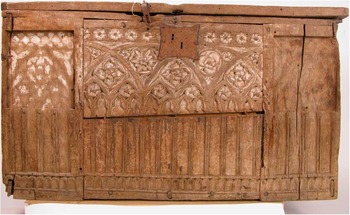
The medieval chest in St Mary Magdalen Church, Oxford, is of the clamp-fronted type in which the boards comprising the front and back of the chest have wide tenons that are clamped and pegged into a long mortise in the stiles. In England, this type of construction is found mainly in the period 1200 to 1500.Footnote 1 It can be seen as a step forward from the boarded chest where the boards were nailed or pegged together and were often reinforced by external iron bands. The two types coexisted, however.
The chest is well known to historians. In 1902 a drawing and detailed description appeared in Fred Roe's first book, where he dated it to around 1320 and reported that it was known locally as the ‘jewel chest’.Footnote 2 Soon after, Johnston dated it to the thirteenth century.Footnote 3 In the 1920s it was included in a list of fine fourteenth-century chests in Cescinsky and Gribble's study of early oak furniture.Footnote 4 It was photographed and described by Howard and Crossley in their study English Church Woodwork and dated to the late thirteenth century.Footnote 5 In 1939 it was described in the RCHME volume on Oxford and dated to around 1300.Footnote 6 The chest was not chosen for inclusion in Eames's major 1977 survey of medieval furniture.Footnote 7 In 1984 an article reported a dendrochronological study yielding an early fourteenth-century date but gave scant details.Footnote 8 In Tracy's study of imported church furniture it was listed as secular and from the ‘Low Countries/Germany’ and so was omitted, but the author noted that the group of chests to which it belonged had not received detailed study.Footnote 9 The author of the church's own history guesses it may have come to the church as part of a benefaction by a wool merchant, Walter Bost, in the early fourteenth century, perhaps to celebrate his son John's call to serve as a member of the parliament of 1317, but admits nothing certain is known about its origin.Footnote 10 In an article on ‘Kentish Gothic’ chests in 2007, I noted that its lid design was similar to a north German chest.Footnote 11 Finally, in 2011, Bridge and Miles, the authors of a survey of dendrochronologically dated chests, concluded that ‘it shared features with the Kentish Gothic chests and some of the dated north German chests, making a fourteenth-century date likely, although it could be a later copy’.Footnote 12
Faced with this radical choice it is clearly timely to look at the St Mary Magdalen chest in more detail. The approach taken seeks to identify specific decorative and constructional features as well as referring to dendrochronological dating, in contrast to the assignation of a date based on stylistic grounds alone. No documentary material on the origin or repair of the chest was available at the time of study. The present paper is based on a close examination of the chest and draws on the study of north German Gothic chests mentioned above.Footnote 13 It will be argued that neither of Bridge and Miles's alternatives is tenable.
Construction
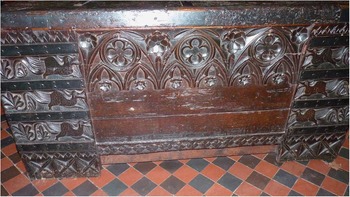
The St Mary Magdalen chest (fig 1) is made of oak, much of which is of the slow-grown, straight-grained type found in Poland, Germany and the Baltic and used widely in north-western Europe in the medieval period for both furniture and fixed woodwork. It was of higher quality and was easier to work than local oak, which grew faster and with more twisted grain. ‘Baltic’ oak was imported to England from the thirteenth to the nineteenth centuries.Footnote 14
The carved facade. Photograph: © author

The chest is capacious. Its overall dimensions today, with lid closed, are 1.75m wide by 0.91m high and 0.63m deep, while the internal depth is 0.61m.Footnote 15 The broad front stiles (0.39m and 0.35m wide on left and right) have a slightly tapering cross section (from 55mm to 50mm), and the front, back and sides are each made of three boards. The joints between sides and front and back (the weak point of this construction type) are strengthened by an applied framework of battens, which is secured to the front and rear stiles by iron straps and to the sides by pegs or nails. The lid of the chest is made of two boards and the bottom of the chest of three. The chest has two till boxes and a set of six pigeonholes between them fixed to the back.
Chests such as this were used to secure valuables of all sorts, including documents certifying ownership of land and other assets (‘evidences’, ‘muniments’), church plate, vestments, domestic textiles, books and money.Footnote 16
Analysis
As the choice between ‘fourteenth century’ and ‘later copy’ makes clear, this chest poses major problems of interpretation. To make progress it is essential to try and establish what repairs it has undergone. It will be argued here that the chest is a combination of original and later material, and that it is not a later copy. The different parts of the chest will be examined in turn, focusing on their originality and their parallels among chests elsewhere, in order to arrive at a conclusion about its origins and evolution.
The lid
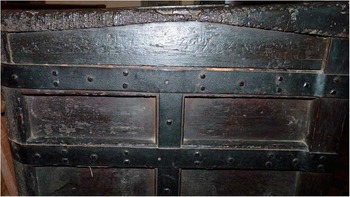
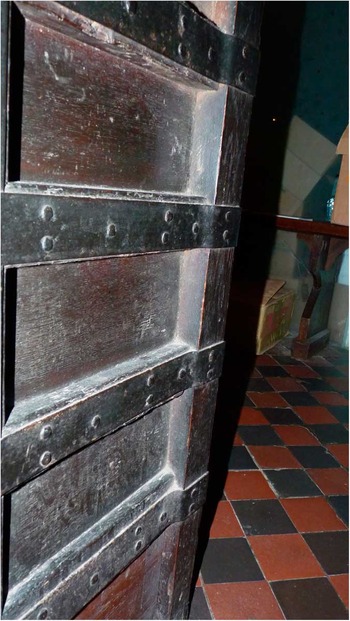
The lid of the chest is made of two boards that taper in cross section towards the centre of the lid (the front board from 65mm to 25mm and the rear board from 35mm to 25mm), with cleats at each end but no dowels between the boards (fig 2). The cleats have a side profile that fits neatly against the tapering boards and binds and supports the flat lid. The cleats, although later, retain the design feature of a short, narrow tenon, which would have fitted into the original stiles.Footnote 17 The use of tapered boards in making a lid is not simply the result of cleaving an oak trunk along a radius, but is a conscious design feature. It can be seen on the ‘Deep Chest’ at Westminster Abbey, and on the Stoke d'Abernon and Graveney chests and among many north German chests.Footnote 18
The left-hand side showing the two boards that make up the lid. Photograph: © author

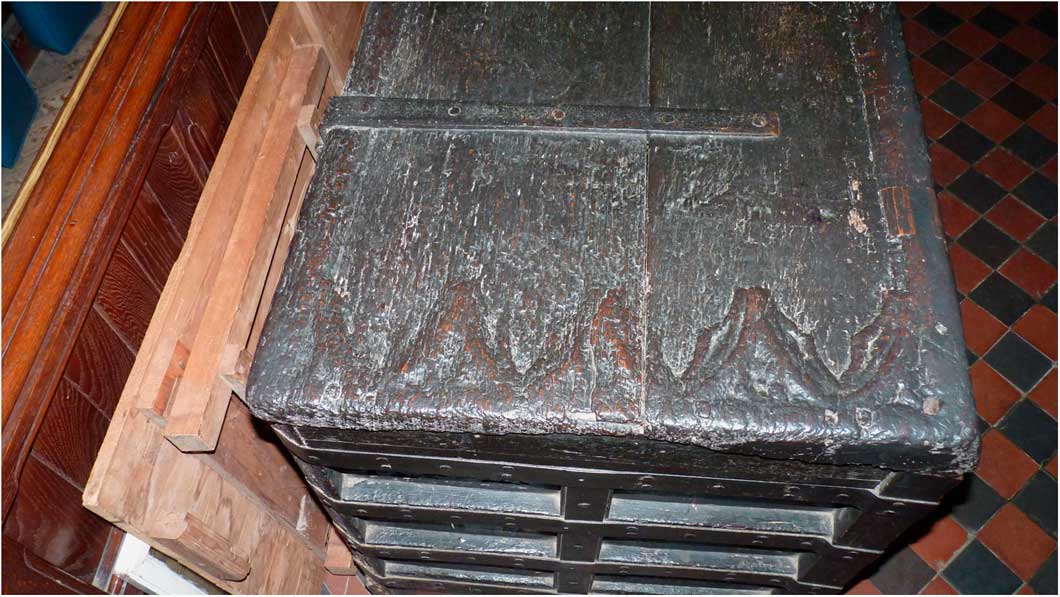
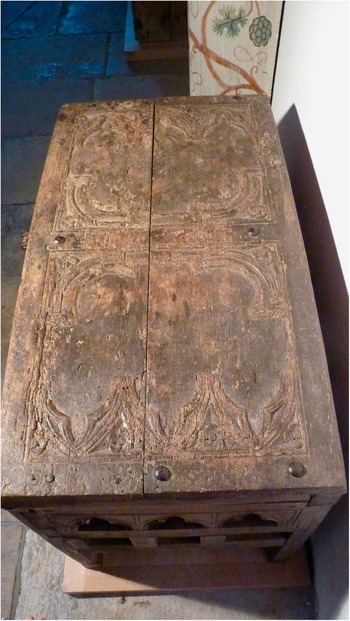
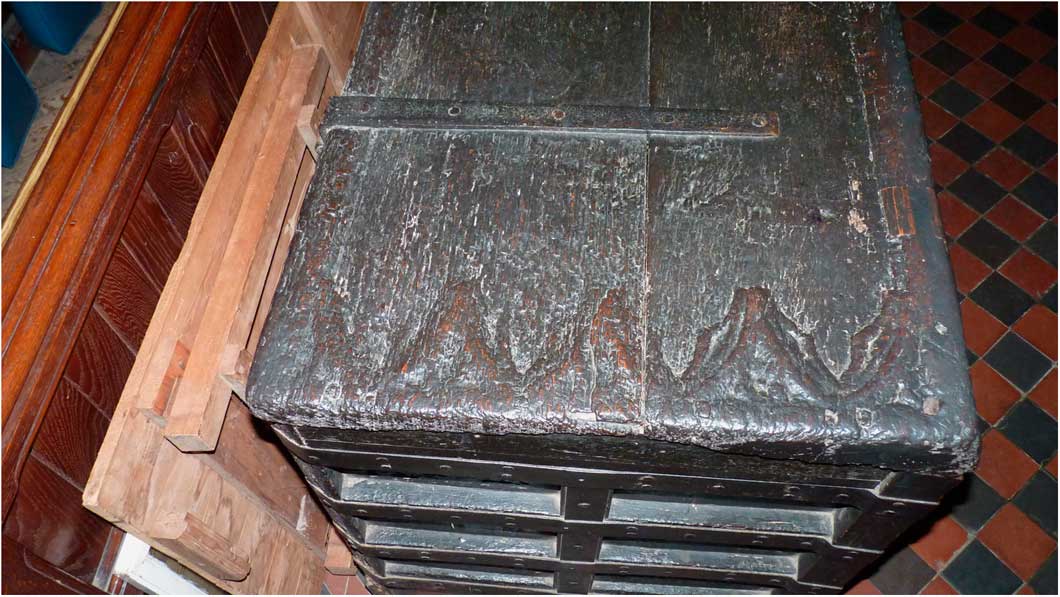
When looking at the chest for the first time it is easy to focus on the carving of the front and ignore the carving of the lid. The lid is dark and very worn and leaves no doubt as to its age. It is, I suggest, the least controversial part of the chest. It is also helpful in interpretation. The carved surface consists of a single frame with four cusped Gothic arches in a row carved in the solid at each end with an uncarved grounded field in between them (fig 3). This lid design has no parallel on tracery-carved chests in England to my knowledge, though admittedly not all have original lids.Footnote 19 However, it is very closely related to the lid on a north German chest in Wienhausen monastery, whose lid is divided into two grounded and framed fields, each of which has three cusped Gothic arches at its outer end facing half of a quatrefoil with stem design (fig 4).Footnote 20 This chest is dated by dendrochronology to 1330 on the basis of a latest measured ring of 1307 and a twenty-three-year allowance for lost heartwood and sapwood. This date cannot be directly transferred to the Oxford chest. The lid carving is very similar but not identical, and carving styles may have been used over a longer period, but it does make a date of around 1330 perfectly feasible for the lid and, by extension, for the original parts of the chest.
The lid carving. Photograph: © author
The Wienhausen lid carving. Photograph: © author

The lid of the Oxford chest was, in fact, dated by Fletcher and Tapper in 1984: the latest ring was measured at 1301, and a likely construction date estimated at 1315–20.Footnote 21 This is not far from the date of 1330 for the Wienhausen chest. However, some caution is necessary: the Oxford dating was done in the early days of dendrochronology in England, before the establishment of the multiple chronologies that exist today for oak in different countries and regions based on scores of samples. Moreover, the authors were not aware that the oak might have been imported. Nevertheless, their dating of chests in Westminster Abbey, made of English, German and Polish timber, has been found to be generally accurate.Footnote 22
The carved front
The stiles
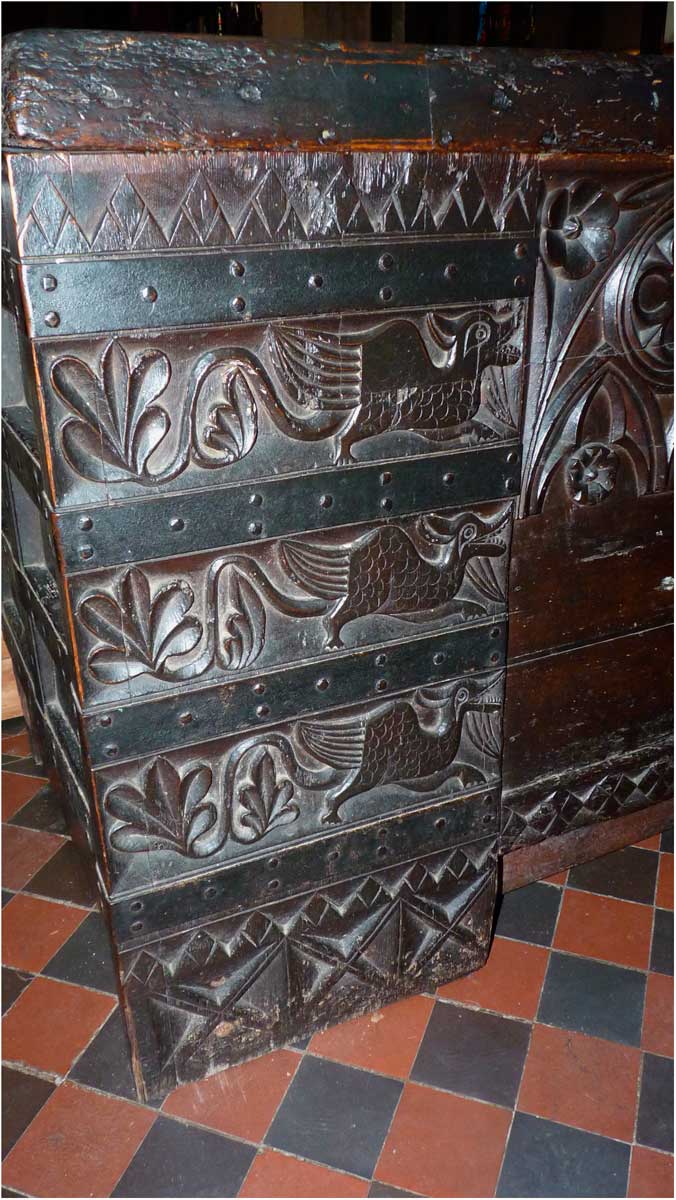
The decoration of these stiles, with their carved mythical beasts in rectangular reserves, triangular running lozenges and triple diapers on the feet, is very striking. Stiles carved with mythical beasts in reserves are found on eleven other medieval chests (or chests with medieval facades inserted in later structures, as at St Peter's Church, Derby) in England, whereas none are known on chests attributed to Germany.
In a previous article I distinguished three types based on the tracery carving on these chests and placed the Oxford chest in Type D, which has large Gothic arches enclosing large roundels and with two Gothic arches with small roundels and two lights, and one to three sizes of flower head. These are found on chests at Saltwood, Kent, St Mary Magdalen, Oxford, Sotheby's, London (sold 27 November 1970, lot 148), and the Victoria and Albert Museum (chest W49-1912).Footnote 23
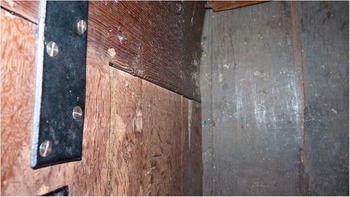
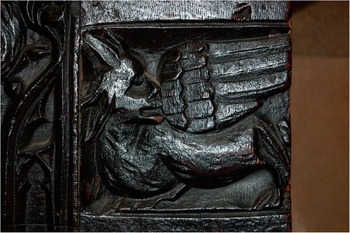
However, a close examination of the Oxford chest leads to the conclusion that the front stiles are later additions, rather than being originally carved, or having later carving added to originally plain stiles. The evidence for this is: (a) the strikingly dark and glossy colour of their timber when viewed from inside compared with the three paler close-grained Baltic oak front boards and the light or medium dull-coloured timber of most of the rest of the chest (fig 5); (b) the fresh pegs holding the boards to the stiles; (c) the sharp, unworn and lightly patinated carving of the mythical beasts, which contrasts with the adjacent running decoration on the lowest central board (fig 6); (d) the mechanical character of the carving compared to the superior carving on a chest of similar type at St Peter's Church, Derby (fig 7); and (e) the difference between the sharp edges on the front left stile and the worn edges of the rear left stile (see fig 2). This implies that the chest has undergone a major reconstruction, a conclusion that is in line with the RCHME's pithy comment, ‘uprights modern’.Footnote 24 It is surprising that neither Roe nor any other subsequent commentator has remarked on this. The carving of mythical beasts on the front stiles is thus likely to be contemporary with the reconstruction.
The front stile from the inside showing the contrasting wood and stepped feature. Photograph: © author

The carving on the front right-hand stile. Photograph: © author
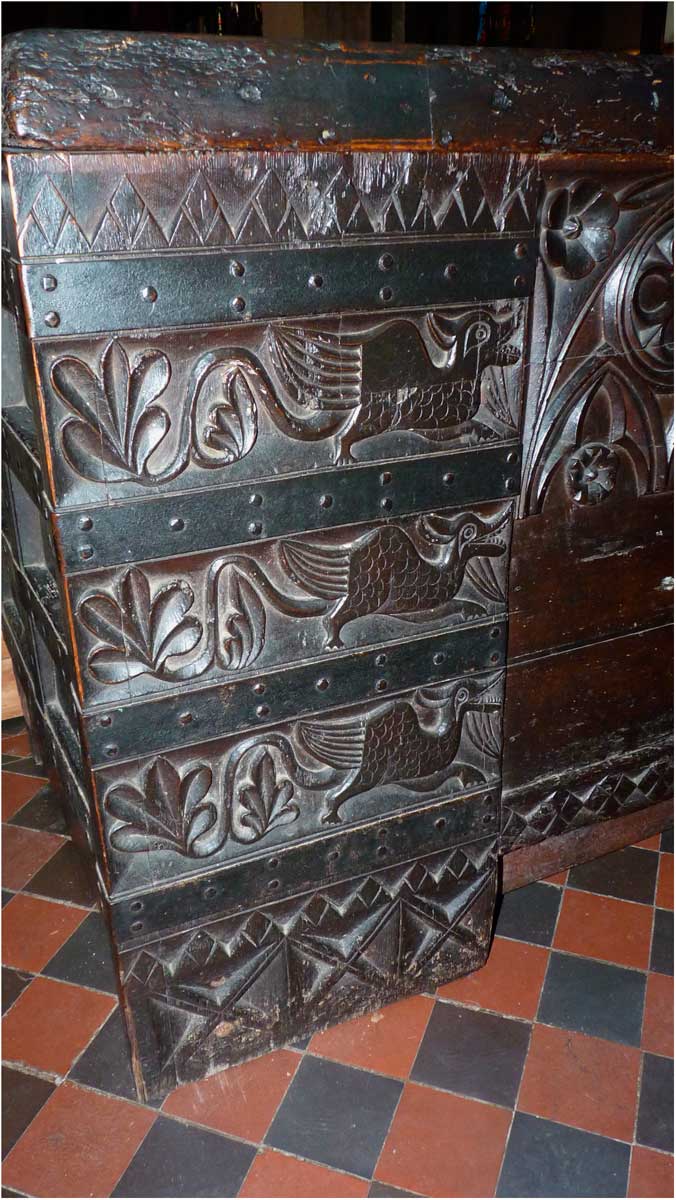
Animal carving on the front right-hand stile of the chest at St Peter's Church, Derby. Photograph: © Patrick Smith

The rear stiles have been repaired but appear original. The left rear stile shows evident wear.
Fletcher and Tapper obtained a date for a ‘stile’ of 1267 and deduced from this a date of ‘after 1290’, which is compatible with their date for the lid.Footnote 25 However, they do not say whether they dated a front or a rear stile, which is an important omission. Given the above argument, it is most likely that they dated a rear stile.
The question of why animal-carved stiles were added can only be a matter of speculation. One possibility is that the mythical animals were carved to replicate damaged or fragmentary original stiles. If so, the chest retains its place in the Type D group, which requires tracery carving of a particular type and animal-carved stiles. Another possibility is that the mythical animals have no connection at all with the original chest and were added to complement and preserve the well-carved central boards. In this case, the inspiration may have come from another chest or from a historicist taste for a Romanesque feature that was absorbed into the Gothic style, for example during the eighteenth- and nineteenth-century Gothic revival, in which case the chest would cease to belong to Type D.
The three front boards
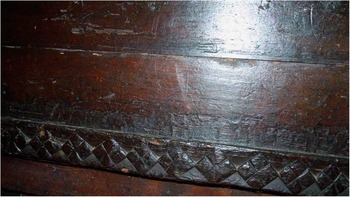
The top board and upper part of the middle board are sharply carved with arcading, quatrefoils and flower heads. The bottom board, which is more worn than the top board externally, is plain except for a running pattern of lozenges each divided into four segments. There is an uncarved area in the centre of the front which Roe suggests may have had paintings of saints or religious subjects.Footnote 26 Close inspection shows seven pairs of holes where applied mullions were fixed below the arcading, in some of which are the remains of nails. In addition, high-resolution photographs reveal a row of very worn nulling above the running pattern of lozenges (fig 8). Interestingly, a chest in Sweden has the same combination of mullions (but in this case carved in the solid rather than applied) set below arcading, along with uncarved areas and nulling, though it lacks the running lozenge pattern (fig 9).Footnote 27
Detail of the area below the tracery showing the nulling. Photograph: © author

The Swedish chest facade for comparison. Photograph: © Nordiska Museum, Stockholm

In my view these three boards are original. The timber matches the colour and type (close-grained Baltic-type oak) of most of the chest, apart from the front stiles. The top and bottom boards also show a distinctive internal constructional detail: two ‘stepped’ features on the ends of these two boards (see fig 5).Footnote 28 This precise feature is said by Stülpnagel to be characteristic of the early Brunswick and late Celle types of north German chest construction.Footnote 29 The five chests with the early Brunswick form are dendrochronologically dated to 1323 and 1330 or stylistically ‘first half [of the] fourteenth century’.Footnote 30 This coincides with the date of the lid given above estimated from two sources.
The tracery carving on the upper two boards of the front is less sharp and more patinated than the carving of the stiles and is likely to be original.Footnote 31 Some similarly well-preserved carving exists on fourteenth-century chests at Wienhausen monastery and early fifteenth-century tracery-carved chests at St John's Hospital, Canterbury, and All Saints Church, Litcham, Norfolk.Footnote 32 Below the tracery, the applied mullions are missing and the carving on the lowest board shows the expected wear. In the centre of the top board there is a neatly carved wooden insert in place of the original lock. Its patination and the colour of the edges where it has worn differ from the rest of the top board. This may be what the RCHME refers to as ‘front partly restored’.Footnote 33
The carving on the facade suggests that the chest may be closely related to a group of chests in north Germany and Sweden, all of which are considered to date from the fourteenth century,Footnote 34 and two of which have been dendrochronologically dated ‘after 1321’ and ‘after 1330’.Footnote 35 Three have clamped fronts with three boards,Footnote 36 the top with Gothic tracery arches, the middle with mullions and the bottom one with a running pattern, as on the Oxford chest. But none is identical and none have animals in reserves on the stiles.Footnote 37 This raises a question about the homogeneity of the Type D group. Despite their shared tracery type, the other three chests in Type D are long and low in shape, unlike the Oxford chest. The chest in Sweden referred to above, however, has a similarly carved front and is of similar length and height, but greater depth, at 1.65m by 0.92m by 0.78m.Footnote 38 This suggests that the Oxford chest may have more to do with the north German/Swedish group than the ‘English’ group.
The sides, including applied frameworks, back and bottom
The three-board sides have no particular internal features. The left-hand side is made of similar close-grained medium-coloured timber whereas the right-hand side is of similar grain but has lighter boards at the top and bottom than in the middle. The three boards of the back are of slightly different shades. Whether these differences are of any significance is hard to know.Footnote 39 Ian Tyers suggests such variations can be attributed to wood supplies becoming mixed as they pass through various hands.Footnote 40 The three bottom boards are jointed lengthways with V-joints. They fit into grooves in the walls and are pegged with three oblique pegs to the front and back lower boards.Footnote 41 Such joints are used in both England and north Germany.Footnote 42
The right-hand applied framework (fig 10) is later (it is made of clean finished, unwormed timber) whereas the left-hand framework appears original (its timber shows the expected wear and worming (see fig 2) Applied frameworks to strengthen the chest structure are often found on early boarded and clamp-fronted chests in both England and north Germany.
The applied framework on the right-hand side. Photograph: © author

In addition, the whole left side slopes inwards (fig 11) whereas the right side is vertical, supporting what was said earlier about a later framework being added to the right-hand side. Although one thinks of chests as being universally rectangular and having vertical sides, this is not always the case. Where the lid has cleats at each end one solution is for them to fit into a space above the top rail of the applied framework and for their tenons to fit into rebates in the tops of the stiles; the ends of the lid are then flush with the front and back of the chest. This can be associated either with vertical sides (and some loss of internal volume at the bottom of the chest) or inward-sloping sides. A further variant has all four walls inward-sloping.Footnote 43 It is likely that only the sides of the Oxford chest sloped inwards. Inspection of the joints between the applied framework and the back left stile shows they are right-angled whereas if the back was inward-sloping they would not be, as on the Canterbury chest.Footnote 44 Among English medieval chests, only a minority appear to have inward-sloping sides – those at Chobham and Shere, Surrey, and Rustington, Sussex, for example – and they do not have inward-sloping fronts and backs.Footnote 45 The inward-sloping sides of the Oxford chest are also features of the early Brunswick group of north German chests referred to above.
The left-hand side showing the inward slope. Photograph: © author

Till boxes
The left-hand till box is two-tiered, access to the lower tier being by sliding the front half of the false bottom, and the right-hand one is single-tiered. Two-tier till boxes are found on some north German chests and usually have a plain internal lid that pivots sideways, effectively concealing the lower tier. The type with a sliding internal lower lid has also been recorded in north Germany.Footnote 46 In England they are also known – for example, at Stoke d'Abernon, Surrey, and Bosham, Sussex.Footnote 47 Their relative frequency has not been studied. Roe considered the till boxes to be later additions but it is impossible to determine this. The timber of the left-hand till-box wall is like the timber on the left-hand side of the chest but the bottoms of both till boxes show band saw marks, an indication of nineteenth-century timber (at the earliest). It is thus likely that the original chest had till boxes but that some new timber was introduced at the time of the major reconstruction.
Pigeonholes
An angled fretted board with six rectangular pigeonholes, of about 160mm by 60mm, is held between the top and bottom boards, fitted to grooves in the back top board; the top board is 90mm wide (fig 12). The concept of a high narrow shelf, with or without an upstand, fitting into a groove high on the back or side of a north German chest is certainly known, though often the groove alone remains.Footnote 48 A set of pigeonholes also exists in the domed chest at Glemsford, Suffolk.Footnote 49 It is difficult to know whether Roe is right to suggest that they are a later addition. It is quite possible that the original chest had at least a high rear shelf and may have had pigeonholes too. The function of the pigeonholes is unknown. They could have held small drawers (which could even have held jewels); if so, they have left no signs of wear on the lower edges of the cut-out holes. They might also have held documents.Footnote 50
The pigeonholes and the hinge gaps on the lid. Photograph: © author

Other woodwork
The chest has undergone numerous other repairs. It is supported today on a strong dovetailed underframe with casters at each corner, which is visible in Howard and Crossley's photograph.Footnote 51 This may date from 1847, when ‘the church was restored … [and] when the coffer was also renovated, none too skilfully’.Footnote 52 The renovation work was led by the leading Gothic-revival architect, George Gilbert Scott, whose desire was ‘to make the church look truly thirteenth century’.Footnote 53 Today the left-hand casters are damaged and the chest partly rests on the later front left stile. The later front stiles are taller than the rear stiles, the current front height of 0.91m being greater than the likely original height of 0.86m.
Minor or superficial repairs include later lid cleats, the insert in place of the lock plate, patching where hasp and staples were once fixed, strengthening timbers at the base and edge of the rear right-hand stile and inside to the left of the back, battens to hold internal partitions and modern steel braces.
Ironwork
The lid opens today on two external strap hinges, which are old but not original. The shadows of a set of three previous iron straps can be seen on the lid but it is more likely that they were to strengthen the lid than that they belonged to three hinges at the back.Footnote 54 Today the lid has a single central external strengthening iron band.
The signs of previous hinges do exist, but contrary to the established view that English chests had pin (or ‘pivot’) hinges in the beginning, which gave way to iron strap hinges, we find evidence on this chest for small knuckle hinges, as we did on the ‘Kentish Gothic’ chests.Footnote 55 Two such hinges, folded over, are still attached to the rear stiles, and there are gaps in the lid and top back board where two further hinges were attached (see fig 12). It is hard to be certain of the manner in which these hinges were attached because of the condition of the wood. The upper flange appears to be rectangular (50mm by 25mm), and may have been tenoned into the lid and held by a single nail; there is a hole in the inside face of the lid which would support this possibility. The knuckle hinges on the ‘Kentish Gothic’ chests had rounded and tapered upper flanges and the lower part was spiked into the top board of the back. In the present case the point of the spike can be seen in one place.
It is often said that medieval church chests always had three locks, with keys held by separate individuals, but the relative frequency of different numbers of locks has not been studied. The St Mary Magdalen chest, like the three ‘Kentish Gothic’ chests,Footnote 56 does not follow this model and originally had only one central lock, which is also the norm for north German chests.Footnote 57 Despite having only one lock, the thick front edge of the lid gives it considerable rigidity and protection against being levered open at the ends.
The missing lock plate may well have been of the concave-sided type but, judging by the lock plates that can be considered original on dendrochronologically dated chests shown by Stülpnagel, the earliest of which is 1322, the concave shaping would not have been very pronounced.Footnote 58 The chest has lost a probably later pair of small hasp and staple fastenings. It currently has two modern keyholes and internal locks.
Finally, the ironwork which fastens the applied frameworks at the sides of the chest to the front and back stiles is later, judging by its regular, unblemished appearance and small neat nails (see figs 2 and 10). Neither this chest nor the ‘Kentish Gothic’ chests have side handles.
Conclusion
First, it is clear that the St Mary Magdalen chest has gone through at least one major reconstruction, which involved new carved front stiles, a new right-hand applied framework, new ironwork to attach the applied frameworks to the stiles and a new dovetailed base on casters.
Minor changes probably include the reconstruction of the till boxes and the addition or reconstruction of the pigeonholes. There have been many other changes as well, such as the addition of iron strap hinges and removal of the lock and lock plate. The band saw marks in the till-box bottoms and the likelihood that these could not have been inserted without the chest being taken apart suggest the nineteenth century as the likely time of the major reconstruction. This would coincide with the period when the George Gilbert Scott renovations to the church were being undertaken and would be consistent with the front stiles being carved in a historicist style.
Secondly, the 1315–20 dendrochronological date for the lid obtained by Fletcher and Tapper, if correct, is consistent with the date of around 1330 suggested by the carved design of the lid, and with the 1323–30 dates suggested by the constructional feature of early Brunswick group chests, namely, stepped features in the front boards.Footnote 59 If Fletcher and Tapper's ‘after 1290’ date refers to the rear stile that is also consistent. Overall, an estimated construction date range of 1320–30 is unlikely to be far from the truth.Footnote 60
The final conclusion concerns the place of construction of the St Mary Magdalen chest. It was initially placed in the Type D group of tracery-carved, clamp-fronted chests in England on the basis of its carved facade and would retain that position if the later front stiles were carved in imitation of deteriorated original stiles. However, if they were carved without reference to originals, the chest ceases to possess a key feature of Type D, namely, stiles with animals carved in reserves, and its membership of this category becomes questionable (animals in reserves on stiles are not recorded for German or Swedish chests but are recorded for chests in England). This question cannot be resolved on the basis of present evidence.Footnote 61
It was also pointed out that the carving of the central three boards was very close to a group of north German chests and to one in Sweden in particular. This suggests that, while the chest certainly or probably shares some characteristics with both English and north German/Swedish chests of the fourteenth century, it also has some characteristics that are more often, or exclusively, found on such chests. Common to both are clamp-fronted construction, applied frameworks, till boxes and tracery carving on the facade; ‘shared features’ that are probable, rather than certain, and that require further study, are the lid construction (two boards of wedge-shaped cross section, lid cleats with a side profile that supports a flat lid), pigeonholes and a two-tier till box. Likewise, inward-sloping walls and a single original lock require further research to determine their incidence and association with other features. On the other hand, the features that the Oxford chest appears to share exclusively with north German/Swedish chests are the carved design of the lid, the stepped constructional feature in the front, probably knuckle hinges and the facade tracery design, and possibly the pigeonholes.
The current state of research on medieval chests prevents us from being more definite about the association of particular features with particular places of construction.Footnote 62 However, the fact that the St Mary Magdalen chest has four or five features that are more often or exclusively found on north German/Swedish chests suggests that this chest is in fact such a chest that has undergone later reconstruction, or that it was made by craftsmen working in that tradition. Given that the Hanseatic trade involved the export of cloth from England in exchange for raw materials, including both timber and chests, it is not at all impossible that this chest reached Oxford through the activities of Walter Bost, the early fourteenth-century wool merchant and benefactor of the church.Footnote 63 In comparison to the chests available domestically at this time, which were either bound with iron straps leaving little room for carving or, if not bound, simply chip-carved or incised, this chest would have seemed outstanding for the quality of its carving.
Acknowledgements
I would like to thank the Revd Peter Groves for facilitating visits to the chest, Patrick Smith (St Peter's, Derby) and Anna Womack (Nordiska Museum, Stockholm) for supplying photographs, Karl Heinrich von Stülpnagel for arranging a visit to Wienhausen monastery and Nick Humphrey, David Sherlock, FSA, Gavin Simpson and Karl Heinrich von Stülpnagel for stimulus and comments.