Introduction
Pulmonary arterial hypertension is a rare disease characterised by increased pulmonary vascular resistance leading to right heart failure and structural remodelling of the pulmonary arteries, which subsequently reduces circulating oxygen levels. Reference Humbert, Kovacs and Hoeper1 This process increases right ventricular load, causing progressive dysfunction and ultimately right heart failure. Reference Hoeper, Humbert and Souza2,Reference Mocumbi, Humbert and Saxena3 Pulmonary arterial hypertension impairs muscle function through fibre-type shifts, atrophy, Reference Riou, Pizzimenti and Enache4 reduced capillary density, Reference Long, Troutman and Gray5 decreased oxidative capacity, and endothelial dysfunction. Reference Menezes, Lee and Fonseca Balladares6,Reference Potus, Malenfant and Graydon7 Despite treatments targeting pulmonary vascular resistance, gains in functional independence and life expectancy remain limited. Reference Humbert, Sitbon and Chaouat8,Reference Humbert, Sitbon and Simonneau9 The Glittre Activities of Daily Living test was chosen for its ability to simulate everyday household tasks, offering a comprehensive measure of functional status. Reference Leite, de Andrade and Araújo10 Unlike tests assessing only walking or isolated strength, it reflects daily demands by incorporating tasks like carrying, stair climbing, and transitions between activity stations. Reference Fernandes-Andrade, Britto and Soares11 Widely used in chronic populations, including heart failure, it effectively captures both aerobic and muscular performance. Reference Bauer, Dehnert and Schoene12–Reference Morris, Kermeen, Jones, Lee and Holland14 Its use in this study provided real-world insight into the functional limitations of pulmonary arterial hypertension.
Previous studies have assessed skeletal muscle oxygenation in adult pulmonary arterial hypertension patients using near-infrared spectroscopy and demonstrated its association with exercise intolerance. Reference Malenfant, Potus and Mainguy15,Reference Panagiotou, Vogiatzis and Louvaris16 However, no studies to date have specifically investigated this relationship in adolescents and young adults with pulmonary arterial hypertension, particularly in the context of daily functional activities. Although systemic and haemodynamic factors contribute to exercise intolerance, impaired muscle metabolism and oxygen use are also key contributors to functional limitations in this population.
This study evaluates activities of daily living in adolescents and young adults with pulmonary arterial hypertension, focusing on how functional capacity, muscle strength, and oxygen exchange influence energy expenditure and overall functional status. It aims to clarify the relationship between physiological deficits and clinical manifestations through detailed assessment and interpretation of these parameters. We hypothesised that adolescents and young adults with pulmonary arterial hypertension would exhibit reduced muscle oxygenation and peripheral muscle strength compared with age- and sex-matched healthy peers. We further hypothesised that these impairments would be significantly associated with poorer activities of daily living performance and reduced functional capacity in the pulmonary arterial hypertension group.
Methods
Study participants
This cross-sectional study compared functional and metabolic parameters between patients with pulmonary arterial hypertension (World Health Organization classification) and healthy controls. Pulmonary arterial hypertension was confirmed by right heart catheterisation (mean pulmonary artery pressure ≥25 mmHg). Eighteen patients (10 females, 8 males; 9–30 years) and 15 age- and sex-matched healthy controls were included. This age range was chosen because all patients were followed in paediatric cardiology, ensuring clinical homogeneity; similar ranges have been used in prior pulmonary arterial hypertension studies. Reference Latus, Bandorski and Rink17,Reference Zöller, Siaplaouras and Apitz18 Eligible patients were World Health Organization class I–III, clinically stable, without medication changes in the past 6 months, asymptomatic at rest, and under regular follow-up. Exclusion criteria were left ventricular ejection fraction (LVEF) < 40%, neurological, genetic, or musculoskeletal disorders, and unstable conditions (e.g., infection and decompensated heart failure). Controls were recruited from the general population, were non-smokers, and were free of functional limitations; they were excluded if they had cardiopulmonary, neurological, musculoskeletal, or genetic disease, systemic illness, or medications affecting exercise capacity.
Measurements
Demographic and clinical data (age, sex, anthropometrics, medical history, right heart catheterisation, clinical status, and medications) were recorded. In the pulmonary arterial hypertension group, functional status was classified by World Health Organization criteria. Reference Bennett, Riegel, Bittner and Nichols19 B-type natriuretic peptide and LVEF values were retrieved from hospital records within 3 months. Functional capacity was assessed by the 6-minute walk test per American Thoracic Society/European Respiratory Society guidelines in a 30-m corridor. Heart rate, oxygen saturation, fatigue, and dyspnoea were recorded before and after the test. 20 Muscle oxygen saturation (SmO2) was measured using the Moxy Monitor (Fortiori Design LLC, USA) placed on the vastus lateralis muscle of the dominant leg. Reference Yogev, Arnold and Nelson21 During the 6-minute walk test, the following SmO2 parameters were analysed: resting (mean of last 30 s at seated rest), minimum (mean of last 30 s of test, reflecting maximal utilisation), deoxygenation (ΔSmO2: resting–minimum), and reoxygenation (ΔSmO2: recovery–minimum). Reference Tekerlek, Aykan and Vardar-Yagli22
Glittre Activities of Daily Living test and energy expenditure
A standardised course with a chair, two-step staircase, and shelf 10 m apart simulated activities of daily living tasks. Participants completed five circuits, including sit-to-stand, stair climbing, shelf interaction, and return. Reference Leite, de Andrade and Araújo10 Participants wore weighted backpacks. Test duration, vital signs, perceived exertion (Borg 0–10), and energy expenditure (SenseWear Armband) were recorded. The device also provided physical activity level as total-to-resting energy expenditure ratio. Reference Santos-Lozano, Hernández-Vicente and Pérez-Isaac23 Baseline and post-test vitals, Borg-rated fatigue, and completion time were recorded. The SenseWear Armband on the dominant arm continuously monitored energy expenditure. Reference Santos-Lozano, Hernández-Vicente and Pérez-Isaac23
Peripheral muscle strength
Muscle strength of the dominant upper (shoulder flexion and abduction) and lower extremity (knee extension) was measured using a digital hand dynamometer (Lafayette MMT System, Model 01165, USA). Three maximal isometric contractions were performed per muscle group, and the highest value (kg) was used for analysis. Reference Mijnarends, Meijers and Halfens24
Lower extremity muscle endurance
Lower-limb endurance was assessed with the 1-minute sit-to-stand test using a wall-secured armless chair. Valid repetitions required full hip contact, 90° knee flexion, and full extension. Total repetitions were recorded. Reference Wang, Yan and Meng25
Hand grip fatigue test
The standardised hand grip fatigue test assessed fatigue levels by measuring maximum isometric hand grip strength with a Jamar hand dynamometer (Jamar, Fabrication Enterprises Inc., Irvington, NY, USA). The protocol involved determining maximum grip strength through three repeated contractions, recording the highest value (kgf), followed by a 5-minute rest period, and then a 30-second sustained maximum grip contraction. Reference Hamilton, McDonald and Chenier26
Study protocol
This study followed a 2-day protocol aligned with patients’ routine 3-month cardiology visits. On day 1, demographic/clinical history and peripheral muscle strength were assessed in the morning; the Glittre Activities of Daily Living test was performed in the afternoon after ≥30 min rest. On day 2, the 6-minute walk test was conducted in the morning, and sit-to-stand and handgrip fatigue tests in the afternoon, again with ≥30 min rest between assessments.
Statistical analysis
Continuous variables are presented as mean ± SD or median (IQR, range) and categorical variables as frequencies (%). Between-group comparisons used independent t-tests, Mann–Whitney U tests, or Fisher’s exact tests, as appropriate. Associations were examined with Pearson’s or Spearman’s correlations based on data distribution. Normality was tested with Shapiro–Wilk test. Statistical significance was set at p < 0.05. Effect sizes (Cohen’s d) were calculated and interpreted as small (≈0.20), medium (≈0.50), and large (≥0.80).
Results
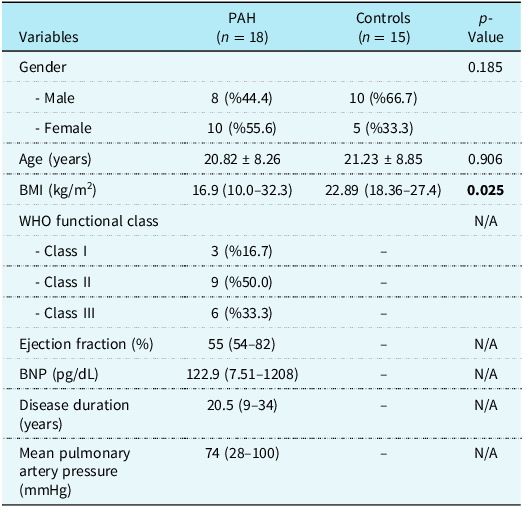
A total of 44 patients with pulmonary arterial hypertension under follow-up at Hacettepe University were screened. Eighteen patients were excluded (loss to follow-up n = 3, death n = 4, refusal n = 4, and transfer n = 7). Of the remaining 26, 9 were excluded for LVEF < 40% (n = 3), Down syndrome (n = 2), microcephaly (n = 1), or orthopaedic problems (n = 2). Eighteen pulmonary arterial hypertension patients and 15 controls were included. Diagnoses were Fontan circulation (n = 3), residual pulmonary arterial hypertension (n = 3), idiopathic pulmonary arterial hypertension (n = 4), Eisenmenger syndrome (n = 7), and Glenn physiology (n = 1). Demographic and disease-specific data are shown in Table 1. Treatments included Phosphodiesterase type 5 (PDE-5) inhibitor (n = 4), Endothelin receptor antagonists (ERA) (n = 6), ERA + PDE-5 inhibitor (n = 4), ERA + prostacyclin analogue (n = 3), and ERA + prostacyclin IP receptor agonist (n = 1).
Comparison of demographic and clinical parameters

PAH = pulmonary arterial hypertension; BMI = body mass index; WHO = World Health Organization; BNP = B-type natriuretic peptide. Data are presented as mean ± SD, median (range), or frequency (n). p-values: bolded for significance (p < 0.05). N/A = not applicable (control group lacks PAH-specific parameters).
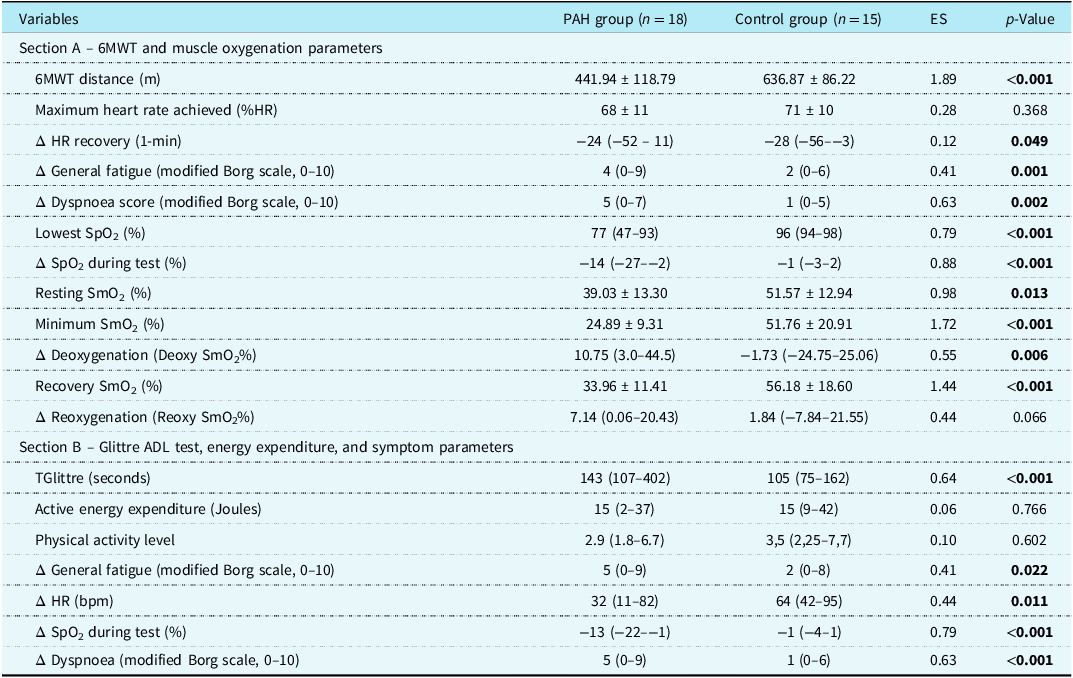
Peripheral muscle strength was reduced in pulmonary arterial hypertension patients (Table 2). Shoulder abduction, knee extension, and handgrip strength at baseline and during sustained contraction were significantly lower (p < 0.05), whereas shoulder flexion showed no difference. Lower-limb endurance was also impaired (p < 0.001). Effect sizes indicated large differences for sit-to-stand performance and grip strength. Six-minute walk test outcomes were likewise significantly reduced in the pulmonary arterial hypertension group (p < 0.001) (Table 2). Walking distance was shorter (p < 0.001; d = 1.89), 1-minute heart rate recovery was blunted (p = 0.049), and fatigue (p = 0.001) and dyspnoea (p = 0.002) scores were higher. Patients also showed more pronounced oxygen desaturation, with both nadir SpO2 and ΔSpO2 significantly worse (p < 0.001 for both), whereas maximum heart rate did not differ (p = 0.368). Effect sizes were large for distance and desaturation, moderate for symptom responses, and small for heart rate recovery. Muscle oxygenation was impaired in pulmonary arterial hypertension patients (Table 2). Resting and minimum SmO2 were significantly lower, deoxygenation was greater, and recovery SmO2 was reduced (p < 0.05), whereas reoxygenation did not differ between groups (p = 0.066). Effect sizes were large for minimum and recovery SmO2.
Comparison of functional capacity, muscle oxygenation, and Glittre ADL test parameters between PAH patients and healthy controls

PAH = pulmonary arterial hypertension; 6MWT = six-minute walk test; TGlittre = time to complete Glittre Activities of Daily Living test; ES = effect size (Cohen’s d); HR = heart rate; SpO2 = peripheral oxygen saturation; SmO2 = muscle oxygen saturation; Deoxy SmO2% = deoxygenation percentage; Reoxy SmO2% = reoxygenation percentage; SBP = systolic blood pressure; DBP = diastolic blood pressure; GF = general fatigue; Δ = change (delta). Notes: Values are presented as mean ± standard deviation or median (range), depending on data distribution. ESs are reported to indicate the magnitude of differences between groups. p-Values < 0.05 were considered statistically significant.
The Glittre Activities of Daily Living test revealed further limitations in pulmonary arterial hypertension patients (Table 2). Completion time was longer, with greater SpO2 decline, blunted heart rate response, and higher fatigue and dyspnoea scores (p < 0.05), while energy expenditure (p = 0.766) and physical activity level (p = 0.602) did not differ. Effect sizes were moderate for completion time and symptoms and large for desaturation. Correlation analysis showed that Glittre Activities of Daily Living duration was inversely related to shoulder flexion (r = −0.656, p = 0.004), abduction (r = −0.694, p = 0.002), handgrip (r = −0.581, p = 0.014), and knee extension (r = −0.550, p = 0.022) (Figure 1( a )), with a borderline link to sit-to-stand (r = 0.471, p = 0.056). DeoxySmO2 showed weak, non-significant correlations with Glittre Activities of Daily Living duration (r = 0.244) and physical activity level (r = 0.257), and a trend with active energy expenditure (r = 0.445, p = 0.084) (Figure 1( b )). Negative correlations were also found with 6-minute walk test distance (r = −0.521, p = 0.032), post-exercise SpO2 (r = −0.512, p = 0.036), and diastolic pressure (r = −0.510, p = 0.037) (Figure 1( c )). No associations emerged with energy expenditure, activity level, heart rate, systolic pressure, dyspnoea, or fatigue (p > 0.05, Figure 1( c )).
Correlations between functional performance, physiological responses, and energy expenditure in adolescents and young adults with pulmonary arterial hypertension. ( a ) Correlations between muscle strength (shoulder flexion, shoulder abduction, hand grip, knee extension, and sit-to-stand repetitions), Glittre ADL test time (TGlittre), and energy expenditure outcomes (AEE and PAL). ( b ) Correlations between muscle oxygenation parameters (SmO2, DeoxySmO2, and ReoxySmO2), TGlittre, and energy expenditure outcomes. ( c ) Correlations between 6MWT outcomes (HR, SBP, DBP, dysponea, fatigue, SpO2, maximum HR, and 6MWT distance), TGlittre, and energy expenditure outcomes. Colour scale and bubble size represent correlation strength (r); positive values in blue and negative in red. Abbreviations: AEE = active energy expenditure; PAL = physical activity level; TGlittre = time to complete Glittre Activities of Daily Living test; 6MWT = six-minute walk test; HR = heart rate; SBP = systolic blood pressure; DBP = diastolic blood pressure; SpO2 = peripheral oxygen saturation; SmO2 = muscle oxygen saturation; DeoxySmO2 = muscle deoxygenation; ReoxySmO2 = muscle reoxygenation.

Discussion
This study revealed marked functional, muscular, and physiological deficits in pulmonary arterial hypertension patients compared with controls. They showed shorter 6-minute walk test distance, longer Glittre Activities of Daily Living time, greater desaturation, higher dyspnoea and fatigue, blunted heart rate dynamics, reduced muscle strength (shoulder abduction and knee extension), poorer sit-to-stand performance, and lower resting/minimum SmO2. Notably, Glittre Activities of Daily Living completion time correlated with weaker limb strength, shorter 6-minute walk test distance, lower post-exercise SpO2, and reduced diastolic pressure, but not with energy expenditure or symptom scores. These findings emphasise multisystemic functional and oxygen-handling impairments. Poor sit-to-stand performance was directly linked to reduced lower-limb strength, consistent with Saglam et al., who showed this test reflects exercise capacity and functional independence in cardiac patients. Strength deficits, combined with desaturation, fatigue, and circulatory insufficiency, likely explain the reduced repetition counts. Reference Saglam, Vardar-Yagli and Calik-Kutukcu27 As Waschki et al. noted, reduced peripheral muscle strength is associated with both muscle mass loss and circulatory insufficiency, suggesting that the muscle strength deficiency in pulmonary arterial hypertension patients may stem from both factors. Reference Waschki, Kirsten and Holz28 Pepplinkhuizen et al. corroborated previous findings, demonstrating that diminished muscle strength persists in paediatric pulmonary arterial hypertension patients despite stable cardiopulmonary function. This consistency implies that such weakness extends beyond secondary cardiac or deconditioning effects, pointing instead to inherent skeletal muscle dysfunction, potentially tied to microcirculatory impairment or metabolic dysregulation. These insights stress the necessity of integrating muscle strength evaluations into routine clinical assessments for children with pulmonary arterial hypertension. Reference Pepplinkhuizen, Eshuis and Zijlstra29
These findings support previous studies showing reduced muscle oxygen extraction and impaired mitochondrial use during exercise in young pulmonary arterial hypertension patients. Mainguy et al. also reported significantly lower peripheral oxygen extraction, reinforcing the role of impaired oxygen use in exercise intolerance. Reference Mainguy, Provencher, Maltais, Malenfant and Saey30 Similarly, Garcia-Rivas and colleagues reported that mitochondrial dysfunction contributes to early fatigue during exercise. Reference Garcia-Rivas, Jerjes-Sánchez, Rodriguez, Garcia-Pelaez and Trevino31 Our findings of reduced muscle oxygen saturation and delayed recovery are consistent with previous studies. Wensel et al. demonstrated that pulmonary vascular resistance together with reduced peak oxygen uptake are strong prognostic markers in pulmonary arterial hypertension, highlighting the role of pulmonary vascular dysfunction in limiting exercise performance. Reference Wensel, Francis and Meyer32 Furthermore, the oxygen desaturation observed during exercise in our study aligns with common findings in pulmonary arterial hypertension patients, often attributed to impaired oxygen delivery due to circulatory insufficiency and reduced cardiac output. Reference Bauer, Dehnert and Schoene12,Reference Meyer, Lossnitzer and Kristen13 Tolle et al. demonstrated that exercise-induced desaturation in pulmonary arterial hypertension patients is associated with decreased aerobic capacity and muscle oxygenation, leading to early fatigue and reduced exercise performance. In this study, reduced SmO2, greater fatigue, and desaturation during the 6-minute walk test likely reflected inadequate oxygen delivery to muscle, driven by circulatory insufficiency and impaired peripheral oxygenation. Consequently, suboptimal cardiovascular and muscular function in pulmonary arterial hypertension manifests as increased fatigue and desaturation. Reference Tolle, Waxman, Van Horn, Pappagianopoulos and Systrom33
Exercise-induced desaturation and delayed recovery indicate impaired oxygen delivery in pulmonary arterial hypertension. Correlations between muscle strength and performance (sit-to-stand, Glittre Activities of Daily Living) highlight peripheral dysfunction. Despite similar energy expenditure, pulmonary arterial hypertension patients showed longer Glittre duration and greater symptoms, reflecting reduced task efficiency rather than metabolic cost, consistent with the “physical activity paradox” and the “Goldilocks” balance of activity load. Reference Cunha34 Moreover, studies in pulmonary arterial hypertension populations have shown that energy expenditure estimated by activity monitors correlates only modestly with exercise capacity and quality of life, suggesting that such measures may not fully capture the physiological strain and symptom burden of daily activities. Reference Okumus, Aslan, Arseven, Ongen, Issever and Kiyan35 Methodological limitations should be noted, as the SenseWear Armband may misestimate energy expenditure compared with indirect calorimetry, especially at higher intensities. Reference Santos-Lozano, Hernández-Vicente and Pérez-Isaac23 In pulmonary arterial hypertension, greater dyspnoea and fatigue reflect inefficient oxygen delivery rather than higher energy cost. Cunha et al. likewise reported reduced functional independence due to increased dyspnoea and fatigue. Reference Cunha34 The lower heart rate response during the Glittre Activities of Daily Living test in pulmonary arterial hypertension patients suggests a limited cardiac reserve, consistent with observations in other advanced respiratory diseases. This limitation, as noted by Waschki et al., significantly impacts functional capacity. Reference Waschki, Kirsten and Holz28 These findings indicate that in pulmonary arterial hypertension, daily activity efficiency is reduced despite similar energy expenditure, with dyspnoea further limiting capacity. Despite treatment advances, pulmonary arterial hypertension patients continue to experience dyspnoea and exercise intolerance. Beyond cardiac limitations, recent studies – including ours – emphasise muscle dysfunction, with consistently shorter 6-minute walk test distances and reduced strength, Reference Fowler, Maiorana, Jenkins, Gain, O’Driscoll and Gabbay36 Our findings further show that longer Glittre Activities of Daily Living duration reflects impaired daily function, consistent with Fernandes-Andrade et al., who validated the test as a functional capacity measure strongly correlated with 6-minute walk test. Reference Fernandes-Andrade, Britto, Soares, Velloso and Pereira37 Inverse correlations between Glittre Activities of Daily Living time and muscle strength (shoulder flexion/abduction, handgrip, and knee extension) support the role of peripheral dysfunction in activity limitations. Preclinical evidence also shows that exercise capacity may decline before overt muscle dysfunction, highlighting early cardiopulmonary impairment. Reference Zhang, Vang and Feord38 Overall, these findings show that cardiopulmonary limitations and peripheral muscle dysfunction jointly determine functional performance in pulmonary arterial hypertension. Exercise-induced desaturation, consistent with Tolle et al., Reference Tolle, Waxman, Van Horn, Pappagianopoulos and Systrom33 reflects impaired oxygen delivery from circulatory insufficiency, worsening muscle dysfunction and fatigue. Negative correlations between Glittre Activities of Daily Living duration, 6-minute walk test distance, and post-exercise SpO2 underscore the interaction of cardiovascular and musculoskeletal systems. The inverse relationship between 6-minute walk test distance – a marker of disease severity and prognosis – and Glittre Activities of Daily Living performance further emphasises the role of cardiovascular limitations in daily activities. Reference Klionsky, Abdelmohsen and Abe39,Reference Miyamoto, Nagaya and Satoh40 Interestingly, Glittre Activities of Daily Living duration showed no correlation with active energy expenditure or physical activity level, suggesting that while cardiovascular and muscle strength strongly influence functional performance, factors such as motivation, psychological state, or activity patterns may also contribute to daily functioning in young pulmonary arterial hypertension patients.
Strengths and limitations
A key strength of this study is the combined assessment of cardiovascular and musculoskeletal parameters in adolescent and young adult pulmonary arterial hypertension patients. However, several limitations should be acknowledged. First, the relatively small sample size, particularly in the control group, reduced statistical power and precluded subgroup analyses (e.g., age, sex, and diagnostic categories). Second, multivariable adjustment for potential confounders could not be performed; instead, strict inclusion/exclusion criteria and age- and sex-matching were applied to minimise confounding. Although strict inclusion/exclusion and matching were applied, residual confounding (e.g., physical activity habits and socio-economic factors) cannot be fully excluded. Third, the cross-sectional and single-centre design precludes causal inference and limits generalisability. Additionally, the heterogeneity of underlying diagnoses and treatments among pulmonary arterial hypertension patients may have influenced the results. Fourth, although energy expenditure was measured with a validated multisensor device, the absence of significant between-group differences should be interpreted with caution, as the device may underestimate metabolic cost in patients with altered movement efficiency. Finally, although validated, the measurement tools employed (e.g., SenseWear Armband, near-infrared spectroscopy, and surface electromyography) are not considered gold standards, and their accuracy in this population may be limited.
Conclusion
In conclusion, pulmonary arterial hypertension patients exhibited reduced exercise capacity, impaired muscle oxygenation, and poorer functional performance compared to healthy controls. Shorter 6-minute walk test distances, lower SmO2 levels, and longer Glittre Activities of Daily Living test duration reflect the multifactorial nature of these impairments, implicating both central and peripheral limitations. These findings underscore the clinical relevance of comprehensive rehabilitation programmes targeting both endurance and muscle strength. Future research should focus on multicentre longitudinal studies with larger cohorts and tailored interventions, such as resistance training and oxygen delivery strategies, to address these deficits.
Acknowledgements
The authors thank the patients for their support.
Author contributions
Jan Dik: conceptualisation, methodology, investigation, formal analysis, and writing – original draft. Ceyhun Topcuoglu: investigation and writing – review and editing. Merve Basol Goksuluk: formal analysis and data curation. Naciye Vardar Yagli: data curation and writing – review and editing. Ebru Aypar: investigation and resources. Dursun Alehan: resources. Melda Saglam: conceptualisation, supervision, and writing – review and editing.
Financial support
None.
Competing interests
None.
Ethical standard
All procedures contributing to this work comply with the ethical standards of the national guidelines on human experimentation and with the Helsinki Declaration of 1975, as revised in 2008, and were approved by the Hacettepe University Non-Interventional Clinical Research Ethics Committee (Approval No: GO 20/361).