

1. Introduction
In a recent empirical study on Swedish wage contracts since 1908 Klas Fregert and Lars Jonung draw two major conclusions (Fregert and Jonung Reference Fregert and Jonung2008). First, they find indications of certain links between policy regimes and labour market structures. Their results indicate that the length of wage contracts decreases in step with macroeconomic volatility, whereas the use of inflation indexation of wage agreements increases. Second, they find that the inflation-targeting regime since the mid 1990s stands out as an exceptionally stable regime in Sweden, characterised by relatively long non-indexed wage contracts.
Overall, there are many similarities between Denmark and Sweden as regards economic history, but one noteworthy difference is the choice of monetary regime in the most recent decades, in which period Denmark has had stronger preference for a fixed-exchange-rate regime than Sweden. It is therefore of interest to complement the Swedish study by a closer examination of the possible links between the monetary regime and the institutional setting of the labour market in Denmark in a long-term perspective in order to check the robustness of the two major findings for Sweden. First, can one find similar indications of links between policy regimes and labour market structures in Denmark? If so, it could indicate that elements of the labour market are endogenous, which could have implications for the robustness of results and policy conclusions derived from theoretical models that treat these parts of the economy as exogenous. Second, is the finding of an exceptionally stable regime in Sweden since the mid 1990s the result of the successful adoption of a particularly promising monetary-policy strategy (inflation targeting)? Or can one find similar results for Denmark, which has chosen a different monetary-policy strategy (fixed exchange rates) than Sweden during the most recent decades?
The article at hand is based on two new data sets constructed by the author.Footnote 1 The first data set concerns the development in wages, prices and productivity since the introduction of the krone as the Danish currency unit in 1875. The second data set covers the length of collective agreements, the use of automatic inflation indexation in wage agreements and intervention in the renewal of collective agreements by Act of Parliament between 1900 and 2007. On the basis of these two data sets, potential labour market endogeneities are examined and the relation to the monetary regime is explored.
2. The endogeneity of labour market structures: theoretical aspects and policy implications
A well-established result from the theoretical literature is that the effects of monetary policy and the cyclical sensitivity of the economy depend on the institutional characteristics of the wage-formation regime. An assumption on nominal wage stickiness is, for instance, a defining feature of many New Keynesian models and plays a crucial role in the reaction of the economy to shocks (Woodford Reference Woodford2003; Galí Reference Galí2008).
However, links from monetary regime to labour market structures can also theoretically be imagined. This direction of causality has been studied, for example, within the context of Optimum Currency Areas (De Grauwe and Mongelli Reference De Grauwe, Mongelli and Sørensen2004) and in relation to the determinants of nominal wage rigidity in the literature with focus on labour market economics (Gray Reference Gray1978; Groth and Johansson Reference Groth and Johansson2004).
A credible monetary regime that delivers on the final target of price stability provides a basis for inflation expectations firmly anchored around price stability, which might facilitate the use of multi-year nominal wage contracts among forward-looking workers and employers. Furthermore, an environment with low and stable inflation eases the formation of inflation expectations, which might promote decentralised wage negotiations.
Lack of credibility of a monetary regime that results in high and volatile inflation might make shorter wage contracts more attractive and encourage the use of inflation indexation of nominal wages. Furthermore, high inflation and pronounced inflation volatility require more resources to forecast inflation and form inflation expectations. This might give centralised labour market organisations a larger role to play as they can allocate the necessary professional resources to make inflation forecasts in relation to collective nominal wage bargaining.
If labour market structures are to some degree regime dependent, this could have implications for the robustness of results and policy conclusions derived from theoretical models that treat these parts of the economy as exogenous. In his seminal paper, Lucas (Reference Lucas1976) argued that policy conclusions drawn from macroeconomic models could be invalid or questionable if they were not based on models with constant ‘deep’ or ‘structural’ parameters. Many New Keynesian DSGE models are based on an assumption of nominal wage rigidities, and the degree of nominal wage stickiness is usually assumed to be approximately constant (a ‘deep’ or ‘structural’ parameter) which should make these models robust to the Lucas critique. However, if labour market structures are endogenous the degree of nominal wage stickiness will not necessarily be constant across monetary regimes. This could have implications for the effectiveness of stabilisation policy in different regimes and make such models unsuitable for the analysis and comparison of alternative monetary regimes.
Whether labour market structures are endogenous is ultimately an empirical question. However, if labour market structures are endogenous at least to some extent, it would enhance the empirical realism of the New Keynesian framework – as well as increase the robustness of these models to the Lucas critique – if such endogeneities were to be taken explicitly into account in the modelling framework.
3. A brief review of the empirical literature on the endogeneity of labour market structures
A number of empirical short-term studies seem to confirm that the length of wage contracts decreases in step with rising inflation uncertainty, and that inflation uncertainty increases the degree of indexation in wage contracts (cf. e.g. Christofides and Peng Reference Christofides and Peng2006).
However, only a few empirical long-term studies have focused on the possible monetary-regime dependence of the institutional characteristics of the wage-formation process and other parts of the labour market settings. A notable exception is the works by Klas Fregert and Lars Jonung, who have studied the length of collective wage agreements and the use of inflation indexation of wages in the industrial sector in Sweden since 1908 (Fregert and Jonung Reference Fregert and Jonung1998, Reference Fregert and Jonung2008). They find that the length of wage contracts in general decreases in step with uncertainty concerning the macroeconomic policy regime. Contract terms were longest during the classical gold standard period, 1908–14, towards the end of the Bretton Woods period, 1966–74, and in the recent period, 1995–2005, with an inflation-targeting regime. Inflation indexation was most pronounced during World War II and in the period 1977–90. These two periods were characterised by high volatility in nominal wages and prices. The inflation-targeting regime since the mid 1990s stands out as an exceptionally stable regime in Sweden, characterised by relatively long non-indexed wage contracts.
Only a few studies have focused on long-term empirical analysis of the Danish labour market structures and the Danish wage-formation process. They include a detailed study of the Phillips curve relationship for the Danish economy, 1904–70 (Kærgård Reference Kærgård1991), and a comprehensive study of a wide range of topics related to the Danish labour market in the twentieth century (Pedersen Reference Pedersen1984). However, none of these studies focuses directly on the possible monetary-regime dependence of labour market structures.
4. General outline of the Danish labour market in a historical perspective
The modern Danish labour market setting was shaped in the first five decades following the abolition of the medieval guild system in the middle of the nineteenth century with the Freedom of Trade Act of 1857 (effective from 1862).Footnote 2
After 1862, many of the masters’ guilds carried on as voluntary organisations. Some of them became employer organisations, while other, newer, industries formed separate employer organisations. In the mid 1880s, the first major employer association was established.
The journeymen guilds can only in a very general sense be seen as predecessors of trade unions. After the implementation of the Freedom of Trade Act, most of the journeymen guilds continued as voluntary sick and burial societies, although some took an interest in the more general working conditions of their members and also concluded written collective agreements with their former masters. However, a number of actual local trade unions were established during the 1860s and 1870s, and worker unionisation gained pace during the 1880s with the formation of local joint organisations covering all trade unions within a local area. In the late 1880s national trade unions also emerged.
One legacy from the guild system might be the tendency to establish separate trade unions for skilled blue-collar workers, unskilled blue-collar workers and white-collar workers, and a certain degree of conflict of interest between the groups. The majority of the early trade unions required journeyman status as a condition for membership. Trade unions for unskilled blue-collar workers and white-collar workers therefore developed relatively late. However, towards the end of the nineteenth century the main unions organising unskilled workers had also been established.
During the last decade up to the turn of the century, collective bargaining became more widespread (see Section 6), and the two main labour market organisations were established towards the end of the 1890s. The Danish Employers’ Confederation (DA) was founded by merger in 1898 and has since been the main private-sector employer organisation in the Danish labour market. The main national workers’ organisation, the Danish Confederation of Trade Unions (LO), was also founded in 1898 as a federation of several national and local trade unions covering both skilled and unskilled workers.
In 1899 a minor strike among carpenters in Jutland escalated into a nationwide lockout covering a large part of the building sector and the iron industry. The lockout lasted for three months. In September 1899 the DA and the LO concluded the ‘September Compromise’ with the following main elements:
• Mutual recognition by workers and employers of the right to form organisations.
• Recognition of both parties’ right to effect work stoppages through strikes and lockout subject to the observance of certain rules (14 days’ notice to the other party and approval of the work stoppage by a majority of three-fourths in a competent assembly).
• Fulfilment of collective agreements concluded by the two parties.
• Recognition of the employers’ right to manage and allocate work and employ the amount of labour deemed necessary (the ‘managerial prerogative’ of the employers).
• Termination of collective agreements at three months’ notice.
• Work supervisors were allowed not to be members of the workers’ organisations.
• Neither of the two parties was allowed to support industrial actions violating the rules of the game stated in the September compromise.
• The occurrences of breaches of collective agreements were first to be handled by the competent assembly of the parties’ organisations. If agreement could not be reached, the issue was to be taken to court.
The September compromise – with subsequent amendments – still serves as the ‘constitution’ of the Danish labour market.
After a major conflict in 1898, the DA and the LO agreed to establish a joint body, the Joint Commission of 1898, to interpret and deal with breaches of collective agreements. As a result of the September compromise of 1899, the Permanent Arbitration Board replaced the Joint Commission in 1900. The purpose of the Permanent Arbitration Board was to handle breaches of the September 1899 compromise. It consisted of seven members: three appointed by the DA, three by the LO and a chairman jointly elected by the two parties.
Following another major work stoppage, the government set up a commission in 1908 with participants from the DA and the LO. The aim was to review the existing collective bargaining system and make suggestions for improvements. An impartial chairman appointed by the government headed the commission's work, which had three main outcomes:
• In 1910 the DA and the LO agreed on the ‘Norm for dealing with industrial strife’. The norm established standard rules for dealing with disputes on rights. Issues regarding the interpretation of existing collective agreements should be handled via arbitration boards at local or centralised level, whereas breaches of existing collective agreements should be handled by legal proceedings. Furthermore, the norm emphasised the obligation to maintain industrial peace outside the periods when collective agreements were due for renewal. The only exemptions from the peace obligation were areas not covered by collective agreements, matters of ‘life, honour and welfare’ or cases where wages were withheld.
• On the basis of the report from the commission, the Labour Court Act of 1910 was adopted. The Labour Court replaced the Permanent Arbitration Court from 1900 and had jurisdiction to deal with breaches of all collective agreements (not only violations of the September 1899 compromise). The Labour Court was to have seven members: three appointed by the DA, three by the LO and a presiding judge nominated jointly by the partisan members and formally appointed by the government. The decisions of the Labour Court were to be final and legally binding, and the Court should have the power to impose fines.
• Finally a temporary Act on a Public Conciliator of 1910 was also implemented as a result of the commission's work. The Public Conciliator was to mediate in disputes between the parties in connection with the conclusion of collective agreements. The Public Conciliator was appointed on a two-year basis by the government after recommendation from the members of the Labour Court.
With only a few deviations, the initiatives of 1910 have constituted the framework for the settlement of disputes in the Danish labour market ever since; see Section 8.
The figures presented below show that trade union membership only amounted to around 10–20 per cent of the total labour force (including farm workers and self-employed persons) in the first quarter of the twentieth century. However, the degree of unionisation was much higher among urban (industrial) workers, around 50–70 per cent in the major cities in 1900 (Christensen et al. Reference Christensen, Hansen and Kolstrup2007). The collective agreements reached between the DA and the LO might also have had an influence on the rest of the Danish labour market since the DA had established statistics on wages in 1907. Later, in 1916–17, the DA's wage statistics became an important input to the official wage statistics compiled by the central bureau of statistics in Denmark (Dansk Arbejdsgiver- og Mesterforening 1907; DA 2007).
Today's Danish labour market system is often characterised as a system based on collective bargaining between the workers’ and employers’ organisations over pay and all other major issues relating to working conditions. Trade union membership is widespread and the level of organisation among employers is also higher than in most other countries. The emphasis is on self-regulation via voluntary agreements among the labour market parties rather than legislation.Footnote 3 As described above, most of these characteristics of the current Danish system of labour market regulation date back to the last decades of the nineteenth century and the early decades of the twentieth century.
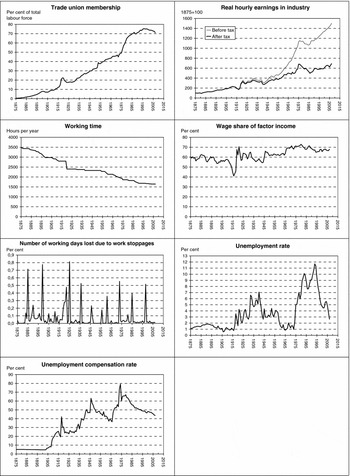
Figure 1 presents a range of key figures for the Danish labour market since 1875. The following observations and trends can be noted:
• Trade union membership has gradually increased from less than 10 per cent of the total labour force in the last quarter of the nineteenth century to more than 70 per cent in the early 2000s.
• The same period has witnessed a substantial increase in the level of real hourly earnings and a significant reduction in annual working time.
• The wage share of factor income has remained roughly unchanged at a level around 60–70 per cent, although with some local upward and downward trends.
• In general the Danish labour market system has delivered a high degree of industrial peace. The average number of working days lost due to work stoppages has amounted to less than 0.1 per cent of the total number of working days. Except for the years following immediately after the end of World War I – where syndicalism temporarily influenced the Danish labour movement – pronounced stability in labour market relations has characterised the whole period since 1875.
• The rate of unemployment displays marked persistence with peaks around the Great Depression in the 1930s and again during the 1980s and early 1990s.
• Finally, there has been an upward long-run trend in the unemployment compensation rate since the introduction of public subsidies to unemployment benefit associations in 1907. The swings in unemployment compensation seem to mirror the swings in the unemployment rate.
Key figures of the Danish labour market, 1875–2007
Sources: Figure 1 in Abildgren (Reference Abildgren2008) updated with revised data from the sources stated in the same work.
Note: The deflator for real hourly earnings in industry is the CPI. The tax rate applied to the calculation of real hourly earnings in industry after tax includes all direct and indirect taxes to the general government. The wage share of factor income is measured as the total wage sum in current prices in per cent of GDP at current factor cost. The number of working days lost due to work stoppages is measured in per cent of total number of working days. The unemployment rate is measured in per cent of the total labour force. The unemployment compensation rate is calculated as unemployment benefit in current prices per unemployed person in per cent of wage sum in current prices per employed person.

5. Monetary regimes and the anchoring of price and wage inflation
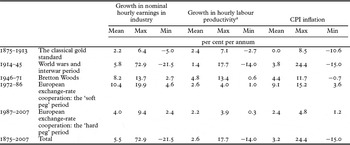
Table 1 shows a range of summary descriptive statistics on nominal wage inflation, labour productivity and consumer price inflation since 1875 broken down by subperiods determined by the Danish exchange-rate policy (cf. Abildgren Reference Abildgren2005).
Monetary regimes and wage inflation in Denmark: summary statistics, 1875–2007

Source: Table 1 in Abildgren (Reference Abildgren2008) updated with revised data from the sources stated in the same work.
a Compiled as annual growth in real total economy GDP per working hour.
During the classical gold standard period, 1875–1913, Denmark participated in the gold-based Scandinavian Currency Union together with Sweden and (from 1877) Norway. During this period all other major trading partners participated in the international fixed-exchange-rate gold standard system as well. The price level in Denmark was roughly unchanged in the period 1875–1913 overall, and average nominal wage inflation was low (2.2 per cent per annum).
The period 1914–45 saw rather frequent changes in the monetary regime. World War I de facto terminated the Scandinavian Currency Union and the international classical gold standard. After the war, Denmark and its major trading partners gradually returned to the gold standard, but the system collapsed again after a few years when the UK went off gold in September 1931. Denmark left the gold standard in the same month, and in 1932 a comprehensive exchange-control system was introduced. Apart from a major Danish devaluation in 1933, the Danish krone was pegged to the pound sterling most of the time until the outbreak of World War II. The average level of nominal wage inflation in the period 1914–45 was still moderate (5.8 per cent per annum), but volatility was substantial.
In the period 1946–71, Denmark participated in the Bretton Woods fixed-exchange-rate system. In the late 1940s the UK was still Denmark's largest trading partner and the devaluation of the pound sterling by 30.5 per cent in September 1949 was mirrored fully by Denmark. During the 1950s and 1960s, Denmark's trade pattern gradually shifted towards higher export shares to continental Europe, and the devaluation of the pound sterling in November 1967 by 14.3 per cent vis-à-vis the US dollar was only followed partly by Denmark (7.9 per cent). In the Bretton Woods period there was a sustained upward trend in the level of nominal wage inflation without a single year with negative wage inflation, whereas nominal wage deflation frequently occurred during the classical gold standard period and several times in the interwar period.
After the breakdown of the Bretton Woods system at the beginning of the 1970s, Danish exchange-rate policy became part of the European exchange-rate cooperation. In principle, a fixed-exchange-rate policy was pursued, but frequent devaluations of the Danish krone were observed until the early 1980s. During the period 1972–86, average nominal wage inflation reached double-digit figures and volatility was fairly high.
The last realignment of the central parity for Danish kroner vis-à-vis Deutsche Mark within ERM occurred at the beginning of 1987. Since then Denmark has pursued a ‘hard’ peg against the D-mark and later the euro. The period since 1987 has seen an average level of wage inflation of 4.0 per cent – the lowest level since the classical gold standard – and volatility has been very low.
The analysis above shows that wage inflation was lowest in those periods when Denmark pursued a consistent fixed-exchange-rate policy: the pre-1914 classical gold standard period and the hard peg vis-à-vis the D-mark (later the euro) since 1987. The latter period has also seen the lowest volatility in wage inflation. The historical evidence shows that in the case of Denmark a consistent fixed-exchange-rate policy has provided the best foundation for anchoring inflation expectations.
It is also worth noticing that in all the subperiods since 1875 shown in Table 1, average annual consumer price inflation has been approximately equal to average annual nominal wage inflation less average annual growth in hourly labour productivity. The advances in real hourly earnings before tax have approximately followed the development in labour productivity – irrespective of the type of monetary regime. In a long-run perspective, the growth in real hourly earnings thus seems to be determined by real factors (productivity) rather than nominal factors (the size of nominal wage increases). The role played by the monetary regime seems in the longer run only related to nominal variables – the ability to create a stable nominal anchor for the economy. However, as Figure 1 shows, the largest drops in real hourly earnings after tax occurred around World Wars I and II and in the decade following the mid 1970s. Those periods were characterised by high levels of CPI inflation. It seems thus to have its price if inflation expectations lose their anchor.
6. Length of collective agreements
For the period 1875–99 only sparse and fragmented information on the length of collective agreements in Denmark is available. For the earliest period – before collective agreements became common – the ‘schedules of wages’ were in some cases changed several times a year. By 1899 collective agreements were common in Copenhagen and the major Danish provincial cities (Galenson Reference Galenson1952). The metal trade industry gained a leading position by establishing a nationwide collective agreement in 1897, and several other trades followed suit during the second half of the 1890s (Christensen et al. Reference Christensen, Hansen and Kolstrup2007). However, the duration was seldom specified in the agreements. In many cases it was just stated that an agreement could be terminated after at least one year. There might have been a tendency towards somewhat longer duration than one year in the 1890s, especially in the second half of the decade (Nørregaard Reference Nørregaard1943; Galenson Reference Galenson1952).
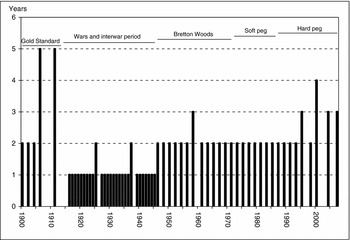
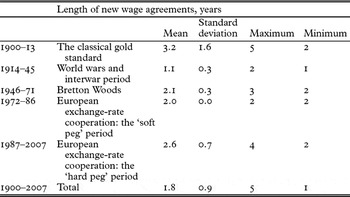
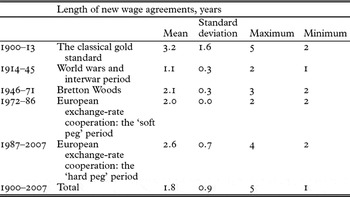
For the post-1900 period, Figure 2 shows the length of new collective agreements in the industrial sector. Table 2 presents a range of summary statistics. A few comments should be given on the nature of the data. For the period 1900–10 the information is only based on the collective agreements for the members of the Danish National Union of Smiths and Fitters, whereas the period since 1911 covers most of the industrial sector. The relatively low coverage ratio prior to 1911 raises the issue of whether the results for the classical gold standard period could be biased and calls for careful interpretation of the data. However, the Danish National Union of Smiths and Fitters was the largest trade union for skilled workers and accounted for 9 per cent of members of the LO in 1900 (Jensen and Olsen Reference Jensen and Olsen1901). Furthermore, the degree of unionisation among smiths and fitters was high, around 75–85 per cent in the period 1899–1912 (Maigaard Reference Maigaard1999), and the collective agreements concluded by the Danish National Union of Smiths and Fitters seem to have had a significant influence on other parts of the private labour market. In the period 1897–1914, the average working time in Copenhagen was quite close to the agreed working time in the collective agreements concluded by the Danish National Union of Smiths and Fitters (Christensen Reference Christensen1975).
Length of new collective agreements in the industrial sector, 1900–2007
Sources: Figure 2 in Abildgren (Reference Abildgren2008).
Note: The length has been rounded to a whole number of years.

Monetary regimes and length of new collective wage agreements in the industrial sector in Denmark: summary statistics, 1900–2007
Source: See Abildgren (Reference Abildgren2008).
In Figure 2 and Table 2, the lengths of new collective agreements are only reported as a whole number of years. However, during most of the period contracts in the private-sector labour market in Denmark have been negotiated for a whole number of years. If negotiations on new contracts are not completed until the expiry of the previous contract term, the new contracts usually enter into force retrospectively. The potential bias from rounding is therefore believed to be insignificant.
During the latter part of the classical gold standard period, the length of collective agreements increased from two to five years – the longest duration in the entire post-1900 period. This might reflect the credibility of the classical gold standard, which by then had delivered on the final target of price stability for quite some time; see Section 5. This provided the basis for inflation expectations firmly anchored around price stability and facilitated the use of multi-year nominal wage contracts among forward-looking workers and employers.
Wartime inflation reduced the term to one year, which, with a few exceptions, was the standard length of collective agreements in the interwar period. The world wars and the interwar period were characterised by higher and more volatile inflation than the classical gold standard period (see Section 5) and the lack of credibility of the monetary regime might – despite negotiation costs – have made shorter wage contracts more attractive.
In most of the post-World War period, the standard length of new collective agreements has been two years. However, in the last decade or so, contract lengths of three or four years have dominated. This might reflect the increased credibility of the Danish fixed-exchange-rate regime and the international decline of inflation rates during the 1980s and the beginning of the 1990s.
7. Use of automatic cost-of-living indexation in wage agreements
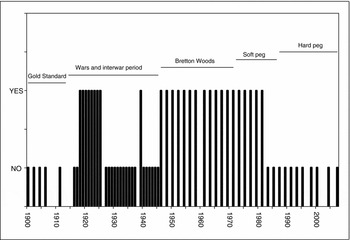
Figure 3 plots the use of automatic inflation indexation of wages in collective agreements in the industrial sector since 1900.
Use of automatic cost-of-living indexation of wages in collective agreements in the industrial sector, 1900–2007
Sources: Figure 3 in Abildgren (Reference Abildgren2008).

Inflation indexation was first introduced in the light of soaring inflation towards the end of World War I. It was a standard element in collective agreements during the first half of the 1920s. From 1927 automatic inflation indexation was no longer an element in the collective agreements until just before the outbreak of World War II.
After World War II, automatic cost-of-living indexation returned as a standard element in collective agreements until the early 1980s. Inflation indexation was suspended by an Act of Parliament as part of a set of income-policy initiatives in 1982 and abolished altogether in 1986. Since then automatic inflation indexation has not been part of the collective agreements in the industrial sector even though legislation does not prevent reintroduction by agreement between the labour market partners.
The Danish experience with automatic cost-of-living indexation of wages thus indicates that a monetary regime that results in high and volatile inflation encourages the use of inflation indexation of nominal wages among forward-looking agents, whereas a regime with low and stable inflation makes inflation indexation unnecessary.
8. Intervention in the renewal of collective agreements by Act of Parliament
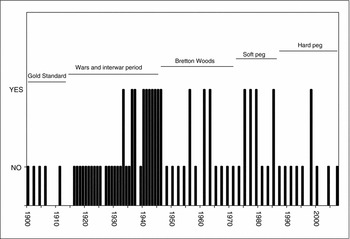
Figure 4 shows the level of intervention in the renewal of collective agreements by Act of Parliament in the period since 1900. The permanent compulsory arbitration enacted in 1940 and in force during the German occupation of Denmark until 1945 has been classified as ‘intervention’ for all of the years 1940–5.
Intervention in the renewal of collective agreements by Act of Parliament, 1900–2007
Sources: Figure 4 in Abildgren (Reference Abildgren2008).
Note: Parliamentary intervention is usually based on a compromise proposed by the Public Conciliator, which again normally builds on negotiation results reached by several of the sub-organisations in the labour market in various trades. There may thus be intervention that also covers the industrial sector, even though the worker and employer organisations within the industrial sector have managed to reach agreements prior to the involvement of the Public Conciliator and Parliament. Such cases have also been classified as intervention. The figure therefore shows the occurrence of interventions related to a large part of the private-sector labour market rather than interventions to settle disputes solely within the industrial sector.

Disregarding the World War II period, the labour market partners have most of the time reached collective agreements without any governmental intervention. However, starting with the ‘Kanslergade Agreement’ in 1933, there have been a few cases where the partners in the labour market have failed to agree on renewal of collective agreements and where the government has had to intervene. Intervention has usually been in the form of an Act of Parliament based on a compromise proposed by the Public Conciliator; see Section 4.
No clear links can be established between the level of intervention in the renewal of collective agreements and the type of monetary regime. However, so far the most recent ‘hard peg’ period has seen only one case of intervention.
9. Degree of centralisation in the collective bargaining system
The degree of centralisation in the collective bargaining system is difficult to measure. Intervention by Act of Parliament in a sense represents a high degree of centralisation. However, parliamentary intervention is usually based on a compromise proposed by the Public Conciliator, which again normally builds on negotiation results reached by several of the sub-organisations in the labour market in various trades.
The degree of centralisation in the Danish collective bargaining system in the time-span from 1934 to 1993 has previously been subject to closer analysis (Due et al. Reference Due, Jensen, Madsen and Petersen1994). Due et al. apply a classification system with seven centralisation degrees. Degree one represents the most decentralised type of bargaining where the sub-organisations in the labour market obtain the negotiation results, while degree seven represents situations with political intervention. Degrees two to six depend on the scale of involvement of the main labour market organisations (DA and LO) and the Public Conciliator. The analysis indicates that the period 1934–93 can be divided into three phases characterised by their own form of collective bargaining, although the authors underline that each phase contains atypical bargaining situations. In the first phase, 1934–50, and the third phase, 1981–93, the sub-organisations played a key role in the collective bargaining process, whereas the main organisation played a larger role in the second phase, 1951–79. Furthermore, in the first phase the DA maintained a high degree of control of the bargaining conducted by its members. The most decentralised collective bargaining with the largest involvement of the sub-organisations has thus occurred in the post-1980 period. The study furthermore notes that the negotiations since 1991 might even be seen as the beginning of a new fourth decentralised phase where the details are filled in at firm level.
The Danish Economic Council has also emphasised the trend towards decentralisation in collective bargaining in the most recent decades (Det Økonomiske Råd Formandskabet 2007). Since the late 1980s the wage systems have changed towards more flexible pay systems (minimum-wage agreements, minimum-pay agreements and agreements without minimum rate), where the actual pay is fixed at firm level. In 2004 these flexible wage systems covered 84 per cent of the LO/DA area compared with 66 per cent in 1989. The share of normal-wage agreements, in which pay is mainly determined centrally by the main organisations, has declined correspondingly from 34 per cent in 1989 to 16 per cent in 2004.
Prior to World War I, the main organisations played only a limited role in the collective agreements. There might therefore be a tendency towards more marked decentralisation in periods when the monetary regime delivers on the final target of price stability, i.e. the pre-1914 classical gold standard period and the hard peg period since 1987; see Section 5. An environment with low (and stable) inflation eases the formation of inflation expectations, which might promote decentralised wage negotiations. High inflation and pronounced inflation volatility require more resources to forecast inflation and form inflation expectations. This might give centralised labour market organisations a larger role to play as they can allocate the necessary professional resources to make inflation forecasts in relation to collective nominal wage bargaining.
10. Regime classification and identification issues
In this article, the regime division has been based on the monetary regime. Naturally, it is difficult to identify whether low inflation and inflation volatility are due to the absence of shocks or the success of the monetary regime. Inflation expectations – and thereby labour market structures – might depend more on the actual economic outcome than on the monetary regime as such.
This issue can be emphasised by a comparison of the results since the mid 1990s from the Swedish and Danish studies. In Fregert and Jonung (Reference Fregert and Jonung2008), the period since the mid 1990s stands out as an exceptionally stable regime characterised by relatively long non-indexed wage contracts. According to Fregert and Jonung, the reduced macroeconomic uncertainty is attributable to successful implementation of inflation targeting in Sweden during this period. The current article shows that Denmark has seen the same tendency towards longer wage contracts since the mid 1990s. In this period Denmark has pursued a firm fixed-exchange-rate policy – not inflation targeting.
One reading of these results would be that it is the success of the monetary regime – and other economic policies – in delivering on the final target of price stability that matters, rather than the choice of monetary-policy strategy (inflation targeting versus fixed exchange rates) as such.
Another interpretation could be that the low and stable inflation observed in both Denmark and Sweden during the most recent decades is primarily attributable to global inflationary trends rather than the monetary regimes in Denmark and Sweden. The same might have been the case towards the end of the pre-World War I classical gold standard era characterised by global price-level stability.
However, the apparent correlation between monetary regimes and labour market structures in Denmark and between policy regimes and labour market structures in Sweden seems to suggest that labour market structures depend on the macroeconomic environment and outcomes and are thus to some degree endogenous.
11. Concluding remarks
Based on the historical evidence for Denmark over the past century or so, it seems that parts of the labour market structure are endogenous. Contract terms were longest towards the end of the classical gold standard period and during the period since the mid 1990s with a hard peg vis-à-vis the D-mark and later the euro. Both periods were characterised by low and stable inflation. The shortest contract lengths were found in the interwar period with high inflation volatility. Inflation indexation was used most extensively in the Bretton Woods period and during the soft peg of the 1970s when inflation was high and raising.
Similar indications of policy-regime dependence of labour market structures have previously been found in a long-term study for Sweden. The empirical evidence from Denmark and Sweden thus indicates that the degree of nominal rigidities in the economy is not necessarily approximately constant, as it is otherwise assumed in many New Keynesian DSGE models. Explicit modelling of the links between monetary regime and labour market structures might be particularly important if such models are to be used for analysis and comparison of alternative monetary regimes without being subject to the Lucas critique.
Acknowledgements
The author is grateful to the editors of this journal and two anonymous referees, whose insightful and constructive comments and suggestions have been significant in helping to tighten and shape the focus of this article in the review process. Furthermore, the author wishes to thank colleagues from Danmarks Nationalbank for useful comments on preliminary versions of this article. Views and conclusions expressed in this article are those of the author and do not necessarily represent those of Danmarks Nationalbank. The author alone is responsible for any remaining errors.