


Election fraud is widely believed to undermine political responsiveness. Scholars and policymakers assume that vote rigging weakens the two channels through which elections can influence politician behavior: selection and sanction. When politicians can rig elections, it undermines citizens’ ability to select competent or public-spirited politicians who share their interests (Besley Reference Besley2005; Fearon Reference Fearon, Przeworski, Stokes and Manin1999). Likewise, voters cannot vote out poorly performing or corrupt incumbents if officeholders can manipulate the polls (Ferejohn Reference Ferejohn1986). Vote rigging breaks down the “electoral connection” between citizens and politicians, decreasing incumbents’ incentives to work hard to win.
Despite the widespread belief that fair elections generate political responsiveness, and the billions of dollars spent annually to support programs such as domestic election monitoring to bolster electoral integrity (Annan et al. Reference Annan, Zedillo, Ahtisaari, Albright, Arbour, Helgesen, Hunaidi, Mogae, Sen, Solana, Vike-Freiberga and Wirajuda2012; Norris Reference Norris2014), we lack solid evidence regarding whether and how high-quality elections incentivize politicians to be more responsive to citizens’ needs.Footnote 1 I provide, to my knowledge, the first systematic analysis of the causal relationship between fair elections and political responsiveness.
I theorize that high-quality elections increase political responsiveness because fair balloting limits politicians’ ability to win through outright manipulation. Accordingly, programs such as election observation that constrain vote rigging will encourage officeholders to invest instead in efforts to meet the needs (and earn the support) of their constituents. My argument implies that incumbents who expect limited opportunities for election-day fraud—which increases the possibility of electoral sanction—will be more responsive to citizens’ needs. Alternatively, higher quality elections may increase political responsiveness through enabling voters to select high-quality candidates to office.
Testing whether high-quality elections cause politicians to work harder on behalf of citizens requires exogenously varying the integrity of the election in which an officeholder is elected. This poses an empirical challenge because it is hard for researchers to randomly assign electoral districts (or countries) to different levels of election quality. To overcome this difficulty, I leverage insights from research on election observation, a popular initiative used by civil society groups to reduce election fraud and promote democratic accountability (Bjornlund Reference Bjornlund2004).
Specifically, I use data from a field experiment that randomized the intensity of election observation (IO) by Ghana’s largest domestic election observation group, the Coalition of Domestic Election Observers (CODEO), across 60 electoral districts in the country’s 2012 elections (Asunka et al. Reference Asunka, Brierley, Golden, Kramon and Ofosu2019). Constituencies received one of three levels of election-monitoring intensities, in which 30, 50, and 80% of a fixed proportion (30%) of polling stations were monitored. Given that observers reduce fraud and that greater intensities of observers reduce fraud more (Enikolopov et al. Reference Enikolopov, Korovkin, Petrova, Sonin and Zakharov2013; Hyde Reference Hyde2008; Ichino and Schündeln Reference Ichino and Schündeln2012), I use the IO within a constituency as an exogenous instrument for election integrity. I argue that experience with high IO incentivize democratic responsiveness because incumbents believe they cannot rig their reelection. Because the IO was randomized, differences in the performance of politicians elected in low—versus high—monitored constituencies during their four-year terms in office can be interpreted as the causal effect of fairer elections on responsiveness.
It is not obvious that improving election quality through high-intensity election-day monitoring will generate political responsiveness. First, politicians may simply shift their fraudulent or undemocratic activities to the period prior to the next elections. For example, incumbents can circumvent the need for election-day fraud by inflating the voter list with unqualified voters (Ichino and Schündeln Reference Ichino and Schündeln2012), bribing their way in legislative primaries (Ichino and Nathan Reference Ichino and Nathan2012) or engaging in vote buying (Kramon Reference Kramon2016). Second, officeholders may simply discount their reelection prospects and maximize their rent-seeking opportunities because they cannot rig (Bates Reference Bates2008). Third, irrespective of their quality, elections may fail to motivate politicians to satisfy citizens’ needs if voters lack information on incumbent performance (Grossman and Michelitch Reference Grossman and Michelitch2018; Humphreys and Weinstein Reference Humphreys and Weinstein2012) or are indifferent to officeholders’ performance, and respond instead to ethnic or party cues, clientelistic arrangements, or the instruction of traditional leaders (Posner Reference Posner2005; van de Walle Reference van de Walle2003; Wantchekon Reference Wantchekon2003). Because of these theoretical possibilities, it is important to establish whether cleaner elections are fundamental to democratic responsiveness.
In many developing countries, including Ghana, scholars suggest that citizens are more likely to demand local public goods and private benefits from their legislators rather than legislation and executive oversight (Barkan et al. Reference Barkan, Mattes, Mozaffar and Smiddy2010; Lindberg Reference Lindberg2010).Footnote 2 Therefore, to measure responsiveness, I collected fine-grained data on Members of Parliament’s (MP’s) spending of their state-provided individual Constituency Development Funds (CDFs) during their four-year terms.Footnote 3 Similar to legislators in other developing countries, MPs in Ghana established these funds to deliver both private benefits and public goods (infrastructure) to address the gaps in public service delivery in their constituencies (Baskin Reference Baskin2014). However, prior work in India finds that, because using CDFs requires effort, representatives often do not use these funds unless they face high levels of electoral competition (Keefer and Khemani Reference Keefer and Khemani2009). Accordingly, the CDF usage rate is an objective measure of responsiveness. The fact that MPs have discretion over the use of these funds also ensures that analyzing CDF spending reveals whether politicians prioritize local public goods or private benefits.
I supplement the information on CDF spending with data from two sources. First, I collected four years of administrative records on MPs’ parliamentary attendance. Second, I conducted closed-ended surveys with MPs to investigate their experiences with past election monitoring (and assess their level of other constituency activities). Using a rich set of information on MPs’ behavior allows me to examine which legislator roles—constituency service versus legislative duties—fairer elections impact, and whether there are substitution effects (Ashworth and Bueno de Mesquita Reference Ashworth and Bueno de Mesquita2006).
My main finding is that higher quality elections increase the responsiveness of politicians. Specifically, the results show that politicians elected in intensely monitored constituencies spent 19 percentage points more of their total funds compared with MPs elected in low-monitored constituencies. Additionally, my analysis shows that higher levels of spending on public goods substantially drives the significant difference in overall expenditure between MPs elected in high—versus low—monitored constituencies. To the best of my knowledge, these findings are the first to show that intensive election monitoring, by decreasing fraud and violence, also produces a downstream effect on political responsiveness, suggesting that cleaner elections generate concrete benefits for citizens. Finally, I find that politicians elected in high-monitored constituencies were equally as present as their counterparts elected in low-monitored constituencies during parliamentary meetings, which suggests that fairer elections do not encourage officeholders to attend more legislative sessions or to substitute constituency service for legislative work.
Tests of mechanisms suggest that incumbents’ fear of voter sanction through intense election-day monitoring in the next election may explain my findings. First, survey evidence indicates that a majority of legislators believe that election monitoring reduces their ability to rig elections and that those in intensely monitored constituencies were more likely to say they experienced more observers in the past elections. I assume that such experience with past monitoring influences an incumbent’s belief about future observation and encourages them to work harder. Second, and to systematically test my assumption, I experimentally manipulate the expectations of high-level monitoring in future elections to see if this affects legislators’ behavior. I do so by sending individual letters to 30 of the 60 MPs to say that they should expect to receive intense monitoring of their constituencies in the December 2016 parliamentary elections. MPs in the control group did not receive a letter.
Consistent with my expectation, I find that MPs who received a letter increased their spending by five percentage points, on average, compared with those who did not. Importantly, MPs who were elected in intensely monitored constituencies and received a letter spent four percentage points more of their funds on public goods compared with legislators in low-monitored constituencies who just received a letter. These effects are substantively (but not statistically) significant, and provide preliminary causal evidence for the proposed mechanism that officeholders who are elected in fairer elections and expect to compete in another one are more responsive to citizens’ needs. I do not find that the observer intervention significantly influenced the number of candidates or the profile of those elected, which would suggest a selection mechanism. Finally, I do not find that the IO influences citizens’ contact with officeholders, which would indicate a citizens’ pressure mechanism, or an increase in the number of challengers in the next elections, which would imply a candidate entry channel of influence (Grossman and Michelitch Reference Grossman and Michelitch2018).
This study makes three contributions to the literature on electoral accountability. First, it provides new evidence that the quality of elections is an important determinant of political responsiveness. My work complements previous findings that electoral integrity affects outcomes such as political participation (Birch Reference Birch2010), regime legitimacy (Berman et al. Reference Berman, Callen, Gibson and Long2014), and stability (Hyde Reference Hyde2008). Second, the literature on electoral accountability has thus far considered how institutional factors such as term limits, electoral systems, and rewards from office (see Ashworth Reference Ashworth2012) and information asymmetries (see Dunning et al. Reference Dunning, Grossman, Humphreys, Hyde and McIntosh2019) shape the efficacy of elections. I show that election-day manipulation also affects democratic accountability. Finally, I contribute to the literature on election observation, which to date has focused on the effect of observers on voter registration fraud before the polls (Ichino and Schündeln Reference Ichino and Schündeln2012), and on polling station-level fraud and violence on the election day (Enikolopov et al. Reference Enikolopov, Korovkin, Petrova, Sonin and Zakharov2013; Hyde Reference Hyde2008). I show that election observers can affect political outcomes long after the election day.
ELECTORAL INTEGRITY AND POLITICIANS’ RESPONSIVENESS
Electoral accountability models suggest that elections affect politicians’ performance through two distinct but reinforcing principal channels (Ashworth Reference Ashworth2012). First, elections help voters to screen candidates, selecting competent or public-spirited types who voters believe work harder in office (Besley Reference Besley2005; Fearon Reference Fearon, Przeworski, Stokes and Manin1999). Indeed, empirical evidence suggests voters prefer honest and high-quality politicians in diverse settings (Besley Reference Besley2005; Bratton Reference Bratton2013; Galasso and Nannicini Reference Galasso and Nannicini2011).
Second, competitive elections can incentivize officeholders to perform well, irrespective of candidates’ quality, because voters can retrospectively sanction poor performance (Ferejohn Reference Ferejohn1986). While politicians may be self-interested and rent-seeking, expectations of electoral discipline motivates reelection-seeking incumbents to put in optimal effort, choosing a (costly) level of effort to satisfy voters’ endogenously established welfare utility threshold (Mayhew Reference Mayhew1974).
Although the selection and sanctioning models of electoral accountability provide plausible explanations for an incumbent’s performance in office, both models typically assume that elections are run honestly—that the will of the voters is accurately reflected in the results. I argue that both channels of influence can be subverted by election-day fraud and that the extent to which politicians can rig elections influences their incentives to cater to citizens’ demands (Collier and Hoeffler Reference Collier and Hoeffler2015).
Concerning selection, other things being equal, election-day fraud may undermine citizens’ ability to elect politicians who share their interests simply because the candidate most voters cast their votes for is not declared as the winner. Because the “winner” may not share the preferences of voters, (s)he is unlikely to satisfy citizens’ needs. Regarding sanctioning, I argue that incumbents can either rig elections to remain in office or “earn” their reelection by working harder to meet voters’ expectations. Obviously, incumbents can win office using other means such as vote buying, access to more campaign funds, media coverage (incumbency advantage), or obscuring information about their performance. Nevertheless, because officeholders cannot rely on these methods, they often supplement these assets at their disposal with vote rigging. All else equal, I argue that when it is easy for incumbents to engage in election-day fraud, they can reduce the time, personal resources, and amount of effort they devote to address constituents’ needs, and instead pursue their private business activities to earn outside rents.
In keeping with electoral accountability models, my argument implies that the quality of elections may encourage political responsiveness through two theoretically distinct channels. First, if we observe that an incumbent who was elected in a high-quality election (at time t − 1) works harder in office (at time t), it is possible that voters succeeded in selecting a competent candidate who shares their preferences. We can examine this possibility by simply comparing the personal attributes or policy preferences of incumbents elected in cleaner elections to those selected through manipulated ones. Second, incumbents’ expectations of competing in fairer election (at time t + 1) that would strengthen voters’ ability to punish shirking or “select them out” may incentivize higher performance (at time t). Such prospective beliefs may derive from past constraints on rigging or exogenous changes in election administration that would limit fraud.
Also, the latter channel of influence, expectation of sanction, suggests that an incumbent’s incentive to serve the interests of citizens depends not only on being elected in high-quality elections but also on “expecting” to compete in another one (at time t + 1). Even when elected in credible polls, incumbents who believe they can rig future polls may simply shirk their duties.
The effects of fairer elections may vary by levels of electoral competition. In Uganda, Grossman and Michelitch (Reference Grossman and Michelitch2018) find that disseminating information about the performance of politicians broadly to citizens increased officeholders’ efforts, but only in competitive constituencies where viable alternative candidates were available or encouraged by the initiative to enter the race. Accordingly, it is possible that an attempt to improve the quality of elections to induce political responsiveness may be more effective in competitive compared with noncompetitive constituencies. However, if parties and candidates use election fraud and intimidation to maintain their dominance in noncompetitive areas (Magaloni Reference Magaloni2006; Simpser Reference Simpser2008), then improving the quality of elections may motivate incumbents to roll up their sleeves (similar to their counterparts in competitive areas).
Political responsiveness involves doing what citizens want or acting in their interests (Pitkin Reference Pitkin1967; Powell Reference Powell2005). To get reelected, and unable to rig, I argue that incumbents are likely to exert a higher effort to satisfy voters’ priorities. Research on African legislators suggests that citizens prioritize constituency service over parliamentary work (Lindberg Reference Lindberg2010). Therefore, officeholders elected in high-quality elections are likely to increase their supply of constituency service (H1). On the other hand, fairer elections may induce incumbents to reduce the effort they put into parliamentary work (H2), perhaps shifting their efforts to providing constituency service (Ashworth and Bueno de Mesquita Reference Ashworth and Bueno de Mesquita2006). Scholars consider most African parliaments as weak, relative to the executive branch (Barkan Reference Barkan2009). Thus, if fairer elections further encourage legislators to reduce their attendance in parliament and instead dedicate their time to investigating citizens’ local needs and to putting pressure on their local governments or seeking donor funds to provide them, that would be theoretically important to know.
Regarding constituency service, which involves satisfying the nonpolicy concerns of citizens (Fenno Reference Fenno1978), MPs can prioritize the provision of public or private goods to maximize their votes. There is no consensus on which type of good—public or private–is more important in determining vote choice in democracies in sub-Saharan Africa. A dominant narrative of African politics would lead us to believe that to win votes in fairer elections, MPs resort to providing benefits to individuals or groups (Wantchekon Reference Wantchekon2003). Thus, legislators elected in high-quality elections are likely to satisfy citizens’ demand for private goods (H1a). However, emerging research suggests that African voters grant their votes to politicians in exchange for local public goods and services (Ichino and Nathan Reference Ichino and Nathan2013; Lindberg Reference Lindberg2010). Accordingly, high-quality elections would induce MPs to provide more public goods (i.e., local infrastructure) (H1b) including schools, clinics, bridges, and roads that are easily attributable to their efforts and enable them to satisfy more voters (Harding Reference Harding2015). Politicians may also simply provide both public and private goods, targeting the entire population with the former while rewarding supporters with the latter (Diaz-Cayeros, Estévez, and Magaloni Reference Diaz-Cayeros, Estévez and Magaloni2016). I combine original data on legislator spending and parliamentary attendance to examine these theoretical possibilities.
STUDY CONTEXT: GHANA
Ghana is an ideal setting for this study because the level of electoral competitiveness and turnover means that politicians have real incentives to think about how they use their resources when seeking reelection. Similar to many other countries, Ghana adopted multiparty elections in November 1992. Its 2012 general elections, which elected the 2013–17 Parliament, were the sixth. Ghanaian legislators are elected to four-year terms from single-member districts using plurality rule; they are not subject to term limits. Currently, the Parliament is composed of 275 members.Footnote 4 During the 2013–16 Parliament, 148 MPs belonged to the ruling National Democratic Congress (NDC), 123 to the main opposition party, the New Patriotic Party (NPP), and one to the People’s National Convention. There were three independent MPs. The NPP and NDC have dominated Ghanaian electoral politics since 1996: the two parties have controlled more than 98% of the seats. However, parliamentary races are increasingly competitive. Between 1996 and 2012, the average vote margin declined by about 11 percentage points (pp).Footnote 5 Also, between 2000 and 2012, the average turnover rates for incumbents seeking reelection was 24%.Footnote 6
Despite the increasing electoral competitiveness, Ghanaians provide poor ratings of their legislators. For example, in Afrobarometer Round 6 conducted in 36 African countries, about 63% of Ghanaians said that they disapprove of their MP’s performance compared with the continental average of about 45%. Similarly, 48% of Ghanaians reported that all or most of their MPs are involved in corruption, compared with the continental average of 34%. These poor ratings may be explained by high expectations of Ghanaians of their representatives after more than two decades of democratic elections. However, they may also be due to politicians’ ability to manipulate local elections.
Several studies indicate that the country’s elections are often characterized by some level of fraud and violence (Gyimah-Boadi Reference Gyimah-Boadi2007; Ichino and Schündeln Reference Ichino and Schündeln2012; Jockers, Kohnert, and Nugent Reference Jockers, Kohnert and Nugent2010; Straus and Taylor Reference Straus, Taylor and Bekoe2012). Scholars argue that the enormous benefits and patronage resources that officeholders receive encourage these practices (Gyimah-Boadi Reference Gyimah-Boadi2009; Ninsin Reference Ninsin2016). Election fraud (and violence) routinely goes unpunished. For example, following the 2012 general election, the main opposition party (NPP) filed a petition in the country’s Supreme Court pointing to several irregularities in the polls. Although the Supreme Court acknowledged some of the allegations in its verdict, no election official or party was indicted, and the case was dismissed. Thus, fraud and violence are viable options for officeholders who face stiff competition or seek to ward off strong competitors (in noncompetitive constituencies).Footnote 7
To curb electoral fraud, civil society groups such as the Coalition of Domestic Election Observers (CODEO), with support from international donors, have monitored the country’s elections since 1996. CODEO has observed all of the country’s general and local government elections held since its formation in 2000. The group is composed of 34 independent civil society organizations including religious, professional, and student bodies. In 2012, CODEO deployed about 4,000 observers to polling stations around the country on the election day. Similar to other domestic election observation groups, CODEO’s aim is to promote election integrity and strengthen political accountability. During the December 2012 elections, Asunka et al. (Reference Asunka, Brierley, Golden, Kramon and Ofosu2019) leveraged CODEO’s observation mission to examine the causal effects of election observers on indicators of election-day fraud and violence. Because observers wear uniforms (i.e., official CODEO T-shirts and caps), they are easily identifiable to election officials, party operatives, and voters. Empirical work suggests that the presence of observers deter election-day fraud and violence at polling stations and within constituencies. Because election observation remains a popular approach to promoting election integrity, it is important to examine whether such efforts, by reducing opportunities for fraud, ultimately improve the quality of political representation in new democracies.
RESEARCH DESIGN
Varying the Quality of Elections in which Politicians Are Elected
In Ghana’s 2012 election, together with colleagues, we employed a randomized saturation design (Baird et al. Reference Baird, Bohren, McIntosh and Özler2018) to measure the impact of monitors on election-day fraud and violence at polling stations across electoral constituencies (Asunka et al. Reference Asunka, Brierley, Golden, Kramon and Ofosu2019). Using this design, we first assigned a regionally representative sample of 60 constituencies to one of three election observation intensities (IO): low (30%) (13 constituencies), medium (50%) (24), and high (80%) (23). The IO is the proportion of a fixed percentage (30%) of polling centers in a constituency to deploy monitors. Second, within these constituencies, CODEO deployed about 1,300 observers to the sampled polling stations with probabilities determined by the first-stage randomly assigned saturation. The observers stayed at their assigned stations throughout the election day. Our study constituencies were nested within four of the country’s ten regions: Ashanti, Volta, Central, and Western regions, which we chose to get a mix of competitive (23) and noncompetitive (37) constituencies.Footnote 8
In addition to estimating the unbiased direct effect of observers on fraud and violence, the randomized saturation design allows us to calculate the total causal effect (TCE) of monitors in constituencies, accounting for possible spillover effects (Baird et al. Reference Baird, Bohren, McIntosh and Özler2018). The key idea is that because monitors often cover only a fraction of stations within a constituency, political party operatives can move their fraudulent activities to unmonitored stations (i.e., displacement effect), or desist from electoral malpractices in nearby polling stations (i.e., deterrence effect) (Ichino and Schündeln Reference Ichino and Schündeln2012). By assigning some constituencies to receive fewer monitors and others to receive significantly more observers, we can estimate the net effect of observers on fraud and violence within constituencies by comparing average electoral outcomes for (monitored and unmonitored) polling stations in intensely monitored districts to control stations in districts with fewer monitors, which by design are less susceptible to spillover effects.
Our estimates of the spillover-corrected direct and total effect of observers on election-day fraud suggests that intense election-day monitoring reduced the overall level of fraud and intimidation or made manipulation costly and risky for political parties. Specifically, we find that in medium and high IO constituencies observers reduced turnout rates by 7 and 6 pp (significant at the five percent level), respectively, at polling station to which they were deployed. Regarding the TCE, we find that increasing the IO from low to medium or high reduced turnout by 5.6 (p = 0.08) pp and 5.5 (p = 0.07) pp, respectively (see Appendix Table H.1). Table H.1 also breaks the TCE results by level of electoral competition. The results show that the decreases in fraud are substantially large in competitive electoral districts (significant at the ten percent level) but small and not statistically significant in noncompetitive electoral areas. As we argue in Asunka et al. (Reference Asunka, Brierley, Golden, Kramon and Ofosu2019), these results suggest that while observers were able to reduce the overall level of fraud in competitive areas, they displaced it in noncompetitive areas. Accordingly, in noncompetitive constituencies, politicians were able to recover deterred fraudulent votes, but the presence of more observers likely increased the cost and risk of manipulation.
Concerning intimidation of voters, election monitors reduced violence by 4 and 6 pp at polling stations to which they were deployed in medium and high IO constituencies, respectively. These results are significant at the five percent level. However, we find that the TCE of monitors was only substantially large in noncompetitive constituencies, where observer reduced the incidents of voter intimidation by 7 (p = 0.16) pp and 9 (p = 0.06) pp in medium and high IO constituencies, respectively, from a baseline of 13.5%. In competitive constituencies, the TCEs were an increase of 10.4 (p = 0.19) and 1.5 (p = 0.59) in medium and high IO electoral districts, respectively, from 3.9% in the low IO, which suggest a potential displacement of violence. Accordingly, in the full sample, we find that observers reduced the overall level of voter intimidation by 5.4 pp in high-IO constituencies from 10.2% in low-IO electoral districts, a 53% decrease. The results are only statistically significant at p = 0.14. In medium-IO constituencies, the TCE is essentially zero.
In sum, higher IO reduced overall fraud or increased the cost of election manipulation across constituencies, on average. Important for my study, I assume that experiences with such intense monitoring will influence the prospective beliefs of incumbents about their ability to rig future polls and shape their behavior in office. I argue that because the IO was randomized, it offers a relevant exogenous instrument for the quality of elections—the intensity of election observation—in constituencies from which incumbents were elected. I refer to this initial random assignment of the intensity of election-day monitoring as Actual Intensity of Observation (AIO). Regarding election-day fraud, the effects of medium and high monitoring are not statistically distinguishable from one another. Given the limited initial sample of constituencies (N = 60) and the constraints it places on the statistical power on a follow-up experiment (described next) to examine causal mechanisms, I consider both medium and high constituencies as high-AIO districts (47). Accordingly, in the analysis, I compare the behavior of politicians elected in these intensely monitored constituencies with those from low-AIO (13) electoral districts during their terms in office (at time t).Footnote 9
Varying Expectations About Future Election Quality
In comparing the performance of incumbents elected in low-AIO with those in high-AIO, I assume that officeholders’ expectations of intensity of monitoring in the next polls coincide with previous levels. I provide evidence in the mechanism section below to show that such an assumption is plausible. However, to test whether such beliefs influence performance, I complemented the initial experiment by dispatching letters to a random set of 30 of the initial 60 MPs (blocking on their initial AIO); MPs in the control group did not receive a letter. In keeping with recent research on monitoring corruption, the letter was designed to alter officeholders’ beliefs about the chances of election-day fraud detection (Callen et al. Reference Callen, Gibson, Jung and Long2016; Olken Reference Olken2007). In consultation with CODEO, the letters stated that evidence from academic research on the country’s 2012 elections shows that more observers in a constituency reduced the overall levels of fraud (i.e., suspicious turnout rates) and voter intimidation. The legislators were then told that, to corroborate these results, I was collaborating with CODEO to replicate the study because, if true, the findings hold promise for democratic consolidation in the country. Appendix B shows copies of these letters.
The letter then informed the MPs that as part of the study, CODEO plans to deploy observers to 80% of polling stations in some constituencies in the upcoming (2016) elections, and that theirs happens to be one of those. The letter was stated in probabilistic terms because the number of observers CODEO could eventually deploy depended on the availability of donor funds, which was not known at the time I circulated the letters. However, I sent out the letters in November 2015 to give incumbents enough time to respond to the treatment in meaningful ways.Footnote 10 Indeed, CDF programs take time to implement. For example, Harris and Posner (Reference Harris and Posner2019) find that in Kenya 56% of the projects implemented by MPs using their CDFs took a year, whereas about a quarter took two years. Accordingly, the probabilistic nature of the letter represents a compromise with CODEO and implies that the treatment may be weak. Nevertheless, it provides a useful first step to understand the effects and potential causal channels through which quality elections influence political responsiveness.Footnote 11
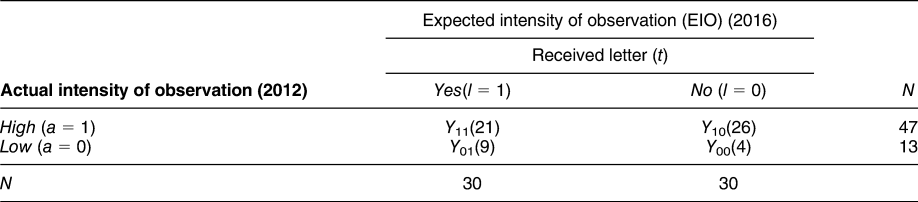
I refer to the letter treatment as expected intensity of observation (EIO). I delivered letters to treated MPs in person and read the content of the letter to them.Footnote 12 As a reminder, another letter was sent to MPs’ mailboxes (followed by phone calls to confirm receipt) in April 2016. By sending letters to MPs who received intensive and less-intensive observation during the 2012 elections, during their last year in office, my experiments yield a 2 × 2 design with four types of incumbents (see Table 1).
Experimental Design

In 2016, the two treatments at times t − 1 (AIO (a)) and t (EIO (l)) generate four sets of MPs (Y al) represented by the row and column cells of Table 1 as follows:
1. Y 11: MPs elected in high-AIO constituencies in 2012 who received a letter to expect a large number of observers in their constituency in the 2016 elections
2. Y 10: MPs elected in high-AIO constituencies in 2012 who did not receive a letter
3. Y 01: MPs elected in low-AIO constituencies in 2012 who received a letter to expect high IO in 2016
4. Y 00: MPs elected in low-AIO constituencies who did not receive a letter to expect high IO.
This set of potential outcomes allows us to examine causal mechanisms linking intensely monitored election and the responsiveness of officeholders. First, if receiving a letter to expect greater monitoring boosts performance (i.e., E[Y 01] − E[Y 00] ≠ 0, and E[Y 11] − E[Y 10] ≠ 0), it would be consistent with the “expectation of sanction” channel of influence. Second, a higher EIO effect among legislators elected in high-AIO compared with low-AIO would provide further evidence to indicate that being elected in fairer elections and expecting to compete in another one is what drives political responsiveness. By contrast, if the letter does not affect performance, it would provide support for a potential selection effect—that it was the initial selection of an officeholder in high-AIO that mattered.
However, the analyses generated by the two treatments are limited to the final year of each MP’s four-year term and is further constrained by the limited number of cases in each of the treatment conditions (as shown in parentheses). Moreover, if legislators respond to different demands of citizens at various points in the electoral cycle (e.g., providing public goods early in their terms in office and supplying private benefits during an election year), the dimension of incumbents’ efforts that the EIO may affect could differ from that of the AIO that was implemented before the MP took office (Michelitch and Utych Reference Michelitch and Utych2018). However, these analyses provide an essential complement to the primary analysis on whether or not improving the quality of the election at time t − 1 increases the responsiveness of incumbents to explore causal mechanisms. The research design also provides a model for future investigation.
Measuring Politicians’ Responsiveness
To obtain direct measures of politician effort on constituency service and parliamentary work, I use data on legislators’ spending of their CDFs and attendance in parliament, respectively.
CDF spending provides an appropriate measure of responsiveness with which to test my theoretical predictions about the influence of quality elections on different types of constituency services for two reasons. First, MPs have to exert a significant amount of effort to use their funds, and their spending directly benefits members of their constituency.Footnote 13 Ghana established its MPs’ CDF in 1992 as part of the country’s District Assembly Common Fund (DACF) [Article 252 of the 1992 constitution]. The DACF represents a proportion (at least 5%) of national revenues disbursed to the country’s 216 local governments for community development projects.Footnote 14
The central government sets aside a portion of the DACF, which it then allocates equally among MPs as CDFs each year. The national Fund Administrator (FA) deposits an MP’s money into a bank account maintained by the local government that serves the legislator’s constituency. To use these funds, MPs need to submit their plans to the local government and satisfy both legal and bureaucratic requirements. For example, to construct a bridge or repair a road in a local community, an MP must submit at least three price quotations from different vendors (Section 43 of the Public Procurement Act 663, 2003). The mayor and the procurement committee of the local government will then approve payment for the winner of the bid. These processes take time and energy.Footnote 15 In the case of providing personal assistance such as paying the school fees or medical bills of individual constituents, MPs must write letters providing reasons for the requests and the lists of selected recipients. Because MPs can decide whether to use these funds, the rate of usage provides a reasonable measure of effort. In this regard, this study joins an emerging literature that uses politician spending of CDFs or other central government transfers in their electoral districts as a measure of responsiveness (e.g., Asunka Reference Asunka2017; Harris and Posner Reference Harris and Posner2019; Keefer and Khemani Reference Keefer and Khemani2009).
Second, when MPs decide to use their funds, they have discretion over the allocation. They can either decide to provide public goods or private benefits to their constituents. Analyzing how MPs allocate their funds provides a way to examine which types of citizen demands they prioritize. I consider the proportion of funds that each legislator spends on public goods and private benefits with the assumption that spending on the former is more responsive because it aligns with what majority of voters want.
Between 2014 and 2016, each Ghanaian MP was allocated GHC1,264,987 (≈$316,246).Footnote 16 Unspent funds are rolled over to the next year. I gained access to and digitized 36 months of spending records for each of 60 MPs—totaling more than 9,400 ledger records that had been submitted to the FA.
I then constructed a database that contains the totals of how MPs allocated their funds among five principal expense categories: personal assistance to constituents (e.g., school fees, medical bills, business support, and house renovation); local public goods (e.g., construction or repairs of local roads, construction or rehabilitation of schools and clinics, streetlights, and bridges); monitoring of constituency projects and office expenses; transfers toward local government projects and activities (e.g., funds for national independence day or farmers’ day celebration); and donations to support local groups to undertake projects or activities (e.g., traditional authorities, religious groups, and youth associations). A last category of expenditure, which I code as unclear, includes expenses for which the purpose or beneficiary was not clear from the ledger.
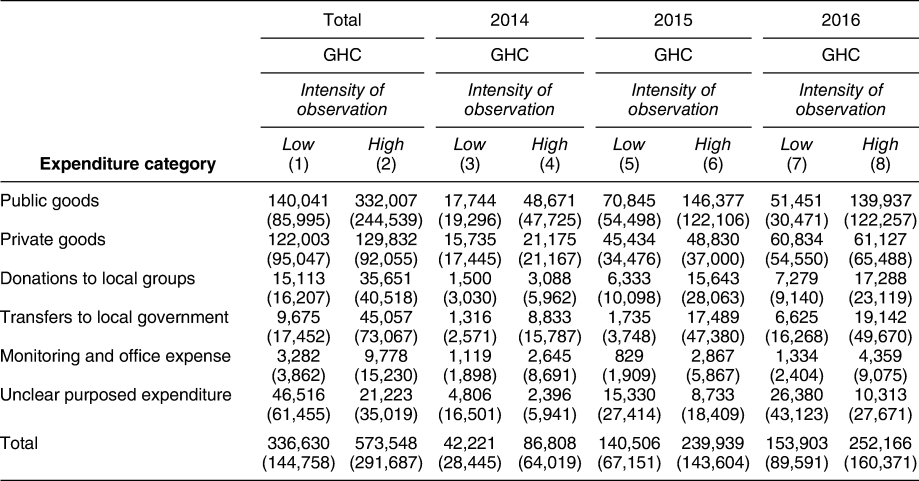
Online Appendix I details my coding rules (Table I.1) and gives examples of the expenses sheets (Appendix Figures I.1 and I.2), as well as the summary statistics of these data (Table I.2). In the main analysis, I focus on the total amount of CDF spent and the part allocated to public and private goods to test my hypotheses. Although the other sets of expenses provide further insights on how legislators spend their CDFs in Ghana, these allocations only emerged from my detailed coding and did not form part of my initial expectations. Therefore, while Table 2 shows the summaries of the amounts incumbents spent on these items, Appendix Section E.3 provides detailed discussions of these expenses and results regarding the effects of fairer elections.
Average CDF Spending Across Six Expenditure Categories by the Intensity of Election Observation

Notes:
1. Table shows the average amount of CDF funds spent by Members of Parliament (MPs) in the sample between 2014 and 2016 by treatment conditions. Standard deviations are reported in parentheses. Amounts are in Ghana Cedis (GHC) ($1 ≊ 4 in August 2014 according to http://freecurrencyrates.com/en/exchange-rate-history/USD-GHS/2014/yahoo).
2. Source: Author’s coding of original expenditure sheets collected from Ghana’s District Assemblies’ Common Fund Administration.
Also, although I did not physically verify reported projects or surveyed individuals reported to have received personal assistance, MPs do not control these data; the local government that supervises the corresponding legislator report the spending and is directly held accountable for missing funds or mishandling of reports by the country’s auditor general (Williams Reference Williams2017). Thus, these data are reliable for my analysis.Footnote 17
Balance Statistics
Appendix Table A.2 shows the balance statistics for a set of pretreatment covariates across the two levels of election monitoring (i.e., low and high).Footnote 18 Because of the small sample size, I use the Kolmogorov–Smirnov test to ensure robustness. I also display covariate balance by way of quantile–quantile plots in Appendix Figures A.1 and A.2. I find that constituencies across the treatment conditions are similar in most, including vote margin in 2008, number of candidates in the 2012 polls, distance from the Parliament House,Footnote 19 and the geographical distribution of party support (using Entropy (H)) (Reardon and O’Sullivan Reference Reardon and O’Sullivan2004).Footnote 20 There is also a balance across treatments in citizens’ assessments of the performance of the previous MP on constituency service, as well as support for the major parties (Appendix Table A.4), which suggest that the treatment did not affect previous performance or the support of major party candidates, respectively.
Disaggregating the balance statistics by the three treatment arms (Appendix Table A.3) shows some imbalances on the following covariates: voter density [# voters/Area (km. sq.)], margin of victory 2008, and the proportion of individuals with primary education or less, employed, living in cement housing, and working in agriculture. My results are robust to controlling for these variables (Appendix Table E.8).
RESULTS
In this section, I present the results from the initial assignment of actual intensity of election-day observation on the behavior of MPs during their four-year (2013–16) terms. Because the follow-up experiment (EIO) that randomized letters to MPs was implemented during legislators’ last year (2016) in office and was designed to explore possible mechanisms, I discuss its results in the mechanism section, where I examine the possible causal explanations for the main results.
Estimating the Causal Effect of AIO on Constituency Service
I estimate the average intention-to-treat (ITT) effect of the AIO on legislators’ responsiveness.Footnote 21 Specifically, I compare the average outcomes for representatives elected in constituencies randomly assigned to high-AIO with those elected in low-AIO electoral districts. Formally, let Y i (M i) denote the outcome of interest for legislator i elected from a constituency with an intensity of observation M. I estimate:
 $$ITT = E\left[ {{Y_i}{\rm{|}}{M_i} = {\rm{high}}} \right] - E\left[ {{Y_i}{\rm{|}}{M_i} = {\rm{low}}} \right],$$
where E[Y i|M i = high] is the average level of responsiveness of legislators elected in intensely monitored elections and E[Y i|M i = low] represents that of legislators elected in low-AIO constituencies. Because of the small sample size, I use the HC3 version of the heteroskedasticity-consistent covariance matrix (HCCM) as described and suggested by Long and Ervin (Reference Long and Ervin2000) to estimate the standard errors associated with all the ITT estimates to check incorrect inferences. I also use randomization inference to generate p-values associated with the sharp null hypothesis of no treatment effect for each unit (Gerber and Green Reference Gerber and Green2012). I estimate the 95% confidence intervals of the effects using bootstrapping to provide further confidence that a few constituencies do not drive the results.Footnote 22
Average ITT Effect of AIO on CDF Spending
Table 2 shows a breakdown of the average total amounts spent by legislators of their allocated GHC1,264,987 in the various expenditure categories by treatment (between 2014 and 2016). I also disaggregate MPs’ expenditures over time to examine possible time trends.Footnote 23 Table 2 displays four interesting patterns.
First, MPs elected from intensely monitored constituencies spent more of their allocated funds [GHC573,548 (45.3%)], on average, compared to those from low-AIO constituencies, who spent only GHC336,630 (26.6%). Although the level of spending increased over time across treatments, MPs in intensely monitored constituencies consistently outspent their counterparts elected in low-AIO constituencies (see Appendix Table E.6). Insofar as the level of expenditure is indicative of an MP’s effort, higher AIO elections increase democratic responsiveness.
Second, disaggregating the total expenditure into categories, I find that MPs elected from high-AIO constituencies spent significantly more of their CDFs on local public goods. However, MPs in high-AIO group appear to spend only slightly more of their funds on providing private benefits to citizens compared with those in the control group. Third, MPs elected in higher quality elections donate more to organized groups, spend more on local government activities, and spend more on monitoring local projects and running their constituency offices. Finally, MPs elected in low-intensity monitored constituencies spent more on items that were hard to detect a purpose or who benefited based on the expenditure records, but further analysis show no statistically significant differences across treatment (see Appendix Table E.9).
In line with my hypotheses, I focus on the causal effects of AIO on MPs’ total expenditures (utilization) and allocations to public and private goods (i.e., the first two items in Table 2).Footnote 24
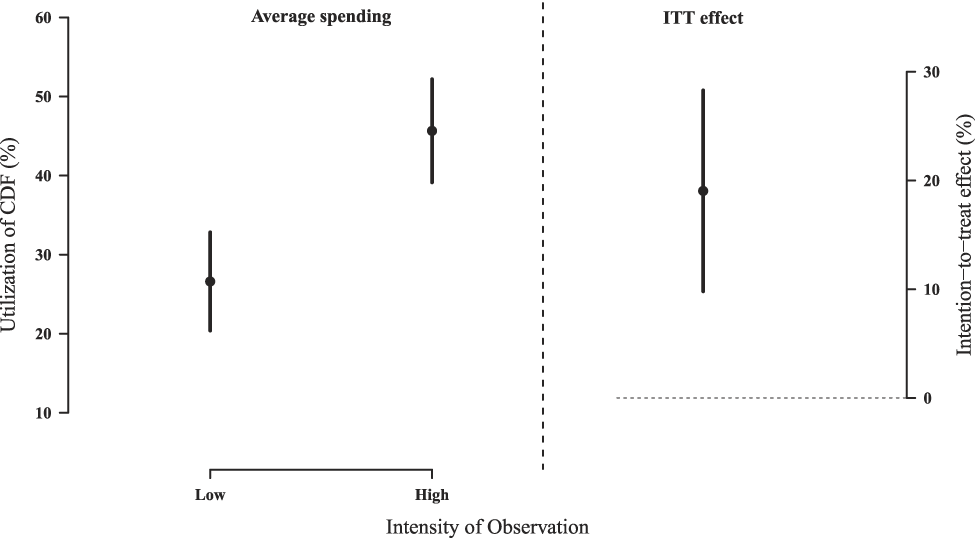
Figure 1 shows that MPs elected in intensely monitored constituencies spent more of their available CDFs compared with those elected from electoral districts with fewer observers. The left side of Figure 1 shows average use of CDFs by legislators in the two treatment conditions along with 95% confidence intervals (CIs). The average CDF spending in the low-AIO constituencies is 26.6% (s.e. 3.2), whereas the average use in intensely monitored constituencies is 45.7% (s.e. 3.3).Footnote 25 The right side of Figure 1 shows the ITT effect (difference-in-means) and the 95% CI. The results show that MPs elected in high-AIO constituencies spent 19 pp (s.e. 4.7, p = 0.006, 95% CI: 10.2–28.2) more of their allocated CDFs during the period, on average, which represents a roughly 71% increase from a baseline of 26.6% in low-AIO constituencies.Footnote 26 These results support the hypothesis that an increase in the intensity of observation causes politicians to exert more effort (H1).
Average ITT Effect of AIO on the Use of CDF
Notes: The left panel shows the mean of the percentage of available CDF (GHC1,264,987) between 2014 and 2016 by AIO level. The right panel shows the average ITT effect of high election observation on CDF spending. Robust standard errors (HC3) are used to generate the 95% intervals around the average ITT effect.

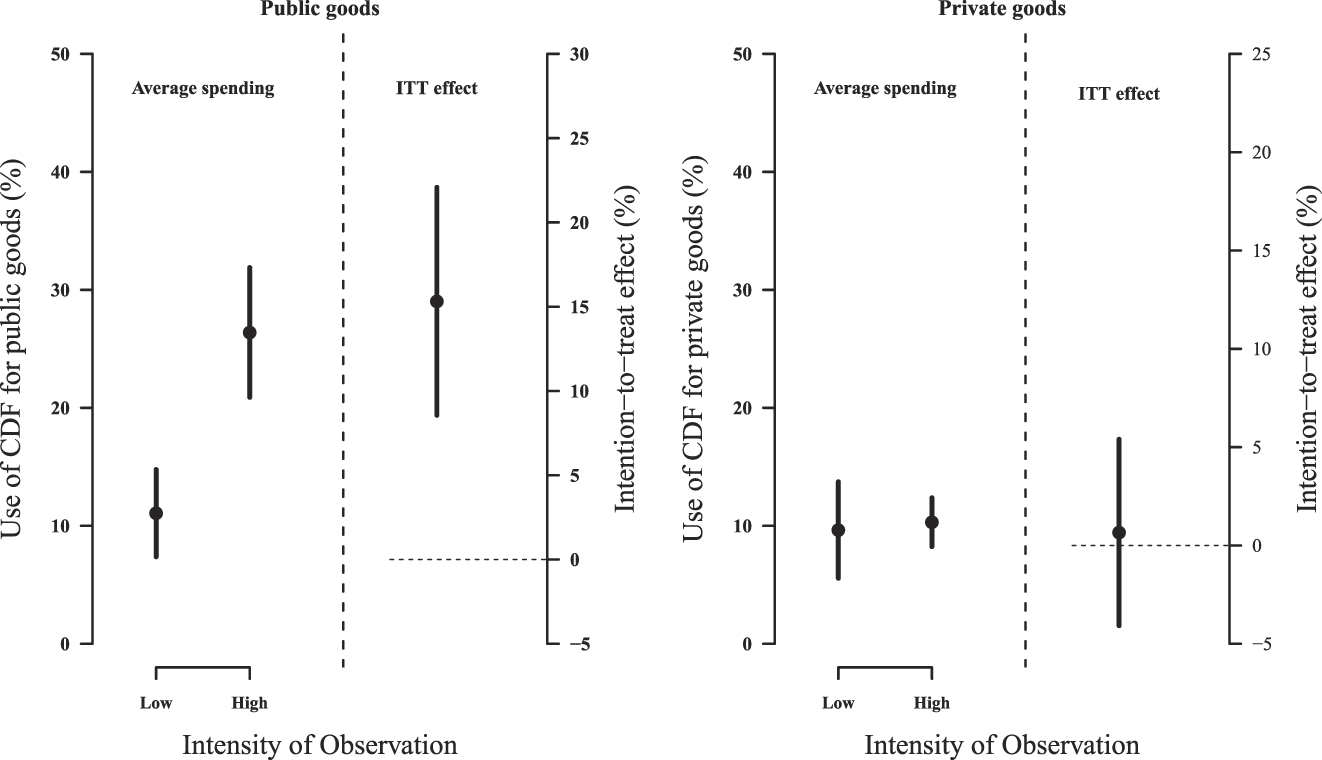
In Figure 2, I disaggregate the results by the type of expenditure: public goods (left) and private benefits (right). I find that higher-intensity monitoring increases legislator spending on public goods, consistent with hypothesis H1 b, but not on private goods (H1 a). The left panel illustrates that the average use of CDF for public goods is 11.1% (s.e. 1.9) and 26.4% (2.8) in low- and high-AIO constituencies, respectively. An increase in the treatment from low to high led to an increase of about 15 percentage points in spending on public goods, which is substantially and statistically significant (p = 0.008, 95% CI: 9.1–22.3). An increase in the intensity of observation more than doubles legislators’ spending on local public goods, suggesting that higher integrity elections improve spending on public works. The right panel displays the results for spending on private goods. The average spending in low- and high-AIO constituencies is 9.6 (s.e. 2.1) and 10.3 (s.e. 1.1), respectively; this difference is not statistically significant (p = 0.774, 95% CI: −4.1–5.1). This implies that AIO does not lead to a significant increase (or decrease) in spending on private benefits for constituents. In sum, the findings indicate that an increase in the quality of elections, induced by increased election monitoring, raises the responsiveness of politicians to constituents’ demands for public goods.
Average ITT Effect of AIO by Expenditure Type
Notes: The figure shows the results of MPs’ use of CDFs for local public goods (left panel) and private goods (right panel) for constituents. In both cases, the left side of the figure displays the average for constituencies in each treatment condition along with 95% CIs. The right side of each panel shows the ITT effect estimates as the difference-in-means between low- and high-intensity monitored constituencies. Robust standards errors (HC3) are used to generate the 95% CIs around these ITT estimates.

Appendix Table E.4 examines whether or not the treatment effects vary by levels of electoral competition. The results show that the average ITT effect is not statistically different across the levels of electoral competition. However, MPs in competitive constituencies do respond to the treatment by spending more than colleagues in less competitive constituencies. Nevertheless, these results should be treated with caution because of the limited number of cases across the different electoral settings, especially in the control condition. It would be fruitful for future research to investigate potential differential effects more systematically.
The results on CDF spending support MPs’ self-reported frequency of visits to their constituencies and the activities they prioritize when they visit, which are used in the literature as indicators of constituency service. These results are presented in the Online Appendix J and further indicate that MPs elected through intensely monitored elections report to work harder to provide local public goods.
Do Legislators Substitute for Legislative Work with Constituency Services?
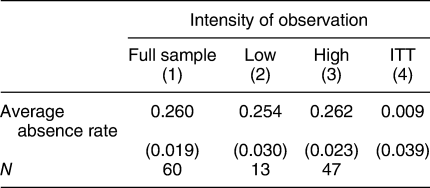
Finally, I estimate the average ITT effect of high AIO on legislator absence from parliamentary meetings. Ghana’s Parliament meets four times a week (Tuesday to Friday).Footnote 27 For each session, an MP may be present, absent with permission, or absent without permission. Using Parliamentary Hansards, I code legislator absence (without permission) for 346 parliamentary meetings between January 2013 and October 2016.Footnote 28 I compare the absence rates for legislators elected from constituencies that received low versus high levels of observation.
Table 3 shows the average absence rate in the full sample in Column (1), and in low- and high-AIO constituencies in Columns (2) and (3), respectively. Standard errors of these estimates are shown in parentheses. The results show that MPs in the sample were absent about a quarter (26%) of the time during their four-year terms in office, on average. The absence rate was 25.4 and 26.2% in low- and high-AIO districts, respectively. The difference-in-means estimate indicates no significant difference in the absence rates among legislators across the two treatments, providing no support for hypothesis H2.
Similar Absence Rates in Parliament among MPs Elected from low intensely and High Intensely Monitored Constituencies

Notes: Table reports the intention-to-treat effect of intensity of observation on the absence of MPs from Parliamentary sessions. Columns (1)–(3) show the means and standard errors for the absence rate in the full sample, and the low and high intensities, respectively. Columns 4 reports the average ITT effect. Each unit is weighted by the inverse of its treatment probability. Robust standard errors are reported in parentheses. Significance levels indicated by *p < 0.1; **p < 0.05; ***p < 0.01 are based on two-sided hypothesis test.
These results suggest that higher quality elections neither cause MPs to shirk nor attend parliamentary meetings more regularly. The results also indicate that cleaner elections do not motivate politicians to substitute constituency service for legislative effort. The results may be explained by the fact that MPs can deliver constituency services when they visit their districts on the weekends or on Mondays when Parliament is not in session, or during their recess.
EXPLORING THE CAUSAL MECHANISM BETWEEN ELECTION QUALITY AND RESPONSIVENESS
What might explain the causal relationship between high-quality elections, generated by intense election monitoring, and improved political responsiveness regarding constituency service? I argued that election observation may strengthen the electoral connection by empowering citizens to either select quality candidates who in turn work hard in office, or by shaping incumbents’ expectations that voters might sanction their poor performance. To distinguish between the two channels, I first draw on features of the initial randomization of AIOs, electoral outcomes, and data collected through closed-ended interviews with 47 of the 60 MPs in the study. Second, I report results from randomizing letters to 30 (of 60) MPs in the initial sample that informed them to expect intense monitoring in the next election.
My analyses suggest that the selection of better candidates through intensely monitored election may only play a minimal role in explaining the behavior of incumbents in this case for two main reasons. First, the intensity of election observation was not announced ahead of the 2012 elections when the initial experiment was implemented. Thus, the treatment could not have influenced the candidate pool in the first stage of selection (Besley Reference Besley2005). Appendix Table A.2 shows that an equal number of candidates contested across constituencies in each treatment condition. Second, although we show that the presence of observers reduced the level of fraud and violence at polling stations, I do not believe the effects were sufficient to influence who won the elections (second stage). Although the treatment reduced the vote margins at the constituency level, especially in competitive districts, this reduction was not statistically significant. Also, the treatment did not produce legislators who were qualitatively different, on average, across multiple characteristics such as education, age, party affiliation, or term in office as I show in Appendix Table F.1. While voters’ choices may have been influenced by other candidate features that I do not capture here, based on the empirical evidence presented, the treatment is unlikely to have had a major influence on responsiveness through the selection of “quality” politicians.
Turning to the sanction mechanism, I provide tentative evidence to suggest that it provides a more plausible explanation for incumbents’ behavior in this study. I argue that, for election observation at time t − 1, to affect incumbents’ performance during their terms in office (in time t), at least two conditions must hold. First, incumbents must be aware of the intensity of election observation in their constituencies in the prior election (at time t − 1) and believe that monitoring was effective at reducing electoral fraud. Second, incumbents must believe that the intensity of election observation in their constituencies will be repeated during their reelection race (at time t + 1), thus reducing their ability to rig their reelection balloting.
To test the first condition, I conducted closed-ended interviews with MPs to determine whether they were aware of the intensity of observation in their constituencies. I asked them if they saw observers at polling stations they visited during the 2012 polls. I find a positive association between a higher AIO and MPs reporting that they saw observers. A higher concentration of observers in a constituency increased the probability that an MP reported that he or she personally saw an observer at polling stations they visited by about 17 pp (41.67% in low-AIO compared with 58.82% in high-AIO districts) (p = 0.31).Footnote 29 Moreover, MPs elected in intensely monitored elections reported that a higher proportion of polling stations (28%) was monitored in their constituencies, on average, compared with those who had fewer monitors (who reported that only 13% of stations were monitored), which represents a 15 pp increase.Footnote 30 These estimates are similar to the concentration of monitors, on average, as shown in Appendix Table F.4. Although these results are not statistically significant at conventional levels, they provide suggestive evidence that incumbents noticed the significant presence of observers in their constituencies during the 2012 election. I argue that this awareness, coupled with the reduction in fraud and violence induced by observers or the significant challenge in executing fraud pose by intense monitoring, signaled to MPs that they could not rely on future rigging.
Testing the second condition, that MPs’ past experiences influence their beliefs about the future, is more challenging. It is not clear that incumbents’ experiences with observers in their constituencies at time t—1 will automatically shape their beliefs about the intensity of observation in time t + 1. Although we can safely assume that MPs would expect some future monitoring in their constituencies because CODEO is credibly committed to observing each election, we cannot be certain about the intensity of observation that MPs would expect. Furthermore, we cannot be sure that these expectations map onto the treatment assignment in the 2012 elections. While the above results on the effect of AIO on politician performance imply incumbents were behaving as if they expected intense election observation, a randomized treatment to manipulate beliefs about future monitoring would allow making causal claims about the expectation of sanctioning mechanism.
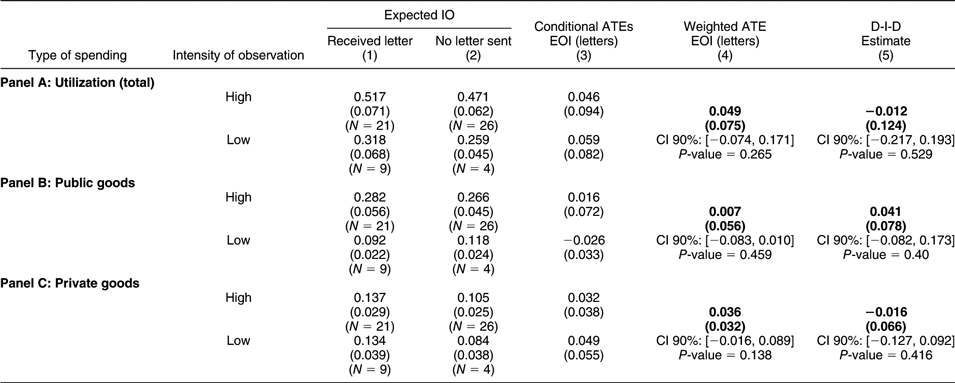
To test the causal effect of expected intense monitoring on responsiveness, I analyze the outcome of my follow-up experiment that sent letters to half of the MPs in the sample a year before the 2016 elections.Footnote 31 Columns (1) and (2) of Table 4 display the average proportion of CDF spent in 2016 by incumbents according to whether they received a letter to expect more observers, respectively, and by the initially assigned intensity of monitoring. Column (3) shows the conditional effects of the letters by the prior AIO, whereas Column (4) reports the weighted average treatment effect. To assess potential interaction effects, I conduct a difference-in-difference (D-I-D) analysis comparing the impact of the letters among legislators who were elected in low intensely versus high intensely monitored elections. Column (5) reports the results. Panels A, B, and C report the results for the total use of CDF (utilization), public goods, and private benefits, respectively. In all cells, standard errors of the estimates are reported in parentheses.
Effect of Expectation of Intense Election Monitoring Conditional on Prior Intensity of Observation

Notes: Table shows the proportion of legislator spending in each experimental cell. It also shows the effect of expectation of intense observation on spending conditional on prior intensity of election monitoring in MPs’ constituencies (blocking variable), and the corresponding weighted ATEs. Randomization inference (accounting for the blocks) is used to generate the standard errors and the one-tailed test of the sharp null of no effect for each MP for the estimated weighted ATEs. 90% confidence intervals are estimated using boostrapping. I conducted 10,000 simulations.
Consistent with expectations, the results presented in Panel A show that receiving a letter increased the proportion of CDF spent in 2016 by 4.9 (s.e. 8) pp (one-tailed test, p = 0.265), on average. The effect of the letter was slightly higher [1.2 pp (12.4) increase] among incumbents elected in low-AIO [5.9 pp (s.e. 8)] compared with those in high-AIO [4.6 pp (s.e. 9.4)] constituencies, but not precisely estimated. Nonetheless, these conditional effects are large (although not statistically significant), representing about a 23 and 10% increase in low- and high-AIO, respectively.
Disaggregating these results into public goods (Panel B) and private goods (Panel C), the latter seems to drive the average increase in CDF spending. Specifically, while, on average, MPs who received a letter did not substantially change their expenditure on public goods, they increased their spending on private benefits. Specifically, the letter treatment increased spending on private benefit by 3.6 (s.e. 3.2) pp (one-tailed test, p = 0.14). For MPs who were elected in low-AIO districts, sending them a letter boosted their spending on individual benefits by 4.9 pp, a 58% increase. Those in high-intensity constituencies spent 3.2 pp more, a 30% increase in their expenditure on private benefits, compared with if they had not received the letter. These weighted average treatment effects masked the potential interaction between the AIO and EIO treatments.
A D-I-D analysis suggests that compared with legislators elected in low-AIO constituencies, the letter caused a further increase in spending on public goods by 4.1 (s.e. 7.8) pp and a decrease in the proportion of funds allocated to private benefits by 1.6 (s.e. 6.6) pp. These results suggest an interaction effect between the high-AIO and the letter treatments to increase spending on public goods further. Specifically, consistent with my argument, these results indicate that legislators who were elected in fairer elections and expected to contest their reelection in another one were more responsive to the priorities of their constituents, which provide tentative causal evidence the threat of sanctioning through fairer election increase democratic responsiveness. However, I acknowledge that a design with greater statistical power is required to confirm these results.
Nevertheless, the fact that the EIO treatment led to an increase in spending on private benefits raises concerns about the potential for fairer elections to promote clientelistic exchanges. However, the timing of the letter treatment may explain this finding (i.e., an electoral cycle effect Michelitch and Utych Reference Michelitch and Utych2018). The letters were sent one year before the elections. Scholarly work on the accountability pressures that legislators face in clientelistic polities such as Ghana suggests that voters demand more private benefits during election years (Lindberg Reference Lindberg2010; Michelitch and Utych Reference Michelitch and Utych2018). Indeed, Appendix Figure E.6 shows that MPs spending on private transfers doubled during the election year (from 6% in 2014, on average, to 12% in 2015 and 2016, a 100% rise), whereas that on public goods decreased (12% in 2014, 32% in 2015 and 24% in 2016, a 25% decrease between 2015 and 2016). Accordingly, the treatment may have further incentivized incumbents to respond to these demands.
I do not find support for two alternative explanations for the effect of the initial treatment on political responsiveness. The first indicates that the AIO treatment may have strengthened citizens’ pressure on the incumbent to supply constituency service. Using Afrobarometer data of respondents sampled from my study constituencies, I show in Appendix Table F.5 that the treatment had no influence on the number of times constituents report to have contacted their MPs, attended community meetings, joined a group to raised an issue, request government action, contacted local government officials, or their beliefs that it the duty of voters to ensure MPs do their work once elected.Footnote 32 Second, the AIO treatment did not affect the number of candidates competing in the next election in 2016, which would indicate incumbents’ fear of the entry of new challengers encouraged by cleaner elections (Besley Reference Besley2005; Grossman and Michelitch Reference Grossman and Michelitch2018) (see Appendix Table F.6). Ghana’s strong two-party system ensures that similar number of candidates usually run in each constituency.Footnote 33
CONCLUSION
In this article, I combine experimental research designs and original data on legislator spending and records on parliamentary attendance to investigate whether and how fair elections incentivize political responsiveness. The results indicate that legislators elected in electoral districts that were randomly assigned to intense election-day monitoring, and thus had limited opportunities for fraud, worked harder during their four-year terms in office to satisfy their constituents’ demand for local public goods and services compared with those elected in constituencies with fewer observers. The treatment did not change MP’s provision of private benefits to constituents. Experimental and observational data suggest that the effect of fairer election, induced by intense election observation, is better explained by incumbents’ beliefs about their potential inability to rig their reelection balloting, and that citizens’ selection of better candidates to office, in the first place, played a minimal role. Together, these results provide, to my knowledge, one of the first systematic analysis of the causal relationship between election integrity and political responsiveness.
The results have implications for both pro-democracy actors and scholars of democratic consolidation and electoral fraud. For promoters of democracy, they suggest that systematic election monitoring by local civil society groups plays a significant role in promoting electoral integrity, which corroborates earlier findings, and that election observation eventually promotes democratic accountability. However, Ghana’s strong two-party system and a well-established civil society groups, which regularly monitor national and local elections and make the threat of electoral sanction more credible, may drive these results. Accordingly, efforts to strengthen such independent civil society organizations, which now operates in more than 60 developing countries around the world (see Grömping Reference Grömping2017), may be required to achieve similar results elsewhere. Future research in such settings using the research designed proposed in this study would provide a more robust test of the external validity of the findings. Also, whereas I focus on election observation, the primary findings suggest that institutions such as independent election management bodies, and biometric voter registration and voting systems that significant reduce electoral fraud hold the potential to improve political responsiveness. However, the timing of such interventions along the electoral cycle may be relevant to the type of response. Finally, my findings suggests that because elections remain the primary mechanism through which citizens demand accountability from their representatives in many settings, attention must be paid not only to the regular conduct of elections but also to strengthening their integrity.
Finally, although these results provide optimism about our beliefs regarding the connection between fairer elections and democratic responsiveness, the limited number of cases in the study, and the challenge to replicating the design under same conditions, implies that this article does not provide a final word on the topic. My goal was to leverage a rare opportunity to provide initial insights on a critical assumption—fairer elections incentivize democratic responsiveness—that motivates many theories of electoral accountability. I hope that this study will motivate other scholars to employ similar research designs to further investigate this topic. These additional studies will provide greater confidence in the main findings of the paper.
SUPPLEMENTARY MATERIAL
To view supplementary material for this article, please visit https://doi.org/10.1017/S0003055419000479.
Replication materials can be found on Dataverse at: https://doi.org/10.7910/DVN/W8HUKY.




Comments
No Comments have been published for this article.