INTRODUCTION
Self-repairs of children, compared to those of adults, have not yet been sufficiently studied. In particular, previous research has not explored the interactive functions of children's self-repairs, but has focused on the investigation of the linguistic aspects of self-repairs connected to speech errors, such as slips of the tongue. In this study we show that besides being indicative of linguistic skills, self-repairs reveal children's developing interactive skills and reflect their emerging social cognition. As self-repair allows cutting off speech and a change in the ongoing speech activity, it reflects the ongoing social monitoring of the appropriateness of the speech for the current recipient. For this reason, self-repair is an important research subject for understanding the emerging social–interactive skills of children.
Children develop language in conversation (Tomasello, Reference Tomasello2003; Wootton, Reference Wootton1997). Through adult responses, moreover, children learn to revise and repair their speech to meet the requirements of the language and the requirements of different activities. Within the conversation analytic literature, revision of one's own speech is called ‘self-initiated self-repair’ (Schegloff, Jefferson & Sacks, Reference Schegloff, Jefferson and Sacks1977). Typical of self-initiated self-repair is the abrupt interruption: the speaker cuts off the ongoing talk and revises something already said. The speaker can, for example, add or substitute a word. Self-initiated self-repair has mainly been studied in adults (Levelt, Reference Levelt1983; Schegloff et al., Reference Schegloff, Jefferson and Sacks1977; in Finnish, Laakso, Reference Laakso1997; Sorjonen & Laakso, Reference Sorjonen and Laakso2005), and there is only scant information on children's self-repairs (see, however, Clark, Reference Clark, Lamb and Brown1982; Evans, Reference Evans1985; McTear, Reference McTear1985: 52, 187–200; Rogers, Reference Rogers1978; Wootton, Reference Wootton2007; on Finnish children, Laakso, Reference Laakso2006; Savolainen, Reference Savolainen2005). These studies suggest that children seem to develop their skills in self-repair through other-initiation, that is, through adults' requests to repeat or clarify their speech (see, for example, Scollon, Reference Scollon, Ochs and Schieffelin1979; Tomasello, Farrar & Dines, Reference Tomasello, Farrar and Dines1984; Wootton, Reference Wootton1994). However, some children have been found to make their first self-initiated self-repairs as early as the single-word stage between 1 ; 6 and 2 ; 0 (Clark, Reference Clark, Lamb and Brown1982; Forrester, Reference Forrester2008; Laakso, Reference Laakso2006; Scollon, Reference Scollon, Ochs and Schieffelin1979). It seems that children are able to cut off their utterances at a very early age, but they also need the feedback provided by parents, and/or other interlocutors in order to recognize what to repair.
Children's self-repairs of speech have mainly been studied from a linguistic perspective, and in many cases, the focus has remained on the type and structure of the repair itself. Accordingly, self-repairs have been isolated from the interactive speech context in which they emerge, and have been analyzed as context-free extracts (see, for example, Clark, Reference Clark, Lamb and Brown1982; Evans, Reference Evans1985; Rogers, Reference Rogers1978). At different ages, children are found to self-repair different aspects of their speech (Clark, Reference Clark, Lamb and Brown1982; Rogers, Reference Rogers1978). For example, children between two and six years have been found to repair the following kinds of linguistic structures (Clark, Reference Clark, Lamb and Brown1982; McTear, Reference McTear1985: 189–98):
• phonological (e.g. substitutions of phonemes or revisions from one-syllable to two-syllable words)
• morphological (e.g. I→me // want→wants // more some books→some more books // a→the; changes in tense)
• lexical (e.g. word substitutions It got (.) the wheel got out)
• syntactic (e.g. Your (.) these are your pets // I could (.) could I get them out)
Repair seems also to play a role in language acquisition. Accordingly, when children attempt to repair their speech, they practice and learn new forms of language. At the early stages of language development, children can monitor only a few linguistic elements at a time, and due to this restricted monitoring children are inclined to repair the same elements they are currently acquiring (Clark, Reference Clark, Lamb and Brown1982; McTear, Reference McTear1985: 188–89). Children below the age of five self-repair their pronunciation and grammar, and repairs mainly focus on individual words (Clark, Reference Clark, Lamb and Brown1982; McTear, Reference McTear1985: 189–98; Rogers, Reference Rogers1978). Between the ages of five and seven years, children are also found to make additions to their speech and also to revise their speech to match their varying speaking roles (Clark, Reference Clark, Lamb and Brown1982; Evans, Reference Evans1985). In older children, the proportion of grammatical self-repairs diminishes, insofar as structures to be repaired become longer and more complex (Rogers, Reference Rogers1978). Four-year-old children seem to be situated between these two developmental stages: they self-repair all kinds of linguistic elements in their speech but the main focus is still on (relatively short) morphological and syntactic structures (see, for example, McTear, Reference McTear1985: 190–99).
The aim of the present research is to examine the self-repair of speech by four-year-old Finnish children. First, we analyze what kinds of things children repair. Second, we examine in detail in which interactive sequential contexts self-repairs in speech emerge and what social functions self-repairs have in interaction. In contrast with many of the previous studies, we study self-repairs in genuine interactions from the perspective of conversation analysis (CA; for a concise description of CA, see, for example, Heritage, Reference Heritage1984: 235–53). In this approach, occurrences of self-repair are analyzed in their interactive sequential context of the successive speaking turns of the interlocutors. Self-repairs in our study mainly emerge as part of the children's play activities and the interactive context has an impact on how the self-repair and the action it produces are to be interpreted. Accordingly, non-verbal actions of the participants are also taken into account. Third, we are interested in discovering to what extent our findings are consistent with the earlier findings reported for English-speaking children.
METHOD
Participants
We analyze eight interactions of two Finnish-speaking girls: Emma (4 ; 8), and Hilma (4 ; 11). These interactions belong to a larger database, the Helsinki Cross-sectional Child Language Corpus that has been collected as part of the project ‘Child's Developing Language and Interaction’ during 2002–2007. Families took part in the research project voluntarily and written consent for participation was obtained from the parents of the children. To confirm that the language of the children had been developing in a typical manner, their parents filled in a questionnaire on the motor and speech development of their children. The parents were also interviewed. In addition, the linguistic skills of the children were assessed using the Reynell Developmental Language Scales III (Edwards, Fletcher, Garman, Hughes, Letts & Sinka, Reference Edwards, Fletcher, Garman, Hughes, Letts and Sinka1997) and the subtests Grammatic Closure, Auditory Sequential Memory and Auditory Closure of the Illinois Test of Psycholinguistic Abilities (Kirk, McCarthy & Kirk, Reference Kirk, McCarthy and Kirk1968). According to the tests, the language skills of the two girls were age-appropriate.
Procedure
The raw data for the study comprises eight hours (7:58:27) of natural interaction videotaped at the children's homes (four hours for each child). Two hours for each child were recorded by a non-participating investigator and the other two hours by the parents. The recordings were made on miniDV-tapes using a Sony DRR-PDX10P camera with a wide-angle lens and external microphone. Children were videotaped by the investigator in two kinds of interactions: first with the mother (recording A) and then with a peer (recording C). These interactions were prestructured in such a way that the investigator brought the same set of toys to each family. Participants were first asked to play a guessing game using picture cards and then to play freely with the toys of their preference (the child's own toys could also be used). The toys included a doll-house with dolls, a traffic carpet with cars, and a plastic construction set (a market place with food items). Interactions of these children separately videotaped by each set of parents (B recordings) included various activities such as family meals, pretend play activities and playing with plasticine. All recordings of each child were made within one week in order to preclude major developmental changes during data collection.
Collection of self-repairs
The research corpus comprises a total of 316 self-initiated self-repairs of speech by the two children. The frequencies of self-repairs studied in each of the recordings are presented in Table 1. Many self-repairs emerged in the prestructured play recordings in which the children interacted either with a parent (recordings A) or with a peer (recordings C). In interactions videotaped by Emma's family (recordings B) there were fewer self-repairs compared to the B recordings of Hilma's family. Hilma's B recordings mainly included her interaction in playing with a three-year-old sister Liisa; these recordings were thus similar to C recordings in the data. Emma's B tapes included somewhat different activities such as meals, playing with plasticine, pillow fights and exercise with a hula hoop.
The frequency of self-repair in different interactions of the two children studied

A=First video recording taped by a researcher in which the child played with her mother;
B=Video recordings of various daily interactions taped by the families themselves;
C=Second video recording taped by a researcher in which the child played with a peer.
We define self-initiated self-repair here as revisions of speech that the speakers themselves had initiated and completed. Self-repairs could be initiated with either a non-lexical (e.g. a cut-off) or with a lexical repair initiator, and the repair change something that the speaker had already said by either substituting, adding or abandoning (Schegloff et al., Reference Schegloff, Jefferson and Sacks1977). Finnish speakers use several lexical repair initiators such as particles eiku (‘no I mean’), tai (‘or’) and siis (‘so I mean’) (Sorjonen & Laakso, Reference Sorjonen and Laakso2005; see also Kärkkäinen, Sorjonen & Helasvuo, Reference Kärkkäinen, Sorjonen, Helasvuo and Shopen2007). Accordingly, clearly marked self-initiations followed by a revision of speech were identified as self-repairs. We also counted the changes in the speaker's non-verbal actions as self-repairs, if the speaker self-initiated the repair verbally.
Only such cases as those that the speakers themselves treated as problematic were examined. Thus, those cases in which the child simply repeated words or phrases were not included in the collection. Although such recycling is sometimes considered as self-repair, we excluded them because there was no change in the wording or in the linguistic structure (about recycling see Fox, Hayashi & Jasperson, Reference Fox, Hayashi, Jasperson, Ochs, Schegloff and Thompson1996). For the same reason, because there was no change in the speech, plain repetitions initiated with a cut-off were left out (e.g. ha-harjaamaan, ‘to bru-brush’). The only exceptions were such repetitions in which the children changed their vocal features to match the play character or, if they played two roles, to clarify which role they were currently playing. Furthermore, as we were interested in the changes children make in their speech, word searching was not included in our collection of self-repairs. We counted as separate self-repairs each instance in which the children self-initiated repair and revised their prior speech. Thus, several self-repairs in a row within the same turn were considered separate instances, if each of these was separately initiated. If the speaker repaired several linguistic features at the same time after one self-initiation, we counted it as one case. However, in classifying self-repairs into different types, we counted as separate instances such cases in which the speaker changed several features in her speech. For example, a case with a morphosyntactic revision was included in the collection both of morphological and of syntactic types of self-repair.
With adult speakers, self-repairs are specified in relation to where they are initiated (Schegloff et al., Reference Schegloff, Jefferson and Sacks1977). First, self-repairs can be initiated in the same turn where the problem emerges. Second, the speakers may self-initiate after the problem turn has been completed, in the transition space, where the co-participants have not yet taken the speaking turn. Third, speakers may also self-initiate repair in the third turn or third position after the original problem turn. In third turn repair the speaker self-repairs late after the recipient's turn that has come in between (for more details see Schegloff, Reference Schegloff, Guy, Feagin, Schiffrin and Baugh1997). Third position self-repair occurs after the recipient has misunderstood the speaker's initial turn (Schegloff, Reference Schegloff1992). In these cases a co-participant has already spoken after the problem source turn, without addressing the problem, however. In this study we examined all positions of self-initiation.
All cases of self-repair were transcribed together with their sequential context: the speaking turns of all the participants, before and after the actual turn in which the self-repair was initiated, were transcribed. Also notable non-verbal activities, such as the handling of the play materials, were included as descriptions in the transcript. The transcription was made according to simplified conversation analytic notation (cf. Atkinson & Heritage, Reference Atkinson and Heritage1984: ix–xv). The transcription conventions can be found in Appendix 1. The original tapes were viewed several times in order to make the transcripts as accurate as possible. The reliability of the transcription was also checked by comparing one third of the transcribed material to transcripts of the same material made by another researcher. There were only minor differences and these cases were all re-examined. All cases transcribed were analyzed following the principles of conversation analysis (Goodwin & Heritage, Reference Goodwin and Heritage1990; Heritage, Reference Heritage1984: 233–92).
After the analysis, cases were grouped based on the type of problem that the child self-repaired. Thus, the division was based on the features of self-repairs found in the data, and similar cases were grouped together. The identification of the types of self-repair was also guided by the previous studies on English-speaking children that had found certain types of self-repair to occur: phonological, lexical, morphological and syntactic (Clark, Reference Clark, Lamb and Brown1982; McTear, Reference McTear1985: 189–98; Rogers, Reference Rogers1978). On the basis of the data analysis we found a group of extensive additions, which later were also found to exist in previous studies (Evans, Reference Evans1985). In addition, we found non-verbal and prosodic self-repairs that we handle as one group since they both addressed non-linguistic aspects. Furthermore, there were only five cases of prosodic self-repairs.
FINDINGS
Where and how was self-repair initiated?
Most typically, children's self-repairs were initiated within the same speaking turn where the problem emerged (see Table 2). This is consistent with the findings on self-repairs by English-speaking adults (Schegloff et al., Reference Schegloff, Jefferson and Sacks1977). Quite often, repair was also initiated in the transition space where the child's turn had already reached a potential completion but the recipient had not yet taken the speaking turn.
Self-initiation of repair in different sequential positions

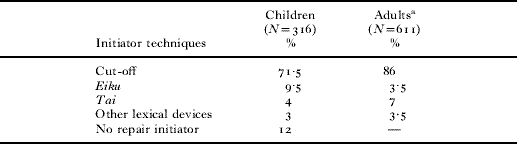
Similarly to adult speakers of Finnish, children most often cut off the flow of speech as a device to self-initiate repair (see Table 3). Children also use lexical devices, such as the Finnish repair particle eiku (‘no I mean’) and other particles, to mark the beginning of self-repair. Eiku is used statistically significantly more often by children than it was used by Finnish adults in a study by Sorjonen & Laakso (Reference Sorjonen and Laakso2005) (χ2 (1, N=802)=18·14, p<0·001). Conversely, children use cut-off less often than adults. However, these differences may result from the fact that our collection also includes repairs in the transition space and in the third position and turn where lexical markers are commonly used. Sorjonen & Laakso (Reference Sorjonen and Laakso2005) studied only same-turn self-repairs and thus have fewer lexical markers.
Repair initiators used by children in this study and by adults in Sorjonen &Laakso (Reference Sorjonen and Laakso2005)

a Sorjonen & Laakso (Reference Sorjonen and Laakso2005) only studied same-turn self-repairs.
What was self-repaired?
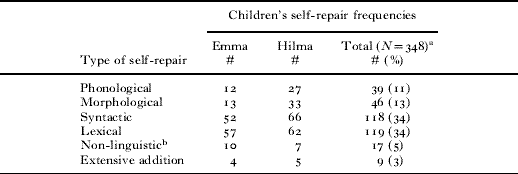
The problems the children addressed varied and there were 348 self-repairs of different types. Self-repairs fell into six groups: the children made phonological, morphological, syntactic, lexical and non-linguistic self-repairs, as well as extensive additions (see Table 4). The most common types of self-repair by the four-year-olds studied were syntactic (34% of all cases) and lexical (34%) revisions. These two groups comprised over two-thirds of all self-repairs the children made. The children self-repaired their phonology (11%) or morphology (13%) less often. Even less often the children made extensive additions (3%) and non-linguistic self-repairs (5%), although the nature of these cases was interesting in and of themselves. Syntactic, lexical and non-linguistic self-repairs were initiated in all possible repair initiation places: in the same turn, transition space, and in the third turn or position (see Appendix 2). In some cases the child self-repaired her utterance in more than one way at the same time: 10% of the self-repairs belong to several groups. The two girls made different types of self-repairs rather equally, with no statistical differences in the relative numbers between the girls (χ2 (5, N=348)=9·417, p=0·094). In the following, we present the types of self-repair with analyses of extracts from the data. It is noteworthy that in all other types of self-repair, except phonological, the utterances are often not erroneous as such but the children nevertheless revise them.
Types of self-repair by the two four-year-old children studied

a There were 15 morphosyntactic self-repairs that have been included both in the morphological and in the syntactic self-repairs. There were also 17 combined self-repairs of other types. Thus, within 316 instances of self-repair there were 32 such self-repairs in which the speech was revised in several ways at the same time (10%).
b Within non-linguistic self-repairs there were 5 prosodic self-repairs.
Phonological self-repairs
In phonological self-repairs (11% of all cases) children clarified their articulation, or corrected a phonemic error. Thus, they could all be considered as error corrections. Phonemic self-repairs were quick revisions in the same turn where the error occurred or in that turn's transition space (see Appendix 2). Together with lexical self-repairs (Laakso, Reference Laakso2006) phonological self-repair has been found to be the earliest form of self-repair (Clark, Reference Clark, Lamb and Brown1982). The speech of our four-year-olds is already phonologically well developed and they rather seldom clarify the phonology of their speech. However, Hilma still had some minor problems with phonology, in that she mixed the phonemes /l/ and /r/, and also replaced /d/ with /r/.Footnote 1 In example (1) Hilma plays a guessing game with her mother and provides her hints as to which card from among the several picture cards on the floor the mother should pick up (a picture of a striped cat). Hilma tries to use the adjective ‘striped’ (in Finnish raidallinen) as a hint but has problems with the phonemic realization of the word. She starts to produce the word beginning with /l/ but cuts off quickly and restarts the clause with a new approximation of the word (rairallinen, line 6).
(1) Hilma and her mother, recording A


The sequence in which the self-repair emerges consists of two hints given by Hilma. First, she mentions that the mother should look for a picture of a feline (line 1). The mother acknowledges Hilma's hint as a good one, but then requests a specification (lines 2–4) as there are pictures of two felines, a striped cat and a lion, on the floor. The mother's request projects a further description of the feline, e.g. an adjective. Hilma starts to produce the description but cuts off the descriptive word after the first syllable. After cut-off, Hilma recycles the beginning of the interrupted clause and now produces in full the adjective that differentiates the cat from the lion: ‘it is la- it is rairallinen {striped}’ (line 6). Theoretically it is possible that la- could be an indication of a lexical selection error and not a false start suggesting a phonological error. However, in this restricted context no other Finnish adjective beginning with la- could differentiate the two felines. For this reason, and because Hilma tends to replace /r/ with /l/, we think it is highly probable that she attempts to say raidallinen in the first instance but cuts off the word after noticing the phonemic error.Footnote 2 Furthermore, she also recycles the beginning of the clause, which indicates that she is revising the cut-off word. Thus, Hilma revises her pronunciation to resemble an appropriate adult-like production.
Morphological self-repairs
In morphological self-repairs (13% of all cases) the target of the self-repair was usually to substitute inflections, to change from singular to plural (or vice versa), or to change the tense of a verb, that is, the children targeted revising the structure of the language. Nine of 46 morphological self-repairs could be considered plain corrections of errors in inflectional morphology. Most often, in 22 instances of morphological self-repairs, the children revised forms that were grammatically correct and suitable in their context. In these self-repairs, they specified the content of the play or, by changing from singular to plural, included the other player in the decision-making concerning the details of the play (e.g. ku mä haluun- me halutaan arvuutella ‘as I want- we want to play a guessing game’). In fifteen of 46 cases the children repaired both morphology and syntax at the same time (morphosyntactic self-repairs; see example (3)). As with phonological self-repairs, morphological self-repairs were mostly initiated in the same turn as the problem source (see Appendix 2). It is noticeable, however, that although the inflectional morphology of Finnish is rich, four-year-olds already have a good command of morphology and therefore make relatively few morphological self-repairs. Morphological repairs are more common by English-speaking children of this age (Rogers, Reference Rogers1978).
In example (2), Hilma and Alli are playing in three nearby locations in the living room at Hilma's home where they have set up three play scenes: a lego house, a wooden doll-house and a chair. Alli plays with a male doll and a maid doll, Hilma with a female doll. At the moment the extract begins, Hilma is near the lego house and her female doll is near the chair. Alli is putting her dolls in a car by the wooden doll-house. In line 2, Alli suggests that her dolls (the maid doll and the male doll) would marry each other. Hilma disagrees by arguing that the male doll is already married to the female doll she is playing with. The girls enter into a dispute that remains unresolved. Nevertheless, they keep on playing together. In line 26, Hilma makes a morphological self-repair by cutting off and changing the tense of a verb. This is not a correction of an error; in this context other tenses would have been grammatically suitable as well.
(2) Hilma and Alli, recording C

In lines 19 and 22–24 Alli has put her dolls into the car and drives the car towards Hilma. In line 26, Hilma joins Alli's play and starts to describe what Alli's male doll is doing next: he would be driving home, as Alli at the same time drives the car towards Hilma. In this turn, Hilma self-initiates repair by cutting off a word (u-, line 26). Apparently Hilma is about to say the verb form unohtaa (‘forget’) either in the present or past tense. In her self-repair she changes the form into the past perfect oli unohtanu (‘had forgotten’). With the past perfect tense, she implies that in the past the male doll had forgotten that he had a wife but now, as he returns home, the wife is not necessarily forgotten and play can continue as Hilma wishes. The change in tense keeps up the possibility that Alli's male doll is married to Hilma's female doll although Alli still has not agreed to that. Thus the self-repair alters the utterance to better suit Hilma's concept of the game. Also, from the perspective that the issue of a wife had already been discussed previously (see lines 2–10), the change in tense makes sense.
Due to the basic structure of Finnish, with a rich inflectional morphology, morphological and syntactic self-repairs were often intertwined. For example, instead of prepositions Finnish makes use of inflectional case marking at the end of the words. When the structure of the clause is revised, the case endings often change, too. In the group of morphological repairs, there were 15 morphosyntactic repairs in which the speaker changed the syntactic construction to better suit her intentions and at the same time the case endings changed. Example (3) illustrates a morphosyntactic change. Here, Hilma and her mother are playing a guessing game with picture cards on the floor in front of them.
(3) Hilma and her mother, recording A

Here the child changes her wording and, thus at the same time, the whole emerging syntactic construction. As a result, inflectional morphology also changes from the nominative ‘who’ to the adessive ‘who-ADE has’ (line 1). The adessive case already implies an ‘owner’ of something (see glossing symbols in Appendix 1), which also requires, besides a change in the morphophonological make-up, a different syntactic structure than the original ‘who’. Here again, the child could have formulated her question in the way she started it; there is no grammatical error that would have required revision.
Syntactic self-repairs
Syntactic self-repairs were the most common type in the database (34% of all cases) together with lexical self-repairs. In syntactic self-repairs, the child revised the clause type, changed the word order of the clause or converted the utterance from negative to positive or vice versa. The last-mentioned forms include different kinds of changes of mind. Furthermore, syntactic additions were made in which, for example, the child added a subject or a conjunction to a clause. With syntactic deletions, the children, besides abandoning the emerging syntactic construction, also often abandoned the speech action they were about to perform with the construction. We have identified these cases as syntactic as they change the syntactic form of the whole utterance. Example (4) represents a syntactic revision that also changes the action that is performed with the utterance.
In example (4), Emma is playing with her friend Sofia by the doll-house. The girls are trying to agree with one another about who is going to play with which doll. Until that given moment, Emma has been playing with the children of the doll family, and Emma asks when they could swap dolls (line 1). They agree to swap immediately and that they will also change the names of the dolls (lines 2–5). After that Emma starts to make a proposal concerning the way in which they would swap the dolls. She, however, cuts off and self-repairs by altering the syntactic formulation of the proposal from the emerging clause ‘if I may choose’ into a clause with the verb ‘swap’ in the passive form that is often used in Finnish with the pronoun ‘we’ (see line 1), in order to include all the relevant participants in the action (lines 6–7). The clause that Emma cuts off is by no means erroneous. However, she replaces the verb with another one requiring a different syntactic structure.
(4) Emma and Sofia, recording C

Emma's self-repair revises her emerging statement into a more socially preferred formulation, that of a question, about the dolls she would like to have. The question also contains Emma's proposal of swapping the dolls but she presents it as one alternative possibility. The self-repaired formulation changes the tone of the suggestion from a direct declaration of one's own interest into an inquiry about the recipient's point of view towards Emma's proposal. The formulation is also a strategic one, reflecting the fact that she takes into account another's opinions. This also makes it easier for Sofia to accept Emma's proposal.
As we have seen, in cases of syntactic revision, the children sometimes abandoned their proposals concerning the planned course of the play activity. By self-repairing the syntactic form of the proposal, the children changed their proposals to be more appealing to the recipients. Thus, many of these self-repairs were socially motivated, as they were made in order to better persuade the recipient to align with the speaker's own play frame.
Lexical self-repairs
The other very common type of self-repair in the database was lexical self-repairs (34%), which were as common as the syntactic self-repairs. In lexical self-repairs, the child replaced or added a word in her utterance so that the syntactic structure of the utterance remained the same. By making lexical self-repairs the child typically specified the content of her utterance for the recipient by adding something to it, or clarified her idea of the content of the play by substituting something. Thus the target of these self-repairs was not necessarily errors in the speech or the linguistic structure as such, but the lexical revision could also be socially oriented to the recipient. In example (5), Emma is playing with her mother by the doll-house; Emma plays with the mother doll (and the girl doll) and her mother is playing with the father doll and modulates her voice to match the father character. Mother also uses a high-pitched voice when she is playing with the boy doll, her other role in the play.
(5) Emma and her mother, recording A

In line 10, Emma starts to answer in the role of the boy with mi- (the beginning of the word minä ‘I’ or its inflected form minulla ‘I-ADE’). However, as the boy is not her character in the play, she switches to the role of the mother and explains hänellä on kala (‘he-ADE has a fish’). The lexical change of a pronoun here is thus motivated by the arrangement of the play, that is, who plays with which doll character.
Non-linguistic self-repairs
In play, children share an activity context in which non-verbal actions and speech are inseparable. On many occasions, non-verbal actions and speech complemented or even substituted for each other. Thus, besides self-repairing their speech, children also made changes in the non-verbal actions (see example (6)), or the objects of their actions (for example, changed a toy to another one). Non-linguistic self-repairs (5% of all cases), although they were launched verbally (e.g. with the Finnish repair particle eiku), were in fact carried out non-linguistically using gestures (see example 6). In non-linguistic self-repairs, the lexical initiator indexed the forthcoming repair. The use of the lexical initiator projected the upcoming non-linguistic change and made changes in play easier to follow for the recipient. The actual self-repair was done by pointing, for example. In addition to gestures, prosodic changes in voice quality were also considered non-linguistic self-repairs (e.g. in role-play the child restarted a line to imitate the pitch of the voice of the doll character she was playing with). With prosodic changes the children clarified whether they were playing in a role, or disambiguated potential misunderstandings concerning several roles they were playing simultaneously. To maintain a shared understanding of the design of the play, it was important that the child expressed clearly if she had made some non-verbal arrangements concerning the play or the play characters. These self-repairs were thus designed to maintain the inter-subjective play frame between players and reflect the social nature of self-repair.
In example (6), Emma and her mother are furnishing the doll-house. They have reserved one room for the family hen. In line 1 Emma's mother has suggested that they place a ladder lying on the floor of the room so that the hen could lay eggs in the interstices of the ladder. Emma, however, rearranges the position of the ladder twice. She marks both changes verbally with the lexical repair initiator (with tai ‘or’ in line 5 and with eiku ‘no I mean’ in line 6).
(6) Emma and her mother, recording A

In lines 2–3 Emma lifts the ladder from the floor and puts it against the wall of the room; she also suggests that the ladder could be used for getting out of the room. The mother aligns to Emma's suggestion (line 4). However, in line 5 Emma self-initiates a non-linguistic self-repair with the repair particle tai (‘or’) and then moves the ladder outside the doll-house and leans it against the wall of the house. Thus, she self-initiates verbally but accomplishes the repair non-verbally by changing the place of the ladder. Again, in line 6, she self-initiates repair by lexical means: she uses the negating repair particle eiku (‘no I mean’) that projects a replacement to come (see Laakso & Sorjonen, Reference Laakso and Sorjonen2003). The repair is again completed non-verbally: Emma moves the ladder back inside the room. This extract shows how verbal markers of repair can be used to mark corrective changes in non-verbal actions in the play context.
Extensive additions
Sometimes the children made self-repairs where they added more material to their utterance; 3% of their self-repairs were counted among such extensive additions (cf. Evans, Reference Evans1985). In making these additions, the children temporarily exited from playing the actual roles of the play characters, and parenthetically added background details or made proposals connected to the design of the play (see example (7)). The children were motivated to sustain the inter-subjectivity and like-mindedness of the design of the play. With the help of adding background details or with utterances clarifying the play design, the children were able to prevent potential communication breakdowns. Extensive additions were always initiated with a cut-off within the same turn (see Appendix 2). In example (7), Emma and her mother are playing with the doll-house. Emma's mother is playing with the boy doll they have previously named Tuomas, which has unexpectedly acquired a cat from a vendor at the market place. Emma has probably forgotten the name of the boy doll and calls him Roni. Emma cuts off the turn where she is using the new name (line 9) and adds a proposal to rename the boy. Besides the boy doll, Emma's mother plays the role of the vendor from the market place, and Emma plays the role of the doll family's mother.
(7) Emma and her mother, recording A

Example (7) shows how self-initiated self-repairs can be used to add parenthetical elements, such as a sequence of negotiation, within an ongoing role-play. Also, here self-repair is socially motivated to ensure the inter-subjective understanding of the names of the play figures on an occasion where the name has been changed by Emma without prior discussion with the mother. Emma, however, takes into account the potential breakdown and inserts a negotiation of the name of the doll amidst the ongoing play.
CONCLUSIONS AND DISCUSSION
The two four-year-old girls we studied were making effective use of their linguistic and interactive skills in making self-repairs to their speech. As we have seen, self-repairs were closely connected to the ongoing play activities. Furthermore, self-repairs focused on revising lexical choices or whole utterances (and the actions made with those utterances) to better fit the context and the current recipient. Except for phonological self-repairs, many of the self-repairs were not targeted at repairing errors or slips in speech. In this way, they resembled the appropriateness repairs described by Levelt (Reference Levelt1989: 459) and seemed to be socially motivated in formulating the speech for the current recipient. With the help of self-repairs, children prevented possible communication breakdowns, as has been stated in previous studies (e.g. Clark, Reference Clark, Lamb and Brown1982; McTear, Reference McTear1985: 193). However, besides monitoring breakdowns, the children took careful notice of the emerging construction of interaction: they also considered the point of view of their play partners as they designed the play in the direction towards which they themselves wanted it to go. The consideration of the partner's view and the negotiation of the direction of play were often reflected as self-repairs of speech. The conversation analytic perspective adopted in our study revealed that, for four-year-old children, self-repair is already a social resource in the same way it is for adults (see Jefferson, Reference Jefferson1974), and children can skillfully use self-repair of speech to modify their utterances and manage interactions with others. Thus, besides linguistic skills, self-repairs reveal children's developing interactive skills and reflect their emerging social cognition.
As a whole, our findings suggest that four-year-old children are more developed in making self-repairs in their speech than had previously been estimated. For example, previous studies have proposed that four-year-olds self-repair mostly grammatical aspects of their speech (Rogers, Reference Rogers1978). Furthermore, four-year-olds have been observed to self-repair mainly single words, leaving complex grammatical constructions larger than one word unrepaired (McTear, Reference McTear1985: 190–99). Our findings, however, do not support this. In our data, self-repairs were skillfully made and even targeted large and complex revisions of the ongoing speech (syntactic self-repairs and extensive additions in particular). Our results show that four-year-olds were able to monitor their speech simultaneously on several levels: they made all kinds of self-repairs and were able to self-repair their pronunciation and the subtle morphological structures (phonological and morphological self-repairs) as well as the content and formulation of their utterances (lexical and syntactic self-repairs), and even took their co-participants into account by clarifying their non-verbal play actions (non-linguistic self-repairs) and the design of the play (syntactic self-repairs and extensive additions). On the basis of our findings, we suggest that four-year-olds are no longer just self-repairing the linguistic structures they are acquiring (cf. Clark, Reference Clark, Lamb and Brown1982; McTear, Reference McTear1985: 188–89; Rogers, Reference Rogers1978), but rather self-repairs of four-year-olds also seem to reflect, to a greater degree than previously realized, the social structures they are acquiring. By means of self-repair, children are making changes in their speech activities and are formulating their speech for the current recipient, often in order to maintain the inter-subjective understanding between interlocutors. One social skill they seem to be acquiring is the recipient-oriented turn design.
Most often, the children studied made lexical and syntactical self-repairs which cover more than two-thirds of the 348 cases analyzed. It has been previously noted that lexical self-repairs are the most common type of self-repair by English-speaking four-year-olds (Clark, Reference Clark, Lamb and Brown1982; McTear, Reference McTear1985). To some extent, our findings seem to be in accordance with this. However, syntactic self-repairs were much more common in our data than in the previous studies. Phonological self-repairs accounted for approximately 10% of all self-repairs and were the fourth most common type of self-repair. However, they were not as infrequent as has been found for English-speaking four-year-olds (McTear, Reference McTear1985: 189). In particular, distribution of the type of self-repair is not in accordance with the findings of English-speaking children, suggesting that morphological repairs are the most common form of self-repair by the age of five (cf. Rogers, Reference Rogers1978). In our collection of self-repairs by the two girls (who were almost five years old), only 13% of self-repairs were morphological. This is somewhat surprising, because Finnish is a morphologically rich language and it could have been presumed that Finnish children make many morphological self-repairs. It may be that Finnish children become aware of morphology and acquire morphological structures earlier due to their prominence in the Finnish language. The main difference with regard to the previous research is, however, that in our data self-repairs of speech were not only focusing on linguistic errors, but to a large extent aimed at managing social and interactive ends.
Conversation analysis offered a useful and data-oriented method for our study. In particular, it provided us with a way to examine the features that children themselves handled as problematic in their interactions. It also showed what the children were doing with their self-repairs. The biggest benefit in using conversation analysis was that it allowed us to consider the different verbal and non-verbal actions of the children while they were playing. As a result, we found cases, such as non-linguistic self-repairs, that had not been observed in previous studies. Using conversation analysis we were able to observe how the children skillfully monitored, besides the features of speech, the emerging interaction and complex features of their play.
However, our study is limited in its scope and we need much more research on self-repair of speech by children using a larger database. To be able to make comparisons between studies, it would be important that the researchers show the phenomena with actual examples from their data. This would also clarify what different researchers mean by self-repair of speech. We studied girls and our study is only indicative with regard to self-repairs of speech by girls. As boys and girls are known to develop at a different pace (and perhaps in different ways) with regard to their language, it would be crucial to study boys, too. Boys and girls also differ in the type of play in which they engage. It would be very interesting to find out whether boys are as socially oriented in making self-repairs as girls.
The study of self-initiated self-repairs offers information about the intuitive awareness of language and about the skills to use and revise language within interactive events. The study of self-repair might provide an index of these skills by young, typically developing children (cf. van Lier, Reference van Lier1998) and also by children with language delays and disorders (cf. McTear & Conti-Ramsden, Reference McTear and Conti-Ramsden1992; Salmenlinna, Reference Salmenlinna2005). Assessment of these skills might prove very difficult using the traditional language assessment tests. By analyzing the amount and positions of self-initiation of repair it could be possible to ascertain how language-delayed children monitor their own speech and how close to the problem source they are able to initiate repair. Furthermore, a closer analysis of the types of self-repair might show us how these children develop in their social–interactive and pragmatic language skills (e.g. what kind of things they self-repair and how complex and large the revisions are that they are able to perform). As already suggested for adult speakers with aphasia (Laakso, Pelkonen & Renvall, Reference Laakso, Pelkonen, Renvall and Lehtihalmes2003), the amount and nature of self-repair would serve as an index of linguistic progress and even as one index of the effectiveness of a therapeutic intervention. Increasing knowledge regarding self-repairs of speech by typically developing children of different ages would certainly be useful in advancing the therapeutic interventions designed to rehabilitate the skills of linguistic awareness and the monitoring of speech. The therapy of language-delayed children could often take the form of imaginary play as this appears to be a creative and linguistically inspiring environment where the children spontaneously revise their speech to make their actions more understandable to their co-players.
APPENDIX 1. TRANSCRIPTION SYMBOLS AND GLOSSING
The notation used is basically the same as the one used in conversation analytic literature (see, for example, Atkinson & Heritage, Reference Atkinson and Heritage1984: ix–xvi). The notation of non-verbal actions is added (cf. Laakso, Reference Laakso1997: 12–14; Savolainen, Reference Savolainen2005).
Overlap and pauses
- (0·5)
A pause and its duration in tenths of a second
- (.)
A micropause (less than 0·2 seconds)
- =
Latching, i.e., no interval between the end of a prior and the start of a following piece of talk
- [
Beginning of overlap
- ]
End of overlap
Intonation contour
- .
A falling intonation
- ,
A continuing (level) intonation
- ?
A rising intonation
Prosodic shifts, emphasis and pace of speech
- ei
The underlined item is uttered with emphatic stress
- ↑
The word following the arrow is uttered with a higher pitch than the surrounding talk
- ↓
The word following the arrow is uttered with a lower pitch than the surrounding talk
- ° ei °
A silently pronounced word or utterance
- EI
A word or utterance pronounced louder than the surrounding talk
- >ei<
Talk inside arrow heads is said at a pace faster than the surrounding talk
- ei<
A word ends abruptly
Duration
- la-
A cut-off word (a hyphen indicates self-interruption of the word)
- la:
A stretch (a colon indicates lengthening of a sound)
Other
- @ei@
Altered voice quality (e.g. indicating a role in play)
- £ei£
Smiling voice
- #ei#
Creaky voice
- .joo
A word pronounced with inbreath
- .hh
Inbreath (each h indicating one tenth of a second)
- hh
Outbreath
- (koira)
Single parentheses indicate transcribers doubt
- (-)
An unclearly heard word or utterance
Gestures and other non-verbal actions
- ((points at a doll))
Non-verbal actions are described in small capital letters within double parentheses on a separate line below the utterance they occur with, or on a line of their own if there is no simultaneous talk.
- ((uses high pitch))
The researcher's comments are also within double parentheses.
Principles and abbreviations used in glossing (Modified from Sorjonen, Reference Sorjonen2001).
In the gloss, a minus sign (−) separates the morphemes from the root word. The following have been treated as unmarked forms, not indicated in the glosses:
-nominative case
-singular
-3rd person singular
-active voice
-present tense
-2nd person singular imperative
The different infinitives and participial verb forms have not been specified.
The abbreviations used in the glosses refer to the following endings:
- 1
1st person
- 2
2nd person
- 3
3rd person
- 4
passive
The case endings are referred to by the following abbreviations:

Other abbreviations:
- CLI
clitic
- PRON
pronoun
- PST
past tense
- QCLI
interrogative clitic
- PPC
past participle
- PRT
particle
- Q
interrogative
In the transcribed data extracts, the talk of each person is depicted in three lines to be read as follows: the first line is the original Finnish speech, the second is the English word-by-word gloss, and the third is the free translation into English. Outside the analytic focus and if the grammar of the original Finnish and the free English translation do not differ significantly, only two lines were used, that is, the gloss line was omitted.
APPENDIX 2. THE TYPES OF SELF-REPAIR AND THE SEQUENTIAL PLACEMENT OF SELF-INITIATION
Placement of initiation